×
Request Free Sample ×

Kindly complete the form below to receive a free sample of this Report

* Please use a valid business email

Leading companies partner with us for data-driven Insights

clients tt-cursor
Hero Background
English
Chinese
French
Japanese
Korean
German
Spanish

Talent Management Software Market Size

ID: MRFR/ICT/2641-CR
110 Pages
Ankit Gupta
October 2022

Talent Management Software Market Research Report Information By Component (Solutions, Services), Deployment (On Premise, Cloud), Organization Size (SMEs and Large Enterprises) and Vertical – Global Forecast 2034

Share:
Download PDF ×

We do not share your information with anyone. However, we may send you emails based on your report interest from time to time. You may contact us at any time to opt-out.

Talent Management Software Market Infographic
×
Talent Management Software Market Infographic Full View
Purchase Options

Talent Management Software Size

Talent Management Software Market Growth Projections and Opportunities

The market for software that deals with managing talents within a company is affected by many different factors that collectively shape the growth and direction of this market. Another thing which is very important is the talent management, organisations should be aware of its importance in a broader way. In order to reach the desired endpoint, in a world where businesses compete (66), employee talent needs to be acquired and conserved. The need for talent management software systems arises due to the awareness amongst organiziations to have inclusive systems that facilitate learning, performance and employee perks.

There has been observed a notable shift towards remote and flexible arrangements, as work nature evolves to its peak against the market factors. When companies shift towards remote work, the necessity of advanced talent management software becomes important to manage & assess employee's performance and for virtual interaction between teams. The market has to fasten the digital and dispersed workforce for organizations to have their talent managed irrespective of where they are. Moreover, hiring and compliance are the two major influences by talent management in the software landscape. Due to an increase in the strictness of data protection standards internationally, companies have to keep privacy concerns and safety of the system in mind and hence choose software systems.

The companies who are providing service for talent management through software are ensuring that their data protection measures comply with regional. So, they can reduce the risk of information leakage. Another important factor causing discrepancy and deserving mention is the shortage of talented resources. The industry faces a continuous gap between the skills in workers and the competition needed by businesses. Talent Management software can address this issue in a modern way by enabling better recruitment, identifying the gaps of their employee's skills, and giving resources for betterment. With an increase in the competition, there is a need for software solutions in order to identify and utilize high-potential employees. One critical factor in the market which leads talent acquisition software is vendor competition.

There are many sellers are in the market, some of them have excess reputation and some are new. They introduce various features and functionalities just to capture the market share. Competitions make sure that companies keep coming up with innovative ideas.

Talent Management Software Market Size Graph
Author
Ankit Gupta
Senior Research Analyst

Ankit Gupta is an analyst in market research industry in ICT and SEMI industry. With post-graduation in "Telecom and Marketing Management" and graduation in "Electronics and Telecommunication" vertical he is well versed with recent development in ICT industry as a whole. Having worked on more than 150+ reports including consultation for fortune 500 companies such as Microsoft and Rio Tinto in identifying solutions with respect to business problems his opinions are inclined towards mixture of technical and managerial aspects.

Leave a Comment

FAQs

How much is the talent management software market?

The global market size of talent management software was valued at USD 7.85 Billion in 2024.

What is the global growth rate of the talent management software market?

The global market is predicted to grow at a CAGR of 16.26% during the forecast period, 2025 -2034.

Which region held the major market share in the talent management software market?

North America had the major share of the global market

Who are the leading market players in the talent management software market?

The key players in the market are Lumesse Ltd. (U.K.), SAP SE, Cornerstone OnDemand (U.S.), and Saba Software (U.S.).

Which component led the talent management software market?

The solution category dominated the market in 2024.

Which deployment had the largest market share in the talent management software market?

The cloud-based software had the largest share of the global market.

Market Summary

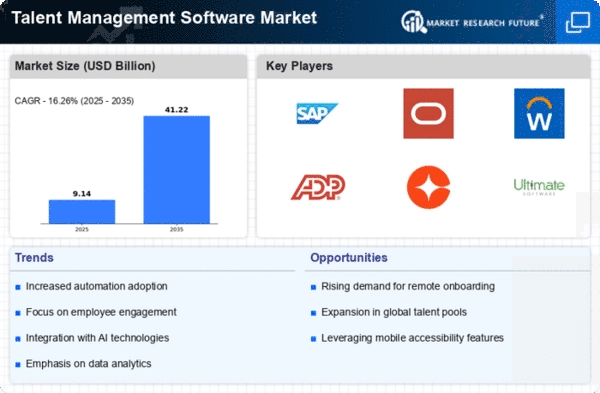
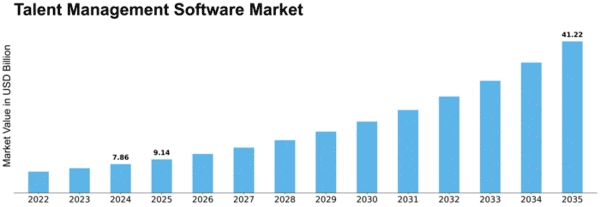
As per MRFR analysis, the Talent Management Software Market Size was estimated at 7.86 USD Billion in 2024. The Talent Management Software industry is projected to grow from 9.14 USD Billion in 2025 to 41.22 USD Billion by 2035, exhibiting a compound annual growth rate (CAGR) of 16.26 during the forecast period 2025 - 2035.

Key Market Trends & Highlights

The Talent Management Software Market is experiencing a transformative shift towards enhanced employee engagement and advanced technological integration.

  • The market demonstrates an increased focus on employee experience, particularly in North America, which remains the largest market. Integration of advanced technologies, such as artificial intelligence, is becoming a pivotal trend across the Asia-Pacific region, the fastest-growing market. The recruitment segment continues to dominate, while the learning and development segment is rapidly gaining traction due to evolving workforce needs. Key market drivers include the growing demand for employee development and an emphasis on data-driven decision making, influencing both cloud-based and hybrid solutions.

Market Size & Forecast

2024 Market Size 7.86 (USD Billion)
2035 Market Size 41.22 (USD Billion)
CAGR (2025 - 2035) 16.26%
Largest Regional Market Share in 2024 North America

Major Players

<p><a href="https://www.sap.com/">SAP</a> (DE), Oracle (US), Workday (US), ADP (US), Cornerstone OnDemand (US), <a href="https://www.ukg.com/">Ultimate Software </a>(US), Ceridian (CA), Saba Software (US), Talentsoft (FR)</p>

Market Trends

The Talent Management Software Market is currently experiencing a transformative phase, driven by the increasing need for organizations to enhance employee engagement and optimize workforce performance. Companies are increasingly recognizing the value of integrating technology into their human resource processes, which facilitates better talent acquisition, development, and retention strategies. This shift is largely influenced by the growing emphasis on data-driven decision-making, enabling organizations to leverage analytics for improved insights into employee performance and potential. As a result, the market is witnessing a surge in demand for innovative solutions that streamline various HR functions, from recruitment to performance management. Moreover, the Talent Management Software Market is characterized by a diverse range of offerings, catering to organizations of varying sizes and industries. The rise of remote work and the need for flexible solutions have prompted software providers to develop platforms that support virtual collaboration and learning. This adaptability is crucial in a landscape where workforce dynamics are continually evolving. Furthermore, the integration of artificial intelligence and machine learning into talent management solutions is anticipated to enhance personalization and efficiency, allowing organizations to tailor their approaches to individual employee needs. Overall, the Talent Management Software Market appears poised for sustained growth as businesses seek to navigate the complexities of modern workforce management.

Increased Focus on Employee Experience

Organizations are placing greater emphasis on enhancing the employee experience, recognizing its impact on retention and productivity. Talent management software is evolving to include features that promote engagement, feedback, and career development, thereby fostering a more positive workplace culture.

Integration of Advanced Technologies

The incorporation of artificial intelligence and machine learning into talent management solutions is becoming more prevalent. These technologies enable organizations to automate processes, analyze data more effectively, and provide personalized experiences for employees, which may lead to improved outcomes.

Shift Towards Remote and Hybrid Work Solutions

As remote and hybrid work models gain traction, talent management software is adapting to support these new ways of working. Solutions that facilitate virtual collaboration, performance tracking, and employee development are increasingly in demand, reflecting the changing nature of the workforce.

Talent Management Software Market Market Drivers

Market Growth Projections

The Global Talent Management Software Market Industry is poised for substantial growth, with projections indicating a market size of 7.24 USD Billion in 2024 and an anticipated increase to 41.2 USD Billion by 2035. This growth trajectory suggests a compound annual growth rate of 17.13% from 2025 to 2035. The increasing adoption of technology in human resource management, coupled with the need for effective talent acquisition and retention strategies, drives this expansion. As organizations recognize the value of investing in talent management solutions, the market is likely to witness significant advancements and innovations in the coming years.

Regulatory Compliance and Data Security

As organizations navigate complex regulatory environments, the importance of compliance and data security in the Global Talent Management Software Market Industry cannot be overstated. Companies are increasingly required to adhere to various labor laws and data protection regulations, necessitating robust talent management solutions that ensure compliance. Software that integrates compliance features helps organizations mitigate risks associated with non-compliance. The focus on data security is paramount, especially with the rise of cyber threats. As businesses prioritize safeguarding sensitive employee information, the demand for secure and compliant talent management software is likely to grow, shaping the future of the Global Talent Management Software Market Industry.

Increased Demand for Remote Work Solutions

The Global Talent Management Software Market Industry experiences heightened demand for solutions that facilitate remote work. As organizations adapt to flexible work arrangements, talent management software becomes essential for managing employee performance, engagement, and development remotely. This shift is reflected in the projected market growth, with the industry expected to reach 7.24 USD Billion in 2024. Companies are increasingly investing in these technologies to ensure seamless collaboration and communication among remote teams, thus enhancing productivity and employee satisfaction. The emphasis on remote work capabilities is likely to drive innovation and expansion within the Global Talent Management Software Market Industry.

Focus on Employee Development and Retention

In the Global Talent Management Software Market Industry, there is a growing emphasis on employee development and retention strategies. Organizations recognize that investing in their workforce leads to improved performance and reduced turnover rates. Talent management software provides tools for personalized learning and career development, enabling companies to nurture their talent effectively. This trend is underscored by the anticipated growth of the market, which is projected to expand to 41.2 USD Billion by 2035. As businesses strive to create a culture of continuous learning, the demand for robust talent management solutions is likely to increase, further propelling the Global Talent Management Software Market Industry.

Globalization and Diverse Workforce Management

Globalization has led to increasingly diverse workforces, presenting both challenges and opportunities for organizations. The Global Talent Management Software Market Industry is responding to this trend by offering solutions that cater to the needs of a multicultural workforce. Talent management software enables companies to manage global talent pools, ensuring compliance with local regulations and cultural nuances. This adaptability is crucial as businesses expand their operations internationally. The growing need for effective workforce management across borders is likely to drive the demand for specialized talent management solutions, further influencing the trajectory of the Global Talent Management Software Market Industry.

Integration of Artificial Intelligence and Automation

The integration of artificial intelligence and automation technologies is transforming the Global Talent Management Software Market Industry. AI-driven analytics enable organizations to make data-informed decisions regarding talent acquisition, performance management, and employee engagement. Automation streamlines administrative tasks, allowing HR professionals to focus on strategic initiatives. This technological advancement is expected to contribute to a compound annual growth rate of 17.13% from 2025 to 2035. As companies seek to enhance efficiency and effectiveness in their talent management processes, the adoption of AI and automation tools is likely to surge, shaping the future landscape of the Global Talent Management Software Market Industry.

Market Segment Insights

By Application: Recruitment (Largest) vs. Learning and Development (Fastest-Growing)

<p>The Talent Management Software Market is primarily segmented into Recruitment, Performance Management, Learning and Development, Succession Planning, and Compensation Management. Among these, Recruitment holds the largest market share, being a critical focus for organizations aiming to enhance their hiring processes efficiently. Performance Management and Compensation Management also contribute significantly, while Learning and Development is rapidly gaining traction as businesses prioritize employee growth and skill enhancement to remain competitive in a dynamic market.</p>

<p>Learning and Development: Recruitment (Dominant) vs. Succession Planning (Emerging)</p>

<p>Recruitment has emerged as a dominant force within the Talent Management Software Market, driven by the increasing need for companies to attract top talent through innovative software solutions. However, Learning and Development is quickly becoming an emerging trend as organizations recognize the importance of continuous employee development. As<a href="https://www.marketresearchfuture.com/reports/remote-work-security-market-28070"> remote work </a>becomes more prevalent, the demand for Learning Management Systems has surged, facilitating online training and upskilling opportunities. Succession Planning, while still developing, is gaining importance as organizations focus on leadership continuity and talent pipelines to secure future growth. Both segments reflect a strategic shift towards building a more skilled and adaptable workforce.</p>

By Deployment Type: Cloud-Based (Largest) vs. Hybrid (Fastest-Growing)

<p>In the Talent Management Software Market, the deployment type segment displays a clear market share distribution, with Cloud-Based solutions leading as the dominant player. These offerings have gained significant traction due to their scalability, ease of access, and cost-effectiveness. On-Premises solutions, while still relevant, are experiencing a decline as organizations shift towards more flexible and remote-friendly options. Hybrid solutions are carving out a niche, appealing to organizations that require a blend of both deployment types.</p>

<p>Cloud-Based (Dominant) vs. Hybrid (Emerging)</p>

<p>Cloud-Based Talent Management Software has firmly established itself as the dominant deployment type, favored for its accessibility and efficiency. These solutions allow users to access software from anywhere, making it ideal for today’s increasingly mobile workforce. Conversely, Hybrid models are emerging as a compelling choice for organizations that need the flexibility of both local and cloud-based capabilities. They enable companies to start with cloud services while retaining control over sensitive data through on-premises solutions. This adaptability makes Hybrid solutions a rising star, attracting organizations that desire customized approaches to their talent management needs.</p>

By End User: Large Enterprises (Largest) vs. Medium Enterprises (Fastest-Growing)

<p>In the Talent Management Software Market, Large Enterprises represent the largest segment, benefiting from substantial resources and a continuous demand for sophisticated talent management solutions. These organizations prioritize advanced functionalities and comprehensive integration with existing systems, allowing them to manage vast employee pools effectively. In contrast, Medium Enterprises are rapidly gaining market share as they increasingly adopt cloud-based solutions that offer scalability and flexibility, leading them to become the fastest-growing segment in this competitive landscape. Growth trends in the Talent Management Software Market indicate a significant shift towards user-friendly and scalable solutions, primarily driven by the <a href="https://www.marketresearchfuture.com/reports/digital-transformation-market-8685">digital transformation</a> initiatives undertaken by Medium Enterprises. These companies seek to enhance employee engagement and streamline recruitment processes, thereby embedding talent management into their strategic goals. The rise of remote work and the necessity for continuous learning have propelled these businesses to invest in effective talent management software, solidifying their position as a vital market segment.</p>

<p>Large Enterprises (Dominant) vs. Medium Enterprises (Emerging)</p>

<p>Large Enterprises often dominate the Talent Management Software Market by leveraging their financial strength and extensive human resources. They have the capabilities to invest in comprehensive solutions that encompass various facets of talent management, including recruitment, performance management, and succession planning. This segment typically demands high levels of customization to cater to their complex organizational structures and compliance requirements. In contrast, Medium Enterprises represent an emerging segment that is quickly adapting to changing market demands. They are increasingly favoring cloud-based talent management solutions that offer flexibility and affordability, allowing them to implement sophisticated systems that were previously only accessible to larger companies. This evolving dynamic highlights a critical shift in the market as Medium Enterprises strive to optimize their talent management processes.</p>

By Functionality: Talent Acquisition (Largest) vs. Employee Engagement (Fastest-Growing)

<p>In the Talent Management Software Market, the 'By Functionality' segment showcases a diverse range of solutions aimed at optimizing workforce management. 'Talent Acquisition' commands the largest market share, reflecting its critical role in attracting and onboarding the right talent. Meanwhile, 'Employee Engagement' has emerged as the fastest-growing segment, reflecting an increasing focus on retaining top talent through enhanced organizational culture and employee satisfaction initiatives. As businesses recognize the impact of engaged employees on productivity and turnover, this area is witnessing significant investment and innovation. The growth trends for this segment are largely driven by the evolving needs of organizations to not only recruit effectively but also to foster employee involvement and satisfaction. 'Workforce Planning' plays a crucial role in aligning talent capabilities with organizational goals, but it is 'Learning Management' that is gaining traction as companies prioritize continuous learning and development. The overall market dynamics indicate a shift towards integrated solutions that address both acquisition and engagement, enhancing overall business performance.</p>

<p>Talent Acquisition (Dominant) vs. Learning Management (Emerging)</p>

<p>The 'Talent Acquisition' functionality is characterized by its comprehensive features aimed at streamlining the recruiting process, enhancing candidate experience, and ensuring a strategic alignment with company goals. This dominant segment focuses on optimizing every stage of hiring, from sourcing candidates to onboarding new hires, and is often viewed as the backbone of talent management. In contrast, 'Learning Management' has emerged as an essential segment in today’s corporate landscape, driven by the need for continuous employee development and skill enhancement. As organizations recognize the importance of upskilling their workforce to meet ever-changing market demands, the learning management segment is seeing increased investments in platforms that offer flexible, scalable, and user-friendly training solutions. Together, these segments showcase a holistic approach to managing talent in a competitive environment.</p>

By Industry: Healthcare (Largest) vs. Information Technology (Fastest-Growing)

<p>The talent management software market is characterized by a diverse range of industry applications, with healthcare leading in market share due to a growing need for compliance, training, and workforce management. Information Technology follows closely as the fastest-growing sector, driven by rapid advancements in technology and a high demand for specialized skills in the labor market. Manufacturing holds a significant portion of the market as well, focused on optimizing talent utilization to boost productivity, while retail continues to adapt its talent strategies in response to changing consumer preferences and e-commerce trends.</p>

<p>Healthcare: Care Management (Dominant) vs. Information Technology: Cloud Solutions (Emerging)</p>

<p>Healthcare talent management software, particularly in care management, dominates the industry with its robust capabilities that cater to hiring, training, and maintaining a skilled workforce in medical settings. This segment emphasizes compliance and regulatory needs, ensuring that healthcare providers have qualified personnel to meet stringent industry standards. On the other hand, the Information Technology sector is experiencing an emerging trend towards cloud-based solutions, which facilitate better scalability and integration for companies. This shift allows IT organizations to adapt quickly to market changes and enhance collaboration among teams, thus positioning themselves effectively in a competitive environment.</p>

Get more detailed insights about Talent Management Software Market Research Report- Forecast to 2035

Regional Insights

North America : Market Leader in Talent Management

North America continues to lead the Talent Management Software market, holding a significant share of 4.5 in 2024. The region's growth is driven by increasing demand for advanced HR solutions, regulatory support for workforce management, and a focus on employee engagement. Companies are investing heavily in technology to streamline operations and enhance productivity, making it a hotbed for innovation in talent management. The competitive landscape is robust, with key players like SAP, Oracle, and Workday dominating the market. The U.S. is the largest contributor, supported by a strong economy and a tech-savvy workforce. Canadian firms like Ceridian also play a crucial role, ensuring a diverse offering of solutions. The presence of these major players fosters a competitive environment, pushing for continuous improvement and innovation in talent management solutions.

Europe : Emerging Market with Growth Potential

Europe's Talent Management Software market is valued at 2.0, reflecting a growing interest in optimizing workforce management. The region is witnessing a shift towards digital transformation, driven by regulatory frameworks that encourage the adoption of advanced HR technologies. Companies are increasingly focusing on employee development and retention strategies, which are crucial for maintaining a competitive edge in the market. Leading countries such as Germany, France, and the UK are at the forefront of this growth, with a strong presence of key players like SAP and Talentsoft. The competitive landscape is characterized by a mix of established firms and innovative startups, all vying for market share. The European market is expected to continue expanding as organizations recognize the importance of effective talent management in achieving business objectives.

Asia-Pacific : Rapidly Growing Talent Management Sector

The Asia-Pacific region, with a market size of 1.8, is experiencing rapid growth in Talent Management Software adoption. This surge is driven by increasing investments in technology and a growing awareness of the importance of human capital management. Countries in this region are focusing on enhancing employee engagement and performance, supported by favorable government policies promoting digitalization in HR practices. Key players like Oracle and Workday are expanding their footprint in countries such as China, India, and Australia. The competitive landscape is becoming increasingly dynamic, with local startups emerging alongside established firms. As organizations in Asia-Pacific recognize the value of effective talent management, the market is poised for significant growth in the coming years.

Middle East and Africa : Emerging Market with Untapped Potential

The Middle East and Africa region, valued at 0.56, presents untapped potential in the Talent Management Software market. The growth is driven by increasing investments in workforce development and a shift towards digital solutions in HR management. Governments are implementing policies to enhance workforce skills, which is catalyzing the demand for effective talent management solutions across various sectors. Countries like South Africa and the UAE are leading the charge, with a growing number of organizations recognizing the importance of talent management. The competitive landscape is still developing, with both The Talent Management Software share. As the region continues to evolve, the demand for innovative talent management solutions is expected to rise significantly.

Key Players and Competitive Insights

The Talent Management Software Market is currently characterized by a dynamic competitive landscape, driven by the increasing demand for efficient workforce management solutions and the integration of advanced technologies. Major players such as SAP (DE), Oracle (US), and Workday (US) are strategically positioned to leverage innovation and digital transformation to enhance their offerings. SAP (DE) focuses on integrating AI capabilities into its software, thereby improving user experience and operational efficiency. Oracle (US) emphasizes cloud-based solutions, which allow for greater scalability and flexibility, while Workday (US) is known for its user-friendly interface and strong analytics capabilities, which collectively shape a competitive environment that prioritizes technological advancement and customer-centric solutions.

The market structure appears moderately fragmented, with a mix of established players and emerging startups. Key business tactics include localizing services to meet regional demands and optimizing supply chains to enhance service delivery. The collective influence of these major players fosters a competitive atmosphere where innovation and customer engagement are paramount, as companies strive to differentiate themselves in a crowded marketplace.

In November 2025, SAP (DE) announced the launch of its new AI-driven talent management module, which aims to streamline recruitment processes and enhance employee engagement. This strategic move is significant as it positions SAP (DE) at the forefront of technological innovation, potentially attracting clients seeking cutting-edge solutions to improve their HR functions. Furthermore, the integration of AI is likely to enhance decision-making processes, thereby increasing operational efficiency.

In October 2025, Oracle (US) expanded its cloud-based talent management suite by acquiring a leading analytics firm. This acquisition is pivotal as it not only strengthens Oracle's data analytics capabilities but also enhances its competitive edge in providing comprehensive talent management solutions. By integrating advanced analytics into its offerings, Oracle (US) is likely to offer more personalized and data-driven insights to its clients, thereby improving user satisfaction and retention.

In September 2025, Workday (US) launched a new partnership with a prominent AI research institution to develop predictive analytics tools for workforce planning. This collaboration is crucial as it underscores Workday's commitment to innovation and positions the company to offer advanced solutions that anticipate workforce needs. By harnessing predictive analytics, Workday (US) may significantly enhance its value proposition, enabling organizations to make informed decisions regarding talent acquisition and management.

As of December 2025, current trends in the Talent Management Software Market indicate a strong focus on digitalization, sustainability, and AI integration. Strategic alliances are increasingly shaping the competitive landscape, allowing companies to pool resources and expertise to deliver superior solutions. The shift from price-based competition to a focus on innovation, technology, and supply chain reliability is evident, suggesting that future competitive differentiation will hinge on the ability to adapt to evolving market demands and technological advancements.

Key Companies in the Talent Management Software Market include

Industry Developments

  • Q2 2024: Workday Announces New AI-Powered Talent Optimization Capabilities Workday launched new AI-driven features in its talent management suite, including skills intelligence and personalized career recommendations, aimed at helping organizations better match employees to internal opportunities and close skills gaps.
  • Q2 2024: Cornerstone OnDemand Acquires Talespin to Expand Immersive Learning in Talent Management Cornerstone OnDemand announced the acquisition of Talespin, a provider of VR-based learning solutions, to enhance its talent management platform with immersive training and upskilling capabilities.
  • Q2 2024: SAP Appoints New Head of SuccessFactors to Drive Cloud Talent Management Growth SAP named a new global head for its SuccessFactors division, signaling a renewed focus on cloud-based talent management solutions and AI integration.
  • Q3 2024: Beamery Raises $50 Million Series D to Expand AI Talent Lifecycle Platform Beamery, a talent management software provider, secured $50 million in Series D funding to accelerate development of its AI-powered talent lifecycle management platform and expand into new markets.
  • Q3 2024: Oracle Launches Next-Gen Oracle Fusion Cloud Talent Management Oracle introduced a major update to its Fusion Cloud Talent Management suite, featuring advanced analytics and generative AI tools for workforce planning and employee engagement.
  • Q3 2024: UK Government Awards Talent Management Software Market Contract to SAP The UK government selected SAP SuccessFactors for a multi-year contract to modernize talent management and HR processes across several public sector agencies.
  • Q4 2024: LinkedIn Unveils New AI-Powered Talent Insights Platform LinkedIn launched a new AI-driven talent insights platform designed to help enterprises identify workforce trends, skills gaps, and optimize talent acquisition strategies.
  • Q4 2024: UKG Announces Partnership with Google Cloud to Enhance Talent Management Offerings UKG (Ultimate Kronos Group) entered a strategic partnership with Google Cloud to integrate advanced AI and machine learning capabilities into its talent management software.
  • Q1 2025: iCIMS Acquires Altru Labs to Bolster Employee Engagement Solutions iCIMS, a leading talent management software provider, acquired Altru Labs, a video-based employee engagement platform, to strengthen its suite of talent experience solutions.
  • Q1 2025: Ceridian Launches Dayforce Talent Intelligence for Predictive Workforce Planning Ceridian introduced Dayforce Talent Intelligence, a new module leveraging AI to provide predictive analytics for workforce planning and talent optimization.
  • Q2 2025: ADP Debuts AI-Driven Talent Marketplace for Internal Mobility ADP launched a new AI-powered talent marketplace within its talent management suite, enabling organizations to match employees to internal job opportunities and projects based on skills and career aspirations.
  • Q2 2025: Eightfold AI Secures $120 Million in Funding to Expand Global Talent Intelligence Platform Eightfold AI, a talent management software company, raised $120 million in a new funding round to accelerate global expansion and further develop its AI-driven talent intelligence platform.

Future Outlook

Talent Management Software Market Future Outlook

<p>The Talent Management Software Market is projected to grow at a 16.26% CAGR from 2024 to 2035, driven by technological advancements, increasing workforce mobility, and the demand for enhanced employee engagement.</p>

New opportunities lie in:

  • <p>Integration of AI-driven analytics for personalized employee development plans.</p>
  • <p>Expansion into emerging markets with localized talent management solutions.</p>
  • <p>Development of mobile-first platforms to enhance user accessibility and engagement.</p>

<p>By 2035, the Talent Management Software Market is expected to be robust, reflecting substantial growth and innovation.</p>

Market Segmentation

Talent Management Software Market End User Outlook

  • Small Enterprises
  • Medium Enterprises
  • Large Enterprises

Talent Management Software Market Industry Outlook

  • Healthcare
  • Information Technology
  • Manufacturing
  • Retail

Talent Management Software Market Application Outlook

  • Recruitment
  • Performance Management
  • Learning and Development
  • Succession Planning
  • Compensation Management

Talent Management Software Market Functionality Outlook

  • Talent Acquisition
  • Employee Engagement
  • Workforce Planning
  • Learning Management

Talent Management Software Market Deployment Type Outlook

  • Cloud-Based
  • On-Premises
  • Hybrid

Report Scope

MARKET SIZE 2024 7.86(USD Billion)
MARKET SIZE 2025 9.14(USD Billion)
MARKET SIZE 2035 41.22(USD Billion)
COMPOUND ANNUAL GROWTH RATE (CAGR) 16.26% (2024 - 2035)
REPORT COVERAGE Revenue Forecast, Competitive Landscape, Growth Factors, and Trends
BASE YEAR 2024
Market Forecast Period 2025 - 2035
Historical Data 2019 - 2024
Market Forecast Units USD Billion
Key Companies Profiled SAP (DE), Oracle (US), Workday (US), ADP (US), Cornerstone OnDemand (US), Ultimate Software (US), Ceridian (CA), Saba Software (US), Talentsoft (FR)
Segments Covered Application, Deployment Type, End User, Functionality, Industry
Key Market Opportunities Integration of artificial intelligence enhances personalization and efficiency in the Talent Management Software Market.
Key Market Dynamics Rising demand for integrated solutions drives innovation and competition in the Talent Management Software market.
Countries Covered North America, Europe, APAC, South America, MEA

FAQs

How much is the talent management software market?

The global market size of talent management software was valued at USD 7.85 Billion in 2024.

What is the global growth rate of the talent management software market?

The global market is predicted to grow at a CAGR of 16.26% during the forecast period, 2025 -2034.

Which region held the major market share in the talent management software market?

North America had the major share of the global market

Who are the leading market players in the talent management software market?

The key players in the market are Lumesse Ltd. (U.K.), SAP SE, Cornerstone OnDemand (U.S.), and Saba Software (U.S.).

Which component led the talent management software market?

The solution category dominated the market in 2024.

Which deployment had the largest market share in the talent management software market?

The cloud-based software had the largest share of the global market.

  1. SECTION I: EXECUTIVE SUMMARY AND KEY HIGHLIGHTS |
    1. EXECUTIVE SUMMARY 2
  2. SECTION II: SCOPING, METHODOLOGY AND MARKET STRUCTURE |
    1. MARKET INTRODUCTION |
    2. RESEARCH METHODOLOGY 3
  3. SECTION III: QUALITATIVE ANALYSIS |
    1. MARKET DYNAMICS |
    2. MARKET FACTOR ANALYSIS 4
  4. SECTION IV: QUANTITATIVE ANALYSIS |
    1. Information and Communications Technology, BY Application (USD Billion) |
    2. Information and Communications Technology, BY Deployment Type (USD Billion) |
    3. Information and Communications Technology, BY End User (USD Billion) |
    4. Information and Communications Technology, BY Functionality (USD Billion) |
    5. Information and Communications Technology, BY Industry (USD Billion) |
    6. Information and Communications Technology, BY Region (USD Billion) 5
  5. SECTION V: COMPETITIVE ANALYSIS |
    1. Competitive Landscape |
    2. Company Profiles |
    3. Appendix

Talent Management Software Market Segmentation

Market Segmentation Overview

  • Detailed segmentation data will be available in the full report
  • Comprehensive analysis by multiple parameters
  • Regional and country-level breakdowns
  • Market size forecasts by segment
Infographic

Free Sample Request

Kindly complete the form below to receive a free sample of this Report

Get Free Sample

Customer Strories

Compare Licence

×
Features License Type
Single User Multiuser License Enterprise User
Price $4,950 $5,950 $7,250
Maximum User Access Limit 1 User Upto 10 Users Unrestricted Access Throughout the Organization
Free Customization
Direct Access to Analyst
Deliverable Format
Platform Access
Discount on Next Purchase 10% 15% 15%
Printable Versions