Data Protection As a Service Market (2026 – 2035)

Data Protection As-A-Service Market Size, Share and Research Report By Service Type (Storage-as-a-Service, Backup-as-a-Service, and Disaster-Recovery-as-a-Service), By Deployment Model (Public Cloud, Private Cloud, and Hybrid Cloud), By Organization Size (Large Enterprises and Small and Medium-Sized Enterprises), By End-User Industry (BFSI, IT and Telecom, Healthcare and Life Sciences, Government and Public Sector, Retail and E-commerce, Manufacturing, Media and Entertainment, and Others) And By Region (North America, Europe, Asia-Pacific, And Rest Of The World) – Industry Forecast Till 2035
ID: MRFR/ICT/5949-CR 200 Pages Kiran Jinkalwad, Aarti Dhapte Last Updated: September 15, 2026
Data Protection As a Service Market
Market Size
Forecast Period2026-2035
CAGR (2026-2035)21.8%
2025 Market SizeUSD 19.87 Billion
2035 Market SizeUSD 144.87 Billion
Key Players
Amazon Web Services
Microsoft
Veeam Software
Broadcom
Cohesity
Dell Technologies
Opportunities
  • SME Penetration Through the Managed Channel
  • Sovereign Vaults as a Premium Tier
  • Backup Data as an AI Training Substrate

Data Protection As a Service Market Summary

The Data Protection As a Service Market was valued at USD 19.87 billion in 2025 and is projected to open the forecast window at USD 24.53 billion in 2026, reaching USD 144.87 billion by 2035 at a 21.8% CAGR. Two catalysts anchor that trajectory. The EU's Digital Operational Resilience Act became applicable on 17 January 2025, obligating roughly 22,000 financial entities and their ICT providers to evidence tested recovery capability rather than merely document it [1]. On the other side of the Atlantic, the SEC's cyber disclosure rule has forced material incidents into 8-K filings within four business days, converting backup posture into a board-reported metric [6].

Enterprises are dismantling a two-decade architecture. Purpose-built backup appliances, tape libraries, and perpetual-license media servers are being retired in favour of subscription-delivered vaults with immutable object storage, air-gapped copies, and policy engines that span SaaS estates. IBM and Ponemon place the 2024 global average breach cost at USD 4.88 million, a figure procurement teams now use to justify recurring spend that once failed capital committees [12]. Recovery, not retention, has become the purchasing test in the Data Protection As a Service Market.

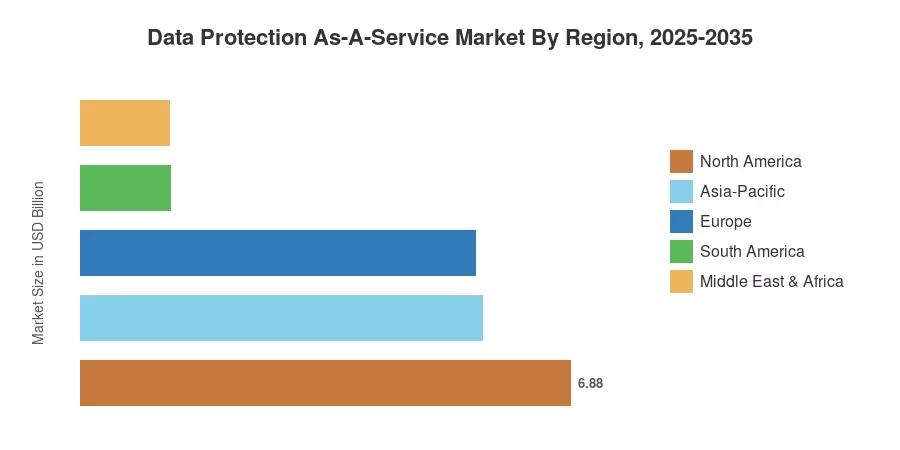
North America commanded 34.6% of 2025 revenue on the strength of hyperscaler proximity and cyber-insurance underwriting discipline. Asia-Pacific will compound at 28.4% through 2035 as India's Digital Personal Data Protection Act and China's PIPL push workloads into in-country vaults [5]. Europe, at 27.9%, is regulation-led rather than growth-led. The decade ahead belongs to vendors that can prove restore times, not storage capacity.


Key Report Takeaways

• By Service Type


  • Storage-as-a-Service held 39.7% of the Data Protection As a Service Market in 2025, reflecting its role as the substrate beneath every other service tier.
  • Disaster-Recovery-as-a-Service is forecast to compound at 26.9% CAGR through 2035, the fastest of the three service types.


• By End-User Industry


  • BFSI accounted for 25.4% of 2025 revenue, driven by operational-resilience testing obligations
  • Healthcare and life sciences will grow at 27.7% CAGR, the sharpest sectoral acceleration in the Data Protection As a Service Markets.


• By Region

  • North America led with a 34.6% share in 2025
  • Asia-Pacific is the fastest-growing region at 28.4% CAGR to 2035
  • Middle East & Africa generated USD 1.25 billion in 2025, concentrated in Gulf sovereign-cloud programmes


Market Size and Forecast (2021–2035)

Estimates were built bottom-up from vendor subscription revenue disclosures, hyperscaler storage and backup service line commentary, channel-partner billing data, and regulatory filings, then triangulated top-down against enterprise IT security budget allocations. Historical years were reconciled against audited annual reports where available; forecast years apply a decaying growth curve reflecting base effects as the addressable estate saturates in mature markets.
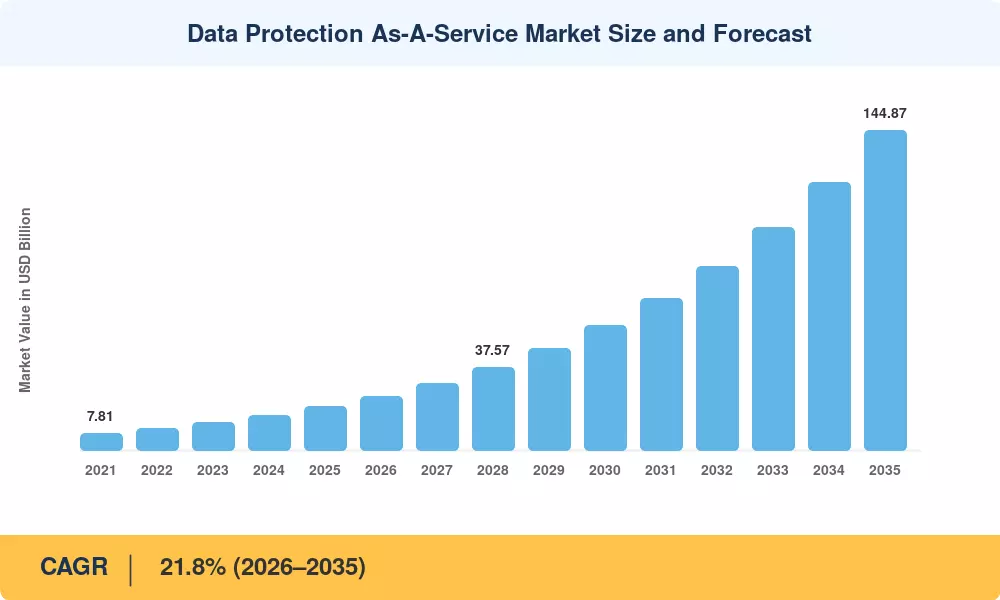
Data Protection As-A-Service Market Size and Forecast
Our Impact

Enabled $4.3B Revenue Impact for Fortune 500 and Leading Multinationals

Partnering with 2000+ Global Organizations Each Year

30K+ Citations by Top-Tier Firms in the Industry

Driver Impact Analysis

Driver ~% Impact on CAGR Geographic Relevance Impact Timeline
Ransomware escalation and cyber-insurance underwriting conditions ~4.8 Global Short-term (≤2 yr)
Regulatory resilience mandates (DORA, NIS2, DPDP, SEC) ~4.1 EU, India, US Short-term (≤2 yr)
Unstructured and SaaS application data sprawl ~3.6 Global Medium-term (2–4 yr)
Capex-to-opex migration from backup appliances ~3.2 North America, Europe Medium-term (2–4 yr)
Sovereign and in-country cloud build-out ~2.7 Asia-Pacific, MEA Medium-term (2–4 yr)
AI/ML anomaly detection embedded in the backup fabric ~2.4 Global Long-term (≥4 yr)
Managed service provider distribution economics ~1.9 Asia-Pacific, South America Long-term (≥4 yr)


Ransomware Economics Rewrote the Buying Committee

Insurers stopped underwriting hope. Verizon's 2024 breach analysis found extortion-linked intrusions present in roughly one-third of all confirmed breaches, and carriers responded by making immutable, air-gapped copies a precondition of coverage rather than a discount lever [13]. That single underwriting change moved budget authority from infrastructure teams to risk committees. Buyers now demand documented restore drills, not retention schedules — and the Data Protection As a Service Market has repriced accordingly, with recovery-orchestration tiers carrying premiums of 30–45% over baseline vaulting.

Resilience Regulation Turned Testing Into a Line Item

Brussels set the template. DORA requires in-scope financial entities to conduct threat-led penetration testing and to demonstrate recovery of critical functions within defined tolerances, with oversight extending to designated critical ICT third parties [1]. NIS2 widened the perimeter to roughly eighteen sectors, including waste management, food production, and public administration, with member-state transposition due 17 October 2024 [2]. India's DPDP Act layered breach notification and data-fiduciary obligations onto a market of 800 million-plus connected users [5]. Compliance-driven data protection solutions became a procurement category in their own right.

The Appliance Estate Is Depreciating Out

Hardware refresh cycles are doing quiet work. A typical purpose-built backup appliance carries a five-to-seven-year depreciation schedule, which means the 2019–2020 purchase cohort is reaching end-of-support precisely as subscription alternatives have matured. IBM's breach research shows organisations with extensively deployed automation and AI in security operations saved an average of USD 2.22 million per incident versus those without [12]. Finance teams comparing a fresh capital outlay against a consumption-priced subscription with embedded analytics increasingly choose the latter.

Healthcare Data Volume Meets Healthcare Regulation

Clinical estates grew faster than the tooling protecting them. Imaging archives, genomic pipelines, and connected-device telemetry have pushed provider data footprints into the multi-petabyte range. At the same time, the US Department of Health and Human Services proposed a substantial strengthening of the HIPAA Security Rule in January 2025, including explicit encryption and recovery-time expectations [15]. Healthcare and life sciences will therefore compound at 27.7% through 2035 — the sharpest sectoral curve in this study.


Restraints Impact Analysis

Restraint ~% Impact on CAGR Geographic Relevance Impact Timeline
Egress and long-term retention cost inflation ~-1.9 Global Short-term (≤2 yr)
Data residency fragmentation across jurisdictions ~-1.6 Europe, Asia-Pacific Medium-term (2–4 yr)
Recovery-time credibility gap and unproven restore SLAs ~-1.4 Global Short-term (≤2 yr)
Cyber and cloud skills shortage ~-1.1 Europe, MEA, South America Medium-term (2–4 yr)
Incumbent on-premises contract lock-in ~-0.9 North America, Japan Long-term (≥4 yr)


The Retention Bill Nobody Modelled

Costs compound where data never leaves. Seven-year regulatory retention on a growing estate means year-seven storage spend can exceed the original year-one subscription by a factor of four, and egress charges levied at restore time convert a disaster-recovery event into an unbudgeted invoice. The EU Data Act, applicable from September 2025, directly targets this friction by phasing out switching charges for cloud services — a structural fix, but one whose commercial effects will take several renewal cycles to reach enterprise pricing [4].

Residency Rules Are Multiplying Faster Than Regions

Jurisdictions keep drawing lines. GDPR transfer mechanisms, China's PIPL cross-border assessment regime, Saudi Arabia's PDPL implementing regulations, and India's DPDP framework each impose distinct conditions on where a secondary copy may legally rest [3][18][5]. A multinational running twelve country entities may need six or seven physically separate vault instances, each with its own key custody arrangement. That fragmentation raises unit cost, slows deployment, and disproportionately favours vendors with dense regional footprints over specialists.

Restores Still Fail Quietly

Confidence exceeds adoption. For some time, the NIST contingency planning guidance has emphasized that a recovery strategy that has not been tested is the same as no procedure at all. However, in practice, the gap between a successful backup operation and a validated application-consistent restore is the least talked about issue in the industry [8]. A big reason why buyers significantly discount vendor RTO claims is partial restore failure, leading to longer sales cycles and pushing a meaningful share of renewals toward hybrid architectures that keep an on-premises copy as insurance.


Data Protection As a Service Market Opportunities

SME Penetration Through the Managed Channel

Businesses around the world are over 90% SMEs, and the bulk of them do not have specialized security staff [25]. Historically, disaster recovery-as-a-service for SMEs has failed on integration load, not price – which is exactly why the managed service provider channel is the greatest untapped pool in the Data Protection As a Service Market. Vendors who supply multi-tenant consoles, automated onboarding, and per-seat billing can get in front of customers whose whole IT budget would not fund a single corporate implementation. SMEs are expected to grow at 30.7% CAGR to 2035.


Sovereign Vaults as a Premium Tier

Gulf and Southeast Asian governments are investing in national cloud capacity with explicit residence guarantees. Demand for vault instances that operate under local key custody and local legal process is created by Saudi Arabia’s PDPL implementing legislation and the UAE’s federal data protection ordinance [18][19]. Providers prepared to live with the margin dilution of in-country infrastructure can charge 20–35% premiums and lock-in multi-year public sector contracts that rarely turnover.


Backup Data as an AI Training Substrate

Protected copies are the most clean, full and regularly cataloged dataset most organizations own. That asset can be monetized – through governed access for retrieval-augmented generation, e-discovery automation or compliance analytics – turning a cost center into a platform. Some early movers are bundling metadata indexing and semantic search into separately priced modules, a change in business model that increases wallet share without a single extra terabyte of storage.


Cyber-Insurance Bundling

Underwriters want telemetry; providers have it. Bundled propositions in which a protection subscription carries a pre-negotiated premium reduction, or in which the provider assumes defined recovery liability, align incentives across a triangle of insurer, vendor, and insured. This model is nascent but scales quickly once actuarial data validates the loss-ratio improvement.

Quantum-Safe Archive Migration

Long-retention archives are uniquely exposed to harvest-now-decrypt-later attacks, because a 2026 backup may still be legally required in 2036. NIST finalised its first post-quantum encryption standards in 2024, opening a defined migration pathway [10]. Re-encrypting historical archives is a large, mandatory, one-time services opportunity that favours incumbents holding the existing data.


Data Protection As a Service Market Future Outlook

Autonomous Recovery Operations

Recovery will stop being a human decision. By the early 2030s, expect orchestration engines that detect encryption-pattern anomalies, isolate the affected blast radius, select the last known-clean snapshot, and initiate restore without waiting for an operator — with the human role shifting to approval and forensics. NIST's Cybersecurity Framework 2.0 formalised "Govern" as a core function, and automated recovery evidence generation maps directly onto that expectation [10].

Platform Economics and the Compression of Per-Terabyte Pricing

Consolidation is already visible in vendor structure, and its commercial consequence is predictable: storage becomes commodity, and margin migrates to the intelligence layer above it. Providers will increasingly give away capacity to sell analytics, compliance reporting, and cyber-recovery orchestration. Buyers should expect headline per-terabyte pricing to fall 6–9% annually while total contract value rises, because module attach rates more than offset the deflation.

The Energy Constraint on Data Retention

Storage has a power bill. The International Energy Agency estimates global data centre electricity consumption at approximately 415 TWh in 2024, with projections approaching 945 TWh by 2030 under current trajectories [22]. Retaining every copy forever becomes environmentally and financially indefensible under that curve. Expect intelligent tiering, deduplication ratios, and defensible deletion policies to move from technical features to contractual commitments as ESG reporting frameworks mature.

Convergence With Security Operations

Boundaries between backup and security tooling will dissolve. The protected copy is the richest available forensic artefact — a complete, timestamped record of enterprise state — and SOC teams increasingly want direct query access to it. Vendors that expose vault telemetry to SIEM and XDR platforms will capture budget from two separate lines simultaneously, materially expanding the addressable spend within the Data Protection As a Service Market.


Regional Market Share Analysis

Region Metric (2025) Primary Investment Themes
North America 34.6% share Cyber-insurance compliance, SaaS estate protection, federal FedRAMP vaulting
Europe 27.9% share DORA and NIS2 resilience testing, sovereign cloud, cross-border transfer controls
Asia-Pacific 28.4% CAGR (2026–2035) Data localisation, MSP channel build-out, digital public infrastructure
South America USD 1.27 Billion LGPD enforcement maturity, financial-sector modernisation
Middle East & Africa USD 1.25 Billion National cloud programmes, oil & gas OT recovery, smart-government archives
Total USD 19.87 Billion —

Geographic performance in the Data Protection As a Service Market tracks two variables above all others: regulatory intensity and hyperscaler region density. Where both are high, adoption is deep but growth is moderating; where regulation is arriving faster than infrastructure, growth rates are steepest.


North America

Country Metric Key Driver
US 79.4% of region SEC disclosure rule and insurer underwriting conditions [6]
Canada USD 0.94 Billion Federal PIPEDA modernisation and provincial health data rules
Mexico 22.6% CAGR Nearshoring-driven manufacturing IT build-out


American demand is being pulled by disclosure liability rather than technology enthusiasm. Since the SEC rule took effect in December 2023, material cybersecurity incidents must be reported on Form 8-K within four business days, which turns an unrecoverable outage into a securities-law event [6]. CISA's proposed CIRCIA reporting framework extends comparable pressure across sixteen critical infrastructure sectors [7]. Canadian buyers, meanwhile, are constrained by residency expectations in health and public-sector procurement, sustaining demand for locally operated vault regions.

Europe

Country Metric Key Driver
Germany 22.1% of region Industrial OT recovery and BSI baseline requirements
UK USD 1.16 Billion Financial-sector operational resilience framework
France 20.9% CAGR SecNumCloud qualification and sovereign hosting mandates
Italy 8.4% of region Public administration digitalisation programme
Spain USD 0.36 Billion Banking consolidation and cloud migration
Nordic Countries 21.7% CAGR Energy-sector NIS2 scope expansion
Russia 4.1% of region Domestic vendor substitution requirements
Rest of Europe USD 0.58 Billion CEE public-sector modernisation funding


Europe buys compliance first and capability second. DORA's oversight regime for critical ICT third-party providers means that a backup vendor serving a systemically important bank is itself subject to regulatory scrutiny — a structural advantage for large providers able to absorb the audit burden [1]. ENISA's 2024 threat assessment identified ransomware and data-related threats as the dominant categories across EU member states, reinforcing budget continuity even amid broader IT spending caution [11].

Asia-Pacific

Country Metric Key Driver
China 31.8% of region PIPL cross-border transfer assessments and domestic cloud mandates
India 32.4% CAGR DPDP Act implementation across banking and telecom [5]
Japan USD 0.93 Billion APPI amendments and enterprise legacy migration
South Korea 9.2% of region PIPA enforcement and financial-sector cloud guidelines
ASEAN 30.1% CAGR Singapore and Indonesia data centre capacity additions
Rest of Asia-Pacific USD 0.41 Billion Australian critical infrastructure obligations


Asia-Pacific is where regulation and greenfield infrastructure are arriving simultaneously, which is why it compounds fastest. India's DPDP Act created data-fiduciary obligations across a market with no legacy backup estate to displace, meaning adoption starts cloud-native rather than migrating [5]. Chinese enterprises face separate constraints under PIPL's security assessment regime for outbound transfers, effectively mandating in-country secondary copies . Southeast Asian growth follows hyperscaler region announcements with a twelve-to-eighteen-month lag.

South America

Country Metric Key Driver
Brazil 54.6% of region LGPD enforcement and central bank open finance rules [21]
Argentina USD 0.19 Billion Financial-services resilience upgrades
Rest of South America 21.4% CAGR Chilean and Colombian public-sector cloud adoption


Brazilian adoption accelerated once the national data protection authority moved from guidance to sanction under LGPD, and the central bank's open finance framework added availability requirements that legacy tape cannot meet [21]. Currency volatility remains the principal brake: subscriptions priced in dollars carry real budget risk for regional buyers, pushing demand toward local-currency reseller arrangements and shorter contract terms than the global norm.

Middle East & Africa

Country Metric Key Driver
Saudi Arabia 28.3% of region SDAIA PDPL implementing regulations and Vision 2030 cloud-first policy [18]
UAE 29.6% CAGR Federal data protection decree and free-zone financial regulation [19]
South Africa USD 0.21 Billion POPIA enforcement across banking and telecom
Egypt 8.7% of region Public-sector digitisation programme
Rest of MEA USD 0.26 Billion Qatari and Kuwaiti national cloud projects


Gulf demand is policy-manufactured. Saudi Arabia's cloud-first directive for government entities, paired with PDPL implementing regulations that constrain personal-data transfers, has produced a procurement environment where in-kingdom vault capacity is a qualification criterion rather than a preference [18]. Energy operators add a distinct requirement layer: operational technology recovery for SCADA and process-control environments, where the acceptable recovery window is measured in minutes and where generic IT backup tooling is unfit for purpose.


Data Protection As-A-Service Market By Region, 2025-2035

Data Protection As a Service Market Segmentation

By Service Type

The Data Protection As a Service Market divides along three service tiers, each carrying distinct margin and growth characteristics.

Segment Metric (2025) Primary Demand Driver
Storage-as-a-Service 39.7% share Elastic capacity for unstructured and archival data
Backup-as-a-Service USD 7.51 Billion SaaS application coverage and endpoint estates
Disaster-Recovery-as-a-Service 26.9% CAGR (2026–2035) Regulatory recovery-time obligations


Storage-as-a-Service dominates because it underpins everything else — every backup and every recovery point ultimately lands on someone's object store. That positioning gives it durable share even as pricing deflates. Backup-as-a-Service is where competitive intensity is highest, particularly around Microsoft 365, Salesforce, and Workday coverage, since native application retention rarely satisfies audit requirements.

Disaster-Recovery-as-a-Service grows fastest for a simple reason: it is the only tier that regulators explicitly test. DORA's threat-led penetration testing and the HIPAA Security Rule proposals both target the recovery event rather than the copy [1][15]. Continuous data protection with zero data loss sits at the premium end of this tier, commanding materially higher per-workload pricing than nightly snapshot models.

By Deployment Model

Segment Metric (2025) Primary Demand Driver
Private Cloud 40.0% share Residency control and key custody requirements
Public Cloud USD 7.39 Billion Consumption economics and elastic scale
Hybrid Cloud 28.5% CAGR (2026–2035) Split primary/secondary copy architectures


Private cloud retains the largest share because regulated buyers in BFSI, healthcare, and government need demonstrable control over encryption keys and physical location. Hybrid grows fastest as sovereignty rules force organisations to hold one copy locally and one in a distant region, an architecture that neither pure model serves well.

By Organization Size

Segment Metric Primary Demand Driver
Large Enterprises 59.1% share (2025) Multi-jurisdiction compliance and complex application estates
Small and Medium-Sized Enterprises 30.7% CAGR (2026–2035) Managed service provider packaging and per-seat pricing


Large enterprises remain the dominant organization size segment within the market, fueled by complex, multi-jurisdiction compliance requirements and sprawling application estates. Small and medium-sized enterprises stand out as the fastest-growing segment, propelled by accessible managed service provider packaging and flexible per-seat pricing models.

By End-User Industry

Segment Metric (2025) Primary Demand Driver
BFSI 25.4% share Operational resilience regulation and transaction integrity
IT and Telecom 17.2% share Multi-tenant customer data obligations
Healthcare and Life Sciences 27.7% CAGR (2026–2035) Imaging and genomic data volume plus HIPAA modernisation
Government and Public Sector USD 2.50 Billion Citizen record retention and sovereign hosting
Retail and E-commerce 10.4% share PCI DSS v4.0 requirements and transaction continuity
Manufacturing 9.1% share OT/IT convergence and production-line downtime cost
Media and Entertainment 5.2% share Large-format asset archives
Others 4.3% share Education, logistics, professional services


BFSI leads the Data Protection As a Service Market because financial regulators moved first and moved hardest — recovery capability is now examined, not self-attested [1]. Healthcare's acceleration reflects a different dynamic: data volume growing faster than security budgets, combined with an installed base of clinical systems that were never designed for ransomware-era threat models. PCI DSS v4.0's phased requirements have added a similar, if narrower, forcing function in retail [16].


Competitive Benchmarking

Concentration in the Data Protection As a Service Market sits in the medium band, with an estimated HHI in the 700–900 range and a top-five combined share of roughly 38–44%. Structure is bifurcated: hyperscalers own the substrate and bundle native services aggressively, while specialists compete on recovery orchestration, SaaS application depth, and cyber-resilience features that platform vendors treat as secondary. The 2024 consolidation wave — Rubrik's public listing, the Cohesity–Veritas combination, and Commvault's acquisition programme — reduced the independent specialist count materially and raised the capital threshold for new entrants. Share estimates below are directional ranges and do not sum precisely.

Company Est. Revenue Share Range Key Offerings for Data Protection As a Service Market Strategic Positioning
Amazon Web Services ~9–12% AWS Backup, S3 Object Lock, Elastic Disaster Recovery Substrate owner; bundles protection into broader cloud commit
Microsoft ~8–11% Azure Backup, Azure Site Recovery, Microsoft 365 Backup Leverages M365 estate ownership as distribution advantage
Veeam Software ~7–10% Data Platform, Backup for M365, Cyber Secure programme Channel-led scale; largest independent by installed base
Broadcom (Veritas heritage) ~5–8% NetBackup SaaS, Alta Data Protection Enterprise incumbency in large regulated accounts
Cohesity ~5–8% DataProtect, FortKnox cyber vault, Gaia AI search Post-merger scale plus AI-driven data insight positioning
Dell Technologies ~4–7% APEX Backup Services, PowerProtect Cyber Recovery Hardware-to-subscription transition; strong in hybrid estates
IBM ~4–6% Storage Defender, Storage Protect, Cloud Object Storage Resilience consulting attached to platform sales
Commvault ~3–6% Cloud Cyber Resilience Platform, Metallic, Clumio, Appranix Cloud-rebuild orchestration differentiation
Rubrik ~3–6% Security Cloud, Ruby AI, Rubrik Annapurna Security-first positioning; public-market capital access
Druva ~2–4% Data Resiliency Cloud, endpoint and SaaS protection Fully SaaS architecture with no customer-managed infrastructure
Acronis ~2–4% Cyber Protect Cloud MSP-channel specialist serving SME density
OpenText (Carbonite) ~1–3% Carbonite Cloud-to-Cloud Backup, Zerto-adjacent recovery Mid-market and SMB reach through embedded distribution


Recent News & Developments

  • European Commission (January 2025): The Digital Operational Resilience Act became applicable across the EU, imposing tested recovery obligations on financial entities and bringing designated critical ICT providers under direct oversight — the single largest regulatory demand catalyst of the forecast period [1]
  • Cohesity and Veritas (December 2024): Cohesity completed its combination with the Veritas data protection business, creating one of the largest independent players by installed base and consolidating two enterprise-scale customer estates under one roadmap
  • Commvault (October 2024): The company acquired Clumio, adding native AWS data protection and sub-minute recovery for S3 datasets, following its April 2024 acquisition of Appranix for cloud application rebuild orchestration [24]
  • Rubrik (April 2024): Completed its initial public offering on the NYSE, giving a security-positioned data protection specialist public-market capital and forcing peers to sharpen cyber-resilience messaging [23]
  • European Union (October 2024): The NIS2 Directive transposition deadline passed, extending incident reporting and continuity obligations to roughly eighteen sectors and to a far larger population of medium-sized entities than its predecessor [2]
  • Veeam Software (April 2024): Acquired Coveware, adding ransomware incident response and extortion negotiation capability directly into a backup vendor's portfolio — a notable convergence of protection and response
  • Microsoft (2024): Microsoft 365 Backup reached general availability, materially changing the competitive dynamic for third-party SaaS backup specialists by placing a native option inside the tenant
  • US Department of Health and Human Services (January 2025): Published a notice of proposed rulemaking to strengthen the HIPAA Security Rule, including explicit expectations around encryption, asset inventory, and recovery timelines for regulated health entities [15]
  • NIST (August 2024): Finalised the first post-quantum cryptography standards, establishing the migration pathway that long-retention archive holders will need to follow over the coming decade [10]


Data Protection As a Service Market Report Scope

Parameter Detail
Market Scope Global Data Protection As a Service Market covering Storage-as-a-Service, Backup-as-a-Service, and Disaster-Recovery-as-a-Service, across public, private, and hybrid cloud deployment, by organization size, end-user industry, and geography
Study Period 2021–2035 (Historical: 2021–2024; Base Year: 2025; Forecast: 2026–2035)
CAGR 21.8% (2026–2035)
Market Size Checkpoints 2025: USD 19.87 Billion; 2026: USD 24.53 Billion; 2031: USD 68.89 Billion; 2035: USD 144.87 Billion
Fastest Growing Segments Disaster-Recovery-as-a-Service (service type); Hybrid Cloud (deployment); SMEs (organization size); Healthcare and Life Sciences (industry); Asia-Pacific (geography)
Companies Profiled 12 major providers including AWS, Microsoft, Veeam, Broadcom, Cohesity, Dell Technologies, IBM, Commvault, Rubrik, Druva, Acronis, OpenText
Valuation Currency USD Billion

FAQs

How should buyers structure a proof-of-concept before committing to a Data Protection As a Service Market vendor?
Run a full application-consistent restore, not a backup job, against your most complex workload. Measure wall-clock time to usable state and log every manual intervention required [8].
What contractual terms most often cause disputes in Data Protection As a Service Market agreements?
Egress and early-termination charges. Negotiate restore-event egress waivers and switching terms at signature, since the EU Data Act only phases out charges for EU-scoped services [4].
Does native SaaS retention from Microsoft or Google eliminate the need for third-party protection?
No. Native retention protects against platform failure, not against malicious deletion, account compromise, or long-horizon regulatory retention. Auditors generally require an independently controlled copy [16].
How do cyber insurers evaluate a Data Protection As a Service Market deployment during underwriting?
Carriers look for immutability, air-gapping, and evidence of tested restores within the past twelve months. Documented drill results usually influence premiums more than the vendor's brand [13].
What integration problems most commonly delay deployments?
Identity and key management. Federating vault access into existing IAM while maintaining separation of duties consistently takes longer than the storage migration itself [9].
Is a single-vendor or best-of-breed approach better for multi-cloud estates?
Single-vendor simplifies audit evidence and reduces licensing overhead. Best-of-breed wins where one cloud carries disproportionate risk and needs native-depth recovery tooling [10].
How do procurement teams benchmark pricing in a market with such varied models?
Normalise to cost per protected workload per year, including projected egress at one full restore. Per-terabyte comparisons systematically understate the true five-year commitment.      
Author
Author Author Profile Kiran Jinkalwad LinkedIn Research Associate Level - II
Kiran Jinkalwad brings over four years of experience in market research, specializing in the ICT and Semiconductor sectors. She has worked on 50+ projects, including custom studies for companies like Microsoft and Huawei, addressing complex business challenges. With a background in Electronics and Telecommunication, Kiran excels in market estimation, forecasting, and strategic analysis. His sharp analytical skills and industry knowledge consistently deliver actionable insights for diverse clients.
Co-Author Co-Author Profile Aarti Dhapte LinkedIn AVP - Research
A consulting professional focused on helping businesses navigate complex markets through structured research and strategic insights. I partner with clients to solve high-impact business problems across market entry strategy, competitive intelligence, and opportunity assessment. Over the course of my experience, I have led and contributed to 100+ market research and consulting engagements, delivering insights across multiple industries and geographies, and supporting strategic decisions linked to $500M+ market opportunities. My core expertise lies in building robust market sizing, forecasting, and commercial models (top-down and bottom-up), alongside deep-dive competitive and industry analysis. I have played a key role in shaping go-to-market strategies, investment cases, and growth roadmaps, enabling clients to make confident, data-backed decisions in dynamic markets.

Research Approach


Secondary Research

The secondary research process involved comprehensive analysis of regulatory frameworks, cybersecurity standards, peer-reviewed technical journals, and authoritative government publications. Key sources included the National Institute of Standards and Technology (NIST) Cybersecurity Framework and Special Publications (SP 800-53, SP 800-171), ENISA (European Union Agency for Cybersecurity) threat landscape reports and cloud security guidance, European Data Protection Board (EDPB) and national Data Protection Authorities (CNIL, ICO, BfDI) for GDPR compliance enforcement data, Cybersecurity and Infrastructure Security Agency (CISA) alerts and strategic guidance, Federal Trade Commission (FTC) breach notification statistics, FedRAMP authorized cloud service listings, Department of Health and Human Services (HHS) healthcare breach reporting for HIPAA compliance trends, Bureau of Industry and Security (BIS) export controls on encryption technologies, and Securities and Exchange Commission (SEC) cybersecurity disclosure rules for financial data protection.

Industry and standardization sources included Cloud Security Alliance (CSA) Security Guidance v4.0 and STAR registry, ISO/IEC 27001/27017/27018 certification databases, International Association of Privacy Professionals (IAPP) privacy benchmark studies, Storage Networking Industry Association (SNIA) data protection standards, IEEE Xplore and ACM Digital Library for peer-reviewed research on quantum-resistant encryption and AI-driven backup technologies, MRFR Magic Quadrants for Enterprise Backup and Recovery, MRFR Worldwide Quarterly Enterprise Storage Systems Tracker, Ponemon Institute cost of data breach studies, and OECD Digital Economy Outlook reports. These sources were utilized to collect compliance mandates, breach statistics, cloud adoption metrics, pricing benchmarks, and competitive intelligence across backup-as-a-service, disaster recovery-as-a-service, and archiving segments.


Primary Research

In order to derive qualitative and quantitative insights on procurement dynamics and data resilience strategies, supply-side and demand-side stakeholders were interviewed during the primary research process. Supply-side sources consist of CEOs, VPs of Cloud Services, Chief Technology Officers (CTOs), Heads of Data Protection Product Development, and Regional Managing Directors from cloud hyperscalers, pure-play backup vendors, enterprise storage manufacturers, managed security service providers (MSSPs), and telecommunications carriers that provide white-label DPaaS solutions. The demand-side sources comprised Chief Information Officers (CIOs), Chief Information Security Officers (CISOs), Data Protection Officers (DPOs), IT Infrastructure Directors, Cloud Architects, and Procurement Heads from Fortune 1000 enterprises, mid-market organizations, federal and state government agencies, healthcare systems, financial institutions, and retail chains. The primary research validated the segmentation of service types (BaaS vs. DRaaS adoption patterns), confirmed the timelines for hybrid/multi-cloud deployment, and collected insights on the requirements for ransomware recovery, compliance automation investments, and pricing elasticity in consumption-based versus subscription models.

Primary Respondent Breakdown:

By Designation: C-level Primaries (30%), Director Level (35%), Others (35%)

By Region: North America (32%), Europe (30%), Asia-Pacific (28%), Rest of World (10%)


Market Size Estimation

Global market valuation was derived through revenue triangulation and service deployment analysis. The methodology included:

Identification of 40+ key providers across North America, Europe, Asia-Pacific, and Latin America, encompassing cloud infrastructure leaders (AWS, Microsoft Azure, Google Cloud), legacy backup vendors (Commvault, Veritas, Veeam), storage-integrated solutions (Dell EMC, NetApp, IBM, Rubrik), and emerging AI-native data protection startups.

Service segmentation mapping across Backup as a Service (BaaS), Disaster Recovery as a Service (DRaaS), Archiving as a Service, and Storage as a Service (STaaS), including differentiation between agent-based, agentless, and SaaS-native protection capabilities.

Analysis of reported and modeled annual revenues specific to DPaaS portfolios, excluding adjacent cybersecurity segments (endpoint protection, network security) to maintain pure-play data protection focus.

Coverage of providers representing 75-80% of global market share in 2024.

Bottom-up estimation through enterprise IT spending surveys (sample size: 1,200+ organizations) multiplied by average selling price (ASP) per protected terabyte and recovery SLA tiers, cross-validated with top-down vendor revenue reporting and cloud infrastructure usage telemetry (hyperscaler storage revenue attribution).

Triangulation with vertical-specific compliance drivers: Healthcare (HIPAA/HITECH enforcement penalties), Financial Services (DORA, SEC Rule 17a-4(f)), and Public Sector (FedRAMP, StateRAMP authorization costs) to adjust regional growth coefficients.

Download Free Sample

Kindly complete the form below to receive a free sample of this Report

Global Diameter Signaling Market
Case Study
Information and Communications Technology
Download PDF ×

We do not share your information with anyone. However, we may send you emails based on your report interest from time to time. You may contact us at any time to opt-out.