×
Request Free Sample ×

Kindly complete the form below to receive a free sample of this Report

* Please use a valid business email

Leading companies partner with us for data-driven Insights

clients tt-cursor
Hero Background
English
Chinese
French
Japanese
Korean
German
Spanish

Somatostatin Analogs Market Trends

ID: MRFR/Pharma/7161-HCR
140 Pages
Rahul Gotadki
October 2025

Somatostatin Analogs Market Size, Growth Research Report By Type (Octreotide, Lanreotide and Pasireotide), By Application (Neuroendocrine Tumor (NET), Acromegaly and Others) And By Region (North America, Europe, Asia-Pacific, And Rest Of The World) – Competitor Industry Analysis and Trends Forecast Till 2035

Share:
Download PDF ×

We do not share your information with anyone. However, we may send you emails based on your report interest from time to time. You may contact us at any time to opt-out.

Somatostatin Analogs Market Infographic
×
Somatostatin Analogs Market Infographic Full View
Purchase Options

Market Trends

Key Emerging Trends in the Somatostatin Analogs Market

Companies are dynamically positioning their shares in the Somatostatin Analogs Market, which is dedicated to dealing with a variety of hormone disorders and tumors. An essential approach entails constant innovation when it comes to treatment methods. The firms acknowledge that hormonal syndromes are complex. Somatostatin analogs can be explored further as therapeutic agents, and this has led to huge investments in research aimed at bringing new drugs that have more effectiveness and fewer side effects. Strategic partnerships and collaborations have a major influence on market share within the Somatostatin Analogs Market. In view of the intricate nature of hormonal disorders and the quest for comprehensive solutions, companies are entering into alliances with research institutions, endocrinologists, and other healthcare players. These partnerships facilitate collaboration in terms of resources, skills, and knowledge, which hasten the development as well as the marketing of efficient somatostatin analogs. By capitalizing on joint strengths, firms entrench themselves as front runners by providing different treatment options depending on how complex an endocrine disease is. Pricing strategies emerge as a critical factor in market share positioning within the Somatostatin Analogs Market. To suit individual patient needs, many firms employ various pricing models based on criteria such as effectiveness rates derived from clinical trial findings, affordability by patients assessed overtime before coming up with prices that can be sustained over a period, or healthcare reimbursement considerations carried out after several changes in payment systems were made ranging from state sponsorship to private insurance. Some premium-priced companies position their advanced analogs, highlighting better benefits with improved control over diseases, while others who want to attract many patients put sensible price tags on traditional somatostatin analogs. Effective marketing and distribution strategies are instrumental in enhancing market share within the Somatostatin Analogs Market. Companies invest heavily in marketing campaigns that aim at reaching out to healthcare providers as well as patients. Gaining a strong brand presence through targeted promotional activities is important for building trust and credibility. At the same time, optimizing distribution networks ensures that somatostatin analogs are widely available, reaching diverse geographic areas and making them accessible to a larger patient population. Customization and patient-centric approaches are gaining prominence as key strategies in the Somatostatin Analogs Market. To address individual patient needs, companies develop their analogs accordingly, knowing well that hormonal syndromes are unique to each person. There are changes in dose, longer release forms, or even support programs for patient-centered somatostatin analog treatments. Not only does this personalization boost treatment effectiveness, but it also further enhances the positioning of a manufacturer by showing dedication to consumer-centered care.

Author
Rahul Gotadki
Assistant Manager

He holds an experience of about 7+ years in Market Research and Business Consulting, working under the spectrum of Life Sciences and Healthcare domains. Rahul conceptualizes and implements a scalable business strategy and provides strategic leadership to the clients. His expertise lies in market estimation, competitive intelligence, pipeline analysis, customer assessment, etc. In addition to the above, his other responsibility includes strategic tracking of high growth markets & advising clients on the potential areas of focus they could direct their business initiatives

Leave a Comment

FAQs

What is the projected growth of the Somatostatin Analogs market?

The Somatostatin Analogs market is the expected increase in total market value of 15.86 USD billion over a defined forecast period 2025–2035. It is driven by factors such as demand trends, technological advances, regulatory changes, and geographic expansion.

What is the size of the Somatostatin Analogs market?

Somatostatin Analogs market size was valued at approximately 7.45 billion USD in 2024. This figure will reach 15.86 billion USD covering all regions (America, Europe, Asia, MEA and ROW), focusing its segments / services / distribution channels till 2035.

What is the CAGR of the Somatostatin Analogs market?

Somatostatin Analogs market is expected to grow at a CAGR of 7.1% between 2025 and 2035.

How much will the Somatostatin Analogs market be worth by 2035?

Somatostatin Analogs market is expected to be worth of 15.86 billion USD, reflecting growth driven by usage, technology and global demands by the end of 2035.

How will the Somatostatin Analogs market perform over the next 10 years?

Over the next 10 years the Somatostatin Analogs market is expected to shift from usd billion 7.45 to 15.86 billion USD, led by adoption of advanced tech, demographic trends, regulatory approvals, with potential headwinds from 2025 to 2035.

Which region held the largest market share in the somatostatin analogs market?

North America had the largest share in the market

Market Summary

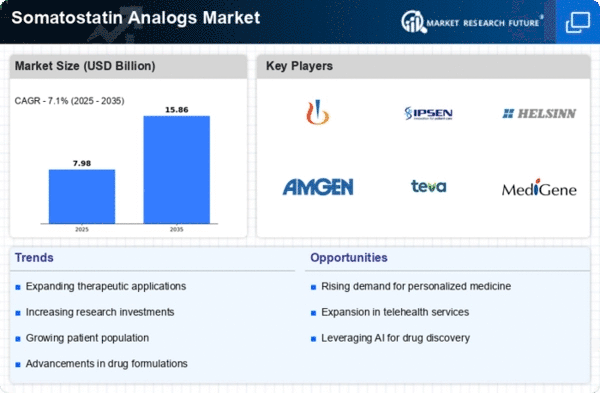
As per MRFR analysis, the Somatostatin Analogs Market Size was estimated at 7.45 USD Billion in 2024. The Somatostatin Analogs industry is projected to grow from 7.98 USD Billion in 2025 to 15.86 USD Billion by 2035, exhibiting a compound annual growth rate (CAGR) of 7.1 during the forecast period 2025 - 2035.

Key Market Trends & Highlights

The Somatostatin Analogs Market is poised for substantial growth driven by increasing prevalence of endocrine disorders and advancements in drug delivery technologies.

  • The market is witnessing a rising prevalence of endocrine disorders, particularly in North America, which remains the largest market.
  • Advancements in drug formulations are enhancing treatment efficacy, especially in the acromegaly segment, which is currently the largest.
  • The Asia-Pacific region is emerging as the fastest-growing market, driven by increasing awareness and diagnosis of hormonal disorders.
  • Key market drivers include the rising incidence of neuroendocrine tumors and regulatory support for innovative therapies, fueling growth in both subcutaneous and intravenous segments.

Market Size & Forecast

2024 Market Size 7.45 (USD Billion)
2035 Market Size 15.86 (USD Billion)
CAGR (2025 - 2035) 7.1%
Largest Regional Market Share in 2024 North America

Major Players

<p>Novartis (CH), Ipsen (FR), Helsinn Healthcare (CH), Amgen (US), Teva Pharmaceutical Industries (IL), MediGene AG (DE), Sandoz (CH), Boehringer Ingelheim (DE), Eisai Co., Ltd. (JP)</p>

Market Trends

The Somatostatin Analogs Market is currently experiencing a notable evolution, driven by increasing awareness of the therapeutic benefits associated with these compounds. These analogs, which mimic the action of somatostatin, are primarily utilized in the treatment of various endocrine disorders, including acromegaly and neuroendocrine tumors. The growing prevalence of such conditions, coupled with advancements in drug formulations, appears to be propelling market growth. Furthermore, the rising demand for targeted therapies in oncology suggests a shift towards more specialized treatment options, which may enhance the market's trajectory. In addition, the Somatostatin Analogs Market is likely to benefit from ongoing research and development initiatives aimed at improving the efficacy and safety profiles of these medications. Collaborations between pharmaceutical companies and research institutions may lead to innovative delivery methods and formulations, potentially expanding the therapeutic applications of somatostatin analogs. As healthcare systems increasingly prioritize personalized medicine, the market could witness a surge in tailored treatment regimens that incorporate these analogs, thereby enhancing patient outcomes and satisfaction.

Rising Prevalence of Endocrine Disorders

The increasing incidence of endocrine disorders, such as acromegaly and neuroendocrine tumors, is driving demand for somatostatin analogs. As awareness of these conditions grows, healthcare providers are more likely to prescribe these therapies, contributing to market expansion.

Advancements in Drug Formulations

Innovations in drug formulations are enhancing the effectiveness and safety of somatostatin analogs. These advancements may lead to improved patient compliance and outcomes, thereby fostering a more favorable market environment.

Focus on Personalized Medicine

The shift towards personalized medicine is influencing treatment approaches in the Somatostatin Analogs Market. Tailored therapies that incorporate somatostatin analogs are likely to gain traction, as they offer potential benefits in managing complex endocrine disorders.

Somatostatin Analogs Market Market Drivers

Rising Geriatric Population

The Global Somatostatin Analogs Market Industry is experiencing growth due to the rising geriatric population, which is more susceptible to hormonal disorders and related health issues. As the global population ages, the demand for effective treatment options, including somatostatin analogs, is expected to increase significantly. This demographic shift is particularly pronounced in developed countries, where healthcare systems are adapting to cater to the needs of older adults. Consequently, the market is likely to expand as healthcare providers seek to address the unique health challenges faced by this population. The increasing prevalence of age-related conditions further underscores the importance of somatostatin analogs in modern medicine.

Advancements in Drug Formulations

Innovations in drug formulations are propelling the Global Somatostatin Analogs Market Industry forward. Enhanced delivery mechanisms and improved pharmacokinetics are making somatostatin analogs more effective and patient-friendly. For example, the development of long-acting formulations allows for less frequent dosing, which is appealing to patients and healthcare providers alike. This trend is expected to contribute to the market's growth, with projections indicating a rise to 15.9 USD Billion by 2035. As pharmaceutical companies invest in research and development to create superior formulations, the market for somatostatin analogs is likely to benefit from increased adoption and patient compliance.

Rising Prevalence of Hormonal Disorders

The Global Somatostatin Analogs Market Industry is witnessing growth due to the increasing prevalence of hormonal disorders such as acromegaly and neuroendocrine tumors. These conditions necessitate effective treatment options, which somatostatin analogs provide. For instance, the market is projected to reach 7.45 USD Billion in 2024, reflecting a heightened demand for these therapeutic agents. As healthcare systems globally prioritize the management of such disorders, the adoption of somatostatin analogs is likely to rise, thereby driving market expansion. Furthermore, the increasing awareness among healthcare professionals about the efficacy of these drugs contributes to their growing utilization in clinical settings.

Increasing Research and Development Activities

The Global Somatostatin Analogs Market Industry is significantly driven by increasing research and development activities aimed at discovering new therapeutic applications for somatostatin analogs. Ongoing clinical trials and studies are exploring their potential in treating various conditions beyond hormonal disorders, such as certain types of cancers and gastrointestinal diseases. This expanding research landscape is likely to enhance the market's growth trajectory, as new indications could lead to broader usage of these drugs. The commitment to R&D in this field suggests a promising future for somatostatin analogs, potentially increasing their market share and relevance in the pharmaceutical industry.

Growing Investment in Healthcare Infrastructure

The Global Somatostatin Analogs Market Industry is also influenced by the growing investment in healthcare infrastructure across various regions. Governments and private entities are increasingly allocating resources to enhance healthcare facilities, which facilitates better access to advanced treatment options, including somatostatin analogs. This trend is particularly evident in developing countries, where healthcare systems are evolving rapidly. As a result, the market is projected to experience a compound annual growth rate (CAGR) of 7.1% from 2025 to 2035. Improved healthcare infrastructure not only enhances the availability of these drugs but also promotes awareness and education regarding their benefits.

Market Segment Insights

By Application: Acromegaly (Largest) vs. Neuroendocrine Tumors (Fastest-Growing)

<p>The Somatostatin Analogs Market is prominently driven by its application in treating Acromegaly, which holds the largest share among different applications. This condition requires continuous management through hormonal therapies, specifically Somatostatin analogs, contributing significantly to market dynamics. On the other hand, Neuroendocrine Tumors represent the fastest-growing segment within this market. The increasing prevalence of these tumors, alongside rising awareness and advances in treatment options, is propelling the demand for effective Somatostatin therapies in this area.</p>

<p>Acromegaly (Dominant) vs. Neuroendocrine Tumors (Emerging)</p>

<p>Acromegaly remains the dominant application segment due to its extensive treatment requirements and established use of Somatostatin analogs in therapy. This condition is characterized by excess growth hormone production, necessitating reliable and long-term therapy. In contrast, Neuroendocrine Tumors are emerging rapidly in clinical focus, characterized by their complex nature, often leading to aggressive treatment protocols. The heightened research interest and clinical trials in this domain emphasize the evolving role of Somatostatin analogs as essential therapeutic agents, addressing unmet medical needs in tumor management.</p>

By Route of Administration: Subcutaneous (Largest) vs. Intravenous (Fastest-Growing)

<p>In the Somatostatin Analogs Market, Subcutaneous administration currently holds the largest market share, largely due to patient preference for self-administration and the convenience it offers. This method is widely adopted for its ease of use and effectiveness, allowing patients to manage their treatment regimens at home. On the other hand, Intravenous administration, while representing a smaller share, is registered as the fastest-growing segment, driven by its rapid action and essential use in clinical settings, particularly in acute care situations.</p>

<p>Subcutaneous (Dominant) vs. Intravenous (Emerging)</p>

<p>Subcutaneous administration of somatostatin analogs is recognized as the dominant method, appealing to patients seeking ease and convenience in their treatment plans. This route allows for self-injection, leading to greater patient autonomy and satisfaction. Conversely, the Intravenous route is gaining traction as an emerging segment due to its necessity in hospital environments for immediate therapeutic effects. The rising complexity of treatments and increasing prevalence of diseases requiring somatostatin analogs contribute to its accelerating adoption in hospitals, highlighting its essential role in effective patient management.</p>

By End User: Hospitals (Largest) vs. Specialty Clinics (Fastest-Growing)

<p>In the Somatostatin Analogs Market, hospitals command a significant portion, primarily due to their comprehensive healthcare services and patient management capabilities. These institutions not only provide immediate care but also engage in extensive research and treatment protocols that integrate somatostatin analogs for various conditions such as acromegaly and neuroendocrine tumors. Specialty clinics, while smaller in volume, are emerging as critical players, focusing on specialized treatments that cater to specific patient needs, thus increasing their overall influence in the market.</p>

<p>Hospitals (Dominant) vs. Homecare Settings (Emerging)</p>

<p>Hospitals serve as the dominant force in the Somatostatin Analogs Market, benefiting from advanced technology, skilled professionals, and extensive facilities that ensure comprehensive patient care. They are equipped to administer complex treatments, which fosters trust and reliance for chronic conditions. In contrast, homecare settings are emerging rapidly, driven by the increasing demand for patient-centered solutions and the convenience of at-home treatments. This shift is catalyzed by advancements in telemedicine and patient monitoring technologies, allowing patients to receive effective care in familiar environments, thereby reflecting a significant shift in healthcare delivery.</p>

By Distribution Channel: Pharmacies (Largest) vs. Online Sales (Fastest-Growing)

<p>The Somatostatin Analogs Market's distribution channels reveal a competitive landscape dominated by pharmacies, which maintain the largest share due to their established networks and trust among consumers. Direct sales also play a significant role in this segment, attracting patients seeking specialized medications. Despite the strong presence of pharmacies, online sales are rapidly gaining traction, appealing to the tech-savvy demographic looking for convenience and accessibility, particularly in the wake of the digital transformation in healthcare.</p>

<p>Pharmacies (Dominant) vs. Online Sales (Emerging)</p>

<p>Pharmacies stand as the dominant distribution channel for Somatostatin Analogs, benefitting from their trusted reputation and ability to provide personalized care. They offer patients direct access to medications and possibly face-to-face consultations, thereby enhancing compliance and patient support. In contrast, online sales have emerged as a dynamic channel, driven by the growing comfort of consumers with e-commerce and the ongoing digitalization of healthcare services. This channel is well-positioned to meet the rising demand for convenience, with home delivery options and discreet purchasing experiences appealing to patients. As competition intensifies, both channels will continue to evolve to meet changing consumer preferences.</p>

Get more detailed insights about Somatostatin Analogs Market Research Report - Global Forecast till 2035

Regional Insights

North America : Market Leader in Innovation

North America continues to lead the Somatostatin Analogs market, holding a significant share of 3.5 billion in 2024. The growth is driven by increasing incidences of neuroendocrine tumors and advancements in drug formulations. Regulatory support from agencies like the FDA has accelerated the approval of new therapies, enhancing market dynamics. The rising awareness of treatment options further fuels demand, positioning North America as a pivotal region in this sector. The competitive landscape is characterized by major players such as Novartis, Amgen, and Ipsen, who are actively investing in research and development. The U.S. remains the largest market, supported by a robust healthcare infrastructure and high healthcare expenditure. The presence of leading pharmaceutical companies ensures a steady supply of innovative treatments, making North America a hub for Somatostatin Analogs.

Europe : Emerging Market with Growth Potential

Europe's Somatostatin Analogs market is valued at €2.0 billion, reflecting a growing demand driven by increasing healthcare investments and a rise in chronic diseases. The region benefits from strong regulatory frameworks that facilitate drug approvals, enhancing market access for innovative therapies. Countries like Germany and France are at the forefront, with supportive healthcare policies that promote the use of advanced treatments, contributing to market growth. The competitive landscape features key players such as Ipsen and Helsinn Healthcare, who are expanding their portfolios through strategic partnerships and acquisitions. The presence of a well-established healthcare system in Europe allows for effective distribution and accessibility of Somatostatin Analogs. As the market evolves, ongoing research and development efforts are expected to introduce new therapies, further solidifying Europe's position in the global market.

Asia-Pacific : Rapidly Growing Market Landscape

The Asia-Pacific region, valued at $1.7 billion, is witnessing rapid growth in the Somatostatin Analogs market, driven by increasing healthcare awareness and rising incidences of related diseases. Countries like Japan and Australia are leading the charge, supported by government initiatives aimed at enhancing healthcare infrastructure. The region's growing middle class is also contributing to increased healthcare spending, which is vital for market expansion. The competitive landscape is evolving, with key players like Eisai Co., Ltd. and Teva Pharmaceutical Industries making significant inroads. The presence of these companies, along with local manufacturers, is fostering a competitive environment that encourages innovation. As regulatory bodies streamline approval processes, the market is expected to see a surge in new product launches, further enhancing its growth trajectory.

Middle East and Africa : Emerging Market with Challenges

The Middle East and Africa (MEA) region, with a market size of $0.25 billion, is gradually emerging in the Somatostatin Analogs sector. The growth is primarily driven by increasing healthcare investments and a rising prevalence of chronic diseases. However, challenges such as limited access to healthcare and regulatory hurdles can impede market growth. Countries like South Africa and the UAE are making strides in improving healthcare infrastructure, which is essential for market development. The competitive landscape is still developing, with a few key players like MediGene AG and Sandoz beginning to establish their presence. The region's market is characterized by a mix of local and international companies, which is crucial for fostering competition. As healthcare policies evolve and access improves, the MEA region is poised for gradual growth in the Somatostatin Analogs market.

Key Players and Competitive Insights

The Somatostatin Analogs Market is characterized by a dynamic competitive landscape, driven by increasing demand for targeted therapies in the treatment of neuroendocrine tumors and acromegaly. Key players such as Novartis (CH), Ipsen (FR), and Amgen (US) are strategically positioned to leverage their extensive research and development capabilities, focusing on innovation and expanding their product portfolios. These companies are actively pursuing partnerships and collaborations to enhance their market presence, which collectively shapes a competitive environment that is both robust and evolving.

In terms of business tactics, companies are increasingly localizing manufacturing and optimizing supply chains to enhance efficiency and reduce costs. The market structure appears moderately fragmented, with several players vying for market share. However, the influence of major companies like Novartis (CH) and Ipsen (FR) is substantial, as they continue to set benchmarks for quality and innovation in the sector.

In November 2025, Novartis (CH) announced a strategic partnership with a leading biotechnology firm to co-develop a next-generation somatostatin analog aimed at improving patient outcomes in neuroendocrine tumors. This collaboration is expected to enhance Novartis's research capabilities and accelerate the development timeline, indicating a strong commitment to innovation and patient-centric solutions.

In October 2025, Ipsen (FR) launched a new digital platform designed to facilitate real-time data sharing among healthcare providers and patients using their somatostatin analogs. This initiative not only enhances patient engagement but also positions Ipsen as a leader in digital transformation within the pharmaceutical industry, potentially improving treatment adherence and outcomes.

In September 2025, Amgen (US) expanded its manufacturing capabilities in Europe, investing €50 million to enhance production efficiency for its somatostatin analogs. This move reflects Amgen's strategy to meet growing global demand while ensuring supply chain reliability, which is increasingly critical in today's market environment.

As of December 2025, current trends in the Somatostatin Analogs Market indicate a shift towards digitalization, sustainability, and the integration of artificial intelligence in drug development processes. Strategic alliances are becoming more prevalent, as companies recognize the value of collaboration in navigating complex regulatory landscapes and accelerating innovation. Looking ahead, competitive differentiation is likely to evolve from traditional price-based competition to a focus on technological advancements, innovative therapies, and reliable supply chains, underscoring the importance of adaptability in a rapidly changing market.

Key Companies in the Somatostatin Analogs Market include

Industry Developments

  • Q2 2025: Exelixis, Inc. announced that the U.S. Food and Drug Administration (FDA) has approved CABOMETYX (cabozantinib) for the treatment of adult and pediatric patients 12 years of age and older with previously treated, unresectable, locally advanced or metastatic, well-differentiated pancreatic neuroendocrine tumors (pNET); and extra-pancreatic NET (epNET). Exelixis received FDA approval for CABOMETYX (cabozantinib) for certain neuroendocrine tumors, expanding treatment options in the somatostatin analogs market.

Future Outlook

Somatostatin Analogs Market Future Outlook

<p>The Somatostatin Analogs Market is projected to grow at a 7.1% CAGR from 2024 to 2035, driven by increasing prevalence of neuroendocrine tumors and advancements in drug formulations.</p>

New opportunities lie in:

  • <p>Expansion into emerging markets with tailored pricing strategies.</p>
  • <p>Development of combination therapies to enhance treatment efficacy.</p>
  • <p>Investment in digital health platforms for patient monitoring and adherence.</p>

<p>By 2035, the Somatostatin Analogs Market is expected to achieve substantial growth and innovation.</p>

Market Segmentation

Somatostatin Analogs Market End User Outlook

  • Hospitals
  • Specialty Clinics
  • Homecare Settings

Somatostatin Analogs Market Application Outlook

  • Acromegaly
  • Neuroendocrine Tumors
  • Gastrointestinal Disorders
  • Pancreatic Disorders

Somatostatin Analogs Market Distribution Channel Outlook

  • Direct Sales
  • Pharmacies
  • Online Sales

Somatostatin Analogs Market Route of Administration Outlook

  • Subcutaneous
  • Intravenous
  • Oral

Report Scope

MARKET SIZE 20247.45(USD Billion)
MARKET SIZE 20257.98(USD Billion)
MARKET SIZE 203515.86(USD Billion)
COMPOUND ANNUAL GROWTH RATE (CAGR)7.1% (2024 - 2035)
REPORT COVERAGERevenue Forecast, Competitive Landscape, Growth Factors, and Trends
BASE YEAR2024
Market Forecast Period2025 - 2035
Historical Data2019 - 2024
Market Forecast UnitsUSD Billion
Key Companies ProfiledNovartis (CH), Ipsen (FR), Helsinn Healthcare (CH), Amgen (US), Teva Pharmaceutical Industries (IL), MediGene AG (DE), Sandoz (CH), Boehringer Ingelheim (DE), Eisai Co., Ltd. (JP)
Segments CoveredApplication, Route of Administration, End User, Distribution Channel
Key Market OpportunitiesAdvancements in targeted therapies enhance growth potential in the Somatostatin Analogs Market.
Key Market DynamicsRising demand for somatostatin analogs driven by increasing prevalence of neuroendocrine tumors and related disorders.
Countries CoveredNorth America, Europe, APAC, South America, MEA

FAQs

What is the projected growth of the Somatostatin Analogs market?

The Somatostatin Analogs market is the expected increase in total market value of 15.86 USD billion over a defined forecast period 2025–2035. It is driven by factors such as demand trends, technological advances, regulatory changes, and geographic expansion.

What is the size of the Somatostatin Analogs market?

Somatostatin Analogs market size was valued at approximately 7.45 billion USD in 2024. This figure will reach 15.86 billion USD covering all regions (America, Europe, Asia, MEA and ROW), focusing its segments / services / distribution channels till 2035.

What is the CAGR of the Somatostatin Analogs market?

Somatostatin Analogs market is expected to grow at a CAGR of 7.1% between 2025 and 2035.

How much will the Somatostatin Analogs market be worth by 2035?

Somatostatin Analogs market is expected to be worth of 15.86 billion USD, reflecting growth driven by usage, technology and global demands by the end of 2035.

How will the Somatostatin Analogs market perform over the next 10 years?

Over the next 10 years the Somatostatin Analogs market is expected to shift from usd billion 7.45 to 15.86 billion USD, led by adoption of advanced tech, demographic trends, regulatory approvals, with potential headwinds from 2025 to 2035.

Which region held the largest market share in the somatostatin analogs market?

North America had the largest share in the market

  1. SECTION I: EXECUTIVE SUMMARY AND KEY HIGHLIGHTS
    1. | 1.1 EXECUTIVE SUMMARY
  2. SECTION II: SCOPING, METHODOLOGY AND MARKET STRUCTURE
    1. | 2.1 MARKET INTRODUCTION
    2. | 2.2 RESEARCH METHODOLOGY
  3. SECTION III: QUALITATIVE ANALYSIS
    1. | 3.1 MARKET DYNAMICS
    2. | 3.2 MARKET FACTOR ANALYSIS
  4. SECTION IV: QUANTITATIVE ANALYSIS
    1. | 4.1 Healthcare, BY Application (USD Billion)
    2. | 4.2 Healthcare, BY Route of Administration (USD Billion)
    3. | 4.3 Healthcare, BY End User (USD Billion)
    4. | 4.4 Healthcare, BY Distribution Channel (USD Billion)
    5. | 4.5 Healthcare, BY Region (USD Billion)
  5. SECTION V: COMPETITIVE ANALYSIS
    1. | 5.1 Competitive Landscape
    2. | 5.2 Company Profiles
    3. | 5.3 Appendix

Somatostatin Analogs Market Segmentation

Market Segmentation Overview

  • Detailed segmentation data will be available in the full report
  • Comprehensive analysis by multiple parameters
  • Regional and country-level breakdowns
  • Market size forecasts by segment
Infographic

Free Sample Request

Kindly complete the form below to receive a free sample of this Report

Get Free Sample

Customer Strories

Compare Licence

×
Features License Type
Single User Multiuser License Enterprise User
Price $4,950 $5,950 $7,250
Maximum User Access Limit 1 User Upto 10 Users Unrestricted Access Throughout the Organization
Free Customization
Direct Access to Analyst
Deliverable Format
Platform Access
Discount on Next Purchase 10% 15% 15%
Printable Versions