Request Free Sample ×

Kindly complete the form below to receive a free sample of this Report

* Please use a valid business email

Leading companies partner with us for data-driven Insights

clients tt-cursor
Hero Background
English
Chinese
French
Japanese
Korean
German
Spanish

Somatostatin Analogs Market Share

ID: MRFR/Pharma/7161-HCR
140 Pages
Satyendra Maurya
Last Updated: April 15, 2026

Somatostatin Analogs Market Size, Growth Research Report By Type (Octreotide, Lanreotide and Pasireotide), By Application (Neuroendocrine Tumor (NET), Acromegaly and Others) And By Region (North America, Europe, Asia-Pacific, And Rest Of The World) – Competitor Industry Analysis and Trends Forecast Till 2035

Share:
Download PDF ×

We do not share your information with anyone. However, we may send you emails based on your report interest from time to time. You may contact us at any time to opt-out.

Somatostatin Analogs Market Infographic
Purchase Options

Market Share

Somatostatin Analogs Market Share Analysis

The Somatostatin Analogs Market is growing significantly due to improved neuroendocrine tumor (NET) management, more cases of hormonal diseases, and prevalence, thus widening the applications of such drugs. Along these lines, a lot has been said about these products being effective because they hinder some symptoms or slow down the rate at which tumors grow. The Somatostatin Analogs Market is expanding its scope into other indications besides NETs as well. Acromegaly is one key target area for somatostatin analogs; thus, extended dosing interval formulations have been introduced to markets, and their effectiveness in managing acromegaly symptoms has resulted in further enlargement. Additionally, there is research going on to investigate possible application fields outside hormonal disorders; thus, this extends the market territory either way. The market has seen advancements in the way delivery is done with a focus on enhancing patient experience. More subcutaneous formulations are becoming available, which allow for self-administration and give patients more control over their treatment. This trend reflects a wider move in healthcare to be more patient-centric, focusing on convenience and adherence. Collaborations and alliances between pharmaceutical companies, research institutions, and healthcare providers are shaping the Somatostatin Analogs Market today. Such partnerships offer a collaborative environment that facilitates research projects, clinical trials, and the development of innovative products. Increased investment in precision medicine and biomarker research helps identify specific populations who could benefit the most from therapy involving somatostatin analogs. In response to the rise of telehealthcare systems within the health sector, the Somatostatin Analogs Market has also evolved accordingly. Consultation, monitoring, and follow-up through telemedicine have increasingly helped patients access specialized services while at home or any other distant location. This improves not only patient accessibility but also ensures efficient healthcare delivery. To address this change towards an aging population, certain disorders targeted by somatostatin analogs, such as NETs, are more common in older individuals than others. They also look at how best to tailor approaches to the treatment of these hormonal disorders, specifically for elderly patients, with particular references to comorbidity considerations and likely drug interactions.

Author
Author Profile
Satyendra Maurya
Research Analyst

An accomplished research analyst with high proficiency in market forecasting, data visualization, competitive benchmarking, and others. He holds a pronounced track record in research and consulting projects for sectors such as life sciences, medical devices, and healthcare IT. His capabilities in qualitative and quantitative analysis have resulted in positive client outcomes. Working on niche market trends, opportunities, sales, and forecasted value is part of his skill set.

Leave a Comment

FAQs

What is the current valuation of the Somatostatin Analogs Market as of 2024?

<p>The Somatostatin Analogs Market was valued at 7.45 USD Billion in 2024.</p>

What is the projected market size for the Somatostatin Analogs Market in 2035?

<p>The market is expected to reach a valuation of 15.86 USD Billion by 2035.</p>

What is the expected CAGR for the Somatostatin Analogs Market during the forecast period 2025 - 2035?

<p>The market is anticipated to grow at a CAGR of 7.1% from 2025 to 2035.</p>

Which application segment is projected to have the highest growth in the Somatostatin Analogs Market?

<p>The Neuroendocrine Tumors segment is projected to grow from 2.5 USD Billion to 5.5 USD Billion.</p>

How does the market for Acromegaly treatments compare to other applications?

<p>The Acromegaly segment is expected to increase from 1.5 USD Billion to 3.2 USD Billion, indicating substantial growth.</p>

What are the leading routes of administration for Somatostatin Analogs?

<p>The Oral route is projected to grow from 2.95 USD Billion to 6.36 USD Billion, indicating a strong preference.</p>

Which end-user segment is expected to dominate the Somatostatin Analogs Market?

Hospitals are projected to lead, with growth from 2.5 USD Billion to 5.3 USD Billion.

What distribution channel is anticipated to show the most growth in the Somatostatin Analogs Market?

Pharmacies are expected to grow from 3.0 USD Billion to 6.5 USD Billion, reflecting a robust demand.

Who are the key players in the Somatostatin Analogs Market?

Key players include Novartis, Ipsen, Hikma Pharmaceuticals, and Amgen, among others.

What trends are influencing the growth of the Somatostatin Analogs Market?

Increasing prevalence of related disorders and advancements in drug formulations are likely driving market growth.

Market Summary

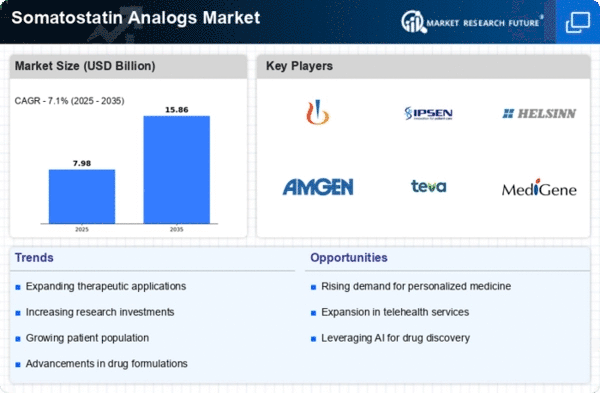
As per MRFR analysis, the Somatostatin Analogs Market Size was estimated at 7.45 USD Billion in 2024. The Somatostatin Analogs industry is projected to grow from 7.98 USD Billion in 2025 to 15.86 USD Billion by 2035, exhibiting a compound annual growth rate (CAGR) of 7.1% during the forecast period 2025 - 2035.

Key Market Trends & Highlights

The Somatostatin Analogs Market is poised for substantial growth driven by increasing prevalence of endocrine disorders and advancements in drug delivery technologies.

  • The market is witnessing a rising prevalence of endocrine disorders, particularly in North America, which remains the largest market. Advancements in drug formulations are enhancing treatment efficacy, especially in the acromegaly segment, which is currently the largest. The Asia-Pacific region is emerging as the fastest-growing market, driven by increasing awareness and diagnosis of hormonal disorders. Key market drivers include the rising incidence of neuroendocrine tumors and regulatory support for innovative therapies, fueling growth in both subcutaneous and intravenous segments.

Market Size & Forecast

2024 Market Size 7.45 (USD Billion)
2035 Market Size 15.86 (USD Billion)
CAGR (2025 - 2035) 7.1%
Largest Regional Market Share in 2024 North America

Major Players

<a title="Novartis" href="https://www.novartis.com/sg-en/sites/novartis_sg/files/SandostatinLAR-Feb2023.SINv1-app270824-pdf.pdf" target="_blank" rel="noopener">Novartis</a> (CH), Ipsen (FR), Helsinn Healthcare (CH), Amgen (US), Teva Pharmaceutical Industries (IL), MediGene AG (DE), Sandoz (CH), Boehringer Ingelheim (DE), Eisai Co., Ltd. (JP)

Market Trends

The Somatostatin Analogs Market is currently experiencing a notable evolution, driven by increasing awareness of the therapeutic benefits associated with these compounds. These analogs, which mimic the action of somatostatin, are primarily utilized in the treatment of various endocrine disorders, including acromegaly and neuroendocrine tumors. The growing prevalence of such conditions, coupled with advancements in drug formulations, appears to be propelling market growth. Furthermore, the rising demand for targeted therapies in oncology suggests a shift towards more specialized treatment options, which may enhance the market's trajectory. In addition, the Somatostatin Analogs Market is likely to benefit from ongoing research and development initiatives aimed at improving the efficacy and safety profiles of these medications. Collaborations between pharmaceutical companies and research institutions may lead to innovative delivery methods and formulations, potentially expanding the therapeutic applications of somatostatin analogs. As healthcare systems increasingly prioritize personalized medicine, the market could witness a surge in tailored treatment regimens that incorporate these analogs, thereby enhancing patient outcomes and satisfaction.

Rising Prevalence of Endocrine Disorders

The increasing incidence of endocrine disorders, such as acromegaly and neuroendocrine tumors, is driving demand for somatostatin analogs. As awareness of these conditions grows, healthcare providers are more likely to prescribe these therapies, contributing to market expansion.

Advancements in Drug Formulations

Innovations in drug formulations are enhancing the effectiveness and safety of somatostatin analogs. These advancements may lead to improved patient compliance and outcomes, thereby fostering a more favorable market environment.

Focus on Personalized Medicine

The shift towards personalized medicine is influencing treatment approaches in the Somatostatin Analogs Market. Tailored therapies that incorporate somatostatin analogs are likely to gain traction, as they offer potential benefits in managing complex endocrine disorders.

Somatostatin Analogs Market Market Drivers

Rising Geriatric Population

The Global Somatostatin Analogs Market Industry is experiencing growth due to the rising geriatric population, which is more susceptible to hormonal disorders and related health issues. As the global population ages, the demand for effective treatment options, including somatostatin analogs, is expected to increase significantly. This demographic shift is particularly pronounced in developed countries, where healthcare systems are adapting to cater to the needs of older adults. Consequently, the market is likely to expand as healthcare providers seek to address the unique health challenges faced by this population. The increasing prevalence of age-related conditions further underscores the importance of somatostatin analogs in modern medicine.

Advancements in Drug Formulations

Innovations in drug formulations are propelling the Global Somatostatin Analogs Market Industry forward. Enhanced delivery mechanisms and improved pharmacokinetics are making somatostatin analogs more effective and patient-friendly. For example, the development of long-acting formulations allows for less frequent dosing, which is appealing to patients and healthcare providers alike. This trend is expected to contribute to the market's growth, with projections indicating a rise to 15.9 USD Billion by 2035. As pharmaceutical companies invest in research and development to create superior formulations, the market for somatostatin analogs is likely to benefit from increased adoption and patient compliance.

Rising Prevalence of Hormonal Disorders

The Global Somatostatin Analogs Market Industry is witnessing growth due to the increasing prevalence of hormonal disorders such as acromegaly and neuroendocrine tumors. These conditions necessitate effective treatment options, which somatostatin analogs provide. For instance, the market is projected to reach 7.45 USD Billion in 2024, reflecting a heightened demand for these therapeutic agents. As healthcare systems globally prioritize the management of such disorders, the adoption of somatostatin analogs is likely to rise, thereby driving market expansion. Furthermore, the increasing awareness among healthcare professionals about the efficacy of these drugs contributes to their growing utilization in clinical settings.

Increasing Research and Development Activities

The Global Somatostatin Analogs Market Industry is significantly driven by increasing research and development activities aimed at discovering new therapeutic applications for somatostatin analogs. Ongoing clinical trials and studies are exploring their potential in treating various conditions beyond hormonal disorders, such as certain types of cancers and gastrointestinal diseases. This expanding research landscape is likely to enhance the market's growth trajectory, as new indications could lead to broader usage of these drugs. The commitment to R&D in this field suggests a promising future for somatostatin analogs, potentially increasing their market share and relevance in the pharmaceutical industry.

Growing Investment in Healthcare Infrastructure

The Global Somatostatin Analogs Market Industry is also influenced by the growing investment in healthcare infrastructure across various regions. Governments and private entities are increasingly allocating resources to enhance healthcare facilities, which facilitates better access to advanced treatment options, including somatostatin analogs. This trend is particularly evident in developing countries, where healthcare systems are evolving rapidly. As a result, the market is projected to experience a compound annual growth rate (CAGR) of 7.1% from 2025 to 2035. Improved healthcare infrastructure not only enhances the availability of these drugs but also promotes awareness and education regarding their benefits.

Market Segment Insights

By Application: Acromegaly (Largest) vs. Neuroendocrine Tumors (Fastest-Growing)

The Somatostatin Analogs Market is prominently driven by its application in treating Acromegaly, which holds the largest share among different applications. This condition requires continuous management through hormonal therapies, specifically Somatostatin analogs, contributing significantly to market dynamics. On the other hand, Neuroendocrine Tumors represent the fastest-growing segment within this market. The increasing prevalence of these tumors, alongside rising awareness and advances in treatment options, is propelling the demand for effective Somatostatin therapies in this area.

Acromegaly (Dominant) vs. Neuroendocrine Tumors (Emerging)

Acromegaly remains the dominant application segment due to its extensive treatment requirements and established use of Somatostatin analogs in therapy. This condition is characterized by excess growth hormone production, necessitating reliable and long-term therapy. In contrast, Neuroendocrine Tumors are emerging rapidly in clinical focus, characterized by their complex nature, often leading to aggressive treatment protocols. The heightened research interest and clinical trials in this domain emphasize the evolving role of Somatostatin analogs as essential therapeutic agents, addressing unmet medical needs in tumor management.

By Route of Administration: Subcutaneous (Largest) vs. Intravenous (Fastest-Growing)

In the Somatostatin Analogs Market, Subcutaneous administration currently holds the largest market share, largely due to patient preference for self-administration and the convenience it offers. This method is widely adopted for its ease of use and effectiveness, allowing patients to manage their treatment regimens at home. On the other hand, Intravenous administration, while representing a smaller share, is registered as the fastest-growing segment, driven by its rapid action and essential use in clinical settings, particularly in acute care situations.

Subcutaneous (Dominant) vs. Intravenous (Emerging)

Subcutaneous administration of somatostatin analogs is recognized as the dominant method, appealing to patients seeking ease and convenience in their treatment plans. This route allows for self-injection, leading to greater patient autonomy and satisfaction. Conversely, the Intravenous route is gaining traction as an emerging segment due to its necessity in hospital environments for immediate therapeutic effects. The rising complexity of treatments and increasing prevalence of diseases requiring somatostatin analogs contribute to its accelerating adoption in hospitals, highlighting its essential role in effective patient management.

By End User: Hospitals (Largest) vs. Clinics (Fastest-Growing)

In the Somatostatin Analogs Market, hospitals dominate the end user segment, capturing the largest share due to their comprehensive facilities and specialized healthcare services. This setting is pivotal as it provides a range of somatostatin analog therapies, particularly for complicated cases, thus significantly driving demand. Clinics, although smaller in market share, are emerging strongly due to their accessibility and focus on outpatient care, making them a critical player in growing this market segment.

Hospitals (Dominant) vs. Clinics (Emerging)

Hospitals play a dominant role in the Somatostatin Analogs Market, offering specialized services to patients requiring advanced therapeutic options. These institutions are equipped with extensive resources, knowledge, and staffing to manage complex cases, thus ensuring a higher utilization of somatostatin analogs. Conversely, clinics are proving to be an emerging segment, primarily driven by the shift towards outpatient care and preventive healthcare. These facilities cater to a diverse patient demographic and often implement cost-effective treatment protocols, making them increasingly relevant in the market landscape. Their growth is fueled by rising patient awareness and preference for accessible healthcare services.

By Distribution Channel: Pharmacies (Largest) vs. Online Pharmacies (Fastest-Growing)

In the Somatostatin Analogs Market, pharmacies hold the largest share among distribution channels, driven by traditional practices and established networks with healthcare providers. Their extensive reach allows them to cater to a broad patient base seeking treatments. Conversely, online pharmacies are gaining momentum, capturing a significant share of tech-savvy consumers who prefer the convenience and accessibility of online platforms. This shift indicates the diversification of distribution methods in response to evolving consumer preferences.

Pharmacies (Dominant) vs. Online Pharmacies (Emerging)

Pharmacies have solidified their dominant position in the Somatostatin Analogs Market by leveraging traditional retail strategies. They benefit from established relationships with healthcare providers, ensuring a steady flow of prescriptions for somatostatin analogs. In contrast, online pharmacies represent an emerging force, gaining traction among patients who prioritize convenience, discretion, and ease of access. Their growth is supported by innovations in e-commerce, allowing them to offer services like home delivery and telepharmacy consultations, making them an attractive option for a growing number of consumers.

Get more detailed insights about Somatostatin Analogs Market Research Report - Global Forecast till 2035

Regional Insights

North America : Market Leader in Innovation

North America continues to lead the Somatostatin Analogs market, holding a significant share of 3.5 billion in 2024. The growth is driven by increasing incidences of neuroendocrine tumors and advancements in drug formulations. Regulatory support from agencies like the FDA has accelerated the approval of new therapies, enhancing market dynamics. The rising awareness of treatment options further fuels demand, positioning North America as a pivotal region in this sector. The competitive landscape is characterized by major players such as Novartis, Amgen, and Ipsen, who are actively investing in research and development. The U.S. remains the largest market, supported by a robust healthcare infrastructure and high healthcare expenditure. The presence of leading pharmaceutical companies ensures a steady supply of innovative treatments, making North America a hub for Somatostatin Analogs.

Europe : Emerging Market with Growth Potential

Europe's Somatostatin Analogs market is valued at €2.0 billion, reflecting a growing demand driven by increasing healthcare investments and a rise in chronic diseases. The region benefits from strong regulatory frameworks that facilitate drug approvals, enhancing market access for innovative therapies. Countries like Germany and France are at the forefront, with supportive healthcare policies that promote the use of advanced treatments, contributing to market growth. The competitive landscape features key players such as Ipsen and Helsinn Healthcare, who are expanding their portfolios through strategic partnerships and acquisitions. The presence of a well-established healthcare system in Europe allows for effective distribution and accessibility of Somatostatin Analogs. As the market evolves, ongoing research and development efforts are expected to introduce new therapies, further solidifying Europe's position in the global market.

Asia-Pacific : Rapidly Growing Market Landscape

The Asia-Pacific region, valued at $1.7 billion, is witnessing rapid growth in the Somatostatin Analogs market, driven by increasing healthcare awareness and rising incidences of related diseases. Countries like Japan and Australia are leading the charge, supported by government initiatives aimed at enhancing healthcare infrastructure. The region's growing middle class is also contributing to increased healthcare spending, which is vital for market expansion. The competitive landscape is evolving, with key players like Eisai Co., Ltd. and Teva Pharmaceutical Industries making significant inroads. The presence of these companies, along with local manufacturers, is fostering a competitive environment that encourages innovation. As regulatory bodies streamline approval processes, the market is expected to see a surge in new product launches, further enhancing its growth trajectory.

Middle East and Africa : Emerging Market with Challenges

The Middle East and Africa (MEA) region, with a market size of $0.25 billion, is gradually emerging in the Somatostatin Analogs sector. The growth is primarily driven by increasing healthcare investments and a rising prevalence of chronic diseases. However, challenges such as limited access to healthcare and regulatory hurdles can impede market growth. Countries like South Africa and the UAE are making strides in improving healthcare infrastructure, which is essential for market development. The competitive landscape is still developing, with a few key players like MediGene AG and Sandoz beginning to establish their presence. The region's market is characterized by a mix of local and international companies, which is crucial for fostering competition. As healthcare policies evolve and access improves, the MEA region is poised for gradual growth in the Somatostatin Analogs market.

Key Players and Competitive Insights

The Somatostatin Analogs Market is characterized by a dynamic competitive landscape, driven by increasing demand for targeted therapies in the treatment of neuroendocrine tumors and acromegaly. Key players such as Novartis (CH), Ipsen (FR), and Amgen (US) are strategically positioned to leverage their extensive research and development capabilities, focusing on innovation and expanding their product portfolios. These companies are actively pursuing partnerships and collaborations to enhance their market presence, which collectively shapes a competitive environment that is both robust and evolving.In terms of business tactics, companies are increasingly localizing manufacturing and optimizing supply chains to enhance efficiency and reduce costs. The market structure appears moderately fragmented, with several players vying for market share. However, the influence of major companies like Novartis (CH) and Ipsen (FR) is substantial, as they continue to set benchmarks for quality and innovation in the sector.
In November Novartis (CH) announced a strategic partnership with a leading biotechnology firm to co-develop a next-generation somatostatin analog aimed at improving patient outcomes in neuroendocrine tumors. This collaboration is expected to enhance Novartis's research capabilities and accelerate the development timeline, indicating a strong commitment to innovation and patient-centric solutions.
In October Ipsen (FR) launched a new digital platform designed to facilitate real-time data sharing among healthcare providers and patients using their somatostatin analogs. This initiative not only enhances patient engagement but also positions Ipsen as a leader in digital transformation within the pharmaceutical industry, potentially improving treatment adherence and outcomes.
In September Amgen (US) expanded its manufacturing capabilities in Europe, investing €50 million to enhance production efficiency for its somatostatin analogs. This move reflects Amgen's strategy to meet growing global demand while ensuring supply chain reliability, which is increasingly critical in today's market environment.
As of December current trends in the Somatostatin Analogs Market indicate a shift towards digitalization, sustainability, and the integration of artificial intelligence in drug development processes. Strategic alliances are becoming more prevalent, as companies recognize the value of collaboration in navigating complex regulatory landscapes and accelerating innovation. Looking ahead, competitive differentiation is likely to evolve from traditional price-based competition to a focus on technological advancements, innovative therapies, and reliable supply chains, underscoring the importance of adaptability in a rapidly changing market.

Key Companies in the Somatostatin Analogs Market include

Industry Developments

  • Q2 2025: Exelixis, Inc. announced that the U.S. Food and Drug Administration (FDA) has approved CABOMETYX (cabozantinib) for the treatment of adult and pediatric patients 12 years of age and older with previously treated, unresectable, locally advanced or metastatic, well-differentiated pancreatic neuroendocrine tumors (pNET); and extra-pancreatic NET (epNET). Exelixis received FDA approval for CABOMETYX (cabozantinib) for certain neuroendocrine tumors, expanding treatment options in the somatostatin analogs market.

Future Outlook

Somatostatin Analogs Market Future Outlook

The Somatostatin Analogs Market is projected to grow at a 7.1% CAGR from 2025 to 2035, driven by increasing prevalence of neuroendocrine tumors and advancements in drug formulations.

New opportunities lie in:

  • <p>Expansion into emerging markets with tailored pricing strategies. Development of combination therapies to enhance treatment efficacy. Investment in digital health platforms for patient monitoring and adherence.</p>

By 2035, the Somatostatin Analogs Market is expected to achieve substantial growth and innovation.

Market Segmentation

Somatostatin Analogs Market End User Outlook

  • Hospitals
  • Specialty Clinics
  • Homecare Settings

Somatostatin Analogs Market Application Outlook

  • Acromegaly
  • Neuroendocrine Tumors
  • Gastrointestinal Disorders
  • Pancreatic Disorders

Somatostatin Analogs Market Distribution Channel Outlook

  • Direct Sales
  • Pharmacies
  • Online Sales

Somatostatin Analogs Market Route of Administration Outlook

  • Subcutaneous
  • Intravenous
  • Oral

Report Scope

MARKET SIZE 2024 7.45(USD Billion)
MARKET SIZE 2025 7.98(USD Billion)
MARKET SIZE 2035 15.86(USD Billion)
COMPOUND ANNUAL GROWTH RATE (CAGR) 7.1% (2025 - 2035)
REPORT COVERAGE Revenue Forecast, Competitive Landscape, Growth Factors, and Trends
BASE YEAR 2024
Market Forecast Period 2025 - 2035
Historical Data 2019 - 2024
Market Forecast Units USD Billion
Key Companies Profiled Novartis (CH), Ipsen (FR), Helsinn Healthcare (CH), Amgen (US), Teva Pharmaceutical Industries (IL), MediGene AG (DE), Sandoz (CH), Boehringer Ingelheim (DE), Eisai Co., Ltd. (JP)
Segments Covered Application, Route of Administration, End User, Distribution Channel
Key Market Opportunities Advancements in targeted therapies enhance growth potential in the Somatostatin Analogs Market.
Key Market Dynamics Rising demand for somatostatin analogs driven by increasing prevalence of neuroendocrine tumors and related disorders.
Countries Covered North America, Europe, APAC, South America, MEA

FAQs

What is the current valuation of the Somatostatin Analogs Market as of 2024?

<p>The Somatostatin Analogs Market was valued at 7.45 USD Billion in 2024.</p>

What is the projected market size for the Somatostatin Analogs Market in 2035?

<p>The market is expected to reach a valuation of 15.86 USD Billion by 2035.</p>

What is the expected CAGR for the Somatostatin Analogs Market during the forecast period 2025 - 2035?

<p>The market is anticipated to grow at a CAGR of 7.1% from 2025 to 2035.</p>

Which application segment is projected to have the highest growth in the Somatostatin Analogs Market?

<p>The Neuroendocrine Tumors segment is projected to grow from 2.5 USD Billion to 5.5 USD Billion.</p>

How does the market for Acromegaly treatments compare to other applications?

<p>The Acromegaly segment is expected to increase from 1.5 USD Billion to 3.2 USD Billion, indicating substantial growth.</p>

What are the leading routes of administration for Somatostatin Analogs?

<p>The Oral route is projected to grow from 2.95 USD Billion to 6.36 USD Billion, indicating a strong preference.</p>

Which end-user segment is expected to dominate the Somatostatin Analogs Market?

Hospitals are projected to lead, with growth from 2.5 USD Billion to 5.3 USD Billion.

What distribution channel is anticipated to show the most growth in the Somatostatin Analogs Market?

Pharmacies are expected to grow from 3.0 USD Billion to 6.5 USD Billion, reflecting a robust demand.

Who are the key players in the Somatostatin Analogs Market?

Key players include Novartis, Ipsen, Hikma Pharmaceuticals, and Amgen, among others.

What trends are influencing the growth of the Somatostatin Analogs Market?

Increasing prevalence of related disorders and advancements in drug formulations are likely driving market growth.

  1. SECTION I: EXECUTIVE SUMMARY AND KEY HIGHLIGHTS |
    1. EXECUTIVE SUMMARY | |
      1. Market Overview | |
      2. Key Findings | |
      3. Market Segmentation | |
      4. Competitive Landscape | |
      5. Challenges and Opportunities | |
      6. Future Outlook 2
  2. SECTION II: SCOPING, METHODOLOGY AND MARKET STRUCTURE |
    1. MARKET INTRODUCTION | |
      1. Definition | |
      2. Scope of the study | | |
    2. RESEARCH METHODOLOGY | |
      1. Overview | |
      2. Data Mining | |
      3. Secondary Research | |
      4. Primary Research | | |
      5. Forecasting Model | |
      6. Market Size Estimation | | |
      7. Data Triangulation | |
      8. Validation 3
  3. SECTION III: QUALITATIVE ANALYSIS |
    1. MARKET DYNAMICS | |
      1. Overview | |
      2. Drivers | |
      3. Restraints | |
      4. Opportunities |
    2. MARKET FACTOR ANALYSIS | |
      1. Value chain Analysis | |
      2. Porter's Five Forces Analysis | | |
      3. COVID-19 Impact Analysis | | |
  4. SECTION IV: QUANTITATIVE ANALYSIS |
    1. Healthcare, BY Application (USD Billion) | |
      1. Acromegaly | |
      2. Neuroendocrine Tumors | |
      3. Gastrointestinal Disorders | |
      4. Pancreatic Disorders |
    2. Healthcare, BY Route of Administration (USD Billion) | |
      1. Subcutaneous | |
      2. Intravenous | |
      3. Oral |
    3. Healthcare, BY End User (USD Billion) | |
      1. Hospitals | |
      2. Clinics | |
      3. Homecare Settings | |
      4. Research Institutions |
    4. Healthcare, BY Distribution Channel (USD Billion) | |
      1. Pharmacies | |
      2. Online Pharmacies | |
      3. Hospital Pharmacies |
    5. Healthcare, BY Region (USD Billion) | |
      1. North America | | |
      2. Europe | | |
      3. APAC | | |
      4. South America | | |
      5. MEA | | |
  5. SECTION V: COMPETITIVE ANALYSIS |
    1. Competitive Landscape | |
      1. Overview | |
      2. Competitive Analysis | |
      3. Market share Analysis | |
      4. Major Growth Strategy in the Healthcare | |
      5. Competitive Benchmarking | |
      6. Leading Players in Terms of Number of Developments in the Healthcare | |
      7. Key developments and growth strategies | | |
      8. Major Players Financial Matrix | | |
    2. Company Profiles | |
      1. Novartis (CH) | | |
      2. Ipsen (FR) | | |
      3. Hikma Pharmaceuticals (GB) | | |
      4. Amgen (US) | | |
      5. Teva Pharmaceutical Industries (IL) | | |
      6. Mylan (US) | | |
      7. Recordati (IT) | | |
      8. Sandoz (DE) | | |
      9. Boehringer Ingelheim (DE) | | |
    3. Appendix | |
      1. References | |
      2. Related Reports 6 LIST OF FIGURES |
    4. MARKET SYNOPSIS |
    5. NORTH AMERICA MARKET ANALYSIS |
    6. US MARKET ANALYSIS BY APPLICATION |
    7. US MARKET ANALYSIS BY ROUTE OF ADMINISTRATION |
    8. US MARKET ANALYSIS BY END USER |
    9. US MARKET ANALYSIS BY DISTRIBUTION CHANNEL |
    10. CANADA MARKET ANALYSIS BY APPLICATION |
    11. CANADA MARKET ANALYSIS BY ROUTE OF ADMINISTRATION |
    12. CANADA MARKET ANALYSIS BY END USER |
    13. CANADA MARKET ANALYSIS BY DISTRIBUTION CHANNEL |
    14. EUROPE MARKET ANALYSIS |
    15. GERMANY MARKET ANALYSIS BY APPLICATION |
    16. GERMANY MARKET ANALYSIS BY ROUTE OF ADMINISTRATION |
    17. GERMANY MARKET ANALYSIS BY END USER |
    18. GERMANY MARKET ANALYSIS BY DISTRIBUTION CHANNEL |
    19. UK MARKET ANALYSIS BY APPLICATION |
    20. UK MARKET ANALYSIS BY ROUTE OF ADMINISTRATION |
    21. UK MARKET ANALYSIS BY END USER |
    22. UK MARKET ANALYSIS BY DISTRIBUTION CHANNEL |
    23. FRANCE MARKET ANALYSIS BY APPLICATION |
    24. FRANCE MARKET ANALYSIS BY ROUTE OF ADMINISTRATION |
    25. FRANCE MARKET ANALYSIS BY END USER |
    26. FRANCE MARKET ANALYSIS BY DISTRIBUTION CHANNEL |
    27. RUSSIA MARKET ANALYSIS BY APPLICATION |
    28. RUSSIA MARKET ANALYSIS BY ROUTE OF ADMINISTRATION |
    29. RUSSIA MARKET ANALYSIS BY END USER |
    30. RUSSIA MARKET ANALYSIS BY DISTRIBUTION CHANNEL |
    31. ITALY MARKET ANALYSIS BY APPLICATION |
    32. ITALY MARKET ANALYSIS BY ROUTE OF ADMINISTRATION |
    33. ITALY MARKET ANALYSIS BY END USER |
    34. ITALY MARKET ANALYSIS BY DISTRIBUTION CHANNEL |
    35. SPAIN MARKET ANALYSIS BY APPLICATION |
    36. SPAIN MARKET ANALYSIS BY ROUTE OF ADMINISTRATION |
    37. SPAIN MARKET ANALYSIS BY END USER |
    38. SPAIN MARKET ANALYSIS BY DISTRIBUTION CHANNEL |
    39. REST OF EUROPE MARKET ANALYSIS BY APPLICATION |
    40. REST OF EUROPE MARKET ANALYSIS BY ROUTE OF ADMINISTRATION |
    41. REST OF EUROPE MARKET ANALYSIS BY END USER |
    42. REST OF EUROPE MARKET ANALYSIS BY DISTRIBUTION CHANNEL |
    43. APAC MARKET ANALYSIS |
    44. CHINA MARKET ANALYSIS BY APPLICATION |
    45. CHINA MARKET ANALYSIS BY ROUTE OF ADMINISTRATION |
    46. CHINA MARKET ANALYSIS BY END USER |
    47. CHINA MARKET ANALYSIS BY DISTRIBUTION CHANNEL |
    48. INDIA MARKET ANALYSIS BY APPLICATION |
    49. INDIA MARKET ANALYSIS BY ROUTE OF ADMINISTRATION |
    50. INDIA MARKET ANALYSIS BY END USER |
    51. INDIA MARKET ANALYSIS BY DISTRIBUTION CHANNEL |
    52. JAPAN MARKET ANALYSIS BY APPLICATION |
    53. JAPAN MARKET ANALYSIS BY ROUTE OF ADMINISTRATION |
    54. JAPAN MARKET ANALYSIS BY END USER |
    55. JAPAN MARKET ANALYSIS BY DISTRIBUTION CHANNEL |
    56. SOUTH KOREA MARKET ANALYSIS BY APPLICATION |
    57. SOUTH KOREA MARKET ANALYSIS BY ROUTE OF ADMINISTRATION |
    58. SOUTH KOREA MARKET ANALYSIS BY END USER |
    59. SOUTH KOREA MARKET ANALYSIS BY DISTRIBUTION CHANNEL |
    60. MALAYSIA MARKET ANALYSIS BY APPLICATION |
    61. MALAYSIA MARKET ANALYSIS BY ROUTE OF ADMINISTRATION |
    62. MALAYSIA MARKET ANALYSIS BY END USER |
    63. MALAYSIA MARKET ANALYSIS BY DISTRIBUTION CHANNEL |
    64. THAILAND MARKET ANALYSIS BY APPLICATION |
    65. THAILAND MARKET ANALYSIS BY ROUTE OF ADMINISTRATION |
    66. THAILAND MARKET ANALYSIS BY END USER |
    67. THAILAND MARKET ANALYSIS BY DISTRIBUTION CHANNEL |
    68. INDONESIA MARKET ANALYSIS BY APPLICATION |
    69. INDONESIA MARKET ANALYSIS BY ROUTE OF ADMINISTRATION |
    70. INDONESIA MARKET ANALYSIS BY END USER |
    71. INDONESIA MARKET ANALYSIS BY DISTRIBUTION CHANNEL |
    72. REST OF APAC MARKET ANALYSIS BY APPLICATION |
    73. REST OF APAC MARKET ANALYSIS BY ROUTE OF ADMINISTRATION |
    74. REST OF APAC MARKET ANALYSIS BY END USER |
    75. REST OF APAC MARKET ANALYSIS BY DISTRIBUTION CHANNEL |
    76. SOUTH AMERICA MARKET ANALYSIS |
    77. BRAZIL MARKET ANALYSIS BY APPLICATION |
    78. BRAZIL MARKET ANALYSIS BY ROUTE OF ADMINISTRATION |
    79. BRAZIL MARKET ANALYSIS BY END USER |
    80. BRAZIL MARKET ANALYSIS BY DISTRIBUTION CHANNEL |
    81. MEXICO MARKET ANALYSIS BY APPLICATION |
    82. MEXICO MARKET ANALYSIS BY ROUTE OF ADMINISTRATION |
    83. MEXICO MARKET ANALYSIS BY END USER |
    84. MEXICO MARKET ANALYSIS BY DISTRIBUTION CHANNEL |
    85. ARGENTINA MARKET ANALYSIS BY APPLICATION |
    86. ARGENTINA MARKET ANALYSIS BY ROUTE OF ADMINISTRATION |
    87. ARGENTINA MARKET ANALYSIS BY END USER |
    88. ARGENTINA MARKET ANALYSIS BY DISTRIBUTION CHANNEL |
    89. REST OF SOUTH AMERICA MARKET ANALYSIS BY APPLICATION |
    90. REST OF SOUTH AMERICA MARKET ANALYSIS BY ROUTE OF ADMINISTRATION |
    91. REST OF SOUTH AMERICA MARKET ANALYSIS BY END USER |
    92. REST OF SOUTH AMERICA MARKET ANALYSIS BY DISTRIBUTION CHANNEL |
    93. MEA MARKET ANALYSIS |
    94. GCC COUNTRIES MARKET ANALYSIS BY APPLICATION |
    95. GCC COUNTRIES MARKET ANALYSIS BY ROUTE OF ADMINISTRATION |
    96. GCC COUNTRIES MARKET ANALYSIS BY END USER |
    97. GCC COUNTRIES MARKET ANALYSIS BY DISTRIBUTION CHANNEL |
    98. SOUTH AFRICA MARKET ANALYSIS BY APPLICATION |
    99. SOUTH AFRICA MARKET ANALYSIS BY ROUTE OF ADMINISTRATION |
    100. SOUTH AFRICA MARKET ANALYSIS BY END USER |
    101. SOUTH AFRICA MARKET ANALYSIS BY DISTRIBUTION CHANNEL |
    102. REST OF MEA MARKET ANALYSIS BY APPLICATION |
    103. REST OF MEA MARKET ANALYSIS BY ROUTE OF ADMINISTRATION |
    104. REST OF MEA MARKET ANALYSIS BY END USER |
    105. REST OF MEA MARKET ANALYSIS BY DISTRIBUTION CHANNEL |
    106. KEY BUYING CRITERIA OF HEALTHCARE |
    107. RESEARCH PROCESS OF MRFR |
    108. DRO ANALYSIS OF HEALTHCARE |
    109. DRIVERS IMPACT ANALYSIS: HEALTHCARE |
    110. RESTRAINTS IMPACT ANALYSIS: HEALTHCARE |
    111. SUPPLY / VALUE CHAIN: HEALTHCARE |
    112. HEALTHCARE, BY APPLICATION, 2024 (% SHARE) |
    113. HEALTHCARE, BY APPLICATION, 2024 TO 2035 (USD Billion) |
    114. HEALTHCARE, BY ROUTE OF ADMINISTRATION, 2024 (% SHARE) |
    115. HEALTHCARE, BY ROUTE OF ADMINISTRATION, 2024 TO 2035 (USD Billion) |
    116. HEALTHCARE, BY END USER, 2024 (% SHARE) |
    117. HEALTHCARE, BY END USER, 2024 TO 2035 (USD Billion) |
    118. HEALTHCARE, BY DISTRIBUTION CHANNEL, 2024 (% SHARE) |
    119. HEALTHCARE, BY DISTRIBUTION CHANNEL, 2024 TO 2035 (USD Billion) |
    120. BENCHMARKING OF MAJOR COMPETITORS 7 LIST OF TABLES |
    121. LIST OF ASSUMPTIONS | |
      1. |
    122. North America MARKET SIZE ESTIMATES; FORECAST | |
      1. BY APPLICATION, 2025-2035 (USD Billion) | |
      2. BY ROUTE OF ADMINISTRATION, 2025-2035 (USD Billion) | |
      3. BY END USER, 2025-2035 (USD Billion) | |
      4. BY DISTRIBUTION CHANNEL, 2025-2035 (USD Billion) |
    123. US MARKET SIZE ESTIMATES; FORECAST | |
      1. BY APPLICATION, 2025-2035 (USD Billion) | |
      2. BY ROUTE OF ADMINISTRATION, 2025-2035 (USD Billion) | |
      3. BY END USER, 2025-2035 (USD Billion) | |
      4. BY DISTRIBUTION CHANNEL, 2025-2035 (USD Billion) |
    124. Canada MARKET SIZE ESTIMATES; FORECAST | |
      1. BY APPLICATION, 2025-2035 (USD Billion) | |
      2. BY ROUTE OF ADMINISTRATION, 2025-2035 (USD Billion) | |
      3. BY END USER, 2025-2035 (USD Billion) | |
      4. BY DISTRIBUTION CHANNEL, 2025-2035 (USD Billion) |
    125. Europe MARKET SIZE ESTIMATES; FORECAST | |
      1. BY APPLICATION, 2025-2035 (USD Billion) | |
      2. BY ROUTE OF ADMINISTRATION, 2025-2035 (USD Billion) | |
      3. BY END USER, 2025-2035 (USD Billion) | |
      4. BY DISTRIBUTION CHANNEL, 2025-2035 (USD Billion) |
    126. Germany MARKET SIZE ESTIMATES; FORECAST | |
      1. BY APPLICATION, 2025-2035 (USD Billion) | |
      2. BY ROUTE OF ADMINISTRATION, 2025-2035 (USD Billion) | |
      3. BY END USER, 2025-2035 (USD Billion) | |
      4. BY DISTRIBUTION CHANNEL, 2025-2035 (USD Billion) |
    127. UK MARKET SIZE ESTIMATES; FORECAST | |
      1. BY APPLICATION, 2025-2035 (USD Billion) | |
      2. BY ROUTE OF ADMINISTRATION, 2025-2035 (USD Billion) | |
      3. BY END USER, 2025-2035 (USD Billion) | |
      4. BY DISTRIBUTION CHANNEL, 2025-2035 (USD Billion) |
    128. France MARKET SIZE ESTIMATES; FORECAST | |
      1. BY APPLICATION, 2025-2035 (USD Billion) | |
      2. BY ROUTE OF ADMINISTRATION, 2025-2035 (USD Billion) | |
      3. BY END USER, 2025-2035 (USD Billion) | |
      4. BY DISTRIBUTION CHANNEL, 2025-2035 (USD Billion) |
    129. Russia MARKET SIZE ESTIMATES; FORECAST | |
      1. BY APPLICATION, 2025-2035 (USD Billion) | |
      2. BY ROUTE OF ADMINISTRATION, 2025-2035 (USD Billion) | |
      3. BY END USER, 2025-2035 (USD Billion) | |
      4. BY DISTRIBUTION CHANNEL, 2025-2035 (USD Billion) |
    130. Italy MARKET SIZE ESTIMATES; FORECAST | |
      1. BY APPLICATION, 2025-2035 (USD Billion) | |
      2. BY ROUTE OF ADMINISTRATION, 2025-2035 (USD Billion) | |
      3. BY END USER, 2025-2035 (USD Billion) | |
      4. BY DISTRIBUTION CHANNEL, 2025-2035 (USD Billion) |
    131. Spain MARKET SIZE ESTIMATES; FORECAST | |
      1. BY APPLICATION, 2025-2035 (USD Billion) | |
      2. BY ROUTE OF ADMINISTRATION, 2025-2035 (USD Billion) | |
      3. BY END USER, 2025-2035 (USD Billion) | |
      4. BY DISTRIBUTION CHANNEL, 2025-2035 (USD Billion) |
    132. Rest of Europe MARKET SIZE ESTIMATES; FORECAST | |
      1. BY APPLICATION, 2025-2035 (USD Billion) | |
      2. BY ROUTE OF ADMINISTRATION, 2025-2035 (USD Billion) | |
      3. BY END USER, 2025-2035 (USD Billion) | |
      4. BY DISTRIBUTION CHANNEL, 2025-2035 (USD Billion) |
    133. APAC MARKET SIZE ESTIMATES; FORECAST | |
      1. BY APPLICATION, 2025-2035 (USD Billion) | |
      2. BY ROUTE OF ADMINISTRATION, 2025-2035 (USD Billion) | |
      3. BY END USER, 2025-2035 (USD Billion) | |
      4. BY DISTRIBUTION CHANNEL, 2025-2035 (USD Billion) |
    134. China MARKET SIZE ESTIMATES; FORECAST | |
      1. BY APPLICATION, 2025-2035 (USD Billion) | |
      2. BY ROUTE OF ADMINISTRATION, 2025-2035 (USD Billion) | |
      3. BY END USER, 2025-2035 (USD Billion) | |
      4. BY DISTRIBUTION CHANNEL, 2025-2035 (USD Billion) |
    135. India MARKET SIZE ESTIMATES; FORECAST | |
      1. BY APPLICATION, 2025-2035 (USD Billion) | |
      2. BY ROUTE OF ADMINISTRATION, 2025-2035 (USD Billion) | |
      3. BY END USER, 2025-2035 (USD Billion) | |
      4. BY DISTRIBUTION CHANNEL, 2025-2035 (USD Billion) |
    136. Japan MARKET SIZE ESTIMATES; FORECAST | |
      1. BY APPLICATION, 2025-2035 (USD Billion) | |
      2. BY ROUTE OF ADMINISTRATION, 2025-2035 (USD Billion) | |
      3. BY END USER, 2025-2035 (USD Billion) | |
      4. BY DISTRIBUTION CHANNEL, 2025-2035 (USD Billion) |
    137. South Korea MARKET SIZE ESTIMATES; FORECAST | |
      1. BY APPLICATION, 2025-2035 (USD Billion) | |
      2. BY ROUTE OF ADMINISTRATION, 2025-2035 (USD Billion) | |
      3. BY END USER, 2025-2035 (USD Billion) | |
      4. BY DISTRIBUTION CHANNEL, 2025-2035 (USD Billion) |
    138. Malaysia MARKET SIZE ESTIMATES; FORECAST | |
      1. BY APPLICATION, 2025-2035 (USD Billion) | |
      2. BY ROUTE OF ADMINISTRATION, 2025-2035 (USD Billion) | |
      3. BY END USER, 2025-2035 (USD Billion) | |
      4. BY DISTRIBUTION CHANNEL, 2025-2035 (USD Billion) |
    139. Thailand MARKET SIZE ESTIMATES; FORECAST | |
      1. BY APPLICATION, 2025-2035 (USD Billion) | |
      2. BY ROUTE OF ADMINISTRATION, 2025-2035 (USD Billion) | |
      3. BY END USER, 2025-2035 (USD Billion) | |
      4. BY DISTRIBUTION CHANNEL, 2025-2035 (USD Billion) |
    140. Indonesia MARKET SIZE ESTIMATES; FORECAST | |
      1. BY APPLICATION, 2025-2035 (USD Billion) | |
      2. BY ROUTE OF ADMINISTRATION, 2025-2035 (USD Billion) | |
      3. BY END USER, 2025-2035 (USD Billion) | |
      4. BY DISTRIBUTION CHANNEL, 2025-2035 (USD Billion) |
    141. Rest of APAC MARKET SIZE ESTIMATES; FORECAST | |
      1. BY APPLICATION, 2025-2035 (USD Billion) | |
      2. BY ROUTE OF ADMINISTRATION, 2025-2035 (USD Billion) | |
      3. BY END USER, 2025-2035 (USD Billion) | |
      4. BY DISTRIBUTION CHANNEL, 2025-2035 (USD Billion) |
    142. South America MARKET SIZE ESTIMATES; FORECAST | |
      1. BY APPLICATION, 2025-2035 (USD Billion) | |
      2. BY ROUTE OF ADMINISTRATION, 2025-2035 (USD Billion) | |
      3. BY END USER, 2025-2035 (USD Billion) | |
      4. BY DISTRIBUTION CHANNEL, 2025-2035 (USD Billion) |
    143. Brazil MARKET SIZE ESTIMATES; FORECAST | |
      1. BY APPLICATION, 2025-2035 (USD Billion) | |
      2. BY ROUTE OF ADMINISTRATION, 2025-2035 (USD Billion) | |
      3. BY END USER, 2025-2035 (USD Billion) | |
      4. BY DISTRIBUTION CHANNEL, 2025-2035 (USD Billion) |
    144. Mexico MARKET SIZE ESTIMATES; FORECAST | |
      1. BY APPLICATION, 2025-2035 (USD Billion) | |
      2. BY ROUTE OF ADMINISTRATION, 2025-2035 (USD Billion) | |
      3. BY END USER, 2025-2035 (USD Billion) | |
      4. BY DISTRIBUTION CHANNEL, 2025-2035 (USD Billion) |
    145. Argentina MARKET SIZE ESTIMATES; FORECAST | |
      1. BY APPLICATION, 2025-2035 (USD Billion) | |
      2. BY ROUTE OF ADMINISTRATION, 2025-2035 (USD Billion) | |
      3. BY END USER, 2025-2035 (USD Billion) | |
      4. BY DISTRIBUTION CHANNEL, 2025-2035 (USD Billion) |
    146. Rest of South America MARKET SIZE ESTIMATES; FORECAST | |
      1. BY APPLICATION, 2025-2035 (USD Billion) | |
      2. BY ROUTE OF ADMINISTRATION, 2025-2035 (USD Billion) | |
      3. BY END USER, 2025-2035 (USD Billion) | |
      4. BY DISTRIBUTION CHANNEL, 2025-2035 (USD Billion) |
    147. MEA MARKET SIZE ESTIMATES; FORECAST | |
      1. BY APPLICATION, 2025-2035 (USD Billion) | |
      2. BY ROUTE OF ADMINISTRATION, 2025-2035 (USD Billion) | |
      3. BY END USER, 2025-2035 (USD Billion) | |
      4. BY DISTRIBUTION CHANNEL, 2025-2035 (USD Billion) |
    148. GCC Countries MARKET SIZE ESTIMATES; FORECAST | |
      1. BY APPLICATION, 2025-2035 (USD Billion) | |
      2. BY ROUTE OF ADMINISTRATION, 2025-2035 (USD Billion) | |
      3. BY END USER, 2025-2035 (USD Billion) | |
      4. BY DISTRIBUTION CHANNEL, 2025-2035 (USD Billion) |
    149. South Africa MARKET SIZE ESTIMATES; FORECAST | |
      1. BY APPLICATION, 2025-2035 (USD Billion) | |
      2. BY ROUTE OF ADMINISTRATION, 2025-2035 (USD Billion) | |
      3. BY END USER, 2025-2035 (USD Billion) | |
      4. BY DISTRIBUTION CHANNEL, 2025-2035 (USD Billion) |
    150. Rest of MEA MARKET SIZE ESTIMATES; FORECAST | |
      1. BY APPLICATION, 2025-2035 (USD Billion) | |
      2. BY ROUTE OF ADMINISTRATION, 2025-2035 (USD Billion) | |
      3. BY END USER, 2025-2035 (USD Billion) | |
      4. BY DISTRIBUTION CHANNEL, 2025-2035 (USD Billion) |
    151. PRODUCT LAUNCH/PRODUCT DEVELOPMENT/APPROVAL | |
      1. |
    152. ACQUISITION/PARTNERSHIP | |

Healthcare Market Segmentation

Healthcare By Application (USD Billion, 2025-2035)

  • Acromegaly
  • Neuroendocrine Tumors
  • Gastrointestinal Disorders
  • Pancreatic Disorders

Healthcare By Route of Administration (USD Billion, 2025-2035)

  • Subcutaneous
  • Intravenous
  • Oral

Healthcare By End User (USD Billion, 2025-2035)

  • Hospitals
  • Clinics
  • Homecare Settings
  • Research Institutions

Healthcare By Distribution Channel (USD Billion, 2025-2035)

  • Pharmacies
  • Online Pharmacies
  • Hospital Pharmacies
Infographic

Free Sample Request

Kindly complete the form below to receive a free sample of this Report

Get Free Sample

Customer Strories

Compare Licence

×
Features License Type
Single User Multiuser License Enterprise User
Price $4,950 $5,950 $7,250
Maximum User Access Limit 1 User Upto 10 Users Unrestricted Access Throughout the Organization
Free Customization
Direct Access to Analyst
Deliverable Format
Platform Access
Discount on Next Purchase 10% 15% 15%
Printable Versions