Silver Paste Market (2026 - 2035)

Silver Paste Market Research Report Information By Substrate (Ceramic, Glass, Metal, and Polymer), By Composition (Silver Flakes, Silver Nanoparticles, Silver Powders, and Other Compositions), By Application (Photovoltaics, Automotive Electronics and EV Power Modules, Consumer Electronics, Integrated Circuits and Semiconductors, and Other Applications), And By Region (North America, Europe, Asia-Pacific, and Rest of the World) – Market Forecast Till 2035.
ID: MRFR/CnM/29129-HCR 128 Pages Priya Nagrale Last Updated: November 12, 2026
Silver Paste Market
Market Size
Forecast Period2026-2035
CAGR (2026-2035)5.15%
2025 Market SizeUSD 2.90 Billion
2035 Market SizeUSD 4.79 Billion
Key Players
Heraeus Electronics
Changzhou Fusion New Material
DKEM
Henkel
DuPont
Giga Solar Materials
Opportunities
  • Pressureless Sintering for 800 V Platforms
  • Emerging Manufacturing Hubs in India, ASEAN and the Gulf
  • Closed-Loop Silver Recovery and Tolling Models

Silver Paste Market Summary

The global silver paste market was valued at USD 2.90 Billion in 2025 and is projected to reach USD 3.05 Billion in 2026, climbing to USD 4.79 Billion by 2035 at a CAGR of 5.15% over 2026–2035. Two catalysts anchor that trajectory. China connected roughly 277 GW of new solar capacity in 2024, keeping metallization lines across the country close to full utilization [6]. India's second-tranche Production Linked Incentive scheme committed INR 19,500 crore to integrated solar manufacturing, creating a new cluster of cell lines that must qualify paste suppliers from scratch [10].

Underneath the headline growth, the technology base is changing fast. Cell makers retired most PERC capacity between 2023 and 2025 in favor of TOPCon, heterojunction and back-contact designs, each with different firing profiles and silver requirements [2]. In power electronics, sintered silver is replacing conventional solder die-attach inside silicon carbide modules, a shift accelerated by electric car sales that topped 17 million units in 2024 [4]. The U.S. CHIPS Act's USD 39 billion manufacturing incentive pool is pulling packaging capacity, and with it die-attach demand, into new geographies [9].

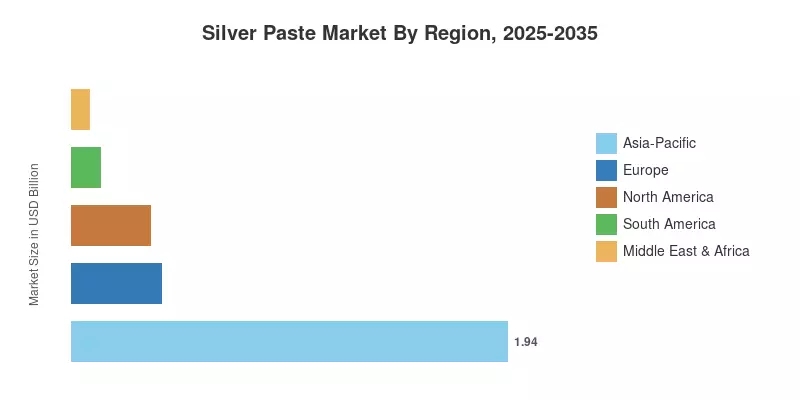
Asia-Pacific controls 66.8% of the silver paste market and also posts the fastest expansion of any region, driven by Chinese cell output, Indian localization and Japanese and Korean packaging lines. Europe ranks second at USD 0.40 Billion, supported by automotive power electronics rather than solar. Through 2035, value growth will increasingly come from high-reliability applications even as solar remains the volume anchor.

Key Report Takeaways

• By Substrate

  • Ceramic held a 48.3% share of the silver paste market in 2025, anchored by direct-bonded-copper power modules for EV inverters and industrial drives.
  • Polymer substrates are forecast to grow at a 5.72% CAGR as flexible sensors, smart textiles and foldable displays scale up.

• By Composition

  • Silver flakes generated a 51.4% revenue share in 2025, reflecting their dominance in high-throughput screen printing.
  • Silver nanoparticles are set to expand at a 6.41% CAGR on the back of pressureless sintering for SiC and GaN die-attach

• By Application

  • Photovoltaics accounted for 54.0% of silver paste market revenue in 2025, despite steady reductions in silver laydown per cell.
  • Automotive electronics and EV power modules represent the fastest-growing application at a 7.64% CAGR.
  • Integrated circuits and semiconductors generated USD 0.30 Billion in 2025, supported by packaging capacity additions in the U.S., Japan and South Korea.

• By Region

  • Asia-Pacific held a 66.8% share in 2025, led by China's cell manufacturing base
  • Europe was valued at USD 0.40 Billion in 2025, with Germany's automotive supply chain as the core demand pool
  • South America is projected to grow at a 4.4% CAGR, driven by electronics assembly and distributed solar

Market Size and Forecast (2021–2035)

Market Research Future built the silver paste market estimates from a bottom-up model of cell production capacity, power module output and electronics assembly volumes, multiplied by application-specific paste loadings and average selling prices. Top-down validation used company filings, silver demand data from The Silver Institute [1] and capacity statistics from IRENA and China's National Energy Administration [5][6]. Historical values reflect reported shipments; forecast values incorporate expected thrifting, technology mix shifts and a moderated silver price path.
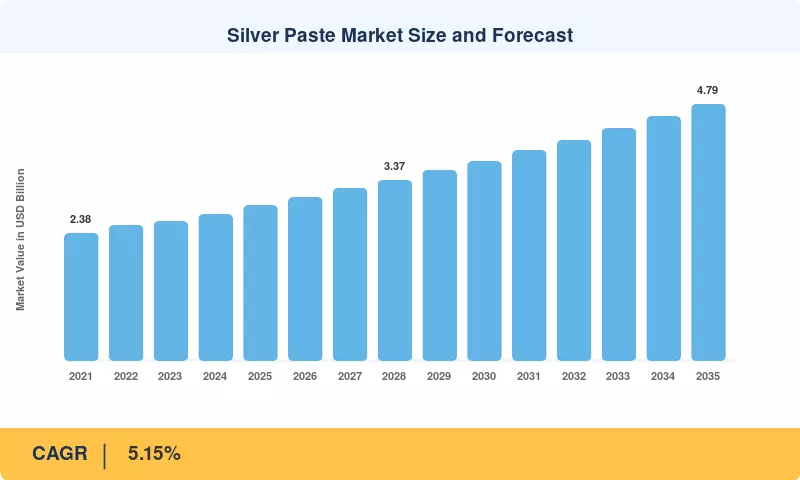
Silver Paste Market Size and Forecast
Our Impact

Enabled $4.3B Revenue Impact for Fortune 500 and Leading Multinationals

Partnering with 2000+ Global Organizations Each Year

30K+ Citations by Top-Tier Firms in the Industry

Driver Impact Analysis

Driver ~% Impact on CAGR Geographic Relevance Impact Timeline
Global solar capacity build-out ~+1.4% Asia-Pacific, Europe, North America Long-term (≥4 yr)
TOPCon and heterojunction cell conversion ~+1.0% China, India, ASEAN Medium-term (2–4 yr)
Wide-bandgap power modules in EVs ~+0.9% China, Europe, U.S., Japan Medium-term (2–4 yr)
Manufacturing incentives and localization ~+0.6% U.S., India Medium-term (2–4 yr)
Semiconductor packaging investment ~+0.5% U.S., Japan, South Korea Long-term (≥4 yr)
Flexible, wearable and display electronics ~+0.4% Asia-Pacific, North America Long-term (≥4 yr)
AI data-center power infrastructure ~+0.3% North America, Asia-Pacific Short-term (≤2 yr)

Global Solar Capacity Build-Out

IRENA data show global renewable additions reached about 585 GW in 2024, with solar responsible for roughly three-quarters of the total [5]. China alone connected around 277 GW [6]. Every gigawatt of crystalline-silicon cells still consumes several tonnes of silver-bearing paste, so installation volume remains the largest single revenue lever. The IEA expects roughly 5,500 GW of new renewable capacity between 2024 and 2030 [3], sustaining baseline demand even as per-watt silver loadings decline.

TOPCon and Heterojunction Cell Conversion

Cell producers replaced most PERC lines with TOPCon between 2023 and 2025, while heterojunction and back-contact capacity also expanded [2]. These n-type designs typically consume more silver per cell than PERC, and heterojunction relies on low-temperature curing formulations that carry a price premium [12]. The ITRPV roadmap expects n-type technologies to hold the majority of new capacity through the decade, lifting value per kilogram sold even where total tonnage stays flat.

Wide-Bandgap Power Modules in EVs

Electric car sales exceeded 17 million units globally in 2024, more than one in five new cars sold [4]. Silicon carbide inverters on 800 V platforms run junction temperatures beyond the reliable range of conventional solder, so OEMs and Tier-1 suppliers are moving to sintered silver die-attach. BloombergNEF expects passenger EV adoption to keep climbing through 2030 [15], securing a reliability-driven outlet that is far less price-sensitive than solar.

Manufacturing Incentives and Localization

The U.S. Section 45X credit pays USD 0.04 per watt for domestically produced solar cells [8], while India's PLI program supports roughly 39.6 GW of integrated module capacity [10]. Both programs push cell production, the stage that consumes metallization paste, outside China. New cell lines in Georgia, Texas, Gujarat and Tamil Nadu open qualification windows for suppliers that can provide local technical service and short-lead-time inventory.

Semiconductor Packaging Investment

The CHIPS Act set aside USD 39 billion in manufacturing incentives [9], South Korea announced a KRW 26 trillion semiconductor support package in 2024 [23], and Japan has committed several trillion yen to domestic chip capacity [22]. Power discretes, advanced packages and MEMS sensors all rely on silver-filled die-attach and thermal-interface materials. As back-end assembly diversifies away from a few Asian hubs, paste demand follows the new footprint.

Flexible, Wearable and Display Electronics

Polymer-compatible, low-cure formulations are reaching foldable phones, smart textiles and skin-mounted medical patches. Kyocera and other component makers have expanded fine-line and low-temperature product lines for compact devices [19]. Volumes are small relative to solar, yet margins run higher, and each design win usually locks in a supplier for the full product life cycle, giving the silver paste market a stable, high-value revenue stream.

AI Data-Center Power Infrastructure

The IEA projects data-center electricity consumption to roughly double to about 945 TWh by 2030 [24]. Server power supplies and rack-level converters are adopting SiC and GaN devices for efficiency, mirroring the thermal profile of EV inverters. That overlap lets die-attach suppliers re-use automotive-qualified chemistries, shortening sales cycles and generating near-term volume as hyperscalers expand capacity across the United States and Asia.

Restraints Impact Analysis

Restraint impacts are directional estimates of downward pressure on silver paste market growth. They are not additive to the CAGR and partially offset one another; silver price spikes, for example, both reduce volume and raise reported revenue.

Restraint ~% Impact on CAGR Geographic Relevance Impact Timeline
Silver price volatility ~-0.8% Global Short-term (≤2 yr)
Silver thrifting and copper substitution ~-0.7% China, Europe Medium-term (2–4 yr)
Module oversupply and price compression ~-0.5% China, Global Short-term (≤2 yr)
Raw-material concentration and policy risk ~-0.3% Europe, North America Long-term (≥4 yr)
Environmental and product compliance ~-0.2% Europe Long-term (≥4 yr)

Silver Price Volatility

Silver makes up the bulk of finished-paste cost, so price swings pass directly into customer pricing. The Silver Institute reported a fourth consecutive structural deficit in 2024, with industrial offtake at a record level [1]. Spot prices climbed above USD 30 per ounce during 2024 and kept rising into 2025, squeezing cell makers already operating on thin margins and accelerating thrifting programs.

Silver Thrifting and Copper Substitution

Zhang et al. have shown that terawatt-scale PV would take an unsustainable share of the global silver supply unless per-watt usage drops significantly [13]. This is being done by manufacturers using finer screen apertures, multi-busbar and zero-busbar topologies, and copper plating or silver-plated copper on heterojunction lines [2]. Each phase reduces the silver mass per cell and limits the volume growth in the greatest final usage.

Module Oversupply and Price Compression

By 2024, global module manufacturing capacity was over 1,000 GW, significantly exceeding yearly installations. Chinese module costs plummeted to about USD 0.10/W, leading cell companies to renegotiate supply contracts and postpone line upgrades. Paste suppliers are facing demands for longer payment terms and discounts that eat into income even when they keep their shipment numbers up.

Raw-Material Concentration and Policy Risk

Mexico, China and Peru dominate mine output, and roughly 70% of silver arrives as a by-product of lead, zinc, copper and gold mining [1][21]. That limits supply response to price signals. The EU Critical Raw Materials Act sets 2030 benchmarks for extraction, processing and recycling [7], encouraging European buyers to diversify sourcing and adding audit costs along the chain.

Environmental and Product Compliance

The EU Ecodesign for Sustainable Devices Regulation, which comes into force in July 2024, includes recyclability and material-disclosure rules for electronics and solar devices [20]. Nanoparticle compositions are also coming under closer scrutiny under REACH. Additional testing and documentation extend certification timelines, which hurts smaller formulators selling into Europe the most.

Silver Paste Market Opportunities

Pressureless Sintering for 800 V Platforms

Pressure-assisted sintering requires expensive presses and slows module throughput. Nanoparticle formulations that sinter without pressure at 200–250 °C let module makers re-use existing die bonders, cutting capital cost per line. Suppliers that pair these chemistries with AQG 324 reliability data can win platform-level contracts lasting five to seven years, especially as automotive demand grows fastest among applications.

Emerging Manufacturing Hubs in India, ASEAN and the Gulf

India's ALMM List-II, effective June 2026, will require domestically made cells for many government-backed projects [11]. Saudi Arabia and the UAE are courting cell and wafer investment under national industrial strategies, and Indonesia and Laos are absorbing capacity displaced by U.S. trade measures on other ASEAN exporters. Each new hub needs locally stocked paste, application engineers and fast line support.

Closed-Loop Silver Recovery and Tolling Models

Several formulators are testing models in which they retain ownership of the silver, charge cell makers a processing fee and reclaim metal from screen residues and rejected wafers. This shifts silver price risk, improves customer cash flow and aligns with EU recycling benchmarks [7]. For the silver paste market, such tolling arrangements could turn a commodity sale into a recurring service relationship.

Low-Temperature Pastes for Tandem Cells

Perovskite-silicon tandem cells are not amenable to firing at ordinary temperatures, and hence rely on low-cure formulations, as employed in heterojunction [12]. Pilot lines in China, Germany and the U.S. are nearing commercial scale ahead of 2030. Early co-development collaborations allow suppliers the chance to specify the reference formulation for a technology that could define the next cell generation.

Process-Data Services and Line Analytics

Printing lines generate large volumes of inline data on finger width, height and contact resistance. Suppliers that bundle paste with analytics, recommending squeegee settings, screen replacement timing and firing adjustments, can charge for measurable efficiency gains. This data-driven service layer deepens customer lock-in and creates a revenue stream that does not depend on grams consumed.

Silver Paste Market Future Outlook

Terawatt-Scale Solar and the Silver Intensity Race

Tripling global renewable capacity to around 11,000 GW by 2030, as targeted at COP28 and tracked by IRENA [5], implies sustained solar additions well above 500 GW a year. Silver supply cannot scale at the same pace, so the silver paste market will be shaped by a race between installation growth and per-watt thrifting. Suppliers that cut laydown while preserving efficiency will capture share; those relying on volume alone will see margins compress.

Wide-Bandgap Electrification

SiC and GaN devices are spreading from EV inverters into onboard chargers, charging stations, industrial drives and renewable inverters. The IEA's electric vehicle outlook points to continued growth in EV stock through 2030 [4], while grid and industrial electrification widen the addressable base. Sintered silver will become the default die-attach for high-power modules, shifting revenue mix toward premium, specification-driven products.

AI-Assisted Formulation and Inline Process Control

Machine-learning models trained on rheology, particle-size and firing data are shortening formulation cycles from months to weeks. Cell makers are deploying inline optical inspection that feeds back to printing parameters in real time. Paste vendors that integrate their materials with these control loops can guarantee efficiency outcomes rather than simply selling grams, a shift that rewards technical depth over scale.

Critical-Materials Policy, Recycling and ESG Disclosure

The EU's 2030 benchmarks call for 25% of strategic raw-material consumption to come from recycling [7], and Ecodesign rules will push product-level material reporting [20]. Customers increasingly ask for recycled-content certificates and carbon footprints per kilogram of paste. Suppliers with traceable silver sourcing and refining partnerships will hold an advantage in European and North American tenders.

Regional Market Share Analysis

Region Key Metric (2025) Primary Investment Themes
North America 12.1% share Section 45X cell lines, CHIPS-funded packaging, EV inverters
Europe USD 0.40 Billion Automotive power electronics, heterojunction lines, raw-material security
Asia-Pacific 66.8% share Chinese n-type cell capacity, Indian localization, Japanese and Korean packaging
South America 4.4% CAGR Electronics assembly, distributed solar, automotive electronics
Middle East & Africa 2.6% share Gulf solar manufacturing ambitions, industrial diversification
Total USD 2.90 Billion —

Regional demand in the silver paste market tracks where cells, power modules and packaged chips are physically produced, not where products are installed or sold. That explains Asia-Pacific's dominance and the outsized role of policy incentives in shifting share elsewhere.

North America

Country Key Metric (2025) Key Driver
US 78.6% share of region Domestic cell manufacturing and SiC module assembly [8][9]
Canada USD 0.03 Billion Automotive and industrial electronics
Mexico 5.6% CAGR Nearshored automotive electronics assembly

The United States dominates regional consumption, with demand split between new solar cell lines and power-module assembly for EVs and data centers. Section 45X credits [8] and CHIPS Act grants [9] have made domestic cell and packaging capacity economically viable for the first time in over a decade. Mexico's role is growing as automotive electronics production nearshores, adding steady demand to the North American silver paste market.

Europe

Country Key Metric (2025) Key Driver
Germany 31.2% share of region Automotive power electronics and SiC module production
UK USD 0.04 Billion Aerospace and defense electronics
France 12.4% share of region Power semiconductors and automotive
Italy 4.3% CAGR Heterojunction cell manufacturing
Spain USD 0.03 Billion Automotive electronics and solar assembly
Nordic Countries 4.9% CAGR Industrial drives and grid electronics
Russia 4.1% share of region Domestic electronics substitution
Rest of Europe USD 0.05 Billion Electronics assembly in Central and Eastern Europe

Germany leads European demand through its automotive Tier-1 suppliers and power semiconductor fabs, where sintered die-attach is standard for SiC modules. Italy hosts Enel's 3Sun heterojunction factory in Catania, one of the few large cell lines on the continent. Raw-material security under the Critical Raw Materials Act [7] and Ecodesign rules [20] shape procurement more than in any other region.

Asia-Pacific

Country Key Metric (2025) Key Driver
China 71.5% share of region n-type cell capacity and EV power modules [6]
India 7.8% CAGR Cell localization under ALMM List-II and PLI [10][11]
Japan USD 0.17 Billion Power semiconductors and ceramic components [22]
South Korea 6.2% share of region Memory packaging and displays [23]
ASEAN 6.9% CAGR Cell export hubs and electronics assembly
Rest of Asia-Pacific 2.4% share of region Electronics assembly in Taiwan and Australia

China anchors regional and global demand, producing the overwhelming majority of the world's solar cells and a fast-growing share of SiC modules [6]. India is the main growth story: ALMM List-II [11] and PLI support [10] will pull cell production onshore and raise local paste consumption sharply. Japan and South Korea contribute high-value semiconductor and display demand [22][23], while ASEAN capacity is rebalancing after U.S. trade actions, reshaping supplier logistics across the Asia-Pacific silver paste market.

South America

Country Key Metric (2025) Key Driver
Brazil 61.3% share of region Electronics assembly and automotive production
Argentina 4.0% CAGR Automotive electronics
Rest of South America 17.5% share of region Consumer electronics assembly in Chile and Colombia

Brazil drives regional demand through electronics assembly in the Manaus Free Trade Zone and a fast-growing distributed solar base, although most modules are imported rather than produced locally. Automotive electronics output in Brazil and Argentina provides a secondary pool. Limited local cell manufacturing keeps the region's share small, but growth outpaces mature markets as assembly operations deepen.

Middle East & Africa

Country Key Metric (2025) Key Driver
Saudi Arabia 7.2% CAGR Localized wafer and cell manufacturing
UAE 22.0% share of region Advanced manufacturing and solar assembly
South Africa USD 0.01 Billion Automotive electronics
Egypt 6.3% CAGR Solar component assembly and electronics
Rest of MEA 18.5% share of region Industrial and consumer electronics

Saudi Arabia is building wafer, cell and module capacity under Vision 2030, supported by partnerships with Chinese manufacturers. The UAE combines large utility-scale solar buildouts with ambitions in advanced manufacturing. Volumes remain modest, but new cell lines in the Gulf could make the region one of the more dynamic pockets of the silver paste market after 2028.

Silver Paste Market By Region, 2025-2035

Silver Paste Market Segmentation

By Substrate

Within the silver paste market, substrate choice dictates curing temperature, adhesion chemistry and price point. Ceramic leads because direct-bonded-copper and active-metal-brazed power modules need bondlines that survive temperatures above 250 °C and isolate kilovolt-class voltages. Glass serves automotive defroster grids, touch panels and solar cover applications. In contrast, Metal covers lead frames and heat spreaders. Polymer grows fastest as polyimide and PET films enter flexible sensors and foldable displays, enabled by low-cure formulations.

Segment Key Metric (2025) Primary Demand Driver
Ceramic 48.3% share DBC and AMB substrates in EV and industrial power modules
Glass 22.6% share Automotive glazing, touch panels and displays
Metal USD 0.55 Billion Lead frames, heat spreaders and die-attach to copper
Polymer 5.72% CAGR Flexible sensors, smart textiles and foldable displays

By Composition

By composition, the silver paste market divides between cost-optimized flake systems and performance-driven nanoscale chemistries. Silver flakes lead thanks to excellent packing density and conductivity in high-speed screen printing for solar cells. Silver nanoparticles grow fastest because they enable pressureless sintering at modest temperatures, critical for SiC and GaN die-attach. Silver powders serve thick-film conductors and firing-type pastes, while other compositions include silver-coated copper hybrids that trade some conductivity for lower metal cost.

Segment Key Metric (2025) Primary Demand Driver
silver flakes 51.4% share High-throughput screen printing in solar cell lines
silver nanoparticles 6.41% CAGR Pressureless sintering for SiC and GaN die-attach
silver powders USD 0.81 Billion Thick-film conductors and fired electrode pastes
other compositions 8.6% share Silver-coated copper hybrids for cost reduction

By Application

Application mix in the silver paste market is shifting from volume toward value. Photovoltaics, covering front- and rear-side metallization of solar cells, still leads, but falling silver laydown per watt limits its revenue upside. Automotive electronics and EV power modules grow fastest because sintered die-attach for 175–300 °C junctions commands premium pricing. Integrated circuits and semiconductors benefit from packaging capacity additions in the U.S., Japan and South Korea.

Consumer electronics demand centers on displays and wearables, where fine-line and low-temperature pastes enable thinner, flexible form factors. Other applications include RFID tags, LEDs and medical devices; RFID faces substitution from copper-hybrid inks, while LEDs and medical devices favor silver for its reliability and biocompatibility.

Segment Key Metric (2025) Primary Demand Driver
photovoltaics 54.0% share n-type solar cell metallization
automotive electronics and EV power modules 7.64% CAGR SiC inverters on 800 V platforms
consumer electronics 14.2% share Displays and wearables
integrated circuits and semiconductors USD 0.30 Billion Advanced packaging and power discretes
other applications 4.1% CAGR RFID, LEDs and medical devices

Competitive Benchmarking

The silver paste market is moderately concentrated, with an estimated Herfindahl-Hirschman Index of 900–1,200 and the top five suppliers controlling roughly 45–55% of revenue. Competition splits into two arenas: Chinese formulators dominate high-volume solar metallization on cost and speed of iteration, while European, Japanese and U.S. firms lead in automotive and semiconductor die-attach, where qualification barriers protect margins.

Company Est. Revenue Share Range Key Offerings for silver paste market Strategic Positioning
Heraeus Electronics ~13–17% Front-side solar metallization, sintered die-attach Technology leader across n-type cells and power modules [17]
Changzhou Fusion New Material ~10–14% TOPCon front- and rear-side pastes Chinese volume leader, built on acquired Samsung SDI paste business
DKEM ~8–12% TOPCon and low-temperature heterojunction pastes Cost-competitive Chinese supplier with rapid formulation cycles
Henkel ~5–8% Sintering and conductive die-attach adhesives Semiconductor packaging and automotive focus [18]
DuPont ~5–8% Thick-film and polymer thick-film conductors Diversified electronics portfolio for automotive and industrial
Giga Solar Materials ~3–5% Solar metallization pastes Taiwan-based supplier serving Asian cell makers
Kyocera ~2–4% Conductive pastes for ceramics and LTCC Vertically integrated with ceramic packages [19]
Namics ~2–4% Conductive die-attach and low-temperature pastes Japanese specialist in semiconductor packaging
Indium Corporation ~1–3% Silver sintering pastes for power modules Niche player in high-reliability die-attach
Vibrantz Technologies ~1–3% Thick-film conductors for glass and ceramics Automotive glazing and industrial electronics

Recent News & Developments

  • Ministry of New and Renewable Energy, India (April 2023): Awarded roughly 39.6 GW of integrated module manufacturing capacity under PLI tranche II, laying the groundwork for domestic cell lines that will need locally qualified paste [10]
  • European Union (May 2024): The Critical Raw Materials Act entered into force, setting 2030 benchmarks for extraction, processing and recycling that shape silver sourcing strategies for European buyers [7]
  • Ministry of Trade, Industry and Energy, South Korea (May 2024): Announced a KRW 26 trillion semiconductor support package, sustaining demand for die-attach and packaging materials [23]
  • U.S. Treasury and IRS (October 2024): Finalized Section 45X regulations, giving investors certainty on per-watt credits for domestically made cells [8]
  • Ministry of New and Renewable Energy, India (December 2024): Issued ALMM List-II for solar cells, effective June 2026, which will require domestic cells in many government-backed projects [11]
  • National Energy Administration, China (January 2025): Reported around 277 GW of solar additions for 2024, confirming record metallization demand in the silver paste market [6]
  • The Silver Institute (April 2025): World Silver Survey 2025 reported record industrial silver demand and a continued structural deficit, reinforcing thrifting pressure on paste users [1]

Silver Paste Market Report Scope

Parameter Details
Market Scope The silver paste market covers conductive silver formulations by substrate, composition and application, supplied to solar, automotive, semiconductor and consumer electronics manufacturers worldwide
Study Period 2021–2035
Base Year 2025
Historical Data 2021–2024
Forecast Period 2026–2035
Market Size in 2025 USD 2.90 Billion
Market Size in 2035 USD 4.79 Billion
CAGR (2026–2035) 5.15%
Fastest Growing Segments automotive electronics and EV power modules (7.64% CAGR); silver nanoparticles (6.41% CAGR); Polymer (5.72% CAGR)
Regions Covered North America, Europe, South America, Asia Pacific, Middle East and Africa and ROW
Companies Profiled Heraeus Electronics, Changzhou Fusion New Material, DKEM, Henkel, DuPont, Giga Solar Materials, Kyocera, Namics, Indium Corporation, Vibrantz Technologies
Valuation Currency USD Billion
Methodology 350+ primary expert interviews; bottom-up market sizing; top-down validation; data triangulation; scenario-based forecasting; real-time project tracking

FAQs

How should buyers qualify a new supplier in the silver paste market?
Run a pilot lot on the production line, not just lab coupons, and track contact resistance, line uniformity and damp-heat reliability [2]. Qualification usually takes three to six months, so dual-sourcing early protects against supply shocks in the silver paste market.
Do silver price clauses matter in silver paste market contracts?
Yes. Most suppliers price paste as a silver index plus a fixed processing fee, so buyers carry metal risk unless contracts include caps or hedging pass-through [1]. Quarterly index resets favor buyers when prices are rising.
Is copper plating a real threat to silver-based metallization?
Plated copper is already in limited mass production for heterojunction and back-contact cells [12]. TOPCon's high-temperature firing still favors silver, so substitution risk is concentrated in specific architectures rather than across the whole silver paste market.
Which certifications matter for automotive die-attach pastes?
Suppliers need IATF 16949 quality systems, and finished modules must pass AEC-Q101 or AQG 324 reliability testing. These requirements stretch qualification to 12–24 months but create durable supplier lock-in once a platform launches.
How are tariffs reshaping silver paste market sourcing?
U.S. antidumping and countervailing duties on cells from Cambodia, Malaysia, Thailand and Vietnam are shifting production toward the U.S., India, Indonesia and the Gulf. Paste suppliers with local warehouses and technical teams in these hubs gain an edge.
Can recycled silver be used in high-performance paste?
Refined to 99.99% purity, recovered silver performs identically to mined metal. The constraint is collection: end-of-life modules return little silver before the 2030s, so near-term recycled supply comes mainly from manufacturing scrap [7].
What should investors watch beyond solar volumes?
Track silver laydown per wafer in the ITRPV roadmap alongside design-win announcements for SiC inverters [2]. Falling laydown with rising automotive wins signals a mix shift toward higher-margin products, which supports supplier valuations even when tonnage stalls.
Author
Author Author Profile Priya Nagrale LinkedIn Senior Research Analyst
With an experience of over five years in market research industry (Chemicals & Materials domain), I gather and analyze market data from diverse sources to produce results, which are then presented back to a client. Also, provide recommendations based on the findings. As a Senior Research Analyst, I perform quality checks (QC) for market estimations, QC for reports, and handle queries and work extensively on client customizations. Also, handle the responsibilities of client proposals, report planning, report finalization, and execution
Download Free Sample

Kindly complete the form below to receive a free sample of this Report

Global Magnesium Sulfate Market – Forecast till 2027
Case Study
Chemicals and Materials
Download PDF ×

We do not share your information with anyone. However, we may send you emails based on your report interest from time to time. You may contact us at any time to opt-out.

















