
Request Free Sample ×

Kindly complete the form below to receive a free sample of this Report

* Please use a valid business email

Leading companies partner with us for data-driven Insights

clients tt-cursor
Hero Background
English
Chinese
French
Japanese
Korean
German
Spanish

Servicenow Store Apps Market Size

ID: MRFR/ICT/10508-HCR
128 Pages
Ankit Gupta
March 2026

Servicenow Store Apps Market Research Report Information By Type (Cloud-Based and Web-Based), By Enterprise Size (Small and Medium Enterprises (SMEs) and Large Enterprises), and By Region (North America, Europe, Asia-Pacific, and Rest Of The World) – Market Forecast Till 2035

Share:
Download PDF ×

We do not share your information with anyone. However, we may send you emails based on your report interest from time to time. You may contact us at any time to opt-out.

Servicenow Store Apps Market Infographic
Purchase Options

Servicenow Store Apps Size

Servicenow Store Apps Market Growth Projections and Opportunities

The ServiceNow Store Apps market is impacted by different market factors that shape its elements and development. One critical variable is the rising interest for productive and levelled out business processes across ventures. As associations endeavor to upgrade their functional effectiveness, the requirement for ServiceNow Store Apps becomes clear. These apps offer many functionalities, from IT administration the board to HR and client support, giving associations a extensive answer for meet their different requirements. Another huge market factor is the quick speed of innovative progressions. As the IT scene develops, organizations are embracing advanced change drives to remain competitive. ServiceNow Store Apps assume a critical part in this change by offering state of the art arrangements that influence arising advances like AI, and robotization. Organizations look for apps that address their ongoing necessities as well as have the adaptability to adjust to future mechanical changes, making the ServiceNow Store Apps market a dynamic and creative space. Moreover, the rising complexity of business activities and the developing volume of information produced by associations add to the interest for robust and adaptable arrangements. ServiceNow Store Apps give a brought together stage that coordinates different business processes, empowering associations to really deal with their information more. The capacity to deal with complex work processes and information the board is a basic component driving the reception of ServiceNow Store Apps across various enterprises. In addition, the worldwide shift towards remote and crossover work models has sped up the reception of cloud-based arrangements. ServiceNow Store Apps, line up with this pattern, giving associations the adaptability and openness required for far off coordinated effort. The versatility and simplicity of organization related with cloud-based arrangements add to the boundless reception of ServiceNow Store Apps, particularly in a business climate where agility and flexibility are central.
Servicenow Store Apps Market Size Graph
Author
Author Profile
Ankit Gupta
Team Lead - Research

Ankit Gupta is a seasoned market intelligence and strategic research professional with over six plus years of experience in the ICT and Semiconductor industries. With academic roots in Telecom, Marketing, and Electronics, he blends technical insight with business strategy. Ankit has led 200+ projects, including work for Fortune 500 clients like Microsoft and Rio Tinto, covering market sizing, tech forecasting, and go-to-market strategies. Known for bridging engineering and enterprise decision-making, his insights support growth, innovation, and investment planning across diverse technology markets.

Leave a Comment

FAQs

What is the current valuation of the Servicenow Store Apps Market?

<p>The Servicenow Store Apps Market was valued at 11.06 USD Billion in 2024.</p>

What is the projected market size for the Servicenow Store Apps Market by 2035?

<p>The market is projected to reach 261.29 USD Billion by 2035.</p>

What is the expected CAGR for the Servicenow Store Apps Market during the forecast period?

<p>The expected CAGR for the market from 2025 to 2035 is 33.3%.</p>

Which companies are considered key players in the Servicenow Store Apps Market?

<p>Key players include ServiceNow, Accenture, Deloitte, Cognizant, KPMG, IBM, Atos, Wipro, and Capgemini.</p>

How does the market valuation for small and medium enterprises compare to large enterprises?

<p>In 2024, the market valuation for SMEs was 3.32 USD Billion, while for large enterprises, it was 7.74 USD Billion.</p>

What are the two main types of service offerings in the Servicenow Store Apps Market?

<p>The two main types are Cloud-Based and Web-Based services, each valued at 5.53 USD Billion in 2024.</p>

What is the significance of the Servicenow Store Apps Market for large enterprises?

Large enterprises are projected to contribute significantly, with a market valuation expected to grow to 186.29 USD Billion by 2035.

How does the Servicenow Store Apps Market support digital transformation?

The market facilitates digital transformation by providing innovative applications that enhance operational efficiency and service delivery.

What trends are influencing the growth of the Servicenow Store Apps Market?

Trends such as increased cloud adoption and the demand for automation are likely driving the market's growth.

What role do consulting firms play in the Servicenow Store Apps Market?

Consulting firms like Accenture and Deloitte are instrumental in implementing and optimizing ServiceNow solutions for clients.

Market Summary

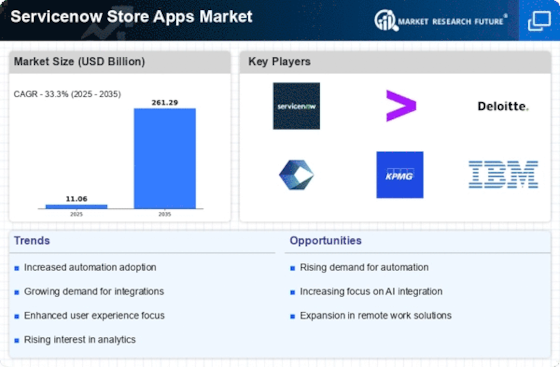
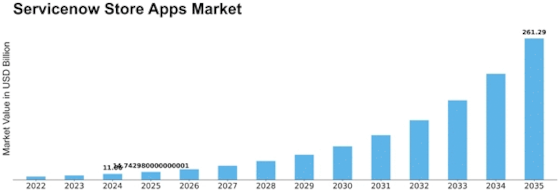
As per Market Research Future analysis, the Servicenow Store Apps Market Size was estimated at 11.06 USD Billion in 2024. The Servicenow Store Apps industry is projected to grow from 14.75 USD Billion in 2025 to 261.29 USD Billion by 2035, exhibiting a compound annual growth rate (CAGR) of 33.3% during the forecast period 2025 - 2035

Key Market Trends & Highlights

The Servicenow Store Apps Market is experiencing robust growth driven by automation and digital transformation.

  • The market exhibits an increased focus on automation, enhancing operational efficiency across various sectors. User experience remains a critical emphasis, as organizations strive to improve customer satisfaction and engagement. Integration with emerging technologies is becoming prevalent, particularly in North America, the largest market. Rising demand for IT service management solutions and a shift towards cloud-based solutions are key drivers propelling market expansion.

Market Size & Forecast

2024 Market Size 11.06 (USD Billion)
2035 Market Size 261.29 (USD Billion)
CAGR (2025 - 2035) 33.3%
Largest Regional Market Share in 2024 North America

Major Players

ServiceNow (US), Accenture (US), Deloitte (US), Cognizant (US), KPMG (GB), IBM (US), Atos (FR), Wipro (IN), Capgemini (FR)

Market Trends

The Servicenow Store Apps Market is currently experiencing a dynamic evolution, characterized by a growing demand for innovative solutions that enhance operational efficiency and streamline workflows. Organizations are increasingly recognizing the value of integrating various applications to optimize their ServiceNow environments. This trend appears to be driven by the need for improved service delivery, better user experiences, and the ability to adapt to changing business requirements. As companies seek to leverage technology for competitive advantage, the Servicenow Store Apps Market is likely to expand, offering a diverse array of applications tailored to specific industry needs. Moreover, the market landscape is becoming increasingly competitive, with numerous developers entering the fray to offer unique solutions. This influx of new entrants suggests a vibrant ecosystem where collaboration and partnerships may flourish. The emphasis on customization and flexibility in app development indicates that organizations are not merely looking for off-the-shelf solutions but are instead seeking tailored applications that align with their specific operational goals. As the Servicenow Store Apps Market continues to mature, it may witness further innovations that enhance integration capabilities and user engagement, ultimately driving growth and adoption across various sectors.

Increased Focus on Automation

The Servicenow Store Apps Market is witnessing a notable shift towards automation, as organizations strive to reduce manual processes and enhance efficiency. This trend indicates a growing recognition of the benefits that automated workflows can bring, such as improved accuracy and faster service delivery.

Emphasis on User Experience

There is a marked emphasis on user experience within the Servicenow Store Apps Market, as developers prioritize intuitive interfaces and seamless interactions. This focus suggests that organizations are increasingly aware of the importance of user satisfaction in driving adoption and engagement.

Integration with Emerging Technologies

The integration of emerging technologies, such as artificial intelligence and machine learning, is becoming a prominent trend in the Servicenow Store Apps Market. This development indicates a potential for enhanced capabilities, allowing organizations to leverage advanced analytics and insights for better decision-making.

Servicenow Store Apps Market Market Drivers

Increased Focus on Cybersecurity

The Servicenow Store Apps Market is also influenced by the heightened focus on cybersecurity. As cyber threats continue to evolve, organizations are prioritizing the implementation of robust security measures within their IT frameworks. This has led to a growing demand for applications that offer enhanced security features and compliance capabilities. Recent reports indicate that The Servicenow Store Apps Market is expected to exceed 300 billion dollars by 2025. Consequently, the Servicenow Store Apps Market is likely to see an influx of applications designed to address these security concerns, providing organizations with the tools necessary to safeguard their IT environments.

Shift Towards Cloud-Based Solutions

The Servicenow Store Apps Market is witnessing a significant shift towards cloud-based solutions. As organizations increasingly migrate their operations to the cloud, the demand for cloud-native applications is on the rise. This transition is fueled by the advantages of scalability, flexibility, and cost-effectiveness that cloud solutions offer. Recent statistics indicate that the cloud computing market is expected to reach a valuation of over 800 billion dollars by 2025. Consequently, the Servicenow Store Apps Market is likely to see a proliferation of applications designed specifically for cloud environments, enabling businesses to optimize their IT service management processes and enhance overall productivity.

Growing Importance of Data Analytics

In the Servicenow Store Apps Market, the growing importance of data analytics is becoming increasingly evident. Organizations are leveraging data analytics to gain insights into their IT operations, enabling them to make informed decisions and improve service delivery. The Servicenow Store Apps Market is projected to reach 274 billion dollars by 2025, indicating a robust demand for analytics-driven applications. This trend suggests that applications within the Servicenow Store Apps Market that incorporate advanced analytics capabilities will likely see heightened interest from businesses aiming to enhance their operational efficiency and customer satisfaction.

Emphasis on Digital Transformation Initiatives

The Servicenow Store Apps Market is significantly impacted by the ongoing emphasis on digital transformation initiatives across various sectors. Organizations are increasingly adopting digital technologies to enhance their operational efficiency and customer engagement. This trend is reflected in the projected growth of the digital transformation market, which is expected to reach 1.8 trillion dollars by 2025. As businesses seek to modernize their IT service management processes, the Servicenow Store Apps Market is poised to benefit from the demand for innovative applications that facilitate seamless digital integration and improve overall service delivery.

Rising Demand for IT Service Management Solutions

The Servicenow Store Apps Market is experiencing a notable surge in demand for IT service management (ITSM) solutions. Organizations are increasingly recognizing the necessity of efficient ITSM tools to streamline operations and enhance service delivery. According to recent data, the ITSM market is projected to grow at a compound annual growth rate (CAGR) of approximately 10% over the next few years. This growth is driven by the need for improved incident management, change management, and service request fulfillment. As businesses strive for operational excellence, the Servicenow Store Apps Market is positioned to benefit from this trend, as organizations seek to leverage applications that integrate seamlessly with their existing IT infrastructure.

Market Segment Insights

By Type: Cloud-Based (Largest) vs. Web-Based (Fastest-Growing)

<p>In the Servicenow Store Apps Market, the distribution of market share shows a significant lean towards Cloud-Based applications, which have established themselves as the largest segment. These offerings dominate the space due to their flexibility, scalability, and ability to integrate seamlessly with existing digital workflows. Meanwhile, Web-Based applications are carving out a notable share, steadily gaining traction amongst businesses looking for cost-effective and easily deployable solutions that require minimal hardware investments. As we look at growth trends in this segment, it is clear that Cloud-Based applications will continue to prosper, driven by their robust infrastructure and increasing reliance on remote work strategies. In contrast, Web-Based solutions are emerging rapidly, fueled by a surge in demand for user-friendly applications that prioritize accessibility and easy management. This shift indicates a dynamic evolution, where traditional models are adapting to meet contemporary business needs.</p>

<p>Cloud-Based (Dominant) vs. Web-Based (Emerging)</p>

<p>Cloud-Based applications in the Servicenow Store Apps Market are recognized for their comprehensive integration capabilities and strong support for enterprise-level operations. They are favored by organizations looking for robust solutions that offer enhanced security and data management through the cloud infrastructure. On the other hand, Web-Based applications present themselves as a highly adaptable option for companies seeking immediate deployment without the constraints of extensive setup. As they are inherently designed to operate through standard web browsers, they cater to a wider audience, particularly smaller enterprises that desire functionality without significant upfront costs. Together, these segments illustrate a market landscape that is diversifying and evolving rapidly.</p>

By Enterprise Size: Small and Medium Enterprises (Largest) vs. Large Enterprises (Fastest-Growing)

<p>In the Servicenow Store Apps Market, Small and Medium Enterprises (SMEs) command a substantial share, leveraging their agility and innovation to integrate advanced solutions. SMEs have increasingly adopted service management tools to optimize operations, pushing their market presence forward. Meanwhile, Large Enterprises, while smaller in overall share, are rapidly growing as they seek to digitize and streamline extensive operations through comprehensive service applications, which are increasingly critical in today’s technology-driven landscape.</p>

<p>Enterprise Size: SMEs (Dominant) vs. Large Enterprises (Emerging)</p>

<p>Small and Medium Enterprises (SMEs) represent the dominant force in the Servicenow Store Apps Market, characterized by their ability to adapt quickly and harness technology for enhanced service delivery. These enterprises often prioritize cost-effective solutions and flexibility, making them a key segment for growth. Conversely, Large Enterprises, while emerging in this space, are recognizing the necessity for robust service management tools to maintain their competitive edge. Their growth is fueled by the need to integrate complex operations under a unified platform, driving demand for tailored solutions that can scale across departments.</p>

Get more detailed insights about Servicenow Store Apps Market Research Report—Global Forecast till 2035

Regional Insights

North America : Innovation and Leadership Hub

North America is the largest market for ServiceNow Store Apps, holding approximately 45% of the global market share. The region's growth is driven by rapid digital transformation, increasing demand for cloud-based solutions, and strong regulatory support for IT modernization. Companies are increasingly adopting ServiceNow applications to enhance operational efficiency and customer service, further propelling market growth. The competitive landscape is robust, with key players like ServiceNow, Accenture, and Deloitte leading the charge. The U.S. is the primary contributor, followed by Canada, which is also witnessing significant growth in IT service management. The presence of major tech firms and a strong startup ecosystem fosters innovation, making North America a pivotal region for ServiceNow Store Apps.

Europe : Emerging Market with Potential

Europe is witnessing a surge in the adoption of ServiceNow Store Apps, accounting for approximately 30% of the global market share. The region's growth is fueled by increasing regulatory requirements for data protection and IT governance, alongside a growing emphasis on digital transformation across various sectors. Countries like Germany and the UK are leading this trend, supported by favorable government initiatives promoting cloud adoption. Germany stands out as a key player in the European market, with a strong presence of ServiceNow partners and a growing number of enterprises leveraging these applications. The competitive landscape includes major firms like IBM and Capgemini, which are actively expanding their ServiceNow offerings. The region's focus on compliance and efficiency is driving demand for innovative solutions, positioning Europe as a significant player in the ServiceNow ecosystem.

Asia-Pacific : Rapid Growth and Adoption

Asia-Pacific is rapidly emerging as a significant market for ServiceNow Store Apps, holding around 20% of the global market share. The region's growth is driven by increasing investments in IT infrastructure, a rising number of enterprises adopting cloud solutions, and government initiatives aimed at digital transformation. Countries like India and Australia are at the forefront, leveraging ServiceNow applications to streamline operations and improve service delivery. India, in particular, is witnessing a boom in IT services, with many local firms partnering with ServiceNow to enhance their offerings. The competitive landscape is evolving, with players like Wipro and Cognizant making substantial inroads. The region's focus on innovation and efficiency is creating a fertile ground for ServiceNow Store Apps, making it a key area for future growth.

Middle East and Africa : Emerging Market with Challenges

The Middle East and Africa region is gradually emerging in the ServiceNow Store Apps market, accounting for about 5% of the global market share. The growth is primarily driven by increasing digital transformation initiatives and a rising demand for efficient IT service management solutions. Countries like the UAE and South Africa are leading the charge, supported by government efforts to enhance digital infrastructure and service delivery. The competitive landscape is still developing, with a mix of local and international players entering the market. Companies are increasingly recognizing the value of ServiceNow applications to improve operational efficiency. However, challenges such as regulatory hurdles and varying levels of digital maturity across countries may impact growth. The region holds significant potential for future expansion as more organizations embrace digital solutions.

Key Players and Competitive Insights

Leading market players are investing heavily in research and development in order to expand their product lines, which will help the servicenow store apps market, grow even more. Market participants are also undertaking a variety of strategic activities to expand their global footprint, with important market developments including new product launches, contractual agreements, mergers and acquisitions, higher investments, and collaboration with other organizations. To expand and survive in a more competitive and rising market climate, Servicenow Store Apps industry must offer cost-effective items.
Manufacturing locally to minimize operational costs is one of the key business tactics used by manufacturers in the global Servicenow Store Apps industry to benefit clients and increase the market sector. In recent years, the Servicenow Store Apps industry has offered some of the most significant advantages to medicine. Major players in the Servicenow Store Apps Market, including International Business Machines Corporation, Okta, Inc., PagerDuty, teamviewer, Dynatrace LLC, xMatters, Inc., SAILPOINT TECHNOLOGIES INC., Talkdesk, Inc., Cisco Systems Inc., and Microsoft Corporation, are attempting to increase market demand by investing in research and development Types.
International Business Machines Corp. (IBM) provides products and services related to information technology (IT). The company also offers infrastructure, hosting, and consulting services in addition to developing and marketing computer hardware and software. IBM's product line includes tools for software development, cybersecurity, blockchain, cloud computing, automation, analytics, and automation. The company also offers services in networking, security, technology consulting, application services, business resilience services, cloud computing, and tech support. It helps the automotive, banking and financial markets, electronics, energy and utilities, healthcare, insurance, life sciences, manufacturing, metals and mining, retail and consumer goods, and telecommunications industries.
The corporation also has operations throughout the Americas, Europe, the Middle East, and Africa in addition to Asia-Pacific. IBM is based in the US city of Armonk, New York.
Cisco Systems Inc. (Cisco) integrates intent-based solutions for networking, security, collaboration, apps, and the cloud. The business offers for sale controllers, access points, switches, modules, routers, and interfaces for wireless networks. The company's technology and tools let its clients manage extra network connections from gadgets, users, and other entities. Among the various industries that Cisco helps are oil and gas, financial services, government, healthcare, mining, sports, media, entertainment, retail, utilities, and transportation. It offers its solutions through its direct sales staff and channel partners, which include distributors, resellers, service providers, and system integrators.
The corporation has business and operational presence throughout the Americas, Europe, the Middle East, Africa, Asia-Pacific, Japan, and China. The corporate headquarters of Cisco are located in the US state of California.

Key Companies in the Servicenow Store Apps Market include

Industry Developments

January 2021: The well-known APEX low-code development platform from Oracle is now accessible as a managed cloud service, enabling developers to create data-driven business apps fast and efficiently. Oracle APEX Application Development is a straightforward, browser-based solution for creating cutting-edge Web and mobile apps, building on the 20 years of APEX capability that has already been utilized by 500,000 developers.

Future Outlook

Servicenow Store Apps Market Future Outlook

The Servicenow Store Apps Market is projected to grow at a 33.3% CAGR from 2025 to 2035, driven by increasing demand for automation, integration, and enhanced user experiences.

New opportunities lie in:

  • Development of AI-driven incident management applications
  • Expansion of mobile-first service delivery solutions
  • Integration of IoT capabilities for real-time data analytics

By 2035, the market is expected to be robust, reflecting substantial growth and innovation.

Market Segmentation

Servicenow Store Apps Market Type Outlook

  • Cloud-Based
  • Web-Based

Servicenow Store Apps Market Enterprise Size Outlook

  • Small and Medium Enterprises (SMEs)
  • Large Enterprises

Report Scope

MARKET SIZE 2024 11.06(USD Billion)
MARKET SIZE 2025 14.75(USD Billion)
MARKET SIZE 2035 261.29(USD Billion)
COMPOUND ANNUAL GROWTH RATE (CAGR) 33.3% (2025 - 2035)
REPORT COVERAGE Revenue Forecast, Competitive Landscape, Growth Factors, and Trends
BASE YEAR 2024
Market Forecast Period 2025 - 2035
Historical Data 2019 - 2024
Market Forecast Units USD Billion
Key Companies Profiled ServiceNow (US), Accenture (US), Deloitte (US), Cognizant (US), KPMG (GB), IBM (US), Atos (FR), Wipro (IN), Capgemini (FR)
Segments Covered Type, Enterprise Size, Region
Key Market Opportunities Integration of artificial intelligence enhances automation capabilities in the Servicenow Store Apps Market.
Key Market Dynamics Rising demand for automation solutions drives innovation and competition in the ServiceNow Store Apps Market.
Countries Covered North America, Europe, APAC, South America, MEA

FAQs

What is the current valuation of the Servicenow Store Apps Market?

<p>The Servicenow Store Apps Market was valued at 11.06 USD Billion in 2024.</p>

What is the projected market size for the Servicenow Store Apps Market by 2035?

<p>The market is projected to reach 261.29 USD Billion by 2035.</p>

What is the expected CAGR for the Servicenow Store Apps Market during the forecast period?

<p>The expected CAGR for the market from 2025 to 2035 is 33.3%.</p>

Which companies are considered key players in the Servicenow Store Apps Market?

<p>Key players include ServiceNow, Accenture, Deloitte, Cognizant, KPMG, IBM, Atos, Wipro, and Capgemini.</p>

How does the market valuation for small and medium enterprises compare to large enterprises?

<p>In 2024, the market valuation for SMEs was 3.32 USD Billion, while for large enterprises, it was 7.74 USD Billion.</p>

What are the two main types of service offerings in the Servicenow Store Apps Market?

<p>The two main types are Cloud-Based and Web-Based services, each valued at 5.53 USD Billion in 2024.</p>

What is the significance of the Servicenow Store Apps Market for large enterprises?

Large enterprises are projected to contribute significantly, with a market valuation expected to grow to 186.29 USD Billion by 2035.

How does the Servicenow Store Apps Market support digital transformation?

The market facilitates digital transformation by providing innovative applications that enhance operational efficiency and service delivery.

What trends are influencing the growth of the Servicenow Store Apps Market?

Trends such as increased cloud adoption and the demand for automation are likely driving the market's growth.

What role do consulting firms play in the Servicenow Store Apps Market?

Consulting firms like Accenture and Deloitte are instrumental in implementing and optimizing ServiceNow solutions for clients.

  1. SECTION I: EXECUTIVE SUMMARY AND KEY HIGHLIGHTS
    1. | 1.1 EXECUTIVE SUMMARY
    2. | | 1.1.1 Market Overview
    3. | | 1.1.2 Key Findings
    4. | | 1.1.3 Market Segmentation
    5. | | 1.1.4 Competitive Landscape
    6. | | 1.1.5 Challenges and Opportunities
    7. | | 1.1.6 Future Outlook
  2. SECTION II: SCOPING, METHODOLOGY AND MARKET STRUCTURE
    1. | 2.1 MARKET INTRODUCTION
    2. | | 2.1.1 Definition
    3. | | 2.1.2 Scope of the study
    4. | | | 2.1.2.1 Research Objective
    5. | | | 2.1.2.2 Assumption
    6. | | | 2.1.2.3 Limitations
    7. | 2.2 RESEARCH METHODOLOGY
    8. | | 2.2.1 Overview
    9. | | 2.2.2 Data Mining
    10. | | 2.2.3 Secondary Research
    11. | | 2.2.4 Primary Research
    12. | | | 2.2.4.1 Primary Interviews and Information Gathering Process
    13. | | | 2.2.4.2 Breakdown of Primary Respondents
    14. | | 2.2.5 Forecasting Model
    15. | | 2.2.6 Market Size Estimation
    16. | | | 2.2.6.1 Bottom-Up Approach
    17. | | | 2.2.6.2 Top-Down Approach
    18. | | 2.2.7 Data Triangulation
    19. | | 2.2.8 Validation
  3. SECTION III: QUALITATIVE ANALYSIS
    1. | 3.1 MARKET DYNAMICS
    2. | | 3.1.1 Overview
    3. | | 3.1.2 Drivers
    4. | | 3.1.3 Restraints
    5. | | 3.1.4 Opportunities
    6. | 3.2 MARKET FACTOR ANALYSIS
    7. | | 3.2.1 Value chain Analysis
    8. | | 3.2.2 Porter's Five Forces Analysis
    9. | | | 3.2.2.1 Bargaining Power of Suppliers
    10. | | | 3.2.2.2 Bargaining Power of Buyers
    11. | | | 3.2.2.3 Threat of New Entrants
    12. | | | 3.2.2.4 Threat of Substitutes
    13. | | | 3.2.2.5 Intensity of Rivalry
    14. | | 3.2.3 COVID-19 Impact Analysis
    15. | | | 3.2.3.1 Market Impact Analysis
    16. | | | 3.2.3.2 Regional Impact
    17. | | | 3.2.3.3 Opportunity and Threat Analysis
  4. SECTION IV: QUANTITATIVE ANALYSIS
    1. | 4.1 Information and Communications Technology, BY Type (USD Billion)
    2. | | 4.1.1 Cloud-Based
    3. | | 4.1.2 Web-Based
    4. | 4.2 Information and Communications Technology, BY Enterprise Size (USD Billion)
    5. | | 4.2.1 Small and Medium Enterprises (SMEs)
    6. | | 4.2.2 Large Enterprises
    7. | 4.3 Information and Communications Technology, BY Region (USD Billion)
    8. | | 4.3.1 North America
    9. | | | 4.3.1.1 US
    10. | | | 4.3.1.2 Canada
    11. | | 4.3.2 Europe
    12. | | | 4.3.2.1 Germany
    13. | | | 4.3.2.2 UK
    14. | | | 4.3.2.3 France
    15. | | | 4.3.2.4 Russia
    16. | | | 4.3.2.5 Italy
    17. | | | 4.3.2.6 Spain
    18. | | | 4.3.2.7 Rest of Europe
    19. | | 4.3.3 APAC
    20. | | | 4.3.3.1 China
    21. | | | 4.3.3.2 India
    22. | | | 4.3.3.3 Japan
    23. | | | 4.3.3.4 South Korea
    24. | | | 4.3.3.5 Malaysia
    25. | | | 4.3.3.6 Thailand
    26. | | | 4.3.3.7 Indonesia
    27. | | | 4.3.3.8 Rest of APAC
    28. | | 4.3.4 South America
    29. | | | 4.3.4.1 Brazil
    30. | | | 4.3.4.2 Mexico
    31. | | | 4.3.4.3 Argentina
    32. | | | 4.3.4.4 Rest of South America
    33. | | 4.3.5 MEA
    34. | | | 4.3.5.1 GCC Countries
    35. | | | 4.3.5.2 South Africa
    36. | | | 4.3.5.3 Rest of MEA
  5. SECTION V: COMPETITIVE ANALYSIS
    1. | 5.1 Competitive Landscape
    2. | | 5.1.1 Overview
    3. | | 5.1.2 Competitive Analysis
    4. | | 5.1.3 Market share Analysis
    5. | | 5.1.4 Major Growth Strategy in the Information and Communications Technology
    6. | | 5.1.5 Competitive Benchmarking
    7. | | 5.1.6 Leading Players in Terms of Number of Developments in the Information and Communications Technology
    8. | | 5.1.7 Key developments and growth strategies
    9. | | | 5.1.7.1 New Product Launch/Service Deployment
    10. | | | 5.1.7.2 Merger & Acquisitions
    11. | | | 5.1.7.3 Joint Ventures
    12. | | 5.1.8 Major Players Financial Matrix
    13. | | | 5.1.8.1 Sales and Operating Income
    14. | | | 5.1.8.2 Major Players R&D Expenditure. 2023
    15. | 5.2 Company Profiles
    16. | | 5.2.1 ServiceNow (US)
    17. | | | 5.2.1.1 Financial Overview
    18. | | | 5.2.1.2 Products Offered
    19. | | | 5.2.1.3 Key Developments
    20. | | | 5.2.1.4 SWOT Analysis
    21. | | | 5.2.1.5 Key Strategies
    22. | | 5.2.2 Accenture (US)
    23. | | | 5.2.2.1 Financial Overview
    24. | | | 5.2.2.2 Products Offered
    25. | | | 5.2.2.3 Key Developments
    26. | | | 5.2.2.4 SWOT Analysis
    27. | | | 5.2.2.5 Key Strategies
    28. | | 5.2.3 Deloitte (US)
    29. | | | 5.2.3.1 Financial Overview
    30. | | | 5.2.3.2 Products Offered
    31. | | | 5.2.3.3 Key Developments
    32. | | | 5.2.3.4 SWOT Analysis
    33. | | | 5.2.3.5 Key Strategies
    34. | | 5.2.4 Cognizant (US)
    35. | | | 5.2.4.1 Financial Overview
    36. | | | 5.2.4.2 Products Offered
    37. | | | 5.2.4.3 Key Developments
    38. | | | 5.2.4.4 SWOT Analysis
    39. | | | 5.2.4.5 Key Strategies
    40. | | 5.2.5 KPMG (GB)
    41. | | | 5.2.5.1 Financial Overview
    42. | | | 5.2.5.2 Products Offered
    43. | | | 5.2.5.3 Key Developments
    44. | | | 5.2.5.4 SWOT Analysis
    45. | | | 5.2.5.5 Key Strategies
    46. | | 5.2.6 IBM (US)
    47. | | | 5.2.6.1 Financial Overview
    48. | | | 5.2.6.2 Products Offered
    49. | | | 5.2.6.3 Key Developments
    50. | | | 5.2.6.4 SWOT Analysis
    51. | | | 5.2.6.5 Key Strategies
    52. | | 5.2.7 Atos (FR)
    53. | | | 5.2.7.1 Financial Overview
    54. | | | 5.2.7.2 Products Offered
    55. | | | 5.2.7.3 Key Developments
    56. | | | 5.2.7.4 SWOT Analysis
    57. | | | 5.2.7.5 Key Strategies
    58. | | 5.2.8 Wipro (IN)
    59. | | | 5.2.8.1 Financial Overview
    60. | | | 5.2.8.2 Products Offered
    61. | | | 5.2.8.3 Key Developments
    62. | | | 5.2.8.4 SWOT Analysis
    63. | | | 5.2.8.5 Key Strategies
    64. | | 5.2.9 Capgemini (FR)
    65. | | | 5.2.9.1 Financial Overview
    66. | | | 5.2.9.2 Products Offered
    67. | | | 5.2.9.3 Key Developments
    68. | | | 5.2.9.4 SWOT Analysis
    69. | | | 5.2.9.5 Key Strategies
    70. | 5.3 Appendix
    71. | | 5.3.1 References
    72. | | 5.3.2 Related Reports
  6. LIST OF FIGURES
    1. | 6.1 MARKET SYNOPSIS
    2. | 6.2 NORTH AMERICA MARKET ANALYSIS
    3. | 6.3 US MARKET ANALYSIS BY TYPE
    4. | 6.4 US MARKET ANALYSIS BY ENTERPRISE SIZE
    5. | 6.5 CANADA MARKET ANALYSIS BY TYPE
    6. | 6.6 CANADA MARKET ANALYSIS BY ENTERPRISE SIZE
    7. | 6.7 EUROPE MARKET ANALYSIS
    8. | 6.8 GERMANY MARKET ANALYSIS BY TYPE
    9. | 6.9 GERMANY MARKET ANALYSIS BY ENTERPRISE SIZE
    10. | 6.10 UK MARKET ANALYSIS BY TYPE
    11. | 6.11 UK MARKET ANALYSIS BY ENTERPRISE SIZE
    12. | 6.12 FRANCE MARKET ANALYSIS BY TYPE
    13. | 6.13 FRANCE MARKET ANALYSIS BY ENTERPRISE SIZE
    14. | 6.14 RUSSIA MARKET ANALYSIS BY TYPE
    15. | 6.15 RUSSIA MARKET ANALYSIS BY ENTERPRISE SIZE
    16. | 6.16 ITALY MARKET ANALYSIS BY TYPE
    17. | 6.17 ITALY MARKET ANALYSIS BY ENTERPRISE SIZE
    18. | 6.18 SPAIN MARKET ANALYSIS BY TYPE
    19. | 6.19 SPAIN MARKET ANALYSIS BY ENTERPRISE SIZE
    20. | 6.20 REST OF EUROPE MARKET ANALYSIS BY TYPE
    21. | 6.21 REST OF EUROPE MARKET ANALYSIS BY ENTERPRISE SIZE
    22. | 6.22 APAC MARKET ANALYSIS
    23. | 6.23 CHINA MARKET ANALYSIS BY TYPE
    24. | 6.24 CHINA MARKET ANALYSIS BY ENTERPRISE SIZE
    25. | 6.25 INDIA MARKET ANALYSIS BY TYPE
    26. | 6.26 INDIA MARKET ANALYSIS BY ENTERPRISE SIZE
    27. | 6.27 JAPAN MARKET ANALYSIS BY TYPE
    28. | 6.28 JAPAN MARKET ANALYSIS BY ENTERPRISE SIZE
    29. | 6.29 SOUTH KOREA MARKET ANALYSIS BY TYPE
    30. | 6.30 SOUTH KOREA MARKET ANALYSIS BY ENTERPRISE SIZE
    31. | 6.31 MALAYSIA MARKET ANALYSIS BY TYPE
    32. | 6.32 MALAYSIA MARKET ANALYSIS BY ENTERPRISE SIZE
    33. | 6.33 THAILAND MARKET ANALYSIS BY TYPE
    34. | 6.34 THAILAND MARKET ANALYSIS BY ENTERPRISE SIZE
    35. | 6.35 INDONESIA MARKET ANALYSIS BY TYPE
    36. | 6.36 INDONESIA MARKET ANALYSIS BY ENTERPRISE SIZE
    37. | 6.37 REST OF APAC MARKET ANALYSIS BY TYPE
    38. | 6.38 REST OF APAC MARKET ANALYSIS BY ENTERPRISE SIZE
    39. | 6.39 SOUTH AMERICA MARKET ANALYSIS
    40. | 6.40 BRAZIL MARKET ANALYSIS BY TYPE
    41. | 6.41 BRAZIL MARKET ANALYSIS BY ENTERPRISE SIZE
    42. | 6.42 MEXICO MARKET ANALYSIS BY TYPE
    43. | 6.43 MEXICO MARKET ANALYSIS BY ENTERPRISE SIZE
    44. | 6.44 ARGENTINA MARKET ANALYSIS BY TYPE
    45. | 6.45 ARGENTINA MARKET ANALYSIS BY ENTERPRISE SIZE
    46. | 6.46 REST OF SOUTH AMERICA MARKET ANALYSIS BY TYPE
    47. | 6.47 REST OF SOUTH AMERICA MARKET ANALYSIS BY ENTERPRISE SIZE
    48. | 6.48 MEA MARKET ANALYSIS
    49. | 6.49 GCC COUNTRIES MARKET ANALYSIS BY TYPE
    50. | 6.50 GCC COUNTRIES MARKET ANALYSIS BY ENTERPRISE SIZE
    51. | 6.51 SOUTH AFRICA MARKET ANALYSIS BY TYPE
    52. | 6.52 SOUTH AFRICA MARKET ANALYSIS BY ENTERPRISE SIZE
    53. | 6.53 REST OF MEA MARKET ANALYSIS BY TYPE
    54. | 6.54 REST OF MEA MARKET ANALYSIS BY ENTERPRISE SIZE
    55. | 6.55 KEY BUYING CRITERIA OF INFORMATION AND COMMUNICATIONS TECHNOLOGY
    56. | 6.56 RESEARCH PROCESS OF MRFR
    57. | 6.57 DRO ANALYSIS OF INFORMATION AND COMMUNICATIONS TECHNOLOGY
    58. | 6.58 DRIVERS IMPACT ANALYSIS: INFORMATION AND COMMUNICATIONS TECHNOLOGY
    59. | 6.59 RESTRAINTS IMPACT ANALYSIS: INFORMATION AND COMMUNICATIONS TECHNOLOGY
    60. | 6.60 SUPPLY / VALUE CHAIN: INFORMATION AND COMMUNICATIONS TECHNOLOGY
    61. | 6.61 INFORMATION AND COMMUNICATIONS TECHNOLOGY, BY TYPE, 2024 (% SHARE)
    62. | 6.62 INFORMATION AND COMMUNICATIONS TECHNOLOGY, BY TYPE, 2024 TO 2035 (USD Billion)
    63. | 6.63 INFORMATION AND COMMUNICATIONS TECHNOLOGY, BY ENTERPRISE SIZE, 2024 (% SHARE)
    64. | 6.64 INFORMATION AND COMMUNICATIONS TECHNOLOGY, BY ENTERPRISE SIZE, 2024 TO 2035 (USD Billion)
    65. | 6.65 BENCHMARKING OF MAJOR COMPETITORS
  7. LIST OF TABLES
    1. | 7.1 LIST OF ASSUMPTIONS
    2. | | 7.1.1
    3. | 7.2 North America MARKET SIZE ESTIMATES; FORECAST
    4. | | 7.2.1 BY TYPE, 2025-2035 (USD Billion)
    5. | | 7.2.2 BY ENTERPRISE SIZE, 2025-2035 (USD Billion)
    6. | 7.3 US MARKET SIZE ESTIMATES; FORECAST
    7. | | 7.3.1 BY TYPE, 2025-2035 (USD Billion)
    8. | | 7.3.2 BY ENTERPRISE SIZE, 2025-2035 (USD Billion)
    9. | 7.4 Canada MARKET SIZE ESTIMATES; FORECAST
    10. | | 7.4.1 BY TYPE, 2025-2035 (USD Billion)
    11. | | 7.4.2 BY ENTERPRISE SIZE, 2025-2035 (USD Billion)
    12. | 7.5 Europe MARKET SIZE ESTIMATES; FORECAST
    13. | | 7.5.1 BY TYPE, 2025-2035 (USD Billion)
    14. | | 7.5.2 BY ENTERPRISE SIZE, 2025-2035 (USD Billion)
    15. | 7.6 Germany MARKET SIZE ESTIMATES; FORECAST
    16. | | 7.6.1 BY TYPE, 2025-2035 (USD Billion)
    17. | | 7.6.2 BY ENTERPRISE SIZE, 2025-2035 (USD Billion)
    18. | 7.7 UK MARKET SIZE ESTIMATES; FORECAST
    19. | | 7.7.1 BY TYPE, 2025-2035 (USD Billion)
    20. | | 7.7.2 BY ENTERPRISE SIZE, 2025-2035 (USD Billion)
    21. | 7.8 France MARKET SIZE ESTIMATES; FORECAST
    22. | | 7.8.1 BY TYPE, 2025-2035 (USD Billion)
    23. | | 7.8.2 BY ENTERPRISE SIZE, 2025-2035 (USD Billion)
    24. | 7.9 Russia MARKET SIZE ESTIMATES; FORECAST
    25. | | 7.9.1 BY TYPE, 2025-2035 (USD Billion)
    26. | | 7.9.2 BY ENTERPRISE SIZE, 2025-2035 (USD Billion)
    27. | 7.10 Italy MARKET SIZE ESTIMATES; FORECAST
    28. | | 7.10.1 BY TYPE, 2025-2035 (USD Billion)
    29. | | 7.10.2 BY ENTERPRISE SIZE, 2025-2035 (USD Billion)
    30. | 7.11 Spain MARKET SIZE ESTIMATES; FORECAST
    31. | | 7.11.1 BY TYPE, 2025-2035 (USD Billion)
    32. | | 7.11.2 BY ENTERPRISE SIZE, 2025-2035 (USD Billion)
    33. | 7.12 Rest of Europe MARKET SIZE ESTIMATES; FORECAST
    34. | | 7.12.1 BY TYPE, 2025-2035 (USD Billion)
    35. | | 7.12.2 BY ENTERPRISE SIZE, 2025-2035 (USD Billion)
    36. | 7.13 APAC MARKET SIZE ESTIMATES; FORECAST
    37. | | 7.13.1 BY TYPE, 2025-2035 (USD Billion)
    38. | | 7.13.2 BY ENTERPRISE SIZE, 2025-2035 (USD Billion)
    39. | 7.14 China MARKET SIZE ESTIMATES; FORECAST
    40. | | 7.14.1 BY TYPE, 2025-2035 (USD Billion)
    41. | | 7.14.2 BY ENTERPRISE SIZE, 2025-2035 (USD Billion)
    42. | 7.15 India MARKET SIZE ESTIMATES; FORECAST
    43. | | 7.15.1 BY TYPE, 2025-2035 (USD Billion)
    44. | | 7.15.2 BY ENTERPRISE SIZE, 2025-2035 (USD Billion)
    45. | 7.16 Japan MARKET SIZE ESTIMATES; FORECAST
    46. | | 7.16.1 BY TYPE, 2025-2035 (USD Billion)
    47. | | 7.16.2 BY ENTERPRISE SIZE, 2025-2035 (USD Billion)
    48. | 7.17 South Korea MARKET SIZE ESTIMATES; FORECAST
    49. | | 7.17.1 BY TYPE, 2025-2035 (USD Billion)
    50. | | 7.17.2 BY ENTERPRISE SIZE, 2025-2035 (USD Billion)
    51. | 7.18 Malaysia MARKET SIZE ESTIMATES; FORECAST
    52. | | 7.18.1 BY TYPE, 2025-2035 (USD Billion)
    53. | | 7.18.2 BY ENTERPRISE SIZE, 2025-2035 (USD Billion)
    54. | 7.19 Thailand MARKET SIZE ESTIMATES; FORECAST
    55. | | 7.19.1 BY TYPE, 2025-2035 (USD Billion)
    56. | | 7.19.2 BY ENTERPRISE SIZE, 2025-2035 (USD Billion)
    57. | 7.20 Indonesia MARKET SIZE ESTIMATES; FORECAST
    58. | | 7.20.1 BY TYPE, 2025-2035 (USD Billion)
    59. | | 7.20.2 BY ENTERPRISE SIZE, 2025-2035 (USD Billion)
    60. | 7.21 Rest of APAC MARKET SIZE ESTIMATES; FORECAST
    61. | | 7.21.1 BY TYPE, 2025-2035 (USD Billion)
    62. | | 7.21.2 BY ENTERPRISE SIZE, 2025-2035 (USD Billion)
    63. | 7.22 South America MARKET SIZE ESTIMATES; FORECAST
    64. | | 7.22.1 BY TYPE, 2025-2035 (USD Billion)
    65. | | 7.22.2 BY ENTERPRISE SIZE, 2025-2035 (USD Billion)
    66. | 7.23 Brazil MARKET SIZE ESTIMATES; FORECAST
    67. | | 7.23.1 BY TYPE, 2025-2035 (USD Billion)
    68. | | 7.23.2 BY ENTERPRISE SIZE, 2025-2035 (USD Billion)
    69. | 7.24 Mexico MARKET SIZE ESTIMATES; FORECAST
    70. | | 7.24.1 BY TYPE, 2025-2035 (USD Billion)
    71. | | 7.24.2 BY ENTERPRISE SIZE, 2025-2035 (USD Billion)
    72. | 7.25 Argentina MARKET SIZE ESTIMATES; FORECAST
    73. | | 7.25.1 BY TYPE, 2025-2035 (USD Billion)
    74. | | 7.25.2 BY ENTERPRISE SIZE, 2025-2035 (USD Billion)
    75. | 7.26 Rest of South America MARKET SIZE ESTIMATES; FORECAST
    76. | | 7.26.1 BY TYPE, 2025-2035 (USD Billion)
    77. | | 7.26.2 BY ENTERPRISE SIZE, 2025-2035 (USD Billion)
    78. | 7.27 MEA MARKET SIZE ESTIMATES; FORECAST
    79. | | 7.27.1 BY TYPE, 2025-2035 (USD Billion)
    80. | | 7.27.2 BY ENTERPRISE SIZE, 2025-2035 (USD Billion)
    81. | 7.28 GCC Countries MARKET SIZE ESTIMATES; FORECAST
    82. | | 7.28.1 BY TYPE, 2025-2035 (USD Billion)
    83. | | 7.28.2 BY ENTERPRISE SIZE, 2025-2035 (USD Billion)
    84. | 7.29 South Africa MARKET SIZE ESTIMATES; FORECAST
    85. | | 7.29.1 BY TYPE, 2025-2035 (USD Billion)
    86. | | 7.29.2 BY ENTERPRISE SIZE, 2025-2035 (USD Billion)
    87. | 7.30 Rest of MEA MARKET SIZE ESTIMATES; FORECAST
    88. | | 7.30.1 BY TYPE, 2025-2035 (USD Billion)
    89. | | 7.30.2 BY ENTERPRISE SIZE, 2025-2035 (USD Billion)
    90. | 7.31 PRODUCT LAUNCH/PRODUCT DEVELOPMENT/APPROVAL
    91. | | 7.31.1
    92. | 7.32 ACQUISITION/PARTNERSHIP
    93. | | 7.32.1

Information and Communications Technology Market Segmentation

Information and Communications Technology By Type (USD Billion, 2025-2035)

  • Cloud-Based
  • Web-Based

Information and Communications Technology By Enterprise Size (USD Billion, 2025-2035)

  • Small and Medium Enterprises (SMEs)
  • Large Enterprises
Infographic

Free Sample Request

Kindly complete the form below to receive a free sample of this Report

Get Free Sample

Customer Strories

Compare Licence

×
Features License Type
Single User Multiuser License Enterprise User
Price $4,950 $5,950 $7,250
Maximum User Access Limit 1 User Upto 10 Users Unrestricted Access Throughout the Organization
Free Customization
Direct Access to Analyst
Deliverable Format
Platform Access
Discount on Next Purchase 10% 15% 15%
Printable Versions