
Request Free Sample ×

Kindly complete the form below to receive a free sample of this Report

* Please use a valid business email

Leading companies partner with us for data-driven Insights

clients tt-cursor
Hero Background
English
Chinese
French
Japanese
Korean
German
Spanish

Robotic Drilling Market Trends

ID: MRFR/EnP/5198-HCR
100 Pages
Chitranshi Jaiswal
Last Updated: April 06, 2026

Robotic Drilling Market Research Report Information by Installation Type (Retrofit, New Builds, and Others), Component (Hardware, Software), Application (Onshore, Offshore), and Region (North America, APAC, Europe, RoW) and By Region (North America, Europe, Asia-Pacific, and Rest of the World) –Market Forecast Till 2035

Share:
Download PDF ×

We do not share your information with anyone. However, we may send you emails based on your report interest from time to time. You may contact us at any time to opt-out.

Robotic Drilling Market Infographic
Purchase Options

Market Trends

Key Emerging Trends in the Robotic Drilling Market

The marketplace developments of the robotic drilling industry have been experiencing enormous improvement and transformation in recent years. As technology continues to boost, the demand for green and automatic answers in diverse industries, in particular in oil and gas exploration, has propelled the adoption of robotic drilling structures. One splendid fashion is the growing emphasis on precision and accuracy in drilling operations. Robotic drilling systems are equipped with superior sensors, synthetic intelligence, and gadget-mastering algorithms that permit them to execute drilling obligations with a high level of precision, minimizing mistakes and enhancing average operational performance. Another prime market trend is the mixing of robotics with digitalization and information analytics. The use of robotics in drilling operations generates vast quantities of facts, and businesses are gradually leveraging statistics analytics to gain valuable insights into drilling performance, equipment health, and usual operational efficiency. This integration permits predictive protection, optimizing drilling approaches, and reducing downtime, leading to tremendous cost financial savings for the operators. Additionally, the market is undergoing a shift towards remote and self-sustaining drilling operations. With improvements in verbal exchange technologies and the improvement of sturdy control structures, operators can now remotely reveal and manipulate drilling operations from a centralized region. This fashion is, in particular, applicable in harsh and faraway environments, wherein conventional drilling methods may be hard or cost-prohibitive. Remote and autonomous drilling not only enhances safety but also increases the accessibility of untapped reserves. Furthermore, sustainability and environmental worries are influencing the marketplace tendencies within the robotic drilling enterprise. As the worldwide awareness of reducing carbon emissions and transitioning in the direction of cleanser strength resources intensifies, the oil and gasoline region is under strain to enhance its overall environmental performance. Robotic drilling structures, through optimizing drilling processes and minimizing environmental impact, are becoming a critical aspect of sustainable practices in the industry. Collaboration and partnerships between generation vendors and enterprise gamers are also shaping the market landscape. The complexity of developing and deploying robotic drilling answers requires a collaborative method, with era corporations operating closely with drilling contractors and operators to tailor answers that meet precise industry desires. These collaborations accelerate the development and adoption of robotic drilling technology, fostering innovation and using marketplace improvement. In the end, the marketplace tendencies inside the robotic drilling industry mirror a dynamic and evolving panorama. The combination of precision drilling, digitalization, remote operations, sustainability initiatives, and collaborative partnerships is reshaping the industry and positioning robotic drilling systems as a high enabler for the future of green and sustainable drilling practices. As generation continues to advance and industry players include those tendencies, the robotic drilling marketplace is poised for persistent improvement and innovation.


Author
Author Profile
Chitranshi Jaiswal
Team Lead - Research

Chitranshi is a Team Leader in the Chemicals & Materials (CnM) and Energy & Power (EnP) domains, with 6+ years of experience in market research. She leads and mentors teams to deliver cross-domain projects that equip clients with actionable insights and growth strategies. She is skilled in market estimation, forecasting, competitive benchmarking, and both primary & secondary research, enabling her to turn complex data into decision-ready insights. An engineer and MBA professional, she combines technical expertise with strategic acumen to solve dynamic market challenges. Chitranshi has successfully managed projects that support market entry, investment planning, and competitive positioning, while building strong client relationships. Certified in Advanced Excel & Power BI she leverages data-driven approaches to ensure accuracy, clarity, and impactful outcomes.

Leave a Comment

FAQs

What is the projected market valuation of the Robotic Drilling Market by 2035?

<p>The Robotic Drilling Market is projected to reach a valuation of 1134.92 USD Billion by 2035.</p>

What was the market valuation of the Robotic Drilling Market in 2024?

<p>In 2024, the overall market valuation was 581.24 USD Billion.</p>

What is the expected CAGR for the Robotic Drilling Market during the forecast period 2025 - 2035?

<p>The expected CAGR for the Robotic Drilling Market during the forecast period 2025 - 2035 is 6.27%.</p>

Which companies are considered key players in the Robotic Drilling Market?

<p>Key players in the Robotic Drilling Market include Schlumberger, Halliburton, Baker Hughes, and National Oilwell Varco.</p>

What are the projected valuations for the Retrofit segment in the Robotic Drilling Market?

<p>The Retrofit segment is projected to grow from 116.25 USD Billion to 220.0 USD Billion.</p>

How does the New Builds segment compare to the Retrofit segment in terms of valuation?

<p>The New Builds segment is expected to grow from 350.0 USD Billion to 700.0 USD Billion, surpassing the Retrofit segment.</p>

What is the projected valuation for the Hardware component in the Robotic Drilling Market?

The Hardware component is projected to grow from 348.74 USD Billion to 683.0 USD Billion.

What is the expected growth for the Software component in the Robotic Drilling Market?

The Software component is anticipated to increase from 232.5 USD Billion to 451.92 USD Billion.

What are the projected valuations for the Onshore and Offshore applications in the Robotic Drilling Market?

The Onshore application is projected to grow from 348.74 USD Billion to 685.0 USD Billion, while Offshore is expected to grow from 232.5 USD Billion to 449.92 USD Billion.

How do the projected valuations of the Robotic Drilling Market segments reflect industry trends?

The projected valuations indicate a robust growth trajectory across segments, suggesting increasing investment in both Hardware and Software components.

Market Summary

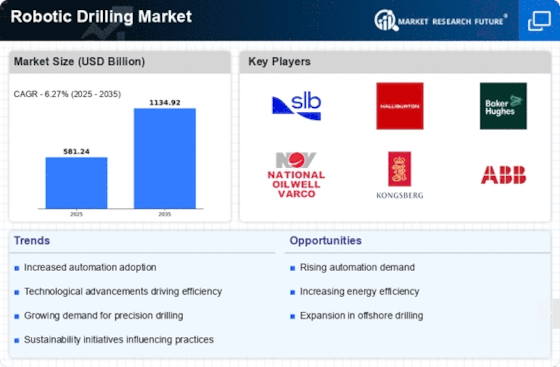
As per Market Research Future analysis, the Robotic Drilling Market Size was estimated at 581.24 USD Billion in 2024. The Robotic Drilling industry is projected to grow from 617.7 USD Billion in 2025 to 1134.92 USD Billion by 2035, exhibiting a compound annual growth rate (CAGR) of 6.27% during the forecast period 2025 - 2035

Key Market Trends & Highlights

The Robotic Drilling Market is poised for substantial growth driven by automation and sustainability initiatives.

  • North America remains the largest market for robotic drilling, reflecting a strong demand for advanced drilling technologies. The Asia-Pacific region is emerging as the fastest-growing market, fueled by increasing investments in energy infrastructure. The New Builds segment dominates the market, while the Retrofit segment is experiencing rapid growth due to modernization efforts. Technological advancements and rising demand for energy are key drivers propelling the market forward.

Market Size & Forecast

2024 Market Size 581.24 (USD Billion)
2035 Market Size 1134.92 (USD Billion)
CAGR (2025 - 2035) 6.27%
Largest Regional Market Share in 2024 North America

Major Players

<a href="https://www.slb.com/products-and-services/innovating-in-oil-and-gas/well-production/midstream/autonomous-robotic-operations">Schlumberger</a> (US), Halliburton (US), Baker Hughes (US), National Oilwell Varco (US), Kongsberg Gruppen (NO), ABB (CH), <a href="https://references.siemens.com/en/reference/robotic-drilling-systems-as?id=4DE60E28801F660010CB0CA91AB80D0D">Siemens </a>(DE), Weatherford International (IE), TechnipFMC (GB)

Market Trends

The Robotic Drilling Market is currently experiencing a transformative phase, driven by advancements in automation and artificial intelligence. Companies are increasingly adopting robotic solutions to enhance operational efficiency and reduce human error in drilling processes. This shift not only optimizes resource utilization but also minimizes environmental impact, aligning with global sustainability goals. As industries seek to improve productivity, the integration of robotics into drilling operations appears to be a strategic move that could redefine traditional practices. Furthermore, the growing demand for precision and safety in drilling activities is propelling innovations in robotic technologies, making them more accessible and effective. In addition, the Robotic Drilling Market is witnessing a surge in investments aimed at research and development. Stakeholders are focusing on creating more sophisticated robotic systems that can operate in challenging environments, such as deep-sea or remote locations. This trend suggests a potential expansion of applications beyond conventional sectors, possibly leading to new opportunities in unexplored markets. As the landscape evolves, collaboration between technology providers and industry players is likely to foster further advancements, ensuring that the Robotic Drilling Market remains at the forefront of technological innovation.

Increased Automation

The trend towards increased automation in the Robotic Drilling Market is reshaping operational frameworks. Companies are investing in automated systems to streamline processes, reduce labor costs, and enhance safety. This shift is likely to lead to more efficient drilling operations, as automated solutions can perform tasks with greater precision and consistency.

Sustainability Focus

A growing emphasis on sustainability is influencing the Robotic Drilling Market. Organizations are adopting robotic technologies that minimize environmental impact, aligning with global efforts to reduce carbon footprints. This trend indicates a shift towards eco-friendly practices, as companies seek to balance productivity with environmental responsibility.

Enhanced Data Analytics

The integration of advanced data analytics in the Robotic Drilling Market is becoming increasingly prevalent. Companies are leveraging data-driven insights to optimize drilling strategies and improve decision-making processes. This trend suggests that the future of drilling operations may rely heavily on data analytics to enhance performance and efficiency.

Robotic Drilling Market Market Drivers

Cost Efficiency

Cost efficiency remains a crucial driver within the Robotic Drilling Market. Companies are increasingly seeking ways to reduce operational expenses while maintaining high productivity levels. Robotic drilling technologies can significantly lower costs associated with labor, equipment maintenance, and downtime. For instance, automated drilling rigs can operate continuously, minimizing the need for human intervention and reducing the risk of costly errors. Industry reports suggest that the implementation of robotic systems can lead to a 15% reduction in overall drilling costs. This focus on cost efficiency is likely to propel the adoption of robotic solutions, as companies strive to enhance their competitive edge in a challenging market.

Rising Demand for Energy

The increasing The Robotic Drilling Industry. As populations grow and economies expand, the need for efficient energy extraction methods becomes paramount. The International Energy Agency projects that global energy demand will rise by 30% by 2040, necessitating innovative drilling technologies to meet this demand sustainably. Robotic drilling systems offer the potential to access hard-to-reach reserves and optimize resource extraction processes. This demand for energy, coupled with the need for environmentally friendly solutions, positions the Robotic Drilling Market as a critical player in the energy sector, likely leading to increased investments and technological advancements.

Environmental Regulations

The increasing stringency of environmental regulations is influencing the Robotic Drilling Market. Governments worldwide are implementing stricter policies to minimize the environmental impact of drilling activities. Robotic drilling technologies are often designed to be more environmentally friendly, utilizing less energy and generating fewer emissions compared to traditional methods. This shift towards sustainable practices is likely to drive the adoption of robotic systems, as companies seek to comply with regulations while maintaining operational efficiency. The potential for reduced environmental footprints positions the Robotic Drilling Market favorably in a landscape where sustainability is becoming a key consideration for stakeholders.

Safety and Risk Mitigation

Safety concerns in drilling operations are driving the adoption of robotic technologies within the Robotic Drilling Market. The inherent risks associated with traditional drilling methods, including accidents and exposure to hazardous environments, have prompted companies to seek safer alternatives. Robotic drilling systems can operate in dangerous conditions without putting human lives at risk, thereby enhancing workplace safety. Furthermore, the integration of advanced monitoring systems allows for real-time assessment of drilling conditions, enabling proactive risk management. As safety regulations become more stringent, the demand for robotic solutions that prioritize worker safety is expected to grow, further solidifying the role of the Robotic Drilling Market in modern drilling practices.

Technological Advancements

The Robotic Drilling Market is experiencing a surge in technological advancements that enhance drilling efficiency and precision. Innovations in robotics, artificial intelligence, and machine learning are driving the development of sophisticated drilling systems. These technologies enable real-time data analysis and decision-making, which can significantly reduce operational costs. According to recent estimates, the integration of advanced robotics in drilling operations could lead to a 20% increase in productivity. Furthermore, the adoption of automated drilling rigs is expected to rise, as companies seek to minimize human error and improve safety standards. This trend indicates a shift towards more intelligent drilling solutions, positioning the Robotic Drilling Market for substantial growth in the coming years.

Market Segment Insights

By Installation Type: New Builds (Largest) vs. Retrofit (Fastest-Growing)

<p>The Installation Type segment in the Robotic Drilling Market reveals a significant distribution of market share, predominantly driven by New Builds, which stand out as the largest segment. This segment benefits from the ongoing demand for advanced drilling technology in newly constructed facilities, enabling operators to leverage the efficiency and precision of robotics. On the other hand, Retrofit solutions are rapidly gaining traction, attracting operators looking to upgrade their existing drilling systems without the substantial costs of entirely new infrastructure.</p>

<p>New Builds: Dominant vs. Retrofit: Emerging</p>

<p>In the Robotic Drilling Market, New Builds represent a dominant force characterized by their integration into modern infrastructure. These installations often utilize the latest technologies to enhance drilling efficiency, reduce downtime, and improve overall operational performance. Conversely, Retrofit solutions are emerging as a vital alternative, appealing to operators seeking cost-effective ways to modernize their existing systems. These solutions not only offer substantial technological upgrades but also facilitate compliance with new regulatory standards and sustainability goals. The growing interest in energy-efficient systems and automation drives the Retrofit market, making it a key player in the future landscape of robotic drilling.</p>

By Component: Hardware (Largest) vs. Software (Fastest-Growing)

<p>In the Robotic Drilling Market, the distribution of market share between Hardware and Software is distinct, with Hardware dominating the segment significantly. This category includes mechanical components, tools, and robotics that provide the foundational structure for robotic drilling systems. Hardware benefits from established manufacturing processes and ongoing industry demand, making it a crucial player in the market landscape. Conversely, Software, while smaller in share, showcases rapid growth as it encompasses advanced control systems, automation software, and analytics that enhance the efficiency and capabilities of robotic drilling operations.</p>

<p>Component: Hardware (Dominant) vs. Software (Emerging)</p>

<p>Hardware is characterized by its robustness and reliability, forming the backbone of robotic drilling systems. It includes specialized tools and machines that are integral for the drilling process, ensuring precision and operational efficiency. The demand for Hardware is driven by the need for durable components that can withstand harsh environments. On the other hand, Software is emerging as a critical aspect of modern drilling operations, focusing on enhancing functionality through advanced algorithms and real-time data analysis. As companies seek to optimize workflow and reduce operational costs, the Software segment is projected to grow rapidly, appealing to those looking to leverage technology for improved drilling precision and automation.</p>

By Application: Onshore (Largest) vs. Offshore (Fastest-Growing)

<p>In the Robotic Drilling Market, the application segment consists primarily of onshore and offshore drilling operations. Onshore drilling currently holds the largest market share, driven by its established infrastructure and operational efficiency. Conversely, the offshore application is gaining ground rapidly, leveraging advancements in technology and robotics for exploration in remote locations. This duality highlights the evolving dynamics within the industry, with onshore operations continuing to dominate in volume while offshore applications are scaling up due to increasing investment and demand for untapped resources. The growth trends in the Robotic Drilling Market indicate a significant shift towards offshore drilling as companies seek to capitalize on deeper and more complex reserves. Key drivers for this segment include technological innovations that enhance safety, efficiency, and the ability to operate in harsher environments. Furthermore, as global energy demands rise, the push for sustainable and efficient extraction practices will likely propel the offshore segment to greater heights, positioning it as the fastest-growing area within the market.</p>

<p>Onshore (Dominant) vs. Offshore (Emerging)</p>

<p>Onshore drilling remains the dominant force in the Robotic Drilling Market, characterized by a more matured and competitive landscape. Its advantages include established technological prowess, lower operational costs, and extensive experience in land-based extraction. Companies involved in onshore drilling are increasingly integrating robotic technologies to enhance productivity and reduce labor costs. In contrast, the offshore segment is considered emerging but rapidly growing, driven by significant investment and innovations tailored to deep-sea exploration. This segment faces unique challenges such as harsh environmental conditions but is buoyed by the promise of resource-rich reserves and advancements in remotely operated vehicles and automated systems, making it an attractive frontier for operators aiming to leverage robotic solutions for enhanced drilling operations.</p>

Get more detailed insights about Robotic Drilling Market Research Report-Global Forecast till 2035

Regional Insights

North America : Innovation and Leadership Hub

North America is the largest market for robotic drilling, holding approximately 45% of the global share. The region's growth is driven by technological advancements, increasing demand for automation in drilling operations, and supportive regulatory frameworks. The U.S. government has been promoting initiatives to enhance energy efficiency and reduce operational costs, further fueling market expansion. The competitive landscape is characterized by major players such as Schlumberger, Halliburton, and Baker Hughes, which are investing heavily in R&D to innovate robotic drilling technologies. The presence of these key players, along with a robust supply chain and skilled workforce, positions North America as a leader in the robotic drilling market.

Europe : Emerging Market with Potential

Europe is witnessing significant growth in the robotic drilling market, accounting for about 30% of the global share. The region's expansion is driven by increasing investments in renewable energy and stringent regulations aimed at reducing carbon emissions. Countries like Norway and the UK are leading the charge, supported by government policies that encourage the adoption of advanced drilling technologies. The competitive landscape in Europe features key players such as Kongsberg Gruppen and ABB, which are focusing on innovative solutions to enhance drilling efficiency. The presence of these companies, along with a growing emphasis on sustainability, is expected to drive further growth in the robotic drilling sector across the region.

Asia-Pacific : Rapidly Growing Market

Asia-Pacific is emerging as a significant player in the robotic drilling market, holding around 20% of the global share. The region's growth is fueled by increasing energy demands, particularly in countries like China and India, where there is a strong push for automation in drilling operations. Government initiatives aimed at enhancing energy efficiency and reducing operational costs are also contributing to market growth. The competitive landscape is evolving, with local players and international companies like Siemens and Weatherford International expanding their presence. The focus on technological advancements and partnerships is expected to drive further growth in the robotic drilling market in this region, making it a key area for investment.

Middle East and Africa : Resource-Rich Frontier

The Middle East and Africa region is gradually developing its robotic drilling market, currently holding about 5% of the global share. The growth is primarily driven by the region's vast oil and gas reserves and the increasing need for efficient drilling technologies. Countries like Saudi Arabia and the UAE are investing in advanced drilling solutions to enhance productivity and reduce costs, supported by favorable government policies. The competitive landscape is characterized by a mix of local and international players, including TechnipFMC and National Oilwell Varco. The presence of these companies, along with ongoing investments in infrastructure and technology, is expected to foster growth in the robotic drilling market across the region, making it an attractive area for future investments.

Key Players and Competitive Insights

Leading market players are investing heavily in research and development in order to expand their product lines, which will help the Robotic Drilling Market, grow even more. Market participants are also undertaking a variety of strategic activities to expand their footprint, with important market developments including new product launches, contractual agreements, mergers and acquisitions, higher investments, and collaboration with other organizations. To expand and survive in a more competitive and rising market climate, Robotic Drilling industry must offer cost-effective items.
Manufacturing locally to minimize operational costs is one of the key business tactics used by manufacturers in the Robotic Drilling industry to benefit clients and increase the market sector. In recent years, the Robotic Drilling industry has offered some of the most significant advantages to medicine. 
Major players in the Robotic Drilling Market, including Sekal, Odfjell Drilling, Ensign Energy Services, Huisman Equipments, Nabors – Rds, Automated Rig Technologies, Drillmec, Weatherford International, National Oilwell Varco, Rigarm and others, are attempting to increase market demand by investing in research and development operations.
Odfjell Drilling Ltd. is a full-service offshore drilling and oil company. In addition to running a fleet of difficult and ultra-deepwater mobile offshore drilling rigs, it also provides platform drilling and well services. The organization's drilling technology offers solutions for conceptual engineering and design, building and commissioning, changes and upgrades, as well as marine and operational requirements.    
It’s well services include tubular running, equipment rentals, and well intervention. Odfjell operates semi-submersibles, drillships, jackups, and modular drilling equipment all over the world. Among the nations where it does business are the UAE, Norway, Brazil, the Philippines, Malaysia, Romania, Saudi Arabia, Singapore, Vietnam, Thailand, the UK, and the Netherlands. Odfjell's headquarters are in Hamilton, Bermuda.
Weatherford International Plc (Weatherford) is a supplier of oilfield services. The company sells equipment and labor for drilling, analyzing, completing, producing, and intervening in oil and gas wells. Its product portfolio includes artificial lift systems, completion systems, liner systems, cementing materials, drilling equipment, and rental equipment. 
The company provides a variety of services, including drilling, controlled pressure drilling, wireline, reservoir solutions, surface data logging systems, tubular running, intervention, and land drilling rigs. Asia Pacific, Europe, Africa, Russia, Latin America, and North America are among regions in which it operates. Houston, Texas, acts as Weatherford's base of operations in the US.

Key Companies in the Robotic Drilling Market include

Industry Developments

March 2021:For Basra Oil Company and ExxonMobil, which jointly operate the massive West Qurna-1 field with partners from Iraq, Japan, Indonesia, and China, Schlumberger was awarded a USD 480 million contract to drill 96 oil wells in southern Iraq.

October 2021:The PACE-R801 from Nabors Industries Ltd. is the first fully automated land drilling rig incorporating Canrig robotics. On its first well in the Permian Basin, it reached total depth. In order to remove employees from dangerous zones and provide reliable drilling performance, it built an autonomous rig floor.

Future Outlook

Robotic Drilling Market Future Outlook

The Robotic Drilling Market is projected to grow at a 6.27% CAGR from 2025 to 2035, driven by technological advancements, increased automation, and demand for efficiency.

New opportunities lie in:

  • Development of AI-driven predictive maintenance systems
  • Integration of IoT for real-time data analytics
  • Expansion into renewable energy drilling applications

By 2035, the market is expected to achieve substantial growth, positioning itself as a leader in drilling technology.

Market Segmentation

Robotic Drilling Market Component Outlook

  • Hardware
  • Software

Robotic Drilling Market Application Outlook

  • Onshore
  • Offshore

Robotic Drilling Market Installation Type Outlook

  • Retrofit
  • New Builds
  • Others

Report Scope

MARKET SIZE 2024 581.24(USD Billion)
MARKET SIZE 2025 617.7(USD Billion)
MARKET SIZE 2035 1134.92(USD Billion)
COMPOUND ANNUAL GROWTH RATE (CAGR) 6.27% (2025 - 2035)
REPORT COVERAGE Revenue Forecast, Competitive Landscape, Growth Factors, and Trends
BASE YEAR 2024
Market Forecast Period 2025 - 2035
Historical Data 2019 - 2024
Market Forecast Units USD Billion
Key Companies Profiled Schlumberger (US), Halliburton (US), Baker Hughes (US), National Oilwell Varco (US), Kongsberg Gruppen (NO), ABB (CH), Siemens (DE), Weatherford International (IE), TechnipFMC (GB)
Segments Covered Installation Type, Region
Key Market Opportunities Integration of artificial intelligence enhances efficiency and precision in the Robotic Drilling Market.
Key Market Dynamics Technological advancements drive efficiency and safety in robotic drilling, reshaping industry standards and competitive dynamics.
Countries Covered North America, Europe, APAC, South America, MEA

FAQs

What is the projected market valuation of the Robotic Drilling Market by 2035?

<p>The Robotic Drilling Market is projected to reach a valuation of 1134.92 USD Billion by 2035.</p>

What was the market valuation of the Robotic Drilling Market in 2024?

<p>In 2024, the overall market valuation was 581.24 USD Billion.</p>

What is the expected CAGR for the Robotic Drilling Market during the forecast period 2025 - 2035?

<p>The expected CAGR for the Robotic Drilling Market during the forecast period 2025 - 2035 is 6.27%.</p>

Which companies are considered key players in the Robotic Drilling Market?

<p>Key players in the Robotic Drilling Market include Schlumberger, Halliburton, Baker Hughes, and National Oilwell Varco.</p>

What are the projected valuations for the Retrofit segment in the Robotic Drilling Market?

<p>The Retrofit segment is projected to grow from 116.25 USD Billion to 220.0 USD Billion.</p>

How does the New Builds segment compare to the Retrofit segment in terms of valuation?

<p>The New Builds segment is expected to grow from 350.0 USD Billion to 700.0 USD Billion, surpassing the Retrofit segment.</p>

What is the projected valuation for the Hardware component in the Robotic Drilling Market?

The Hardware component is projected to grow from 348.74 USD Billion to 683.0 USD Billion.

What is the expected growth for the Software component in the Robotic Drilling Market?

The Software component is anticipated to increase from 232.5 USD Billion to 451.92 USD Billion.

What are the projected valuations for the Onshore and Offshore applications in the Robotic Drilling Market?

The Onshore application is projected to grow from 348.74 USD Billion to 685.0 USD Billion, while Offshore is expected to grow from 232.5 USD Billion to 449.92 USD Billion.

How do the projected valuations of the Robotic Drilling Market segments reflect industry trends?

The projected valuations indicate a robust growth trajectory across segments, suggesting increasing investment in both Hardware and Software components.

  1. SECTION I: EXECUTIVE SUMMARY AND KEY HIGHLIGHTS
    1. | 1.1 EXECUTIVE SUMMARY
    2. | | 1.1.1 Market Overview
    3. | | 1.1.2 Key Findings
    4. | | 1.1.3 Market Segmentation
    5. | | 1.1.4 Competitive Landscape
    6. | | 1.1.5 Challenges and Opportunities
    7. | | 1.1.6 Future Outlook
  2. SECTION II: SCOPING, METHODOLOGY AND MARKET STRUCTURE
    1. | 2.1 MARKET INTRODUCTION
    2. | | 2.1.1 Definition
    3. | | 2.1.2 Scope of the study
    4. | | | 2.1.2.1 Research Objective
    5. | | | 2.1.2.2 Assumption
    6. | | | 2.1.2.3 Limitations
    7. | 2.2 RESEARCH METHODOLOGY
    8. | | 2.2.1 Overview
    9. | | 2.2.2 Data Mining
    10. | | 2.2.3 Secondary Research
    11. | | 2.2.4 Primary Research
    12. | | | 2.2.4.1 Primary Interviews and Information Gathering Process
    13. | | | 2.2.4.2 Breakdown of Primary Respondents
    14. | | 2.2.5 Forecasting Model
    15. | | 2.2.6 Market Size Estimation
    16. | | | 2.2.6.1 Bottom-Up Approach
    17. | | | 2.2.6.2 Top-Down Approach
    18. | | 2.2.7 Data Triangulation
    19. | | 2.2.8 Validation
  3. SECTION III: QUALITATIVE ANALYSIS
    1. | 3.1 MARKET DYNAMICS
    2. | | 3.1.1 Overview
    3. | | 3.1.2 Drivers
    4. | | 3.1.3 Restraints
    5. | | 3.1.4 Opportunities
    6. | 3.2 MARKET FACTOR ANALYSIS
    7. | | 3.2.1 Value chain Analysis
    8. | | 3.2.2 Porter's Five Forces Analysis
    9. | | | 3.2.2.1 Bargaining Power of Suppliers
    10. | | | 3.2.2.2 Bargaining Power of Buyers
    11. | | | 3.2.2.3 Threat of New Entrants
    12. | | | 3.2.2.4 Threat of Substitutes
    13. | | | 3.2.2.5 Intensity of Rivalry
    14. | | 3.2.3 COVID-19 Impact Analysis
    15. | | | 3.2.3.1 Market Impact Analysis
    16. | | | 3.2.3.2 Regional Impact
    17. | | | 3.2.3.3 Opportunity and Threat Analysis
  4. SECTION IV: QUANTITATIVE ANALYSIS
    1. | 4.1 Energy & Power, BY Installation Type (USD Billion)
    2. | | 4.1.1 Retrofit
    3. | | 4.1.2 New Builds
    4. | | 4.1.3 Others
    5. | 4.2 Energy & Power, BY Component (USD Billion)
    6. | | 4.2.1 Hardware
    7. | | 4.2.2 Software
    8. | 4.3 Energy & Power, BY Application (USD Billion)
    9. | | 4.3.1 Onshore
    10. | | 4.3.2 Offshore
    11. | 4.4 Energy & Power, BY Region (USD Billion)
    12. | | 4.4.1 North America
    13. | | | 4.4.1.1 US
    14. | | | 4.4.1.2 Canada
    15. | | 4.4.2 Europe
    16. | | | 4.4.2.1 Germany
    17. | | | 4.4.2.2 UK
    18. | | | 4.4.2.3 France
    19. | | | 4.4.2.4 Russia
    20. | | | 4.4.2.5 Italy
    21. | | | 4.4.2.6 Spain
    22. | | | 4.4.2.7 Rest of Europe
    23. | | 4.4.3 APAC
    24. | | | 4.4.3.1 China
    25. | | | 4.4.3.2 India
    26. | | | 4.4.3.3 Japan
    27. | | | 4.4.3.4 South Korea
    28. | | | 4.4.3.5 Malaysia
    29. | | | 4.4.3.6 Thailand
    30. | | | 4.4.3.7 Indonesia
    31. | | | 4.4.3.8 Rest of APAC
    32. | | 4.4.4 South America
    33. | | | 4.4.4.1 Brazil
    34. | | | 4.4.4.2 Mexico
    35. | | | 4.4.4.3 Argentina
    36. | | | 4.4.4.4 Rest of South America
    37. | | 4.4.5 MEA
    38. | | | 4.4.5.1 GCC Countries
    39. | | | 4.4.5.2 South Africa
    40. | | | 4.4.5.3 Rest of MEA
  5. SECTION V: COMPETITIVE ANALYSIS
    1. | 5.1 Competitive Landscape
    2. | | 5.1.1 Overview
    3. | | 5.1.2 Competitive Analysis
    4. | | 5.1.3 Market share Analysis
    5. | | 5.1.4 Major Growth Strategy in the Energy & Power
    6. | | 5.1.5 Competitive Benchmarking
    7. | | 5.1.6 Leading Players in Terms of Number of Developments in the Energy & Power
    8. | | 5.1.7 Key developments and growth strategies
    9. | | | 5.1.7.1 New Product Launch/Service Deployment
    10. | | | 5.1.7.2 Merger & Acquisitions
    11. | | | 5.1.7.3 Joint Ventures
    12. | | 5.1.8 Major Players Financial Matrix
    13. | | | 5.1.8.1 Sales and Operating Income
    14. | | | 5.1.8.2 Major Players R&D Expenditure. 2023
    15. | 5.2 Company Profiles
    16. | | 5.2.1 Schlumberger (US)
    17. | | | 5.2.1.1 Financial Overview
    18. | | | 5.2.1.2 Products Offered
    19. | | | 5.2.1.3 Key Developments
    20. | | | 5.2.1.4 SWOT Analysis
    21. | | | 5.2.1.5 Key Strategies
    22. | | 5.2.2 Halliburton (US)
    23. | | | 5.2.2.1 Financial Overview
    24. | | | 5.2.2.2 Products Offered
    25. | | | 5.2.2.3 Key Developments
    26. | | | 5.2.2.4 SWOT Analysis
    27. | | | 5.2.2.5 Key Strategies
    28. | | 5.2.3 Baker Hughes (US)
    29. | | | 5.2.3.1 Financial Overview
    30. | | | 5.2.3.2 Products Offered
    31. | | | 5.2.3.3 Key Developments
    32. | | | 5.2.3.4 SWOT Analysis
    33. | | | 5.2.3.5 Key Strategies
    34. | | 5.2.4 National Oilwell Varco (US)
    35. | | | 5.2.4.1 Financial Overview
    36. | | | 5.2.4.2 Products Offered
    37. | | | 5.2.4.3 Key Developments
    38. | | | 5.2.4.4 SWOT Analysis
    39. | | | 5.2.4.5 Key Strategies
    40. | | 5.2.5 Kongsberg Gruppen (NO)
    41. | | | 5.2.5.1 Financial Overview
    42. | | | 5.2.5.2 Products Offered
    43. | | | 5.2.5.3 Key Developments
    44. | | | 5.2.5.4 SWOT Analysis
    45. | | | 5.2.5.5 Key Strategies
    46. | | 5.2.6 ABB (CH)
    47. | | | 5.2.6.1 Financial Overview
    48. | | | 5.2.6.2 Products Offered
    49. | | | 5.2.6.3 Key Developments
    50. | | | 5.2.6.4 SWOT Analysis
    51. | | | 5.2.6.5 Key Strategies
    52. | | 5.2.7 Siemens (DE)
    53. | | | 5.2.7.1 Financial Overview
    54. | | | 5.2.7.2 Products Offered
    55. | | | 5.2.7.3 Key Developments
    56. | | | 5.2.7.4 SWOT Analysis
    57. | | | 5.2.7.5 Key Strategies
    58. | | 5.2.8 Weatherford International (IE)
    59. | | | 5.2.8.1 Financial Overview
    60. | | | 5.2.8.2 Products Offered
    61. | | | 5.2.8.3 Key Developments
    62. | | | 5.2.8.4 SWOT Analysis
    63. | | | 5.2.8.5 Key Strategies
    64. | | 5.2.9 TechnipFMC (GB)
    65. | | | 5.2.9.1 Financial Overview
    66. | | | 5.2.9.2 Products Offered
    67. | | | 5.2.9.3 Key Developments
    68. | | | 5.2.9.4 SWOT Analysis
    69. | | | 5.2.9.5 Key Strategies
    70. | 5.3 Appendix
    71. | | 5.3.1 References
    72. | | 5.3.2 Related Reports
  6. LIST OF FIGURES
    1. | 6.1 MARKET SYNOPSIS
    2. | 6.2 NORTH AMERICA MARKET ANALYSIS
    3. | 6.3 US MARKET ANALYSIS BY INSTALLATION TYPE
    4. | 6.4 US MARKET ANALYSIS BY COMPONENT
    5. | 6.5 US MARKET ANALYSIS BY APPLICATION
    6. | 6.6 CANADA MARKET ANALYSIS BY INSTALLATION TYPE
    7. | 6.7 CANADA MARKET ANALYSIS BY COMPONENT
    8. | 6.8 CANADA MARKET ANALYSIS BY APPLICATION
    9. | 6.9 EUROPE MARKET ANALYSIS
    10. | 6.10 GERMANY MARKET ANALYSIS BY INSTALLATION TYPE
    11. | 6.11 GERMANY MARKET ANALYSIS BY COMPONENT
    12. | 6.12 GERMANY MARKET ANALYSIS BY APPLICATION
    13. | 6.13 UK MARKET ANALYSIS BY INSTALLATION TYPE
    14. | 6.14 UK MARKET ANALYSIS BY COMPONENT
    15. | 6.15 UK MARKET ANALYSIS BY APPLICATION
    16. | 6.16 FRANCE MARKET ANALYSIS BY INSTALLATION TYPE
    17. | 6.17 FRANCE MARKET ANALYSIS BY COMPONENT
    18. | 6.18 FRANCE MARKET ANALYSIS BY APPLICATION
    19. | 6.19 RUSSIA MARKET ANALYSIS BY INSTALLATION TYPE
    20. | 6.20 RUSSIA MARKET ANALYSIS BY COMPONENT
    21. | 6.21 RUSSIA MARKET ANALYSIS BY APPLICATION
    22. | 6.22 ITALY MARKET ANALYSIS BY INSTALLATION TYPE
    23. | 6.23 ITALY MARKET ANALYSIS BY COMPONENT
    24. | 6.24 ITALY MARKET ANALYSIS BY APPLICATION
    25. | 6.25 SPAIN MARKET ANALYSIS BY INSTALLATION TYPE
    26. | 6.26 SPAIN MARKET ANALYSIS BY COMPONENT
    27. | 6.27 SPAIN MARKET ANALYSIS BY APPLICATION
    28. | 6.28 REST OF EUROPE MARKET ANALYSIS BY INSTALLATION TYPE
    29. | 6.29 REST OF EUROPE MARKET ANALYSIS BY COMPONENT
    30. | 6.30 REST OF EUROPE MARKET ANALYSIS BY APPLICATION
    31. | 6.31 APAC MARKET ANALYSIS
    32. | 6.32 CHINA MARKET ANALYSIS BY INSTALLATION TYPE
    33. | 6.33 CHINA MARKET ANALYSIS BY COMPONENT
    34. | 6.34 CHINA MARKET ANALYSIS BY APPLICATION
    35. | 6.35 INDIA MARKET ANALYSIS BY INSTALLATION TYPE
    36. | 6.36 INDIA MARKET ANALYSIS BY COMPONENT
    37. | 6.37 INDIA MARKET ANALYSIS BY APPLICATION
    38. | 6.38 JAPAN MARKET ANALYSIS BY INSTALLATION TYPE
    39. | 6.39 JAPAN MARKET ANALYSIS BY COMPONENT
    40. | 6.40 JAPAN MARKET ANALYSIS BY APPLICATION
    41. | 6.41 SOUTH KOREA MARKET ANALYSIS BY INSTALLATION TYPE
    42. | 6.42 SOUTH KOREA MARKET ANALYSIS BY COMPONENT
    43. | 6.43 SOUTH KOREA MARKET ANALYSIS BY APPLICATION
    44. | 6.44 MALAYSIA MARKET ANALYSIS BY INSTALLATION TYPE
    45. | 6.45 MALAYSIA MARKET ANALYSIS BY COMPONENT
    46. | 6.46 MALAYSIA MARKET ANALYSIS BY APPLICATION
    47. | 6.47 THAILAND MARKET ANALYSIS BY INSTALLATION TYPE
    48. | 6.48 THAILAND MARKET ANALYSIS BY COMPONENT
    49. | 6.49 THAILAND MARKET ANALYSIS BY APPLICATION
    50. | 6.50 INDONESIA MARKET ANALYSIS BY INSTALLATION TYPE
    51. | 6.51 INDONESIA MARKET ANALYSIS BY COMPONENT
    52. | 6.52 INDONESIA MARKET ANALYSIS BY APPLICATION
    53. | 6.53 REST OF APAC MARKET ANALYSIS BY INSTALLATION TYPE
    54. | 6.54 REST OF APAC MARKET ANALYSIS BY COMPONENT
    55. | 6.55 REST OF APAC MARKET ANALYSIS BY APPLICATION
    56. | 6.56 SOUTH AMERICA MARKET ANALYSIS
    57. | 6.57 BRAZIL MARKET ANALYSIS BY INSTALLATION TYPE
    58. | 6.58 BRAZIL MARKET ANALYSIS BY COMPONENT
    59. | 6.59 BRAZIL MARKET ANALYSIS BY APPLICATION
    60. | 6.60 MEXICO MARKET ANALYSIS BY INSTALLATION TYPE
    61. | 6.61 MEXICO MARKET ANALYSIS BY COMPONENT
    62. | 6.62 MEXICO MARKET ANALYSIS BY APPLICATION
    63. | 6.63 ARGENTINA MARKET ANALYSIS BY INSTALLATION TYPE
    64. | 6.64 ARGENTINA MARKET ANALYSIS BY COMPONENT
    65. | 6.65 ARGENTINA MARKET ANALYSIS BY APPLICATION
    66. | 6.66 REST OF SOUTH AMERICA MARKET ANALYSIS BY INSTALLATION TYPE
    67. | 6.67 REST OF SOUTH AMERICA MARKET ANALYSIS BY COMPONENT
    68. | 6.68 REST OF SOUTH AMERICA MARKET ANALYSIS BY APPLICATION
    69. | 6.69 MEA MARKET ANALYSIS
    70. | 6.70 GCC COUNTRIES MARKET ANALYSIS BY INSTALLATION TYPE
    71. | 6.71 GCC COUNTRIES MARKET ANALYSIS BY COMPONENT
    72. | 6.72 GCC COUNTRIES MARKET ANALYSIS BY APPLICATION
    73. | 6.73 SOUTH AFRICA MARKET ANALYSIS BY INSTALLATION TYPE
    74. | 6.74 SOUTH AFRICA MARKET ANALYSIS BY COMPONENT
    75. | 6.75 SOUTH AFRICA MARKET ANALYSIS BY APPLICATION
    76. | 6.76 REST OF MEA MARKET ANALYSIS BY INSTALLATION TYPE
    77. | 6.77 REST OF MEA MARKET ANALYSIS BY COMPONENT
    78. | 6.78 REST OF MEA MARKET ANALYSIS BY APPLICATION
    79. | 6.79 KEY BUYING CRITERIA OF ENERGY & POWER
    80. | 6.80 RESEARCH PROCESS OF MRFR
    81. | 6.81 DRO ANALYSIS OF ENERGY & POWER
    82. | 6.82 DRIVERS IMPACT ANALYSIS: ENERGY & POWER
    83. | 6.83 RESTRAINTS IMPACT ANALYSIS: ENERGY & POWER
    84. | 6.84 SUPPLY / VALUE CHAIN: ENERGY & POWER
    85. | 6.85 ENERGY & POWER, BY INSTALLATION TYPE, 2024 (% SHARE)
    86. | 6.86 ENERGY & POWER, BY INSTALLATION TYPE, 2024 TO 2035 (USD Billion)
    87. | 6.87 ENERGY & POWER, BY COMPONENT, 2024 (% SHARE)
    88. | 6.88 ENERGY & POWER, BY COMPONENT, 2024 TO 2035 (USD Billion)
    89. | 6.89 ENERGY & POWER, BY APPLICATION, 2024 (% SHARE)
    90. | 6.90 ENERGY & POWER, BY APPLICATION, 2024 TO 2035 (USD Billion)
    91. | 6.91 BENCHMARKING OF MAJOR COMPETITORS
  7. LIST OF TABLES
    1. | 7.1 LIST OF ASSUMPTIONS
    2. | | 7.1.1
    3. | 7.2 North America MARKET SIZE ESTIMATES; FORECAST
    4. | | 7.2.1 BY INSTALLATION TYPE, 2025-2035 (USD Billion)
    5. | | 7.2.2 BY COMPONENT, 2025-2035 (USD Billion)
    6. | | 7.2.3 BY APPLICATION, 2025-2035 (USD Billion)
    7. | 7.3 US MARKET SIZE ESTIMATES; FORECAST
    8. | | 7.3.1 BY INSTALLATION TYPE, 2025-2035 (USD Billion)
    9. | | 7.3.2 BY COMPONENT, 2025-2035 (USD Billion)
    10. | | 7.3.3 BY APPLICATION, 2025-2035 (USD Billion)
    11. | 7.4 Canada MARKET SIZE ESTIMATES; FORECAST
    12. | | 7.4.1 BY INSTALLATION TYPE, 2025-2035 (USD Billion)
    13. | | 7.4.2 BY COMPONENT, 2025-2035 (USD Billion)
    14. | | 7.4.3 BY APPLICATION, 2025-2035 (USD Billion)
    15. | 7.5 Europe MARKET SIZE ESTIMATES; FORECAST
    16. | | 7.5.1 BY INSTALLATION TYPE, 2025-2035 (USD Billion)
    17. | | 7.5.2 BY COMPONENT, 2025-2035 (USD Billion)
    18. | | 7.5.3 BY APPLICATION, 2025-2035 (USD Billion)
    19. | 7.6 Germany MARKET SIZE ESTIMATES; FORECAST
    20. | | 7.6.1 BY INSTALLATION TYPE, 2025-2035 (USD Billion)
    21. | | 7.6.2 BY COMPONENT, 2025-2035 (USD Billion)
    22. | | 7.6.3 BY APPLICATION, 2025-2035 (USD Billion)
    23. | 7.7 UK MARKET SIZE ESTIMATES; FORECAST
    24. | | 7.7.1 BY INSTALLATION TYPE, 2025-2035 (USD Billion)
    25. | | 7.7.2 BY COMPONENT, 2025-2035 (USD Billion)
    26. | | 7.7.3 BY APPLICATION, 2025-2035 (USD Billion)
    27. | 7.8 France MARKET SIZE ESTIMATES; FORECAST
    28. | | 7.8.1 BY INSTALLATION TYPE, 2025-2035 (USD Billion)
    29. | | 7.8.2 BY COMPONENT, 2025-2035 (USD Billion)
    30. | | 7.8.3 BY APPLICATION, 2025-2035 (USD Billion)
    31. | 7.9 Russia MARKET SIZE ESTIMATES; FORECAST
    32. | | 7.9.1 BY INSTALLATION TYPE, 2025-2035 (USD Billion)
    33. | | 7.9.2 BY COMPONENT, 2025-2035 (USD Billion)
    34. | | 7.9.3 BY APPLICATION, 2025-2035 (USD Billion)
    35. | 7.10 Italy MARKET SIZE ESTIMATES; FORECAST
    36. | | 7.10.1 BY INSTALLATION TYPE, 2025-2035 (USD Billion)
    37. | | 7.10.2 BY COMPONENT, 2025-2035 (USD Billion)
    38. | | 7.10.3 BY APPLICATION, 2025-2035 (USD Billion)
    39. | 7.11 Spain MARKET SIZE ESTIMATES; FORECAST
    40. | | 7.11.1 BY INSTALLATION TYPE, 2025-2035 (USD Billion)
    41. | | 7.11.2 BY COMPONENT, 2025-2035 (USD Billion)
    42. | | 7.11.3 BY APPLICATION, 2025-2035 (USD Billion)
    43. | 7.12 Rest of Europe MARKET SIZE ESTIMATES; FORECAST
    44. | | 7.12.1 BY INSTALLATION TYPE, 2025-2035 (USD Billion)
    45. | | 7.12.2 BY COMPONENT, 2025-2035 (USD Billion)
    46. | | 7.12.3 BY APPLICATION, 2025-2035 (USD Billion)
    47. | 7.13 APAC MARKET SIZE ESTIMATES; FORECAST
    48. | | 7.13.1 BY INSTALLATION TYPE, 2025-2035 (USD Billion)
    49. | | 7.13.2 BY COMPONENT, 2025-2035 (USD Billion)
    50. | | 7.13.3 BY APPLICATION, 2025-2035 (USD Billion)
    51. | 7.14 China MARKET SIZE ESTIMATES; FORECAST
    52. | | 7.14.1 BY INSTALLATION TYPE, 2025-2035 (USD Billion)
    53. | | 7.14.2 BY COMPONENT, 2025-2035 (USD Billion)
    54. | | 7.14.3 BY APPLICATION, 2025-2035 (USD Billion)
    55. | 7.15 India MARKET SIZE ESTIMATES; FORECAST
    56. | | 7.15.1 BY INSTALLATION TYPE, 2025-2035 (USD Billion)
    57. | | 7.15.2 BY COMPONENT, 2025-2035 (USD Billion)
    58. | | 7.15.3 BY APPLICATION, 2025-2035 (USD Billion)
    59. | 7.16 Japan MARKET SIZE ESTIMATES; FORECAST
    60. | | 7.16.1 BY INSTALLATION TYPE, 2025-2035 (USD Billion)
    61. | | 7.16.2 BY COMPONENT, 2025-2035 (USD Billion)
    62. | | 7.16.3 BY APPLICATION, 2025-2035 (USD Billion)
    63. | 7.17 South Korea MARKET SIZE ESTIMATES; FORECAST
    64. | | 7.17.1 BY INSTALLATION TYPE, 2025-2035 (USD Billion)
    65. | | 7.17.2 BY COMPONENT, 2025-2035 (USD Billion)
    66. | | 7.17.3 BY APPLICATION, 2025-2035 (USD Billion)
    67. | 7.18 Malaysia MARKET SIZE ESTIMATES; FORECAST
    68. | | 7.18.1 BY INSTALLATION TYPE, 2025-2035 (USD Billion)
    69. | | 7.18.2 BY COMPONENT, 2025-2035 (USD Billion)
    70. | | 7.18.3 BY APPLICATION, 2025-2035 (USD Billion)
    71. | 7.19 Thailand MARKET SIZE ESTIMATES; FORECAST
    72. | | 7.19.1 BY INSTALLATION TYPE, 2025-2035 (USD Billion)
    73. | | 7.19.2 BY COMPONENT, 2025-2035 (USD Billion)
    74. | | 7.19.3 BY APPLICATION, 2025-2035 (USD Billion)
    75. | 7.20 Indonesia MARKET SIZE ESTIMATES; FORECAST
    76. | | 7.20.1 BY INSTALLATION TYPE, 2025-2035 (USD Billion)
    77. | | 7.20.2 BY COMPONENT, 2025-2035 (USD Billion)
    78. | | 7.20.3 BY APPLICATION, 2025-2035 (USD Billion)
    79. | 7.21 Rest of APAC MARKET SIZE ESTIMATES; FORECAST
    80. | | 7.21.1 BY INSTALLATION TYPE, 2025-2035 (USD Billion)
    81. | | 7.21.2 BY COMPONENT, 2025-2035 (USD Billion)
    82. | | 7.21.3 BY APPLICATION, 2025-2035 (USD Billion)
    83. | 7.22 South America MARKET SIZE ESTIMATES; FORECAST
    84. | | 7.22.1 BY INSTALLATION TYPE, 2025-2035 (USD Billion)
    85. | | 7.22.2 BY COMPONENT, 2025-2035 (USD Billion)
    86. | | 7.22.3 BY APPLICATION, 2025-2035 (USD Billion)
    87. | 7.23 Brazil MARKET SIZE ESTIMATES; FORECAST
    88. | | 7.23.1 BY INSTALLATION TYPE, 2025-2035 (USD Billion)
    89. | | 7.23.2 BY COMPONENT, 2025-2035 (USD Billion)
    90. | | 7.23.3 BY APPLICATION, 2025-2035 (USD Billion)
    91. | 7.24 Mexico MARKET SIZE ESTIMATES; FORECAST
    92. | | 7.24.1 BY INSTALLATION TYPE, 2025-2035 (USD Billion)
    93. | | 7.24.2 BY COMPONENT, 2025-2035 (USD Billion)
    94. | | 7.24.3 BY APPLICATION, 2025-2035 (USD Billion)
    95. | 7.25 Argentina MARKET SIZE ESTIMATES; FORECAST
    96. | | 7.25.1 BY INSTALLATION TYPE, 2025-2035 (USD Billion)
    97. | | 7.25.2 BY COMPONENT, 2025-2035 (USD Billion)
    98. | | 7.25.3 BY APPLICATION, 2025-2035 (USD Billion)
    99. | 7.26 Rest of South America MARKET SIZE ESTIMATES; FORECAST
    100. | | 7.26.1 BY INSTALLATION TYPE, 2025-2035 (USD Billion)
    101. | | 7.26.2 BY COMPONENT, 2025-2035 (USD Billion)
    102. | | 7.26.3 BY APPLICATION, 2025-2035 (USD Billion)
    103. | 7.27 MEA MARKET SIZE ESTIMATES; FORECAST
    104. | | 7.27.1 BY INSTALLATION TYPE, 2025-2035 (USD Billion)
    105. | | 7.27.2 BY COMPONENT, 2025-2035 (USD Billion)
    106. | | 7.27.3 BY APPLICATION, 2025-2035 (USD Billion)
    107. | 7.28 GCC Countries MARKET SIZE ESTIMATES; FORECAST
    108. | | 7.28.1 BY INSTALLATION TYPE, 2025-2035 (USD Billion)
    109. | | 7.28.2 BY COMPONENT, 2025-2035 (USD Billion)
    110. | | 7.28.3 BY APPLICATION, 2025-2035 (USD Billion)
    111. | 7.29 South Africa MARKET SIZE ESTIMATES; FORECAST
    112. | | 7.29.1 BY INSTALLATION TYPE, 2025-2035 (USD Billion)
    113. | | 7.29.2 BY COMPONENT, 2025-2035 (USD Billion)
    114. | | 7.29.3 BY APPLICATION, 2025-2035 (USD Billion)
    115. | 7.30 Rest of MEA MARKET SIZE ESTIMATES; FORECAST
    116. | | 7.30.1 BY INSTALLATION TYPE, 2025-2035 (USD Billion)
    117. | | 7.30.2 BY COMPONENT, 2025-2035 (USD Billion)
    118. | | 7.30.3 BY APPLICATION, 2025-2035 (USD Billion)
    119. | 7.31 PRODUCT LAUNCH/PRODUCT DEVELOPMENT/APPROVAL
    120. | | 7.31.1
    121. | 7.32 ACQUISITION/PARTNERSHIP
    122. | | 7.32.1

Energy & Power Market Segmentation

Energy & Power By Installation Type (USD Billion, 2025-2035)

  • Retrofit
  • New Builds
  • Others

Energy & Power By Component (USD Billion, 2025-2035)

  • Hardware
  • Software

Energy & Power By Application (USD Billion, 2025-2035)

  • Onshore
  • Offshore
Infographic

Free Sample Request

Kindly complete the form below to receive a free sample of this Report

Get Free Sample

Customer Strories

Compare Licence

×
Features License Type
Single User Multiuser License Enterprise User
Price $4,950 $5,950 $7,250
Maximum User Access Limit 1 User Upto 10 Users Unrestricted Access Throughout the Organization
Free Customization
Direct Access to Analyst
Deliverable Format
Platform Access
Discount on Next Purchase 10% 15% 15%
Printable Versions