Request Free Sample ×

Kindly complete the form below to receive a free sample of this Report

* Please use a valid business email

Leading companies partner with us for data-driven Insights

clients tt-cursor
Hero Background
English
Chinese
French
Japanese
Korean
German
Spanish

Rapid Sterility Testing Market Trends

ID: MRFR/LS/5158-HCR
100 Pages
Rahul Gotadki
Last Updated: April 06, 2026

Rapid Sterility Testing Market Research Report Information By Product (Kits & Reagents, Instruments, Services), By Technology (Membrane Filtration, ATP Bioluminescence), By Application (Pharmaceutical and Biological Manufacturing, Medical Device), And By Region (North America, Europe, Asia-Pacific, And Rest Of The World) –Market Forecast Till 2035

Share:
Download PDF ×

We do not share your information with anyone. However, we may send you emails based on your report interest from time to time. You may contact us at any time to opt-out.

Rapid Sterility Testing Market Infographic
Purchase Options

Market Trends

Key Emerging Trends in the Rapid Sterility Testing Market

The Rapid Sterility Testing market is undergoing transformative trends driven by advancements in pharmaceutical manufacturing, regulatory requirements, and the need for faster and more reliable sterility testing methods. Rapid Sterility Testing is crucial for ensuring the safety of pharmaceutical products, and this overview outlines key market trends shaping the landscape of this industry. The increasing focus on regulatory compliance is one of the major trends in Rapid Sterility Testing market. The regulatory authorities are becoming increasingly strict with regards to enforcing the sterility standard specifications for pharmaceutical products. This is driving firms to opt for rapid sterility testing techniques that are fast and comply with measurements, fulfilling the dynamic regulatory environment. The technologies used in the testing platforms are leading to change an evolution of Rapid Sterility Testing market. Sophisticated techniques, which involve adoption of automated systems and development of novel detection technologies increase the speed and accuracy in sterility testing. Such a trend reveals that the industry plans to find modern technical solutions more accurate. Rapid Sterility Testing Market is witness to the growing adoption of real-time microbial monitoring. This trend is basically about the continual monitoring of manufacturing environments and processes for microbial contaminants. When real-time monitoring is implemented, proactive identification of looming issues becomes possible due to which prompt corrective actions may be undertaken and the requirement for subsequent sterility test after production would almost reduce. A significant turn to use fast sterility testing methods for product release in pharmaceutical manufacturing is observed. However sterility test methods are mostly time consuming and this may result into production delay. Rapid techniques provide faster results thereby enabling manufacturers to simplify their production processes so as bring products into the market more effectively. The market is observing the incorporation of sophisticated analytical methods in quick sterility testing. Techniques including, polymerase chain reaction (PCR), nucleic acid amplification in addition to ATP bioluminescence are being used for quick detection and quantitation of microbial contaminants. This growth improves sterility testing sensitivity and specificity, leading to reliable detection ability. The trends in the market imply an interest to standardize and harmonization of standards for proper rapid sterility test protocol. Consistency, comparability, and compliance are encouraged when testing methods and protocols are unified in the industry. In line with the solution of various testing approaches, this trend aims to solve challenges associated with diverse test environments and ensures a more unified landscape. The market is advancing towards high demand rates for disposable sterility test systems. Disposable systems curtail the risk of cross contamination by limiting need for thorough cleaning which may be time consuming and the more extensive process involved in validations is not necessary. This strengthen the industry culture of improving sterility testing efficiency and reliability. It is mostly by strategic collaborations and mergers that shape the market of Rapid Sterility Testing. Organizations continue to form collaborations so that they can merge their expertise, technologies and other resources required for the production of sophisticated rapid sterility tests. Such collaborative trend further enhances the pace of innovations and increases in market’s responsiveness to emerging industry needs. The future outlook for the Rapid Sterility Testing market involves the integration of Industry 4.0 technologies. Smart manufacturing, data analytics, and connectivity are expected to play a significant role in enhancing the efficiency and reliability of sterility testing. This futuristic trend positions rapid sterility testing as an integral component of the digitized and interconnected pharmaceutical manufacturing landscape.

Author
Author Profile
Rahul Gotadki
Research Manager

He holds an experience of about 9+ years in Market Research and Business Consulting, working under the spectrum of Life Sciences and Healthcare domains. Rahul conceptualizes and implements a scalable business strategy and provides strategic leadership to the clients. His expertise lies in market estimation, competitive intelligence, pipeline analysis, customer assessment, etc.

Leave a Comment

FAQs

What is the projected market valuation of the Rapid Sterility Testing Market by 2035?

<p>The Rapid Sterility Testing Market is projected to reach a valuation of 5.845 USD Billion by 2035.</p>

What was the market valuation of the Rapid Sterility Testing Market in 2024?

<p>In 2024, the market valuation of the Rapid Sterility Testing Market was 2.456 USD Billion.</p>

What is the expected CAGR for the Rapid Sterility Testing Market during the forecast period 2025 - 2035?

<p>The expected CAGR for the Rapid Sterility Testing Market during the forecast period 2025 - 2035 is 8.2%.</p>

Which product segment is anticipated to show significant growth in the Rapid Sterility Testing Market?

<p>The Services segment, valued at 0.98 USD Billion in 2024, is anticipated to grow to 2.275 USD Billion by 2035.</p>

What are the key technologies driving the Rapid Sterility Testing Market?

<p>Membrane Filtration and ATP Bioluminescence are key technologies, with projected valuations of 2.925 USD Billion and 2.92 USD Billion respectively by 2035.</p>

Which applications are expected to dominate the Rapid Sterility Testing Market?

<p>Pharmaceutical and Biological Manufacturing is expected to dominate, growing from 1.5 USD Billion in 2024 to 3.6 USD Billion by 2035.</p>

Who are the leading players in the Rapid Sterility Testing Market?

<p>Key players in the market include Merck KGaA, Thermo Fisher Scientific, and Becton Dickinson and Company.</p>

What was the valuation of the Kits & Reagents segment in 2024?

The Kits &amp; Reagents segment was valued at 0.738 USD Billion in 2024.

How does the Instruments segment compare to the Services segment in terms of market valuation?

<p>Both the Instruments and Services segments were valued at 0.738 USD Billion and 0.98 USD Billion in 2024, respectively, indicating Services may have a higher growth potential.</p>

What is the significance of the projected growth in the Rapid Sterility Testing Market?

<p>The projected growth indicates a robust demand for rapid testing solutions, reflecting advancements in technology and increasing regulatory requirements.</p>

Market Summary

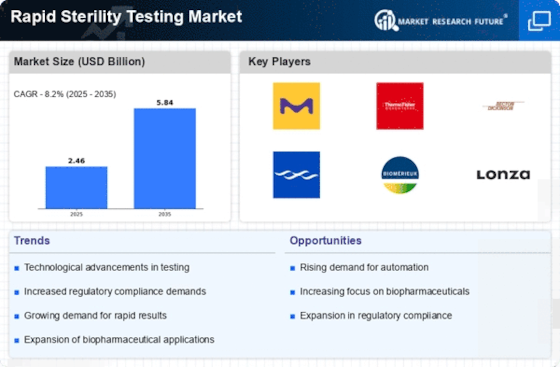
As per Market Research Future analysis, the Rapid Sterility Testing Market was estimated at 2.456 USD Billion in 2024. The Rapid Sterility Testing industry is projected to grow from 2.658 USD Billion in 2025 to 5.845 USD Billion by 2035, exhibiting a compound annual growth rate (CAGR) of 8.2% during the forecast period 2025 - 2035

Key Market Trends & Highlights

The Rapid Sterility Testing Market is poised for substantial growth driven by technological advancements and increasing regulatory demands.

  • Technological advancements are enhancing the efficiency and accuracy of rapid sterility testing methods. North America remains the largest market, while Asia-Pacific is emerging as the fastest-growing region in this sector. Kits and reagents dominate the market, whereas instruments are experiencing the fastest growth due to innovation. The increased demand for biopharmaceuticals and regulatory pressure for faster testing are key drivers propelling market expansion.

Market Size & Forecast

2024 Market Size 2.456 (USD Billion)
2035 Market Size 5.845 (USD Billion)
CAGR (2025 - 2035) 8.2%
Largest Regional Market Share in 2024 North America

Major Players

Merck KGaA (DE), Thermo Fisher Scientific (US), Becton Dickinson and Company (US), Charles River Laboratories (US), BioMérieux (FR), Lonza Group (CH), Fujifilm Corporation (JP), Sartorius AG (DE), Eppendorf AG (DE)

Market Trends

The Rapid Sterility Testing Market is currently experiencing a notable transformation, driven by advancements in technology and increasing demand for faster results in sterility assurance. This market encompasses a variety of testing methods that ensure the absence of viable microorganisms in pharmaceutical products, medical devices, and other sterile environments. As regulatory bodies emphasize the importance of rapid testing, manufacturers are compelled to innovate and enhance their testing capabilities. The integration of automated systems and real-time monitoring technologies appears to be a key factor in improving efficiency and accuracy in sterility testing processes. Moreover, the growing trend towards personalized medicine and the expansion of biopharmaceuticals are likely to further propel the Rapid Sterility Testing Market. Companies are increasingly focusing on developing robust testing solutions that can accommodate the unique requirements of diverse products. This shift not only enhances product safety but also aligns with the evolving landscape of healthcare, where rapid and reliable testing is paramount. As the market continues to evolve, collaboration between stakeholders, including manufacturers, regulatory agencies, and healthcare providers, seems essential to address challenges and leverage opportunities for growth in this dynamic sector.

Technological Advancements

The Rapid Sterility Testing Market is witnessing a surge in technological innovations, particularly in automation and real-time monitoring. These advancements facilitate quicker results and enhance the reliability of sterility testing, thereby meeting the stringent demands of regulatory bodies.

Increased Demand for Biopharmaceuticals

The rise in biopharmaceutical development is influencing the Rapid Sterility Testing Market significantly. As more companies venture into this sector, the need for effective sterility assurance becomes critical, driving the demand for rapid testing solutions.

Regulatory Pressure for Faster Testing

Regulatory agencies are increasingly advocating for expedited testing methods to ensure product safety. This pressure is prompting manufacturers to adopt rapid sterility testing techniques, thereby reshaping the market landscape.

Rapid Sterility Testing Market Market Drivers

Expansion of Healthcare Infrastructure

The expansion of healthcare infrastructure is a notable driver for the Rapid Sterility Testing Market. As countries invest in improving their healthcare systems, the demand for advanced testing solutions is expected to grow. New healthcare facilities, particularly in emerging markets, are increasingly incorporating rapid sterility testing into their quality control processes. This trend is indicative of a broader movement towards modernization and efficiency in healthcare delivery. The establishment of new laboratories and testing centers is likely to further stimulate market growth, as these facilities seek to implement the latest testing technologies.

Growing Awareness of Infection Control

The Rapid Sterility Testing Market is also benefiting from the heightened awareness surrounding infection control practices. As healthcare facilities and pharmaceutical companies prioritize infection prevention, the demand for rapid sterility testing solutions is on the rise. This awareness is particularly pronounced in settings where sterile products are critical, such as surgical environments and drug manufacturing. The market is likely to see an increase in adoption rates of rapid testing methods as organizations strive to enhance their infection control protocols, thereby ensuring patient safety and product reliability.

Regulatory Pressure for Faster Testing

Regulatory bodies are imposing stricter guidelines on sterility testing, which is a key driver for the Rapid Sterility Testing Market. These regulations aim to ensure that pharmaceutical and biopharmaceutical products meet safety standards before reaching consumers. Consequently, companies are compelled to adopt rapid testing methods to comply with these regulations. The increasing emphasis on patient safety and product quality is likely to drive the market, as organizations seek to minimize the time taken for testing without compromising on accuracy. This trend indicates a shift towards more efficient testing methodologies in the industry.

Increased Demand for Biopharmaceuticals

The Rapid Sterility Testing Market is significantly influenced by the rising demand for biopharmaceuticals. As the biopharmaceutical sector expands, the need for stringent sterility testing becomes paramount to ensure product safety and efficacy. This demand is further fueled by the increasing prevalence of chronic diseases and the growing focus on personalized medicine. According to industry reports, the biopharmaceutical market is expected to reach USD 500 billion by 2026, thereby propelling the need for rapid sterility testing solutions to meet regulatory requirements and maintain product integrity.

Technological Advancements in Rapid Sterility Testing

The Rapid Sterility Testing Market is experiencing a surge in technological advancements that enhance testing efficiency and accuracy. Innovations such as automated systems and real-time monitoring are becoming increasingly prevalent. These advancements not only reduce the time required for sterility testing but also improve the reliability of results. For instance, the integration of molecular techniques, such as PCR, allows for quicker detection of microbial contamination. As a result, the market is projected to grow at a compound annual growth rate of approximately 10% over the next few years, driven by the need for faster and more reliable testing solutions.

Market Segment Insights

By Product: Kits & Reagents (Largest) vs. Instruments (Fastest-Growing)

In the Rapid Sterility Testing Market, Kits &amp; Reagents holds the significant portion of the market share, reflecting its critical role in the sterility testing process. This segment benefits from a diverse range of products tailored to various applications across industries such as pharmaceuticals and biotechnology. Instruments, while comprising a lesser share, are gaining traction due to technological advancements and higher demand for automated solutions that expedite testing procedures. As industries continue to focus on stringent compliance and accelerated product development, the growth potential for Instruments is substantial. Market players are investing in innovative technologies that increase accuracy and efficiency, making these instruments an appealing choice. In contrast, Kits &amp; Reagents will likely maintain their dominance due to their established presence and essentiality in testing protocols, although their growth may be steadier compared to the rapidly emerging instruments segment.

Kits &amp; Reagents (Dominant) vs. Instruments (Emerging)

Kits &amp; Reagents remain the dominant force in the Rapid Sterility Testing Market, characterized by their extensive usage and adaptability in diverse testing environments. These products are integral to ensuring compliance with stringent regulatory standards, making them a staple in laboratories. Their prevalent use across vital sectors such as pharmaceuticals and food safety underlines their market strength. On the other hand, Instruments are emerging as a vital segment driven by the shift towards automation and smart technologies in laboratory settings. These instruments are designed for high throughput and superior accuracy, thus appealing to a modernizing industry that prioritizes efficiency. The growing preference for instrument-led testing solutions positions this segment for accelerated growth, even as Kits &amp; Reagents continue to dominate.

By Technology: Membrane Filtration (Largest) vs. ATP Bioluminescence (Fastest-Growing)

In the Rapid Sterility Testing Market, membrane filtration stands out as the largest segment, capturing a significant share of the overall market. This technology is preferred for its reliability in separating microorganisms from samples, making it essential for industries like pharmaceuticals and biotechnology. On the other hand, ATP bioluminescence is quickly gaining traction, driven by its rapid results and ease of use, appealing to manufacturers seeking efficiency in sterility assurance processes.

Technology: Membrane Filtration (Dominant) vs. ATP Bioluminescence (Emerging)

Membrane filtration is known for its robust performance in providing sterile products by effectively filtering out bacteria and other pathogens. Its established presence in the market allows manufacturers to rely on its effectiveness, especially in stringent regulatory environments. Conversely, ATP bioluminescence represents an emerging technology, leveraging bioluminescent reactions to detect contamination quickly. This method is becoming increasingly popular due to its rapid response times and can be employed in various environments, making it a compelling option for companies aiming to enhance their sterility testing workflows.

By Application: Pharmaceutical and Biological Manufacturing (Largest) vs. Medical Devices (Fastest-Growing)

The Rapid Sterility Testing Market is significantly influenced by the applications of pharmaceutical and biological manufacturing, along with medical devices. Within this segment, pharmaceutical and biological manufacturing holds the largest market share, driven by the increasing demand for biopharmaceuticals and vaccines that require stringent sterility testing. On the other hand, the medical devices application is gaining traction, although it currently holds a smaller share compared to the pharmaceutical sector. The need for rapid sterility testing procedures in these applications is becoming paramount as the industry focuses on quality assurance and regulatory compliance.

Pharmaceutical and Biological Manufacturing: Dominant vs. Medical Devices: Emerging

Pharmaceutical and biological manufacturing is a dominant player in the Rapid Sterility Testing Market, characterized by its well-established protocols and stringent regulatory requirements. This sector requires robust sterility assurance throughout the manufacturing process, often employing rapid testing methods to enhance efficiency without compromising safety. Conversely, the medical devices segment is emerging rapidly, propelled by the proliferation of innovative device technologies that necessitate rapid sterility assessments. This segment is increasingly focusing on adapting flexible and swift testing solutions to cater to the extensive lifecycle of medical devices, thus ensuring safety and compliance in a competitive market.

Get more detailed insights about Rapid Sterility Testing Market Research Report-Global Forecast till 2035

Regional Insights

North America : Innovation and Regulatory Leadership

North America is the largest market for rapid sterility testing, holding approximately 45% of the global share. The region benefits from advanced healthcare infrastructure, stringent regulatory standards, and a growing demand for rapid testing solutions in pharmaceuticals and biotechnology. The increasing focus on quality assurance and compliance with FDA regulations further drives market growth. The United States leads the market, supported by key players such as Thermo Fisher Scientific and Becton Dickinson. Canada also contributes significantly, with a rising emphasis on biopharmaceuticals. The competitive landscape is characterized by innovation and strategic partnerships among leading companies, ensuring a robust supply chain and technological advancements.

Europe : Regulatory Compliance and Growth

Europe is the second-largest market for rapid sterility testing, accounting for around 30% of the global market share. The region's growth is driven by stringent regulations from the European Medicines Agency (EMA) and increasing investments in biopharmaceutical research. The demand for rapid testing is further fueled by the rising prevalence of infectious diseases and the need for faster results in clinical settings. Germany and France are the leading countries in this market, with a strong presence of key players like Merck KGaA and BioMérieux. The competitive landscape is marked by innovation and collaboration among companies to enhance product offerings. The focus on regulatory compliance ensures that the market remains robust and responsive to emerging healthcare needs.

Asia-Pacific : Rapid Growth and Adoption

Asia-Pacific is witnessing rapid growth in the rapid sterility testing market, holding approximately 20% of the global share. The region's expansion is driven by increasing healthcare investments, a growing pharmaceutical industry, and rising awareness of quality control in manufacturing processes. Countries like China and India are at the forefront, with significant government initiatives to enhance healthcare infrastructure. China is the largest market in the region, supported by local manufacturers and international players like Fujifilm Corporation. India is also emerging as a key player, with a focus on biotechnology and pharmaceuticals. The competitive landscape is evolving, with companies investing in research and development to meet the growing demand for rapid testing solutions.

Middle East and Africa : Untapped Potential and Growth

The Middle East and Africa represent an emerging market for rapid sterility testing, accounting for about 5% of the global share. The growth in this region is driven by increasing healthcare investments, rising awareness of quality standards, and the need for rapid testing solutions in pharmaceuticals and healthcare. Countries like South Africa and the UAE are leading the way, with government initiatives aimed at improving healthcare infrastructure. South Africa is the largest market in the region, with a growing focus on biotechnology and pharmaceuticals. The competitive landscape is characterized by a mix of local and international players, with companies seeking to establish a foothold in this developing market. The potential for growth is significant as healthcare demands continue to rise.

Key Players and Competitive Insights

Leading market players are investing heavily in research and development to expand their product lines, which will help the Rapid Sterility Testing Market grow even more. Market participants are also undertaking various strategic activities to expand their footprint, with important market developments including new product launches, contractual agreements, mergers and acquisitions, higher investments, and collaboration with other organizations. The rapid sterility testing industry must offer cost-effective items to expand and survive in a more competitive and rising market climate. Manufacturing locally to minimize operational costs is one of the key business tactics manufacturers use in the Rapid Sterility Testing industry to benefit clients and increase the market sector. The Rapid Sterility Testing industry has offered some of the most significant medical advantages in recent years. Major players in the Rapid Sterility Testing Market, including Terumo Corporation - Japan Beacon Dickinson - USA Sanofi - USA F. Hoffmann-LaRoche - Switzerland Bayer A.G. - Germany Novo Nordisk A.S. - USA Eli Lily and Company - USA Owen Mumford LTD - USA Medtronic - USA Greiner Bio-one - USA Abbott laboratories - USA HTL., and others, are attempting to increase market demand by investing in research and development operations. The Merck Group, branded and commonly known as Merck, is a German multinational science and technology company headquartered in Darmstadt, with about 60,000 employees and present in 66 countries. The group includes around 250 companies; the main company is Merck KGaA in Germany.Merck KGaA (Switzerland) invested USD 306.5 million in expanding its biosafety testing capacity at Rockville, Maryland, US. This site will provide biosafety testing and analytical development services in the US. Charles River Laboratories International, Inc., is an American pharmaceutical company specializing in various preclinical and clinical laboratory, gene therapy, and cell therapy services for the Pharmaceutical, Medical Device, and Biotechnology industries.Charles River Laboratories, Inc. (US) opened a new High Quality (HQ) Plasmid DNA Centre of Excellence facility at Bruntwood SciTech's Alderley Park in Cheshire, UK. The 16,000 sq. ft facility will provide plasmid DNA manufacturing services.

Key Companies in the Rapid Sterility Testing Market include

Industry Developments

November 2022 Merck KGaA (Switzerland) invested USD 306.5 million in expanding its biosafety testing capacity at Rockville, Maryland, US. This site will provide biosafety testing and analytical development services in the US.

September 2022 Merck KGaA (Switzerland) opened its viral clearance (VC) laboratory as the first phase of the China Biologics Testing Center. This site will operate in China and will conduct viral clearance studies locally across preclinical development to commercialization.

June 2022 Charles River Laboratories, Inc. (US) opened a new High Quality (HQ) Plasmid DNA Centre of Excellence facility at Bruntwood SciTech's Alderley Park in Cheshire, UK. The 16,000 sq. ft facility will provide plasmid DNA manufacturing services.

Future Outlook

Rapid Sterility Testing Market Future Outlook

The Rapid Sterility Testing Market is projected to grow at an 8.2% CAGR from 2025 to 2035, driven by technological advancements, regulatory pressures, and increasing demand for rapid results.

New opportunities lie in:

  • <p>Development of portable rapid testing devices for field applications. Integration of AI-driven analytics for enhanced testing accuracy. Expansion into emerging markets with tailored product offerings.</p>

By 2035, the market is expected to be robust, driven by innovation and strategic expansions.

Market Segmentation

Rapid Sterility Testing Market Product Outlook

  • Kits & Reagents
  • Instruments
  • Services

Rapid Sterility Testing Market Technology Outlook

  • Membrane Filtration
  • ATP Bioluminescence

Rapid Sterility Testing Market Application Outlook

  • Pharmaceutical and Biological Manufacturing
  • Medical Devices

Report Scope

MARKET SIZE 2024 2.456(USD Billion)
MARKET SIZE 2025 2.658(USD Billion)
MARKET SIZE 2035 5.845(USD Billion)
COMPOUND ANNUAL GROWTH RATE (CAGR) 8.2% (2025 - 2035)
REPORT COVERAGE Revenue Forecast, Competitive Landscape, Growth Factors, and Trends
BASE YEAR 2024
Market Forecast Period 2025 - 2035
Historical Data 2019 - 2024
Market Forecast Units USD Billion
Key Companies Profiled Merck KGaA (DE), Thermo Fisher Scientific (US), Becton Dickinson and Company (US), Charles River Laboratories (US), BioMérieux (FR), Lonza Group (CH), Fujifilm Corporation (JP), Sartorius AG (DE), Eppendorf AG (DE)
Segments Covered Product, Technology, Application, Region
Key Market Opportunities Integration of advanced automation technologies enhances efficiency in the Rapid Sterility Testing Market.
Key Market Dynamics Technological advancements drive rapid sterility testing adoption, enhancing regulatory compliance and efficiency in pharmaceutical manufacturing.
Countries Covered North America, Europe, APAC, South America, MEA

FAQs

What is the projected market valuation of the Rapid Sterility Testing Market by 2035?

<p>The Rapid Sterility Testing Market is projected to reach a valuation of 5.845 USD Billion by 2035.</p>

What was the market valuation of the Rapid Sterility Testing Market in 2024?

<p>In 2024, the market valuation of the Rapid Sterility Testing Market was 2.456 USD Billion.</p>

What is the expected CAGR for the Rapid Sterility Testing Market during the forecast period 2025 - 2035?

<p>The expected CAGR for the Rapid Sterility Testing Market during the forecast period 2025 - 2035 is 8.2%.</p>

Which product segment is anticipated to show significant growth in the Rapid Sterility Testing Market?

<p>The Services segment, valued at 0.98 USD Billion in 2024, is anticipated to grow to 2.275 USD Billion by 2035.</p>

What are the key technologies driving the Rapid Sterility Testing Market?

<p>Membrane Filtration and ATP Bioluminescence are key technologies, with projected valuations of 2.925 USD Billion and 2.92 USD Billion respectively by 2035.</p>

Which applications are expected to dominate the Rapid Sterility Testing Market?

<p>Pharmaceutical and Biological Manufacturing is expected to dominate, growing from 1.5 USD Billion in 2024 to 3.6 USD Billion by 2035.</p>

Who are the leading players in the Rapid Sterility Testing Market?

<p>Key players in the market include Merck KGaA, Thermo Fisher Scientific, and Becton Dickinson and Company.</p>

What was the valuation of the Kits & Reagents segment in 2024?

The Kits &amp; Reagents segment was valued at 0.738 USD Billion in 2024.

How does the Instruments segment compare to the Services segment in terms of market valuation?

<p>Both the Instruments and Services segments were valued at 0.738 USD Billion and 0.98 USD Billion in 2024, respectively, indicating Services may have a higher growth potential.</p>

What is the significance of the projected growth in the Rapid Sterility Testing Market?

<p>The projected growth indicates a robust demand for rapid testing solutions, reflecting advancements in technology and increasing regulatory requirements.</p>

  1. SECTION I: EXECUTIVE SUMMARY AND KEY HIGHLIGHTS |
    1. EXECUTIVE SUMMARY | |
      1. Market Overview | |
      2. Key Findings | |
      3. Market Segmentation | |
      4. Competitive Landscape | |
      5. Challenges and Opportunities | |
      6. Future Outlook 2
  2. SECTION II: SCOPING, METHODOLOGY AND MARKET STRUCTURE |
    1. MARKET INTRODUCTION | |
      1. Definition | |
      2. Scope of the study | | |
    2. RESEARCH METHODOLOGY | |
      1. Overview | |
      2. Data Mining | |
      3. Secondary Research | |
      4. Primary Research | | |
      5. Forecasting Model | |
      6. Market Size Estimation | | |
      7. Data Triangulation | |
      8. Validation 3
  3. SECTION III: QUALITATIVE ANALYSIS |
    1. MARKET DYNAMICS | |
      1. Overview | |
      2. Drivers | |
      3. Restraints | |
      4. Opportunities |
    2. MARKET FACTOR ANALYSIS | |
      1. Value chain Analysis | |
      2. Porter's Five Forces Analysis | | |
      3. COVID-19 Impact Analysis | | |
  4. SECTION IV: QUANTITATIVE ANALYSIS |
    1. Healthcare, BY Product (USD Billion) | |
      1. Kits & Reagents | |
      2. Instruments | |
      3. Services |
    2. Healthcare, BY Technology (USD Billion) | |
      1. Membrane Filtration | |
      2. ATP Bioluminescence |
    3. Healthcare, BY Application (USD Billion) | |
      1. Pharmaceutical and Biological Manufacturing | |
      2. Medical Devices |
    4. Healthcare, BY Region (USD Billion) | |
      1. North America | | |
      2. Europe | | |
      3. APAC | | |
      4. South America | | |
      5. MEA | | |
  5. SECTION V: COMPETITIVE ANALYSIS |
    1. Competitive Landscape | |
      1. Overview | |
      2. Competitive Analysis | |
      3. Market share Analysis | |
      4. Major Growth Strategy in the Healthcare | |
      5. Competitive Benchmarking | |
      6. Leading Players in Terms of Number of Developments in the Healthcare | |
      7. Key developments and growth strategies | | |
      8. Major Players Financial Matrix | | |
    2. Company Profiles | |
      1. Merck KGaA (DE) | | |
      2. Thermo Fisher Scientific (US) | | |
      3. Becton Dickinson and Company (US) | | |
      4. Charles River Laboratories (US) | | |
      5. BioMérieux (FR) | | |
      6. Lonza Group (CH) | | |
      7. Fujifilm Corporation (JP) | | |
      8. Sartorius AG (DE) | | |
      9. Eppendorf AG (DE) | | |
    3. Appendix | |
      1. References | |
      2. Related Reports 6 LIST OF FIGURES |
    4. MARKET SYNOPSIS |
    5. NORTH AMERICA MARKET ANALYSIS |
    6. US MARKET ANALYSIS BY PRODUCT |
    7. US MARKET ANALYSIS BY TECHNOLOGY |
    8. US MARKET ANALYSIS BY APPLICATION |
    9. CANADA MARKET ANALYSIS BY PRODUCT |
    10. CANADA MARKET ANALYSIS BY TECHNOLOGY |
    11. CANADA MARKET ANALYSIS BY APPLICATION |
    12. EUROPE MARKET ANALYSIS |
    13. GERMANY MARKET ANALYSIS BY PRODUCT |
    14. GERMANY MARKET ANALYSIS BY TECHNOLOGY |
    15. GERMANY MARKET ANALYSIS BY APPLICATION |
    16. UK MARKET ANALYSIS BY PRODUCT |
    17. UK MARKET ANALYSIS BY TECHNOLOGY |
    18. UK MARKET ANALYSIS BY APPLICATION |
    19. FRANCE MARKET ANALYSIS BY PRODUCT |
    20. FRANCE MARKET ANALYSIS BY TECHNOLOGY |
    21. FRANCE MARKET ANALYSIS BY APPLICATION |
    22. RUSSIA MARKET ANALYSIS BY PRODUCT |
    23. RUSSIA MARKET ANALYSIS BY TECHNOLOGY |
    24. RUSSIA MARKET ANALYSIS BY APPLICATION |
    25. ITALY MARKET ANALYSIS BY PRODUCT |
    26. ITALY MARKET ANALYSIS BY TECHNOLOGY |
    27. ITALY MARKET ANALYSIS BY APPLICATION |
    28. SPAIN MARKET ANALYSIS BY PRODUCT |
    29. SPAIN MARKET ANALYSIS BY TECHNOLOGY |
    30. SPAIN MARKET ANALYSIS BY APPLICATION |
    31. REST OF EUROPE MARKET ANALYSIS BY PRODUCT |
    32. REST OF EUROPE MARKET ANALYSIS BY TECHNOLOGY |
    33. REST OF EUROPE MARKET ANALYSIS BY APPLICATION |
    34. APAC MARKET ANALYSIS |
    35. CHINA MARKET ANALYSIS BY PRODUCT |
    36. CHINA MARKET ANALYSIS BY TECHNOLOGY |
    37. CHINA MARKET ANALYSIS BY APPLICATION |
    38. INDIA MARKET ANALYSIS BY PRODUCT |
    39. INDIA MARKET ANALYSIS BY TECHNOLOGY |
    40. INDIA MARKET ANALYSIS BY APPLICATION |
    41. JAPAN MARKET ANALYSIS BY PRODUCT |
    42. JAPAN MARKET ANALYSIS BY TECHNOLOGY |
    43. JAPAN MARKET ANALYSIS BY APPLICATION |
    44. SOUTH KOREA MARKET ANALYSIS BY PRODUCT |
    45. SOUTH KOREA MARKET ANALYSIS BY TECHNOLOGY |
    46. SOUTH KOREA MARKET ANALYSIS BY APPLICATION |
    47. MALAYSIA MARKET ANALYSIS BY PRODUCT |
    48. MALAYSIA MARKET ANALYSIS BY TECHNOLOGY |
    49. MALAYSIA MARKET ANALYSIS BY APPLICATION |
    50. THAILAND MARKET ANALYSIS BY PRODUCT |
    51. THAILAND MARKET ANALYSIS BY TECHNOLOGY |
    52. THAILAND MARKET ANALYSIS BY APPLICATION |
    53. INDONESIA MARKET ANALYSIS BY PRODUCT |
    54. INDONESIA MARKET ANALYSIS BY TECHNOLOGY |
    55. INDONESIA MARKET ANALYSIS BY APPLICATION |
    56. REST OF APAC MARKET ANALYSIS BY PRODUCT |
    57. REST OF APAC MARKET ANALYSIS BY TECHNOLOGY |
    58. REST OF APAC MARKET ANALYSIS BY APPLICATION |
    59. SOUTH AMERICA MARKET ANALYSIS |
    60. BRAZIL MARKET ANALYSIS BY PRODUCT |
    61. BRAZIL MARKET ANALYSIS BY TECHNOLOGY |
    62. BRAZIL MARKET ANALYSIS BY APPLICATION |
    63. MEXICO MARKET ANALYSIS BY PRODUCT |
    64. MEXICO MARKET ANALYSIS BY TECHNOLOGY |
    65. MEXICO MARKET ANALYSIS BY APPLICATION |
    66. ARGENTINA MARKET ANALYSIS BY PRODUCT |
    67. ARGENTINA MARKET ANALYSIS BY TECHNOLOGY |
    68. ARGENTINA MARKET ANALYSIS BY APPLICATION |
    69. REST OF SOUTH AMERICA MARKET ANALYSIS BY PRODUCT |
    70. REST OF SOUTH AMERICA MARKET ANALYSIS BY TECHNOLOGY |
    71. REST OF SOUTH AMERICA MARKET ANALYSIS BY APPLICATION |
    72. MEA MARKET ANALYSIS |
    73. GCC COUNTRIES MARKET ANALYSIS BY PRODUCT |
    74. GCC COUNTRIES MARKET ANALYSIS BY TECHNOLOGY |
    75. GCC COUNTRIES MARKET ANALYSIS BY APPLICATION |
    76. SOUTH AFRICA MARKET ANALYSIS BY PRODUCT |
    77. SOUTH AFRICA MARKET ANALYSIS BY TECHNOLOGY |
    78. SOUTH AFRICA MARKET ANALYSIS BY APPLICATION |
    79. REST OF MEA MARKET ANALYSIS BY PRODUCT |
    80. REST OF MEA MARKET ANALYSIS BY TECHNOLOGY |
    81. REST OF MEA MARKET ANALYSIS BY APPLICATION |
    82. KEY BUYING CRITERIA OF HEALTHCARE |
    83. RESEARCH PROCESS OF MRFR |
    84. DRO ANALYSIS OF HEALTHCARE |
    85. DRIVERS IMPACT ANALYSIS: HEALTHCARE |
    86. RESTRAINTS IMPACT ANALYSIS: HEALTHCARE |
    87. SUPPLY / VALUE CHAIN: HEALTHCARE |
    88. HEALTHCARE, BY PRODUCT, 2024 (% SHARE) |
    89. HEALTHCARE, BY PRODUCT, 2024 TO 2035 (USD Billion) |
    90. HEALTHCARE, BY TECHNOLOGY, 2024 (% SHARE) |
    91. HEALTHCARE, BY TECHNOLOGY, 2024 TO 2035 (USD Billion) |
    92. HEALTHCARE, BY APPLICATION, 2024 (% SHARE) |
    93. HEALTHCARE, BY APPLICATION, 2024 TO 2035 (USD Billion) |
    94. BENCHMARKING OF MAJOR COMPETITORS 7 LIST OF TABLES |
    95. LIST OF ASSUMPTIONS | |
      1. |
    96. North America MARKET SIZE ESTIMATES; FORECAST | |
      1. BY PRODUCT, 2025-2035 (USD Billion) | |
      2. BY TECHNOLOGY, 2025-2035 (USD Billion) | |
      3. BY APPLICATION, 2025-2035 (USD Billion) |
    97. US MARKET SIZE ESTIMATES; FORECAST | |
      1. BY PRODUCT, 2025-2035 (USD Billion) | |
      2. BY TECHNOLOGY, 2025-2035 (USD Billion) | |
      3. BY APPLICATION, 2025-2035 (USD Billion) |
    98. Canada MARKET SIZE ESTIMATES; FORECAST | |
      1. BY PRODUCT, 2025-2035 (USD Billion) | |
      2. BY TECHNOLOGY, 2025-2035 (USD Billion) | |
      3. BY APPLICATION, 2025-2035 (USD Billion) |
    99. Europe MARKET SIZE ESTIMATES; FORECAST | |
      1. BY PRODUCT, 2025-2035 (USD Billion) | |
      2. BY TECHNOLOGY, 2025-2035 (USD Billion) | |
      3. BY APPLICATION, 2025-2035 (USD Billion) |
    100. Germany MARKET SIZE ESTIMATES; FORECAST | |
      1. BY PRODUCT, 2025-2035 (USD Billion) | |
      2. BY TECHNOLOGY, 2025-2035 (USD Billion) | |
      3. BY APPLICATION, 2025-2035 (USD Billion) |
    101. UK MARKET SIZE ESTIMATES; FORECAST | |
      1. BY PRODUCT, 2025-2035 (USD Billion) | |
      2. BY TECHNOLOGY, 2025-2035 (USD Billion) | |
      3. BY APPLICATION, 2025-2035 (USD Billion) |
    102. France MARKET SIZE ESTIMATES; FORECAST | |
      1. BY PRODUCT, 2025-2035 (USD Billion) | |
      2. BY TECHNOLOGY, 2025-2035 (USD Billion) | |
      3. BY APPLICATION, 2025-2035 (USD Billion) |
    103. Russia MARKET SIZE ESTIMATES; FORECAST | |
      1. BY PRODUCT, 2025-2035 (USD Billion) | |
      2. BY TECHNOLOGY, 2025-2035 (USD Billion) | |
      3. BY APPLICATION, 2025-2035 (USD Billion) |
    104. Italy MARKET SIZE ESTIMATES; FORECAST | |
      1. BY PRODUCT, 2025-2035 (USD Billion) | |
      2. BY TECHNOLOGY, 2025-2035 (USD Billion) | |
      3. BY APPLICATION, 2025-2035 (USD Billion) |
    105. Spain MARKET SIZE ESTIMATES; FORECAST | |
      1. BY PRODUCT, 2025-2035 (USD Billion) | |
      2. BY TECHNOLOGY, 2025-2035 (USD Billion) | |
      3. BY APPLICATION, 2025-2035 (USD Billion) |
    106. Rest of Europe MARKET SIZE ESTIMATES; FORECAST | |
      1. BY PRODUCT, 2025-2035 (USD Billion) | |
      2. BY TECHNOLOGY, 2025-2035 (USD Billion) | |
      3. BY APPLICATION, 2025-2035 (USD Billion) |
    107. APAC MARKET SIZE ESTIMATES; FORECAST | |
      1. BY PRODUCT, 2025-2035 (USD Billion) | |
      2. BY TECHNOLOGY, 2025-2035 (USD Billion) | |
      3. BY APPLICATION, 2025-2035 (USD Billion) |
    108. China MARKET SIZE ESTIMATES; FORECAST | |
      1. BY PRODUCT, 2025-2035 (USD Billion) | |
      2. BY TECHNOLOGY, 2025-2035 (USD Billion) | |
      3. BY APPLICATION, 2025-2035 (USD Billion) |
    109. India MARKET SIZE ESTIMATES; FORECAST | |
      1. BY PRODUCT, 2025-2035 (USD Billion) | |
      2. BY TECHNOLOGY, 2025-2035 (USD Billion) | |
      3. BY APPLICATION, 2025-2035 (USD Billion) |
    110. Japan MARKET SIZE ESTIMATES; FORECAST | |
      1. BY PRODUCT, 2025-2035 (USD Billion) | |
      2. BY TECHNOLOGY, 2025-2035 (USD Billion) | |
      3. BY APPLICATION, 2025-2035 (USD Billion) |
    111. South Korea MARKET SIZE ESTIMATES; FORECAST | |
      1. BY PRODUCT, 2025-2035 (USD Billion) | |
      2. BY TECHNOLOGY, 2025-2035 (USD Billion) | |
      3. BY APPLICATION, 2025-2035 (USD Billion) |
    112. Malaysia MARKET SIZE ESTIMATES; FORECAST | |
      1. BY PRODUCT, 2025-2035 (USD Billion) | |
      2. BY TECHNOLOGY, 2025-2035 (USD Billion) | |
      3. BY APPLICATION, 2025-2035 (USD Billion) |
    113. Thailand MARKET SIZE ESTIMATES; FORECAST | |
      1. BY PRODUCT, 2025-2035 (USD Billion) | |
      2. BY TECHNOLOGY, 2025-2035 (USD Billion) | |
      3. BY APPLICATION, 2025-2035 (USD Billion) |
    114. Indonesia MARKET SIZE ESTIMATES; FORECAST | |
      1. BY PRODUCT, 2025-2035 (USD Billion) | |
      2. BY TECHNOLOGY, 2025-2035 (USD Billion) | |
      3. BY APPLICATION, 2025-2035 (USD Billion) |
    115. Rest of APAC MARKET SIZE ESTIMATES; FORECAST | |
      1. BY PRODUCT, 2025-2035 (USD Billion) | |
      2. BY TECHNOLOGY, 2025-2035 (USD Billion) | |
      3. BY APPLICATION, 2025-2035 (USD Billion) |
    116. South America MARKET SIZE ESTIMATES; FORECAST | |
      1. BY PRODUCT, 2025-2035 (USD Billion) | |
      2. BY TECHNOLOGY, 2025-2035 (USD Billion) | |
      3. BY APPLICATION, 2025-2035 (USD Billion) |
    117. Brazil MARKET SIZE ESTIMATES; FORECAST | |
      1. BY PRODUCT, 2025-2035 (USD Billion) | |
      2. BY TECHNOLOGY, 2025-2035 (USD Billion) | |
      3. BY APPLICATION, 2025-2035 (USD Billion) |
    118. Mexico MARKET SIZE ESTIMATES; FORECAST | |
      1. BY PRODUCT, 2025-2035 (USD Billion) | |
      2. BY TECHNOLOGY, 2025-2035 (USD Billion) | |
      3. BY APPLICATION, 2025-2035 (USD Billion) |
    119. Argentina MARKET SIZE ESTIMATES; FORECAST | |
      1. BY PRODUCT, 2025-2035 (USD Billion) | |
      2. BY TECHNOLOGY, 2025-2035 (USD Billion) | |
      3. BY APPLICATION, 2025-2035 (USD Billion) |
    120. Rest of South America MARKET SIZE ESTIMATES; FORECAST | |
      1. BY PRODUCT, 2025-2035 (USD Billion) | |
      2. BY TECHNOLOGY, 2025-2035 (USD Billion) | |
      3. BY APPLICATION, 2025-2035 (USD Billion) |
    121. MEA MARKET SIZE ESTIMATES; FORECAST | |
      1. BY PRODUCT, 2025-2035 (USD Billion) | |
      2. BY TECHNOLOGY, 2025-2035 (USD Billion) | |
      3. BY APPLICATION, 2025-2035 (USD Billion) |
    122. GCC Countries MARKET SIZE ESTIMATES; FORECAST | |
      1. BY PRODUCT, 2025-2035 (USD Billion) | |
      2. BY TECHNOLOGY, 2025-2035 (USD Billion) | |
      3. BY APPLICATION, 2025-2035 (USD Billion) |
    123. South Africa MARKET SIZE ESTIMATES; FORECAST | |
      1. BY PRODUCT, 2025-2035 (USD Billion) | |
      2. BY TECHNOLOGY, 2025-2035 (USD Billion) | |
      3. BY APPLICATION, 2025-2035 (USD Billion) |
    124. Rest of MEA MARKET SIZE ESTIMATES; FORECAST | |
      1. BY PRODUCT, 2025-2035 (USD Billion) | |
      2. BY TECHNOLOGY, 2025-2035 (USD Billion) | |
      3. BY APPLICATION, 2025-2035 (USD Billion) |
    125. PRODUCT LAUNCH/PRODUCT DEVELOPMENT/APPROVAL | |
      1. |
    126. ACQUISITION/PARTNERSHIP | |

Healthcare Market Segmentation

Healthcare By Product (USD Billion, 2025-2035)

  • Kits & Reagents
  • Instruments
  • Services

Healthcare By Technology (USD Billion, 2025-2035)

  • Membrane Filtration
  • ATP Bioluminescence

Healthcare By Application (USD Billion, 2025-2035)

  • Pharmaceutical and Biological Manufacturing
  • Medical Devices
Infographic

Free Sample Request

Kindly complete the form below to receive a free sample of this Report

Get Free Sample

Customer Strories

Compare Licence

×
Features License Type
Single User Multiuser License Enterprise User
Price $4,950 $5,950 $7,250
Maximum User Access Limit 1 User Upto 10 Users Unrestricted Access Throughout the Organization
Free Customization
Direct Access to Analyst
Deliverable Format
Platform Access
Discount on Next Purchase 10% 15% 15%
Printable Versions