Request Free Sample ×

Kindly complete the form below to receive a free sample of this Report

* Please use a valid business email

Leading companies partner with us for data-driven Insights

clients tt-cursor
Hero Background
English
Chinese
French
Japanese
Korean
German
Spanish

Protein Chip Market Share

ID: MRFR/HC/9548-HCR
120 Pages
Rahul Gotadki
April 2026

Protein Chip Market Research Report Information By Type (Analytical Microarrays, Functional Protein Microarrays and Reverse Phase Protein Microarrays), By Application (Protein Identification, Clinical Diagnostics, Proteomics and Others), By End User (Hospitals & Clinics, Diagnostic Laboratories, Academic & Research Institutes and Pharmaceutical & Biotechnology Companies), And By Region (North America, Europe, Asia-Pacific, And Rest Of The World) –Market Forecast Till 2035

Share:
Download PDF ×

We do not share your information with anyone. However, we may send you emails based on your report interest from time to time. You may contact us at any time to opt-out.

Protein Chip Market Infographic
Purchase Options

Market Share

Protein Chip Market Share Analysis

To succeed in the Protein Chip Market, you must first understand how it operates and is separated into categories. Finding proteomics, drug development, and diagnostics uses is crucial. To employ targeted placement, you must understand each group's requirements. Smartly, Protein Chip systems are being modified to suit a variety of commercial purposes. Offering customizable alternatives for different companies makes a product more helpful and attracts more clients. To succeed in the Protein Chip Market, you need innovative ideas. Research and development are needed to create more sensitive, productive, and versatile systems. Staying current with technology keeps products appealing. Finding the correct price-efficiency ratio is crucial. Protein Chip companies may determine reasonable rates by undertaking market research. Research colleges, biotech companies, and testing laboratories choose cost-effective, high-quality solutions. Global presence is crucial to market share positioning. Companies may reach more consumers by expanding their marketing network and developing strategic global connections. Companies that collaborate with local merchants and adjust items to match international standards may enter new markets more easily. Green technology and ethical material sourcing may help Protein Chip firms succeed as sustainability and ethics become increasingly relevant. This matches the principles of eco-conscious consumers and boosts the company's reputation. Quality control and legal compliance are crucial in the Protein Chip industry. Companies need licenses to prove compliance. Customer confidence will increase if you regularly provide high-quality systems. Market placement requires educating consumers about Protein Chip technology's advantages and applications. Training, seminars, and instructional tools maximize Protein Chip device use. This develops client trust. Smart alliances or purchasing complementary firms may boost market share growth. By partnering with comparable organizations or study institutions, you may increase your business's consumer base. You stand out with exceptional customer service. Fast technological support, competent problem-solving, and a call-back customer care staff boost client satisfaction. Customer focus builds confidence in the Protein Chip Market by building solid connections.

Author
Author Profile
Rahul Gotadki
Research Manager

He holds an experience of about 9+ years in Market Research and Business Consulting, working under the spectrum of Life Sciences and Healthcare domains. Rahul conceptualizes and implements a scalable business strategy and provides strategic leadership to the clients. His expertise lies in market estimation, competitive intelligence, pipeline analysis, customer assessment, etc.

Leave a Comment

FAQs

What is the current valuation of the Protein Chip Market as of 2025?

<p>The Protein Chip Market is valued at approximately 1248.53 USD Million in 2024.</p>

What is the projected market size for the Protein Chip Market by 2035?

<p>The market is expected to reach a valuation of 2551.21 USD Million by 2035.</p>

What is the expected CAGR for the Protein Chip Market during the forecast period 2025 - 2035?

<p>The anticipated CAGR for the Protein Chip Market during 2025 - 2035 is 6.71%.</p>

Which application segment is projected to have the highest growth in the Protein Chip Market?

<p>The Disease Diagnosis segment is projected to grow from 400.0 to 800.0 USD Million during the forecast period.</p>

How does the Drug Discovery segment perform in the Protein Chip Market?

<p>The Drug Discovery segment is expected to increase from 300.0 to 600.0 USD Million by 2035.</p>

What technologies are driving the Protein Chip Market growth?

<p>Microarray Technology is leading, with a projected growth from 499.0 to 1020.0 USD Million.</p>

Which end-user segment is likely to dominate the Protein Chip Market?

Pharmaceutical Companies are expected to dominate, growing from 500.0 to 1000.0 USD Million.

What role do key players like Agilent Technologies and Illumina play in the market?

Key players such as Agilent Technologies and Illumina are instrumental in driving innovation and market growth.

What is the expected performance of the Surface Plasmon Resonance technology in the market?

Surface Plasmon Resonance technology is projected to grow from 250.0 to 500.0 USD Million by 2035.

How does the Protein Chip Market support personalized medicine?

The Personalized Medicine segment is anticipated to grow from 298.53 to 651.21 USD Million during the forecast period.

Market Summary

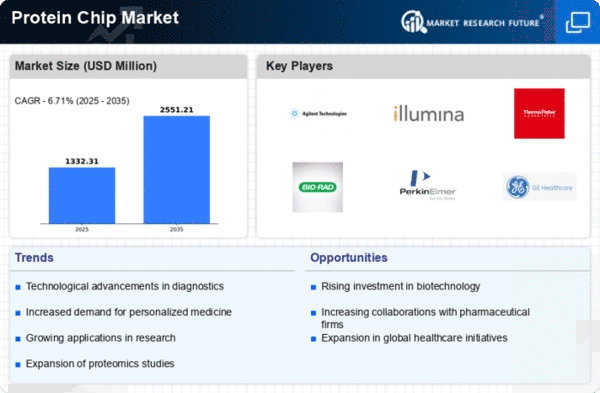
As per MRFR analysis, the Protein Chip Market Size was estimated at 1248.53 USD Million in 2024. The Protein Chip industry is projected to grow from 1332.33 USD Million in 2025 to 2551.21 USD Million by 2035, exhibiting a compound annual growth rate (CAGR) of 6.71% during the forecast period 2025 - 2035.

Key Market Trends & Highlights

The Protein Chip Market is poised for substantial growth driven by technological advancements and increasing demand for personalized medicine.

  • Advancements in microarray technology are enhancing the capabilities of protein analysis. The integration of artificial intelligence is streamlining data interpretation in protein chip applications. North America remains the largest market, while Asia-Pacific is emerging as the fastest-growing region in this sector. Rising demand for biomarkers and growing investment in biotechnology are key drivers propelling market expansion.

Market Size & Forecast

2024 Market Size 1248.53 (USD Million)
2035 Market Size 2551.21 (USD Million)
CAGR (2025 - 2035) 6.71%
Largest Regional Market Share in 2024 North America

Major Players

<p>Agilent Technologies (US), Illumina (US), <a href="https://www.thermofisher.com/in/en/home/life-science/protein-biology/protein-assays-analysis/immunoprecipitation/chip-rip-protein-nucleic-acid-pull-down-magnetic-beads-kits.html">Thermo Fisher Scientific</a> (US), Bio-Rad Laboratories (US), PerkinElmer (US), GE Healthcare (GB), Roche Diagnostics (CH), Merck KGaA (DE), Luminex Corporation (US)</p>

Market Trends

The Protein Chip Market is currently experiencing a dynamic evolution, driven by advancements in biotechnology and increasing demand for personalized medicine. This market encompasses a range of applications, including drug discovery, diagnostics, and biomarker identification. As researchers and healthcare professionals seek more efficient methods for analyzing proteins, the integration of microarray technology into clinical settings appears to be gaining traction. Furthermore, the growing emphasis on precision medicine suggests that protein chips may play a pivotal role in tailoring treatments to individual patients, thereby enhancing therapeutic outcomes.

In addition, the Protein Chip Market is likely to benefit from collaborations between academic institutions and industry players. These partnerships may foster innovation and accelerate the development of novel protein analysis techniques. Moreover, the rising prevalence of chronic diseases and the need for rapid diagnostic tools could further propel market growth. As the landscape continues to evolve, stakeholders must remain vigilant to emerging trends and technological advancements that could shape the future of protein analysis and its applications in healthcare.

Advancements in Microarray Technology

Recent innovations in microarray technology are enhancing the capabilities of protein chips. These advancements may lead to improved sensitivity and specificity in protein detection, which could facilitate more accurate diagnostics and research outcomes.

Integration with Artificial Intelligence

The incorporation of artificial intelligence into the Protein Chip Market is becoming increasingly prevalent. AI algorithms may assist in data analysis, enabling researchers to derive insights from complex protein interactions more efficiently.

Focus on Personalized Medicine

The shift towards personalized medicine is influencing the Protein Chip Market significantly. As healthcare moves towards tailored therapies, protein chips may become essential tools for identifying biomarkers that guide individualized treatment plans.

Protein Chip Market Market Drivers

Market Trends and Growth Projections

The Global Protein Chip Market Industry is characterized by dynamic trends and growth projections that reflect its evolving landscape. The market is anticipated to grow from 1.25 USD Billion in 2024 to 2.55 USD Billion by 2035, indicating a robust trajectory. The compound annual growth rate of 6.7% from 2025 to 2035 suggests that the industry is poised for sustained growth, driven by technological advancements, increasing applications in various fields, and heightened investment in research. These trends underscore the importance of protein chips in addressing contemporary challenges in healthcare and biotechnology.

Rising Prevalence of Chronic Diseases

The Global Protein Chip Market Industry is also being propelled by the rising prevalence of chronic diseases, which necessitate advanced diagnostic and monitoring tools. Protein chips offer a promising solution for the early detection and management of conditions such as cancer, diabetes, and cardiovascular diseases. As healthcare systems worldwide strive to improve patient outcomes, the demand for innovative diagnostic technologies is likely to increase. This trend is expected to contribute to the market's growth, with projections indicating a significant expansion in the coming years. The ability of protein chips to provide rapid and accurate results positions them as essential tools in modern healthcare.

Rising Demand for Personalized Medicine

The Global Protein Chip Market Industry is experiencing a surge in demand for personalized medicine, driven by advancements in genomics and proteomics. As healthcare shifts towards tailored treatments, protein chips play a crucial role in biomarker discovery and patient stratification. This trend is reflected in the projected market growth, with the industry expected to reach 1.25 USD Billion in 2024. Personalized medicine not only enhances treatment efficacy but also minimizes adverse effects, making it a focal point for healthcare providers and researchers alike. The integration of protein chips into clinical workflows is likely to accelerate, further propelling market expansion.

Increased Investment in Biotechnology Research

Investment in biotechnology research is a significant driver of the Global Protein Chip Market Industry. Governments and private entities are allocating substantial funds to support research initiatives that leverage protein chips for various applications, including diagnostics and therapeutic development. This influx of capital is likely to enhance research capabilities and foster innovation within the industry. As a result, the market is expected to benefit from a robust pipeline of new products and technologies. The emphasis on biotechnology research aligns with global health priorities, suggesting that the protein chip market will continue to thrive as funding and interest in this sector grow.

Technological Advancements in Protein Chip Technology

Technological innovations are significantly influencing the Global Protein Chip Market Industry. Enhanced sensitivity, specificity, and multiplexing capabilities of protein chips are enabling researchers to conduct high-throughput analyses with greater accuracy. For instance, the development of microarray technology has revolutionized protein profiling, allowing for the simultaneous detection of thousands of proteins. As these technologies evolve, they are expected to drive market growth, with projections indicating a market size of 2.55 USD Billion by 2035. The continuous improvement in chip design and manufacturing processes suggests that the industry will likely witness increased adoption across various research and clinical applications.

Growing Applications in Drug Discovery and Development

The Global Protein Chip Market Industry is witnessing increased applications in drug discovery and development, as protein chips facilitate the identification of potential drug targets and biomarkers. Pharmaceutical companies are increasingly utilizing these tools to streamline their research processes, thereby reducing time and costs associated with drug development. The integration of protein chips into high-throughput screening platforms is becoming more prevalent, which could lead to a compound annual growth rate of 6.7% from 2025 to 2035. This growth trajectory indicates that the industry is poised for substantial expansion as the demand for efficient drug discovery methods continues to rise.

Market Segment Insights

By Application: Disease Diagnosis (Largest) vs. Personalized Medicine (Fastest-Growing)

<p>Within the Protein Chip Market, the application segment is prominently led by Disease Diagnosis, which captures the largest market share due to its vital role in clinical settings and the growing need for rapid and accurate diagnostic tools. Following this is Personalized Medicine, which, while currently smaller in overall market share, is recognized for its innovative approach to tailoring treatments to individual patient profiles, indicating a significant shift in healthcare dynamics. Moreover, Drug Discovery and Genetic Research are also integral to this segment but hold comparatively lesser market positions. The growth trend for Personalized Medicine is particularly pronounced as advancements in technology promote more targeted treatment methodologies, driven by an increasing demand for individualized healthcare solutions. Disease Diagnosis continues to evolve with refined methodologies, enhancing the accuracy and efficiency of patient assessments, thereby solidifying its market presence.</p>

<p>Disease Diagnosis (Dominant) vs. Drug Discovery (Emerging)</p>

<p>Disease Diagnosis stands out as the dominant application in the Protein Chip Market. It leverages advanced protein profiling technologies to facilitate fast and accurate identification of various health conditions, thus playing a critical role in improving patient outcomes. In contrast, Drug Discovery, categorized as an emerging application, focuses on utilizing protein chips to explore new therapeutic compounds and biomarkers for disease treatment. This segment is gaining traction as pharmaceutical companies strive to accelerate the drug development process. The incorporation of protein chips into the drug development pipeline enhances the identification of potential drug candidates, contributing to the momentum of this emerging segment. Both areas showcase their unique contributions to medical science, with Disease Diagnosis maintaining robust stability, while Drug Discovery offers promising growth potential.</p>

By Technology: Microarray Technology (Largest) vs. Mass Spectrometry (Fastest-Growing)

<p>The Protein Chip Market is categorized into several technology segments, with Microarray Technology currently leading in market share. This segment benefits from widespread adoption due to its versatility and ability to analyze multiple targets simultaneously. Following closely is Mass Spectrometry, which is rapidly gaining traction owing to its high sensitivity and accuracy in protein analysis. Other technologies like Surface Plasmon Resonance and Electrochemical Detection play significant roles, but their market shares remain smaller compared to the top two.</p>

<p>Technology: Microarray Technology (Dominant) vs. Mass Spectrometry (Emerging)</p>

<p>Microarray Technology remains the dominant force in the Protein Chip Market, leading due to its well-established applications in genomics and proteomics. Its capability to handle large datasets and provide high-throughput analysis makes it preferred in research and clinical labs. In contrast, Mass Spectrometry is an emerging technology that is revolutionizing protein analysis by offering unparalleled precision and the ability to identify post-translational modifications. As research becomes more advanced, the demand for accurate and efficient protein analysis drives the adoption of Mass Spectrometry at an increasing rate, heralding its rising importance in the market.</p>

By End User: Pharmaceutical Companies (Largest) vs. Academic Research Institutes (Fastest-Growing)

<p>The Protein Chip Market showcases a diverse distribution of market share among its end users, primarily comprising pharmaceutical companies, biotechnology firms, academic research institutes, and clinical laboratories. Currently, pharmaceutical companies hold the largest market share, driven by their investments in drug development and personalized medicine. Academic research institutes, however, are rapidly increasing their share, attributed to their focus on groundbreaking research that leverages protein chip technology for biomolecular analysis.</p>

<p>Pharmaceutical Companies (Dominant) vs. Academic Research Institutes (Emerging)</p>

<p>Pharmaceutical companies stand out as dominant players in the Protein Chip Market due to their robust financial resources and extensive R&D capabilities. They leverage protein chips to expedite drug discovery and development, leading to more efficient and targeted therapeutic solutions. Conversely, academic research institutes are emerging as significant contributors to the market. These institutions adopt protein chips to enhance their research capabilities, focusing on proteomics and diagnostics. Their innovative approaches are fostering collaborations with biotech firms, thereby further driving advancements in the field.</p>

Get more detailed insights about Protein Chip Market Research Report—Global Forecast till 2035

Regional Insights

North America : Market Leader in Innovation

North America continues to lead the Protein Chip Market, holding a significant share of 624.27 million in 2024. The region's growth is driven by advanced research facilities, increasing investments in biotechnology, and a robust regulatory framework that supports innovation. The demand for personalized medicine and diagnostics is also on the rise, further propelling market expansion. The United States is the primary contributor, with key players like Agilent Technologies, Illumina, and Thermo Fisher Scientific dominating the landscape. The competitive environment is characterized by continuous technological advancements and strategic collaborations among leading firms, ensuring a strong foothold in the global market.

Europe : Emerging Market with Potential

Europe's Protein Chip Market is valued at 348.56 million, reflecting a growing interest in personalized healthcare solutions. The region benefits from strong governmental support for research and development, alongside increasing collaborations between academic institutions and industry players. Regulatory frameworks are evolving to facilitate innovation, which is crucial for market growth. Germany, the UK, and France are leading countries in this sector, with companies like Roche Diagnostics and Merck KGaA playing pivotal roles. The competitive landscape is marked by a mix of established firms and emerging startups, all striving to enhance their product offerings and expand their market presence.

Asia-Pacific : Rapid Growth and Development

The Asia-Pacific region, valued at 227.45 million, is witnessing rapid growth in the Protein Chip Market, driven by increasing healthcare expenditures and a rising focus on research and development. Countries like China and India are investing heavily in biotechnology, which is expected to boost market demand significantly. Regulatory bodies are also becoming more supportive of innovative healthcare solutions, further catalyzing growth. China is emerging as a key player, with numerous local companies entering the market. The competitive landscape is evolving, with both domestic and international firms vying for market share. Key players like Illumina and Thermo Fisher Scientific are expanding their operations in the region to capitalize on the growing demand.

Middle East and Africa : Untapped Market Opportunities

The Middle East and Africa region, with a market size of 48.25 million, presents untapped opportunities in the Protein Chip Market. The growth is primarily driven by increasing investments in healthcare infrastructure and a rising awareness of advanced diagnostic technologies. Governments are beginning to recognize the importance of biotechnology, leading to supportive policies that encourage innovation. Countries like South Africa and the UAE are at the forefront of this development, with a growing number of research initiatives and collaborations. The competitive landscape is still in its nascent stages, but the presence of global players is expected to stimulate growth and attract local investments.

Key Players and Competitive Insights

The Protein Chip Market is currently characterized by a dynamic competitive landscape, driven by advancements in biotechnology and increasing demand for personalized medicine. Key players such as Agilent Technologies (US), Illumina (US), and Thermo Fisher Scientific (US) are at the forefront, leveraging innovation and strategic partnerships to enhance their market positions. Agilent Technologies (US) focuses on expanding its product portfolio through continuous research and development, while Illumina (US) emphasizes its leadership in genomic sequencing technologies. Thermo Fisher Scientific (US) adopts a strategy of mergers and acquisitions to bolster its capabilities, thereby shaping a competitive environment that is increasingly reliant on technological advancements and collaborative efforts.
In terms of business tactics, companies are localizing manufacturing and optimizing supply chains to enhance operational efficiency. The Protein Chip Market appears moderately fragmented, with a mix of established players and emerging companies. The collective influence of these key players is significant, as they drive innovation and set industry standards, which in turn influences market dynamics and consumer expectations.
In November 2025, Illumina (US) announced a strategic partnership with a leading pharmaceutical company to develop a new protein chip technology aimed at accelerating drug discovery. This collaboration is expected to enhance Illumina's capabilities in precision medicine, allowing for more targeted therapies and potentially revolutionizing the drug development process. The strategic importance of this partnership lies in its potential to position Illumina as a leader in the integration of protein chips within the pharmaceutical sector.
In October 2025, Thermo Fisher Scientific (US) launched a new line of protein chips designed for high-throughput screening applications. This product introduction is significant as it addresses the growing demand for rapid and efficient screening methods in research and clinical settings. By enhancing its product offerings, Thermo Fisher aims to capture a larger market share and respond to the evolving needs of researchers and clinicians.
In September 2025, Agilent Technologies (US) expanded its global footprint by establishing a new manufacturing facility in Asia. This move is indicative of Agilent's strategy to localize production and reduce lead times for customers in the region. The establishment of this facility not only enhances Agilent's operational capabilities but also reflects a broader trend of companies seeking to optimize their supply chains in response to global market demands.
As of December 2025, current competitive trends in the Protein Chip Market include a strong emphasis on digitalization, sustainability, and the integration of artificial intelligence (AI) into product development. Strategic alliances are increasingly shaping the landscape, as companies recognize the value of collaboration in driving innovation. Looking ahead, competitive differentiation is likely to evolve from traditional price-based competition to a focus on technological innovation, reliability in supply chains, and the ability to deliver customized solutions. This shift underscores the importance of agility and responsiveness in a rapidly changing market.

Key Companies in the Protein Chip Market include

Industry Developments

  • Q2 2024: Agilent Technologies Introduces ProteoAnalyzer System for Protein Quality Assessment Agilent Technologies launched the ProteoAnalyzer System, a next-generation solution designed to enhance analytical precision in proteomics and support high-throughput protein chip applications.

.webp

Future Outlook

Protein Chip Market Future Outlook

The Protein Chip Market is projected to grow at a 6.71% CAGR from 2025 to 2035, driven by advancements in personalized medicine, increasing demand for rapid diagnostics, and technological innovations.

New opportunities lie in:

  • Development of integrated protein chip platforms for personalized healthcare solutions.
  • Expansion into emerging markets with tailored protein chip applications.
  • Collaboration with biotech firms for innovative protein biomarker discovery.

By 2035, the Protein Chip Market is expected to achieve substantial growth, solidifying its role in advanced diagnostics.

Market Segmentation

Protein Chip Market End User Outlook

  • Pharmaceutical Companies
  • Research Institutions
  • Clinical Laboratories
  • Biotechnology Firms

Protein Chip Market Technology Outlook

  • Microarray Technology
  • Mass Spectrometry
  • Surface Plasmon Resonance
  • Electrochemical Detection

Protein Chip Market Application Outlook

  • Disease Diagnosis
  • Drug Discovery
  • Genetic Research
  • Personalized Medicine

Report Scope

MARKET SIZE 2024 1248.53(USD Million)
MARKET SIZE 2025 1332.33(USD Million)
MARKET SIZE 2035 2551.21(USD Million)
COMPOUND ANNUAL GROWTH RATE (CAGR) 6.71% (2025 - 2035)
REPORT COVERAGE Revenue Forecast, Competitive Landscape, Growth Factors, and Trends
BASE YEAR 2024
Market Forecast Period 2025 - 2035
Historical Data 2019 - 2024
Market Forecast Units USD Million
Key Companies Profiled Agilent Technologies (US), Illumina (US), Thermo Fisher Scientific (US), Bio-Rad Laboratories (US), PerkinElmer (US), GE Healthcare (GB), Roche Diagnostics (CH), Merck KGaA (DE), Luminex Corporation (US)
Segments Covered Application, Technology, End User
Key Market Opportunities Advancements in personalized medicine drive demand for innovative solutions in the Protein Chip Market.
Key Market Dynamics Technological advancements and regulatory changes drive innovation and competition in the Protein Chip Market.
Countries Covered North America, Europe, APAC, South America, MEA

FAQs

What is the current valuation of the Protein Chip Market as of 2025?

<p>The Protein Chip Market is valued at approximately 1248.53 USD Million in 2024.</p>

What is the projected market size for the Protein Chip Market by 2035?

<p>The market is expected to reach a valuation of 2551.21 USD Million by 2035.</p>

What is the expected CAGR for the Protein Chip Market during the forecast period 2025 - 2035?

<p>The anticipated CAGR for the Protein Chip Market during 2025 - 2035 is 6.71%.</p>

Which application segment is projected to have the highest growth in the Protein Chip Market?

<p>The Disease Diagnosis segment is projected to grow from 400.0 to 800.0 USD Million during the forecast period.</p>

How does the Drug Discovery segment perform in the Protein Chip Market?

<p>The Drug Discovery segment is expected to increase from 300.0 to 600.0 USD Million by 2035.</p>

What technologies are driving the Protein Chip Market growth?

<p>Microarray Technology is leading, with a projected growth from 499.0 to 1020.0 USD Million.</p>

Which end-user segment is likely to dominate the Protein Chip Market?

Pharmaceutical Companies are expected to dominate, growing from 500.0 to 1000.0 USD Million.

What role do key players like Agilent Technologies and Illumina play in the market?

Key players such as Agilent Technologies and Illumina are instrumental in driving innovation and market growth.

What is the expected performance of the Surface Plasmon Resonance technology in the market?

Surface Plasmon Resonance technology is projected to grow from 250.0 to 500.0 USD Million by 2035.

How does the Protein Chip Market support personalized medicine?

The Personalized Medicine segment is anticipated to grow from 298.53 to 651.21 USD Million during the forecast period.

  1. SECTION I: EXECUTIVE SUMMARY AND KEY HIGHLIGHTS
    1. | 1.1 EXECUTIVE SUMMARY
    2. | | 1.1.1 Market Overview
    3. | | 1.1.2 Key Findings
    4. | | 1.1.3 Market Segmentation
    5. | | 1.1.4 Competitive Landscape
    6. | | 1.1.5 Challenges and Opportunities
    7. | | 1.1.6 Future Outlook
  2. SECTION II: SCOPING, METHODOLOGY AND MARKET STRUCTURE
    1. | 2.1 MARKET INTRODUCTION
    2. | | 2.1.1 Definition
    3. | | 2.1.2 Scope of the study
    4. | | | 2.1.2.1 Research Objective
    5. | | | 2.1.2.2 Assumption
    6. | | | 2.1.2.3 Limitations
    7. | 2.2 RESEARCH METHODOLOGY
    8. | | 2.2.1 Overview
    9. | | 2.2.2 Data Mining
    10. | | 2.2.3 Secondary Research
    11. | | 2.2.4 Primary Research
    12. | | | 2.2.4.1 Primary Interviews and Information Gathering Process
    13. | | | 2.2.4.2 Breakdown of Primary Respondents
    14. | | 2.2.5 Forecasting Model
    15. | | 2.2.6 Market Size Estimation
    16. | | | 2.2.6.1 Bottom-Up Approach
    17. | | | 2.2.6.2 Top-Down Approach
    18. | | 2.2.7 Data Triangulation
    19. | | 2.2.8 Validation
  3. SECTION III: QUALITATIVE ANALYSIS
    1. | 3.1 MARKET DYNAMICS
    2. | | 3.1.1 Overview
    3. | | 3.1.2 Drivers
    4. | | 3.1.3 Restraints
    5. | | 3.1.4 Opportunities
    6. | 3.2 MARKET FACTOR ANALYSIS
    7. | | 3.2.1 Value chain Analysis
    8. | | 3.2.2 Porter's Five Forces Analysis
    9. | | | 3.2.2.1 Bargaining Power of Suppliers
    10. | | | 3.2.2.2 Bargaining Power of Buyers
    11. | | | 3.2.2.3 Threat of New Entrants
    12. | | | 3.2.2.4 Threat of Substitutes
    13. | | | 3.2.2.5 Intensity of Rivalry
    14. | | 3.2.3 COVID-19 Impact Analysis
    15. | | | 3.2.3.1 Market Impact Analysis
    16. | | | 3.2.3.2 Regional Impact
    17. | | | 3.2.3.3 Opportunity and Threat Analysis
  4. SECTION IV: QUANTITATIVE ANALYSIS
    1. | 4.1 Healthcare, BY Application (USD Million)
    2. | | 4.1.1 Disease Diagnosis
    3. | | 4.1.2 Drug Discovery
    4. | | 4.1.3 Genetic Research
    5. | | 4.1.4 Personalized Medicine
    6. | 4.2 Healthcare, BY Technology (USD Million)
    7. | | 4.2.1 Microarray Technology
    8. | | 4.2.2 Mass Spectrometry
    9. | | 4.2.3 Surface Plasmon Resonance
    10. | | 4.2.4 Electrophoresis
    11. | 4.3 Healthcare, BY End User (USD Million)
    12. | | 4.3.1 Academic Research Institutes
    13. | | 4.3.2 Pharmaceutical Companies
    14. | | 4.3.3 Biotechnology Firms
    15. | | 4.3.4 Clinical Laboratories
    16. | 4.4 Healthcare, BY Region (USD Million)
    17. | | 4.4.1 North America
    18. | | | 4.4.1.1 US
    19. | | | 4.4.1.2 Canada
    20. | | 4.4.2 Europe
    21. | | | 4.4.2.1 Germany
    22. | | | 4.4.2.2 UK
    23. | | | 4.4.2.3 France
    24. | | | 4.4.2.4 Russia
    25. | | | 4.4.2.5 Italy
    26. | | | 4.4.2.6 Spain
    27. | | | 4.4.2.7 Rest of Europe
    28. | | 4.4.3 APAC
    29. | | | 4.4.3.1 China
    30. | | | 4.4.3.2 India
    31. | | | 4.4.3.3 Japan
    32. | | | 4.4.3.4 South Korea
    33. | | | 4.4.3.5 Malaysia
    34. | | | 4.4.3.6 Thailand
    35. | | | 4.4.3.7 Indonesia
    36. | | | 4.4.3.8 Rest of APAC
    37. | | 4.4.4 South America
    38. | | | 4.4.4.1 Brazil
    39. | | | 4.4.4.2 Mexico
    40. | | | 4.4.4.3 Argentina
    41. | | | 4.4.4.4 Rest of South America
    42. | | 4.4.5 MEA
    43. | | | 4.4.5.1 GCC Countries
    44. | | | 4.4.5.2 South Africa
    45. | | | 4.4.5.3 Rest of MEA
  5. SECTION V: COMPETITIVE ANALYSIS
    1. | 5.1 Competitive Landscape
    2. | | 5.1.1 Overview
    3. | | 5.1.2 Competitive Analysis
    4. | | 5.1.3 Market share Analysis
    5. | | 5.1.4 Major Growth Strategy in the Healthcare
    6. | | 5.1.5 Competitive Benchmarking
    7. | | 5.1.6 Leading Players in Terms of Number of Developments in the Healthcare
    8. | | 5.1.7 Key developments and growth strategies
    9. | | | 5.1.7.1 New Product Launch/Service Deployment
    10. | | | 5.1.7.2 Merger & Acquisitions
    11. | | | 5.1.7.3 Joint Ventures
    12. | | 5.1.8 Major Players Financial Matrix
    13. | | | 5.1.8.1 Sales and Operating Income
    14. | | | 5.1.8.2 Major Players R&D Expenditure. 2023
    15. | 5.2 Company Profiles
    16. | | 5.2.1 Agilent Technologies (US)
    17. | | | 5.2.1.1 Financial Overview
    18. | | | 5.2.1.2 Products Offered
    19. | | | 5.2.1.3 Key Developments
    20. | | | 5.2.1.4 SWOT Analysis
    21. | | | 5.2.1.5 Key Strategies
    22. | | 5.2.2 Illumina (US)
    23. | | | 5.2.2.1 Financial Overview
    24. | | | 5.2.2.2 Products Offered
    25. | | | 5.2.2.3 Key Developments
    26. | | | 5.2.2.4 SWOT Analysis
    27. | | | 5.2.2.5 Key Strategies
    28. | | 5.2.3 Thermo Fisher Scientific (US)
    29. | | | 5.2.3.1 Financial Overview
    30. | | | 5.2.3.2 Products Offered
    31. | | | 5.2.3.3 Key Developments
    32. | | | 5.2.3.4 SWOT Analysis
    33. | | | 5.2.3.5 Key Strategies
    34. | | 5.2.4 Bio-Rad Laboratories (US)
    35. | | | 5.2.4.1 Financial Overview
    36. | | | 5.2.4.2 Products Offered
    37. | | | 5.2.4.3 Key Developments
    38. | | | 5.2.4.4 SWOT Analysis
    39. | | | 5.2.4.5 Key Strategies
    40. | | 5.2.5 PerkinElmer (US)
    41. | | | 5.2.5.1 Financial Overview
    42. | | | 5.2.5.2 Products Offered
    43. | | | 5.2.5.3 Key Developments
    44. | | | 5.2.5.4 SWOT Analysis
    45. | | | 5.2.5.5 Key Strategies
    46. | | 5.2.6 GE Healthcare (GB)
    47. | | | 5.2.6.1 Financial Overview
    48. | | | 5.2.6.2 Products Offered
    49. | | | 5.2.6.3 Key Developments
    50. | | | 5.2.6.4 SWOT Analysis
    51. | | | 5.2.6.5 Key Strategies
    52. | | 5.2.7 Roche Diagnostics (CH)
    53. | | | 5.2.7.1 Financial Overview
    54. | | | 5.2.7.2 Products Offered
    55. | | | 5.2.7.3 Key Developments
    56. | | | 5.2.7.4 SWOT Analysis
    57. | | | 5.2.7.5 Key Strategies
    58. | | 5.2.8 Merck KGaA (DE)
    59. | | | 5.2.8.1 Financial Overview
    60. | | | 5.2.8.2 Products Offered
    61. | | | 5.2.8.3 Key Developments
    62. | | | 5.2.8.4 SWOT Analysis
    63. | | | 5.2.8.5 Key Strategies
    64. | | 5.2.9 Luminex Corporation (US)
    65. | | | 5.2.9.1 Financial Overview
    66. | | | 5.2.9.2 Products Offered
    67. | | | 5.2.9.3 Key Developments
    68. | | | 5.2.9.4 SWOT Analysis
    69. | | | 5.2.9.5 Key Strategies
    70. | 5.3 Appendix
    71. | | 5.3.1 References
    72. | | 5.3.2 Related Reports
  6. LIST OF FIGURES
    1. | 6.1 MARKET SYNOPSIS
    2. | 6.2 NORTH AMERICA MARKET ANALYSIS
    3. | 6.3 US MARKET ANALYSIS BY APPLICATION
    4. | 6.4 US MARKET ANALYSIS BY TECHNOLOGY
    5. | 6.5 US MARKET ANALYSIS BY END USER
    6. | 6.6 CANADA MARKET ANALYSIS BY APPLICATION
    7. | 6.7 CANADA MARKET ANALYSIS BY TECHNOLOGY
    8. | 6.8 CANADA MARKET ANALYSIS BY END USER
    9. | 6.9 EUROPE MARKET ANALYSIS
    10. | 6.10 GERMANY MARKET ANALYSIS BY APPLICATION
    11. | 6.11 GERMANY MARKET ANALYSIS BY TECHNOLOGY
    12. | 6.12 GERMANY MARKET ANALYSIS BY END USER
    13. | 6.13 UK MARKET ANALYSIS BY APPLICATION
    14. | 6.14 UK MARKET ANALYSIS BY TECHNOLOGY
    15. | 6.15 UK MARKET ANALYSIS BY END USER
    16. | 6.16 FRANCE MARKET ANALYSIS BY APPLICATION
    17. | 6.17 FRANCE MARKET ANALYSIS BY TECHNOLOGY
    18. | 6.18 FRANCE MARKET ANALYSIS BY END USER
    19. | 6.19 RUSSIA MARKET ANALYSIS BY APPLICATION
    20. | 6.20 RUSSIA MARKET ANALYSIS BY TECHNOLOGY
    21. | 6.21 RUSSIA MARKET ANALYSIS BY END USER
    22. | 6.22 ITALY MARKET ANALYSIS BY APPLICATION
    23. | 6.23 ITALY MARKET ANALYSIS BY TECHNOLOGY
    24. | 6.24 ITALY MARKET ANALYSIS BY END USER
    25. | 6.25 SPAIN MARKET ANALYSIS BY APPLICATION
    26. | 6.26 SPAIN MARKET ANALYSIS BY TECHNOLOGY
    27. | 6.27 SPAIN MARKET ANALYSIS BY END USER
    28. | 6.28 REST OF EUROPE MARKET ANALYSIS BY APPLICATION
    29. | 6.29 REST OF EUROPE MARKET ANALYSIS BY TECHNOLOGY
    30. | 6.30 REST OF EUROPE MARKET ANALYSIS BY END USER
    31. | 6.31 APAC MARKET ANALYSIS
    32. | 6.32 CHINA MARKET ANALYSIS BY APPLICATION
    33. | 6.33 CHINA MARKET ANALYSIS BY TECHNOLOGY
    34. | 6.34 CHINA MARKET ANALYSIS BY END USER
    35. | 6.35 INDIA MARKET ANALYSIS BY APPLICATION
    36. | 6.36 INDIA MARKET ANALYSIS BY TECHNOLOGY
    37. | 6.37 INDIA MARKET ANALYSIS BY END USER
    38. | 6.38 JAPAN MARKET ANALYSIS BY APPLICATION
    39. | 6.39 JAPAN MARKET ANALYSIS BY TECHNOLOGY
    40. | 6.40 JAPAN MARKET ANALYSIS BY END USER
    41. | 6.41 SOUTH KOREA MARKET ANALYSIS BY APPLICATION
    42. | 6.42 SOUTH KOREA MARKET ANALYSIS BY TECHNOLOGY
    43. | 6.43 SOUTH KOREA MARKET ANALYSIS BY END USER
    44. | 6.44 MALAYSIA MARKET ANALYSIS BY APPLICATION
    45. | 6.45 MALAYSIA MARKET ANALYSIS BY TECHNOLOGY
    46. | 6.46 MALAYSIA MARKET ANALYSIS BY END USER
    47. | 6.47 THAILAND MARKET ANALYSIS BY APPLICATION
    48. | 6.48 THAILAND MARKET ANALYSIS BY TECHNOLOGY
    49. | 6.49 THAILAND MARKET ANALYSIS BY END USER
    50. | 6.50 INDONESIA MARKET ANALYSIS BY APPLICATION
    51. | 6.51 INDONESIA MARKET ANALYSIS BY TECHNOLOGY
    52. | 6.52 INDONESIA MARKET ANALYSIS BY END USER
    53. | 6.53 REST OF APAC MARKET ANALYSIS BY APPLICATION
    54. | 6.54 REST OF APAC MARKET ANALYSIS BY TECHNOLOGY
    55. | 6.55 REST OF APAC MARKET ANALYSIS BY END USER
    56. | 6.56 SOUTH AMERICA MARKET ANALYSIS
    57. | 6.57 BRAZIL MARKET ANALYSIS BY APPLICATION
    58. | 6.58 BRAZIL MARKET ANALYSIS BY TECHNOLOGY
    59. | 6.59 BRAZIL MARKET ANALYSIS BY END USER
    60. | 6.60 MEXICO MARKET ANALYSIS BY APPLICATION
    61. | 6.61 MEXICO MARKET ANALYSIS BY TECHNOLOGY
    62. | 6.62 MEXICO MARKET ANALYSIS BY END USER
    63. | 6.63 ARGENTINA MARKET ANALYSIS BY APPLICATION
    64. | 6.64 ARGENTINA MARKET ANALYSIS BY TECHNOLOGY
    65. | 6.65 ARGENTINA MARKET ANALYSIS BY END USER
    66. | 6.66 REST OF SOUTH AMERICA MARKET ANALYSIS BY APPLICATION
    67. | 6.67 REST OF SOUTH AMERICA MARKET ANALYSIS BY TECHNOLOGY
    68. | 6.68 REST OF SOUTH AMERICA MARKET ANALYSIS BY END USER
    69. | 6.69 MEA MARKET ANALYSIS
    70. | 6.70 GCC COUNTRIES MARKET ANALYSIS BY APPLICATION
    71. | 6.71 GCC COUNTRIES MARKET ANALYSIS BY TECHNOLOGY
    72. | 6.72 GCC COUNTRIES MARKET ANALYSIS BY END USER
    73. | 6.73 SOUTH AFRICA MARKET ANALYSIS BY APPLICATION
    74. | 6.74 SOUTH AFRICA MARKET ANALYSIS BY TECHNOLOGY
    75. | 6.75 SOUTH AFRICA MARKET ANALYSIS BY END USER
    76. | 6.76 REST OF MEA MARKET ANALYSIS BY APPLICATION
    77. | 6.77 REST OF MEA MARKET ANALYSIS BY TECHNOLOGY
    78. | 6.78 REST OF MEA MARKET ANALYSIS BY END USER
    79. | 6.79 KEY BUYING CRITERIA OF HEALTHCARE
    80. | 6.80 RESEARCH PROCESS OF MRFR
    81. | 6.81 DRO ANALYSIS OF HEALTHCARE
    82. | 6.82 DRIVERS IMPACT ANALYSIS: HEALTHCARE
    83. | 6.83 RESTRAINTS IMPACT ANALYSIS: HEALTHCARE
    84. | 6.84 SUPPLY / VALUE CHAIN: HEALTHCARE
    85. | 6.85 HEALTHCARE, BY APPLICATION, 2024 (% SHARE)
    86. | 6.86 HEALTHCARE, BY APPLICATION, 2024 TO 2035 (USD Million)
    87. | 6.87 HEALTHCARE, BY TECHNOLOGY, 2024 (% SHARE)
    88. | 6.88 HEALTHCARE, BY TECHNOLOGY, 2024 TO 2035 (USD Million)
    89. | 6.89 HEALTHCARE, BY END USER, 2024 (% SHARE)
    90. | 6.90 HEALTHCARE, BY END USER, 2024 TO 2035 (USD Million)
    91. | 6.91 BENCHMARKING OF MAJOR COMPETITORS
  7. LIST OF TABLES
    1. | 7.1 LIST OF ASSUMPTIONS
    2. | | 7.1.1
    3. | 7.2 North America MARKET SIZE ESTIMATES; FORECAST
    4. | | 7.2.1 BY APPLICATION, 2025-2035 (USD Million)
    5. | | 7.2.2 BY TECHNOLOGY, 2025-2035 (USD Million)
    6. | | 7.2.3 BY END USER, 2025-2035 (USD Million)
    7. | 7.3 US MARKET SIZE ESTIMATES; FORECAST
    8. | | 7.3.1 BY APPLICATION, 2025-2035 (USD Million)
    9. | | 7.3.2 BY TECHNOLOGY, 2025-2035 (USD Million)
    10. | | 7.3.3 BY END USER, 2025-2035 (USD Million)
    11. | 7.4 Canada MARKET SIZE ESTIMATES; FORECAST
    12. | | 7.4.1 BY APPLICATION, 2025-2035 (USD Million)
    13. | | 7.4.2 BY TECHNOLOGY, 2025-2035 (USD Million)
    14. | | 7.4.3 BY END USER, 2025-2035 (USD Million)
    15. | 7.5 Europe MARKET SIZE ESTIMATES; FORECAST
    16. | | 7.5.1 BY APPLICATION, 2025-2035 (USD Million)
    17. | | 7.5.2 BY TECHNOLOGY, 2025-2035 (USD Million)
    18. | | 7.5.3 BY END USER, 2025-2035 (USD Million)
    19. | 7.6 Germany MARKET SIZE ESTIMATES; FORECAST
    20. | | 7.6.1 BY APPLICATION, 2025-2035 (USD Million)
    21. | | 7.6.2 BY TECHNOLOGY, 2025-2035 (USD Million)
    22. | | 7.6.3 BY END USER, 2025-2035 (USD Million)
    23. | 7.7 UK MARKET SIZE ESTIMATES; FORECAST
    24. | | 7.7.1 BY APPLICATION, 2025-2035 (USD Million)
    25. | | 7.7.2 BY TECHNOLOGY, 2025-2035 (USD Million)
    26. | | 7.7.3 BY END USER, 2025-2035 (USD Million)
    27. | 7.8 France MARKET SIZE ESTIMATES; FORECAST
    28. | | 7.8.1 BY APPLICATION, 2025-2035 (USD Million)
    29. | | 7.8.2 BY TECHNOLOGY, 2025-2035 (USD Million)
    30. | | 7.8.3 BY END USER, 2025-2035 (USD Million)
    31. | 7.9 Russia MARKET SIZE ESTIMATES; FORECAST
    32. | | 7.9.1 BY APPLICATION, 2025-2035 (USD Million)
    33. | | 7.9.2 BY TECHNOLOGY, 2025-2035 (USD Million)
    34. | | 7.9.3 BY END USER, 2025-2035 (USD Million)
    35. | 7.10 Italy MARKET SIZE ESTIMATES; FORECAST
    36. | | 7.10.1 BY APPLICATION, 2025-2035 (USD Million)
    37. | | 7.10.2 BY TECHNOLOGY, 2025-2035 (USD Million)
    38. | | 7.10.3 BY END USER, 2025-2035 (USD Million)
    39. | 7.11 Spain MARKET SIZE ESTIMATES; FORECAST
    40. | | 7.11.1 BY APPLICATION, 2025-2035 (USD Million)
    41. | | 7.11.2 BY TECHNOLOGY, 2025-2035 (USD Million)
    42. | | 7.11.3 BY END USER, 2025-2035 (USD Million)
    43. | 7.12 Rest of Europe MARKET SIZE ESTIMATES; FORECAST
    44. | | 7.12.1 BY APPLICATION, 2025-2035 (USD Million)
    45. | | 7.12.2 BY TECHNOLOGY, 2025-2035 (USD Million)
    46. | | 7.12.3 BY END USER, 2025-2035 (USD Million)
    47. | 7.13 APAC MARKET SIZE ESTIMATES; FORECAST
    48. | | 7.13.1 BY APPLICATION, 2025-2035 (USD Million)
    49. | | 7.13.2 BY TECHNOLOGY, 2025-2035 (USD Million)
    50. | | 7.13.3 BY END USER, 2025-2035 (USD Million)
    51. | 7.14 China MARKET SIZE ESTIMATES; FORECAST
    52. | | 7.14.1 BY APPLICATION, 2025-2035 (USD Million)
    53. | | 7.14.2 BY TECHNOLOGY, 2025-2035 (USD Million)
    54. | | 7.14.3 BY END USER, 2025-2035 (USD Million)
    55. | 7.15 India MARKET SIZE ESTIMATES; FORECAST
    56. | | 7.15.1 BY APPLICATION, 2025-2035 (USD Million)
    57. | | 7.15.2 BY TECHNOLOGY, 2025-2035 (USD Million)
    58. | | 7.15.3 BY END USER, 2025-2035 (USD Million)
    59. | 7.16 Japan MARKET SIZE ESTIMATES; FORECAST
    60. | | 7.16.1 BY APPLICATION, 2025-2035 (USD Million)
    61. | | 7.16.2 BY TECHNOLOGY, 2025-2035 (USD Million)
    62. | | 7.16.3 BY END USER, 2025-2035 (USD Million)
    63. | 7.17 South Korea MARKET SIZE ESTIMATES; FORECAST
    64. | | 7.17.1 BY APPLICATION, 2025-2035 (USD Million)
    65. | | 7.17.2 BY TECHNOLOGY, 2025-2035 (USD Million)
    66. | | 7.17.3 BY END USER, 2025-2035 (USD Million)
    67. | 7.18 Malaysia MARKET SIZE ESTIMATES; FORECAST
    68. | | 7.18.1 BY APPLICATION, 2025-2035 (USD Million)
    69. | | 7.18.2 BY TECHNOLOGY, 2025-2035 (USD Million)
    70. | | 7.18.3 BY END USER, 2025-2035 (USD Million)
    71. | 7.19 Thailand MARKET SIZE ESTIMATES; FORECAST
    72. | | 7.19.1 BY APPLICATION, 2025-2035 (USD Million)
    73. | | 7.19.2 BY TECHNOLOGY, 2025-2035 (USD Million)
    74. | | 7.19.3 BY END USER, 2025-2035 (USD Million)
    75. | 7.20 Indonesia MARKET SIZE ESTIMATES; FORECAST
    76. | | 7.20.1 BY APPLICATION, 2025-2035 (USD Million)
    77. | | 7.20.2 BY TECHNOLOGY, 2025-2035 (USD Million)
    78. | | 7.20.3 BY END USER, 2025-2035 (USD Million)
    79. | 7.21 Rest of APAC MARKET SIZE ESTIMATES; FORECAST
    80. | | 7.21.1 BY APPLICATION, 2025-2035 (USD Million)
    81. | | 7.21.2 BY TECHNOLOGY, 2025-2035 (USD Million)
    82. | | 7.21.3 BY END USER, 2025-2035 (USD Million)
    83. | 7.22 South America MARKET SIZE ESTIMATES; FORECAST
    84. | | 7.22.1 BY APPLICATION, 2025-2035 (USD Million)
    85. | | 7.22.2 BY TECHNOLOGY, 2025-2035 (USD Million)
    86. | | 7.22.3 BY END USER, 2025-2035 (USD Million)
    87. | 7.23 Brazil MARKET SIZE ESTIMATES; FORECAST
    88. | | 7.23.1 BY APPLICATION, 2025-2035 (USD Million)
    89. | | 7.23.2 BY TECHNOLOGY, 2025-2035 (USD Million)
    90. | | 7.23.3 BY END USER, 2025-2035 (USD Million)
    91. | 7.24 Mexico MARKET SIZE ESTIMATES; FORECAST
    92. | | 7.24.1 BY APPLICATION, 2025-2035 (USD Million)
    93. | | 7.24.2 BY TECHNOLOGY, 2025-2035 (USD Million)
    94. | | 7.24.3 BY END USER, 2025-2035 (USD Million)
    95. | 7.25 Argentina MARKET SIZE ESTIMATES; FORECAST
    96. | | 7.25.1 BY APPLICATION, 2025-2035 (USD Million)
    97. | | 7.25.2 BY TECHNOLOGY, 2025-2035 (USD Million)
    98. | | 7.25.3 BY END USER, 2025-2035 (USD Million)
    99. | 7.26 Rest of South America MARKET SIZE ESTIMATES; FORECAST
    100. | | 7.26.1 BY APPLICATION, 2025-2035 (USD Million)
    101. | | 7.26.2 BY TECHNOLOGY, 2025-2035 (USD Million)
    102. | | 7.26.3 BY END USER, 2025-2035 (USD Million)
    103. | 7.27 MEA MARKET SIZE ESTIMATES; FORECAST
    104. | | 7.27.1 BY APPLICATION, 2025-2035 (USD Million)
    105. | | 7.27.2 BY TECHNOLOGY, 2025-2035 (USD Million)
    106. | | 7.27.3 BY END USER, 2025-2035 (USD Million)
    107. | 7.28 GCC Countries MARKET SIZE ESTIMATES; FORECAST
    108. | | 7.28.1 BY APPLICATION, 2025-2035 (USD Million)
    109. | | 7.28.2 BY TECHNOLOGY, 2025-2035 (USD Million)
    110. | | 7.28.3 BY END USER, 2025-2035 (USD Million)
    111. | 7.29 South Africa MARKET SIZE ESTIMATES; FORECAST
    112. | | 7.29.1 BY APPLICATION, 2025-2035 (USD Million)
    113. | | 7.29.2 BY TECHNOLOGY, 2025-2035 (USD Million)
    114. | | 7.29.3 BY END USER, 2025-2035 (USD Million)
    115. | 7.30 Rest of MEA MARKET SIZE ESTIMATES; FORECAST
    116. | | 7.30.1 BY APPLICATION, 2025-2035 (USD Million)
    117. | | 7.30.2 BY TECHNOLOGY, 2025-2035 (USD Million)
    118. | | 7.30.3 BY END USER, 2025-2035 (USD Million)
    119. | 7.31 PRODUCT LAUNCH/PRODUCT DEVELOPMENT/APPROVAL
    120. | | 7.31.1
    121. | 7.32 ACQUISITION/PARTNERSHIP
    122. | | 7.32.1

Healthcare Market Segmentation

Healthcare By Application (USD Million, 2025-2035)

  • Disease Diagnosis
  • Drug Discovery
  • Genetic Research
  • Personalized Medicine

Healthcare By Technology (USD Million, 2025-2035)

  • Microarray Technology
  • Mass Spectrometry
  • Surface Plasmon Resonance
  • Electrophoresis

Healthcare By End User (USD Million, 2025-2035)

  • Academic Research Institutes
  • Pharmaceutical Companies
  • Biotechnology Firms
  • Clinical Laboratories
Infographic

Free Sample Request

Kindly complete the form below to receive a free sample of this Report

Get Free Sample

Customer Strories

Compare Licence

×
Features License Type
Single User Multiuser License Enterprise User
Price $4,950 $5,950 $7,250
Maximum User Access Limit 1 User Upto 10 Users Unrestricted Access Throughout the Organization
Free Customization
Direct Access to Analyst
Deliverable Format
Platform Access
Discount on Next Purchase 10% 15% 15%
Printable Versions
%>