Request Free Sample ×

Kindly complete the form below to receive a free sample of this Report

* Please use a valid business email

Leading companies partner with us for data-driven Insights

clients tt-cursor
Hero Background
English
Chinese
French
Japanese
Korean
German
Spanish

Proppants Market Analysis

ID: MRFR/CnM/9075-HCR
180 Pages
Anshula Mandaokar
March 2026

Proppants Market Research Report Information By Product Type (Freac Sand, Resin-Coated Proppant, Ceramic Proppant) By Application (Shale Gas, Tight Gas, Coal Bed Methane) By Region ( North America, Europe, Asia Pacific, Latin America, Middle East & Africa) Forecast till 2035

Share:
Download PDF ×

We do not share your information with anyone. However, we may send you emails based on your report interest from time to time. You may contact us at any time to opt-out.

Proppants Market Infographic
Purchase Options

Market Analysis

In-depth Analysis of Proppants Market Industry Landscape

The main drivers behind this market growth include the high demand for proppants from oil & gas industries due to the hydraulic fracturing process. Rather, it increases flow rates between the rock reservoirs through which crude oil or natural gas flows. Hydraulic fracturing involves pumping propellants into an oil well together with fracturing fluid. This will then keep fractures open, thus promoting crude oil or natural gas flow within the well. The value of a frac job lies, among other things, on fuel. Essentially, hydrocarbons would not trickle out if not because of proppant pack performance. The market for proppants is undergoing significant changes due to the ongoing increase in the oil and gas industry as well as the rising demand for hydraulic fracturing in unconventional oil and gas reservoirs. Proppants, which are normally made of sand or ceramic particles, are materials used in the hydraulic fracturing process that allows for open fractures, thus enabling the extraction of crude oil and natural gas from underground formations. One major point influencing the dynamics of this market is the boom in shale gas and tight oil exploration, particularly across North America. Advances influence the dynamic nature of the proppants market in techniques and technology used for hydraulic fracturing. The need by the Oil & Gas industry to improve well productivity results in a growing demand for top-quality specialized proppants. Also, the distribution patterns of shale gas and tight oil reservoirs greatly affect the proppant's market dynamics. Regions with abundant unconventional resources, like the Permian Basin, Marcellus Shale, and Bakken Formation, witness a high number of companies purchasing these products. The dynamics of this market are further affected by price fluctuation, drilling activity levels, and regulatory changes in the energy sector. It relies heavily on the overall health of the oil and gas sector; hence, changing conditions such as commodity prices or drilling rig counts will directly affect the demand for fuels. Different factors like pricing pressures, logistics issues, and competition from alternative technologies present a challenge to the proppants market. The demand pattern of the market, raw material cost, and economic environment determine price fluctuation in the market. The shipment and storage of proppants are issues when it comes to proppant logistics, especially in areas with high drilling activities. Changing dynamics of the proppants markets depend on research and development activities. The current focus is directed toward making proppants with better conductivity, crush resistance, and environmentally friendly properties. Innovations in proppant chemistries and coatings are targeted at specific reservoir challenges and enhance performance under different conditions. Research is aimed at developing recyclable and environment-friendly proppants that align with industry sustainability initiatives and respond to concerns about used prop pants discarding.

Author
Author Profile
Anshula Mandaokar
Team Lead - Research

Anshula Mandaokar holds an academic degree in Chemical Engineering and has been contributing to the field for more than 5 years. She has expertise in Market Research and Business Consulting and serves as a Team Lead for a reputed Market Research firm under the Chemicals and Materials domain spectrum. She has worked on multiple projects, generating explicit results in a quick turnaround time. Her understanding of data interpretation justifies her role as a leader.

Leave a Comment

FAQs

What is the projected market valuation of the Proppants Market by 2035?

<p>The Proppants Market is projected to reach a valuation of 29.87 USD Billion by 2035.</p>

What was the market valuation of the Proppants Market in 2024?

<p>In 2024, the Proppants Market was valued at 10.31 USD Billion.</p>

What is the expected CAGR for the Proppants Market during the forecast period 2025 - 2035?

<p>The expected CAGR for the Proppants Market during the forecast period 2025 - 2035 is 10.15%.</p>

Which application segment had the highest valuation in 2024?

<p>In 2024, the Hydraulic Fracturing application segment had the highest valuation at 3.09 USD Billion.</p>

What are the projected valuations for the Sand Proppants segment by 2035?

<p>The Sand Proppants segment is projected to reach a valuation of 11.56 USD Billion by 2035.</p>

Which key players dominate the Proppants Market?

<p>Key players in the Proppants Market include Halliburton, Schlumberger, and Carbo Ceramics, among others.</p>

What is the projected valuation for the Oil and Gas end-use segment by 2035?

The Oil and Gas end-use segment is projected to reach a valuation of 14.0 USD Billion by 2035.

What was the valuation of the Resin-Coated Proppants segment in 2024?

The Resin-Coated Proppants segment was valued at 2.46 USD Billion in 2024.

How does the valuation of Medium Proppants compare to Large Proppants by 2035?

By 2035, Medium Proppants are projected to be valued at 8.76 USD Billion, while Large Proppants are expected to reach 16.73 USD Billion.

What is the projected valuation for the Silica material segment by 2035?

The Silica material segment is projected to reach a valuation of 8.67 USD Billion by 2035.

Market Summary

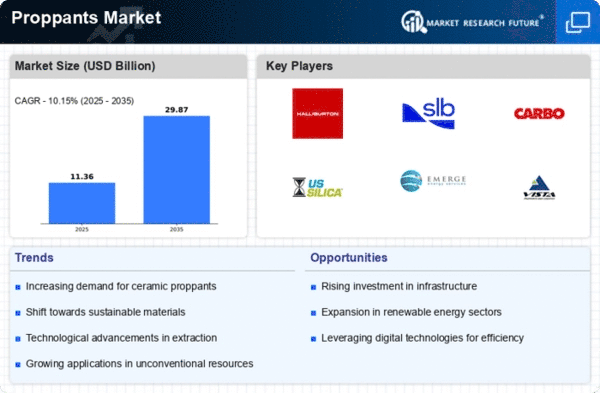
As per MRFR analysis, the Proppants Market Size was estimated at 10.31 USD Billion in 2024. The Proppants industry is projected to grow from 11.36 USD Billion in 2025 to 29.87 USD Billion by 2035, exhibiting a compound annual growth rate (CAGR) of 10.15% during the forecast period 2025 - 2035.

Key Market Trends & Highlights

The Proppants Market is currently experiencing a dynamic shift driven by technological advancements and sustainability initiatives.

  • North America remains the largest market for proppants, primarily due to its extensive oil and gas production activities. The Asia-Pacific region is emerging as the fastest-growing market, fueled by increasing energy demands and infrastructure investments. Hydraulic fracturing continues to dominate the market, while well stimulation is recognized as the fastest-growing segment. Key market drivers include the rising demand for oil and gas, alongside technological innovations in fracturing that enhance efficiency.

Market Size & Forecast

2024 Market Size 10.31 (USD Billion)
2035 Market Size 29.87 (USD Billion)
CAGR (2025 - 2035) 10.15%
Largest Regional Market Share in 2024 North America

Major Players

Halliburton (US), Schlumberger (US), Carbo Ceramics (US), U.S. Silica Holdings (US), Emerge Energy Services (US), Vista Proppants (US), Badger Mining Corporation (US), Select Energy Services (US)

Market Trends

The Proppants Market is currently experiencing a dynamic evolution, driven by various factors that influence demand and supply. The increasing need for energy resources, particularly in the oil and gas sector, propels the utilization of proppants in hydraulic fracturing processes. This trend appears to be bolstered by advancements in extraction technologies, which enhance the efficiency of resource recovery. Furthermore, the growing emphasis on sustainable practices within the industry suggests a shift towards eco-friendly proppant materials, potentially reshaping market dynamics. As companies strive to balance profitability with environmental responsibility, the Proppants Market may witness a gradual transition towards innovative solutions that align with these objectives.

In addition, the geographical diversification of production and consumption patterns indicates a broader acceptance of proppants across various regions. Emerging markets are likely to adopt hydraulic fracturing techniques, thereby expanding the overall market landscape.  Overall, the proppants market appears poised for growth, with evolving consumer preferences and technological advancements shaping its future trajectory, as highlighted in recent proppant market analysis.

Technological Advancements

The Proppants Market is witnessing a surge in technological innovations that enhance the performance of proppants. New materials and manufacturing processes are being developed, which may lead to improved strength and durability. These advancements could potentially optimize hydraulic fracturing operations, making them more efficient and cost-effective.

Sustainability Focus

There is a growing emphasis on sustainability within the Proppants Market, as companies strive to minimize their environmental footprint. This trend indicates a shift towards eco-friendly proppant options, which may include biodegradable materials or those sourced from sustainable practices. Such initiatives could align with global efforts to promote responsible resource extraction.

Regulatory Influences

The Proppants Market is increasingly shaped by regulatory frameworks that govern extraction activities. These regulations often aim to ensure safe and environmentally responsible practices, which may drive demand for compliant proppant solutions. As regulations evolve, companies may need to adapt their strategies to meet new standards, influencing market dynamics.

Proppants Market Market Drivers

Increasing Demand for Oil and Gas

The Global Proppants Market Industry experiences a robust demand driven by the increasing exploration and production activities in the oil and gas sector. As countries strive to enhance energy security and reduce dependency on imports, investments in hydraulic fracturing technologies have surged. This trend is particularly evident in regions such as North America and the Middle East, where shale gas production is on the rise. The market is projected to reach 10.3 USD Billion in 2024, reflecting the industry's growth trajectory. This demand is expected to continue, with projections indicating a market size of 29.9 USD Billion by 2035, suggesting a compound annual growth rate of 10.15% from 2025 to 2035.

Market Segment Insights

By Application: Hydraulic Fracturing (Largest) vs. Well Stimulation (Fastest-Growing)

In the proppants market, the application segment is dominated by hydraulic fracturing, which holds the largest market share due to its widespread use in unconventional oil and gas extraction. This technique's efficiency and effectiveness have made it the preferred choice among operators, leading to a significant proportion of overall proppant consumption in the industry. Sand control and enhanced oil recovery also contribute to the application segment but to a lesser extent, reflecting the specific needs of different extraction methods.

Hydraulic Fracturing (Dominant) vs. Well Stimulation (Emerging)

Hydraulic fracturing remains the dominant application in the proppants market, primarily due to its essential role in unlocking oil and gas reserves from shale formations. This method utilizes proppants to maintain fissures created during fracturing, significantly enhancing well productivity. On the other hand, well stimulation is an emerging area, gaining traction as operators seek to improve recovery rates from existing wells. This segment leverages advanced techniques and technologies to augment production, positioning it as a key growth driver in the market, with increasing investment and innovation tailored to optimize performance and efficiency.

By Type: Ceramic Proppants (Largest) vs. Sand Proppants (Fastest-Growing)

The Proppants Market is characterized by a diverse range of materials, with Ceramic Proppants holding the largest market share due to their superior performance in high-pressure environments. Sand Proppants, however, are rapidly gaining traction and are recognized as the fastest-growing segment, driven by lower costs and widespread availability. As oil and gas extraction increases, these materials are becoming essential in hydraulic fracturing processes.

Proppants: Ceramic Proppants (Dominant) vs. Sand Proppants (Emerging)

Ceramic Proppants are renowned for durability and efficiency in maintaining well productivity, making them the dominant choice for operators in challenging drilling conditions. Their high strength-to-weight ratio ensures optimal performance under pressure. In contrast, Sand Proppants are emerging as a cost-effective alternative, appealing to a broader range of operators, especially in less demanding applications. While Ceramic Proppants excel in high-performance scenarios, Sand Proppants are increasingly adopted due to advancements in extraction techniques and rising demand in various geographic regions, positioning them as key players in the evolving Proppants Market.

By End Use: Oil and Gas (Largest) vs. Mining (Fastest-Growing)

In the Proppants Market, the segment distribution showcases Oil and Gas as the largest field, significantly contributing to the overall demand. This segment benefits from the extensive usage of proppants in hydraulic fracturing processes, where high-quality sand and resin-coated proppants are essential for maintaining fissures and enhancing oil and gas extraction efficiency. In parallel, the Mining sector is gaining traction, driven by increasing mineral extraction activities and expanding applications of proppants in mineral processing, thereby enhancing its market share.

Oil and Gas: Dominant vs. Mining: Emerging

The Oil and Gas segment remains dominant in the Proppants Market, fueled by the ongoing expansion in hydrocarbon exploration and extraction technologies that require proficient proppant solutions. Its use in hydraulic fracturing processes has cemented its position, underscoring its reliance on high-performance materials to enhance recovery rates. Meanwhile, the Mining segment is emerging rapidly, with increased investments in mineral extraction technologies and infrastructure development. Its reliance on proppants to enhance the efficiency of mineral extraction processes indicates a shifting paradigm, whereby innovation and higher quality are becoming essential, positioning Mining as a critical growth vector in the industry.

By Material: Silica (Largest) vs. Ceramic (Fastest-Growing)

The proppants market is characterized by a dynamic distribution of materials including Silica, Alumina, Resin, and Ceramic. Among these, Silica stands out as the largest segment, offering unparalleled market penetration and share due to its extensive use in hydraulic fracturing. Ceramic proppants, on the other hand, are emerging strongly and are recognized for their durability, leading to an increasing interest and share, driven by the need for higher efficiency in extraction processes. In recent years, the growth trends within the proppants market have been significantly influenced by the boom in the <a href="https://www.marketresearchfuture.com/reports/shale-gas-market-11778" target="_blank" title="shale gas">shale gas</a> and oil exploration sector. The demand for Silica proppants remains robust, driving continual innovation and adaptation in supply and processing techniques. Conversely, Ceramic proppants are gaining traction due to their superior properties, including higher strength and conductivity, which appeal to users seeking operational efficiencies. This trend highlights a shift towards more advanced materials as the industry evolves.

Silica (Dominant) vs. Resin (Emerging)

Silica proppants comprise the dominant material in the proppants market, known for their effectiveness and reliability in supporting fracture conductivity in various oil and gas extraction processes. Their widespread use can be attributed to their cost-effectiveness and superior performance in many applications. In contrast, Resin proppants have emerged as a significant alternative, offering enhanced performance characteristics such as improved crush resistance and conductivity. These emerging proppants are becoming increasingly favored, particularly in complex reservoir environments where high performance is essential. The shift towards Resin proppants is indicative of a broader trend in the industry, where operators are seeking solutions that optimize extraction efficiency and reduce operational costs, ultimately influencing their adoption rates in the market.

By Size: Large Proppants (Largest) vs. Small Proppants (Fastest-Growing)

In the Proppants Market, the distribution of market share among the different sizes reveals a clear dominance of Large Proppants. This segment accounts for a significant portion of the overall market due to its extensive applicability in high-pressure fracking operations and its popularity among oil and gas operators. In contrast, Small Proppants, while possessing a smaller share, are rapidly gaining ground, particularly in niche applications and enhanced recovery projects. The growth dynamics in this size segment can be attributed to factors such as advancements in proppant technology and increasing demand for operational efficiency. Medium Proppants, on the other hand, have maintained a steady presence but are outpaced by the more specialized usage of Small and Large Proppants. The market is witnessing a shift as operators seek tailored solutions that suit specific geological formations and hydraulic fracturing needs, fueling the growth of both Small and Large Proppants.

Large Proppants (Dominant) vs. Small Proppants (Emerging)

Large Proppants dominate the Proppants Market primarily due to their robustness and high performance in extreme pressure and temperature conditions. Their large size enables optimal conductivity and efficiency in fracturing applications, making them the preferred choice for many large-scale operators. In comparison, Small Proppants, are emerging as a significant contender owing to their unique advantages like improved placement and reliability in intricate well architectures. Their growing popularity is supported by enhanced production techniques and stringent environmental regulations that favor smaller proppant sizes for more sustainable operations. As companies become more focused on maximizing yield and minimizing environmental impact, Small Proppants are likely to experience an upsurge in adoption, balancing the market dynamics with their larger counterparts.

Get more detailed insights about Proppants Market Research Report—Global Forecast till 2035

Regional Insights

North America : Market Leader in Proppants

North America continues to lead the proppants market, holding a significant share of 5.5 in 2024. The growth is driven by the increasing demand for hydraulic fracturing in shale gas and oil extraction, supported by favorable regulations and technological advancements. The region's robust infrastructure and investment in energy projects further enhance market dynamics, making it a focal point for proppant suppliers. The United States is the primary contributor to this market, with key players like Halliburton, Schlumberger, and U.S. Silica Holdings dominating the landscape. The competitive environment is characterized by innovation and strategic partnerships, ensuring a steady supply of high-quality proppants. As the market evolves, these companies are expected to leverage their expertise to meet the growing demand effectively.

Europe : Emerging Market Potential

Europe's proppants market is gaining traction, with a market size of 2.5 in 2024. The region is witnessing increased exploration and production activities, driven by the need for energy independence and the transition to cleaner energy sources. Regulatory support for unconventional gas extraction is also a catalyst for growth, as countries seek to enhance their energy security and reduce reliance on imports. Leading countries in this region include Germany, the UK, and Poland, where significant investments are being made in shale gas exploration. The competitive landscape features both local and international players, with companies like Carbo Ceramics and Badger Mining Corporation expanding their presence. The market is expected to grow as regulatory frameworks become more favorable for proppant usage in hydraulic fracturing.

Asia-Pacific : Rapidly Growing Demand

The Asia-Pacific proppants market is on the rise, with a market size of 1.8 in 2024. The region's growth is fueled by increasing energy demands, particularly in countries like China and India, where industrialization and urbanization are driving the need for efficient energy extraction methods. Regulatory frameworks are gradually evolving to support unconventional gas production, further enhancing market prospects. China and India are the leading countries in this market, with significant investments in shale gas exploration. The competitive landscape is becoming more dynamic, with both domestic and international players vying for market share. Companies like Emerge Energy Services and Vista Proppants are expanding their operations to cater to the growing demand, positioning themselves as key contributors to the region's proppants market.

Middle East and Africa : Emerging Market Opportunities

The Middle East and Africa (MEA) proppants market is still in its nascent stages, with a market size of 0.51 in 2024. However, the region presents significant opportunities for growth, driven by increasing investments in oil and gas exploration. The demand for proppants is expected to rise as countries seek to enhance their extraction capabilities and optimize production processes. Regulatory support for unconventional resource development is also a key driver. Leading countries in this region include Saudi Arabia and South Africa, where the focus is on maximizing hydrocarbon recovery. The competitive landscape is characterized by a mix of local and international players, with companies like Select Energy Services making strides in establishing a foothold. As the market matures, the presence of key players is likely to expand, fostering a more competitive environment.

Key Players and Competitive Insights

The Proppants Market is currently characterized by a dynamic competitive landscape, driven by increasing demand for hydraulic fracturing in oil and gas extraction. Key players are actively pursuing strategies that emphasize innovation, regional expansion, and partnerships to enhance their market positioning. Halliburton (US) has been focusing on technological advancements in proppant materials, aiming to improve efficiency and reduce environmental impact. Meanwhile, Schlumberger (US) is leveraging its extensive global network to optimize supply chains and enhance service delivery, which appears to strengthen its competitive edge. The collective strategies of these companies suggest a trend towards a more integrated and technologically advanced market environment.In terms of business tactics, companies are increasingly localizing manufacturing to reduce transportation costs and improve responsiveness to regional demands. This approach, coupled with supply chain optimization, is indicative of a moderately fragmented market structure where several players vie for market share. The influence of major companies like U.S. Silica Holdings (US) and Carbo Ceramics (US) is notable, as they continue to innovate and adapt to changing market conditions, thereby shaping the competitive dynamics.
In November U.S. Silica Holdings (US) announced the launch of a new line of eco-friendly proppants designed to minimize environmental impact during hydraulic fracturing operations. This strategic move not only aligns with the growing emphasis on sustainability but also positions the company as a leader in environmentally responsible practices within the industry. The introduction of these products could potentially attract a broader customer base that prioritizes sustainability in their operations.
In October Carbo Ceramics (US) entered into a strategic partnership with a leading technology firm to develop advanced data analytics solutions for optimizing proppant usage in real-time during fracking operations. This collaboration is likely to enhance operational efficiency and provide clients with valuable insights, thereby reinforcing Carbo's competitive position in a technology-driven market.
In September Halliburton (US) expanded its production capacity by investing in a new facility dedicated to the manufacturing of high-performance proppants. This expansion is expected to meet the rising demand from the North American shale market, indicating Halliburton's commitment to maintaining its leadership position through increased production capabilities and innovation.
As of December the Proppants Market is witnessing trends that emphasize digitalization, sustainability, and the integration of artificial intelligence in operational processes. Strategic alliances are becoming increasingly pivotal, as companies seek to leverage complementary strengths to enhance their offerings. The competitive landscape is shifting from a focus on price-based competition to one that prioritizes innovation, technological advancements, and supply chain reliability. This evolution suggests that future differentiation will hinge on the ability to deliver superior products and services that meet the evolving needs of the market.

Key Companies in the Proppants Market include

Industry Developments

Atlas Sand Company

Llc

HEXION

Schlumberger Ltd.

Proppants Industry Developments

March 2020: COVIA completed expanding its Canoitas facility in Mexico. The expansion will enable COVIA to add 350 tons of annual silica production capacity to support the growth of customers in Mexico.

March 2020: COVIA expanded the capabilities of its facility in North America to serve coating & polymers end-markets and create a highly efficient modern facility; the project cost was approximately USD 45 million.

May 2019: Hi-Crush Inc. acquired Proppant Logistics LLC, which owns Pronghorn Logistics LLC. The company provides end- to end-logistic services for proppants.

Future Outlook

Proppants Market Future Outlook

The Proppants Market is projected to grow at a 10.15% CAGR from 2025 to 2035, driven by increasing demand for hydraulic fracturing and advancements in proppant technology.

New opportunities lie in:

  • <p>Development of eco-friendly proppants to meet regulatory demands. Expansion into emerging markets with untapped shale resources. Investment in advanced logistics for efficient proppant delivery systems.</p>

By 2035, the Proppants Market is expected to achieve substantial growth and innovation.

Market Segmentation

Proppants Market Size Outlook

  • Fine Proppants
  • Medium Proppants
  • Coarse Proppants

Proppants Market Type Outlook

  • Ceramic Proppants
  • Sand Proppants
  • Resin-Coated Proppants
  • Composite Proppants

Proppants Market End Use Outlook

  • Oil and Gas
  • Mining
  • Construction
  • Industrial

Proppants Market Material Outlook

  • Silica
  • Alumina
  • Resin
  • Ceramic

Proppants Market Application Outlook

  • Hydraulic Fracturing
  • Sand Control
  • Well Stimulation
  • Enhanced Oil Recovery

Report Scope

MARKET SIZE 2024 10.31(USD Billion)
MARKET SIZE 2025 11.36(USD Billion)
MARKET SIZE 2035 29.87(USD Billion)
COMPOUND ANNUAL GROWTH RATE (CAGR) 10.15% (2025 - 2035)
REPORT COVERAGE Revenue Forecast, Competitive Landscape, Growth Factors, and Trends
BASE YEAR 2024
Market Forecast Period 2025 - 2035
Historical Data 2019 - 2024
Market Forecast Units USD Billion
Key Companies Profiled Halliburton (US), Schlumberger (US), Carbo Ceramics (US), U.S. Silica Holdings (US), Emerge Energy Services (US), Vista Proppants (US), Badger Mining Corporation (US), Select Energy Services (US)
Segments Covered Application, Type, End Use, Material, Size
Key Market Opportunities Advancements in sustainable proppant materials enhance environmental compliance and market competitiveness in the Proppants Market.
Key Market Dynamics Rising demand for high-performance proppants drives innovation and competition among manufacturers in the market.
Countries Covered North America, Europe, APAC, South America, MEA

FAQs

What is the projected market valuation of the Proppants Market by 2035?

<p>The Proppants Market is projected to reach a valuation of 29.87 USD Billion by 2035.</p>

What was the market valuation of the Proppants Market in 2024?

<p>In 2024, the Proppants Market was valued at 10.31 USD Billion.</p>

What is the expected CAGR for the Proppants Market during the forecast period 2025 - 2035?

<p>The expected CAGR for the Proppants Market during the forecast period 2025 - 2035 is 10.15%.</p>

Which application segment had the highest valuation in 2024?

<p>In 2024, the Hydraulic Fracturing application segment had the highest valuation at 3.09 USD Billion.</p>

What are the projected valuations for the Sand Proppants segment by 2035?

<p>The Sand Proppants segment is projected to reach a valuation of 11.56 USD Billion by 2035.</p>

Which key players dominate the Proppants Market?

<p>Key players in the Proppants Market include Halliburton, Schlumberger, and Carbo Ceramics, among others.</p>

What is the projected valuation for the Oil and Gas end-use segment by 2035?

The Oil and Gas end-use segment is projected to reach a valuation of 14.0 USD Billion by 2035.

What was the valuation of the Resin-Coated Proppants segment in 2024?

The Resin-Coated Proppants segment was valued at 2.46 USD Billion in 2024.

How does the valuation of Medium Proppants compare to Large Proppants by 2035?

By 2035, Medium Proppants are projected to be valued at 8.76 USD Billion, while Large Proppants are expected to reach 16.73 USD Billion.

What is the projected valuation for the Silica material segment by 2035?

The Silica material segment is projected to reach a valuation of 8.67 USD Billion by 2035.

  1. SECTION I: EXECUTIVE SUMMARY AND KEY HIGHLIGHTS |
    1. EXECUTIVE SUMMARY | |
      1. Market Overview | |
      2. Key Findings | |
      3. Market Segmentation | |
      4. Competitive Landscape | |
      5. Challenges and Opportunities | |
      6. Future Outlook 2
  2. SECTION II: SCOPING, METHODOLOGY AND MARKET STRUCTURE |
    1. MARKET INTRODUCTION | |
      1. Definition | |
      2. Scope of the study | | |
    2. RESEARCH METHODOLOGY | |
      1. Overview | |
      2. Data Mining | |
      3. Secondary Research | |
      4. Primary Research | | |
      5. Forecasting Model | |
      6. Market Size Estimation | | |
      7. Data Triangulation | |
      8. Validation 3
  3. SECTION III: QUALITATIVE ANALYSIS |
    1. MARKET DYNAMICS | |
      1. Overview | |
      2. Drivers | |
      3. Restraints | |
      4. Opportunities |
    2. MARKET FACTOR ANALYSIS | |
      1. Value chain Analysis | |
      2. Porter's Five Forces Analysis | | |
      3. COVID-19 Impact Analysis | | |
  4. SECTION IV: QUANTITATIVE ANALYSIS |
    1. Chemicals and Materials, BY Application (USD Billion) | |
      1. Hydraulic Fracturing | |
      2. Sand Control | |
      3. Well Stimulation | |
      4. Enhanced Oil Recovery |
    2. Chemicals and Materials, BY Type (USD Billion) | |
      1. Ceramic Proppants | |
      2. Sand Proppants | |
      3. Resin-Coated Proppants | |
      4. Composite Proppants |
    3. Chemicals and Materials, BY End Use (USD Billion) | |
      1. Oil and Gas | |
      2. Mining | |
      3. Construction | |
      4. Industrial |
    4. Chemicals and Materials, BY Material (USD Billion) | |
      1. Silica | |
      2. Alumina | |
      3. Resin | |
      4. Ceramic |
    5. Chemicals and Materials, BY Size (USD Billion) | |
      1. Small Proppants | |
      2. Medium Proppants | |
      3. Large Proppants |
    6. Chemicals and Materials, BY Region (USD Billion) | |
      1. North America | | |
      2. Europe | | |
      3. APAC | | |
      4. South America | | |
      5. MEA | | |
  5. SECTION V: COMPETITIVE ANALYSIS |
    1. Competitive Landscape | |
      1. Overview | |
      2. Competitive Analysis | |
      3. Market share Analysis | |
      4. Major Growth Strategy in the Chemicals and Materials | |
      5. Competitive Benchmarking | |
      6. Leading Players in Terms of Number of Developments in the Chemicals and Materials | |
      7. Key developments and growth strategies | | |
      8. Major Players Financial Matrix | | |
    2. Company Profiles | |
      1. Halliburton (US) | | |
      2. Schlumberger (US) | | |
      3. Carbo Ceramics (US) | | |
      4. U.S. Silica Holdings (US) | | |
      5. Emerge Energy Services (US) | | |
      6. Vista Proppants (US) | | |
      7. Badger Mining Corporation (US) | | |
      8. Select Energy Services (US) | | |
    3. Appendix | |
      1. References | |
      2. Related Reports 6 LIST OF FIGURES |
    4. MARKET SYNOPSIS |
    5. NORTH AMERICA MARKET ANALYSIS |
    6. US MARKET ANALYSIS BY APPLICATION |
    7. US MARKET ANALYSIS BY TYPE |
    8. US MARKET ANALYSIS BY END USE |
    9. US MARKET ANALYSIS BY MATERIAL |
    10. US MARKET ANALYSIS BY SIZE |
    11. CANADA MARKET ANALYSIS BY APPLICATION |
    12. CANADA MARKET ANALYSIS BY TYPE |
    13. CANADA MARKET ANALYSIS BY END USE |
    14. CANADA MARKET ANALYSIS BY MATERIAL |
    15. CANADA MARKET ANALYSIS BY SIZE |
    16. EUROPE MARKET ANALYSIS |
    17. GERMANY MARKET ANALYSIS BY APPLICATION |
    18. GERMANY MARKET ANALYSIS BY TYPE |
    19. GERMANY MARKET ANALYSIS BY END USE |
    20. GERMANY MARKET ANALYSIS BY MATERIAL |
    21. GERMANY MARKET ANALYSIS BY SIZE |
    22. UK MARKET ANALYSIS BY APPLICATION |
    23. UK MARKET ANALYSIS BY TYPE |
    24. UK MARKET ANALYSIS BY END USE |
    25. UK MARKET ANALYSIS BY MATERIAL |
    26. UK MARKET ANALYSIS BY SIZE |
    27. FRANCE MARKET ANALYSIS BY APPLICATION |
    28. FRANCE MARKET ANALYSIS BY TYPE |
    29. FRANCE MARKET ANALYSIS BY END USE |
    30. FRANCE MARKET ANALYSIS BY MATERIAL |
    31. FRANCE MARKET ANALYSIS BY SIZE |
    32. RUSSIA MARKET ANALYSIS BY APPLICATION |
    33. RUSSIA MARKET ANALYSIS BY TYPE |
    34. RUSSIA MARKET ANALYSIS BY END USE |
    35. RUSSIA MARKET ANALYSIS BY MATERIAL |
    36. RUSSIA MARKET ANALYSIS BY SIZE |
    37. ITALY MARKET ANALYSIS BY APPLICATION |
    38. ITALY MARKET ANALYSIS BY TYPE |
    39. ITALY MARKET ANALYSIS BY END USE |
    40. ITALY MARKET ANALYSIS BY MATERIAL |
    41. ITALY MARKET ANALYSIS BY SIZE |
    42. SPAIN MARKET ANALYSIS BY APPLICATION |
    43. SPAIN MARKET ANALYSIS BY TYPE |
    44. SPAIN MARKET ANALYSIS BY END USE |
    45. SPAIN MARKET ANALYSIS BY MATERIAL |
    46. SPAIN MARKET ANALYSIS BY SIZE |
    47. REST OF EUROPE MARKET ANALYSIS BY APPLICATION |
    48. REST OF EUROPE MARKET ANALYSIS BY TYPE |
    49. REST OF EUROPE MARKET ANALYSIS BY END USE |
    50. REST OF EUROPE MARKET ANALYSIS BY MATERIAL |
    51. REST OF EUROPE MARKET ANALYSIS BY SIZE |
    52. APAC MARKET ANALYSIS |
    53. CHINA MARKET ANALYSIS BY APPLICATION |
    54. CHINA MARKET ANALYSIS BY TYPE |
    55. CHINA MARKET ANALYSIS BY END USE |
    56. CHINA MARKET ANALYSIS BY MATERIAL |
    57. CHINA MARKET ANALYSIS BY SIZE |
    58. INDIA MARKET ANALYSIS BY APPLICATION |
    59. INDIA MARKET ANALYSIS BY TYPE |
    60. INDIA MARKET ANALYSIS BY END USE |
    61. INDIA MARKET ANALYSIS BY MATERIAL |
    62. INDIA MARKET ANALYSIS BY SIZE |
    63. JAPAN MARKET ANALYSIS BY APPLICATION |
    64. JAPAN MARKET ANALYSIS BY TYPE |
    65. JAPAN MARKET ANALYSIS BY END USE |
    66. JAPAN MARKET ANALYSIS BY MATERIAL |
    67. JAPAN MARKET ANALYSIS BY SIZE |
    68. SOUTH KOREA MARKET ANALYSIS BY APPLICATION |
    69. SOUTH KOREA MARKET ANALYSIS BY TYPE |
    70. SOUTH KOREA MARKET ANALYSIS BY END USE |
    71. SOUTH KOREA MARKET ANALYSIS BY MATERIAL |
    72. SOUTH KOREA MARKET ANALYSIS BY SIZE |
    73. MALAYSIA MARKET ANALYSIS BY APPLICATION |
    74. MALAYSIA MARKET ANALYSIS BY TYPE |
    75. MALAYSIA MARKET ANALYSIS BY END USE |
    76. MALAYSIA MARKET ANALYSIS BY MATERIAL |
    77. MALAYSIA MARKET ANALYSIS BY SIZE |
    78. THAILAND MARKET ANALYSIS BY APPLICATION |
    79. THAILAND MARKET ANALYSIS BY TYPE |
    80. THAILAND MARKET ANALYSIS BY END USE |
    81. THAILAND MARKET ANALYSIS BY MATERIAL |
    82. THAILAND MARKET ANALYSIS BY SIZE |
    83. INDONESIA MARKET ANALYSIS BY APPLICATION |
    84. INDONESIA MARKET ANALYSIS BY TYPE |
    85. INDONESIA MARKET ANALYSIS BY END USE |
    86. INDONESIA MARKET ANALYSIS BY MATERIAL |
    87. INDONESIA MARKET ANALYSIS BY SIZE |
    88. REST OF APAC MARKET ANALYSIS BY APPLICATION |
    89. REST OF APAC MARKET ANALYSIS BY TYPE |
    90. REST OF APAC MARKET ANALYSIS BY END USE |
    91. REST OF APAC MARKET ANALYSIS BY MATERIAL |
    92. REST OF APAC MARKET ANALYSIS BY SIZE |
    93. SOUTH AMERICA MARKET ANALYSIS |
    94. BRAZIL MARKET ANALYSIS BY APPLICATION |
    95. BRAZIL MARKET ANALYSIS BY TYPE |
    96. BRAZIL MARKET ANALYSIS BY END USE |
    97. BRAZIL MARKET ANALYSIS BY MATERIAL |
    98. BRAZIL MARKET ANALYSIS BY SIZE |
    99. MEXICO MARKET ANALYSIS BY APPLICATION |
    100. MEXICO MARKET ANALYSIS BY TYPE |
    101. MEXICO MARKET ANALYSIS BY END USE |
    102. MEXICO MARKET ANALYSIS BY MATERIAL |
    103. MEXICO MARKET ANALYSIS BY SIZE |
    104. ARGENTINA MARKET ANALYSIS BY APPLICATION |
    105. ARGENTINA MARKET ANALYSIS BY TYPE |
    106. ARGENTINA MARKET ANALYSIS BY END USE |
    107. ARGENTINA MARKET ANALYSIS BY MATERIAL |
    108. ARGENTINA MARKET ANALYSIS BY SIZE |
    109. REST OF SOUTH AMERICA MARKET ANALYSIS BY APPLICATION |
    110. REST OF SOUTH AMERICA MARKET ANALYSIS BY TYPE |
    111. REST OF SOUTH AMERICA MARKET ANALYSIS BY END USE |
    112. REST OF SOUTH AMERICA MARKET ANALYSIS BY MATERIAL |
    113. REST OF SOUTH AMERICA MARKET ANALYSIS BY SIZE |
    114. MEA MARKET ANALYSIS |
    115. GCC COUNTRIES MARKET ANALYSIS BY APPLICATION |
    116. GCC COUNTRIES MARKET ANALYSIS BY TYPE |
    117. GCC COUNTRIES MARKET ANALYSIS BY END USE |
    118. GCC COUNTRIES MARKET ANALYSIS BY MATERIAL |
    119. GCC COUNTRIES MARKET ANALYSIS BY SIZE |
    120. SOUTH AFRICA MARKET ANALYSIS BY APPLICATION |
    121. SOUTH AFRICA MARKET ANALYSIS BY TYPE |
    122. SOUTH AFRICA MARKET ANALYSIS BY END USE |
    123. SOUTH AFRICA MARKET ANALYSIS BY MATERIAL |
    124. SOUTH AFRICA MARKET ANALYSIS BY SIZE |
    125. REST OF MEA MARKET ANALYSIS BY APPLICATION |
    126. REST OF MEA MARKET ANALYSIS BY TYPE |
    127. REST OF MEA MARKET ANALYSIS BY END USE |
    128. REST OF MEA MARKET ANALYSIS BY MATERIAL |
    129. REST OF MEA MARKET ANALYSIS BY SIZE |
    130. KEY BUYING CRITERIA OF CHEMICALS AND MATERIALS |
    131. RESEARCH PROCESS OF MRFR |
    132. DRO ANALYSIS OF CHEMICALS AND MATERIALS |
    133. DRIVERS IMPACT ANALYSIS: CHEMICALS AND MATERIALS |
    134. RESTRAINTS IMPACT ANALYSIS: CHEMICALS AND MATERIALS |
    135. SUPPLY / VALUE CHAIN: CHEMICALS AND MATERIALS |
    136. CHEMICALS AND MATERIALS, BY APPLICATION, 2024 (% SHARE) |
    137. CHEMICALS AND MATERIALS, BY APPLICATION, 2024 TO 2035 (USD Billion) |
    138. CHEMICALS AND MATERIALS, BY TYPE, 2024 (% SHARE) |
    139. CHEMICALS AND MATERIALS, BY TYPE, 2024 TO 2035 (USD Billion) |
    140. CHEMICALS AND MATERIALS, BY END USE, 2024 (% SHARE) |
    141. CHEMICALS AND MATERIALS, BY END USE, 2024 TO 2035 (USD Billion) |
    142. CHEMICALS AND MATERIALS, BY MATERIAL, 2024 (% SHARE) |
    143. CHEMICALS AND MATERIALS, BY MATERIAL, 2024 TO 2035 (USD Billion) |
    144. CHEMICALS AND MATERIALS, BY SIZE, 2024 (% SHARE) |
    145. CHEMICALS AND MATERIALS, BY SIZE, 2024 TO 2035 (USD Billion) |
    146. BENCHMARKING OF MAJOR COMPETITORS 7 LIST OF TABLES |
    147. LIST OF ASSUMPTIONS | |
      1. |
    148. North America MARKET SIZE ESTIMATES; FORECAST | |
      1. BY APPLICATION, 2025-2035 (USD Billion) | |
      2. BY TYPE, 2025-2035 (USD Billion) | |
      3. BY END USE, 2025-2035 (USD Billion) | |
      4. BY MATERIAL, 2025-2035 (USD Billion) | |
      5. BY SIZE, 2025-2035 (USD Billion) |
    149. US MARKET SIZE ESTIMATES; FORECAST | |
      1. BY APPLICATION, 2025-2035 (USD Billion) | |
      2. BY TYPE, 2025-2035 (USD Billion) | |
      3. BY END USE, 2025-2035 (USD Billion) | |
      4. BY MATERIAL, 2025-2035 (USD Billion) | |
      5. BY SIZE, 2025-2035 (USD Billion) |
    150. Canada MARKET SIZE ESTIMATES; FORECAST | |
      1. BY APPLICATION, 2025-2035 (USD Billion) | |
      2. BY TYPE, 2025-2035 (USD Billion) | |
      3. BY END USE, 2025-2035 (USD Billion) | |
      4. BY MATERIAL, 2025-2035 (USD Billion) | |
      5. BY SIZE, 2025-2035 (USD Billion) |
    151. Europe MARKET SIZE ESTIMATES; FORECAST | |
      1. BY APPLICATION, 2025-2035 (USD Billion) | |
      2. BY TYPE, 2025-2035 (USD Billion) | |
      3. BY END USE, 2025-2035 (USD Billion) | |
      4. BY MATERIAL, 2025-2035 (USD Billion) | |
      5. BY SIZE, 2025-2035 (USD Billion) |
    152. Germany MARKET SIZE ESTIMATES; FORECAST | |
      1. BY APPLICATION, 2025-2035 (USD Billion) | |
      2. BY TYPE, 2025-2035 (USD Billion) | |
      3. BY END USE, 2025-2035 (USD Billion) | |
      4. BY MATERIAL, 2025-2035 (USD Billion) | |
      5. BY SIZE, 2025-2035 (USD Billion) |
    153. UK MARKET SIZE ESTIMATES; FORECAST | |
      1. BY APPLICATION, 2025-2035 (USD Billion) | |
      2. BY TYPE, 2025-2035 (USD Billion) | |
      3. BY END USE, 2025-2035 (USD Billion) | |
      4. BY MATERIAL, 2025-2035 (USD Billion) | |
      5. BY SIZE, 2025-2035 (USD Billion) |
    154. France MARKET SIZE ESTIMATES; FORECAST | |
      1. BY APPLICATION, 2025-2035 (USD Billion) | |
      2. BY TYPE, 2025-2035 (USD Billion) | |
      3. BY END USE, 2025-2035 (USD Billion) | |
      4. BY MATERIAL, 2025-2035 (USD Billion) | |
      5. BY SIZE, 2025-2035 (USD Billion) |
    155. Russia MARKET SIZE ESTIMATES; FORECAST | |
      1. BY APPLICATION, 2025-2035 (USD Billion) | |
      2. BY TYPE, 2025-2035 (USD Billion) | |
      3. BY END USE, 2025-2035 (USD Billion) | |
      4. BY MATERIAL, 2025-2035 (USD Billion) | |
      5. BY SIZE, 2025-2035 (USD Billion) |
    156. Italy MARKET SIZE ESTIMATES; FORECAST | |
      1. BY APPLICATION, 2025-2035 (USD Billion) | |
      2. BY TYPE, 2025-2035 (USD Billion) | |
      3. BY END USE, 2025-2035 (USD Billion) | |
      4. BY MATERIAL, 2025-2035 (USD Billion) | |
      5. BY SIZE, 2025-2035 (USD Billion) |
    157. Spain MARKET SIZE ESTIMATES; FORECAST | |
      1. BY APPLICATION, 2025-2035 (USD Billion) | |
      2. BY TYPE, 2025-2035 (USD Billion) | |
      3. BY END USE, 2025-2035 (USD Billion) | |
      4. BY MATERIAL, 2025-2035 (USD Billion) | |
      5. BY SIZE, 2025-2035 (USD Billion) |
    158. Rest of Europe MARKET SIZE ESTIMATES; FORECAST | |
      1. BY APPLICATION, 2025-2035 (USD Billion) | |
      2. BY TYPE, 2025-2035 (USD Billion) | |
      3. BY END USE, 2025-2035 (USD Billion) | |
      4. BY MATERIAL, 2025-2035 (USD Billion) | |
      5. BY SIZE, 2025-2035 (USD Billion) |
    159. APAC MARKET SIZE ESTIMATES; FORECAST | |
      1. BY APPLICATION, 2025-2035 (USD Billion) | |
      2. BY TYPE, 2025-2035 (USD Billion) | |
      3. BY END USE, 2025-2035 (USD Billion) | |
      4. BY MATERIAL, 2025-2035 (USD Billion) | |
      5. BY SIZE, 2025-2035 (USD Billion) |
    160. China MARKET SIZE ESTIMATES; FORECAST | |
      1. BY APPLICATION, 2025-2035 (USD Billion) | |
      2. BY TYPE, 2025-2035 (USD Billion) | |
      3. BY END USE, 2025-2035 (USD Billion) | |
      4. BY MATERIAL, 2025-2035 (USD Billion) | |
      5. BY SIZE, 2025-2035 (USD Billion) |
    161. India MARKET SIZE ESTIMATES; FORECAST | |
      1. BY APPLICATION, 2025-2035 (USD Billion) | |
      2. BY TYPE, 2025-2035 (USD Billion) | |
      3. BY END USE, 2025-2035 (USD Billion) | |
      4. BY MATERIAL, 2025-2035 (USD Billion) | |
      5. BY SIZE, 2025-2035 (USD Billion) |
    162. Japan MARKET SIZE ESTIMATES; FORECAST | |
      1. BY APPLICATION, 2025-2035 (USD Billion) | |
      2. BY TYPE, 2025-2035 (USD Billion) | |
      3. BY END USE, 2025-2035 (USD Billion) | |
      4. BY MATERIAL, 2025-2035 (USD Billion) | |
      5. BY SIZE, 2025-2035 (USD Billion) |
    163. South Korea MARKET SIZE ESTIMATES; FORECAST | |
      1. BY APPLICATION, 2025-2035 (USD Billion) | |
      2. BY TYPE, 2025-2035 (USD Billion) | |
      3. BY END USE, 2025-2035 (USD Billion) | |
      4. BY MATERIAL, 2025-2035 (USD Billion) | |
      5. BY SIZE, 2025-2035 (USD Billion) |
    164. Malaysia MARKET SIZE ESTIMATES; FORECAST | |
      1. BY APPLICATION, 2025-2035 (USD Billion) | |
      2. BY TYPE, 2025-2035 (USD Billion) | |
      3. BY END USE, 2025-2035 (USD Billion) | |
      4. BY MATERIAL, 2025-2035 (USD Billion) | |
      5. BY SIZE, 2025-2035 (USD Billion) |
    165. Thailand MARKET SIZE ESTIMATES; FORECAST | |
      1. BY APPLICATION, 2025-2035 (USD Billion) | |
      2. BY TYPE, 2025-2035 (USD Billion) | |
      3. BY END USE, 2025-2035 (USD Billion) | |
      4. BY MATERIAL, 2025-2035 (USD Billion) | |
      5. BY SIZE, 2025-2035 (USD Billion) |
    166. Indonesia MARKET SIZE ESTIMATES; FORECAST | |
      1. BY APPLICATION, 2025-2035 (USD Billion) | |
      2. BY TYPE, 2025-2035 (USD Billion) | |
      3. BY END USE, 2025-2035 (USD Billion) | |
      4. BY MATERIAL, 2025-2035 (USD Billion) | |
      5. BY SIZE, 2025-2035 (USD Billion) |
    167. Rest of APAC MARKET SIZE ESTIMATES; FORECAST | |
      1. BY APPLICATION, 2025-2035 (USD Billion) | |
      2. BY TYPE, 2025-2035 (USD Billion) | |
      3. BY END USE, 2025-2035 (USD Billion) | |
      4. BY MATERIAL, 2025-2035 (USD Billion) | |
      5. BY SIZE, 2025-2035 (USD Billion) |
    168. South America MARKET SIZE ESTIMATES; FORECAST | |
      1. BY APPLICATION, 2025-2035 (USD Billion) | |
      2. BY TYPE, 2025-2035 (USD Billion) | |
      3. BY END USE, 2025-2035 (USD Billion) | |
      4. BY MATERIAL, 2025-2035 (USD Billion) | |
      5. BY SIZE, 2025-2035 (USD Billion) |
    169. Brazil MARKET SIZE ESTIMATES; FORECAST | |
      1. BY APPLICATION, 2025-2035 (USD Billion) | |
      2. BY TYPE, 2025-2035 (USD Billion) | |
      3. BY END USE, 2025-2035 (USD Billion) | |
      4. BY MATERIAL, 2025-2035 (USD Billion) | |
      5. BY SIZE, 2025-2035 (USD Billion) |
    170. Mexico MARKET SIZE ESTIMATES; FORECAST | |
      1. BY APPLICATION, 2025-2035 (USD Billion) | |
      2. BY TYPE, 2025-2035 (USD Billion) | |
      3. BY END USE, 2025-2035 (USD Billion) | |
      4. BY MATERIAL, 2025-2035 (USD Billion) | |
      5. BY SIZE, 2025-2035 (USD Billion) |
    171. Argentina MARKET SIZE ESTIMATES; FORECAST | |
      1. BY APPLICATION, 2025-2035 (USD Billion) | |
      2. BY TYPE, 2025-2035 (USD Billion) | |
      3. BY END USE, 2025-2035 (USD Billion) | |
      4. BY MATERIAL, 2025-2035 (USD Billion) | |
      5. BY SIZE, 2025-2035 (USD Billion) |
    172. Rest of South America MARKET SIZE ESTIMATES; FORECAST | |
      1. BY APPLICATION, 2025-2035 (USD Billion) | |
      2. BY TYPE, 2025-2035 (USD Billion) | |
      3. BY END USE, 2025-2035 (USD Billion) | |
      4. BY MATERIAL, 2025-2035 (USD Billion) | |
      5. BY SIZE, 2025-2035 (USD Billion) |
    173. MEA MARKET SIZE ESTIMATES; FORECAST | |
      1. BY APPLICATION, 2025-2035 (USD Billion) | |
      2. BY TYPE, 2025-2035 (USD Billion) | |
      3. BY END USE, 2025-2035 (USD Billion) | |
      4. BY MATERIAL, 2025-2035 (USD Billion) | |
      5. BY SIZE, 2025-2035 (USD Billion) |
    174. GCC Countries MARKET SIZE ESTIMATES; FORECAST | |
      1. BY APPLICATION, 2025-2035 (USD Billion) | |
      2. BY TYPE, 2025-2035 (USD Billion) | |
      3. BY END USE, 2025-2035 (USD Billion) | |
      4. BY MATERIAL, 2025-2035 (USD Billion) | |
      5. BY SIZE, 2025-2035 (USD Billion) |
    175. South Africa MARKET SIZE ESTIMATES; FORECAST | |
      1. BY APPLICATION, 2025-2035 (USD Billion) | |
      2. BY TYPE, 2025-2035 (USD Billion) | |
      3. BY END USE, 2025-2035 (USD Billion) | |
      4. BY MATERIAL, 2025-2035 (USD Billion) | |
      5. BY SIZE, 2025-2035 (USD Billion) |
    176. Rest of MEA MARKET SIZE ESTIMATES; FORECAST | |
      1. BY APPLICATION, 2025-2035 (USD Billion) | |
      2. BY TYPE, 2025-2035 (USD Billion) | |
      3. BY END USE, 2025-2035 (USD Billion) | |
      4. BY MATERIAL, 2025-2035 (USD Billion) | |
      5. BY SIZE, 2025-2035 (USD Billion) |
    177. PRODUCT LAUNCH/PRODUCT DEVELOPMENT/APPROVAL | |
      1. |
    178. ACQUISITION/PARTNERSHIP | |

Chemicals and Materials Market Segmentation

Chemicals and Materials By Application (USD Billion, 2025-2035)

  • Hydraulic Fracturing
  • Sand Control
  • Well Stimulation
  • Enhanced Oil Recovery

Chemicals and Materials By Type (USD Billion, 2025-2035)

  • Ceramic Proppants
  • Sand Proppants
  • Resin-Coated Proppants
  • Composite Proppants

Chemicals and Materials By End Use (USD Billion, 2025-2035)

  • Oil and Gas
  • Mining
  • Construction
  • Industrial

Chemicals and Materials By Material (USD Billion, 2025-2035)

  • Silica
  • Alumina
  • Resin
  • Ceramic

Chemicals and Materials By Size (USD Billion, 2025-2035)

  • Small Proppants
  • Medium Proppants
  • Large Proppants
Infographic

Free Sample Request

Kindly complete the form below to receive a free sample of this Report

Get Free Sample

Customer Strories

Compare Licence

×
Features License Type
Single User Multiuser License Enterprise User
Price $4,950 $5,950 $7,250
Maximum User Access Limit 1 User Upto 10 Users Unrestricted Access Throughout the Organization
Free Customization
Direct Access to Analyst
Deliverable Format
Platform Access
Discount on Next Purchase 10% 15% 15%
Printable Versions