×
Hero Background
English
Chinese
French
Japanese
Korean
German
Spanish

Proppants Market Size

ID: MRFR/CnM/9075-HCR
180 Pages
Anshula Mandaokar
October 2025

Proppants Market Research Report Information By Product Type (Freac Sand, Resin-Coated Proppant, Ceramic Proppant) By Application (Shale Gas, Tight Gas, Coal Bed Methane) By Region ( North America, Europe, Asia Pacific, Latin America, Middle East & Africa) Forecast till 2035

Share:
Download PDF ×

We do not share your information with anyone. However, we may send you emails based on your report interest from time to time. You may contact us at any time to opt-out.

Proppants Market Infographic
Purchase Options

Proppants Size

Proppants Market Growth Projections and Opportunities

In 2022, Proppants' market size was estimated at USD 8.5 billion. The growth of the industry from USD 9.36 Billion in 2023 to USD 20.28 Billion by 2032 will show a compound annual growth rate (CAGR) of about 10.15%. Many factors can influence the Proppants Market and its development. One is that the oil and gas industry is thriving with a lot of hydraulic fracturing operations expansion taking place. Sand, resin-coated sand, and ceramics used together as proppants in hydraulic fracturing are vital for increasing the production of oil and gas from underground reservoirs all over the world. With energy needs soaring worldwide, exploration and production activities relating to unconventional oil and gas reserves have led to increased usage of proppants, resulting in their market expansion. Likewise, innovation regarding fracking has greatly impacted proppant marketability. This sector focuses its investments on research aimed at optimizing fracking processes, leading to better well productivity levels as well as enhanced hydrocarbon recovery rates. These innovative methods require proppants with better qualities and, thus, performance, such as high-volume hydraulic fracturing and horizontal drilling, which are more sophisticated techniques compared to traditional fracking methods. Having abundant shale reserves makes North America a major consumer of proppants because of their wide application in Oil & Gas production via fracking technology. Additionally, the construction industry influences proppant markets mainly through the demand for good-quality Silica sand, which is commonly used not only for hydraulic fracturing but also for concrete manufacturing and other building applications. On top of this, particular types like silica sands have ecological implications; hence, regulation on these provisions may limit their applicability. The use of certain types must be guided by government legislation covering areas pertaining to air pollution norms, protecting health safety measures for employees, and maintaining land reclamation methods during fracking. Obstacles involving unstable pricing, rivalry from other materials, and changes in the prices of gas and oil may influence Proppants Markets. The proppants sector is influenced by global petroleum price fluctuations affecting overall investment as well as drilling activities. In addition, competition with substitute proppants such as resin-coated sand and ceramic products creates a problem with the use of traditional sand as a prop.
Proppants Market Size Graph
Author
Anshula Mandaokar
Team Lead - Research

Anshula Mandaokar holds an academic degree in Chemical Engineering and has been contributing to the field for more than 5 years. She has expertise in Market Research and Business Consulting and serves as a Team Lead for a reputed Market Research firm under the Chemicals and Materials domain spectrum. She has worked on multiple projects, generating explicit results in a quick turnaround time. Her understanding of data interpretation justifies her role as a leader.

Leave a Comment

FAQs

How much is the Proppants market?

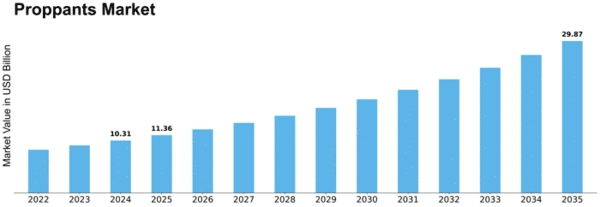
The Proppants market size was valued at USD 10.31 Billion in 2024

What is the growth rate of the Proppants market?

Proppants Market is projected to register a CAGR of 10.15% from 2025-2035

Which region held the largest market share in the Proppants market?

North America had the largest share of the market

Who are the key players in the Proppants market?

The key players in the market are Carbo Ceramics Inc., COVIA, JSC Borovichi Refractories Plant, S. Silica Holdings Inc., Hi-Crush Inc., MineraçãoCurimbaba, XinmiWanli Industry' Development Co. Ltd., Atlas Sand Company, Llc, HEXION, Schlumberger Ltd

Which product type led the Proppants market?

The freak sand category dominated the market in 2024

Which application had the largest market share in the Proppants market?

Shale gas had the largest share of the market

Market Summary

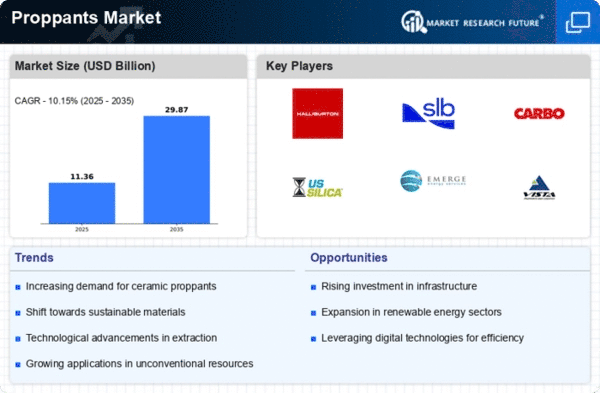
As per Market Research Future analysis, the Proppants Market Size was estimated at 10.31 USD Billion in 2024. The Proppants industry is projected to grow from 11.36 USD Billion in 2025 to 29.87 USD Billion by 2035, exhibiting a compound annual growth rate (CAGR) of 10.15% during the forecast period 2025 - 2035

Key Market Trends & Highlights

The Proppants Market is experiencing a dynamic shift towards sustainability and technological innovation.

  • Sustainable proppant development is becoming increasingly prevalent, reflecting a broader industry trend towards environmental responsibility.
  • Technological advancements in extraction methods are enhancing efficiency and reducing costs across the proppants sector.
  • North America remains the largest market for proppants, while Asia-Pacific is emerging as the fastest-growing region, driven by rising energy demands.
  • The expansion of unconventional resource development and regulatory support for hydraulic fracturing are key drivers propelling market growth.

Market Size & Forecast

2024 Market Size 10.31 (USD Billion)
2035 Market Size 29.87 (USD Billion)
CAGR (2025 - 2035) 10.15%
Largest Regional Market Share in 2024 North America

Major Players

<p>Halliburton (US), Schlumberger (US), Carbo Ceramics (US), U.S. Silica Holdings (US), Emerge Energy Services (US), Vista Proppants (US), Badger Mining Corporation (US), Select Energy Services (US)</p>

Market Trends

The Proppants Market is currently experiencing a dynamic evolution, driven by various factors that influence demand and supply. The increasing need for energy resources, particularly in the oil and gas sector, propels the utilization of proppants in hydraulic fracturing processes. This trend appears to be bolstered by advancements in extraction technologies, which enhance the efficiency of resource recovery. Furthermore, the growing emphasis on sustainable practices within the industry suggests a shift towards eco-friendly proppant materials, potentially reshaping market dynamics. As companies strive to balance profitability with environmental responsibility, the Proppants Market may witness a gradual transition towards innovative solutions that align with these objectives. In addition, the geographical diversification of production and consumption patterns indicates a broader acceptance of proppants across various regions. Emerging markets are likely to adopt hydraulic fracturing techniques, thereby expanding the overall market landscape. This expansion could lead to increased competition among manufacturers, fostering innovation and potentially lowering costs. Overall, the Proppants Market appears poised for growth, with evolving consumer preferences and technological advancements shaping its future trajectory.

Sustainable Proppant Development

There is a noticeable trend towards the development of sustainable proppants, as companies seek to minimize environmental impact. This shift may involve the use of biodegradable materials and recycled components, reflecting a broader commitment to eco-friendly practices within the industry.

Technological Advancements in Extraction

Technological innovations in extraction methods are likely to enhance the efficiency of proppant usage. These advancements may lead to improved recovery rates and reduced operational costs, thereby attracting more investments into the Proppants Market.

Geographical Market Expansion

The Proppants Market is witnessing geographical expansion, particularly in emerging economies. As these regions adopt hydraulic fracturing techniques, the demand for proppants is expected to rise, creating new opportunities for manufacturers and suppliers.

Proppants Market Market Drivers

Increasing Demand for Oil and Gas

The Global Proppants Market Industry experiences a robust demand driven by the increasing exploration and production activities in the oil and gas sector. As countries strive to enhance energy security and reduce dependency on imports, investments in hydraulic fracturing technologies have surged. This trend is particularly evident in regions such as North America and the Middle East, where shale gas production is on the rise. The market is projected to reach 10.3 USD Billion in 2024, reflecting the industry's growth trajectory. This demand is expected to continue, with projections indicating a market size of 29.9 USD Billion by 2035, suggesting a compound annual growth rate of 10.15% from 2025 to 2035.

Market Segment Insights

By Application: Hydraulic Fracturing (Largest) vs. Well Stimulation (Fastest-Growing)

<p>In the Proppants Market, hydraulic fracturing holds the largest market share, dominating the application segment due to its widespread use in extracting unconventional oil and gas resources. This method has become the standard for maximizing extraction efficiency, with many operators relying on proppants to keep fractures open after injection and thus ensuring the productivity of wells. Meanwhile, sand control is also significant in the market, as well as enhanced oil recovery, but they do not match the share held by hydraulic fracturing. On the other hand, the well stimulation application segment is rapidly growing, driven by the increasing need for enhancing production rates in mature fields. This segment is gaining traction as operators seek innovative solutions for optimizing well output and extending the life of their assets. Enhanced oil recovery and sand control follow suit, but they primarily complement hydraulic fracturing and well stimulation strategies within the industry. Overall, the application segment reflects a competitive landscape, where hydraulic fracturing remains the backbone, while well stimulation emerges as a key growth area.</p>

<p>Hydraulic Fracturing (Dominant) vs. Well Stimulation (Emerging)</p>

<p>Hydraulic fracturing, as the dominant application in the Proppants Market, is characterized by its critical role in unlocking resource potential from unconventional formations. This method has seen substantial technological advancements, improving efficiency and effectiveness in fracture creation and proppant delivery. The demand for hydraulic fracturing continues to rise due to its essential contribution to meeting energy needs amid increasing consumption across the globe. On the other hand, well stimulation represents an emerging application, buoyed by rising investments in enhancing production from existing wells. Operators are adopting various methods to stimulate well performance, ensuring that aging assets remain productive. This segment is significantly influenced by advancements in technology and practices that increase oil recovery rates, reflecting a promising opportunity for future growth.</p>

By Type: Ceramic Proppants (Largest) vs. Sand Proppants (Fastest-Growing)

<p>In the Proppants Market, Ceramic Proppants command the largest share, leveraging their superior strength and conductivity, making them a preferred choice in numerous fracturing applications. Sand Proppants, while historically significant, are witnessing a surge in demand due to their cost-effectiveness and availability, making them an essential player in the market dynamics. Other types such as Resin-Coated and Composite Proppants also contribute to the market but remain smaller in terms of market share compared to these two dominant categories.</p>

<p>Proppants: Ceramic (Dominant) vs. Sand (Emerging)</p>

<p>Ceramic Proppants stand out in the Proppants Market due to their high durability and ability to withstand extreme pressures, making them ideal for deep well fracturing. Their superior performance justifies higher costs, allowing them to maintain a dominant position. In contrast, Sand Proppants have emerged as a competitive alternative, favored for their lower price and availability. As operators look to optimize costs while still achieving satisfactory well performance, Sand Proppants are becoming increasingly popular, especially in regions with less stringent performance requirements. This dynamic positions Sand Proppants as a significant player in the ongoing evolution of the proppants market.</p>

By End Use: Oil and Gas (Largest) vs. Mining (Fastest-Growing)

<p>The Proppants Market showcases a significant distribution of market share among its end use segments. The Oil and Gas segment remains the dominant player, driven by the high demand for hydraulic fracturing in natural gas exploration and production. In contrast, the Mining sector is gaining traction, focusing on improving extraction efficiency, which is positioning it as the fastest-growing segment within the market. Growth trends in the Proppants Market are largely influenced by advancements in extraction technologies and increasing drilling activities globally. The Oil and Gas segment benefits from a stable demand trajectory, bolstered by investments in energy infrastructure. Meanwhile, the Mining segment is witnessing a rapid ascent due to rising mineral extraction efforts and environmentally friendly practices that enhance the demand for eco-friendly proppants.</p>

<p>Oil and Gas (Dominant) vs. Mining (Emerging)</p>

<p>The Oil and Gas segment is characterized by its established market presence, catering primarily to hydraulic fracturing applications. This segment benefits from a loyal customer base and continuous investments in technology improvements aimed at maximizing well productivity. Conversely, the Mining segment is emerging with innovative practices and a focus on sustainability, appealing to operators looking for efficient materials. This segment is also diversifying its applications, including the use of proppants in mineral processing, which shows significant promise for future growth. As such, while Oil and Gas remains dominant, Mining is poised for substantial expansion, reflecting changing dynamics in resource extraction.</p>

By Material: Silica (Largest) vs. Ceramic (Fastest-Growing)

<p>In the Proppants Market, the material segment is comprised primarily of Silica, Alumina, Resin, and Ceramic. Silica has established itself as the largest contributor to the market share, driven by its abundance and cost-effectiveness. In contrast, Ceramic proppants are gaining momentum as the fastest-growing segment, attributed to their superior properties that enhance performance in hydraulic fracturing operations. Alumina and Resin are significant but occupy smaller shares, factoring in to diversify the market offerings.</p>

<p>Material: Silica (Dominant) vs. Ceramic (Emerging)</p>

<p>Silica proppants are the dominant material in the Proppants Market, widely recognized for their high strength and availability. They offer excellent conductivity essential for optimizing oil and gas extraction. On the other hand, Ceramic proppants are emerging as a formidable alternative, providing even better conductivity and fracture support due to their superior strength-to-weight ratio. While Silica remains preferred due to its economic advantages, the growing adoption of Ceramic proppants, particularly in high-pressure applications, indicates a shift towards more advanced materials. This competition between the dominant and emerging materials is shaping the landscape of the proppant industry.</p>

By Size: Large Proppants (Largest) vs. Small Proppants (Fastest-Growing)

<p>In the Proppants Market, the distribution of market share among the different sizes reveals a clear dominance of Large Proppants. This segment accounts for a significant portion of the overall market due to its extensive applicability in high-pressure fracking operations and its popularity among oil and gas operators. In contrast, Small Proppants, while possessing a smaller share, are rapidly gaining ground, particularly in niche applications and enhanced recovery projects. The growth dynamics in this size segment can be attributed to factors such as advancements in proppant technology and increasing demand for operational efficiency. Medium Proppants, on the other hand, have maintained a steady presence but are outpaced by the more specialized usage of Small and Large Proppants. The market is witnessing a shift as operators seek tailored solutions that suit specific geological formations and hydraulic fracturing needs, fueling the growth of both Small and Large Proppants.</p>

<p>Large Proppants (Dominant) vs. Small Proppants (Emerging)</p>

<p>Large Proppants dominate the Proppants Market primarily due to their robustness and high performance in extreme pressure and temperature conditions. Their large size enables optimal conductivity and efficiency in fracturing applications, making them the preferred choice for many large-scale operators. In comparison, Small Proppants, are emerging as a significant contender owing to their unique advantages like improved placement and reliability in intricate well architectures. Their growing popularity is supported by enhanced production techniques and stringent environmental regulations that favor smaller proppant sizes for more sustainable operations. As companies become more focused on maximizing yield and minimizing environmental impact, Small Proppants are likely to experience an upsurge in adoption, balancing the market dynamics with their larger counterparts.</p>

Get more detailed insights about Proppants Market Research Report—Global Forecast till 2035

Regional Insights

North America : Dominant Market Leader

North America continues to dominate the proppants market, holding a significant share of 5.5 billion in 2024. The region's growth is driven by the increasing demand for hydraulic fracturing in shale gas and oil extraction, supported by favorable regulations and technological advancements. The push for energy independence and the rise in unconventional oil and gas production are key catalysts for this growth. The United States is the leading country in this region, with major players like Halliburton, Schlumberger, and U.S. Silica Holdings driving competition. The presence of advanced infrastructure and a skilled workforce further enhances the market landscape. As the demand for proppants continues to rise, these companies are expected to innovate and expand their offerings to meet the evolving needs of the industry.

Europe : Emerging Market Potential

Europe's proppants market is on the rise, with a market size of 2.5 billion in 2024. The growth is fueled by increasing investments in unconventional gas exploration and production, alongside regulatory support for sustainable energy practices. The region is witnessing a shift towards cleaner energy sources, which is driving demand for efficient proppants in hydraulic fracturing applications. Leading countries in this market include Germany, the UK, and Norway, where companies are increasingly adopting advanced technologies. Key players such as Carbo Ceramics and Badger Mining Corporation are establishing a foothold in Europe, enhancing competition. The regulatory environment is becoming more favorable, with initiatives aimed at boosting domestic production and reducing reliance on imports, thus fostering a competitive landscape.

Asia-Pacific : Emerging Powerhouse

The Asia-Pacific proppants market is emerging as a significant player, with a market size of 1.8 billion in 2024. The region's growth is driven by increasing energy demands, particularly in countries like China and India, where rapid industrialization and urbanization are leading to higher consumption of energy resources. Regulatory support for shale gas exploration is also contributing to market expansion. China and India are the leading countries in this region, with a growing number of domestic and international companies entering the market. The competitive landscape is characterized by the presence of both established players and new entrants, focusing on innovation and cost-effective solutions. As the region continues to develop its energy infrastructure, the demand for proppants is expected to rise significantly, attracting further investments.

Middle East and Africa : Resource-Rich Frontier

The Middle East and Africa proppants market, valued at 0.51 billion in 2024, is gradually gaining traction. The region's growth is primarily driven by the increasing exploration of unconventional oil and gas reserves, alongside investments in energy infrastructure. Regulatory frameworks are evolving to support sustainable practices, which is expected to enhance market dynamics in the coming years. Leading countries in this region include Saudi Arabia and South Africa, where the presence of key players like Select Energy Services is notable. The competitive landscape is still developing, with opportunities for both local and international companies to establish a presence. As the region focuses on diversifying its energy portfolio, the demand for proppants is anticipated to grow, supported by ongoing investments in technology and infrastructure.

Key Players and Competitive Insights

The Proppants Market is currently characterized by a dynamic competitive landscape, driven by increasing demand for hydraulic fracturing in oil and gas extraction. Key players are actively pursuing strategies that emphasize innovation, regional expansion, and partnerships to enhance their market positioning. Halliburton (US) and Schlumberger (US) are notable leaders, focusing on technological advancements and digital transformation to optimize their operations. Meanwhile, U.S. Silica Holdings (US) is concentrating on sustainability initiatives, which appear to resonate well with current market trends, thereby shaping a competitive environment that increasingly values eco-friendly practices alongside traditional performance metrics.

In terms of business tactics, companies are localizing manufacturing to reduce logistics costs and enhance supply chain efficiency. The market structure is moderately fragmented, with several players vying for market share, yet a few dominant firms maintain significant influence. This collective presence of key players fosters a competitive atmosphere where innovation and operational excellence are paramount, as companies strive to differentiate themselves in a crowded marketplace.

In November 2025, Halliburton (US) announced a strategic partnership with a leading technology firm to develop AI-driven solutions for optimizing proppant selection and application in hydraulic fracturing. This move is likely to enhance Halliburton's service offerings, allowing for more precise and efficient operations, which could lead to reduced costs and improved outcomes for clients. Such advancements may position Halliburton favorably against competitors who are slower to adopt similar technologies.

In October 2025, Schlumberger (US) launched a new line of eco-friendly proppants made from recycled materials, aiming to meet the growing demand for sustainable solutions in the energy sector. This initiative not only aligns with global sustainability goals but also reflects a strategic pivot towards environmentally responsible practices, potentially attracting a broader client base that prioritizes sustainability in their operations.

In September 2025, U.S. Silica Holdings (US) expanded its production capacity by 20% at its facility in Texas, responding to the increasing demand for high-quality proppants. This expansion is indicative of U.S. Silica's commitment to maintaining a competitive edge through enhanced supply capabilities, which may prove crucial as market demand continues to rise. Such operational enhancements are likely to solidify their market position and improve customer satisfaction.

As of December 2025, the Proppants Market is witnessing trends that emphasize digitalization, sustainability, and AI integration. Strategic alliances are increasingly shaping the competitive landscape, as companies recognize the value of collaboration in driving innovation. The shift from price-based competition to a focus on technological advancements and supply chain reliability is becoming evident. Moving forward, competitive differentiation will likely hinge on the ability to innovate and adapt to evolving market demands, with a clear emphasis on sustainable practices and advanced technologies.

Key Companies in the Proppants Market market include

Industry Developments

Atlas Sand Company

Llc

HEXION

Schlumberger Ltd.

Proppants Industry Developments

March 2020: COVIA completed expanding its Canoitas facility in Mexico. The expansion will enable COVIA to add 350 tons of annual silica production capacity to support the growth of customers in Mexico.

March 2020: COVIA expanded the capabilities of its facility in North America to serve coating & polymers end-markets and create a highly efficient modern facility; the project cost was approximately USD 45 million.

May 2019: Hi-Crush Inc. acquired Proppant Logistics LLC, which owns Pronghorn Logistics LLC. The company provides end- to end-logistic services for proppants.

Future Outlook

Proppants Market Future Outlook

<p>The Proppants Market is projected to grow at a 10.15% CAGR from 2024 to 2035, driven by increasing demand for hydraulic fracturing and advancements in proppant technology.</p>

New opportunities lie in:

  • <p>Development of eco-friendly proppants to meet regulatory demands.</p>
  • <p>Expansion into emerging markets with untapped shale resources.</p>
  • <p>Investment in advanced logistics for efficient proppant delivery systems.</p>

<p>By 2035, the Proppants Market is expected to achieve substantial growth and innovation.</p>

Market Segmentation

Proppants Market Size Outlook

  • Small Proppants
  • Medium Proppants
  • Large Proppants

Proppants Market Type Outlook

  • Ceramic Proppants
  • Sand Proppants
  • Resin-Coated Proppants
  • Composite Proppants

Proppants Market End Use Outlook

  • Oil and Gas
  • Mining
  • Construction
  • Industrial

Proppants Market Material Outlook

  • Silica
  • Alumina
  • Resin
  • Ceramic

Proppants Market Application Outlook

  • Hydraulic Fracturing
  • Sand Control
  • Well Stimulation
  • Enhanced Oil Recovery

Report Scope

MARKET SIZE 202410.31(USD Billion)
MARKET SIZE 202511.36(USD Billion)
MARKET SIZE 203529.87(USD Billion)
COMPOUND ANNUAL GROWTH RATE (CAGR)10.15% (2024 - 2035)
REPORT COVERAGERevenue Forecast, Competitive Landscape, Growth Factors, and Trends
BASE YEAR2024
Market Forecast Period2025 - 2035
Historical Data2019 - 2024
Market Forecast UnitsUSD Billion
Key Companies ProfiledHalliburton (US), Schlumberger (US), Carbo Ceramics (US), U.S. Silica Holdings (US), Emerge Energy Services (US), Vista Proppants (US), Badger Mining Corporation (US), Select Energy Services (US)
Segments CoveredApplication, Type, End Use, Material, Size
Key Market OpportunitiesAdvancements in sustainable proppant materials enhance environmental compliance and market competitiveness in the Proppants Market.
Key Market DynamicsRising demand for high-performance proppants drives innovation and competition among manufacturers in the energy sector.
Countries CoveredNorth America, Europe, APAC, South America, MEA

FAQs

How much is the Proppants market?

The Proppants market size was valued at USD 10.31 Billion in 2024

What is the growth rate of the Proppants market?

Proppants Market is projected to register a CAGR of 10.15% from 2025-2035

Which region held the largest market share in the Proppants market?

North America had the largest share of the market

Who are the key players in the Proppants market?

The key players in the market are Carbo Ceramics Inc., COVIA, JSC Borovichi Refractories Plant, S. Silica Holdings Inc., Hi-Crush Inc., MineraçãoCurimbaba, XinmiWanli Industry' Development Co. Ltd., Atlas Sand Company, Llc, HEXION, Schlumberger Ltd

Which product type led the Proppants market?

The freak sand category dominated the market in 2024

Which application had the largest market share in the Proppants market?

Shale gas had the largest share of the market

  1. Executive Summary
  2. Market Introduction
    1. Market Definition
    2. Scope of the Study
    3. Assumptions & Limitations
    4. Market Structure
    5. Key Takeaways
  3. Market Insights
  4. Research Methodology
    1. Research Process
    2. Primary Research
    3. Secondary Research
    4. Market Size Estimation
    5. Forecast Model
  5. Market Dynamics
    1. Introduction
    2. Drivers
    3. Restraints
    4. Opportunities
    5. Challenges
    6. Trends
  6. Market Factor Analysis
    1. Supply Chain Analysis
      1. Raw Material Suppliers
      2. Manufacturers/Producers
      3. Distributors/Retailers/Wholesalers/E-Commerce Merchants
      4. End-users
    2. Porter’s Five Forces Analysis
      1. Threat of New Entrants
      2. Bargaining Power of Buyers
      3. Bargaining Power of Suppliers
      4. Threat of Substitutes
      5. Intensity of Rivalry
    3. Pricing Analysis (USD/Ton)
    4. Impact of COVID-19 in Proppants Market
  7. Global Proppants Market,by Product Type
    1. Introduction
    2. Frac Sand
      1. Market Estimates & Forecast, 2025 - 2034
      2. Market Estimates & Forecast, by Region, 2025 - 2034
    3. Resin-Coated Proppant
      1. Market Estimates & Forecast, 2025 - 2034
      2. Market Estimates & Forecast, by Region, 2025 - 2034
    4. Ceramic Proppant
      1. Market Estimates & Forecast, 2025 - 2034
      2. Market Estimates & Forecast, by Region, 2025 - 2034
  8. Global Proppants Market,by Application
    1. Introduction
    2. Shale Gas
      1. Market Estimates & Forecast, 2025 - 2034
      2. Market Estimates & Forecast, by Region, 2025 - 2034
    3. Tight Gas
      1. Market Estimates & Forecast, 2025 - 2034
      2. Market Estimates & Forecast, by Region, 2025 - 2034
    4. Coal Bed Methane
      1. Market Estimates & Forecast, 2025 - 2034
      2. Market Estimates & Forecast, by Region, 2025 - 2034
    5. Others
      1. Market Estimates & Forecast, 2025 - 2034
      2. Market Estimates & Forecast, by Region, 2025 - 2034
  9. Global Proppants Market, by Region
    1. Introduction
    2. North America
      1. Market Estimates & Forecast, 2025 - 2034
      2. Market Estimates & Forecast, by Product Type, 2025 - 2034
      3. +
      4. US
      5. Canada
    3. Europe
      1. Market Estimates & Forecast, 2025 - 2034
      2. Market Estimates & Forecast, by Product Type, 2025 - 2034
      3. Market Estimates & Forecast, by Application, 2025 - 2034
      4. Germany
      5. France
      6. Italy
      7. Spain
      8. UK
      9. Russia
      10. Poland
      11. Rest of Europe
    4. Asia-Pacific
      1. Market Estimates & Forecast, 2025 - 2034
      2. Market Estimates & Forecast, by Product Type, 2025 - 2034
      3. Market Estimates & Forecast, by Application, 2025 - 2034
      4. China
      5. India
      6. Japan
      7. Australia
      8. New Zealand
      9. Rest of Asia-Pacific
    5. Middle East & Africa
      1. Market Estimates & Forecast, 2025 - 2034
      2. Market Estimates & Forecast, by Product Type, 2025 - 2034
      3. Market Estimates & Forecast, by Application, 2025 - 2034
      4. Turkey
      5. Israel
      6. GCC
      7. Rest of the Middle East & Africa
    6. 9.5.6South Africa
    7. Latin America
      1. Market Estimates & Forecast, 2025 - 2034
      2. Market Estimates & Forecast, by Product Type, 2025 - 2034
      3. Market Estimates & Forecast, by Application, 2025 - 2034
      4. Brazil
      5. Argentina
      6. Mexico
      7. Rest of Latin America
  10. Competitive Landscape
    1. Introduction
    2. Global Proppants Market Strategy
    3. Key Development Analysis (Expansions/Mergers& Acquisitions/Joint Ventures/New Product Developments/Agreements/Investments)
  11. Company Profiles
    1. Carbo Ceramics Inc.
      1. Company Overview
      2. Financial Updates
      3. Product Overview
      4. Key Developments
      5. SWOT Analysis
      6. Strategies
      7. Company Overview
      8. Financial Updates
      9. Product Overview
      10. Key Developments
      11. SWOT Analysis
      12. Strategies
    2. 11.2COVIA
    3. JSC Borovichi Refractories Plant
      1. Company Overview
      2. Financial Updates
      3. Product Overview
      4. Key Developments
      5. SWOT Analysis
      6. Strategies
    4. U.S. Silica Holdings Inc.
      1. Company Overview
      2. Financial Updates
      3. Product Overview
      4. Key Developments
      5. SWOT Analysis
      6. Strategies
    5. Hi-Crush Inc.
      1. Company Overview
      2. Financial Updates
      3. Product Overview
      4. Key Developments
      5. SWOT Analysis
      6. Strategies
    6. MineraçãoCurimbaba
      1. Company Overview
      2. Financial Updates
      3. Product Overview
      4. Key Developments
      5. SWOT Analysis
      6. Strategies
    7. XinmiWanli Industry Development Co., Ltd.
      1. Company Overview
      2. Financial Updates
      3. Product Overview
      4. Key Developments
      5. SWOT Analysis
      6. Strategies
    8. Atlas Sand Company, Llc
      1. Company Overview
      2. Financial Updates
      3. Product Overview
      4. Key Developments
      5. SWOT Analysis
      6. Strategies
    9. HEXION
      1. Company Overview
      2. Financial Updates
      3. Product Overview
      4. Key Developments
      5. SWOT Analysis
      6. Strategies
    10. Schlumberger Limited
      1. Company Overview
      2. Financial Updates
      3. Product Overview
      4. Key Developments
      5. SWOT Analysis
      6. Strategies
    11. Others
  12. Appendix
  13. LIST OF TABLES
  14. Global Proppants Market, by Region, 2025 - 2034
  15. North America: Proppants Market, by Country, 2025 - 2034
  16. Europe: Proppants Market, by Country, 2025 - 2034
  17. Asia-Pacific: Proppants Market, by Country, 2025 - 2034
  18. Middle East & Africa: Proppants Market, by Country, 2025 - 2034
  19. Latin America: Proppants Market, by Country, 2025 - 2034
  20. Global Proppants Market Product Type, by Region, 2025 - 2034
  21. North America: Proppants Market Product Type, by Country, 2025 - 2034
  22. Europe: Proppants Market Product Type, by Country, 2025 - 2034
  23. Asia-Pacific: Proppants Market Product Type, by Country, 2025 - 2034
  24. Middle East & Africa: Proppants Market Product Type, by Country, 2025 - 2034
  25. Latin America: Proppants Market Product Type, by Country, 2025 - 2034
  26. Global Proppants Market Application, by Region, 2025 - 2034
  27. North America: Proppants Market Application, by Country, 2025 - 2034
  28. Europe: Proppants Market Application, by Country, 2025 - 2034
  29. Asia-Pacific: Proppants Market Application, by Country, 2025 - 2034
  30. Middle East & Africa: Proppants Market Application, by Country, 2025 - 2034
  31. Latin America: Proppants Market Application, by Country, 2025 - 2034
  32. Global Product Type Market, by Region, 2025 - 2034
  33. Global Market Application, by Region, 2025 - 2034
  34. North America: Proppants Market, by Country, 2025 - 2034
  35. North America: Proppants Market Product Type, 2025 - 2034
  36. North America: Proppants Market Application, 2025 - 2034
  37. Europe: Proppants Market, by Country, 2025 - 2034
  38. Europe: Proppants Market Product Type, 2025 - 2034
  39. Europe: Proppants Market Application, 2025 - 2034
  40. Asia-Pacific: Proppants Market, by Country, 2025 - 2034
  41. Asia-Pacific: Proppants Market Product Type, 2025 - 2034
  42. Asia-Pacific: Proppants Market Application, 2025 - 2034
  43. Middle East & Africa: Proppants Market, by Country, 2025 - 2034
  44. Middle East & Africa: Proppants Market Product Type, 2025 - 2034
  45. Middle East & Africa: Proppants Market Application, 2025 - 2034
  46. Latin America: Proppants Market, by Country, 2025 - 2034
  47. Latin America: Proppants Market Product Type, 2025 - 2034
  48. Latin America: Proppants Market Application, 2025 - 2034
  49. LIST OF FIGURES
  50. Global Proppants Market Segmentation
  51. Forecast Methodology
  52. Porter’s Five Forces Analysis of the Global Proppants Market
  53. Supply Chain Analysis of the Global Proppants Market
  54. Share of the Global Proppants Market, by Country, 2022 (%)
  55. Global Proppants Market, 2025 - 2034
  56. Sub-Segments of Product Type
  57. Global Proppants Market Size, by Product Type, 2022(%)
  58. Share of the Global Proppants Market, by Product Type, 2025 - 2034
  59. Sub-Segments of Application
  60. GlobalProppants Market Size,by Application, 2022(%)
  61. Share of the Global Proppants Market,by Application, 2025 - 2034

Proppants Market Segmentation

Proppants Product Type Outlook (USD Billion, 2018-2032)

Frac Sand

Resin-Coated Proppant

Ceramic Proppant

Proppants Application Outlook (USD Billion, 2018-2032)

Shale Gas

Tight Gas

Coal Bed Methane

Proppants Regional Outlook (USD Billion, 2018-2032)

North America Outlook (USD Billion, 2018-2032)

North America Proppants by Product Type

Frac Sand

Resin-Coated Proppant

Ceramic Proppant

North America Proppants by Application

Shale Gas

Tight Gas

Coal Bed Methane

US Outlook (USD Billion, 2018-2032)

US Proppants by Product Type

Frac Sand

Resin-Coated Proppant

Ceramic Proppant

US Proppants by Application

Shale Gas

Tight Gas

Coal Bed Methane

CANADA Outlook (USD Billion, 2018-2032)

CANADA Proppants by Product Type

Frac Sand

Resin-Coated Proppant

Ceramic Proppant

CANADA Proppants by Application

Shale Gas

Tight Gas

Coal Bed Methane

Europe Outlook (USD Billion, 2018-2032)

Europe Proppants by Product Type

Frac Sand

Resin-Coated Proppant

Ceramic Proppant

Europe Proppants by Application

Shale Gas

Tight Gas

Coal Bed Methane

Germany Outlook (USD Billion, 2018-2032)

Germany Proppants by Product Type

Frac Sand

Resin-Coated Proppant

Ceramic Proppant

Germany Proppants by Application

Shale Gas

Tight Gas

Coal Bed Methane

France Outlook (USD Billion, 2018-2032)

France Proppants by Product Type

Frac Sand

Resin-Coated Proppant

Ceramic Proppant

France Proppants by Application

Shale Gas

Tight Gas

Coal Bed Methane

UK Outlook (USD Billion, 2018-2032)

UK Proppants by Product Type

Frac Sand

Resin-Coated Proppant

Ceramic Proppant

UK Proppants by Application

Shale Gas

Tight Gas

Coal Bed Methane

ITALY Outlook (USD Billion, 2018-2032)

ITALY Proppants by Product Type

Frac Sand

Resin-Coated Proppant

Ceramic Proppant

ITALY Proppants by Application

Shale Gas

Tight Gas

Coal Bed Methane

SPAIN Outlook (USD Billion, 2018-2032)

Spain Proppants by Product Type

Frac Sand

Resin-Coated Proppant

Ceramic Proppant

Spain Proppants by Application

Shale Gas

Tight Gas

Coal Bed Methane

Rest Of Europe Outlook (USD Billion, 2018-2032)

Rest Of Europe Proppants by Product Type

Frac Sand

Resin-Coated Proppant

Ceramic Proppant

REST OF EUROPE Proppants by Application

Shale Gas

Tight Gas

Coal Bed Methane

Asia-Pacific Outlook (USD Billion, 2018-2032)

Asia-Pacific Proppants by Product Type

Frac Sand

Resin-Coated Proppant

Ceramic Proppant

Asia-Pacific Proppants by Application

Shale Gas

Tight Gas

Coal Bed Methane

China Outlook (USD Billion, 2018-2032)

China Proppants by Product Type

Frac Sand

Resin-Coated Proppant

Ceramic Proppant

China Proppants by Application

Shale Gas

Tight Gas

Coal Bed Methane

Japan Outlook (USD Billion, 2018-2032)

Japan Proppants by Product Type

Frac Sand

Resin-Coated Proppant

Ceramic Proppant

Japan Proppants by Application

Shale Gas

Tight Gas

Coal Bed Methane

India Outlook (USD Billion, 2018-2032)

India Proppants by Product Type

Frac Sand

Resin-Coated Proppant

Ceramic Proppant

India Proppants by Application

Shale Gas

Tight Gas

Coal Bed Methane

Australia Outlook (USD Billion, 2018-2032)

Australia Proppants by Product Type

Frac Sand

Resin-Coated Proppant

Ceramic Proppant

Australia Proppants by Application

Shale Gas

Tight Gas

Coal Bed Methane

Rest of Asia-Pacific Outlook (USD Billion, 2018-2032)

Rest of Asia-Pacific Proppants by Product Type

Frac Sand

Resin-Coated Proppant

Ceramic Proppant

Rest of Asia-Pacific Proppants by Application

Shale Gas

Tight Gas

Coal Bed Methane

Rest of the World Outlook (USD Billion, 2018-2032)

Rest of the World Proppants by Product Type

Frac Sand

Resin-Coated Proppant

Ceramic Proppant

Rest of the World Proppants by Application

Shale Gas

Tight Gas

Coal Bed Methane

Middle East Outlook (USD Billion, 2018-2032)

Middle East Proppants by Product Type

Frac Sand

Resin-Coated Proppant

Ceramic Proppant

Middle East Proppants by Application

Shale Gas

Tight Gas

Coal Bed Methane

Africa Outlook (USD Billion, 2018-2032)

Africa Proppants by Product Type

Frac Sand

Resin-Coated Proppant

Ceramic Proppant

Africa Proppants by Application

Shale Gas

Tight Gas

Coal Bed Methane

Latin America Outlook (USD Billion, 2018-2032)

Latin America Proppants by Product Type

Frac Sand

Resin-Coated Proppant

Ceramic Proppant

Latin America Proppants by Application

Shale Gas

Tight Gas

Coal Bed Methane

Infographic

Free Sample Request

Kindly complete the form below to receive a free sample of this Report

Get Free Sample

Customer Strories

Compare Licence

×
Features License Type
Single User Multiuser License Enterprise User
Price $4,950 $5,950 $7,250
Maximum User Access Limit 1 User Upto 10 Users Unrestricted Access Throughout the Organization
Free Customization
Direct Access to Analyst
Deliverable Format
Platform Access
Discount on Next Purchase 10% 15% 15%
Printable Versions