×
Request Free Sample ×

Kindly complete the form below to receive a free sample of this Report

* Please use a valid business email

Leading companies partner with us for data-driven Insights

clients tt-cursor
Hero Background
English
Chinese
French
Japanese
Korean
German
Spanish

Polyphenol Market Analysis

ID: MRFR/CnM/4388-HCR
100 Pages
Chitranshi Jaiswal
February 2026

Polyphenol Market Research Report Information By Source (Fruits, Vegetables, Whole Grains, Beverages), Type (Flavonoids, Phenolic Acids, Stilbenes, Lignans), Application (Food & Beverage, Dietary Supplement, Cosmetics, Pharmaceuticals), and By Region (Asia-Pacific, Europe, North America, And Rest Of The World) –Market Forecast Till 2035

Share:
Download PDF ×

We do not share your information with anyone. However, we may send you emails based on your report interest from time to time. You may contact us at any time to opt-out.

Polyphenol Market Infographic
Purchase Options

Market Analysis

In-depth Analysis of Polyphenol Market Industry Landscape

The polyphenol market is characterized by dynamic forces that shape its growth and development. Polyphenols, a diverse group of naturally occurring compounds found in plants, have gained significant attention for their potential health benefits, leading to a surge in demand. The market dynamics are influenced by several key factors, including increasing consumer awareness of the health benefits associated with polyphenol consumption.

One driving force behind the market dynamics is the growing emphasis on preventive healthcare. As consumers become more health-conscious, there is a rising demand for functional foods and beverages containing polyphenols, as these compounds are known for their antioxidant properties. This shift towards proactive health management has propelled the polyphenol market forward, creating opportunities for product innovation and diversification.

Additionally, the dietary supplement industry plays a crucial role in shaping the market dynamics of polyphenols. The rising popularity of supplements, driven by a desire for convenient and effective health solutions, has led to an increased incorporation of polyphenol-rich ingredients in various formulations. Manufacturers are responding to this demand by developing supplements that harness the potential health benefits of polyphenols, contributing to the overall market growth.

Furthermore, globalization and increased international trade have impacted the polyphenol market dynamics. With the ease of cross-border transactions, market players have expanded their reach and diversified their product offerings to cater to diverse consumer preferences. This has led to a more competitive landscape, prompting companies to focus on research and development to differentiate their products and gain a competitive edge in the global market.

Environmental factors also play a role in shaping the dynamics of the polyphenol market. Climate conditions, soil quality, and geographical locations influence the availability and concentration of polyphenols in plants. Fluctuations in these factors can impact the overall supply chain, leading to variations in the quantity and quality of polyphenol-rich raw materials. As a result, market players need to adapt to these environmental dynamics, ensuring a stable and consistent supply of polyphenols for their products.

Moreover, regulatory factors contribute significantly to the market dynamics of polyphenols. As scientific research continues to uncover new health benefits and applications of polyphenols, regulatory bodies may update or introduce standards and guidelines. Compliance with these regulations is crucial for market players to ensure the safety and quality of their products, influencing the overall market trajectory.

The Polyphenol Market has many dietary supplements, functional food & beverage, pharmaceuticals, cosmetics, and others. These increasing applications are bringing more opportunities to the global market. They are using advanced technology and innovations to propel the growth of the global market.

The Polyphenol Market Analysis Report highlights that the global market is involving more key players to grab more opportunities.


Author
Chitranshi Jaiswal
Team Lead - Research

Chitranshi is a Team Leader in the Chemicals & Materials (CnM) and Energy & Power (EnP) domains, with 6+ years of experience in market research. She leads and mentors teams to deliver cross-domain projects that equip clients with actionable insights and growth strategies. She is skilled in market estimation, forecasting, competitive benchmarking, and both primary & secondary research, enabling her to turn complex data into decision-ready insights. An engineer and MBA professional, she combines technical expertise with strategic acumen to solve dynamic market challenges. Chitranshi has successfully managed projects that support market entry, investment planning, and competitive positioning, while building strong client relationships. Certified in Advanced Excel & Power BI she leverages data-driven approaches to ensure accuracy, clarity, and impactful outcomes.

Leave a Comment

FAQs

What is the current valuation of the Polyphenol Market as of 2024?

<p>The Polyphenol Market was valued at 2.32 USD Billion in 2024.</p>

What is the projected market valuation for the Polyphenol Market in 2035?

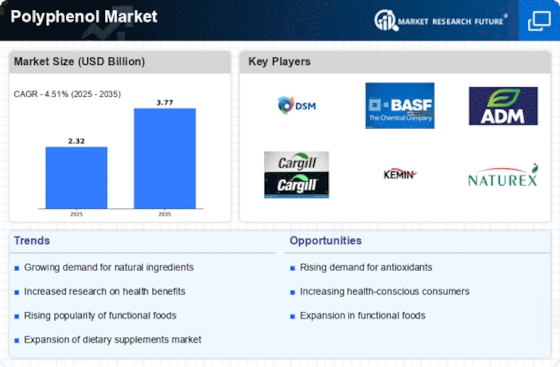
<p>The Polyphenol Market is projected to reach 3.77 USD Billion by 2035.</p>

What is the expected CAGR for the Polyphenol Market during the forecast period 2025 - 2035?

<p>The expected CAGR for the Polyphenol Market during 2025 - 2035 is 4.51%.</p>

Which segments are included in the Polyphenol Market based on source?

<p>The segments based on source include Fruits, Nuts, Legumes, Vegetables, Whole grains, Spices, and Beverages.</p>

What was the market value for Fruits in the Polyphenol Market in 2024?

<p>The market value for Fruits in the Polyphenol Market was 0.8 USD Billion in 2024.</p>

How much is the market for Flavonoids expected to grow by 2035?

<p>The market for Flavonoids is expected to grow from 0.8 USD Billion in 2024 to 1.3 USD Billion by 2035.</p>

What applications are driving the Polyphenol Market?

Key applications driving the Polyphenol Market include Dietary supplements, Functional food &amp; beverage, Pharmaceuticals, and Cosmetics.

What was the market value for Dietary supplements in 2024?

The market value for Dietary supplements in the Polyphenol Market was 0.7 USD Billion in 2024.

Who are the key players in the Polyphenol Market?

Key players in the Polyphenol Market include DSM Nutritional Products, BASF SE, Archer Daniels Midland Company, and Cargill, Incorporated.

What is the projected market value for Vegetables in 2035?

The projected market value for Vegetables in the Polyphenol Market is expected to reach 0.8 USD Billion by 2035.

Market Summary

As per Market Research Future analysis, the Polyphenol Market Size was estimated at 2.1 USD Billion in 2024. The Polyphenol industry is projected to grow from 2.3 USD Billion in 2025 to 5.4 USD Billion by 2035, exhibiting a compound annual growth rate (CAGR) of 8.90% during the forecast period 2025 - 2035

Key Market Trends & Highlights

The Polyphenol Market is experiencing robust growth driven by health trends and innovation.

  • North America remains the largest market for polyphenols, reflecting a strong consumer preference for health-oriented products. The Asia-Pacific region is emerging as the fastest-growing market, fueled by increasing health consciousness among consumers. Fruits dominate the polyphenol segment, while beverages are rapidly gaining traction as a preferred source of these compounds. The rising demand for natural ingredients and awareness of antioxidant benefits are key drivers propelling market expansion.

Market Size & Forecast

2024 Market Size 2.1 (USD Billion)
2035 Market Size 5.4 (USD Billion)
CAGR (2025 - 2035) 8.90%
Largest Regional Market Share in 2024 Asia Pacific

Major Players

Naturex, Indena, Evolva, Kemin Industries, Ajinomoto Health &amp; Nutrition

Market Trends

The Polyphenol Market is currently experiencing a notable transformation, driven by increasing consumer awareness regarding health benefits associated with polyphenols. These compounds, found abundantly in fruits, vegetables, and beverages, are recognized for their antioxidant properties and potential role in disease prevention. As a result, there is a growing demand for polyphenol-rich products across various sectors, including food and beverages, dietary supplements, and cosmetics. This shift is further fueled by the rising trend of clean label products, where consumers seek transparency in ingredient sourcing and formulation. Consequently, manufacturers are adapting their offerings to align with these preferences, leading to innovative product development and marketing strategies. In addition, the Polyphenol Market is witnessing a surge in research and development activities aimed at exploring the diverse applications of polyphenols. This includes their incorporation into functional foods and nutraceuticals, which are gaining traction among health-conscious consumers. Furthermore, the increasing popularity of plant-based diets is likely to bolster the demand for polyphenol-rich foods, as these diets typically emphasize the consumption of fruits, vegetables, and whole grains. Overall, the Polyphenol Market appears poised for growth, driven by evolving consumer preferences and ongoing scientific exploration of polyphenol benefits.

Rising Health Consciousness

There is a growing trend among consumers towards health and wellness, leading to increased interest in polyphenol-rich foods and beverages. This shift is prompting manufacturers to innovate and create products that highlight the health benefits of polyphenols.

Clean Label Movement

The demand for transparency in food labeling is influencing the Polyphenol Market. Consumers are increasingly seeking products with clear ingredient lists, prompting brands to emphasize natural sources of polyphenols and avoid artificial additives.

Research and Development Initiatives

Ongoing research into the health benefits of polyphenols is driving innovation within the market. Companies are investing in R&D to explore new applications and formulations, enhancing the appeal of polyphenol-based products.

Polyphenol Market Market Drivers

Regulatory Support for Health Claims

The Polyphenol Market benefits from regulatory support that facilitates health claims associated with polyphenol consumption. Various health authorities recognize the potential health benefits of polyphenols, leading to guidelines that encourage their inclusion in food products. This regulatory backing not only enhances consumer trust but also incentivizes manufacturers to invest in polyphenol-rich formulations. As a result, the market is likely to witness an influx of new products that highlight the health benefits of polyphenols, further driving growth. The Polyphenol Market is thus positioned to capitalize on this supportive regulatory environment, which may lead to increased consumer adoption and market expansion.

Rising Awareness of Antioxidant Benefits

The Polyphenol Market is bolstered by an increasing awareness of the antioxidant properties associated with polyphenols. Research indicates that polyphenols play a crucial role in combating oxidative stress, which is linked to various chronic diseases. As consumers become more informed about the health benefits of antioxidants, the demand for polyphenol-rich products, such as green tea and dark chocolate, is likely to rise. This trend is reflected in market data, which shows a steady increase in sales of antioxidant supplements and functional foods. Consequently, the Polyphenol Market is poised for growth as health-conscious consumers actively seek products that promote overall well-being.

Increasing Demand for Natural Ingredients

The Polyphenol Market experiences a notable surge in demand for natural ingredients, driven by consumers' growing preference for health-oriented products. This trend is evident as more individuals seek alternatives to synthetic additives, favoring natural sources of polyphenols found in fruits, vegetables, and beverages. The market for natural polyphenols is projected to expand significantly, with estimates suggesting a compound annual growth rate of over 7% in the coming years. This shift towards natural ingredients not only aligns with consumer preferences but also encourages manufacturers to innovate and diversify their product offerings, thereby enhancing the overall appeal of the Polyphenol Market.

Expansion of Functional Foods and Beverages

The Polyphenol Market is significantly influenced by the expansion of functional foods and beverages. As consumers increasingly prioritize health and wellness, manufacturers are incorporating polyphenols into a variety of products, including dietary supplements, juices, and snacks. This trend is supported by market data indicating that the functional food sector is expected to reach a valuation of several billion dollars in the next few years. The integration of polyphenols into these products not only enhances their nutritional profile but also appeals to consumers seeking added health benefits. Thus, the Polyphenol Market stands to benefit from this growing segment, as innovation continues to drive product development.

Technological Advancements in Extraction Methods

The Polyphenol Market is experiencing a transformation due to technological advancements in extraction methods. Innovations in extraction techniques, such as supercritical fluid extraction and enzymatic processes, enhance the efficiency and yield of polyphenol extraction from natural sources. These advancements not only improve the quality of polyphenol extracts but also reduce production costs, making them more accessible to manufacturers. As a result, the Polyphenol Market is likely to see an increase in the availability of high-quality polyphenol products. This technological progress may also stimulate research and development efforts, leading to the discovery of new applications for polyphenols in various sectors, including food, cosmetics, and pharmaceuticals.

Market Segment Insights

By Source: Fruits (Largest) vs. Beverages (Fastest-Growing)

<p>In the Polyphenol Market, the source segment's distribution reflects a diverse array of contributors, with fruits taking the lead. They are favored due to their naturally high polyphenol content and associated health benefits, making them the largest segment. Meanwhile, beverages have emerged as a significant player, driven by the growing consumer preference for health-oriented drinks, which has enhanced their market presence rapidly. This positioning highlights the importance of both categories in the polyphenol landscape.</p>

<p>Fruits (Dominant) vs. Beverages (Emerging)</p>

<p>Fruits represent the dominant source of polyphenols, with berries, apples, and grapes leading the way in terms of both variety and health benefits. Their popularity is driven by increased awareness of antioxidants and other health benefits they offer. On the other hand, beverages are emerging as a fast-growing segment owing to a surge in demand for functional drinks that contain polyphenols. Consumers are increasingly seeking teas, coffees, and infused waters that not only hydrate but also contribute to health. This trend arises from a broader shift toward preventive healthcare and wellness-focused lifestyles, propelling the beverage segment to new heights in the polyphenol market.</p>

By Type: Flavonoids (Largest) vs. Stilbenes (Fastest-Growing)

<p>The 'Type' segment of the Polyphenol Market showcases a dynamic competition among several key players. Flavonoids currently hold the largest market share owing to their comprehensive presence in various food and beverage products, recognized for their health benefits. In contrast, Stilbenes, particularly resveratrol, have been gaining traction, bolstered by growing consumer interest in anti-aging products and potential cardiovascular benefits, positioning them as a significant player in the market's future.</p>

<p>Flavonoids (Dominant) vs. Phenolic Acids (Emerging)</p>

<p>Flavonoids have established themselves as the dominant force in the Polyphenol Market, attributed to their extensive application in food and beverage, nutraceuticals, and cosmetics. Recognized for their antioxidant properties, they encompass a wide variety of compounds such as flavonols, flavones, and catechins, appealing to health-conscious consumers. Meanwhile, Phenolic Acids are emerging, driven by increasing awareness of their health benefits, especially in chronic disease prevention. While they currently represent a smaller market segment, their potential is on the rise, particularly as brands enhance product formulations to include these beneficial compounds.</p>

By Application: Dietary Supplements (Largest) vs. Functional Food & Beverage (Fastest-Growing)

<p>The Polyphenol Market exhibits a diverse application landscape, prominently featuring dietary supplements, functional food & beverages, pharmaceuticals, and cosmetics. Among these, dietary supplements account for a significant portion of the market share, driven by rising consumer health consciousness and a growing focus on preventive healthcare. Functional food and beverages are also gaining traction, reflecting an increasing preference for health-oriented products. Their share is being bolstered by innovative product formulations and the incorporation of polyphenols into everyday foods.</p>

<p>Dietary Supplements (Dominant) vs. Functional Food & Beverage (Emerging)</p>

<p>Dietary supplements stand out as the dominant application in the Polyphenol Market, appealing to health-conscious consumers seeking to enhance their nutritional intake with concentrated polyphenolic compounds. The wide availability of supplements catering to various health needs contributes to their sustained popularity. Conversely, functional food and beverages are emerging rapidly, appealing to consumers looking for tasty yet healthful options. With growing awareness of the health benefits associated with polyphenols, this segment is witnessing a surge in product innovations, including beverages infused with polyphenols to offer enhanced flavors and health benefits.</p>

Get more detailed insights about Polyphenol Market Research Report - Forecast to 2035

Regional Insights

North America : Market Leader in Polyphenols

North America is the largest market for polyphenols, holding approximately 40% of the global share. The region's growth is driven by increasing consumer awareness regarding health benefits, coupled with a rise in demand for natural food additives. Regulatory support for natural ingredients further catalyzes market expansion, with initiatives promoting the use of polyphenols in food and beverages. The United States and Canada are the leading countries in this region, with major players like DSM Nutritional Products and Archer Daniels Midland Company dominating the landscape. The competitive environment is characterized by innovation and strategic partnerships, as companies focus on expanding their product portfolios to meet the growing demand for polyphenol-rich products.

Europe : Emerging Market for Health Products

Europe is the second-largest market for polyphenols, accounting for around 30% of the global share. The region's growth is fueled by increasing health consciousness among consumers and a shift towards natural and organic products. Regulatory frameworks, such as the European Food Safety Authority guidelines, support the use of polyphenols in food and dietary supplements, enhancing market potential. Leading countries include Germany, France, and the UK, where companies like BASF SE and Naturex S.A. are prominent. The competitive landscape is marked by a focus on research and development, with firms investing in innovative applications of polyphenols in various sectors, including cosmetics and pharmaceuticals. This dynamic environment fosters collaboration among industry stakeholders.

Asia-Pacific : Rapidly Growing Market Potential

Asia-Pacific is witnessing rapid growth in the polyphenol market, driven by increasing health awareness and rising disposable incomes. The region holds approximately 20% of the global market share, with countries like China and India leading the demand. The growing trend of functional foods and beverages is a significant catalyst for market expansion, supported by favorable government policies promoting health and wellness. China is the largest market in the region, with a burgeoning interest in natural ingredients. Key players such as Kemin Industries and Indena S.p.A. are actively expanding their presence. The competitive landscape is characterized by a mix of local and international companies, focusing on product innovation and strategic collaborations to capture the growing consumer base seeking polyphenol-rich products.

Middle East and Africa : Emerging Market with Potential

The Middle East and Africa region is gradually emerging in the polyphenol market, holding about 10% of the global share. The growth is primarily driven by increasing health awareness and a shift towards natural products among consumers. The region's diverse dietary habits and the rising prevalence of lifestyle-related diseases are further propelling the demand for polyphenols in food and supplements. Countries like South Africa and the UAE are at the forefront of this market, with local companies exploring the potential of polyphenols in traditional foods. The competitive landscape is evolving, with both local and international players, including Sabinsa Corporation, focusing on expanding their product offerings to cater to the growing health-conscious consumer base.

Key Players and Competitive Insights

Leading industry companies are making significant R&D investments to diversify their product offerings, which will spur further expansion of the market for polyphenols. Market participants also engage in various strategic actions to increase their worldwide footprint. Important market developments include introducing new products, increased investments, contractual agreements, mergers and acquisitions, and collaboration with other organizations. The polyphenol sector must provide affordable products to grow and thrive in a more competitive market. One of the main business strategies manufacturers use in the worldwide gluten-free beer industry to benefit customers and expand the market sector is local manufacturing to reduce operational costs. The polyphenol sector has recently provided some of the most important medicinal benefits. Major players in the polyphenol market, including Naturex (France), MB- Holding GmbH & Co. KG (Germany), Ajinomoto OmniChem N.V. (Belgium), Indena S.p.A. (Italy), Frutarom (Israel), Chr. Hansen Holding A/S (Denmark), Diana Group (France), Guilin Layn Natural Ingredients Corp. (China), Archer Daniels Midland Company (U.S.), DuPont Nutrition & Health (Denmark), and others. Naturex makes and distributes plant extracts to the food industry for use as flavoring, coloring, or preservatives. The business has offices and production facilities in Europe, the United States, Canada, Brazil, Morocco, and India, and its headquarters is in Avignon, France. Jacques Dikansky created the business in 1992 and remained its CEO until his passing in 2012. Olivier Rigaud took over as CEO in 2018, after Thierry Lambert, who held the position until 2014. Naturex was purchased by the Swiss company Givaudan in 2018. An Omani conglomerate with interests in oil and gas exploration and production, oilfield services, engineering, and mining is known as MB Holding Company LLC. Mohammed Al Barwani established the business in 1982 to serve oil producers, including Petroleum Development Oman and Occidental Petroleum by providing oilfield services. Later, it increased its exploration and production capabilities and obtained concessions in Oman, Egypt, and Mozambique. The engineering division of MB works in the aerospace and defense sectors. Oman's largest privately owned mining firm was founded in 2000 by its mining subsidiary, Mawarid Mining. The first privately owned mining firm to do copper and gold exploration in Oman was Mawarid.

Key Companies in the Polyphenol Market include

Industry Developments

October 2019: The powdered extract of suntava purple maize components was introduced by NiroWell and Healthy Food Components (HFI). Since this recently introduced component is a great natural color alternative for many clean-label applications, such as snack foods and beverages, this extract powder has acquired popularity within the baking sector.

November 2021: By bringing the ingredient for brain health to Canadian consumers, Kemin introduced NeumentixTM Phenolic Complex K110-42, a spearmint extract with a patented phenolic complex that claims to be approved by Health Canada. This move helped Kemin increase its market share.

Future Outlook

Polyphenol Market Future Outlook

The Polyphenol Market is projected to grow at a 8.90% CAGR from 2025 to 2035, driven by increasing health awareness, demand for natural ingredients, and expanding applications in food and beverages.

New opportunities lie in:

  • <p>Development of polyphenol-enriched functional foods targeting health-conscious consumers. Investment in innovative extraction technologies to enhance yield and purity. Expansion into emerging markets with tailored polyphenol-based products for local preferences.</p>

By 2035, the Polyphenol Market is expected to achieve robust growth, reflecting evolving consumer trends and increased product applications.

Market Segmentation

Polyphenol Market Type Outlook

  • Stilbenes
  • Flavonoids
  • Phenolic acids
  • Lignans

Polyphenol Market Source Outlook

  • Fruits
  • Nuts
  • Legumes
  • Vegetables
  • Whole grains
  • Spices
  • Beverages

Polyphenol Market Application Outlook

  • Dietary supplements
  • Functional food & beverage
  • Pharmaceuticals
  • Cosmetics

Report Scope

MARKET SIZE 2024 2.1(USD Billion)
MARKET SIZE 2025 2.3(USD Billion)
MARKET SIZE 2035 5.4(USD Billion)
COMPOUND ANNUAL GROWTH RATE (CAGR) 8.90% (2025 - 2035)
REPORT COVERAGE Revenue Forecast, Competitive Landscape, Growth Factors, and Trends
BASE YEAR 2024
Market Forecast Period 2025 - 2035
Historical Data 2019 - 2024
Market Forecast Units USD Billion
Key Companies Profiled DSM Nutritional Products (CH), BASF SE (DE), Archer Daniels Midland Company (US), Cargill, Incorporated (US), Kemin Industries, Inc. (US), Naturex S.A. (FR), Indena S.p.A. (IT), Polyphenols Canada Inc. (CA), Sabinsa Corporation (US)
Segments Covered Source, Region
Key Market Opportunities Rising consumer demand for natural antioxidants drives innovation in the Polyphenol Market.
Key Market Dynamics Rising consumer demand for natural antioxidants drives innovation and competition in the polyphenol market.
Countries Covered North America, Europe, APAC, South America, MEA

FAQs

What is the current valuation of the Polyphenol Market as of 2024?

<p>The Polyphenol Market was valued at 2.32 USD Billion in 2024.</p>

What is the projected market valuation for the Polyphenol Market in 2035?

<p>The Polyphenol Market is projected to reach 3.77 USD Billion by 2035.</p>

What is the expected CAGR for the Polyphenol Market during the forecast period 2025 - 2035?

<p>The expected CAGR for the Polyphenol Market during 2025 - 2035 is 4.51%.</p>

Which segments are included in the Polyphenol Market based on source?

<p>The segments based on source include Fruits, Nuts, Legumes, Vegetables, Whole grains, Spices, and Beverages.</p>

What was the market value for Fruits in the Polyphenol Market in 2024?

<p>The market value for Fruits in the Polyphenol Market was 0.8 USD Billion in 2024.</p>

How much is the market for Flavonoids expected to grow by 2035?

<p>The market for Flavonoids is expected to grow from 0.8 USD Billion in 2024 to 1.3 USD Billion by 2035.</p>

What applications are driving the Polyphenol Market?

Key applications driving the Polyphenol Market include Dietary supplements, Functional food &amp; beverage, Pharmaceuticals, and Cosmetics.

What was the market value for Dietary supplements in 2024?

The market value for Dietary supplements in the Polyphenol Market was 0.7 USD Billion in 2024.

Who are the key players in the Polyphenol Market?

Key players in the Polyphenol Market include DSM Nutritional Products, BASF SE, Archer Daniels Midland Company, and Cargill, Incorporated.

What is the projected market value for Vegetables in 2035?

The projected market value for Vegetables in the Polyphenol Market is expected to reach 0.8 USD Billion by 2035.

  1. SECTION I: EXECUTIVE SUMMARY AND KEY HIGHLIGHTS
    1. | 1.1 EXECUTIVE SUMMARY
    2. | | 1.1.1 Market Overview
    3. | | 1.1.2 Key Findings
    4. | | 1.1.3 Market Segmentation
    5. | | 1.1.4 Competitive Landscape
    6. | | 1.1.5 Challenges and Opportunities
    7. | | 1.1.6 Future Outlook
  2. SECTION II: SCOPING, METHODOLOGY AND MARKET STRUCTURE
    1. | 2.1 MARKET INTRODUCTION
    2. | | 2.1.1 Definition
    3. | | 2.1.2 Scope of the study
    4. | | | 2.1.2.1 Research Objective
    5. | | | 2.1.2.2 Assumption
    6. | | | 2.1.2.3 Limitations
    7. | 2.2 RESEARCH METHODOLOGY
    8. | | 2.2.1 Overview
    9. | | 2.2.2 Data Mining
    10. | | 2.2.3 Secondary Research
    11. | | 2.2.4 Primary Research
    12. | | | 2.2.4.1 Primary Interviews and Information Gathering Process
    13. | | | 2.2.4.2 Breakdown of Primary Respondents
    14. | | 2.2.5 Forecasting Model
    15. | | 2.2.6 Market Size Estimation
    16. | | | 2.2.6.1 Bottom-Up Approach
    17. | | | 2.2.6.2 Top-Down Approach
    18. | | 2.2.7 Data Triangulation
    19. | | 2.2.8 Validation
  3. SECTION III: QUALITATIVE ANALYSIS
    1. | 3.1 MARKET DYNAMICS
    2. | | 3.1.1 Overview
    3. | | 3.1.2 Drivers
    4. | | 3.1.3 Restraints
    5. | | 3.1.4 Opportunities
    6. | 3.2 MARKET FACTOR ANALYSIS
    7. | | 3.2.1 Value chain Analysis
    8. | | 3.2.2 Porter's Five Forces Analysis
    9. | | | 3.2.2.1 Bargaining Power of Suppliers
    10. | | | 3.2.2.2 Bargaining Power of Buyers
    11. | | | 3.2.2.3 Threat of New Entrants
    12. | | | 3.2.2.4 Threat of Substitutes
    13. | | | 3.2.2.5 Intensity of Rivalry
    14. | | 3.2.3 COVID-19 Impact Analysis
    15. | | | 3.2.3.1 Market Impact Analysis
    16. | | | 3.2.3.2 Regional Impact
    17. | | | 3.2.3.3 Opportunity and Threat Analysis
  4. SECTION IV: QUANTITATIVE ANALYSIS
    1. | 4.1 Chemicals and Materials, BY Source (USD Billion)
    2. | | 4.1.1 Fruits
    3. | | 4.1.2 Nuts
    4. | | 4.1.3 Legumes
    5. | | 4.1.4 Vegetables
    6. | | 4.1.5 Whole grains
    7. | | 4.1.6 Spices
    8. | | 4.1.7 Beverages
    9. | 4.2 Chemicals and Materials, BY Type (USD Billion)
    10. | | 4.2.1 Stilbenes
    11. | | 4.2.2 Flavonoids
    12. | | 4.2.3 Phenolic acids
    13. | | 4.2.4 Lignans
    14. | 4.3 Chemicals and Materials, BY Application (USD Billion)
    15. | | 4.3.1 Dietary supplements
    16. | | 4.3.2 Functional food & beverage
    17. | | 4.3.3 Pharmaceuticals
    18. | | 4.3.4 Cosmetics
    19. | 4.4 Chemicals and Materials, BY Region (USD Billion)
    20. | | 4.4.1 North America
    21. | | | 4.4.1.1 US
    22. | | | 4.4.1.2 Canada
    23. | | 4.4.2 Europe
    24. | | | 4.4.2.1 Germany
    25. | | | 4.4.2.2 UK
    26. | | | 4.4.2.3 France
    27. | | | 4.4.2.4 Russia
    28. | | | 4.4.2.5 Italy
    29. | | | 4.4.2.6 Spain
    30. | | | 4.4.2.7 Rest of Europe
    31. | | 4.4.3 APAC
    32. | | | 4.4.3.1 China
    33. | | | 4.4.3.2 India
    34. | | | 4.4.3.3 Japan
    35. | | | 4.4.3.4 South Korea
    36. | | | 4.4.3.5 Malaysia
    37. | | | 4.4.3.6 Thailand
    38. | | | 4.4.3.7 Indonesia
    39. | | | 4.4.3.8 Rest of APAC
    40. | | 4.4.4 South America
    41. | | | 4.4.4.1 Brazil
    42. | | | 4.4.4.2 Mexico
    43. | | | 4.4.4.3 Argentina
    44. | | | 4.4.4.4 Rest of South America
    45. | | 4.4.5 MEA
    46. | | | 4.4.5.1 GCC Countries
    47. | | | 4.4.5.2 South Africa
    48. | | | 4.4.5.3 Rest of MEA
  5. SECTION V: COMPETITIVE ANALYSIS
    1. | 5.1 Competitive Landscape
    2. | | 5.1.1 Overview
    3. | | 5.1.2 Competitive Analysis
    4. | | 5.1.3 Market share Analysis
    5. | | 5.1.4 Major Growth Strategy in the Chemicals and Materials
    6. | | 5.1.5 Competitive Benchmarking
    7. | | 5.1.6 Leading Players in Terms of Number of Developments in the Chemicals and Materials
    8. | | 5.1.7 Key developments and growth strategies
    9. | | | 5.1.7.1 New Product Launch/Service Deployment
    10. | | | 5.1.7.2 Merger & Acquisitions
    11. | | | 5.1.7.3 Joint Ventures
    12. | | 5.1.8 Major Players Financial Matrix
    13. | | | 5.1.8.1 Sales and Operating Income
    14. | | | 5.1.8.2 Major Players R&D Expenditure. 2023
    15. | 5.2 Company Profiles
    16. | | 5.2.1 DSM Nutritional Products (CH)
    17. | | | 5.2.1.1 Financial Overview
    18. | | | 5.2.1.2 Products Offered
    19. | | | 5.2.1.3 Key Developments
    20. | | | 5.2.1.4 SWOT Analysis
    21. | | | 5.2.1.5 Key Strategies
    22. | | 5.2.2 BASF SE (DE)
    23. | | | 5.2.2.1 Financial Overview
    24. | | | 5.2.2.2 Products Offered
    25. | | | 5.2.2.3 Key Developments
    26. | | | 5.2.2.4 SWOT Analysis
    27. | | | 5.2.2.5 Key Strategies
    28. | | 5.2.3 Archer Daniels Midland Company (US)
    29. | | | 5.2.3.1 Financial Overview
    30. | | | 5.2.3.2 Products Offered
    31. | | | 5.2.3.3 Key Developments
    32. | | | 5.2.3.4 SWOT Analysis
    33. | | | 5.2.3.5 Key Strategies
    34. | | 5.2.4 Cargill, Incorporated (US)
    35. | | | 5.2.4.1 Financial Overview
    36. | | | 5.2.4.2 Products Offered
    37. | | | 5.2.4.3 Key Developments
    38. | | | 5.2.4.4 SWOT Analysis
    39. | | | 5.2.4.5 Key Strategies
    40. | | 5.2.5 Kemin Industries, Inc. (US)
    41. | | | 5.2.5.1 Financial Overview
    42. | | | 5.2.5.2 Products Offered
    43. | | | 5.2.5.3 Key Developments
    44. | | | 5.2.5.4 SWOT Analysis
    45. | | | 5.2.5.5 Key Strategies
    46. | | 5.2.6 Naturex S.A. (FR)
    47. | | | 5.2.6.1 Financial Overview
    48. | | | 5.2.6.2 Products Offered
    49. | | | 5.2.6.3 Key Developments
    50. | | | 5.2.6.4 SWOT Analysis
    51. | | | 5.2.6.5 Key Strategies
    52. | | 5.2.7 Indena S.p.A. (IT)
    53. | | | 5.2.7.1 Financial Overview
    54. | | | 5.2.7.2 Products Offered
    55. | | | 5.2.7.3 Key Developments
    56. | | | 5.2.7.4 SWOT Analysis
    57. | | | 5.2.7.5 Key Strategies
    58. | | 5.2.8 Polyphenols Canada Inc. (CA)
    59. | | | 5.2.8.1 Financial Overview
    60. | | | 5.2.8.2 Products Offered
    61. | | | 5.2.8.3 Key Developments
    62. | | | 5.2.8.4 SWOT Analysis
    63. | | | 5.2.8.5 Key Strategies
    64. | | 5.2.9 Sabinsa Corporation (US)
    65. | | | 5.2.9.1 Financial Overview
    66. | | | 5.2.9.2 Products Offered
    67. | | | 5.2.9.3 Key Developments
    68. | | | 5.2.9.4 SWOT Analysis
    69. | | | 5.2.9.5 Key Strategies
    70. | 5.3 Appendix
    71. | | 5.3.1 References
    72. | | 5.3.2 Related Reports
  6. LIST OF FIGURES
    1. | 6.1 MARKET SYNOPSIS
    2. | 6.2 NORTH AMERICA MARKET ANALYSIS
    3. | 6.3 US MARKET ANALYSIS BY SOURCE
    4. | 6.4 US MARKET ANALYSIS BY TYPE
    5. | 6.5 US MARKET ANALYSIS BY APPLICATION
    6. | 6.6 CANADA MARKET ANALYSIS BY SOURCE
    7. | 6.7 CANADA MARKET ANALYSIS BY TYPE
    8. | 6.8 CANADA MARKET ANALYSIS BY APPLICATION
    9. | 6.9 EUROPE MARKET ANALYSIS
    10. | 6.10 GERMANY MARKET ANALYSIS BY SOURCE
    11. | 6.11 GERMANY MARKET ANALYSIS BY TYPE
    12. | 6.12 GERMANY MARKET ANALYSIS BY APPLICATION
    13. | 6.13 UK MARKET ANALYSIS BY SOURCE
    14. | 6.14 UK MARKET ANALYSIS BY TYPE
    15. | 6.15 UK MARKET ANALYSIS BY APPLICATION
    16. | 6.16 FRANCE MARKET ANALYSIS BY SOURCE
    17. | 6.17 FRANCE MARKET ANALYSIS BY TYPE
    18. | 6.18 FRANCE MARKET ANALYSIS BY APPLICATION
    19. | 6.19 RUSSIA MARKET ANALYSIS BY SOURCE
    20. | 6.20 RUSSIA MARKET ANALYSIS BY TYPE
    21. | 6.21 RUSSIA MARKET ANALYSIS BY APPLICATION
    22. | 6.22 ITALY MARKET ANALYSIS BY SOURCE
    23. | 6.23 ITALY MARKET ANALYSIS BY TYPE
    24. | 6.24 ITALY MARKET ANALYSIS BY APPLICATION
    25. | 6.25 SPAIN MARKET ANALYSIS BY SOURCE
    26. | 6.26 SPAIN MARKET ANALYSIS BY TYPE
    27. | 6.27 SPAIN MARKET ANALYSIS BY APPLICATION
    28. | 6.28 REST OF EUROPE MARKET ANALYSIS BY SOURCE
    29. | 6.29 REST OF EUROPE MARKET ANALYSIS BY TYPE
    30. | 6.30 REST OF EUROPE MARKET ANALYSIS BY APPLICATION
    31. | 6.31 APAC MARKET ANALYSIS
    32. | 6.32 CHINA MARKET ANALYSIS BY SOURCE
    33. | 6.33 CHINA MARKET ANALYSIS BY TYPE
    34. | 6.34 CHINA MARKET ANALYSIS BY APPLICATION
    35. | 6.35 INDIA MARKET ANALYSIS BY SOURCE
    36. | 6.36 INDIA MARKET ANALYSIS BY TYPE
    37. | 6.37 INDIA MARKET ANALYSIS BY APPLICATION
    38. | 6.38 JAPAN MARKET ANALYSIS BY SOURCE
    39. | 6.39 JAPAN MARKET ANALYSIS BY TYPE
    40. | 6.40 JAPAN MARKET ANALYSIS BY APPLICATION
    41. | 6.41 SOUTH KOREA MARKET ANALYSIS BY SOURCE
    42. | 6.42 SOUTH KOREA MARKET ANALYSIS BY TYPE
    43. | 6.43 SOUTH KOREA MARKET ANALYSIS BY APPLICATION
    44. | 6.44 MALAYSIA MARKET ANALYSIS BY SOURCE
    45. | 6.45 MALAYSIA MARKET ANALYSIS BY TYPE
    46. | 6.46 MALAYSIA MARKET ANALYSIS BY APPLICATION
    47. | 6.47 THAILAND MARKET ANALYSIS BY SOURCE
    48. | 6.48 THAILAND MARKET ANALYSIS BY TYPE
    49. | 6.49 THAILAND MARKET ANALYSIS BY APPLICATION
    50. | 6.50 INDONESIA MARKET ANALYSIS BY SOURCE
    51. | 6.51 INDONESIA MARKET ANALYSIS BY TYPE
    52. | 6.52 INDONESIA MARKET ANALYSIS BY APPLICATION
    53. | 6.53 REST OF APAC MARKET ANALYSIS BY SOURCE
    54. | 6.54 REST OF APAC MARKET ANALYSIS BY TYPE
    55. | 6.55 REST OF APAC MARKET ANALYSIS BY APPLICATION
    56. | 6.56 SOUTH AMERICA MARKET ANALYSIS
    57. | 6.57 BRAZIL MARKET ANALYSIS BY SOURCE
    58. | 6.58 BRAZIL MARKET ANALYSIS BY TYPE
    59. | 6.59 BRAZIL MARKET ANALYSIS BY APPLICATION
    60. | 6.60 MEXICO MARKET ANALYSIS BY SOURCE
    61. | 6.61 MEXICO MARKET ANALYSIS BY TYPE
    62. | 6.62 MEXICO MARKET ANALYSIS BY APPLICATION
    63. | 6.63 ARGENTINA MARKET ANALYSIS BY SOURCE
    64. | 6.64 ARGENTINA MARKET ANALYSIS BY TYPE
    65. | 6.65 ARGENTINA MARKET ANALYSIS BY APPLICATION
    66. | 6.66 REST OF SOUTH AMERICA MARKET ANALYSIS BY SOURCE
    67. | 6.67 REST OF SOUTH AMERICA MARKET ANALYSIS BY TYPE
    68. | 6.68 REST OF SOUTH AMERICA MARKET ANALYSIS BY APPLICATION
    69. | 6.69 MEA MARKET ANALYSIS
    70. | 6.70 GCC COUNTRIES MARKET ANALYSIS BY SOURCE
    71. | 6.71 GCC COUNTRIES MARKET ANALYSIS BY TYPE
    72. | 6.72 GCC COUNTRIES MARKET ANALYSIS BY APPLICATION
    73. | 6.73 SOUTH AFRICA MARKET ANALYSIS BY SOURCE
    74. | 6.74 SOUTH AFRICA MARKET ANALYSIS BY TYPE
    75. | 6.75 SOUTH AFRICA MARKET ANALYSIS BY APPLICATION
    76. | 6.76 REST OF MEA MARKET ANALYSIS BY SOURCE
    77. | 6.77 REST OF MEA MARKET ANALYSIS BY TYPE
    78. | 6.78 REST OF MEA MARKET ANALYSIS BY APPLICATION
    79. | 6.79 KEY BUYING CRITERIA OF CHEMICALS AND MATERIALS
    80. | 6.80 RESEARCH PROCESS OF MRFR
    81. | 6.81 DRO ANALYSIS OF CHEMICALS AND MATERIALS
    82. | 6.82 DRIVERS IMPACT ANALYSIS: CHEMICALS AND MATERIALS
    83. | 6.83 RESTRAINTS IMPACT ANALYSIS: CHEMICALS AND MATERIALS
    84. | 6.84 SUPPLY / VALUE CHAIN: CHEMICALS AND MATERIALS
    85. | 6.85 CHEMICALS AND MATERIALS, BY SOURCE, 2024 (% SHARE)
    86. | 6.86 CHEMICALS AND MATERIALS, BY SOURCE, 2024 TO 2035 (USD Billion)
    87. | 6.87 CHEMICALS AND MATERIALS, BY TYPE, 2024 (% SHARE)
    88. | 6.88 CHEMICALS AND MATERIALS, BY TYPE, 2024 TO 2035 (USD Billion)
    89. | 6.89 CHEMICALS AND MATERIALS, BY APPLICATION, 2024 (% SHARE)
    90. | 6.90 CHEMICALS AND MATERIALS, BY APPLICATION, 2024 TO 2035 (USD Billion)
    91. | 6.91 BENCHMARKING OF MAJOR COMPETITORS
  7. LIST OF TABLES
    1. | 7.1 LIST OF ASSUMPTIONS
    2. | | 7.1.1
    3. | 7.2 North America MARKET SIZE ESTIMATES; FORECAST
    4. | | 7.2.1 BY SOURCE, 2025-2035 (USD Billion)
    5. | | 7.2.2 BY TYPE, 2025-2035 (USD Billion)
    6. | | 7.2.3 BY APPLICATION, 2025-2035 (USD Billion)
    7. | 7.3 US MARKET SIZE ESTIMATES; FORECAST
    8. | | 7.3.1 BY SOURCE, 2025-2035 (USD Billion)
    9. | | 7.3.2 BY TYPE, 2025-2035 (USD Billion)
    10. | | 7.3.3 BY APPLICATION, 2025-2035 (USD Billion)
    11. | 7.4 Canada MARKET SIZE ESTIMATES; FORECAST
    12. | | 7.4.1 BY SOURCE, 2025-2035 (USD Billion)
    13. | | 7.4.2 BY TYPE, 2025-2035 (USD Billion)
    14. | | 7.4.3 BY APPLICATION, 2025-2035 (USD Billion)
    15. | 7.5 Europe MARKET SIZE ESTIMATES; FORECAST
    16. | | 7.5.1 BY SOURCE, 2025-2035 (USD Billion)
    17. | | 7.5.2 BY TYPE, 2025-2035 (USD Billion)
    18. | | 7.5.3 BY APPLICATION, 2025-2035 (USD Billion)
    19. | 7.6 Germany MARKET SIZE ESTIMATES; FORECAST
    20. | | 7.6.1 BY SOURCE, 2025-2035 (USD Billion)
    21. | | 7.6.2 BY TYPE, 2025-2035 (USD Billion)
    22. | | 7.6.3 BY APPLICATION, 2025-2035 (USD Billion)
    23. | 7.7 UK MARKET SIZE ESTIMATES; FORECAST
    24. | | 7.7.1 BY SOURCE, 2025-2035 (USD Billion)
    25. | | 7.7.2 BY TYPE, 2025-2035 (USD Billion)
    26. | | 7.7.3 BY APPLICATION, 2025-2035 (USD Billion)
    27. | 7.8 France MARKET SIZE ESTIMATES; FORECAST
    28. | | 7.8.1 BY SOURCE, 2025-2035 (USD Billion)
    29. | | 7.8.2 BY TYPE, 2025-2035 (USD Billion)
    30. | | 7.8.3 BY APPLICATION, 2025-2035 (USD Billion)
    31. | 7.9 Russia MARKET SIZE ESTIMATES; FORECAST
    32. | | 7.9.1 BY SOURCE, 2025-2035 (USD Billion)
    33. | | 7.9.2 BY TYPE, 2025-2035 (USD Billion)
    34. | | 7.9.3 BY APPLICATION, 2025-2035 (USD Billion)
    35. | 7.10 Italy MARKET SIZE ESTIMATES; FORECAST
    36. | | 7.10.1 BY SOURCE, 2025-2035 (USD Billion)
    37. | | 7.10.2 BY TYPE, 2025-2035 (USD Billion)
    38. | | 7.10.3 BY APPLICATION, 2025-2035 (USD Billion)
    39. | 7.11 Spain MARKET SIZE ESTIMATES; FORECAST
    40. | | 7.11.1 BY SOURCE, 2025-2035 (USD Billion)
    41. | | 7.11.2 BY TYPE, 2025-2035 (USD Billion)
    42. | | 7.11.3 BY APPLICATION, 2025-2035 (USD Billion)
    43. | 7.12 Rest of Europe MARKET SIZE ESTIMATES; FORECAST
    44. | | 7.12.1 BY SOURCE, 2025-2035 (USD Billion)
    45. | | 7.12.2 BY TYPE, 2025-2035 (USD Billion)
    46. | | 7.12.3 BY APPLICATION, 2025-2035 (USD Billion)
    47. | 7.13 APAC MARKET SIZE ESTIMATES; FORECAST
    48. | | 7.13.1 BY SOURCE, 2025-2035 (USD Billion)
    49. | | 7.13.2 BY TYPE, 2025-2035 (USD Billion)
    50. | | 7.13.3 BY APPLICATION, 2025-2035 (USD Billion)
    51. | 7.14 China MARKET SIZE ESTIMATES; FORECAST
    52. | | 7.14.1 BY SOURCE, 2025-2035 (USD Billion)
    53. | | 7.14.2 BY TYPE, 2025-2035 (USD Billion)
    54. | | 7.14.3 BY APPLICATION, 2025-2035 (USD Billion)
    55. | 7.15 India MARKET SIZE ESTIMATES; FORECAST
    56. | | 7.15.1 BY SOURCE, 2025-2035 (USD Billion)
    57. | | 7.15.2 BY TYPE, 2025-2035 (USD Billion)
    58. | | 7.15.3 BY APPLICATION, 2025-2035 (USD Billion)
    59. | 7.16 Japan MARKET SIZE ESTIMATES; FORECAST
    60. | | 7.16.1 BY SOURCE, 2025-2035 (USD Billion)
    61. | | 7.16.2 BY TYPE, 2025-2035 (USD Billion)
    62. | | 7.16.3 BY APPLICATION, 2025-2035 (USD Billion)
    63. | 7.17 South Korea MARKET SIZE ESTIMATES; FORECAST
    64. | | 7.17.1 BY SOURCE, 2025-2035 (USD Billion)
    65. | | 7.17.2 BY TYPE, 2025-2035 (USD Billion)
    66. | | 7.17.3 BY APPLICATION, 2025-2035 (USD Billion)
    67. | 7.18 Malaysia MARKET SIZE ESTIMATES; FORECAST
    68. | | 7.18.1 BY SOURCE, 2025-2035 (USD Billion)
    69. | | 7.18.2 BY TYPE, 2025-2035 (USD Billion)
    70. | | 7.18.3 BY APPLICATION, 2025-2035 (USD Billion)
    71. | 7.19 Thailand MARKET SIZE ESTIMATES; FORECAST
    72. | | 7.19.1 BY SOURCE, 2025-2035 (USD Billion)
    73. | | 7.19.2 BY TYPE, 2025-2035 (USD Billion)
    74. | | 7.19.3 BY APPLICATION, 2025-2035 (USD Billion)
    75. | 7.20 Indonesia MARKET SIZE ESTIMATES; FORECAST
    76. | | 7.20.1 BY SOURCE, 2025-2035 (USD Billion)
    77. | | 7.20.2 BY TYPE, 2025-2035 (USD Billion)
    78. | | 7.20.3 BY APPLICATION, 2025-2035 (USD Billion)
    79. | 7.21 Rest of APAC MARKET SIZE ESTIMATES; FORECAST
    80. | | 7.21.1 BY SOURCE, 2025-2035 (USD Billion)
    81. | | 7.21.2 BY TYPE, 2025-2035 (USD Billion)
    82. | | 7.21.3 BY APPLICATION, 2025-2035 (USD Billion)
    83. | 7.22 South America MARKET SIZE ESTIMATES; FORECAST
    84. | | 7.22.1 BY SOURCE, 2025-2035 (USD Billion)
    85. | | 7.22.2 BY TYPE, 2025-2035 (USD Billion)
    86. | | 7.22.3 BY APPLICATION, 2025-2035 (USD Billion)
    87. | 7.23 Brazil MARKET SIZE ESTIMATES; FORECAST
    88. | | 7.23.1 BY SOURCE, 2025-2035 (USD Billion)
    89. | | 7.23.2 BY TYPE, 2025-2035 (USD Billion)
    90. | | 7.23.3 BY APPLICATION, 2025-2035 (USD Billion)
    91. | 7.24 Mexico MARKET SIZE ESTIMATES; FORECAST
    92. | | 7.24.1 BY SOURCE, 2025-2035 (USD Billion)
    93. | | 7.24.2 BY TYPE, 2025-2035 (USD Billion)
    94. | | 7.24.3 BY APPLICATION, 2025-2035 (USD Billion)
    95. | 7.25 Argentina MARKET SIZE ESTIMATES; FORECAST
    96. | | 7.25.1 BY SOURCE, 2025-2035 (USD Billion)
    97. | | 7.25.2 BY TYPE, 2025-2035 (USD Billion)
    98. | | 7.25.3 BY APPLICATION, 2025-2035 (USD Billion)
    99. | 7.26 Rest of South America MARKET SIZE ESTIMATES; FORECAST
    100. | | 7.26.1 BY SOURCE, 2025-2035 (USD Billion)
    101. | | 7.26.2 BY TYPE, 2025-2035 (USD Billion)
    102. | | 7.26.3 BY APPLICATION, 2025-2035 (USD Billion)
    103. | 7.27 MEA MARKET SIZE ESTIMATES; FORECAST
    104. | | 7.27.1 BY SOURCE, 2025-2035 (USD Billion)
    105. | | 7.27.2 BY TYPE, 2025-2035 (USD Billion)
    106. | | 7.27.3 BY APPLICATION, 2025-2035 (USD Billion)
    107. | 7.28 GCC Countries MARKET SIZE ESTIMATES; FORECAST
    108. | | 7.28.1 BY SOURCE, 2025-2035 (USD Billion)
    109. | | 7.28.2 BY TYPE, 2025-2035 (USD Billion)
    110. | | 7.28.3 BY APPLICATION, 2025-2035 (USD Billion)
    111. | 7.29 South Africa MARKET SIZE ESTIMATES; FORECAST
    112. | | 7.29.1 BY SOURCE, 2025-2035 (USD Billion)
    113. | | 7.29.2 BY TYPE, 2025-2035 (USD Billion)
    114. | | 7.29.3 BY APPLICATION, 2025-2035 (USD Billion)
    115. | 7.30 Rest of MEA MARKET SIZE ESTIMATES; FORECAST
    116. | | 7.30.1 BY SOURCE, 2025-2035 (USD Billion)
    117. | | 7.30.2 BY TYPE, 2025-2035 (USD Billion)
    118. | | 7.30.3 BY APPLICATION, 2025-2035 (USD Billion)
    119. | 7.31 PRODUCT LAUNCH/PRODUCT DEVELOPMENT/APPROVAL
    120. | | 7.31.1
    121. | 7.32 ACQUISITION/PARTNERSHIP
    122. | | 7.32.1

Chemicals and Materials Market Segmentation

Chemicals and Materials By Source (USD Billion, 2025-2035)

  • Fruits
  • Nuts
  • Legumes
  • Vegetables
  • Whole grains
  • Spices
  • Beverages

Chemicals and Materials By Type (USD Billion, 2025-2035)

  • Stilbenes
  • Flavonoids
  • Phenolic acids
  • Lignans

Chemicals and Materials By Application (USD Billion, 2025-2035)

  • Dietary supplements
  • Functional food & beverage
  • Pharmaceuticals
  • Cosmetics
Infographic

Free Sample Request

Kindly complete the form below to receive a free sample of this Report

Get Free Sample

Customer Strories

Compare Licence

×
Features License Type
Single User Multiuser License Enterprise User
Price $4,950 $5,950 $7,250
Maximum User Access Limit 1 User Upto 10 Users Unrestricted Access Throughout the Organization
Free Customization
Direct Access to Analyst
Deliverable Format
Platform Access
Discount on Next Purchase 10% 15% 15%
Printable Versions