
Plant Based Beverages Size
Plant-Based Beverages Market Growth Projections and Opportunities
N/A



N/A
What is the current valuation of the Plant-Based Beverages Market?
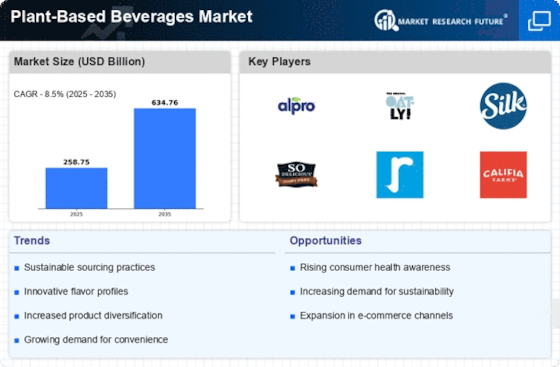
<p>The Plant-Based Beverages Market was valued at 258.75 USD Billion in 2024.</p>
What is the projected market size for the Plant-Based Beverages Market by 2035?
<p>The market is projected to reach 634.76 USD Billion by 2035.</p>
What is the expected CAGR for the Plant-Based Beverages Market during the forecast period 2025 - 2035?
<p>The expected CAGR for the market during 2025 - 2035 is 8.5%.</p>
Which segment of plant-based beverages had the highest valuation in 2024?
<p>In 2024, the Plant-Based Milk segment had the highest valuation at 150.0 USD Billion.</p>
What are the key players in the Plant-Based Beverages Market?
<p>Key players include Alpro, Oatly, Silk, So Delicious, Ripple Foods, Califia Farms, Mooala, Minor Figures, and Vitasoy.</p>
How does the valuation of the Fruits segment compare to the Nuts segment in 2024?
<p>In 2024, the Fruits segment was valued at 51.75 USD Billion, while the Nuts segment was valued at 38.25 USD Billion.</p>
What is the projected valuation for the RTD Tea & Coffee segment by 2035?
<p>The RTD Tea & Coffee segment is projected to reach 80.0 USD Billion by 2035.</p>
What distribution channel is expected to dominate the Plant-Based Beverages Market?
<p>The Store-Based distribution channel was valued at 155.25 USD Billion in 2024 and is expected to continue dominating the market.</p>
What is the valuation of the Juices segment in 2024?
<p>The Juices segment was valued at 78.75 USD Billion in 2024.</p>
How does the projected growth of the Plant-Based Beverages Market reflect consumer trends?
<p>The projected growth to 634.76 USD Billion by 2035 suggests a strong consumer shift towards plant-based options.</p>
As per Market Research Future analysis, the Plant-Based Beverages Market was estimated at 29.88 USD Billion in 2024. The Plant-Based Beverages industry is projected to grow from 33.2 USD Billion in 2025 to 95.1 USD Billion by 2035, exhibiting a compound annual growth rate (CAGR) of 11.1% during the forecast period 2025 - 2035
The Plant-Based Beverages Market is experiencing robust growth driven by health consciousness and sustainability.
| 2024 Market Size | 29.88 (USD Billion) |
| 2035 Market Size | 95.1 (USD Billion) |
| CAGR (2025 - 2035) | 11.1% |
| Largest Regional Market Share in 2024 | North America |
<a href="https://www.alpro.com/">Alpro (BE)</a>, Oatly (SE), Silk (US), So Delicious (US), Ripple Foods (US), Califia Farms (US), Mooala (US), Minor Figures (GB), Vitasoy (HK)
The Plant-Based Beverages Market is currently experiencing a notable transformation, driven by shifting consumer preferences towards healthier and more sustainable options. This market encompasses a diverse range of products, including plant-based milks, juices, and teas, which are increasingly favored for their perceived health benefits and environmental advantages. As consumers become more health-conscious, the demand for beverages that are free from animal products and artificial additives appears to be on the rise. Additionally, the growing awareness of the environmental impact of traditional dairy and beverage production is prompting a shift towards plant-based alternatives. Moreover, innovation within the Plant-Based Beverages Market is evident, as manufacturers explore new ingredients and flavors to attract a broader audience. The introduction of fortified beverages, which offer added nutritional benefits, seems to resonate well with consumers seeking functional products. Furthermore, the expansion of distribution channels, including online platforms, enhances accessibility, allowing consumers to easily find and purchase these products. Overall, the Plant-Based Beverages Market is poised for continued growth, reflecting strengthening plant based beverages market trends globally.
The emphasis on health and wellness is a driving force in the Plant-Based Beverages Market. Consumers are increasingly seeking beverages that align with their health goals, leading to a rise in demand for products that are low in sugar, high in nutrients, and free from artificial ingredients.
Sustainability plays a crucial role in shaping consumer choices within the Plant-Based Beverages Market. As awareness of environmental issues grows, consumers are more inclined to select products that are produced sustainably, reflecting a commitment to ethical consumption and reducing their carbon footprint.
Innovation is a key trend in the Plant-Based Beverages Market, with manufacturers experimenting with unique flavors and ingredients. This trend not only caters to diverse palates but also introduces consumers to new and exciting beverage options, enhancing the overall market appeal.
The plant based beverages market growth trends point to robust global expansion as consumers increasingly adopt dairy alternatives for health, sustainability, and lifestyle reasons. Demand for plant-based drinks such as almond, oat, soy, and coconut beverages is expanding rapidly, with the market size expected to grow significantly through the next decade as manufacturers introduce fortified, functional, and clean-label products that appeal to health-focused buyers. This growth is underpinned by rising lactose intolerance awareness, greater emphasis on sustainable diets, and the mainstreaming of vegan and flexitarian lifestyles that favor plant-derived nutrition options.
The Plant-Based Beverages Market is adapting to the changing lifestyles of consumers, particularly among millennials and Generation Z. These demographics are increasingly prioritizing health, convenience, and sustainability in their purchasing decisions. The rise of on-the-go consumption has led to a demand for ready-to-drink plant-based beverages that fit seamlessly into busy lifestyles. Market Research Future indicates that the convenience segment is projected to grow significantly, with ready-to-drink options becoming a staple in many households. This shift in consumer behavior is prompting brands to innovate and expand their product lines, ensuring that the Plant-Based Beverages Market remains relevant and appealing to a diverse consumer base.
The Plant-Based Beverages Market benefits from increased retail availability, as more retailers recognize the growing consumer demand for plant-based options. Supermarkets, convenience stores, and online platforms are expanding their offerings to include a wider range of plant-based beverages. This trend is supported by market data showing that plant-based beverage sales have seen double-digit growth in recent years. The enhanced visibility and accessibility of these products are likely to drive further adoption among consumers who may have previously been hesitant to try plant-based alternatives. As retail channels continue to evolve, the Plant-Based Beverages Market is poised for sustained growth and expansion.
Innovation plays a crucial role in the Plant-Based Beverages Market, as companies continuously explore new flavors, formulations, and health benefits. The introduction of functional beverages, such as those fortified with vitamins, minerals, and probiotics, caters to the evolving preferences of health-conscious consumers. Market data indicates that the functional beverage segment is expected to grow at a compound annual growth rate of over 8% in the coming years. This trend not only enhances the appeal of plant-based beverages but also positions them as viable alternatives to traditional drinks. As brands invest in research and development, the Plant-Based Beverages Market is likely to see an influx of diverse and innovative products.
The Plant-Based Beverages Market experiences a notable surge in demand for dairy alternatives, driven by a growing awareness of lactose intolerance and dairy allergies among consumers. This shift is reflected in market data, indicating that the plant-based milk segment alone is projected to reach a valuation of approximately 20 billion USD by 2026. As consumers increasingly seek healthier options, the appeal of almond, oat, and soy milk continues to rise. This trend is further supported by the increasing availability of these products in mainstream retail channels, making them more accessible to a broader audience. The Plant-Based Beverages Market is thus witnessing a transformation as traditional dairy products face competition from innovative plant-based alternatives.
The Plant-Based Beverages Market is significantly influenced by heightened environmental concerns among consumers. The production of plant-based beverages generally requires fewer natural resources compared to traditional dairy farming, leading to a lower carbon footprint. Recent studies suggest that switching to plant-based diets could reduce greenhouse gas emissions by up to 70%. This awareness is prompting consumers to opt for beverages that align with their values of sustainability and ethical consumption. As a result, brands that emphasize eco-friendly practices and sustainable sourcing are likely to gain a competitive edge in the Plant-Based Beverages Market, appealing to environmentally conscious consumers.
In the Plant-Based Beverages Market, the distribution of market share among various sources reveals a clear dominance of fruit-based beverages, recognized for their refreshing taste and versatility. Fruits, such as apples, berries, and tropical varieties, capture a significant share, appealing to health-conscious consumers seeking natural flavors. Meanwhile, nuts-based beverages are rapidly gaining traction, driven by their creamy texture and nutritional benefits, thus positioning themselves as the fastest-growing category within this segment.<br> <br>The vegan plant based drinks market forecast anticipates continued strong expansion over the coming decade, with substantial increases in market size and consumer adoption across regions such as North America, Europe, and Asia-Pacific. Projections indicate that the overall market could reach tens of billions of dollars by the early-to-mid 2030s, driven by growth in plant-based milk alternatives and functional vegan beverages such as drinks enhanced with protein, prebiotics, and probiotics. This forecast reflects rising vegan and flexitarian populations, heightened health consciousness, and ongoing innovation that broadens product appeal beyond traditional plant-milk formats.
Fruits (Dominant) vs. Nuts (Emerging)
Fruits hold a dominant position in the Plant-Based Beverages Market due to their widespread acceptance and versatility across various applications, from juices to smoothies. Their natural sweetness and vibrant flavors cater to diverse consumer preferences, contributing to consistent demand. On the other hand, nuts are emerging as a notable segment, with beverages made from almonds, cashews, and other nuts appealing to consumers looking for alternative sources of protein and nutrients. This segment's growth is fueled by increasing interest in lactose-free and vegan diets, making nut-based beverages a strong contender for market share.<br> <br>Health focused plant based beverages are rapidly rising in popularity as consumers seek drinks that support nutritional goals, digestive wellness, and overall well-being. Functional formulations enriched with vitamins, minerals, plant proteins, and probiotics are increasingly prominent, appealing to fitness enthusiasts and health-conscious consumers alike. Clean-label priorities, low-sugar variants, and allergen-free profiles further drive demand as plant-derived options become daily staples rather than niche products, positioning them as mainstream alternatives to sugary and dairy-based beverages.
Within the Plant-Based Beverages Market, Plant-Based Milk holds the largest share, dominating consumer preferences with its versatility and health benefits. RTD Tea & Coffee follows as a notable contender, capitalizing on the demand for convenient and on-the-go beverage options. Juices, while popular, are growing more steadily and don't boast the same market presence as the top two segments, indicating a significant difference in consumer inclination towards milk alternatives and ready-to-drink solutions.<br> <br>The alternative milk beverages market outlook remains highly favorable, with sustained growth expected as lactose intolerance, vegan lifestyles, and environmental concerns push consumers toward plant-based milks. Market trends include strong performance in almond, oat, and soy milk segments, expansion of barista and specialty formats, and broader retail penetration across supermarkets and online platforms. Consumers’ preference for lower environmental impact and ethical sourcing also enhances the appeal of alternative milk options, ensuring these products play a growing role in the global beverage landscape.
Plant-Based Milk (Dominant) vs. RTD Tea & Coffee (Emerging)
Plant-Based Milk has solidified its position as the dominant player in the segment, appealing to health-conscious consumers with offers of lactose-free, nutrient-rich alternatives. Its wide variety includes almond, soy, oat, and coconut milk, catering to diverse dietary needs and preferences. On the other hand, RTD Tea & Coffee is emerging rapidly, driven by the caffeine consumption trend and the convenience factor for busy lifestyles. This segment's growth can be attributed to innovative flavors and blends, appealing to younger demographics seeking refreshing and energizing options.
In the Plant-Based Beverages Market, store-based distribution channels hold a significant share and dominate retail operations. These channels include supermarkets, health food stores, and convenience stores, where consumers can physically browse and purchase a variety of plant-based beverage options. The convenience of access and the ability to compare products in-person contribute to its substantial market position. In contrast, non-store based channels, which include online retail and direct-to-consumer sales, are rapidly gaining traction due to shifts in consumer purchasing behavior, fueled by increasing digital commerce and convenience preferences. The growth trends within the distribution channel segment reflect a pivotal shift in consumer habits. Online shopping, particularly in the wake of recent global events, has accelerated the adoption of non-store-based channels as consumers seek convenience and safety. Additionally, expanding plant-based product ranges on e-commerce platforms, along with targeted marketing efforts and enhanced delivery services, are driving this segment's rapid growth. These trends suggest a balanced yet competitive dynamic between store-based and non-store based channels in the Plant-Based Beverages Market.
Distribution Channel: Store-Based (Dominant) vs. Non-Store Based (Emerging)
Store-based distribution channels represent a dominant presence in the Plant-Based Beverages Market, offering consumers a tactile shopping experience that is hard to replicate online. Typically, these channels boast well-established relationships with suppliers and a diverse array of branded products, allowing customers to easily find their familiar favorites as well as new innovations. On the other hand, non-store based channels, characterized by their rapid expansion, cater to a growing demographic excited by the ease and accessibility of online shopping. These emerging platforms not only provide quicker access to products but often feature exclusive online offerings. The interplay between established store-based outlets and the burgeoning non-store sector paints a vibrant picture of evolving consumer preferences and shopping behaviors in this dynamic market.
By Region, the study provides the market insights into North America, Europe, Asia-Pacific and Rest of the World. North America Plant-Based Beverages Market accounted for USD 100.66 billion in 2022 and is expected to exhibit a significant CAGR growth during the study period. The demand for plant-based beverages in North America is driven by health and wellness trends, environmental concerns, and the rise of veganism and vegetarianism. The popularity of plant-based milk alternatives, such as almond milk and soy milk, is also contributing to the growth of the market.
The region is home to several major plant-based beverage manufacturers, including Silk, So Delicious, and Califia Farms. U.S. being the biggest contributor to the market.
Further, the major countries studied in the market report are: The U.S, Canada, Germany, France, UK, Italy, Spain, China, Japan, India, Australia, South Korea, and Brazil.
Europe Plant-Based Beverages Market accounts for the second-largest market share due to the health and wellness trends and environmental concerns. Soy milk and almond milk are the most popular plant-based milk alternatives in Europe. The region is also home to several major plant-based beverage manufacturers, including Alpro, Oatly, and Innocent. Further, the Germany Plant-Based Beverages Market held the largest market share, and the UK Plant-Based Beverages Market was the fastest growing market in the European region, reinforcing the growth of the Europe plant based beverages market.
The Asia-Pacific Plant-Based Beverages Market is expected to grow at the fastest CAGR from 2022 to 2030. The Asia-Pacific Plant-Based Beverages Market is driven by increasing consumer awareness of the health and environmental benefits of plant-based products. The region is home to several large and emerging markets, including China, Japan, India, and Australia. Soy milk and almond milk are the most popular plant-based milk alternatives in the region, but other types of plant-based beverages, such as coconut milk and rice milk, are also gaining popularity.
The region is home to several major plant-based beverage manufacturers, including Vitasoy International Holdings Ltd, Sanitarium Health and Wellbeing Company, and Nestle S.A. Moreover, the china plant based beverages market held the largest market share, and the India plant-based beverages market was the fastest growing market in the Asia-Pacific region.
Further, the major countries studied in the market report include Brazil, where the brazil plant based beverages market is witnessing steady growth due to rising health awareness and increasing adoption of dairy-free alternatives.
Major market players are spending a lot of money on R&D to increase their product lines, which will help the Plant-Based Beverages Market grow even more. Market participants are also taking a range of strategic initiatives to grow their worldwide footprint, with key market developments such as new product launches, contractual agreements, mergers and acquisitions, increased investments, and collaboration with other organizations. Competitors in the Plant-Based Beverages industry must offer healthy items to expand and survive in an increasingly competitive and rising market environment.
One of the primary business strategies adopted by manufacturers in the Plant-Based Beverages industry to benefit clients and expand the market sector is to manufacture locally to reduce operating costs. In recent years, Plant-Based Beverages industry has provided innovative products with some of the most significant benefits. The Plant-Based Beverages Market major player such as Coca-Cola Company, PepsiCo Inc., Hain Celestial Group, Danone SA, Fresh Del Monte Produce Inc., Campbell Soup Company, Califia Strategies, Koia Keurig Dr Pepper Inc., SunOpta Inc. and others are working to expand the market demand by investing in research and development activities.
PepsiCo is a multinational food and beverage company headquartered in New York. The company was founded in 1965 through the merger of Pepsi-Cola and Frito-Lay. PepsiCo has since expanded to become one of the world's largest food and beverage companies, with a portfolio of over 22 brands. PepsiCo's product portfolio includes a wide range of food and beverage products, including soft drinks, sports drinks, juices, snacks, and breakfast foods. The company operates in more than 200 countries and has a workforce of over 300,000 employees.
In June 2021, PepsiCo and Beyond Meat announced a joint venture called The PLANeT Partnership to develop, produce, and market plant-based snacks and beverages.
Danone SA is a multinational food and beverage company based in France. The company was founded in 1919 and has since expanded to become one of the largest dairy and plant-based food companies in the world. Danone's product portfolio includes a range of dairy products, such as yogurt and cheese, as well as plant-based alternatives, including soy, almond, and oat milk, among others.
In November Danone and Biospringer, a producer of yeast-based ingredients, partnered to develop and market plant-based food products.
A comprehensive dairy free beverage industry analysis shows a dynamic market shaped by shifting consumer preferences toward lactose-free, low-cholesterol, and nutrient-rich alternatives to traditional dairy. The industry includes a wide range of plant-based products—from milk alternatives to ready-to-drink (RTD) beverages—with significant innovation in texture, taste, and nutritional enhancement. Key drivers include sustainability concerns, improved sensory profiles, expanding retail and e-commerce channels, and strategic product diversification by leading brands to capture both mainstream and niche consumer segments aiming for healthier, ethical beverage choices.


January 2019: Coca-Cola launched a line of plant-based dairy alternatives under its AdeZ brand, made from a blend of almonds, rice, and oats.
March 2021: Silk launched a line of protein-packed plant-based milk alternatives made from a blend of pea protein and oat milk.
May 2019: Nestle acquired a majority stake in Terrafertil, a leading producer of organic and plant-based foods, including beverages.
October 2020: Danone acquired Earth Island, the maker of Follow Your Heart brand plant-based foods and beverages, including plant-based milk and mayonnaise.
April 2021: PepsiCo announced the acquisition of Health Warrior, a plant-based snack and beverage company that produces products such as plant-based protein bars and smoothie bowls.
The Plant-Based Beverages Market is projected to grow at an 11.1% CAGR from 2025 to 2035, driven by health consciousness, sustainability trends, and innovation in product offerings.
New opportunities lie in:
By 2035, the market is expected to solidify its position as a leader in the beverage industry, supported by increasing plant based beverages market share across key regions.
| MARKET SIZE 2024 | 29.88(USD Billion) |
| MARKET SIZE 2025 | 33.2(USD Billion) |
| MARKET SIZE 2035 | 95.1(USD Billion) |
| COMPOUND ANNUAL GROWTH RATE (CAGR) | 11.1% (2025 - 2035) |
| REPORT COVERAGE | Revenue Forecast, Competitive Landscape, Growth Factors, and Trends |
| BASE YEAR | 2024 |
| Market Forecast Period | 2025 - 2035 |
| Historical Data | 2019 - 2024 |
| Market Forecast Units | USD Billion |
| Key Companies Profiled | Alpro (BE), Oatly (SE), Silk (US), So Delicious (US), Ripple Foods (US), Califia Farms (US), Mooala (US), Minor Figures (GB), Vitasoy (HK) |
| Segments Covered | Source, Type, Distribution Channel, Region |
| Key Market Opportunities | Growing consumer demand for sustainable and health-conscious alternatives in the Plant-Based Beverages Market. |
| Key Market Dynamics | Rising consumer preference for health-conscious options drives innovation and competition in the Plant-Based Beverages Market. |
| Countries Covered | North America, Europe, APAC, South America, MEA |
What is the current valuation of the Plant-Based Beverages Market?
<p>The Plant-Based Beverages Market was valued at 258.75 USD Billion in 2024.</p>
What is the projected market size for the Plant-Based Beverages Market by 2035?
<p>The market is projected to reach 634.76 USD Billion by 2035.</p>
What is the expected CAGR for the Plant-Based Beverages Market during the forecast period 2025 - 2035?
<p>The expected CAGR for the market during 2025 - 2035 is 8.5%.</p>
Which segment of plant-based beverages had the highest valuation in 2024?
<p>In 2024, the Plant-Based Milk segment had the highest valuation at 150.0 USD Billion.</p>
What are the key players in the Plant-Based Beverages Market?
<p>Key players include Alpro, Oatly, Silk, So Delicious, Ripple Foods, Califia Farms, Mooala, Minor Figures, and Vitasoy.</p>
How does the valuation of the Fruits segment compare to the Nuts segment in 2024?
<p>In 2024, the Fruits segment was valued at 51.75 USD Billion, while the Nuts segment was valued at 38.25 USD Billion.</p>
What is the projected valuation for the RTD Tea & Coffee segment by 2035?
<p>The RTD Tea & Coffee segment is projected to reach 80.0 USD Billion by 2035.</p>
What distribution channel is expected to dominate the Plant-Based Beverages Market?
<p>The Store-Based distribution channel was valued at 155.25 USD Billion in 2024 and is expected to continue dominating the market.</p>
What is the valuation of the Juices segment in 2024?
<p>The Juices segment was valued at 78.75 USD Billion in 2024.</p>
How does the projected growth of the Plant-Based Beverages Market reflect consumer trends?
<p>The projected growth to 634.76 USD Billion by 2035 suggests a strong consumer shift towards plant-based options.</p>

Kindly complete the form below to receive a free sample of this Report

“This is really good guys. Excellent work on a tight deadline. I will continue to use you going forward and recommend you to others. Nice job”


“Thanks. It’s been a pleasure working with you, please use me as reference with any other Intel employees.”


“Thanks for sending the report it gives us a good global view of the Betaïne market.”


“Thank you, this will be very helpful for OQS.”


“We found the report very insightful! we found your research firm very helpful. I'm sending this email to secure our future business.”


“I am very pleased with how market segments have been defined in a relevant way for my purposes (such as "Portable Freezers & refrigerators" and "last-mile"). In general the report is well structured. Thanks very much for your efforts.”


“I have been reading the first document or the study, ,the Global HVAC and FP market report 2021 till 2026. Must say, good info! I have not gone in depth at all parts, but got a good indication of the data inside!”


“We got the report in time, we really thank you for your support in this process. I also thank to all of your team as they did a great job.”



Leave a Comment