Request Free Sample ×

Kindly complete the form below to receive a free sample of this Report

* Please use a valid business email

Leading companies partner with us for data-driven Insights

clients tt-cursor
Hero Background
English
Chinese
French
Japanese
Korean
German
Spanish

Pemphigus Market Size

ID: MRFR/Pharma/5024-HCR
100 Pages
Rahul Gotadki
March 2026

Pemphigus Market Research Report Information  By Type (Pemphigus Vulgaris and Others), by Diagnosis (Skin Peeling, Endoscopy, and Others), by Treatment (Corticosteroid, Biological Therapies, and Others), by End-Users (Hospitals and Others)– Forecast Till 2035

Share:
Download PDF ×

We do not share your information with anyone. However, we may send you emails based on your report interest from time to time. You may contact us at any time to opt-out.

Pemphigus Market Infographic
Purchase Options

Pemphigus Size

Pemphigus Market Growth Projections and Opportunities

In the healthcare landscape, Pemphigus Market stands out among autoimmune blistering disorders that occur due to a rare group of diseases characterized by painful fluid filled blisters on the skin and mucous membranes. It consists of various types with pemphigus vulgaris and pemphigus foliaceus being the most prevalent. The immune system attacks cell adhesion proteins leading to blister formation in these conditions which are mistakenly considered as invaders by it. Diagnostic methods for pemphigus include clinical examination, skin biopsies and immunological tests.

Pharmaceutical interventions are crucial in this market because they aim at suppressing the overactive immune response while relieving symptoms. Corticosteroids, immunosuppressants and biologics are commonly used treatments for pemphigus to prevent disease flares. Blister formation is reduced by controlling inflammation using these drugs hence promoting healing of the skin as well. Instead of simply symptom management, there is a focus on understanding the autoimmune process underlying it with ongoing research into targeted therapies and immunomodulatory agents that could provide more accurate treatments in future.

Geographically, Pemphigus Market spans different regions depending on their prevalence of autoimmune disorders. Despite its rarity, this market underscores need for correct diagnosis and specialized care often involving dermatologists and immunologists. Efforts are underway by stakeholders towards informedness among health workers so that early detection can be easily facilitated.

Challenges within Pemphigus Market involve the potentiality of recurrence as well as long-term side effects associated with immuno-suppressive agents use. A balance must be struck between efficient control over autoimmunity thereby minimizing adverse reactions. Additionally, visible skin lesions and chronic nature of pemphigus have major implications for quality life thus addressed within this industry.

In future, Pemphigus Market will expand further based on current research findings along with clinical trials being conducted. With more specific therapies and better tolerated monoclonal antibodies, the targeted therapies can also be considered. Not just coming up with novel therapeutic options, the market is committed to patient-centric care by exploring how patient education, support and advocacy can be improved.
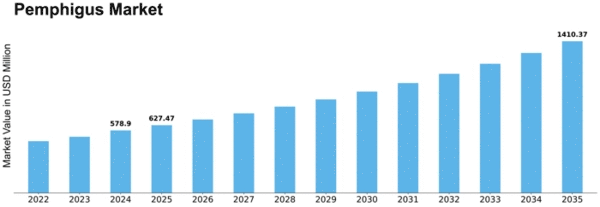
Pemphigus Market Size Graph
Author
Author Profile
Rahul Gotadki
Research Manager

He holds an experience of about 9+ years in Market Research and Business Consulting, working under the spectrum of Life Sciences and Healthcare domains. Rahul conceptualizes and implements a scalable business strategy and provides strategic leadership to the clients. His expertise lies in market estimation, competitive intelligence, pipeline analysis, customer assessment, etc.

Leave a Comment

FAQs

What is the current valuation of the Pemphigus Market as of 2025?

<p>The Pemphigus Market valuation was 578.9 USD Million in 2024.</p>

What is the projected market size for the Pemphigus Market by 2035?

<p>The market is projected to reach 1410.37 USD Million by 2035.</p>

What is the expected CAGR for the Pemphigus Market during the forecast period 2025 - 2035?

<p>The expected CAGR for the Pemphigus Market during this period is 8.39%.</p>

Which companies are the key players in the Pemphigus Market?

<p>Key players include Roche, Bristol-Myers Squibb, Novartis, Amgen, Sanofi, Merck & Co., Pfizer, GSK, and Eli Lilly.</p>

How does the Pemphigus Vulgaris segment perform in terms of market valuation?

<p>The Pemphigus Vulgaris segment had a valuation of 300.0 USD Million in 2024 and is projected to reach 700.0 USD Million.</p>

What are the market valuations for different treatment types in the Pemphigus Market?

Corticosteroids were valued at 200.0 USD Million, while biologics reached 150.0 USD Million in 2024.

What is the market size for the Pediatric demographic in the Pemphigus Market?

The Pediatric demographic was valued at 100.0 USD Million in 2024, with projections indicating growth.

What is the valuation of the Immunology application segment in the Pemphigus Market?

The Immunology application segment had a valuation of 144.0 USD Million in 2024, with future growth anticipated.

How does the market for intravenous treatments compare to other routes of administration?

Intravenous treatments were valued at 231.78 USD Million in 2024, indicating a strong preference among treatment routes.

What is the projected growth for the Geriatric demographic in the Pemphigus Market?

The Geriatric demographic was valued at 132.9 USD Million in 2024, with expectations for substantial growth by 2035.

Market Summary

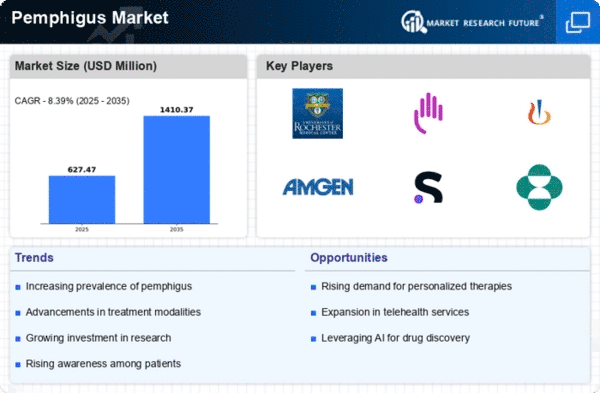
As per MRFR analysis, the Pemphigus Market Size was estimated at 578.9 USD Million in 2024. The Pemphigus industry is projected to grow from 634.1 in 2025 to 1410.37 by 2035, exhibiting a compound annual growth rate (CAGR) of 8.39% during the forecast period 2025 - 2035.

Key Market Trends & Highlights

The Pemphigus Market is experiencing notable growth driven by advancements in treatment and increasing awareness.

  • Rising awareness and education about pemphigus are enhancing patient engagement and treatment adherence.
  • Advancements in treatment options, particularly in biologics, are transforming the management of pemphigus vulgaris.
  • Integration of multidisciplinary care is becoming essential in providing comprehensive treatment for patients across North America and Asia-Pacific.
  • The increasing incidence of pemphigus, coupled with innovative therapeutic developments, is driving market growth and investment in research and development.

Market Size & Forecast

2024 Market Size 578.9 (USD Million)
2035 Market Size 1410.37 (USD Million)
CAGR (2025 - 2035) 8.39%
Largest Regional Market Share in 2024 North America

Major Players

Roche (CH), Bristol-Myers Squibb (US), Novartis (CH), Amgen (US), Sanofi (FR), Merck & Co. (US), Pfizer (US), GSK (GB), AbbVie (US)

Market Trends

The Pemphigus Market is currently experiencing notable developments, driven by a combination of increasing awareness and advancements in treatment options. The rise in the prevalence of pemphigus, an autoimmune blistering disorder, has prompted healthcare providers and researchers to focus on innovative therapies. This heightened attention is likely to foster collaborations among pharmaceutical companies, academic institutions, and healthcare organizations, aiming to enhance patient outcomes. Furthermore, the growing emphasis on personalized medicine appears to be shaping the landscape of treatment approaches, as tailored therapies may offer improved efficacy and safety profiles for individuals affected by this condition. In addition, the Pemphigus Market is witnessing a shift towards more comprehensive care models, integrating multidisciplinary teams to address the complex needs of patients. This trend suggests a potential increase in the availability of support services, including psychological counseling and nutritional guidance, which could significantly improve the quality of life for those living with pemphigus. As research continues to evolve, the market may also see the introduction of novel biologics and targeted therapies, which could revolutionize the management of this challenging disease.

Rising Awareness and Education

There is a growing recognition of pemphigus among healthcare professionals and the general public. Increased educational initiatives are likely to enhance understanding of the disease, leading to earlier diagnosis and treatment.

Advancements in Treatment Options

The Pemphigus Market is experiencing a surge in innovative therapies, including biologics and targeted treatments. These advancements may provide more effective management strategies for patients.

Integration of Multidisciplinary Care

A trend towards holistic care models is emerging, where various healthcare professionals collaborate to address the diverse needs of pemphigus patients. This approach could improve overall patient outcomes.

Pemphigus Market Market Drivers

Market Growth Projections

The Global Pemphigus Market Industry is projected to experience substantial growth over the coming years. With a market value of 1.67 USD Billion in 2024, it is anticipated to reach 4.0 USD Billion by 2035. This growth trajectory reflects a CAGR of 8.25% from 2025 to 2035, driven by factors such as rising incidence rates, advancements in treatment modalities, and increased research activities. The market's expansion indicates a growing recognition of pemphigus as a significant health concern, necessitating ongoing investment in therapeutic development and patient care.

Rising Incidence of Pemphigus

The Global Pemphigus Market Industry experiences a notable increase in the incidence of pemphigus, an autoimmune blistering disorder. Recent data suggests that the prevalence of pemphigus vulgaris is approximately 0.5 to 3 cases per 100,000 individuals globally. This rising incidence is likely to drive the demand for effective treatment options, contributing to the market's growth. As the population ages and awareness of autoimmune diseases increases, the Global Pemphigus Market Industry is projected to reach 1.67 USD Billion in 2024, indicating a strong need for innovative therapies and management strategies.

Supportive Government Policies

Supportive government policies and initiatives play a pivotal role in the Global Pemphigus Market Industry. Regulatory agencies are increasingly recognizing the need for effective treatments for rare diseases, including pemphigus. Policies that promote research funding, expedite drug approvals, and provide incentives for pharmaceutical companies are likely to foster innovation in this field. Such supportive measures can enhance the availability of treatment options, ultimately benefiting patients. As the market evolves, these policies may contribute to a more robust Global Pemphigus Market Industry, ensuring that patients have access to necessary therapies.

Growing Awareness and Education

Growing awareness and education regarding pemphigus among healthcare professionals and patients contribute positively to the Global Pemphigus Market Industry. Initiatives by health organizations and patient advocacy groups aim to disseminate information about the disease, its symptoms, and treatment options. This increased awareness is likely to facilitate early diagnosis and prompt treatment, thereby improving patient outcomes. As more individuals seek medical attention, the demand for therapies is expected to rise, further propelling the Global Pemphigus Market Industry's growth trajectory.

Advancements in Treatment Modalities

Innovations in treatment modalities significantly influence the Global Pemphigus Market Industry. The introduction of biologics and targeted therapies has transformed the management of pemphigus, offering improved efficacy and safety profiles. For instance, monoclonal antibodies such as rituximab have shown promising results in clinical trials, leading to increased adoption in clinical practice. This trend is expected to continue, with the market projected to expand at a CAGR of 8.25% from 2025 to 2035. As new therapies emerge, the Global Pemphigus Market Industry is likely to witness substantial growth, enhancing patient outcomes and quality of life.

Increased Research and Development Activities

The Global Pemphigus Market Industry benefits from heightened research and development activities aimed at understanding the pathophysiology of pemphigus. Government and academic institutions are increasingly investing in studies to identify novel therapeutic targets and biomarkers. This surge in R&D is anticipated to lead to the discovery of new treatment options, thereby expanding the market. With a projected market value of 4.0 USD Billion by 2035, the emphasis on innovation and scientific exploration is likely to play a crucial role in shaping the future of the Global Pemphigus Market Industry.

Market Segment Insights

By Application: Dermatology (Largest) vs. Oncology (Fastest-Growing)

<p>The Pemphigus Market exhibits a diverse application landscape, predominantly influenced by segments such as Dermatology, Oncology, Immunology, and Transplantation. In this competitive arena, Dermatology takes the lead with the largest market share, driven by the rising prevalence of pemphigus diseases. The Oncology segment, while smaller, showcases significant promise as it addresses complications arising from pemphigus in cancer patients and shows a rapidly expanding market presence due to evolving treatment paradigms.</p>

<p>Dermatology (Dominant) vs. Oncology (Emerging)</p>

<p>Dermatology maintains its position as the dominant application in the Pemphigus Market, primarily due to the high incidence and awareness of pemphigus among dermatological conditions. This segment is characterized by a variety of treatment options ranging from systemic therapies to innovative biologics, ensuring comprehensive patient management. Conversely, Oncology is emerging as a vital sector within the market, particularly as research uncovers correlations between pemphigus and cancer. The anticipated growth in this area is fueled by increasing recognition of the need for targeted therapies and integrated treatment approaches in oncological patients, making it a crucial focus for future research and market strategies.</p>

By Type of Pemphigus: Pemphigus Vulgaris (Largest) vs. Pemphigus Foliaceus (Fastest-Growing)

<p>The Pemphigus market is primarily dominated by Pemphigus Vulgaris, which accounts for the largest market share among the different types of pemphigus. This condition is characterized by blister formation and is often considered a more severe form of the disease, thus attracting greater attention and more treatment options. Pemphigus Foliaceus, while smaller in market size, is emerging rapidly due to increasing awareness and diagnosis rates among healthcare providers, making it a focus for future growth and development.</p>

<p>Pemphigus Vulgaris (Dominant) vs. Pemphigus Foliaceus (Emerging)</p>

<p>Pemphigus Vulgaris stands out as the dominant segment in the Pemphigus market due to its prevalence and severity, leading to more significant clinical focus and investment in treatment options. Patients suffering from this condition often require long-term management, which intensifies the demand for therapies. In contrast, Pemphigus Foliaceus is gaining momentum as it is recognized as a less severe but still impactful form of pemphigus. The emerging research into targeted therapies and biological treatments for Pemphigus Foliaceus is driving its rapid growth and leading to an increased number of diagnosed cases, thus expanding its market share.</p>

By Treatment Type: Corticosteroids (Largest) vs. Biologics (Fastest-Growing)

<p>Corticosteroids continue to dominate the Pemphigus treatment landscape due to their effectiveness in rapidly reducing inflammation and controlling symptoms. They hold the largest market share among treatment types, being the first-line therapy prescribed for most patients, leading to consistent utilization rates. Immunosuppressants and plasmapheresis also play vital roles, albeit with lower prevalence compared to corticosteroids and the emerging biologics segment.</p>

<p>Corticosteroids (Dominant) vs. Biologics (Emerging)</p>

<p>Corticosteroids are established as the dominant choice in the Pemphigus Market, favored for their quick therapeutic action and ability to induce remission in patients. They are often used in conjunction with other agents to prevent flare-ups. In contrast, biologics represent an emerging segment that is gaining traction due to their targeted approach in treating autoimmune disorders like Pemphigus. While biologics are still in the early stages of adoption, their efficacy in reducing disease activity without the broad immunosuppressive effects of traditional therapies makes them appealing and potentially faster-growing in the coming years.</p>

By Route of Administration: Oral (Largest) vs. Intravenous (Fastest-Growing)

<p>In the Pemphigus market, the Route of Administration segment displays a distinct distribution among its three key values: Oral, Intravenous, and Subcutaneous. Oral administration remains the dominant choice among healthcare professionals due to its ease of use and patient compliance. This method accounts for the majority of market share as patients prefer non-invasive routes over more complex delivery mechanisms. On the other hand, Intravenous administration is emerging as the fastest-growing method in this space. Its growth can be attributed to the increasing focus on targeted therapy, which allows for more efficient and rapid administration of treatment. The Subcutaneous route is also significant, though it currently holds a smaller market share compared to the dominant and fastest-growing methods.</p>

<p>Administration Route: Oral (Dominant) vs. Intravenous (Emerging)</p>

<p>The Oral administration route is characterized by its high patient acceptability and ease of use, making it a favored option among physicians when prescribing treatments for Pemphigus. This method allows for straightforward self-administration, which is crucial for patient adherence to treatment regimens. Conversely, Intravenous administration, while less commonly used, is becoming important as an emerging route for more severe cases requiring rapid therapeutic action. This method delivers medication directly into the bloodstream, providing faster and more effective treatment. The growing preference for <a href="https://www.marketresearchfuture.com/reports/precision-medicine-market-925" target="_blank" title="precision medicine">precision medicine</a> and advancements in drug formulations are driving the increased utilization of both routes in treating Pemphigus.</p>

By Patient Demographics: Adults (Largest) vs. Geriatric (Fastest-Growing)

<p>The Pemphigus Market is significantly influenced by patient demographics, particularly among adults who represent the largest segment within this therapeutic area. This demographic showcases a higher prevalence of pemphigus, contributing substantially to the market share. In contrast, the geriatric population, while smaller in comparison, is showing an increased incidence of pemphigus conditions, leading to a notable share in the market.</p>

<p>Adults (Dominant) vs. Geriatric (Emerging)</p>

<p>Adults presently dominate the Pemphigus Market due to their higher exposure and diagnosis rates. This group is characterized by a greater likelihood of experiencing pemphigus vulgaris, which necessitates targeted treatment strategies. On the other hand, the geriatric segment is emerging rapidly, driven by an aging population that is at higher risk for autoimmune disorders including pemphigus. As healthcare access improves, this demographic is likely to see increased awareness and diagnosis rates, making it an important area for future growth and tailored therapies.</p>

Get more detailed insights about Pemphigus Market Research Report – Forecast to 2035

Regional Insights

North America : Market Leader in Pemphigus

North America is poised to maintain its leadership in the Pemphigus market, holding a significant share of 300.0M in 2025. The region benefits from advanced healthcare infrastructure, high R&D investments, and a growing prevalence of autoimmune diseases. Regulatory support, including expedited approval processes for innovative therapies, further drives market growth. The increasing awareness of Pemphigus among healthcare professionals is also contributing to rising demand for effective treatments. The competitive landscape in North America is robust, featuring key players such as Roche, Bristol-Myers Squibb, and AbbVie. The U.S. is the leading country, accounting for the majority of the market share, driven by a high incidence rate of Pemphigus and a strong focus on research and development. The presence of major pharmaceutical companies enhances the availability of advanced treatment options, ensuring that patients have access to the latest therapies.

Europe : Emerging Market Potential

Europe is witnessing a growing interest in the Pemphigus market, with a market size of 150.0M in 2025. Factors such as increasing healthcare expenditure, a rise in autoimmune disease diagnoses, and supportive regulatory frameworks are driving this growth. The European Medicines Agency (EMA) has been proactive in facilitating the approval of new therapies, which is expected to enhance treatment options for patients suffering from Pemphigus. The region's focus on patient-centric care is also contributing to market expansion. Leading countries in Europe include Germany, France, and the UK, where the prevalence of Pemphigus is being increasingly recognized. The competitive landscape features major players like Novartis and Sanofi, who are investing in innovative treatments. The collaboration between pharmaceutical companies and healthcare providers is fostering a more comprehensive approach to managing Pemphigus, ensuring that patients receive timely and effective care.

Asia-Pacific : Growing Awareness and Demand

The Asia-Pacific region is emerging as a significant player in the Pemphigus market, with a market size of 100.0M in 2025. The growth is driven by increasing awareness of autoimmune diseases, rising healthcare investments, and a growing patient population. Regulatory bodies in countries like Japan and Australia are enhancing their frameworks to facilitate quicker access to new treatments, which is expected to boost market growth. The region's diverse healthcare landscape presents both challenges and opportunities for market players. Key countries such as Japan, China, and India are leading the charge in the Asia-Pacific Pemphigus market. The presence of major pharmaceutical companies, including Amgen and Pfizer, is strengthening the competitive landscape. Collaborative efforts between local and international firms are paving the way for innovative treatment solutions, ensuring that patients have access to the latest therapies and improving overall patient outcomes.

Middle East and Africa : Untapped Market Opportunities

The Middle East and Africa region represents an untapped market for Pemphigus treatments, with a market size of 28.9M in 2025. The growth is driven by increasing healthcare access, rising awareness of autoimmune diseases, and the need for effective treatment options. Regulatory bodies are beginning to recognize the importance of addressing rare diseases, which is expected to catalyze market development. The region's diverse healthcare systems present unique challenges but also opportunities for growth in the Pemphigus market. Countries like South Africa and the UAE are at the forefront of this emerging market, with increasing investments in healthcare infrastructure. The competitive landscape is gradually evolving, with both local and international players looking to establish a presence. As awareness of Pemphigus grows, the demand for effective therapies is expected to rise, paving the way for new entrants and innovative solutions in the market.

Key Players and Competitive Insights

The Pemphigus Market is characterized by a dynamic competitive landscape, driven by increasing incidences of autoimmune diseases and a growing demand for innovative therapies. Key players such as Roche (CH), Bristol-Myers Squibb (US), and AbbVie (US) are strategically positioned to leverage their extensive research capabilities and robust product pipelines. Roche (CH) focuses on precision medicine and has made significant investments in biologics, while Bristol-Myers Squibb (US) emphasizes immuno-oncology and has expanded its portfolio through strategic acquisitions. AbbVie (US) is enhancing its market presence through partnerships aimed at developing novel therapies, collectively shaping a competitive environment that prioritizes innovation and patient-centric solutions.In terms of business tactics, companies are increasingly localizing manufacturing to enhance supply chain efficiency and reduce costs. The Pemphigus Market appears moderately fragmented, with a mix of established players and emerging biotech firms. The collective influence of these key players is significant, as they engage in collaborations and partnerships to optimize their market strategies and expand their geographical reach.

In November Roche (CH) announced a collaboration with a leading biotech firm to develop a novel monoclonal antibody targeting pemphigus vulgaris. This strategic move is likely to enhance Roche's product offerings and strengthen its position in the market, as it aligns with the growing trend towards personalized medicine. The collaboration underscores the importance of innovation in addressing unmet medical needs in the Pemphigus Market.

In October Bristol-Myers Squibb (US) launched a new clinical trial for its investigational therapy aimed at treating pemphigus foliaceus. This initiative reflects the company's commitment to advancing research in autoimmune diseases and could potentially lead to a breakthrough treatment option. The trial's outcomes may significantly influence the competitive landscape, as successful results could position Bristol-Myers Squibb as a leader in this therapeutic area.

In September AbbVie (US) entered into a strategic partnership with a digital health company to integrate AI-driven solutions into its clinical development processes. This collaboration is indicative of the growing trend towards digital transformation in the pharmaceutical industry, which may enhance AbbVie's efficiency in drug development and patient engagement. The integration of technology is likely to play a crucial role in shaping competitive differentiation in the Pemphigus Market.

As of December current trends in the Pemphigus Market include a strong emphasis on digitalization, sustainability, and the integration of AI technologies. Strategic alliances are increasingly shaping the competitive landscape, enabling companies to pool resources and expertise. Looking ahead, competitive differentiation is expected to evolve from traditional price-based competition to a focus on innovation, technological advancements, and supply chain reliability, positioning companies to better meet the needs of patients and healthcare providers.

Key Companies in the Pemphigus Market include

Industry Developments

  • Q2 2024: Argenx Receives FDA Approval for Vyvgart Hytrulo for the Treatment of Pemphigus Market Vulgaris Argenx announced that the U.S. Food and Drug Administration (FDA) has approved Vyvgart Hytrulo (efgartigimod alfa and hyaluronidase-qvfc) for the treatment of adults with pemphigus vulgaris, marking a significant regulatory milestone for the company.
  • Q1 2024: Cabaletta Bio Announces FDA Clearance of IND Application for CABA-201 in Pemphigus Market Vulgaris Cabaletta Bio reported that the FDA has cleared its Investigational New Drug (IND) application for CABA-201, a novel cell therapy candidate, to initiate a Phase 1/2 clinical trial in patients with pemphigus vulgaris.
  • Q2 2024: Principia Biopharma Initiates Phase 3 PEGASUS Study of PRN1008 in Pemphigus Market Vulgaris Principia Biopharma, a Sanofi company, announced the initiation of the Phase 3 PEGASUS clinical trial evaluating PRN1008 (rilzabrutinib) for the treatment of pemphigus vulgaris.
  • Q2 2024: Novartis Announces Positive Topline Results from Phase 3 Study of Ianalumab in Pemphigus Market Vulgaris Novartis reported positive topline results from its Phase 3 clinical trial of ianalumab, a BAFF-R inhibitor, in patients with pemphigus vulgaris, supporting further regulatory submissions.
  • Q1 2024: Argenx Raises $350M in Public Offering to Support Autoimmune Pipeline Including Pemphigus Market Programs Argenx completed a $350 million public offering to fund the continued development and commercialization of its autoimmune disease pipeline, including therapies for pemphigus vulgaris.
  • Q2 2024: Sanofi’s Rilzabrutinib Receives Orphan Drug Designation from European Commission for Pemphigus Market Vulgaris Sanofi announced that the European Commission has granted orphan drug designation to rilzabrutinib for the treatment of pemphigus vulgaris, providing regulatory incentives for its development.
  • Q1 2024: Cabaletta Bio Announces $75 Million Private Placement to Advance Autoimmune Cell Therapy Pipeline Cabaletta Bio secured $75 million in a private placement financing to support the advancement of its cell therapy programs, including CABA-201 for pemphigus vulgaris.
  • Q2 2024: Argenx and Zai Lab Announce Strategic Partnership to Commercialize Vyvgart in Greater China for Pemphigus Market Vulgaris Argenx and Zai Lab entered into a strategic partnership to commercialize Vyvgart for the treatment of pemphigus vulgaris and other autoimmune diseases in Greater China.
  • Q2 2024: Novartis Submits Marketing Authorization Application to EMA for Ianalumab in Pemphigus Market Vulgaris Novartis submitted a Marketing Authorization Application (MAA) to the European Medicines Agency (EMA) for ianalumab for the treatment of pemphigus vulgaris, following positive Phase 3 results.
  • Q1 2024: Cabaletta Bio Appoints Dr. Jane Smith as Chief Medical Officer to Lead Pemphigus Market Clinical Programs Cabaletta Bio appointed Dr. Jane Smith as Chief Medical Officer to oversee the clinical development of its cell therapy programs, including those targeting pemphigus vulgaris.

Global Pemphigus Market, by Pemphigus Market Types

  • Pemphigus Market Vulgaris
  • Pemphigus Market Foliaceus
  • Pemphigus Market Vegetans
  • Paraneoplastic Pemphigus Market

Global Pemphigus Market, by Diagnosis

  • Skin peeling
  • Skin biopsy
  • Run blood tests
  • Endoscopy

Global Pemphigus Market, by Treatment

  • Initial therapy
  • Maintenance therapy
  • Immunosuppressants
  • Biological therapies
  • Intravenous Immunoglobulin (IVIG) therapy
  • Other medication

Global Pemphigus Market, by End User

  • Laboratories
  • Hospitals and Clinics
  • Academic and Research Institutes

Global Pemphigus Market, by Region

  • Americas
  • North America
  • US
  • Canada
  • South America
  • Europe
  • Western Europe
  • Germany
  • France
  • Italy
  • Spain
  • UK
  • Rest of Western Europe
  • Eastern Europe
  • Asia-Pacific
  • Japan
  • China
  • India
  • Australia
  • Republic of Korea
  • Rest of Asia Pacific
  • Middle East & Africa
  • Middle East
  • Africa

Future Outlook

Pemphigus Market Future Outlook

The Pemphigus Market is projected to grow at an 8.39% CAGR from 2025 to 2035, driven by advancements in treatment options, increasing awareness, and rising healthcare expenditure.

New opportunities lie in:

  • Development of targeted biologic therapies for pemphigus vulgaris.
  • Expansion of telemedicine platforms for remote patient monitoring.
  • Investment in personalized medicine approaches for treatment optimization.

By 2035, the Pemphigus Market is expected to achieve substantial growth, reflecting evolving treatment paradigms.

Market Segmentation

Pemphigus Market Disease Severity Outlook

  • Mild
  • Moderate
  • Severe
  • Refractory

Pemphigus Market Treatment Method Outlook

  • Immunosuppressants
  • Corticosteroids
  • Biologics
  • Plasmapheresis

Pemphigus Market Type of Pemphigus Outlook

  • Pemphigus Vulgaris
  • Pemphigus Foliaceus
  • Pemphigus Erythematosus
  • Pemphigus Vegetans

Pemphigus Market Patient Demographics Outlook

  • Age Group
  • Gender
  • Ethnicity
  • Socioeconomic Status

Report Scope

MARKET SIZE 2024 578.9(USD Million)
MARKET SIZE 2025 634.1(USD Million)
MARKET SIZE 2035 1410.37(USD Million)
COMPOUND ANNUAL GROWTH RATE (CAGR) 8.39% (2025 - 2035)
REPORT COVERAGE Revenue Forecast, Competitive Landscape, Growth Factors, and Trends
BASE YEAR 2024
Market Forecast Period 2025 - 2035
Historical Data 2019 - 2024
Market Forecast Units USD Million
Key Companies Profiled Roche (CH), Bristol-Myers Squibb (US), Novartis (CH), Amgen (US), Sanofi (FR), Merck & Co. (US), Pfizer (US), GSK (GB), AbbVie (US)
Segments Covered Type of Pemphigus, Treatment Method, Patient Demographics, Disease Severity
Key Market Opportunities Advancements in biologics and targeted therapies enhance treatment options in the Pemphigus Market.
Key Market Dynamics Rising demand for targeted therapies drives innovation and competition in the Pemphigus treatment landscape.
Countries Covered North America, Europe, APAC, South America, MEA

FAQs

What is the current valuation of the Pemphigus Market as of 2025?

<p>The Pemphigus Market valuation was 578.9 USD Million in 2024.</p>

What is the projected market size for the Pemphigus Market by 2035?

<p>The market is projected to reach 1410.37 USD Million by 2035.</p>

What is the expected CAGR for the Pemphigus Market during the forecast period 2025 - 2035?

<p>The expected CAGR for the Pemphigus Market during this period is 8.39%.</p>

Which companies are the key players in the Pemphigus Market?

<p>Key players include Roche, Bristol-Myers Squibb, Novartis, Amgen, Sanofi, Merck & Co., Pfizer, GSK, and Eli Lilly.</p>

How does the Pemphigus Vulgaris segment perform in terms of market valuation?

<p>The Pemphigus Vulgaris segment had a valuation of 300.0 USD Million in 2024 and is projected to reach 700.0 USD Million.</p>

What are the market valuations for different treatment types in the Pemphigus Market?

Corticosteroids were valued at 200.0 USD Million, while biologics reached 150.0 USD Million in 2024.

What is the market size for the Pediatric demographic in the Pemphigus Market?

The Pediatric demographic was valued at 100.0 USD Million in 2024, with projections indicating growth.

What is the valuation of the Immunology application segment in the Pemphigus Market?

The Immunology application segment had a valuation of 144.0 USD Million in 2024, with future growth anticipated.

How does the market for intravenous treatments compare to other routes of administration?

Intravenous treatments were valued at 231.78 USD Million in 2024, indicating a strong preference among treatment routes.

What is the projected growth for the Geriatric demographic in the Pemphigus Market?

The Geriatric demographic was valued at 132.9 USD Million in 2024, with expectations for substantial growth by 2035.

  1. SECTION I: EXECUTIVE SUMMARY AND KEY HIGHLIGHTS
    1. | 1.1 EXECUTIVE SUMMARY
    2. | | 1.1.1 Market Overview
    3. | | 1.1.2 Key Findings
    4. | | 1.1.3 Market Segmentation
    5. | | 1.1.4 Competitive Landscape
    6. | | 1.1.5 Challenges and Opportunities
    7. | | 1.1.6 Future Outlook
  2. SECTION II: SCOPING, METHODOLOGY AND MARKET STRUCTURE
    1. | 2.1 MARKET INTRODUCTION
    2. | | 2.1.1 Definition
    3. | | 2.1.2 Scope of the study
    4. | | | 2.1.2.1 Research Objective
    5. | | | 2.1.2.2 Assumption
    6. | | | 2.1.2.3 Limitations
    7. | 2.2 RESEARCH METHODOLOGY
    8. | | 2.2.1 Overview
    9. | | 2.2.2 Data Mining
    10. | | 2.2.3 Secondary Research
    11. | | 2.2.4 Primary Research
    12. | | | 2.2.4.1 Primary Interviews and Information Gathering Process
    13. | | | 2.2.4.2 Breakdown of Primary Respondents
    14. | | 2.2.5 Forecasting Model
    15. | | 2.2.6 Market Size Estimation
    16. | | | 2.2.6.1 Bottom-Up Approach
    17. | | | 2.2.6.2 Top-Down Approach
    18. | | 2.2.7 Data Triangulation
    19. | | 2.2.8 Validation
  3. SECTION III: QUALITATIVE ANALYSIS
    1. | 3.1 MARKET DYNAMICS
    2. | | 3.1.1 Overview
    3. | | 3.1.2 Drivers
    4. | | 3.1.3 Restraints
    5. | | 3.1.4 Opportunities
    6. | 3.2 MARKET FACTOR ANALYSIS
    7. | | 3.2.1 Value chain Analysis
    8. | | 3.2.2 Porter's Five Forces Analysis
    9. | | | 3.2.2.1 Bargaining Power of Suppliers
    10. | | | 3.2.2.2 Bargaining Power of Buyers
    11. | | | 3.2.2.3 Threat of New Entrants
    12. | | | 3.2.2.4 Threat of Substitutes
    13. | | | 3.2.2.5 Intensity of Rivalry
    14. | | 3.2.3 COVID-19 Impact Analysis
    15. | | | 3.2.3.1 Market Impact Analysis
    16. | | | 3.2.3.2 Regional Impact
    17. | | | 3.2.3.3 Opportunity and Threat Analysis
  4. SECTION IV: QUANTITATIVE ANALYSIS
    1. | 4.1 Healthcare, BY Application (USD Million)
    2. | | 4.1.1 Dermatology
    3. | | 4.1.2 Oncology
    4. | | 4.1.3 Immunology
    5. | | 4.1.4 Transplantation
    6. | 4.2 Healthcare, BY Type of Pemphigus (USD Million)
    7. | | 4.2.1 Pemphigus Vulgaris
    8. | | 4.2.2 Pemphigus Foliaceus
    9. | | 4.2.3 Paraneoplastic Pemphigus
    10. | 4.3 Healthcare, BY Treatment Type (USD Million)
    11. | | 4.3.1 Corticosteroids
    12. | | 4.3.2 Immunosuppressants
    13. | | 4.3.3 Biologics
    14. | | 4.3.4 Plasmapheresis
    15. | 4.4 Healthcare, BY Route of Administration (USD Million)
    16. | | 4.4.1 Oral
    17. | | 4.4.2 Intravenous
    18. | | 4.4.3 Subcutaneous
    19. | 4.5 Healthcare, BY Patient Demographics (USD Million)
    20. | | 4.5.1 Adults
    21. | | 4.5.2 Pediatric
    22. | | 4.5.3 Geriatric
    23. | 4.6 Healthcare, BY Region (USD Million)
    24. | | 4.6.1 North America
    25. | | | 4.6.1.1 US
    26. | | | 4.6.1.2 Canada
    27. | | 4.6.2 Europe
    28. | | | 4.6.2.1 Germany
    29. | | | 4.6.2.2 UK
    30. | | | 4.6.2.3 France
    31. | | | 4.6.2.4 Russia
    32. | | | 4.6.2.5 Italy
    33. | | | 4.6.2.6 Spain
    34. | | | 4.6.2.7 Rest of Europe
    35. | | 4.6.3 APAC
    36. | | | 4.6.3.1 China
    37. | | | 4.6.3.2 India
    38. | | | 4.6.3.3 Japan
    39. | | | 4.6.3.4 South Korea
    40. | | | 4.6.3.5 Malaysia
    41. | | | 4.6.3.6 Thailand
    42. | | | 4.6.3.7 Indonesia
    43. | | | 4.6.3.8 Rest of APAC
    44. | | 4.6.4 South America
    45. | | | 4.6.4.1 Brazil
    46. | | | 4.6.4.2 Mexico
    47. | | | 4.6.4.3 Argentina
    48. | | | 4.6.4.4 Rest of South America
    49. | | 4.6.5 MEA
    50. | | | 4.6.5.1 GCC Countries
    51. | | | 4.6.5.2 South Africa
    52. | | | 4.6.5.3 Rest of MEA
  5. SECTION V: COMPETITIVE ANALYSIS
    1. | 5.1 Competitive Landscape
    2. | | 5.1.1 Overview
    3. | | 5.1.2 Competitive Analysis
    4. | | 5.1.3 Market share Analysis
    5. | | 5.1.4 Major Growth Strategy in the Healthcare
    6. | | 5.1.5 Competitive Benchmarking
    7. | | 5.1.6 Leading Players in Terms of Number of Developments in the Healthcare
    8. | | 5.1.7 Key developments and growth strategies
    9. | | | 5.1.7.1 New Product Launch/Service Deployment
    10. | | | 5.1.7.2 Merger & Acquisitions
    11. | | | 5.1.7.3 Joint Ventures
    12. | | 5.1.8 Major Players Financial Matrix
    13. | | | 5.1.8.1 Sales and Operating Income
    14. | | | 5.1.8.2 Major Players R&D Expenditure. 2023
    15. | 5.2 Company Profiles
    16. | | 5.2.1 Roche (CH)
    17. | | | 5.2.1.1 Financial Overview
    18. | | | 5.2.1.2 Products Offered
    19. | | | 5.2.1.3 Key Developments
    20. | | | 5.2.1.4 SWOT Analysis
    21. | | | 5.2.1.5 Key Strategies
    22. | | 5.2.2 Bristol-Myers Squibb (US)
    23. | | | 5.2.2.1 Financial Overview
    24. | | | 5.2.2.2 Products Offered
    25. | | | 5.2.2.3 Key Developments
    26. | | | 5.2.2.4 SWOT Analysis
    27. | | | 5.2.2.5 Key Strategies
    28. | | 5.2.3 Novartis (CH)
    29. | | | 5.2.3.1 Financial Overview
    30. | | | 5.2.3.2 Products Offered
    31. | | | 5.2.3.3 Key Developments
    32. | | | 5.2.3.4 SWOT Analysis
    33. | | | 5.2.3.5 Key Strategies
    34. | | 5.2.4 Amgen (US)
    35. | | | 5.2.4.1 Financial Overview
    36. | | | 5.2.4.2 Products Offered
    37. | | | 5.2.4.3 Key Developments
    38. | | | 5.2.4.4 SWOT Analysis
    39. | | | 5.2.4.5 Key Strategies
    40. | | 5.2.5 Sanofi (FR)
    41. | | | 5.2.5.1 Financial Overview
    42. | | | 5.2.5.2 Products Offered
    43. | | | 5.2.5.3 Key Developments
    44. | | | 5.2.5.4 SWOT Analysis
    45. | | | 5.2.5.5 Key Strategies
    46. | | 5.2.6 Merck & Co. (US)
    47. | | | 5.2.6.1 Financial Overview
    48. | | | 5.2.6.2 Products Offered
    49. | | | 5.2.6.3 Key Developments
    50. | | | 5.2.6.4 SWOT Analysis
    51. | | | 5.2.6.5 Key Strategies
    52. | | 5.2.7 Pfizer (US)
    53. | | | 5.2.7.1 Financial Overview
    54. | | | 5.2.7.2 Products Offered
    55. | | | 5.2.7.3 Key Developments
    56. | | | 5.2.7.4 SWOT Analysis
    57. | | | 5.2.7.5 Key Strategies
    58. | | 5.2.8 GSK (GB)
    59. | | | 5.2.8.1 Financial Overview
    60. | | | 5.2.8.2 Products Offered
    61. | | | 5.2.8.3 Key Developments
    62. | | | 5.2.8.4 SWOT Analysis
    63. | | | 5.2.8.5 Key Strategies
    64. | | 5.2.9 Eli Lilly (US)
    65. | | | 5.2.9.1 Financial Overview
    66. | | | 5.2.9.2 Products Offered
    67. | | | 5.2.9.3 Key Developments
    68. | | | 5.2.9.4 SWOT Analysis
    69. | | | 5.2.9.5 Key Strategies
    70. | 5.3 Appendix
    71. | | 5.3.1 References
    72. | | 5.3.2 Related Reports
  6. LIST OF FIGURES
    1. | 6.1 MARKET SYNOPSIS
    2. | 6.2 NORTH AMERICA MARKET ANALYSIS
    3. | 6.3 US MARKET ANALYSIS BY APPLICATION
    4. | 6.4 US MARKET ANALYSIS BY TYPE OF PEMPHIGUS
    5. | 6.5 US MARKET ANALYSIS BY TREATMENT TYPE
    6. | 6.6 US MARKET ANALYSIS BY ROUTE OF ADMINISTRATION
    7. | 6.7 US MARKET ANALYSIS BY PATIENT DEMOGRAPHICS
    8. | 6.8 CANADA MARKET ANALYSIS BY APPLICATION
    9. | 6.9 CANADA MARKET ANALYSIS BY TYPE OF PEMPHIGUS
    10. | 6.10 CANADA MARKET ANALYSIS BY TREATMENT TYPE
    11. | 6.11 CANADA MARKET ANALYSIS BY ROUTE OF ADMINISTRATION
    12. | 6.12 CANADA MARKET ANALYSIS BY PATIENT DEMOGRAPHICS
    13. | 6.13 EUROPE MARKET ANALYSIS
    14. | 6.14 GERMANY MARKET ANALYSIS BY APPLICATION
    15. | 6.15 GERMANY MARKET ANALYSIS BY TYPE OF PEMPHIGUS
    16. | 6.16 GERMANY MARKET ANALYSIS BY TREATMENT TYPE
    17. | 6.17 GERMANY MARKET ANALYSIS BY ROUTE OF ADMINISTRATION
    18. | 6.18 GERMANY MARKET ANALYSIS BY PATIENT DEMOGRAPHICS
    19. | 6.19 UK MARKET ANALYSIS BY APPLICATION
    20. | 6.20 UK MARKET ANALYSIS BY TYPE OF PEMPHIGUS
    21. | 6.21 UK MARKET ANALYSIS BY TREATMENT TYPE
    22. | 6.22 UK MARKET ANALYSIS BY ROUTE OF ADMINISTRATION
    23. | 6.23 UK MARKET ANALYSIS BY PATIENT DEMOGRAPHICS
    24. | 6.24 FRANCE MARKET ANALYSIS BY APPLICATION
    25. | 6.25 FRANCE MARKET ANALYSIS BY TYPE OF PEMPHIGUS
    26. | 6.26 FRANCE MARKET ANALYSIS BY TREATMENT TYPE
    27. | 6.27 FRANCE MARKET ANALYSIS BY ROUTE OF ADMINISTRATION
    28. | 6.28 FRANCE MARKET ANALYSIS BY PATIENT DEMOGRAPHICS
    29. | 6.29 RUSSIA MARKET ANALYSIS BY APPLICATION
    30. | 6.30 RUSSIA MARKET ANALYSIS BY TYPE OF PEMPHIGUS
    31. | 6.31 RUSSIA MARKET ANALYSIS BY TREATMENT TYPE
    32. | 6.32 RUSSIA MARKET ANALYSIS BY ROUTE OF ADMINISTRATION
    33. | 6.33 RUSSIA MARKET ANALYSIS BY PATIENT DEMOGRAPHICS
    34. | 6.34 ITALY MARKET ANALYSIS BY APPLICATION
    35. | 6.35 ITALY MARKET ANALYSIS BY TYPE OF PEMPHIGUS
    36. | 6.36 ITALY MARKET ANALYSIS BY TREATMENT TYPE
    37. | 6.37 ITALY MARKET ANALYSIS BY ROUTE OF ADMINISTRATION
    38. | 6.38 ITALY MARKET ANALYSIS BY PATIENT DEMOGRAPHICS
    39. | 6.39 SPAIN MARKET ANALYSIS BY APPLICATION
    40. | 6.40 SPAIN MARKET ANALYSIS BY TYPE OF PEMPHIGUS
    41. | 6.41 SPAIN MARKET ANALYSIS BY TREATMENT TYPE
    42. | 6.42 SPAIN MARKET ANALYSIS BY ROUTE OF ADMINISTRATION
    43. | 6.43 SPAIN MARKET ANALYSIS BY PATIENT DEMOGRAPHICS
    44. | 6.44 REST OF EUROPE MARKET ANALYSIS BY APPLICATION
    45. | 6.45 REST OF EUROPE MARKET ANALYSIS BY TYPE OF PEMPHIGUS
    46. | 6.46 REST OF EUROPE MARKET ANALYSIS BY TREATMENT TYPE
    47. | 6.47 REST OF EUROPE MARKET ANALYSIS BY ROUTE OF ADMINISTRATION
    48. | 6.48 REST OF EUROPE MARKET ANALYSIS BY PATIENT DEMOGRAPHICS
    49. | 6.49 APAC MARKET ANALYSIS
    50. | 6.50 CHINA MARKET ANALYSIS BY APPLICATION
    51. | 6.51 CHINA MARKET ANALYSIS BY TYPE OF PEMPHIGUS
    52. | 6.52 CHINA MARKET ANALYSIS BY TREATMENT TYPE
    53. | 6.53 CHINA MARKET ANALYSIS BY ROUTE OF ADMINISTRATION
    54. | 6.54 CHINA MARKET ANALYSIS BY PATIENT DEMOGRAPHICS
    55. | 6.55 INDIA MARKET ANALYSIS BY APPLICATION
    56. | 6.56 INDIA MARKET ANALYSIS BY TYPE OF PEMPHIGUS
    57. | 6.57 INDIA MARKET ANALYSIS BY TREATMENT TYPE
    58. | 6.58 INDIA MARKET ANALYSIS BY ROUTE OF ADMINISTRATION
    59. | 6.59 INDIA MARKET ANALYSIS BY PATIENT DEMOGRAPHICS
    60. | 6.60 JAPAN MARKET ANALYSIS BY APPLICATION
    61. | 6.61 JAPAN MARKET ANALYSIS BY TYPE OF PEMPHIGUS
    62. | 6.62 JAPAN MARKET ANALYSIS BY TREATMENT TYPE
    63. | 6.63 JAPAN MARKET ANALYSIS BY ROUTE OF ADMINISTRATION
    64. | 6.64 JAPAN MARKET ANALYSIS BY PATIENT DEMOGRAPHICS
    65. | 6.65 SOUTH KOREA MARKET ANALYSIS BY APPLICATION
    66. | 6.66 SOUTH KOREA MARKET ANALYSIS BY TYPE OF PEMPHIGUS
    67. | 6.67 SOUTH KOREA MARKET ANALYSIS BY TREATMENT TYPE
    68. | 6.68 SOUTH KOREA MARKET ANALYSIS BY ROUTE OF ADMINISTRATION
    69. | 6.69 SOUTH KOREA MARKET ANALYSIS BY PATIENT DEMOGRAPHICS
    70. | 6.70 MALAYSIA MARKET ANALYSIS BY APPLICATION
    71. | 6.71 MALAYSIA MARKET ANALYSIS BY TYPE OF PEMPHIGUS
    72. | 6.72 MALAYSIA MARKET ANALYSIS BY TREATMENT TYPE
    73. | 6.73 MALAYSIA MARKET ANALYSIS BY ROUTE OF ADMINISTRATION
    74. | 6.74 MALAYSIA MARKET ANALYSIS BY PATIENT DEMOGRAPHICS
    75. | 6.75 THAILAND MARKET ANALYSIS BY APPLICATION
    76. | 6.76 THAILAND MARKET ANALYSIS BY TYPE OF PEMPHIGUS
    77. | 6.77 THAILAND MARKET ANALYSIS BY TREATMENT TYPE
    78. | 6.78 THAILAND MARKET ANALYSIS BY ROUTE OF ADMINISTRATION
    79. | 6.79 THAILAND MARKET ANALYSIS BY PATIENT DEMOGRAPHICS
    80. | 6.80 INDONESIA MARKET ANALYSIS BY APPLICATION
    81. | 6.81 INDONESIA MARKET ANALYSIS BY TYPE OF PEMPHIGUS
    82. | 6.82 INDONESIA MARKET ANALYSIS BY TREATMENT TYPE
    83. | 6.83 INDONESIA MARKET ANALYSIS BY ROUTE OF ADMINISTRATION
    84. | 6.84 INDONESIA MARKET ANALYSIS BY PATIENT DEMOGRAPHICS
    85. | 6.85 REST OF APAC MARKET ANALYSIS BY APPLICATION
    86. | 6.86 REST OF APAC MARKET ANALYSIS BY TYPE OF PEMPHIGUS
    87. | 6.87 REST OF APAC MARKET ANALYSIS BY TREATMENT TYPE
    88. | 6.88 REST OF APAC MARKET ANALYSIS BY ROUTE OF ADMINISTRATION
    89. | 6.89 REST OF APAC MARKET ANALYSIS BY PATIENT DEMOGRAPHICS
    90. | 6.90 SOUTH AMERICA MARKET ANALYSIS
    91. | 6.91 BRAZIL MARKET ANALYSIS BY APPLICATION
    92. | 6.92 BRAZIL MARKET ANALYSIS BY TYPE OF PEMPHIGUS
    93. | 6.93 BRAZIL MARKET ANALYSIS BY TREATMENT TYPE
    94. | 6.94 BRAZIL MARKET ANALYSIS BY ROUTE OF ADMINISTRATION
    95. | 6.95 BRAZIL MARKET ANALYSIS BY PATIENT DEMOGRAPHICS
    96. | 6.96 MEXICO MARKET ANALYSIS BY APPLICATION
    97. | 6.97 MEXICO MARKET ANALYSIS BY TYPE OF PEMPHIGUS
    98. | 6.98 MEXICO MARKET ANALYSIS BY TREATMENT TYPE
    99. | 6.99 MEXICO MARKET ANALYSIS BY ROUTE OF ADMINISTRATION
    100. | 6.100 MEXICO MARKET ANALYSIS BY PATIENT DEMOGRAPHICS
    101. | 6.101 ARGENTINA MARKET ANALYSIS BY APPLICATION
    102. | 6.102 ARGENTINA MARKET ANALYSIS BY TYPE OF PEMPHIGUS
    103. | 6.103 ARGENTINA MARKET ANALYSIS BY TREATMENT TYPE
    104. | 6.104 ARGENTINA MARKET ANALYSIS BY ROUTE OF ADMINISTRATION
    105. | 6.105 ARGENTINA MARKET ANALYSIS BY PATIENT DEMOGRAPHICS
    106. | 6.106 REST OF SOUTH AMERICA MARKET ANALYSIS BY APPLICATION
    107. | 6.107 REST OF SOUTH AMERICA MARKET ANALYSIS BY TYPE OF PEMPHIGUS
    108. | 6.108 REST OF SOUTH AMERICA MARKET ANALYSIS BY TREATMENT TYPE
    109. | 6.109 REST OF SOUTH AMERICA MARKET ANALYSIS BY ROUTE OF ADMINISTRATION
    110. | 6.110 REST OF SOUTH AMERICA MARKET ANALYSIS BY PATIENT DEMOGRAPHICS
    111. | 6.111 MEA MARKET ANALYSIS
    112. | 6.112 GCC COUNTRIES MARKET ANALYSIS BY APPLICATION
    113. | 6.113 GCC COUNTRIES MARKET ANALYSIS BY TYPE OF PEMPHIGUS
    114. | 6.114 GCC COUNTRIES MARKET ANALYSIS BY TREATMENT TYPE
    115. | 6.115 GCC COUNTRIES MARKET ANALYSIS BY ROUTE OF ADMINISTRATION
    116. | 6.116 GCC COUNTRIES MARKET ANALYSIS BY PATIENT DEMOGRAPHICS
    117. | 6.117 SOUTH AFRICA MARKET ANALYSIS BY APPLICATION
    118. | 6.118 SOUTH AFRICA MARKET ANALYSIS BY TYPE OF PEMPHIGUS
    119. | 6.119 SOUTH AFRICA MARKET ANALYSIS BY TREATMENT TYPE
    120. | 6.120 SOUTH AFRICA MARKET ANALYSIS BY ROUTE OF ADMINISTRATION
    121. | 6.121 SOUTH AFRICA MARKET ANALYSIS BY PATIENT DEMOGRAPHICS
    122. | 6.122 REST OF MEA MARKET ANALYSIS BY APPLICATION
    123. | 6.123 REST OF MEA MARKET ANALYSIS BY TYPE OF PEMPHIGUS
    124. | 6.124 REST OF MEA MARKET ANALYSIS BY TREATMENT TYPE
    125. | 6.125 REST OF MEA MARKET ANALYSIS BY ROUTE OF ADMINISTRATION
    126. | 6.126 REST OF MEA MARKET ANALYSIS BY PATIENT DEMOGRAPHICS
    127. | 6.127 KEY BUYING CRITERIA OF HEALTHCARE
    128. | 6.128 RESEARCH PROCESS OF MRFR
    129. | 6.129 DRO ANALYSIS OF HEALTHCARE
    130. | 6.130 DRIVERS IMPACT ANALYSIS: HEALTHCARE
    131. | 6.131 RESTRAINTS IMPACT ANALYSIS: HEALTHCARE
    132. | 6.132 SUPPLY / VALUE CHAIN: HEALTHCARE
    133. | 6.133 HEALTHCARE, BY APPLICATION, 2024 (% SHARE)
    134. | 6.134 HEALTHCARE, BY APPLICATION, 2024 TO 2035 (USD Million)
    135. | 6.135 HEALTHCARE, BY TYPE OF PEMPHIGUS, 2024 (% SHARE)
    136. | 6.136 HEALTHCARE, BY TYPE OF PEMPHIGUS, 2024 TO 2035 (USD Million)
    137. | 6.137 HEALTHCARE, BY TREATMENT TYPE, 2024 (% SHARE)
    138. | 6.138 HEALTHCARE, BY TREATMENT TYPE, 2024 TO 2035 (USD Million)
    139. | 6.139 HEALTHCARE, BY ROUTE OF ADMINISTRATION, 2024 (% SHARE)
    140. | 6.140 HEALTHCARE, BY ROUTE OF ADMINISTRATION, 2024 TO 2035 (USD Million)
    141. | 6.141 HEALTHCARE, BY PATIENT DEMOGRAPHICS, 2024 (% SHARE)
    142. | 6.142 HEALTHCARE, BY PATIENT DEMOGRAPHICS, 2024 TO 2035 (USD Million)
    143. | 6.143 BENCHMARKING OF MAJOR COMPETITORS
  7. LIST OF TABLES
    1. | 7.1 LIST OF ASSUMPTIONS
    2. | | 7.1.1
    3. | 7.2 North America MARKET SIZE ESTIMATES; FORECAST
    4. | | 7.2.1 BY APPLICATION, 2025-2035 (USD Million)
    5. | | 7.2.2 BY TYPE OF PEMPHIGUS, 2025-2035 (USD Million)
    6. | | 7.2.3 BY TREATMENT TYPE, 2025-2035 (USD Million)
    7. | | 7.2.4 BY ROUTE OF ADMINISTRATION, 2025-2035 (USD Million)
    8. | | 7.2.5 BY PATIENT DEMOGRAPHICS, 2025-2035 (USD Million)
    9. | 7.3 US MARKET SIZE ESTIMATES; FORECAST
    10. | | 7.3.1 BY APPLICATION, 2025-2035 (USD Million)
    11. | | 7.3.2 BY TYPE OF PEMPHIGUS, 2025-2035 (USD Million)
    12. | | 7.3.3 BY TREATMENT TYPE, 2025-2035 (USD Million)
    13. | | 7.3.4 BY ROUTE OF ADMINISTRATION, 2025-2035 (USD Million)
    14. | | 7.3.5 BY PATIENT DEMOGRAPHICS, 2025-2035 (USD Million)
    15. | 7.4 Canada MARKET SIZE ESTIMATES; FORECAST
    16. | | 7.4.1 BY APPLICATION, 2025-2035 (USD Million)
    17. | | 7.4.2 BY TYPE OF PEMPHIGUS, 2025-2035 (USD Million)
    18. | | 7.4.3 BY TREATMENT TYPE, 2025-2035 (USD Million)
    19. | | 7.4.4 BY ROUTE OF ADMINISTRATION, 2025-2035 (USD Million)
    20. | | 7.4.5 BY PATIENT DEMOGRAPHICS, 2025-2035 (USD Million)
    21. | 7.5 Europe MARKET SIZE ESTIMATES; FORECAST
    22. | | 7.5.1 BY APPLICATION, 2025-2035 (USD Million)
    23. | | 7.5.2 BY TYPE OF PEMPHIGUS, 2025-2035 (USD Million)
    24. | | 7.5.3 BY TREATMENT TYPE, 2025-2035 (USD Million)
    25. | | 7.5.4 BY ROUTE OF ADMINISTRATION, 2025-2035 (USD Million)
    26. | | 7.5.5 BY PATIENT DEMOGRAPHICS, 2025-2035 (USD Million)
    27. | 7.6 Germany MARKET SIZE ESTIMATES; FORECAST
    28. | | 7.6.1 BY APPLICATION, 2025-2035 (USD Million)
    29. | | 7.6.2 BY TYPE OF PEMPHIGUS, 2025-2035 (USD Million)
    30. | | 7.6.3 BY TREATMENT TYPE, 2025-2035 (USD Million)
    31. | | 7.6.4 BY ROUTE OF ADMINISTRATION, 2025-2035 (USD Million)
    32. | | 7.6.5 BY PATIENT DEMOGRAPHICS, 2025-2035 (USD Million)
    33. | 7.7 UK MARKET SIZE ESTIMATES; FORECAST
    34. | | 7.7.1 BY APPLICATION, 2025-2035 (USD Million)
    35. | | 7.7.2 BY TYPE OF PEMPHIGUS, 2025-2035 (USD Million)
    36. | | 7.7.3 BY TREATMENT TYPE, 2025-2035 (USD Million)
    37. | | 7.7.4 BY ROUTE OF ADMINISTRATION, 2025-2035 (USD Million)
    38. | | 7.7.5 BY PATIENT DEMOGRAPHICS, 2025-2035 (USD Million)
    39. | 7.8 France MARKET SIZE ESTIMATES; FORECAST
    40. | | 7.8.1 BY APPLICATION, 2025-2035 (USD Million)
    41. | | 7.8.2 BY TYPE OF PEMPHIGUS, 2025-2035 (USD Million)
    42. | | 7.8.3 BY TREATMENT TYPE, 2025-2035 (USD Million)
    43. | | 7.8.4 BY ROUTE OF ADMINISTRATION, 2025-2035 (USD Million)
    44. | | 7.8.5 BY PATIENT DEMOGRAPHICS, 2025-2035 (USD Million)
    45. | 7.9 Russia MARKET SIZE ESTIMATES; FORECAST
    46. | | 7.9.1 BY APPLICATION, 2025-2035 (USD Million)
    47. | | 7.9.2 BY TYPE OF PEMPHIGUS, 2025-2035 (USD Million)
    48. | | 7.9.3 BY TREATMENT TYPE, 2025-2035 (USD Million)
    49. | | 7.9.4 BY ROUTE OF ADMINISTRATION, 2025-2035 (USD Million)
    50. | | 7.9.5 BY PATIENT DEMOGRAPHICS, 2025-2035 (USD Million)
    51. | 7.10 Italy MARKET SIZE ESTIMATES; FORECAST
    52. | | 7.10.1 BY APPLICATION, 2025-2035 (USD Million)
    53. | | 7.10.2 BY TYPE OF PEMPHIGUS, 2025-2035 (USD Million)
    54. | | 7.10.3 BY TREATMENT TYPE, 2025-2035 (USD Million)
    55. | | 7.10.4 BY ROUTE OF ADMINISTRATION, 2025-2035 (USD Million)
    56. | | 7.10.5 BY PATIENT DEMOGRAPHICS, 2025-2035 (USD Million)
    57. | 7.11 Spain MARKET SIZE ESTIMATES; FORECAST
    58. | | 7.11.1 BY APPLICATION, 2025-2035 (USD Million)
    59. | | 7.11.2 BY TYPE OF PEMPHIGUS, 2025-2035 (USD Million)
    60. | | 7.11.3 BY TREATMENT TYPE, 2025-2035 (USD Million)
    61. | | 7.11.4 BY ROUTE OF ADMINISTRATION, 2025-2035 (USD Million)
    62. | | 7.11.5 BY PATIENT DEMOGRAPHICS, 2025-2035 (USD Million)
    63. | 7.12 Rest of Europe MARKET SIZE ESTIMATES; FORECAST
    64. | | 7.12.1 BY APPLICATION, 2025-2035 (USD Million)
    65. | | 7.12.2 BY TYPE OF PEMPHIGUS, 2025-2035 (USD Million)
    66. | | 7.12.3 BY TREATMENT TYPE, 2025-2035 (USD Million)
    67. | | 7.12.4 BY ROUTE OF ADMINISTRATION, 2025-2035 (USD Million)
    68. | | 7.12.5 BY PATIENT DEMOGRAPHICS, 2025-2035 (USD Million)
    69. | 7.13 APAC MARKET SIZE ESTIMATES; FORECAST
    70. | | 7.13.1 BY APPLICATION, 2025-2035 (USD Million)
    71. | | 7.13.2 BY TYPE OF PEMPHIGUS, 2025-2035 (USD Million)
    72. | | 7.13.3 BY TREATMENT TYPE, 2025-2035 (USD Million)
    73. | | 7.13.4 BY ROUTE OF ADMINISTRATION, 2025-2035 (USD Million)
    74. | | 7.13.5 BY PATIENT DEMOGRAPHICS, 2025-2035 (USD Million)
    75. | 7.14 China MARKET SIZE ESTIMATES; FORECAST
    76. | | 7.14.1 BY APPLICATION, 2025-2035 (USD Million)
    77. | | 7.14.2 BY TYPE OF PEMPHIGUS, 2025-2035 (USD Million)
    78. | | 7.14.3 BY TREATMENT TYPE, 2025-2035 (USD Million)
    79. | | 7.14.4 BY ROUTE OF ADMINISTRATION, 2025-2035 (USD Million)
    80. | | 7.14.5 BY PATIENT DEMOGRAPHICS, 2025-2035 (USD Million)
    81. | 7.15 India MARKET SIZE ESTIMATES; FORECAST
    82. | | 7.15.1 BY APPLICATION, 2025-2035 (USD Million)
    83. | | 7.15.2 BY TYPE OF PEMPHIGUS, 2025-2035 (USD Million)
    84. | | 7.15.3 BY TREATMENT TYPE, 2025-2035 (USD Million)
    85. | | 7.15.4 BY ROUTE OF ADMINISTRATION, 2025-2035 (USD Million)
    86. | | 7.15.5 BY PATIENT DEMOGRAPHICS, 2025-2035 (USD Million)
    87. | 7.16 Japan MARKET SIZE ESTIMATES; FORECAST
    88. | | 7.16.1 BY APPLICATION, 2025-2035 (USD Million)
    89. | | 7.16.2 BY TYPE OF PEMPHIGUS, 2025-2035 (USD Million)
    90. | | 7.16.3 BY TREATMENT TYPE, 2025-2035 (USD Million)
    91. | | 7.16.4 BY ROUTE OF ADMINISTRATION, 2025-2035 (USD Million)
    92. | | 7.16.5 BY PATIENT DEMOGRAPHICS, 2025-2035 (USD Million)
    93. | 7.17 South Korea MARKET SIZE ESTIMATES; FORECAST
    94. | | 7.17.1 BY APPLICATION, 2025-2035 (USD Million)
    95. | | 7.17.2 BY TYPE OF PEMPHIGUS, 2025-2035 (USD Million)
    96. | | 7.17.3 BY TREATMENT TYPE, 2025-2035 (USD Million)
    97. | | 7.17.4 BY ROUTE OF ADMINISTRATION, 2025-2035 (USD Million)
    98. | | 7.17.5 BY PATIENT DEMOGRAPHICS, 2025-2035 (USD Million)
    99. | 7.18 Malaysia MARKET SIZE ESTIMATES; FORECAST
    100. | | 7.18.1 BY APPLICATION, 2025-2035 (USD Million)
    101. | | 7.18.2 BY TYPE OF PEMPHIGUS, 2025-2035 (USD Million)
    102. | | 7.18.3 BY TREATMENT TYPE, 2025-2035 (USD Million)
    103. | | 7.18.4 BY ROUTE OF ADMINISTRATION, 2025-2035 (USD Million)
    104. | | 7.18.5 BY PATIENT DEMOGRAPHICS, 2025-2035 (USD Million)
    105. | 7.19 Thailand MARKET SIZE ESTIMATES; FORECAST
    106. | | 7.19.1 BY APPLICATION, 2025-2035 (USD Million)
    107. | | 7.19.2 BY TYPE OF PEMPHIGUS, 2025-2035 (USD Million)
    108. | | 7.19.3 BY TREATMENT TYPE, 2025-2035 (USD Million)
    109. | | 7.19.4 BY ROUTE OF ADMINISTRATION, 2025-2035 (USD Million)
    110. | | 7.19.5 BY PATIENT DEMOGRAPHICS, 2025-2035 (USD Million)
    111. | 7.20 Indonesia MARKET SIZE ESTIMATES; FORECAST
    112. | | 7.20.1 BY APPLICATION, 2025-2035 (USD Million)
    113. | | 7.20.2 BY TYPE OF PEMPHIGUS, 2025-2035 (USD Million)
    114. | | 7.20.3 BY TREATMENT TYPE, 2025-2035 (USD Million)
    115. | | 7.20.4 BY ROUTE OF ADMINISTRATION, 2025-2035 (USD Million)
    116. | | 7.20.5 BY PATIENT DEMOGRAPHICS, 2025-2035 (USD Million)
    117. | 7.21 Rest of APAC MARKET SIZE ESTIMATES; FORECAST
    118. | | 7.21.1 BY APPLICATION, 2025-2035 (USD Million)
    119. | | 7.21.2 BY TYPE OF PEMPHIGUS, 2025-2035 (USD Million)
    120. | | 7.21.3 BY TREATMENT TYPE, 2025-2035 (USD Million)
    121. | | 7.21.4 BY ROUTE OF ADMINISTRATION, 2025-2035 (USD Million)
    122. | | 7.21.5 BY PATIENT DEMOGRAPHICS, 2025-2035 (USD Million)
    123. | 7.22 South America MARKET SIZE ESTIMATES; FORECAST
    124. | | 7.22.1 BY APPLICATION, 2025-2035 (USD Million)
    125. | | 7.22.2 BY TYPE OF PEMPHIGUS, 2025-2035 (USD Million)
    126. | | 7.22.3 BY TREATMENT TYPE, 2025-2035 (USD Million)
    127. | | 7.22.4 BY ROUTE OF ADMINISTRATION, 2025-2035 (USD Million)
    128. | | 7.22.5 BY PATIENT DEMOGRAPHICS, 2025-2035 (USD Million)
    129. | 7.23 Brazil MARKET SIZE ESTIMATES; FORECAST
    130. | | 7.23.1 BY APPLICATION, 2025-2035 (USD Million)
    131. | | 7.23.2 BY TYPE OF PEMPHIGUS, 2025-2035 (USD Million)
    132. | | 7.23.3 BY TREATMENT TYPE, 2025-2035 (USD Million)
    133. | | 7.23.4 BY ROUTE OF ADMINISTRATION, 2025-2035 (USD Million)
    134. | | 7.23.5 BY PATIENT DEMOGRAPHICS, 2025-2035 (USD Million)
    135. | 7.24 Mexico MARKET SIZE ESTIMATES; FORECAST
    136. | | 7.24.1 BY APPLICATION, 2025-2035 (USD Million)
    137. | | 7.24.2 BY TYPE OF PEMPHIGUS, 2025-2035 (USD Million)
    138. | | 7.24.3 BY TREATMENT TYPE, 2025-2035 (USD Million)
    139. | | 7.24.4 BY ROUTE OF ADMINISTRATION, 2025-2035 (USD Million)
    140. | | 7.24.5 BY PATIENT DEMOGRAPHICS, 2025-2035 (USD Million)
    141. | 7.25 Argentina MARKET SIZE ESTIMATES; FORECAST
    142. | | 7.25.1 BY APPLICATION, 2025-2035 (USD Million)
    143. | | 7.25.2 BY TYPE OF PEMPHIGUS, 2025-2035 (USD Million)
    144. | | 7.25.3 BY TREATMENT TYPE, 2025-2035 (USD Million)
    145. | | 7.25.4 BY ROUTE OF ADMINISTRATION, 2025-2035 (USD Million)
    146. | | 7.25.5 BY PATIENT DEMOGRAPHICS, 2025-2035 (USD Million)
    147. | 7.26 Rest of South America MARKET SIZE ESTIMATES; FORECAST
    148. | | 7.26.1 BY APPLICATION, 2025-2035 (USD Million)
    149. | | 7.26.2 BY TYPE OF PEMPHIGUS, 2025-2035 (USD Million)
    150. | | 7.26.3 BY TREATMENT TYPE, 2025-2035 (USD Million)
    151. | | 7.26.4 BY ROUTE OF ADMINISTRATION, 2025-2035 (USD Million)
    152. | | 7.26.5 BY PATIENT DEMOGRAPHICS, 2025-2035 (USD Million)
    153. | 7.27 MEA MARKET SIZE ESTIMATES; FORECAST
    154. | | 7.27.1 BY APPLICATION, 2025-2035 (USD Million)
    155. | | 7.27.2 BY TYPE OF PEMPHIGUS, 2025-2035 (USD Million)
    156. | | 7.27.3 BY TREATMENT TYPE, 2025-2035 (USD Million)
    157. | | 7.27.4 BY ROUTE OF ADMINISTRATION, 2025-2035 (USD Million)
    158. | | 7.27.5 BY PATIENT DEMOGRAPHICS, 2025-2035 (USD Million)
    159. | 7.28 GCC Countries MARKET SIZE ESTIMATES; FORECAST
    160. | | 7.28.1 BY APPLICATION, 2025-2035 (USD Million)
    161. | | 7.28.2 BY TYPE OF PEMPHIGUS, 2025-2035 (USD Million)
    162. | | 7.28.3 BY TREATMENT TYPE, 2025-2035 (USD Million)
    163. | | 7.28.4 BY ROUTE OF ADMINISTRATION, 2025-2035 (USD Million)
    164. | | 7.28.5 BY PATIENT DEMOGRAPHICS, 2025-2035 (USD Million)
    165. | 7.29 South Africa MARKET SIZE ESTIMATES; FORECAST
    166. | | 7.29.1 BY APPLICATION, 2025-2035 (USD Million)
    167. | | 7.29.2 BY TYPE OF PEMPHIGUS, 2025-2035 (USD Million)
    168. | | 7.29.3 BY TREATMENT TYPE, 2025-2035 (USD Million)
    169. | | 7.29.4 BY ROUTE OF ADMINISTRATION, 2025-2035 (USD Million)
    170. | | 7.29.5 BY PATIENT DEMOGRAPHICS, 2025-2035 (USD Million)
    171. | 7.30 Rest of MEA MARKET SIZE ESTIMATES; FORECAST
    172. | | 7.30.1 BY APPLICATION, 2025-2035 (USD Million)
    173. | | 7.30.2 BY TYPE OF PEMPHIGUS, 2025-2035 (USD Million)
    174. | | 7.30.3 BY TREATMENT TYPE, 2025-2035 (USD Million)
    175. | | 7.30.4 BY ROUTE OF ADMINISTRATION, 2025-2035 (USD Million)
    176. | | 7.30.5 BY PATIENT DEMOGRAPHICS, 2025-2035 (USD Million)
    177. | 7.31 PRODUCT LAUNCH/PRODUCT DEVELOPMENT/APPROVAL
    178. | | 7.31.1
    179. | 7.32 ACQUISITION/PARTNERSHIP
    180. | | 7.32.1

Healthcare Market Segmentation

Healthcare By Application (USD Million, 2025-2035)

  • Dermatology
  • Oncology
  • Immunology
  • Transplantation

Healthcare By Type of Pemphigus (USD Million, 2025-2035)

  • Pemphigus Vulgaris
  • Pemphigus Foliaceus
  • Paraneoplastic Pemphigus

Healthcare By Treatment Type (USD Million, 2025-2035)

  • Corticosteroids
  • Immunosuppressants
  • Biologics
  • Plasmapheresis

Healthcare By Route of Administration (USD Million, 2025-2035)

  • Oral
  • Intravenous
  • Subcutaneous

Healthcare By Patient Demographics (USD Million, 2025-2035)

  • Adults
  • Pediatric
  • Geriatric
Infographic

Free Sample Request

Kindly complete the form below to receive a free sample of this Report

Get Free Sample

Customer Strories

Compare Licence

×
Features License Type
Single User Multiuser License Enterprise User
Price $4,950 $5,950 $7,250
Maximum User Access Limit 1 User Upto 10 Users Unrestricted Access Throughout the Organization
Free Customization
Direct Access to Analyst
Deliverable Format
Platform Access
Discount on Next Purchase 10% 15% 15%
Printable Versions