Request Free Sample ×

Kindly complete the form below to receive a free sample of this Report

* Please use a valid business email

Leading companies partner with us for data-driven Insights

clients tt-cursor
Hero Background
English
Chinese
French
Japanese
Korean
German
Spanish

Orthopedic Trauma Devices Market Analysis

ID: MRFR/MED/1548-HCR
90 Pages
Vikita Thakur
March 2026

Orthopedic Trauma Devices Market Research Report: Size, Share, Trend Analysis By Material Type (Bioabsorbable Materials and Non-Absorbable Materials), By Product Type (Internal Fixator and External Fixator), By End-User (Hospitals, Clinics and Orthopedic Centers), and By Region (North America, Europe, Asia-Pacific, And Rest Of The World) - Growth Outlook & Industry Forecast Till 2035

Share:
Download PDF ×

We do not share your information with anyone. However, we may send you emails based on your report interest from time to time. You may contact us at any time to opt-out.

Orthopedic Trauma Devices Market Infographic
Purchase Options

Market Analysis

In-depth Analysis of Orthopedic Trauma Devices Market Industry Landscape

The dynamics within the orthopedic trauma devices industry mirror a complex interplay between various factors which determine its growth and development. As of the latest analysis, this sector has been expanding at a consistent rate because there is an increasing number of orthopedic injuries and fractures caused by issues like aging population and increased involvement in sporting activities. Moreover, there are high instances of road accidents leading to a high demand for orthopedic trauma devices since they play critical role during treatment and rehabilitation processes involving patients living with musculoskeletal conditions.

Furthermore, the market is highly influenced by awareness among older people on physical activity maintenance. To this effect, people struggling to maintain their mobility and quality of life are increasingly seeking orthopedic trauma devices which can provide effective solutions for a long time. In developed areas where healthcare infrastructure and disposable income levels are high, there is an increased adoption of advanced orthopedic treatments. On the other hand, the market dynamics face challenges because of expensive orthopedic trauma devices. Despite their advantages, these devices still remain unaffordable in emerging economies. Consequently, many individuals globally cannot have access to advanced orthopaedic treatments thus affecting market penetration and growth potential in some areas due to this economic barrier. Moreover, the regulatory framework determines how the market moves. For one thing, strict regulation concerning approval of orthopedic trauma devices could have an impact on product development timelines as well as increase overall cost towards introduction of new technologies into the market. These regulations must be effectively managed by manufacturers for them to comply with and enter the market successfully. Geographically speaking; North America and Europe lead in terms of orthopedic trauma devices with developed healthcare infrastructure, significant healthcare spending and established regulatory framework meanwhile Asia-Pacific is becoming an important player supported by increasing health care awareness increasing disposable income level growing aging population that’s why organization focus on expanding geographical coverage in these regions to capitalize on untapped growth potential.


Author
Author Profile
Vikita Thakur
Senior Research Analyst

She holds an experience of about 5+ years in market research and business consulting projects for sectors such as life sciences, medical devices, and healthcare IT. She possesses a robust background in data analysis, market estimation, competitive intelligence, pipeline analysis market trend identification, and consumer behavior insights. Her expertise lies in technical Sales support, client interaction and project management, designing and implementing market research studies, conducting competitive analysis, and synthesizing complex data into actionable recommendations that drive business growth.

Leave a Comment

FAQs

What is the projected market valuation of the Orthopedic Trauma Devices Market by 2035?

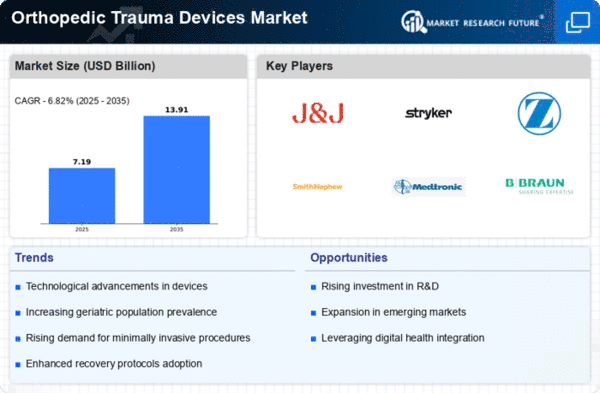
<p>The projected market valuation for the Orthopedic Trauma Devices Market is expected to reach 13.91 USD Billion by 2035.</p>

What was the market valuation of the Orthopedic Trauma Devices Market in 2024?

<p>The overall market valuation of the Orthopedic Trauma Devices Market was 6.73 USD Billion in 2024.</p>

What is the expected CAGR for the Orthopedic Trauma Devices Market during the forecast period 2025 - 2035?

<p>The expected CAGR for the Orthopedic Trauma Devices Market during the forecast period 2025 - 2035 is 6.82%.</p>

Which application segment is projected to have the highest valuation by 2035?

<p>The Fracture Fixation segment is projected to reach 5.54 USD Billion by 2035, indicating its leading position.</p>

What are the key players in the Orthopedic Trauma Devices Market?

<p>Key players in the market include DePuy Synthes, Stryker, Zimmer Biomet, Smith & Nephew, and Medtronic.</p>

How does the valuation of the Joint Reconstruction segment change from 2024 to 2035?

The Joint Reconstruction segment is expected to grow from 1.8 USD Billion in 2024 to 3.73 USD Billion by 2035.

What is the projected valuation for the Soft Tissue Repair segment by 2035?

The Soft Tissue Repair segment is projected to reach 2.04 USD Billion by 2035.

Which device type is anticipated to show the most growth by 2035?

The Screws device type is anticipated to grow from 1.8 USD Billion in 2024 to 3.7 USD Billion by 2035.

What is the expected valuation for the Ambulatory Surgical Centers segment by 2035?

The Ambulatory Surgical Centers segment is expected to reach 2.79 USD Billion by 2035.

What materials are projected to dominate the Orthopedic Trauma Devices Market by 2035?

Metal and Composite materials are projected to dominate, with valuations of 5.54 USD Billion and 4.17 USD Billion, respectively, by 2035.

Market Summary

As per MRFR analysis, the Orthopedic Trauma Devices Market was estimated at 11.7 USD Billion in 2025. The orthopedic trauma devices industry is projected to grow from 12.5 USD Billion in 2026 to 22.7 USD Billion by 2035, exhibiting a compound annual growth rate (CAGR) of 6.8% during the forecast period 2026 - 2035.

Key Market Trends & Highlights

The Orthopedic Trauma Devices Market is experiencing robust growth driven by technological advancements and demographic shifts.

  • North America remains the largest market for orthopedic trauma devices, driven by advanced healthcare infrastructure. The Asia-Pacific region is emerging as the fastest-growing market, fueled by increasing healthcare investments and rising population. Fracture fixation devices dominate the market, while joint reconstruction devices are witnessing the fastest growth due to rising demand for effective treatments. Technological advancements and the aging population are key drivers, alongside a growing focus on minimally invasive surgical techniques.

Market Size & Forecast

2025 Market Size 11.7 (USD Billion)
2035 Market Size 22.7 (USD Billion)
CAGR (2026 - 2035) 6.8%
Largest Regional Market Share in 2024 North America

Major Players

DePuy Synthes (US), Stryker (US), Zimmer Biomet (US), Smith &amp; Nephew (GB), Medtronic (US), B. Braun (DE), Orthofix (US), NuVasive (US), Aesculap (DE)

Market Trends

The Orthopedic Trauma Devices Market is currently experiencing a notable evolution, driven by advancements in technology and an increasing demand for effective treatment solutions. The integration of innovative materials and designs into orthopedic devices appears to enhance patient outcomes and recovery times. Furthermore, the growing prevalence of orthopedic injuries, particularly among the aging population, suggests a sustained need for these devices. As healthcare systems worldwide continue to prioritize patient-centered care, the market is likely to witness further growth, with an emphasis on minimally invasive procedures and personalized treatment options. In addition, the Orthopedic Trauma Devices Market is influenced by ongoing research and development efforts aimed at improving device functionality and safety. Collaborations between manufacturers and healthcare providers may lead to the introduction of next-generation products that address specific patient needs. Regulatory bodies are also playing a crucial role in ensuring that new devices meet stringent safety standards, which could enhance consumer confidence. Overall, the market landscape appears dynamic, with various factors contributing to its expansion and evolution.

Technological Advancements

The Orthopedic Trauma Devices Market is witnessing a surge in technological innovations, including the use of smart materials and robotics. These advancements are likely to improve surgical precision and patient outcomes, making procedures less invasive and more efficient.

Aging Population

The increasing number of elderly individuals globally is contributing to a higher incidence of orthopedic injuries. This demographic shift suggests a growing demand for orthopedic trauma devices, as older adults are more susceptible to fractures and other related conditions.

Focus on Minimally Invasive Techniques

There is a noticeable trend towards minimally invasive surgical techniques within the Orthopedic Trauma Devices Market. These approaches may reduce recovery times and hospital stays, appealing to both patients and healthcare providers.

Orthopedic Trauma Devices Market Market Drivers

Market Growth Projections

The Global Orthopedic Trauma Devices Market Industry is projected to experience robust growth in the coming years. With an estimated market value of 6.73 USD Billion in 2024, the industry is anticipated to expand significantly, reaching 13.9 USD Billion by 2035. This growth trajectory suggests a compound annual growth rate of 6.82% from 2025 to 2035. Such projections indicate a strong demand for orthopedic trauma devices driven by factors such as technological advancements, an aging population, and increasing healthcare expenditure. The market's expansion reflects the ongoing commitment to improving orthopedic care and addressing the needs of patients worldwide.

Growing Geriatric Population

The Global Orthopedic Trauma Devices Market Industry is significantly influenced by the growing geriatric population, which is more susceptible to fractures and orthopedic conditions. According to the United Nations, the number of individuals aged 65 and older is expected to double by 2050, leading to an increased demand for orthopedic trauma devices. This demographic shift necessitates the development of specialized devices tailored to the needs of older patients, such as hip and knee implants. As a result, the market is poised for growth, with a projected compound annual growth rate of 6.82% from 2025 to 2035, reflecting the urgent need for effective orthopedic solutions.

Rising Healthcare Expenditure

Rising healthcare expenditure globally is a crucial driver for the Global Orthopedic Trauma Devices Market Industry. As countries allocate more resources to healthcare, there is a corresponding increase in the availability and accessibility of advanced medical technologies, including orthopedic trauma devices. For instance, nations with robust healthcare systems are investing in innovative surgical techniques and rehabilitation programs, which enhance patient care. This trend is likely to stimulate market growth as healthcare providers seek to improve outcomes for patients with orthopedic injuries. The increasing focus on quality healthcare services is expected to contribute to the market's expansion in the foreseeable future.

Increase in Road Traffic Accidents

The Global Orthopedic Trauma Devices Market Industry is also driven by the alarming rise in road traffic accidents, which contribute significantly to orthopedic injuries. According to the World Health Organization, road traffic injuries claim approximately 1.35 million lives annually, with many survivors requiring orthopedic interventions. This trend underscores the need for advanced trauma devices to address the growing number of injuries sustained in accidents. As awareness of road safety increases and preventive measures are implemented, the demand for orthopedic trauma devices is expected to rise, further propelling market growth in the coming years.

Rising Incidence of Orthopedic Injuries

The Global Orthopedic Trauma Devices Market Industry experiences a notable surge in demand due to the increasing incidence of orthopedic injuries. Factors such as an aging population, active lifestyles, and rising participation in sports contribute to this trend. For instance, the World Health Organization indicates that musculoskeletal disorders are among the leading causes of disability worldwide. This growing prevalence of injuries necessitates advanced orthopedic trauma devices, which are projected to drive the market's growth significantly. The market is expected to reach 6.73 USD Billion in 2024, reflecting the urgent need for innovative solutions in orthopedic care.

Technological Advancements in Orthopedic Devices

Technological advancements play a pivotal role in shaping the Global Orthopedic Trauma Devices Market Industry. Innovations such as 3D printing, minimally invasive surgical techniques, and smart implants enhance the efficacy and safety of orthopedic procedures. These advancements not only improve patient outcomes but also reduce recovery times, thereby increasing the adoption of orthopedic trauma devices. As healthcare providers increasingly seek to integrate cutting-edge technology into their practices, the market is likely to witness substantial growth. By 2035, the market is projected to reach 13.9 USD Billion, underscoring the impact of technology on orthopedic trauma care.

Market Segment Insights

By Application: Fracture Fixation (Largest) vs. Joint Reconstruction (Fastest-Growing)

The Orthopedic Trauma Devices Market is primarily segmented into four key applications: Fracture Fixation, Joint Reconstruction, Spinal Surgery, and <a href="https://www.marketresearchfuture.com/reports/soft-tissue-repair-market-7810" target="_blank" title="soft tissue repair">Soft Tissue Repair</a>. Among these, Fracture Fixation holds the largest share, driven by the increasing incidence of fractures and the aging population. Concurrently, Joint Reconstruction is emerging rapidly, attributed to the growing prevalence of joint-related disorders and increasing sports injuries that necessitate advanced surgical interventions. Market dynamics reflect a robust demand for Fracture Fixation devices as they become integral in emergency and trauma care settings. The advancement in joint reconstruction devices signifies a shift towards more effective and less invasive surgical options, enhancing recovery times and patient satisfaction, thus driving the growth of this segment further in the upcoming years.

Fracture Fixation (Dominant) vs. Soft Tissue Repair (Emerging)

Fracture Fixation remains the dominant application in the Orthopedic Trauma Devices Market, responsible for a significant part of the market revenue due to its pivotal role in treating a variety of fractures, particularly among older adults and athletes. This segment benefits from continuous innovations in implant materials and techniques, leading to improved patient outcomes. On the other hand, Soft Tissue Repair is seen as an emerging segment, gaining traction with advancements like minimally invasive surgical techniques and bioengineering. This segment addresses the repair of ligaments and tendons, supporting a rising trend in sports medicine. As the awareness of soft tissue injuries increases, the demand for effective treatment solutions in this segment is expected to expand, providing opportunities for market players.

By Device Type: Plates (Largest) vs. Screws (Fastest-Growing)

In the Orthopedic Trauma Devices Market, the distribution of market share among device types shows that plates hold the largest portion, given their widespread use in various orthopedic procedures. Screws, however, are emerging rapidly, gaining traction due to their versatility and advancements in material technology which make them lighter and stronger. External fixators and nails contribute to the market as well but to a lesser extent, particularly in specific scenarios such as complex fractures or in the pediatric population.

Plates (Dominant) vs. Screws (Emerging)

Plates are considered the dominant player in the orthopedic trauma device segment due to their critical role in stabilization and support during the healing process. They are commonly used in a variety of fracture types, providing physicians with reliable solutions. On the other hand, screws, labeled as the emerging segment, are witnessing significant growth driven by innovations in design and materials that enhance their efficacy and performance. They are becoming increasingly vital in complex surgical procedures, enabling better outcomes and supporting the trend towards minimally invasive surgeries. Their adaptability and lower profile compared to traditional devices make them a favorable choice for orthopedic surgeons.

By End Use: Hospitals (Largest) vs. Ambulatory Surgical Centers (Fastest-Growing)

<p>In the Orthopedic Trauma Devices Market, hospitals hold the largest market share, reflecting their integral role in trauma care and surgical procedures. Hospitals are equipped with advanced technology and staffed by specialists, making them highly preferred for complex orthopedic surgeries. Ambulatory Surgical Centers (ASCs), although smaller in market share, are rapidly increasing their footprint due to the rising demand for outpatient surgeries, which are typically less invasive and have shorter recovery times. Over the next few years, the distribution of market share is anticipated to evolve, with ASCs gaining more prominence in the orthopedic landscape. Growth trends indicate an increasing shift towards minimally invasive procedures that ASCs often specialize in. Factors such as rising healthcare expenditures, technological advancements in <a href="https://www.marketresearchfuture.com/reports/orthopedic-devices-market-3323" target="_blank" title="orthopedic devices">orthopedic devices</a>, and the growing preference for outpatient surgical solutions drive this growth. Additionally, an increase in sports-related injuries and the aging population are contributing to a higher demand for orthopedic trauma devices across both hospitals and ASCs, with ASCs becoming an appealing option for many patients seeking efficient and effective care.</p>

<p>Hospitals (Dominant) vs. Ambulatory Surgical Centers (Emerging)</p>

<p>Hospitals are the dominant player in the orthopedic trauma devices market, primarily due to their comprehensive facilities that support complex surgical interventions and 24/7 patient care. They are equipped with state-of-the-art technology and offer a wide range of orthopedic treatments, positioning them as the go-to choice for serious traumatic injuries. In contrast, Ambulatory Surgical Centers (ASCs) are emerging as a significant trend in orthopedic care by offering innovative solutions for outpatient procedures. ASCs provide a more convenient, cost-effective, and patient-friendly alternative, often focusing on less invasive surgeries that minimize recovery times. As the preference for outpatient care increases, ASCs are expected to capture a larger segment of the market.</p>

By Material: Metal (Largest) vs. Polymer (Fastest-Growing)

<p>The Orthopedic Trauma Devices Market exhibits a diverse material composition where the metal segment holds the largest share. Metal, primarily in the form of titanium and stainless steel, is favored for its strength and durability, making it essential for various orthopedic applications. Polymer materials are gaining impetus, attributed to their lighter weight and biocompatibility, contributing to their increased usage in trauma devices. Together, these materials dominate and shape the market dynamics.</p>

<p>Material: Metal (Dominant) vs. Polymer (Emerging)</p>

<p>The Metal segment is the dominant force in the Orthopedic Trauma Devices Market due to its exceptional mechanical properties like tensile strength and fatigue resistance. Predominantly used for internal fixation devices such as plates, screws, and nails, metals like titanium and stainless steel provide long-term stability. Conversely, the Polymer segment is emerging rapidly, recognized for its lightweight nature and ability to be molded into complex shapes. Ideal for soft tissue repair and some load-bearing applications, polymers are becoming increasingly popular owing to their biocompatibility and ease of handling in surgical procedures. This combination of properties positions both metals and polymers as crucial components in the evolving landscape of orthopedic trauma devices.</p>

By Surgery Type: Minimally Invasive Surgery (Largest) vs. Robotic Surgery (Fastest-Growing)

<p>The Orthopedic Trauma Devices market exhibits a varied distribution among the types of surgical approaches employed. Currently, Minimally Invasive Surgery (MIS) accounts for a significant share, favored for its reduced recovery times and lower complication rates. Open Surgery, while historically dominant, is gradually declining as MIS and Robotic Surgery gain traction. Each approach is shaped by its own advantages and limitations, influencing patient and surgeon preferences alike. Looking forward, the growth trends within this segment are mostly driven by advancements in surgical techniques and technologies. The burgeoning demand for outpatient procedures is helping fuel interest in Minimally Invasive methods, while Robotic Surgery is gaining attention for its precision and enhanced outcomes. As surgical technology evolves, these trends are expected to continue influencing the market dynamics significantly.</p>

<p>Minimally Invasive Surgery (Dominant) vs. Open Surgery (Emerging)</p>

<p>Minimally Invasive Surgery (MIS) has emerged as the dominant approach in the Orthopedic Trauma Devices market due to its numerous advantages, including reduced pain and shorter recovery times for patients. This methodology relies on smaller incisions and specialized instruments, successfully addressing various orthopedic conditions with enhanced precision. In contrast, Open Surgery, traditionally a standard procedure, is experiencing a resurgence as emerging technologies improve its safety and efficacy. Although it remains pivotal in complex cases, Open Surgery is now often considered in tandem with emerging strategies, particularly in less complicated scenarios. Overall, both methodologies present unique strengths, catering to different clinical needs and aligning with evolving surgical preferences.</p>

Get more detailed insights about Orthopedic Trauma Devices Market Research Report -Forecast to 2035

Regional Insights

North America : Market Leader in Innovation

North America is poised to maintain its leadership in the orthopedic trauma devices market, holding a significant share of 3.5 billion in 2024. The region's growth is driven by an aging population, increasing incidence of orthopedic injuries, and advancements in medical technology. Regulatory support from agencies like the FDA further catalyzes innovation and market expansion, ensuring that new products meet safety and efficacy standards. The competitive landscape is robust, with key players such as DePuy Synthes, Stryker, and Zimmer Biomet leading the charge. The U.S. remains the largest market, supported by a well-established healthcare infrastructure and high healthcare expenditure. Companies are focusing on R&D to introduce minimally invasive solutions, enhancing patient outcomes and driving market growth.

Europe : Emerging Market with Growth Potential

Europe's orthopedic trauma devices market is valued at 1.8 billion, reflecting a growing demand driven by an increase in road accidents and sports injuries. The region benefits from strong regulatory frameworks that promote innovation and ensure product safety. The European Medicines Agency (EMA) plays a crucial role in streamlining the approval process for new devices, which is vital for market growth and consumer trust. Leading countries such as Germany, France, and the UK are at the forefront of this market, with a competitive landscape featuring major players like B. Braun and Smith & Nephew. The presence of advanced healthcare systems and a focus on research and development are key factors contributing to the region's growth. Collaborative efforts between manufacturers and healthcare providers are also enhancing the adoption of innovative orthopedic solutions.

Asia-Pacific : Rapidly Growing Market Segment

The Asia-Pacific orthopedic trauma devices market, valued at 1.3 billion, is experiencing rapid growth due to rising healthcare expenditures and an increasing population. The region is witnessing a surge in orthopedic injuries, driven by urbanization and lifestyle changes. Governments are investing in healthcare infrastructure, which is expected to further boost market demand and accessibility to advanced orthopedic solutions. Countries like China and India are leading the market, with a growing number of local and international players entering the space. The competitive landscape is evolving, with companies focusing on cost-effective solutions to cater to the diverse needs of the population. Partnerships between local manufacturers and global firms are also enhancing product availability and innovation in the region.

Middle East and Africa : Emerging Market with Challenges

The Middle East and Africa orthopedic trauma devices market is valued at 0.13 billion, reflecting a nascent but growing segment. The region faces challenges such as limited healthcare infrastructure and regulatory hurdles, yet there is a rising demand for orthopedic solutions driven by increasing road accidents and sports injuries. Governments are beginning to prioritize healthcare investments, which may catalyze market growth in the coming years. Countries like South Africa and the UAE are leading the market, with a focus on improving healthcare access and quality. The competitive landscape is characterized by a mix of local and international players, with companies seeking to establish a foothold in this emerging market. Collaborative efforts between governments and private sectors are essential for overcoming existing challenges and enhancing market potential.

Key Players and Competitive Insights

The Orthopedic Trauma Devices Market is characterized by a dynamic competitive landscape, driven by technological advancements, an aging population, and increasing incidences of orthopedic injuries. Major players such as DePuy Synthes (US), Stryker (US), and Zimmer Biomet (US) are at the forefront, each adopting distinct strategies to enhance their market presence. DePuy Synthes (US) focuses on innovation through the development of advanced fixation devices, while Stryker (US) emphasizes strategic acquisitions to broaden its product portfolio. Zimmer Biomet (US) is actively pursuing partnerships to enhance its technological capabilities, thereby shaping a competitive environment that is increasingly reliant on innovation and collaboration. Key business tactics within the market include localizing manufacturing to reduce costs and optimize supply chains, which appears to be a common approach among leading firms. The competitive structure of the market is moderately fragmented, with several key players exerting substantial influence. This fragmentation allows for a diverse range of products and solutions, catering to various customer needs and preferences, while also fostering a competitive atmosphere that encourages continuous improvement and innovation. In November 2025, Stryker (US) announced the launch of a new line of biodegradable orthopedic implants, which could potentially revolutionize the treatment of fractures by reducing the need for subsequent surgeries. This strategic move not only aligns with the growing trend towards sustainability but also positions Stryker as a leader in innovative solutions that address both clinical and environmental concerns. The introduction of such products may enhance patient outcomes and reduce healthcare costs, thereby solidifying Stryker's competitive edge. In October 2025, Zimmer Biomet (US) entered into a partnership with a leading AI technology firm to develop smart orthopedic devices that utilize machine learning for improved surgical outcomes. This collaboration signifies a strategic pivot towards integrating digital technologies into orthopedic trauma solutions, which may enhance precision in surgeries and optimize recovery times. The implications of this partnership could be profound, as it positions Zimmer Biomet at the intersection of healthcare and technology, appealing to a tech-savvy demographic of healthcare providers. In September 2025, DePuy Synthes (US) expanded its global footprint by establishing a new manufacturing facility in India, aimed at localizing production and enhancing supply chain efficiency. This strategic expansion not only reduces operational costs but also allows for quicker response times to regional market demands. Such initiatives reflect a broader trend among key players to optimize their supply chains while ensuring product availability in emerging markets, which is crucial for maintaining competitive advantage. As of December 2025, the Orthopedic Trauma Devices Market is witnessing trends such as digitalization, sustainability, and the integration of AI technologies. Strategic alliances are increasingly shaping the competitive landscape, enabling companies to leverage complementary strengths and enhance their offerings. Looking ahead, competitive differentiation is likely to evolve from traditional price-based competition towards a focus on innovation, technological advancements, and supply chain reliability. This shift underscores the importance of adaptability and forward-thinking strategies in a rapidly changing market.

Key Companies in the Orthopedic Trauma Devices Market include

Industry Developments

October 2021: The CurvaFix implant was introduced in the US by CurvaFix Inc. According to reports, the implant can be used to treat pelvic and acetabular fractures.

June 2021: For the purpose of preventing infections, Zimmer Biomet introduced Bactiguard-coated orthopedic trauma implants in a few regions in Europe, the Middle East, and Africa. These implants were given the CE mark in January 2021.

Future Outlook

Orthopedic Trauma Devices Market Future Outlook

The Orthopedic Trauma Devices Market is projected to grow at a 6.8% CAGR from 2026 to 2035, driven by technological advancements, increasing geriatric population, and rising incidence of orthopedic injuries.

New opportunities lie in:

  • <p>Development of smart <a href="https://www.marketresearchfuture.com/reports/orthopedic-implant-market-838" target="_blank" title="orthopedic implant">orthopedic implants</a> with integrated monitoring capabilities. Expansion of telemedicine platforms for remote orthopedic consultations. Investment in biodegradable materials for sustainable trauma devices.</p>

By 2035, the market is expected to achieve substantial growth, reflecting evolving healthcare needs and technological innovations.

Market Segmentation

Orthopedic Trauma Devices Market End User Outlook

  • Hospitals
  • Orthopedic Clinics
  • Ambulatory Surgical Centers

Orthopedic Trauma Devices Market Application Outlook

  • Fracture Fixation
  • Joint Reconstruction
  • Spinal Surgery
  • Soft Tissue Repair

Orthopedic Trauma Devices Market Device Type Outlook

  • Plates
  • Screws
  • Nails
  • External Fixators

Report Scope

MARKET SIZE 2025 11.7(USD Billion)
MARKET SIZE 2026 12.5(USD Billion)
MARKET SIZE 2035 22.7(USD Billion)
COMPOUND ANNUAL GROWTH RATE (CAGR) 6.8% (2026 - 2035)
REPORT COVERAGE Revenue Forecast, Competitive Landscape, Growth Factors, and Trends
BASE YEAR 2025
Market Forecast Period 2026 - 2035
Historical Data 2019 - 2024
Market Forecast Units USD Billion
Key Companies Profiled DePuy Synthes (US), Stryker (US), Zimmer Biomet (US), Smith & Nephew (GB), Medtronic (US), B. Braun (DE), Orthofix (US), NuVasive (US), Aesculap (DE)
Segments Covered Application, Device Type, End User
Key Market Opportunities Integration of advanced materials and smart technologies in Orthopedic Trauma Devices Market enhances patient outcomes and recovery.
Key Market Dynamics Technological advancements and regulatory changes drive innovation and competition in the orthopedic trauma devices market.
Countries Covered North America, Europe, APAC, South America, MEA

FAQs

What is the projected market valuation of the Orthopedic Trauma Devices Market by 2035?

<p>The projected market valuation for the Orthopedic Trauma Devices Market is expected to reach 13.91 USD Billion by 2035.</p>

What was the market valuation of the Orthopedic Trauma Devices Market in 2024?

<p>The overall market valuation of the Orthopedic Trauma Devices Market was 6.73 USD Billion in 2024.</p>

What is the expected CAGR for the Orthopedic Trauma Devices Market during the forecast period 2025 - 2035?

<p>The expected CAGR for the Orthopedic Trauma Devices Market during the forecast period 2025 - 2035 is 6.82%.</p>

Which application segment is projected to have the highest valuation by 2035?

<p>The Fracture Fixation segment is projected to reach 5.54 USD Billion by 2035, indicating its leading position.</p>

What are the key players in the Orthopedic Trauma Devices Market?

<p>Key players in the market include DePuy Synthes, Stryker, Zimmer Biomet, Smith & Nephew, and Medtronic.</p>

How does the valuation of the Joint Reconstruction segment change from 2024 to 2035?

The Joint Reconstruction segment is expected to grow from 1.8 USD Billion in 2024 to 3.73 USD Billion by 2035.

What is the projected valuation for the Soft Tissue Repair segment by 2035?

The Soft Tissue Repair segment is projected to reach 2.04 USD Billion by 2035.

Which device type is anticipated to show the most growth by 2035?

The Screws device type is anticipated to grow from 1.8 USD Billion in 2024 to 3.7 USD Billion by 2035.

What is the expected valuation for the Ambulatory Surgical Centers segment by 2035?

The Ambulatory Surgical Centers segment is expected to reach 2.79 USD Billion by 2035.

What materials are projected to dominate the Orthopedic Trauma Devices Market by 2035?

Metal and Composite materials are projected to dominate, with valuations of 5.54 USD Billion and 4.17 USD Billion, respectively, by 2035.

  1. SECTION I: EXECUTIVE SUMMARY AND KEY HIGHLIGHTS
    1. | 1.1 EXECUTIVE SUMMARY
    2. | | 1.1.1 Market Overview
    3. | | 1.1.2 Key Findings
    4. | | 1.1.3 Market Segmentation
    5. | | 1.1.4 Competitive Landscape
    6. | | 1.1.5 Challenges and Opportunities
    7. | | 1.1.6 Future Outlook
  2. SECTION II: SCOPING, METHODOLOGY AND MARKET STRUCTURE
    1. | 2.1 MARKET INTRODUCTION
    2. | | 2.1.1 Definition
    3. | | 2.1.2 Scope of the study
    4. | | | 2.1.2.1 Research Objective
    5. | | | 2.1.2.2 Assumption
    6. | | | 2.1.2.3 Limitations
    7. | 2.2 RESEARCH METHODOLOGY
    8. | | 2.2.1 Overview
    9. | | 2.2.2 Data Mining
    10. | | 2.2.3 Secondary Research
    11. | | 2.2.4 Primary Research
    12. | | | 2.2.4.1 Primary Interviews and Information Gathering Process
    13. | | | 2.2.4.2 Breakdown of Primary Respondents
    14. | | 2.2.5 Forecasting Model
    15. | | 2.2.6 Market Size Estimation
    16. | | | 2.2.6.1 Bottom-Up Approach
    17. | | | 2.2.6.2 Top-Down Approach
    18. | | 2.2.7 Data Triangulation
    19. | | 2.2.8 Validation
  3. SECTION III: QUALITATIVE ANALYSIS
    1. | 3.1 MARKET DYNAMICS
    2. | | 3.1.1 Overview
    3. | | 3.1.2 Drivers
    4. | | 3.1.3 Restraints
    5. | | 3.1.4 Opportunities
    6. | 3.2 MARKET FACTOR ANALYSIS
    7. | | 3.2.1 Value chain Analysis
    8. | | 3.2.2 Porter's Five Forces Analysis
    9. | | | 3.2.2.1 Bargaining Power of Suppliers
    10. | | | 3.2.2.2 Bargaining Power of Buyers
    11. | | | 3.2.2.3 Threat of New Entrants
    12. | | | 3.2.2.4 Threat of Substitutes
    13. | | | 3.2.2.5 Intensity of Rivalry
    14. | | 3.2.3 COVID-19 Impact Analysis
    15. | | | 3.2.3.1 Market Impact Analysis
    16. | | | 3.2.3.2 Regional Impact
    17. | | | 3.2.3.3 Opportunity and Threat Analysis
  4. SECTION IV: QUANTITATIVE ANALYSIS
    1. | 4.1 Healthcare, BY Application (USD Billion)
    2. | | 4.1.1 Fracture Fixation
    3. | | 4.1.2 Joint Reconstruction
    4. | | 4.1.3 Spinal Surgery
    5. | | 4.1.4 Soft Tissue Repair
    6. | 4.2 Healthcare, BY Device Type (USD Billion)
    7. | | 4.2.1 Plates
    8. | | 4.2.2 Screws
    9. | | 4.2.3 Nails
    10. | | 4.2.4 External Fixators
    11. | 4.3 Healthcare, BY End Use (USD Billion)
    12. | | 4.3.1 Hospitals
    13. | | 4.3.2 Ambulatory Surgical Centers
    14. | | 4.3.3 Orthopedic Clinics
    15. | 4.4 Healthcare, BY Material (USD Billion)
    16. | | 4.4.1 Metal
    17. | | 4.4.2 Polymer
    18. | | 4.4.3 Ceramic
    19. | | 4.4.4 Composite
    20. | 4.5 Healthcare, BY Surgery Type (USD Billion)
    21. | | 4.5.1 Open Surgery
    22. | | 4.5.2 Minimally Invasive Surgery
    23. | | 4.5.3 Robotic Surgery
    24. | 4.6 Healthcare, BY Region (USD Billion)
    25. | | 4.6.1 North America
    26. | | | 4.6.1.1 US
    27. | | | 4.6.1.2 Canada
    28. | | 4.6.2 Europe
    29. | | | 4.6.2.1 Germany
    30. | | | 4.6.2.2 UK
    31. | | | 4.6.2.3 France
    32. | | | 4.6.2.4 Russia
    33. | | | 4.6.2.5 Italy
    34. | | | 4.6.2.6 Spain
    35. | | | 4.6.2.7 Rest of Europe
    36. | | 4.6.3 APAC
    37. | | | 4.6.3.1 China
    38. | | | 4.6.3.2 India
    39. | | | 4.6.3.3 Japan
    40. | | | 4.6.3.4 South Korea
    41. | | | 4.6.3.5 Malaysia
    42. | | | 4.6.3.6 Thailand
    43. | | | 4.6.3.7 Indonesia
    44. | | | 4.6.3.8 Rest of APAC
    45. | | 4.6.4 South America
    46. | | | 4.6.4.1 Brazil
    47. | | | 4.6.4.2 Mexico
    48. | | | 4.6.4.3 Argentina
    49. | | | 4.6.4.4 Rest of South America
    50. | | 4.6.5 MEA
    51. | | | 4.6.5.1 GCC Countries
    52. | | | 4.6.5.2 South Africa
    53. | | | 4.6.5.3 Rest of MEA
  5. SECTION V: COMPETITIVE ANALYSIS
    1. | 5.1 Competitive Landscape
    2. | | 5.1.1 Overview
    3. | | 5.1.2 Competitive Analysis
    4. | | 5.1.3 Market share Analysis
    5. | | 5.1.4 Major Growth Strategy in the Healthcare
    6. | | 5.1.5 Competitive Benchmarking
    7. | | 5.1.6 Leading Players in Terms of Number of Developments in the Healthcare
    8. | | 5.1.7 Key developments and growth strategies
    9. | | | 5.1.7.1 New Product Launch/Service Deployment
    10. | | | 5.1.7.2 Merger & Acquisitions
    11. | | | 5.1.7.3 Joint Ventures
    12. | | 5.1.8 Major Players Financial Matrix
    13. | | | 5.1.8.1 Sales and Operating Income
    14. | | | 5.1.8.2 Major Players R&D Expenditure. 2023
    15. | 5.2 Company Profiles
    16. | | 5.2.1 DePuy Synthes (US)
    17. | | | 5.2.1.1 Financial Overview
    18. | | | 5.2.1.2 Products Offered
    19. | | | 5.2.1.3 Key Developments
    20. | | | 5.2.1.4 SWOT Analysis
    21. | | | 5.2.1.5 Key Strategies
    22. | | 5.2.2 Stryker (US)
    23. | | | 5.2.2.1 Financial Overview
    24. | | | 5.2.2.2 Products Offered
    25. | | | 5.2.2.3 Key Developments
    26. | | | 5.2.2.4 SWOT Analysis
    27. | | | 5.2.2.5 Key Strategies
    28. | | 5.2.3 Zimmer Biomet (US)
    29. | | | 5.2.3.1 Financial Overview
    30. | | | 5.2.3.2 Products Offered
    31. | | | 5.2.3.3 Key Developments
    32. | | | 5.2.3.4 SWOT Analysis
    33. | | | 5.2.3.5 Key Strategies
    34. | | 5.2.4 Smith & Nephew (GB)
    35. | | | 5.2.4.1 Financial Overview
    36. | | | 5.2.4.2 Products Offered
    37. | | | 5.2.4.3 Key Developments
    38. | | | 5.2.4.4 SWOT Analysis
    39. | | | 5.2.4.5 Key Strategies
    40. | | 5.2.5 Medtronic (US)
    41. | | | 5.2.5.1 Financial Overview
    42. | | | 5.2.5.2 Products Offered
    43. | | | 5.2.5.3 Key Developments
    44. | | | 5.2.5.4 SWOT Analysis
    45. | | | 5.2.5.5 Key Strategies
    46. | | 5.2.6 B. Braun (DE)
    47. | | | 5.2.6.1 Financial Overview
    48. | | | 5.2.6.2 Products Offered
    49. | | | 5.2.6.3 Key Developments
    50. | | | 5.2.6.4 SWOT Analysis
    51. | | | 5.2.6.5 Key Strategies
    52. | | 5.2.7 Orthofix (US)
    53. | | | 5.2.7.1 Financial Overview
    54. | | | 5.2.7.2 Products Offered
    55. | | | 5.2.7.3 Key Developments
    56. | | | 5.2.7.4 SWOT Analysis
    57. | | | 5.2.7.5 Key Strategies
    58. | | 5.2.8 NuVasive (US)
    59. | | | 5.2.8.1 Financial Overview
    60. | | | 5.2.8.2 Products Offered
    61. | | | 5.2.8.3 Key Developments
    62. | | | 5.2.8.4 SWOT Analysis
    63. | | | 5.2.8.5 Key Strategies
    64. | | 5.2.9 Aesculap (DE)
    65. | | | 5.2.9.1 Financial Overview
    66. | | | 5.2.9.2 Products Offered
    67. | | | 5.2.9.3 Key Developments
    68. | | | 5.2.9.4 SWOT Analysis
    69. | | | 5.2.9.5 Key Strategies
    70. | 5.3 Appendix
    71. | | 5.3.1 References
    72. | | 5.3.2 Related Reports
  6. LIST OF FIGURES
    1. | 6.1 MARKET SYNOPSIS
    2. | 6.2 NORTH AMERICA MARKET ANALYSIS
    3. | 6.3 US MARKET ANALYSIS BY APPLICATION
    4. | 6.4 US MARKET ANALYSIS BY DEVICE TYPE
    5. | 6.5 US MARKET ANALYSIS BY END USE
    6. | 6.6 US MARKET ANALYSIS BY MATERIAL
    7. | 6.7 US MARKET ANALYSIS BY SURGERY TYPE
    8. | 6.8 CANADA MARKET ANALYSIS BY APPLICATION
    9. | 6.9 CANADA MARKET ANALYSIS BY DEVICE TYPE
    10. | 6.10 CANADA MARKET ANALYSIS BY END USE
    11. | 6.11 CANADA MARKET ANALYSIS BY MATERIAL
    12. | 6.12 CANADA MARKET ANALYSIS BY SURGERY TYPE
    13. | 6.13 EUROPE MARKET ANALYSIS
    14. | 6.14 GERMANY MARKET ANALYSIS BY APPLICATION
    15. | 6.15 GERMANY MARKET ANALYSIS BY DEVICE TYPE
    16. | 6.16 GERMANY MARKET ANALYSIS BY END USE
    17. | 6.17 GERMANY MARKET ANALYSIS BY MATERIAL
    18. | 6.18 GERMANY MARKET ANALYSIS BY SURGERY TYPE
    19. | 6.19 UK MARKET ANALYSIS BY APPLICATION
    20. | 6.20 UK MARKET ANALYSIS BY DEVICE TYPE
    21. | 6.21 UK MARKET ANALYSIS BY END USE
    22. | 6.22 UK MARKET ANALYSIS BY MATERIAL
    23. | 6.23 UK MARKET ANALYSIS BY SURGERY TYPE
    24. | 6.24 FRANCE MARKET ANALYSIS BY APPLICATION
    25. | 6.25 FRANCE MARKET ANALYSIS BY DEVICE TYPE
    26. | 6.26 FRANCE MARKET ANALYSIS BY END USE
    27. | 6.27 FRANCE MARKET ANALYSIS BY MATERIAL
    28. | 6.28 FRANCE MARKET ANALYSIS BY SURGERY TYPE
    29. | 6.29 RUSSIA MARKET ANALYSIS BY APPLICATION
    30. | 6.30 RUSSIA MARKET ANALYSIS BY DEVICE TYPE
    31. | 6.31 RUSSIA MARKET ANALYSIS BY END USE
    32. | 6.32 RUSSIA MARKET ANALYSIS BY MATERIAL
    33. | 6.33 RUSSIA MARKET ANALYSIS BY SURGERY TYPE
    34. | 6.34 ITALY MARKET ANALYSIS BY APPLICATION
    35. | 6.35 ITALY MARKET ANALYSIS BY DEVICE TYPE
    36. | 6.36 ITALY MARKET ANALYSIS BY END USE
    37. | 6.37 ITALY MARKET ANALYSIS BY MATERIAL
    38. | 6.38 ITALY MARKET ANALYSIS BY SURGERY TYPE
    39. | 6.39 SPAIN MARKET ANALYSIS BY APPLICATION
    40. | 6.40 SPAIN MARKET ANALYSIS BY DEVICE TYPE
    41. | 6.41 SPAIN MARKET ANALYSIS BY END USE
    42. | 6.42 SPAIN MARKET ANALYSIS BY MATERIAL
    43. | 6.43 SPAIN MARKET ANALYSIS BY SURGERY TYPE
    44. | 6.44 REST OF EUROPE MARKET ANALYSIS BY APPLICATION
    45. | 6.45 REST OF EUROPE MARKET ANALYSIS BY DEVICE TYPE
    46. | 6.46 REST OF EUROPE MARKET ANALYSIS BY END USE
    47. | 6.47 REST OF EUROPE MARKET ANALYSIS BY MATERIAL
    48. | 6.48 REST OF EUROPE MARKET ANALYSIS BY SURGERY TYPE
    49. | 6.49 APAC MARKET ANALYSIS
    50. | 6.50 CHINA MARKET ANALYSIS BY APPLICATION
    51. | 6.51 CHINA MARKET ANALYSIS BY DEVICE TYPE
    52. | 6.52 CHINA MARKET ANALYSIS BY END USE
    53. | 6.53 CHINA MARKET ANALYSIS BY MATERIAL
    54. | 6.54 CHINA MARKET ANALYSIS BY SURGERY TYPE
    55. | 6.55 INDIA MARKET ANALYSIS BY APPLICATION
    56. | 6.56 INDIA MARKET ANALYSIS BY DEVICE TYPE
    57. | 6.57 INDIA MARKET ANALYSIS BY END USE
    58. | 6.58 INDIA MARKET ANALYSIS BY MATERIAL
    59. | 6.59 INDIA MARKET ANALYSIS BY SURGERY TYPE
    60. | 6.60 JAPAN MARKET ANALYSIS BY APPLICATION
    61. | 6.61 JAPAN MARKET ANALYSIS BY DEVICE TYPE
    62. | 6.62 JAPAN MARKET ANALYSIS BY END USE
    63. | 6.63 JAPAN MARKET ANALYSIS BY MATERIAL
    64. | 6.64 JAPAN MARKET ANALYSIS BY SURGERY TYPE
    65. | 6.65 SOUTH KOREA MARKET ANALYSIS BY APPLICATION
    66. | 6.66 SOUTH KOREA MARKET ANALYSIS BY DEVICE TYPE
    67. | 6.67 SOUTH KOREA MARKET ANALYSIS BY END USE
    68. | 6.68 SOUTH KOREA MARKET ANALYSIS BY MATERIAL
    69. | 6.69 SOUTH KOREA MARKET ANALYSIS BY SURGERY TYPE
    70. | 6.70 MALAYSIA MARKET ANALYSIS BY APPLICATION
    71. | 6.71 MALAYSIA MARKET ANALYSIS BY DEVICE TYPE
    72. | 6.72 MALAYSIA MARKET ANALYSIS BY END USE
    73. | 6.73 MALAYSIA MARKET ANALYSIS BY MATERIAL
    74. | 6.74 MALAYSIA MARKET ANALYSIS BY SURGERY TYPE
    75. | 6.75 THAILAND MARKET ANALYSIS BY APPLICATION
    76. | 6.76 THAILAND MARKET ANALYSIS BY DEVICE TYPE
    77. | 6.77 THAILAND MARKET ANALYSIS BY END USE
    78. | 6.78 THAILAND MARKET ANALYSIS BY MATERIAL
    79. | 6.79 THAILAND MARKET ANALYSIS BY SURGERY TYPE
    80. | 6.80 INDONESIA MARKET ANALYSIS BY APPLICATION
    81. | 6.81 INDONESIA MARKET ANALYSIS BY DEVICE TYPE
    82. | 6.82 INDONESIA MARKET ANALYSIS BY END USE
    83. | 6.83 INDONESIA MARKET ANALYSIS BY MATERIAL
    84. | 6.84 INDONESIA MARKET ANALYSIS BY SURGERY TYPE
    85. | 6.85 REST OF APAC MARKET ANALYSIS BY APPLICATION
    86. | 6.86 REST OF APAC MARKET ANALYSIS BY DEVICE TYPE
    87. | 6.87 REST OF APAC MARKET ANALYSIS BY END USE
    88. | 6.88 REST OF APAC MARKET ANALYSIS BY MATERIAL
    89. | 6.89 REST OF APAC MARKET ANALYSIS BY SURGERY TYPE
    90. | 6.90 SOUTH AMERICA MARKET ANALYSIS
    91. | 6.91 BRAZIL MARKET ANALYSIS BY APPLICATION
    92. | 6.92 BRAZIL MARKET ANALYSIS BY DEVICE TYPE
    93. | 6.93 BRAZIL MARKET ANALYSIS BY END USE
    94. | 6.94 BRAZIL MARKET ANALYSIS BY MATERIAL
    95. | 6.95 BRAZIL MARKET ANALYSIS BY SURGERY TYPE
    96. | 6.96 MEXICO MARKET ANALYSIS BY APPLICATION
    97. | 6.97 MEXICO MARKET ANALYSIS BY DEVICE TYPE
    98. | 6.98 MEXICO MARKET ANALYSIS BY END USE
    99. | 6.99 MEXICO MARKET ANALYSIS BY MATERIAL
    100. | 6.100 MEXICO MARKET ANALYSIS BY SURGERY TYPE
    101. | 6.101 ARGENTINA MARKET ANALYSIS BY APPLICATION
    102. | 6.102 ARGENTINA MARKET ANALYSIS BY DEVICE TYPE
    103. | 6.103 ARGENTINA MARKET ANALYSIS BY END USE
    104. | 6.104 ARGENTINA MARKET ANALYSIS BY MATERIAL
    105. | 6.105 ARGENTINA MARKET ANALYSIS BY SURGERY TYPE
    106. | 6.106 REST OF SOUTH AMERICA MARKET ANALYSIS BY APPLICATION
    107. | 6.107 REST OF SOUTH AMERICA MARKET ANALYSIS BY DEVICE TYPE
    108. | 6.108 REST OF SOUTH AMERICA MARKET ANALYSIS BY END USE
    109. | 6.109 REST OF SOUTH AMERICA MARKET ANALYSIS BY MATERIAL
    110. | 6.110 REST OF SOUTH AMERICA MARKET ANALYSIS BY SURGERY TYPE
    111. | 6.111 MEA MARKET ANALYSIS
    112. | 6.112 GCC COUNTRIES MARKET ANALYSIS BY APPLICATION
    113. | 6.113 GCC COUNTRIES MARKET ANALYSIS BY DEVICE TYPE
    114. | 6.114 GCC COUNTRIES MARKET ANALYSIS BY END USE
    115. | 6.115 GCC COUNTRIES MARKET ANALYSIS BY MATERIAL
    116. | 6.116 GCC COUNTRIES MARKET ANALYSIS BY SURGERY TYPE
    117. | 6.117 SOUTH AFRICA MARKET ANALYSIS BY APPLICATION
    118. | 6.118 SOUTH AFRICA MARKET ANALYSIS BY DEVICE TYPE
    119. | 6.119 SOUTH AFRICA MARKET ANALYSIS BY END USE
    120. | 6.120 SOUTH AFRICA MARKET ANALYSIS BY MATERIAL
    121. | 6.121 SOUTH AFRICA MARKET ANALYSIS BY SURGERY TYPE
    122. | 6.122 REST OF MEA MARKET ANALYSIS BY APPLICATION
    123. | 6.123 REST OF MEA MARKET ANALYSIS BY DEVICE TYPE
    124. | 6.124 REST OF MEA MARKET ANALYSIS BY END USE
    125. | 6.125 REST OF MEA MARKET ANALYSIS BY MATERIAL
    126. | 6.126 REST OF MEA MARKET ANALYSIS BY SURGERY TYPE
    127. | 6.127 KEY BUYING CRITERIA OF HEALTHCARE
    128. | 6.128 RESEARCH PROCESS OF MRFR
    129. | 6.129 DRO ANALYSIS OF HEALTHCARE
    130. | 6.130 DRIVERS IMPACT ANALYSIS: HEALTHCARE
    131. | 6.131 RESTRAINTS IMPACT ANALYSIS: HEALTHCARE
    132. | 6.132 SUPPLY / VALUE CHAIN: HEALTHCARE
    133. | 6.133 HEALTHCARE, BY APPLICATION, 2024 (% SHARE)
    134. | 6.134 HEALTHCARE, BY APPLICATION, 2024 TO 2035 (USD Billion)
    135. | 6.135 HEALTHCARE, BY DEVICE TYPE, 2024 (% SHARE)
    136. | 6.136 HEALTHCARE, BY DEVICE TYPE, 2024 TO 2035 (USD Billion)
    137. | 6.137 HEALTHCARE, BY END USE, 2024 (% SHARE)
    138. | 6.138 HEALTHCARE, BY END USE, 2024 TO 2035 (USD Billion)
    139. | 6.139 HEALTHCARE, BY MATERIAL, 2024 (% SHARE)
    140. | 6.140 HEALTHCARE, BY MATERIAL, 2024 TO 2035 (USD Billion)
    141. | 6.141 HEALTHCARE, BY SURGERY TYPE, 2024 (% SHARE)
    142. | 6.142 HEALTHCARE, BY SURGERY TYPE, 2024 TO 2035 (USD Billion)
    143. | 6.143 BENCHMARKING OF MAJOR COMPETITORS
  7. LIST OF TABLES
    1. | 7.1 LIST OF ASSUMPTIONS
    2. | | 7.1.1
    3. | 7.2 North America MARKET SIZE ESTIMATES; FORECAST
    4. | | 7.2.1 BY APPLICATION, 2025-2035 (USD Billion)
    5. | | 7.2.2 BY DEVICE TYPE, 2025-2035 (USD Billion)
    6. | | 7.2.3 BY END USE, 2025-2035 (USD Billion)
    7. | | 7.2.4 BY MATERIAL, 2025-2035 (USD Billion)
    8. | | 7.2.5 BY SURGERY TYPE, 2025-2035 (USD Billion)
    9. | 7.3 US MARKET SIZE ESTIMATES; FORECAST
    10. | | 7.3.1 BY APPLICATION, 2025-2035 (USD Billion)
    11. | | 7.3.2 BY DEVICE TYPE, 2025-2035 (USD Billion)
    12. | | 7.3.3 BY END USE, 2025-2035 (USD Billion)
    13. | | 7.3.4 BY MATERIAL, 2025-2035 (USD Billion)
    14. | | 7.3.5 BY SURGERY TYPE, 2025-2035 (USD Billion)
    15. | 7.4 Canada MARKET SIZE ESTIMATES; FORECAST
    16. | | 7.4.1 BY APPLICATION, 2025-2035 (USD Billion)
    17. | | 7.4.2 BY DEVICE TYPE, 2025-2035 (USD Billion)
    18. | | 7.4.3 BY END USE, 2025-2035 (USD Billion)
    19. | | 7.4.4 BY MATERIAL, 2025-2035 (USD Billion)
    20. | | 7.4.5 BY SURGERY TYPE, 2025-2035 (USD Billion)
    21. | 7.5 Europe MARKET SIZE ESTIMATES; FORECAST
    22. | | 7.5.1 BY APPLICATION, 2025-2035 (USD Billion)
    23. | | 7.5.2 BY DEVICE TYPE, 2025-2035 (USD Billion)
    24. | | 7.5.3 BY END USE, 2025-2035 (USD Billion)
    25. | | 7.5.4 BY MATERIAL, 2025-2035 (USD Billion)
    26. | | 7.5.5 BY SURGERY TYPE, 2025-2035 (USD Billion)
    27. | 7.6 Germany MARKET SIZE ESTIMATES; FORECAST
    28. | | 7.6.1 BY APPLICATION, 2025-2035 (USD Billion)
    29. | | 7.6.2 BY DEVICE TYPE, 2025-2035 (USD Billion)
    30. | | 7.6.3 BY END USE, 2025-2035 (USD Billion)
    31. | | 7.6.4 BY MATERIAL, 2025-2035 (USD Billion)
    32. | | 7.6.5 BY SURGERY TYPE, 2025-2035 (USD Billion)
    33. | 7.7 UK MARKET SIZE ESTIMATES; FORECAST
    34. | | 7.7.1 BY APPLICATION, 2025-2035 (USD Billion)
    35. | | 7.7.2 BY DEVICE TYPE, 2025-2035 (USD Billion)
    36. | | 7.7.3 BY END USE, 2025-2035 (USD Billion)
    37. | | 7.7.4 BY MATERIAL, 2025-2035 (USD Billion)
    38. | | 7.7.5 BY SURGERY TYPE, 2025-2035 (USD Billion)
    39. | 7.8 France MARKET SIZE ESTIMATES; FORECAST
    40. | | 7.8.1 BY APPLICATION, 2025-2035 (USD Billion)
    41. | | 7.8.2 BY DEVICE TYPE, 2025-2035 (USD Billion)
    42. | | 7.8.3 BY END USE, 2025-2035 (USD Billion)
    43. | | 7.8.4 BY MATERIAL, 2025-2035 (USD Billion)
    44. | | 7.8.5 BY SURGERY TYPE, 2025-2035 (USD Billion)
    45. | 7.9 Russia MARKET SIZE ESTIMATES; FORECAST
    46. | | 7.9.1 BY APPLICATION, 2025-2035 (USD Billion)
    47. | | 7.9.2 BY DEVICE TYPE, 2025-2035 (USD Billion)
    48. | | 7.9.3 BY END USE, 2025-2035 (USD Billion)
    49. | | 7.9.4 BY MATERIAL, 2025-2035 (USD Billion)
    50. | | 7.9.5 BY SURGERY TYPE, 2025-2035 (USD Billion)
    51. | 7.10 Italy MARKET SIZE ESTIMATES; FORECAST
    52. | | 7.10.1 BY APPLICATION, 2025-2035 (USD Billion)
    53. | | 7.10.2 BY DEVICE TYPE, 2025-2035 (USD Billion)
    54. | | 7.10.3 BY END USE, 2025-2035 (USD Billion)
    55. | | 7.10.4 BY MATERIAL, 2025-2035 (USD Billion)
    56. | | 7.10.5 BY SURGERY TYPE, 2025-2035 (USD Billion)
    57. | 7.11 Spain MARKET SIZE ESTIMATES; FORECAST
    58. | | 7.11.1 BY APPLICATION, 2025-2035 (USD Billion)
    59. | | 7.11.2 BY DEVICE TYPE, 2025-2035 (USD Billion)
    60. | | 7.11.3 BY END USE, 2025-2035 (USD Billion)
    61. | | 7.11.4 BY MATERIAL, 2025-2035 (USD Billion)
    62. | | 7.11.5 BY SURGERY TYPE, 2025-2035 (USD Billion)
    63. | 7.12 Rest of Europe MARKET SIZE ESTIMATES; FORECAST
    64. | | 7.12.1 BY APPLICATION, 2025-2035 (USD Billion)
    65. | | 7.12.2 BY DEVICE TYPE, 2025-2035 (USD Billion)
    66. | | 7.12.3 BY END USE, 2025-2035 (USD Billion)
    67. | | 7.12.4 BY MATERIAL, 2025-2035 (USD Billion)
    68. | | 7.12.5 BY SURGERY TYPE, 2025-2035 (USD Billion)
    69. | 7.13 APAC MARKET SIZE ESTIMATES; FORECAST
    70. | | 7.13.1 BY APPLICATION, 2025-2035 (USD Billion)
    71. | | 7.13.2 BY DEVICE TYPE, 2025-2035 (USD Billion)
    72. | | 7.13.3 BY END USE, 2025-2035 (USD Billion)
    73. | | 7.13.4 BY MATERIAL, 2025-2035 (USD Billion)
    74. | | 7.13.5 BY SURGERY TYPE, 2025-2035 (USD Billion)
    75. | 7.14 China MARKET SIZE ESTIMATES; FORECAST
    76. | | 7.14.1 BY APPLICATION, 2025-2035 (USD Billion)
    77. | | 7.14.2 BY DEVICE TYPE, 2025-2035 (USD Billion)
    78. | | 7.14.3 BY END USE, 2025-2035 (USD Billion)
    79. | | 7.14.4 BY MATERIAL, 2025-2035 (USD Billion)
    80. | | 7.14.5 BY SURGERY TYPE, 2025-2035 (USD Billion)
    81. | 7.15 India MARKET SIZE ESTIMATES; FORECAST
    82. | | 7.15.1 BY APPLICATION, 2025-2035 (USD Billion)
    83. | | 7.15.2 BY DEVICE TYPE, 2025-2035 (USD Billion)
    84. | | 7.15.3 BY END USE, 2025-2035 (USD Billion)
    85. | | 7.15.4 BY MATERIAL, 2025-2035 (USD Billion)
    86. | | 7.15.5 BY SURGERY TYPE, 2025-2035 (USD Billion)
    87. | 7.16 Japan MARKET SIZE ESTIMATES; FORECAST
    88. | | 7.16.1 BY APPLICATION, 2025-2035 (USD Billion)
    89. | | 7.16.2 BY DEVICE TYPE, 2025-2035 (USD Billion)
    90. | | 7.16.3 BY END USE, 2025-2035 (USD Billion)
    91. | | 7.16.4 BY MATERIAL, 2025-2035 (USD Billion)
    92. | | 7.16.5 BY SURGERY TYPE, 2025-2035 (USD Billion)
    93. | 7.17 South Korea MARKET SIZE ESTIMATES; FORECAST
    94. | | 7.17.1 BY APPLICATION, 2025-2035 (USD Billion)
    95. | | 7.17.2 BY DEVICE TYPE, 2025-2035 (USD Billion)
    96. | | 7.17.3 BY END USE, 2025-2035 (USD Billion)
    97. | | 7.17.4 BY MATERIAL, 2025-2035 (USD Billion)
    98. | | 7.17.5 BY SURGERY TYPE, 2025-2035 (USD Billion)
    99. | 7.18 Malaysia MARKET SIZE ESTIMATES; FORECAST
    100. | | 7.18.1 BY APPLICATION, 2025-2035 (USD Billion)
    101. | | 7.18.2 BY DEVICE TYPE, 2025-2035 (USD Billion)
    102. | | 7.18.3 BY END USE, 2025-2035 (USD Billion)
    103. | | 7.18.4 BY MATERIAL, 2025-2035 (USD Billion)
    104. | | 7.18.5 BY SURGERY TYPE, 2025-2035 (USD Billion)
    105. | 7.19 Thailand MARKET SIZE ESTIMATES; FORECAST
    106. | | 7.19.1 BY APPLICATION, 2025-2035 (USD Billion)
    107. | | 7.19.2 BY DEVICE TYPE, 2025-2035 (USD Billion)
    108. | | 7.19.3 BY END USE, 2025-2035 (USD Billion)
    109. | | 7.19.4 BY MATERIAL, 2025-2035 (USD Billion)
    110. | | 7.19.5 BY SURGERY TYPE, 2025-2035 (USD Billion)
    111. | 7.20 Indonesia MARKET SIZE ESTIMATES; FORECAST
    112. | | 7.20.1 BY APPLICATION, 2025-2035 (USD Billion)
    113. | | 7.20.2 BY DEVICE TYPE, 2025-2035 (USD Billion)
    114. | | 7.20.3 BY END USE, 2025-2035 (USD Billion)
    115. | | 7.20.4 BY MATERIAL, 2025-2035 (USD Billion)
    116. | | 7.20.5 BY SURGERY TYPE, 2025-2035 (USD Billion)
    117. | 7.21 Rest of APAC MARKET SIZE ESTIMATES; FORECAST
    118. | | 7.21.1 BY APPLICATION, 2025-2035 (USD Billion)
    119. | | 7.21.2 BY DEVICE TYPE, 2025-2035 (USD Billion)
    120. | | 7.21.3 BY END USE, 2025-2035 (USD Billion)
    121. | | 7.21.4 BY MATERIAL, 2025-2035 (USD Billion)
    122. | | 7.21.5 BY SURGERY TYPE, 2025-2035 (USD Billion)
    123. | 7.22 South America MARKET SIZE ESTIMATES; FORECAST
    124. | | 7.22.1 BY APPLICATION, 2025-2035 (USD Billion)
    125. | | 7.22.2 BY DEVICE TYPE, 2025-2035 (USD Billion)
    126. | | 7.22.3 BY END USE, 2025-2035 (USD Billion)
    127. | | 7.22.4 BY MATERIAL, 2025-2035 (USD Billion)
    128. | | 7.22.5 BY SURGERY TYPE, 2025-2035 (USD Billion)
    129. | 7.23 Brazil MARKET SIZE ESTIMATES; FORECAST
    130. | | 7.23.1 BY APPLICATION, 2025-2035 (USD Billion)
    131. | | 7.23.2 BY DEVICE TYPE, 2025-2035 (USD Billion)
    132. | | 7.23.3 BY END USE, 2025-2035 (USD Billion)
    133. | | 7.23.4 BY MATERIAL, 2025-2035 (USD Billion)
    134. | | 7.23.5 BY SURGERY TYPE, 2025-2035 (USD Billion)
    135. | 7.24 Mexico MARKET SIZE ESTIMATES; FORECAST
    136. | | 7.24.1 BY APPLICATION, 2025-2035 (USD Billion)
    137. | | 7.24.2 BY DEVICE TYPE, 2025-2035 (USD Billion)
    138. | | 7.24.3 BY END USE, 2025-2035 (USD Billion)
    139. | | 7.24.4 BY MATERIAL, 2025-2035 (USD Billion)
    140. | | 7.24.5 BY SURGERY TYPE, 2025-2035 (USD Billion)
    141. | 7.25 Argentina MARKET SIZE ESTIMATES; FORECAST
    142. | | 7.25.1 BY APPLICATION, 2025-2035 (USD Billion)
    143. | | 7.25.2 BY DEVICE TYPE, 2025-2035 (USD Billion)
    144. | | 7.25.3 BY END USE, 2025-2035 (USD Billion)
    145. | | 7.25.4 BY MATERIAL, 2025-2035 (USD Billion)
    146. | | 7.25.5 BY SURGERY TYPE, 2025-2035 (USD Billion)
    147. | 7.26 Rest of South America MARKET SIZE ESTIMATES; FORECAST
    148. | | 7.26.1 BY APPLICATION, 2025-2035 (USD Billion)
    149. | | 7.26.2 BY DEVICE TYPE, 2025-2035 (USD Billion)
    150. | | 7.26.3 BY END USE, 2025-2035 (USD Billion)
    151. | | 7.26.4 BY MATERIAL, 2025-2035 (USD Billion)
    152. | | 7.26.5 BY SURGERY TYPE, 2025-2035 (USD Billion)
    153. | 7.27 MEA MARKET SIZE ESTIMATES; FORECAST
    154. | | 7.27.1 BY APPLICATION, 2025-2035 (USD Billion)
    155. | | 7.27.2 BY DEVICE TYPE, 2025-2035 (USD Billion)
    156. | | 7.27.3 BY END USE, 2025-2035 (USD Billion)
    157. | | 7.27.4 BY MATERIAL, 2025-2035 (USD Billion)
    158. | | 7.27.5 BY SURGERY TYPE, 2025-2035 (USD Billion)
    159. | 7.28 GCC Countries MARKET SIZE ESTIMATES; FORECAST
    160. | | 7.28.1 BY APPLICATION, 2025-2035 (USD Billion)
    161. | | 7.28.2 BY DEVICE TYPE, 2025-2035 (USD Billion)
    162. | | 7.28.3 BY END USE, 2025-2035 (USD Billion)
    163. | | 7.28.4 BY MATERIAL, 2025-2035 (USD Billion)
    164. | | 7.28.5 BY SURGERY TYPE, 2025-2035 (USD Billion)
    165. | 7.29 South Africa MARKET SIZE ESTIMATES; FORECAST
    166. | | 7.29.1 BY APPLICATION, 2025-2035 (USD Billion)
    167. | | 7.29.2 BY DEVICE TYPE, 2025-2035 (USD Billion)
    168. | | 7.29.3 BY END USE, 2025-2035 (USD Billion)
    169. | | 7.29.4 BY MATERIAL, 2025-2035 (USD Billion)
    170. | | 7.29.5 BY SURGERY TYPE, 2025-2035 (USD Billion)
    171. | 7.30 Rest of MEA MARKET SIZE ESTIMATES; FORECAST
    172. | | 7.30.1 BY APPLICATION, 2025-2035 (USD Billion)
    173. | | 7.30.2 BY DEVICE TYPE, 2025-2035 (USD Billion)
    174. | | 7.30.3 BY END USE, 2025-2035 (USD Billion)
    175. | | 7.30.4 BY MATERIAL, 2025-2035 (USD Billion)
    176. | | 7.30.5 BY SURGERY TYPE, 2025-2035 (USD Billion)
    177. | 7.31 PRODUCT LAUNCH/PRODUCT DEVELOPMENT/APPROVAL
    178. | | 7.31.1
    179. | 7.32 ACQUISITION/PARTNERSHIP
    180. | | 7.32.1

Healthcare Market Segmentation

Healthcare By Application (USD Billion, 2025-2035)

  • Fracture Fixation
  • Joint Reconstruction
  • Spinal Surgery
  • Soft Tissue Repair

Healthcare By Device Type (USD Billion, 2025-2035)

  • Plates
  • Screws
  • Nails
  • External Fixators

Healthcare By End Use (USD Billion, 2025-2035)

  • Hospitals
  • Ambulatory Surgical Centers
  • Orthopedic Clinics

Healthcare By Material (USD Billion, 2025-2035)

  • Metal
  • Polymer
  • Ceramic
  • Composite

Healthcare By Surgery Type (USD Billion, 2025-2035)

  • Open Surgery
  • Minimally Invasive Surgery
  • Robotic Surgery
Infographic

Free Sample Request

Kindly complete the form below to receive a free sample of this Report

Get Free Sample

Customer Strories

Compare Licence

×
Features License Type
Single User Multiuser License Enterprise User
Price $4,950 $5,950 $7,250
Maximum User Access Limit 1 User Upto 10 Users Unrestricted Access Throughout the Organization
Free Customization
Direct Access to Analyst
Deliverable Format
Platform Access
Discount on Next Purchase 10% 15% 15%
Printable Versions