×
Hero Background
English
Chinese
French
Japanese
Korean
German
Spanish

Orthopedic Trauma Devices Market Share

ID: MRFR/MED/1548-HCR
90 Pages
Kinjoll Dey
October 2025

Orthopedic Trauma Devices Market Research Report By Material Type (Bioabsorbable Materials and Non-Absorbable Materials), By Product Type (Internal Fixator and External Fixator), By End-User (Hospitals, Clinics and Orthopedic Centers), and By Region (North America, Europe, Asia-Pacific, And Rest Of The World) – Competitor Industry Analysis and Forecast Till 2035

Share:
Download PDF ×

We do not share your information with anyone. However, we may send you emails based on your report interest from time to time. You may contact us at any time to opt-out.

Orthopedic Trauma Devices Market Infographic
Purchase Options

Market Share

Orthopedic Trauma Devices Market Share Analysis

The orthopedic trauma devices market is a critical sector of the healthcare industry that employs various strategies for market share positioning to negotiate the competitive landscape and meet different needs of patients and health care providers. Some companies opt for product differentiation as their main strategy; they do this by focusing on producing specialized, cutting-edge trauma products. These may include trauma devices made from sophisticated materials with improved designs or enhanced functionality thereby distinguishing them in the market. This tactic attracts not only orthopedic surgeons looking for cutting-edge solutions but also allows firms to command premium prices for their specialized devices as well. It is a strategy that promotes a reputation for delivering state-of-the-art trauma services.

Another key strategy adopted in the Orthopedic Trauma Devices Market is cost leadership. Companies endeavor to become low-cost suppliers of trauma devices without compromising quality and effectiveness. This approach works best in cost-sensitive markets such as healthcare institutions under financial constraints. By improving manufacturing processes, managing supply chains and benefiting from economies of scale, manufacturers can provide affordable yet dependable trauma devices. Additionally, this policy helps address budgetary limitations faced by healthcare providers while also providing an avenue into developing markets where affordability is key.

Market segmentation emerges as one of the vital tactics whereby companies produce trauma devices specifically designed for certain orthopedic segments or applications. Multiple fractures within distinct body parts may necessitate different types of trauma devices hence customization ensures each device addresses unique demands from targeted patient groups. With this type of focus, businesses can position themselves perfectly with respect to what orthopedic doctors and hospitals are seeking hence creating competitive advantage against competitors in that line of operation. Furthermore, specialization in particular areas within orthopedics makes companies leaders in specific market sectors, which builds confidence among their target audience.

Continuous innovation remains a cornerstone for success in the Orthopedic Trauma Devices Market because it calls for investing heavily into R&D activities, keeping up with technology trends and adjusting products accordingly so as to retain market share. The use of bioresorbable polymers, more efficient manufacturing techniques and smart technologies are some of the moves that help in transforming trauma devices. This is a way for manufacturers to stay ahead of their rivals thereby providing surgeons with machines used to enhance patient outcomes.


Author
Kinjoll Dey
Research Analyst Level I

He is an extremely curious individual currently working in Healthcare and Medical Devices Domain. Kinjoll is comfortably versed in data centric research backed by healthcare educational background. He leverages extensive data mining and analytics tools such as Primary and Secondary Research, Statistical Analysis, Machine Learning, Data Modelling. His key role also involves Technical Sales Support, Client Interaction and Project management within the Healthcare team. Lastly, he showcases extensive affinity towards learning new skills and remain fascinated in implementing them.

Leave a Comment

FAQs

What is the projected growth of the Medical Orthopedic Trauma Devices market?

The Orthopedic Trauma Devices market is the expected increase in total market value of 13.91 USD billion over a defined forecast period 2025–2035. It is driven by factors such as demand trends, technological advances, regulatory changes, and geographic expansion.

What is the size of the Medical Orthopedic Trauma Devices market?

Orthopedic Trauma Devices market size was valued at approximately 6.73 billion USD in 2024. This figure will reach 13.91 billion USD covering all regions (America, Europe, Asia, MEA and ROW), focusing its segments / services / distribution channels till 2035.

What is the CAGR of the Medical Orthopedic Trauma Devices market?

Orthopedic Trauma Devices market is expected to grow at a CAGR of 6.82% between 2025 and 2035.

How much will the Orthopedic Trauma Devices market be worth by 2035?

Orthopedic Trauma Devices market is expected to be worth of 13.91 billion USD, reflecting growth driven by usage, technology and global demands by the end of 2035.

How will the Orthopedic Trauma Devices market perform over the next 10 years?

Over the next 10 years the Orthopedic Trauma Devices market is expected to shift from usd billion 6.73 to 13.91 billion USD, led by adoption of advanced tech, demographic trends, regulatory approvals, with potential headwinds from 2025 to 2035.

Market Summary

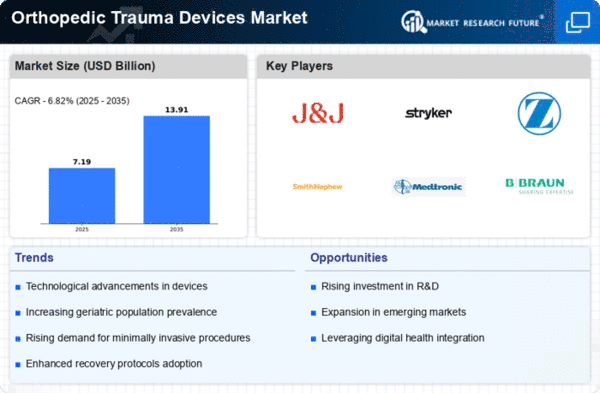
As per Market Research Future analysis, the Orthopedic Trauma Devices Market was estimated at 6.73 USD Billion in 2024. The orthopedic trauma devices industry is projected to grow from 7.19 USD Billion in 2025 to 13.91 USD Billion by 2035, exhibiting a compound annual growth rate (CAGR) of 6.82 during the forecast period 2025 - 2035.

Key Market Trends & Highlights

The Orthopedic Trauma Devices Market is experiencing robust growth driven by technological advancements and demographic shifts.

  • Technological advancements are revolutionizing Orthopedics Trauma and Specialty, enhancing surgical outcomes and recovery times. The aging population in North America is contributing to a rising demand for orthopedic trauma solutions, particularly in fracture fixation. Increased sports participation in Asia-Pacific is driving the need for innovative trauma devices, especially in the joint reconstruction segment. Market drivers such as the rising incidence of trauma cases and growing awareness of orthopedic health are significantly influencing market dynamics.

Market Size & Forecast

2024 Market Size 6.73 (USD Billion)
2035 Market Size 13.91 (USD Billion)
CAGR (2025 - 2035) 6.82%
Largest Regional Market Share in 2024 North America

Major Players

<p><a title="DePuy Synthes" href="https://www.jnjmedtech.com/en-NZ/specialty/orthopaedic-trauma" target="_blank" rel="noopener">DePuy Synthes</a> (US), Stryker (US), <a title="Zimmer Biomet" href="https://www.zimmerbiomet.com/en/products-and-solutions/specialties/trauma.html" target="_blank" rel="noopener">Zimmer Biomet</a> (US), Smith &amp; Nephew (GB), Medtronic (US), B. Braun (DE), Orthofix (US), NuVasive (US), Aesculap (DE)</p>

Market Trends

The Orthopedic Trauma Devices Market is currently experiencing a dynamic evolution, driven by advancements in technology and an increasing demand for effective treatment solutions. The orthopedics medical devices market appears to be influenced by a growing aging population, which often necessitates orthopedic interventions due to age-related musculoskeletal disorders. Furthermore, the rise in sports-related injuries and accidents contributes to the heightened need for innovative trauma devices. Manufacturers are focusing on developing products that enhance patient outcomes, which may include improved surgical techniques and materials that promote faster recovery times. In addition, the Orthopedic Trauma Devices Market seems to be benefiting from a surge in research and development activities. Companies are investing in cutting-edge technologies such as robotics and minimally invasive procedures, which could potentially transform surgical practices. The integration of digital health solutions, including telemedicine and remote monitoring, is also gaining traction, suggesting a shift towards more patient-centered care. Overall, the market is poised for growth, with various factors indicating a promising future for orthopedic trauma solutions.

Technological Advancements

The Orthopedic Trauma Devices Market is witnessing rapid technological advancements that enhance surgical precision and patient recovery. Innovations such as 3D printing and robotics are becoming increasingly prevalent, allowing for customized implants and minimally invasive procedures. These developments not only improve surgical outcomes but also reduce recovery times, making them attractive options for both healthcare providers and patients.

Aging Population

The demographic shift towards an aging population is significantly impacting the Orthopedic Trauma Devices Market. As individuals age, they often experience a higher incidence of fractures and musculoskeletal disorders, leading to an increased demand for orthopedic interventions. This trend suggests that healthcare systems must adapt to accommodate the growing need for effective trauma solutions tailored to older adults.

Increased Sports Participation

The rising participation in sports and physical activities is contributing to a higher incidence of orthopedic injuries, thereby driving demand within the Orthopedic Trauma Devices Market. As more individuals engage in recreational and competitive sports, the likelihood of trauma increases, necessitating advanced devices for treatment. This trend indicates a need for continuous innovation in trauma care to address the specific requirements of active individuals.

Orthopedic Trauma Devices Market Market Drivers

Market Growth Projections

The Global Orthopedic Trauma Devices Market Industry is projected to experience robust growth in the coming years. With an estimated market value of 6.73 USD Billion in 2024, the industry is anticipated to expand significantly, reaching 13.9 USD Billion by 2035. This growth trajectory suggests a compound annual growth rate of 6.82% from 2025 to 2035. Such projections indicate a strong demand for orthopedic trauma devices driven by factors such as technological advancements, an aging population, and increasing healthcare expenditure. The market's expansion reflects the ongoing commitment to improving orthopedic care and addressing the needs of patients worldwide.

Growing Geriatric Population

The Global Orthopedic Trauma Devices Market Industry is significantly influenced by the growing geriatric population, which is more susceptible to fractures and orthopedic conditions. According to the United Nations, the number of individuals aged 65 and older is expected to double by 2050, leading to an increased demand for orthopedic trauma devices. This demographic shift necessitates the development of specialized devices tailored to the needs of older patients, such as hip and knee implants. As a result, the market is poised for growth, with a projected compound annual growth rate of 6.82% from 2025 to 2035, reflecting the urgent need for effective orthopedic solutions.

Rising Healthcare Expenditure

Rising healthcare expenditure globally is a crucial driver for the Global Orthopedic Trauma Devices Market Industry. As countries allocate more resources to healthcare, there is a corresponding increase in the availability and accessibility of advanced medical technologies, including orthopedic trauma devices. For instance, nations with robust healthcare systems are investing in innovative surgical techniques and rehabilitation programs, which enhance patient care. This trend is likely to stimulate market growth as healthcare providers seek to improve outcomes for patients with orthopedic injuries. The increasing focus on quality healthcare services is expected to contribute to the market's expansion in the foreseeable future.

Increase in Road Traffic Accidents

The Global Orthopedic Trauma Devices Market Industry is also driven by the alarming rise in road traffic accidents, which contribute significantly to orthopedic injuries. According to the World Health Organization, road traffic injuries claim approximately 1.35 million lives annually, with many survivors requiring orthopedic interventions. This trend underscores the need for advanced trauma devices to address the growing number of injuries sustained in accidents. As awareness of road safety increases and preventive measures are implemented, the demand for orthopedic trauma devices is expected to rise, further propelling market growth in the coming years.

Rising Incidence of Orthopedic Injuries

The Global Orthopedic Trauma Devices Market Industry experiences a notable surge in demand due to the increasing incidence of orthopedic injuries. Factors such as an aging population, active lifestyles, and rising participation in sports contribute to this trend. For instance, the World Health Organization indicates that musculoskeletal disorders are among the leading causes of disability worldwide. This growing prevalence of injuries necessitates advanced orthopedic trauma devices, which are projected to drive the market's growth significantly. The market is expected to reach 6.73 USD Billion in 2024, reflecting the urgent need for innovative solutions in orthopedic care.

Technological Advancements in Orthopedic Devices

Technological advancements play a pivotal role in shaping the Global Orthopedic Trauma Devices Market Industry. Innovations such as 3D printing, minimally invasive surgical techniques, and smart implants enhance the efficacy and safety of orthopedic procedures. These advancements not only improve patient outcomes but also reduce recovery times, thereby increasing the adoption of orthopedic trauma devices. As healthcare providers increasingly seek to integrate cutting-edge technology into their practices, the market is likely to witness substantial growth. By 2035, the market is projected to reach 13.9 USD Billion, underscoring the impact of technology on orthopedic trauma care.

Market Segment Insights

By Application: Fracture Fixation (Largest) vs. Joint Reconstruction (Fastest-Growing)

<p>In the Orthopedic Trauma Devices Market, the application segment is categorized into four key areas: Fracture Fixation, Joint Reconstruction, Spinal Surgery, and Soft Tissue Repair. Among these, Fracture Fixation remains the largest segment, driven by the high prevalence of fractures, especially in the aging population, and increasing participation in sports. Joint Reconstruction is gaining momentum due to the rising awareness of orthopedic conditions leading to surgeries, making it a significant contributor to orthopedics medical devices market dynamics.</p>

<p>Fracture Fixation (Dominant) vs. Joint Reconstruction (Emerging)</p>

<p>Fracture Fixation is recognized as the dominant force within the Orthopedic Trauma Devices Market, primarily due to its critical role in treating bone fractures. These devices include plates, screws, and rods that facilitate proper alignment and healing of broken bones. Conversely, Joint Reconstruction is emerging rapidly as healthcare advancements are enabling more effective procedures, catering to an aging population at risk of joint-related disorders. This segment is characterized by innovative prosthetic implant technologies and minimally invasive techniques, enhancing recovery times and patient satisfaction.</p>

By Device Type: Plates (Largest) vs. Screws (Fastest-Growing)

<p>In the Orthopedic Trauma Devices Market, the segment of plates commands the largest market share, widely recognized for their pivotal role in stabilizing fractures and supporting bone healing. On the other hand, screws hold a significant portion of the market, valued for their versatility and ease of use in various surgical procedures. Nails and external fixators, albeit important, are comparatively smaller in share, catering to specific types of fractures and conditions, influencing the overall distribution of this <a title="medical devices" href="https://www.marketresearchfuture.com/reports/medical-devices-market-2869" target="_blank" rel="noopener">medical devices</a> segment.</p>

<p>Plates (Dominant) vs. Screws (Emerging)</p>

<p>Plates are the dominant force in the orthopedic trauma devices segment, thanks to their established reputation for stability and robustness in fracture fixation. Their ability to provide rigid support makes them preferred in complex orthopedic surgeries, leading to increased demand. Conversely, screws are emerging as a fast-growing segment due to innovations in their design and application. With advancements that enhance their functionality and ease of implantation, screws are becoming favored for a range of applications, thereby significantly contributing to overall growth in the orthopedic trauma devices market.</p>

By End Use: Hospitals (Largest) vs. Ambulatory Surgical Centers (Fastest-Growing)

<p>In the Orthopedic Trauma Devices Market, hospitals hold the largest market share, reflecting their integral role in trauma care and surgical procedures. Hospitals are equipped with advanced technology and staffed by specialists, making them highly preferred for complex orthopedic surgeries. Ambulatory Surgical Centers (ASCs), although smaller in market share, are rapidly increasing their footprint due to the rising demand for outpatient surgeries, which are typically less invasive and have shorter recovery times. Over the next few years, the distribution of market share is anticipated to evolve, with ASCs gaining more prominence in the orthopedic landscape. Growth trends indicate an increasing shift towards minimally invasive procedures that ASCs often specialize in. Factors such as rising healthcare expenditures, technological advancements in orthopedic devices, and the growing preference for outpatient surgical solutions drive this growth. Additionally, an increase in sports-related injuries and the aging population are contributing to a higher demand for orthopedic trauma devices across both hospitals and ASCs, with ASCs becoming an appealing option for many patients seeking efficient and effective care.</p>

<p>Hospitals (Dominant) vs. Ambulatory Surgical Centers (Emerging)</p>

<p>Hospitals are the dominant player in the orthopedic trauma devices market, primarily due to their comprehensive facilities that support complex surgical interventions and 24/7 patient care. They are equipped with state-of-the-art technology and offer a wide range of orthopedic treatments, positioning them as the go-to choice for serious traumatic injuries. In contrast, Ambulatory Surgical Centers (ASCs) are emerging as a significant trend in orthopedic care by offering innovative solutions for outpatient procedures. ASCs provide a more convenient, cost-effective, and patient-friendly alternative, often focusing on less invasive surgeries that minimize recovery times. As the preference for outpatient care increases, ASCs are expected to capture a larger segment of the market.</p>

By Material: Metal (Largest) vs. Polymer (Fastest-Growing)

<p>The Orthopedic Trauma Devices Market exhibits a diverse material composition where the metal segment holds the largest share. Metal, primarily in the form of titanium and stainless steel, is favored for its strength and durability, making it essential for various orthopedic applications. Polymer materials are gaining impetus, attributed to their lighter weight and biocompatibility, contributing to their increased usage in trauma devices. Together, these materials dominate and shape the market dynamics.</p>

<p>Material: Metal (Dominant) vs. Polymer (Emerging)</p>

<p>The Metal segment is the dominant force in the Orthopedic Trauma Devices Market due to its exceptional mechanical properties like tensile strength and fatigue resistance. Predominantly used for internal fixation devices such as plates, screws, and nails, metals like titanium and stainless steel provide long-term stability. Conversely, the Polymer segment is emerging rapidly, recognized for its lightweight nature and ability to be molded into complex shapes. Ideal for soft tissue repair and some load-bearing applications, polymers are becoming increasingly popular owing to their biocompatibility and ease of handling in surgical procedures. This combination of properties positions both metals and polymers as crucial components in the evolving landscape of orthopedic trauma devices.</p>

By Surgery Type: Minimally Invasive Surgery (Largest) vs. Robotic Surgery (Fastest-Growing)

<p>The Orthopedic Trauma Devices market exhibits a varied distribution among the types of surgical approaches employed. Currently, Minimally Invasive Surgery (MIS) accounts for a significant share, favored for its reduced recovery times and lower complication rates. Open Surgery, while historically dominant, is gradually declining as MIS and Robotic Surgery gain traction. Each approach is shaped by its own advantages and limitations, influencing patient and surgeon preferences alike. Looking forward, the growth trends within this segment are mostly driven by advancements in surgical techniques and technologies. The burgeoning demand for outpatient procedures is helping fuel interest in Minimally Invasive methods, while Robotic Surgery is gaining attention for its precision and enhanced outcomes. As surgical technology evolves, these trends are expected to continue influencing the market dynamics significantly.</p>

<p>Minimally Invasive Surgery (Dominant) vs. Open Surgery (Emerging)</p>

<p>Minimally Invasive Surgery (MIS) has emerged as the dominant approach in the Orthopedic Trauma Devices market due to its numerous advantages, including reduced pain and shorter recovery times for patients. This methodology relies on smaller incisions and specialized instruments, successfully addressing various orthopedic conditions with enhanced precision. In contrast, Open Surgery, traditionally a standard procedure, is experiencing a resurgence as emerging technologies improve its safety and efficacy. Although it remains pivotal in complex cases, Open Surgery is now often considered in tandem with emerging strategies, particularly in less complicated scenarios. Overall, both methodologies present unique strengths, catering to different clinical needs and aligning with evolving surgical preferences.</p>

Get more detailed insights about Orthopedic Trauma Devices Market Research Report -Forecast to 2035

Regional Insights

North America : Market Leader in Innovation

North America is poised to maintain its leadership in the orthopedic trauma devices market, holding a significant share of 3.5 billion in 2024. The region's growth is driven by an aging population, increasing incidence of orthopedic injuries, and advancements in surgical techniques. Regulatory support from agencies like the FDA further catalyzes innovation and market expansion, ensuring that new technologies are rapidly adopted to meet healthcare demands. The competitive landscape is robust, with key players such as DePuy Synthes, Stryker, and Zimmer Biomet leading the charge. The U.S. remains the largest market, supported by a well-established healthcare infrastructure and high healthcare expenditure. Companies are focusing on product innovation and strategic partnerships to enhance their market presence, ensuring they meet the evolving needs of healthcare providers and patients alike.

Europe : Emerging Market with Growth Potential

Europe's orthopedic trauma devices market is valued at 1.8 billion, reflecting a growing demand driven by an increase in road accidents and sports injuries. The region benefits from stringent regulatory frameworks that ensure high-quality standards for medical devices. Additionally, initiatives by the European Commission to promote healthcare innovation are expected to further stimulate market growth, making it a key player in the global landscape. Leading countries such as Germany, France, and the UK are at the forefront of this market, with a strong presence of companies like B. Braun and Smith & Nephew. The competitive environment is characterized by a mix of established firms and emerging startups, all vying for market share through innovative product offerings and strategic collaborations. This dynamic landscape is set to enhance the overall growth trajectory of the orthopedic trauma devices market in Europe.

Asia-Pacific : Rapidly Growing Market Segment

The Asia-Pacific orthopedic trauma devices market, valued at 1.2 billion, is experiencing rapid growth due to rising healthcare expenditures and an increasing population prone to orthopedic injuries. Countries like China and India are witnessing a surge in demand for advanced medical technologies, driven by urbanization and improved access to healthcare services. Regulatory bodies are also enhancing their frameworks to facilitate quicker approvals for innovative devices, further boosting market dynamics. China stands out as a leading market, supported by significant investments in healthcare infrastructure and a growing middle class. The competitive landscape features both global players and local manufacturers, with companies like Medtronic and Orthofix actively expanding their presence. This competitive environment fosters innovation and ensures that a diverse range of products is available to meet the needs of healthcare providers and patients in the region.

Middle East and Africa : Emerging Market with Challenges

The Middle East and Africa orthopedic trauma devices market, valued at 0.23 billion, is gradually emerging, driven by increasing healthcare investments and a rising prevalence of orthopedic conditions. However, the market faces challenges such as regulatory hurdles and varying healthcare standards across countries. Despite these obstacles, the region is witnessing a gradual shift towards adopting advanced medical technologies, supported by government initiatives aimed at improving healthcare access. Countries like South Africa and the UAE are leading the market, with a growing number of healthcare facilities and increasing demand for orthopedic solutions. The competitive landscape is characterized by a mix of international and local players, with companies like Aesculap and NuVasive making significant inroads. As the market matures, there is potential for growth through strategic partnerships and investments in healthcare infrastructure.

Key Players and Competitive Insights

The Orthopedic Trauma Devices Market is characterized by a dynamic competitive landscape, driven by technological advancements, an aging population, and increasing incidences of orthopedic injuries. Major players of orthopedics medical devices industry such as DePuy Synthes (US), Stryker (US), and Zimmer Biomet (US) are at the forefront, focusing on innovation and strategic partnerships to enhance their market presence. DePuy Synthes (US) emphasizes a robust pipeline of new products, particularly in minimally invasive surgical techniques, while Stryker (US) is known for its aggressive acquisition strategy, which has expanded its portfolio significantly. Zimmer Biomet (US) is concentrating on digital transformation, integrating AI and robotics into its surgical solutions, thereby enhancing operational efficiency and patient outcomes. Collectively, these strategies foster a competitive environment that prioritizes innovation and technological integration.

Key business tactics within the market include localizing manufacturing to reduce costs and optimize supply chains, which is particularly relevant in the context of global economic fluctuations. The competitive structure of the Orthopedic Trauma Devices Market appears moderately fragmented, with several key players holding substantial market shares. This fragmentation allows for a diverse range of products and innovations, although the influence of major companies remains significant in shaping market trends and consumer preferences.

In November 2025, Stryker (US) announced the launch of its latest robotic-assisted surgical system, which is designed to enhance precision in orthopedic procedures. This strategic move is likely to solidify Stryker's position as a leader in the market, as robotic technology continues to gain traction among surgeons seeking improved outcomes and efficiency. The introduction of this system not only reflects Stryker's commitment to innovation but also aligns with the broader trend of increasing automation in surgical environments.

In October 2025, Zimmer Biomet (US) unveiled a new digital platform aimed at streamlining the surgical workflow and improving patient engagement. This initiative underscores the company's focus on digital transformation, which is becoming increasingly vital in the orthopedic sector. By enhancing connectivity between healthcare providers and patients, Zimmer Biomet (US) is likely to improve overall patient satisfaction and outcomes, thereby reinforcing its competitive edge in the market.

In September 2025, DePuy Synthes (US) entered into a strategic partnership with a leading telehealth provider to integrate remote monitoring capabilities into its orthopedic solutions. This collaboration is indicative of a growing trend towards telemedicine in orthopedic care, allowing for better post-operative management and patient follow-up. Such strategic alliances not only enhance the value proposition of DePuy Synthes (US) but also reflect a broader industry shift towards integrated care models.

As of December 2025, current competitive trends in the Orthopedic Trauma Devices Market are increasingly defined by digitalization, sustainability, and the integration of AI technologies. Strategic alliances are playing a crucial role in shaping the landscape, enabling companies to leverage complementary strengths and enhance their offerings. Looking ahead, competitive differentiation is expected to evolve from traditional price-based competition to a focus on innovation, technological advancements, and supply chain reliability. This shift suggests that companies that prioritize R&D and strategic partnerships will likely emerge as leaders in the market.

Key Companies in the Orthopedic Trauma Devices Market market include

Industry Developments

October 2021: The CurvaFix implant was introduced in the US by CurvaFix Inc. According to reports, the implant can be used to treat pelvic and acetabular fractures.

June 2021: For the purpose of preventing infections, Zimmer Biomet introduced Bactiguard-coated orthopedic trauma implants in a few regions in Europe, the Middle East, and Africa. These implants were given the CE mark in January 2021.

Future Outlook

Orthopedic Trauma Devices Market Future Outlook

<p>The Orthopedic Trauma Devices Market is projected to grow at a 6.82% CAGR from 2024 to 2035, driven by technological advancements, increasing geriatric population, and rising incidence of orthopedic injuries.</p>

New opportunities lie in:

  • <p>Development of smart orthopedic implants with integrated monitoring capabilities.</p>
  • <p>Expansion of telemedicine platforms for remote orthopedic consultations.</p>
  • <p>Investment in biodegradable materials for sustainable trauma device manufacturing.</p>

<p>By 2035, the orthopedics medical devices market is expected to achieve substantial growth, driven by innovation and evolving healthcare needs.</p>

Market Segmentation

Orthopedic Trauma Devices Market End Use Outlook

  • Hospitals
  • Ambulatory Surgical Centers
  • Orthopedic Clinics

Orthopedic Trauma Devices Market Material Outlook

  • Metal
  • Polymer
  • Ceramic
  • Composite

Orthopedic Trauma Devices Market Application Outlook

  • Fracture Fixation
  • Joint Reconstruction
  • Spinal Surgery
  • Soft Tissue Repair

Orthopedic Trauma Devices Market Device Type Outlook

  • Plates
  • Screws
  • Nails
  • External Fixators

Orthopedic Trauma Devices Market Surgery Type Outlook

  • Open Surgery
  • Minimally Invasive Surgery
  • Robotic Surgery

Report Scope

MARKET SIZE 2024 6.73(USD Billion)
MARKET SIZE 2025 7.19(USD Billion)
MARKET SIZE 2035 13.91(USD Billion)
COMPOUND ANNUAL GROWTH RATE (CAGR) 6.82% (2024 - 2035)
REPORT COVERAGE Revenue Forecast, Competitive Landscape, Growth Factors, and Trends
BASE YEAR 2024
Market Forecast Period 2025 - 2035
Historical Data 2019 - 2024
Market Forecast Units USD Billion
Key Companies Profiled DePuy Synthes (US), Stryker (US), Zimmer Biomet (US), Smith & Nephew (GB), Medtronic (US), B. Braun (DE), Orthofix (US), NuVasive (US), Aesculap (DE)
Segments Covered Application, Device Type, End Use, Material, Surgery Type
Key Market Opportunities Integration of advanced materials and smart technologies in Orthopedic Trauma Devices Market enhances patient outcomes and recovery.
Key Market Dynamics Technological advancements and regulatory changes drive innovation and competition in the orthopedic trauma devices market.
Countries Covered North America, Europe, APAC, South America, MEA

FAQs

What is the projected growth of the Medical Orthopedic Trauma Devices market?

The Orthopedic Trauma Devices market is the expected increase in total market value of 13.91 USD billion over a defined forecast period 2025–2035. It is driven by factors such as demand trends, technological advances, regulatory changes, and geographic expansion.

What is the size of the Medical Orthopedic Trauma Devices market?

Orthopedic Trauma Devices market size was valued at approximately 6.73 billion USD in 2024. This figure will reach 13.91 billion USD covering all regions (America, Europe, Asia, MEA and ROW), focusing its segments / services / distribution channels till 2035.

What is the CAGR of the Medical Orthopedic Trauma Devices market?

Orthopedic Trauma Devices market is expected to grow at a CAGR of 6.82% between 2025 and 2035.

How much will the Orthopedic Trauma Devices market be worth by 2035?

Orthopedic Trauma Devices market is expected to be worth of 13.91 billion USD, reflecting growth driven by usage, technology and global demands by the end of 2035.

How will the Orthopedic Trauma Devices market perform over the next 10 years?

Over the next 10 years the Orthopedic Trauma Devices market is expected to shift from usd billion 6.73 to 13.91 billion USD, led by adoption of advanced tech, demographic trends, regulatory approvals, with potential headwinds from 2025 to 2035.

  1. Definition
    1. Scope of the Study
      1. Research Objective
      2. Assumptions
      3. Limitations
    2. Introduction
    3. Primary Research
    4. Secondary Research
    5. Market Size Estimation
    6. Drivers
    7. Restraints
    8. Opportunities
    9. Challenges
    10. Macroeconomic Indicators
    11. Technology Trends & Assessment
    12. Porter’s Five Forces Analysis
      1. Bargaining Power of Suppliers
      2. Bargaining Power of Buyers
      3. Threat of New Entrants
      4. Threat of Substitutes
      5. Intensity of Rivalry
    13. Value Chain Analysis
    14. Investment Feasibility Analysis
    15. Pricing Analysis
  2. Chapter 6. Global Orthopedic Trauma Devices Market, by Material Type
    1. Introduction
    2. Bioabsorbable Materials
      1. Polyglycolic Acid (PGA)
      2. Polylactic Acid (PLA)
      3. Other
    3. Non-Absorbable Materials
      1. Titanium
      2. Stainless Steel
      3. Other
    4. Others
  3. Chapter 7. Global Orthopedic Trauma Devices Market, By Product Type
    1. Introduction
    2. Internal Fixator
      1. Screws
      2. Plates
      3. Nails
      4. Patient-Specific Implants
      5. Others
    3. External fixator
      1. Rigid Casts
      2. Unilateral Frames
      3. Circular Frames
      4. Others
  4. Chapter 8. Global Orthopedic Trauma Devices Market, by End-Users
    1. Introduction
    2. Hospitals and clinics
    3. Ambulatory Surgical Centers
    4. Orthopedic Centers
    5. Emergency Departments
    6. Others
  5. Chapter 9. Global Orthopedic Trauma Devices Market, by Region
    1. Introduction
    2. America
      1. North America
      2. South America
    3. Europe
      1. Western Europe
      2. Eastern Europe
    4. Asia-Pacific
      1. Japan
      2. China
      3. India
      4. Australia
      5. Republic of Korea
      6. Rest of Asia-Pacific
    5. Middle East & Africa
      1. United Arab Emirates
      2. Saudi Arabia
      3. Oman
      4. Kuwait
      5. Qatar
      6. Rest of the Middle East & Africa
    6. Chapter 10. Company Landscape
    7. Introduction
    8. Market Share Analysis
    9. Key Development & Strategies
      1. Key Developments
    10. Chapter 11 Company Profiles
    11. Invibio
      1. Company Overview
      2. Type Overview
      3. Financials
      4. Key Developments
      5. SWOT Analysis
    12. DePuy Synthes Companies
      1. Company Overview
      2. Type Overview
      3. Financial Overview
      4. Key Developments
      5. SWOT Analysis
    13. Ortho Max Manufacturing Company Pvt. Ltd
      1. Company Overview
      2. Type Overview
      3. Financial Overview
      4. Key Development
      5. SWOT Analysis
    14. Auxein Medical
      1. Company Overview
      2. Type/Business Segment Overview
      3. Financial Overview
      4. Key Development
      5. SWOT Analysis
    15. Stryker
      1. Company Overview
      2. Type Overview
      3. Financial overview
      4. Key Developments
      5. SWOT Analysis
    16. Johnson & Johnson Services, Inc.
      1. Company Overview
      2. Type Overview
      3. Financial Overview
      4. Key Developments
      5. SWOT Analysis
    17. Smith & Nephew
      1. Overview
      2. Type Overview
      3. Financials
      4. Key Developments
      5. SWOT Analysis
    18. MEDTRONIC
      1. Overview
      2. Type Overview
      3. Financials
      4. Key Developments
      5. SWOT Analysis
    19. B. Braun Melsungen AG
      1. Overview
      2. Type Overview
      3. Financials
      4. Key Developments
      5. SWOT Analysis
    20. Integra LifeSciences Corporation
      1. Overview
      2. Type Overview
      3. Financials
      4. Key Developments
      5. SWOT Analysis
    21. Zimmer Holding Inc.
      1. Overview
      2. Type Overview
      3. Financials
      4. Key Developments
      5. SWOT Analysis
    22. Others
    23. Chapter 12 Appendix
  6. LIST OF TABLES
  7. Global Orthopedic Trauma Devices Market Industry Synopsis, 2020-2027
  8. Global Orthopedic Trauma Devices Market Estimates & Forecast, 2020-2027, (USD Million)
  9. Global Orthopedic Trauma Devices Market, by Region, 2020-2027, (USD Million)
  10. Global Orthopedic Trauma Devices Market, by Material Type, 2020-2027, (USD Million)
  11. Global Orthopedic Trauma Devices Market, by Product Type, 2020-2027, (USD Million)
  12. Global Orthopedic Trauma Devices Market, by End-User, 2020-2027, (USD Million)
  13. North America: Prescribed Health Apps Market, by Material Type, 2020-2027, (USD Million)
  14. North America: Orthopedic Trauma Devices Market, by Product Type, 2020-2027, (USD Million)
  15. North America: Orthopedic Trauma Devices Market, by End-User, 2020-2027, (USD Million)
  16. US: Orthopedic Trauma Devices Market, by Material Type, 2020-2027, (USD Million)
  17. US: Orthopedic Trauma Devices Market, by Product Type, 2020-2027, (USD Million)
  18. US: Orthopedic Trauma Devices Market, by End-User, 2020-2027, (USD Million)
  19. Canada: Orthopedic Trauma Devices Market, by Material Type, 2020-2027, (USD Million)
  20. Canada: Orthopedic Trauma Devices Market, by Product Type, 2020-2027, (USD Million)
  21. Canada: Orthopedic Trauma Devices Market, by End-User, 2020-2027, (USD Million)
  22. South America: Orthopedic Trauma Devices Market, by Material Type, 2020-2027, (USD Million)
  23. South America: Orthopedic Trauma Devices Market, by Product Type, 2020-2027, (USD Million)
  24. South America: Orthopedic Trauma Devices Market, by End-User, 2020-2027, (USD Million)
  25. Europe: Orthopedic Trauma Devices Market, Material Type, 2020-2027, (USD Million)
  26. Europe: Orthopedic Trauma Devices Market, by Product Type, 2020-2027, (USD Million)
  27. Europe: Orthopedic Trauma Devices Market, by End-User, 2020-2027, (USD Million)
  28. Western Europe: Orthopedic Trauma Devices Market, by Material Type, 2020-2027, (USD Million)
  29. Western Europe: Orthopedic Trauma Devices Market, by Product Type, 2020-2027, (USD Million)
  30. Western Europe: Orthopedic Trauma Devices Market, by End-User, 2020-2027, (USD Million)
  31. Eastern Europe: Orthopedic Trauma Devices Market, by Material Type, 2020-2027, (USD Million)
  32. Eastern Europe: Orthopedic Trauma Devices Market, by Product Type, 2020-2027, (USD Million)
  33. Eastern Europe: Orthopedic Trauma Devices Market, by End-User, 2020-2027, (USD Million)
  34. Asia-Pacific: Orthopedic Trauma Devices Market, by Material Type, 2020-2027, (USD Million)
  35. Asia-Pacific: Orthopedic Trauma Devices Market, by Product Type, 2020-2027, (USD Million)
  36. Asia-Pacific: Orthopedic Trauma Devices Market, by End-User, 2020-2027, (USD Million)
  37. Middle East & Africa: Orthopedic Trauma Devices Market, by Material Type, 2020-2027, (USD Million)
  38. Middle East & Africa: Orthopedic Trauma Devices Market, by Product Type, 2020-2027, (USD Million)
  39. Middle East & Africa: Orthopedic Trauma Devices Market, by End-User, 2020-2027, (USD Million)
  40. LIST OF FIGURES
  41. Research Process
  42. Segmentation for the Global Orthopedic Trauma Devices Market
  43. Market Dynamics for the Global Orthopedic Trauma Devices Market
  44. Global Orthopedic Trauma Devices Market Share, by Material Type 2020
  45. Global Orthopedic Trauma Devices Market Share, by Product Type, 2020
  46. Global Orthopedic Trauma Devices Market Share, by End-User, 2020
  47. Global Orthopedic Trauma Devices Market Share, by Region, 2020
  48. North America Orthopedic Trauma Devices Market Share, by Country, 2020
  49. Europe Prescribed Health Apps Share, by Country, 2020
  50. Asia-Pacific Orthopedic Trauma Devices Market Share, by Country, 2020
  51. Middle East & Africa Orthopedic Trauma Devices Market Share, by Country, 2020
  52. Global Orthopedic Trauma Devices Market: Company Share Analysis, 2020 (%)
  53. Invibio: Key Financials
  54. Invibio: Segmental Revenue
  55. Invibio: Geographical Revenue
  56. DePuy Synthes Companies: Key Financials
  57. DePuy Synthes Companies: Segmental Revenue
  58. DePuy Synthes Companies: Geographical Revenue
  59. Ortho Max Manufacturing Company Pvt. Ltd: Key Financials
  60. Ortho Max Manufacturing Company Pvt. Ltd : Segmental Revenue
  61. Ortho Max Manufacturing Company Pvt. Ltd: Geographical Revenue
  62. Auxein Medical: Key Financials
  63. Auxein Medical: Segmental Revenue
  64. Auxein Medical: Geographical Revenue
  65. Johnson & Johnson Services, Inc.: Key Financials
  66. Johnson & Johnson Services, Inc.: Segmental Revenue
  67. Johnson & Johnson Services, Inc.: Geographical Revenue
  68. Smith & Nephew: Key Financials
  69. Smith & Nephew: Segmental Revenue
  70. Smith & Nephew: Geographical Revenue
  71. MEDTRONIC: Key Financials
  72. MEDTRONIC: Segmental Revenue
  73. MEDTRONIC: Geographical Revenue
  74. B. Braun Melsungen AG: Key Financials
  75. B. Braun Melsungen AG: Segmental Revenue
  76. B. Braun Melsungen AG: Geographical Revenue
  77. Integra LifeSciences Corporation: Key Financials
  78. Integra LifeSciences Corporation : Segmental Revenue
  79. Integra LifeSciences Corporation : Geographical Revenue
  80. Zimmer Holding Inc.: Key Financials
  81. Zimmer Holding Inc.: Segmental Revenue
  82. Zimmer Holding Inc.: Geographical Revenue
    1. '

Market Segmentation Tab

Orthopedic Trauma Devices Material Type Outlook (USD Billion, 2018-2030)

  • Bioabsorbable Materials
  • Non-Absorbable Materials

Orthopedic Trauma Devices Product Type Outlook (USD Billion, 2018-2030)

  • Internal Fixator
  • External Fixator

Orthopedic Trauma Devices End-User Outlook (USD Billion, 2018-2030)

  • Hospitals
  • Clinics
  • Orthopedic Centers

Orthopedic Trauma Devices Regional Outlook (USD Billion, 2018-2030)

  • North America Outlook (USD Billion, 2018-2030)
    • North America Orthopedic Trauma Devices by Material Type
      • Bioabsorbable Materials
      • Non-Absorbable Materials
    • North America Orthopedic Trauma Devices by Product Type
      • Internal Fixator
      • External Fixator
    • North America Orthopedic Trauma Devices by End-User
      • Hospitals
      • Clinics
      • Orthopedic Centers
    • US Outlook (USD Billion, 2018-2030)
    • US Orthopedic Trauma Devices by Material Type
      • Bioabsorbable Materials
      • Non-Absorbable Materials
    • US Orthopedic Trauma Devices by Product Type
      • Internal Fixator
      • External Fixator
    • US Orthopedic Trauma Devices by End-User
      • Hospitals
      • Clinics
      • Orthopedic Centers
    • Canada Outlook (USD Billion, 2018-2030)
    • Canada Orthopedic Trauma Devices by Material Type
      • Bioabsorbable Materials
      • Non-Absorbable Materials
    • Canada Orthopedic Trauma Devices by Product Type
      • Internal Fixator
      • External Fixator
    • Canada Orthopedic Trauma Devices by End-User
      • Hospitals
      • Clinics
      • Orthopedic Centers
    • Europe Outlook (USD Billion, 2018-2030)
      • Europe Orthopedic Trauma Devices by Material Type
        • Bioabsorbable Materials
        • Non-Absorbable Materials
      • Europe Orthopedic Trauma Devices by Product Type
        • Internal Fixator
        • External Fixator
      • Europe Orthopedic Trauma Devices by End-User
        • Hospitals
        • Clinics
        • Orthopedic Centers
      • Germany Outlook (USD Billion, 2018-2030)
      • Germany Orthopedic Trauma Devices by Material Type
        • Bioabsorbable Materials
        • Non-Absorbable Materials
      • Germany Orthopedic Trauma Devices by Product Type
        • Internal Fixator
        • External Fixator
      • Germany Orthopedic Trauma Devices by End-User
        • Hospitals
        • Clinics
        • Orthopedic Centers
      • France Outlook (USD Billion, 2018-2030)
      • France Orthopedic Trauma Devices by Material Type
        • Bioabsorbable Materials
        • Non-Absorbable Materials
      • France Orthopedic Trauma Devices by Product Type
        • Internal Fixator
        • External Fixator
      • France Orthopedic Trauma Devices by End-User
        • Hospitals
        • Clinics
        • Orthopedic Centers
      • UK Outlook (USD Billion, 2018-2030)
      • UK Orthopedic Trauma Devices by Material Type
        • Bioabsorbable Materials
        • Non-Absorbable Materials
      • UK Orthopedic Trauma Devices by Product Type
        • Internal Fixator
        • External Fixator
      • UK Orthopedic Trauma Devices by End-User
        • Hospitals
        • Clinics
        • Orthopedic Centers
      • Italy Outlook (USD Billion, 2018-2030)
      • Italy Orthopedic Trauma Devices by Material Type
        • Bioabsorbable Materials
        • Non-Absorbable Materials
      • Italy Orthopedic Trauma Devices by Product Type
        • Internal Fixator
        • External Fixator
      • Italy Orthopedic Trauma Devices by End-User
        • Hospitals
        • Clinics
        • Orthopedic Centers
      • Spain Outlook (USD Billion, 2018-2030)
      • Spain Orthopedic Trauma Devices by Material Type
        • Bioabsorbable Materials
        • Non-Absorbable Materials
      • Spain Orthopedic Trauma Devices by Product Type
        • Internal Fixator
        • External Fixator
      • Spain Orthopedic Trauma Devices by End-User
        • Hospitals
        • Clinics
        • Orthopedic Centers
      • Rest Of Europe Outlook (USD Billion, 2018-2030)
      • Rest Of Europe Orthopedic Trauma Devices by Material Type
        • Bioabsorbable Materials
        • Non-Absorbable Materials
      • Rest Of Europe Orthopedic Trauma Devices by Product Type
        • Internal Fixator
        • External Fixator
      • Rest Of Europe Orthopedic Trauma Devices by End-User
        • Hospitals
        • Clinics
        • Orthopedic Centers
      • Asia-Pacific Outlook (USD Billion, 2018-2030)
        • Asia-Pacific Orthopedic Trauma Devices by Material Type
          • Bioabsorbable Materials
          • Non-Absorbable Materials
        • Asia-Pacific Orthopedic Trauma Devices by Product Type
          • Internal Fixator
          • External Fixator
        • Asia-Pacific Orthopedic Trauma Devices by End-User
          • Hospitals
          • Clinics
          • Orthopedic Centers
        • China Outlook (USD Billion, 2018-2030)
        • China Orthopedic Trauma Devices by Material Type
          • Bioabsorbable Materials
          • Non-Absorbable Materials
        • China Orthopedic Trauma Devices by Product Type
          • Internal Fixator
          • External Fixator
        • China Orthopedic Trauma Devices by End-User
          • Hospitals
          • Clinics
          • Orthopedic Centers
        • Japan Outlook (USD Billion, 2018-2030)
        • Japan Orthopedic Trauma Devices by Material Type
          • Bioabsorbable Materials
          • Non-Absorbable Materials
        • Japan Orthopedic Trauma Devices by Product Type
          • Internal Fixator
          • External Fixator
        • Japan Orthopedic Trauma Devices by End-User
          • Hospitals
          • Clinics
          • Orthopedic Centers
        • India Outlook (USD Billion, 2018-2030)
        • India Orthopedic Trauma Devices by Material Type
          • Bioabsorbable Materials
          • Non-Absorbable Materials
        • India Orthopedic Trauma Devices by Product Type
          • Internal Fixator
          • External Fixator
        • India Orthopedic Trauma Devices by End-User
          • Hospitals
          • Clinics
          • Orthopedic Centers
        • Australia Outlook (USD Billion, 2018-2030)
        • Australia Orthopedic Trauma Devices by Material Type
          • Bioabsorbable Materials
          • Non-Absorbable Materials
        • Australia Orthopedic Trauma Devices by Product Type
          • Internal Fixator
          • External Fixator
        • Australia Orthopedic Trauma Devices by End-User
          • Hospitals
          • Clinics
          • Orthopedic Centers
        • Rest of Asia-Pacific Outlook (USD Billion, 2018-2030)
        • Rest of Asia-Pacific Orthopedic Trauma Devices by Material Type
          • Bioabsorbable Materials
          • Non-Absorbable Materials
        • Rest of Asia-Pacific Orthopedic Trauma Devices by Product Type
          • Internal Fixator
          • External Fixator
        • Rest of Asia-Pacific Orthopedic Trauma Devices by End-User
          • Hospitals
          • Clinics
          • Orthopedic Centers
        • Rest of the World Outlook (USD Billion, 2018-2030)
          • Rest of the World Orthopedic Trauma Devices by Material Type
            • Bioabsorbable Materials
            • Non-Absorbable Materials
          • Rest of the World Orthopedic Trauma Devices by Product Type
            • Internal Fixator
            • External Fixator
          • Rest of the World Orthopedic Trauma Devices by End-User
            • Hospitals
            • Clinics
            • Orthopedic Centers
          • Middle East Outlook (USD Billion, 2018-2030)
          • Middle East Orthopedic Trauma Devices by Material Type
            • Bioabsorbable Materials
            • Non-Absorbable Materials
          • Middle East Orthopedic Trauma Devices by Product Type
            • Internal Fixator
            • External Fixator
          • Middle East Orthopedic Trauma Devices by End-User
            • Hospitals
            • Clinics
            • Orthopedic Centers
          • Africa Outlook (USD Billion, 2018-2030)
          • Africa Orthopedic Trauma Devices by Material Type
            • Bioabsorbable Materials
            • Non-Absorbable Materials
          • Africa Orthopedic Trauma Devices by Product Type
            • Internal Fixator
            • External Fixator
          • Africa Orthopedic Trauma Devices by End-User
            • Hospitals
            • Clinics
            • Orthopedic Centers
          • Latin America Outlook (USD Billion, 2018-2030)
          • Latin America Orthopedic Trauma Devices by Material Type
            • Bioabsorbable Materials
            • Non-Absorbable Materials
          • Latin America Orthopedic Trauma Devices by Product Type
            • Internal Fixator
            • External Fixator
          • Latin America Orthopedic Trauma Devices by End-User
            • Hospitals
            • Clinics
            • Orthopedic Centers
Infographic

Free Sample Request

Kindly complete the form below to receive a free sample of this Report

Get Free Sample

Customer Strories

Compare Licence

×
Features License Type
Single User Multiuser License Enterprise User
Price $4,950 $5,950 $7,250
Maximum User Access Limit 1 User Upto 10 Users Unrestricted Access Throughout the Organization
Free Customization
Direct Access to Analyst
Deliverable Format
Platform Access
Discount on Next Purchase 10% 15% 15%
Printable Versions