Request Free Sample ×

Kindly complete the form below to receive a free sample of this Report

* Please use a valid business email

Leading companies partner with us for data-driven Insights

clients tt-cursor
Hero Background
English
Chinese
French
Japanese
Korean
German
Spanish

Organic Chocolate Market Size

ID: MRFR/FnB/1158-HCR
110 Pages
Harshita Gorde
March 2026

Organic Chocolate Market Size, Share, Industry Trend & Analysis Research Report Information By Type (Dark, White, Milk, and Others), By Distribution Channel (Store-Based and Non-Store Based), And By Region (North America, Europe, Asia-Pacific, And Rest Of The World) – Forecast Till 2035

Share:
Download PDF ×

We do not share your information with anyone. However, we may send you emails based on your report interest from time to time. You may contact us at any time to opt-out.

Organic Chocolate Market Infographic
Purchase Options

Organic Chocolate Size

Organic Chocolate Market Growth Projections and Opportunities

The Organic Chocolate Market can be described as such a kind of market that much depends on numerous factors that eventually shape the market dynamics, the growth route and the consumer preferences. A very important element contributing to the market growth now is growing consumer focus on organic food and sustainable production types. Nowadays, with people paying more and more attention to what they eat and the existence of environment through food production, we can notice a consecutive growth in the consumption of organic chocolate. Value of organic ingredients that are free from synthetic pesticides and chemicals, mains ethical issue and position organic chocolate as healthy and environmentally friendly candidate on the market, thus causing a rapid growth of its share.

Health conscious demands of consumers together with the overall health-related lifestyle trend form the basis of organic chocolate's market position. On the backdrop of an increasing amount of attention to their well-ness and mindful consumption, people are looking for brand which offer natural and organic ingredients in their products. Not only organic chocolate from the best cocoa beans but also without the application of synthetic additives equally attracts people who like to treat themselves healthily but still easily. This variable simply extends the demand for such products since consumers pay more attention to what they purchase and prefer healthy option with matching values. The organic chocolate market today thrives on the production of chocolates with sustainable ingredients, and ultimately, responsible sourcing from cocoa farms. In contrast to this method, the idea is around not using synthetic fertilizers or pesticides all during the process of growing. The organic chocolates manufacturing is focused on the exhibition of fermentation process that is not polluted with chemical substances such as pesticides and fertilizers. This pledge matches with the growing trend of people more into healthy food options in the first place, being very specific on the prohibition of artificial preservation.

The apprehension of the wellness movement by consumers is one of the biggest forces which are shaping the production dynamics of the organic chocolates. Consumers' attentiveness is increasingly focusing on the negative side effects of consuming traditional chocolates, such as presence of chemical components. This knowledge is having a direct effect on the sales and production policies at the global level of the organic chocolate industry. The massive rush for organic chocolate products is a strong indication that there is greater demand for clean labels items, which is a clear manifestation of the shift in consumer preference to products free from synthetic additives and chemicals.

The marketing factors have a great impact on advertising organic chocolate making production. Producers use marketing tactics to draw attention to the key selling points of organic chocolates to the consumer, for example health benefits, ethical sourcing and a cocoa free of harmful chemicals.

Organic Chocolate Market Size Graph
Author
Author Profile
Harshita Gorde
Research Analyst

Harshita Post graduate MBA in Business Administration from Welingkar Institute, Mumbai and 5 years of experience in the field of product market research. As a Research Analyst, I have cross-domain experience in packaging, and industrial Automation & Equipment. I am currently looking after the research process of packaging, logistics & transportation, and industrial automation & equipment at Market Research Future Reports. My responsibilities at the organization involve handling syndicate and custom reports as well as responding to client inquiries, and organize, co-ordinate with a group of 5 to 6 persons to manage all workflows.

Leave a Comment

FAQs

What is the current valuation of The Global Organic Chocolate?

<p>The market valuation was 0.59 USD Billion in 2024.</p>

What is the projected market size for The Global Organic Chocolate by 2035?

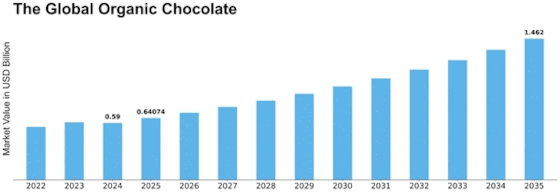
<p>The market is projected to reach 1.462 USD Billion by 2035.</p>

What is the expected CAGR for The Global Organic Chocolate during the forecast period?

<p>The expected CAGR for the market from 2025 to 2035 is 8.6%.</p>

Which companies are considered key players in The Global Organic Chocolate?

<p>Key players include Alter Eco, Green & Black's, Endangered Species Chocolate, and Lindt & Sprüngli.</p>

How does the market segment for dark chocolate perform in terms of valuation?

<p>The dark chocolate segment was valued at 0.2365 USD Billion in 2024 and is expected to grow significantly.</p>

What are the valuation figures for the milk chocolate segment in The Global Organic Chocolate?

<p>The milk chocolate segment had a valuation of 0.2365 USD Billion in 2024.</p>

What is the distribution channel performance for store-based sales in the market?

Store-based distribution was valued at 0.3545 USD Billion in 2024.

How does the non-store based distribution channel compare in valuation?

The non-store based distribution channel was valued at 0.2355 USD Billion in 2024.

What is the expected growth trend for the white chocolate segment?

The white chocolate segment is projected to grow from 0.0595 USD Billion in 2024.

What potential does The Global Organic Chocolate hold for future investors?

With a projected valuation of 1.462 USD Billion by 2035, the market presents substantial investment potential.

Market Summary

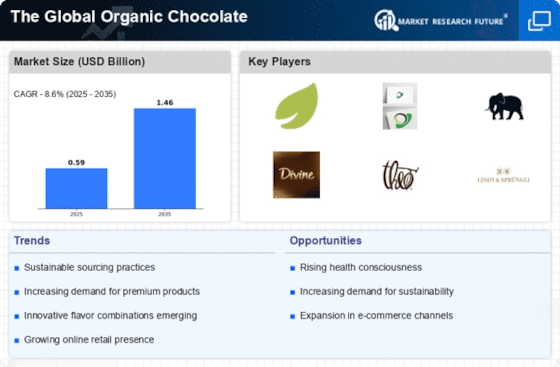
As per Market Research Future analysis, The Global Organic Chocolate Market Size was estimated at 0.59 USD Billion in 2024. The organic chocolate industry is projected to grow from USD 0.6408 Billion in 2025 to USD 1.462 Billion by 2035, exhibiting a compound annual growth rate (CAGR) of 8.6% during the forecast period 2025 - 2035

Key Market Trends & Highlights

The Global Organic Chocolate Market is experiencing robust growth driven by sustainability and health trends.

  • North America remains the largest market for organic chocolate, reflecting a strong consumer preference for premium products. The Asia-Pacific region is emerging as the fastest-growing market, driven by increasing demand for organic and health-oriented options. Dark chocolate continues to dominate the market, while white chocolate is gaining traction as the fastest-growing segment. Key market drivers include a heightened focus on sustainability and health-conscious choices, which are shaping consumer purchasing behaviors.

Market Size & Forecast

2024 Market Size 0.59 (USD Billion)
2035 Market Size 1.462 (USD Billion)
CAGR (2025 - 2035) 8.6%
Largest Regional Market Share in 2024 Europe

Major Players

<a href="https://www.alterecofoods.com/">Alter Eco</a> (CH), Green &amp; Black's (GB), Endangered Species Chocolate (US), Divine Chocolate (GB), Theo Chocolate (US), Lindt &amp; Sprüngli (CH), Cocoa Runners (GB), Taza Chocolate (US), Pacari Chocolate (EC)

Market Trends

The Global Organic Chocolate Market is currently experiencing a notable transformation, driven by a growing consumer preference for healthier and more sustainable food options. This shift appears to be influenced by an increasing awareness of the benefits associated with organic products, including reduced exposure to harmful chemicals and a commitment to environmentally friendly practices. As consumers become more discerning, they seem to gravitate towards brands that emphasize ethical sourcing and transparency in their supply chains. This trend indicates a potential for organic chocolate to capture a larger share of the overall chocolate market, as more individuals seek indulgent yet health-conscious alternatives. Moreover, the market landscape is evolving with the introduction of innovative flavors and product formats. Manufacturers are exploring unique combinations that appeal to adventurous palates, while also catering to dietary restrictions such as veganism and gluten intolerance. This diversification of offerings suggests that The Global Organic Chocolate Market is not only expanding in terms of consumer base but also in the variety of products available. As the demand for organic chocolate continues to rise, it is likely that brands will invest in research and development to create novel products that align with consumer preferences, thereby enhancing their competitive edge in this dynamic market.

Sustainability Focus

There is a growing emphasis on sustainability within The Global Organic Chocolate Market. Consumers increasingly prefer products that are sourced responsibly, leading brands to adopt eco-friendly practices in their production processes. This trend reflects a broader societal shift towards environmental consciousness.

Health-Conscious Choices

The demand for healthier options is shaping The Global Organic Chocolate Market. Consumers are seeking chocolates that not only satisfy their cravings but also align with their health goals. This has led to an increase in products that are low in sugar and rich in natural ingredients.

Flavor Innovation

Innovation in flavors is becoming a key trend in The Global Organic Chocolate Market. Manufacturers are experimenting with unique and exotic flavor profiles to attract a diverse consumer base. This trend indicates a move towards more adventurous and varied chocolate experiences.

Organic Chocolate Market Market Drivers

Ethical Sourcing

Ethical sourcing is emerging as a vital driver for The Global Organic Chocolate Industry, as consumers increasingly demand transparency in the supply chain. The awareness of fair trade practices and the conditions under which cocoa is produced is prompting brands to adopt more responsible sourcing strategies. This shift is not only beneficial for farmers but also resonates with consumers who are willing to pay a premium for products that support ethical practices. Recent data suggests that the market for fair trade certified organic chocolate has expanded significantly, with a growth rate of around 10% annually. As more companies commit to ethical sourcing, The Global Organic Chocolate Industry is likely to experience sustained growth, driven by consumer trust and loyalty.

E-commerce Growth

The rapid growth of e-commerce is transforming The Global Organic Chocolate Industry, providing consumers with greater access to a diverse range of products. Online shopping platforms are increasingly featuring organic chocolate brands, allowing consumers to explore and purchase products from the comfort of their homes. This trend has been accelerated by the convenience and variety offered by online retailers, which cater to the growing demand for organic options. Recent statistics indicate that online sales of organic chocolate have increased by over 20% in the past year, highlighting the shift in consumer purchasing behavior. As e-commerce continues to expand, it is likely to play a pivotal role in shaping the future of The Global Organic Chocolate Industry, enabling brands to reach a wider audience.

Flavor Innovation

Flavor innovation serves as a crucial driver for The Global Organic Chocolate Industry, as manufacturers strive to differentiate their products in a competitive landscape. The introduction of unique flavor combinations and exotic ingredients is becoming increasingly popular, appealing to adventurous consumers. Recent market analysis indicates that the demand for dark chocolate varieties, infused with spices or superfoods, has surged, reflecting a shift in consumer preferences towards more complex taste profiles. This trend not only enhances the sensory experience but also aligns with the growing interest in gourmet and artisanal products. As brands continue to experiment with flavors, the potential for growth in The Global Organic Chocolate Industry appears promising, with consumers eager to explore new and exciting offerings.

Sustainability Focus

The increasing emphasis on sustainability is a pivotal driver for The Global Organic Chocolate Industry. Consumers are becoming more aware of the environmental impact of their purchases, leading to a surge in demand for products that are ethically sourced and produced. This trend is reflected in the growing number of certifications for organic chocolate, which often include sustainable farming practices. According to recent data, the organic chocolate segment has seen a compound annual growth rate of approximately 8% over the past few years, indicating a robust market response to sustainability initiatives. As brands adopt eco-friendly packaging and transparent supply chains, they are likely to attract a more conscientious consumer base, further propelling the growth of The Global Organic Chocolate Industry.

Health-Conscious Choices

The rising trend of health-conscious choices among consumers is significantly influencing The Global Organic Chocolate Industry. With an increasing number of individuals prioritizing their health and wellness, organic chocolate, which is often perceived as a healthier alternative to conventional chocolate, is gaining traction. The market has witnessed a notable increase in demand for products that are free from artificial additives and high in antioxidants. Recent statistics suggest that organic chocolate sales have risen by over 15% in the last year, as consumers seek indulgent yet healthier options. This shift towards health-oriented products is likely to continue, as more brands innovate to meet the evolving preferences of health-conscious consumers, thereby enhancing the appeal of The Global Organic Chocolate Industry.

Market Segment Insights

By Type: Dark (Largest) vs. White (Fastest-Growing)

In The Global Organic Chocolate Market, the segment distribution reveals that Dark Chocolate holds the largest share, appealing to health-conscious consumers due to its higher cocoa content and lower sugar levels. Following closely, <a href="https://www.marketresearchfuture.com/reports/milk-chocolate-market-24785">Milk Chocolate </a>caters to a sizeable audience as well, benefiting from its creamy taste. White Chocolate, while traditionally viewed as a niche, is gaining traction among younger consumers and those seeking sweeter alternatives, positioning it as a vibrant player within this competitive landscape.

Chocolate: Dark (Dominant) vs. White (Emerging)

Dark Chocolate is renowned for its rich flavor and health benefits, making it a dominant choice in the organic chocolate sector. It attracts a loyal consumer base concerned with health, wellness, and quality ingredients. Meanwhile, White Chocolate, often perceived as a less authentic chocolate option, is emerging rapidly among consumers who prefer its sweet, creamy taste. It is increasingly seen as a versatile ingredient in desserts and snacks, appealing to the trend of experimentation and variety in culinary applications. This rising popularity is driving innovation and new product formulations, placing White Chocolate firmly as an emerging segment in the organic market.

By Distribution Channel: Store-Based (Largest) vs. Non-Store Based (Fastest-Growing)

In The Global Organic Chocolate Market, the store-based distribution channel continues to command a significant share, benefiting from established retail networks and the consumer preference for in-person shopping experiences. This segment includes supermarkets, hypermarkets, and specialty stores, which have effectively positioned organic chocolate products to attract health-conscious consumers. Conversely, the non-store based channel, encompassing online sales and direct-to-consumer models, is gaining traction, driven by the increasing popularity of e-commerce platforms and changing consumer shopping habits. The growth trends in the distribution channel indicate a strong future for both segments. The store-based channel is expected to maintain robust sales due to physical product visibility and immediate access. However, the non-store based channel is emerging as the fastest-growing segment, propelled by the convenience of online shopping and the rise in digital marketing strategies. Consumers are increasingly drawn to purchasing organic chocolate through online outlets, providing a dynamic shift in the market landscape that businesses must capitalize on.

Store-Based (Dominant) vs. Non-Store Based (Emerging)

The store-based distribution channel for organic chocolate remains a dominant force, characterized by traditional retail establishments such as supermarkets, health food stores, and specialty chocolate shops. This segment thrives through customer engagement and the sensory experience of product browsing, which is essential in appealing to organic chocolate enthusiasts. Store-based retailers invest in showcasing organic brands, enhancing consumer awareness and preference through in-store promotions and tastings. On the other hand, the emerging non-store based channel is revolutionizing the market landscape, leveraging online platforms to reach a broader audience. This segment attracts tech-savvy consumers who appreciate the convenience of purchasing organic products from the comfort of their homes. The rapid growth of e-commerce, along with targeted digital advertising, positions the non-store based channel as a key player in shaping future trends in the organic chocolate market.

Get more detailed insights about Organic Chocolate Market Research Report- Forecast to 2035

Regional Insights

North America : Sustainable Chocolate Growth

North America is the largest market for organic chocolate, holding approximately 40% of the global share. The growth is driven by increasing consumer awareness regarding health benefits and sustainability. Regulatory support for organic farming practices and labeling has further catalyzed market expansion. The demand for ethically sourced products is also on the rise, influencing purchasing decisions across demographics. The United States leads the North American market, with significant contributions from Canada. Key players such as Alter Eco, Endangered Species Chocolate, and Theo Chocolate are prominent in this region. The competitive landscape is characterized by a mix of established brands and emerging companies focusing on organic and fair-trade certifications, enhancing consumer trust and loyalty.

Europe : Innovation and Quality Focus

Europe is the second-largest market for organic chocolate, accounting for around 30% of the global market share. The region's growth is fueled by a strong preference for high-quality, ethically sourced products. Stringent regulations on food safety and organic certifications have created a favorable environment for organic chocolate producers. Additionally, the rising trend of veganism and health-conscious consumption is driving demand for organic options. Leading countries in this market include Germany, France, and the United Kingdom, where brands like Green & Black's and Divine Chocolate thrive. The competitive landscape is marked by innovation, with companies investing in unique flavors and sustainable packaging. The presence of key players and a robust distribution network further enhance market accessibility and consumer reach.

Asia-Pacific : Emerging Market Potential

Asia-Pacific is an emerging powerhouse in the organic chocolate market, currently holding about 20% of the global share. The region's growth is driven by increasing disposable incomes, urbanization, and a growing awareness of health and wellness. Regulatory frameworks supporting organic agriculture are also being developed, which will further boost market potential. The demand for premium and organic products is expected to rise significantly in the coming years. Countries like Japan, Australia, and India are leading the charge in this market. The competitive landscape is evolving, with both local and international brands vying for market share. Key players such as Pacari Chocolate are making strides in the region, focusing on unique flavors and sustainable sourcing practices to attract health-conscious consumers.

Middle East and Africa : Untapped Market Opportunities

The Middle East and Africa represent a nascent market for organic chocolate, holding approximately 10% of the global share. The growth is primarily driven by increasing health awareness and a shift towards organic products among consumers. Regulatory bodies are beginning to establish guidelines for organic certifications, which will likely enhance market credibility and consumer trust. The region's diverse culinary traditions also present unique opportunities for organic chocolate innovation. Leading countries include South Africa and the UAE, where the market is gradually expanding. The competitive landscape is characterized by a mix of local artisans and international brands. Companies are focusing on product differentiation and premium offerings to capture the interest of affluent consumers seeking quality and sustainability in their purchases.

Key Players and Competitive Insights

The Global Organic Chocolate Market is currently characterized by a dynamic competitive landscape, driven by increasing consumer demand for sustainable and ethically sourced products. Key players are actively engaging in innovative strategies to enhance their market presence and operational efficiency. Companies such as Alter Eco (CH), Green & Black's (GB), and Theo Chocolate (US) are at the forefront, focusing on product innovation, sustainable sourcing, and expanding their distribution channels. This collective emphasis on sustainability and ethical practices not only shapes their individual strategies but also influences the broader market dynamics, fostering a competitive environment that prioritizes quality and environmental responsibility.In terms of business tactics, companies are increasingly localizing manufacturing to reduce carbon footprints and optimize supply chains. The market structure appears moderately fragmented, with several key players holding substantial market shares while numerous smaller brands contribute to the diversity of offerings. This fragmentation allows for niche players to thrive, particularly those that emphasize organic and fair-trade certifications, thereby enhancing the overall competitive landscape.

In August Alter Eco (CH) announced a partnership with local farmers in Ecuador to enhance the traceability of their cocoa supply chain. This strategic move not only strengthens their commitment to sustainability but also ensures that farmers receive fair compensation, thereby fostering community development. Such initiatives are likely to resonate with environmentally conscious consumers, positioning Alter Eco as a leader in ethical chocolate production.

In September Theo Chocolate (US) launched a new line of organic chocolate bars infused with superfoods, aiming to cater to health-conscious consumers. This innovation reflects a growing trend towards functional foods, suggesting that Theo Chocolate is keen on tapping into the wellness market. By diversifying their product offerings, the company may enhance its competitive edge and attract a broader customer base.

In July Green & Black's (GB) expanded its distribution network by entering into a strategic alliance with a major online retailer, significantly increasing its market reach. This move indicates a shift towards digital transformation in the organic chocolate sector, as companies recognize the importance of e-commerce in reaching consumers. Such partnerships are likely to enhance brand visibility and accessibility, further intensifying competition in the market.

As of October the competitive trends in The Global Organic Chocolate Market are increasingly defined by digitalization, sustainability, and the integration of advanced technologies. Strategic alliances are becoming pivotal in shaping the current landscape, allowing companies to leverage each other's strengths. Looking ahead, it appears that competitive differentiation will evolve from traditional price-based competition to a focus on innovation, technological advancements, and supply chain reliability, as companies strive to meet the growing expectations of discerning consumers.

Key Companies in the Organic Chocolate Market include

Industry Developments

August 2022: Hu Kitchen, a vegan chocolate company, introduces dairy products from grass-fed cows. With a clear "grass-fed" message, Hu Kitchen, the most popular vegan chocolate company in the world, is expanding its line of dairy milk chocolate products.

September 2022: Theobroma Chocolat, known for its organic chocolate goods, is innovating by introducing Yummy Zero Sugar, a new plant-based, sugar-free organic chocolate, to consumers worldwide. Since this Canadian business, established in Quebec, began operations, social manufacturing has been a crucial tenet of innovation efforts.

Future Outlook

Organic Chocolate Market Future Outlook

The Global Organic Chocolate Market is projected to grow at an 8.6% CAGR from 2025 to 2035, driven by increasing health consciousness, sustainable sourcing, and premiumization trends.

New opportunities lie in:

  • Expansion into emerging markets with tailored product lines</p><p>Development of subscription-based delivery services for organic chocolate</p><p>Investment in eco-friendly packaging solutions to attract environmentally conscious consumers

By 2035, the market is expected to solidify its position as a leader in the premium <a href="https://www.marketresearchfuture.com/reports/confectionery-market-16095">confectionery</a> segment.

Market Segmentation

Organic Chocolate Market Type Outlook

  • Dark
  • White
  • Milk
  • Others

Organic Chocolate Market Distribution Channel Outlook

  • Store-Based
  • Non-Store Based

Report Scope

MARKET SIZE 2024 0.59(USD Billion)
MARKET SIZE 2025 0.6408(USD Billion)
MARKET SIZE 2035 1.462(USD Billion)
COMPOUND ANNUAL GROWTH RATE (CAGR) 8.6% (2025 - 2035)
REPORT COVERAGE Revenue Forecast, Competitive Landscape, Growth Factors, and Trends
BASE YEAR 2024
Market Forecast Period 2025 - 2035
Historical Data 2019 - 2024
Market Forecast Units USD Billion
Key Companies Profiled Alter Eco (CH), Green & Black's (GB), Endangered Species Chocolate (US), Divine Chocolate (GB), Theo Chocolate (US), Lindt & Sprüngli (CH), Cocoa Runners (GB), Taza Chocolate (US), Pacari Chocolate (EC)
Segments Covered Type, Distribution Channel, Region
Key Market Opportunities Growing consumer preference for sustainable and ethically sourced ingredients in The Global Organic Chocolate.
Key Market Dynamics Rising consumer demand for sustainable products drives innovation and competition in the organic chocolate sector.
Countries Covered North America, Europe, APAC, South America, MEA

FAQs

What is the current valuation of The Global Organic Chocolate?

<p>The market valuation was 0.59 USD Billion in 2024.</p>

What is the projected market size for The Global Organic Chocolate by 2035?

<p>The market is projected to reach 1.462 USD Billion by 2035.</p>

What is the expected CAGR for The Global Organic Chocolate during the forecast period?

<p>The expected CAGR for the market from 2025 to 2035 is 8.6%.</p>

Which companies are considered key players in The Global Organic Chocolate?

<p>Key players include Alter Eco, Green & Black's, Endangered Species Chocolate, and Lindt & Sprüngli.</p>

How does the market segment for dark chocolate perform in terms of valuation?

<p>The dark chocolate segment was valued at 0.2365 USD Billion in 2024 and is expected to grow significantly.</p>

What are the valuation figures for the milk chocolate segment in The Global Organic Chocolate?

<p>The milk chocolate segment had a valuation of 0.2365 USD Billion in 2024.</p>

What is the distribution channel performance for store-based sales in the market?

Store-based distribution was valued at 0.3545 USD Billion in 2024.

How does the non-store based distribution channel compare in valuation?

The non-store based distribution channel was valued at 0.2355 USD Billion in 2024.

What is the expected growth trend for the white chocolate segment?

The white chocolate segment is projected to grow from 0.0595 USD Billion in 2024.

What potential does The Global Organic Chocolate hold for future investors?

With a projected valuation of 1.462 USD Billion by 2035, the market presents substantial investment potential.

  1. SECTION I: EXECUTIVE SUMMARY AND KEY HIGHLIGHTS
    1. | 1.1 EXECUTIVE SUMMARY
    2. | | 1.1.1 Market Overview
    3. | | 1.1.2 Key Findings
    4. | | 1.1.3 Market Segmentation
    5. | | 1.1.4 Competitive Landscape
    6. | | 1.1.5 Challenges and Opportunities
    7. | | 1.1.6 Future Outlook
  2. SECTION II: SCOPING, METHODOLOGY AND MARKET STRUCTURE
    1. | 2.1 MARKET INTRODUCTION
    2. | | 2.1.1 Definition
    3. | | 2.1.2 Scope of the study
    4. | | | 2.1.2.1 Research Objective
    5. | | | 2.1.2.2 Assumption
    6. | | | 2.1.2.3 Limitations
    7. | 2.2 RESEARCH METHODOLOGY
    8. | | 2.2.1 Overview
    9. | | 2.2.2 Data Mining
    10. | | 2.2.3 Secondary Research
    11. | | 2.2.4 Primary Research
    12. | | | 2.2.4.1 Primary Interviews and Information Gathering Process
    13. | | | 2.2.4.2 Breakdown of Primary Respondents
    14. | | 2.2.5 Forecasting Model
    15. | | 2.2.6 Market Size Estimation
    16. | | | 2.2.6.1 Bottom-Up Approach
    17. | | | 2.2.6.2 Top-Down Approach
    18. | | 2.2.7 Data Triangulation
    19. | | 2.2.8 Validation
  3. SECTION III: QUALITATIVE ANALYSIS
    1. | 3.1 MARKET DYNAMICS
    2. | | 3.1.1 Overview
    3. | | 3.1.2 Drivers
    4. | | 3.1.3 Restraints
    5. | | 3.1.4 Opportunities
    6. | 3.2 MARKET FACTOR ANALYSIS
    7. | | 3.2.1 Value chain Analysis
    8. | | 3.2.2 Porter's Five Forces Analysis
    9. | | | 3.2.2.1 Bargaining Power of Suppliers
    10. | | | 3.2.2.2 Bargaining Power of Buyers
    11. | | | 3.2.2.3 Threat of New Entrants
    12. | | | 3.2.2.4 Threat of Substitutes
    13. | | | 3.2.2.5 Intensity of Rivalry
    14. | | 3.2.3 COVID-19 Impact Analysis
    15. | | | 3.2.3.1 Market Impact Analysis
    16. | | | 3.2.3.2 Regional Impact
    17. | | | 3.2.3.3 Opportunity and Threat Analysis
  4. SECTION IV: QUANTITATIVE ANALYSIS
    1. | 4.1 Food, Beverages & Nutrition, BY Type (USD Billion)
    2. | | 4.1.1 Dark
    3. | | 4.1.2 White
    4. | | 4.1.3 Milk
    5. | | 4.1.4 Others
    6. | 4.2 Food, Beverages & Nutrition, BY Distribution Channel (USD Billion)
    7. | | 4.2.1 Store-Based
    8. | | 4.2.2 Non-Store Based
    9. | 4.3 Food, Beverages & Nutrition, BY Region (USD Billion)
    10. | | 4.3.1 North America
    11. | | | 4.3.1.1 US
    12. | | | 4.3.1.2 Canada
    13. | | 4.3.2 Europe
    14. | | | 4.3.2.1 Germany
    15. | | | 4.3.2.2 UK
    16. | | | 4.3.2.3 France
    17. | | | 4.3.2.4 Russia
    18. | | | 4.3.2.5 Italy
    19. | | | 4.3.2.6 Spain
    20. | | | 4.3.2.7 Rest of Europe
    21. | | 4.3.3 APAC
    22. | | | 4.3.3.1 China
    23. | | | 4.3.3.2 India
    24. | | | 4.3.3.3 Japan
    25. | | | 4.3.3.4 South Korea
    26. | | | 4.3.3.5 Malaysia
    27. | | | 4.3.3.6 Thailand
    28. | | | 4.3.3.7 Indonesia
    29. | | | 4.3.3.8 Rest of APAC
    30. | | 4.3.4 South America
    31. | | | 4.3.4.1 Brazil
    32. | | | 4.3.4.2 Mexico
    33. | | | 4.3.4.3 Argentina
    34. | | | 4.3.4.4 Rest of South America
    35. | | 4.3.5 MEA
    36. | | | 4.3.5.1 GCC Countries
    37. | | | 4.3.5.2 South Africa
    38. | | | 4.3.5.3 Rest of MEA
  5. SECTION V: COMPETITIVE ANALYSIS
    1. | 5.1 Competitive Landscape
    2. | | 5.1.1 Overview
    3. | | 5.1.2 Competitive Analysis
    4. | | 5.1.3 Market share Analysis
    5. | | 5.1.4 Major Growth Strategy in the Food, Beverages & Nutrition
    6. | | 5.1.5 Competitive Benchmarking
    7. | | 5.1.6 Leading Players in Terms of Number of Developments in the Food, Beverages & Nutrition
    8. | | 5.1.7 Key developments and growth strategies
    9. | | | 5.1.7.1 New Product Launch/Service Deployment
    10. | | | 5.1.7.2 Merger & Acquisitions
    11. | | | 5.1.7.3 Joint Ventures
    12. | | 5.1.8 Major Players Financial Matrix
    13. | | | 5.1.8.1 Sales and Operating Income
    14. | | | 5.1.8.2 Major Players R&D Expenditure. 2023
    15. | 5.2 Company Profiles
    16. | | 5.2.1 Alter Eco (CH)
    17. | | | 5.2.1.1 Financial Overview
    18. | | | 5.2.1.2 Products Offered
    19. | | | 5.2.1.3 Key Developments
    20. | | | 5.2.1.4 SWOT Analysis
    21. | | | 5.2.1.5 Key Strategies
    22. | | 5.2.2 Green & Black's (GB)
    23. | | | 5.2.2.1 Financial Overview
    24. | | | 5.2.2.2 Products Offered
    25. | | | 5.2.2.3 Key Developments
    26. | | | 5.2.2.4 SWOT Analysis
    27. | | | 5.2.2.5 Key Strategies
    28. | | 5.2.3 Endangered Species Chocolate (US)
    29. | | | 5.2.3.1 Financial Overview
    30. | | | 5.2.3.2 Products Offered
    31. | | | 5.2.3.3 Key Developments
    32. | | | 5.2.3.4 SWOT Analysis
    33. | | | 5.2.3.5 Key Strategies
    34. | | 5.2.4 Divine Chocolate (GB)
    35. | | | 5.2.4.1 Financial Overview
    36. | | | 5.2.4.2 Products Offered
    37. | | | 5.2.4.3 Key Developments
    38. | | | 5.2.4.4 SWOT Analysis
    39. | | | 5.2.4.5 Key Strategies
    40. | | 5.2.5 Theo Chocolate (US)
    41. | | | 5.2.5.1 Financial Overview
    42. | | | 5.2.5.2 Products Offered
    43. | | | 5.2.5.3 Key Developments
    44. | | | 5.2.5.4 SWOT Analysis
    45. | | | 5.2.5.5 Key Strategies
    46. | | 5.2.6 Lindt & Sprüngli (CH)
    47. | | | 5.2.6.1 Financial Overview
    48. | | | 5.2.6.2 Products Offered
    49. | | | 5.2.6.3 Key Developments
    50. | | | 5.2.6.4 SWOT Analysis
    51. | | | 5.2.6.5 Key Strategies
    52. | | 5.2.7 Cocoa Runners (GB)
    53. | | | 5.2.7.1 Financial Overview
    54. | | | 5.2.7.2 Products Offered
    55. | | | 5.2.7.3 Key Developments
    56. | | | 5.2.7.4 SWOT Analysis
    57. | | | 5.2.7.5 Key Strategies
    58. | | 5.2.8 Taza Chocolate (US)
    59. | | | 5.2.8.1 Financial Overview
    60. | | | 5.2.8.2 Products Offered
    61. | | | 5.2.8.3 Key Developments
    62. | | | 5.2.8.4 SWOT Analysis
    63. | | | 5.2.8.5 Key Strategies
    64. | | 5.2.9 Pacari Chocolate (EC)
    65. | | | 5.2.9.1 Financial Overview
    66. | | | 5.2.9.2 Products Offered
    67. | | | 5.2.9.3 Key Developments
    68. | | | 5.2.9.4 SWOT Analysis
    69. | | | 5.2.9.5 Key Strategies
    70. | 5.3 Appendix
    71. | | 5.3.1 References
    72. | | 5.3.2 Related Reports
  6. LIST OF FIGURES
    1. | 6.1 MARKET SYNOPSIS
    2. | 6.2 NORTH AMERICA MARKET ANALYSIS
    3. | 6.3 US MARKET ANALYSIS BY TYPE
    4. | 6.4 US MARKET ANALYSIS BY DISTRIBUTION CHANNEL
    5. | 6.5 CANADA MARKET ANALYSIS BY TYPE
    6. | 6.6 CANADA MARKET ANALYSIS BY DISTRIBUTION CHANNEL
    7. | 6.7 EUROPE MARKET ANALYSIS
    8. | 6.8 GERMANY MARKET ANALYSIS BY TYPE
    9. | 6.9 GERMANY MARKET ANALYSIS BY DISTRIBUTION CHANNEL
    10. | 6.10 UK MARKET ANALYSIS BY TYPE
    11. | 6.11 UK MARKET ANALYSIS BY DISTRIBUTION CHANNEL
    12. | 6.12 FRANCE MARKET ANALYSIS BY TYPE
    13. | 6.13 FRANCE MARKET ANALYSIS BY DISTRIBUTION CHANNEL
    14. | 6.14 RUSSIA MARKET ANALYSIS BY TYPE
    15. | 6.15 RUSSIA MARKET ANALYSIS BY DISTRIBUTION CHANNEL
    16. | 6.16 ITALY MARKET ANALYSIS BY TYPE
    17. | 6.17 ITALY MARKET ANALYSIS BY DISTRIBUTION CHANNEL
    18. | 6.18 SPAIN MARKET ANALYSIS BY TYPE
    19. | 6.19 SPAIN MARKET ANALYSIS BY DISTRIBUTION CHANNEL
    20. | 6.20 REST OF EUROPE MARKET ANALYSIS BY TYPE
    21. | 6.21 REST OF EUROPE MARKET ANALYSIS BY DISTRIBUTION CHANNEL
    22. | 6.22 APAC MARKET ANALYSIS
    23. | 6.23 CHINA MARKET ANALYSIS BY TYPE
    24. | 6.24 CHINA MARKET ANALYSIS BY DISTRIBUTION CHANNEL
    25. | 6.25 INDIA MARKET ANALYSIS BY TYPE
    26. | 6.26 INDIA MARKET ANALYSIS BY DISTRIBUTION CHANNEL
    27. | 6.27 JAPAN MARKET ANALYSIS BY TYPE
    28. | 6.28 JAPAN MARKET ANALYSIS BY DISTRIBUTION CHANNEL
    29. | 6.29 SOUTH KOREA MARKET ANALYSIS BY TYPE
    30. | 6.30 SOUTH KOREA MARKET ANALYSIS BY DISTRIBUTION CHANNEL
    31. | 6.31 MALAYSIA MARKET ANALYSIS BY TYPE
    32. | 6.32 MALAYSIA MARKET ANALYSIS BY DISTRIBUTION CHANNEL
    33. | 6.33 THAILAND MARKET ANALYSIS BY TYPE
    34. | 6.34 THAILAND MARKET ANALYSIS BY DISTRIBUTION CHANNEL
    35. | 6.35 INDONESIA MARKET ANALYSIS BY TYPE
    36. | 6.36 INDONESIA MARKET ANALYSIS BY DISTRIBUTION CHANNEL
    37. | 6.37 REST OF APAC MARKET ANALYSIS BY TYPE
    38. | 6.38 REST OF APAC MARKET ANALYSIS BY DISTRIBUTION CHANNEL
    39. | 6.39 SOUTH AMERICA MARKET ANALYSIS
    40. | 6.40 BRAZIL MARKET ANALYSIS BY TYPE
    41. | 6.41 BRAZIL MARKET ANALYSIS BY DISTRIBUTION CHANNEL
    42. | 6.42 MEXICO MARKET ANALYSIS BY TYPE
    43. | 6.43 MEXICO MARKET ANALYSIS BY DISTRIBUTION CHANNEL
    44. | 6.44 ARGENTINA MARKET ANALYSIS BY TYPE
    45. | 6.45 ARGENTINA MARKET ANALYSIS BY DISTRIBUTION CHANNEL
    46. | 6.46 REST OF SOUTH AMERICA MARKET ANALYSIS BY TYPE
    47. | 6.47 REST OF SOUTH AMERICA MARKET ANALYSIS BY DISTRIBUTION CHANNEL
    48. | 6.48 MEA MARKET ANALYSIS
    49. | 6.49 GCC COUNTRIES MARKET ANALYSIS BY TYPE
    50. | 6.50 GCC COUNTRIES MARKET ANALYSIS BY DISTRIBUTION CHANNEL
    51. | 6.51 SOUTH AFRICA MARKET ANALYSIS BY TYPE
    52. | 6.52 SOUTH AFRICA MARKET ANALYSIS BY DISTRIBUTION CHANNEL
    53. | 6.53 REST OF MEA MARKET ANALYSIS BY TYPE
    54. | 6.54 REST OF MEA MARKET ANALYSIS BY DISTRIBUTION CHANNEL
    55. | 6.55 KEY BUYING CRITERIA OF FOOD, BEVERAGES & NUTRITION
    56. | 6.56 RESEARCH PROCESS OF MRFR
    57. | 6.57 DRO ANALYSIS OF FOOD, BEVERAGES & NUTRITION
    58. | 6.58 DRIVERS IMPACT ANALYSIS: FOOD, BEVERAGES & NUTRITION
    59. | 6.59 RESTRAINTS IMPACT ANALYSIS: FOOD, BEVERAGES & NUTRITION
    60. | 6.60 SUPPLY / VALUE CHAIN: FOOD, BEVERAGES & NUTRITION
    61. | 6.61 FOOD, BEVERAGES & NUTRITION, BY TYPE, 2024 (% SHARE)
    62. | 6.62 FOOD, BEVERAGES & NUTRITION, BY TYPE, 2024 TO 2035 (USD Billion)
    63. | 6.63 FOOD, BEVERAGES & NUTRITION, BY DISTRIBUTION CHANNEL, 2024 (% SHARE)
    64. | 6.64 FOOD, BEVERAGES & NUTRITION, BY DISTRIBUTION CHANNEL, 2024 TO 2035 (USD Billion)
    65. | 6.65 BENCHMARKING OF MAJOR COMPETITORS
  7. LIST OF TABLES
    1. | 7.1 LIST OF ASSUMPTIONS
    2. | | 7.1.1
    3. | 7.2 North America MARKET SIZE ESTIMATES; FORECAST
    4. | | 7.2.1 BY TYPE, 2025-2035 (USD Billion)
    5. | | 7.2.2 BY DISTRIBUTION CHANNEL, 2025-2035 (USD Billion)
    6. | 7.3 US MARKET SIZE ESTIMATES; FORECAST
    7. | | 7.3.1 BY TYPE, 2025-2035 (USD Billion)
    8. | | 7.3.2 BY DISTRIBUTION CHANNEL, 2025-2035 (USD Billion)
    9. | 7.4 Canada MARKET SIZE ESTIMATES; FORECAST
    10. | | 7.4.1 BY TYPE, 2025-2035 (USD Billion)
    11. | | 7.4.2 BY DISTRIBUTION CHANNEL, 2025-2035 (USD Billion)
    12. | 7.5 Europe MARKET SIZE ESTIMATES; FORECAST
    13. | | 7.5.1 BY TYPE, 2025-2035 (USD Billion)
    14. | | 7.5.2 BY DISTRIBUTION CHANNEL, 2025-2035 (USD Billion)
    15. | 7.6 Germany MARKET SIZE ESTIMATES; FORECAST
    16. | | 7.6.1 BY TYPE, 2025-2035 (USD Billion)
    17. | | 7.6.2 BY DISTRIBUTION CHANNEL, 2025-2035 (USD Billion)
    18. | 7.7 UK MARKET SIZE ESTIMATES; FORECAST
    19. | | 7.7.1 BY TYPE, 2025-2035 (USD Billion)
    20. | | 7.7.2 BY DISTRIBUTION CHANNEL, 2025-2035 (USD Billion)
    21. | 7.8 France MARKET SIZE ESTIMATES; FORECAST
    22. | | 7.8.1 BY TYPE, 2025-2035 (USD Billion)
    23. | | 7.8.2 BY DISTRIBUTION CHANNEL, 2025-2035 (USD Billion)
    24. | 7.9 Russia MARKET SIZE ESTIMATES; FORECAST
    25. | | 7.9.1 BY TYPE, 2025-2035 (USD Billion)
    26. | | 7.9.2 BY DISTRIBUTION CHANNEL, 2025-2035 (USD Billion)
    27. | 7.10 Italy MARKET SIZE ESTIMATES; FORECAST
    28. | | 7.10.1 BY TYPE, 2025-2035 (USD Billion)
    29. | | 7.10.2 BY DISTRIBUTION CHANNEL, 2025-2035 (USD Billion)
    30. | 7.11 Spain MARKET SIZE ESTIMATES; FORECAST
    31. | | 7.11.1 BY TYPE, 2025-2035 (USD Billion)
    32. | | 7.11.2 BY DISTRIBUTION CHANNEL, 2025-2035 (USD Billion)
    33. | 7.12 Rest of Europe MARKET SIZE ESTIMATES; FORECAST
    34. | | 7.12.1 BY TYPE, 2025-2035 (USD Billion)
    35. | | 7.12.2 BY DISTRIBUTION CHANNEL, 2025-2035 (USD Billion)
    36. | 7.13 APAC MARKET SIZE ESTIMATES; FORECAST
    37. | | 7.13.1 BY TYPE, 2025-2035 (USD Billion)
    38. | | 7.13.2 BY DISTRIBUTION CHANNEL, 2025-2035 (USD Billion)
    39. | 7.14 China MARKET SIZE ESTIMATES; FORECAST
    40. | | 7.14.1 BY TYPE, 2025-2035 (USD Billion)
    41. | | 7.14.2 BY DISTRIBUTION CHANNEL, 2025-2035 (USD Billion)
    42. | 7.15 India MARKET SIZE ESTIMATES; FORECAST
    43. | | 7.15.1 BY TYPE, 2025-2035 (USD Billion)
    44. | | 7.15.2 BY DISTRIBUTION CHANNEL, 2025-2035 (USD Billion)
    45. | 7.16 Japan MARKET SIZE ESTIMATES; FORECAST
    46. | | 7.16.1 BY TYPE, 2025-2035 (USD Billion)
    47. | | 7.16.2 BY DISTRIBUTION CHANNEL, 2025-2035 (USD Billion)
    48. | 7.17 South Korea MARKET SIZE ESTIMATES; FORECAST
    49. | | 7.17.1 BY TYPE, 2025-2035 (USD Billion)
    50. | | 7.17.2 BY DISTRIBUTION CHANNEL, 2025-2035 (USD Billion)
    51. | 7.18 Malaysia MARKET SIZE ESTIMATES; FORECAST
    52. | | 7.18.1 BY TYPE, 2025-2035 (USD Billion)
    53. | | 7.18.2 BY DISTRIBUTION CHANNEL, 2025-2035 (USD Billion)
    54. | 7.19 Thailand MARKET SIZE ESTIMATES; FORECAST
    55. | | 7.19.1 BY TYPE, 2025-2035 (USD Billion)
    56. | | 7.19.2 BY DISTRIBUTION CHANNEL, 2025-2035 (USD Billion)
    57. | 7.20 Indonesia MARKET SIZE ESTIMATES; FORECAST
    58. | | 7.20.1 BY TYPE, 2025-2035 (USD Billion)
    59. | | 7.20.2 BY DISTRIBUTION CHANNEL, 2025-2035 (USD Billion)
    60. | 7.21 Rest of APAC MARKET SIZE ESTIMATES; FORECAST
    61. | | 7.21.1 BY TYPE, 2025-2035 (USD Billion)
    62. | | 7.21.2 BY DISTRIBUTION CHANNEL, 2025-2035 (USD Billion)
    63. | 7.22 South America MARKET SIZE ESTIMATES; FORECAST
    64. | | 7.22.1 BY TYPE, 2025-2035 (USD Billion)
    65. | | 7.22.2 BY DISTRIBUTION CHANNEL, 2025-2035 (USD Billion)
    66. | 7.23 Brazil MARKET SIZE ESTIMATES; FORECAST
    67. | | 7.23.1 BY TYPE, 2025-2035 (USD Billion)
    68. | | 7.23.2 BY DISTRIBUTION CHANNEL, 2025-2035 (USD Billion)
    69. | 7.24 Mexico MARKET SIZE ESTIMATES; FORECAST
    70. | | 7.24.1 BY TYPE, 2025-2035 (USD Billion)
    71. | | 7.24.2 BY DISTRIBUTION CHANNEL, 2025-2035 (USD Billion)
    72. | 7.25 Argentina MARKET SIZE ESTIMATES; FORECAST
    73. | | 7.25.1 BY TYPE, 2025-2035 (USD Billion)
    74. | | 7.25.2 BY DISTRIBUTION CHANNEL, 2025-2035 (USD Billion)
    75. | 7.26 Rest of South America MARKET SIZE ESTIMATES; FORECAST
    76. | | 7.26.1 BY TYPE, 2025-2035 (USD Billion)
    77. | | 7.26.2 BY DISTRIBUTION CHANNEL, 2025-2035 (USD Billion)
    78. | 7.27 MEA MARKET SIZE ESTIMATES; FORECAST
    79. | | 7.27.1 BY TYPE, 2025-2035 (USD Billion)
    80. | | 7.27.2 BY DISTRIBUTION CHANNEL, 2025-2035 (USD Billion)
    81. | 7.28 GCC Countries MARKET SIZE ESTIMATES; FORECAST
    82. | | 7.28.1 BY TYPE, 2025-2035 (USD Billion)
    83. | | 7.28.2 BY DISTRIBUTION CHANNEL, 2025-2035 (USD Billion)
    84. | 7.29 South Africa MARKET SIZE ESTIMATES; FORECAST
    85. | | 7.29.1 BY TYPE, 2025-2035 (USD Billion)
    86. | | 7.29.2 BY DISTRIBUTION CHANNEL, 2025-2035 (USD Billion)
    87. | 7.30 Rest of MEA MARKET SIZE ESTIMATES; FORECAST
    88. | | 7.30.1 BY TYPE, 2025-2035 (USD Billion)
    89. | | 7.30.2 BY DISTRIBUTION CHANNEL, 2025-2035 (USD Billion)
    90. | 7.31 PRODUCT LAUNCH/PRODUCT DEVELOPMENT/APPROVAL
    91. | | 7.31.1
    92. | 7.32 ACQUISITION/PARTNERSHIP
    93. | | 7.32.1

Food, Beverages & Nutrition Market Segmentation

Food, Beverages & Nutrition By Type (USD Billion, 2025-2035)

  • Dark
  • White
  • Milk
  • Others

Food, Beverages & Nutrition By Distribution Channel (USD Billion, 2025-2035)

  • Store-Based
  • Non-Store Based
Infographic

Free Sample Request

Kindly complete the form below to receive a free sample of this Report

Get Free Sample

Customer Strories

Compare Licence

×
Features License Type
Single User Multiuser License Enterprise User
Price $4,950 $5,950 $7,250
Maximum User Access Limit 1 User Upto 10 Users Unrestricted Access Throughout the Organization
Free Customization
Direct Access to Analyst
Deliverable Format
Platform Access
Discount on Next Purchase 10% 15% 15%
Printable Versions