×
Request Free Sample ×

Kindly complete the form below to receive a free sample of this Report

* Please use a valid business email

Leading companies partner with us for data-driven Insights

clients tt-cursor
Hero Background
English
Chinese
French
Japanese
Korean
German
Spanish

Organic Cereals Market Size

ID: MRFR/FnB/1969-HCR
110 Pages
Snehal Singh
October 2025

Organic Cereals Market Size, Share, Industry Trend & Analysis Research Report Information By Source (Wheat, Barley, Oats, Blended, and Others), Category (Conventional Organic Cereals and Gluten-Free Organic Cereals), Distribution Channel (Store-Based [Supermarkets & Hypermarkets, Convenience Stores and Others] and Non-Store-Based), and Region (North America, Europe, Asia-Pacific, and Rest of the World)-Forecast till 2032

Share:
Download PDF ×

We do not share your information with anyone. However, we may send you emails based on your report interest from time to time. You may contact us at any time to opt-out.

Organic Cereals Market Infographic
×
Organic Cereals Market Infographic Full View
Purchase Options

Organic Cereals Size

Organic Cereals Market Growth Projections and Opportunities

The organic cereals market is influenced by a myriad of factors that collectively shape its dynamics and growth trajectory. One of the pivotal market factors is the increasing consumer inclination towards healthier and more sustainable food choices. As awareness about the benefits of organic products continues to rise, consumers are actively seeking cereals that are free from synthetic pesticides, genetically modified organisms (GMOs), and artificial additives. This growing demand for organic cereals is driven by a broader societal shift towards healthier lifestyles and a heightened awareness of the environmental impact of conventional farming practices.

Moreover, regulatory support and certification standards play a crucial role in defining the landscape of the organic cereals market. Governments and regulatory bodies worldwide have implemented stringent standards to ensure the authenticity and quality of organic products. The presence of credible certification organizations, such as the USDA Organic and the European Organic Certification, instills confidence among consumers and facilitates market growth. Manufacturers and producers that adhere to these standards gain a competitive edge in the market, as consumers are more likely to trust and choose certified organic cereals. The global organic cereals market is projected to experience a compound annual growth rate (CAGR) of 5.32% from 2020 to 2027, with an estimated market value reaching USD 36,100 Million by the close of 2027. Various cereals, including wheat, barley, oats, maize, and sorghum, contribute to this market. Renowned for their rich vitamin content, cereals are particularly abundant in B vitamins such as thiamine, folate, and niacin. These nutrients play crucial roles in supporting the proper functioning of the brain, nervous system, heart, eyesight, and hair. With a substantial fiber content, cereals are also recognized for their digestive benefits, making them a preferred choice among health-conscious consumers.

Cereals hold staple status in numerous regions globally, contributing to the escalating demand for these grains. The surge in the popularity of organic food further fuels the growth of the global organic cereals market. Moreover, the expanding vegan population is expected to act as a significant driver for the market's growth. Economic factors also contribute significantly to the dynamics of the organic cereals market. The rising disposable income in many regions has allowed consumers to allocate more of their budget towards premium and organic food products. While organic cereals may have a higher price point compared to conventional ones, consumers are increasingly willing to invest in their health and well-being, driving the overall market growth. Additionally, the availability of organic cereals across various retail channels, including supermarkets, specialty stores, and online platforms, provides consumers with convenient access, further fueling market expansion.

Technological advancements in agriculture and food production have a direct impact on the organic cereals market. Innovations in organic farming practices, such as precision farming techniques and sustainable agricultural technologies, contribute to increased yields and improved efficiency in organic cereal production. These advancements not only benefit producers by enhancing their productivity but also contribute to the overall supply chain sustainability, meeting the growing demand for organic cereals without compromising on environmental stewardship.

Consumer preferences and tastes also influence the product offerings within the organic cereals market. Manufacturers are responding to the diversity of consumer demands by introducing a wide range of flavors, textures, and ingredient combinations. This customization aligns with the varying preferences of consumers, making organic cereals a versatile choice for different demographics and age groups. The market is witnessing the emergence of innovative formulations, such as gluten-free options and cereals enriched with superfoods, to cater to specific dietary needs and preferences.

Furthermore, global trends, such as the focus on plant-based diets and sustainability, have a ripple effect on the organic cereals market. As more consumers adopt plant-based lifestyles and prioritize environmentally friendly products, organic cereals, which are often associated with sustainable and ethical farming practices, gain traction. The alignment of organic cereals with these broader lifestyle trends positions the market for sustained growth, reflecting the evolving consumer consciousness in the food and beverage sector.

Organic Cereals Market Size Graph
Author
Snehal Singh
Assistant Manager - Research

High acumen in analyzing complex macro & micro markets with more than 6 years of work experience in the field of market research. By implementing her analytical skills in forecasting and estimation into market research reports, she has expertise in Packaging, Construction, and Equipment domains. She handles a team size of 20-25 resources and ensures smooth running of the projects, associated marketing activities, and client servicing.

Leave a Comment

FAQs

What is the leading regional global market?

North America is likely to dominate the global organic cereals market over the forecast period.

Market Summary

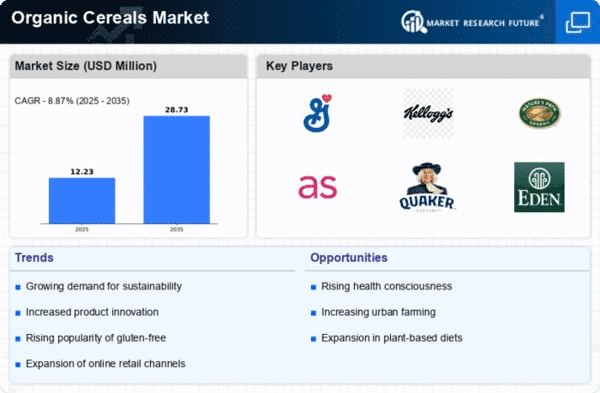
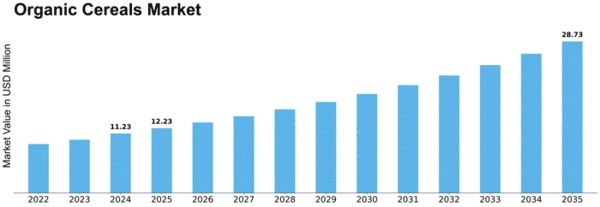
As per MRFR analysis, the Organic Cereals Market Size was estimated at 11.23 USD Million in 2024. The Organic Cereals industry is projected to grow from 12.36 USD Million in 2025 to 28.73 USD Million by 2035, exhibiting a compound annual growth rate (CAGR) of 8.87 during the forecast period 2025 - 2035.

Key Market Trends & Highlights

The Organic Cereals Market is experiencing robust growth driven by health consciousness and sustainability trends.

  • The North American region remains the largest market for organic cereals, reflecting a strong consumer preference for health-oriented products.
  • The Asia-Pacific region is emerging as the fastest-growing market, driven by increasing urbanization and changing dietary habits.
  • Breakfast cereals continue to dominate the market, while snack bars are rapidly gaining traction as a convenient health option.
  • Rising health consciousness and sustainability trends are key drivers propelling the demand for innovative organic cereal products.

Market Size & Forecast

2024 Market Size 11.23 (USD Million)
2035 Market Size 28.73 (USD Million)
CAGR (2025 - 2035) 8.87%
Largest Regional Market Share in 2024 North America

Major Players

General Mills (US), Kellogg's (US), Nature's Path (CA), Annie's (US), Quaker Oats (US), Eden Foods (US), Bob's Red Mill (US), Cascadian Farm (US)

Market Trends

The Organic Cereals Market is currently experiencing a notable transformation, driven by a growing consumer preference for health-conscious food options. This shift is largely influenced by increased awareness regarding the benefits of organic products, which are perceived as healthier alternatives to conventional cereals. As consumers become more discerning about their dietary choices, the demand for organic cereals is likely to rise, reflecting a broader trend towards sustainable and environmentally friendly food production. Retailers are responding to this trend by expanding their organic product lines, thereby enhancing accessibility for consumers. Moreover, the Organic Cereals Market is witnessing innovations in product offerings, with manufacturers exploring diverse ingredients and flavors to cater to evolving consumer tastes. This diversification not only attracts a wider audience but also encourages existing consumers to experiment with new products. The emphasis on transparency in sourcing and production processes further strengthens consumer trust, which is essential for brand loyalty in this competitive landscape. As the market continues to evolve, it appears poised for sustained growth, driven by both consumer demand and industry innovation.

Health and Wellness Focus

There is a discernible trend towards health and wellness, with consumers increasingly prioritizing nutritious food options. This focus on well-being is propelling the demand for organic cereals, as they are often associated with higher nutritional value and fewer harmful additives.

Sustainability and Ethical Sourcing

Sustainability is becoming a critical factor in purchasing decisions. Consumers are more inclined to support brands that demonstrate ethical sourcing practices and environmentally friendly production methods, which is influencing the Organic Cereals Market significantly.

Product Innovation and Variety

The market is characterized by a surge in product innovation, with manufacturers introducing a variety of flavors and formulations. This trend caters to diverse consumer preferences and dietary needs, thereby expanding the market's reach.

Organic Cereals Market Market Drivers

Rising Health Consciousness

The increasing awareness of health and wellness among consumers appears to be a primary driver for the Global Organic Cereals Industry. As individuals become more informed about the benefits of organic foods, there is a notable shift towards healthier dietary choices. This trend is reflected in the growing demand for organic cereals, which are perceived as healthier alternatives to conventional options. In 2024, the market is projected to reach 0.02 USD Billion, indicating a robust interest in organic products. This health consciousness is likely to continue influencing consumer preferences, thereby propelling the market forward.

Market Segment Insights

By Application: Breakfast Cereals (Largest) vs. Snack Bars (Fastest-Growing)

<a href="https://www.marketresearchfuture.com/reports/baking-ingredients-market-6692" target="_blank">baking ingredients</a>

<a href="https://www.marketresearchfuture.com/reports/breakfast-cereals-market-2202" target="_blank">breakfast cereals</a>: Dominant vs. Snack Bars: Emerging

<a href="https://www.marketresearchfuture.com/reports/breakfast-cereals-market-2202" target="_blank">breakfast cereals</a> have established themselves as the dominant player in the organic cereals segment, characterized by their diverse offerings such as oats, flakes, and clusters, appealing to a broad consumer base. Their presence in retail shelves is significant, backed by robust brand loyalty and extensive marketing. On the other hand, snack bars represent an emerging segment that is rapidly evolving, catering to consumers' need for portable and healthy options. These bars typically feature wholesome ingredients and cater to various dietary preferences, including gluten-free and vegan options. The innovation in flavors and textures, along with enticing packaging, positions snack bars as a go-to choice for busy individuals, thereby reshaping the competitive landscape of the organic cereals market.

By Distribution Channel: Supermarkets (Largest) vs. Online Retail (Fastest-Growing)

In the Organic Cereals Market, supermarkets hold the largest share among distribution channels, capturing a significant portion of the market due to their widespread presence and established customer base. Notably, supermarkets not only provide convenience but also engage in various promotional strategies to attract healthy-conscious consumers. Meanwhile, online retail is rapidly gaining traction, driven by the convenience of shopping from home and increasing internet penetration, making it the fastest-growing segment in this market.

Supermarkets (Dominant) vs. Online Retail (Emerging)

Supermarkets are the dominant distribution channel for organic cereals, benefiting from their extensive reach and ability to offer a wide selection of brands. They play a crucial role in providing consumers with access to organic products within their daily shopping routines. Conversely, online retail has emerged as a key player, appealing to tech-savvy shoppers who appreciate the flexibility and ease of ordering organic cereals from various brands at their convenience. This channel is witnessing a surge in popularity, thanks to improved logistics and delivery systems, attracting a younger demographic that values time-saving options and personalized shopping experiences.

By Product Type: Whole Grain Cereals (Largest) vs. Granola Clusters (Fastest-Growing)

In the Organic Cereals Market, Whole Grain Cereals hold the largest share of the product type segment. The consumer preference for whole grains, due to their health benefits such as high fiber content and nutritional richness, reinforces the prominence of this category. Flaked Cereals and Oatmeal follow closely, appealing to consumers seeking convenience and nutritious breakfast options. Meanwhile, Flaked Cereals have become popular among families for their ease of incorporation into various meals, contributing to a significant presence in the market. Emerging trends are transforming the dynamics of the segment, with Granola Clusters becoming the fastest-growing product. This surge is driven by changing consumer lifestyles that favor on-the-go healthy snacks, positioning Granola Clusters as the ideal choice. Additionally, the focus on clean labels and natural ingredients amplifies their appeal. Puffed Cereals also capture attention, particularly among younger consumers looking for innovative and attractive breakfast options, thus making the product type segment increasingly diverse.

Whole Grain Cereals (Dominant) vs. Flaked Cereals (Emerging)

Whole Grain Cereals are characterized by their rich nutrient profile, catering to health-conscious consumers seeking wholesome options. This segment allows manufacturers to emphasize organic certifications and natural ingredients, which resonate with sustainability-focused shoppers. Meanwhile, Flaked Cereals, although emerging, are becoming increasingly favored for their versatility and ease of use. They often serve as a base for various meals or mixes and appeal to families and busy individuals alike. This growing adaptability and ongoing product innovation within Flaked Cereals signify a shift in consumer preferences, suggesting that despite Whole Grain Cereals' dominance, Flaked Cereals are poised for rapid growth.

By Consumer Demographics: Health-Conscious Consumers (Largest) vs. Fitness Enthusiasts (Fastest-Growing)

The Organic Cereals Market showcases a diverse consumer demographic, with Health-Conscious Consumers holding the largest market share. This segment encompasses individuals prioritizing nutritional values and seeking organic options free from synthetic additives. Closely following are Fitness Enthusiasts, who are increasingly embracing organic cereals as part of their health routines, a trend fueled by rising interest in fitness and wellness. In recent years, the market has witnessed a surge in segments such as Parents with Young Children and Vegans, driven by increasing awareness of healthy eating habits among families and the growing availability of vegan options in the organic cereals sphere. This evolution reflects a broader shift towards healthier living and the embrace of sustainable food choices.

Health-Conscious Consumers (Dominant) vs. Fitness Enthusiasts (Emerging)

Health-Conscious Consumers represent a dominant force in the Organic Cereals Market, characterized by their commitment to health, nutrition, and the quality of ingredients. This demographic is typically well-informed about the impact of diet on health and actively seeks organic certifications when selecting products. Conversely, Fitness Enthusiasts, although currently an emerging segment, are becoming increasingly integral to market growth. They prioritize functional foods that enhance performance, making organic cereals appealing for their nutritional benefits. This growing awareness and alignment with fitness goals foster a competitive landscape, as brands cater to both segments by emphasizing health benefits and natural ingredients in their marketing efforts.

By Packaging Type: Bulk Packaging (Largest) vs. Eco-Friendly Packaging (Fastest-Growing)

The Organic Cereals Market is witnessing a diverse range of packaging types, with bulk packaging securing the largest market share among consumers who prioritize convenience and value. This type of packaging is particularly favored by health-conscious buyers looking for bulk purchases, which also minimizes waste. Following closely are eco-friendly packaging solutions, which are gaining traction as sustainability becomes a top priority for many consumers. The rising awareness regarding environmental impact positions eco-friendly options as crucial players in the market landscape.

Bulk Packaging (Dominant) vs. Eco-Friendly Packaging (Emerging)

Bulk packaging is a dominant force in the Organic Cereals Market, catering to consumers who prefer purchasing in larger quantities for cost-effectiveness and reduced packaging waste. This packaging type appeals not only to households but also to retailers looking for efficient stocking solutions. Conversely, eco-friendly packaging is emerging rapidly as a competitive alternative, appealing to environmentally conscious consumers. Brands that utilize biodegradable materials or compostable packaging are positioning themselves to attract this growing demographic, responding to increasing consumer demand for sustainable practices. As a result, these two segments reflect contrasting yet complementary trends in consumer preferences, with bulk packaging focusing on practicality and eco-friendly options striving for sustainability.

Get more detailed insights about Organic Cereals Market Research Report -Forecast till 2035

Regional Insights

North America : Market Leader in Organic Cereals

North America continues to lead the organic cereals market, holding a significant share of 5.62 in 2024. The growth is driven by increasing consumer awareness regarding health benefits, coupled with a rising demand for organic products. Regulatory support, including subsidies for organic farming, has further catalyzed this growth. The trend towards healthier eating habits is expected to sustain demand, with projections indicating continued expansion in the coming years. The competitive landscape in North America is robust, featuring key players such as General Mills, Kellogg's, and Quaker Oats. These companies are investing in innovative product development and marketing strategies to capture the growing health-conscious consumer base. The U.S. remains the largest market, with Canada also showing promising growth. The presence of established brands and a strong distribution network enhances market accessibility, solidifying North America's position as a leader in organic cereals.

Europe : Emerging Market for Organic Products

Europe's organic cereals market is on the rise, with a market size of 3.36 in 2024. The growth is fueled by increasing consumer preference for organic foods, driven by health consciousness and environmental concerns. Regulatory frameworks, such as the EU Organic Regulation, support organic farming practices, enhancing market growth. The region is witnessing a shift towards sustainable agriculture, which is expected to further boost demand for organic cereals in the coming years. Leading countries in this market include Germany, France, and the UK, where consumer demand for organic products is particularly strong. The competitive landscape features prominent players like Nature's Path and Kellogg's, who are adapting their offerings to meet local preferences. The presence of a well-established retail network, including health food stores and online platforms, facilitates access to organic cereals, making Europe a key player in this sector.

Asia-Pacific : Rapidly Growing Organic Sector

The Asia-Pacific region is witnessing a burgeoning organic cereals market, with a size of 2.1 in 2024. This growth is driven by rising disposable incomes, urbanization, and a growing awareness of health and wellness among consumers. Regulatory initiatives promoting organic farming practices are also contributing to market expansion. The increasing availability of organic products in retail outlets is expected to further stimulate demand in this region. Countries like Australia, Japan, and China are leading the charge in the organic cereals market. The competitive landscape is evolving, with both local and international players, including Bob's Red Mill and Annie's, vying for market share. The region's diverse consumer preferences are prompting companies to innovate and tailor their products, ensuring a dynamic and competitive market environment.

Middle East and Africa : Niche Market with Growth Potential

The Middle East and Africa represent a nascent market for organic cereals, with a size of 0.15 in 2024. The growth potential is significant, driven by increasing health awareness and a shift towards organic food consumption. Regulatory support for organic farming is gradually improving, which is expected to enhance market conditions. The region's diverse agricultural landscape offers opportunities for local organic production, which can cater to the growing demand for healthier food options. Countries like South Africa and the UAE are beginning to embrace organic cereals, although the market remains relatively small. The competitive landscape is characterized by emerging local brands and a few international players. As consumer awareness grows and distribution channels expand, the organic cereals market in this region is poised for gradual growth, presenting opportunities for investment and development.

Key Players and Competitive Insights

The Organic Cereals Market is currently characterized by a dynamic competitive landscape, driven by increasing consumer demand for health-conscious and sustainable food options. Major players such as General Mills (US), Kellogg's (US), and Nature's Path (CA) are strategically positioning themselves through innovation and sustainability initiatives. General Mills (US) has focused on expanding its organic product lines, while Kellogg's (US) emphasizes partnerships with local farmers to enhance supply chain transparency. Nature's Path (CA) continues to leverage its commitment to organic farming practices, which resonates well with environmentally conscious consumers. Collectively, these strategies not only enhance brand loyalty but also intensify competition as companies vie for market share in a growing sector.In terms of business tactics, companies are increasingly localizing manufacturing to reduce carbon footprints and optimize supply chains. The market structure appears moderately fragmented, with several key players holding substantial shares, yet numerous smaller brands also contributing to the competitive dynamics. This fragmentation allows for diverse product offerings, catering to various consumer preferences, while the influence of major players remains significant in shaping market trends.

In November General Mills (US) announced a partnership with a leading agricultural technology firm to enhance its organic grain sourcing capabilities. This strategic move is likely to improve supply chain efficiency and ensure higher quality standards for its organic cereals, thereby reinforcing its market position. Such collaborations may also facilitate the integration of advanced technologies in farming practices, aligning with the growing trend towards sustainability.

In October Kellogg's (US) launched a new line of organic cereals that feature locally sourced ingredients, reflecting its commitment to regional sourcing and sustainability. This initiative not only caters to the increasing consumer preference for locally produced food but also strengthens Kellogg's brand image as a responsible corporate entity. The emphasis on local sourcing may also mitigate supply chain risks, which have become increasingly pertinent in recent years.

In September Nature's Path (CA) unveiled a new marketing campaign aimed at educating consumers about the benefits of organic cereals. This campaign is expected to enhance brand visibility and consumer engagement, potentially leading to increased sales. By focusing on consumer education, Nature's Path is likely to differentiate itself in a crowded market, appealing to health-conscious consumers who prioritize organic products.

As of December the Organic Cereals Market is witnessing trends such as digitalization, sustainability, and the integration of AI technologies. Strategic alliances among companies are becoming increasingly prevalent, fostering innovation and enhancing competitive advantages. The shift from price-based competition to a focus on innovation, technology, and supply chain reliability is evident. Companies that can effectively leverage these trends are likely to emerge as leaders in the evolving landscape of the Organic Cereals Market.

Key Companies in the Organic Cereals Market include

Industry Developments

  • Kellogg company partnered with Toram Africa to expand its presence in the African market a few years ago.
  • Kellogg company recently acquired Mass Foods, a major Egyptian Cereal manufacturing company. The intent is to increase its presence in the Egyptian cereals market

Report Outlook

The organic cereals market is expected to register a CAGR of 5.32% from 2020 to 2027 and reach USD 36,100 Million by the end of 2027.

The Asia-Pacific region leads in terms of growth rate. That said, the North American market has the highest market share. What accounts for this is the fact that this region has a strong middle class with a relatively high purchasing power.

Future Outlook

Organic Cereals Market Future Outlook

The Organic Cereals Market is projected to grow at an 8.87% CAGR from 2025 to 2035, driven by increasing health consciousness, sustainable farming practices, and rising consumer demand for organic products.

New opportunities lie in:

  • Expansion into e-commerce platforms for direct consumer sales.
  • Development of innovative packaging solutions to enhance shelf life.
  • Partnerships with health-focused retailers to increase market penetration.

By 2035, the Organic Cereals Market is expected to achieve substantial growth and market presence.

Market Segmentation

Organic Cereals Market Application Outlook

  • Breakfast Cereals
  • Snack Bars
  • Baking Ingredients
  • Granola
  • Muesli

Organic Cereals Market Product Type Outlook

  • Whole Grain Cereals
  • Flaked Cereals
  • Puffed Cereals
  • Oatmeal
  • Granola Clusters

Organic Cereals Market Packaging Type Outlook

  • Bulk Packaging
  • Single-Serve Packaging
  • Eco-Friendly Packaging
  • Resealable Bags
  • Boxes

Organic Cereals Market Distribution Channel Outlook

  • Supermarkets
  • Health Food Stores
  • Online Retail
  • Specialty Stores
  • Farmers Markets

Organic Cereals Market Consumer Demographics Outlook

  • Health-Conscious Consumers
  • Parents with Young Children
  • Vegetarians
  • Vegans
  • Fitness Enthusiasts

Report Scope

MARKET SIZE 202411.23(USD Million)
MARKET SIZE 202512.36(USD Million)
MARKET SIZE 203528.73(USD Million)
COMPOUND ANNUAL GROWTH RATE (CAGR)8.87% (2025 - 2035)
REPORT COVERAGERevenue Forecast, Competitive Landscape, Growth Factors, and Trends
BASE YEAR2024
Market Forecast Period2025 - 2035
Historical Data2019 - 2024
Market Forecast UnitsUSD Million
Key Companies ProfiledGeneral Mills (US), Kellogg's (US), Nature's Path (CA), Annie's (US), Quaker Oats (US), Eden Foods (US), Bob's Red Mill (US), Cascadian Farm (US)
Segments CoveredApplication, Distribution Channel, Product Type, Consumer Demographics, Packaging Type
Key Market OpportunitiesGrowing consumer demand for health-conscious, sustainable food options drives innovation in the Organic Cereals Market.
Key Market DynamicsRising consumer preference for health-conscious diets drives demand for organic cereals, influencing market dynamics and competition.
Countries CoveredNorth America, Europe, APAC, South America, MEA

FAQs

What is the leading regional global market?

North America is likely to dominate the global organic cereals market over the forecast period.

  1. SECTION I: EXECUTIVE SUMMARY AND KEY HIGHLIGHTS
    1. | 1.1 EXECUTIVE SUMMARY
    2. | 1.1.1 Market Overview
    3. | 1.1.2 Key Findings
    4. | 1.1.3 Market Segmentation
    5. | 1.1.4 Competitive Landscape
    6. | 1.1.5 Challenges and Opportunities
    7. | 1.1.6 Future Outlook
  2. SECTION II: SCOPING, METHODOLOGY AND MARKET STRUCTURE
    1. | 2.1 MARKET INTRODUCTION
    2. | 2.1.1 Definition
    3. | 2.1.2 Scope of the study
    4. |-- 2.1.2.1 Research Objective
    5. |-- 2.1.2.2 Assumption
    6. |-- 2.1.2.3 Limitations
    7. | 2.2 RESEARCH METHODOLOGY
    8. | 2.2.1 Overview
    9. | 2.2.2 Data Mining
    10. | 2.2.3 Secondary Research
    11. | 2.2.4 Primary Research
    12. |-- 2.2.4.1 Primary Interviews and Information Gathering Process
    13. |-- 2.2.4.2 Breakdown of Primary Respondents
    14. | 2.2.5 Forecasting Model
    15. | 2.2.6 Market Size Estimation
    16. |-- 2.2.6.1 Bottom-Up Approach
    17. |-- 2.2.6.2 Top-Down Approach
    18. | 2.2.7 Data Triangulation
    19. | 2.2.8 Validation
  3. SECTION III: QUALITATIVE ANALYSIS
    1. | 3.1 MARKET DYNAMICS
    2. | 3.1.1 Overview
    3. | 3.1.2 Drivers
    4. | 3.1.3 Restraints
    5. | 3.1.4 Opportunities
    6. | 3.2 MARKET FACTOR ANALYSIS
    7. | 3.2.1 Value chain Analysis
    8. | 3.2.2 Porter's Five Forces Analysis
    9. |-- 3.2.2.1 Bargaining Power of Suppliers
    10. |-- 3.2.2.2 Bargaining Power of Buyers
    11. |-- 3.2.2.3 Threat of New Entrants
    12. |-- 3.2.2.4 Threat of Substitutes
    13. |-- 3.2.2.5 Intensity of Rivalry
    14. | 3.2.3 COVID-19 Impact Analysis
    15. |-- 3.2.3.1 Market Impact Analysis
    16. |-- 3.2.3.2 Regional Impact
    17. |-- 3.2.3.3 Opportunity and Threat Analysis
  4. SECTION IV: QUANTITATIVE ANALYSIS
    1. | 4.1 Food, Beverages & Nutrition, BY Application (USD Million)
    2. | 4.1.1 Breakfast Cereals
    3. | 4.1.2 Snack Bars
    4. | 4.1.3 Baking Ingredients
    5. | 4.1.4 Granola
    6. | 4.1.5 Muesli
    7. | 4.2 Food, Beverages & Nutrition, BY Distribution Channel (USD Million)
    8. | 4.2.1 Supermarkets
    9. | 4.2.2 Health Food Stores
    10. | 4.2.3 Online Retail
    11. | 4.2.4 Specialty Stores
    12. | 4.2.5 Farmers Markets
    13. | 4.3 Food, Beverages & Nutrition, BY Product Type (USD Million)
    14. | 4.3.1 Whole Grain Cereals
    15. | 4.3.2 Flaked Cereals
    16. | 4.3.3 Puffed Cereals
    17. | 4.3.4 Oatmeal
    18. | 4.3.5 Granola Clusters
    19. | 4.4 Food, Beverages & Nutrition, BY Consumer Demographics (USD Million)
    20. | 4.4.1 Health-Conscious Consumers
    21. | 4.4.2 Parents with Young Children
    22. | 4.4.3 Vegetarians
    23. | 4.4.4 Vegans
    24. | 4.4.5 Fitness Enthusiasts
    25. | 4.5 Food, Beverages & Nutrition, BY Packaging Type (USD Million)
    26. | 4.5.1 Bulk Packaging
    27. | 4.5.2 Single-Serve Packaging
    28. | 4.5.3 Eco-Friendly Packaging
    29. | 4.5.4 Resealable Bags
    30. | 4.5.5 Boxes
    31. | 4.6 Food, Beverages & Nutrition, BY Region (USD Million)
    32. | 4.6.1 North America
    33. |-- 4.6.1.1 US
    34. |-- 4.6.1.2 Canada
    35. | 4.6.2 Europe
    36. |-- 4.6.2.1 Germany
    37. |-- 4.6.2.2 UK
    38. |-- 4.6.2.3 France
    39. |-- 4.6.2.4 Russia
    40. |-- 4.6.2.5 Italy
    41. |-- 4.6.2.6 Spain
    42. |-- 4.6.2.7 Rest of Europe
    43. | 4.6.3 APAC
    44. |-- 4.6.3.1 China
    45. |-- 4.6.3.2 India
    46. |-- 4.6.3.3 Japan
    47. |-- 4.6.3.4 South Korea
    48. |-- 4.6.3.5 Malaysia
    49. |-- 4.6.3.6 Thailand
    50. |-- 4.6.3.7 Indonesia
    51. |-- 4.6.3.8 Rest of APAC
    52. | 4.6.4 South America
    53. |-- 4.6.4.1 Brazil
    54. |-- 4.6.4.2 Mexico
    55. |-- 4.6.4.3 Argentina
    56. |-- 4.6.4.4 Rest of South America
    57. | 4.6.5 MEA
    58. |-- 4.6.5.1 GCC Countries
    59. |-- 4.6.5.2 South Africa
    60. |-- 4.6.5.3 Rest of MEA
  5. SECTION V: COMPETITIVE ANALYSIS
    1. | 5.1 Competitive Landscape
    2. | 5.1.1 Overview
    3. | 5.1.2 Competitive Analysis
    4. | 5.1.3 Market share Analysis
    5. | 5.1.4 Major Growth Strategy in the Food, Beverages & Nutrition
    6. | 5.1.5 Competitive Benchmarking
    7. | 5.1.6 Leading Players in Terms of Number of Developments in the Food, Beverages & Nutrition
    8. | 5.1.7 Key developments and growth strategies
    9. |-- 5.1.7.1 New Product Launch/Service Deployment
    10. |-- 5.1.7.2 Merger & Acquisitions
    11. |-- 5.1.7.3 Joint Ventures
    12. | 5.1.8 Major Players Financial Matrix
    13. |-- 5.1.8.1 Sales and Operating Income
    14. |-- 5.1.8.2 Major Players R&D Expenditure. 2023
    15. | 5.2 Company Profiles
    16. | 5.2.1 General Mills (US)
    17. |-- 5.2.1.1 Financial Overview
    18. |-- 5.2.1.2 Products Offered
    19. |-- 5.2.1.3 Key Developments
    20. |-- 5.2.1.4 SWOT Analysis
    21. |-- 5.2.1.5 Key Strategies
    22. | 5.2.2 Kellogg's (US)
    23. |-- 5.2.2.1 Financial Overview
    24. |-- 5.2.2.2 Products Offered
    25. |-- 5.2.2.3 Key Developments
    26. |-- 5.2.2.4 SWOT Analysis
    27. |-- 5.2.2.5 Key Strategies
    28. | 5.2.3 Nature's Path (CA)
    29. |-- 5.2.3.1 Financial Overview
    30. |-- 5.2.3.2 Products Offered
    31. |-- 5.2.3.3 Key Developments
    32. |-- 5.2.3.4 SWOT Analysis
    33. |-- 5.2.3.5 Key Strategies
    34. | 5.2.4 Annie's (US)
    35. |-- 5.2.4.1 Financial Overview
    36. |-- 5.2.4.2 Products Offered
    37. |-- 5.2.4.3 Key Developments
    38. |-- 5.2.4.4 SWOT Analysis
    39. |-- 5.2.4.5 Key Strategies
    40. | 5.2.5 Quaker Oats (US)
    41. |-- 5.2.5.1 Financial Overview
    42. |-- 5.2.5.2 Products Offered
    43. |-- 5.2.5.3 Key Developments
    44. |-- 5.2.5.4 SWOT Analysis
    45. |-- 5.2.5.5 Key Strategies
    46. | 5.2.6 Eden Foods (US)
    47. |-- 5.2.6.1 Financial Overview
    48. |-- 5.2.6.2 Products Offered
    49. |-- 5.2.6.3 Key Developments
    50. |-- 5.2.6.4 SWOT Analysis
    51. |-- 5.2.6.5 Key Strategies
    52. | 5.2.7 Bob's Red Mill (US)
    53. |-- 5.2.7.1 Financial Overview
    54. |-- 5.2.7.2 Products Offered
    55. |-- 5.2.7.3 Key Developments
    56. |-- 5.2.7.4 SWOT Analysis
    57. |-- 5.2.7.5 Key Strategies
    58. | 5.2.8 Cascadian Farm (US)
    59. |-- 5.2.8.1 Financial Overview
    60. |-- 5.2.8.2 Products Offered
    61. |-- 5.2.8.3 Key Developments
    62. |-- 5.2.8.4 SWOT Analysis
    63. |-- 5.2.8.5 Key Strategies
    64. | 5.3 Appendix
    65. | 5.3.1 References
    66. | 5.3.2 Related Reports

Food, Beverages & Nutrition Market Segmentation

Food, Beverages & Nutrition By Application (USD Million, 2025-2035)

  • Breakfast Cereals
  • Snack Bars
  • Baking Ingredients
  • Granola
  • Muesli

Food, Beverages & Nutrition By Distribution Channel (USD Million, 2025-2035)

  • Supermarkets
  • Health Food Stores
  • Online Retail
  • Specialty Stores
  • Farmers Markets

Food, Beverages & Nutrition By Product Type (USD Million, 2025-2035)

  • Whole Grain Cereals
  • Flaked Cereals
  • Puffed Cereals
  • Oatmeal
  • Granola Clusters

Food, Beverages & Nutrition By Consumer Demographics (USD Million, 2025-2035)

  • Health-Conscious Consumers
  • Parents with Young Children
  • Vegetarians
  • Vegans
  • Fitness Enthusiasts

Food, Beverages & Nutrition By Packaging Type (USD Million, 2025-2035)

  • Bulk Packaging
  • Single-Serve Packaging
  • Eco-Friendly Packaging
  • Resealable Bags
  • Boxes
Infographic

Free Sample Request

Kindly complete the form below to receive a free sample of this Report

Get Free Sample

Customer Strories

Compare Licence

×
Features License Type
Single User Multiuser License Enterprise User
Price $4,950 $5,950 $7,250
Maximum User Access Limit 1 User Upto 10 Users Unrestricted Access Throughout the Organization
Free Customization
Direct Access to Analyst
Deliverable Format
Platform Access
Discount on Next Purchase 10% 15% 15%
Printable Versions