×
Hero Background
English
Chinese
French
Japanese
Korean
German
Spanish

Ophthalmic Drugs Devices Market Size

ID: MRFR/Pharma/9438-CR
136 Pages
Rahul Gotadki
September 2022

Ophthalmic Drugs and Devices Market Research Report Information by Product (Drugs and Devices), by Treatment (Eye Infections, Allergic Conjunctivitis, Dry Eyes Syndrome, Red Eyes, Inflammation, and Others), and Region (North America, Europe, Asia-Pacific, and Rest of the World)—Forecast till 2035.

Share:
Download PDF ×

We do not share your information with anyone. However, we may send you emails based on your report interest from time to time. You may contact us at any time to opt-out.

Ophthalmic Drugs Devices Market Infographic
Purchase Options

Ophthalmic Drugs Devices Size

Ophthalmic Drugs Devices Market Growth Projections and Opportunities

The Ophthalmic Drugs and Devices Market, a dynamic sector in the healthcare industry, is influenced by various market factors that contribute to its growth and evolution. One key factor is the increasing prevalence of eye disorders and diseases globally. As the aging population expands, the incidence of conditions like glaucoma, macular degeneration, and diabetic retinopathy rises, driving the demand for ophthalmic drugs and devices. Additionally, lifestyle changes and prolonged screen time contribute to the growing cases of myopia and dry eye syndrome, further fueling market growth.

Technological advancements play a pivotal role in shaping the Ophthalmic Drugs and Devices Market. Continuous innovations in drug formulations, surgical techniques, and diagnostic devices enhance the efficacy and precision of treatments. The advent of minimally invasive surgical procedures, such as laser surgeries and micro-incision cataract surgeries, has revolutionized ophthalmic care, offering patients quicker recovery times and reduced postoperative complications. These technological developments attract both healthcare providers and patients, stimulating market expansion.

Furthermore, the regulatory landscape significantly impacts the Ophthalmic Drugs and Devices Market. Stringent regulatory requirements for product approval and quality assurance ensure the safety and effectiveness of ophthalmic drugs and devices. Compliance with these regulations not only safeguards patient health but also builds trust among healthcare professionals and consumers. Market players must navigate these regulatory frameworks, leading to a competitive environment where only products meeting the highest standards gain market acceptance.

The economic landscape and healthcare infrastructure of different regions also contribute to the dynamics of the Ophthalmic Drugs and Devices Market. Developed regions with well-established healthcare systems witness a higher adoption rate of advanced ophthalmic technologies due to better accessibility and affordability. On the other hand, emerging economies are experiencing a growing awareness of eye health, prompting increased investments in healthcare infrastructure. The evolving economic scenarios in these regions present both challenges and opportunities for market players, requiring a tailored approach to meet the diverse needs of each market.

Collaborations and partnerships within the healthcare industry are another crucial market factor. Strategic alliances between pharmaceutical companies, medical device manufacturers, and research institutions foster innovation and accelerate product development. These collaborations enable the pooling of resources, expertise, and technologies, resulting in the introduction of novel drugs and devices to the market. The synergy created through such partnerships enhances the overall competitiveness and sustainability of the Ophthalmic Drugs and Devices Market.

Patient preferences and changing healthcare delivery models also influence the market dynamics. A growing emphasis on patient-centric care and personalized medicine has led to increased demand for customized treatment plans. Ophthalmic drugs and devices that offer better patient outcomes, convenience, and minimal side effects gain traction in the market. Additionally, the shift towards outpatient care and ambulatory surgical centers reflects changing healthcare delivery preferences, impacting the utilization of ophthalmic drugs and devices.
Ophthalmic Drugs Devices Market Size Graph
Author
Rahul Gotadki
Assistant Manager

He holds an experience of about 7+ years in Market Research and Business Consulting, working under the spectrum of Life Sciences and Healthcare domains. Rahul conceptualizes and implements a scalable business strategy and provides strategic leadership to the clients. His expertise lies in market estimation, competitive intelligence, pipeline analysis, customer assessment, etc. In addition to the above, his other responsibility includes strategic tracking of high growth markets & advising clients on the potential areas of focus they could direct their business initiatives

Leave a Comment

FAQs

How Big is the Ophthalmic Drugs and Devices market?

The ophthalmic drugs and devices market is projected to reach USD 192.5billion by 2030 and register a CAGR of 9% during the forecast period of 2023 to 2032.

Who are the key competitors in the market of Ophthalmic Drugs and Devices?

Allergan plc (Ireland), Johnson and Johnson Vision (US), Alcon (Switzerland), Teva Pharmaceutical Industries Ltd. (Israel), Ocular Therapeutix, Inc. (US), Lomb Incorporated (Canada), Sight Sciences, Inc. (US), Mibo Medical Group (US), BioTissue (US), and NuSight Medical (US) are the leading players in the market

Which region is predicted to have the largest market share of Ophthalmic Drugs and Devices?

North America is predicted to lead the market of Ophthalmic Drugs and Devices.

What are the key factors driving the market of Ophthalmic Drugs and Devices?

Rising prevalence of ophthalmic disorders and Rising geriatric population are key factors driving the market of Ophthalmic Drugs and Devices

Which factors may act as market deterrents Ophthalmic Drugs and Devices?

Lack of awareness regarding eye disorders and Side effects associated with ophthalmic drugs are the market deterrents

Market Summary

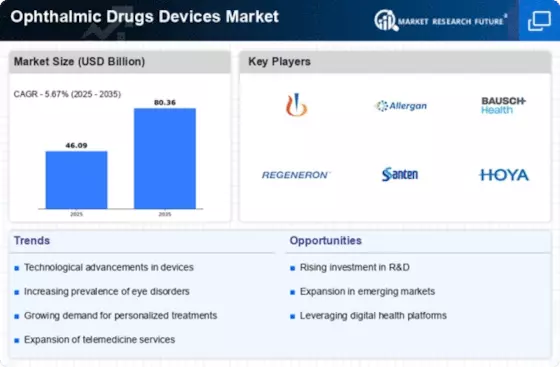
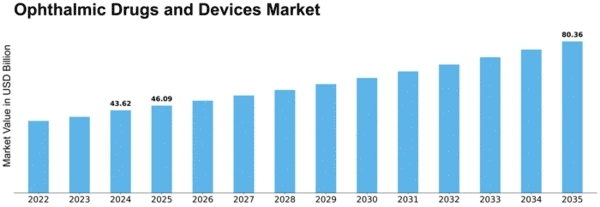
As per MRFR analysis, the Ophthalmic Drugs Devices Market was estimated at 43.62 USD Billion in 2024. The ophthalmic industry is projected to grow from 46.6 USD Billion in 2025 to 80.36 USD Billion by 2035, exhibiting a compound annual growth rate (CAGR) of 5.67 during the forecast period 2025 - 2035.

Key Market Trends & Highlights

The Ophthalmic Drugs Devices Market is experiencing robust growth driven by technological advancements and increasing demand for eye care solutions.

  • Technological advancements in drug delivery systems are reshaping treatment methodologies in the ophthalmic sector.
  • The rising incidence of eye disorders, particularly in aging populations, is propelling market demand in North America.
  • Preventive eye care is gaining traction, with a notable focus on early detection and management of conditions like glaucoma.
  • Market drivers such as technological innovations in ophthalmic devices and the growing aging population are significantly influencing market dynamics.

Market Size & Forecast

2024 Market Size 43.62 (USD Billion)
2035 Market Size 80.36 (USD Billion)
CAGR (2025 - 2035) 5.67%
Largest Regional Market Share in 2024 North America

Major Players

<p>Novartis (CH), Allergan (IE), Bausch Health (CA), Regeneron Pharmaceuticals (US), Santen Pharmaceutical (JP), Hoya Corporation (JP), Carl Zeiss AG (DE), Alcon (CH), Merck & Co. (US)</p>

Market Trends

The Ophthalmic Drugs Devices Market is currently experiencing a dynamic evolution, driven by advancements in technology and an increasing prevalence of eye-related disorders. The integration of innovative drug delivery systems and the development of sophisticated diagnostic tools are reshaping treatment paradigms. As the global population ages, the demand for effective therapies and devices is likely to rise, prompting manufacturers to invest in research and development. Furthermore, the growing awareness of eye health among consumers appears to be influencing market growth, as individuals seek preventive measures and timely interventions for ocular conditions. In addition, regulatory bodies are playing a crucial role in shaping the landscape of the Ophthalmic Drugs Devices Market. Stricter guidelines and approval processes may lead to enhanced safety and efficacy of products, thereby fostering consumer trust. Collaboration between pharmaceutical companies and technology firms is also on the rise, suggesting a trend towards more integrated solutions that combine drugs and devices. Overall, the market seems poised for continued expansion, with opportunities for innovation and improved patient outcomes.

Technological Advancements in Drug Delivery

Recent innovations in drug delivery systems are transforming the Ophthalmic Drugs Devices Market. These advancements include sustained-release formulations and targeted delivery mechanisms, which enhance therapeutic efficacy while minimizing side effects. Such technologies may lead to improved patient compliance and better management of chronic eye diseases.

Rising Incidence of Eye Disorders

The increasing prevalence of eye disorders, particularly among aging populations, is driving demand within the Ophthalmic Drugs Devices Market. Conditions such as glaucoma, cataracts, and age-related macular degeneration are becoming more common, necessitating the development of effective treatment options and diagnostic tools.

Focus on Preventive Eye Care

There is a growing emphasis on preventive eye care, which is influencing the Ophthalmic Drugs Devices Market. Consumers are becoming more proactive about their eye health, leading to increased demand for screening devices and educational resources. This trend suggests a shift towards early detection and intervention strategies.

Ophthalmic Drugs Devices Market Market Drivers

Market Growth Projections

The Global Ophthalmic Drugs and Devices Market Industry is projected to experience substantial growth over the next decade. With a valuation of 83.3 USD Billion in 2024, the market is expected to reach 249.3 USD Billion by 2035. This growth trajectory indicates a compound annual growth rate of 10.48% from 2025 to 2035. Various factors, including the rising prevalence of eye disorders, technological advancements, and increased investment in research and development, contribute to this optimistic outlook. The market's expansion reflects the ongoing need for innovative solutions in ophthalmic care.

Rising Prevalence of Eye Disorders

The Global Ophthalmic Drugs and Devices Market Industry is experiencing growth due to the increasing prevalence of eye disorders such as cataracts, glaucoma, and age-related macular degeneration. According to the World Health Organization, millions of individuals are affected by these conditions, leading to a heightened demand for effective treatment options. As the global population ages, the incidence of these disorders is expected to rise, further driving the market. The industry is projected to reach a valuation of 83.3 USD Billion in 2024, indicating a robust need for innovative ophthalmic drugs and devices to address these challenges.

Aging Population and Lifestyle Changes

The demographic shift towards an aging population, coupled with lifestyle changes, is a key driver of the Global Ophthalmic Drugs and Devices Market Industry. As individuals age, they become more susceptible to various eye disorders, necessitating medical intervention. Additionally, lifestyle factors such as increased screen time and poor dietary habits contribute to the rise in eye-related issues. This trend is expected to fuel demand for ophthalmic treatments and devices. The market's growth trajectory reflects these demographic and lifestyle changes, positioning it for continued expansion in the coming years.

Growing Awareness and Education Initiatives

The Global Ophthalmic Drugs and Devices Market Industry benefits from increasing awareness and education initiatives aimed at eye health. Public health campaigns and educational programs are effectively informing individuals about the importance of regular eye examinations and early detection of eye diseases. Organizations such as the International Agency for the Prevention of Blindness are actively promoting eye health awareness globally. This heightened awareness is likely to lead to increased demand for ophthalmic drugs and devices, as more individuals seek preventive care and treatment options. Consequently, the market is poised for growth as awareness continues to expand.

Increased Investment in Research and Development

Investment in research and development is a significant driver of the Global Ophthalmic Drugs and Devices Market Industry. Pharmaceutical companies and medical device manufacturers are allocating substantial resources to develop innovative therapies and devices. This focus on R&D is essential for addressing unmet medical needs and improving treatment efficacy. For example, recent advancements in gene therapy and regenerative medicine hold promise for treating previously untreatable eye conditions. As a result, the market is expected to grow substantially, with projections indicating a rise to 249.3 USD Billion by 2035, underscoring the importance of sustained investment in this sector.

Technological Advancements in Ophthalmic Devices

Technological innovations play a crucial role in the expansion of the Global Ophthalmic Drugs and Devices Market Industry. The development of advanced diagnostic tools, minimally invasive surgical techniques, and novel drug delivery systems has transformed the treatment landscape. For instance, the introduction of telemedicine in ophthalmology allows for remote consultations and monitoring, enhancing patient access to care. These advancements not only improve patient outcomes but also contribute to market growth. As the industry evolves, it is anticipated that the market will experience a compound annual growth rate of 10.48% from 2025 to 2035, reflecting the impact of these technological breakthroughs.

Market Segment Insights

By Application: Glaucoma Treatment (Largest) vs. Surgical Procedures (Fastest-Growing)

<p>In the Ophthalmic Drugs Devices Market, the application segment is primarily dominated by Glaucoma Treatment, which holds the largest share due to the increasing prevalence of glaucoma in aging populations and heightened awareness regarding eye health. Anti-Inflammatory and Infection Control applications also have significant market presence but to a lesser extent. Dry Eye Treatment shows stable demand, while Surgical Procedures, though currently smaller in share, are rapidly gaining traction as minimally invasive surgery techniques improve, leading to enhanced patient outcomes and satisfaction.</p>

<p>Glaucoma Treatment (Dominant) vs. Surgical Procedures (Emerging)</p>

<p>Glaucoma Treatment remains the dominant application in the Ophthalmic Drugs Devices Market, characterized by an extensive range of medications and devices designed to reduce intraocular pressure and prevent vision loss. This segment benefits from ongoing research and development focused on innovative therapeutic approaches. In contrast, Surgical Procedures are emerging as a vital area within the market, bolstered by advancements in technology and techniques, such as laser-assisted procedures that offer quicker recoveries and reduced procedural risks, thus attracting a new patient demographic seeking effective solutions for various ophthalmic conditions.</p>

By Device Type: Intraocular Pressure Monitors (Largest) vs. Contact Lenses (Fastest-Growing)

<p>In the Ophthalmic Drugs Devices Market, Intraocular Pressure Monitors represent the largest segment, holding a significant market share compared to other device types. This segment is crucial due to the rising prevalence of glaucoma and other eye conditions that necessitate regular monitoring. Following closely is the market for Contact Lenses, which has been witnessing a rapid increase in demand as consumers increasingly shift towards convenience and aesthetic solutions for vision correction. The growth trends within the Ophthalmic Drugs Devices Market are largely driven by advancements in technology and an aging population requiring more ophthalmic care. Diagnostic Devices are also gaining traction, as healthcare providers seek accurate and efficient methods for assessing eye health. As innovation continues to thrive, Drug Delivery Systems are becoming more sophisticated, promising improved therapeutic outcomes. Overall, the market reflects a dynamic shift towards more integrated and user-friendly devices.</p>

<p>Intraocular Pressure Monitors (Dominant) vs. Contact Lenses (Emerging)</p>

<p>Intraocular Pressure Monitors are vital in managing diseases like glaucoma, making them a dominant force in the Ophthalmic Drugs Devices Market. These devices are typically characterized by their accuracy and reliability, fostering confidence among both healthcare professionals and patients. Their established presence ensures they meet stringent regulatory standards, while technological advancements further enhance their utility in clinical settings. On the other hand, Contact Lenses are fast emerging, appealing to younger demographics seeking convenience and aesthetic options for vision correction. Innovations such as daily disposables and specialized lenses for astigmatism are expanding their market reach. Together, these segments illustrate contrasting yet complementary aspects of ophthalmic care, catering to diverse patient needs and preferences.</p>

By Formulation Type: Topical Solutions (Largest) vs. Injectable Solutions (Fastest-Growing)

<p>The formulation type segment of the ophthalmic drugs devices market is diverse, encompassing several key product categories. Dominating this segment, topical solutions present a significant share due to their ease of administration and high patient acceptance. Other formulation types like injectable solutions, ocular implants, ophthalmic gels, and sustained release formulations collectively shape the competitive landscape but exhibit varying degrees of market penetration and growth potential. The market's dynamics are influenced by factors such as advancing technologies, increasing prevalence of ocular diseases, and more accessible healthcare solutions. Growth trends within the formulation types reveal a shifting preference towards injectable solutions, recognized as the fastest-growing category. This growth is largely attributed to the enhanced efficacy and long-lasting outcomes associated with these solutions, catering to a growing patient population seeking effective treatment options. Additionally, the rise of ocular implants and sustained release formulations signifies a transition towards innovative therapeutics that promise improved patient compliance and better disease management. Overall, these trends indicate a vibrant and evolving market for ophthalmic formulation types.</p>

<p>Topical Solutions (Dominant) vs. Ocular Implants (Emerging)</p>

<p>Topical solutions are the dominant formulation type within the ophthalmic drugs devices market, primarily due to their convenience for patients and clinicians alike. They enable straightforward self-administration, which significantly enhances patient adherence to treatment regimens. In contrast, ocular implants represent an emerging segment known for their potential to deliver sustained drug release over extended periods while reducing the frequency of administration. These implants are particularly advantageous for managing chronic ocular conditions, thereby gaining traction among both healthcare providers and patients. As the market embraces innovation, the development of new formulations and drug delivery methods continues to shape the competitive landscape, creating opportunities for both dominant and emerging technologies.</p>

By End User: Hospitals (Largest) vs. Ophthalmology Clinics (Fastest-Growing)

<p>The Ophthalmic Drugs Devices Market is primarily segmented by end users, where hospitals constitute the largest share. Hospitals play a vital role in the provision of ophthalmic devices, serving a broad patient base with advanced treatment options. Following closely are ophthalmology clinics, which are gaining significant traction due to their specialized services and increasing patient visits, especially with an aging population that demands eye care solutions.</p>

<p>Hospitals (Dominant) vs. Ophthalmology Clinics (Emerging)</p>

<p>Hospitals have established themselves as the dominant players in the ophthalmic drugs devices market, offering a wide range of surgical and therapeutic options. Their extensive resources and infrastructure enable them to handle complex cases and perform advanced procedures. Conversely, ophthalmology clinics, while currently categorized as emerging, are rapidly increasing in significance. Their ability to provide specialized services, personalized care, and flexibility attracts a growing patient population, particularly in outpatient settings. As they continue to innovate and meet the evolving needs of patients, clinics are expected to challenge hospitals' dominance in the coming years.</p>

Get more detailed insights about Ophthalmic Drugs and Devices Market Research Report—Global Forecast till 2035

Regional Insights

North America : Market Leader in Innovation

North America continues to lead the Ophthalmic Drugs Devices Market, holding a significant share of 21.81% in 2024. The region's growth is driven by increasing prevalence of eye disorders, advancements in technology, and robust healthcare infrastructure. Regulatory support from agencies like the FDA further catalyzes innovation and market expansion, ensuring that new therapies and devices reach the market efficiently. The competitive landscape is characterized by major players such as Novartis, Allergan, and Regeneron Pharmaceuticals, which are heavily investing in R&D to enhance product offerings. The U.S. remains the largest market, supported by a high demand for innovative treatments and a well-established distribution network. This environment fosters collaboration among key stakeholders, driving further growth in the sector.

Europe : Emerging Market with Growth Potential

Europe's Ophthalmic Drugs Devices Market is valued at €12.96 billion, reflecting a growing demand for advanced eye care solutions. Factors such as an aging population, increased awareness of eye health, and supportive regulatory frameworks are propelling market growth. The European Medicines Agency (EMA) plays a crucial role in facilitating the approval of new therapies, ensuring patient access to innovative treatments. Leading countries like Germany, France, and the UK are at the forefront of this market, with a strong presence of key players such as Alcon and Carl Zeiss AG. The competitive landscape is marked by strategic partnerships and collaborations aimed at enhancing product portfolios. As the market evolves, the focus on personalized medicine and digital health solutions is expected to further drive growth in the region.

Asia-Pacific : Rapidly Growing Market Segment

The Asia-Pacific region, with a market size of $7.3 billion, is witnessing rapid growth in the Ophthalmic Drugs Devices Market. Key drivers include rising incidences of eye diseases, increasing healthcare expenditure, and a growing awareness of eye health among the population. Government initiatives aimed at improving healthcare access and affordability are also contributing to market expansion. Countries like Japan, China, and India are leading the charge, with significant investments from local and international players such as Santen Pharmaceutical and Hoya Corporation. The competitive landscape is evolving, with a focus on innovative product development and strategic collaborations to meet the diverse needs of the population. As the region continues to develop, the demand for advanced ophthalmic solutions is expected to surge.

Middle East and Africa : Emerging Market with Challenges

The Middle East and Africa (MEA) region, valued at $1.55 billion, is gradually emerging in the Ophthalmic Drugs Devices Market. Growth is driven by increasing awareness of eye health, rising disposable incomes, and improvements in healthcare infrastructure. However, challenges such as limited access to advanced treatments and varying regulatory environments can hinder market growth. Countries like South Africa and the UAE are leading the market, with a growing presence of international players. The competitive landscape is characterized by a mix of local and The Ophthalmic Drugs Devices share. As healthcare systems improve and awareness increases, the demand for ophthalmic solutions is expected to rise significantly in the coming years.

Key Players and Competitive Insights

The Ophthalmic Drugs Devices Market is characterized by a dynamic competitive landscape, driven by innovation, strategic partnerships, and a growing demand for advanced therapeutic solutions. Key players such as Novartis (CH), Allergan (IE), and Bausch Health (CA) are actively shaping the market through their distinct operational focuses. Novartis (CH) emphasizes research and development, particularly in gene therapies for retinal diseases, while Allergan (IE) has been enhancing its portfolio through strategic acquisitions aimed at expanding its presence in the dry eye segment. Bausch Health (CA) is concentrating on diversifying its product offerings, particularly in surgical devices, which reflects a broader trend of companies seeking to capture a larger share of the market by addressing various ophthalmic conditions. Collectively, these strategies contribute to a competitive environment that is increasingly focused on innovation and comprehensive care solutions.

In terms of business tactics, companies are localizing manufacturing and optimizing supply chains to enhance efficiency and responsiveness to market demands. The competitive structure of the market appears moderately fragmented, with several key players exerting influence while also facing competition from emerging firms. This fragmentation allows for a variety of approaches to market entry and product development, fostering an environment where innovation can thrive.

In November 2025, Novartis (CH) announced a groundbreaking partnership with a leading tech firm to develop AI-driven diagnostic tools for early detection of ocular diseases. This strategic move is likely to enhance Novartis's capabilities in personalized medicine, positioning the company at the forefront of technological integration in ophthalmology. The collaboration underscores the importance of leveraging technology to improve patient outcomes and streamline clinical workflows.

In October 2025, Allergan (IE) launched a new line of preservative-free eye drops, responding to increasing consumer demand for safer, more effective treatment options. This product introduction not only strengthens Allergan's market position but also reflects a broader trend towards patient-centric solutions in the ophthalmic sector. The emphasis on preservative-free formulations may attract a more health-conscious consumer base, thereby enhancing brand loyalty and market share.

In September 2025, Bausch Health (CA) completed the acquisition of a smaller competitor specializing in innovative surgical devices. This acquisition is indicative of Bausch's strategy to expand its surgical portfolio and enhance its competitive edge in the market. By integrating new technologies and expertise, Bausch Health is likely to improve its product offerings and operational efficiencies, which could lead to increased market penetration.

As of December 2025, current competitive trends in the Ophthalmic Drugs Devices Market are increasingly defined by digitalization, sustainability, and the integration of AI technologies. Strategic alliances are becoming more prevalent, as companies recognize the value of collaboration in driving innovation and enhancing product development. Looking ahead, competitive differentiation is expected to evolve, with a notable shift from price-based competition to a focus on innovation, technological advancements, and supply chain reliability. This transition may ultimately redefine market dynamics, as companies strive to deliver superior value through cutting-edge solutions.

Key Companies in the Ophthalmic Drugs Devices Market market include

Industry Developments

    • In June 2022, Bausch + Lomb Corporation announced the U.S. launch of Revive custom soft contact lenses, available in spherical, toric, multifocal, and multifocal toric options.
    • In October 2021, Ocular Therapeutix announced FDA approval of a supplemental new drug application (sNDA) for DEXTENZA (dexamethasone ophthalmic insert) 0.4 mg for intracanalicular use for the treatment of ocular itching associated with allergic conjunctivitis.
    • In June 2021, Ocular Therapeutix, Inc. entered into a discovery collaboration with Mosaic Biosciences (US) to identify new targets and therapeutic agents aimed at the treatment of dry age-related macular degeneration (dAMD).
    • In May 2022, Alcon signed an agreement to acquire EYSUVIS (loteprednol etabonate suspension) 0.25% pharmaceutical eye drops from Kala Pharmaceuticals, Inc. (US). Alcon's Systane family of eye drops, which includes the recently launched Systane Preservative-Free formulations, will be supplemented by EYSUVIS.
    • According to a court ruling in Genus Medical Technologies LLV v. FDA (Genus), the US Food and Drug Administration (FDA) has clarified a shift in classifying specific ophthalmic products in a piece of final advice for the industry. The most recent guidance refers to "ophthalmic drugs bundled with eye droppers, eyecups, or other dispensers," as defined by 21 CFR Part 4, which covers the regulation of combination products. As a result of the Genus ruling, FDA is now regulating certain ophthalmic dispensers bundled with ophthalmic medications as drug-led combination items rather than drugs, even though historically, these products did not fall under the scope of 21 CFR Part 4.

Future Outlook

Ophthalmic Drugs Devices Market Future Outlook

<p>The Ophthalmic Drugs Devices Market is projected to grow at a 5.67% CAGR from 2024 to 2035, driven by technological advancements, increasing prevalence of eye disorders, and rising healthcare expenditure.</p>

New opportunities lie in:

  • <p>Development of personalized ophthalmic drug delivery systems</p>
  • <p>Expansion of telemedicine platforms for remote eye care</p>
  • <p>Investment in AI-driven diagnostic tools for early disease detection</p>

<p>By 2035, the market is expected to achieve substantial growth, reflecting evolving healthcare needs and technological innovations.</p>

Market Segmentation

Ophthalmic Drugs Devices Market End User Outlook

  • Hospitals
  • Ophthalmology Clinics
  • Home Care Settings
  • Research Institutions
  • Pharmacies

Ophthalmic Drugs Devices Market Application Outlook

  • Glaucoma Treatment
  • Anti-Inflammatory
  • Infection Control
  • Dry Eye Treatment
  • Surgical Procedures

Ophthalmic Drugs Devices Market Device Type Outlook

  • Intraocular Pressure Monitors
  • Ophthalmic Surgical Instruments
  • Diagnostic Devices
  • Drug Delivery Systems
  • Contact Lenses

Ophthalmic Drugs Devices Market Formulation Type Outlook

  • Topical Solutions
  • Injectable Solutions
  • Ocular Implants
  • Ophthalmic Gels
  • Sustained Release Formulations

Report Scope

MARKET SIZE 202443.62(USD Billion)
MARKET SIZE 202546.6(USD Billion)
MARKET SIZE 203580.36(USD Billion)
COMPOUND ANNUAL GROWTH RATE (CAGR)5.67% (2024 - 2035)
REPORT COVERAGERevenue Forecast, Competitive Landscape, Growth Factors, and Trends
BASE YEAR2024
Market Forecast Period2025 - 2035
Historical Data2019 - 2024
Market Forecast UnitsUSD Billion
Key Companies ProfiledNovartis (CH), Allergan (IE), Bausch Health (CA), Regeneron Pharmaceuticals (US), Santen Pharmaceutical (JP), Hoya Corporation (JP), Carl Zeiss AG (DE), Alcon (CH), Merck & Co. (US)
Segments CoveredApplication, Device Type, Formulation Type, End User
Key Market OpportunitiesAdvancements in personalized medicine enhance treatment efficacy in the Ophthalmic Drugs Devices Market.
Key Market DynamicsTechnological advancements and regulatory changes drive innovation and competition in the Ophthalmic Drugs Devices Market.
Countries CoveredNorth America, Europe, APAC, South America, MEA

FAQs

How Big is the Ophthalmic Drugs and Devices market?

The ophthalmic drugs and devices market is projected to reach USD 192.5billion by 2030 and register a CAGR of 9% during the forecast period of 2023 to 2032.

Who are the key competitors in the market of Ophthalmic Drugs and Devices?

Allergan plc (Ireland), Johnson and Johnson Vision (US), Alcon (Switzerland), Teva Pharmaceutical Industries Ltd. (Israel), Ocular Therapeutix, Inc. (US), Lomb Incorporated (Canada), Sight Sciences, Inc. (US), Mibo Medical Group (US), BioTissue (US), and NuSight Medical (US) are the leading players in the market

Which region is predicted to have the largest market share of Ophthalmic Drugs and Devices?

North America is predicted to lead the market of Ophthalmic Drugs and Devices.

What are the key factors driving the market of Ophthalmic Drugs and Devices?

Rising prevalence of ophthalmic disorders and Rising geriatric population are key factors driving the market of Ophthalmic Drugs and Devices

Which factors may act as market deterrents Ophthalmic Drugs and Devices?

Lack of awareness regarding eye disorders and Side effects associated with ophthalmic drugs are the market deterrents

  1. EXECUTIVE SUMMARY
    1. OVERVIEW
  2. MARKET INTRODUCTION
    1. DEFINITION
    2. SCOPE OF THE STUDY
    3. RESEARCH OBJECTIVE
    4. MARKET STRUCTURE
    5. ASSUMPTIONS & LIMITATIONS
  3. RESEARCH METHODOLOGY
    1. DATA MINING
    2. SECONDARY RESEARCH
    3. PRIMARY RESEARCH
    4. BREAKDOWN OF PRIMARY RESPONDENTS
    5. FORECASTING TECHNIQUES
    6. RESEARCH METHODOLOGY
      1. BOTTOM-UP APPROACH
      2. TOP-DOWN APPROACH
    7. FOR MARKET SIZE ESTIMATION
    8. DATA TRIANGULATION
    9. VALIDATION
  4. MARKET DYNAMICS
    1. OVERVIEW
    2. DRIVERS
      1. RISING PREVALENCE OF OPHTHALMIC DISORDERS
      2. RISING GERAITRIC
    3. POPULATION
    4. GROWING NUMBER OF DIABETES CASES
    5. RESTRAINTS
      1. LACK OF AWARENESS REGARDING EYE DISORDERS
      2. SIDE EFFECTS ASSOCIATED WITH OPHTHALMIC DRUGS
    6. OPPORTUNITIES
      1. INCREASE PRODUCT
    7. DEVELOPMENT AND LAUNCHES
  5. MARKET FACTOR ANALYSIS
    1. VALUE CHAIN ANALYSIS
      1. R&D
      2. MANUFACTURING
      3. DISTRIBUTION & SALES
      4. POST-SALES MONITORING
    2. PORTER''S FIVE FORCES
      1. THREAT OF SUBSTITUTES
      2. BARGAINING POWER OF BUYERS
      3. INTENSITY OF RIVALRY
    3. MODEL
    4. THREAT OF NEW ENTRANTS
    5. BARGAINING POWER OF SUPPLIERS
    6. IMPACT OF COVID-19 ON THE OPHTHALMIC DRUGS AND
  6. DEVICES MARKET
    1. IMPACT ON SUPPLY CHAIN
    2. IMPACT ON PRODUCTION
    3. IMPACT ON MARKET PLAYERS
  7. GLOBAL OPHTHALMIC DRUGS AND DEVICES MARKET, BY PRODUCT
    1. OVERVIEW
    2. DRUGS
      1. PILOCARPINE
      2. MICROPINE
      3. PROVISC
      4. DIURETICS
      5. VASOCONSTRICTORS
      6. FLUOCINOLONE
      7. BIMATOPROST
      8. OTHERS
    3. DEVICES
      1. GLASSES AND CONTACT
      2. OTHERS
    4. LENS
    5. OPTICAL DISPENSER
    6. EYE MASSAGERS
    7. SPONGE DEVICES AND EYE CLEANER
  8. GLOBAL OPHTHALMIC DRUGS AND DEVICES MARKET, BY TREATMENT
    1. OVERVIEW
    2. EYE INFECTIONS
    3. ALLERGIC CONJUNCTIVITIS
    4. DRY EYES SYNDROME
    5. RED EYES
    6. INFLAMMATION
    7. OTHERS
  9. GLOBAL OPHTHALMIC DRUGS
  10. AND DEVICES MARKET, BY REGION
    1. OVERVIEW
    2. NORTH AMERICA
      1. US
      2. FRANCE
      3. ITALY
      4. SPAIN
      5. REST OF EUROPE
    3. CANADA
    4. EUROPE
    5. GERMANY
    6. UK
    7. ASIA-PACIFIC
      1. JAPAN
      2. CHINA
      3. INDIA
      4. AUSTRALIA
      5. SOUTH KOREA
      6. REST OF ASIA-PACIFIC
    8. REST OF THE WORLD
      1. MIDDLE EAST
      2. AFRICA
      3. LATIN AMERICA
  11. COMPETITIVE LANDSCAPE
    1. OVERVIEW
    2. COMPETITIVE BENCHMARKING
    3. MAJOR GROWTH STRATEGY
  12. IN THE GLOBAL OPHTHALMIC DRUGS AND DEVICES MARKET
    1. THE LEADING PLAYERS IN TERMS OF NUMBER OF DEVELOPMENTS
  13. IN GLOBAL OPHTHALMIC DRUGS AND DEVICES MARKET
    1. KEY DEVELOPMENT ANALYSIS
    2. KEY DEVELOPMENTS & GROWTH STRATEGIES
      1. PRODUCT APPROVAL
      2. SALES (USD MILLION), 2021
      3. R&D (USD MILLION), 2021
    3. AND PRODUCT LAUNCH
    4. COLLABORATION
    5. AGREEMENT
    6. ACQUISITION
    7. MAJOR PLAYERS FINANCIAL MATRIX
  14. COMPANY PROFILES
    1. JOHNSON AND JOHNSON
    2. VISION
    3. COMPANY OVERVIEW
    4. FINANCIAL OVERVIEW
    5. PRODUCTS OFFERED
    6. KEY DEVELOPMENTS
  15. SWOT ANALYSIS
    1. KEY STRATEGIES
    2. ALLERGAN PLC
    3. COMPANY OVERVIEW
    4. FINANCIAL OVERVIEW
    5. PRODUCTS OFFERED
    6. KEY DEVELOPMENTS
  16. SWOT ANALYSIS
    1. KEY STRATEGIES
    2. TEVA PHARMACEUTICAL INDUSTRIES LTD.
    3. INC.
    4. COMPANY OVERVIEW
  17. COMPANY OVERVIEW
  18. FINANCIAL ANALYSIS
  19. PRODUCTS OFFERED
  20. KEY DEVELOPMENTS
  21. SWOT ANALYSIS
  22. KEY STRATEGIES
    1. OCULAR THERAPEUTIX, INC
      1. COMPANY OVERVIEW
      2. FINANCIAL OVERVIEW
      3. PRODUCTS OFFERED
      4. KEY DEVELOPMENTS
      5. SWOT ANALYSIS
      6. KEY STRATEGIES
    2. BAUSCH & LOMB INCORPORATED
      1. COMPANY OVERVIEW
      2. FINANCIAL OVERVIEW
      3. PRODUCTS OFFERED
      4. KEY DEVELOPMENTS
      5. SWOT ANALYSIS
      6. KEY STRATEGIES
    3. SIGHT SCIENCES,
  23. FINANCIAL ANALYSIS
    1. PRODUCTS OFFERED
    2. KEY DEVELOPMENTS
    3. KEY STRATEGIES
    4. MIBO MEDICAL GROUP
    5. COMPANY OVERVIEW
    6. FINANCIAL OVERVIEW
    7. PRODUCTS OFFERED
    8. KEY DEVELOPMENTS
    9. KEY STRATEGIES
    10. ALCON
    11. COMPANY OVERVIEW
    12. FINANCIAL OVERVIEW
    13. PRODUCTS 0FFERED
    14. KEY DEVELOPMENTS
  24. SWOT ANALYSIS
    1. KEY STRATEGIES
    2. BIOTISSUE
    3. COMPANY OVERVIEW
    4. FINANCIAL OVERVIEW
    5. PRODUCTS OFFERED
    6. KEY DEVELOPMENTS
    7. KEY STRATEGIES
    8. NUSIGHT MEDICAL
    9. COMPANY OVERVIEW
    10. FINANCIAL OVERVIEW
    11. PRODUCTS OFFERED
    12. KEY DEVELOPMENTS
    13. KEY STRATEGIES
    14. APPENDIX
    15. REFERENCES
    16. RELATED REPORTS
    17. LIST
  25. OF TABLES
    1. TABLE
  26. LIST OF ASSUMPTIONS & LIMITATIONS
  27. PRIMARY INTERVIEWS AND INFORMATION GATHERING PROCESS
  28. GLOBAL OPHTHALMIC
  29. DRUGS AND DEVICES MARKET, BY PRODUCT, 2018–2030 (USD MILLION)
  30. GLOBAL OPHTHALMIC DRUGS
  31. AND DEVICES MARKET, FOR DRUGS, BY TYPE, 2018–2030 (USD MILLION)
  32. GLOBAL OPHTHALMIC
  33. DRUGS AND DEVICES MARKET, FOR DEVICES, BY TYPE, 2018–2030 (USD MILLION)
  34. GLOBAL OPHTHALMIC
  35. DRUGS AND DEVICES MARKET, FOR DRUGS, BY REGION, 2018–2030 (USD MILLION)
  36. GLOBAL OPHTHALMIC
  37. DRUGS AND DEVICES MARKET, FOR PILOCARPINE, BY REGION, 2018–2030 (USD MILLION)
  38. GLOBAL OPHTHALMIC
  39. DRUGS AND DEVICES MARKET, FOR MICROPINE, BY REGION, 2018–2030 (USD MILLION)
  40. GLOBAL OPHTHALMIC
  41. DRUGS AND DEVICES MARKET, FOR PROVISC, BY REGION, 2018–2030 (USD MILLION)
  42. GLOBAL OPHTHALMIC
  43. DRUGS AND DEVICES MARKET, FOR DIURETICS, BY REGION, 2018–2030 (USD MILLION)
  44. GLOBAL OPHTHALMIC
  45. DRUGS AND DEVICES MARKET, FOR VASOCONSTRICTORS, BY REGION, 2018–2030 (USD
    1. MILLION)
    2. TABLE
  46. GLOBAL OPHTHALMIC DRUGS AND DEVICES MARKET, FOR FLUOCINOLONE, BY REGION, 2018–2030
    1. (USD MILLION)
    2. TABLE
  47. GLOBAL OPHTHALMIC DRUGS AND DEVICES MARKET, FOR BIMATOPROST, BY REGION, 2018–2030
    1. (USD MILLION)
    2. TABLE
  48. GLOBAL OPHTHALMIC DRUGS AND DEVICES MARKET, FOR OTHERS, BY REGION, 2018–2030
    1. (USD MILLION)
    2. TABLE
  49. GLOBAL OPHTHALMIC DRUGS AND DEVICES MARKET, FOR DEVICES, BY REGION, 2018–2030
    1. (USD MILLION)
    2. TABLE
  50. GLOBAL OPHTHALMIC DRUGS AND DEVICES MARKET, FOR GLASSES AND CONTACT LENS, BY
    1. REGION, 2018–2030 (USD MILLION)
  51. GLOBAL OPHTHALMIC DRUGS AND DEVICES MARKET, FOR
    1. OPTICAL DISPENSER, BY REGION, 2018–2030 (USD MILLION)
  52. GLOBAL OPHTHALMIC DRUGS AND DEVICES MARKET,
    1. FOR EYE MASSAGERS, BY REGION, 2018–2030 (USD MILLION)
  53. GLOBAL OPHTHALMIC DRUGS AND DEVICES MARKET,
    1. FOR SPONGE DEVICES AND EYE CLEANER, BY REGION, 2018–2030 (USD MILLION)
  54. GLOBAL OPHTHALMIC
  55. DRUGS AND DEVICES MARKET, FOR OTHERS, BY REGION, 2018–2030 (USD MILLION)
  56. GLOBAL OPHTHALMIC
  57. DRUGS AND DEVICES MARKET, BY TREATMENT, 2018–2030 (USD MILLION)
  58. GLOBAL OPHTHALMIC
  59. DRUGS AND DEVICES MARKET, FOR EYE INFECTIONS, BY REGION, 2018–2030 (USD MILLION)
  60. GLOBAL OPHTHALMIC
  61. DRUGS AND DEVICES MARKET, FOR ALLERGIC CONJUNCTIVITIS, BY REGION, 2018–2030
    1. (USD MILLION)
    2. TABLE
  62. GLOBAL OPHTHALMIC DRUGS AND DEVICES MARKET, FOR DRY EYES SYNDROME, BY REGION,
  63. GLOBAL OPHTHALMIC DRUGS AND DEVICES MARKET, FOR RED EYES,
    1. BY REGION, 2018–2030 (USD MILLION)
  64. GLOBAL OPHTHALMIC DRUGS AND DEVICES MARKET, FOR
    1. INFLAMMATION, BY REGION, 2018–2030 (USD MILLION)
  65. GLOBAL OPHTHALMIC DRUGS AND DEVICES MARKET,
    1. FOR OTHERS, BY REGION, 2018–2030 (USD MILLION)
  66. GLOBAL: OPHTHALMIC DRUGS AND DEVICES MARKET,
    1. BY REGION, 2018–2030 (USD MILLION)
  67. NORTH AMERICA: OPHTHALMIC DRUGS AND DEVICES MARKET,
    1. BY COUNTRY, 2018-2030 (USD MILLION)
  68. NORTH AMERICA: OPHTHALMIC DRUGS AND DEVICES MARKET,
    1. BY PRODUCT, 2018-2030 (USD MILLION)
  69. NORTH AMERICA: OPHTHALMIC DRUGS AND DEVICES MARKET,
    1. FOR DRUGS, BY TYPE, 2018-2030 (USD MILLION)
  70. NORTH AMERICA: OPHTHALMIC DRUGS AND DEVICES
  71. MARKET, FOR DEVICES, BY TYPE, 2018-2030 (USD MILLION)
  72. NORTH AMERICA: OPHTHALMIC DRUGS AND DEVICES
  73. MARKET, BY TREATMENT, 2018-2030 (USD MILLION)
  74. US: OPHTHALMIC DRUGS AND DEVICES MARKET,
    1. BY PRODUCT, 2018-2030 (USD MILLION)
  75. US: OPHTHALMIC DRUGS AND DEVICES MARKET, FOR DRUGS,
    1. BY TYPE, 2018-2030 (USD MILLION)
  76. US: OPHTHALMIC DRUGS AND DEVICES MARKET, FOR DEVICES, BY TYPE,
  77. US: OPHTHALMIC DRUGS AND DEVICES MARKET, BY TREATMENT, 2018-2030
    1. (USD MILLION)
    2. TABLE
  78. CANADA: OPHTHALMIC DRUGS AND DEVICES MARKET, BY PRODUCT, 2018-2030 (USD MILLION)
  79. CANADA: OPHTHALMIC
  80. DRUGS AND DEVICES MARKET, FOR DRUGS, BY TYPE, 2018-2030 (USD MILLION)
  81. CANADA: OPHTHALMIC
  82. DRUGS AND DEVICES MARKET, FOR DEVICES, BY TYPE, 2018-2030 (USD MILLION)
  83. CANADA: OPHTHALMIC
  84. DRUGS AND DEVICES MARKET, BY TREATMENT, 2018-2030 (USD MILLION)
  85. EUROPE: OPHTHALMIC DRUGS
  86. AND DEVICES MARKET, BY COUNTRY, 2018-2030 (USD MILLION)
  87. EUROPE: OPHTHALMIC DRUGS AND DEVICES MARKET,
    1. BY PRODUCT, 2018-2030 (USD MILLION)
  88. EUROPE: OPHTHALMIC DRUGS AND DEVICES MARKET, FOR
    1. DRUGS, BY TYPE, 2018-2030 (USD MILLION)
  89. EUROPE: OPHTHALMIC DRUGS AND DEVICES MARKET, FOR
    1. DEVICES, BY TYPE, 2018-2030 (USD MILLION)
  90. EUROPE: OPHTHALMIC DRUGS AND DEVICES MARKET,
    1. BY TREATMENT, 2018-2030 (USD MILLION)
  91. GERMANY: OPHTHALMIC DRUGS AND DEVICES MARKET, BY
    1. PRODUCT, 2018-2030 (USD MILLION)
  92. GERMANY: OPHTHALMIC DRUGS AND DEVICES MARKET, FOR DRUGS, BY
    1. TYPE, 2018-2030 (USD MILLION)
  93. GERMANY: OPHTHALMIC DRUGS AND DEVICES MARKET, FOR DEVICES,
    1. BY TYPE, 2018-2030 (USD MILLION)
  94. GERMANY: OPHTHALMIC DRUGS AND DEVICES MARKET, BY TREATMENT,
  95. UK: OPHTHALMIC DRUGS AND DEVICES MARKET, BY PRODUCT, 2018-2030
    1. (USD MILLION)
    2. TABLE
  96. UK: OPHTHALMIC DRUGS AND DEVICES MARKET, FOR DRUGS, BY TYPE, 2018-2030 (USD MILLION)
  97. UK: OPHTHALMIC
  98. DRUGS AND DEVICES MARKET, FOR DEVICES, BY TYPE, 2018-2030 (USD MILLION)
  99. UK: OPHTHALMIC
  100. DRUGS AND DEVICES MARKET, BY TREATMENT, 2018-2030 (USD MILLION)
  101. FRANCE: OPHTHALMIC DRUGS
  102. AND DEVICES MARKET, BY PRODUCT, 2018-2030 (USD MILLION)
  103. FRANCE: OPHTHALMIC DRUGS AND DEVICES MARKET,
    1. FOR DRUGS, BY TYPE, 2018-2030 (USD MILLION)
  104. FRANCE: OPHTHALMIC DRUGS AND DEVICES MARKET,
    1. FOR DEVICES, BY TYPE, 2018-2030 (USD MILLION)
  105. FRANCE: OPHTHALMIC DRUGS AND DEVICES MARKET,
    1. BY TREATMENT, 2018-2030 (USD MILLION)
  106. ITALY: OPHTHALMIC DRUGS AND DEVICES MARKET, BY
    1. PRODUCT, 2018-2030 (USD MILLION)
  107. ITALY: OPHTHALMIC DRUGS AND DEVICES MARKET, FOR DRUGS, BY
    1. TYPE, 2018-2030 (USD MILLION)
  108. ITALY: OPHTHALMIC DRUGS AND DEVICES MARKET, FOR DEVICES, BY
    1. TYPE, 2018-2030 (USD MILLION)
  109. ITALY: OPHTHALMIC DRUGS AND DEVICES MARKET, BY TREATMENT,
  110. SPAIN: OPHTHALMIC DRUGS AND DEVICES MARKET, BY PRODUCT, 2018-2030
    1. (USD MILLION)
    2. TABLE
  111. SPAIN: OPHTHALMIC DRUGS AND DEVICES MARKET, FOR DRUGS, BY TYPE, 2018-2030 (USD
    1. MILLION)
    2. TABLE
  112. SPAIN: OPHTHALMIC DRUGS AND DEVICES MARKET, FOR DEVICES, BY TYPE, 2018-2030 (USD
    1. MILLION)
    2. TABLE
  113. SPAIN: OPHTHALMIC DRUGS AND DEVICES MARKET, BY TREATMENT, 2018-2030 (USD MILLION)
  114. REST OF EUROPE:
  115. OPHTHALMIC DRUGS AND DEVICES MARKET, BY PRODUCT, 2018-2030 (USD MILLION)
  116. REST OF EUROPE:
  117. OPHTHALMIC DRUGS AND DEVICES MARKET, FOR DRUGS, BY TYPE, 2018-2030 (USD MILLION)
  118. REST OF EUROPE:
  119. OPHTHALMIC DRUGS AND DEVICES MARKET, FOR DEVICES, BY TYPE, 2018-2030 (USD MILLION)
  120. REST OF EUROPE:
  121. OPHTHALMIC DRUGS AND DEVICES MARKET, BY TREATMENT, 2018-2030 (USD MILLION)
  122. ASIA-PACIFIC:
  123. OPHTHALMIC DRUGS AND DEVICES MARKET, BY COUNTRY, 2018-2030 (USD MILLION)
  124. ASIA-PACIFIC:
  125. OPHTHALMIC DRUGS AND DEVICES MARKET, BY PRODUCT, 2018-2030 (USD MILLION)
  126. ASIA-PACIFIC:
  127. OPHTHALMIC DRUGS AND DEVICES MARKET, FOR DRUGS, BY TYPE, 2018-2030 (USD MILLION)
  128. ASIA-PACIFIC:
  129. OPHTHALMIC DRUGS AND DEVICES MARKET, FOR DEVICES, BY TYPE, 2018-2030 (USD MILLION)
  130. ASIA-PACIFIC:
  131. OPHTHALMIC DRUGS AND DEVICES MARKET, BY TREATMENT, 2018-2030 (USD MILLION)
  132. JAPAN: OPHTHALMIC
  133. DRUGS AND DEVICES MARKET, BY PRODUCT, 2018-2030 (USD MILLION)
  134. JAPAN: OPHTHALMIC DRUGS
  135. AND DEVICES MARKET, FOR DRUGS, BY TYPE, 2018-2030 (USD MILLION)
  136. JAPAN: OPHTHALMIC DRUGS
  137. AND DEVICES MARKET, FOR DEVICES, BY TYPE, 2018-2030 (USD MILLION)
  138. JAPAN: OPHTHALMIC DRUGS
  139. AND DEVICES MARKET, BY TREATMENT, 2018-2030 (USD MILLION)
  140. CHINA: OPHTHALMIC DRUGS AND DEVICES MARKET,
    1. BY PRODUCT, 2018-2030 (USD MILLION)
  141. CHINA: OPHTHALMIC DRUGS AND DEVICES MARKET, FOR
    1. DRUGS, BY TYPE, 2018-2030 (USD MILLION)
  142. CHINA: OPHTHALMIC DRUGS AND DEVICES MARKET, FOR
    1. DEVICES, BY TYPE, 2018-2030 (USD MILLION)
  143. CHINA: OPHTHALMIC DRUGS AND DEVICES MARKET,
    1. BY TREATMENT, 2018-2030 (USD MILLION)
  144. INDIA: OPHTHALMIC DRUGS AND DEVICES MARKET, BY
    1. PRODUCT, 2018-2030 (USD MILLION)
  145. INDIA: OPHTHALMIC DRUGS AND DEVICES MARKET, FOR DRUGS, BY
    1. TYPE, 2018-2030 (USD MILLION)
  146. INDIA: OPHTHALMIC DRUGS AND DEVICES MARKET, FOR DEVICES, BY
    1. TYPE, 2018-2030 (USD MILLION)
  147. INDIA: OPHTHALMIC DRUGS AND DEVICES MARKET, BY TREATMENT,
  148. AUSTRALIA: OPHTHALMIC DRUGS AND DEVICES MARKET, BY PRODUCT,
  149. AUSTRALIA: OPHTHALMIC DRUGS AND DEVICES MARKET, FOR DRUGS,
    1. BY TYPE, 2018-2030 (USD MILLION)
  150. AUSTRALIA: OPHTHALMIC DRUGS AND DEVICES MARKET, FOR DEVICES,
    1. BY TYPE, 2018-2030 (USD MILLION)
  151. AUSTRALIA: OPHTHALMIC DRUGS AND DEVICES MARKET, BY TREATMENT,
  152. SOUTH KOREA: OPHTHALMIC DRUGS AND DEVICES MARKET, BY PRODUCT,
  153. SOUTH KOREA: OPHTHALMIC DRUGS AND DEVICES MARKET, FOR DRUGS,
    1. BY TYPE, 2018-2030 (USD MILLION)
  154. SOUTH KOREA: OPHTHALMIC DRUGS AND DEVICES MARKET, FOR DEVICES,
    1. BY TYPE, 2018-2030 (USD MILLION)
    2. T

Ophthalmic Drugs and Devices Market Segmentation

Market Segmentation Overview

  • Detailed segmentation data will be available in the full report
  • Comprehensive analysis by multiple parameters
  • Regional and country-level breakdowns
  • Market size forecasts by segment
Infographic

Free Sample Request

Kindly complete the form below to receive a free sample of this Report

Get Free Sample

Customer Strories

Compare Licence

×
Features License Type
Single User Multiuser License Enterprise User
Price $4,950 $5,950 $7,250
Maximum User Access Limit 1 User Upto 10 Users Unrestricted Access Throughout the Organization
Free Customization
Direct Access to Analyst
Deliverable Format
Platform Access
Discount on Next Purchase 10% 15% 15%
Printable Versions