×
Request Free Sample ×

Kindly complete the form below to receive a free sample of this Report

* Please use a valid business email

Leading companies partner with us for data-driven Insights

clients tt-cursor
Hero Background
English
Chinese
French
Japanese
Korean
German
Spanish

Oil Filter Market Trends

ID: MRFR/AT/5916-CR
100 Pages
Sejal Akre
June 2023

Oil Filter Market Research Report Information by Filter Type (Fuel Filter, Engine Oil Filter, Hydraulic Filter, and Others), Filter Media (Cellulose, Synthetic, and Other Oil Filter), Vehicle Type, Fuel Type, Sales Channel, and Region - Global Forecast till 2035

Share:
Download PDF ×

We do not share your information with anyone. However, we may send you emails based on your report interest from time to time. You may contact us at any time to opt-out.

Oil Filter Market Infographic
×
Oil Filter Market Infographic Full View
Purchase Options

Market Trends

Key Emerging Trends in the Oil Filter Market

In the dynamic landscape of the Oil Filter Market, companies employ various market share positioning strategies to establish a competitive edge and thrive in the industry. One prominent approach is product differentiation, wherein companies focus on offering unique and innovative oil filter solutions. This strategy aims to create a distinct identity for a brand by providing features such as advanced filtration technology, extended durability, and compatibility with a wide range of vehicles. By highlighting these differentiators, companies strive to attract a segment of consumers who prioritize quality and performance in their oil filters.

Another key strategy involves pricing, wherein companies strategically set their prices to capture specific market segments. Some may adopt a premium pricing strategy, positioning their oil filters as high-quality, premium products targeting consumers who are willing to pay a premium for superior performance and reliability. On the contrary, others may adopt a cost leadership strategy, aiming to capture a larger market share by offering affordable yet reliable oil filters. This approach is particularly effective in appealing to price-sensitive consumers who prioritize budget-friendly options without compromising on essential performance aspects.

Market segmentation is an essential component of successful market share positioning in the oil filter industry. Companies analyze the diverse needs and preferences of consumers and tailor their products accordingly. For instance, some companies may focus on producing specialized oil filters for heavy-duty vehicles, catering to the needs of trucking and industrial sectors. Meanwhile, others may concentrate on developing filters specifically designed for high-performance sports cars, meeting the demands of automotive enthusiasts. Through effective segmentation, companies can align their products with the specific requirements of distinct consumer groups, enhancing their market presence.

Strategic partnerships and collaborations are increasingly becoming integral to market share positioning in the Oil Filter Market. Companies may form alliances with automotive manufacturers or dealerships to ensure their products are recommended or offered as part of vehicle servicing packages. Such collaborations not only enhance brand visibility but also contribute to building a reputation for reliability and compatibility within the automotive industry. Additionally, partnerships with online retailers and e-commerce platforms can broaden the reach of oil filter products, tapping into a wider consumer base and diversifying sales channels.

Continuous innovation is a key driver in market share positioning, as companies strive to stay ahead of the curve in terms of technological advancements. This involves investing in research and development to introduce cutting-edge filtration technologies that improve efficiency, durability, and environmental sustainability. By regularly updating their product offerings, companies can attract consumers who value staying abreast of the latest advancements in automotive technology, thus securing a competitive position in the market.

In conclusion, the Oil Filter Market is characterized by a myriad of market share positioning strategies, each tailored to meet the diverse needs and preferences of consumers. From product differentiation and pricing strategies to market segmentation, strategic partnerships, and continuous innovation, companies employ a multifaceted approach to carve out their space in this competitive industry. As technology continues to evolve and consumer expectations shift, adaptability and a keen understanding of market dynamics remain crucial for sustained success in the Oil Filter Market.


Author
Sejal Akre
Senior Research Analyst

She has over 5 years of rich experience, in market research and consulting providing valuable market insights to client. Hands on expertise in management consulting, and extensive knowledge in domain including ICT, Automotive & Transportation and Aerospace & Defense. She is skilled in Go-to market strategy, industry analysis, market sizing, in depth company profiling, competitive intelligence & benchmarking and value chain amongst others.

Leave a Comment

FAQs

How much is the Oil Filter market?

Oil Filter market is estimated USD 3.3 Billion.

How Big is the U.S Oil Filter market?

U.S Market is estimated USD 2.64 billion.

What is the growth rate of the Oil Filter market?

5.6% is the growth rate of Oil Filter market.

Which region held the largest market share in the Oil Filter market?

North America region held the largest market share in the Oil Filter market.

Who are the key players in the Oil Filter market?

The Mann+Hummel Group, Ahlstrom Corporation, Rank Group Limited (UCI-FRAM), Cummins Inc., Sogefi SpA, Donaldson Company, Inc., MAHLE GmbH, Clarcor Inc., Denso Corporation, Hengst Se & Co. Kg, AC Delco Inc., GUD Holdings Limited, and others are key players in the market.

Which type led the Oil Filter market?

Engine Oil Type led the Oil Filter market.

Which vehicle type had the largest market share in the Oil Filter market?

Disel vehicle type had the largest market share in the Oil Filter market.

Market Summary

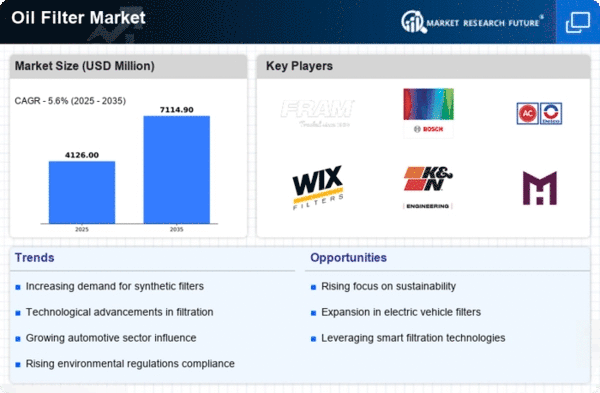
As per MRFR analysis, the Oil Filter Market Size was estimated at 3907.2 USD Million in 2024. The Oil Filter industry is projected to grow from 4126.0 in 2025 to 7114.9 by 2035, exhibiting a compound annual growth rate (CAGR) of 5.6 during the forecast period 2025 - 2035.

Key Market Trends & Highlights

The Oil Filter Market is experiencing a dynamic shift towards sustainability and technological innovation.

  • The North American region remains the largest market for oil filters, driven by robust automotive production. Asia-Pacific is emerging as the fastest-growing region, fueled by increasing vehicle ownership and industrial expansion. The automotive segment dominates the market, while the industrial segment is witnessing rapid growth due to rising demand for filtration solutions. Key market drivers include rising automotive production and increased awareness of vehicle maintenance, which are propelling the demand for oil filters.

Market Size & Forecast

2024 Market Size 3907.2 (USD Million)
2035 Market Size 7114.9 (USD Million)
CAGR (2025 - 2035) 5.6%
Largest Regional Market Share in 2024 North America

Major Players

Mann+Hummel (DE), Fram (US), Bosch (DE), AC Delco (US), WIX Filters (US), K&N Engineering (US), Mahle (DE), Acdelco (US), Sakura Filter (JP)

Market Trends

The Oil Filter Market is currently experiencing a dynamic evolution, driven by various factors that influence consumer preferences and technological advancements. As environmental concerns gain prominence, there is a noticeable shift towards eco-friendly and sustainable oil filter options.

This trend appears to be fueled by increasing awareness regarding the impact of waste on the environment, prompting manufacturers to innovate and develop products that align with green initiatives. Furthermore, the rise of electric vehicles is likely to reshape the landscape of the Oil Filter Market, as traditional oil filters may need to adapt or be replaced by alternative filtration solutions. In addition to environmental considerations, the Oil Filter Market is also witnessing a surge in demand for high-performance filters.

Consumers are increasingly seeking products that enhance engine efficiency and prolong vehicle lifespan. This trend suggests a growing preference for advanced filtration technologies that can effectively remove contaminants while maintaining optimal oil flow. As the market continues to evolve, it is essential for stakeholders to remain attuned to these shifts, ensuring that their offerings meet the changing needs of consumers and regulatory standards.

Sustainability Focus

The Oil Filter Market is increasingly leaning towards sustainable practices, with manufacturers prioritizing eco-friendly materials and processes. This trend reflects a broader societal shift towards environmental responsibility, as consumers demand products that minimize ecological impact.

Technological Advancements

Innovations in filtration technology are reshaping the Oil Filter Market, with a focus on enhancing performance and efficiency. Advanced materials and designs are being developed to improve contaminant removal and extend filter life, catering to the needs of modern engines.

Electric Vehicle Integration

The rise of electric vehicles is influencing the Oil Filter Market, as traditional oil filtration systems may need to adapt to new technologies. This shift presents opportunities for manufacturers to explore alternative filtration solutions that align with the evolving automotive landscape.

Oil Filter Market Market Drivers

Market Segment Insights

By Application: Automotive (Largest) vs. Industrial (Fastest-Growing)

In the Oil Filter Market, the application segment is primarily dominated by the automotive sector, which accounts for a significant share due to the increasing number of vehicles on the road. Growing consumer awareness about engine maintenance and performance has led to a consistent demand for high-quality oil filters in automobiles. Other notable segments include industrial applications catering to manufacturing, construction, and heavy machinery, accounting for a smaller but vital share of the market.

Automotive: Dominant vs. Industrial: Emerging

The automotive segment continues to be the dominant force within the Oil Filter Market, driven by the growing <a href="https://www.marketresearchfuture.com/reports/automotive-industry-7683">automotive industry</a> and increasing vehicle production. Consumers are increasingly prioritizing vehicle longevity and efficiency, leading to an emphasis on premium oil filters that enhance engine performance. In contrast, the industrial segment is emerging rapidly, propelled by advancements in manufacturing technologies and a growing focus on machinery maintenance. The demand for specialized oil filters that cater to industrial engines and equipment is on the rise, reflecting a shift towards improved operational efficiency and reduced downtime in industrial applications.

By End Use: Passenger Vehicles (Largest) vs. Commercial Vehicles (Fastest-Growing)

The oil filter market is significantly influenced by its end-use segments, with passenger vehicles holding the largest share. This dominance stems from the increasing production of passenger cars and the growing emphasis on vehicle maintenance among consumers. Additionally, the rise in disposable income is encouraging car ownership, further propelling the demand for oil filters within this segment. On the other hand, commercial vehicles are experiencing the fastest growth in the oil filter market. This can be attributed to the expansion of e-commerce, which drives the demand for logistics and transportation services, thereby increasing the requirement for commercial vehicles and their associated components, including oil filters.

Passenger Vehicles (Dominant) vs. Commercial Vehicles (Emerging)

Passenger vehicles are regarded as the dominant segment in the oil filter market, characterized by high demand driven by consumer preferences for personal mobility and convenience. The segment benefits from regular maintenance practices, which necessitate the use of high-quality oil filters to ensure vehicle engine performance and longevity. In contrast, the commercial vehicles segment is emerging rapidly, fueled by the rising commercial activities and the demand for efficient logistics solutions. These vehicles require robust and reliable oil filters to withstand demanding operational conditions, differentiating them from the consumer market. As the logistics sector continues to expand, so does the focus on developing advanced oil filtration technologies to cater to the evolving needs of commercial vehicles.

By Filter Type: Oil Filter (Largest) vs. Fuel Filter (Fastest-Growing)

In the Oil Filter Market, the Oil Filter segment holds a substantial share, demonstrating its critical role in automotive and industrial applications. Fuel Filters, while smaller in comparison, showcase significant growth, driven by the increasing demand for clean and efficient fuel systems across various vehicles. Air and Cabin Filters also play an essential role, but their market share lags behind Oil and Fuel Filters.

Oil Filter (Dominant) vs. Fuel Filter (Emerging)

The Oil Filter segment stands as the dominant player in the market, primarily due to its essential role in maintaining engine performance and longevity. These filters are designed to remove contaminants from engine oil, providing superior protection against wear. In contrast, the Fuel Filter segment is rapidly emerging, propelled by heightened consumer awareness regarding fuel efficiency and environmental regulations. While Oil Filters boast a more established market presence, Fuel Filters are gaining traction as automakers prioritize cleaner operation, making them vital in the shift towards more sustainable vehicle technologies.

By Technology: Mechanical (Largest) vs. Nanofiber (Fastest-Growing)

The Oil Filter Market has seen significant segmentation by technology, with Mechanical filters leading the market due to their widespread adoption in various automotive and industrial applications. Mechanical filters currently hold the largest share, providing reliable filtration through physical barriers. Electrostatic and Magnetic filters follow as competitive alternatives but have yet to match Mechanical filters' penetration into the market. Meanwhile, Nanofiber technology is gaining traction rapidly, characterized by superior filtration capabilities and efficiency, which positions it as a strong contender in upcoming market forecasts.

Technology: Mechanical (Dominant) vs. Nanofiber (Emerging)

Mechanical filters are the dominant technology in the Oil Filter Market, known for their robustness and reliability in trapping contaminants through physical means. They are widely utilized across various vehicles and machinery, making them a preferred choice due to their proven effectiveness. In contrast, Nanofiber filters are emerging as a promising alternative, utilizing fine fibers to create a larger surface area for enhanced filtration. This technology allows for better dirt-holding capacity and improved oil flow efficiency. As automotive and industrial sectors shift towards more efficient filtration solutions, Nanofiber technology is expected to see substantial growth and adoption, particularly in high-performance applications.

By Material: Paper (Largest) vs. Synthetic Fiber (Fastest-Growing)

Within the Oil Filter Market, the distribution of materials reveals distinct preferences among consumers. Paper filters dominate the market largely due to their cost-effectiveness and wide availability, making them the choice for everyday vehicles. In contrast, synthetic fiber filters are gaining traction, recognized for their superior filtration efficiency and durability. This shift is indicative of an increasing consumer demand for high-performance options that go beyond basic filtration needs. Looking ahead, the growth trends in the segment are largely stimulated by advancements in material technology and rising awareness of oil maintenance benefits. While paper filters continue to cater to traditional markets, synthetic fiber filters are being adopted by more discerning consumers. This reflects a broader trend towards higher-quality components in vehicle maintenance, predicting a swift rise in synthetic fiber filter adoption in the coming years.

Paper (Dominant) vs. Metal (Emerging)

In the dynamic landscape of the Oil Filter Market, paper filters stand out as the dominant choice, primarily due to their affordability and effective performance for standard vehicles. These filters are widely utilized, thereby ensuring their strong market presence. On the other hand, metal filters are emerging as an innovative alternative, appreciated for their reusable and recyclable properties. This eco-friendly aspect aligns with the growing emphasis on sustainability in automotive maintenance, making metal filters an appealing option. Their robust construction provides longevity and enhanced filtration capabilities, catering to a niche market that values performance and environmental impact. As consumer preferences shift toward sustainable solutions, metal filters are poised to carve out a more significant share in the future.

Get more detailed insights about Oil Filter Market Research Report – Global Forecast till 2035

Regional Insights

North America : Market Leader in Oil Filters

North America continues to lead the oil filter market, holding a significant share of 1950.0 million in 2024. The growth is driven by increasing vehicle production, stringent emission regulations, and a rising focus on vehicle maintenance. The demand for high-quality oil filters is further propelled by the growing awareness of engine performance and longevity among consumers. Regulatory catalysts, such as the Clean Air Act, are also enhancing the market landscape, ensuring that manufacturers comply with environmental standards. The competitive landscape in North America is robust, featuring key players like Fram, AC Delco, and WIX Filters. The U.S. remains the largest market, supported by a strong automotive sector and a high rate of vehicle ownership. Companies are investing in innovative technologies to enhance filter efficiency and durability. The presence of established brands and a growing aftermarket segment are expected to sustain market growth in the coming years.

Europe : Emerging Trends in Oil Filters

Europe's oil filter market is projected to reach 1100.0 million by 2025, driven by increasing automotive production and a shift towards electric vehicles. The region is witnessing a growing demand for advanced filtration technologies, influenced by stringent EU regulations on emissions and environmental sustainability. The focus on reducing carbon footprints is pushing manufacturers to innovate, leading to the development of eco-friendly oil filters that meet regulatory standards. Germany, France, and the UK are the leading countries in this market, with major players like Mann+Hummel and Bosch dominating the landscape. The competitive environment is characterized by a mix of established brands and emerging companies focusing on sustainability. The presence of a well-developed automotive industry and a growing aftermarket for vehicle maintenance are key factors contributing to the market's expansion.

Asia-Pacific : Rapid Growth in Oil Filter Demand

The Asia-Pacific oil filter market is expected to grow significantly, reaching 1300.0 million by 2025. This growth is fueled by rising vehicle production, increasing disposable incomes, and a growing awareness of vehicle maintenance. Countries like China and India are experiencing rapid urbanization, leading to higher vehicle ownership rates. Additionally, government initiatives promoting cleaner technologies are further driving demand for efficient oil filters that comply with new regulations. China is the largest market in the region, with a strong presence of local and international players such as Sakura Filter and Mahle. The competitive landscape is evolving, with companies focusing on innovation and cost-effective solutions to capture market share. The increasing trend of online sales and distribution channels is also reshaping the market dynamics, providing consumers with easier access to quality products.

Middle East and Africa : Emerging Market Opportunities

The Middle East and Africa (MEA) oil filter market is projected to reach 557.2 million by 2025, driven by increasing automotive sales and a growing focus on vehicle maintenance. The region is witnessing a rise in disposable incomes, leading to higher vehicle ownership and demand for quality oil filters. Additionally, government initiatives aimed at improving air quality are pushing for better filtration solutions, creating opportunities for market growth. Countries like South Africa and the UAE are leading the market, with a mix of local and international players. The competitive landscape is characterized by a growing number of manufacturers and suppliers, focusing on both the OEM and aftermarket segments. The increasing availability of advanced filtration technologies is expected to enhance market dynamics, providing consumers with more options for quality products.

Key Players and Competitive Insights

The Oil Filter Market is currently characterized by a competitive landscape that is both dynamic and multifaceted. Key growth drivers include the increasing demand for automotive maintenance, the rise in vehicle production, and a growing emphasis on sustainability. Major players such as Mann+Hummel (DE), Fram (US), and Bosch (DE) are strategically positioned to leverage these trends. Mann+Hummel (DE) focuses on innovation and sustainability, investing heavily in R&D to develop advanced filtration technologies. Fram (US) emphasizes brand loyalty and consumer awareness, while Bosch (DE) integrates digital transformation into its operations, enhancing product offerings through smart technology. Collectively, these strategies shape a competitive environment that is increasingly focused on technological advancement and sustainability.
In terms of business tactics, companies are localizing manufacturing to reduce costs and optimize supply chains. The market structure appears moderately fragmented, with several key players holding substantial market shares. This fragmentation allows for a diverse range of products and innovations, fostering competition among established brands and new entrants alike. The collective influence of these key players is significant, as they drive trends and set benchmarks for quality and performance in the industry.
In November 2025, Mann+Hummel (DE) announced a partnership with a leading automotive manufacturer to develop a new line of eco-friendly oil filters. This strategic move underscores the company's commitment to sustainability and positions it favorably in a market increasingly driven by environmental considerations. The collaboration is expected to enhance Mann+Hummel's product portfolio and strengthen its market presence.
In October 2025, Fram (US) launched a digital marketing campaign aimed at educating consumers about the importance of regular oil filter changes. This initiative not only reinforces brand loyalty but also aligns with the growing trend of consumer engagement through digital platforms. By enhancing awareness, Fram (US) seeks to capture a larger share of the market by positioning itself as a thought leader in automotive maintenance.
In September 2025, Bosch (DE) unveiled a new line of smart oil filters equipped with IoT technology. This innovation allows for real-time monitoring of filter performance, providing users with valuable data to optimize vehicle maintenance. The introduction of smart technology reflects Bosch's commitment to integrating digital solutions into traditional automotive components, potentially setting a new standard in the industry.
As of December 2025, current competitive trends in the Oil Filter Market are heavily influenced by digitalization, sustainability, and the integration of AI technologies. Strategic alliances are becoming increasingly important, as companies seek to enhance their capabilities and expand their market reach. The competitive differentiation is likely to evolve from traditional price-based competition to a focus on innovation, technology, and supply chain reliability. This shift suggests that companies that prioritize R&D and sustainable practices will be better positioned to thrive in the future.

Key Companies in the Oil Filter Market include

Industry Developments

Rank Group Limited (UCI-FRAM)

February, 2025: Announced a new line of eco-friendly oil filters made from recyclable materials, aiming to reduce environmental impact.

January, 2025: UCI-FRAM reported a 12% increase in sales for their oil filter segment, driven by demand in the automotive aftermarket.

Cummins Inc.

March, 2025: Launched a new advanced oil filtration technology that enhances engine performance and extends oil life by 30%.

February, 2025: Cummins announced a partnership with a leading automotive manufacturer to supply custom oil filters for electric vehicles.

April 2024: MG Motor India has made an announcement on an exclusive ownership experience program for the MG Gloster. By ensuring that there is no expenditure on automobile maintenance and providing complete peace of mind by ensuring that there are no charges associated with maintenance and repair for the first three years of ownership, this program intends to go one step further in elevating the experience.

The coverage includes fees for wear-and-tear items, such as oil filters, wiper blades, engine oil, electrical wiring, hoses, motors, and brake pads. This ensures that owners will not incur any costs for maintenance over the course of the policy. It is important to note that this does not apply to expenses linked to battery replacement or tyre wear.

There are three distinct trim levels available for the Gloster: Super, Sharp, and Savvy. Additionally, the Gloster is available in both six and seven-seater configurations. A 12.3-inch touchscreen infotainment system, a 12-speaker audio system, more than 75 connected car features, Apple CarPlay and Android Auto, a navigation system sourced from MapmyIndia, an all-terrain system with seven modes, a dual panoramic sunroof, 12-way adjustable electric seats, a driver massage and ventilation function, wireless charging, and a great deal more are some of the features that are included in the SUV.

The Gloster is equipped with six airbags, electronic stability control, traction control, hill hold, and advanced driver assistance systems (ADAS) features such as forward collision warning, autonomous emergency braking, lane-departure warning, adaptive cruise control, hands-free parking, Door Open Warning, Rear Cross Traffic Alert, and Lane Change Assist. These safety features include hill hold.

The Gloster's power source is a 2.0-liter turbocharged diesel engine. This engine is offered in two different tunings: 160 horsepower and 375 Nm and 215 horsepower and 480 Nm. Both engines are mated to a standard eight-speed automatic transmission.

January 2023 The MANN+HUMMEL Group sets up new strategic business areas in Scandinavia and the Baltic States in partnership with the Finnish filtration firm M-Filter. With MANN+HUMMEL as a solid partner, M-Filter will be able to grow in the area and provide clients with a wider range of products.

Future Outlook

Oil Filter Market Future Outlook

The Oil Filter Market is projected to grow at a 5.6% CAGR from 2025 to 2035, driven by increasing automotive production, environmental regulations, and technological advancements.

New opportunities lie in:

  • Expansion into renewable energy sector oil filtration solutions.
  • Development of smart oil filters with IoT integration.
  • Partnerships with automotive manufacturers for OEM oil filter supply.

By 2035, the Oil Filter Market is expected to achieve robust growth, reflecting evolving industry demands.

Market Segmentation

Oil Filter Market End Use Outlook

  • Passenger Vehicles
  • Commercial Vehicles
  • Heavy Machinery
  • Two-Wheelers

Oil Filter Market Material Outlook

  • Paper
  • Synthetic Fiber
  • Metal
  • Plastic

Oil Filter Market Technology Outlook

  • Mechanical
  • Electrostatic
  • Magnetic
  • Nanofiber

Oil Filter Market Application Outlook

  • Automotive
  • Industrial
  • Marine
  • Aerospace
  • Power Generation

Oil Filter Market Filter Type Outlook

  • Oil Filter
  • Fuel Filter
  • Air Filter
  • Cabin Filter

Report Scope

MARKET SIZE 2024 3907.2(USD Million)
MARKET SIZE 2025 4126.0(USD Million)
MARKET SIZE 2035 7114.9(USD Million)
COMPOUND ANNUAL GROWTH RATE (CAGR) 5.6% (2025 - 2035)
REPORT COVERAGE Revenue Forecast, Competitive Landscape, Growth Factors, and Trends
BASE YEAR 2024
Market Forecast Period 2025 - 2035
Historical Data 2019 - 2024
Market Forecast Units USD Million
Key Companies Profiled Mann+Hummel (DE), Fram (US), Bosch (DE), AC Delco (US), WIX Filters (US), K&N Engineering (US), Mahle (DE), Acdelco (US), Sakura Filter (JP)
Segments Covered Application, End Use, Filter Type, Technology, Material
Key Market Opportunities Integration of advanced filtration technologies to enhance efficiency in the Oil Filter Market.
Key Market Dynamics Rising demand for advanced filtration technologies drives innovation and competition in the oil filter market.
Countries Covered North America, Europe, APAC, South America, MEA

FAQs

How much is the Oil Filter market?

Oil Filter market is estimated USD 3.3 Billion.

How Big is the U.S Oil Filter market?

U.S Market is estimated USD 2.64 billion.

What is the growth rate of the Oil Filter market?

5.6% is the growth rate of Oil Filter market.

Which region held the largest market share in the Oil Filter market?

North America region held the largest market share in the Oil Filter market.

Who are the key players in the Oil Filter market?

The Mann+Hummel Group, Ahlstrom Corporation, Rank Group Limited (UCI-FRAM), Cummins Inc., Sogefi SpA, Donaldson Company, Inc., MAHLE GmbH, Clarcor Inc., Denso Corporation, Hengst Se &amp; Co. Kg, AC Delco Inc., GUD Holdings Limited, and others are key players in the market.

Which type led the Oil Filter market?

Engine Oil Type led the Oil Filter market.

Which vehicle type had the largest market share in the Oil Filter market?

Disel vehicle type had the largest market share in the Oil Filter market.

  1. SECTION I: EXECUTIVE SUMMARY AND KEY HIGHLIGHTS
    1. | 1.1 EXECUTIVE SUMMARY
    2. | 1.1.1 Market Overview
    3. | 1.1.2 Key Findings
    4. | 1.1.3 Market Segmentation
    5. | 1.1.4 Competitive Landscape
    6. | 1.1.5 Challenges and Opportunities
    7. | 1.1.6 Future Outlook
  2. SECTION II: SCOPING, METHODOLOGY AND MARKET STRUCTURE
    1. | 2.1 MARKET INTRODUCTION
    2. | 2.1.1 Definition
    3. | 2.1.2 Scope of the study
    4. |-- 2.1.2.1 Research Objective
    5. |-- 2.1.2.2 Assumption
    6. |-- 2.1.2.3 Limitations
    7. | 2.2 RESEARCH METHODOLOGY
    8. | 2.2.1 Overview
    9. | 2.2.2 Data Mining
    10. | 2.2.3 Secondary Research
    11. | 2.2.4 Primary Research
    12. |-- 2.2.4.1 Primary Interviews and Information Gathering Process
    13. |-- 2.2.4.2 Breakdown of Primary Respondents
    14. | 2.2.5 Forecasting Model
    15. | 2.2.6 Market Size Estimation
    16. |-- 2.2.6.1 Bottom-Up Approach
    17. |-- 2.2.6.2 Top-Down Approach
    18. | 2.2.7 Data Triangulation
    19. | 2.2.8 Validation
  3. SECTION III: QUALITATIVE ANALYSIS
    1. | 3.1 MARKET DYNAMICS
    2. | 3.1.1 Overview
    3. | 3.1.2 Drivers
    4. | 3.1.3 Restraints
    5. | 3.1.4 Opportunities
    6. | 3.2 MARKET FACTOR ANALYSIS
    7. | 3.2.1 Value chain Analysis
    8. | 3.2.2 Porter's Five Forces Analysis
    9. |-- 3.2.2.1 Bargaining Power of Suppliers
    10. |-- 3.2.2.2 Bargaining Power of Buyers
    11. |-- 3.2.2.3 Threat of New Entrants
    12. |-- 3.2.2.4 Threat of Substitutes
    13. |-- 3.2.2.5 Intensity of Rivalry
    14. | 3.2.3 COVID-19 Impact Analysis
    15. |-- 3.2.3.1 Market Impact Analysis
    16. |-- 3.2.3.2 Regional Impact
    17. |-- 3.2.3.3 Opportunity and Threat Analysis
  4. SECTION IV: QUANTITATIVE ANALYSIS
    1. | 4.1 Automobile, BY Application (USD Million)
    2. | 4.1.1 Automotive
    3. | 4.1.2 Industrial
    4. | 4.1.3 Marine
    5. | 4.1.4 Aerospace
    6. | 4.1.5 Power Generation
    7. | 4.2 Automobile, BY End Use (USD Million)
    8. | 4.2.1 Passenger Vehicles
    9. | 4.2.2 Commercial Vehicles
    10. | 4.2.3 Heavy Machinery
    11. | 4.2.4 Two-Wheelers
    12. | 4.3 Automobile, BY Filter Type (USD Million)
    13. | 4.3.1 Oil Filter
    14. | 4.3.2 Fuel Filter
    15. | 4.3.3 Air Filter
    16. | 4.3.4 Cabin Filter
    17. | 4.4 Automobile, BY Technology (USD Million)
    18. | 4.4.1 Mechanical
    19. | 4.4.2 Electrostatic
    20. | 4.4.3 Magnetic
    21. | 4.4.4 Nanofiber
    22. | 4.5 Automobile, BY Material (USD Million)
    23. | 4.5.1 Paper
    24. | 4.5.2 Synthetic Fiber
    25. | 4.5.3 Metal
    26. | 4.5.4 Plastic
    27. | 4.6 Automobile, BY Region (USD Million)
    28. | 4.6.1 North America
    29. |-- 4.6.1.1 US
    30. |-- 4.6.1.2 Canada
    31. | 4.6.2 Europe
    32. |-- 4.6.2.1 Germany
    33. |-- 4.6.2.2 UK
    34. |-- 4.6.2.3 France
    35. |-- 4.6.2.4 Russia
    36. |-- 4.6.2.5 Italy
    37. |-- 4.6.2.6 Spain
    38. |-- 4.6.2.7 Rest of Europe
    39. | 4.6.3 APAC
    40. |-- 4.6.3.1 China
    41. |-- 4.6.3.2 India
    42. |-- 4.6.3.3 Japan
    43. |-- 4.6.3.4 South Korea
    44. |-- 4.6.3.5 Malaysia
    45. |-- 4.6.3.6 Thailand
    46. |-- 4.6.3.7 Indonesia
    47. |-- 4.6.3.8 Rest of APAC
    48. | 4.6.4 South America
    49. |-- 4.6.4.1 Brazil
    50. |-- 4.6.4.2 Mexico
    51. |-- 4.6.4.3 Argentina
    52. |-- 4.6.4.4 Rest of South America
    53. | 4.6.5 MEA
    54. |-- 4.6.5.1 GCC Countries
    55. |-- 4.6.5.2 South Africa
    56. |-- 4.6.5.3 Rest of MEA
  5. SECTION V: COMPETITIVE ANALYSIS
    1. | 5.1 Competitive Landscape
    2. | 5.1.1 Overview
    3. | 5.1.2 Competitive Analysis
    4. | 5.1.3 Market share Analysis
    5. | 5.1.4 Major Growth Strategy in the Automobile
    6. | 5.1.5 Competitive Benchmarking
    7. | 5.1.6 Leading Players in Terms of Number of Developments in the Automobile
    8. | 5.1.7 Key developments and growth strategies
    9. |-- 5.1.7.1 New Product Launch/Service Deployment
    10. |-- 5.1.7.2 Merger & Acquisitions
    11. |-- 5.1.7.3 Joint Ventures
    12. | 5.1.8 Major Players Financial Matrix
    13. |-- 5.1.8.1 Sales and Operating Income
    14. |-- 5.1.8.2 Major Players R&D Expenditure. 2023
    15. | 5.2 Company Profiles
    16. | 5.2.1 Mann+Hummel (DE)
    17. |-- 5.2.1.1 Financial Overview
    18. |-- 5.2.1.2 Products Offered
    19. |-- 5.2.1.3 Key Developments
    20. |-- 5.2.1.4 SWOT Analysis
    21. |-- 5.2.1.5 Key Strategies
    22. | 5.2.2 Fram (US)
    23. |-- 5.2.2.1 Financial Overview
    24. |-- 5.2.2.2 Products Offered
    25. |-- 5.2.2.3 Key Developments
    26. |-- 5.2.2.4 SWOT Analysis
    27. |-- 5.2.2.5 Key Strategies
    28. | 5.2.3 Bosch (DE)
    29. |-- 5.2.3.1 Financial Overview
    30. |-- 5.2.3.2 Products Offered
    31. |-- 5.2.3.3 Key Developments
    32. |-- 5.2.3.4 SWOT Analysis
    33. |-- 5.2.3.5 Key Strategies
    34. | 5.2.4 AC Delco (US)
    35. |-- 5.2.4.1 Financial Overview
    36. |-- 5.2.4.2 Products Offered
    37. |-- 5.2.4.3 Key Developments
    38. |-- 5.2.4.4 SWOT Analysis
    39. |-- 5.2.4.5 Key Strategies
    40. | 5.2.5 WIX Filters (US)
    41. |-- 5.2.5.1 Financial Overview
    42. |-- 5.2.5.2 Products Offered
    43. |-- 5.2.5.3 Key Developments
    44. |-- 5.2.5.4 SWOT Analysis
    45. |-- 5.2.5.5 Key Strategies
    46. | 5.2.6 K&N Engineering (US)
    47. |-- 5.2.6.1 Financial Overview
    48. |-- 5.2.6.2 Products Offered
    49. |-- 5.2.6.3 Key Developments
    50. |-- 5.2.6.4 SWOT Analysis
    51. |-- 5.2.6.5 Key Strategies
    52. | 5.2.7 Mahle (DE)
    53. |-- 5.2.7.1 Financial Overview
    54. |-- 5.2.7.2 Products Offered
    55. |-- 5.2.7.3 Key Developments
    56. |-- 5.2.7.4 SWOT Analysis
    57. |-- 5.2.7.5 Key Strategies
    58. | 5.2.8 Acdelco (US)
    59. |-- 5.2.8.1 Financial Overview
    60. |-- 5.2.8.2 Products Offered
    61. |-- 5.2.8.3 Key Developments
    62. |-- 5.2.8.4 SWOT Analysis
    63. |-- 5.2.8.5 Key Strategies
    64. | 5.2.9 Sakura Filter (JP)
    65. |-- 5.2.9.1 Financial Overview
    66. |-- 5.2.9.2 Products Offered
    67. |-- 5.2.9.3 Key Developments
    68. |-- 5.2.9.4 SWOT Analysis
    69. |-- 5.2.9.5 Key Strategies
    70. | 5.3 Appendix
    71. | 5.3.1 References
    72. | 5.3.2 Related Reports

Automobile Market Segmentation

Automobile By Application (USD Million, 2025-2035)

  • Automotive
  • Industrial
  • Marine
  • Aerospace
  • Power Generation

Automobile By End Use (USD Million, 2025-2035)

  • Passenger Vehicles
  • Commercial Vehicles
  • Heavy Machinery
  • Two-Wheelers

Automobile By Filter Type (USD Million, 2025-2035)

  • Oil Filter
  • Fuel Filter
  • Air Filter
  • Cabin Filter

Automobile By Technology (USD Million, 2025-2035)

  • Mechanical
  • Electrostatic
  • Magnetic
  • Nanofiber

Automobile By Material (USD Million, 2025-2035)

  • Paper
  • Synthetic Fiber
  • Metal
  • Plastic
Infographic

Free Sample Request

Kindly complete the form below to receive a free sample of this Report

Get Free Sample

Customer Strories

Compare Licence

×
Features License Type
Single User Multiuser License Enterprise User
Price $4,950 $5,950 $7,250
Maximum User Access Limit 1 User Upto 10 Users Unrestricted Access Throughout the Organization
Free Customization
Direct Access to Analyst
Deliverable Format
Platform Access
Discount on Next Purchase 10% 15% 15%
Printable Versions