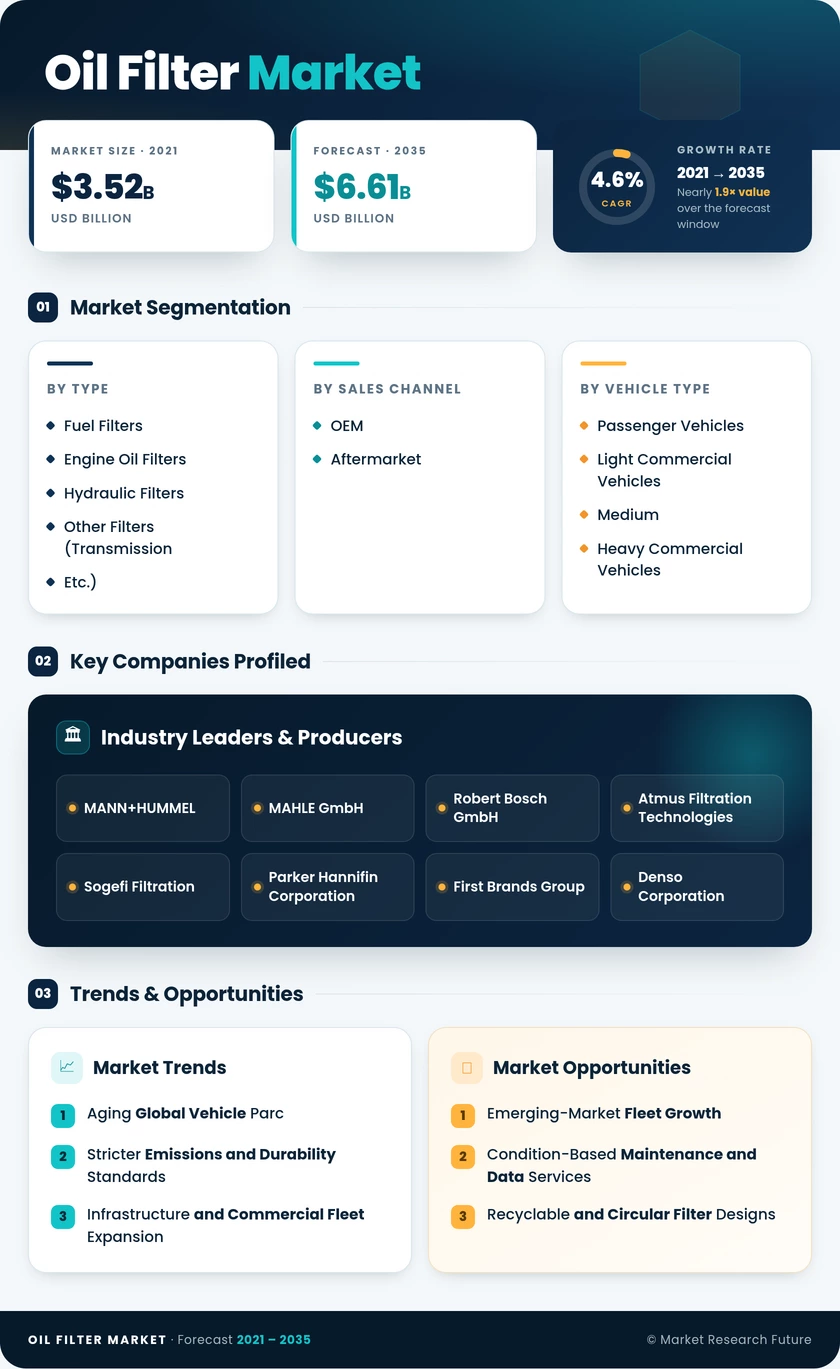
Segmentation Quick Reference
| Dimension | Sub-Segments | Dominant Segment | Fastest Growing Segment |
|---|---|---|---|
| By Type | Fuel Filters; Engine Oil Filters; Hydraulic Filters; Other Filters (Transmission, Etc.) | Engine Oil Filters (44.0% share) | Hydraulic Filters (4.7% CAGR) |
| By Sales Channel | OEM; Aftermarket | Aftermarket (70.0% share) | Aftermarket (70.0% share) |
| By Vehicle Type | Passenger Vehicles; Light Commercial Vehicles; Medium and Heavy Commercial Vehicles | Passenger Vehicles (57.5% share) | Medium and Heavy Commercial Vehicles (4.8% CAGR) |
| By Distribution Channel | Traditional Retail; Authorized Dealerships; Online Retail and E-commerce | Traditional Retail (51.0% share) | Online Retail and E-commerce (4.7% CAGR) |
| By Region | North America; Europe; Asia-Pacific; South America; Middle East & Africa | Asia-Pacific (41.5% share) | Asia-Pacific (41.5% share) |
Market Segmentation Overview
By Type
| Sub-Segment | Key Trend |
|---|---|
| Fuel Filters | Higher-efficiency water separation for high-pressure diesel injection |
| Engine Oil Filters | Migration to synthetic media for extended drain intervals |
| Hydraulic Filters | Volume growth from construction and agricultural machinery |
| Other Filters (Transmission, Etc.) | More filtration points in multi-speed and automated transmissions |
Engine Oil Filters lead at 44.0% because every combustion engine requires one at each service, and synthetic media is lifting their unit value even as change frequency falls. Hydraulic Filters grow fastest at a 4.7% CAGR, since excavators and tractors run high-pressure circuits that are largely untouched by electrification. Fuel Filters hold steady on diesel truck demand, while transmission filters gain from rising gearbox complexity.
By Sales Channel
| Sub-Segment | Key Trend |
|---|---|
| OEM | Factory-fill volume tied to new-vehicle production and Euro 7 specifications |
| Aftermarket | Repeat replacement across an aging parc; shift toward online ordering |
The Aftermarket dominates with a 70.0% share and also grows faster, because a vehicle consumes many replacement filters over a 12-plus-year life but only one at the factory. OEM revenue of USD 1.27 billion follows production cycles and gives suppliers specification influence, which in turn supports their aftermarket brand credibility with installers.
By Vehicle Type
| Sub-Segment | Key Trend |
|---|---|
| Passenger Vehicles | Value growth from premium media offsets electrification volume loss |
| Light Commercial Vehicles | High-mileage last-mile delivery fleets shorten service cycles |
| Medium and Heavy Commercial Vehicles | Diesel persistence and multiple filters per engine |
Passenger Vehicles lead at 57.5% on fleet size, but battery-electric adoption caps their unit growth in China and Europe. Medium and Heavy Commercial Vehicles grow fastest at a 4.8% CAGR, as long-haul duty cycles delay electrification and each heavy engine carries several lube and fuel filters. Light Commercial Vehicles sit between the two, buoyed by delivery fleet mileage.
By Distribution Channel
| Sub-Segment | Key Trend |
|---|---|
| Traditional Retail | Same-day parts availability for installers and quick-lube chains |
| Authorized Dealerships | Bundled maintenance plans for in-warranty vehicles |
| Online Retail and E-commerce | Fitment tools, subscriptions, and serialized authentication |
Traditional Retail leads at 51.0% because professional installers need filters on the shelf the same day. Online Retail and E-commerce grows fastest at a 4.7% CAGR as fitment-lookup tools and subscription delivery win DIY owners and small garages. Authorized Dealerships retain in-warranty customers through bundled service packages but face price-transparency pressure from online listings.


 Noah Malgeri
Co-Founder

 Peter Groot koerkamp
Account and Business Manager

 Younghwan Choi
Senior Retail Manager

 Mark Irwin
Management Consultant

 Akif Moroglu
Strategy & Business Development Director

 Guilherme Gomes Martins
Product Management Director

 Joseph Aguayo
Sales Operations & Pricing Manager

 La Terria Dodd
Program Support Specialist

 Rob Kooiker
Group Product Manager HVAC & Fire Protection GMA