×
Hero Background
English
Chinese
French
Japanese
Korean
German
Spanish

Menswear Market Analysis

ID: MRFR/CG/9989-HCR
128 Pages
Snehal Singh
October 2025

Menswear Market Research Report Information By Type (Trousers, Denims, Shirts and T-Shirts, Ethnic Wear, and Others), By Season (Summer Wear, Winter Wear, and All-Season Wear), By Distribution Channel (Supermarkets and Hypermarkets, Exclusive Stores, Multi-Brand Retail Outlets, Online Stores, and Others) And By Region (North America, Europe, Asia-Pacific, And Rest Of The World) –Market Forecast Till 2035

Share:
Download PDF ×

We do not share your information with anyone. However, we may send you emails based on your report interest from time to time. You may contact us at any time to opt-out.

Menswear Market Infographic
Purchase Options

Market Analysis

In-depth Analysis of Menswear Market Industry Landscape

The global menswear market is set to reach US$ 988.24 BN by 2032, at a 6.20% CAGR between years 2023-2032. This market is among the largest segments in apparel sector owing to numerous factors that collaboratively support its development and trends. One important factor in the dynamics of this market is changing preferences and lifestyles with respect to fashion by men. Among other people, acceptability and standards of men’s fashion that are changing from time to time have forced more males into embracing different types of dressing such as the informal looks or even casual while others like tailored formal attires. This evolution in the consciousness of fashion has driven a more diverse range of menswear available thereby making this market dynamic. Cultural factors greatly impact the dynamics of the Menswear market. Fashion trends are manifested by the cultural movements, historical details, and social changes. From streetwear rooted in urban culture to classic attire influenced by heritage and tradition, the multitude of cultural influences creates a mosaic of masculine fashions. This cultural juxtaposition ensures that the market is dynamic and products as well as their designs can be reinvented for newer ideas. E-commerce and digital platforms have transformed the Menswear market dynamics. Now, online shopping is ruling over as it provides excellent flexibility and numerous options for consumers. All these developments have contributed to the rapid diffusion of trends, shortening their product life cycles, and increasing consumer demand for new releases. By incorporating technology into the retail process, men’s relationship with and consumption of fashion has been altered making consumers more reactive to in-the moment trends. Economic aspects such as disposable income, spending patterns affect the dynamics of Menswear market. In times of economic slump, people tend to focus on essentials or look for cheaper alternatives and prefer value in terms of longevity and adaptability. Alternatively, thriving economics may foster demand for high-end and premium menswear products. Menswear is made readily available to a multitude of consumer segments by the ability of this market in adapting itself so well with changing economic situations. Dynamic nature of the Menswear market is supported by innovations in materials, design, and sustainability operations. Menswear must now be environmentally friendly and ethically manufactured due to the development of eco-consciousness. They are including organic fabrics, recycled materials, and ethical sourcing practices because of this changing consumer behaviour. The inclusion of sustainable features into the menswear offerings draws upon a wider movement in conscious-consumerism and affects market activity.


Author
Snehal Singh
Assistant Manager - Research

High acumen in analyzing complex macro & micro markets with more than 6 years of work experience in the field of market research. By implementing her analytical skills in forecasting and estimation into market research reports, she has expertise in Packaging, Construction, and Equipment domains. She handles a team size of 20-25 resources and ensures smooth running of the projects, associated marketing activities, and client servicing.

Leave a Comment

FAQs

What is the current valuation of the Menswear Market in 2024?

The Menswear Market was valued at 610.75 USD Billion in 2024.

What is the projected market size for the Menswear Market by 2035?

The Menswear Market is projected to reach 1183.93 USD Billion by 2035.

What is the expected CAGR for the Menswear Market during the forecast period 2025 - 2035?

The expected CAGR for the Menswear Market during 2025 - 2035 is 6.2%.

Which segments of the Menswear Market are expected to perform well?

Segments such as Shirts and T-Shirts, and All-Season Wear are expected to show strong performance.

How do the sales of trousers compare to other menswear segments?

Trousers generated 120.0 USD Billion in 2024, indicating a robust segment within the market.

What distribution channels are most significant in the Menswear Market?

Supermarkets and Hypermarkets accounted for 183.23 USD Billion in 2024, making them a key distribution channel.

Market Summary

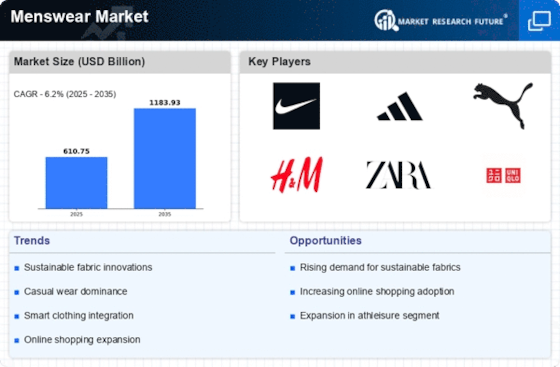
As per MRFR analysis, the Menswear Market Size was estimated at 610.75 USD Billion in 2024. The Menswear industry is projected to grow from 648.63 USD Billion in 2025 to 1183.93 USD Billion by 2035, exhibiting a compound annual growth rate (CAGR) of 6.2 during the forecast period 2025 - 2035.

Key Market Trends & Highlights

The menswear market is currently experiencing a dynamic shift towards casual and sustainable fashion, driven by evolving consumer preferences.

  • The rise of casual wear is reshaping the menswear landscape, particularly in North America, where comfort and style converge.
  • Sustainability is becoming a focal point, with brands increasingly prioritizing eco-friendly materials and practices across the Asia-Pacific region.
  • The digital shopping experience is enhancing consumer engagement, as e-commerce platforms expand their reach and influence.
  • Evolving fashion trends and the growing demand for sustainable products are major drivers, particularly in the trousers and summer wear segments.

Market Size & Forecast

2024 Market Size 610.75 (USD Billion)
2035 Market Size 1183.93 (USD Billion)
CAGR (2025 - 2035) 6.2%
Largest Regional Market Share in 2024 North America

Major Players

<p>Nike (US), Adidas (DE), Puma (DE), H&M (SE), Zara (ES), Uniqlo (JP), Levi's (US), Gap (US), Tommy Hilfiger (US), Calvin Klein (US)</p>

Market Trends

The Menswear Market is currently experiencing a dynamic evolution, characterized by shifting consumer preferences and an increasing emphasis on sustainability. As men become more fashion-conscious, there is a noticeable trend towards casual yet stylish attire, reflecting a broader cultural shift towards comfort without sacrificing aesthetics. This transformation is further fueled by the rise of e-commerce, which has made it easier for consumers to access a diverse range of brands and styles. Additionally, the influence of social media and celebrity endorsements plays a pivotal role in shaping men's fashion choices, leading to a more informed and engaged consumer base. Moreover, the Menswear Market is witnessing a growing demand for sustainable and ethically produced clothing. Consumers are increasingly aware of the environmental impact of their purchases, prompting brands to adopt more responsible practices. This trend not only caters to the eco-conscious consumer but also aligns with broader societal movements advocating for sustainability. As a result, brands that prioritize transparency and ethical sourcing are likely to gain a competitive edge in this evolving landscape. Overall, the Menswear Market appears poised for continued growth, driven by innovation, consumer engagement, and a commitment to sustainability.

Rise of Casual Wear

The Menswear Market is seeing a significant shift towards casual wear, as men increasingly prioritize comfort and versatility in their clothing choices. This trend reflects a broader cultural movement that values relaxed styles, allowing for greater freedom of expression while maintaining a polished appearance.

Sustainability Focus

There is a growing emphasis on sustainability within the Menswear Market, as consumers become more conscious of the environmental impact of their fashion choices. Brands that adopt eco-friendly practices and promote ethical production are likely to resonate with a more discerning audience.

Digital Shopping Experience

The rise of e-commerce is transforming the Menswear Market, providing consumers with unprecedented access to a wide array of brands and styles. This shift not only enhances convenience but also encourages brands to innovate in their online presence, creating engaging shopping experiences.

Menswear Market Market Drivers

Evolving Fashion Trends

The Menswear Market is currently experiencing a shift towards more relaxed and versatile styles. This evolution is driven by changing consumer preferences, where comfort and functionality are prioritized. As a result, brands are increasingly offering collections that blend casual and formal elements, appealing to a broader audience. The rise of athleisure, for instance, has led to a significant increase in sales, with reports indicating that this segment alone could account for over 30% of the total menswear market by 2025. This trend suggests that menswear brands must adapt to these evolving fashion sensibilities to remain competitive.

Expansion of E-commerce Platforms

The Menswear Market is experiencing a significant shift towards e-commerce, driven by changing shopping habits. With the convenience of online shopping, consumers are increasingly turning to digital platforms for their menswear needs. Reports indicate that e-commerce sales in the menswear sector are projected to grow by over 25% in the next few years. This trend is prompting traditional retailers to enhance their online offerings and invest in digital marketing strategies. As e-commerce continues to expand, it is likely to reshape the competitive landscape of the menswear market, compelling brands to innovate and adapt.

Technological Advancements in Retail

The Menswear Market is witnessing a transformation due to technological advancements in retail. Innovations such as augmented reality and virtual fitting rooms are enhancing the shopping experience, allowing consumers to visualize how garments will look and fit before making a purchase. Furthermore, the integration of artificial intelligence in inventory management and personalized marketing strategies is streamlining operations and improving customer engagement. Data indicates that retailers leveraging these technologies may see a 20% increase in conversion rates. As technology continues to evolve, it is likely to play a pivotal role in shaping the future of menswear.

Growing Demand for Sustainable Products

Sustainability has emerged as a crucial driver in the Menswear Market, with consumers increasingly seeking eco-friendly options. This shift is reflected in the rising demand for sustainable fabrics and ethical production practices. Reports suggest that nearly 60% of consumers are willing to pay more for sustainable menswear, indicating a significant market opportunity. Brands that prioritize sustainability not only enhance their brand image but also attract a loyal customer base. As awareness of environmental issues continues to grow, the menswear industry is likely to see a substantial increase in the availability and variety of sustainable products.

Influence of Social Media and Celebrity Endorsements

The Menswear Market is heavily influenced by social media platforms and celebrity endorsements. These channels serve as powerful marketing tools, shaping consumer perceptions and driving trends. Influencers and celebrities often showcase menswear brands, creating a sense of aspiration and desirability among their followers. Data suggests that menswear brands that engage with social media effectively can experience a 15% increase in brand awareness. As social media continues to evolve, its impact on menswear marketing strategies is expected to grow, making it essential for brands to maintain a strong online presence.

Market Segment Insights

By Type: Trousers (Largest) vs. T-Shirts (Fastest-Growing)

<p>In the Menswear Market, Trousers hold the largest market share among the various segments. They are a staple in men's wardrobes, appealing to consumers for their versatility, comfort, and style. Shirts and T-Shirts follow closely behind, contributing significantly to the overall market. Ethnic Wear and Denims also enjoy notable shares, but the surge in casual fashion has seen T-Shirts carve a niche, gaining momentum among younger demographics seeking both style and comfort. The growth trends in the Menswear Market are being driven by changing consumer preferences towards casual wear, especially in the post-pandemic era. T-Shirts, in particular, have emerged as the fastest-growing segment due to their adaptability and relevance across a wide range of occasions. As sustainability becomes more important, brands are innovating in this category, utilizing eco-friendly materials and ethical production methods to attract environmentally conscious consumers.</p>

<p>Trousers: Dominant vs. T-Shirts: Emerging</p>

<p>Trousers remain the dominant segment in the Menswear Market, characterized by their broad appeal and functionality. They cater to various occasions, from formal to casual, making them essential for any man's wardrobe. Trousers are available in various styles, including chinos, formal pants, and cargo styles, allowing consumers to choose according to their preference. Conversely, T-Shirts are emerging as a dynamic segment, appealing largely to younger consumers. Their casual nature and ability to express personal style through prints and designs are resonating well. The increasing trend of athleisure and the influence of social media on fashion choices are propelling T-Shirts' growth, making them more appealing for everyday wear.</p>

By Season: Summer Wear (Largest) vs. Winter Wear (Fastest-Growing)

<p>In the Menswear Market, Summer Wear commands the largest share due to its broad appeal and versatility, driven by consumers' preferences for comfort and style during warmer months. It encapsulates a variety of clothing items from shorts to light shirts, making it a go-to choice for men during the summer season. On the other hand, Winter Wear, while smaller in market share, is the fastest-growing segment as colder climates drive demand for warmer clothing, innovative materials, and stylish outerwear. The increasing focus on functionality and fashion is reshaping consumer choices in winter apparel.</p>

<p>Summer Wear (Dominant) vs. Winter Wear (Emerging)</p>

<p>Summer Wear holds a dominant position in the Menswear Market, characterized by lightweight fabrics, vibrant colors, and casual styles that cater to a variety of occasions. It is particularly popular among younger demographics and has benefited from lifestyle trends promoting relaxation and outdoor activities. Conversely, Winter Wear is an emerging segment that is rapidly expanding, characterized by innovative designs that not only focus on warmth but also on fashion. As consumers become more style-conscious even in colder weather, the demand for stylish jackets, thermal gear, and layered clothing is surging, leading to a fruitful marketplace for winter apparel.</p>

By Distribution Channel: Online Stores (Largest) vs. Multi-Brand Retail Outlets (Fastest-Growing)

<p>In the Menswear Market, the distribution of sales across different channels highlights the prominence of Online Stores, which have become the largest segment due to their convenience and accessibility. Supermarkets and Hypermarkets also hold a substantial share, catering to consumers seeking a one-stop shopping experience for menswear. However, Exclusive Stores and Multi-Brand Retail Outlets are gradually carving out their niche in the market, appealing to fashion-forward consumers looking for diverse choices. As the retail landscape evolves, the growth trajectory of the distribution channels is significantly influenced by changing consumer behaviors and digital transformation. Online Stores are driving the market with robust growth, fueled by increased internet penetration and the preference for online shopping. Meanwhile, Multi-Brand Retail Outlets are emerging as a preferred choice for those seeking curated collections and personalized shopping experiences, reflecting broader trends in fashion consumption and retail innovation.</p>

<p>Online Stores (Dominant) vs. Exclusive Stores (Emerging)</p>

<p>Online Stores have solidified their position as the dominant distribution channel in the Menswear Market, offering unparalleled convenience and an extensive range of products. Shoppers appreciate the ease of browsing, comparing prices, and quickly accessing the latest trends from the comfort of their homes. In contrast, Exclusive Stores represent an emerging segment that focuses on high-quality, branded menswear, often creating a unique shopping experience that combines luxury with personalized service. These stores target consumers who value brand identity and exclusivity in their clothing choices. Together, these two channels illustrate the diverse needs of menswear consumers and the market's adaptability to varying shopping preferences.</p>

Get more detailed insights about Menswear Market Research Report-Global Forecast till 2035

Regional Insights

North America : Market Leader in Menswear Market

North America stands as the largest market for menswear, accounting for approximately 35% of the global market share. Key growth drivers include rising disposable incomes, a growing focus on fashion, and increased online shopping. Regulatory support for e-commerce and retail innovation further fuels this growth, making it a dynamic landscape for menswear brands. The U.S. and Canada are the primary contributors to this market, with the U.S. alone holding around 30% of the global share. The competitive landscape in North America is robust, featuring major players like Nike, Levi's, and Gap. These brands leverage strong marketing strategies and extensive distribution networks to capture consumer attention. The presence of e-commerce giants also enhances market accessibility, allowing brands to reach a wider audience. As consumer preferences shift towards sustainability, brands are increasingly adopting eco-friendly practices to align with market demands.

Europe : Fashion Capital of the World

Europe is a significant player in the menswear market, holding approximately 30% of the global share, making it the second-largest region. The market is driven by a rich cultural heritage in fashion, with countries like Italy and France leading in style and innovation. Regulatory frameworks promoting sustainable fashion practices are also gaining traction, encouraging brands to adopt eco-friendly materials and production methods. The region's diverse consumer base drives demand for both luxury and casual menswear, reflecting varied lifestyle choices. Leading countries in Europe include Germany, France, and Italy, each contributing to the competitive landscape with renowned brands like Adidas, Puma, and H&M. The presence of fashion weeks and trade shows fosters innovation and collaboration among designers and retailers. As the market evolves, brands are increasingly focusing on digital transformation to enhance customer engagement and streamline operations. The European menswear market is poised for growth, driven by both tradition and modernity.

Asia-Pacific : Emerging Market Potential

Asia-Pacific is rapidly emerging as a key player in the menswear market, holding around 25% of the global share. The region's growth is fueled by rising urbanization, increasing disposable incomes, and a growing middle class. Countries like China and India are leading this trend, with a significant shift towards western fashion styles. Regulatory initiatives aimed at promoting local manufacturing and reducing import tariffs are also contributing to market expansion, making it an attractive destination for global brands. China is the largest market in the region, followed by India, both showcasing a competitive landscape with local and international brands vying for consumer attention. Key players like Uniqlo and Zara are expanding their footprints, leveraging e-commerce and social media to engage younger consumers. The demand for athleisure and casual wear is on the rise, reflecting changing lifestyle preferences. As the market matures, brands are focusing on innovation and sustainability to capture the evolving consumer base.

Middle East and Africa : Untapped Market Opportunities

The Middle East and Africa represent an emerging frontier in the menswear market, holding approximately 10% of the global share. The region's growth is driven by increasing urbanization, a young population, and rising disposable incomes. Countries like South Africa and the UAE are leading the charge, with regulatory support for retail expansion and foreign investment. The demand for luxury menswear is particularly strong, driven by a growing affluent class and changing consumer preferences towards branded products. In the competitive landscape, local and international brands are increasingly entering the market, with players like Tommy Hilfiger and Calvin Klein establishing a presence. The region's unique cultural dynamics influence fashion trends, creating opportunities for brands to tailor their offerings. As e-commerce continues to grow, brands are focusing on enhancing their online presence to capture the tech-savvy consumer base. The Middle East and Africa are poised for significant growth in the coming years, driven by both economic and demographic factors.

Key Players and Competitive Insights

The Menswear Market is currently characterized by a dynamic competitive landscape, driven by evolving consumer preferences and technological advancements. Key players such as Nike (US), Adidas (DE), and H&M (SE) are strategically positioning themselves through innovation and digital transformation. Nike (US) continues to emphasize sustainability in its product lines, while Adidas (DE) focuses on expanding its eco-friendly offerings. H&M (SE) is enhancing its digital presence, aiming to capture a larger share of the online retail market. Collectively, these strategies not only enhance brand loyalty but also intensify competition, as companies strive to differentiate themselves in a crowded marketplace.

In terms of business tactics, companies are increasingly localizing manufacturing to reduce lead times and optimize supply chains. This approach appears to be particularly effective in addressing the growing demand for quick fashion cycles. The menswear market is moderately fragmented, with several key players exerting substantial influence. The collective actions of these companies shape a competitive structure that encourages innovation and responsiveness to market trends.

In September 2025, Nike (US) announced a partnership with a leading tech firm to develop a new line of smart apparel that integrates wearable technology. This strategic move is likely to enhance consumer engagement and position Nike at the forefront of the intersection between fashion and technology. The integration of smart features into clothing could redefine user experience, making it a pivotal development in the menswear sector.

In August 2025, Adidas (DE) launched a new initiative aimed at increasing the use of recycled materials in its menswear collections. This initiative not only aligns with global sustainability trends but also reinforces Adidas's commitment to environmental responsibility. By prioritizing sustainable practices, Adidas is likely to attract environmentally conscious consumers, thereby enhancing its market position.

In July 2025, H&M (SE) unveiled a new digital platform designed to streamline the online shopping experience for menswear. This platform incorporates AI-driven recommendations and personalized shopping experiences, which could significantly enhance customer satisfaction and retention. As online shopping continues to grow, H&M's investment in digital infrastructure may prove crucial in maintaining its competitive edge.

As of October 2025, the menswear market is witnessing a pronounced shift towards digitalization, sustainability, and the integration of artificial intelligence. Strategic alliances are increasingly shaping the competitive landscape, as companies collaborate to leverage technology and enhance product offerings. Looking ahead, competitive differentiation is likely to evolve from traditional price-based competition to a focus on innovation, technological integration, and supply chain reliability. This shift suggests that companies that prioritize these areas may emerge as leaders in the menswear market.

Key Companies in the Menswear Market market include

Industry Developments

March 2024: The UK fashion brand Next's distribution and management rights were acquired by the e-commerce behemoth Myntra. By doing agreement, Myntra gains the authority to open branded storefronts for the fashion retailer Next in India and to distribute its items.

October 2023: The launch of Skims Men’s was introduced by Kim Kardashian's company Skims with an All Star commercial featuring football superstar Neymar Jr., 2022 NFL Defensive Player of the Year Nick Bosa, and NBA All-Star Shai Gilgeous-Alexander. Cozy tanks and shirts, silky boxers, and finely crafted briefs are all part of the collection.

August 2022: A limited-edition denim collection inspired by circular fashion was released by H&M. The collection is the first to be made with eco-friendly materials, such as Circulose Viscose and TENCEL Lyocell with REFIBRA technology. The collection includes four pairs of loose-fitting five-pocket trousers, two oversized button-down shirts, one oversized workwear jacket, and one hooded zip jacket, all in muted indigo hues with a stonewashed finish.

July 2022: Gap Inc. partnered with India's largest retailer, Reliance Retail Limited, to launch in India. With this partnership, Reliance began offering Gap's most recent men's, women's, and children's fashions to Indian customers.

Future Outlook

Menswear Market Future Outlook

<p>The Menswear Market is projected to grow at a 6.2% CAGR from 2024 to 2035, driven by evolving consumer preferences, sustainability trends, and technological advancements.</p>

New opportunities lie in:

  • <p>Expansion of e-commerce platforms targeting niche menswear segments.</p>
  • <p>Development of sustainable fabric lines to meet eco-conscious consumer demand.</p>
  • <p>Integration of augmented reality for virtual fitting experiences in retail.</p>

<p>By 2035, the Menswear Market is expected to achieve robust growth, reflecting evolving consumer dynamics.</p>

Market Segmentation

Menswear Market Type Outlook

  • Trousers
  • Denims
  • Shirts and T-Shirts
  • Ethnic Wear
  • Others

Menswear Market Season Outlook

  • Summer Wear
  • Winter Wear
  • All-Season Wear

Menswear Market Distribution Channel Outlook

  • Supermarkets and Hypermarkets
  • Exclusive Stores
  • Multi-Brand Retail Outlets
  • Online Stores
  • Others

Report Scope

MARKET SIZE 2024610.75(USD Billion)
MARKET SIZE 2025648.63(USD Billion)
MARKET SIZE 20351183.93(USD Billion)
COMPOUND ANNUAL GROWTH RATE (CAGR)6.2% (2024 - 2035)
REPORT COVERAGERevenue Forecast, Competitive Landscape, Growth Factors, and Trends
BASE YEAR2024
Market Forecast Period2025 - 2035
Historical Data2019 - 2024
Market Forecast UnitsUSD Billion
Key Companies ProfiledMarket analysis in progress
Segments CoveredMarket segmentation analysis in progress
Key Market OpportunitiesIntegration of sustainable materials and smart textiles in the Menswear Market.
Key Market DynamicsShifting consumer preferences towards sustainable materials drive innovation and competition in the menswear market.
Countries CoveredNorth America, Europe, APAC, South America, MEA

FAQs

What is the current valuation of the Menswear Market in 2024?

The Menswear Market was valued at 610.75 USD Billion in 2024.

What is the projected market size for the Menswear Market by 2035?

The Menswear Market is projected to reach 1183.93 USD Billion by 2035.

What is the expected CAGR for the Menswear Market during the forecast period 2025 - 2035?

The expected CAGR for the Menswear Market during 2025 - 2035 is 6.2%.

Which segments of the Menswear Market are expected to perform well?

Segments such as Shirts and T-Shirts, and All-Season Wear are expected to show strong performance.

How do the sales of trousers compare to other menswear segments?

Trousers generated 120.0 USD Billion in 2024, indicating a robust segment within the market.

What distribution channels are most significant in the Menswear Market?

Supermarkets and Hypermarkets accounted for 183.23 USD Billion in 2024, making them a key distribution channel.

  1. SECTION I: EXECUTIVE SUMMARY AND KEY HIGHLIGHTS
    1. EXECUTIVE SUMMARY
      1. Market Overview
      2. Key Findings
      3. Market Segmentation
      4. Competitive Landscape
      5. Challenges and Opportunities
      6. Future Outlook
  2. SECTION II: SCOPING, METHODOLOGY AND MARKET STRUCTURE
    1. MARKET INTRODUCTION
      1. Definition
      2. Scope of the study
    2. RESEARCH METHODOLOGY
      1. Overview
      2. Data Mining
      3. Secondary Research
      4. Primary Research
      5. Forecasting Model
      6. Market Size Estimation
      7. Data Triangulation
      8. Validation
  3. SECTION III: QUALITATIVE ANALYSIS
    1. MARKET DYNAMICS
      1. Overview
      2. Drivers
      3. Restraints
      4. Opportunities
    2. MARKET FACTOR ANALYSIS
      1. Value chain Analysis
      2. Porter's Five Forces Analysis
      3. COVID-19 Impact Analysis
  4. SECTION IV: QUANTITATIVE ANALYSIS
    1. Consumer and Retail, BY Type (USD Billion)
      1. Trousers
      2. Denims
      3. Shirts and T-Shirts
      4. Ethnic Wear
      5. Others
    2. Consumer and Retail, BY Season (USD Billion)
      1. Summer Wear
      2. Winter Wear
      3. All-Season Wear
    3. Consumer and Retail, BY Distribution Channel (USD Billion)
      1. Supermarkets and Hypermarkets
      2. Exclusive Stores
      3. Multi-Brand Retail Outlets
      4. Online Stores
      5. Others
    4. Consumer and Retail, BY Region (USD Billion)
      1. North America
      2. Europe
      3. APAC
      4. South America
      5. MEA
  5. SECTION V: COMPETITIVE ANALYSIS
    1. Competitive Landscape
      1. Overview
      2. Competitive Analysis
      3. Market share Analysis
      4. Major Growth Strategy in the Consumer and Retail
      5. Competitive Benchmarking
      6. Leading Players in Terms of Number of Developments in the Consumer and Retail
      7. Key developments and growth strategies
      8. Major Players Financial Matrix
    2. Company Profiles
      1. Nike (US)
      2. Adidas (DE)
      3. Puma (DE)
      4. H&M (SE)
      5. Zara (ES)
      6. Uniqlo (JP)
      7. Levi's (US)
      8. Gap (US)
      9. Tommy Hilfiger (US)
      10. Calvin Klein (US)
    3. Appendix
      1. References
      2. Related Reports
  6. LIST OF FIGURES
    1. MARKET SYNOPSIS
    2. NORTH AMERICA MARKET ANALYSIS
    3. US MARKET ANALYSIS BY TYPE
    4. US MARKET ANALYSIS BY SEASON
    5. US MARKET ANALYSIS BY DISTRIBUTION CHANNEL
    6. CANADA MARKET ANALYSIS BY TYPE
    7. CANADA MARKET ANALYSIS BY SEASON
    8. CANADA MARKET ANALYSIS BY DISTRIBUTION CHANNEL
    9. EUROPE MARKET ANALYSIS
    10. GERMANY MARKET ANALYSIS BY TYPE
    11. GERMANY MARKET ANALYSIS BY SEASON
    12. GERMANY MARKET ANALYSIS BY DISTRIBUTION CHANNEL
    13. UK MARKET ANALYSIS BY TYPE
    14. UK MARKET ANALYSIS BY SEASON
    15. UK MARKET ANALYSIS BY DISTRIBUTION CHANNEL
    16. FRANCE MARKET ANALYSIS BY TYPE
    17. FRANCE MARKET ANALYSIS BY SEASON
    18. FRANCE MARKET ANALYSIS BY DISTRIBUTION CHANNEL
    19. RUSSIA MARKET ANALYSIS BY TYPE
    20. RUSSIA MARKET ANALYSIS BY SEASON
    21. RUSSIA MARKET ANALYSIS BY DISTRIBUTION CHANNEL
    22. ITALY MARKET ANALYSIS BY TYPE
    23. ITALY MARKET ANALYSIS BY SEASON
    24. ITALY MARKET ANALYSIS BY DISTRIBUTION CHANNEL
    25. SPAIN MARKET ANALYSIS BY TYPE
    26. SPAIN MARKET ANALYSIS BY SEASON
    27. SPAIN MARKET ANALYSIS BY DISTRIBUTION CHANNEL
    28. REST OF EUROPE MARKET ANALYSIS BY TYPE
    29. REST OF EUROPE MARKET ANALYSIS BY SEASON
    30. REST OF EUROPE MARKET ANALYSIS BY DISTRIBUTION CHANNEL
    31. APAC MARKET ANALYSIS
    32. CHINA MARKET ANALYSIS BY TYPE
    33. CHINA MARKET ANALYSIS BY SEASON
    34. CHINA MARKET ANALYSIS BY DISTRIBUTION CHANNEL
    35. INDIA MARKET ANALYSIS BY TYPE
    36. INDIA MARKET ANALYSIS BY SEASON
    37. INDIA MARKET ANALYSIS BY DISTRIBUTION CHANNEL
    38. JAPAN MARKET ANALYSIS BY TYPE
    39. JAPAN MARKET ANALYSIS BY SEASON
    40. JAPAN MARKET ANALYSIS BY DISTRIBUTION CHANNEL
    41. SOUTH KOREA MARKET ANALYSIS BY TYPE
    42. SOUTH KOREA MARKET ANALYSIS BY SEASON
    43. SOUTH KOREA MARKET ANALYSIS BY DISTRIBUTION CHANNEL
    44. MALAYSIA MARKET ANALYSIS BY TYPE
    45. MALAYSIA MARKET ANALYSIS BY SEASON
    46. MALAYSIA MARKET ANALYSIS BY DISTRIBUTION CHANNEL
    47. THAILAND MARKET ANALYSIS BY TYPE
    48. THAILAND MARKET ANALYSIS BY SEASON
    49. THAILAND MARKET ANALYSIS BY DISTRIBUTION CHANNEL
    50. INDONESIA MARKET ANALYSIS BY TYPE
    51. INDONESIA MARKET ANALYSIS BY SEASON
    52. INDONESIA MARKET ANALYSIS BY DISTRIBUTION CHANNEL
    53. REST OF APAC MARKET ANALYSIS BY TYPE
    54. REST OF APAC MARKET ANALYSIS BY SEASON
    55. REST OF APAC MARKET ANALYSIS BY DISTRIBUTION CHANNEL
    56. SOUTH AMERICA MARKET ANALYSIS
    57. BRAZIL MARKET ANALYSIS BY TYPE
    58. BRAZIL MARKET ANALYSIS BY SEASON
    59. BRAZIL MARKET ANALYSIS BY DISTRIBUTION CHANNEL
    60. MEXICO MARKET ANALYSIS BY TYPE
    61. MEXICO MARKET ANALYSIS BY SEASON
    62. MEXICO MARKET ANALYSIS BY DISTRIBUTION CHANNEL
    63. ARGENTINA MARKET ANALYSIS BY TYPE
    64. ARGENTINA MARKET ANALYSIS BY SEASON
    65. ARGENTINA MARKET ANALYSIS BY DISTRIBUTION CHANNEL
    66. REST OF SOUTH AMERICA MARKET ANALYSIS BY TYPE
    67. REST OF SOUTH AMERICA MARKET ANALYSIS BY SEASON
    68. REST OF SOUTH AMERICA MARKET ANALYSIS BY DISTRIBUTION CHANNEL
    69. MEA MARKET ANALYSIS
    70. GCC COUNTRIES MARKET ANALYSIS BY TYPE
    71. GCC COUNTRIES MARKET ANALYSIS BY SEASON
    72. GCC COUNTRIES MARKET ANALYSIS BY DISTRIBUTION CHANNEL
    73. SOUTH AFRICA MARKET ANALYSIS BY TYPE
    74. SOUTH AFRICA MARKET ANALYSIS BY SEASON
    75. SOUTH AFRICA MARKET ANALYSIS BY DISTRIBUTION CHANNEL
    76. REST OF MEA MARKET ANALYSIS BY TYPE
    77. REST OF MEA MARKET ANALYSIS BY SEASON
    78. REST OF MEA MARKET ANALYSIS BY DISTRIBUTION CHANNEL
    79. KEY BUYING CRITERIA OF CONSUMER AND RETAIL
    80. RESEARCH PROCESS OF MRFR
    81. DRO ANALYSIS OF CONSUMER AND RETAIL
    82. DRIVERS IMPACT ANALYSIS: CONSUMER AND RETAIL
    83. RESTRAINTS IMPACT ANALYSIS: CONSUMER AND RETAIL
    84. SUPPLY / VALUE CHAIN: CONSUMER AND RETAIL
    85. CONSUMER AND RETAIL, BY TYPE, 2024 (% SHARE)
    86. CONSUMER AND RETAIL, BY TYPE, 2024 TO 2035 (USD Billion)
    87. CONSUMER AND RETAIL, BY SEASON, 2024 (% SHARE)
    88. CONSUMER AND RETAIL, BY SEASON, 2024 TO 2035 (USD Billion)
    89. CONSUMER AND RETAIL, BY DISTRIBUTION CHANNEL, 2024 (% SHARE)
    90. CONSUMER AND RETAIL, BY DISTRIBUTION CHANNEL, 2024 TO 2035 (USD Billion)
    91. BENCHMARKING OF MAJOR COMPETITORS
  7. LIST OF TABLES
    1. LIST OF ASSUMPTIONS
    2. North America MARKET SIZE ESTIMATES; FORECAST
      1. BY TYPE, 2025-2035 (USD Billion)
      2. BY SEASON, 2025-2035 (USD Billion)
      3. BY DISTRIBUTION CHANNEL, 2025-2035 (USD Billion)
    3. US MARKET SIZE ESTIMATES; FORECAST
      1. BY TYPE, 2025-2035 (USD Billion)
      2. BY SEASON, 2025-2035 (USD Billion)
      3. BY DISTRIBUTION CHANNEL, 2025-2035 (USD Billion)
    4. Canada MARKET SIZE ESTIMATES; FORECAST
      1. BY TYPE, 2025-2035 (USD Billion)
      2. BY SEASON, 2025-2035 (USD Billion)
      3. BY DISTRIBUTION CHANNEL, 2025-2035 (USD Billion)
    5. Europe MARKET SIZE ESTIMATES; FORECAST
      1. BY TYPE, 2025-2035 (USD Billion)
      2. BY SEASON, 2025-2035 (USD Billion)
      3. BY DISTRIBUTION CHANNEL, 2025-2035 (USD Billion)
    6. Germany MARKET SIZE ESTIMATES; FORECAST
      1. BY TYPE, 2025-2035 (USD Billion)
      2. BY SEASON, 2025-2035 (USD Billion)
      3. BY DISTRIBUTION CHANNEL, 2025-2035 (USD Billion)
    7. UK MARKET SIZE ESTIMATES; FORECAST
      1. BY TYPE, 2025-2035 (USD Billion)
      2. BY SEASON, 2025-2035 (USD Billion)
      3. BY DISTRIBUTION CHANNEL, 2025-2035 (USD Billion)
    8. France MARKET SIZE ESTIMATES; FORECAST
      1. BY TYPE, 2025-2035 (USD Billion)
      2. BY SEASON, 2025-2035 (USD Billion)
      3. BY DISTRIBUTION CHANNEL, 2025-2035 (USD Billion)
    9. Russia MARKET SIZE ESTIMATES; FORECAST
      1. BY TYPE, 2025-2035 (USD Billion)
      2. BY SEASON, 2025-2035 (USD Billion)
      3. BY DISTRIBUTION CHANNEL, 2025-2035 (USD Billion)
    10. Italy MARKET SIZE ESTIMATES; FORECAST
      1. BY TYPE, 2025-2035 (USD Billion)
      2. BY SEASON, 2025-2035 (USD Billion)
      3. BY DISTRIBUTION CHANNEL, 2025-2035 (USD Billion)
    11. Spain MARKET SIZE ESTIMATES; FORECAST
      1. BY TYPE, 2025-2035 (USD Billion)
      2. BY SEASON, 2025-2035 (USD Billion)
      3. BY DISTRIBUTION CHANNEL, 2025-2035 (USD Billion)
    12. Rest of Europe MARKET SIZE ESTIMATES; FORECAST
      1. BY TYPE, 2025-2035 (USD Billion)
      2. BY SEASON, 2025-2035 (USD Billion)
      3. BY DISTRIBUTION CHANNEL, 2025-2035 (USD Billion)
    13. APAC MARKET SIZE ESTIMATES; FORECAST
      1. BY TYPE, 2025-2035 (USD Billion)
      2. BY SEASON, 2025-2035 (USD Billion)
      3. BY DISTRIBUTION CHANNEL, 2025-2035 (USD Billion)
    14. China MARKET SIZE ESTIMATES; FORECAST
      1. BY TYPE, 2025-2035 (USD Billion)
      2. BY SEASON, 2025-2035 (USD Billion)
      3. BY DISTRIBUTION CHANNEL, 2025-2035 (USD Billion)
    15. India MARKET SIZE ESTIMATES; FORECAST
      1. BY TYPE, 2025-2035 (USD Billion)
      2. BY SEASON, 2025-2035 (USD Billion)
      3. BY DISTRIBUTION CHANNEL, 2025-2035 (USD Billion)
    16. Japan MARKET SIZE ESTIMATES; FORECAST
      1. BY TYPE, 2025-2035 (USD Billion)
      2. BY SEASON, 2025-2035 (USD Billion)
      3. BY DISTRIBUTION CHANNEL, 2025-2035 (USD Billion)
    17. South Korea MARKET SIZE ESTIMATES; FORECAST
      1. BY TYPE, 2025-2035 (USD Billion)
      2. BY SEASON, 2025-2035 (USD Billion)
      3. BY DISTRIBUTION CHANNEL, 2025-2035 (USD Billion)
    18. Malaysia MARKET SIZE ESTIMATES; FORECAST
      1. BY TYPE, 2025-2035 (USD Billion)
      2. BY SEASON, 2025-2035 (USD Billion)
      3. BY DISTRIBUTION CHANNEL, 2025-2035 (USD Billion)
    19. Thailand MARKET SIZE ESTIMATES; FORECAST
      1. BY TYPE, 2025-2035 (USD Billion)
      2. BY SEASON, 2025-2035 (USD Billion)
      3. BY DISTRIBUTION CHANNEL, 2025-2035 (USD Billion)
    20. Indonesia MARKET SIZE ESTIMATES; FORECAST
      1. BY TYPE, 2025-2035 (USD Billion)
      2. BY SEASON, 2025-2035 (USD Billion)
      3. BY DISTRIBUTION CHANNEL, 2025-2035 (USD Billion)
    21. Rest of APAC MARKET SIZE ESTIMATES; FORECAST
      1. BY TYPE, 2025-2035 (USD Billion)
      2. BY SEASON, 2025-2035 (USD Billion)
      3. BY DISTRIBUTION CHANNEL, 2025-2035 (USD Billion)
    22. South America MARKET SIZE ESTIMATES; FORECAST
      1. BY TYPE, 2025-2035 (USD Billion)
      2. BY SEASON, 2025-2035 (USD Billion)
      3. BY DISTRIBUTION CHANNEL, 2025-2035 (USD Billion)
    23. Brazil MARKET SIZE ESTIMATES; FORECAST
      1. BY TYPE, 2025-2035 (USD Billion)
      2. BY SEASON, 2025-2035 (USD Billion)
      3. BY DISTRIBUTION CHANNEL, 2025-2035 (USD Billion)
    24. Mexico MARKET SIZE ESTIMATES; FORECAST
      1. BY TYPE, 2025-2035 (USD Billion)
      2. BY SEASON, 2025-2035 (USD Billion)
      3. BY DISTRIBUTION CHANNEL, 2025-2035 (USD Billion)
    25. Argentina MARKET SIZE ESTIMATES; FORECAST
      1. BY TYPE, 2025-2035 (USD Billion)
      2. BY SEASON, 2025-2035 (USD Billion)
      3. BY DISTRIBUTION CHANNEL, 2025-2035 (USD Billion)
    26. Rest of South America MARKET SIZE ESTIMATES; FORECAST
      1. BY TYPE, 2025-2035 (USD Billion)
      2. BY SEASON, 2025-2035 (USD Billion)
      3. BY DISTRIBUTION CHANNEL, 2025-2035 (USD Billion)
    27. MEA MARKET SIZE ESTIMATES; FORECAST
      1. BY TYPE, 2025-2035 (USD Billion)
      2. BY SEASON, 2025-2035 (USD Billion)
      3. BY DISTRIBUTION CHANNEL, 2025-2035 (USD Billion)
    28. GCC Countries MARKET SIZE ESTIMATES; FORECAST
      1. BY TYPE, 2025-2035 (USD Billion)
      2. BY SEASON, 2025-2035 (USD Billion)
      3. BY DISTRIBUTION CHANNEL, 2025-2035 (USD Billion)
    29. South Africa MARKET SIZE ESTIMATES; FORECAST
      1. BY TYPE, 2025-2035 (USD Billion)
      2. BY SEASON, 2025-2035 (USD Billion)
      3. BY DISTRIBUTION CHANNEL, 2025-2035 (USD Billion)
    30. Rest of MEA MARKET SIZE ESTIMATES; FORECAST
      1. BY TYPE, 2025-2035 (USD Billion)
      2. BY SEASON, 2025-2035 (USD Billion)
      3. BY DISTRIBUTION CHANNEL, 2025-2035 (USD Billion)
    31. PRODUCT LAUNCH/PRODUCT DEVELOPMENT/APPROVAL
    32. ACQUISITION/PARTNERSHIP

Menswear Market Segmentation

Menswear Product Type Outlook (USD Billion, 2018-2032)

Trousers

Denims

Shirts and T-Shirts

Ethnic Wear

Others

Menswear Season Outlook (USD Billion, 2018-2032)

Summer Wear

Winter Wear

All-Season Wear

Menswear Season Outlook (USD Billion, 2018-2032)

Supermarkets and Hypermarkets

Exclusive Stores

Multi-Brand Retail Outlets

Online Stores

Others

Menswear Regional Outlook (USD Billion, 2018-2032)

North America Outlook (USD Billion, 2018-2032)

North America Menswear by Product Type

Trousers

Denims

Shirts and T-Shirts

Ethnic Wear

Others

North America Menswear by Season

Summer Wear

Winter Wear

All-Season Wear

North America Menswear by Season

Supermarkets and Hypermarkets

Exclusive Stores

Multi-Brand Retail Outlets

Online Stores

Others

US Outlook (USD Billion, 2018-2032)

US Menswear by Product Type

Trousers

Denims

Shirts and T-Shirts

Ethnic Wear

Others

US Menswear by Season

Summer Wear

Winter Wear

All-Season Wear

US Menswear by Season

Supermarkets and Hypermarkets

Exclusive Stores

Multi-Brand Retail Outlets

Online Stores

Others

CANADA Outlook (USD Billion, 2018-2032)

CANADA Menswear by Product Type

Trousers

Denims

Shirts and T-Shirts

Ethnic Wear

Others

CANADA Menswear by Season

Summer Wear

Winter Wear

All-Season Wear

CANADA Menswear by Season

Supermarkets and Hypermarkets

Exclusive Stores

Multi-Brand Retail Outlets

Online Stores

Others

Europe Outlook (USD Billion, 2018-2032)

Europe Menswear by Product Type

Trousers

Denims

Shirts and T-Shirts

Ethnic Wear

Others

Europe Menswear by Season

Summer Wear

Winter Wear

All-Season Wear

Europe Menswear by Season

Supermarkets and Hypermarkets

Exclusive Stores

Multi-Brand Retail Outlets

Online Stores

Others

Germany Outlook (USD Billion, 2018-2032)

Germany Menswear by Product Type

Trousers

Denims

Shirts and T-Shirts

Ethnic Wear

Others

Germany Menswear by Season

Summer Wear

Winter Wear

All-Season Wear

Germany Menswear by Season

Supermarkets and Hypermarkets

Exclusive Stores

Multi-Brand Retail Outlets

Online Stores

Others

France Outlook (USD Billion, 2018-2032)

France Menswear by Product Type

Trousers

Denims

Shirts and T-Shirts

Ethnic Wear

Others

France Menswear by Season

Summer Wear

Winter Wear

All-Season Wear

France Menswear by Season

Supermarkets and Hypermarkets

Exclusive Stores

Multi-Brand Retail Outlets

Online Stores

Others

UK Outlook (USD Billion, 2018-2032)

UK Menswear by Product Type

Trousers

Denims

Shirts and T-Shirts

Ethnic Wear

Others

UK Menswear by Season

Summer Wear

Winter Wear

All-Season Wear

UK Menswear by Season

Supermarkets and Hypermarkets

Exclusive Stores

Multi-Brand Retail Outlets

Online Stores

Others

ITALY Outlook (USD Billion, 2018-2032)

ITALY Menswear by Product Type

Trousers

Denims

Shirts and T-Shirts

Ethnic Wear

Others

ITALY Menswear by Season

Summer Wear

Winter Wear

All-Season Wear

ITALY Menswear by Season

Supermarkets and Hypermarkets

Exclusive Stores

Multi-Brand Retail Outlets

Online Stores

Others

SPAIN Outlook (USD Billion, 2018-2032)

Spain Menswear by Product Type

Trousers

Denims

Shirts and T-Shirts

Ethnic Wear

Others

Spain Menswear by Season

Summer Wear

Winter Wear

All-Season Wear

Spain Menswear by Season

Supermarkets and Hypermarkets

Exclusive Stores

Multi-Brand Retail Outlets

Online Stores

Others

Rest Of Europe Outlook (USD Billion, 2018-2032)

Rest Of Europe Menswear by Product Type

Trousers

Denims

Shirts and T-Shirts

Ethnic Wear

Others

REST OF EUROPE Menswear by Season

Summer Wear

Winter Wear

All-Season Wear

REST OF EUROPE Menswear by Season

Supermarkets and Hypermarkets

Exclusive Stores

Multi-Brand Retail Outlets

Online Stores

Others

Asia-Pacific Outlook (USD Billion, 2018-2032)

Asia-Pacific Menswear by Product Type

Trousers

Denims

Shirts and T-Shirts

Ethnic Wear

Others

Asia-Pacific Menswear by Season

Summer Wear

Winter Wear

All-Season Wear

Asia-Pacific Menswear by Season

Supermarkets and Hypermarkets

Exclusive Stores

Multi-Brand Retail Outlets

Online Stores

Others

China Outlook (USD Billion, 2018-2032)

China Menswear by Product Type

Trousers

Denims

Shirts and T-Shirts

Ethnic Wear

Others

China Menswear by Season

Summer Wear

Winter Wear

All-Season Wear

China Menswear by Season

Supermarkets and Hypermarkets

Exclusive Stores

Multi-Brand Retail Outlets

Online Stores

Others

Japan Outlook (USD Billion, 2018-2032)

Japan Menswear by Product Type

Trousers

Denims

Shirts and T-Shirts

Ethnic Wear

Others

Japan Menswear by Season

Summer Wear

Winter Wear

All-Season Wear

Japan Menswear by Season

Supermarkets and Hypermarkets

Exclusive Stores

Multi-Brand Retail Outlets

Online Stores

Others

India Outlook (USD Billion, 2018-2032)

India Menswear by Product Type

Trousers

Denims

Shirts and T-Shirts

Ethnic Wear

Others

India Menswear by Season

Summer Wear

Winter Wear

All-Season Wear

India Menswear by Season

Supermarkets and Hypermarkets

Exclusive Stores

Multi-Brand Retail Outlets

Online Stores

Others

Australia Outlook (USD Billion, 2018-2032)

Australia Menswear by Product Type

Trousers

Denims

Shirts and T-Shirts

Ethnic Wear

Others

Australia Menswear by Season

Summer Wear

Winter Wear

All-Season Wear

Australia Menswear by Season

Supermarkets and Hypermarkets

Exclusive Stores

Multi-Brand Retail Outlets

Online Stores

Others

Rest of Asia-Pacific Outlook (USD Billion, 2018-2032)

Rest of Asia-Pacific Menswear by Product Type

Trousers

Denims

Shirts and T-Shirts

Ethnic Wear

Others

Rest of Asia-Pacific Menswear by Season

Summer Wear

Winter Wear

All-Season Wear

Rest of Asia-Pacific Menswear by Season

Supermarkets and Hypermarkets

Exclusive Stores

Multi-Brand Retail Outlets

Online Stores

Others

Rest of the World Outlook (USD Billion, 2018-2032)

Rest of the World Menswear by Product Type

Trousers

Denims

Shirts and T-Shirts

Ethnic Wear

Others

Rest of the World Menswear by Season

Summer Wear

Winter Wear

All-Season Wear

Rest of the World Menswear by Season

Supermarkets and Hypermarkets

Exclusive Stores

Multi-Brand Retail Outlets

Online Stores

Others

Middle East Outlook (USD Billion, 2018-2032)

Middle East Menswear by Product Type

Trousers

Denims

Shirts and T-Shirts

Ethnic Wear

Others

Middle East Menswear by Season

Summer Wear

Winter Wear

All-Season Wear

Middle East Menswear by Season

Supermarkets and Hypermarkets

Exclusive Stores

Multi-Brand Retail Outlets

Online Stores

Others

Africa Outlook (USD Billion, 2018-2032)

Africa Menswear by Product Type

Trousers

Denims

Shirts and T-Shirts

Ethnic Wear

Others

Africa Menswear by Season

Summer Wear

Winter Wear

All-Season Wear

Africa Menswear by Season

Supermarkets and Hypermarkets

Exclusive Stores

Multi-Brand Retail Outlets

Online Stores

Others

Latin America Outlook (USD Billion, 2018-2032)

Latin America Menswear by Product Type

Trousers

Denims

Shirts and T-Shirts

Ethnic Wear

Others

Latin America Menswear by Season

Summer Wear

Winter Wear

All-Season Wear

Latin America Menswear by Season

Supermarkets and Hypermarkets

Exclusive Stores

Multi-Brand Retail Outlets

Online Stores

Others

Infographic

Free Sample Request

Kindly complete the form below to receive a free sample of this Report

Get Free Sample

Customer Strories

Compare Licence

×
Features License Type
Single User Multiuser License Enterprise User
Price $4,950 $5,950 $7,250
Maximum User Access Limit 1 User Upto 10 Users Unrestricted Access Throughout the Organization
Free Customization
Direct Access to Analyst
Deliverable Format
Platform Access
Discount on Next Purchase 10% 15% 15%
Printable Versions