Menswear Market (2026 - 2035)

ID: MRFR/CG/9989-HCR
128 Pages
Snehal Singh
Last Updated: July 07, 2026
Menswear Market Size, Share, Industry Trend & Analysis Research Report Information By Product Type (Trousers, Jeans, T-Shirts, Shirts, Shorts, Jackets/Sweatshirts/Hoodies, Innerwear, Other), By Category (Mass, Premium), By Fabric Material (Cotton, Polyester, Other), By Distribution Channel (Offline, Online), By Region (North America, Europe, Asia-Pacific, South America, Middle East & Africa) โ€“ Forecast Till 2035
Menswear Market
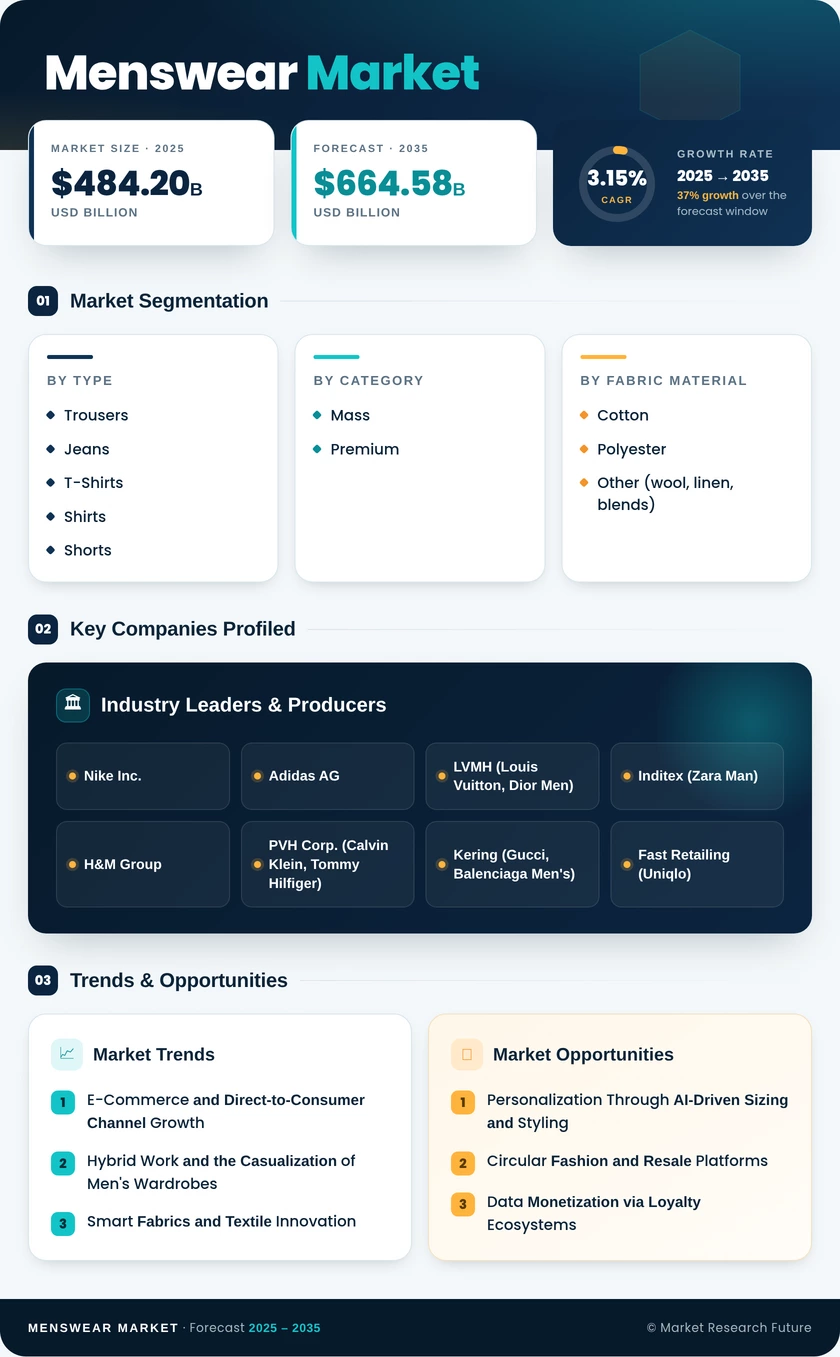
Market Size
Forecast Period2026-2035
CAGR (2026-2035)3.15%
2025 Market SizeUSD 484.20 Billion
2035 Market SizeUSD 664.58 Billion
Key Players
Nike Inc.
Adidas AG
LVMH (Louis Vuitton
Dior Men)
Inditex
H&M Group
Opportunities
  • Personalization Through AI-Driven Sizing and Styling
  • Circular Fashion and Resale Platforms
  • Data Monetization via Loyalty Ecosystems
  1. 1 Market Overview |
    1. 1.1 Study Assumptions & Market Definition |
    2. 1.2 Scope of the Study |
    3. 1.3 Research Methodology
  2. 2 Market Summary & Key Takeaways
  3. 3 Market Dynamics |
    1. 3.1 Market Drivers Analysis | |
      1. 3.1.1 E-Commerce and Direct-to-Consumer Channel Growth | |
      2. 3.1.2 Hybrid Work and the Casualization of Men's Wardrobes | |
      3. 3.1.3 Premium Capsule Collections and Brand Elevation | |
      4. 3.1.4 Smart Fabrics and Textile Innovation | |
      5. 3.1.5 Urbanization in Emerging Markets | |
      6. 3.1.6 Sustainability and Circular Fashion Mandates | |
      7. 3.1.7 Celebrity and Influencer-Driven Demand |
    2. 3.2 Market Restraints Analysis | |
      1. 3.2.1 Raw Material Price Volatility | |
      2. 3.2.2 Inflationary Pressure on Consumer Spending | |
      3. 3.2.3 Counterfeit and Grey-Market Competition | |
      4. 3.2.4 Sustainability Compliance Costs for SMEs | |
      5. 3.2.5 Supply Chain Disruptions and Geopolitical Risk |
    3. 3.3 Market Opportunity Analysis | |
      1. 3.3.1 Personalization Through AI-Driven Sizing and Styling | |
      2. 3.3.2 Circular Fashion and Resale Platforms | |
      3. 3.3.3 Emerging Market Penetration in Africa and South Asia | |
      4. 3.3.4 Performance and Athleisure Crossover | |
      5. 3.3.5 Data Monetization via Loyalty Ecosystems |
    4. 3.4 Industry Value Chain Analysis |
    5. 3.5 Porter's Five Forces Analysis
  4. 4 Global Menswear Market Size & Forecast (2021โ€“2035) |
    1. 4.1 Historical Market Size (2021โ€“2025) |
    2. 4.2 Current & Forecast Market Size (2026โ€“2035) |
    3. 4.3 Market Size by Revenue (USD Billion) |
    4. 4.4 Year-over-Year Growth Analysis
  5. 5 Segmentation Analysis |
    1. 5.1 By Product Type | |
      1. 5.1.1 Trousers | |
      2. 5.1.2 Jeans | |
      3. 5.1.3 T-Shirts | |
      4. 5.1.4 Shirts | |
      5. 5.1.5 Shorts | |
      6. 5.1.6 Jackets/Sweatshirts/Hoodies | |
      7. 5.1.7 Innerwear | |
      8. 5.1.8 Other |
    2. 5.2 By Category | |
      1. 5.2.1 Mass | |
      2. 5.2.2 Premium |
    3. 5.3 By Fabric Material | |
      1. 5.3.1 Cotton | |
      2. 5.3.2 Polyester | |
      3. 5.3.3 Other (Wool, Linen, Blends) |
    4. 5.4 By Distribution Channel | |
      1. 5.4.1 Offline | |
      2. 5.4.2 Online
  6. 6 Regional Analysis |
    1. 6.1 North America | |
      1. 6.1.1 United States | |
      2. 6.1.2 Canada | |
      3. 6.1.3 Mexico |
    2. 6.2 Europe | |
      1. 6.2.1 Germany | |
      2. 6.2.2 United Kingdom | |
      3. 6.2.3 France | |
      4. 6.2.4 Italy | |
      5. 6.2.5 Spain | |
      6. 6.2.6 Nordic Countries | |
      7. 6.2.7 Russia | |
      8. 6.2.8 Rest of Europe |
    3. 6.3 Asia-Pacific | |
      1. 6.3.1 China | |
      2. 6.3.2 India | |
      3. 6.3.3 Japan | |
      4. 6.3.4 South Korea | |
      5. 6.3.5 ASEAN | |
      6. 6.3.6 Rest of Asia-Pacific |
    4. 6.4 South America | |
      1. 6.4.1 Brazil | |
      2. 6.4.2 Argentina | |
      3. 6.4.3 Rest of South America |
    5. 6.5 Middle East & Africa | |
      1. 6.5.1 Saudi Arabia | |
      2. 6.5.2 UAE | |
      3. 6.5.3 South Africa | |
      4. 6.5.4 Egypt | |
      5. 6.5.5 Rest of MEA
  7. 7 Competitive Landscape |
    1. 7.1 Market Share Analysis (2025) |
    2. 7.2 Competitive Benchmarking Matrix |
    3. 7.3 Company Profiles | |
      1. 7.3.1 Nike Inc. | |
      2. 7.3.2 Adidas AG | |
      3. 7.3.3 LVMH (Louis Vuitton, Dior Men) | |
      4. 7.3.4 Inditex (Zara Man) | |
      5. 7.3.5 H&M Group | |
      6. 7.3.6 PVH Corp. (Calvin Klein, Tommy Hilfiger) | |
      7. 7.3.7 Kering (Gucci, Balenciaga Men's) | |
      8. 7.3.8 Fast Retailing (Uniqlo) | |
      9. 7.3.9 Ralph Lauren Corp. | |
      10. 7.3.10 Lululemon Athletica
  8. 8 Future Outlook & Strategic Recommendations (2026โ€“2035) |
    1. 8.1 AI-Driven Supply Chain and Demand Forecasting |
    2. 8.2 Platform Economics and Marketplace Consolidation |
    3. 8.3 Sustainability Reporting and Circular Compliance |
    4. 8.4 Regionalized Production and Nearshoring
  9. 9 Recent Developments & News
  10. 10 Frequently Asked Questions (FAQs)
  11. 11 Report Scope & Methodology |
    1. 11.1 Study Period & Base Year |
    2. 11.2 Data Sources & Citations |
    3. 11.3 Abbreviations
  12. 12 LIST OF TABLES
  13. 13 LIST OF FIGURES

Segmentation Quick Reference

DimensionSub-SegmentsDominant SegmentFastest Growing Segment
Product TypeTrousers, Jeans, T-Shirts, Shirts, Shorts, Jackets/Sweatshirts/Hoodies, Innerwear, OtherShirts (20.8% share, 2025)Jackets/Sweatshirts/Hoodies (3.48% CAGR)
CategoryMass, PremiumMass (72.1% share, 2025)Premium (3.95% CAGR)
Fabric MaterialCotton, Polyester, OtherCotton (47.2% share, 2025)Polyester (4.58% CAGR)
Distribution ChannelOffline, OnlineOffline (69.8% share, 2025)Online (5.23% CAGR)
RegionNorth America, Europe, Asia-Pacific, South America, Middle East & AfricaAsia-Pacific (37.2% share, 2025)Asia-Pacific (5.18% CAGR)

ย 

ย 

Market Segmentation Overview

By Product Type

Sub-SegmentKey Trend
TrousersStretch and performance fabrics replacing rigid weaves in office and casual trousers
JeansPremium selvedge and sustainable denim driving average price increases
T-ShirtsGraphic tees and brand collaborations fueling streetwear-driven demand
ShirtsHybrid fabrics bridging formal and casual use cases for office-to-evening versatility
ShortsYear-round demand growth in tropical markets and athleisure contexts
Jackets/Sweatshirts/HoodiesTechnical outerwear and layering systems gaining traction across age groups
InnerwearComfort-first innovation with modal, bamboo, and micro-fiber blends
OtherAccessories, swimwear, and sleepwear benefiting from lifestyle brand extensions

ย 

The product type dimension of the Menswear Market captures the full breadth of men's wardrobe categories. Shirts remain the volume leader, but growth momentum has shifted toward outerwear and activewear-adjacent categories as hybrid lifestyles reshape daily dressing habits.

By Category

Sub-SegmentKey Trend
MassFast-fashion agility and value pricing sustaining dominant share
PremiumCapsule drops, limited editions, and quality positioning driving premiumization

ย 

The category split reflects an increasingly polarized Menswear Market. Mass-segment retailers compete on speed and affordability, while premium labels leverage scarcity and craftsmanship narratives to justify higher price points.

By Fabric Material

Sub-SegmentKey Trend
CottonOrganic and BCI-certified cotton gaining preference among sustainability-conscious buyers
PolyesterRecycled polyester adoption accelerating in performance and athleisure lines
Other (Wool, Linen, Blends)Merino wool and linen blends anchoring premium tailoring and warm-weather collections

ย 

Fabric material selection in the Menswear Market is evolving rapidly as sustainability and performance converge. Cotton's dominance persists, but polyester's growth rate signals a structural shift toward engineered textiles.

By Distribution Channel

Sub-SegmentKey Trend
OfflineExperiential retail, in-store tailoring, and flagship concepts revitalizing physical channels
OnlineMobile-first shopping, virtual try-on, and subscription models accelerating digital adoption

ย 

Distribution dynamics in the Menswear Market are trending decisively toward omnichannel integration. Offline remains essential for high-touch categories like tailoring and luxury, while online channels capture growing share in basics, activewear, and repeat purchases.


Download PDF ×

We do not share your information with anyone. However, we may send you emails based on your report interest from time to time. You may contact us at any time to opt-out.