Request Free Sample ×

Kindly complete the form below to receive a free sample of this Report

* Please use a valid business email

Leading companies partner with us for data-driven Insights

clients tt-cursor
Hero Background
English
Chinese
French
Japanese
Korean
German
Spanish

Luxury Wines Spirits Market Analysis

ID: MRFR/FnB/5769-CR
167 Pages
Snehal Singh
February 2021

Luxury Wines and Spirits Market Size, Share, Industry Trend & Analysis Research Report Information By Type (Wine, Whisky, Rum, Brandy, Vodka, Gin, Tequila and Others), By Distribution Channel (Food Retail and Food Service), and By Region (North America, Europe, Asia-Pacific, And Rest Of The World) – Forecast Till 2035

Share:
Download PDF ×

We do not share your information with anyone. However, we may send you emails based on your report interest from time to time. You may contact us at any time to opt-out.

Luxury Wines Spirits Market Infographic
Purchase Options

Market Analysis

In-depth Analysis of Luxury Wines Spirits Market Industry Landscape

Luxury wine and spirits marketers can find great opportunities by making their packaging unique, using unique labels, and promoting technology. Use tamper-proof packaging to help prevent illegal drugs and counterfeit products. This is crucial to maintaining the luxury brand's image and maintaining customer loyalty. Digitalization, that is, the use of technology, is expected to bring positive changes to the beverage industry. It can benefit partners by connecting with customers using technology, improving overall business results and resolving issues instantly. How the brand is perceived is very important in the luxury industry. Entrepreneurs are trying to move away from traditional wealth products and instead focus on creating valuable experiences that differentiate themselves from their competitors.

This change creates opportunities for entrepreneurs who add value with unique experiences and quality products. For example, companies such as Baccarat and Bulgari are entering the luxury market by opening hotels in various cities. To grow in the luxury wine and spirits industry, companies have adopted strategies such as partnerships, partnerships, joint venture duplications, products and more. Innovation, mergers and acquisitions. This process helps them expand their reach and offer a variety of products. For example, Bacardi & Company Limited's acquisition of Patrón in 2018 gave it a significant presence in the US market, thereby increasing revenue. Other entrepreneurs using similar growth strategies may also find income in the coming years.

Author
Author Profile
Snehal Singh
Manager - Research

High acumen in analyzing complex macro & micro markets with more than 6 years of work experience in the field of market research. By implementing her analytical skills in forecasting and estimation into market research reports, she has expertise in Packaging, Construction, and Equipment domains. She handles a team size of 20-25 resources and ensures smooth running of the projects, associated marketing activities, and client servicing.

Leave a Comment

FAQs

What is the current valuation of the luxury wines and spirits market?

<p>The luxury wines and spirits market was valued at 400.0 USD Billion in 2024.</p>

What is the projected market valuation for luxury wines and spirits by 2035?

<p>The market is expected to reach a valuation of 545.0 USD Billion by 2035.</p>

What is the expected CAGR for the luxury wines and spirits market during the forecast period?

<p>The expected CAGR for the luxury wines and spirits market from 2025 to 2035 is 2.85%.</p>

Which companies are considered key players in the luxury wines and spirits market?

<p>Key players include LVMH, Pernod Ricard, Diageo, Remy Cointreau, Moet Hennessy, Chandon, Treasury Wine Estates, Constellation Brands, and E&J Gallo Winery.</p>

How is the luxury wines and spirits market segmented by product type?

<p>The market is segmented into Red Wine, White Wine, Sparkling Wine, Fortified Wine, and Spirits, with Red Wine valued at 120.0 to 160.0 USD Billion.</p>

What are the price range segments in the luxury wines and spirits market?

<p>The market segments by price range include Premium, Super Premium, Ultra Premium, Luxury, and Exclusive, with Luxury valued at 100.0 to 130.0 USD Billion.</p>

How does consumer demographics influence the luxury wines and spirits market?

<p>Consumer demographics are segmented by Age Group, Income Level, Gender, Lifestyle, and Occasion, with Income Level valued at 120.0 to 165.0 USD Billion.</p>

What distribution channels are utilized in the luxury wines and spirits market?

<p>Distribution channels include Online Retail, Specialty Stores, Supermarkets, Wine Shops, and Direct Sales, with Direct Sales valued at 130.0 to 145.0 USD Billion.</p>

What packaging types are prevalent in the luxury wines and spirits market?

<p>The market is segmented by packaging types such as Bottle, Box, Can, Keg, and Bag-in-Box, with Bottle valued at 160.0 to 220.0 USD Billion.</p>

What trends are shaping the luxury wines and spirits market in 2025?

<p>Trends in 2025 indicate a growing preference for premium products and online retail channels, reflecting shifts in consumer behavior.</p>

Market Summary

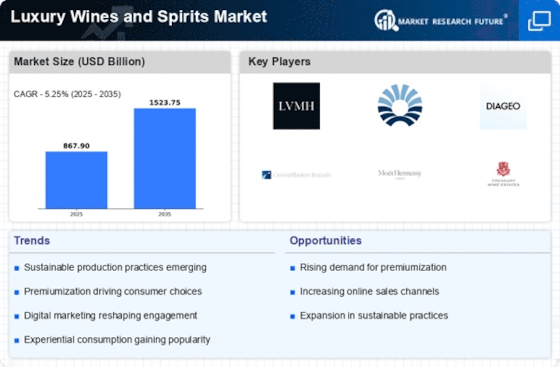
As per Market Research Future analysis, the Luxury Wines and Spirits Market was estimated at 867.9 USD Billion in 2024. The Luxury Wines and Spirits industry is projected to grow from 913.46 USD Billion in 2025 to 1523.75 USD Billion by 2035, exhibiting a compound annual growth rate (CAGR) of 5.25% during the forecast period 2025 - 2035

Key Market Trends & Highlights

The Luxury Wines and Spirits Market is experiencing a dynamic shift towards artisanal craftsmanship and sustainability, driven by evolving consumer preferences.

  • Artisanal craftsmanship is becoming increasingly prominent, appealing to discerning consumers in North America. Sustainability is a key focus, with brands in the Asia-Pacific region adopting eco-friendly practices to attract environmentally conscious buyers. Digital engagement is on the rise, as e-commerce channels expand and social media influences consumer choices. Rising disposable incomes and a growing interest in sustainable practices are driving demand in the wine and food retail segments.

Market Size & Forecast

2024 Market Size 867.9 (USD Billion)
2035 Market Size 1523.75 (USD Billion)
CAGR (2025 - 2035) 5.25%
Largest Regional Market Share in 2024 Asia Pacific

Major Players

LVMH (FR), Pernod Ricard (FR), Diageo (GB), Constellation Brands (US), Moet Hennessy (FR), Treasury Wine Estates (AU), Campari Group (IT), Brown-Forman (US), E&amp;J Gallo Winery (US)

Market Trends

The Luxury Wines and Spirits Market is currently experiencing a dynamic evolution, reflecting key luxury wines and spirits market trends such as shifting consumer preferences and an increasing demand for premium products. This market appears to be influenced by a growing appreciation for artisanal craftsmanship and unique flavor profiles, which consumers seem to seek out more fervently. As a result, brands are focusing on enhancing their storytelling and heritage, thereby creating a deeper connection with their clientele. Furthermore, the rise of social media and digital platforms has enabled consumers to explore and discover luxury offerings more easily, fostering a culture of sharing experiences and recommendations. In addition, sustainability has emerged as a pivotal theme within the Luxury Wines and Spirits Market. Consumers are increasingly inclined to support brands that prioritize environmentally friendly practices and ethical sourcing. This evolution is supported by ongoing luxury wines and spirits market analysis, which highlights the growing importance of sustainability in purchasing decisions. Overall, the Luxury Wines and Spirits Market is poised for continued growth, driven by evolving consumer expectations and a commitment to quality and sustainability.

Artisanal Craftsmanship

There is a noticeable shift towards artisanal products, as consumers increasingly value unique and handcrafted offerings. This trend indicates a preference for quality over quantity, with buyers seeking out brands that emphasize traditional methods and local ingredients.

Sustainability Focus

Sustainability has become a crucial consideration for consumers in the Luxury Wines and Spirits Market. Brands that adopt eco-friendly practices and transparent sourcing are likely to resonate more with environmentally conscious buyers, potentially influencing purchasing decisions.

Digital Engagement

The rise of digital platforms has transformed how consumers interact with luxury brands. Enhanced online presence and social media engagement allow for greater exploration and discovery of products, suggesting that brands must invest in digital marketing strategies to capture consumer interest.

Luxury Wines Spirits Market Market Drivers

Influence of Social Media

The Luxury Wines and Spirits Market is experiencing a transformative impact due to the influence of social media platforms. These platforms serve as powerful marketing tools, enabling brands to engage directly with consumers and showcase their products in innovative ways. Data suggests that brands leveraging social media effectively can see a significant increase in brand awareness and consumer engagement. Influencers and brand ambassadors play a crucial role in shaping consumer perceptions, often leading to increased sales of luxury wines and spirits. As social media continues to evolve, its role in driving trends and consumer behavior within the Luxury Wines and Spirits Market is likely to expand, creating new opportunities for brands to connect with their target audiences.

Rising Disposable Incomes

The Luxury Wines and Spirits Market appears to be significantly influenced by the increasing disposable incomes of consumers. As wealth distribution becomes more favorable, particularly in emerging economies, individuals are more inclined to indulge in premium products. Reports indicate that the number of high-net-worth individuals has been on the rise, leading to a greater demand for luxury wines and spirits. This trend is particularly evident in regions where economic growth is robust, allowing consumers to allocate a larger portion of their income towards luxury goods. Consequently, the Luxury Wines and Spirits Market is likely to experience sustained growth as more consumers seek out high-quality, exclusive offerings that reflect their elevated social status.

Evolving Consumer Preferences

Consumer preferences within the Luxury Wines and Spirits Market are evolving, with a noticeable shift towards unique and premium products. Today's consumers are increasingly discerning, seeking out artisanal and craft options that offer distinct flavors and experiences. This trend is supported by data indicating that sales of craft spirits have surged, reflecting a broader desire for authenticity and quality. Additionally, the rise of experiential consumption, where consumers prioritize experiences over mere products, has led to a growing interest in luxury wines and spirits that provide memorable moments. As a result, brands that can effectively communicate their heritage and craftsmanship are likely to thrive in this competitive landscape.

Expansion of E-commerce Channels

The Luxury Wines and Spirits Market is witnessing a notable expansion of e-commerce channels, which is reshaping how consumers access premium products. The convenience and accessibility of online shopping have led to a surge in direct-to-consumer sales, allowing brands to reach a broader audience. Data indicates that online sales of luxury wines and spirits have increased significantly, driven by changing consumer behaviors and preferences. This shift is particularly relevant as younger consumers, who are more comfortable with digital transactions, seek out luxury offerings online. As e-commerce continues to grow, the Luxury Wines and Spirits Market is likely to adapt, with brands investing in digital platforms to enhance their reach and customer engagement.

Growing Interest in Sustainable Practices

Sustainability has emerged as a pivotal driver within the Luxury Wines and Spirits Market, as consumers increasingly prioritize environmentally friendly practices. Brands that adopt sustainable sourcing, production, and packaging methods are likely to resonate with a conscientious consumer base. Reports indicate that a significant percentage of consumers are willing to pay a premium for products that align with their values, particularly in the luxury segment. This trend is prompting many producers to implement eco-friendly practices, from organic farming to reduced carbon footprints. As sustainability becomes a key differentiator, the Luxury Wines and Spirits Market may witness a shift towards brands that not only offer quality products but also demonstrate a commitment to environmental stewardship.


Market Segment Insights

By Product Type: Red Wine (Largest) vs. Sparkling Wine (Fastest-Growing)

<p>The luxury wines and spirits market is characterized by a diverse array of product types, with red wine leading in market share, being favored for its rich flavors and aging potential. In contrast, sparkling wine has been experiencing a surge in popularity, particularly among younger consumers and special occasions, indicating a shift in consumer preferences. As wine enthusiasts seek unique and high-quality offerings, red wine maintains a strong position while sparkling options expand their footprint in the luxury segment.</p>

<p>Red Wine (Dominant) vs. Sparkling Wine (Emerging)</p>

<p>Red wine remains the dominant force in the luxury wines and spirits market, celebrated for its depth of flavor and prestige. This segment appeals to connoisseurs and collectors alike, often associated with high-end dining experiences. Conversely, sparkling wine is emerging rapidly, capturing the interest of millennials and Generation Z. Its versatility and celebratory nature make it a preferred choice for many social occasions. As luxury consumers become increasingly adventurous, brands are innovating their offerings, allowing both red and sparkling wines to carve out significant niches that cater to evolving tastes.</p>

By Price Range: Super Premium (Largest) vs. Ultra Premium (Fastest-Growing)

<p>The luxury wines and spirits market exhibits a notable distribution among various price ranges, notably 'Premium', 'Super Premium', 'Ultra Premium', 'Luxury', and 'Exclusive'. The 'Super Premium' segment stands out as the leading category, capturing the largest market share, largely attributed to increasing consumer disposable incomes and a growing penchant for premium beverages. Meanwhile, the 'Ultra Premium' segment is quickly gaining traction, appealing to sophisticated consumers who prioritize quality and exclusivity, making it an essential focus for luxury brands. Market trends in this sector indicate a shift towards more discerning consumer preferences, with an inclination towards sustainability and artisanal production. This is driving growth in both the 'Super Premium' and 'Ultra Premium' segments, as consumers seek authenticity and individuality in their choice of luxury wines and spirits. The desire for unique flavor profiles and heritage brands is propelling this segment forward, positioning it for increased relevance in coming years.</p>

<p>Super Premium (Dominant) vs. Ultra Premium (Emerging)</p>

<p>The 'Super Premium' segment represents the cornerstone of the luxury wines and spirits market, characterized by its superior quality and extensive range of offerings that resonate with affluent consumers. This segment typically includes well-established brands that are synonymous with luxury and have cultivated a loyal customer base. Craftsmanship and unique flavor profiles are key characteristics of this segment, allowing it to maintain a dominant position in the market. Conversely, the 'Ultra Premium' segment, while still emerging, is defined by exclusivity and limited releases, targeting a niche audience willing to pay a premium for unique experiences. This segment often features small-batch producers known for innovative practices and high-quality ingredients, appealing to consumers who value the story and authenticity behind their choices. Together, these segments create a dynamic interplay that drives the luxury wines and spirits market.</p>

By Consumer Demographics: Age Group (Largest) vs. Income Level (Fastest-Growing)

<p>In the luxury wines and spirits market, age group segmentation reveals that consumers aged 35-54 hold the largest market share, as they are more inclined towards premium purchasing due to increased disposable income and inclination towards sophisticated products. Conversely, younger consumers aged 21-34 are emerging as a significant market force, driven by trends towards premiumization and experiential drinking, thus reshaping the consumer landscape.</p>

<p>Age Group: 35-54 (Dominant) vs. 21-34 (Emerging)</p>

<p>The age group of 35-54 is characterized by established careers and substantial disposable income, making them the dominant force in luxury wines and spirits consumption. They prioritize quality and brand reputation, often seeking exclusivity in their purchases. Conversely, the 21-34 age group is emerging, driven by social media influence and a preference for unique flavors and experiences. This group tends to favor brands that align with their lifestyle choices, such as sustainability and authenticity, thereby presenting new opportunities for brands targeting luxury markets.</p>

By Distribution Channel: Online Retail (Largest) vs. Specialty Stores (Fastest-Growing)

<p>The distribution of luxury wines and spirits across various channels reveals a significant dominance of online retail, which has captured the largest share of the market. Consumers increasingly prefer the convenience and variety offered by online platforms, which allow for easy comparison and access to exclusive offerings. Specialty stores also play a crucial role, appealing to consumers seeking personalized experiences and expert recommendations, thus securing their position in the market.</p>

<p>Online Retail (Dominant) vs. Specialty Stores (Emerging)</p>

<p>Online retailing remains a dominant force in the luxury wines and spirits market, driven by the rise of e-commerce and changing consumer behaviors. Shoppers enjoy the ease of browsing a wide selection without geographic limitations, often finding rare and niche products unavailable in physical stores. On the other hand, specialty stores are classified as an emerging segment. They captivate discerning customers through curated selections, exclusive brands, and personalized services, making them a go-to destination for enthusiasts and collectors who value quality and unique offerings.</p>

By Packaging Type: Bottle (Largest) vs. Bag-in-Box (Fastest-Growing)

<p>The packaging type segment in the luxury wines and spirits market reveals a dynamic distribution, with bottles dominating the market share. Bottles are synonymous with traditional luxury and craftsmanship, making them immensely popular among consumers seeking premium experiences. In contrast, segments like bag-in-box, which cater to convenience and sustainability, are steadily gaining traction. Their appeal is notably pronounced among eco-conscious consumers and those looking for innovative serving solutions. As consumer preferences evolve, the growth trends within the luxury packaging segment reflect an increasing inclination towards sustainability and convenience. The demand for bag-in-box solutions, which allows for efficient storage and easy transport, is particularly notable among younger demographics. Additionally, the premiumization of products within this packaging type signals a shift in consumer expectations, emphasizing the importance of quality and experience in luxury spirits consumption.</p>

<p>Bottles: Dominant vs. Bag-in-Box: Emerging</p>

<p>Bottles remain the dominant packaging format in the luxury wines and spirits market. Their classic design and perceived elegance resonate strongly with consumers associating bottles with high-quality and premium products. This traditional packaging signifies authenticity and sophistication, aligning well with the luxury branding of many spirits. However, bag-in-box packaging is emerging as a significant trend in the segment, appealing to a growing consumer base that values practicality and eco-friendliness. This format allows for a more accessible consumption experience without sacrificing quality, making it popular among younger consumers and casual drinkers. The innovation in design and focus on responsible packaging practices positions bag-in-box as a viable competitor, gradually gaining acceptance within the luxury segment.</p>

Get more detailed insights about Luxury Wines and Spirits Market Research Report - Forecast to 2035

Regional Insights

North America : Luxury Market Leader

North America is the largest market for luxury wines and spirits, accounting for approximately 40% of the global market share. The region's growth is driven by increasing disposable incomes, a growing trend towards premiumization, and a rising interest in wine tourism. Regulatory support for alcohol sales and distribution has also catalyzed market expansion, with states increasingly allowing direct-to-consumer sales. The United States leads the North American market, with California being a significant contributor due to its renowned wine regions. Key players such as Constellation Brands and E&J Gallo Winery dominate the landscape, alongside international brands like Moet Hennessy and Diageo. The competitive environment is characterized by innovation in product offerings and marketing strategies aimed at affluent consumers.

Europe : Cultural Heritage and Innovation

Europe is the second-largest market for luxury wines and spirits, holding around 30% of the global market share. The region benefits from a rich cultural heritage in winemaking, with countries like France and Italy leading the charge. Regulatory frameworks, such as the EU's Common Agricultural Policy, support quality production and promote local brands, enhancing market growth. The increasing demand for organic and biodynamic wines is also a significant trend. France is the largest market in Europe, with Bordeaux and champagne being iconic regions. Italy follows closely, known for its diverse wine offerings. Major players like LVMH and Pernod Ricard are well-established, while emerging brands are gaining traction. The competitive landscape is vibrant, with a focus on sustainability and premium product offerings, catering to a discerning consumer base.

Asia-Pacific : Emerging Luxury Market

Asia-Pacific is rapidly emerging as a significant market for luxury wines and spirits, accounting for approximately 20% of the global market share. The region's growth is fueled by rising disposable incomes, changing consumer preferences towards premium products, and an increasing interest in wine culture, particularly in countries like China and Japan. Regulatory changes are also facilitating market entry for international brands, enhancing competition. China is the largest market in the region, with a growing middle class that is increasingly inclined towards luxury consumption. Japan follows, with a strong appreciation for fine wines and spirits. Key players like Treasury Wine Estates and Campari Group are expanding their presence, while local brands are also gaining popularity. The competitive landscape is characterized by a blend of traditional and modern marketing strategies aimed at educating consumers about luxury offerings.

Middle East and Africa : Untapped Market Potential

The Middle East and Africa represent an emerging frontier for luxury wines and spirits, holding about 10% of the global market share. The region's growth is driven by increasing urbanization, a burgeoning affluent class, and a growing acceptance of wine culture, particularly in countries like South Africa and the UAE. Regulatory frameworks are evolving, with some countries relaxing restrictions on alcohol sales, which is expected to further stimulate market growth. South Africa is the leading market in the region, known for its quality wine production and export capabilities. The UAE is also gaining traction, with a rising number of luxury establishments catering to affluent consumers. Key players like Brown-Forman and local wineries are competing in this dynamic landscape, focusing on premium offerings and unique experiences to attract consumers.

Key Players and Competitive Insights

The Luxury Wines and Spirits Market is currently characterized by a dynamic competitive landscape, driven by evolving consumer preferences and a growing demand for premium products. Key players such as LVMH (FR), Diageo (GB), and Pernod Ricard (FR) are strategically positioned to leverage their extensive portfolios and global reach. LVMH (FR) focuses on innovation and brand prestige, while Diageo (GB) emphasizes sustainability and digital transformation. Pernod Ricard (FR) is actively pursuing regional expansion and strategic partnerships, which collectively shape a competitive environment that is both concentrated and moderately fragmented, with significant influence from these major players.In terms of business tactics, companies are increasingly localizing manufacturing and optimizing supply chains to enhance efficiency and responsiveness to market demands. The competitive structure of the Luxury Wines and Spirits Market appears to be moderately fragmented, with a few dominant players exerting considerable influence. This structure allows for a diverse range of products and brands, catering to various consumer segments while fostering healthy competition among key players.
In August Diageo (GB) announced a significant investment in sustainable packaging initiatives aimed at reducing its carbon footprint. This strategic move underscores the company's commitment to environmental responsibility and aligns with the growing consumer demand for sustainable products. By enhancing its packaging processes, Diageo (GB) not only improves its brand image but also positions itself favorably in a market increasingly focused on sustainability.
In September Pernod Ricard (FR) launched a new digital marketing campaign targeting younger consumers, utilizing social media platforms to engage with this demographic. This initiative reflects the company's recognition of the importance of digital channels in reaching modern consumers. By leveraging innovative marketing strategies, Pernod Ricard (FR) aims to strengthen its brand presence and drive sales among a younger audience, which is crucial for long-term growth.
In October LVMH (FR) unveiled a new luxury wine brand that emphasizes artisanal production methods and exclusive sourcing. This launch not only diversifies LVMH's portfolio but also caters to the increasing consumer interest in authenticity and craftsmanship. By focusing on high-quality, unique offerings, LVMH (FR) reinforces its position as a leader in the luxury segment, appealing to discerning consumers seeking premium experiences.
As of October current trends in the Luxury Wines and Spirits Market indicate a strong emphasis on digitalization, sustainability, and the integration of artificial intelligence in operations. Strategic alliances among key players are shaping the competitive landscape, fostering innovation and collaboration. Looking ahead, competitive differentiation is likely to evolve, shifting from price-based competition to a focus on innovation, technology, and supply chain reliability, as companies strive to meet the demands of an increasingly discerning consumer base.

Key Companies in the Luxury Wines Spirits Market include

Industry Developments

January 2022: On St. Patrick's Day, Jameson introduced a brand-new whisky with a citrus flavour. The end result features undertones of vanilla and almonds that are reminiscent of those in an Old-Fashioned drink. The product debuted in the U.K. in 2021, where it gained traction, and Jameson intends to release it across America this month with a suggested MSRP of $24.99. The introduction of this product domestically ushers in a new era for the whisky producer as the company continues to experiment with flavoured spirits.

April 2021: "Loyal 9 Cocktails," a US-based company that produces ready-to-drink spirits, was successfully acquired by English multinational company Diageo, which produces alcoholic beverages. The move is likely to be a full hit given the US's booming desire for ready-to-drink drinks. Sales of ready-to-drink cocktails increased by 79% in 2020 to $664 million.

Future Outlook

Luxury Wines Spirits Market Future Outlook

The Luxury Wines and Spirits Market is projected to grow at a 5.25% CAGR from 2025 to 2035, driven by premiumization, evolving consumer preferences, and innovative marketing strategies.

New opportunities lie in:

  • <p>Expansion of e-commerce platforms for luxury wine sales. Development of exclusive wine and spirit subscription services. Investment in sustainable production practices to attract eco-conscious consumers.</p>

By 2035, the market is expected to solidify its position as a leader in luxury consumer goods.

Market Segmentation

Luxury Wines Spirits Market Type Outlook

  • Wine
  • Whisky
  • Rum
  • Brandy
  • Vodka
  • Gin
  • Tequila
  • Others

Luxury Wines Spirits Market Distribution Channel Outlook

  • Food Retail
  • Food Service

Report Scope

MARKET SIZE 2024 867.9(USD Billion)
MARKET SIZE 2025 913.46(USD Billion)
MARKET SIZE 2035 1523.75(USD Billion)
COMPOUND ANNUAL GROWTH RATE (CAGR) 5.25% (2025 - 2035)
REPORT COVERAGE Revenue Forecast, Competitive Landscape, Growth Factors, and Trends
BASE YEAR 2024
Market Forecast Period 2025 - 2035
Historical Data 2019 - 2024
Market Forecast Units USD Billion
Key Companies Profiled LVMH (FR), Pernod Ricard (FR), Diageo (GB), Constellation Brands (US), Moet Hennessy (FR), Treasury Wine Estates (AU), Campari Group (IT), Brown-Forman (US), E&J Gallo Winery (US)
Segments Covered Type, Distribution Channel, Region
Key Market Opportunities Growing consumer interest in sustainable and organic production methods in the Luxury Wines and Spirits Market.
Key Market Dynamics Shifting consumer preferences towards premium products drive innovation and competition in the Luxury Wines and Spirits Market.
Countries Covered North America, Europe, APAC, South America, MEA

FAQs

What is the current valuation of the luxury wines and spirits market?

<p>The luxury wines and spirits market was valued at 400.0 USD Billion in 2024.</p>

What is the projected market valuation for luxury wines and spirits by 2035?

<p>The market is expected to reach a valuation of 545.0 USD Billion by 2035.</p>

What is the expected CAGR for the luxury wines and spirits market during the forecast period?

<p>The expected CAGR for the luxury wines and spirits market from 2025 to 2035 is 2.85%.</p>

Which companies are considered key players in the luxury wines and spirits market?

<p>Key players include LVMH, Pernod Ricard, Diageo, Remy Cointreau, Moet Hennessy, Chandon, Treasury Wine Estates, Constellation Brands, and E&J Gallo Winery.</p>

How is the luxury wines and spirits market segmented by product type?

<p>The market is segmented into Red Wine, White Wine, Sparkling Wine, Fortified Wine, and Spirits, with Red Wine valued at 120.0 to 160.0 USD Billion.</p>

What are the price range segments in the luxury wines and spirits market?

<p>The market segments by price range include Premium, Super Premium, Ultra Premium, Luxury, and Exclusive, with Luxury valued at 100.0 to 130.0 USD Billion.</p>

How does consumer demographics influence the luxury wines and spirits market?

<p>Consumer demographics are segmented by Age Group, Income Level, Gender, Lifestyle, and Occasion, with Income Level valued at 120.0 to 165.0 USD Billion.</p>

What distribution channels are utilized in the luxury wines and spirits market?

<p>Distribution channels include Online Retail, Specialty Stores, Supermarkets, Wine Shops, and Direct Sales, with Direct Sales valued at 130.0 to 145.0 USD Billion.</p>

What packaging types are prevalent in the luxury wines and spirits market?

<p>The market is segmented by packaging types such as Bottle, Box, Can, Keg, and Bag-in-Box, with Bottle valued at 160.0 to 220.0 USD Billion.</p>

What trends are shaping the luxury wines and spirits market in 2025?

<p>Trends in 2025 indicate a growing preference for premium products and online retail channels, reflecting shifts in consumer behavior.</p>

  1. SECTION I: EXECUTIVE SUMMARY AND KEY HIGHLIGHTS
    1. | 1.1 EXECUTIVE SUMMARY
    2. | | 1.1.1 Market Overview
    3. | | 1.1.2 Key Findings
    4. | | 1.1.3 Market Segmentation
    5. | | 1.1.4 Competitive Landscape
    6. | | 1.1.5 Challenges and Opportunities
    7. | | 1.1.6 Future Outlook
  2. SECTION II: SCOPING, METHODOLOGY AND MARKET STRUCTURE
    1. | 2.1 MARKET INTRODUCTION
    2. | | 2.1.1 Definition
    3. | | 2.1.2 Scope of the study
    4. | | | 2.1.2.1 Research Objective
    5. | | | 2.1.2.2 Assumption
    6. | | | 2.1.2.3 Limitations
    7. | 2.2 RESEARCH METHODOLOGY
    8. | | 2.2.1 Overview
    9. | | 2.2.2 Data Mining
    10. | | 2.2.3 Secondary Research
    11. | | 2.2.4 Primary Research
    12. | | | 2.2.4.1 Primary Interviews and Information Gathering Process
    13. | | | 2.2.4.2 Breakdown of Primary Respondents
    14. | | 2.2.5 Forecasting Model
    15. | | 2.2.6 Market Size Estimation
    16. | | | 2.2.6.1 Bottom-Up Approach
    17. | | | 2.2.6.2 Top-Down Approach
    18. | | 2.2.7 Data Triangulation
    19. | | 2.2.8 Validation
  3. SECTION III: QUALITATIVE ANALYSIS
    1. | 3.1 MARKET DYNAMICS
    2. | | 3.1.1 Overview
    3. | | 3.1.2 Drivers
    4. | | 3.1.3 Restraints
    5. | | 3.1.4 Opportunities
    6. | 3.2 MARKET FACTOR ANALYSIS
    7. | | 3.2.1 Value chain Analysis
    8. | | 3.2.2 Porter's Five Forces Analysis
    9. | | | 3.2.2.1 Bargaining Power of Suppliers
    10. | | | 3.2.2.2 Bargaining Power of Buyers
    11. | | | 3.2.2.3 Threat of New Entrants
    12. | | | 3.2.2.4 Threat of Substitutes
    13. | | | 3.2.2.5 Intensity of Rivalry
    14. | | 3.2.3 COVID-19 Impact Analysis
    15. | | | 3.2.3.1 Market Impact Analysis
    16. | | | 3.2.3.2 Regional Impact
    17. | | | 3.2.3.3 Opportunity and Threat Analysis
  4. SECTION IV: QUANTITATIVE ANALYSIS
    1. | 4.1 Food, Beverages & Nutrition, BY Product Type (USD Billion)
    2. | | 4.1.1 Red Wine
    3. | | 4.1.2 White Wine
    4. | | 4.1.3 Sparkling Wine
    5. | | 4.1.4 Fortified Wine
    6. | | 4.1.5 Spirits
    7. | 4.2 Food, Beverages & Nutrition, BY Price Range (USD Billion)
    8. | | 4.2.1 Premium
    9. | | 4.2.2 Super Premium
    10. | | 4.2.3 Ultra Premium
    11. | | 4.2.4 Luxury
    12. | | 4.2.5 Exclusive
    13. | 4.3 Food, Beverages & Nutrition, BY Consumer Demographics (USD Billion)
    14. | | 4.3.1 Age Group
    15. | | 4.3.2 Income Level
    16. | | 4.3.3 Gender
    17. | | 4.3.4 Lifestyle
    18. | | 4.3.5 Occasion
    19. | 4.4 Food, Beverages & Nutrition, BY Distribution Channel (USD Billion)
    20. | | 4.4.1 Online Retail
    21. | | 4.4.2 Specialty Stores
    22. | | 4.4.3 Supermarkets
    23. | | 4.4.4 Wine Shops
    24. | | 4.4.5 Direct Sales
    25. | 4.5 Food, Beverages & Nutrition, BY Packaging Type (USD Billion)
    26. | | 4.5.1 Bottle
    27. | | 4.5.2 Box
    28. | | 4.5.3 Can
    29. | | 4.5.4 Keg
    30. | | 4.5.5 Bag-in-Box
    31. | 4.6 Food, Beverages & Nutrition, BY Region (USD Billion)
    32. | | 4.6.1 North America
    33. | | | 4.6.1.1 US
    34. | | | 4.6.1.2 Canada
    35. | | 4.6.2 Europe
    36. | | | 4.6.2.1 Germany
    37. | | | 4.6.2.2 UK
    38. | | | 4.6.2.3 France
    39. | | | 4.6.2.4 Russia
    40. | | | 4.6.2.5 Italy
    41. | | | 4.6.2.6 Spain
    42. | | | 4.6.2.7 Rest of Europe
    43. | | 4.6.3 APAC
    44. | | | 4.6.3.1 China
    45. | | | 4.6.3.2 India
    46. | | | 4.6.3.3 Japan
    47. | | | 4.6.3.4 South Korea
    48. | | | 4.6.3.5 Malaysia
    49. | | | 4.6.3.6 Thailand
    50. | | | 4.6.3.7 Indonesia
    51. | | | 4.6.3.8 Rest of APAC
    52. | | 4.6.4 South America
    53. | | | 4.6.4.1 Brazil
    54. | | | 4.6.4.2 Mexico
    55. | | | 4.6.4.3 Argentina
    56. | | | 4.6.4.4 Rest of South America
    57. | | 4.6.5 MEA
    58. | | | 4.6.5.1 GCC Countries
    59. | | | 4.6.5.2 South Africa
    60. | | | 4.6.5.3 Rest of MEA
  5. SECTION V: COMPETITIVE ANALYSIS
    1. | 5.1 Competitive Landscape
    2. | | 5.1.1 Overview
    3. | | 5.1.2 Competitive Analysis
    4. | | 5.1.3 Market share Analysis
    5. | | 5.1.4 Major Growth Strategy in the Food, Beverages & Nutrition
    6. | | 5.1.5 Competitive Benchmarking
    7. | | 5.1.6 Leading Players in Terms of Number of Developments in the Food, Beverages & Nutrition
    8. | | 5.1.7 Key developments and growth strategies
    9. | | | 5.1.7.1 New Product Launch/Service Deployment
    10. | | | 5.1.7.2 Merger & Acquisitions
    11. | | | 5.1.7.3 Joint Ventures
    12. | | 5.1.8 Major Players Financial Matrix
    13. | | | 5.1.8.1 Sales and Operating Income
    14. | | | 5.1.8.2 Major Players R&D Expenditure. 2023
    15. | 5.2 Company Profiles
    16. | | 5.2.1 LVMH (FR)
    17. | | | 5.2.1.1 Financial Overview
    18. | | | 5.2.1.2 Products Offered
    19. | | | 5.2.1.3 Key Developments
    20. | | | 5.2.1.4 SWOT Analysis
    21. | | | 5.2.1.5 Key Strategies
    22. | | 5.2.2 Pernod Ricard (FR)
    23. | | | 5.2.2.1 Financial Overview
    24. | | | 5.2.2.2 Products Offered
    25. | | | 5.2.2.3 Key Developments
    26. | | | 5.2.2.4 SWOT Analysis
    27. | | | 5.2.2.5 Key Strategies
    28. | | 5.2.3 Diageo (GB)
    29. | | | 5.2.3.1 Financial Overview
    30. | | | 5.2.3.2 Products Offered
    31. | | | 5.2.3.3 Key Developments
    32. | | | 5.2.3.4 SWOT Analysis
    33. | | | 5.2.3.5 Key Strategies
    34. | | 5.2.4 Remy Cointreau (FR)
    35. | | | 5.2.4.1 Financial Overview
    36. | | | 5.2.4.2 Products Offered
    37. | | | 5.2.4.3 Key Developments
    38. | | | 5.2.4.4 SWOT Analysis
    39. | | | 5.2.4.5 Key Strategies
    40. | | 5.2.5 Moet Hennessy (FR)
    41. | | | 5.2.5.1 Financial Overview
    42. | | | 5.2.5.2 Products Offered
    43. | | | 5.2.5.3 Key Developments
    44. | | | 5.2.5.4 SWOT Analysis
    45. | | | 5.2.5.5 Key Strategies
    46. | | 5.2.6 Chandon (FR)
    47. | | | 5.2.6.1 Financial Overview
    48. | | | 5.2.6.2 Products Offered
    49. | | | 5.2.6.3 Key Developments
    50. | | | 5.2.6.4 SWOT Analysis
    51. | | | 5.2.6.5 Key Strategies
    52. | | 5.2.7 Treasury Wine Estates (AU)
    53. | | | 5.2.7.1 Financial Overview
    54. | | | 5.2.7.2 Products Offered
    55. | | | 5.2.7.3 Key Developments
    56. | | | 5.2.7.4 SWOT Analysis
    57. | | | 5.2.7.5 Key Strategies
    58. | | 5.2.8 Constellation Brands (US)
    59. | | | 5.2.8.1 Financial Overview
    60. | | | 5.2.8.2 Products Offered
    61. | | | 5.2.8.3 Key Developments
    62. | | | 5.2.8.4 SWOT Analysis
    63. | | | 5.2.8.5 Key Strategies
    64. | | 5.2.9 E&J Gallo Winery (US)
    65. | | | 5.2.9.1 Financial Overview
    66. | | | 5.2.9.2 Products Offered
    67. | | | 5.2.9.3 Key Developments
    68. | | | 5.2.9.4 SWOT Analysis
    69. | | | 5.2.9.5 Key Strategies
    70. | 5.3 Appendix
    71. | | 5.3.1 References
    72. | | 5.3.2 Related Reports
  6. LIST OF FIGURES
    1. | 6.1 MARKET SYNOPSIS
    2. | 6.2 NORTH AMERICA MARKET ANALYSIS
    3. | 6.3 US MARKET ANALYSIS BY PRODUCT TYPE
    4. | 6.4 US MARKET ANALYSIS BY PRICE RANGE
    5. | 6.5 US MARKET ANALYSIS BY CONSUMER DEMOGRAPHICS
    6. | 6.6 US MARKET ANALYSIS BY DISTRIBUTION CHANNEL
    7. | 6.7 US MARKET ANALYSIS BY PACKAGING TYPE
    8. | 6.8 CANADA MARKET ANALYSIS BY PRODUCT TYPE
    9. | 6.9 CANADA MARKET ANALYSIS BY PRICE RANGE
    10. | 6.10 CANADA MARKET ANALYSIS BY CONSUMER DEMOGRAPHICS
    11. | 6.11 CANADA MARKET ANALYSIS BY DISTRIBUTION CHANNEL
    12. | 6.12 CANADA MARKET ANALYSIS BY PACKAGING TYPE
    13. | 6.13 EUROPE MARKET ANALYSIS
    14. | 6.14 GERMANY MARKET ANALYSIS BY PRODUCT TYPE
    15. | 6.15 GERMANY MARKET ANALYSIS BY PRICE RANGE
    16. | 6.16 GERMANY MARKET ANALYSIS BY CONSUMER DEMOGRAPHICS
    17. | 6.17 GERMANY MARKET ANALYSIS BY DISTRIBUTION CHANNEL
    18. | 6.18 GERMANY MARKET ANALYSIS BY PACKAGING TYPE
    19. | 6.19 UK MARKET ANALYSIS BY PRODUCT TYPE
    20. | 6.20 UK MARKET ANALYSIS BY PRICE RANGE
    21. | 6.21 UK MARKET ANALYSIS BY CONSUMER DEMOGRAPHICS
    22. | 6.22 UK MARKET ANALYSIS BY DISTRIBUTION CHANNEL
    23. | 6.23 UK MARKET ANALYSIS BY PACKAGING TYPE
    24. | 6.24 FRANCE MARKET ANALYSIS BY PRODUCT TYPE
    25. | 6.25 FRANCE MARKET ANALYSIS BY PRICE RANGE
    26. | 6.26 FRANCE MARKET ANALYSIS BY CONSUMER DEMOGRAPHICS
    27. | 6.27 FRANCE MARKET ANALYSIS BY DISTRIBUTION CHANNEL
    28. | 6.28 FRANCE MARKET ANALYSIS BY PACKAGING TYPE
    29. | 6.29 RUSSIA MARKET ANALYSIS BY PRODUCT TYPE
    30. | 6.30 RUSSIA MARKET ANALYSIS BY PRICE RANGE
    31. | 6.31 RUSSIA MARKET ANALYSIS BY CONSUMER DEMOGRAPHICS
    32. | 6.32 RUSSIA MARKET ANALYSIS BY DISTRIBUTION CHANNEL
    33. | 6.33 RUSSIA MARKET ANALYSIS BY PACKAGING TYPE
    34. | 6.34 ITALY MARKET ANALYSIS BY PRODUCT TYPE
    35. | 6.35 ITALY MARKET ANALYSIS BY PRICE RANGE
    36. | 6.36 ITALY MARKET ANALYSIS BY CONSUMER DEMOGRAPHICS
    37. | 6.37 ITALY MARKET ANALYSIS BY DISTRIBUTION CHANNEL
    38. | 6.38 ITALY MARKET ANALYSIS BY PACKAGING TYPE
    39. | 6.39 SPAIN MARKET ANALYSIS BY PRODUCT TYPE
    40. | 6.40 SPAIN MARKET ANALYSIS BY PRICE RANGE
    41. | 6.41 SPAIN MARKET ANALYSIS BY CONSUMER DEMOGRAPHICS
    42. | 6.42 SPAIN MARKET ANALYSIS BY DISTRIBUTION CHANNEL
    43. | 6.43 SPAIN MARKET ANALYSIS BY PACKAGING TYPE
    44. | 6.44 REST OF EUROPE MARKET ANALYSIS BY PRODUCT TYPE
    45. | 6.45 REST OF EUROPE MARKET ANALYSIS BY PRICE RANGE
    46. | 6.46 REST OF EUROPE MARKET ANALYSIS BY CONSUMER DEMOGRAPHICS
    47. | 6.47 REST OF EUROPE MARKET ANALYSIS BY DISTRIBUTION CHANNEL
    48. | 6.48 REST OF EUROPE MARKET ANALYSIS BY PACKAGING TYPE
    49. | 6.49 APAC MARKET ANALYSIS
    50. | 6.50 CHINA MARKET ANALYSIS BY PRODUCT TYPE
    51. | 6.51 CHINA MARKET ANALYSIS BY PRICE RANGE
    52. | 6.52 CHINA MARKET ANALYSIS BY CONSUMER DEMOGRAPHICS
    53. | 6.53 CHINA MARKET ANALYSIS BY DISTRIBUTION CHANNEL
    54. | 6.54 CHINA MARKET ANALYSIS BY PACKAGING TYPE
    55. | 6.55 INDIA MARKET ANALYSIS BY PRODUCT TYPE
    56. | 6.56 INDIA MARKET ANALYSIS BY PRICE RANGE
    57. | 6.57 INDIA MARKET ANALYSIS BY CONSUMER DEMOGRAPHICS
    58. | 6.58 INDIA MARKET ANALYSIS BY DISTRIBUTION CHANNEL
    59. | 6.59 INDIA MARKET ANALYSIS BY PACKAGING TYPE
    60. | 6.60 JAPAN MARKET ANALYSIS BY PRODUCT TYPE
    61. | 6.61 JAPAN MARKET ANALYSIS BY PRICE RANGE
    62. | 6.62 JAPAN MARKET ANALYSIS BY CONSUMER DEMOGRAPHICS
    63. | 6.63 JAPAN MARKET ANALYSIS BY DISTRIBUTION CHANNEL
    64. | 6.64 JAPAN MARKET ANALYSIS BY PACKAGING TYPE
    65. | 6.65 SOUTH KOREA MARKET ANALYSIS BY PRODUCT TYPE
    66. | 6.66 SOUTH KOREA MARKET ANALYSIS BY PRICE RANGE
    67. | 6.67 SOUTH KOREA MARKET ANALYSIS BY CONSUMER DEMOGRAPHICS
    68. | 6.68 SOUTH KOREA MARKET ANALYSIS BY DISTRIBUTION CHANNEL
    69. | 6.69 SOUTH KOREA MARKET ANALYSIS BY PACKAGING TYPE
    70. | 6.70 MALAYSIA MARKET ANALYSIS BY PRODUCT TYPE
    71. | 6.71 MALAYSIA MARKET ANALYSIS BY PRICE RANGE
    72. | 6.72 MALAYSIA MARKET ANALYSIS BY CONSUMER DEMOGRAPHICS
    73. | 6.73 MALAYSIA MARKET ANALYSIS BY DISTRIBUTION CHANNEL
    74. | 6.74 MALAYSIA MARKET ANALYSIS BY PACKAGING TYPE
    75. | 6.75 THAILAND MARKET ANALYSIS BY PRODUCT TYPE
    76. | 6.76 THAILAND MARKET ANALYSIS BY PRICE RANGE
    77. | 6.77 THAILAND MARKET ANALYSIS BY CONSUMER DEMOGRAPHICS
    78. | 6.78 THAILAND MARKET ANALYSIS BY DISTRIBUTION CHANNEL
    79. | 6.79 THAILAND MARKET ANALYSIS BY PACKAGING TYPE
    80. | 6.80 INDONESIA MARKET ANALYSIS BY PRODUCT TYPE
    81. | 6.81 INDONESIA MARKET ANALYSIS BY PRICE RANGE
    82. | 6.82 INDONESIA MARKET ANALYSIS BY CONSUMER DEMOGRAPHICS
    83. | 6.83 INDONESIA MARKET ANALYSIS BY DISTRIBUTION CHANNEL
    84. | 6.84 INDONESIA MARKET ANALYSIS BY PACKAGING TYPE
    85. | 6.85 REST OF APAC MARKET ANALYSIS BY PRODUCT TYPE
    86. | 6.86 REST OF APAC MARKET ANALYSIS BY PRICE RANGE
    87. | 6.87 REST OF APAC MARKET ANALYSIS BY CONSUMER DEMOGRAPHICS
    88. | 6.88 REST OF APAC MARKET ANALYSIS BY DISTRIBUTION CHANNEL
    89. | 6.89 REST OF APAC MARKET ANALYSIS BY PACKAGING TYPE
    90. | 6.90 SOUTH AMERICA MARKET ANALYSIS
    91. | 6.91 BRAZIL MARKET ANALYSIS BY PRODUCT TYPE
    92. | 6.92 BRAZIL MARKET ANALYSIS BY PRICE RANGE
    93. | 6.93 BRAZIL MARKET ANALYSIS BY CONSUMER DEMOGRAPHICS
    94. | 6.94 BRAZIL MARKET ANALYSIS BY DISTRIBUTION CHANNEL
    95. | 6.95 BRAZIL MARKET ANALYSIS BY PACKAGING TYPE
    96. | 6.96 MEXICO MARKET ANALYSIS BY PRODUCT TYPE
    97. | 6.97 MEXICO MARKET ANALYSIS BY PRICE RANGE
    98. | 6.98 MEXICO MARKET ANALYSIS BY CONSUMER DEMOGRAPHICS
    99. | 6.99 MEXICO MARKET ANALYSIS BY DISTRIBUTION CHANNEL
    100. | 6.100 MEXICO MARKET ANALYSIS BY PACKAGING TYPE
    101. | 6.101 ARGENTINA MARKET ANALYSIS BY PRODUCT TYPE
    102. | 6.102 ARGENTINA MARKET ANALYSIS BY PRICE RANGE
    103. | 6.103 ARGENTINA MARKET ANALYSIS BY CONSUMER DEMOGRAPHICS
    104. | 6.104 ARGENTINA MARKET ANALYSIS BY DISTRIBUTION CHANNEL
    105. | 6.105 ARGENTINA MARKET ANALYSIS BY PACKAGING TYPE
    106. | 6.106 REST OF SOUTH AMERICA MARKET ANALYSIS BY PRODUCT TYPE
    107. | 6.107 REST OF SOUTH AMERICA MARKET ANALYSIS BY PRICE RANGE
    108. | 6.108 REST OF SOUTH AMERICA MARKET ANALYSIS BY CONSUMER DEMOGRAPHICS
    109. | 6.109 REST OF SOUTH AMERICA MARKET ANALYSIS BY DISTRIBUTION CHANNEL
    110. | 6.110 REST OF SOUTH AMERICA MARKET ANALYSIS BY PACKAGING TYPE
    111. | 6.111 MEA MARKET ANALYSIS
    112. | 6.112 GCC COUNTRIES MARKET ANALYSIS BY PRODUCT TYPE
    113. | 6.113 GCC COUNTRIES MARKET ANALYSIS BY PRICE RANGE
    114. | 6.114 GCC COUNTRIES MARKET ANALYSIS BY CONSUMER DEMOGRAPHICS
    115. | 6.115 GCC COUNTRIES MARKET ANALYSIS BY DISTRIBUTION CHANNEL
    116. | 6.116 GCC COUNTRIES MARKET ANALYSIS BY PACKAGING TYPE
    117. | 6.117 SOUTH AFRICA MARKET ANALYSIS BY PRODUCT TYPE
    118. | 6.118 SOUTH AFRICA MARKET ANALYSIS BY PRICE RANGE
    119. | 6.119 SOUTH AFRICA MARKET ANALYSIS BY CONSUMER DEMOGRAPHICS
    120. | 6.120 SOUTH AFRICA MARKET ANALYSIS BY DISTRIBUTION CHANNEL
    121. | 6.121 SOUTH AFRICA MARKET ANALYSIS BY PACKAGING TYPE
    122. | 6.122 REST OF MEA MARKET ANALYSIS BY PRODUCT TYPE
    123. | 6.123 REST OF MEA MARKET ANALYSIS BY PRICE RANGE
    124. | 6.124 REST OF MEA MARKET ANALYSIS BY CONSUMER DEMOGRAPHICS
    125. | 6.125 REST OF MEA MARKET ANALYSIS BY DISTRIBUTION CHANNEL
    126. | 6.126 REST OF MEA MARKET ANALYSIS BY PACKAGING TYPE
    127. | 6.127 KEY BUYING CRITERIA OF FOOD, BEVERAGES & NUTRITION
    128. | 6.128 RESEARCH PROCESS OF MRFR
    129. | 6.129 DRO ANALYSIS OF FOOD, BEVERAGES & NUTRITION
    130. | 6.130 DRIVERS IMPACT ANALYSIS: FOOD, BEVERAGES & NUTRITION
    131. | 6.131 RESTRAINTS IMPACT ANALYSIS: FOOD, BEVERAGES & NUTRITION
    132. | 6.132 SUPPLY / VALUE CHAIN: FOOD, BEVERAGES & NUTRITION
    133. | 6.133 FOOD, BEVERAGES & NUTRITION, BY PRODUCT TYPE, 2024 (% SHARE)
    134. | 6.134 FOOD, BEVERAGES & NUTRITION, BY PRODUCT TYPE, 2024 TO 2035 (USD Billion)
    135. | 6.135 FOOD, BEVERAGES & NUTRITION, BY PRICE RANGE, 2024 (% SHARE)
    136. | 6.136 FOOD, BEVERAGES & NUTRITION, BY PRICE RANGE, 2024 TO 2035 (USD Billion)
    137. | 6.137 FOOD, BEVERAGES & NUTRITION, BY CONSUMER DEMOGRAPHICS, 2024 (% SHARE)
    138. | 6.138 FOOD, BEVERAGES & NUTRITION, BY CONSUMER DEMOGRAPHICS, 2024 TO 2035 (USD Billion)
    139. | 6.139 FOOD, BEVERAGES & NUTRITION, BY DISTRIBUTION CHANNEL, 2024 (% SHARE)
    140. | 6.140 FOOD, BEVERAGES & NUTRITION, BY DISTRIBUTION CHANNEL, 2024 TO 2035 (USD Billion)
    141. | 6.141 FOOD, BEVERAGES & NUTRITION, BY PACKAGING TYPE, 2024 (% SHARE)
    142. | 6.142 FOOD, BEVERAGES & NUTRITION, BY PACKAGING TYPE, 2024 TO 2035 (USD Billion)
    143. | 6.143 BENCHMARKING OF MAJOR COMPETITORS
  7. LIST OF TABLES
    1. | 7.1 LIST OF ASSUMPTIONS
    2. | | 7.1.1
    3. | 7.2 North America MARKET SIZE ESTIMATES; FORECAST
    4. | | 7.2.1 BY PRODUCT TYPE, 2025-2035 (USD Billion)
    5. | | 7.2.2 BY PRICE RANGE, 2025-2035 (USD Billion)
    6. | | 7.2.3 BY CONSUMER DEMOGRAPHICS, 2025-2035 (USD Billion)
    7. | | 7.2.4 BY DISTRIBUTION CHANNEL, 2025-2035 (USD Billion)
    8. | | 7.2.5 BY PACKAGING TYPE, 2025-2035 (USD Billion)
    9. | 7.3 US MARKET SIZE ESTIMATES; FORECAST
    10. | | 7.3.1 BY PRODUCT TYPE, 2025-2035 (USD Billion)
    11. | | 7.3.2 BY PRICE RANGE, 2025-2035 (USD Billion)
    12. | | 7.3.3 BY CONSUMER DEMOGRAPHICS, 2025-2035 (USD Billion)
    13. | | 7.3.4 BY DISTRIBUTION CHANNEL, 2025-2035 (USD Billion)
    14. | | 7.3.5 BY PACKAGING TYPE, 2025-2035 (USD Billion)
    15. | 7.4 Canada MARKET SIZE ESTIMATES; FORECAST
    16. | | 7.4.1 BY PRODUCT TYPE, 2025-2035 (USD Billion)
    17. | | 7.4.2 BY PRICE RANGE, 2025-2035 (USD Billion)
    18. | | 7.4.3 BY CONSUMER DEMOGRAPHICS, 2025-2035 (USD Billion)
    19. | | 7.4.4 BY DISTRIBUTION CHANNEL, 2025-2035 (USD Billion)
    20. | | 7.4.5 BY PACKAGING TYPE, 2025-2035 (USD Billion)
    21. | 7.5 Europe MARKET SIZE ESTIMATES; FORECAST
    22. | | 7.5.1 BY PRODUCT TYPE, 2025-2035 (USD Billion)
    23. | | 7.5.2 BY PRICE RANGE, 2025-2035 (USD Billion)
    24. | | 7.5.3 BY CONSUMER DEMOGRAPHICS, 2025-2035 (USD Billion)
    25. | | 7.5.4 BY DISTRIBUTION CHANNEL, 2025-2035 (USD Billion)
    26. | | 7.5.5 BY PACKAGING TYPE, 2025-2035 (USD Billion)
    27. | 7.6 Germany MARKET SIZE ESTIMATES; FORECAST
    28. | | 7.6.1 BY PRODUCT TYPE, 2025-2035 (USD Billion)
    29. | | 7.6.2 BY PRICE RANGE, 2025-2035 (USD Billion)
    30. | | 7.6.3 BY CONSUMER DEMOGRAPHICS, 2025-2035 (USD Billion)
    31. | | 7.6.4 BY DISTRIBUTION CHANNEL, 2025-2035 (USD Billion)
    32. | | 7.6.5 BY PACKAGING TYPE, 2025-2035 (USD Billion)
    33. | 7.7 UK MARKET SIZE ESTIMATES; FORECAST
    34. | | 7.7.1 BY PRODUCT TYPE, 2025-2035 (USD Billion)
    35. | | 7.7.2 BY PRICE RANGE, 2025-2035 (USD Billion)
    36. | | 7.7.3 BY CONSUMER DEMOGRAPHICS, 2025-2035 (USD Billion)
    37. | | 7.7.4 BY DISTRIBUTION CHANNEL, 2025-2035 (USD Billion)
    38. | | 7.7.5 BY PACKAGING TYPE, 2025-2035 (USD Billion)
    39. | 7.8 France MARKET SIZE ESTIMATES; FORECAST
    40. | | 7.8.1 BY PRODUCT TYPE, 2025-2035 (USD Billion)
    41. | | 7.8.2 BY PRICE RANGE, 2025-2035 (USD Billion)
    42. | | 7.8.3 BY CONSUMER DEMOGRAPHICS, 2025-2035 (USD Billion)
    43. | | 7.8.4 BY DISTRIBUTION CHANNEL, 2025-2035 (USD Billion)
    44. | | 7.8.5 BY PACKAGING TYPE, 2025-2035 (USD Billion)
    45. | 7.9 Russia MARKET SIZE ESTIMATES; FORECAST
    46. | | 7.9.1 BY PRODUCT TYPE, 2025-2035 (USD Billion)
    47. | | 7.9.2 BY PRICE RANGE, 2025-2035 (USD Billion)
    48. | | 7.9.3 BY CONSUMER DEMOGRAPHICS, 2025-2035 (USD Billion)
    49. | | 7.9.4 BY DISTRIBUTION CHANNEL, 2025-2035 (USD Billion)
    50. | | 7.9.5 BY PACKAGING TYPE, 2025-2035 (USD Billion)
    51. | 7.10 Italy MARKET SIZE ESTIMATES; FORECAST
    52. | | 7.10.1 BY PRODUCT TYPE, 2025-2035 (USD Billion)
    53. | | 7.10.2 BY PRICE RANGE, 2025-2035 (USD Billion)
    54. | | 7.10.3 BY CONSUMER DEMOGRAPHICS, 2025-2035 (USD Billion)
    55. | | 7.10.4 BY DISTRIBUTION CHANNEL, 2025-2035 (USD Billion)
    56. | | 7.10.5 BY PACKAGING TYPE, 2025-2035 (USD Billion)
    57. | 7.11 Spain MARKET SIZE ESTIMATES; FORECAST
    58. | | 7.11.1 BY PRODUCT TYPE, 2025-2035 (USD Billion)
    59. | | 7.11.2 BY PRICE RANGE, 2025-2035 (USD Billion)
    60. | | 7.11.3 BY CONSUMER DEMOGRAPHICS, 2025-2035 (USD Billion)
    61. | | 7.11.4 BY DISTRIBUTION CHANNEL, 2025-2035 (USD Billion)
    62. | | 7.11.5 BY PACKAGING TYPE, 2025-2035 (USD Billion)
    63. | 7.12 Rest of Europe MARKET SIZE ESTIMATES; FORECAST
    64. | | 7.12.1 BY PRODUCT TYPE, 2025-2035 (USD Billion)
    65. | | 7.12.2 BY PRICE RANGE, 2025-2035 (USD Billion)
    66. | | 7.12.3 BY CONSUMER DEMOGRAPHICS, 2025-2035 (USD Billion)
    67. | | 7.12.4 BY DISTRIBUTION CHANNEL, 2025-2035 (USD Billion)
    68. | | 7.12.5 BY PACKAGING TYPE, 2025-2035 (USD Billion)
    69. | 7.13 APAC MARKET SIZE ESTIMATES; FORECAST
    70. | | 7.13.1 BY PRODUCT TYPE, 2025-2035 (USD Billion)
    71. | | 7.13.2 BY PRICE RANGE, 2025-2035 (USD Billion)
    72. | | 7.13.3 BY CONSUMER DEMOGRAPHICS, 2025-2035 (USD Billion)
    73. | | 7.13.4 BY DISTRIBUTION CHANNEL, 2025-2035 (USD Billion)
    74. | | 7.13.5 BY PACKAGING TYPE, 2025-2035 (USD Billion)
    75. | 7.14 China MARKET SIZE ESTIMATES; FORECAST
    76. | | 7.14.1 BY PRODUCT TYPE, 2025-2035 (USD Billion)
    77. | | 7.14.2 BY PRICE RANGE, 2025-2035 (USD Billion)
    78. | | 7.14.3 BY CONSUMER DEMOGRAPHICS, 2025-2035 (USD Billion)
    79. | | 7.14.4 BY DISTRIBUTION CHANNEL, 2025-2035 (USD Billion)
    80. | | 7.14.5 BY PACKAGING TYPE, 2025-2035 (USD Billion)
    81. | 7.15 India MARKET SIZE ESTIMATES; FORECAST
    82. | | 7.15.1 BY PRODUCT TYPE, 2025-2035 (USD Billion)
    83. | | 7.15.2 BY PRICE RANGE, 2025-2035 (USD Billion)
    84. | | 7.15.3 BY CONSUMER DEMOGRAPHICS, 2025-2035 (USD Billion)
    85. | | 7.15.4 BY DISTRIBUTION CHANNEL, 2025-2035 (USD Billion)
    86. | | 7.15.5 BY PACKAGING TYPE, 2025-2035 (USD Billion)
    87. | 7.16 Japan MARKET SIZE ESTIMATES; FORECAST
    88. | | 7.16.1 BY PRODUCT TYPE, 2025-2035 (USD Billion)
    89. | | 7.16.2 BY PRICE RANGE, 2025-2035 (USD Billion)
    90. | | 7.16.3 BY CONSUMER DEMOGRAPHICS, 2025-2035 (USD Billion)
    91. | | 7.16.4 BY DISTRIBUTION CHANNEL, 2025-2035 (USD Billion)
    92. | | 7.16.5 BY PACKAGING TYPE, 2025-2035 (USD Billion)
    93. | 7.17 South Korea MARKET SIZE ESTIMATES; FORECAST
    94. | | 7.17.1 BY PRODUCT TYPE, 2025-2035 (USD Billion)
    95. | | 7.17.2 BY PRICE RANGE, 2025-2035 (USD Billion)
    96. | | 7.17.3 BY CONSUMER DEMOGRAPHICS, 2025-2035 (USD Billion)
    97. | | 7.17.4 BY DISTRIBUTION CHANNEL, 2025-2035 (USD Billion)
    98. | | 7.17.5 BY PACKAGING TYPE, 2025-2035 (USD Billion)
    99. | 7.18 Malaysia MARKET SIZE ESTIMATES; FORECAST
    100. | | 7.18.1 BY PRODUCT TYPE, 2025-2035 (USD Billion)
    101. | | 7.18.2 BY PRICE RANGE, 2025-2035 (USD Billion)
    102. | | 7.18.3 BY CONSUMER DEMOGRAPHICS, 2025-2035 (USD Billion)
    103. | | 7.18.4 BY DISTRIBUTION CHANNEL, 2025-2035 (USD Billion)
    104. | | 7.18.5 BY PACKAGING TYPE, 2025-2035 (USD Billion)
    105. | 7.19 Thailand MARKET SIZE ESTIMATES; FORECAST
    106. | | 7.19.1 BY PRODUCT TYPE, 2025-2035 (USD Billion)
    107. | | 7.19.2 BY PRICE RANGE, 2025-2035 (USD Billion)
    108. | | 7.19.3 BY CONSUMER DEMOGRAPHICS, 2025-2035 (USD Billion)
    109. | | 7.19.4 BY DISTRIBUTION CHANNEL, 2025-2035 (USD Billion)
    110. | | 7.19.5 BY PACKAGING TYPE, 2025-2035 (USD Billion)
    111. | 7.20 Indonesia MARKET SIZE ESTIMATES; FORECAST
    112. | | 7.20.1 BY PRODUCT TYPE, 2025-2035 (USD Billion)
    113. | | 7.20.2 BY PRICE RANGE, 2025-2035 (USD Billion)
    114. | | 7.20.3 BY CONSUMER DEMOGRAPHICS, 2025-2035 (USD Billion)
    115. | | 7.20.4 BY DISTRIBUTION CHANNEL, 2025-2035 (USD Billion)
    116. | | 7.20.5 BY PACKAGING TYPE, 2025-2035 (USD Billion)
    117. | 7.21 Rest of APAC MARKET SIZE ESTIMATES; FORECAST
    118. | | 7.21.1 BY PRODUCT TYPE, 2025-2035 (USD Billion)
    119. | | 7.21.2 BY PRICE RANGE, 2025-2035 (USD Billion)
    120. | | 7.21.3 BY CONSUMER DEMOGRAPHICS, 2025-2035 (USD Billion)
    121. | | 7.21.4 BY DISTRIBUTION CHANNEL, 2025-2035 (USD Billion)
    122. | | 7.21.5 BY PACKAGING TYPE, 2025-2035 (USD Billion)
    123. | 7.22 South America MARKET SIZE ESTIMATES; FORECAST
    124. | | 7.22.1 BY PRODUCT TYPE, 2025-2035 (USD Billion)
    125. | | 7.22.2 BY PRICE RANGE, 2025-2035 (USD Billion)
    126. | | 7.22.3 BY CONSUMER DEMOGRAPHICS, 2025-2035 (USD Billion)
    127. | | 7.22.4 BY DISTRIBUTION CHANNEL, 2025-2035 (USD Billion)
    128. | | 7.22.5 BY PACKAGING TYPE, 2025-2035 (USD Billion)
    129. | 7.23 Brazil MARKET SIZE ESTIMATES; FORECAST
    130. | | 7.23.1 BY PRODUCT TYPE, 2025-2035 (USD Billion)
    131. | | 7.23.2 BY PRICE RANGE, 2025-2035 (USD Billion)
    132. | | 7.23.3 BY CONSUMER DEMOGRAPHICS, 2025-2035 (USD Billion)
    133. | | 7.23.4 BY DISTRIBUTION CHANNEL, 2025-2035 (USD Billion)
    134. | | 7.23.5 BY PACKAGING TYPE, 2025-2035 (USD Billion)
    135. | 7.24 Mexico MARKET SIZE ESTIMATES; FORECAST
    136. | | 7.24.1 BY PRODUCT TYPE, 2025-2035 (USD Billion)
    137. | | 7.24.2 BY PRICE RANGE, 2025-2035 (USD Billion)
    138. | | 7.24.3 BY CONSUMER DEMOGRAPHICS, 2025-2035 (USD Billion)
    139. | | 7.24.4 BY DISTRIBUTION CHANNEL, 2025-2035 (USD Billion)
    140. | | 7.24.5 BY PACKAGING TYPE, 2025-2035 (USD Billion)
    141. | 7.25 Argentina MARKET SIZE ESTIMATES; FORECAST
    142. | | 7.25.1 BY PRODUCT TYPE, 2025-2035 (USD Billion)
    143. | | 7.25.2 BY PRICE RANGE, 2025-2035 (USD Billion)
    144. | | 7.25.3 BY CONSUMER DEMOGRAPHICS, 2025-2035 (USD Billion)
    145. | | 7.25.4 BY DISTRIBUTION CHANNEL, 2025-2035 (USD Billion)
    146. | | 7.25.5 BY PACKAGING TYPE, 2025-2035 (USD Billion)
    147. | 7.26 Rest of South America MARKET SIZE ESTIMATES; FORECAST
    148. | | 7.26.1 BY PRODUCT TYPE, 2025-2035 (USD Billion)
    149. | | 7.26.2 BY PRICE RANGE, 2025-2035 (USD Billion)
    150. | | 7.26.3 BY CONSUMER DEMOGRAPHICS, 2025-2035 (USD Billion)
    151. | | 7.26.4 BY DISTRIBUTION CHANNEL, 2025-2035 (USD Billion)
    152. | | 7.26.5 BY PACKAGING TYPE, 2025-2035 (USD Billion)
    153. | 7.27 MEA MARKET SIZE ESTIMATES; FORECAST
    154. | | 7.27.1 BY PRODUCT TYPE, 2025-2035 (USD Billion)
    155. | | 7.27.2 BY PRICE RANGE, 2025-2035 (USD Billion)
    156. | | 7.27.3 BY CONSUMER DEMOGRAPHICS, 2025-2035 (USD Billion)
    157. | | 7.27.4 BY DISTRIBUTION CHANNEL, 2025-2035 (USD Billion)
    158. | | 7.27.5 BY PACKAGING TYPE, 2025-2035 (USD Billion)
    159. | 7.28 GCC Countries MARKET SIZE ESTIMATES; FORECAST
    160. | | 7.28.1 BY PRODUCT TYPE, 2025-2035 (USD Billion)
    161. | | 7.28.2 BY PRICE RANGE, 2025-2035 (USD Billion)
    162. | | 7.28.3 BY CONSUMER DEMOGRAPHICS, 2025-2035 (USD Billion)
    163. | | 7.28.4 BY DISTRIBUTION CHANNEL, 2025-2035 (USD Billion)
    164. | | 7.28.5 BY PACKAGING TYPE, 2025-2035 (USD Billion)
    165. | 7.29 South Africa MARKET SIZE ESTIMATES; FORECAST
    166. | | 7.29.1 BY PRODUCT TYPE, 2025-2035 (USD Billion)
    167. | | 7.29.2 BY PRICE RANGE, 2025-2035 (USD Billion)
    168. | | 7.29.3 BY CONSUMER DEMOGRAPHICS, 2025-2035 (USD Billion)
    169. | | 7.29.4 BY DISTRIBUTION CHANNEL, 2025-2035 (USD Billion)
    170. | | 7.29.5 BY PACKAGING TYPE, 2025-2035 (USD Billion)
    171. | 7.30 Rest of MEA MARKET SIZE ESTIMATES; FORECAST
    172. | | 7.30.1 BY PRODUCT TYPE, 2025-2035 (USD Billion)
    173. | | 7.30.2 BY PRICE RANGE, 2025-2035 (USD Billion)
    174. | | 7.30.3 BY CONSUMER DEMOGRAPHICS, 2025-2035 (USD Billion)
    175. | | 7.30.4 BY DISTRIBUTION CHANNEL, 2025-2035 (USD Billion)
    176. | | 7.30.5 BY PACKAGING TYPE, 2025-2035 (USD Billion)
    177. | 7.31 PRODUCT LAUNCH/PRODUCT DEVELOPMENT/APPROVAL
    178. | | 7.31.1
    179. | 7.32 ACQUISITION/PARTNERSHIP
    180. | | 7.32.1

Food, Beverages & Nutrition Market Segmentation

Food, Beverages & Nutrition By Product Type (USD Billion, 2025-2035)

  • Red Wine
  • White Wine
  • Sparkling Wine
  • Fortified Wine
  • Spirits

Food, Beverages & Nutrition By Price Range (USD Billion, 2025-2035)

  • Premium
  • Super Premium
  • Ultra Premium
  • Luxury
  • Exclusive

Food, Beverages & Nutrition By Consumer Demographics (USD Billion, 2025-2035)

  • Age Group
  • Income Level
  • Gender
  • Lifestyle
  • Occasion

Food, Beverages & Nutrition By Distribution Channel (USD Billion, 2025-2035)

  • Online Retail
  • Specialty Stores
  • Supermarkets
  • Wine Shops
  • Direct Sales

Food, Beverages & Nutrition By Packaging Type (USD Billion, 2025-2035)

  • Bottle
  • Box
  • Can
  • Keg
  • Bag-in-Box
Infographic

Free Sample Request

Kindly complete the form below to receive a free sample of this Report

Get Free Sample

Customer Strories

Compare Licence

×
Features License Type
Single User Multiuser License Enterprise User
Price $4,950 $5,950 $7,250
Maximum User Access Limit 1 User Upto 10 Users Unrestricted Access Throughout the Organization
Free Customization
Direct Access to Analyst
Deliverable Format
Platform Access
Discount on Next Purchase 10% 15% 15%
Printable Versions