Request Free Sample ×

Kindly complete the form below to receive a free sample of this Report

* Please use a valid business email

Leading companies partner with us for data-driven Insights

clients tt-cursor
Hero Background
English
Chinese
French
Japanese
Korean
German
Spanish

Luxury Perfumes Market Share

ID: MRFR/CG/5816-HCR
128 Pages
Pradeep Nandi
April 2026

Luxury Perfumes Market Size, Share, Industry Trend & Analysis Research Report: By Product Type (Eau de Parfum, Eau de Toilette, Parfum, Eau Fraiche, Cologne), By Gender (Male, Female, Unisex), By Fragrance Family (Floral, Woody, Oriental, Fresh, Citrus), By Distribution Channel (Online Retail, Department Stores, Specialty Stores, Perfume Boutiques, Supermarkets) andBy Regional (North America, Europe, South America, Asia Pacific, Middle East and Africa)- Forecast to 2035

Share:
Download PDF ×

We do not share your information with anyone. However, we may send you emails based on your report interest from time to time. You may contact us at any time to opt-out.

Luxury Perfumes Market Infographic
Purchase Options

Market Share

Luxury Perfumes Market Share Analysis

Inside the insightful space of the luxury perfumes Market, associations use a variety of piece of the pie situating strategies with an end goal to captivate shoppers looking for exceptional and erotically satisfying aromas. A center methodology involves creating unmistakable and top-notch details. Using ace perfumers to make signature aromas that evoke sensations of refinement and restrictiveness, extravagance fragrance brands put altogether in the acquirement of uncommon, excellent fixings. These brands lay out their standing as purveyors of olfactory showstoppers by putting accentuation on the shortage and imaginativeness of their aromas. This technique draws in knowing buyers who want a one-of-a-kind sensorial involvement in each utilization.

Situating as far as piece of the pie is fundamentally affected by evaluating systems in the luxury perfumes Market industry. Considering the shortage, craftsmanship, and restrictiveness of the parts connected to their scents, organizations working inside this area habitually carry out a superior valuing system. Raised sticker costs bring out an emanation of glory and extravagance, interesting to customers who see their fragrance choices as an impression of their independence and monetary achievement. Accomplishing an agreeable balance among evaluating and saw esteem is basic for these brands to safeguard a demeanor of selectiveness and assurance that their items stay reasonable for the planned segment.

Need is given to mark picture and legacy in the luxury perfumes Market industry. Affiliates of this specific area much of the time compare extravagance with the legacy, creativity, and remaining of a brand in the development of getting through scents. Associations distribute assets towards the foundation and food of a vigorous brand character through intricate bundling, limited time drives that grandstand regarded craftsmen or characters, and a relentless devotion to maintaining the genuineness of their starting points. The charm and glory related with an extravagance scent brand are upgraded by its verifiable foundation and familial genealogy.

In the luxury perfumes market, vital piece of the pie situating procedures incorporate restricted versions and customized contributions. Brands court the craving for uniqueness among rich people by creating restricted amounts of elite scents and giving customized customization choices. By executing this methodology, the brand intensifies its allure as well as develops a more significant compatibility with customer base who esteem the uniqueness and shortage of their scent choices.

In the luxury perfumes Market, dispersion diverts are fastidiously chosen to protect an atmosphere of selectiveness. Various brands choose particular dissemination, assigning their items available to be purchased only in well-to-do retail chains, eminent stores, or their lead areas. By decisively choosing these conveyance channels, the aromas are shown in settings that compare to the brand's exceptional situating, consequently enlarging the clients' general extravagance experience.

Author
Author Profile
Pradeep Nandi
Senior Research Analyst

I have a bachelor's degree in mechanical engineering and an MBA. I have more than two years of expertise in the retail, food, and beverage, chemical, and material industries, and hence have developed a sound cross-domain expertise. A firm believer in lifelong learning and sharing of knowledge. Having a proclivity for hatching ideas and trying to absorb as much information as possible in a short amount of time. Introducing corporates to the data and insight, which enables them to move from probability to possibility, has been my key areas of interest. 

Leave a Comment

FAQs

What is the current valuation of the Luxury Perfumes Market in 2025?

<p>The Luxury Perfumes Market is valued at approximately 35.64 USD Billion in 2024.</p>

What is the projected market size for the Luxury Perfumes Market by 2035?

<p>The market is expected to reach a valuation of 48.86 USD Billion by 2035.</p>

What is the expected CAGR for the Luxury Perfumes Market during the forecast period 2025 - 2035?

<p>The anticipated CAGR for the Luxury Perfumes Market during 2025 - 2035 is 2.91%.</p>

Which distribution channel is projected to generate the highest revenue in the Luxury Perfumes Market?

<p>Department Stores are projected to generate the highest revenue, with estimates ranging from 10.0 to 12.0 USD Billion.</p>

How do male and female fragrance segments compare in terms of market valuation?

<p>In 2024, the female fragrance segment was valued at 15.0 to 20.0 USD Billion, while the male segment was valued at 10.0 to 13.0 USD Billion.</p>

What are the leading fragrance families in the Luxury Perfumes Market?

<p>The leading fragrance families include Floral, with a valuation of 7.5 to 10.0 USD Billion, and Citrus, projected to reach 8.64 to 13.86 USD Billion.</p>

Which key players dominate the Luxury Perfumes Market?

<p>Key players in the market include L'Oreal, Estée Lauder, Coty, Chanel, and Dior, among others.</p>

What is the market valuation for Eau de Parfum in 2024?

<p>Eau de Parfum was valued at 12.0 to 16.0 USD Billion in 2024.</p>

How does online retail compare to other distribution channels in the Luxury Perfumes Market?

<p>Online Retail is expected to generate between 5.0 and 7.0 USD Billion, indicating a growing trend in e-commerce.</p>

What is the projected market performance for unisex fragrances by 2035?

<p>Unisex fragrances are projected to reach a valuation of 10.64 to 15.86 USD Billion by 2035.</p>

Market Summary

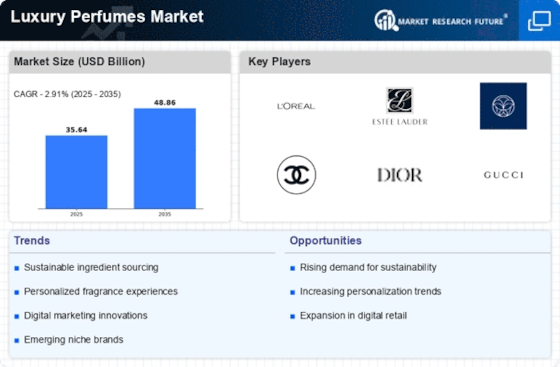
As per Market Research Future analysis, the Luxury Perfumes Market Size was estimated at 35.64 USD Billion in 2024. The Luxury Perfumes industry is projected to grow from 36.67 USD Billion in 2025 to 48.86 USD Billion by 2035, exhibiting a compound annual growth rate (CAGR) of 2.91% during the forecast period 2025 - 2035

Key Market Trends & Highlights

The Luxury Perfumes Market is experiencing a dynamic evolution driven by diverse consumer preferences and innovative trends.

  • The rise of niche fragrances is reshaping consumer choices, particularly in North America, where personalization is highly valued. Sustainability and ethical sourcing are becoming paramount, influencing purchasing decisions across both the female and male segments. E-commerce expansion is facilitating access to luxury perfumes, significantly impacting the fastest-growing Eau de Toilette segment in Asia-Pacific. Increasing disposable income and the influence of social media are major drivers propelling the demand for luxury perfumes, especially among male consumers.

Market Size & Forecast

2024 Market Size 35.64 (USD Billion)
2035 Market Size 48.86 (USD Billion)
CAGR (2025 - 2035) 2.91%
Largest Regional Market Share in 2024 Europe

Major Players

<a href="https://www.loreal-paris.fr/">L'Oreal (FR)</a>, Estée Lauder (US), Coty (US), Chanel (FR), Dior (FR), Gucci (IT), Hermès (FR), Prada (IT), Burberry (GB)

Market Trends

The Luxury Perfumes Market is currently experiencing a dynamic evolution, characterized by shifting consumer preferences and an increasing emphasis on sustainability. As individuals become more discerning about their purchases, there is a noticeable trend towards artisanal and niche fragrances that offer unique olfactory experiences. This shift suggests that consumers are not merely seeking scents but are also interested in the stories and craftsmanship behind each product. Furthermore, the rise of e-commerce platforms has transformed the way luxury fragrances are marketed and sold, allowing brands to reach a broader audience while providing personalized shopping experiences. In addition to these changes, the Luxury Perfumes Market is witnessing a growing inclination towards eco-friendly packaging and ethically sourced ingredients. This trend indicates a broader societal movement towards environmental consciousness, with consumers increasingly favoring brands that align with their values. As the market continues to adapt to these evolving demands, it appears poised for further growth, driven by innovation and a commitment to sustainability. The interplay between tradition and modernity in fragrance creation is likely to shape the future landscape of this sector, making it an intriguing area for ongoing observation and analysis.

Rise of Niche Fragrances

The Luxury Perfumes Market is seeing a notable increase in demand for niche fragrances. Consumers are gravitating towards unique, artisanal scents that offer distinct olfactory experiences, moving away from mass-produced options. This trend reflects a desire for individuality and personal expression in fragrance choices.

Sustainability and Ethical Sourcing

There is a growing emphasis on sustainability within the Luxury Perfumes Market. Brands are increasingly focusing on eco-friendly packaging and ethically sourced ingredients, aligning with consumer values that prioritize environmental responsibility. This shift suggests a potential long-term transformation in production practices.

E-commerce Expansion

The expansion of e-commerce platforms is reshaping the Luxury Perfumes Market. Online shopping provides consumers with greater access to a variety of luxury fragrances, enabling personalized experiences and convenience. This trend indicates a significant shift in how luxury products are marketed and sold.

Luxury Perfumes Market Market Drivers

Expansion of Retail Channels

The Luxury Perfumes Market is benefiting from the expansion of retail channels, which enhances accessibility for consumers. Traditional brick-and-mortar stores are increasingly complemented by online platforms, allowing consumers to purchase luxury fragrances with ease. The rise of e-commerce has transformed the shopping experience, enabling brands to reach a wider audience. Recent statistics indicate that online sales of luxury perfumes have surged, accounting for a significant portion of total sales in the industry. This trend suggests that as retail channels diversify, the Luxury Perfumes Market is likely to experience sustained growth, as consumers enjoy the convenience of purchasing their favorite fragrances from various platforms.

Increasing Disposable Income

The Luxury Perfumes Market is experiencing a notable surge in demand, primarily driven by the increasing disposable income of consumers. As individuals attain higher income levels, they tend to allocate a portion of their earnings towards luxury goods, including high-end fragrances. This trend is particularly evident in emerging markets, where a burgeoning middle class is becoming more inclined to invest in premium products. According to recent data, the luxury goods sector, which encompasses perfumes, is projected to grow at a compound annual growth rate of approximately 5% over the next few years. This growth indicates a robust appetite for luxury fragrances, suggesting that as disposable income rises, so too does the willingness to purchase luxury perfumes, thereby propelling the Luxury Perfumes Market forward.

Growing Demand for Personalization

The Luxury Perfumes Market is witnessing a growing demand for personalized fragrances, as consumers increasingly seek unique and tailored experiences. This trend is driven by a desire for individuality and self-expression, prompting brands to offer customizable options. Recent market analysis suggests that personalized perfumes can command a premium price, as consumers are willing to pay more for products that reflect their personal identity. This shift towards personalization not only enhances customer satisfaction but also fosters brand loyalty. As the Luxury Perfumes Market adapts to these consumer preferences, it is likely to see an expansion in offerings that cater to bespoke fragrance experiences, thereby enhancing overall market growth.

Emphasis on Sustainability and Eco-Friendly Products

The Luxury Perfumes Market is increasingly focusing on sustainability and eco-friendly products, reflecting a broader consumer shift towards environmentally conscious purchasing. Brands are now prioritizing sustainable sourcing of ingredients and eco-friendly packaging, appealing to a demographic that values ethical consumption. Recent surveys indicate that a substantial percentage of consumers are willing to pay a premium for products that align with their values regarding sustainability. This trend not only enhances brand reputation but also drives sales within the Luxury Perfumes Market. As awareness of environmental issues continues to grow, it is likely that sustainability will play a pivotal role in shaping the future of luxury fragrances.

Influence of Social Media and Celebrity Endorsements

The Luxury Perfumes Market is significantly influenced by social media platforms and celebrity endorsements. In an era where digital presence is paramount, brands leverage social media to create awareness and desirability for their products. Influencers and celebrities often showcase luxury perfumes, which can lead to increased consumer interest and sales. Data indicates that brands that engage in social media marketing experience a higher rate of customer engagement and conversion. This trend is particularly pronounced among younger consumers, who are more likely to be swayed by online recommendations. As a result, the Luxury Perfumes Market is likely to continue evolving, with brands investing heavily in digital marketing strategies to capture the attention of potential buyers.

Market Segment Insights

By Type: Eau de Parfum (Largest) vs. Eau de Toilette (Fastest-Growing)

In the Luxury Perfumes Market, the distribution of market share among different types reveals Eau de Parfum as the largest segment, renowned for its richer scent concentration and longevity. Following closely, Eau de Toilette is gaining rapid popularity due to its lighter formulation, making it a preferred choice for everyday wear. Other types like Parfum and Cologne also hold notable positions but do not match the significant market shares of Eau de Parfum and Eau de Toilette. Growth trends for these segments showcase a shift towards lighter fragrances, particularly Eau de Toilette, driven by changing consumer preferences for versatility and comfort. The increasing demand for affordable luxury, alongside rising influencer marketing, has fueled the growth of lighter options. Meanwhile, Eau de Parfum maintains its dominance through high-profile branding and a focus on quality, appealing to consumers seeking lasting scents for special occasions.

Eau de Parfum (Dominant) vs. Eau de Toilette (Emerging)

Eau de Parfum is characterized by its higher concentration of fragrance oils, making it a longer-lasting and more intense option compared to other types, which often appeals to luxury consumers looking for a strong signature scent. It dominates the Luxury Perfumes Market due to its prestigious branding and ability to deliver complex aromatic experiences. Conversely, Eau de Toilette, while emerging, attracts a growing segment of consumers favoring a lighter, fresher scent suitable for everyday use. Its increasing popularity is attributed to shifting lifestyle patterns, with consumers seeking versatility and affordability in luxury perfumes. This emerging preference has driven brands to innovate and offer Eau de Toilette versions of popular fragrances, capturing a share of the luxury market without compromising on quality.

By Gender: Female (Largest) vs. Male (Fastest-Growing)

The luxury perfumes market exhibits a distinctive distribution among gender segments, with female perfumes commanding the largest share. This dominance reflects not only the long-standing tradition of women’s fragrances but also the broad range of options available that appeal to various age groups and preferences. Meanwhile, the male segment is gaining significant traction, encouraged by a growing trend of men becoming increasingly involved in luxury self-care and grooming, which translates into a rising demand for high-end fragrances.

Gender: Female (Dominant) vs. Male (Emerging)

Female consumers remain the backbone of the luxury perfumes market, characterized by a diverse array of products that cater to differing tastes, occasions, and moods. This dominance is supported by targeted advertising and seasonal campaigns aimed specifically at women, bolstering brand loyalty and engagement. Meanwhile, the male segment is emerging vigorously as a growing market, driven by evolving perceptions around masculinity and grooming. Men's fragrances are increasingly being marketed not just as accessories but as essential components of a stylish and appealing persona, with innovative scents and effective branding strategies fostering a rapid expansion in this sector.

By Fragrance Family: Floral (Largest) vs. Woody (Fastest-Growing)

The Luxury Perfumes Market showcases a vivid tapestry of fragrance families, leading with Floral as the predominant segment. Floral fragrances capture significant consumer preference, due to their romantic and inviting nature, contributing to their large market share. Woody fragrances, however, are making impressive strides as they resonate well with modern consumers who seek depth and warmth in their scent choices, positioning them as a rapidly growing segment in this luxury sector.

Floral (Dominant) vs. Woody (Emerging)

Floral fragrances have long reigned supreme in the luxury perfumes sector due to their diverse appeal and versatility. Known for their fresh and vibrant aromas, they evoke feelings of romance and elegance, attracting a wide demographic of fragrance enthusiasts. On the other hand, Woody fragrances are emerging as a captivating alternative, often characterized by notes like sandalwood and cedarwood, appealing to those seeking a strong yet refined scent. This growing interest in woody scents is driven by shifting consumer preferences towards authenticity and natural ingredients, making them a formidable contender against the floral giants.

By Distribution Channel: Online Retail (Largest) vs. Department Stores (Fastest-Growing)

The luxury perfumes market sees a significant shift toward online retail, which currently holds the largest share among all distribution channels. This segment has capitalized on the growing trend of e-commerce, allowing consumers easier access to their favorite luxury brands. Department stores, while still a strong player in the market, are facing increasing competition from online platforms that offer convenience and often exclusive online deals, resulting in department stores holding a notable but smaller share of the market.

Online Retail (Dominant) vs. Specialty Stores (Emerging)

Online retail stands out as the dominant channel in the luxury perfumes market due to the increasing preference for convenient shopping and the ability to browse a vast selection of brands. This segment caters to tech-savvy consumers who prioritize quick access to products without geographical constraints. In contrast, specialty stores are emerging in the market as personalized shopping experiences gain popularity. These stores offer curated selections and product experts that attract consumers looking for unique fragrances and high-quality service. Together, both channels address distinct consumer needs and preferences.

Get more detailed insights about Luxury Perfumes Market Research Report – Forecast till 2035

Regional Insights

The Global Luxury Perfumes Market revenue is anticipated to experience steady growth, with regional contributions playing a crucial role in its overall dynamics. In 2024, North America is projected to hold a considerable valuation of 10.0 USD billion, growing to 13.5 USD billion by 2035, reflecting its significant consumer base and affinity for luxury brands.

Europe follows closely, with a valuation of 12.0 USD Billion in 2024, increasing to 16.0 USD billion in 2035, showcasing its dominance in the luxury fragrance sector, driven by cultural preferences for scent refinement.In contrast, South America's market evaluation stands at 3.0 USD Billion in 2024, with a gradual rise to 4.0 USD billion by 2035, indicating a growing trend towards luxury products among the affluent population.

The Asia Pacific region is valued at 7.5 USD Billion in 2024, reaching 10.0 USD billion in 2035, propelled by rising disposable incomes and increasing urbanization, thus becoming an emerging hub for luxury fragrances.

The Middle East and Africa region, valued at 2.13 USD Billion in 2024 and expected to rise to 3.0 USD Billion by 2035, capitalizes on its rich history with scents but remains the smallest segment in comparison.The diversity in consumer preferences across these regions offers unique opportunities and challenges within the Global Luxury Perfumes Market, influencing market growth driven by evolving trends, marketing strategies, and competitive landscapes.

Key Players and Competitive Insights

The Global Luxury Perfumes Market is characterized by vibrant competition as brands vie for the attention of affluent consumers seeking high-end fragrance options. With increasing disposable incomes, especially in emerging markets, the demand for luxury perfumes has surged, prompting established brands and new entrants alike to innovate and expand their portfolios. Key competitive insights highlight the importance of brand heritage, marketing strategies, and distribution channels in capturing market share. Companies strive to differentiate themselves through unique scents, exclusive packaging, and celebrity endorsements. The market dynamics are continually evolving with changing consumer preferences toward personalization and sustainability, compelling brands to adapt and redefine their offerings. Armani has solidified its position in the Global Luxury Perfumes Market by leveraging its iconic brand reputation and the allure of high fashion. The brand’s strength lies in its ability to create sophisticated scents that resonate with a discerning clientele, often characterized by elegance and timelessness. Armani’s strategic marketing campaigns heighten its appeal, showcasing its luxury ethos that attracts consumers globally. The brand also enjoys a robust distribution network, ensuring availability in premium retail outlets and exclusive department stores, which enhances customer accessibility. Furthermore, its commitment to quality and refinement in fragrance development enables Armani to maintain a loyal customer base and attract new consumers seeking the prestige associated with the brand. Louis Vuitton's presence in the Global Luxury Perfumes Market is marked by its extensive portfolio of high-quality fragrances, combining classic elegance with contemporary creativity. The brand's luxurious reputation not only underpins its perfumes but also strengthens its market position through a well-established global retail presence and iconic brand identity. Louis Vuitton’s fragrances often embody the essence of luxury and exclusivity, aligning perfectly with consumers' desires for high-end products. Furthermore, the brand continually innovates within this segment, launching new scents that reflect current trends while remaining true to its heritage. Partnerships and collaborations, along with strategic mergers and acquisitions, position Louis Vuitton favorably to expand its reach and enhance its market offerings, providing consumers with products that reflect sophistication and quality.

Key Companies in the Luxury Perfumes Market include

Industry Developments

In recent months, the Global Luxury Perfumes Market has observed significant developments, particularly with brands such as Armani, Louis Vuitton, Bvlgari, Versace, Givenchy, Gucci, Burberry, Chanel, Dior, Estée Lauder, Coty, Prada, L'Oreal, and Procter & Gamble actively shaping industry trends. The growth trajectory has been notable, with a steady increase in market valuation reflected in heightened consumer spending on premium fragrance products.

Additionally, luxury brands are focusing on sustainable practices and innovative marketing strategies to capture the expanding market share.In February 2023, Procter & Gamble announced a strategic acquisition that will enhance its fragrance portfolio, integrating elements of luxury and sustainability. The acquisition aligns with the broader trend towards environmentally friendly products within the sector, a key expectation from global consumers today. Over the past few years, the market has also seen a surge in digital engagement as brands leverage e-commerce and social media platforms to connect with younger demographics, contributing to the luxury perfumes market's resilience and adaptability amidst economic fluctuations.

As these companies continue to innovate and respond to consumer desires, the Global Luxury Perfumes Market remains a dynamic and evolving landscape.

Future Outlook

Luxury Perfumes Market Future Outlook

The Luxury Perfumes Market is projected to grow at a 2.91% CAGR from 2025 to 2035, driven by increasing consumer demand for premium fragrances and innovative marketing strategies.

New opportunities lie in:

  • <p>Expansion of personalized fragrance services through AI technology. Development of eco-friendly packaging solutions to attract sustainability-focused consumers. Collaboration with luxury fashion brands for exclusive fragrance lines.</p>

By 2035, the Luxury Perfumes Market is expected to solidify its position as a leading segment in the global fragrance industry.

Market Segmentation

Luxury Perfumes Market Type Outlook

  • Eau de Parfum
  • Eau de Toilette
  • Parfum
  • Eau Fraiche
  • Cologne

Luxury Perfumes Market Gender Outlook

  • Male
  • Female
  • Unisex

Luxury Perfumes Market Fragrance Family Outlook

  • Floral
  • Woody
  • Oriental
  • Fresh
  • Citrus

Luxury Perfumes Market Distribution Channel Outlook

  • Online Retail
  • Department Stores
  • Specialty Stores
  • Perfume Boutiques
  • Supermarkets

Report Scope

MARKET SIZE 2024 35.64(USD Billion)
MARKET SIZE 2025 36.67(USD Billion)
MARKET SIZE 2035 48.86(USD Billion)
COMPOUND ANNUAL GROWTH RATE (CAGR) 2.91% (2025 - 2035)
REPORT COVERAGE Revenue Forecast, Competitive Landscape, Growth Factors, and Trends
BASE YEAR 2024
Market Forecast Period 2025 - 2035
Historical Data 2019 - 2024
Market Forecast Units USD Billion
Key Companies Profiled L'Oreal (FR), Estée Lauder (US), Coty (US), Chanel (FR), Dior (FR), Gucci (IT), Hermès (FR), Prada (IT), Burberry (GB)
Segments Covered Product Type, Gender, Fragrance Family, Distribution Channel, Regional
Key Market Opportunities Growing consumer preference for sustainable and personalized luxury fragrances presents a unique opportunity in the Luxury Perfumes Market.
Key Market Dynamics Shifting consumer preferences towards sustainable luxury perfumes drive innovation and reshape competitive dynamics in the market.
Countries Covered North America, Europe, APAC, South America, MEA

FAQs

What is the current valuation of the Luxury Perfumes Market in 2025?

<p>The Luxury Perfumes Market is valued at approximately 35.64 USD Billion in 2024.</p>

What is the projected market size for the Luxury Perfumes Market by 2035?

<p>The market is expected to reach a valuation of 48.86 USD Billion by 2035.</p>

What is the expected CAGR for the Luxury Perfumes Market during the forecast period 2025 - 2035?

<p>The anticipated CAGR for the Luxury Perfumes Market during 2025 - 2035 is 2.91%.</p>

Which distribution channel is projected to generate the highest revenue in the Luxury Perfumes Market?

<p>Department Stores are projected to generate the highest revenue, with estimates ranging from 10.0 to 12.0 USD Billion.</p>

How do male and female fragrance segments compare in terms of market valuation?

<p>In 2024, the female fragrance segment was valued at 15.0 to 20.0 USD Billion, while the male segment was valued at 10.0 to 13.0 USD Billion.</p>

What are the leading fragrance families in the Luxury Perfumes Market?

<p>The leading fragrance families include Floral, with a valuation of 7.5 to 10.0 USD Billion, and Citrus, projected to reach 8.64 to 13.86 USD Billion.</p>

Which key players dominate the Luxury Perfumes Market?

<p>Key players in the market include L'Oreal, Estée Lauder, Coty, Chanel, and Dior, among others.</p>

What is the market valuation for Eau de Parfum in 2024?

<p>Eau de Parfum was valued at 12.0 to 16.0 USD Billion in 2024.</p>

How does online retail compare to other distribution channels in the Luxury Perfumes Market?

<p>Online Retail is expected to generate between 5.0 and 7.0 USD Billion, indicating a growing trend in e-commerce.</p>

What is the projected market performance for unisex fragrances by 2035?

<p>Unisex fragrances are projected to reach a valuation of 10.64 to 15.86 USD Billion by 2035.</p>

  1. SECTION I: EXECUTIVE SUMMARY AND KEY HIGHLIGHTS
    1. | 1.1 EXECUTIVE SUMMARY
    2. | | 1.1.1 Market Overview
    3. | | 1.1.2 Key Findings
    4. | | 1.1.3 Market Segmentation
    5. | | 1.1.4 Competitive Landscape
    6. | | 1.1.5 Challenges and Opportunities
    7. | | 1.1.6 Future Outlook
  2. SECTION II: SCOPING, METHODOLOGY AND MARKET STRUCTURE
    1. | 2.1 MARKET INTRODUCTION
    2. | | 2.1.1 Definition
    3. | | 2.1.2 Scope of the study
    4. | | | 2.1.2.1 Research Objective
    5. | | | 2.1.2.2 Assumption
    6. | | | 2.1.2.3 Limitations
    7. | 2.2 RESEARCH METHODOLOGY
    8. | | 2.2.1 Overview
    9. | | 2.2.2 Data Mining
    10. | | 2.2.3 Secondary Research
    11. | | 2.2.4 Primary Research
    12. | | | 2.2.4.1 Primary Interviews and Information Gathering Process
    13. | | | 2.2.4.2 Breakdown of Primary Respondents
    14. | | 2.2.5 Forecasting Model
    15. | | 2.2.6 Market Size Estimation
    16. | | | 2.2.6.1 Bottom-Up Approach
    17. | | | 2.2.6.2 Top-Down Approach
    18. | | 2.2.7 Data Triangulation
    19. | | 2.2.8 Validation
  3. SECTION III: QUALITATIVE ANALYSIS
    1. | 3.1 MARKET DYNAMICS
    2. | | 3.1.1 Overview
    3. | | 3.1.2 Drivers
    4. | | 3.1.3 Restraints
    5. | | 3.1.4 Opportunities
    6. | 3.2 MARKET FACTOR ANALYSIS
    7. | | 3.2.1 Value chain Analysis
    8. | | 3.2.2 Porter's Five Forces Analysis
    9. | | | 3.2.2.1 Bargaining Power of Suppliers
    10. | | | 3.2.2.2 Bargaining Power of Buyers
    11. | | | 3.2.2.3 Threat of New Entrants
    12. | | | 3.2.2.4 Threat of Substitutes
    13. | | | 3.2.2.5 Intensity of Rivalry
    14. | | 3.2.3 COVID-19 Impact Analysis
    15. | | | 3.2.3.1 Market Impact Analysis
    16. | | | 3.2.3.2 Regional Impact
    17. | | | 3.2.3.3 Opportunity and Threat Analysis
  4. SECTION IV: QUANTITATIVE ANALYSIS
    1. | 4.1 Consumer and Retail, BY Type (USD Billion)
    2. | | 4.1.1 Eau de Parfum
    3. | | 4.1.2 Eau de Toilette
    4. | | 4.1.3 Parfum
    5. | | 4.1.4 Eau Fraiche
    6. | | 4.1.5 Cologne
    7. | 4.2 Consumer and Retail, BY Gender (USD Billion)
    8. | | 4.2.1 Male
    9. | | 4.2.2 Female
    10. | | 4.2.3 Unisex
    11. | 4.3 Consumer and Retail, BY Fragrance Family (USD Billion)
    12. | | 4.3.1 Floral
    13. | | 4.3.2 Woody
    14. | | 4.3.3 Oriental
    15. | | 4.3.4 Fresh
    16. | | 4.3.5 Citrus
    17. | 4.4 Consumer and Retail, BY Distribution Channel (USD Billion)
    18. | | 4.4.1 Online Retail
    19. | | 4.4.2 Department Stores
    20. | | 4.4.3 Specialty Stores
    21. | | 4.4.4 Perfume Boutiques
    22. | | 4.4.5 Supermarkets
    23. | 4.5 Consumer and Retail, BY Region (USD Billion)
    24. | | 4.5.1 North America
    25. | | | 4.5.1.1 US
    26. | | | 4.5.1.2 Canada
    27. | | 4.5.2 Europe
    28. | | | 4.5.2.1 Germany
    29. | | | 4.5.2.2 UK
    30. | | | 4.5.2.3 France
    31. | | | 4.5.2.4 Russia
    32. | | | 4.5.2.5 Italy
    33. | | | 4.5.2.6 Spain
    34. | | | 4.5.2.7 Rest of Europe
    35. | | 4.5.3 APAC
    36. | | | 4.5.3.1 China
    37. | | | 4.5.3.2 India
    38. | | | 4.5.3.3 Japan
    39. | | | 4.5.3.4 South Korea
    40. | | | 4.5.3.5 Malaysia
    41. | | | 4.5.3.6 Thailand
    42. | | | 4.5.3.7 Indonesia
    43. | | | 4.5.3.8 Rest of APAC
    44. | | 4.5.4 South America
    45. | | | 4.5.4.1 Brazil
    46. | | | 4.5.4.2 Mexico
    47. | | | 4.5.4.3 Argentina
    48. | | | 4.5.4.4 Rest of South America
    49. | | 4.5.5 MEA
    50. | | | 4.5.5.1 GCC Countries
    51. | | | 4.5.5.2 South Africa
    52. | | | 4.5.5.3 Rest of MEA
  5. SECTION V: COMPETITIVE ANALYSIS
    1. | 5.1 Competitive Landscape
    2. | | 5.1.1 Overview
    3. | | 5.1.2 Competitive Analysis
    4. | | 5.1.3 Market share Analysis
    5. | | 5.1.4 Major Growth Strategy in the Consumer and Retail
    6. | | 5.1.5 Competitive Benchmarking
    7. | | 5.1.6 Leading Players in Terms of Number of Developments in the Consumer and Retail
    8. | | 5.1.7 Key developments and growth strategies
    9. | | | 5.1.7.1 New Product Launch/Service Deployment
    10. | | | 5.1.7.2 Merger & Acquisitions
    11. | | | 5.1.7.3 Joint Ventures
    12. | | 5.1.8 Major Players Financial Matrix
    13. | | | 5.1.8.1 Sales and Operating Income
    14. | | | 5.1.8.2 Major Players R&D Expenditure. 2023
    15. | 5.2 Company Profiles
    16. | | 5.2.1 L'Oreal (FR)
    17. | | | 5.2.1.1 Financial Overview
    18. | | | 5.2.1.2 Products Offered
    19. | | | 5.2.1.3 Key Developments
    20. | | | 5.2.1.4 SWOT Analysis
    21. | | | 5.2.1.5 Key Strategies
    22. | | 5.2.2 Estée Lauder (US)
    23. | | | 5.2.2.1 Financial Overview
    24. | | | 5.2.2.2 Products Offered
    25. | | | 5.2.2.3 Key Developments
    26. | | | 5.2.2.4 SWOT Analysis
    27. | | | 5.2.2.5 Key Strategies
    28. | | 5.2.3 Coty (US)
    29. | | | 5.2.3.1 Financial Overview
    30. | | | 5.2.3.2 Products Offered
    31. | | | 5.2.3.3 Key Developments
    32. | | | 5.2.3.4 SWOT Analysis
    33. | | | 5.2.3.5 Key Strategies
    34. | | 5.2.4 Chanel (FR)
    35. | | | 5.2.4.1 Financial Overview
    36. | | | 5.2.4.2 Products Offered
    37. | | | 5.2.4.3 Key Developments
    38. | | | 5.2.4.4 SWOT Analysis
    39. | | | 5.2.4.5 Key Strategies
    40. | | 5.2.5 Dior (FR)
    41. | | | 5.2.5.1 Financial Overview
    42. | | | 5.2.5.2 Products Offered
    43. | | | 5.2.5.3 Key Developments
    44. | | | 5.2.5.4 SWOT Analysis
    45. | | | 5.2.5.5 Key Strategies
    46. | | 5.2.6 Gucci (IT)
    47. | | | 5.2.6.1 Financial Overview
    48. | | | 5.2.6.2 Products Offered
    49. | | | 5.2.6.3 Key Developments
    50. | | | 5.2.6.4 SWOT Analysis
    51. | | | 5.2.6.5 Key Strategies
    52. | | 5.2.7 Hermès (FR)
    53. | | | 5.2.7.1 Financial Overview
    54. | | | 5.2.7.2 Products Offered
    55. | | | 5.2.7.3 Key Developments
    56. | | | 5.2.7.4 SWOT Analysis
    57. | | | 5.2.7.5 Key Strategies
    58. | | 5.2.8 Prada (IT)
    59. | | | 5.2.8.1 Financial Overview
    60. | | | 5.2.8.2 Products Offered
    61. | | | 5.2.8.3 Key Developments
    62. | | | 5.2.8.4 SWOT Analysis
    63. | | | 5.2.8.5 Key Strategies
    64. | | 5.2.9 Burberry (GB)
    65. | | | 5.2.9.1 Financial Overview
    66. | | | 5.2.9.2 Products Offered
    67. | | | 5.2.9.3 Key Developments
    68. | | | 5.2.9.4 SWOT Analysis
    69. | | | 5.2.9.5 Key Strategies
    70. | 5.3 Appendix
    71. | | 5.3.1 References
    72. | | 5.3.2 Related Reports
  6. LIST OF FIGURES
    1. | 6.1 MARKET SYNOPSIS
    2. | 6.2 NORTH AMERICA MARKET ANALYSIS
    3. | 6.3 US MARKET ANALYSIS BY TYPE
    4. | 6.4 US MARKET ANALYSIS BY GENDER
    5. | 6.5 US MARKET ANALYSIS BY FRAGRANCE FAMILY
    6. | 6.6 US MARKET ANALYSIS BY DISTRIBUTION CHANNEL
    7. | 6.7 CANADA MARKET ANALYSIS BY TYPE
    8. | 6.8 CANADA MARKET ANALYSIS BY GENDER
    9. | 6.9 CANADA MARKET ANALYSIS BY FRAGRANCE FAMILY
    10. | 6.10 CANADA MARKET ANALYSIS BY DISTRIBUTION CHANNEL
    11. | 6.11 EUROPE MARKET ANALYSIS
    12. | 6.12 GERMANY MARKET ANALYSIS BY TYPE
    13. | 6.13 GERMANY MARKET ANALYSIS BY GENDER
    14. | 6.14 GERMANY MARKET ANALYSIS BY FRAGRANCE FAMILY
    15. | 6.15 GERMANY MARKET ANALYSIS BY DISTRIBUTION CHANNEL
    16. | 6.16 UK MARKET ANALYSIS BY TYPE
    17. | 6.17 UK MARKET ANALYSIS BY GENDER
    18. | 6.18 UK MARKET ANALYSIS BY FRAGRANCE FAMILY
    19. | 6.19 UK MARKET ANALYSIS BY DISTRIBUTION CHANNEL
    20. | 6.20 FRANCE MARKET ANALYSIS BY TYPE
    21. | 6.21 FRANCE MARKET ANALYSIS BY GENDER
    22. | 6.22 FRANCE MARKET ANALYSIS BY FRAGRANCE FAMILY
    23. | 6.23 FRANCE MARKET ANALYSIS BY DISTRIBUTION CHANNEL
    24. | 6.24 RUSSIA MARKET ANALYSIS BY TYPE
    25. | 6.25 RUSSIA MARKET ANALYSIS BY GENDER
    26. | 6.26 RUSSIA MARKET ANALYSIS BY FRAGRANCE FAMILY
    27. | 6.27 RUSSIA MARKET ANALYSIS BY DISTRIBUTION CHANNEL
    28. | 6.28 ITALY MARKET ANALYSIS BY TYPE
    29. | 6.29 ITALY MARKET ANALYSIS BY GENDER
    30. | 6.30 ITALY MARKET ANALYSIS BY FRAGRANCE FAMILY
    31. | 6.31 ITALY MARKET ANALYSIS BY DISTRIBUTION CHANNEL
    32. | 6.32 SPAIN MARKET ANALYSIS BY TYPE
    33. | 6.33 SPAIN MARKET ANALYSIS BY GENDER
    34. | 6.34 SPAIN MARKET ANALYSIS BY FRAGRANCE FAMILY
    35. | 6.35 SPAIN MARKET ANALYSIS BY DISTRIBUTION CHANNEL
    36. | 6.36 REST OF EUROPE MARKET ANALYSIS BY TYPE
    37. | 6.37 REST OF EUROPE MARKET ANALYSIS BY GENDER
    38. | 6.38 REST OF EUROPE MARKET ANALYSIS BY FRAGRANCE FAMILY
    39. | 6.39 REST OF EUROPE MARKET ANALYSIS BY DISTRIBUTION CHANNEL
    40. | 6.40 APAC MARKET ANALYSIS
    41. | 6.41 CHINA MARKET ANALYSIS BY TYPE
    42. | 6.42 CHINA MARKET ANALYSIS BY GENDER
    43. | 6.43 CHINA MARKET ANALYSIS BY FRAGRANCE FAMILY
    44. | 6.44 CHINA MARKET ANALYSIS BY DISTRIBUTION CHANNEL
    45. | 6.45 INDIA MARKET ANALYSIS BY TYPE
    46. | 6.46 INDIA MARKET ANALYSIS BY GENDER
    47. | 6.47 INDIA MARKET ANALYSIS BY FRAGRANCE FAMILY
    48. | 6.48 INDIA MARKET ANALYSIS BY DISTRIBUTION CHANNEL
    49. | 6.49 JAPAN MARKET ANALYSIS BY TYPE
    50. | 6.50 JAPAN MARKET ANALYSIS BY GENDER
    51. | 6.51 JAPAN MARKET ANALYSIS BY FRAGRANCE FAMILY
    52. | 6.52 JAPAN MARKET ANALYSIS BY DISTRIBUTION CHANNEL
    53. | 6.53 SOUTH KOREA MARKET ANALYSIS BY TYPE
    54. | 6.54 SOUTH KOREA MARKET ANALYSIS BY GENDER
    55. | 6.55 SOUTH KOREA MARKET ANALYSIS BY FRAGRANCE FAMILY
    56. | 6.56 SOUTH KOREA MARKET ANALYSIS BY DISTRIBUTION CHANNEL
    57. | 6.57 MALAYSIA MARKET ANALYSIS BY TYPE
    58. | 6.58 MALAYSIA MARKET ANALYSIS BY GENDER
    59. | 6.59 MALAYSIA MARKET ANALYSIS BY FRAGRANCE FAMILY
    60. | 6.60 MALAYSIA MARKET ANALYSIS BY DISTRIBUTION CHANNEL
    61. | 6.61 THAILAND MARKET ANALYSIS BY TYPE
    62. | 6.62 THAILAND MARKET ANALYSIS BY GENDER
    63. | 6.63 THAILAND MARKET ANALYSIS BY FRAGRANCE FAMILY
    64. | 6.64 THAILAND MARKET ANALYSIS BY DISTRIBUTION CHANNEL
    65. | 6.65 INDONESIA MARKET ANALYSIS BY TYPE
    66. | 6.66 INDONESIA MARKET ANALYSIS BY GENDER
    67. | 6.67 INDONESIA MARKET ANALYSIS BY FRAGRANCE FAMILY
    68. | 6.68 INDONESIA MARKET ANALYSIS BY DISTRIBUTION CHANNEL
    69. | 6.69 REST OF APAC MARKET ANALYSIS BY TYPE
    70. | 6.70 REST OF APAC MARKET ANALYSIS BY GENDER
    71. | 6.71 REST OF APAC MARKET ANALYSIS BY FRAGRANCE FAMILY
    72. | 6.72 REST OF APAC MARKET ANALYSIS BY DISTRIBUTION CHANNEL
    73. | 6.73 SOUTH AMERICA MARKET ANALYSIS
    74. | 6.74 BRAZIL MARKET ANALYSIS BY TYPE
    75. | 6.75 BRAZIL MARKET ANALYSIS BY GENDER
    76. | 6.76 BRAZIL MARKET ANALYSIS BY FRAGRANCE FAMILY
    77. | 6.77 BRAZIL MARKET ANALYSIS BY DISTRIBUTION CHANNEL
    78. | 6.78 MEXICO MARKET ANALYSIS BY TYPE
    79. | 6.79 MEXICO MARKET ANALYSIS BY GENDER
    80. | 6.80 MEXICO MARKET ANALYSIS BY FRAGRANCE FAMILY
    81. | 6.81 MEXICO MARKET ANALYSIS BY DISTRIBUTION CHANNEL
    82. | 6.82 ARGENTINA MARKET ANALYSIS BY TYPE
    83. | 6.83 ARGENTINA MARKET ANALYSIS BY GENDER
    84. | 6.84 ARGENTINA MARKET ANALYSIS BY FRAGRANCE FAMILY
    85. | 6.85 ARGENTINA MARKET ANALYSIS BY DISTRIBUTION CHANNEL
    86. | 6.86 REST OF SOUTH AMERICA MARKET ANALYSIS BY TYPE
    87. | 6.87 REST OF SOUTH AMERICA MARKET ANALYSIS BY GENDER
    88. | 6.88 REST OF SOUTH AMERICA MARKET ANALYSIS BY FRAGRANCE FAMILY
    89. | 6.89 REST OF SOUTH AMERICA MARKET ANALYSIS BY DISTRIBUTION CHANNEL
    90. | 6.90 MEA MARKET ANALYSIS
    91. | 6.91 GCC COUNTRIES MARKET ANALYSIS BY TYPE
    92. | 6.92 GCC COUNTRIES MARKET ANALYSIS BY GENDER
    93. | 6.93 GCC COUNTRIES MARKET ANALYSIS BY FRAGRANCE FAMILY
    94. | 6.94 GCC COUNTRIES MARKET ANALYSIS BY DISTRIBUTION CHANNEL
    95. | 6.95 SOUTH AFRICA MARKET ANALYSIS BY TYPE
    96. | 6.96 SOUTH AFRICA MARKET ANALYSIS BY GENDER
    97. | 6.97 SOUTH AFRICA MARKET ANALYSIS BY FRAGRANCE FAMILY
    98. | 6.98 SOUTH AFRICA MARKET ANALYSIS BY DISTRIBUTION CHANNEL
    99. | 6.99 REST OF MEA MARKET ANALYSIS BY TYPE
    100. | 6.100 REST OF MEA MARKET ANALYSIS BY GENDER
    101. | 6.101 REST OF MEA MARKET ANALYSIS BY FRAGRANCE FAMILY
    102. | 6.102 REST OF MEA MARKET ANALYSIS BY DISTRIBUTION CHANNEL
    103. | 6.103 KEY BUYING CRITERIA OF CONSUMER AND RETAIL
    104. | 6.104 RESEARCH PROCESS OF MRFR
    105. | 6.105 DRO ANALYSIS OF CONSUMER AND RETAIL
    106. | 6.106 DRIVERS IMPACT ANALYSIS: CONSUMER AND RETAIL
    107. | 6.107 RESTRAINTS IMPACT ANALYSIS: CONSUMER AND RETAIL
    108. | 6.108 SUPPLY / VALUE CHAIN: CONSUMER AND RETAIL
    109. | 6.109 CONSUMER AND RETAIL, BY TYPE, 2024 (% SHARE)
    110. | 6.110 CONSUMER AND RETAIL, BY TYPE, 2024 TO 2035 (USD Billion)
    111. | 6.111 CONSUMER AND RETAIL, BY GENDER, 2024 (% SHARE)
    112. | 6.112 CONSUMER AND RETAIL, BY GENDER, 2024 TO 2035 (USD Billion)
    113. | 6.113 CONSUMER AND RETAIL, BY FRAGRANCE FAMILY, 2024 (% SHARE)
    114. | 6.114 CONSUMER AND RETAIL, BY FRAGRANCE FAMILY, 2024 TO 2035 (USD Billion)
    115. | 6.115 CONSUMER AND RETAIL, BY DISTRIBUTION CHANNEL, 2024 (% SHARE)
    116. | 6.116 CONSUMER AND RETAIL, BY DISTRIBUTION CHANNEL, 2024 TO 2035 (USD Billion)
    117. | 6.117 BENCHMARKING OF MAJOR COMPETITORS
  7. LIST OF TABLES
    1. | 7.1 LIST OF ASSUMPTIONS
    2. | | 7.1.1
    3. | 7.2 North America MARKET SIZE ESTIMATES; FORECAST
    4. | | 7.2.1 BY TYPE, 2025-2035 (USD Billion)
    5. | | 7.2.2 BY GENDER, 2025-2035 (USD Billion)
    6. | | 7.2.3 BY FRAGRANCE FAMILY, 2025-2035 (USD Billion)
    7. | | 7.2.4 BY DISTRIBUTION CHANNEL, 2025-2035 (USD Billion)
    8. | 7.3 US MARKET SIZE ESTIMATES; FORECAST
    9. | | 7.3.1 BY TYPE, 2025-2035 (USD Billion)
    10. | | 7.3.2 BY GENDER, 2025-2035 (USD Billion)
    11. | | 7.3.3 BY FRAGRANCE FAMILY, 2025-2035 (USD Billion)
    12. | | 7.3.4 BY DISTRIBUTION CHANNEL, 2025-2035 (USD Billion)
    13. | 7.4 Canada MARKET SIZE ESTIMATES; FORECAST
    14. | | 7.4.1 BY TYPE, 2025-2035 (USD Billion)
    15. | | 7.4.2 BY GENDER, 2025-2035 (USD Billion)
    16. | | 7.4.3 BY FRAGRANCE FAMILY, 2025-2035 (USD Billion)
    17. | | 7.4.4 BY DISTRIBUTION CHANNEL, 2025-2035 (USD Billion)
    18. | 7.5 Europe MARKET SIZE ESTIMATES; FORECAST
    19. | | 7.5.1 BY TYPE, 2025-2035 (USD Billion)
    20. | | 7.5.2 BY GENDER, 2025-2035 (USD Billion)
    21. | | 7.5.3 BY FRAGRANCE FAMILY, 2025-2035 (USD Billion)
    22. | | 7.5.4 BY DISTRIBUTION CHANNEL, 2025-2035 (USD Billion)
    23. | 7.6 Germany MARKET SIZE ESTIMATES; FORECAST
    24. | | 7.6.1 BY TYPE, 2025-2035 (USD Billion)
    25. | | 7.6.2 BY GENDER, 2025-2035 (USD Billion)
    26. | | 7.6.3 BY FRAGRANCE FAMILY, 2025-2035 (USD Billion)
    27. | | 7.6.4 BY DISTRIBUTION CHANNEL, 2025-2035 (USD Billion)
    28. | 7.7 UK MARKET SIZE ESTIMATES; FORECAST
    29. | | 7.7.1 BY TYPE, 2025-2035 (USD Billion)
    30. | | 7.7.2 BY GENDER, 2025-2035 (USD Billion)
    31. | | 7.7.3 BY FRAGRANCE FAMILY, 2025-2035 (USD Billion)
    32. | | 7.7.4 BY DISTRIBUTION CHANNEL, 2025-2035 (USD Billion)
    33. | 7.8 France MARKET SIZE ESTIMATES; FORECAST
    34. | | 7.8.1 BY TYPE, 2025-2035 (USD Billion)
    35. | | 7.8.2 BY GENDER, 2025-2035 (USD Billion)
    36. | | 7.8.3 BY FRAGRANCE FAMILY, 2025-2035 (USD Billion)
    37. | | 7.8.4 BY DISTRIBUTION CHANNEL, 2025-2035 (USD Billion)
    38. | 7.9 Russia MARKET SIZE ESTIMATES; FORECAST
    39. | | 7.9.1 BY TYPE, 2025-2035 (USD Billion)
    40. | | 7.9.2 BY GENDER, 2025-2035 (USD Billion)
    41. | | 7.9.3 BY FRAGRANCE FAMILY, 2025-2035 (USD Billion)
    42. | | 7.9.4 BY DISTRIBUTION CHANNEL, 2025-2035 (USD Billion)
    43. | 7.10 Italy MARKET SIZE ESTIMATES; FORECAST
    44. | | 7.10.1 BY TYPE, 2025-2035 (USD Billion)
    45. | | 7.10.2 BY GENDER, 2025-2035 (USD Billion)
    46. | | 7.10.3 BY FRAGRANCE FAMILY, 2025-2035 (USD Billion)
    47. | | 7.10.4 BY DISTRIBUTION CHANNEL, 2025-2035 (USD Billion)
    48. | 7.11 Spain MARKET SIZE ESTIMATES; FORECAST
    49. | | 7.11.1 BY TYPE, 2025-2035 (USD Billion)
    50. | | 7.11.2 BY GENDER, 2025-2035 (USD Billion)
    51. | | 7.11.3 BY FRAGRANCE FAMILY, 2025-2035 (USD Billion)
    52. | | 7.11.4 BY DISTRIBUTION CHANNEL, 2025-2035 (USD Billion)
    53. | 7.12 Rest of Europe MARKET SIZE ESTIMATES; FORECAST
    54. | | 7.12.1 BY TYPE, 2025-2035 (USD Billion)
    55. | | 7.12.2 BY GENDER, 2025-2035 (USD Billion)
    56. | | 7.12.3 BY FRAGRANCE FAMILY, 2025-2035 (USD Billion)
    57. | | 7.12.4 BY DISTRIBUTION CHANNEL, 2025-2035 (USD Billion)
    58. | 7.13 APAC MARKET SIZE ESTIMATES; FORECAST
    59. | | 7.13.1 BY TYPE, 2025-2035 (USD Billion)
    60. | | 7.13.2 BY GENDER, 2025-2035 (USD Billion)
    61. | | 7.13.3 BY FRAGRANCE FAMILY, 2025-2035 (USD Billion)
    62. | | 7.13.4 BY DISTRIBUTION CHANNEL, 2025-2035 (USD Billion)
    63. | 7.14 China MARKET SIZE ESTIMATES; FORECAST
    64. | | 7.14.1 BY TYPE, 2025-2035 (USD Billion)
    65. | | 7.14.2 BY GENDER, 2025-2035 (USD Billion)
    66. | | 7.14.3 BY FRAGRANCE FAMILY, 2025-2035 (USD Billion)
    67. | | 7.14.4 BY DISTRIBUTION CHANNEL, 2025-2035 (USD Billion)
    68. | 7.15 India MARKET SIZE ESTIMATES; FORECAST
    69. | | 7.15.1 BY TYPE, 2025-2035 (USD Billion)
    70. | | 7.15.2 BY GENDER, 2025-2035 (USD Billion)
    71. | | 7.15.3 BY FRAGRANCE FAMILY, 2025-2035 (USD Billion)
    72. | | 7.15.4 BY DISTRIBUTION CHANNEL, 2025-2035 (USD Billion)
    73. | 7.16 Japan MARKET SIZE ESTIMATES; FORECAST
    74. | | 7.16.1 BY TYPE, 2025-2035 (USD Billion)
    75. | | 7.16.2 BY GENDER, 2025-2035 (USD Billion)
    76. | | 7.16.3 BY FRAGRANCE FAMILY, 2025-2035 (USD Billion)
    77. | | 7.16.4 BY DISTRIBUTION CHANNEL, 2025-2035 (USD Billion)
    78. | 7.17 South Korea MARKET SIZE ESTIMATES; FORECAST
    79. | | 7.17.1 BY TYPE, 2025-2035 (USD Billion)
    80. | | 7.17.2 BY GENDER, 2025-2035 (USD Billion)
    81. | | 7.17.3 BY FRAGRANCE FAMILY, 2025-2035 (USD Billion)
    82. | | 7.17.4 BY DISTRIBUTION CHANNEL, 2025-2035 (USD Billion)
    83. | 7.18 Malaysia MARKET SIZE ESTIMATES; FORECAST
    84. | | 7.18.1 BY TYPE, 2025-2035 (USD Billion)
    85. | | 7.18.2 BY GENDER, 2025-2035 (USD Billion)
    86. | | 7.18.3 BY FRAGRANCE FAMILY, 2025-2035 (USD Billion)
    87. | | 7.18.4 BY DISTRIBUTION CHANNEL, 2025-2035 (USD Billion)
    88. | 7.19 Thailand MARKET SIZE ESTIMATES; FORECAST
    89. | | 7.19.1 BY TYPE, 2025-2035 (USD Billion)
    90. | | 7.19.2 BY GENDER, 2025-2035 (USD Billion)
    91. | | 7.19.3 BY FRAGRANCE FAMILY, 2025-2035 (USD Billion)
    92. | | 7.19.4 BY DISTRIBUTION CHANNEL, 2025-2035 (USD Billion)
    93. | 7.20 Indonesia MARKET SIZE ESTIMATES; FORECAST
    94. | | 7.20.1 BY TYPE, 2025-2035 (USD Billion)
    95. | | 7.20.2 BY GENDER, 2025-2035 (USD Billion)
    96. | | 7.20.3 BY FRAGRANCE FAMILY, 2025-2035 (USD Billion)
    97. | | 7.20.4 BY DISTRIBUTION CHANNEL, 2025-2035 (USD Billion)
    98. | 7.21 Rest of APAC MARKET SIZE ESTIMATES; FORECAST
    99. | | 7.21.1 BY TYPE, 2025-2035 (USD Billion)
    100. | | 7.21.2 BY GENDER, 2025-2035 (USD Billion)
    101. | | 7.21.3 BY FRAGRANCE FAMILY, 2025-2035 (USD Billion)
    102. | | 7.21.4 BY DISTRIBUTION CHANNEL, 2025-2035 (USD Billion)
    103. | 7.22 South America MARKET SIZE ESTIMATES; FORECAST
    104. | | 7.22.1 BY TYPE, 2025-2035 (USD Billion)
    105. | | 7.22.2 BY GENDER, 2025-2035 (USD Billion)
    106. | | 7.22.3 BY FRAGRANCE FAMILY, 2025-2035 (USD Billion)
    107. | | 7.22.4 BY DISTRIBUTION CHANNEL, 2025-2035 (USD Billion)
    108. | 7.23 Brazil MARKET SIZE ESTIMATES; FORECAST
    109. | | 7.23.1 BY TYPE, 2025-2035 (USD Billion)
    110. | | 7.23.2 BY GENDER, 2025-2035 (USD Billion)
    111. | | 7.23.3 BY FRAGRANCE FAMILY, 2025-2035 (USD Billion)
    112. | | 7.23.4 BY DISTRIBUTION CHANNEL, 2025-2035 (USD Billion)
    113. | 7.24 Mexico MARKET SIZE ESTIMATES; FORECAST
    114. | | 7.24.1 BY TYPE, 2025-2035 (USD Billion)
    115. | | 7.24.2 BY GENDER, 2025-2035 (USD Billion)
    116. | | 7.24.3 BY FRAGRANCE FAMILY, 2025-2035 (USD Billion)
    117. | | 7.24.4 BY DISTRIBUTION CHANNEL, 2025-2035 (USD Billion)
    118. | 7.25 Argentina MARKET SIZE ESTIMATES; FORECAST
    119. | | 7.25.1 BY TYPE, 2025-2035 (USD Billion)
    120. | | 7.25.2 BY GENDER, 2025-2035 (USD Billion)
    121. | | 7.25.3 BY FRAGRANCE FAMILY, 2025-2035 (USD Billion)
    122. | | 7.25.4 BY DISTRIBUTION CHANNEL, 2025-2035 (USD Billion)
    123. | 7.26 Rest of South America MARKET SIZE ESTIMATES; FORECAST
    124. | | 7.26.1 BY TYPE, 2025-2035 (USD Billion)
    125. | | 7.26.2 BY GENDER, 2025-2035 (USD Billion)
    126. | | 7.26.3 BY FRAGRANCE FAMILY, 2025-2035 (USD Billion)
    127. | | 7.26.4 BY DISTRIBUTION CHANNEL, 2025-2035 (USD Billion)
    128. | 7.27 MEA MARKET SIZE ESTIMATES; FORECAST
    129. | | 7.27.1 BY TYPE, 2025-2035 (USD Billion)
    130. | | 7.27.2 BY GENDER, 2025-2035 (USD Billion)
    131. | | 7.27.3 BY FRAGRANCE FAMILY, 2025-2035 (USD Billion)
    132. | | 7.27.4 BY DISTRIBUTION CHANNEL, 2025-2035 (USD Billion)
    133. | 7.28 GCC Countries MARKET SIZE ESTIMATES; FORECAST
    134. | | 7.28.1 BY TYPE, 2025-2035 (USD Billion)
    135. | | 7.28.2 BY GENDER, 2025-2035 (USD Billion)
    136. | | 7.28.3 BY FRAGRANCE FAMILY, 2025-2035 (USD Billion)
    137. | | 7.28.4 BY DISTRIBUTION CHANNEL, 2025-2035 (USD Billion)
    138. | 7.29 South Africa MARKET SIZE ESTIMATES; FORECAST
    139. | | 7.29.1 BY TYPE, 2025-2035 (USD Billion)
    140. | | 7.29.2 BY GENDER, 2025-2035 (USD Billion)
    141. | | 7.29.3 BY FRAGRANCE FAMILY, 2025-2035 (USD Billion)
    142. | | 7.29.4 BY DISTRIBUTION CHANNEL, 2025-2035 (USD Billion)
    143. | 7.30 Rest of MEA MARKET SIZE ESTIMATES; FORECAST
    144. | | 7.30.1 BY TYPE, 2025-2035 (USD Billion)
    145. | | 7.30.2 BY GENDER, 2025-2035 (USD Billion)
    146. | | 7.30.3 BY FRAGRANCE FAMILY, 2025-2035 (USD Billion)
    147. | | 7.30.4 BY DISTRIBUTION CHANNEL, 2025-2035 (USD Billion)
    148. | 7.31 PRODUCT LAUNCH/PRODUCT DEVELOPMENT/APPROVAL
    149. | | 7.31.1
    150. | 7.32 ACQUISITION/PARTNERSHIP
    151. | | 7.32.1

Consumer and Retail Market Segmentation

Consumer and Retail By Type (USD Billion, 2025-2035)

  • Eau de Parfum
  • Eau de Toilette
  • Parfum
  • Eau Fraiche
  • Cologne

Consumer and Retail By Gender (USD Billion, 2025-2035)

  • Male
  • Female
  • Unisex

Consumer and Retail By Fragrance Family (USD Billion, 2025-2035)

  • Floral
  • Woody
  • Oriental
  • Fresh
  • Citrus

Consumer and Retail By Distribution Channel (USD Billion, 2025-2035)

  • Online Retail
  • Department Stores
  • Specialty Stores
  • Perfume Boutiques
  • Supermarkets
Infographic

Free Sample Request

Kindly complete the form below to receive a free sample of this Report

Get Free Sample

Customer Strories

Compare Licence

×
Features License Type
Single User Multiuser License Enterprise User
Price $4,950 $5,950 $7,250
Maximum User Access Limit 1 User Upto 10 Users Unrestricted Access Throughout the Organization
Free Customization
Direct Access to Analyst
Deliverable Format
Platform Access
Discount on Next Purchase 10% 15% 15%
Printable Versions
%>