Request Free Sample ×

Kindly complete the form below to receive a free sample of this Report

* Please use a valid business email

Leading companies partner with us for data-driven Insights

clients tt-cursor
Hero Background
English
Chinese
French
Japanese
Korean
German
Spanish

Low Intensity Sweeteners Market Share

ID: MRFR/FnB/0735-HCR
90 Pages
Snehal Singh
April 2026

Low-Intensity Sweeteners Market Size, Share, Industry Trend & Analysis Research Report Information By Category (Natural, Synthetic), By Type (Sorbitol, Xylitol, Lactitol, Allulose, Others), By Application (Bakery & Confectionary, Beverages, Dairy & Frozen Dessert, Sweet & Savoury Snacks, Others), And By Region (North America, Europe, Asia-Pacific, And Rest Of The World) – Forecast Till 2035

Share:
Download PDF ×

We do not share your information with anyone. However, we may send you emails based on your report interest from time to time. You may contact us at any time to opt-out.

Low Intensity Sweeteners Market Infographic
Purchase Options

Market Share

Introduction: Navigating the Competitive Landscape of Low-Intensity Sweeteners

The low intensity sweeteners market is going through a transformational phase driven by the rapidly evolving technology, changing consumer preferences, and stringent regulatory framework. The key players, which include established manufacturers, new entrants, and suppliers, are striving to gain market leadership by deploying artificial intelligence and automation to enhance product development and consumer engagement. Major players are focusing on clean label offerings and sustainable sourcing with a notable shift towards plant-based alternatives to cater to the health-conscious consumer trend. The integration of IoT in their value chains is further helping the key players to collect real-time data, which is further aiding the players in devising customer-centric strategies. As the regional dynamics are shifting, mainly in North America and Asia-Pacific, the key players are strategically deploying their resources to seize the emerging opportunities and remain agile in the market, which is expected to be highly disrupted and characterized by a high growth potential through 2025.

Competitive Positioning

Full-Suite Integrators

These vendors offer comprehensive solutions across the low-intensity sweeteners spectrum, from production to application.

Vendor Competitive Edge Solution Focus Regional Focus
Cargill Inc. (US) Diverse product portfolio and global reach Sweeteners and food ingredients North America, Europe, Asia
Ingredion (US) Strong innovation in ingredient solutions Food and beverage ingredients North America, Latin America, Asia
Tate and Lyle (UK) Expertise in health and wellness solutions Food ingredients and sweeteners Europe, North America, Asia

Specialized Technology Vendors

These players focus on specific technologies or products within the low-intensity sweeteners market, often leading in innovation.

Vendor Competitive Edge Solution Focus Regional Focus
Roquette Freres SA (France) Strong R&D capabilities in plant-based solutions Natural sweeteners and food ingredients Europe, Asia, Americas
E.l. Du Pont de Nemours and Company (US) Advanced biotechnological processes Food ingredients and sweeteners Global
NutraSweet Company (US) Pioneers in aspartame production Artificial sweeteners North America, Asia
Matsutani Chemical Industry Co. Ltd. (Japan) Specialization in high-quality sweeteners Maltitol and other sweeteners Asia, North America
Purecircle (Malaysia) Leader in stevia-based sweeteners Natural sweeteners Global

Infrastructure & Equipment Providers

These vendors supply the necessary equipment and infrastructure for the production and processing of low-intensity sweeteners.

Vendor Competitive Edge Solution Focus Regional Focus
Mitsui (Japan) Strong supply chain and logistics Chemical and food processing Asia, North America
Food Chem International Corporation (Japan) Expertise in food additives and ingredients Food processing solutions Asia, Europe
Gulshan Polyols Limited (India) Cost-effective production capabilities Sweeteners and food ingredients India, Asia
JK Sucralose Inc. (India) Focus on sucralose production Artificial sweeteners India, Asia
EcogreenOleochemicals (Singapore) Sustainable production methods Oleochemicals and sweeteners Asia, Europe
ZuChem Inc. (US) Innovative carbohydrate chemistry Specialty sweeteners North America, Europe

Regional Players

These vendors are primarily focused on specific regional markets, providing tailored solutions to local demands.

Vendor Competitive Edge Solution Focus Regional Focus
Südzucker AG (Germany) Strong presence in European markets Sugar and sweeteners Europe

Emerging Players & Regional Champions

  • SweetLeaf (USA): Specializes in stevia-based sweeteners, recently secured a partnership with a major beverage manufacturer to develop low-calorie drinks, complementing established vendors by offering a natural alternative to synthetic sweeteners.
  • PureCircle (Malaysia): Focuses on innovative stevia extraction methods, recently launched a new line of organic stevia products, challenging established vendors by emphasizing sustainability and organic certification.
  • Nutraceutical Corporation (USA): Offers a range of low-intensity sweeteners derived from monk fruit, recently expanded distribution in the health food sector, complementing traditional sweetener suppliers by targeting health-conscious consumers.
  • Tate & Lyle (UK): Known for their low-calorie sweetener solutions, recently entered into a collaboration with a global snack brand to reduce sugar content, positioning themselves as a challenger to traditional sugar suppliers.

Regional Trends: In 2024, the use of low-intensity sweeteners will increase significantly in North America and Europe, resulting from growing health consciousness and government regulation to reduce sugar consumption. Asia-Pacific is a significant market, mainly due to the increasing demand for natural sweeteners, especially in China and India. In terms of technology, specialization is moving towards new extraction methods and organic certifications, which will make the product more attractive to consumers.

Collaborations & M&A Movements

  • Cargill and PureCircle entered a partnership to develop new stevia-based sweeteners aimed at expanding their product offerings in the health-conscious consumer segment, enhancing their competitive positioning in the low-intensity sweeteners market.
  • Nutraceutical Corporation acquired the natural sweetener brand, SweetLeaf, to diversify its product portfolio and strengthen its market share in the growing demand for natural low-calorie sweeteners.
  • Tate & Lyle and DSM announced a collaboration to innovate and commercialize new low-calorie sweetening solutions, aiming to leverage their combined expertise to capture a larger share of the health and wellness market.

Competitive Summary Table

Capability Leading Players Remarks
Product Innovation Cargill, Tate & Lyle Cargill has introduced a new line of monk fruit sweeteners that cater to health-conscious consumers, while Tate & Lyle focuses on developing stevia-based products with improved taste profiles, showcasing their commitment to innovation.
Sustainability Practices Nutraceutical Corporation, PureCircle Nutraceutical Corporation emphasizes sustainable sourcing of sweeteners, utilizing eco-friendly farming practices. PureCircle has made strides in producing stevia through sustainable agricultural methods, enhancing their brand reputation.
Regulatory Compliance DuPont, ADM DuPont has developed a rigorous compliance system to navigate the world’s sweetener regulations and ensure product safety and market access. ADM has successfully established the Generally Recognized as Safe (GRAS) status for its sweetener products, which facilitates market entry.
Consumer Education and Marketing SweetLeaf, Wholesome Sweeteners SweetLeaf has launched educational campaigns to inform consumers about the benefits of low-intensity sweeteners, while Wholesome Sweeteners focuses on transparency in ingredient sourcing, enhancing consumer trust.
Distribution Network BASF, Kerry Group BASF leverages its extensive global distribution network to ensure product availability across various markets, while Kerry Group has established partnerships with major retailers to enhance product reach.

Conclusion: Navigating the Low-Intensity Sweeteners Landscape

The competition in the low-intensity sweeteners market is extremely fragmented, with both established and new entrants vying for a larger share of the market. North America and Europe are increasingly turning towards natural sweeteners, while the Asia-Pacific region is witnessing a surge in demand for low-calorie, low-intensity sweeteners. Strategically, vendors need to focus on deploying artificial intelligence (AI) for consumer insights, automation for efficient production, and sustainable practices to meet evolving regulatory standards and consumer preferences. In addition, they must be able to quickly respond to changing market trends. Companies that are able to successfully integrate these capabilities will likely emerge as the market leaders.


Author
Author Profile
Snehal Singh
Manager - Research

High acumen in analyzing complex macro & micro markets with more than 6 years of work experience in the field of market research. By implementing her analytical skills in forecasting and estimation into market research reports, she has expertise in Packaging, Construction, and Equipment domains. She handles a team size of 20-25 resources and ensures smooth running of the projects, associated marketing activities, and client servicing.

Leave a Comment

FAQs

What is the current valuation of the Low-Intensity Sweeteners Market as of 2024?

<p>The market valuation was 2.255 USD Billion in 2024.</p>

What is the projected market size for Low-Intensity Sweeteners by 2035?

The market is projected to reach 4.947 USD Billion by 2035.

What is the expected CAGR for the Low-Intensity Sweeteners Market during the forecast period 2025 - 2035?

The expected CAGR for the market during this period is 7.4%.

Which companies are considered key players in the Low-Intensity Sweeteners Market?

Key players include Cargill, Tate &amp; Lyle, DuPont, Ajinomoto, and others.

How did the Natural and Synthetic segments perform in terms of market valuation in 2024?

In 2024, the Natural segment was valued at 1.5 USD Billion, while the Synthetic segment was valued at 0.755 USD Billion.

What are the projected valuations for the Natural and Synthetic segments by 2035?

By 2035, the Natural segment is expected to reach 3.2 USD Billion, and the Synthetic segment is projected to reach 1.747 USD Billion.

What types of low-intensity sweeteners are included in the market analysis?

Types include Sorbitol, Xylitol, Lactitol, Allulose, and others.

What was the market valuation for Sorbitol and Xylitol in 2024?

Sorbitol was valued at 0.5 USD Billion, and Xylitol was valued at 0.4 USD Billion in 2024.

What is the expected market size for Dairy & Frozen Desserts by 2035?

The market size for Dairy &amp; Frozen Desserts is projected to reach 0.8 USD Billion by 2035.

How do the applications of low-intensity sweeteners vary in terms of market valuation?

In 2024, Beverages accounted for 0.8 USD Billion, while Bakery &amp; Confectionery accounted for 0.5 USD Billion.

Market Summary

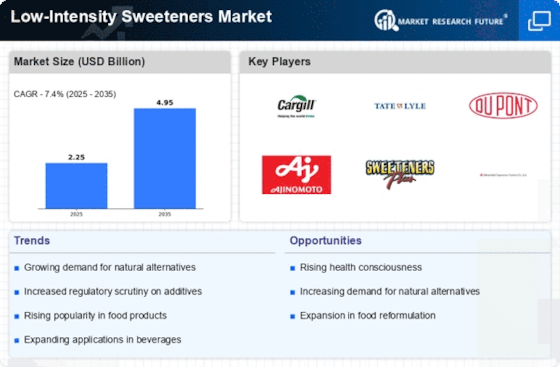
As per Market Research Future analysis, the Low-Intensity Sweeteners Market Size was estimated at 2.255 USD Billion in 2024. The Low-Intensity Sweeteners industry is projected to grow from 2.422 USD Billion in 2025 to 4.947 USD Billion by 2035, exhibiting a compound annual growth rate (CAGR) of 7.4% during the forecast period 2025 - 2035

Key Market Trends & Highlights

The Low-Intensity Sweeteners Market is experiencing robust growth driven by health trends and innovation.

  • Health consciousness among consumers is significantly driving the demand for low-intensity sweeteners, particularly in North America.
  • The rise of clean label products is influencing manufacturers to adopt natural sweeteners, with the natural segment being the largest in the market.
  • Innovation in product formulation is evident, especially with the rapid growth of allulose as a preferred sweetener in the Asia-Pacific region.
  • Key market drivers include the health benefits of low-calorie options and increasing consumer preference for natural ingredients.

Market Size & Forecast

2024 Market Size 2.255 (USD Billion)
2035 Market Size 4.947 (USD Billion)
CAGR (2025 - 2035) 7.4%
Largest Regional Market Share in 2024 North America

Major Players

Cargill (US), Tate & Lyle (GB), DuPont (US), Ajinomoto (JP), Sweeteners Plus (US), Mitsubishi Corporation (JP), NutraSweet (US), Südzucker AG (DE)

Market Trends

The Low-Intensity Sweeteners Market is currently experiencing a notable evolution, driven by a growing consumer preference for healthier alternatives to traditional sugars. This shift is largely influenced by increasing awareness regarding the adverse health effects associated with excessive sugar consumption, such as obesity and diabetes. As a result, manufacturers are actively exploring innovative formulations that incorporate low-intensity sweeteners, which provide sweetness without the caloric burden. This trend appears to be fostering a diverse range of products across various food and beverage categories, including dairy, baked goods, and beverages, thereby expanding the market's reach. Moreover, the Low-Intensity Sweeteners Market is likely to benefit from the rising demand for clean-label products. Consumers are becoming more discerning, seeking transparency in ingredient sourcing and production processes. This inclination towards natural and minimally processed ingredients suggests that low-intensity sweeteners derived from plant sources may gain traction. As companies adapt to these evolving consumer preferences, the market landscape is poised for further transformation, potentially leading to increased competition and innovation in product offerings. The future of the Low-Intensity Sweeteners Market seems promising, with opportunities for growth and diversification on the horizon.

Health Consciousness Driving Demand

The increasing awareness of health issues related to sugar consumption is propelling the demand for low-intensity sweeteners. Consumers are actively seeking alternatives that offer sweetness without the associated health risks, leading to a surge in product development.

Rise of Clean Label Products

There is a growing trend towards clean label products, where consumers prefer transparency in ingredient sourcing. This shift is likely to favor low-intensity sweeteners derived from natural sources, aligning with consumer desires for healthier options.

Innovation in Product Formulation

Manufacturers are focusing on innovative formulations that incorporate low-intensity sweeteners across various food and beverage categories. This trend indicates a potential for diversification in product offerings, catering to a broader audience.

Low Intensity Sweeteners Market Market Drivers

Rising Demand for Functional Foods

The growing interest in functional foods is significantly impacting the Low-Intensity Sweeteners Market. Consumers are increasingly seeking foods that offer health benefits beyond basic nutrition, such as weight management and improved metabolic health. Low-intensity sweeteners align well with this trend, as they provide sweetness without the added calories. Market Research Future indicates that the functional food sector is expected to grow at a rate of approximately 7% annually, which could drive demand for low-intensity sweeteners as key ingredients. This rising demand for functional foods may encourage manufacturers to incorporate low-intensity sweeteners into their product formulations, thereby enhancing the overall market landscape.

Health Benefits of Low-Calorie Options

The increasing awareness of health and wellness among consumers appears to be a primary driver for the Low-Intensity Sweeteners Market. As individuals seek to reduce caloric intake without sacrificing sweetness, low-intensity sweeteners present an appealing alternative. Research indicates that the market for low-calorie sweeteners is projected to grow at a compound annual growth rate of approximately 5.5% over the next few years. This trend is particularly evident in the beverage sector, where low-calorie drinks are gaining traction. The demand for healthier options is likely to continue influencing product development and marketing strategies within the Low-Intensity Sweeteners Market.

Innovation in Food and Beverage Products

Innovation within the food and beverage sector is a crucial driver for the Low-Intensity Sweeteners Market. Manufacturers are continuously exploring new formulations and applications for low-intensity sweeteners, aiming to enhance flavor profiles while maintaining lower calorie counts. This innovation is evident in the development of new product lines, including snacks, desserts, and beverages that utilize low-intensity sweeteners. Market analysis indicates that the introduction of innovative products is likely to attract health-conscious consumers, thereby expanding the customer base for the Low-Intensity Sweeteners Market. The ongoing focus on product differentiation may further stimulate market growth.

Regulatory Support for Sugar Alternatives

Regulatory bodies are increasingly recognizing the need for sugar alternatives, which may bolster the Low-Intensity Sweeteners Market. Governments are implementing policies aimed at reducing sugar consumption due to its association with various health issues, including obesity and diabetes. For instance, some regions have introduced taxes on sugary beverages, prompting manufacturers to explore low-intensity sweeteners as viable substitutes. This regulatory environment could potentially enhance the market landscape, encouraging innovation and investment in low-intensity sweetener products. As a result, the Low-Intensity Sweeteners Market may experience accelerated growth driven by supportive regulations.

Consumer Preference for Natural Ingredients

The shift towards natural ingredients is becoming increasingly pronounced, influencing the Low-Intensity Sweeteners Market. Consumers are gravitating towards products perceived as natural or derived from plant sources, which has led to a rise in demand for low-intensity sweeteners such as stevia and monk fruit. Market data suggests that the natural sweetener segment is expected to witness substantial growth, with projections indicating a market size increase of over 20% in the coming years. This trend reflects a broader consumer desire for transparency and clean labels, which is likely to shape product offerings in the Low-Intensity Sweeteners Market.

Market Segment Insights

By Category: Natural (Largest) vs. Synthetic (Fastest-Growing)

The Low-Intensity Sweeteners Market showcases a clear distinction in market share between natural and synthetic sweeteners. Natural sweeteners are currently the largest segment, driven by increasing consumer preference for healthier and more natural options. This trend is a response to growing health consciousness among consumers who are concerned about the adverse effects of artificial products. Synthetic sweeteners, on the other hand, are rapidly gaining traction due to their versatility and cost-effectiveness in food production, capturing a significant share of the market.

Natural (Dominant) vs. Synthetic (Emerging)

Natural low-intensity sweeteners, derived from plants and fruits, have established themselves as the dominant force in the market. Their appeal lies in their perceived health benefits, as they often come without the chemical aftertaste associated with synthetic alternatives. On the other hand, synthetic sweeteners are emerging as a strong contender, favored for their low caloric content and sugar-like taste, making them a preferred choice for formulation in various food products. This duality presents a unique dynamic in the market, as consumers weigh their options between sustainable natural choices and the innovations offered by synthetic alternatives.

By Type: Sorbitol (Largest) vs. Allulose (Fastest-Growing)

In the Low-Intensity Sweeteners Market, the segment values are primarily influenced by consumer preferences and health trends. Sorbitol holds a significant market share, largely due to its widespread use in food and beverage applications. Xylitol and Lactitol also contribute notable portions to the market, appealing to specific consumer segments seeking low-calorie and sugar-free options. <a href="https://www.marketresearchfuture.com/reports/allulose-market-22098" target="_blank">allulose</a>, while smaller in share, is rapidly gaining traction among health-conscious consumers seeking natural alternatives.

Sorbitol (Dominant) vs. <a href="https://www.marketresearchfuture.com/reports/allulose-market-22098" target="_blank">allulose</a> (Emerging)

Sorbitol is recognized as a dominant player in the Low-Intensity Sweeteners Market, renowned for its versatile applications in sugar-free and low-calorie products. Its ability to provide bulk and sweetness makes it a preferred choice among manufacturers. The rising health consciousness among consumers drives demand for lower-calorie sweeteners, bolstering Sorbitol's market position. Conversely, Allulose emerges as a formidable contender due to its unique attributes as a low-calorie sweetener with minimal impact on blood sugar levels. It appeals particularly to the keto and health-centric demographics. While Sorbitol enjoys established market presence, Allulose's growing popularity marks it as an emerging choice, potentially reshaping consumer preferences in the sweeteners category.

By Application: Beverages (Largest) vs. Bakery & Confectionary (Fastest-Growing)

In the Low-Intensity Sweeteners Market, the application segment displays significant diversity with beverages leading in market share, showcasing steady demand driven by consumer preferences for healthier drinks. The bakery and <a href="https://www.marketresearchfuture.com/reports/confectionery-market-16095" target="_blank">confectionery</a> sector follows closely, emphasizing the importance of sweeteners in baked goods and confections without the excess calories, aligning with health-conscious trends. Other notable segments include <a href="https://www.marketresearchfuture.com/reports/dairy-market-11483" target="_blank">dairy</a> and frozen desserts, and sweet and savory snacks, which collectively contribute to the market's dynamic landscape as consumers shift towards low-calorie options.

Beverages: Dominant vs. Bakery & Confectionary: Emerging

The beverages segment stands as the dominant player in the Low-Intensity Sweeteners Market, capitalizing on the trend of healthier hydration options as consumers lean towards sugar alternatives in their drinks. This segment encompasses a variety of products including soft drinks, flavored waters, and health drinks. Conversely, the bakery and <a href="https://www.marketresearchfuture.com/reports/confectionery-market-16095" target="_blank">confectionery</a> segment is emerging rapidly, fueled by innovations in formulations and a growing consumer base seeking indulgent yet healthier sweet treats. This sector's development is marked by a focus on taste enhancement without compromising health benefits, making it a fast-growing area in the sweeteners market.

Get more detailed insights about Low Intensity Sweeteners Market Research Report - Global Forecast till 2035

Regional Insights

By Region, the study provides market insights into North America, Europe, Asia-Pacific, and the Rest of the World. The North American, Low-Intensity Sweeteners market accounted for USD 1.8 billion in 2022 and is expected to exhibit a significant CAGR growth during the study period. This is attributed to the increasing number of obese and diabetic people in North America. Consumers in the Region are more interested in food items containing low calories and fewer sweeteners across the Region.

Further, the major countries studied in the market report are The U.S., Canada, Germany, France, the UK, Italy, Spain, China, Japan, India, Australia, South Korea, and Brazil.

Figure 2: LOW-INTENSITY SWEETENERS MARKET SHARE BY REGION 2022 (%)

Europe's Low-Intensity Sweeteners market accounts for the second-largest market share due to the Consumer inclination towards low-calorie food, increasing demand for low-calorie products, and the growing health awareness amongst consumer groups. Further, the German Market of low-intensity sweeteners held the largest market share, and the UK low-lntensity sweeteners industry was the fastest-growing market in the European Region.

The Asia-Pacific Low-Intensity Sweeteners Market is expected to grow at the fastest CAGR from 2022 to 2030. This is due to increased food and beverage industry rates, which are rapidly growing with changing consumer preferences and obesity. Moreover, China's low-lntensity sweeteners industry held the largest market share, and the Indian market for low-intensity sweeteners was the fastest-growing market in the Asia-Pacific region.

Hence, Asia-Pacific is anticipated to register the highest growth rate over the forecast period from 2022–2030.

Key Players and Competitive Insights

Major market players are spending a lot of money on R&D to increase their product lines, which will help the Low-Intensity sweeteners market grow even more. Market participants are also taking various strategic initiatives to grow their worldwide footprint, with key market developments such as new product launches, contractual agreements, mergers and acquisitions, increased investments, and collaboration with other organizations. Competitors in the Low-Intensity sweetener industry must offer cost-effective items to expand and survive in an increasingly competitive and rising market environment.One of the primary business strategies manufacturers adopt in the Low-Intensity Sweeteners industry to benefit clients and expand the market sector is manufacturing locally to reduce operating costs. The Low-Intensity Sweeteners industry has provided medicine with some of the most significant benefits in recent years. The Low-Intensity Sweeteners Market major player such as Roquette Freres SA (France), Cargill Inc. (US), E.l.Du Pont de Nemours and Company (US), Mitsui (Japan), Matsutani Chemical Industry Co., Ltd. (Japan), Tate and Lyle (UK), Ingredion (US), NutraSweet Company (US), Südzucker AG (Germany), Purecircle (Malaysia), ZuChem Inc. (US), Food Chem International Corporation (Japan), Gulshan Polyols Limited (India), JK Sucralose Inc. (India), and EcogreenOleochemicals (Singapore), and others are working on expanding the market demand by investing in research and development activities.Bonumose is an early-stage food ingredient manufacturer specializing in the affordable production of delicious, good-for-you sugars such as tagatose and allulose. Built on innovative enzymatic technology discovered by Dr. Daniel Wichelecki, Bonumose developed a novel platform to produce naturally-occurring ingredients in commercial-scale quantities that would not otherwise be cost-effective or sustainable. Bonumose, Inc announced a strategic collaboration with NOVASEP to develop, design, fabricate, install, and start a complete process line to produce High Purity Rare Sugars, including Tagatose and Allulose, in Virginia, USA. This approval has further broadened the growth opportunity for the Low-Intensity sweeteners industry.Whole earth brand is a food company enabling healthier lifestyles. It provides access to high-quality plant-based sweeteners, flavor enhancers, and other foods through our diverse portfolio of trusted brands and delicious products. Whole Earth Brands Inc. launched the new Whole Earth allulose baking blends. The launch is the latest for Whole Earth, a brand that meets the needs of consumers looking to reduce or eliminate sugar from their diets. Whole Earth uses these plant-based, zero-calorie, sugar-free baking solutions as more consumers turn to home baking for comfort.

Key Companies in the Low Intensity Sweeteners Market include

Industry Developments

  • Q2 2024: Cargill launches new stevia-based low-intensity sweetener for beverage sector Cargill announced the commercial launch of a new stevia-derived low-intensity sweetener targeting beverage manufacturers, expanding its portfolio of natural sugar alternatives and responding to increased demand for clean-label, reduced-calorie products.
  • Q2 2024: Ingredion opens new R&D center focused on low-intensity sweetener innovation Ingredion inaugurated a dedicated research and development facility in Illinois to accelerate the development of next-generation low-intensity sweeteners, aiming to support food and beverage manufacturers in reformulating products for sugar reduction.
  • Q3 2024: Tate & Lyle acquires US-based allulose producer SweetGen for $120 million Tate & Lyle completed the acquisition of SweetGen, a leading manufacturer of allulose, strengthening its position in the low-intensity sweeteners market and expanding its portfolio of specialty sweeteners for health-conscious consumers.
  • Q3 2024: PureCircle receives regulatory approval for new monk fruit sweetener blend in the EU PureCircle, a subsidiary of Ingredion, announced it has received European Commission approval for its proprietary monk fruit and stevia blend, enabling expanded sales of the low-intensity sweetener across the European Union.
  • Q4 2024: ADM partners with Japanese firm Matsutani to develop next-gen low-intensity sweeteners ADM entered a strategic partnership with Matsutani Chemical Industry to co-develop and commercialize novel low-intensity sweeteners, focusing on plant-based and fermentation-derived ingredients for global food and beverage markets.
  • Q4 2024: SweeGen announces opening of new manufacturing facility in Malaysia SweeGen opened a new production plant in Malaysia dedicated to the manufacture of stevia and allulose-based low-intensity sweeteners, aiming to meet growing demand in the Asia-Pacific region.
  • Q1 2025: DSM-Firmenich launches low-intensity sweetener platform for dairy applications DSM-Firmenich unveiled a new platform of low-intensity sweeteners specifically formulated for use in dairy products, targeting manufacturers seeking to reduce sugar content while maintaining taste and texture.
  • Q1 2025: Ingredion appoints new Chief Innovation Officer to lead sweetener R&D Ingredion announced the appointment of Dr. Maria Lopez as Chief Innovation Officer, with a mandate to accelerate research and commercialization of low-intensity sweetener solutions.
  • Q2 2025: GLG Life Tech secures major supply contract with global beverage company GLG Life Tech signed a multi-year supply agreement to provide its proprietary stevia-based low-intensity sweeteners to a leading multinational beverage company, marking a significant commercial milestone.
  • Q2 2025: Beneo receives FDA GRAS status for new isomaltulose-based low-intensity sweetener Beneo announced that its latest isomaltulose-derived low-intensity sweetener has been granted Generally Recognized As Safe (GRAS) status by the US FDA, paving the way for expanded use in food and beverage applications.

Future Outlook

Low Intensity Sweeteners Market Future Outlook

The Low-Intensity Sweeteners Market is projected to grow at a 7.4% CAGR from 2025 to 2035, driven by rising health consciousness and demand for sugar alternatives.

New opportunities lie in:

  • Development of innovative low-calorie product lines
  • Expansion into emerging markets with tailored sweetener solutions
  • Strategic partnerships with health-focused food brands

By 2035, the market is expected to achieve robust growth, solidifying its position in the global food industry.

Market Segmentation

Low Intensity Sweeteners Market Type Outlook

  • Sorbitol
  • Xylitol
  • Lactitol
  • Allulose
  • Others

Low Intensity Sweeteners Market Category Outlook

  • Natural
  • Synthetic

Low Intensity Sweeteners Market Application Outlook

  • Bakery & Confectionary
  • Beverages
  • Dairy & Frozen Desserts
  • Sweet & Savoury Snacks
  • Others

Report Scope

MARKET SIZE 2024 2.255(USD Billion)
MARKET SIZE 2025 2.422(USD Billion)
MARKET SIZE 2035 4.947(USD Billion)
COMPOUND ANNUAL GROWTH RATE (CAGR) 7.4% (2025 - 2035)
REPORT COVERAGE Revenue Forecast, Competitive Landscape, Growth Factors, and Trends
BASE YEAR 2024
Market Forecast Period 2025 - 2035
Historical Data 2019 - 2024
Market Forecast Units USD Billion
Key Companies Profiled Cargill (US), Tate & Lyle (GB), DuPont (US), Ajinomoto (JP), Sweeteners Plus (US), Mitsubishi Corporation (JP), NutraSweet (US), Südzucker AG (DE)
Segments Covered Category, Type, Application, Region
Key Market Opportunities Growing consumer demand for healthier alternatives drives innovation in the Low-Intensity Sweeteners Market.
Key Market Dynamics Rising consumer preference for natural ingredients drives demand for low-intensity sweeteners in various food applications.
Countries Covered North America, Europe, APAC, South America, MEA

FAQs

What is the current valuation of the Low-Intensity Sweeteners Market as of 2024?

<p>The market valuation was 2.255 USD Billion in 2024.</p>

What is the projected market size for Low-Intensity Sweeteners by 2035?

The market is projected to reach 4.947 USD Billion by 2035.

What is the expected CAGR for the Low-Intensity Sweeteners Market during the forecast period 2025 - 2035?

The expected CAGR for the market during this period is 7.4%.

Which companies are considered key players in the Low-Intensity Sweeteners Market?

Key players include Cargill, Tate &amp; Lyle, DuPont, Ajinomoto, and others.

How did the Natural and Synthetic segments perform in terms of market valuation in 2024?

In 2024, the Natural segment was valued at 1.5 USD Billion, while the Synthetic segment was valued at 0.755 USD Billion.

What are the projected valuations for the Natural and Synthetic segments by 2035?

By 2035, the Natural segment is expected to reach 3.2 USD Billion, and the Synthetic segment is projected to reach 1.747 USD Billion.

What types of low-intensity sweeteners are included in the market analysis?

Types include Sorbitol, Xylitol, Lactitol, Allulose, and others.

What was the market valuation for Sorbitol and Xylitol in 2024?

Sorbitol was valued at 0.5 USD Billion, and Xylitol was valued at 0.4 USD Billion in 2024.

What is the expected market size for Dairy & Frozen Desserts by 2035?

The market size for Dairy &amp; Frozen Desserts is projected to reach 0.8 USD Billion by 2035.

How do the applications of low-intensity sweeteners vary in terms of market valuation?

In 2024, Beverages accounted for 0.8 USD Billion, while Bakery &amp; Confectionery accounted for 0.5 USD Billion.

  1. SECTION I: EXECUTIVE SUMMARY AND KEY HIGHLIGHTS
    1. | 1.1 EXECUTIVE SUMMARY
    2. | | 1.1.1 Market Overview
    3. | | 1.1.2 Key Findings
    4. | | 1.1.3 Market Segmentation
    5. | | 1.1.4 Competitive Landscape
    6. | | 1.1.5 Challenges and Opportunities
    7. | | 1.1.6 Future Outlook
  2. SECTION II: SCOPING, METHODOLOGY AND MARKET STRUCTURE
    1. | 2.1 MARKET INTRODUCTION
    2. | | 2.1.1 Definition
    3. | | 2.1.2 Scope of the study
    4. | | | 2.1.2.1 Research Objective
    5. | | | 2.1.2.2 Assumption
    6. | | | 2.1.2.3 Limitations
    7. | 2.2 RESEARCH METHODOLOGY
    8. | | 2.2.1 Overview
    9. | | 2.2.2 Data Mining
    10. | | 2.2.3 Secondary Research
    11. | | 2.2.4 Primary Research
    12. | | | 2.2.4.1 Primary Interviews and Information Gathering Process
    13. | | | 2.2.4.2 Breakdown of Primary Respondents
    14. | | 2.2.5 Forecasting Model
    15. | | 2.2.6 Market Size Estimation
    16. | | | 2.2.6.1 Bottom-Up Approach
    17. | | | 2.2.6.2 Top-Down Approach
    18. | | 2.2.7 Data Triangulation
    19. | | 2.2.8 Validation
  3. SECTION III: QUALITATIVE ANALYSIS
    1. | 3.1 MARKET DYNAMICS
    2. | | 3.1.1 Overview
    3. | | 3.1.2 Drivers
    4. | | 3.1.3 Restraints
    5. | | 3.1.4 Opportunities
    6. | 3.2 MARKET FACTOR ANALYSIS
    7. | | 3.2.1 Value chain Analysis
    8. | | 3.2.2 Porter's Five Forces Analysis
    9. | | | 3.2.2.1 Bargaining Power of Suppliers
    10. | | | 3.2.2.2 Bargaining Power of Buyers
    11. | | | 3.2.2.3 Threat of New Entrants
    12. | | | 3.2.2.4 Threat of Substitutes
    13. | | | 3.2.2.5 Intensity of Rivalry
    14. | | 3.2.3 COVID-19 Impact Analysis
    15. | | | 3.2.3.1 Market Impact Analysis
    16. | | | 3.2.3.2 Regional Impact
    17. | | | 3.2.3.3 Opportunity and Threat Analysis
  4. SECTION IV: QUANTITATIVE ANALYSIS
    1. | 4.1 Food, Beverages & Nutrition, BY Category (USD Billion)
    2. | | 4.1.1 Natural
    3. | | 4.1.2 Synthetic
    4. | 4.2 Food, Beverages & Nutrition, BY Type (USD Billion)
    5. | | 4.2.1 Sorbitol
    6. | | 4.2.2 Xylitol
    7. | | 4.2.3 Lactitol
    8. | | 4.2.4 Allulose
    9. | | 4.2.5 Others
    10. | 4.3 Food, Beverages & Nutrition, BY Application (USD Billion)
    11. | | 4.3.1 Bakery & Confectionary
    12. | | 4.3.2 Beverages
    13. | | 4.3.3 Dairy & Frozen Desserts
    14. | | 4.3.4 Sweet & Savoury Snacks
    15. | | 4.3.5 Others
    16. | 4.4 Food, Beverages & Nutrition, BY Region (USD Billion)
    17. | | 4.4.1 North America
    18. | | | 4.4.1.1 US
    19. | | | 4.4.1.2 Canada
    20. | | 4.4.2 Europe
    21. | | | 4.4.2.1 Germany
    22. | | | 4.4.2.2 UK
    23. | | | 4.4.2.3 France
    24. | | | 4.4.2.4 Russia
    25. | | | 4.4.2.5 Italy
    26. | | | 4.4.2.6 Spain
    27. | | | 4.4.2.7 Rest of Europe
    28. | | 4.4.3 APAC
    29. | | | 4.4.3.1 China
    30. | | | 4.4.3.2 India
    31. | | | 4.4.3.3 Japan
    32. | | | 4.4.3.4 South Korea
    33. | | | 4.4.3.5 Malaysia
    34. | | | 4.4.3.6 Thailand
    35. | | | 4.4.3.7 Indonesia
    36. | | | 4.4.3.8 Rest of APAC
    37. | | 4.4.4 South America
    38. | | | 4.4.4.1 Brazil
    39. | | | 4.4.4.2 Mexico
    40. | | | 4.4.4.3 Argentina
    41. | | | 4.4.4.4 Rest of South America
    42. | | 4.4.5 MEA
    43. | | | 4.4.5.1 GCC Countries
    44. | | | 4.4.5.2 South Africa
    45. | | | 4.4.5.3 Rest of MEA
  5. SECTION V: COMPETITIVE ANALYSIS
    1. | 5.1 Competitive Landscape
    2. | | 5.1.1 Overview
    3. | | 5.1.2 Competitive Analysis
    4. | | 5.1.3 Market share Analysis
    5. | | 5.1.4 Major Growth Strategy in the Food, Beverages & Nutrition
    6. | | 5.1.5 Competitive Benchmarking
    7. | | 5.1.6 Leading Players in Terms of Number of Developments in the Food, Beverages & Nutrition
    8. | | 5.1.7 Key developments and growth strategies
    9. | | | 5.1.7.1 New Product Launch/Service Deployment
    10. | | | 5.1.7.2 Merger & Acquisitions
    11. | | | 5.1.7.3 Joint Ventures
    12. | | 5.1.8 Major Players Financial Matrix
    13. | | | 5.1.8.1 Sales and Operating Income
    14. | | | 5.1.8.2 Major Players R&D Expenditure. 2023
    15. | 5.2 Company Profiles
    16. | | 5.2.1 Cargill (US)
    17. | | | 5.2.1.1 Financial Overview
    18. | | | 5.2.1.2 Products Offered
    19. | | | 5.2.1.3 Key Developments
    20. | | | 5.2.1.4 SWOT Analysis
    21. | | | 5.2.1.5 Key Strategies
    22. | | 5.2.2 Tate & Lyle (GB)
    23. | | | 5.2.2.1 Financial Overview
    24. | | | 5.2.2.2 Products Offered
    25. | | | 5.2.2.3 Key Developments
    26. | | | 5.2.2.4 SWOT Analysis
    27. | | | 5.2.2.5 Key Strategies
    28. | | 5.2.3 DuPont (US)
    29. | | | 5.2.3.1 Financial Overview
    30. | | | 5.2.3.2 Products Offered
    31. | | | 5.2.3.3 Key Developments
    32. | | | 5.2.3.4 SWOT Analysis
    33. | | | 5.2.3.5 Key Strategies
    34. | | 5.2.4 Ajinomoto (JP)
    35. | | | 5.2.4.1 Financial Overview
    36. | | | 5.2.4.2 Products Offered
    37. | | | 5.2.4.3 Key Developments
    38. | | | 5.2.4.4 SWOT Analysis
    39. | | | 5.2.4.5 Key Strategies
    40. | | 5.2.5 Sweeteners Plus (US)
    41. | | | 5.2.5.1 Financial Overview
    42. | | | 5.2.5.2 Products Offered
    43. | | | 5.2.5.3 Key Developments
    44. | | | 5.2.5.4 SWOT Analysis
    45. | | | 5.2.5.5 Key Strategies
    46. | | 5.2.6 Mitsubishi Corporation (JP)
    47. | | | 5.2.6.1 Financial Overview
    48. | | | 5.2.6.2 Products Offered
    49. | | | 5.2.6.3 Key Developments
    50. | | | 5.2.6.4 SWOT Analysis
    51. | | | 5.2.6.5 Key Strategies
    52. | | 5.2.7 NutraSweet (US)
    53. | | | 5.2.7.1 Financial Overview
    54. | | | 5.2.7.2 Products Offered
    55. | | | 5.2.7.3 Key Developments
    56. | | | 5.2.7.4 SWOT Analysis
    57. | | | 5.2.7.5 Key Strategies
    58. | | 5.2.8 Südzucker AG (DE)
    59. | | | 5.2.8.1 Financial Overview
    60. | | | 5.2.8.2 Products Offered
    61. | | | 5.2.8.3 Key Developments
    62. | | | 5.2.8.4 SWOT Analysis
    63. | | | 5.2.8.5 Key Strategies
    64. | 5.3 Appendix
    65. | | 5.3.1 References
    66. | | 5.3.2 Related Reports
  6. LIST OF FIGURES
    1. | 6.1 MARKET SYNOPSIS
    2. | 6.2 NORTH AMERICA MARKET ANALYSIS
    3. | 6.3 US MARKET ANALYSIS BY CATEGORY
    4. | 6.4 US MARKET ANALYSIS BY TYPE
    5. | 6.5 US MARKET ANALYSIS BY APPLICATION
    6. | 6.6 CANADA MARKET ANALYSIS BY CATEGORY
    7. | 6.7 CANADA MARKET ANALYSIS BY TYPE
    8. | 6.8 CANADA MARKET ANALYSIS BY APPLICATION
    9. | 6.9 EUROPE MARKET ANALYSIS
    10. | 6.10 GERMANY MARKET ANALYSIS BY CATEGORY
    11. | 6.11 GERMANY MARKET ANALYSIS BY TYPE
    12. | 6.12 GERMANY MARKET ANALYSIS BY APPLICATION
    13. | 6.13 UK MARKET ANALYSIS BY CATEGORY
    14. | 6.14 UK MARKET ANALYSIS BY TYPE
    15. | 6.15 UK MARKET ANALYSIS BY APPLICATION
    16. | 6.16 FRANCE MARKET ANALYSIS BY CATEGORY
    17. | 6.17 FRANCE MARKET ANALYSIS BY TYPE
    18. | 6.18 FRANCE MARKET ANALYSIS BY APPLICATION
    19. | 6.19 RUSSIA MARKET ANALYSIS BY CATEGORY
    20. | 6.20 RUSSIA MARKET ANALYSIS BY TYPE
    21. | 6.21 RUSSIA MARKET ANALYSIS BY APPLICATION
    22. | 6.22 ITALY MARKET ANALYSIS BY CATEGORY
    23. | 6.23 ITALY MARKET ANALYSIS BY TYPE
    24. | 6.24 ITALY MARKET ANALYSIS BY APPLICATION
    25. | 6.25 SPAIN MARKET ANALYSIS BY CATEGORY
    26. | 6.26 SPAIN MARKET ANALYSIS BY TYPE
    27. | 6.27 SPAIN MARKET ANALYSIS BY APPLICATION
    28. | 6.28 REST OF EUROPE MARKET ANALYSIS BY CATEGORY
    29. | 6.29 REST OF EUROPE MARKET ANALYSIS BY TYPE
    30. | 6.30 REST OF EUROPE MARKET ANALYSIS BY APPLICATION
    31. | 6.31 APAC MARKET ANALYSIS
    32. | 6.32 CHINA MARKET ANALYSIS BY CATEGORY
    33. | 6.33 CHINA MARKET ANALYSIS BY TYPE
    34. | 6.34 CHINA MARKET ANALYSIS BY APPLICATION
    35. | 6.35 INDIA MARKET ANALYSIS BY CATEGORY
    36. | 6.36 INDIA MARKET ANALYSIS BY TYPE
    37. | 6.37 INDIA MARKET ANALYSIS BY APPLICATION
    38. | 6.38 JAPAN MARKET ANALYSIS BY CATEGORY
    39. | 6.39 JAPAN MARKET ANALYSIS BY TYPE
    40. | 6.40 JAPAN MARKET ANALYSIS BY APPLICATION
    41. | 6.41 SOUTH KOREA MARKET ANALYSIS BY CATEGORY
    42. | 6.42 SOUTH KOREA MARKET ANALYSIS BY TYPE
    43. | 6.43 SOUTH KOREA MARKET ANALYSIS BY APPLICATION
    44. | 6.44 MALAYSIA MARKET ANALYSIS BY CATEGORY
    45. | 6.45 MALAYSIA MARKET ANALYSIS BY TYPE
    46. | 6.46 MALAYSIA MARKET ANALYSIS BY APPLICATION
    47. | 6.47 THAILAND MARKET ANALYSIS BY CATEGORY
    48. | 6.48 THAILAND MARKET ANALYSIS BY TYPE
    49. | 6.49 THAILAND MARKET ANALYSIS BY APPLICATION
    50. | 6.50 INDONESIA MARKET ANALYSIS BY CATEGORY
    51. | 6.51 INDONESIA MARKET ANALYSIS BY TYPE
    52. | 6.52 INDONESIA MARKET ANALYSIS BY APPLICATION
    53. | 6.53 REST OF APAC MARKET ANALYSIS BY CATEGORY
    54. | 6.54 REST OF APAC MARKET ANALYSIS BY TYPE
    55. | 6.55 REST OF APAC MARKET ANALYSIS BY APPLICATION
    56. | 6.56 SOUTH AMERICA MARKET ANALYSIS
    57. | 6.57 BRAZIL MARKET ANALYSIS BY CATEGORY
    58. | 6.58 BRAZIL MARKET ANALYSIS BY TYPE
    59. | 6.59 BRAZIL MARKET ANALYSIS BY APPLICATION
    60. | 6.60 MEXICO MARKET ANALYSIS BY CATEGORY
    61. | 6.61 MEXICO MARKET ANALYSIS BY TYPE
    62. | 6.62 MEXICO MARKET ANALYSIS BY APPLICATION
    63. | 6.63 ARGENTINA MARKET ANALYSIS BY CATEGORY
    64. | 6.64 ARGENTINA MARKET ANALYSIS BY TYPE
    65. | 6.65 ARGENTINA MARKET ANALYSIS BY APPLICATION
    66. | 6.66 REST OF SOUTH AMERICA MARKET ANALYSIS BY CATEGORY
    67. | 6.67 REST OF SOUTH AMERICA MARKET ANALYSIS BY TYPE
    68. | 6.68 REST OF SOUTH AMERICA MARKET ANALYSIS BY APPLICATION
    69. | 6.69 MEA MARKET ANALYSIS
    70. | 6.70 GCC COUNTRIES MARKET ANALYSIS BY CATEGORY
    71. | 6.71 GCC COUNTRIES MARKET ANALYSIS BY TYPE
    72. | 6.72 GCC COUNTRIES MARKET ANALYSIS BY APPLICATION
    73. | 6.73 SOUTH AFRICA MARKET ANALYSIS BY CATEGORY
    74. | 6.74 SOUTH AFRICA MARKET ANALYSIS BY TYPE
    75. | 6.75 SOUTH AFRICA MARKET ANALYSIS BY APPLICATION
    76. | 6.76 REST OF MEA MARKET ANALYSIS BY CATEGORY
    77. | 6.77 REST OF MEA MARKET ANALYSIS BY TYPE
    78. | 6.78 REST OF MEA MARKET ANALYSIS BY APPLICATION
    79. | 6.79 KEY BUYING CRITERIA OF FOOD, BEVERAGES & NUTRITION
    80. | 6.80 RESEARCH PROCESS OF MRFR
    81. | 6.81 DRO ANALYSIS OF FOOD, BEVERAGES & NUTRITION
    82. | 6.82 DRIVERS IMPACT ANALYSIS: FOOD, BEVERAGES & NUTRITION
    83. | 6.83 RESTRAINTS IMPACT ANALYSIS: FOOD, BEVERAGES & NUTRITION
    84. | 6.84 SUPPLY / VALUE CHAIN: FOOD, BEVERAGES & NUTRITION
    85. | 6.85 FOOD, BEVERAGES & NUTRITION, BY CATEGORY, 2024 (% SHARE)
    86. | 6.86 FOOD, BEVERAGES & NUTRITION, BY CATEGORY, 2024 TO 2035 (USD Billion)
    87. | 6.87 FOOD, BEVERAGES & NUTRITION, BY TYPE, 2024 (% SHARE)
    88. | 6.88 FOOD, BEVERAGES & NUTRITION, BY TYPE, 2024 TO 2035 (USD Billion)
    89. | 6.89 FOOD, BEVERAGES & NUTRITION, BY APPLICATION, 2024 (% SHARE)
    90. | 6.90 FOOD, BEVERAGES & NUTRITION, BY APPLICATION, 2024 TO 2035 (USD Billion)
    91. | 6.91 BENCHMARKING OF MAJOR COMPETITORS
  7. LIST OF TABLES
    1. | 7.1 LIST OF ASSUMPTIONS
    2. | | 7.1.1
    3. | 7.2 North America MARKET SIZE ESTIMATES; FORECAST
    4. | | 7.2.1 BY CATEGORY, 2025-2035 (USD Billion)
    5. | | 7.2.2 BY TYPE, 2025-2035 (USD Billion)
    6. | | 7.2.3 BY APPLICATION, 2025-2035 (USD Billion)
    7. | 7.3 US MARKET SIZE ESTIMATES; FORECAST
    8. | | 7.3.1 BY CATEGORY, 2025-2035 (USD Billion)
    9. | | 7.3.2 BY TYPE, 2025-2035 (USD Billion)
    10. | | 7.3.3 BY APPLICATION, 2025-2035 (USD Billion)
    11. | 7.4 Canada MARKET SIZE ESTIMATES; FORECAST
    12. | | 7.4.1 BY CATEGORY, 2025-2035 (USD Billion)
    13. | | 7.4.2 BY TYPE, 2025-2035 (USD Billion)
    14. | | 7.4.3 BY APPLICATION, 2025-2035 (USD Billion)
    15. | 7.5 Europe MARKET SIZE ESTIMATES; FORECAST
    16. | | 7.5.1 BY CATEGORY, 2025-2035 (USD Billion)
    17. | | 7.5.2 BY TYPE, 2025-2035 (USD Billion)
    18. | | 7.5.3 BY APPLICATION, 2025-2035 (USD Billion)
    19. | 7.6 Germany MARKET SIZE ESTIMATES; FORECAST
    20. | | 7.6.1 BY CATEGORY, 2025-2035 (USD Billion)
    21. | | 7.6.2 BY TYPE, 2025-2035 (USD Billion)
    22. | | 7.6.3 BY APPLICATION, 2025-2035 (USD Billion)
    23. | 7.7 UK MARKET SIZE ESTIMATES; FORECAST
    24. | | 7.7.1 BY CATEGORY, 2025-2035 (USD Billion)
    25. | | 7.7.2 BY TYPE, 2025-2035 (USD Billion)
    26. | | 7.7.3 BY APPLICATION, 2025-2035 (USD Billion)
    27. | 7.8 France MARKET SIZE ESTIMATES; FORECAST
    28. | | 7.8.1 BY CATEGORY, 2025-2035 (USD Billion)
    29. | | 7.8.2 BY TYPE, 2025-2035 (USD Billion)
    30. | | 7.8.3 BY APPLICATION, 2025-2035 (USD Billion)
    31. | 7.9 Russia MARKET SIZE ESTIMATES; FORECAST
    32. | | 7.9.1 BY CATEGORY, 2025-2035 (USD Billion)
    33. | | 7.9.2 BY TYPE, 2025-2035 (USD Billion)
    34. | | 7.9.3 BY APPLICATION, 2025-2035 (USD Billion)
    35. | 7.10 Italy MARKET SIZE ESTIMATES; FORECAST
    36. | | 7.10.1 BY CATEGORY, 2025-2035 (USD Billion)
    37. | | 7.10.2 BY TYPE, 2025-2035 (USD Billion)
    38. | | 7.10.3 BY APPLICATION, 2025-2035 (USD Billion)
    39. | 7.11 Spain MARKET SIZE ESTIMATES; FORECAST
    40. | | 7.11.1 BY CATEGORY, 2025-2035 (USD Billion)
    41. | | 7.11.2 BY TYPE, 2025-2035 (USD Billion)
    42. | | 7.11.3 BY APPLICATION, 2025-2035 (USD Billion)
    43. | 7.12 Rest of Europe MARKET SIZE ESTIMATES; FORECAST
    44. | | 7.12.1 BY CATEGORY, 2025-2035 (USD Billion)
    45. | | 7.12.2 BY TYPE, 2025-2035 (USD Billion)
    46. | | 7.12.3 BY APPLICATION, 2025-2035 (USD Billion)
    47. | 7.13 APAC MARKET SIZE ESTIMATES; FORECAST
    48. | | 7.13.1 BY CATEGORY, 2025-2035 (USD Billion)
    49. | | 7.13.2 BY TYPE, 2025-2035 (USD Billion)
    50. | | 7.13.3 BY APPLICATION, 2025-2035 (USD Billion)
    51. | 7.14 China MARKET SIZE ESTIMATES; FORECAST
    52. | | 7.14.1 BY CATEGORY, 2025-2035 (USD Billion)
    53. | | 7.14.2 BY TYPE, 2025-2035 (USD Billion)
    54. | | 7.14.3 BY APPLICATION, 2025-2035 (USD Billion)
    55. | 7.15 India MARKET SIZE ESTIMATES; FORECAST
    56. | | 7.15.1 BY CATEGORY, 2025-2035 (USD Billion)
    57. | | 7.15.2 BY TYPE, 2025-2035 (USD Billion)
    58. | | 7.15.3 BY APPLICATION, 2025-2035 (USD Billion)
    59. | 7.16 Japan MARKET SIZE ESTIMATES; FORECAST
    60. | | 7.16.1 BY CATEGORY, 2025-2035 (USD Billion)
    61. | | 7.16.2 BY TYPE, 2025-2035 (USD Billion)
    62. | | 7.16.3 BY APPLICATION, 2025-2035 (USD Billion)
    63. | 7.17 South Korea MARKET SIZE ESTIMATES; FORECAST
    64. | | 7.17.1 BY CATEGORY, 2025-2035 (USD Billion)
    65. | | 7.17.2 BY TYPE, 2025-2035 (USD Billion)
    66. | | 7.17.3 BY APPLICATION, 2025-2035 (USD Billion)
    67. | 7.18 Malaysia MARKET SIZE ESTIMATES; FORECAST
    68. | | 7.18.1 BY CATEGORY, 2025-2035 (USD Billion)
    69. | | 7.18.2 BY TYPE, 2025-2035 (USD Billion)
    70. | | 7.18.3 BY APPLICATION, 2025-2035 (USD Billion)
    71. | 7.19 Thailand MARKET SIZE ESTIMATES; FORECAST
    72. | | 7.19.1 BY CATEGORY, 2025-2035 (USD Billion)
    73. | | 7.19.2 BY TYPE, 2025-2035 (USD Billion)
    74. | | 7.19.3 BY APPLICATION, 2025-2035 (USD Billion)
    75. | 7.20 Indonesia MARKET SIZE ESTIMATES; FORECAST
    76. | | 7.20.1 BY CATEGORY, 2025-2035 (USD Billion)
    77. | | 7.20.2 BY TYPE, 2025-2035 (USD Billion)
    78. | | 7.20.3 BY APPLICATION, 2025-2035 (USD Billion)
    79. | 7.21 Rest of APAC MARKET SIZE ESTIMATES; FORECAST
    80. | | 7.21.1 BY CATEGORY, 2025-2035 (USD Billion)
    81. | | 7.21.2 BY TYPE, 2025-2035 (USD Billion)
    82. | | 7.21.3 BY APPLICATION, 2025-2035 (USD Billion)
    83. | 7.22 South America MARKET SIZE ESTIMATES; FORECAST
    84. | | 7.22.1 BY CATEGORY, 2025-2035 (USD Billion)
    85. | | 7.22.2 BY TYPE, 2025-2035 (USD Billion)
    86. | | 7.22.3 BY APPLICATION, 2025-2035 (USD Billion)
    87. | 7.23 Brazil MARKET SIZE ESTIMATES; FORECAST
    88. | | 7.23.1 BY CATEGORY, 2025-2035 (USD Billion)
    89. | | 7.23.2 BY TYPE, 2025-2035 (USD Billion)
    90. | | 7.23.3 BY APPLICATION, 2025-2035 (USD Billion)
    91. | 7.24 Mexico MARKET SIZE ESTIMATES; FORECAST
    92. | | 7.24.1 BY CATEGORY, 2025-2035 (USD Billion)
    93. | | 7.24.2 BY TYPE, 2025-2035 (USD Billion)
    94. | | 7.24.3 BY APPLICATION, 2025-2035 (USD Billion)
    95. | 7.25 Argentina MARKET SIZE ESTIMATES; FORECAST
    96. | | 7.25.1 BY CATEGORY, 2025-2035 (USD Billion)
    97. | | 7.25.2 BY TYPE, 2025-2035 (USD Billion)
    98. | | 7.25.3 BY APPLICATION, 2025-2035 (USD Billion)
    99. | 7.26 Rest of South America MARKET SIZE ESTIMATES; FORECAST
    100. | | 7.26.1 BY CATEGORY, 2025-2035 (USD Billion)
    101. | | 7.26.2 BY TYPE, 2025-2035 (USD Billion)
    102. | | 7.26.3 BY APPLICATION, 2025-2035 (USD Billion)
    103. | 7.27 MEA MARKET SIZE ESTIMATES; FORECAST
    104. | | 7.27.1 BY CATEGORY, 2025-2035 (USD Billion)
    105. | | 7.27.2 BY TYPE, 2025-2035 (USD Billion)
    106. | | 7.27.3 BY APPLICATION, 2025-2035 (USD Billion)
    107. | 7.28 GCC Countries MARKET SIZE ESTIMATES; FORECAST
    108. | | 7.28.1 BY CATEGORY, 2025-2035 (USD Billion)
    109. | | 7.28.2 BY TYPE, 2025-2035 (USD Billion)
    110. | | 7.28.3 BY APPLICATION, 2025-2035 (USD Billion)
    111. | 7.29 South Africa MARKET SIZE ESTIMATES; FORECAST
    112. | | 7.29.1 BY CATEGORY, 2025-2035 (USD Billion)
    113. | | 7.29.2 BY TYPE, 2025-2035 (USD Billion)
    114. | | 7.29.3 BY APPLICATION, 2025-2035 (USD Billion)
    115. | 7.30 Rest of MEA MARKET SIZE ESTIMATES; FORECAST
    116. | | 7.30.1 BY CATEGORY, 2025-2035 (USD Billion)
    117. | | 7.30.2 BY TYPE, 2025-2035 (USD Billion)
    118. | | 7.30.3 BY APPLICATION, 2025-2035 (USD Billion)
    119. | 7.31 PRODUCT LAUNCH/PRODUCT DEVELOPMENT/APPROVAL
    120. | | 7.31.1
    121. | 7.32 ACQUISITION/PARTNERSHIP
    122. | | 7.32.1

Food, Beverages & Nutrition Market Segmentation

Food, Beverages & Nutrition By Category (USD Billion, 2025-2035)

  • Natural
  • Synthetic

Food, Beverages & Nutrition By Type (USD Billion, 2025-2035)

  • Sorbitol
  • Xylitol
  • Lactitol
  • Allulose
  • Others

Food, Beverages & Nutrition By Application (USD Billion, 2025-2035)

  • Bakery & Confectionary
  • Beverages
  • Dairy & Frozen Desserts
  • Sweet & Savoury Snacks
  • Others
Infographic

Free Sample Request

Kindly complete the form below to receive a free sample of this Report

Get Free Sample

Customer Strories

Compare Licence

×
Features License Type
Single User Multiuser License Enterprise User
Price $4,950 $5,950 $7,250
Maximum User Access Limit 1 User Upto 10 Users Unrestricted Access Throughout the Organization
Free Customization
Direct Access to Analyst
Deliverable Format
Platform Access
Discount on Next Purchase 10% 15% 15%
Printable Versions