×
Request Free Sample ×

Kindly complete the form below to receive a free sample of this Report

* Please use a valid business email

Leading companies partner with us for data-driven Insights

clients tt-cursor
Hero Background
English
Chinese
French
Japanese
Korean
German
Spanish

Leavening Agents Market Size

ID: MRFR/FnB/9071-HCR
90 Pages
Snehal Singh
October 2025

Leavening Agents Market Size, Share, Industry Trend & Analysis Research Report Information By Type (Chemical and Biological), By Application (Bakery Products (Breads & Rolls, Biscuits & Cookies, Cakes & Muffins, and Others), Fried Food), and By Region (North America, Europe, Asia-Pacific, and Rest of the World) - Forecast Till 2035

Share:
Download PDF ×

We do not share your information with anyone. However, we may send you emails based on your report interest from time to time. You may contact us at any time to opt-out.

Leavening Agents Market Infographic
Purchase Options

Leavening Agents Size

Leavening Agents Market Growth Projections and Opportunities

The Leavening Agents Market is growing because more and more people want ready-to-eat foods. More people want leavening agents because they want meals that are easier to make and take less time, all around. Like, leavening products are very important in the baking business for making light and fluffy baked goods. Clients are happy because they get tasty candies. The business is also growing because more and more people are baking at home. This is due in part to online groups and famous cooks.

The market for leavening products is also affected by the rules and regulations that are in place. People who buy this get more than they want. For food safety, the government has strict rules and quality standards. This is why it is very important that food is made with leavening products that are known to be safe. When companies make things, they need to follow these rules so that the market values reliability and the right way to use things. Because of government rules and customers who care about their health, companies spend money on research and development to come up with new leavening agents.

The market for leavening products is affected by the world economy in a big way. In the end, the price of leavening agents could change because of things like changes in exchange rates, changes in trade limits, and wars in other countries. These things have an effect on the costs of raw materials and shipping, which in turn have an effect on the total cost of production. To stay competitive and keep prices stable, manufacturers need to get past these market issues. What people buy could also have an effect on the market. People value things more highly when they are scarce or cost less.

How much technology has changed things is another important thing to think about in the leavening agent market. Leavening agents can work better and last longer if the way food is handled and the things that are used change. One part of this is coming up with new leavening agents for people who have to follow certain diets, like those who want gluten-free or organic choices. When a business opens up to new technologies, it can give more goods, go after special markets, and get more users.

Leavening Agents Market Size Graph
Author
Snehal Singh
Assistant Manager - Research

High acumen in analyzing complex macro & micro markets with more than 6 years of work experience in the field of market research. By implementing her analytical skills in forecasting and estimation into market research reports, she has expertise in Packaging, Construction, and Equipment domains. She handles a team size of 20-25 resources and ensures smooth running of the projects, associated marketing activities, and client servicing.

Leave a Comment

FAQs

How much is the Leavening Agents market?

Leavening Agents Market Size was valued at USD 4,708.6 million in 2023

What is the growth rate of the Leavening Agents market?

Leavening Agents Market exhibiting a compound annual growth rate (CAGR) of 6.78% during the forecast period (2024 - 2032)

Which region held the largest market share in the Leavening Agents market?

North America held the largest market share in the leavening agents market

Who are the key players in the Leavening Agents market?

Kudos Blends (UK), Puratos (Belgium), Kraft Heinz Company (US), DSM (Netherlands), Associated British Foods plc (UK), Angel Yeast Co., Ltd. (China), Lallemand Inc. (Canada), B&G Foods, Inc (US), Lesaffre (France), and Weikfield Foods Pvt. Ltd. (India)

Which Type led the Leavening Agents market?

Chemical

Which application had the largest market share in the Leavening Agents market?

Bakery Products

Market Summary

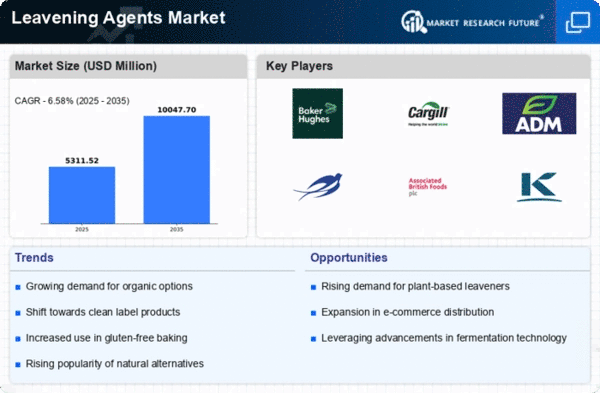
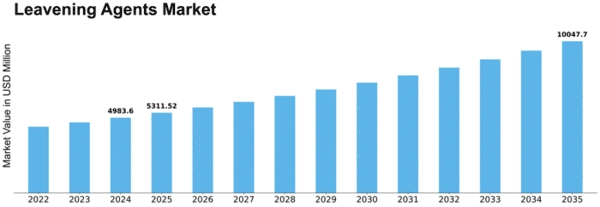
As per Market Research Future analysis, the Leavening Agents Market Size was estimated at 4983.6 USD Million in 2024. The Leavening Agents industry is projected to grow from 5311.62 USD Million in 2025 to 10047.7 USD Million by 2035, exhibiting a compound annual growth rate (CAGR) of 6.58% during the forecast period 2025 - 2035

Key Market Trends & Highlights

The Leavening Agents Market is experiencing a dynamic evolution driven by health trends and consumer preferences.

  • The market is witnessing a notable shift towards natural ingredients, reflecting consumer demand for cleaner labels.
  • Artisanal and home baking are gaining traction, particularly in North America, as consumers seek unique culinary experiences.
  • Technological innovations in formulation are enhancing the efficiency and effectiveness of leavening agents, especially in the baking segment.
  • Rising demand for convenience foods and health and wellness trends are major drivers, particularly influencing the growth of chemical leavening agents.

Market Size & Forecast

2024 Market Size 4983.6 (USD Million)
2035 Market Size 10047.7 (USD Million)
CAGR (2025 - 2035) 6.58%
Largest Regional Market Share in 2024 North America

Major Players

Baker Hughes (US), Cargill (US), Archer Daniels Midland (US), Lesaffre (FR), Associated British Foods (GB), Kerry Group (IE), MGP Ingredients (US), Tate & Lyle (GB), Döhler (DE)

Market Trends

The Leavening Agents Market is currently experiencing a dynamic evolution, driven by various factors that influence consumer preferences and industry practices. The growing inclination towards healthier food options appears to be reshaping the demand for natural leavening agents, such as yeast and baking soda, as consumers increasingly seek products with fewer artificial additives. Additionally, the rise of artisanal baking and the popularity of home baking have contributed to a heightened interest in diverse leavening agents, prompting manufacturers to innovate and expand their product offerings. This trend suggests a potential shift towards more sustainable and organic options, aligning with broader health and wellness movements. Moreover, the Leavening Agents Market is likely to witness advancements in technology that enhance the efficiency and effectiveness of these agents. Innovations in formulation and processing techniques may lead to improved performance characteristics, such as faster rising times and better texture in baked goods. As the market continues to adapt to changing consumer demands, the emphasis on quality and functionality is expected to intensify. This evolving landscape indicates that stakeholders in the Leavening Agents Market must remain agile and responsive to emerging trends to maintain competitiveness and meet the expectations of a discerning consumer base.

Shift Towards Natural Ingredients

There is a noticeable trend towards the use of natural leavening agents, as consumers increasingly prefer products that are free from synthetic additives. This shift is prompting manufacturers to explore and promote options like yeast and baking powder derived from natural sources.

Growth of Artisanal and Home Baking

The rising popularity of artisanal baking and home cooking is influencing the Leavening Agents Market. Consumers are experimenting with various leavening agents, leading to a demand for diverse and specialty products that cater to this growing segment.

Technological Innovations in Formulation

Advancements in technology are likely to enhance the performance of leavening agents. Innovations in formulation and processing may result in improved characteristics, such as quicker rising times and superior texture, thereby attracting more consumers.

Leavening Agents Market Market Drivers

Market Growth Projections

The Global Leavening Agents Market Industry is projected to experience a compound annual growth rate of 6.56% from 2025 to 2035. This growth trajectory is indicative of the increasing adoption of leavening agents across various food applications, including bakery products, snacks, and convenience foods. The rising awareness of the importance of leavening agents in achieving desired textures and flavors in food products contributes to this growth. As the market evolves, stakeholders are likely to explore new opportunities and innovations, further driving the expansion of the industry.

Rising Demand for Baked Goods

The Global Leavening Agents Market Industry experiences a notable surge in demand for baked goods, driven by changing consumer preferences towards convenience foods. As more individuals seek ready-to-eat options, the market for leavening agents, essential for producing light and airy textures in bread and pastries, expands. In 2024, the market is valued at approximately 4.98 USD Billion, reflecting the growing inclination towards artisanal and specialty baked products. This trend is likely to continue, as consumers increasingly prioritize quality and taste, suggesting a robust growth trajectory for the industry.

Health-Conscious Consumer Trends

The Global Leavening Agents Market Industry is influenced by a shift towards healthier eating habits among consumers. There is a growing preference for organic and natural ingredients, which has led to an increased demand for clean-label products. Manufacturers are responding by developing leavening agents that align with these health trends, such as those derived from natural sources. This shift not only caters to consumer preferences but also enhances product appeal in a competitive market. As health-conscious choices become more prevalent, the industry is expected to adapt, potentially leading to innovations in leavening agent formulations.

Regulatory Support for Food Safety

Regulatory frameworks aimed at ensuring food safety significantly impact the Global Leavening Agents Market Industry. Governments worldwide are implementing stringent regulations concerning food additives, including leavening agents. This regulatory support not only enhances consumer confidence but also encourages manufacturers to invest in quality and safety measures. Compliance with these regulations often leads to the development of innovative leavening solutions that meet safety standards. As the industry navigates these regulatory landscapes, it is likely to foster a culture of quality and safety, ultimately benefiting the market.

Expansion of the Food and Beverage Sector

The Global Leavening Agents Market Industry benefits from the continuous expansion of the food and beverage sector. As the global population grows and urbanization increases, the demand for processed and convenience foods rises. This trend is particularly evident in emerging markets, where the consumption of baked goods is on the rise. By 2035, the market is projected to reach 10.0 USD Billion, indicating a substantial growth potential. The increasing number of food service establishments and retail outlets further fuels this demand, creating a favorable environment for leavening agents.

Technological Advancements in Food Production

Technological innovations play a crucial role in shaping the Global Leavening Agents Market Industry. Advances in food processing technologies enable manufacturers to enhance the efficiency and effectiveness of leavening agents. For instance, the development of enzyme-based leavening agents has improved the quality and shelf life of baked goods. These innovations not only optimize production processes but also meet the evolving demands of consumers for better quality products. As the industry embraces these advancements, it is likely to witness a significant transformation, fostering growth and expanding market opportunities.

Market Segment Insights

By Application: Baking (Largest) vs. Brewing (Fastest-Growing)

In the Leavening Agents Market, the application segment is predominantly led by Baking, which holds a significant share due to the global demand for baked goods. This includes bread, pastries, and other baked products, where leavening agents play a crucial role in texture and flavor. Following Baking, the Brewing and Fermentation applications are also notable, as they utilize leavening agents in the production of alcoholic beverages and fermented foods, contributing further to the segment's overall market share.

Baking (Dominant) vs. Brewing (Emerging)

Baking remains the dominant application in the Leavening Agents Market, characterized by its extensive usage in various baked goods such as bread, cakes, and cookies. The demand for artisanal and specialty breads continues to grow, further solidifying its market position. Conversely, Brewing is identified as an emerging segment, experiencing rapid growth driven by the rising trend of craft beers and home brewing. This segment leverages leavening agents for carbonation and flavor development, appealing to both craft breweries and consumers seeking unique brewing experiences. As consumer preferences evolve, both segments are poised for dynamic growth, with Baking maintaining its stronghold while Brewing captures new market interests.

By Type: Chemical Leavening Agents (Largest) vs. Biological Leavening Agents (Fastest-Growing)

In the Leavening Agents Market, the distribution of market share among the types reveals that Chemical Leavening Agents dominate the segment, driven by their extensive use in various baked goods due to their efficiency and cost-effectiveness. On the other hand, Biological Leavening Agents, especially those that utilize yeast, have seen a significant rise in popularity, appealing to a growing consumer base interested in natural and organic ingredients.

Chemical Leavening Agents (Dominant) vs. Biological Leavening Agents (Emerging)

Chemical Leavening Agents, known for their quick action and reliability, are widely used in commercial baking processes. Their dominant position in the market is attributed to the convenience they offer, especially in large-scale productions. Conversely, Biological Leavening Agents, such as yeast, are emerging as a healthier alternative, favored for their natural properties and ability to enhance flavor. This segment is gaining traction as consumers increasingly seek clean-label products, indicating a shift in preferences towards more organic and wholesome baking solutions.

By Form: Powder (Largest) vs. Liquid (Fastest-Growing)

In the Leavening Agents Market, the 'By Form' segment showcases a diverse landscape, primarily dominated by powder forms. Powder leavening agents hold a substantial share, benefitting from their traditional use in various bakery products. Conversely, the liquid form of leavening agents is witnessing rapid growth, driven by the increasing demand for convenient and ready-to-use baking solutions. The market dynamics reveal a clear preference for powder agents, yet liquid forms are gaining traction, particularly in modern baking applications.

Leavening Agents: Powder (Dominant) vs. Liquid (Emerging)

Powdered leavening agents stand out as the dominant form, preferred for their reliability and performance in baked goods. Their ability to provide consistent results in various formulations makes them integral in commercial baking. On the other hand, liquid leavening agents, classified as emerging, are experiencing heightened demand because of their ease of use and incorporation into ready-to-eat or pre-mixed products. Liquid forms offer manufacturers flexibility in formulation and convenience for end-users, thus capturing a growing share of the market. Both segments cater to specific consumer needs, reflecting the evolving trends in the food industry.

By End Use: Bakery Products (Largest) vs. Food Industry (Fastest-Growing)

The Leavening Agents Market showcases varying market share among its primary end-use segments, notably the bakery products, which hold the largest share. Bakery Products, including bread, cakes, and pastries, utilize leavening agents extensively due to their essential role in achieving the desired texture and volume. Meanwhile, the Food Industry segment, which includes various processed and packaged foods, is witnessing rapid growth as manufacturers increasingly incorporate leavening agents to enhance product quality and shelf life.

Bakery Products (Dominant) vs. Food Industry (Emerging)

Bakery Products, as the dominant segment in the Leavening Agents Market, significantly rely on leavening agents such as baking soda and yeast to achieve appropriate fermentation and leavening of dough. This segment benefits from a strong demand driven by consumer preference for baked goods and artisanal products. Conversely, the Food Industry segment is classified as emerging, reflecting an increasing trend of utilizing leavening agents in a broad range of processed foods to improve texture and flavor. The consumer shift towards more convenient and appealing food options fuels this growth, as food manufacturers look to innovate and enhance their offerings.

Get more detailed insights about Leavening Agents Market Research Report—Global Forecast till 2035

Regional Insights

North America : Market Leader in Leavening Agents

North America is poised to maintain its leadership in the leavening agents market, holding a significant share of 2491.8 million in 2024. The region's growth is driven by increasing consumer demand for baked goods and convenience foods, alongside stringent food safety regulations that promote the use of approved leavening agents. The rise in health-conscious consumers is also pushing manufacturers to innovate with natural and organic leavening options. The United States is the primary contributor to this market, with key players like Cargill, Archer Daniels Midland, and Baker Hughes leading the charge. The competitive landscape is characterized by a mix of established companies and emerging players, all vying for market share. The presence of advanced manufacturing facilities and a robust distribution network further solidifies North America's position as a hub for leavening agents.

Europe : Emerging Market with Growth Potential

Europe's leavening agents market is valued at 1490.16 million, reflecting a growing trend towards artisanal and health-oriented baked products. The region's growth is fueled by increasing consumer awareness regarding food quality and safety, alongside regulatory frameworks that encourage the use of safe and approved leavening agents. The demand for gluten-free and organic products is also on the rise, driving innovation in the sector. Leading countries such as Germany, France, and the UK are at the forefront of this market, with key players like Lesaffre and Associated British Foods making significant contributions. The competitive landscape is marked by a blend of local and international companies, all focused on meeting the diverse needs of consumers. The European market is expected to continue evolving, driven by changing consumer preferences and regulatory support.

Asia-Pacific : Rapidly Growing Market Segment

The Asia-Pacific region, with a market size of 850.0 million, is witnessing rapid growth in the leavening agents sector. This growth is primarily driven by urbanization, increasing disposable incomes, and a rising demand for baked goods and convenience foods. Regulatory support for food safety and quality is also a significant catalyst, encouraging the use of approved leavening agents in food production. Countries like China, India, and Japan are leading the charge in this market, with a mix of local and international players competing for market share. Companies such as Kerry Group and MGP Ingredients are establishing a strong presence in the region. The competitive landscape is dynamic, with a focus on innovation and adapting to local tastes and preferences, ensuring sustained growth in the Asia-Pacific leavening agents market.

Middle East and Africa : Emerging Market with Unique Challenges

The Middle East and Africa region, valued at 151.64 million, presents unique challenges and opportunities in the leavening agents market. The growth in this region is driven by increasing urbanization and a growing population, leading to higher demand for baked goods. However, regulatory hurdles and varying food safety standards can impact market dynamics, necessitating compliance with local regulations to ensure product acceptance. Countries like South Africa and the UAE are key players in this market, with a mix of local and international companies striving to capture market share. The competitive landscape is characterized by a focus on adapting products to meet local tastes and preferences. As the market evolves, companies are increasingly investing in research and development to innovate and meet the diverse needs of consumers in this region.

Key Players and Competitive Insights

The Leavening Agents Market is characterized by a dynamic competitive landscape, driven by increasing consumer demand for baked goods and the growing trend towards healthier food options. Key players such as Cargill (US), Lesaffre (FR), and Kerry Group (IE) are strategically positioned to leverage innovation and sustainability in their operations. Cargill (US) focuses on enhancing its product portfolio through the development of clean-label leavening agents, while Lesaffre (FR) emphasizes its commitment to sustainability by investing in eco-friendly production processes. Kerry Group (IE) is also notable for its strategic partnerships aimed at expanding its market reach and enhancing product offerings, collectively shaping a competitive environment that prioritizes quality and sustainability.In terms of business tactics, companies are increasingly localizing manufacturing to reduce supply chain vulnerabilities and optimize logistics. The market structure appears moderately fragmented, with several key players exerting significant influence. This fragmentation allows for niche players to thrive, while larger companies consolidate their market positions through strategic acquisitions and partnerships.

In November Cargill (US) announced the launch of a new line of organic leavening agents aimed at health-conscious consumers. This strategic move not only aligns with the growing demand for organic products but also positions Cargill (US) as a leader in the health-oriented segment of the market. The introduction of these products is expected to enhance customer loyalty and expand market share in a competitive landscape.

In October Lesaffre (FR) unveiled its latest innovation in yeast technology, which significantly improves the fermentation process for various baked goods. This advancement is crucial as it enhances product quality and consistency, thereby meeting the evolving demands of both industrial bakers and artisanal producers. Lesaffre's focus on innovation underscores its commitment to maintaining a competitive edge in the market.

In September Kerry Group (IE) entered into a strategic partnership with a leading food technology firm to develop AI-driven solutions for optimizing leavening agent formulations. This collaboration is indicative of the growing trend towards digitalization in the food industry, allowing Kerry Group (IE) to enhance product development efficiency and respond more swiftly to market trends.

As of December the competitive trends in the Leavening Agents Market are increasingly defined by digitalization, sustainability, and the integration of AI technologies. Strategic alliances are becoming more prevalent, enabling companies to pool resources and expertise to drive innovation. The competitive differentiation is likely to evolve from traditional price-based competition towards a focus on technological advancements, product innovation, and supply chain reliability, reflecting a broader shift in consumer preferences towards quality and sustainability.

Key Companies in the Leavening Agents Market include

Industry Developments

In August 2021,

Angel Yeast Co., Ltd established a joint venture company and acquired Shandong Bio Sunkeen Co, Ltd. The acquisition will help the company optimize its production capacity and further consolidate and strengthen its position in the industry.

In June 2021,

Kudos Blends extended its ZEUS range by launching ZEUS Hybrid Leavening System. The launching of the product will strengthen the company product portfolio.

In January 2021,

Puratos acquired Ruskhleb, a bakery ingredient manufacturer located in Saint Petersburg, Russia. The acquisition extends Puratos’ local presence and leadership in the bakery while localizing sourdough production using local raw materials.

Future Outlook

Leavening Agents Market Future Outlook

The Leavening Agents Market is projected to grow at a 6.58% CAGR from 2025 to 2035, driven by increasing demand for baked goods and health-conscious formulations.

New opportunities lie in:

  • Expansion into plant-based leavening solutions for vegan products.
  • Development of customized leavening agents for gluten-free baking.
  • Investment in sustainable packaging for leavening agent products.

By 2035, the market is expected to achieve robust growth, reflecting evolving consumer preferences and innovation.

Market Segmentation

Leavening Agents Market Form Outlook

  • Powder
  • Liquid
  • Granular

Leavening Agents Market Type Outlook

  • Chemical Leavening Agents
  • Biological Leavening Agents
  • Physical Leavening Agents

Leavening Agents Market End Use Outlook

  • Food Industry
  • Beverage Industry
  • Bakery Products

Leavening Agents Market Application Outlook

  • Baking
  • Brewing
  • Fermentation
  • Confectionery

Report Scope

MARKET SIZE 20244983.6(USD Million)
MARKET SIZE 20255311.62(USD Million)
MARKET SIZE 203510047.7(USD Million)
COMPOUND ANNUAL GROWTH RATE (CAGR)6.58% (2025 - 2035)
REPORT COVERAGERevenue Forecast, Competitive Landscape, Growth Factors, and Trends
BASE YEAR2024
Market Forecast Period2025 - 2035
Historical Data2019 - 2024
Market Forecast UnitsUSD Million
Key Companies ProfiledBaker Hughes (US), Cargill (US), Archer Daniels Midland (US), Lesaffre (FR), Associated British Foods (GB), Kerry Group (IE), MGP Ingredients (US), Tate & Lyle (GB), Döhler (DE)
Segments CoveredApplication, Type, Form, End Use
Key Market OpportunitiesGrowing demand for clean-label products drives innovation in the Leavening Agents Market.
Key Market DynamicsRising demand for clean-label products drives innovation in leavening agents, influencing market dynamics and competitive strategies.
Countries CoveredNorth America, Europe, APAC, South America, MEA

FAQs

How much is the Leavening Agents market?

Leavening Agents Market Size was valued at USD 4,708.6 million in 2023

What is the growth rate of the Leavening Agents market?

Leavening Agents Market exhibiting a compound annual growth rate (CAGR) of 6.78% during the forecast period (2024 - 2032)

Which region held the largest market share in the Leavening Agents market?

North America held the largest market share in the leavening agents market

Who are the key players in the Leavening Agents market?

Kudos Blends (UK), Puratos (Belgium), Kraft Heinz Company (US), DSM (Netherlands), Associated British Foods plc (UK), Angel Yeast Co., Ltd. (China), Lallemand Inc. (Canada), B&G Foods, Inc (US), Lesaffre (France), and Weikfield Foods Pvt. Ltd. (India)

Which Type led the Leavening Agents market?

Chemical

Which application had the largest market share in the Leavening Agents market?

Bakery Products

  1. SECTION I: EXECUTIVE SUMMARY AND KEY HIGHLIGHTS
    1. | 1.1 EXECUTIVE SUMMARY
    2. | 1.1.1 Market Overview
    3. | 1.1.2 Key Findings
    4. | 1.1.3 Market Segmentation
    5. | 1.1.4 Competitive Landscape
    6. | 1.1.5 Challenges and Opportunities
    7. | 1.1.6 Future Outlook
  2. SECTION II: SCOPING, METHODOLOGY AND MARKET STRUCTURE
    1. | 2.1 MARKET INTRODUCTION
    2. | 2.1.1 Definition
    3. | 2.1.2 Scope of the study
    4. |-- 2.1.2.1 Research Objective
    5. |-- 2.1.2.2 Assumption
    6. |-- 2.1.2.3 Limitations
    7. | 2.2 RESEARCH METHODOLOGY
    8. | 2.2.1 Overview
    9. | 2.2.2 Data Mining
    10. | 2.2.3 Secondary Research
    11. | 2.2.4 Primary Research
    12. |-- 2.2.4.1 Primary Interviews and Information Gathering Process
    13. |-- 2.2.4.2 Breakdown of Primary Respondents
    14. | 2.2.5 Forecasting Model
    15. | 2.2.6 Market Size Estimation
    16. |-- 2.2.6.1 Bottom-Up Approach
    17. |-- 2.2.6.2 Top-Down Approach
    18. | 2.2.7 Data Triangulation
    19. | 2.2.8 Validation
  3. SECTION III: QUALITATIVE ANALYSIS
    1. | 3.1 MARKET DYNAMICS
    2. | 3.1.1 Overview
    3. | 3.1.2 Drivers
    4. | 3.1.3 Restraints
    5. | 3.1.4 Opportunities
    6. | 3.2 MARKET FACTOR ANALYSIS
    7. | 3.2.1 Value chain Analysis
    8. | 3.2.2 Porter's Five Forces Analysis
    9. |-- 3.2.2.1 Bargaining Power of Suppliers
    10. |-- 3.2.2.2 Bargaining Power of Buyers
    11. |-- 3.2.2.3 Threat of New Entrants
    12. |-- 3.2.2.4 Threat of Substitutes
    13. |-- 3.2.2.5 Intensity of Rivalry
    14. | 3.2.3 COVID-19 Impact Analysis
    15. |-- 3.2.3.1 Market Impact Analysis
    16. |-- 3.2.3.2 Regional Impact
    17. |-- 3.2.3.3 Opportunity and Threat Analysis
  4. SECTION IV: QUANTITATIVE ANALYSIS
    1. | 4.1 Food, Beverages & Nutrition, BY Application (USD Million)
    2. | 4.1.1 Baking
    3. | 4.1.2 Brewing
    4. | 4.1.3 Fermentation
    5. | 4.1.4 Confectionery
    6. | 4.2 Food, Beverages & Nutrition, BY Type (USD Million)
    7. | 4.2.1 Chemical Leavening Agents
    8. | 4.2.2 Biological Leavening Agents
    9. | 4.2.3 Physical Leavening Agents
    10. | 4.3 Food, Beverages & Nutrition, BY Form (USD Million)
    11. | 4.3.1 Powder
    12. | 4.3.2 Liquid
    13. | 4.3.3 Granular
    14. | 4.4 Food, Beverages & Nutrition, BY End Use (USD Million)
    15. | 4.4.1 Food Industry
    16. | 4.4.2 Beverage Industry
    17. | 4.4.3 Bakery Products
    18. | 4.5 Food, Beverages & Nutrition, BY Region (USD Million)
    19. | 4.5.1 North America
    20. |-- 4.5.1.1 US
    21. |-- 4.5.1.2 Canada
    22. | 4.5.2 Europe
    23. |-- 4.5.2.1 Germany
    24. |-- 4.5.2.2 UK
    25. |-- 4.5.2.3 France
    26. |-- 4.5.2.4 Russia
    27. |-- 4.5.2.5 Italy
    28. |-- 4.5.2.6 Spain
    29. |-- 4.5.2.7 Rest of Europe
    30. | 4.5.3 APAC
    31. |-- 4.5.3.1 China
    32. |-- 4.5.3.2 India
    33. |-- 4.5.3.3 Japan
    34. |-- 4.5.3.4 South Korea
    35. |-- 4.5.3.5 Malaysia
    36. |-- 4.5.3.6 Thailand
    37. |-- 4.5.3.7 Indonesia
    38. |-- 4.5.3.8 Rest of APAC
    39. | 4.5.4 South America
    40. |-- 4.5.4.1 Brazil
    41. |-- 4.5.4.2 Mexico
    42. |-- 4.5.4.3 Argentina
    43. |-- 4.5.4.4 Rest of South America
    44. | 4.5.5 MEA
    45. |-- 4.5.5.1 GCC Countries
    46. |-- 4.5.5.2 South Africa
    47. |-- 4.5.5.3 Rest of MEA
  5. SECTION V: COMPETITIVE ANALYSIS
    1. | 5.1 Competitive Landscape
    2. | 5.1.1 Overview
    3. | 5.1.2 Competitive Analysis
    4. | 5.1.3 Market share Analysis
    5. | 5.1.4 Major Growth Strategy in the Food, Beverages & Nutrition
    6. | 5.1.5 Competitive Benchmarking
    7. | 5.1.6 Leading Players in Terms of Number of Developments in the Food, Beverages & Nutrition
    8. | 5.1.7 Key developments and growth strategies
    9. |-- 5.1.7.1 New Product Launch/Service Deployment
    10. |-- 5.1.7.2 Merger & Acquisitions
    11. |-- 5.1.7.3 Joint Ventures
    12. | 5.1.8 Major Players Financial Matrix
    13. |-- 5.1.8.1 Sales and Operating Income
    14. |-- 5.1.8.2 Major Players R&D Expenditure. 2023
    15. | 5.2 Company Profiles
    16. | 5.2.1 Baker Hughes (US)
    17. |-- 5.2.1.1 Financial Overview
    18. |-- 5.2.1.2 Products Offered
    19. |-- 5.2.1.3 Key Developments
    20. |-- 5.2.1.4 SWOT Analysis
    21. |-- 5.2.1.5 Key Strategies
    22. | 5.2.2 Cargill (US)
    23. |-- 5.2.2.1 Financial Overview
    24. |-- 5.2.2.2 Products Offered
    25. |-- 5.2.2.3 Key Developments
    26. |-- 5.2.2.4 SWOT Analysis
    27. |-- 5.2.2.5 Key Strategies
    28. | 5.2.3 Archer Daniels Midland (US)
    29. |-- 5.2.3.1 Financial Overview
    30. |-- 5.2.3.2 Products Offered
    31. |-- 5.2.3.3 Key Developments
    32. |-- 5.2.3.4 SWOT Analysis
    33. |-- 5.2.3.5 Key Strategies
    34. | 5.2.4 Lesaffre (FR)
    35. |-- 5.2.4.1 Financial Overview
    36. |-- 5.2.4.2 Products Offered
    37. |-- 5.2.4.3 Key Developments
    38. |-- 5.2.4.4 SWOT Analysis
    39. |-- 5.2.4.5 Key Strategies
    40. | 5.2.5 Associated British Foods (GB)
    41. |-- 5.2.5.1 Financial Overview
    42. |-- 5.2.5.2 Products Offered
    43. |-- 5.2.5.3 Key Developments
    44. |-- 5.2.5.4 SWOT Analysis
    45. |-- 5.2.5.5 Key Strategies
    46. | 5.2.6 Kerry Group (IE)
    47. |-- 5.2.6.1 Financial Overview
    48. |-- 5.2.6.2 Products Offered
    49. |-- 5.2.6.3 Key Developments
    50. |-- 5.2.6.4 SWOT Analysis
    51. |-- 5.2.6.5 Key Strategies
    52. | 5.2.7 MGP Ingredients (US)
    53. |-- 5.2.7.1 Financial Overview
    54. |-- 5.2.7.2 Products Offered
    55. |-- 5.2.7.3 Key Developments
    56. |-- 5.2.7.4 SWOT Analysis
    57. |-- 5.2.7.5 Key Strategies
    58. | 5.2.8 Tate & Lyle (GB)
    59. |-- 5.2.8.1 Financial Overview
    60. |-- 5.2.8.2 Products Offered
    61. |-- 5.2.8.3 Key Developments
    62. |-- 5.2.8.4 SWOT Analysis
    63. |-- 5.2.8.5 Key Strategies
    64. | 5.2.9 Döhler (DE)
    65. |-- 5.2.9.1 Financial Overview
    66. |-- 5.2.9.2 Products Offered
    67. |-- 5.2.9.3 Key Developments
    68. |-- 5.2.9.4 SWOT Analysis
    69. |-- 5.2.9.5 Key Strategies
    70. | 5.3 Appendix
    71. | 5.3.1 References
    72. | 5.3.2 Related Reports

Food, Beverages & Nutrition Market Segmentation

Food, Beverages & Nutrition By Application (USD Million, 2025-2035)

  • Baking
  • Brewing
  • Fermentation
  • Confectionery

Food, Beverages & Nutrition By Type (USD Million, 2025-2035)

  • Chemical Leavening Agents
  • Biological Leavening Agents
  • Physical Leavening Agents

Food, Beverages & Nutrition By Form (USD Million, 2025-2035)

  • Powder
  • Liquid
  • Granular

Food, Beverages & Nutrition By End Use (USD Million, 2025-2035)

  • Food Industry
  • Beverage Industry
  • Bakery Products
Infographic

Free Sample Request

Kindly complete the form below to receive a free sample of this Report

Get Free Sample

Customer Strories

Compare Licence

×
Features License Type
Single User Multiuser License Enterprise User
Price $4,950 $5,950 $7,250
Maximum User Access Limit 1 User Upto 10 Users Unrestricted Access Throughout the Organization
Free Customization
Direct Access to Analyst
Deliverable Format
Platform Access
Discount on Next Purchase 10% 15% 15%
Printable Versions