
×
Request Free Sample ×

Kindly complete the form below to receive a free sample of this Report

* Please use a valid business email

Leading companies partner with us for data-driven Insights

clients tt-cursor
Hero Background
English
Chinese
French
Japanese
Korean
German
Spanish

Indoor Positioning Navigation System Market Size

ID: MRFR/ICT/1243-CR
110 Pages
Ankit Gupta
October 2018

Indoor Positioning and Navigation System Market by Component  (Hardware, Software), by Technology (UWB,Bluetooth Low Energy, RFID, Cellular, WLAN) by Platform (Anroid Based, iOS Based), Forecast to 2035

Share:
Download PDF ×

We do not share your information with anyone. However, we may send you emails based on your report interest from time to time. You may contact us at any time to opt-out.

Indoor Positioning Navigation System Market Infographic
Purchase Options

Indoor Positioning Navigation System Size

Indoor Positioning Navigation System Market Growth Projections and Opportunities

The Indoor Positioning and Navigation System (IPNS) business is changing due to technological advances and rising demand for location-based services across industries. As organizations realise the benefits of accurate indoor positioning for user experiences and operational efficiency, the worldwide IPNS market is growing.

Smartphones and other smart devices with location-based services drive market dynamics. Consumers are used to using navigation applications outdoors and expect them indoors. In retail, medical care, public transit, and other industries, accurate location information may increase consumer interaction and expedite operations, driving IPNS solution demand.

IPNS is used in retail to customize shopping, issue targeted promotions, and improve store layouts depending on user traffic. This improves the buying experience and gives businesses data for business choices. IPNS improves patient care and operational efficiency in healthcare by tracking assets, navigating patients, and optimizing workflows.

The growing deployment of IoT technologies further drives IPNS market dynamics. Precision indoor location is essential for seamless communication and coordination as more devices become linked. IPNS helps IoT devices locate themselves inside for real-time data transmission and automation in smart buildings, industries, and warehouses.

To meet rising demand, many businesses are joining the IPNS industry. Startups and established firms are developing Bluetooth-based beacons, Wi-Fi location, Ultra-Wideband (UWB), and LiDAR sensor technologies. This range of options creates a dynamic market where customers may chose solutions that fit their demands and budgets.

Government rules and standards affect IPNS market dynamics. Policymakers are prioritizing interoperability, data privacy, and security as the technology spreads. Companies deploying IPNS solutions are considering compliance with legislation and standards, altering the competitive environment and impacting buying decisions.

IPNS market prospects come with challenges. Implementing and maintaining these systems is expensive and raises privacy and data security concerns, which hinder adoption. These issues must be addressed to keep the IPNS industry growing and acquire company and consumer trust.

The COVID-19 outbreak also affected IPNS market dynamics. Social distancing and contactless solutions have increased location-based technology adoption in numerous areas. IPNS is utilized in hospitality to develop touchless check-in processes and improve client experiences, and in manufacturing to ensure safe worker distance.

IPNS market dynamics are predicted to change when 5G and AI are integrated. More precise and responsive indoor location systems will enable novel augmented reality, virtual reality, and immersive experiences."
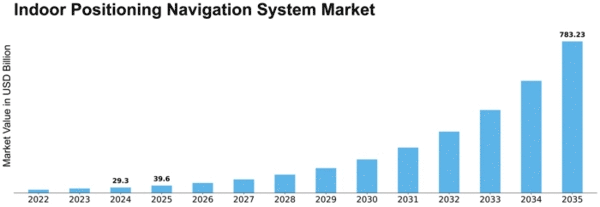
Indoor Positioning Navigation System Market Size Graph
Author
Ankit Gupta
Senior Research Analyst

Ankit Gupta is an analyst in market research industry in ICT and SEMI industry. With post-graduation in "Telecom and Marketing Management" and graduation in "Electronics and Telecommunication" vertical he is well versed with recent development in ICT industry as a whole. Having worked on more than 150+ reports including consultation for fortune 500 companies such as Microsoft and Rio Tinto in identifying solutions with respect to business problems his opinions are inclined towards mixture of technical and managerial aspects.

Leave a Comment

FAQs

What is the growth scope of the Indoor Positioning and Navigation System Market?

The rate that the market is anticipated to achieve in the coming years is 35.20%.

How big is the Indoor Positioning and Navigation System Market?

The indoor positioning and navigation System Market value will surpass USD 365.0 Billion by the year 2032.

Who are the contenders in the market for Indoor Positioning and Navigation System?

All the players in the market identified in the report are Insoft GmbH, Senion AB, Septentrio N.V., Telit Communications PLC, Zebra Technologies Corporation, NovAtel Inc., Galileo Satelite Navigation Ltd., Trimble Inc., Tersus GNSS Inc., and others.

What are the technology-based market segments?

UWB, Wi-Fi, Bluetooth Low Energy (BLE), RFID, Cellular based, Lo-Ra and others are the technology-based market segments.

What types of platforms have been listed in the report?

The types of platforms have been listed in the report are Android based, iOS based and others.

The global market for indoor positioning and navigation system has been divided into which segments?

The global market for indoor positioning and navigation system has been divided into technology, component, and software/apps.

Which platform-based segment can record the highest growth rate in the global market?

The iOS segment can record the highest growth rate in the global market.

Which region is a major driver in the Indoor Positioning and Navigation System Market?

The North American region dominates the indoor positioning and navigation system market.

Market Summary

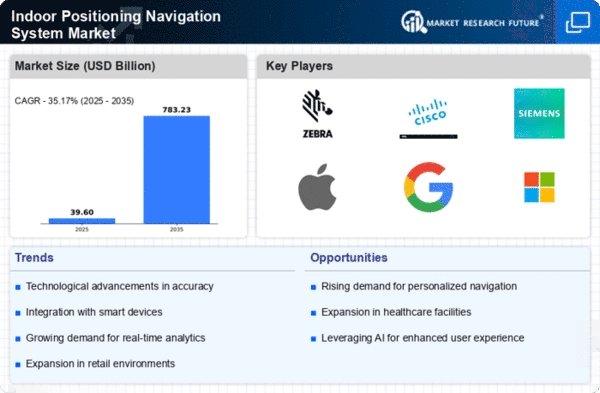
As per MRFR analysis, the Indoor Positioning Navigation System Market was estimated at 29.3 USD Billion in 2024. The Indoor Positioning Navigation System industry is projected to grow from 38.46 USD Billion in 2025 to 783.23 USD Billion by 2035, exhibiting a compound annual growth rate (CAGR) of 35.17 during the forecast period 2025 - 2035.

Key Market Trends & Highlights

The Indoor Positioning Navigation System Market is experiencing robust growth driven by technological advancements and increasing demand for location-based services.

  • The integration of AI and machine learning is transforming the capabilities of indoor positioning systems.
  • North America remains the largest market, while Asia-Pacific is emerging as the fastest-growing region in this sector.
  • Retail continues to dominate the market, whereas healthcare is witnessing the fastest growth in adoption of indoor positioning technologies.
  • Key drivers include the increasing demand for location-based services and advancements in technology, particularly in smart buildings.

Market Size & Forecast

2024 Market Size 29.3 (USD Billion)
2035 Market Size 783.23 (USD Billion)
CAGR (2025 - 2035) 35.17%
Largest Regional Market Share in 2024 North America

Major Players

<p>Zebra Technologies (US), Cisco Systems (US), Siemens (DE), Apple (US), Google (US), Microsoft (US), IndoorAtlas (FI), NavVis (DE), HERE Technologies (NL)</p>

Market Trends

The Indoor Positioning Navigation System Market is currently experiencing a notable evolution, driven by advancements in technology and increasing demand for precise location services. Various sectors, including retail, healthcare, and transportation, are adopting these systems to enhance operational efficiency and improve user experiences. The integration of artificial intelligence and machine learning into these systems appears to be a key factor, as it enables more accurate positioning and personalized services. Furthermore, the growing trend of smart buildings and the Internet of Things (IoT) is likely to propel the market forward, as these technologies require robust indoor navigation solutions to function effectively. In addition, the emphasis on safety and security within public spaces is fostering the development of Indoor Positioning Navigation Systems. Organizations are increasingly recognizing the value of real-time tracking and navigation capabilities, particularly in emergency situations. This heightened awareness may lead to greater investments in these technologies, as stakeholders seek to provide enhanced safety measures for users. Overall, the Indoor Positioning Navigation System Market is poised for substantial growth, with various factors converging to create a dynamic landscape that could redefine how individuals navigate indoor environments.

Integration of AI and Machine Learning

The incorporation of artificial intelligence and machine learning technologies into Indoor Positioning Navigation Systems is becoming increasingly prevalent. This trend suggests that systems can offer more accurate positioning and tailored user experiences, enhancing overall functionality.

Rise of Smart Buildings

The growing trend of smart buildings is likely to drive demand for Indoor Positioning Navigation Systems. As these structures become more interconnected, the need for effective navigation solutions that integrate seamlessly with IoT devices appears to be critical.

Focus on Safety and Security

There is a noticeable emphasis on safety and security in public spaces, which is influencing the development of Indoor Positioning Navigation Systems. Organizations are recognizing the importance of real-time tracking and navigation capabilities to enhance user safety.

Indoor Positioning Navigation System Market Market Drivers

Smart City Initiatives

The Global Indoor Positioning and Navigation System Market Industry is positively impacted by the rise of smart city initiatives worldwide. Governments are increasingly investing in smart infrastructure that incorporates advanced navigation systems to improve urban mobility and enhance public services. For example, cities are deploying indoor navigation solutions in public transport hubs, airports, and shopping centers to facilitate seamless movement for residents and visitors. This trend is expected to drive market growth as urban areas seek to optimize space utilization and improve the overall quality of life. The integration of these systems aligns with broader goals of sustainability and efficiency in urban planning.

Market Growth Projections

The Global Indoor Positioning and Navigation System Market Industry is projected to experience remarkable growth in the coming years. With a market value of 29.3 USD Billion in 2024, the industry is expected to expand significantly, reaching 902.0 USD Billion by 2035. This growth trajectory reflects a compound annual growth rate of 36.56% from 2025 to 2035. Various factors contribute to this expansion, including technological advancements, increased demand for location-based services, and the growing adoption of indoor navigation systems across multiple sectors. The market's evolution indicates a robust future for indoor positioning technologies.

Technological Advancements

The Global Indoor Positioning and Navigation System Market Industry experiences rapid growth due to continuous technological advancements. Innovations in Bluetooth Low Energy, Wi-Fi, and Ultra-Wideband technologies enhance the accuracy and reliability of indoor positioning systems. For instance, the integration of artificial intelligence and machine learning algorithms allows for real-time data processing and improved user experiences. As these technologies evolve, they are expected to drive the market's expansion, contributing to a projected market value of 29.3 USD Billion in 2024. This growth trajectory indicates a strong demand for sophisticated navigation solutions across various sectors, including retail, healthcare, and transportation.

Enhanced Safety and Security

The Global Indoor Positioning and Navigation System Market Industry benefits from the growing emphasis on safety and security in various environments. Organizations are increasingly adopting indoor navigation systems to enhance security measures, particularly in large venues such as airports, malls, and corporate offices. These systems can assist in emergency evacuations by providing real-time location data and guiding individuals to safety. As safety regulations become more stringent, the demand for reliable indoor positioning solutions is likely to rise. This trend not only supports market growth but also underscores the importance of integrating safety features into navigation systems.

Growing Adoption in Healthcare

The Global Indoor Positioning and Navigation System Market Industry sees substantial growth driven by the increasing adoption of these systems in healthcare facilities. Hospitals and clinics implement indoor navigation solutions to streamline patient flow, reduce wait times, and enhance overall operational efficiency. For instance, systems that guide patients to their appointments or help staff locate medical equipment are becoming commonplace. This trend is likely to accelerate as healthcare providers recognize the potential benefits, contributing to a compound annual growth rate of 36.56% from 2025 to 2035. The integration of these systems is poised to transform patient care and facility management.

Increased Demand for Location-Based Services

The Global Indoor Positioning and Navigation System Market Industry is significantly influenced by the rising demand for location-based services. Businesses across sectors are increasingly leveraging these services to enhance customer engagement and operational efficiency. For example, retailers utilize indoor navigation systems to guide customers to specific products, thereby improving the shopping experience. This trend is expected to contribute to the market's growth, with a projected value of 902.0 USD Billion by 2035. The increasing reliance on mobile applications and smart devices further fuels this demand, as consumers seek personalized experiences that utilize precise location data.

Market Segment Insights

By Application: Retail (Largest) vs. Healthcare (Fastest-Growing)

<p>The indoor positioning navigation system market is witnessing significant distribution among various application segments with retail holding the largest share. Retailers are increasingly adopting indoor navigation systems to enhance customer experience and operational efficiency. Healthcare follows as an emerging segment as hospitals and clinics implement these systems to improve asset tracking and patient care. Transportation, manufacturing, and hospitality also contribute to the market but remain relatively smaller in comparison.</p>

<p>Retail: Dominant vs. Healthcare: Emerging</p>

<p>The retail sector stands out as the dominant application for indoor positioning navigation systems due to its focus on enhancing customer experiences and operational productivity. Retailers are leveraging these systems to guide customers through stores, optimize their layout, and improve inventory management. On the other hand, healthcare is an emerging player that is rapidly adopting indoor positioning for better asset management and patient navigation. The need for real-time locating systems in hospitals is driven by the demand for improved patient outcomes and efficient asset utilization. Together, these segments highlight the diverse applications of indoor positioning technology.</p>

By Technology: Bluetooth (Largest) vs. Ultra-Wideband (Fastest-Growing)

<p>The Indoor Positioning Navigation System Market showcases a competitive landscape, with Bluetooth technology leading the segment, attributed to its widespread adoption across various industries. This is followed by Wi-Fi, which has established its relevance in indoor positioning, especially in large facilities. Other technologies like Ultra-Wideband, Magnetic, and Visible Light capture niche markets and are continuing to gain traction due to advancements in their respective fields. The growth trends in this segment are influenced by the increasing demand for precise location services indoors, driven by smart building initiatives and the proliferation of IoT devices. Ultra-Wideband is recognized as the fastest-growing technology due to its accuracy over short distances, making it suitable for applications requiring pinpoint positioning in real-time. Furthermore, as enterprises prioritize enhanced user experiences, technologies like Bluetooth and Wi-Fi are expected to evolve, catering to this trend.</p>

<p>Technology: Bluetooth (Dominant) vs. Ultra-Wideband (Emerging)</p>

<p>Bluetooth technology has firmly established itself as the dominant player in the Indoor Positioning Navigation System Market due to its compatibility with a wide range of devices, ease of use, and relatively low cost. It's particularly favored in retail environments for location-based services that enhance customer engagement. Conversely, Ultra-Wideband, while an emerging technology, is quickly capturing attention for its unique capabilities in providing highly accurate location information within complex indoor environments. Its low-latency and high-resolution positioning, combined with the increasing interest from industries such as healthcare and warehousing, signify its potential for robust growth. The contrasting profiles of these technologies illustrate the dynamic nature of the market, where established players co-exist with innovative entrants.</p>

By End Use: Smartphones (Largest) vs. Wearable Devices (Fastest-Growing)

<p>The Indoor Positioning Navigation System market shows a diverse distribution of end-use segments, with smartphones being the largest contributor. This segment has captured a substantial share due to the widespread adoption of mobile devices and the consumers' demand for accurate indoor navigation solutions. Following closely are wearable devices, which, although presently smaller in share, are gaining traction as they cater to fitness, health tracking, and augmented reality applications, showcasing significant potential for growth.</p>

<p>Smartphones (Dominant) vs. Wearable Devices (Emerging)</p>

<p>Smartphones dominate the Indoor Positioning Navigation System market, primarily due to their integration with various applications that require precise location tracking, such as navigation, gaming, and social networking. This dominance is fueled by the escalating need for enhanced user experiences in indoor environments. On the other hand, wearable devices represent an emerging segment, driven by the latest trends in health and fitness applications, alongside the rise of smartwatches and AR glasses. These devices require accurate positioning data to function effectively, pushing their demand forward. As technology advances, wearable devices are anticipated to gain a larger foothold in the market, presenting new opportunities for innovation and user engagement.</p>

By Deployment Type: Cloud-Based (Largest) vs. Hybrid (Fastest-Growing)

<p>In the Indoor Positioning Navigation System Market, deployment types are classified into On-Premises, Cloud-Based, and Hybrid solutions. Cloud-Based systems currently dominate the market, capturing the largest share due to their scalability, ease of deployment, and reduced infrastructure costs. On-Premises solutions, while stable, see a slower growth trajectory as organizations increasingly prefer flexible, remote-access options offered by cloud solutions. Hybrid systems are gaining traction as they combine the best of both worlds, thus appealing to a wider range of users.</p>

<p>Deployment Type: Cloud-Based (Dominant) vs. Hybrid (Emerging)</p>

<p>Cloud-Based solutions are characterized by their ability to offer seamless access to indoor positioning services via the internet, providing businesses and consumers with lower upfront investment costs and high scalability. Major technology players are optimizing cloud infrastructure to enhance performance and security in navigation services. Meanwhile, Hybrid systems are emerging as a popular choice among organizations that require a balance of control and flexibility. These systems allow for the integration of local server capabilities alongside cloud functionalities, making them highly adaptable in diverse operational environments. As businesses increasingly seek reliable and flexible navigation solutions, both Cloud-Based and Hybrid deployments are set for significant growth.</p>

By User Type: Enterprise Users (Largest) vs. Individual Users (Fastest-Growing)

<p>The Indoor Positioning Navigation System Market exhibits distinct segmentation among user types, with Enterprise Users commanding the largest market share. The growing reliance of businesses on indoor navigation solutions to enhance operational efficiency and improve customer experience drives this dominance. Enterprise applications span various industries, including retail, healthcare, and transportation, contributing significantly to the market's strength. In contrast, Individual Users represent the fastest-growing segment, fueled by the rise of mobile applications that incorporate indoor navigation features. This trend is particularly notable in consumer-centric facilities like shopping malls and airports, where users seek seamless navigation experiences.</p>

<p>Enterprise Users (Dominant) vs. Individual Users (Emerging)</p>

<p>Enterprise Users are characterized by their extensive adoption of indoor positioning systems to optimize operations and enhance customer interactions. This segment benefits from the integration of advanced technologies, including IoT and AI, to deliver precise navigation solutions that cater to various business needs. In contrast, Individual Users, while currently emerging, are rapidly gaining traction as more people become accustomed to utilizing mobile applications for indoor navigation. Features like personalized navigation and location-based services are appealing to this group, primarily in high-traffic areas. The dynamic interplay between these segments underscores the evolving landscape of the Indoor Positioning Navigation System Market.</p>

Get more detailed insights about Indoor Positioning and Navigation System Market Research Report- Forecast 2035

Regional Insights

North America : Market Leader in Innovation

North America is poised to maintain its leadership in the Indoor Positioning Navigation System market, holding a significant share of 14.65% as of 2024. The region's growth is driven by rapid technological advancements, increasing demand for location-based services, and supportive regulatory frameworks. The integration of IoT and AI technologies further enhances the capabilities of indoor navigation systems, making them indispensable in various sectors such as retail, healthcare, and logistics. The competitive landscape in North America is robust, featuring key players like Zebra Technologies, Cisco Systems, and Apple. These companies are at the forefront of innovation, continuously developing advanced solutions to meet the evolving needs of consumers and businesses. The presence of major tech hubs in the US fosters collaboration and investment, propelling the market forward. As organizations increasingly adopt indoor navigation systems, North America is set to remain a pivotal player in this dynamic industry.

Europe : Emerging Market with Growth Potential

Europe is witnessing a growing demand for Indoor Positioning Navigation Systems, with a market size of €8.79 million. The region's growth is fueled by increasing urbanization, the need for efficient space utilization, and advancements in wireless technologies. Regulatory support for smart city initiatives and digital transformation further catalyzes market expansion, making indoor navigation systems essential for enhancing user experiences in public spaces and commercial establishments. Leading countries in Europe, such as Germany, the UK, and France, are at the forefront of this market. Companies like Siemens and NavVis are leveraging innovative technologies to provide cutting-edge solutions. The competitive landscape is characterized by a mix of established players and startups, fostering a vibrant ecosystem. As the demand for seamless navigation experiences grows, Europe is positioned to capitalize on the opportunities within this sector.

Asia-Pacific : Rapid Growth in Emerging Markets

The Asia-Pacific region is emerging as a significant player in the Indoor Positioning Navigation System market, with a market size of $4.83 million. The growth is driven by rapid urbanization, increasing smartphone penetration, and the rising demand for location-based services. Governments in the region are also investing in smart city projects, which are expected to boost the adoption of indoor navigation technologies across various sectors, including retail and transportation. Countries like China, Japan, and India are leading the charge in this market. The competitive landscape features both global giants and local startups, creating a dynamic environment for innovation. Companies such as IndoorAtlas and HERE Technologies are actively developing solutions tailored to the unique needs of the region. As the market matures, Asia-Pacific is set to become a key contributor to the global indoor navigation landscape.

Middle East and Africa : Emerging Opportunities in Navigation

The Middle East and Africa region is gradually emerging in the Indoor Positioning Navigation System market, with a market size of $1.03 million. The growth is primarily driven by increasing investments in smart infrastructure and the rising demand for efficient navigation solutions in sectors like retail and healthcare. Governments are recognizing the importance of digital transformation, which is fostering a conducive environment for the adoption of indoor navigation technologies. Countries such as the UAE and South Africa are leading the way in this market. The competitive landscape is characterized by a mix of local and international players, creating opportunities for collaboration and innovation. As the region continues to develop its digital infrastructure, the demand for indoor navigation systems is expected to rise significantly, positioning the Middle East and Africa as a growing market in this sector.

Key Players and Competitive Insights

The Indoor Positioning Navigation System Market is currently characterized by a dynamic competitive landscape, driven by technological advancements and increasing demand for precise location-based services. Key players such as Zebra Technologies (US), Cisco Systems (US), and Apple (US) are strategically positioning themselves through innovation and partnerships. Zebra Technologies (US) focuses on enhancing its product offerings with advanced analytics and AI capabilities, while Cisco Systems (US) emphasizes the integration of its networking solutions with indoor positioning technologies. Apple (US), on the other hand, leverages its extensive ecosystem to enhance user experience through seamless navigation solutions, thereby shaping a competitive environment that prioritizes technological integration and user-centric design.

The market structure appears moderately fragmented, with several players vying for market share through various business tactics. Companies are increasingly localizing manufacturing and optimizing supply chains to enhance operational efficiency. This collective influence of key players fosters a competitive atmosphere where innovation and strategic partnerships are paramount. The interplay between established firms and emerging startups contributes to a vibrant market, where agility and responsiveness to consumer needs are critical.

In November 2025, Zebra Technologies (US) announced a partnership with a leading retail chain to implement its advanced indoor positioning system across multiple locations. This strategic move is likely to enhance the retail chain's operational efficiency and customer engagement by providing real-time location data and analytics. Such initiatives not only bolster Zebra's market presence but also signify a growing trend towards the adoption of location-based services in retail environments.

In October 2025, Cisco Systems (US) unveiled a new suite of indoor positioning solutions designed to integrate seamlessly with its existing networking infrastructure. This development is indicative of Cisco's commitment to enhancing its technological offerings and underscores the importance of interoperability in the Indoor Positioning Navigation System Market. By aligning its solutions with existing technologies, Cisco positions itself as a leader in providing comprehensive navigation solutions that cater to diverse industry needs.

In September 2025, Apple (US) launched an update to its indoor mapping capabilities, enhancing the accuracy and user experience of its navigation services. This update reflects Apple's ongoing investment in technology and user experience, reinforcing its competitive edge in the market. By continuously improving its offerings, Apple not only meets consumer expectations but also sets a benchmark for innovation in the industry.

As of December 2025, the competitive trends in the Indoor Positioning Navigation System Market are increasingly defined by digitalization, sustainability, and AI integration. Strategic alliances among key players are shaping the landscape, fostering collaboration that enhances technological capabilities. Looking ahead, competitive differentiation is likely to evolve from traditional price-based competition to a focus on innovation, technology, and supply chain reliability. This shift suggests that companies that prioritize these aspects will be better positioned to thrive in an increasingly complex market.

Key Companies in the Indoor Positioning Navigation System Market include

Industry Developments

Cisco acquired privately held monitoring Greece company Code BGP in August 2023. Cisco ThousandEyes could increase its BGP monitoring capabilities and have a global authoritative view of Internet Health by leveraging some of the best BGP minds from Code BGP.

According to Mapsted’s June 2023 blog, indoor mapping in hospitals can help management move around faster and streamline patient care. The aim of IoT in the healthcare industry is to improve the overall healthcare experience through means such as indoor mapping & wayfinding for hospitals.Apple officially announced its Apple Business Connect platform in January 2023. A new feature has been added to Apple Maps.

Apple Business Connect: Key information like business hours and location, photos, logos, special offers or promotions etc., will now be editable by business owners on the platform.Inpixon entered into a distribution agreement with Schauenburg Systems, which is an OEM for mine safety systems and equipment, to sell Inpizon's real-time location technologies to mining companies in South Africa in March 2023.

The parties under the deal are expecting sales volumes that include hundreds of thousands of nanoLOC chips together with other core technologies provided by Inpixon for real-time tracking, collision avoidance and proximity applications within the mining sector.Phunware’s Multiscreen-as-a-Service (MaaS) Location-based Services (LBS) app was launched on Cisco Meraki’s Meraki Marketplace back in February 2022.

Phunware is a mobile-first, fully integrated enterprise cloud platform that offers world-leading products, solutions, data and services to global organizations across industries.Google and Apple announced their collaboration in April 2022, where they would leverage Bluetooth technology to support governments’ efforts along with health providers' fight against the COVID-19 pandemic. This opened up possibilities for a wider Bluetooth-based contact tracing platform.The CXApp was bought by Inpixon along with its outstanding capital stock because it was one of the most popular SaaS app platforms in May 2022.

The CXApp allows businesses to deploy a custom-branded, location-aware employee app that enhances the workplace experience and is used for hosting virtual & hybrid events. The transaction would result in increased revenues and profitability.

  • Given below are some recent developments seen in the indoor positioning and navigation system market-Advancements are made in the investments which are continued due to the rising Technology, improved services, quality, and functionality.
  • Moreover, developments are made in the wireless connection systems and the availability of powerful sensors. This has allowed various development of more effective IPN systems.
  • Advancements were made in the methodology to conduct in-depth studies of historical and current market trends.


Future Outlook

Indoor Positioning Navigation System Market Future Outlook

<p>The Indoor Positioning Navigation System Market is projected to grow at a 35.17% CAGR from 2024 to 2035, driven by advancements in technology, increased demand for location-based services, and enhanced user experiences.</p>

New opportunities lie in:

  • <p>Integration of AI-driven analytics for personalized navigation solutions.</p>
  • <p>Development of indoor mapping platforms for retail environments.</p>
  • <p>Partnerships with smart building technologies to enhance user engagement.</p>

<p>By 2035, the market is expected to be robust, driven by innovative solutions and strategic partnerships.</p>

Market Segmentation

Indoor Positioning Navigation System Market End Use Outlook

  • Smartphones
  • Wearable Devices
  • Robotics
  • Automated Guided Vehicles
  • Drones

Indoor Positioning Navigation System Market User Type Outlook

  • Individual Users
  • Enterprise Users
  • Government

Indoor Positioning Navigation System Market Technology Outlook

  • Bluetooth
  • Wi-Fi
  • Ultra-Wideband
  • Magnetic
  • Visible Light

Indoor Positioning Navigation System Market Application Outlook

  • Retail
  • Healthcare
  • Transportation
  • Manufacturing
  • Hospitality

Indoor Positioning Navigation System Market Deployment Type Outlook

  • On-Premises
  • Cloud-Based
  • Hybrid

Report Scope

MARKET SIZE 202429.3(USD Billion)
MARKET SIZE 202538.46(USD Billion)
MARKET SIZE 2035783.23(USD Billion)
COMPOUND ANNUAL GROWTH RATE (CAGR)35.17% (2024 - 2035)
REPORT COVERAGERevenue Forecast, Competitive Landscape, Growth Factors, and Trends
BASE YEAR2024
Market Forecast Period2025 - 2035
Historical Data2019 - 2024
Market Forecast UnitsUSD Billion
Key Companies ProfiledZebra Technologies (US), Cisco Systems (US), Siemens (DE), Apple (US), Google (US), Microsoft (US), IndoorAtlas (FI), NavVis (DE), HERE Technologies (NL)
Segments CoveredApplication, Technology, End Use, Deployment Type, User Type
Key Market OpportunitiesIntegration of artificial intelligence enhances accuracy and user experience in the Indoor Positioning Navigation System Market.
Key Market DynamicsTechnological advancements and increasing demand for location-based services drive growth in the Indoor Positioning Navigation System market.
Countries CoveredNorth America, Europe, APAC, South America, MEA

FAQs

What is the growth scope of the Indoor Positioning and Navigation System Market?

The rate that the market is anticipated to achieve in the coming years is 35.20%.

How big is the Indoor Positioning and Navigation System Market?

The indoor positioning and navigation System Market value will surpass USD 365.0 Billion by the year 2032.

Who are the contenders in the market for Indoor Positioning and Navigation System?

All the players in the market identified in the report are Insoft GmbH, Senion AB, Septentrio N.V., Telit Communications PLC, Zebra Technologies Corporation, NovAtel Inc., Galileo Satelite Navigation Ltd., Trimble Inc., Tersus GNSS Inc., and others.

What are the technology-based market segments?

UWB, Wi-Fi, Bluetooth Low Energy (BLE), RFID, Cellular based, Lo-Ra and others are the technology-based market segments.

What types of platforms have been listed in the report?

The types of platforms have been listed in the report are Android based, iOS based and others.

The global market for indoor positioning and navigation system has been divided into which segments?

The global market for indoor positioning and navigation system has been divided into technology, component, and software/apps.

Which platform-based segment can record the highest growth rate in the global market?

The iOS segment can record the highest growth rate in the global market.

Which region is a major driver in the Indoor Positioning and Navigation System Market?

The North American region dominates the indoor positioning and navigation system market.

  1. Report prologue
  2. Introduction
    1. Definition
    2. Scope of the study
      1. Research objective
      2. Assumptions
      3. Limitations
    3. Market structure
  3. Research Methodology
    1. Research process
    2. Primary research
    3. Secondary research
    4. Market size estimation
    5. Forecast model
  4. Market Dynamics
    1. Drivers
    2. Restraints
    3. Opportunities
    4. Challenges
    5. 4.5Macroeconomic Indicators
  5. Market factor analysis
    1. Value chain analysis/Supply chain analysis
    2. Porters five forces
      1. Bargaining Power of suppliers
      2. Bargaining Power of Customer
      3. Intensity of Competitor’s
      4. Threat of New Entrants
      5. Threat of Substitutes
  6. Global Indoor Positioing And Navigation System : By Type
    1. Introduction
    2. Market Sub-segments
      1. Indoor location based Analytics
    3. 6.2.2.Indoor navigation and maps
  7. Global Indoor Positioing And Navigation System : by Technology
    1. Introduction
    2. Market Sub-segments
      1. RFID Based
      2. Cellular Based
      3. WLAN(802.11)
      4. Bluetooth(802.15)
      5. Others
  8. Global Indoor Positioing And Navigation System : by Verticals
    1. Introduction
    2. Market Sub-segments
      1. Consumer Electronics
      2. IT
      3. Healthcare
      4. Transport & Logistics
      5. Entertainment
      6. Others
  9. Global Indoor Positioing And Navigation System : by Application
    1. Introduction
    2. Market Sub-segments
      1. Navigation
      2. positioning
      3. Location
      4. Geo-fencing
      5. Others
  10. Global Indoor Positioing And Navigation System : by Region
    1. Introduction
      1. North America
      2. Europe
      3. Asia-Pacific
      4. Middle East & Africa
  11. Competitive landscape
    1. Introduction
      1. Mergers & Acquisitions
      2. Collaborations
      3. Releases/New Product launches
      4. Other (Expansion/ Updates/Partnerships)
  12. Company profile
    1. Apple Inc. (U.S.)
      1. Company overview
      2. Product/business segment overview
      3. Financial updates
      4. Key Developments
    2. Google, Inc. (U.S.)
      1. Company Overview
      2. Product/Business Segment Overview
      3. Financials
      4. Key Developments
    3. Microsoft Corporation (U.S.)
      1. Company Overview
      2. Product/Business Segment Overview
      3. Financials
      4. Key Developments
    4. ST Microelectronics (Switzerland)
      1. Company Overview
      2. Product/Business Segment Overview
      3. Financials
      4. Key Developments
    5. Senionlab Ab (Sweden)
      1. Company Overview
      2. Product/Business Segment Overview
      3. Financials
      4. Key Developments
    6. Ericsson (Sweden)
      1. Company Overview
      2. Product/Business Segment Overview
      3. Financials
      4. Key Developments
    7. Nokia Corporation (Finland)
      1. Company Overview
      2. Product/Business Segment Overview
      3. Financials
      4. Key Developments
    8. Cisco Systems Inc (U.S.)
      1. Company Overview
      2. Product/Business Segment Overview
      3. Financials
      4. Key Developments
    9. Qualcomm Technologies Inc. (U.S.)
      1. Company Overview
      2. Product/Business Segment Overview
      3. Financials
      4. Key Developments
    10. Zebra Technologies (U.S.)
      1. Company Overview
      2. Product/Business Segment Overview
      3. Financials
      4. Key Developments
  13. MRFR Conclusion
  14. Appendix
    1. List of Tables
  15. GLOBAL INDOOR POSITIONING AND NAVIGATION SYSTEM MARKET: BY TYPE
  16. GLOBAL INDOOR LOCATION ANALYTICSBASED MARKET, BY REGION
  17. GLOBAL INDOOR NAVIGATIONS & MAPS BASED MARKET, BY REGION
  18. GLOBAL INDOOR POSITIONING AND NAVIGATION SYSTEM MARKET, BY TECHNOLOGY
  19. GLOBAL RFID BASED MARKET, BY REGION
  20. GLOBAL CELLULAR BASED MARKETS, BY REGION
  21. GLOBAL WLAN (IEEE 802.11) MARKET, BY REGION
  22. GLOBAL BLUETOOTH (IEEE 802.15) MARKET, BY REGION
  23. GLOBAL INDOOR POSITIONING AND NAVIGATION SYSTEM MARKET, BY VERTICALS
  24. GLOBAL CONSUMER ELECTRONICS MARKET, BY REGION
  25. GLOBAL IT MARKET, BY REGION
  26. GLOBAL HEALTHCARE MARKETS, BY REGION
  27. GLOBAL TRANSPORTATION& LOGISTICS MARKET, BY REGION
  28. GLOBAL ENTERTAINMENT MARKET, BY REGION
  29. GLOBAL OTHERS MARKET, BY REGION
  30. GLOBAL INDOOR POSITIONING AND NAVIGATION SYSTEM MARKET, BY APPLICATIONS
  31. GLOBAL NAVIGATION BASED MARKET, BY REGION
  32. GLOBAL POSITIOING BASED MARKET, BY REGION
  33. GLOBAL LOCATION BASED PROMOTION MARKET, BY REGION
  34. GLOBAL GEO-FENCING MARKETS, BY REGION
  35. GLOBAL OTHERS MARKET, BY REGION
  36. NORTH AMERICA INDOOR POSITIONING AND NAVIGATION SYSTEM MARKET, BY COUNTRY
  37. NORTH AMERICA INDOOR POSITIONING AND NAVIGATION SYSTEM MARKET, BY TYPE
  38. NORTH AMERICA INDOOR POSITIONING AND NAVIGATION SYSTEM MARKET, BY TECHNOLOGY
  39. NORTH AMERICA INDOOR POSITIONING AND NAVIGATION SYSTEM MARKET, BY VERTICALS
  40. NORTH AMERICA INDOOR POSITIONING AND NAVIGATION SYSTEM MARKET, BYAPPLICATION
  41. U.S. INDOOR POSITIONING AND NAVIGATION SYSTEM MARKET, BY TYPE
  42. U.SINDOOR POSITIONING AND NAVIGATION SYSTEM MARKET, BY TECHNOLOGY
  43. U.SINDOOR POSITIONING AND NAVIGATION SYSTEM MARKET, BY VERTICALS
  44. U.SINDOOR POSITIONING AND NAVIGATION SYSTEM MARKET, BY APPLICATIONS
  45. CANADA INDOOR POSITIONING AND NAVIGATION SYSTEM MARKET, BY TYPE
  46. CANADA INDOOR POSITIONING AND NAVIGATION SYSTEM MARKET, BY TECHNOLOGY
  47. CANADA INDOOR POSITIONING AND NAVIGATION SYSTEM MARKET, BY VERTICALS
  48. CANADA INDOOR POSITIONING AND NAVIGATION SYSTEM MARKET, BY APPLICATIONS
  49. EUROPE INDOOR POSITIONING AND NAVIGATION SYSTEM MARKET, BY COUNTRY
  50. EUROPE INDOOR POSITIONING AND NAVIGATION SYSTEM MARKET, BY TYPE
  51. EUROPE INDOOR POSITIONING AND NAVIGATION SYSTEM MARKET, BY TECHNOLOGY
  52. EUROPE INDOOR POSITIONING AND NAVIGATION SYSTEM MARKET, BY VERTCIALS
  53. EUROPE INDOOR POSITIONING AND NAVIGATION SYSTEM MARKET, BY APPLICATIONS
  54. GERMANY INDOOR POSITIONING AND NAVIGATION SYSTEM MARKET, BY TYPE
  55. GERMANY INDOOR POSITIONING AND NAVIGATION SYSTEM MARKET, BY TECHNOLOGY
  56. GERMANY INDOOR POSITIONING AND NAVIGATION SYSTEM MARKET, BY VERTICALS
  57. GERMANY INDOOR POSITIONING AND NAVIGATION SYSTEM MARKET, BY APPLICATION
  58. FRANCE INDOOR POSITIONING AND NAVIGATION SYSTEM MARKET, BY TYPE
  59. FRANCE INDOOR POSITIONING AND NAVIGATION SYSTEM MARKET, BY TECHNOLOGY
  60. FRANCE INDOOR POSITIONING AND NAVIGATION SYSTEM MARKET, BY VERTICALS
  61. FRANCE INDOOR POSITIONING AND NAVIGATION SYSTEM MARKET, BY APPLICATION
  62. U.K. INDOOR POSITIONING AND NAVIGATION SYSTEM MARKET, BY TYPE
  63. U.K. INDOOR POSITIONING AND NAVIGATION SYSTEM MARKET, BY TECHNOLOGY
  64. U.K. INDOOR POSITIONING AND NAVIGATION SYSTEM MARKET, BY VERTCIALS
  65. ITALY INDOOR POSITIONING AND NAVIGATION SYSTEM MARKET, BY TYPE
  66. ITALY INDOOR POSITIONING AND NAVIGATION SYSTEM MARKET, BY TECHNOLOGY
  67. ITALY INDOOR POSITIONING AND NAVIGATION SYSTEM MARKET, BY VERTICALS
  68. ITALY INDOOR POSITIONING AND NAVIGATION SYSTEM MARKET, BY APPLICATIONS
  69. SPAIN INDOOR POSITIONING AND NAVIGATION SYSTEM MARKET, BY TYPE
  70. SPAIN INDOOR POSITIONING AND NAVIGATION SYSTEM MARKET, BY TECHNOLOGY
  71. SPAIN INDOOR POSITIONING AND NAVIGATION SYSTEM MARKET, BY VERTICALS
  72. SPAIN INDOOR POSITIONING AND NAVIGATION SYSTEM MARKET, BY APPLICATION
  73. REST OF EUROPE INDOOR POSITIONING AND NAVIGATION SYSTEM MARKET, BY REGION
  74. REST OF EUROPE INDOOR POSITIONING AND NAVIGATION SYSTEM MARKET, BY TYPE
  75. REST OF EUROPE INDOOR POSITIONING AND NAVIGATION SYSTEM MARKET,BYAPPLICATION
  76. ASIA-PACIFIC INDOOR POSITIONING AND NAVIGATION SYSTEM MARKET, BY COUNTRY
  77. ASIA-PACIFIC INDOOR POSITIONING AND NAVIGATION SYSTEM MARKET, BYTYPE
  78. ASIA-PACIFIC INDOOR POSITIONING AND NAVIGATION SYSTEM MARKET, BY TECHNOLOGY
  79. ASIA-PACIFIC INDOOR POSITIONING AND NAVIGATION SYSTEM MARKET, BY VERTICALS
  80. ASIA-PACIFIC INDOOR POSITIONING AND NAVIGATION SYSTEM MARKET, BY APPLICATION
  81. MIDDLE EAST & AFRICA INDOOR POSITIONING AND NAVIGATION MARKET, BYCOUNTRY
  82. MIDDLE EAST & AFRICA INDOOR POSITIONING AND NAVIGATION MARKET, BY TYPE
  83. MIDDLE EAST & AFRICA INDOOR POSITIONING AND NAVIGATION SYSTEM MARKET, BY TECHNOLOGY
  84. MIDDLE EAST & AFRICA INDOOR POSITIONING AND NAVIGATION SYSTEM MARKET, BY VERTICALS
  85. MIDDLE EAST & AFRICA INDOOR POSITIONING AND NAVIGATION MARKET, BY APPLICATION

Indoor Positioning and Navigation System Market Segmentation

Market Segmentation Overview

  • Detailed segmentation data will be available in the full report
  • Comprehensive analysis by multiple parameters
  • Regional and country-level breakdowns
  • Market size forecasts by segment
Infographic

Free Sample Request

Kindly complete the form below to receive a free sample of this Report

Get Free Sample

Customer Strories

Compare Licence

×
Features License Type
Single User Multiuser License Enterprise User
Price $4,950 $5,950 $7,250
Maximum User Access Limit 1 User Upto 10 Users Unrestricted Access Throughout the Organization
Free Customization
Direct Access to Analyst
Deliverable Format
Platform Access
Discount on Next Purchase 10% 15% 15%
Printable Versions