
×
Request Free Sample ×

Kindly complete the form below to receive a free sample of this Report

* Please use a valid business email

Leading companies partner with us for data-driven Insights

clients tt-cursor
Hero Background
English
Chinese
French
Japanese
Korean
German
Spanish

Independent Software Vendor Market Size

ID: MRFR/ICT/8827-CR
128 Pages
Shubham Munde
January 2024

Independent Software Vendor Market Research Report Information by Type (Cloud-based, On-premises), By Application (E-Commerce, Logistics, Retail, Healthcare, Financial, Educational, Others) By Region (North America, Europe, Asia-Pacific, Middle East and Africa, South America) –Market Forecast Till 2035.

Share:
Download PDF ×

We do not share your information with anyone. However, we may send you emails based on your report interest from time to time. You may contact us at any time to opt-out.

Independent Software Vendors Market Infographic
Purchase Options

Independent Software Vendors Size

Independent Software Vendors Market Growth Projections and Opportunities

The Independent Software Vendors (ISVs) market is a dynamic and rapidly evolving ecosystem shaped by myriad factors that influence these software providers' success and growth. One crucial market factor is technological innovation. As advancements continue to emerge, ISVs must stay at the forefront of cutting-edge technologies to remain competitive. The ability to adapt and integrate emerging trends such as AI, cloud computing, and blockchain into their software offerings is pivotal for ISVs to meet the ever-changing demands of customers. Market demand plays a causal role in the success of ISVs.

Understanding customer needs and preferences is essential for developing software solutions that address specific challenges and deliver tangible value. ISVs that can effectively identify and respond to market demands are better positioned to gain market share and build a loyal customer base. Moreover, the increasing focus on digital transformation across industries contributes to the demand for innovative software solutions, providing ample opportunities for ISVs to thrive. The competitive landscape is another key factor influencing ISV market dynamics. With numerous players vying for market share, ISVs must differentiate themselves through unique value propositions, features, and pricing models. Partnerships and collaborations also play a crucial role, enabling ISVs to leverage complementary technologies and expand their reach. Moreover, strategic alliances with major technology platforms and service providers can enhance the visibility and credibility of ISVs in the market.

Regulatory and compliance factors also impact the ISV market. As data privacy and security concerns become more pronounced, ISVs must navigate a complex landscape of regulations and standards. Adhering to these requirements not only ensures legal compliance but also builds trust among customers. ISVs that prioritize security and compliance in their software solutions help them gain a competitive advantage in an increasingly regulated environment. Economic factors, including overall market conditions and budget constraints, influence the purchasing decisions of businesses and organizations. During economic downturns, organizations may be more cost-conscious, leading to a greater emphasis on the value proposition offered by ISVs. On the other hand, periods of economic growth may provide opportunities for ISVs to invest in research and development, expand their offerings, and explore new markets. The globalization of markets has opened up new avenues for ISVs to reach a diverse and geographically dispersed customer base. However, it also introduces challenges related to cultural differences, language barriers, and varying business practices.

Successful ISVs must navigate these challenges by tailoring their software solutions to help meet the specific needs of different regions while maintaining a global perspective. Lastly, the pace of technological obsolescence poses a constant challenge for ISVs. Rapid advances in technology can quickly render existing software outdated. To stay relevant, ISVs must commit to continuous innovation, regular updates, and a responsive approach to customer feedback. The ability to anticipate and adapt to technological shifts ensures that ISVs remain competitive and resilient in a fast-paced market environment.

Independent Software Vendors Market Size Graph
Author
Shubham Munde
Team Lead - Research

Shubham brings over 7 years of expertise in Market Intelligence and Strategic Consulting, with a strong focus on the Automotive, Aerospace, and Defense sectors. Backed by a solid foundation in semiconductors, electronics, and software, he has successfully delivered high-impact syndicated and custom research on a global scale. His core strengths include market sizing, forecasting, competitive intelligence, consumer insights, and supply chain mapping. Widely recognized for developing scalable growth strategies, Shubham empowers clients to navigate complex markets and achieve a lasting competitive edge. Trusted by start-ups and Fortune 500 companies alike, he consistently converts challenges into strategic opportunities that drive sustainable growth.

Leave a Comment

FAQs

What is the current valuation of the Independent Software Vendor Market?

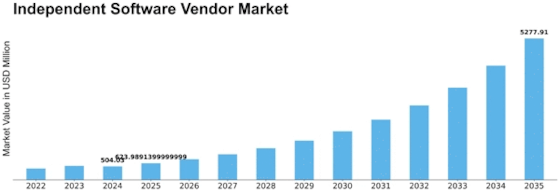
<p>The Independent Software Vendor Market was valued at 504.03 USD Million in 2024.</p>

What is the projected market valuation for the Independent Software Vendor Market in 2035?

<p>The market is projected to reach a valuation of 5277.91 USD Million by 2035.</p>

What is the expected CAGR for the Independent Software Vendor Market from 2025 to 2035?

<p>The expected CAGR during the forecast period 2025 - 2035 is 23.8%.</p>

Which companies are considered key players in the Independent Software Vendor Market?

<p>Key players include Microsoft, Oracle, SAP, Salesforce, Adobe, Intuit, ServiceNow, Atlassian, and VMware.</p>

What are the two main types of software offerings in the Independent Software Vendor Market?

The two main types are Cloud-based and On-premises solutions.

How did the Cloud-based segment perform in 2024?

The Cloud-based segment was valued at 2638.955 USD Million in 2024.

What was the valuation of the On-premises segment in 2024?

The On-premises segment also had a valuation of 2638.955 USD Million in 2024.

Which application segment had the highest valuation in 2024?

The Financial application segment was valued at 900.0 USD Million in 2024.

What is the projected growth for the Healthcare application segment by 2035?

The Healthcare application segment is expected to grow to 800.0 USD Million by 2035.

How does the performance of the E-Commerce segment compare to other application segments?

The E-Commerce segment was valued at 500.0 USD Million in 2024, indicating a moderate position compared to others.

Market Summary

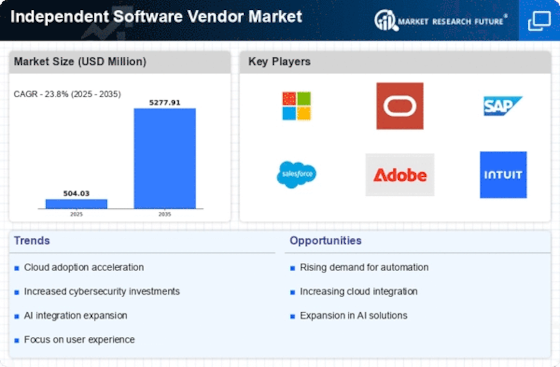
As per Market Research Future analysis, the Independent Software Vendor Market Size was estimated at 504.03 USD Million in 2024. The Independent Software Vendor industry is projected to grow from USD 624.0 Million in 2025 to USD 5277.91 Million by 2035, exhibiting a compound annual growth rate (CAGR) of 23.8% during the forecast period 2025 - 2035

Key Market Trends & Highlights

The Independent Software Vendor Market is experiencing a transformative shift towards niche solutions and subscription models, driven by technological advancements and evolving customer needs.

  • The market witnesses a rise in niche solutions tailored to specific industry needs, particularly in North America. A notable shift towards subscription models is reshaping revenue streams, especially within the cloud-based segment. Integration of advanced technologies, such as artificial intelligence, is becoming increasingly prevalent across various applications. Key market drivers include the increased demand for customization and the widespread adoption of cloud computing, particularly in the e-commerce and healthcare segments.

Market Size & Forecast

2024 Market Size 504.03 (USD Million)
2035 Market Size 5277.91 (USD Million)
CAGR (2025 - 2035) 23.8%
Largest Regional Market Share in 2024 North America

Major Players

<a href="https://www.microsoft.com/">Microsoft </a>(US), Oracle (US), SAP (DE), Salesforce (US), Adobe (US), Intuit (US), ServiceNow (US), Atlassian (AU), <a href="https://www.vmware.com/">VMware</a> (US)

Market Trends

The Independent Software Vendor Market is currently experiencing a dynamic evolution, driven by the increasing demand for specialized software solutions across various industries. Organizations are increasingly seeking tailored applications that address specific operational challenges, which has led to a proliferation of independent software vendors. These vendors are often more agile than larger corporations, allowing them to innovate rapidly and respond to market needs effectively. The integration of ISV cloud computing models allows vendors to accelerate deployment cycles, improve application performance, and enhance customer experience. As digital transformation accelerates, independent software vendors are increasingly leveraging cloud-native architectures to expand their market reach. Strong revenue growth for ISVs is expected during the forecast period, supported by rising demand for cloud-based solutions, subscription pricing models, and sector-specific software offerings.

Furthermore, the rise of cloud computing and mobile technologies has enabled these vendors to deliver their products more efficiently, enhancing accessibility and user experience. As businesses continue to prioritize digital transformation, the role of independent software vendors becomes increasingly pivotal in providing the necessary tools for success. In addition, the Independent Software Vendor Market is witnessing a shift towards subscription-based models, which offer flexibility and scalability for clients. This trend appears to be appealing to organizations that prefer predictable budgeting and ongoing support. Moreover, the integration of artificial intelligence and machine learning into software solutions is becoming more prevalent, suggesting that independent vendors are likely to leverage these technologies to enhance their offerings. Overall, the market seems poised for continued growth, with independent software vendors playing a crucial role in shaping the future of software development and deployment.

The global market for independent software vendors (ISVs) is expanding rapidly as organizations increasingly rely on specialized software solutions to drive digital transformation and operational efficiency. An independent software vendor (ISV) develops, markets, and sells software solutions that operate on third-party platforms, playing a crucial role in modern enterprise ecosystems. The rapid adoption of cloud platforms is reshaping the ISV industry, enabling independent software vendors to deliver scalable, secure, and globally accessible applications.

Rise of Niche Solutions

The Independent Software Vendor Market is increasingly characterized by the emergence of niche solutions tailored to specific industry needs. This trend indicates that vendors are focusing on developing specialized applications that cater to unique operational requirements, thereby enhancing efficiency and effectiveness for their clients.

The evolving ISV industry is expected to benefit from increasing enterprise IT spending, digital transformation initiatives, and expanding cloud ecosystems. The expansion of ISV cloud computing platforms enables vendors to optimize resource utilization, improve scalability, and accelerate innovation across application portfolios.

Shift to Subscription Models

A notable trend within the Independent Software Vendor Market is the transition towards subscription-based pricing models. This approach allows organizations to access software solutions with lower upfront costs, while also ensuring ongoing updates and support, which may lead to higher customer satisfaction and retention.

Integration of Advanced Technologies

The incorporation of advanced technologies, such as artificial intelligence and machine learning, is becoming more prevalent among independent software vendors. This trend suggests that vendors are likely to enhance their products with intelligent features, improving functionality and user experience, which could provide a competitive edge in the market.

Independent Software Vendors Market Market Drivers

Adoption of Cloud Computing

The Independent Software Vendor Market is significantly influenced by the widespread adoption of cloud computing technologies. Organizations are increasingly migrating their operations to the cloud, seeking enhanced flexibility, scalability, and cost-effectiveness. This shift allows independent software vendors to develop and deliver software solutions that leverage cloud infrastructure, enabling clients to access applications from anywhere, at any time. The cloud segment is expected to account for over 30% of the total software market by 2026, reflecting a substantial opportunity for independent vendors to provide cloud-based solutions. Furthermore, the integration of cloud services with existing software enhances collaboration and data sharing, which are critical in today’s interconnected business environment.

Growing Focus on Cybersecurity

In the Independent Software Vendor Market, the increasing emphasis on cybersecurity is a pivotal driver. As cyber threats become more sophisticated, businesses are prioritizing the protection of their digital assets. Independent software vendors are responding by incorporating advanced security features into their offerings, ensuring compliance with regulatory standards and safeguarding sensitive information. The cybersecurity software market is projected to reach USD 300 billion by 2026, indicating a significant opportunity for independent vendors to develop security-focused solutions. This trend not only enhances the value proposition of their software but also builds trust with clients, who are increasingly aware of the risks associated with data breaches and cyberattacks.

Expansion of Mobile Applications

The Independent Software Vendor Market is significantly shaped by the rapid expansion of mobile applications. With the proliferation of smartphones and tablets, businesses are increasingly investing in mobile solutions to enhance customer engagement and streamline operations. Independent software vendors are capitalizing on this trend by developing mobile applications that cater to diverse industries and user needs. The mobile application market is projected to exceed USD 400 billion by 2026, highlighting the immense potential for independent vendors to innovate and capture market share. This expansion not only facilitates improved accessibility for users but also allows businesses to leverage mobile technology for real-time data access and communication.

Increased Demand for Customization

The Independent Software Vendor Market experiences a notable surge in demand for customized software solutions. Businesses increasingly seek tailored applications that address specific operational needs, enhancing efficiency and productivity. This trend is driven by the recognition that one-size-fits-all solutions often fall short in meeting unique business requirements. As a result, independent software vendors are compelled to innovate and offer bespoke solutions, which may include personalized user interfaces and specialized functionalities. According to recent data, the customization segment within the software market is projected to grow at a compound annual growth rate of 10% over the next five years. This growth indicates a robust opportunity for independent software vendors to capitalize on the increasing preference for tailored software offerings.

Emergence of Artificial Intelligence

The Independent Software Vendor Market is witnessing a transformative impact from the emergence of artificial intelligence (AI) technologies. AI capabilities are being integrated into software solutions, enabling automation, predictive analytics, and enhanced decision-making processes. Independent software vendors are leveraging AI to create innovative applications that improve operational efficiency and provide deeper insights into business performance. The AI software market is anticipated to grow at a staggering rate, potentially reaching USD 190 billion by 2025. This growth presents a lucrative opportunity for independent vendors to differentiate their offerings and meet the evolving demands of businesses seeking to harness the power of AI for competitive advantage.

Market Segment Insights

By Type: Cloud-based (Largest) vs. On-premises (Fastest-Growing)

<p>The Independent Software Vendor (ISV) market showcases a significant inclination towards cloud-based solutions, which currently dominate in market share. This segment benefits from the increasing preference for flexibility, accessibility, and cost-effectiveness among businesses. With ongoing advancements in cloud infrastructure and services, cloud-based offerings have consolidated their position, attracting a wide range of customers looking to enhance operational efficiency without substantial upfront investments. On the other hand, On-premises solutions are witnessing a notable resurgence, characterized as the fastest-growing segment within the ISV market. This resurgence is primarily driven by organizations' growing concerns regarding data security and compliance. Many businesses are opting for on-premises software to maintain greater control over their data, which is pivotal in sectors where sensitive information is handled extensively.</p>

<p>Type: Cloud-based (Dominant) vs. On-premises (Emerging)</p>

<p>Cloud-based software solutions have emerged as the dominant force in the Independent Software Vendor market. Their inherent flexibility, ease of updates, and wide accessibility from various devices make them highly preferred by businesses of all sizes. These solutions cater particularly well to startups and SMEs, allowing them to leverage technology without heavy investments in infrastructure. In contrast, on-premises software is gaining traction as an emerging option, specifically among larger enterprises that require robust security and compliance measures. Organizations are increasingly investing in on-premises solutions to mitigate risks associated with data breaches and to comply with stringent regulatory requirements. Both segments reflect a dynamic landscape, where businesses weigh the trade-offs between flexibility and control.</p>

By Application: E-Commerce (Largest) vs. Healthcare (Fastest-Growing)

<p>In the Independent Software Vendor Market, the application segment demonstrates a diverse distribution of market share among its key players. E-Commerce leads the segment with substantial adoption across industries, driven by the surge in online shopping and digital transactions. Following closely, applications in logistics, retail, and healthcare are also prominent, each contributing significant shares to the overall market, emphasizing the critical role of these sectors in the digital landscape. As technology evolves, the growth of the application segment is increasingly influenced by digital transformation initiatives across various domains. Healthcare software solutions are emerging as the fastest-growing area, spurred on by advancements in telemedicine and health tech innovations. Concurrently, the growth within logistics and retail applications continues to be robust, driven by the need for efficiency and customer-centric solutions.</p>

<p>E-Commerce: Dominant vs. Healthcare: Emerging</p>

<p>The E-Commerce application stands out as a dominant force within the Independent Software Vendor Market due to its integral role in facilitating digital transactions and enhancing user experiences. This segment has leveraged cutting-edge technologies, such as AI and big data analytics, to optimize online shopping processes, ensuring an adaptive and efficient platform for both consumers and businesses. Its established market presence underscores the significance of e-commerce solutions in improving operational efficiencies and customer engagement. On the other hand, the Healthcare application is considered an emerging player with a rapidly expanding footprint in the software landscape. This growth is primarily driven by the demand for solutions that enhance patient care, improve operational efficiencies, and comply with regulatory standards. Innovations in telehealth, electronic health records, and health management applications are reshaping the healthcare sector, making this an exciting area for investment and development as more healthcare providers embrace technology.</p>

Get more detailed insights about Independent Software Vendor Market Research Report - Global Forecast till 2035

Regional Insights

North America : Technology Leadership and Innovation

North America remains the largest market for Independent Software Vendors Market (ISVs), holding approximately 45% of the global market share. The region's growth is driven by rapid technological advancements, increasing demand for cloud-based solutions, and supportive regulatory frameworks. The U.S. government has been actively promoting digital transformation initiatives, which further catalyze market expansion. Leading the charge are the United States and Canada, with the U.S. accounting for the majority of the market. Key players such as Microsoft, Oracle, and Salesforce dominate the landscape, leveraging their innovative capabilities to meet diverse customer needs. The competitive environment is characterized by continuous product development and strategic partnerships, ensuring that North America remains at the forefront of the ISV market.

Europe : Emerging Digital Ecosystem

Europe is witnessing significant growth in the Independent Software Vendor market, capturing around 30% of the global share. The region's expansion is fueled by increasing digitalization across various sectors, stringent data protection regulations, and a strong emphasis on cybersecurity. The European Union's Digital Single Market strategy is a key regulatory catalyst, promoting seamless access to digital services across member states. Germany and the United Kingdom are the leading countries in this market, with a robust presence of key players like SAP and Adobe. The competitive landscape is marked by a mix of established firms and innovative startups, driving a diverse range of software solutions. The region's focus on sustainability and compliance further enhances its attractiveness for ISVs, fostering a vibrant ecosystem.

Asia-Pacific : Rapid Growth and Innovation

Asia-Pacific is rapidly emerging as a significant player in the Independent Software Vendor market, holding approximately 20% of the global market share. The region's growth is driven by increasing internet penetration, a burgeoning middle class, and government initiatives aimed at fostering digital innovation. Countries like India and China are at the forefront, with supportive policies that encourage technology adoption and entrepreneurship. China and India are the leading countries in this market, showcasing a vibrant competitive landscape with numerous local and international players. Companies like Atlassian and VMware are expanding their footprint, catering to the diverse needs of businesses in the region. The focus on cloud computing and AI technologies is reshaping the software landscape, making Asia-Pacific a key area for future growth in the ISV sector.

Middle East and Africa : Untapped Market Potential

The Middle East and Africa region is gradually emerging in the Independent Software Vendor market, currently holding about 5% of the global share. The growth is primarily driven by increasing investments in technology infrastructure, a young population eager for digital solutions, and government initiatives aimed at enhancing the digital economy. Countries like the UAE and South Africa are leading this transformation, with various regulatory frameworks supporting innovation. The competitive landscape is still developing, with a mix of local startups and international players entering the market. Key players are beginning to establish a presence, focusing on sectors such as finance and healthcare. The region's unique challenges and opportunities present a fertile ground for ISVs looking to expand their offerings and capture market share.

Key Players and Competitive Insights

The Independent Software Vendor (ISV) Market is characterized by a dynamic competitive landscape, driven by rapid technological advancements and evolving customer demands. Leading companies operate as an ISV software vendor, delivering specialized applications across cloud, enterprise, and industry-specific platforms. Major players such as Microsoft, Oracle, and Salesforce represent prominent independent software vendor examples, demonstrating the scale and diversity of the ISV ecosystem. Major players such as Microsoft (US), Oracle (US), and Salesforce (US) are at the forefront, each adopting distinct strategies to enhance their market positioning. Microsoft (US) emphasizes innovation through its Azure cloud platform, which integrates AI capabilities, thereby appealing to businesses seeking digital transformation. Oracle (US), on the other hand, focuses on expanding its cloud services and enhancing its database solutions, positioning itself as a leader in enterprise resource planning. Salesforce (US) continues to leverage its customer relationship management (CRM) expertise, integrating AI and analytics to provide personalized customer experiences, which is increasingly vital in today’s market.
The ISV market exhibits a moderately fragmented structure, with numerous players competing across various segments. Key business tactics include localizing software solutions to meet regional needs and optimizing supply chains to enhance service delivery. The collective influence of these major players shapes the competitive environment, as they continuously innovate and adapt to market changes, thereby driving growth and customer engagement.
In August 2025, Microsoft (US) announced a strategic partnership with OpenAI to enhance its AI offerings within the Azure platform. This collaboration aims to integrate advanced AI capabilities into Microsoft’s cloud services, potentially revolutionizing how businesses utilize data analytics and machine learning. The strategic importance of this partnership lies in its potential to solidify Microsoft’s position as a leader in AI-driven cloud solutions, catering to the increasing demand for intelligent business applications.
In September 2025, Oracle (US) unveiled its latest cloud infrastructure enhancements, focusing on sustainability and energy efficiency. This initiative not only aligns with global sustainability goals but also positions Oracle as a forward-thinking player in the cloud market. By prioritizing eco-friendly practices, Oracle may attract environmentally conscious businesses, thereby expanding its customer base and enhancing its competitive edge.
In July 2025, Salesforce (US) launched a new suite of AI-driven tools designed to enhance customer engagement and streamline sales processes. This move reflects Salesforce’s commitment to innovation and its understanding of the critical role that AI plays in modern business operations. By providing businesses with advanced tools to analyze customer data and predict trends, Salesforce strengthens its market position and fosters deeper customer relationships.
As of October 2025, the ISV market is increasingly defined by trends such as digitalization, sustainability, and AI integration. Strategic alliances among key players are shaping the competitive landscape, fostering innovation and collaboration. The shift from price-based competition to a focus on technological advancement and supply chain reliability is evident, suggesting that future competitive differentiation will hinge on the ability to innovate and deliver value through advanced technology solutions.

Key Companies in the Independent Software Vendors Market include

Industry Developments

In October 2023, Cobo collaborated with Alibaba Cloud, monetizing the business ties in these technologies. The partnership between the two companies is expected to facilitate the advanced wallet infrastructure targeting international organizations within the Web3 space. Cobo’s specialized provision of digital assets solutions and Alibaba Cloud’s capabilities of secure and scalable cloud computing have therefore been highlighted as the purpose of the partnership. Also introduced was a Wallet-as-a-Service solution for developers and organizations.

Commvault is a data management and data protection software company that joined Ingenious Technologies in August 2023 to join the Amazon Web Services (AWS) ISV Workload Migration Program to assist customers' migration to AWS with better technical assistance.

In May 2023, Alibaba Cloud, a cloud computing company, launched a new ISV program to penetrate the Asia Pacific market. The company has intended to provide global ISVs with additional financial and technical benefits.

In March 2023, Datalogic S.p.A. announced the launch of its Global Independent Software Vendor Partner Program as Datalogic devices for mobile computers. This program is designed to improve brand exposure, generate leads and enhance its software development times.

In July 2022, TD SYNNEX launched the preferred partner program for independent software vendors optimally in the market. This ISV experience will leverage SaaS opportunities that are contract based.

In September 2021, Azure ISV Connect was launched by Microsoft, with plans to integrate into its first American cloud management platform, Microsoft Azure. This program encompasses a wide variety of activities, from resources through support, and even co-selling opportunities, clearly outlining for independent software vendors ways to develop their solutions and go to market with them.

In September 2020, Salesforce, Inc. announced the launch of their cloud initiative called Salesforce Industries, previously branded as Salesforce Vertical Solutions, helping independent software vendors targeting the financial, healthcare and manufacturing industries in delivering sector-specific solutions to the market.

Future Outlook

Independent Software Vendors Market Future Outlook

The Independent Software Vendor Market is projected to grow at a 23.8% CAGR from 2025 to 2035, driven by digital transformation, cloud adoption, and increasing demand for customized solutions.

New opportunities lie in:

  • <p>Development of AI-driven analytics platforms for real-time decision-making. Expansion into vertical-specific software solutions for niche markets. Integration of subscription-based models to enhance recurring revenue streams.</p>

By 2035, the market is expected to be robust, reflecting substantial growth and innovation.

Market Segmentation

Independent Software Vendors Market Type Outlook

  • Cloud-based
  • On-premises

Independent Software Vendors Market Application Outlook

  • E-Commerce
  • Logistics
  • Retail
  • Healthcare
  • Financial
  • Educational
  • Others

Report Scope

MARKET SIZE 2024 504.03 (USD Million)
MARKET SIZE 2025 624.0 (USD Million)
MARKET SIZE 2035 5277.91 (USD Million)
COMPOUND ANNUAL GROWTH RATE (CAGR) 23.8% (2025 - 2035)
REPORT COVERAGE Revenue Forecast, Competitive Landscape, Growth Factors, and Trends
BASE YEAR 2024
Market Forecast Period 2025 - 2035
Historical Data 2019 - 2024
Market Forecast Units USD Million
Key Companies Profiled Microsoft (US), Oracle (US), SAP (DE), Salesforce (US), Adobe (US), Intuit (US), ServiceNow (US), Atlassian (AU), VMware (US)
Segments Covered Type, Application, Region
Key Market Opportunities Integration of artificial intelligence and machine learning in software solutions enhances competitive advantage in the Independent Software Vendor Market.
Key Market Dynamics Rising demand for cloud-based solutions drives competition among Independent Software Vendors, influencing market dynamics and innovation.
Countries Covered North America, Europe, APAC, South America, MEA

FAQs

What is the current valuation of the Independent Software Vendor Market?

<p>The Independent Software Vendor Market was valued at 504.03 USD Million in 2024.</p>

What is the projected market valuation for the Independent Software Vendor Market in 2035?

<p>The market is projected to reach a valuation of 5277.91 USD Million by 2035.</p>

What is the expected CAGR for the Independent Software Vendor Market from 2025 to 2035?

<p>The expected CAGR during the forecast period 2025 - 2035 is 23.8%.</p>

Which companies are considered key players in the Independent Software Vendor Market?

<p>Key players include Microsoft, Oracle, SAP, Salesforce, Adobe, Intuit, ServiceNow, Atlassian, and VMware.</p>

What are the two main types of software offerings in the Independent Software Vendor Market?

The two main types are Cloud-based and On-premises solutions.

How did the Cloud-based segment perform in 2024?

The Cloud-based segment was valued at 2638.955 USD Million in 2024.

What was the valuation of the On-premises segment in 2024?

The On-premises segment also had a valuation of 2638.955 USD Million in 2024.

Which application segment had the highest valuation in 2024?

The Financial application segment was valued at 900.0 USD Million in 2024.

What is the projected growth for the Healthcare application segment by 2035?

The Healthcare application segment is expected to grow to 800.0 USD Million by 2035.

How does the performance of the E-Commerce segment compare to other application segments?

The E-Commerce segment was valued at 500.0 USD Million in 2024, indicating a moderate position compared to others.

  1. SECTION I: EXECUTIVE SUMMARY AND KEY HIGHLIGHTS
    1. | 1.1 EXECUTIVE SUMMARY
    2. | | 1.1.1 Market Overview
    3. | | 1.1.2 Key Findings
    4. | | 1.1.3 Market Segmentation
    5. | | 1.1.4 Competitive Landscape
    6. | | 1.1.5 Challenges and Opportunities
    7. | | 1.1.6 Future Outlook
  2. SECTION II: SCOPING, METHODOLOGY AND MARKET STRUCTURE
    1. | 2.1 MARKET INTRODUCTION
    2. | | 2.1.1 Definition
    3. | | 2.1.2 Scope of the study
    4. | | | 2.1.2.1 Research Objective
    5. | | | 2.1.2.2 Assumption
    6. | | | 2.1.2.3 Limitations
    7. | 2.2 RESEARCH METHODOLOGY
    8. | | 2.2.1 Overview
    9. | | 2.2.2 Data Mining
    10. | | 2.2.3 Secondary Research
    11. | | 2.2.4 Primary Research
    12. | | | 2.2.4.1 Primary Interviews and Information Gathering Process
    13. | | | 2.2.4.2 Breakdown of Primary Respondents
    14. | | 2.2.5 Forecasting Model
    15. | | 2.2.6 Market Size Estimation
    16. | | | 2.2.6.1 Bottom-Up Approach
    17. | | | 2.2.6.2 Top-Down Approach
    18. | | 2.2.7 Data Triangulation
    19. | | 2.2.8 Validation
  3. SECTION III: QUALITATIVE ANALYSIS
    1. | 3.1 MARKET DYNAMICS
    2. | | 3.1.1 Overview
    3. | | 3.1.2 Drivers
    4. | | 3.1.3 Restraints
    5. | | 3.1.4 Opportunities
    6. | 3.2 MARKET FACTOR ANALYSIS
    7. | | 3.2.1 Value chain Analysis
    8. | | 3.2.2 Porter's Five Forces Analysis
    9. | | | 3.2.2.1 Bargaining Power of Suppliers
    10. | | | 3.2.2.2 Bargaining Power of Buyers
    11. | | | 3.2.2.3 Threat of New Entrants
    12. | | | 3.2.2.4 Threat of Substitutes
    13. | | | 3.2.2.5 Intensity of Rivalry
    14. | | 3.2.3 COVID-19 Impact Analysis
    15. | | | 3.2.3.1 Market Impact Analysis
    16. | | | 3.2.3.2 Regional Impact
    17. | | | 3.2.3.3 Opportunity and Threat Analysis
  4. SECTION IV: QUANTITATIVE ANALYSIS
    1. | 4.1 Information and Communications Technology, BY Type (USD Million)
    2. | | 4.1.1 Cloud-based
    3. | | 4.1.2 On-premises
    4. | 4.2 Information and Communications Technology, BY Application (USD Million)
    5. | | 4.2.1 E-Commerce
    6. | | 4.2.2 Logistics
    7. | | 4.2.3 Retail
    8. | | 4.2.4 Healthcare
    9. | | 4.2.5 Financial
    10. | | 4.2.6 Educational
    11. | | 4.2.7 Others
    12. | 4.3 Information and Communications Technology, BY Region (USD Million)
    13. | | 4.3.1 North America
    14. | | | 4.3.1.1 US
    15. | | | 4.3.1.2 Canada
    16. | | 4.3.2 Europe
    17. | | | 4.3.2.1 Germany
    18. | | | 4.3.2.2 UK
    19. | | | 4.3.2.3 France
    20. | | | 4.3.2.4 Russia
    21. | | | 4.3.2.5 Italy
    22. | | | 4.3.2.6 Spain
    23. | | | 4.3.2.7 Rest of Europe
    24. | | 4.3.3 APAC
    25. | | | 4.3.3.1 China
    26. | | | 4.3.3.2 India
    27. | | | 4.3.3.3 Japan
    28. | | | 4.3.3.4 South Korea
    29. | | | 4.3.3.5 Malaysia
    30. | | | 4.3.3.6 Thailand
    31. | | | 4.3.3.7 Indonesia
    32. | | | 4.3.3.8 Rest of APAC
    33. | | 4.3.4 South America
    34. | | | 4.3.4.1 Brazil
    35. | | | 4.3.4.2 Mexico
    36. | | | 4.3.4.3 Argentina
    37. | | | 4.3.4.4 Rest of South America
    38. | | 4.3.5 MEA
    39. | | | 4.3.5.1 GCC Countries
    40. | | | 4.3.5.2 South Africa
    41. | | | 4.3.5.3 Rest of MEA
  5. SECTION V: COMPETITIVE ANALYSIS
    1. | 5.1 Competitive Landscape
    2. | | 5.1.1 Overview
    3. | | 5.1.2 Competitive Analysis
    4. | | 5.1.3 Market share Analysis
    5. | | 5.1.4 Major Growth Strategy in the Information and Communications Technology
    6. | | 5.1.5 Competitive Benchmarking
    7. | | 5.1.6 Leading Players in Terms of Number of Developments in the Information and Communications Technology
    8. | | 5.1.7 Key developments and growth strategies
    9. | | | 5.1.7.1 New Product Launch/Service Deployment
    10. | | | 5.1.7.2 Merger & Acquisitions
    11. | | | 5.1.7.3 Joint Ventures
    12. | | 5.1.8 Major Players Financial Matrix
    13. | | | 5.1.8.1 Sales and Operating Income
    14. | | | 5.1.8.2 Major Players R&D Expenditure. 2023
    15. | 5.2 Company Profiles
    16. | | 5.2.1 Microsoft (US)
    17. | | | 5.2.1.1 Financial Overview
    18. | | | 5.2.1.2 Products Offered
    19. | | | 5.2.1.3 Key Developments
    20. | | | 5.2.1.4 SWOT Analysis
    21. | | | 5.2.1.5 Key Strategies
    22. | | 5.2.2 Oracle (US)
    23. | | | 5.2.2.1 Financial Overview
    24. | | | 5.2.2.2 Products Offered
    25. | | | 5.2.2.3 Key Developments
    26. | | | 5.2.2.4 SWOT Analysis
    27. | | | 5.2.2.5 Key Strategies
    28. | | 5.2.3 SAP (DE)
    29. | | | 5.2.3.1 Financial Overview
    30. | | | 5.2.3.2 Products Offered
    31. | | | 5.2.3.3 Key Developments
    32. | | | 5.2.3.4 SWOT Analysis
    33. | | | 5.2.3.5 Key Strategies
    34. | | 5.2.4 Salesforce (US)
    35. | | | 5.2.4.1 Financial Overview
    36. | | | 5.2.4.2 Products Offered
    37. | | | 5.2.4.3 Key Developments
    38. | | | 5.2.4.4 SWOT Analysis
    39. | | | 5.2.4.5 Key Strategies
    40. | | 5.2.5 Adobe (US)
    41. | | | 5.2.5.1 Financial Overview
    42. | | | 5.2.5.2 Products Offered
    43. | | | 5.2.5.3 Key Developments
    44. | | | 5.2.5.4 SWOT Analysis
    45. | | | 5.2.5.5 Key Strategies
    46. | | 5.2.6 Intuit (US)
    47. | | | 5.2.6.1 Financial Overview
    48. | | | 5.2.6.2 Products Offered
    49. | | | 5.2.6.3 Key Developments
    50. | | | 5.2.6.4 SWOT Analysis
    51. | | | 5.2.6.5 Key Strategies
    52. | | 5.2.7 ServiceNow (US)
    53. | | | 5.2.7.1 Financial Overview
    54. | | | 5.2.7.2 Products Offered
    55. | | | 5.2.7.3 Key Developments
    56. | | | 5.2.7.4 SWOT Analysis
    57. | | | 5.2.7.5 Key Strategies
    58. | | 5.2.8 Atlassian (AU)
    59. | | | 5.2.8.1 Financial Overview
    60. | | | 5.2.8.2 Products Offered
    61. | | | 5.2.8.3 Key Developments
    62. | | | 5.2.8.4 SWOT Analysis
    63. | | | 5.2.8.5 Key Strategies
    64. | | 5.2.9 VMware (US)
    65. | | | 5.2.9.1 Financial Overview
    66. | | | 5.2.9.2 Products Offered
    67. | | | 5.2.9.3 Key Developments
    68. | | | 5.2.9.4 SWOT Analysis
    69. | | | 5.2.9.5 Key Strategies
    70. | 5.3 Appendix
    71. | | 5.3.1 References
    72. | | 5.3.2 Related Reports
  6. LIST OF FIGURES
    1. | 6.1 MARKET SYNOPSIS
    2. | 6.2 NORTH AMERICA MARKET ANALYSIS
    3. | 6.3 US MARKET ANALYSIS BY TYPE
    4. | 6.4 US MARKET ANALYSIS BY APPLICATION
    5. | 6.5 CANADA MARKET ANALYSIS BY TYPE
    6. | 6.6 CANADA MARKET ANALYSIS BY APPLICATION
    7. | 6.7 EUROPE MARKET ANALYSIS
    8. | 6.8 GERMANY MARKET ANALYSIS BY TYPE
    9. | 6.9 GERMANY MARKET ANALYSIS BY APPLICATION
    10. | 6.10 UK MARKET ANALYSIS BY TYPE
    11. | 6.11 UK MARKET ANALYSIS BY APPLICATION
    12. | 6.12 FRANCE MARKET ANALYSIS BY TYPE
    13. | 6.13 FRANCE MARKET ANALYSIS BY APPLICATION
    14. | 6.14 RUSSIA MARKET ANALYSIS BY TYPE
    15. | 6.15 RUSSIA MARKET ANALYSIS BY APPLICATION
    16. | 6.16 ITALY MARKET ANALYSIS BY TYPE
    17. | 6.17 ITALY MARKET ANALYSIS BY APPLICATION
    18. | 6.18 SPAIN MARKET ANALYSIS BY TYPE
    19. | 6.19 SPAIN MARKET ANALYSIS BY APPLICATION
    20. | 6.20 REST OF EUROPE MARKET ANALYSIS BY TYPE
    21. | 6.21 REST OF EUROPE MARKET ANALYSIS BY APPLICATION
    22. | 6.22 APAC MARKET ANALYSIS
    23. | 6.23 CHINA MARKET ANALYSIS BY TYPE
    24. | 6.24 CHINA MARKET ANALYSIS BY APPLICATION
    25. | 6.25 INDIA MARKET ANALYSIS BY TYPE
    26. | 6.26 INDIA MARKET ANALYSIS BY APPLICATION
    27. | 6.27 JAPAN MARKET ANALYSIS BY TYPE
    28. | 6.28 JAPAN MARKET ANALYSIS BY APPLICATION
    29. | 6.29 SOUTH KOREA MARKET ANALYSIS BY TYPE
    30. | 6.30 SOUTH KOREA MARKET ANALYSIS BY APPLICATION
    31. | 6.31 MALAYSIA MARKET ANALYSIS BY TYPE
    32. | 6.32 MALAYSIA MARKET ANALYSIS BY APPLICATION
    33. | 6.33 THAILAND MARKET ANALYSIS BY TYPE
    34. | 6.34 THAILAND MARKET ANALYSIS BY APPLICATION
    35. | 6.35 INDONESIA MARKET ANALYSIS BY TYPE
    36. | 6.36 INDONESIA MARKET ANALYSIS BY APPLICATION
    37. | 6.37 REST OF APAC MARKET ANALYSIS BY TYPE
    38. | 6.38 REST OF APAC MARKET ANALYSIS BY APPLICATION
    39. | 6.39 SOUTH AMERICA MARKET ANALYSIS
    40. | 6.40 BRAZIL MARKET ANALYSIS BY TYPE
    41. | 6.41 BRAZIL MARKET ANALYSIS BY APPLICATION
    42. | 6.42 MEXICO MARKET ANALYSIS BY TYPE
    43. | 6.43 MEXICO MARKET ANALYSIS BY APPLICATION
    44. | 6.44 ARGENTINA MARKET ANALYSIS BY TYPE
    45. | 6.45 ARGENTINA MARKET ANALYSIS BY APPLICATION
    46. | 6.46 REST OF SOUTH AMERICA MARKET ANALYSIS BY TYPE
    47. | 6.47 REST OF SOUTH AMERICA MARKET ANALYSIS BY APPLICATION
    48. | 6.48 MEA MARKET ANALYSIS
    49. | 6.49 GCC COUNTRIES MARKET ANALYSIS BY TYPE
    50. | 6.50 GCC COUNTRIES MARKET ANALYSIS BY APPLICATION
    51. | 6.51 SOUTH AFRICA MARKET ANALYSIS BY TYPE
    52. | 6.52 SOUTH AFRICA MARKET ANALYSIS BY APPLICATION
    53. | 6.53 REST OF MEA MARKET ANALYSIS BY TYPE
    54. | 6.54 REST OF MEA MARKET ANALYSIS BY APPLICATION
    55. | 6.55 KEY BUYING CRITERIA OF INFORMATION AND COMMUNICATIONS TECHNOLOGY
    56. | 6.56 RESEARCH PROCESS OF MRFR
    57. | 6.57 DRO ANALYSIS OF INFORMATION AND COMMUNICATIONS TECHNOLOGY
    58. | 6.58 DRIVERS IMPACT ANALYSIS: INFORMATION AND COMMUNICATIONS TECHNOLOGY
    59. | 6.59 RESTRAINTS IMPACT ANALYSIS: INFORMATION AND COMMUNICATIONS TECHNOLOGY
    60. | 6.60 SUPPLY / VALUE CHAIN: INFORMATION AND COMMUNICATIONS TECHNOLOGY
    61. | 6.61 INFORMATION AND COMMUNICATIONS TECHNOLOGY, BY TYPE, 2024 (% SHARE)
    62. | 6.62 INFORMATION AND COMMUNICATIONS TECHNOLOGY, BY TYPE, 2024 TO 2035 (USD Million)
    63. | 6.63 INFORMATION AND COMMUNICATIONS TECHNOLOGY, BY APPLICATION, 2024 (% SHARE)
    64. | 6.64 INFORMATION AND COMMUNICATIONS TECHNOLOGY, BY APPLICATION, 2024 TO 2035 (USD Million)
    65. | 6.65 BENCHMARKING OF MAJOR COMPETITORS
  7. LIST OF TABLES
    1. | 7.1 LIST OF ASSUMPTIONS
    2. | | 7.1.1
    3. | 7.2 North America MARKET SIZE ESTIMATES; FORECAST
    4. | | 7.2.1 BY TYPE, 2025-2035 (USD Million)
    5. | | 7.2.2 BY APPLICATION, 2025-2035 (USD Million)
    6. | 7.3 US MARKET SIZE ESTIMATES; FORECAST
    7. | | 7.3.1 BY TYPE, 2025-2035 (USD Million)
    8. | | 7.3.2 BY APPLICATION, 2025-2035 (USD Million)
    9. | 7.4 Canada MARKET SIZE ESTIMATES; FORECAST
    10. | | 7.4.1 BY TYPE, 2025-2035 (USD Million)
    11. | | 7.4.2 BY APPLICATION, 2025-2035 (USD Million)
    12. | 7.5 Europe MARKET SIZE ESTIMATES; FORECAST
    13. | | 7.5.1 BY TYPE, 2025-2035 (USD Million)
    14. | | 7.5.2 BY APPLICATION, 2025-2035 (USD Million)
    15. | 7.6 Germany MARKET SIZE ESTIMATES; FORECAST
    16. | | 7.6.1 BY TYPE, 2025-2035 (USD Million)
    17. | | 7.6.2 BY APPLICATION, 2025-2035 (USD Million)
    18. | 7.7 UK MARKET SIZE ESTIMATES; FORECAST
    19. | | 7.7.1 BY TYPE, 2025-2035 (USD Million)
    20. | | 7.7.2 BY APPLICATION, 2025-2035 (USD Million)
    21. | 7.8 France MARKET SIZE ESTIMATES; FORECAST
    22. | | 7.8.1 BY TYPE, 2025-2035 (USD Million)
    23. | | 7.8.2 BY APPLICATION, 2025-2035 (USD Million)
    24. | 7.9 Russia MARKET SIZE ESTIMATES; FORECAST
    25. | | 7.9.1 BY TYPE, 2025-2035 (USD Million)
    26. | | 7.9.2 BY APPLICATION, 2025-2035 (USD Million)
    27. | 7.10 Italy MARKET SIZE ESTIMATES; FORECAST
    28. | | 7.10.1 BY TYPE, 2025-2035 (USD Million)
    29. | | 7.10.2 BY APPLICATION, 2025-2035 (USD Million)
    30. | 7.11 Spain MARKET SIZE ESTIMATES; FORECAST
    31. | | 7.11.1 BY TYPE, 2025-2035 (USD Million)
    32. | | 7.11.2 BY APPLICATION, 2025-2035 (USD Million)
    33. | 7.12 Rest of Europe MARKET SIZE ESTIMATES; FORECAST
    34. | | 7.12.1 BY TYPE, 2025-2035 (USD Million)
    35. | | 7.12.2 BY APPLICATION, 2025-2035 (USD Million)
    36. | 7.13 APAC MARKET SIZE ESTIMATES; FORECAST
    37. | | 7.13.1 BY TYPE, 2025-2035 (USD Million)
    38. | | 7.13.2 BY APPLICATION, 2025-2035 (USD Million)
    39. | 7.14 China MARKET SIZE ESTIMATES; FORECAST
    40. | | 7.14.1 BY TYPE, 2025-2035 (USD Million)
    41. | | 7.14.2 BY APPLICATION, 2025-2035 (USD Million)
    42. | 7.15 India MARKET SIZE ESTIMATES; FORECAST
    43. | | 7.15.1 BY TYPE, 2025-2035 (USD Million)
    44. | | 7.15.2 BY APPLICATION, 2025-2035 (USD Million)
    45. | 7.16 Japan MARKET SIZE ESTIMATES; FORECAST
    46. | | 7.16.1 BY TYPE, 2025-2035 (USD Million)
    47. | | 7.16.2 BY APPLICATION, 2025-2035 (USD Million)
    48. | 7.17 South Korea MARKET SIZE ESTIMATES; FORECAST
    49. | | 7.17.1 BY TYPE, 2025-2035 (USD Million)
    50. | | 7.17.2 BY APPLICATION, 2025-2035 (USD Million)
    51. | 7.18 Malaysia MARKET SIZE ESTIMATES; FORECAST
    52. | | 7.18.1 BY TYPE, 2025-2035 (USD Million)
    53. | | 7.18.2 BY APPLICATION, 2025-2035 (USD Million)
    54. | 7.19 Thailand MARKET SIZE ESTIMATES; FORECAST
    55. | | 7.19.1 BY TYPE, 2025-2035 (USD Million)
    56. | | 7.19.2 BY APPLICATION, 2025-2035 (USD Million)
    57. | 7.20 Indonesia MARKET SIZE ESTIMATES; FORECAST
    58. | | 7.20.1 BY TYPE, 2025-2035 (USD Million)
    59. | | 7.20.2 BY APPLICATION, 2025-2035 (USD Million)
    60. | 7.21 Rest of APAC MARKET SIZE ESTIMATES; FORECAST
    61. | | 7.21.1 BY TYPE, 2025-2035 (USD Million)
    62. | | 7.21.2 BY APPLICATION, 2025-2035 (USD Million)
    63. | 7.22 South America MARKET SIZE ESTIMATES; FORECAST
    64. | | 7.22.1 BY TYPE, 2025-2035 (USD Million)
    65. | | 7.22.2 BY APPLICATION, 2025-2035 (USD Million)
    66. | 7.23 Brazil MARKET SIZE ESTIMATES; FORECAST
    67. | | 7.23.1 BY TYPE, 2025-2035 (USD Million)
    68. | | 7.23.2 BY APPLICATION, 2025-2035 (USD Million)
    69. | 7.24 Mexico MARKET SIZE ESTIMATES; FORECAST
    70. | | 7.24.1 BY TYPE, 2025-2035 (USD Million)
    71. | | 7.24.2 BY APPLICATION, 2025-2035 (USD Million)
    72. | 7.25 Argentina MARKET SIZE ESTIMATES; FORECAST
    73. | | 7.25.1 BY TYPE, 2025-2035 (USD Million)
    74. | | 7.25.2 BY APPLICATION, 2025-2035 (USD Million)
    75. | 7.26 Rest of South America MARKET SIZE ESTIMATES; FORECAST
    76. | | 7.26.1 BY TYPE, 2025-2035 (USD Million)
    77. | | 7.26.2 BY APPLICATION, 2025-2035 (USD Million)
    78. | 7.27 MEA MARKET SIZE ESTIMATES; FORECAST
    79. | | 7.27.1 BY TYPE, 2025-2035 (USD Million)
    80. | | 7.27.2 BY APPLICATION, 2025-2035 (USD Million)
    81. | 7.28 GCC Countries MARKET SIZE ESTIMATES; FORECAST
    82. | | 7.28.1 BY TYPE, 2025-2035 (USD Million)
    83. | | 7.28.2 BY APPLICATION, 2025-2035 (USD Million)
    84. | 7.29 South Africa MARKET SIZE ESTIMATES; FORECAST
    85. | | 7.29.1 BY TYPE, 2025-2035 (USD Million)
    86. | | 7.29.2 BY APPLICATION, 2025-2035 (USD Million)
    87. | 7.30 Rest of MEA MARKET SIZE ESTIMATES; FORECAST
    88. | | 7.30.1 BY TYPE, 2025-2035 (USD Million)
    89. | | 7.30.2 BY APPLICATION, 2025-2035 (USD Million)
    90. | 7.31 PRODUCT LAUNCH/PRODUCT DEVELOPMENT/APPROVAL
    91. | | 7.31.1
    92. | 7.32 ACQUISITION/PARTNERSHIP
    93. | | 7.32.1

Information and Communications Technology Market Segmentation

Information and Communications Technology By Type (USD Million, 2025-2035)

  • Cloud-based
  • On-premises

Information and Communications Technology By Application (USD Million, 2025-2035)

  • E-Commerce
  • Logistics
  • Retail
  • Healthcare
  • Financial
  • Educational
  • Others
Infographic

Free Sample Request

Kindly complete the form below to receive a free sample of this Report

Get Free Sample

Customer Strories

Compare Licence

×
Features License Type
Single User Multiuser License Enterprise User
Price $4,950 $5,950 $7,250
Maximum User Access Limit 1 User Upto 10 Users Unrestricted Access Throughout the Organization
Free Customization
Direct Access to Analyst
Deliverable Format
Platform Access
Discount on Next Purchase 10% 15% 15%
Printable Versions