Request Free Sample ×

Kindly complete the form below to receive a free sample of this Report

* Please use a valid business email

Leading companies partner with us for data-driven Insights

clients tt-cursor
Hero Background
English
Chinese
French
Japanese
Korean
German
Spanish

Hydrogen Generation Market Trends

ID: MRFR/EnP/5561-HCR
100 Pages
Anshula Mandaokar
March 2026

Hydrogen Generation Market Research Report Information By Source (Blue Hydrogen, Green Hydrogen and Grey Hydrogen), By Technology (Steam Methane Reforming (SMR), Partial Oxidation (POX), Coal Gasification and Electrolysis), By Application (Petroleum Refinery, Ammonia Production, Methanol Production, Transportation, Power Generation and Other Applications), and By Region - Growth & Industry Forecast to 2035

Share:
Download PDF ×

We do not share your information with anyone. However, we may send you emails based on your report interest from time to time. You may contact us at any time to opt-out.

Hydrogen Generation Market Infographic
Purchase Options

Market Trends

Key Emerging Trends in the Hydrogen Generation Market

The market for hydrogen generation is going through critical changes because of the rising significance of hydrogen as a harmless to the ecosystem and practical energy asset. As the worldwide local area endeavours to battle environmental change, hydrogen has arisen as a huge member in the energy area. Green hydrogen creation strategies, which are driven by feasible energy sources like sunlight based or wind, are acquiring prevalence because of their decreased biological impression. This is predictable with worldwide drives to lessen fossil fuel byproducts and accomplish a more practical energy portfolio. A huge expansion in joint efforts and organizations among key industry members has portrayed the market. Associations are coming to recognize the significance of cooperative undertakings to grow hydrogen assembling and foundation. The target of these joint efforts is to overcome impediments including significant creation costs and lacking foundation, subsequently developing a hydrogen environment that is stronger and related. The advancement of new innovations altogether impacts the market patterns of hydrogen age. Electrolysis innovation progressions, including the execution of PEM electrolyzes, are increasing hydrogen's practicality as an energy transporter. Raised adaptability, reduced energy utilization, and improved effectiveness are delivering electrolysis an undeniably achievable and engaging option for the age of hydrogen. Strategy systems and government support are vital elements in deciding the direction of the hydrogen generation industry. Various countries are carrying out administrative measures, appropriations, and motivations to advance the utilization of hydrogen as a feature of their decarbonization endeavours. These approaches cultivate a climate that is helpful for business interest in hydrogen advancements, in this way animating the extension of the market. Furthermore, the market is going through a change toward a more extensive assortment of end-use applications for hydrogen. Hydrogen, which has generally been utilized in the substance and refining enterprises, is turning out to be progressively huge in the power age and transportation areas because of the multiplication of energy component innovation in the car area. The usage of energy components or the immediate burning of hydrogen into power age frameworks is turning into a rising concentration with an end goal to decrease fossil fuel byproducts in the power business. A worldwide obligation to environmentally friendly power and supportability is causing a huge change in the hydrogen age market. This envelops different end-use applications, mechanical progressions, key associations, government backing, and environmental hydrogen creation. With the continuation of these examples, the market is situated for development and will essentially add to the shift towards an energy future that is both manageable and low carbon.


Author
Author Profile
Anshula Mandaokar
Team Lead - Research

Anshula Mandaokar holds an academic degree in Chemical Engineering and has been contributing to the field for more than 5 years. She has expertise in Market Research and Business Consulting and serves as a Team Lead for a reputed Market Research firm under the Chemicals and Materials domain spectrum. She has worked on multiple projects, generating explicit results in a quick turnaround time. Her understanding of data interpretation justifies her role as a leader.

Leave a Comment

FAQs

What is the current valuation of the Hydrogen Generation Market?

<p>The Hydrogen Generation Market was valued at 134.05 USD Billion in 2024.</p>

What is the projected market valuation for the Hydrogen Generation Market by 2035?

<p>The market is projected to reach 361.94 USD Billion by 2035.</p>

What is the expected CAGR for the Hydrogen Generation Market during the forecast period 2025 - 2035?

<p>The expected CAGR for the Hydrogen Generation Market is 9.45% from 2025 to 2035.</p>

Which segment of hydrogen generation has the highest valuation in 2024?

<p>In 2024, Grey Hydrogen had the highest valuation at 64.05 USD Billion.</p>

What are the projected valuations for Blue Hydrogen and Green Hydrogen by 2035?

<p>By 2035, Blue Hydrogen is projected to reach 100.0 USD Billion, while Green Hydrogen may reach 90.0 USD Billion.</p>

Which technology is expected to dominate the Hydrogen Generation Market?

<p>Steam Methane Reforming (SMR) is expected to dominate, with a projected valuation of 160.0 USD Billion by 2035.</p>

What applications are driving growth in the Hydrogen Generation Market?

<p>Ammonia Production and Petroleum Refinery are key applications, projected to reach 100.0 USD Billion and 80.0 USD Billion, respectively, by 2035.</p>

Who are the key players in the Hydrogen Generation Market?

<p>Key players include Air Products and Chemicals, Linde, Nel ASA, Siemens Energy, and Plug Power.</p>

What is the projected valuation for Electrolysis technology by 2035?

<p>Electrolysis technology is projected to reach 71.94 USD Billion by 2035.</p>

How does the market for Hydrogen Generation compare across different applications?

<p>In 2024, the market for Ammonia Production was valued at 40.0 USD Billion, while Transportation was valued at 15.0 USD Billion.</p>

Market Summary

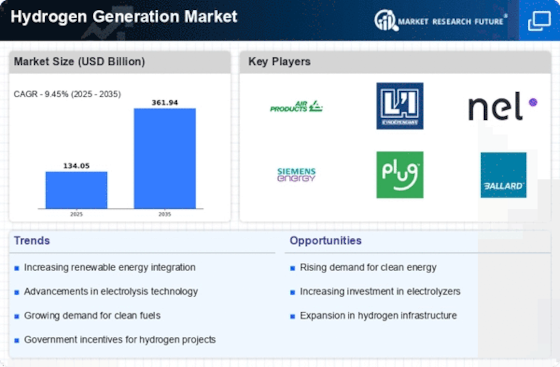
As per Market Research Future analysis, the Hydrogen Generation Market Size was estimated at 134.05 USD Billion in 2024. The hydrogen generation industry is projected to grow from 146.72 USD Billion in 2025 to 361.94 USD Billion by 2035, exhibiting a compound annual growth rate (CAGR) of 9.4% during the forecast period 2025 - 2035

Key Market Trends & Highlights

The Hydrogen Generation Market is poised for substantial growth driven by technological advancements and increasing regulatory support.

  • North America remains the largest market for hydrogen generation, driven by robust infrastructure and investment. Asia-Pacific is emerging as the fastest-growing region, fueled by rising energy demands and government initiatives. Blue Hydrogen continues to dominate the market, while Green Hydrogen is rapidly gaining traction as a sustainable alternative. The rising demand for clean energy and supportive government policies are key drivers propelling market expansion.

Market Size & Forecast

2024 Market Size 134.05 (USD Billion)
2035 Market Size 361.94 (USD Billion)
CAGR (2025 - 2035) 9.45%
Largest Regional Market Share in 2024 Asia Pacific

Major Players

Air Products and Chemicals (US), <a href="https://www.linde-engineering.com/path-to-netzero/hydrogen">Linde </a>(DE), Nel ASA (NO), Siemens Energy (DE), Plug Power (US), Ballard Power Systems (CA), Hydrogenics (CA), ITM Power (GB), McPhy Energy (FR)

Market Trends

The Hydrogen Generation Market is currently experiencing a transformative phase, driven by a growing emphasis on sustainable energy solutions. As global awareness of climate change intensifies, various industries are increasingly seeking cleaner alternatives to traditional fossil fuels. This shift is prompting investments in hydrogen production technologies, which are perceived as pivotal in achieving carbon neutrality. The market landscape is characterized by a diverse array of production methods, including electrolysis, steam methane reforming, and biomass gasification, each offering unique advantages and challenges. Furthermore, advancements in technology are likely to enhance efficiency and reduce costs, thereby fostering wider adoption across multiple sectors. In addition to technological innovations, regulatory frameworks are evolving to support the Hydrogen Generation Market. Governments worldwide are implementing policies aimed at promoting hydrogen as a key component of their energy strategies. This regulatory support, coupled with increasing collaboration between public and private sectors, appears to be accelerating the development of hydrogen infrastructure. As a result, the market is poised for substantial growth, with potential applications spanning transportation, industrial processes, and energy storage. The future of the Hydrogen Generation Market seems promising, as stakeholders continue to explore new avenues for harnessing this versatile energy carrier.

Technological Advancements

Recent innovations in hydrogen production technologies are reshaping the Hydrogen Generation Market. Enhanced electrolysis methods and improved catalysts are likely to increase efficiency and lower production costs, making hydrogen more accessible for various applications.

Regulatory Support

Government initiatives aimed at promoting hydrogen as a clean energy source are gaining momentum. Policies and incentives designed to encourage investment in hydrogen infrastructure may significantly influence market dynamics and drive growth.

Diverse Applications

The versatility of hydrogen is becoming increasingly apparent, with potential applications spanning transportation, energy storage, and industrial processes. This broad range of uses suggests that the Hydrogen Generation Market could expand into new sectors, further driving demand.

Hydrogen Generation Market Market Drivers

Rising Demand for Clean Energy

The Hydrogen Generation Market is experiencing a notable surge in demand for clean energy solutions. As nations strive to meet their climate goals, the transition from fossil fuels to renewable energy sources becomes increasingly critical. Hydrogen, recognized for its potential as a clean fuel, is gaining traction across various sectors, including transportation and industrial applications. According to recent data, the hydrogen market is projected to reach a value of approximately USD 200 billion by 2030, driven by the need for sustainable energy alternatives. This growing demand for hydrogen as a clean energy carrier is likely to propel the Hydrogen Generation Market forward, fostering innovation and investment in hydrogen production technologies.

Government Initiatives and Policies

The Hydrogen Generation Market is significantly influenced by government initiatives and supportive policies aimed at promoting hydrogen as a key energy source. Various governments are implementing strategies to reduce carbon emissions and enhance energy security, which often includes substantial investments in hydrogen infrastructure. For instance, several countries have established national hydrogen strategies, allocating billions of dollars to support research, development, and deployment of hydrogen technologies. These initiatives not only create a favorable regulatory environment but also stimulate private sector investment, thereby accelerating the growth of the Hydrogen Generation Market. The alignment of public and private efforts is expected to enhance the market's trajectory in the coming years.

Diverse Applications Across Industries

The Hydrogen Generation Market is characterized by its diverse applications across multiple sectors, including transportation, power generation, and industrial processes. Hydrogen is increasingly being utilized as a fuel for fuel cell vehicles, as well as a feedstock in chemical manufacturing and refining processes. The versatility of hydrogen as an energy carrier is driving its adoption in various industries, which is expected to expand the market significantly. For instance, the transportation sector is projected to account for a substantial share of hydrogen demand, with fuel cell vehicles gaining popularity. This broad range of applications is likely to enhance the growth prospects of the Hydrogen Generation Market, as industries seek cleaner alternatives to traditional energy sources.

Growing Investment in Hydrogen Infrastructure

The Hydrogen Generation Market is bolstered by a growing investment in hydrogen infrastructure, which is crucial for the widespread adoption of hydrogen technologies. Investments in production facilities, storage solutions, and distribution networks are essential to support the burgeoning hydrogen economy. Recent reports indicate that investments in hydrogen infrastructure are expected to exceed USD 50 billion by 2025, reflecting a strong commitment from both public and private sectors. This influx of capital is likely to enhance the accessibility and availability of hydrogen, thereby facilitating its integration into various energy systems. As infrastructure develops, the Hydrogen Generation Market is poised for substantial growth.

Technological Innovations in Hydrogen Production

The Hydrogen Generation Market is witnessing rapid technological innovations that enhance the efficiency and cost-effectiveness of hydrogen production methods. Advancements in electrolysis, steam methane reforming, and biomass gasification are transforming the landscape of hydrogen generation. For example, the development of high-efficiency electrolyzers is reducing the cost of green hydrogen production, making it more competitive with traditional fossil fuel sources. As technology continues to evolve, the Hydrogen Generation Market is likely to benefit from improved production processes, which could lead to a significant reduction in the levelized cost of hydrogen. This technological progress is essential for meeting the increasing demand for hydrogen across various applications.

Market Segment Insights

By Source: Blue Hydrogen (Largest) vs. Green Hydrogen (Fastest-Growing)

<p>In the Hydrogen Generation Market, Blue Hydrogen occupies a substantial portion of the market share, primarily due to its produced hydrogen from natural gas with integrated carbon capture and storage technologies. This segment benefits from established infrastructure and governmental support which positions it as a dominant player. In contrast, Green Hydrogen, generated from renewable energy sources, is rapidly gaining attention and investment, signaling an increasing shift towards sustainability and de-carbonization goals. As companies and nations commit to carbon neutrality, Green Hydrogen's share is expected to significantly grow.</p>

<p>Blue Hydrogen (Dominant) vs. Green Hydrogen (Emerging)</p>

<p>Blue Hydrogen is characterized by its production from natural gas, incorporating carbon capture technologies to mitigate emissions. This makes it a transitional fuel option favored by many industries seeking a cleaner alternative while relying on existing fossil fuel infrastructure. Meanwhile, Green Hydrogen is derived from renewable energy sources like wind or solar, representing an innovative and sustainable approach to hydrogen production. Its rapid technological advancements and decreasing costs are making it increasingly competitive. The growth of Green Hydrogen is propelled by a robust policy push for green technologies and a global focus on reducing greenhouse gas emissions, setting the stage for a significant market transformation.</p>

By Technology: Steam Methane Reforming (Largest) vs. Electrolysis (Fastest-Growing)

<p>In the Hydrogen Generation Market, Steam Methane Reforming (SMR) holds the largest share owing to its established infrastructure and cost-effectiveness. It currently dominates the market landscape in terms of production volume, making it a preferred choice for several industrial applications. On the other hand, Electrolysis, although it has a smaller current share, is witnessing rapid growth due to increasing investments in renewable energy technologies and government incentives encouraging clean hydrogen production. The growth trends in this segment are significantly driven by the global push towards sustainability and the decarbonization of energy sectors. Electrolysis is emerging as the fastest-growing method due to technological advancements and decreasing costs of renewable electricity. Meanwhile, SMR continues to evolve with carbon capture technologies, solidifying its market presence as industries look to balance economic feasibility with environmental responsibilities.</p>

<p>Technology: SMR (Dominant) vs. Electrolysis (Emerging)</p>

<p>Steam Methane Reforming (SMR) is currently the dominant technology in hydrogen generation, accounting for a substantial share of the market due to its efficiency and existing infrastructure. SMR utilizes natural gas as the primary feedstock, converting it into hydrogen through a reaction with steam. However, as the world transitions towards greener practices, Electrolysis is emerging as an appealing alternative. It employs electricity to split water into hydrogen and oxygen, making it a clean production method when powered by renewable sources. The dual dynamic of established dominance versus innovative emergence positions SMR as a necessary transitional technology while Electrolysis is set to gain traction as the industry pivots to low carbon emissions.</p>

By Application: Ammonia Production (Largest) vs. Transportation (Fastest-Growing)

<p>The Hydrogen Generation Market has seen a diverse application distribution, with Ammonia Production holding the largest share due to its critical role as a feedstock in fertilizer production. Following closely are Petroleum Refinery and Methanol Production, which also contribute significantly to hydrogen utilization in industrial processes. Transportation and Power Generation, although they have smaller current shares, are gaining traction as sustainability initiatives push for greener alternatives, making them vital components of the market landscape.</p>

<p>Ammonia Production (Dominant) vs. Transportation (Emerging)</p>

<p>Ammonia Production remains the dominant application in the Hydrogen Generation Market due to its essential role in producing nitrogenous fertilizers, which are crucial for global food supply. The consistency and reliability of hydrogen produced for ammonia synthesis underscore its importance. In contrast, Transportation is emerging as a critical application, driven by advancements in fuel cell technologies and increasing regulatory pressures for cleaner emissions. The automotive industry is exploring hydrogen as an alternative to fossil fuels, promoting innovation and investment in hydrogen infrastructure, which significantly enhances its market attractiveness.</p>

Get more detailed insights about Hydrogen Generation Market Research Report - Global Forecast till 2035

Regional Insights

North America : Innovation and Investment Hub

North America is poised to dominate the hydrogen generation market, driven by significant investments in clean energy technologies and supportive regulatory frameworks. The region is expected to hold approximately 45% of the global market share by 2025, with the U.S. and Canada leading the charge. Key drivers include government incentives for hydrogen production and a growing demand for sustainable energy solutions. The U.S. is the largest market, followed closely by Canada, both fostering a competitive landscape with major players like Air Products and Chemicals, Plug Power, and Ballard Power Systems. These companies are actively engaged in innovative projects and partnerships to enhance hydrogen production efficiency. The presence of advanced infrastructure and research institutions further strengthens the market position in North America.

Europe : Sustainable Energy Transition Leader

Europe is rapidly emerging as a leader in the hydrogen generation market, driven by ambitious climate goals and regulatory support. The region is expected to capture around 30% of the global market share by 2025, with Germany and France being the largest contributors. The European Union's Green Deal and national hydrogen strategies are pivotal in fostering investment and innovation in hydrogen technologies. Germany is at the forefront, with significant initiatives from companies like Linde and Siemens Energy. France and the UK are also key players, focusing on developing hydrogen infrastructure and fostering public-private partnerships. The competitive landscape is characterized by collaboration among industry leaders and government bodies, aiming to position Europe as a global hydrogen hub.

Asia-Pacific : Emerging Market with Potential

Asia-Pacific is witnessing a surge in hydrogen generation initiatives, driven by increasing energy demands and a shift towards cleaner energy sources. The region is projected to hold about 20% of the global market share by 2025, with countries like Japan and South Korea leading the charge. Government policies promoting hydrogen as a key energy carrier are crucial in shaping market dynamics and attracting investments. Japan is a pioneer in hydrogen technology, with companies like Nel ASA and ITM Power actively participating in the market. South Korea is also making significant strides, focusing on hydrogen fuel cell technology and infrastructure development. The competitive landscape is evolving, with both domestic and international players vying for market share, supported by favorable government initiatives and funding.

Middle East and Africa : Resource-Rich Hydrogen Frontier

The Middle East and Africa region is emerging as a potential player in the hydrogen generation market, driven by abundant natural resources and increasing interest in renewable energy. The region is expected to hold around 5% of the global market share by 2025, with countries like Saudi Arabia and South Africa leading the way. Government initiatives aimed at diversifying energy sources and reducing carbon emissions are key growth drivers. Saudi Arabia is investing heavily in hydrogen projects, positioning itself as a future hydrogen exporter. South Africa is also exploring hydrogen as part of its energy transition strategy. The competitive landscape is characterized by a mix of local and international players, with a focus on developing infrastructure and technology to harness hydrogen's potential.

Key Players and Competitive Insights

The Hydrogen Generation Market is currently characterized by a dynamic competitive landscape, driven by increasing demand for clean energy solutions and the global push towards decarbonization. Key players such as Air Products and Chemicals (US), Linde (DE), and Nel ASA (NO) are strategically positioning themselves through innovation and partnerships. Air Products and Chemicals (US) focuses on large-scale hydrogen production and has been investing heavily in infrastructure to support hydrogen as a fuel source. Linde (DE) emphasizes technological advancements in hydrogen production and distribution, while Nel ASA (NO) is enhancing its electrolyzer technology to improve efficiency and reduce costs. Collectively, these strategies are shaping a competitive environment that prioritizes technological innovation and sustainability. In terms of business tactics, companies are increasingly localizing manufacturing and optimizing supply chains to enhance operational efficiency. The Hydrogen Generation Market appears moderately fragmented, with several key players exerting influence over various segments. This fragmentation allows for niche players to emerge, while larger companies leverage their resources to dominate the market. The collective influence of these key players is significant, as they drive advancements in technology and infrastructure, thereby shaping market dynamics. In September 2025, Linde (DE) announced a partnership with a major automotive manufacturer to develop hydrogen fueling stations across Europe. This strategic move is likely to enhance Linde's market presence and facilitate the adoption of hydrogen fuel cell vehicles, aligning with the broader trend of increasing hydrogen infrastructure. The partnership underscores Linde's commitment to expanding its operational footprint and supporting the transition to sustainable transportation. In August 2025, Nel ASA (NO) secured a contract to supply electrolyzers for a large-scale green hydrogen project in North America. This development is pivotal as it not only reinforces Nel's position as a leader in electrolyzer technology but also highlights the growing demand for green hydrogen solutions. The project is expected to significantly contribute to the decarbonization efforts in the region, showcasing Nel's strategic focus on sustainability and innovation. In July 2025, Air Products and Chemicals (US) completed the acquisition of a hydrogen production facility in the Gulf Coast region. This acquisition is strategically important as it enhances Air Products' production capacity and strengthens its supply chain capabilities. The facility is expected to play a crucial role in meeting the increasing demand for hydrogen in various industrial applications, thereby solidifying Air Products' competitive edge in the market. As of October 2025, current competitive trends in the Hydrogen Generation Market are increasingly defined by digitalization, sustainability, and the integration of advanced technologies such as AI. Strategic alliances are becoming more prevalent, as companies recognize the need to collaborate to enhance their technological capabilities and market reach. Looking ahead, competitive differentiation is likely to evolve from traditional price-based competition to a focus on innovation, technological advancements, and supply chain reliability. This shift indicates a growing emphasis on creating value through sustainable practices and cutting-edge solutions.

Key Companies in the Hydrogen Generation Market include

Industry Developments

  • Q1 2024: Plug Power launches Georgia green hydrogen plant, largest in US Plug Power began operations at its Peachtree facility in Georgia, producing 15 tons per day of green hydrogen using PEM electrolysis powered by 100% renewable energy. The plant is described as the largest of its kind in the United States.
  • Q2 2024: Air Liquide and TotalEnergies sign agreement to develop hydrogen infrastructure in Europe Air Liquide and TotalEnergies announced a partnership to jointly develop a network of hydrogen refueling stations for heavy-duty vehicles across Europe, aiming to accelerate the adoption of hydrogen in transportation.
  • Q2 2024: BP and Ørsted to build large-scale green hydrogen project in Germany BP and Ørsted revealed plans to construct a 100MW electrolyzer at BP’s Lingen refinery in Germany, which will produce green hydrogen for industrial use, with operations expected to begin in 2025.
  • Q2 2024: Shell opens first hydrogen refueling station for trucks in the Netherlands Shell inaugurated its first hydrogen refueling station for heavy-duty trucks in the Netherlands, marking a significant step in expanding hydrogen infrastructure for commercial transport.
  • Q2 2024: Siemens Energy and Air Liquide inaugurate gigawatt-scale electrolyzer factory in Berlin Siemens Energy and Air Liquide officially opened a new gigawatt-scale electrolyzer manufacturing facility in Berlin, designed to support the rapid scale-up of green hydrogen production in Europe.
  • Q3 2024: Nel ASA secures $90 million contract to supply electrolyzers for US hydrogen hub Nel ASA announced it has won a $90 million contract to deliver electrolyzer equipment for a major US hydrogen hub project, supporting large-scale green hydrogen production.
  • Q3 2024: Hy24 raises €2 billion for hydrogen infrastructure fund Hy24, a joint venture between Ardian and FiveT Hydrogen, closed a €2 billion fund dedicated to investing in large-scale hydrogen infrastructure projects across Europe and North America.
  • Q3 2024: Cummins opens new hydrogen electrolyzer plant in Spain Cummins Inc. inaugurated a new hydrogen electrolyzer manufacturing facility in Castilla-La Mancha, Spain, to meet growing demand for green hydrogen solutions in Europe.
  • Q4 2024: Linde to supply green hydrogen to BASF’s Ludwigshafen site under new long-term contract Linde signed a long-term agreement to supply green hydrogen to BASF’s Ludwigshafen chemical complex, supporting BASF’s decarbonization efforts and marking a major industrial hydrogen contract.
  • Q4 2024: Toyota and Chevron partner to develop hydrogen fueling network in California Toyota and Chevron announced a partnership to build and operate a network of hydrogen fueling stations in California, targeting the expansion of hydrogen mobility for passenger and commercial vehicles.
  • Q1 2025: Air Products breaks ground on $4.5 billion Louisiana blue hydrogen complex Air Products commenced construction of a $4.5 billion blue hydrogen production facility in Louisiana, which will use carbon capture technology to supply low-carbon hydrogen to industrial customers.
  • Q2 2025: Enel and Eni launch joint venture for green hydrogen production in Italy Enel and Eni announced the formation of a joint venture to develop and operate green hydrogen production plants in Italy, with the first facility expected to be operational by late 2025.

Future Outlook

Hydrogen Generation Market Future Outlook

The Hydrogen Generation Market is projected to grow at a 9.45% CAGR from 2025 to 2035, driven by increasing demand for clean energy and technological advancements.

New opportunities lie in:

  • <p>Development of modular hydrogen production units for decentralized energy solutions. Investment in hydrogen storage technologies to enhance supply chain efficiency. Partnerships with automotive manufacturers for hydrogen fuel cell vehicle infrastructure.</p>

By 2035, the Hydrogen Generation Market is expected to be a pivotal player in the global energy landscape.

Market Segmentation

Hydrogen Generation Market Source Outlook

  • Blue Hydrogen
  • Green Hydrogen
  • Grey Hydrogen

Hydrogen Generation Market Technology Outlook

  • Steam Methane Reforming (SMR)
  • Partial Oxidation (POX)
  • Coal Gasification
  • Electrolysis

Hydrogen Generation Market Application Outlook

  • Petroleum Refinery
  • Ammonia Production
  • Methanol Production
  • Transportation
  • Power Generation
  • Other Applications

Report Scope

MARKET SIZE 2024 134.05(USD Billion)
MARKET SIZE 2025 146.72(USD Billion)
MARKET SIZE 2035 361.94(USD Billion)
COMPOUND ANNUAL GROWTH RATE (CAGR) 9.45% (2025 - 2035)
REPORT COVERAGE Revenue Forecast, Competitive Landscape, Growth Factors, and Trends
BASE YEAR 2024
Market Forecast Period 2025 - 2035
Historical Data 2019 - 2024
Market Forecast Units USD Billion
Key Companies Profiled Air Products and Chemicals (US), Linde (DE), Nel ASA (NO), Siemens Energy (DE), Plug Power (US), Ballard Power Systems (CA), Hydrogenics (CA), ITM Power (GB), McPhy Energy (FR)
Segments Covered Source, Technology, Application, Region - Forecast Till 2035
Key Market Opportunities Advancements in electrolysis technology enhance efficiency in the Hydrogen Generation Market.
Key Market Dynamics Rising demand for clean energy drives innovation and competition in hydrogen generation technologies and infrastructure development.
Countries Covered North America, Europe, APAC, South America, MEA

FAQs

What is the current valuation of the Hydrogen Generation Market?

<p>The Hydrogen Generation Market was valued at 134.05 USD Billion in 2024.</p>

What is the projected market valuation for the Hydrogen Generation Market by 2035?

<p>The market is projected to reach 361.94 USD Billion by 2035.</p>

What is the expected CAGR for the Hydrogen Generation Market during the forecast period 2025 - 2035?

<p>The expected CAGR for the Hydrogen Generation Market is 9.45% from 2025 to 2035.</p>

Which segment of hydrogen generation has the highest valuation in 2024?

<p>In 2024, Grey Hydrogen had the highest valuation at 64.05 USD Billion.</p>

What are the projected valuations for Blue Hydrogen and Green Hydrogen by 2035?

<p>By 2035, Blue Hydrogen is projected to reach 100.0 USD Billion, while Green Hydrogen may reach 90.0 USD Billion.</p>

Which technology is expected to dominate the Hydrogen Generation Market?

<p>Steam Methane Reforming (SMR) is expected to dominate, with a projected valuation of 160.0 USD Billion by 2035.</p>

What applications are driving growth in the Hydrogen Generation Market?

<p>Ammonia Production and Petroleum Refinery are key applications, projected to reach 100.0 USD Billion and 80.0 USD Billion, respectively, by 2035.</p>

Who are the key players in the Hydrogen Generation Market?

<p>Key players include Air Products and Chemicals, Linde, Nel ASA, Siemens Energy, and Plug Power.</p>

What is the projected valuation for Electrolysis technology by 2035?

<p>Electrolysis technology is projected to reach 71.94 USD Billion by 2035.</p>

How does the market for Hydrogen Generation compare across different applications?

<p>In 2024, the market for Ammonia Production was valued at 40.0 USD Billion, while Transportation was valued at 15.0 USD Billion.</p>

  1. SECTION I: EXECUTIVE SUMMARY AND KEY HIGHLIGHTS
    1. | 1.1 EXECUTIVE SUMMARY
    2. | | 1.1.1 Market Overview
    3. | | 1.1.2 Key Findings
    4. | | 1.1.3 Market Segmentation
    5. | | 1.1.4 Competitive Landscape
    6. | | 1.1.5 Challenges and Opportunities
    7. | | 1.1.6 Future Outlook
  2. SECTION II: SCOPING, METHODOLOGY AND MARKET STRUCTURE
    1. | 2.1 MARKET INTRODUCTION
    2. | | 2.1.1 Definition
    3. | | 2.1.2 Scope of the study
    4. | | | 2.1.2.1 Research Objective
    5. | | | 2.1.2.2 Assumption
    6. | | | 2.1.2.3 Limitations
    7. | 2.2 RESEARCH METHODOLOGY
    8. | | 2.2.1 Overview
    9. | | 2.2.2 Data Mining
    10. | | 2.2.3 Secondary Research
    11. | | 2.2.4 Primary Research
    12. | | | 2.2.4.1 Primary Interviews and Information Gathering Process
    13. | | | 2.2.4.2 Breakdown of Primary Respondents
    14. | | 2.2.5 Forecasting Model
    15. | | 2.2.6 Market Size Estimation
    16. | | | 2.2.6.1 Bottom-Up Approach
    17. | | | 2.2.6.2 Top-Down Approach
    18. | | 2.2.7 Data Triangulation
    19. | | 2.2.8 Validation
  3. SECTION III: QUALITATIVE ANALYSIS
    1. | 3.1 MARKET DYNAMICS
    2. | | 3.1.1 Overview
    3. | | 3.1.2 Drivers
    4. | | 3.1.3 Restraints
    5. | | 3.1.4 Opportunities
    6. | 3.2 MARKET FACTOR ANALYSIS
    7. | | 3.2.1 Value chain Analysis
    8. | | 3.2.2 Porter's Five Forces Analysis
    9. | | | 3.2.2.1 Bargaining Power of Suppliers
    10. | | | 3.2.2.2 Bargaining Power of Buyers
    11. | | | 3.2.2.3 Threat of New Entrants
    12. | | | 3.2.2.4 Threat of Substitutes
    13. | | | 3.2.2.5 Intensity of Rivalry
    14. | | 3.2.3 COVID-19 Impact Analysis
    15. | | | 3.2.3.1 Market Impact Analysis
    16. | | | 3.2.3.2 Regional Impact
    17. | | | 3.2.3.3 Opportunity and Threat Analysis
  4. SECTION IV: QUANTITATIVE ANALYSIS
    1. | 4.1 Energy & Power, BY Source (USD Billion)
    2. | | 4.1.1 Blue Hydrogen
    3. | | 4.1.2 Green Hydrogen
    4. | | 4.1.3 Grey Hydrogen
    5. | 4.2 Energy & Power, BY Technology (USD Billion)
    6. | | 4.2.1 Steam Methane Reforming (SMR)
    7. | | 4.2.2 Partial Oxidation (POX)
    8. | | 4.2.3 Coal Gasification
    9. | | 4.2.4 Electrolysis
    10. | 4.3 Energy & Power, BY Application (USD Billion)
    11. | | 4.3.1 Petroleum Refinery
    12. | | 4.3.2 Ammonia Production
    13. | | 4.3.3 Methanol Production
    14. | | 4.3.4 Transportation
    15. | | 4.3.5 Power Generation
    16. | | 4.3.6 Other Applications
    17. | 4.4 Energy & Power, BY Region (USD Billion)
    18. | | 4.4.1 North America
    19. | | | 4.4.1.1 US
    20. | | | 4.4.1.2 Canada
    21. | | 4.4.2 Europe
    22. | | | 4.4.2.1 Germany
    23. | | | 4.4.2.2 UK
    24. | | | 4.4.2.3 France
    25. | | | 4.4.2.4 Russia
    26. | | | 4.4.2.5 Italy
    27. | | | 4.4.2.6 Spain
    28. | | | 4.4.2.7 Rest of Europe
    29. | | 4.4.3 APAC
    30. | | | 4.4.3.1 China
    31. | | | 4.4.3.2 India
    32. | | | 4.4.3.3 Japan
    33. | | | 4.4.3.4 South Korea
    34. | | | 4.4.3.5 Malaysia
    35. | | | 4.4.3.6 Thailand
    36. | | | 4.4.3.7 Indonesia
    37. | | | 4.4.3.8 Rest of APAC
    38. | | 4.4.4 South America
    39. | | | 4.4.4.1 Brazil
    40. | | | 4.4.4.2 Mexico
    41. | | | 4.4.4.3 Argentina
    42. | | | 4.4.4.4 Rest of South America
    43. | | 4.4.5 MEA
    44. | | | 4.4.5.1 GCC Countries
    45. | | | 4.4.5.2 South Africa
    46. | | | 4.4.5.3 Rest of MEA
  5. SECTION V: COMPETITIVE ANALYSIS
    1. | 5.1 Competitive Landscape
    2. | | 5.1.1 Overview
    3. | | 5.1.2 Competitive Analysis
    4. | | 5.1.3 Market share Analysis
    5. | | 5.1.4 Major Growth Strategy in the Energy & Power
    6. | | 5.1.5 Competitive Benchmarking
    7. | | 5.1.6 Leading Players in Terms of Number of Developments in the Energy & Power
    8. | | 5.1.7 Key developments and growth strategies
    9. | | | 5.1.7.1 New Product Launch/Service Deployment
    10. | | | 5.1.7.2 Merger & Acquisitions
    11. | | | 5.1.7.3 Joint Ventures
    12. | | 5.1.8 Major Players Financial Matrix
    13. | | | 5.1.8.1 Sales and Operating Income
    14. | | | 5.1.8.2 Major Players R&D Expenditure. 2023
    15. | 5.2 Company Profiles
    16. | | 5.2.1 Air Products and Chemicals (US)
    17. | | | 5.2.1.1 Financial Overview
    18. | | | 5.2.1.2 Products Offered
    19. | | | 5.2.1.3 Key Developments
    20. | | | 5.2.1.4 SWOT Analysis
    21. | | | 5.2.1.5 Key Strategies
    22. | | 5.2.2 Linde (DE)
    23. | | | 5.2.2.1 Financial Overview
    24. | | | 5.2.2.2 Products Offered
    25. | | | 5.2.2.3 Key Developments
    26. | | | 5.2.2.4 SWOT Analysis
    27. | | | 5.2.2.5 Key Strategies
    28. | | 5.2.3 Nel ASA (NO)
    29. | | | 5.2.3.1 Financial Overview
    30. | | | 5.2.3.2 Products Offered
    31. | | | 5.2.3.3 Key Developments
    32. | | | 5.2.3.4 SWOT Analysis
    33. | | | 5.2.3.5 Key Strategies
    34. | | 5.2.4 Siemens Energy (DE)
    35. | | | 5.2.4.1 Financial Overview
    36. | | | 5.2.4.2 Products Offered
    37. | | | 5.2.4.3 Key Developments
    38. | | | 5.2.4.4 SWOT Analysis
    39. | | | 5.2.4.5 Key Strategies
    40. | | 5.2.5 Plug Power (US)
    41. | | | 5.2.5.1 Financial Overview
    42. | | | 5.2.5.2 Products Offered
    43. | | | 5.2.5.3 Key Developments
    44. | | | 5.2.5.4 SWOT Analysis
    45. | | | 5.2.5.5 Key Strategies
    46. | | 5.2.6 Ballard Power Systems (CA)
    47. | | | 5.2.6.1 Financial Overview
    48. | | | 5.2.6.2 Products Offered
    49. | | | 5.2.6.3 Key Developments
    50. | | | 5.2.6.4 SWOT Analysis
    51. | | | 5.2.6.5 Key Strategies
    52. | | 5.2.7 Hydrogenics (CA)
    53. | | | 5.2.7.1 Financial Overview
    54. | | | 5.2.7.2 Products Offered
    55. | | | 5.2.7.3 Key Developments
    56. | | | 5.2.7.4 SWOT Analysis
    57. | | | 5.2.7.5 Key Strategies
    58. | | 5.2.8 ITM Power (GB)
    59. | | | 5.2.8.1 Financial Overview
    60. | | | 5.2.8.2 Products Offered
    61. | | | 5.2.8.3 Key Developments
    62. | | | 5.2.8.4 SWOT Analysis
    63. | | | 5.2.8.5 Key Strategies
    64. | | 5.2.9 McPhy Energy (FR)
    65. | | | 5.2.9.1 Financial Overview
    66. | | | 5.2.9.2 Products Offered
    67. | | | 5.2.9.3 Key Developments
    68. | | | 5.2.9.4 SWOT Analysis
    69. | | | 5.2.9.5 Key Strategies
    70. | 5.3 Appendix
    71. | | 5.3.1 References
    72. | | 5.3.2 Related Reports
  6. LIST OF FIGURES
    1. | 6.1 MARKET SYNOPSIS
    2. | 6.2 NORTH AMERICA MARKET ANALYSIS
    3. | 6.3 US MARKET ANALYSIS BY SOURCE
    4. | 6.4 US MARKET ANALYSIS BY TECHNOLOGY
    5. | 6.5 US MARKET ANALYSIS BY APPLICATION
    6. | 6.6 CANADA MARKET ANALYSIS BY SOURCE
    7. | 6.7 CANADA MARKET ANALYSIS BY TECHNOLOGY
    8. | 6.8 CANADA MARKET ANALYSIS BY APPLICATION
    9. | 6.9 EUROPE MARKET ANALYSIS
    10. | 6.10 GERMANY MARKET ANALYSIS BY SOURCE
    11. | 6.11 GERMANY MARKET ANALYSIS BY TECHNOLOGY
    12. | 6.12 GERMANY MARKET ANALYSIS BY APPLICATION
    13. | 6.13 UK MARKET ANALYSIS BY SOURCE
    14. | 6.14 UK MARKET ANALYSIS BY TECHNOLOGY
    15. | 6.15 UK MARKET ANALYSIS BY APPLICATION
    16. | 6.16 FRANCE MARKET ANALYSIS BY SOURCE
    17. | 6.17 FRANCE MARKET ANALYSIS BY TECHNOLOGY
    18. | 6.18 FRANCE MARKET ANALYSIS BY APPLICATION
    19. | 6.19 RUSSIA MARKET ANALYSIS BY SOURCE
    20. | 6.20 RUSSIA MARKET ANALYSIS BY TECHNOLOGY
    21. | 6.21 RUSSIA MARKET ANALYSIS BY APPLICATION
    22. | 6.22 ITALY MARKET ANALYSIS BY SOURCE
    23. | 6.23 ITALY MARKET ANALYSIS BY TECHNOLOGY
    24. | 6.24 ITALY MARKET ANALYSIS BY APPLICATION
    25. | 6.25 SPAIN MARKET ANALYSIS BY SOURCE
    26. | 6.26 SPAIN MARKET ANALYSIS BY TECHNOLOGY
    27. | 6.27 SPAIN MARKET ANALYSIS BY APPLICATION
    28. | 6.28 REST OF EUROPE MARKET ANALYSIS BY SOURCE
    29. | 6.29 REST OF EUROPE MARKET ANALYSIS BY TECHNOLOGY
    30. | 6.30 REST OF EUROPE MARKET ANALYSIS BY APPLICATION
    31. | 6.31 APAC MARKET ANALYSIS
    32. | 6.32 CHINA MARKET ANALYSIS BY SOURCE
    33. | 6.33 CHINA MARKET ANALYSIS BY TECHNOLOGY
    34. | 6.34 CHINA MARKET ANALYSIS BY APPLICATION
    35. | 6.35 INDIA MARKET ANALYSIS BY SOURCE
    36. | 6.36 INDIA MARKET ANALYSIS BY TECHNOLOGY
    37. | 6.37 INDIA MARKET ANALYSIS BY APPLICATION
    38. | 6.38 JAPAN MARKET ANALYSIS BY SOURCE
    39. | 6.39 JAPAN MARKET ANALYSIS BY TECHNOLOGY
    40. | 6.40 JAPAN MARKET ANALYSIS BY APPLICATION
    41. | 6.41 SOUTH KOREA MARKET ANALYSIS BY SOURCE
    42. | 6.42 SOUTH KOREA MARKET ANALYSIS BY TECHNOLOGY
    43. | 6.43 SOUTH KOREA MARKET ANALYSIS BY APPLICATION
    44. | 6.44 MALAYSIA MARKET ANALYSIS BY SOURCE
    45. | 6.45 MALAYSIA MARKET ANALYSIS BY TECHNOLOGY
    46. | 6.46 MALAYSIA MARKET ANALYSIS BY APPLICATION
    47. | 6.47 THAILAND MARKET ANALYSIS BY SOURCE
    48. | 6.48 THAILAND MARKET ANALYSIS BY TECHNOLOGY
    49. | 6.49 THAILAND MARKET ANALYSIS BY APPLICATION
    50. | 6.50 INDONESIA MARKET ANALYSIS BY SOURCE
    51. | 6.51 INDONESIA MARKET ANALYSIS BY TECHNOLOGY
    52. | 6.52 INDONESIA MARKET ANALYSIS BY APPLICATION
    53. | 6.53 REST OF APAC MARKET ANALYSIS BY SOURCE
    54. | 6.54 REST OF APAC MARKET ANALYSIS BY TECHNOLOGY
    55. | 6.55 REST OF APAC MARKET ANALYSIS BY APPLICATION
    56. | 6.56 SOUTH AMERICA MARKET ANALYSIS
    57. | 6.57 BRAZIL MARKET ANALYSIS BY SOURCE
    58. | 6.58 BRAZIL MARKET ANALYSIS BY TECHNOLOGY
    59. | 6.59 BRAZIL MARKET ANALYSIS BY APPLICATION
    60. | 6.60 MEXICO MARKET ANALYSIS BY SOURCE
    61. | 6.61 MEXICO MARKET ANALYSIS BY TECHNOLOGY
    62. | 6.62 MEXICO MARKET ANALYSIS BY APPLICATION
    63. | 6.63 ARGENTINA MARKET ANALYSIS BY SOURCE
    64. | 6.64 ARGENTINA MARKET ANALYSIS BY TECHNOLOGY
    65. | 6.65 ARGENTINA MARKET ANALYSIS BY APPLICATION
    66. | 6.66 REST OF SOUTH AMERICA MARKET ANALYSIS BY SOURCE
    67. | 6.67 REST OF SOUTH AMERICA MARKET ANALYSIS BY TECHNOLOGY
    68. | 6.68 REST OF SOUTH AMERICA MARKET ANALYSIS BY APPLICATION
    69. | 6.69 MEA MARKET ANALYSIS
    70. | 6.70 GCC COUNTRIES MARKET ANALYSIS BY SOURCE
    71. | 6.71 GCC COUNTRIES MARKET ANALYSIS BY TECHNOLOGY
    72. | 6.72 GCC COUNTRIES MARKET ANALYSIS BY APPLICATION
    73. | 6.73 SOUTH AFRICA MARKET ANALYSIS BY SOURCE
    74. | 6.74 SOUTH AFRICA MARKET ANALYSIS BY TECHNOLOGY
    75. | 6.75 SOUTH AFRICA MARKET ANALYSIS BY APPLICATION
    76. | 6.76 REST OF MEA MARKET ANALYSIS BY SOURCE
    77. | 6.77 REST OF MEA MARKET ANALYSIS BY TECHNOLOGY
    78. | 6.78 REST OF MEA MARKET ANALYSIS BY APPLICATION
    79. | 6.79 KEY BUYING CRITERIA OF ENERGY & POWER
    80. | 6.80 RESEARCH PROCESS OF MRFR
    81. | 6.81 DRO ANALYSIS OF ENERGY & POWER
    82. | 6.82 DRIVERS IMPACT ANALYSIS: ENERGY & POWER
    83. | 6.83 RESTRAINTS IMPACT ANALYSIS: ENERGY & POWER
    84. | 6.84 SUPPLY / VALUE CHAIN: ENERGY & POWER
    85. | 6.85 ENERGY & POWER, BY SOURCE, 2024 (% SHARE)
    86. | 6.86 ENERGY & POWER, BY SOURCE, 2024 TO 2035 (USD Billion)
    87. | 6.87 ENERGY & POWER, BY TECHNOLOGY, 2024 (% SHARE)
    88. | 6.88 ENERGY & POWER, BY TECHNOLOGY, 2024 TO 2035 (USD Billion)
    89. | 6.89 ENERGY & POWER, BY APPLICATION, 2024 (% SHARE)
    90. | 6.90 ENERGY & POWER, BY APPLICATION, 2024 TO 2035 (USD Billion)
    91. | 6.91 BENCHMARKING OF MAJOR COMPETITORS
  7. LIST OF TABLES
    1. | 7.1 LIST OF ASSUMPTIONS
    2. | | 7.1.1
    3. | 7.2 North America MARKET SIZE ESTIMATES; FORECAST
    4. | | 7.2.1 BY SOURCE, 2025-2035 (USD Billion)
    5. | | 7.2.2 BY TECHNOLOGY, 2025-2035 (USD Billion)
    6. | | 7.2.3 BY APPLICATION, 2025-2035 (USD Billion)
    7. | 7.3 US MARKET SIZE ESTIMATES; FORECAST
    8. | | 7.3.1 BY SOURCE, 2025-2035 (USD Billion)
    9. | | 7.3.2 BY TECHNOLOGY, 2025-2035 (USD Billion)
    10. | | 7.3.3 BY APPLICATION, 2025-2035 (USD Billion)
    11. | 7.4 Canada MARKET SIZE ESTIMATES; FORECAST
    12. | | 7.4.1 BY SOURCE, 2025-2035 (USD Billion)
    13. | | 7.4.2 BY TECHNOLOGY, 2025-2035 (USD Billion)
    14. | | 7.4.3 BY APPLICATION, 2025-2035 (USD Billion)
    15. | 7.5 Europe MARKET SIZE ESTIMATES; FORECAST
    16. | | 7.5.1 BY SOURCE, 2025-2035 (USD Billion)
    17. | | 7.5.2 BY TECHNOLOGY, 2025-2035 (USD Billion)
    18. | | 7.5.3 BY APPLICATION, 2025-2035 (USD Billion)
    19. | 7.6 Germany MARKET SIZE ESTIMATES; FORECAST
    20. | | 7.6.1 BY SOURCE, 2025-2035 (USD Billion)
    21. | | 7.6.2 BY TECHNOLOGY, 2025-2035 (USD Billion)
    22. | | 7.6.3 BY APPLICATION, 2025-2035 (USD Billion)
    23. | 7.7 UK MARKET SIZE ESTIMATES; FORECAST
    24. | | 7.7.1 BY SOURCE, 2025-2035 (USD Billion)
    25. | | 7.7.2 BY TECHNOLOGY, 2025-2035 (USD Billion)
    26. | | 7.7.3 BY APPLICATION, 2025-2035 (USD Billion)
    27. | 7.8 France MARKET SIZE ESTIMATES; FORECAST
    28. | | 7.8.1 BY SOURCE, 2025-2035 (USD Billion)
    29. | | 7.8.2 BY TECHNOLOGY, 2025-2035 (USD Billion)
    30. | | 7.8.3 BY APPLICATION, 2025-2035 (USD Billion)
    31. | 7.9 Russia MARKET SIZE ESTIMATES; FORECAST
    32. | | 7.9.1 BY SOURCE, 2025-2035 (USD Billion)
    33. | | 7.9.2 BY TECHNOLOGY, 2025-2035 (USD Billion)
    34. | | 7.9.3 BY APPLICATION, 2025-2035 (USD Billion)
    35. | 7.10 Italy MARKET SIZE ESTIMATES; FORECAST
    36. | | 7.10.1 BY SOURCE, 2025-2035 (USD Billion)
    37. | | 7.10.2 BY TECHNOLOGY, 2025-2035 (USD Billion)
    38. | | 7.10.3 BY APPLICATION, 2025-2035 (USD Billion)
    39. | 7.11 Spain MARKET SIZE ESTIMATES; FORECAST
    40. | | 7.11.1 BY SOURCE, 2025-2035 (USD Billion)
    41. | | 7.11.2 BY TECHNOLOGY, 2025-2035 (USD Billion)
    42. | | 7.11.3 BY APPLICATION, 2025-2035 (USD Billion)
    43. | 7.12 Rest of Europe MARKET SIZE ESTIMATES; FORECAST
    44. | | 7.12.1 BY SOURCE, 2025-2035 (USD Billion)
    45. | | 7.12.2 BY TECHNOLOGY, 2025-2035 (USD Billion)
    46. | | 7.12.3 BY APPLICATION, 2025-2035 (USD Billion)
    47. | 7.13 APAC MARKET SIZE ESTIMATES; FORECAST
    48. | | 7.13.1 BY SOURCE, 2025-2035 (USD Billion)
    49. | | 7.13.2 BY TECHNOLOGY, 2025-2035 (USD Billion)
    50. | | 7.13.3 BY APPLICATION, 2025-2035 (USD Billion)
    51. | 7.14 China MARKET SIZE ESTIMATES; FORECAST
    52. | | 7.14.1 BY SOURCE, 2025-2035 (USD Billion)
    53. | | 7.14.2 BY TECHNOLOGY, 2025-2035 (USD Billion)
    54. | | 7.14.3 BY APPLICATION, 2025-2035 (USD Billion)
    55. | 7.15 India MARKET SIZE ESTIMATES; FORECAST
    56. | | 7.15.1 BY SOURCE, 2025-2035 (USD Billion)
    57. | | 7.15.2 BY TECHNOLOGY, 2025-2035 (USD Billion)
    58. | | 7.15.3 BY APPLICATION, 2025-2035 (USD Billion)
    59. | 7.16 Japan MARKET SIZE ESTIMATES; FORECAST
    60. | | 7.16.1 BY SOURCE, 2025-2035 (USD Billion)
    61. | | 7.16.2 BY TECHNOLOGY, 2025-2035 (USD Billion)
    62. | | 7.16.3 BY APPLICATION, 2025-2035 (USD Billion)
    63. | 7.17 South Korea MARKET SIZE ESTIMATES; FORECAST
    64. | | 7.17.1 BY SOURCE, 2025-2035 (USD Billion)
    65. | | 7.17.2 BY TECHNOLOGY, 2025-2035 (USD Billion)
    66. | | 7.17.3 BY APPLICATION, 2025-2035 (USD Billion)
    67. | 7.18 Malaysia MARKET SIZE ESTIMATES; FORECAST
    68. | | 7.18.1 BY SOURCE, 2025-2035 (USD Billion)
    69. | | 7.18.2 BY TECHNOLOGY, 2025-2035 (USD Billion)
    70. | | 7.18.3 BY APPLICATION, 2025-2035 (USD Billion)
    71. | 7.19 Thailand MARKET SIZE ESTIMATES; FORECAST
    72. | | 7.19.1 BY SOURCE, 2025-2035 (USD Billion)
    73. | | 7.19.2 BY TECHNOLOGY, 2025-2035 (USD Billion)
    74. | | 7.19.3 BY APPLICATION, 2025-2035 (USD Billion)
    75. | 7.20 Indonesia MARKET SIZE ESTIMATES; FORECAST
    76. | | 7.20.1 BY SOURCE, 2025-2035 (USD Billion)
    77. | | 7.20.2 BY TECHNOLOGY, 2025-2035 (USD Billion)
    78. | | 7.20.3 BY APPLICATION, 2025-2035 (USD Billion)
    79. | 7.21 Rest of APAC MARKET SIZE ESTIMATES; FORECAST
    80. | | 7.21.1 BY SOURCE, 2025-2035 (USD Billion)
    81. | | 7.21.2 BY TECHNOLOGY, 2025-2035 (USD Billion)
    82. | | 7.21.3 BY APPLICATION, 2025-2035 (USD Billion)
    83. | 7.22 South America MARKET SIZE ESTIMATES; FORECAST
    84. | | 7.22.1 BY SOURCE, 2025-2035 (USD Billion)
    85. | | 7.22.2 BY TECHNOLOGY, 2025-2035 (USD Billion)
    86. | | 7.22.3 BY APPLICATION, 2025-2035 (USD Billion)
    87. | 7.23 Brazil MARKET SIZE ESTIMATES; FORECAST
    88. | | 7.23.1 BY SOURCE, 2025-2035 (USD Billion)
    89. | | 7.23.2 BY TECHNOLOGY, 2025-2035 (USD Billion)
    90. | | 7.23.3 BY APPLICATION, 2025-2035 (USD Billion)
    91. | 7.24 Mexico MARKET SIZE ESTIMATES; FORECAST
    92. | | 7.24.1 BY SOURCE, 2025-2035 (USD Billion)
    93. | | 7.24.2 BY TECHNOLOGY, 2025-2035 (USD Billion)
    94. | | 7.24.3 BY APPLICATION, 2025-2035 (USD Billion)
    95. | 7.25 Argentina MARKET SIZE ESTIMATES; FORECAST
    96. | | 7.25.1 BY SOURCE, 2025-2035 (USD Billion)
    97. | | 7.25.2 BY TECHNOLOGY, 2025-2035 (USD Billion)
    98. | | 7.25.3 BY APPLICATION, 2025-2035 (USD Billion)
    99. | 7.26 Rest of South America MARKET SIZE ESTIMATES; FORECAST
    100. | | 7.26.1 BY SOURCE, 2025-2035 (USD Billion)
    101. | | 7.26.2 BY TECHNOLOGY, 2025-2035 (USD Billion)
    102. | | 7.26.3 BY APPLICATION, 2025-2035 (USD Billion)
    103. | 7.27 MEA MARKET SIZE ESTIMATES; FORECAST
    104. | | 7.27.1 BY SOURCE, 2025-2035 (USD Billion)
    105. | | 7.27.2 BY TECHNOLOGY, 2025-2035 (USD Billion)
    106. | | 7.27.3 BY APPLICATION, 2025-2035 (USD Billion)
    107. | 7.28 GCC Countries MARKET SIZE ESTIMATES; FORECAST
    108. | | 7.28.1 BY SOURCE, 2025-2035 (USD Billion)
    109. | | 7.28.2 BY TECHNOLOGY, 2025-2035 (USD Billion)
    110. | | 7.28.3 BY APPLICATION, 2025-2035 (USD Billion)
    111. | 7.29 South Africa MARKET SIZE ESTIMATES; FORECAST
    112. | | 7.29.1 BY SOURCE, 2025-2035 (USD Billion)
    113. | | 7.29.2 BY TECHNOLOGY, 2025-2035 (USD Billion)
    114. | | 7.29.3 BY APPLICATION, 2025-2035 (USD Billion)
    115. | 7.30 Rest of MEA MARKET SIZE ESTIMATES; FORECAST
    116. | | 7.30.1 BY SOURCE, 2025-2035 (USD Billion)
    117. | | 7.30.2 BY TECHNOLOGY, 2025-2035 (USD Billion)
    118. | | 7.30.3 BY APPLICATION, 2025-2035 (USD Billion)
    119. | 7.31 PRODUCT LAUNCH/PRODUCT DEVELOPMENT/APPROVAL
    120. | | 7.31.1
    121. | 7.32 ACQUISITION/PARTNERSHIP
    122. | | 7.32.1

Energy & Power Market Segmentation

Energy & Power By Source (USD Billion, 2025-2035)

  • Blue Hydrogen
  • Green Hydrogen
  • Grey Hydrogen

Energy & Power By Technology (USD Billion, 2025-2035)

  • Steam Methane Reforming (SMR)
  • Partial Oxidation (POX)
  • Coal Gasification
  • Electrolysis

Energy & Power By Application (USD Billion, 2025-2035)

  • Petroleum Refinery
  • Ammonia Production
  • Methanol Production
  • Transportation
  • Power Generation
  • Other Applications
Infographic

Free Sample Request

Kindly complete the form below to receive a free sample of this Report

Get Free Sample

Customer Strories

Compare Licence

×
Features License Type
Single User Multiuser License Enterprise User
Price $4,950 $5,950 $7,250
Maximum User Access Limit 1 User Upto 10 Users Unrestricted Access Throughout the Organization
Free Customization
Direct Access to Analyst
Deliverable Format
Platform Access
Discount on Next Purchase 10% 15% 15%
Printable Versions