×
Hero Background
English
Chinese
French
Japanese
Korean
German
Spanish

Hydrochloric Acid Electrolysis Market Share

ID: MRFR/CnM/2801-CR
70 Pages
Anshula Mandaokar
August 2017

Hydrochloric Acid Electrolysis Market Research Report Information Report, By Technology (ODC Electrolysis, Dupont Gas Phase Electrolysis, Diaphragm Electrolysis, Sumitomo Process and others), By Application (PVC Production & Chlorination, Polyurethane Industry, Metal Pickling, Fertilizers, Oil & Gas and others), and By Region - Forecast To 2035

Share:
Download PDF ×

We do not share your information with anyone. However, we may send you emails based on your report interest from time to time. You may contact us at any time to opt-out.

Hydrochloric Acid Electrolysis Market Infographic
Purchase Options

Market Share

Hydrochloric Acid Electrolysis Market Share Analysis

Replacement of Mercury Cell Plants

The global chlor-alkali industry is gradually moving away from using mercury cell technology. This shift is a result of the UN Environment Minamata Convention on Mercury, a global agreement aimed at safeguarding human health and the environment from the harmful effects of mercury. Euro-Chlor notes that European chlor-alkali producers utilizing mercury technology must either convert or dismantle their mercury production plants by 2020. In 2016, mercury technology represented 17.4% of EU chlorine production capacity, whereas membrane production accounted for 66%. Many other regions are expected to follow suit in phasing out mercury cell technology. The chlor-alkali industry is actively seeking safe and cost-effective solutions for chlorine generation processes that are both environmentally sustainable and economically viable to meet the necessary capacity. The eventual discontinuation of mercury cell plants is anticipated to drive the adoption of various HCl electrolysis methods.

ODC Electrolysis was the leading market contributor in 2016, holding the largest share of 28.70% with a market value of USD 358.0 million. It is expected to maintain its growth momentum and achieve the highest Compound Annual Growth Rate (CAGR) of 7.34% during the forecast period. DuPont gas phase electrolysis secured the second-largest position in the market in 2016, valued at USD 294.4 million, and is projected to grow at a CAGR of 4.80%.

In terms of application, PVC Production & Chlorination dominated the market with the largest share of 30.20% in 2016, having a market value of USD 376.7 million. This segment is anticipated to continue its robust growth, with the highest CAGR of 5.49% during the forecast period. The Polyurethane Industry held the second-largest position in 2016, with a market value of USD 311.0 million, and is projected to grow at a CAGR of 4.95%.

 

Author
Anshula Mandaokar
Team Lead - Research

Anshula Mandaokar holds an academic degree in Chemical Engineering and has been contributing to the field for more than 5 years. She has expertise in Market Research and Business Consulting and serves as a Team Lead for a reputed Market Research firm under the Chemicals and Materials domain spectrum. She has worked on multiple projects, generating explicit results in a quick turnaround time. Her understanding of data interpretation justifies her role as a leader.

Leave a Comment

FAQs

What is the forecast period of Hydrochloric Acid Electrolysis Market research report?

The forecast period for Hydrochloric Acid Electrolysis Market research report is 20250-2035.

Which region will lead the Hydrochloric Acid Electrolysis Market?

Hydrochloric Acid Electrolysis Market is dominated by APAC region.

Who are the key players in the Hydrochloric Acid Electrolysis Market?

The main players in the Market are Chemical MachineryCo. Ltd., Thyssenkrupp AG, CovestroAG, Mitsui Chemicals, Inc., DowDuPont, and Sumitomo Chemical Co. Ltd, Bluestar (Beijing)

Market Summary

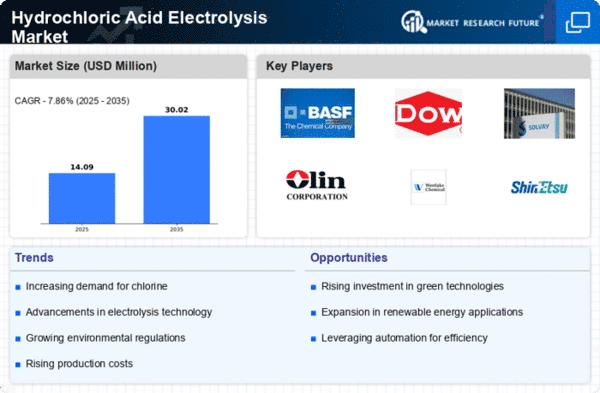
As per MRFR analysis, the Hydrochloric Acid Electrolysis Market Size was estimated at 13.06 USD Million in 2024. The Hydrochloric Acid Electrolysis industry is projected to grow from 14.09 USD Million in 2025 to 30.02 USD Million by 2035, exhibiting a compound annual growth rate (CAGR) of 7.86 during the forecast period 2025 - 2035.

Key Market Trends & Highlights

The Hydrochloric Acid Electrolysis Market is poised for growth driven by sustainability and technological advancements.

  • North America remains the largest market for hydrochloric acid electrolysis, driven by robust industrial applications.
  • Asia-Pacific is emerging as the fastest-growing region, fueled by increasing investments in clean technologies.
  • The electrolytic production segment dominates the market, while the pharmaceuticals segment is witnessing rapid growth.
  • Rising demand for chlorine derivatives and regulatory support for clean technologies are key drivers propelling market expansion.

Market Size & Forecast

2024 Market Size 13.06 (USD Million)
2035 Market Size 30.02 (USD Million)
CAGR (2025 - 2035) 7.86%
Largest Regional Market Share in 2024 Asia-Pacific

Major Players

<p>BASF SE (DE), Dow Chemical Company (US), Solvay S.A. (BE), Olin Corporation (US), Westlake Chemical Corporation (US), Shin-Etsu Chemical Co., Ltd. (JP), AkzoNobel N.V. (NL), Huntsman Corporation (US), Mitsubishi Gas Chemical Company, Inc. (JP)</p>

Market Trends

The Hydrochloric Acid Electrolysis Market is currently experiencing a notable transformation, driven by advancements in electrochemical technologies and increasing demand for chlorine and hydrogen production. This market appears to be influenced by various factors, including the growing emphasis on sustainable practices and the need for efficient chemical processes. As industries seek to reduce their carbon footprint, the electrolysis of hydrochloric acid emerges as a viable alternative, potentially offering a cleaner method for producing essential chemicals. Furthermore, the integration of innovative technologies may enhance the efficiency and cost-effectiveness of electrolysis systems, thereby attracting investments and fostering market growth. In addition, regulatory frameworks and environmental policies are likely to shape the Hydrochloric Acid Electrolysis Market landscape. Governments worldwide are increasingly prioritizing green technologies, which may lead to favorable conditions for electrolysis applications. The market could also benefit from collaborations between research institutions and industry players, aiming to develop advanced electrolysis solutions. Overall, the Hydrochloric Acid Electrolysis Market seems poised for growth, with a focus on sustainability and technological advancements driving its evolution.

Sustainability Initiatives

The Hydrochloric Acid Electrolysis Market is witnessing a shift towards sustainability, as industries increasingly adopt eco-friendly practices. This trend suggests a growing preference for processes that minimize environmental impact, potentially leading to a rise in demand for electrolysis technologies that produce fewer emissions.

Technological Advancements

Innovations in electrochemical technologies are likely to play a crucial role in the Hydrochloric Acid Electrolysis Market. Enhanced efficiency and cost-effectiveness of electrolysis systems may attract more players, fostering competition and driving further advancements in the field.

Regulatory Support

Government policies and regulations appear to be increasingly supportive of green technologies, which could positively influence the Hydrochloric Acid Electrolysis Market. As regulatory frameworks evolve, they may create favorable conditions for the adoption of electrolysis processes in various industries.

Hydrochloric Acid Electrolysis Market Market Drivers

Rising Demand for Chlorine Derivatives

The Global Hydrochloric Acid Electrolysis Market Industry experiences a notable increase in demand for chlorine derivatives, which are essential in various industrial applications. Industries such as pharmaceuticals, textiles, and water treatment rely heavily on chlorine compounds. As the global population grows, the need for these products intensifies, leading to an anticipated market value of 2500 USD Million in 2024. This trend suggests that the electrolysis of hydrochloric acid will play a crucial role in meeting the rising demand for chlorine derivatives, thereby driving growth in the industry.

Growing Applications in the Food Industry

The Global Hydrochloric Acid Electrolysis Market Industry sees a growing application of hydrochloric acid in the food sector, particularly in food processing and preservation. Hydrochloric acid is utilized for pH adjustment and as a food additive, which is crucial for maintaining food safety and quality. As consumer awareness regarding food safety increases, the demand for hydrochloric acid in food applications is likely to rise. This trend may further bolster the market, as food manufacturers seek reliable sources of hydrochloric acid produced through electrolysis.

Technological Advancements in Electrolysis

Innovations in electrolysis technology are significantly impacting the Global Hydrochloric Acid Electrolysis Market Industry. Advances in electrode materials, energy efficiency, and process optimization are enhancing the overall performance of electrolysis systems. These technological improvements not only reduce operational costs but also increase the yield of hydrochloric acid, making the process more economically viable. As these technologies continue to evolve, they are expected to attract investments and drive market expansion, potentially doubling the market size to 5000 USD Million by 2035.

Increased Investment in Chemical Manufacturing

The Global Hydrochloric Acid Electrolysis Market Industry benefits from increased investments in chemical manufacturing, particularly in emerging economies. As countries strive to enhance their industrial capabilities, investments in chemical production facilities are on the rise. This influx of capital is expected to support the development of electrolysis technologies, thereby expanding the market for hydrochloric acid. The anticipated growth in chemical manufacturing could lead to a more robust market environment, fostering innovation and efficiency in hydrochloric acid production.

Environmental Regulations and Sustainability Initiatives

The Global Hydrochloric Acid Electrolysis Market Industry is influenced by stringent environmental regulations aimed at reducing harmful emissions and promoting sustainable practices. Governments worldwide are implementing policies that encourage the adoption of cleaner technologies, including electrolysis processes that minimize waste and energy consumption. This regulatory landscape is likely to propel the market forward, as companies seek to comply with these regulations while enhancing their sustainability profiles. The shift towards greener production methods may contribute to a projected market growth rate of 6.5% CAGR from 2025 to 2035.

Market Segment Insights

By Application: Electrolytic Production (Largest) vs. Wastewater Treatment (Fastest-Growing)

<p>In the Hydrochloric Acid Electrolysis Market, the application segments showcase a diverse distribution of utilization. Electrolytic Production stands as the largest segment, primarily due to its extensive use in various industrial processes. Following closely are Chemical Synthesis and Metal Processing, which also contribute significantly to market dynamics. Wastewater Treatment, while currently smaller, is increasingly recognized for its potential, reflecting changing regulatory landscapes and environmental considerations that are shaping market preferences.</p>

<p>Chemical Synthesis (Dominant) vs. Metal Processing (Emerging)</p>

<p>Chemical Synthesis is a dominant force in the Hydrochloric Acid Electrolysis Market due to its critical role in producing essential chemical intermediates and end-products. It leverages hydrochloric acid for synthesis reactions that are foundational in the production of pharmaceuticals, plastics, and other key materials. Metal Processing is emerging in importance as industries seek efficient and environmentally sustainable methods for surface treatment, etching and cleaning metals. Both segments benefit from advancements in electrolytic technologies, but they serve distinct roles—Chemical Synthesis providing stability while Metal Processing pushes innovation.</p>

By End Use Industry: Chemical Manufacturing (Largest) vs. Pharmaceuticals (Fastest-Growing)

<p>In the Hydrochloric Acid Electrolysis Market, the Chemical Manufacturing sector holds the largest market share, driven by its extensive use in the production of various chemicals such as vinyl chloride and isocyanates. This segment benefits from the increasing demand for petrochemical products and agricultural chemicals, establishing a solid foundation for sustained growth. Meanwhile, the Pharmaceuticals segment is emerging as the fastest-growing area within the market due to the rising need for hydrochloric acid in drug formulation and synthesis processes. With healthcare advancements and an aging population, the demand for pharmaceuticals is expected to rise significantly. The growth trends in the Hydrochloric Acid Electrolysis Market are closely linked to the industrial expansion of these end-use industries. Chemical Manufacturing remains robust, as its applications continue to unfold in various sectors, meeting the global demand for chemical production. Conversely, the Pharmaceuticals industry is witnessing rapid growth due to innovations in drug discoveries and the increasing prevalence of chronic diseases, fostering a heightened requirement for hydrochloric acid in pharmaceutical processes. This dual growth trajectory reflects the adaptability of hydrochloric acid, ensuring its pivotal role across diverse end-use industries.</p>

<p>Chemical Manufacturing (Dominant) vs. Pharmaceuticals (Emerging)</p>

<p>The Chemical Manufacturing sector is the dominant player in the Hydrochloric Acid Electrolysis Market, leveraging its vast applications in chemical production. This segment is characterized by its high volume consumption of hydrochloric acid for processes like pH adjustment and the extraction of metals. It serves a wide range of industries, including petrochemicals, fertilizers, and various specialty chemicals, underpinning its steady demand. On the other hand, the Pharmaceuticals sector is emerging with a focused trajectory; its reliance on hydrochloric acid for drug synthesis and formulation is rapidly increasing due to the expanding pharmaceutical industry and the surge in drug development activities. This segment benefits from trends towards personalized medicine and biopharmaceuticals, driving innovation and resulting in a heightened requirement for hydrochloric acid in production. The contrasting nature of these segments illustrates the diverse applications of hydrochloric acid and its vital role in both established and emerging markets.</p>

By Technology: Membrane Electrolysis (Largest) vs. Continuous Electrolysis (Fastest-Growing)

<p>The Hydrochloric Acid Electrolysis Market is significantly impacted by different technologies, with Membrane Electrolysis currently holding the largest market share. Its efficiency and effectiveness in HCl production make it a preferred choice among manufacturers. In contrast, Continuous Electrolysis is emerging rapidly, attracting attention due to its capability for larger production cycles and lower operational costs. As industries seek more sustainable methods for hydrochloric acid production, these technologies are at the forefront of transformation in the market. Moreover, the trend towards greener technologies is propelling the growth of Continuous Electrolysis. Companies are increasingly investing in advanced electrolysis systems to meet environmental regulations and to reduce emissions. This technology not only enhances the production capacity but also minimizes the overall production time, making it an attractive choice for manufacturers aiming to optimize their supply chains.</p>

<p>Technology: Membrane Electrolysis (Dominant) vs. Continuous Electrolysis (Emerging)</p>

<p>Membrane Electrolysis stands out in the Hydrochloric Acid Electrolysis Market as a dominant technology due to its high efficiency and minimal energy consumption, making it the go-to choice for many large-scale chemical production facilities. This technology utilizes ion-exchange membranes to separate the products of electrolysis, ensuring purified outputs. Its reliability and operational advantages over other conventional methods have solidified its market position. Meanwhile, Continuous Electrolysis, characterized by its ongoing processing capabilities and adaptability to larger production demands, is gaining traction as an emerging technology. It allows for cost-effective production and is particularly appealing to companies aiming for long-term investment in electrolysis processes. As the demand for hydrochloric acid grows, both technologies are set to play crucial roles in shaping future production strategies.</p>

By Concentration Level: Concentrated Hydrochloric Acid (Largest) vs. Anhydrous Hydrochloric Acid (Fastest-Growing)

<p>The Hydrochloric Acid Electrolysis Market exhibits a diverse distribution across different concentration levels, with concentrated hydrochloric acid being the most prevalent segment. This segment dominates the market due to its widespread application in industrial processes. Conversely, dilute hydrochloric acid holds a smaller share but remains crucial for specific applications, while anhydrous hydrochloric acid is emerging as a significant player. Its unique properties and increasing demand in various industries contribute to its growth, indicating a shift in market dynamics. In recent years, the trend toward concentrating hydrochloric acid has been reinforced by its efficiency and cost-effectiveness in production processes. The increasing focus on sustainable practices leads to the rising popularity of anhydrous hydrochloric acid, which is gaining traction due to its higher purity levels and lower environmental impact. The segment's growth is also driven by advancements in electrolysis technology, enhancing the efficacy of hydrochloric acid's application across sectors such as chemicals and pharmaceuticals.</p>

<p>Concentrated Hydrochloric Acid (Dominant) vs. Anhydrous Hydrochloric Acid (Emerging)</p>

<p>Concentrated hydrochloric acid is well-established in the Hydrochloric Acid Electrolysis Market, revered for its effectiveness in numerous industrial processes including metal cleaning and pH regulation. Its dominance stems from its high reactivity and ability to facilitate efficient electrolysis, making it essential in various applications. This segment benefits from economies of scale, leading to reduced production costs, further cementing its market position. On the other hand, anhydrous hydrochloric acid, despite being newer to the forefront, is rapidly emerging due to its advantages in specific applications that demand high purity and low moisture content. Its growth is propelled by its superior performance in electrochemical processes and rising interest in green technology.</p>

By Process Type: Batch Process (Largest) vs. Continuous Process (Fastest-Growing)

<p>In the Hydrochloric Acid Electrolysis Market, the Batch Process currently dominates the segment, owing to its efficiency and flexibility in small-scale production. This method accounts for a significant portion of the market share, as many industries prefer batch production for specific applications requiring tailored properties. Conversely, the Continuous Process is rapidly gaining traction, driven by industry demand for high-volume production and consistent quality. With advancements in technology and process optimization, the Continuous Process is steadily taking a larger share of the market as manufacturers aim to increase output and reduce operational costs.</p>

<p>Batch Process: Dominant vs. Continuous Process: Emerging</p>

<p>The Batch Process is the established leader in the Hydrochloric Acid Electrolysis Market, known for its versatility and ability to cater to specific customer requirements, thus making it a preferred choice for many chemical manufacturers. In contrast, the Continuous Process is viewed as an emerging technology, promising greater operational efficiency and lower production costs; this process allows for a constant feed of raw materials that enhances the overall yield and minimizes downtime. Manufacturers adopting Continuous Processing can capitalize on significant cost savings and improved product uniformity, positioning themselves favorably in competitive markets.</p>

Get more detailed insights about Hydrochloric Acid Electrolysis Market Research Report - Global Forecast to 2035

Regional Insights

North America : Innovation and Demand Growth

The North American Hydrochloric Acid Electrolysis Market is projected to reach $3.91 billion by 2025, driven by increasing industrial applications and stringent environmental regulations. The demand for eco-friendly production methods is catalyzing growth, as industries seek to reduce their carbon footprint. Regulatory support for green technologies further enhances market potential, making it a key player in the global landscape. Leading countries such as the US and Canada are at the forefront of this market, with major players like Dow Chemical Company and Olin Corporation driving innovation. The competitive landscape is characterized by significant investments in R&D and strategic partnerships, ensuring a robust supply chain. The presence of established companies fosters a dynamic environment, positioning North America as a leader in hydrochloric acid electrolysis.

Europe : Sustainability and Innovation Focus

Europe's Hydrochloric Acid Electrolysis Market is expected to reach $3.12 billion by 2025, driven by a strong emphasis on sustainability and innovation. The region's commitment to reducing greenhouse gas emissions and promoting circular economy practices is a significant growth driver. Regulatory frameworks, such as the European Green Deal, are catalyzing investments in cleaner technologies, enhancing market dynamics. Germany, France, and the Netherlands are leading countries in this sector, with key players like BASF SE and AkzoNobel N.V. actively participating in the market. The competitive landscape is marked by collaborations and technological advancements, ensuring that Europe remains at the forefront of hydrochloric acid electrolysis. The focus on sustainable practices positions the region as a critical player in the global market.

Asia-Pacific : Emerging Powerhouse in Electrolysis

Asia-Pacific is the largest market for Hydrochloric Acid Electrolysis, projected to reach $5.8 billion by 2025. The region's rapid industrialization and urbanization are key growth drivers, with increasing demand for hydrochloric acid in various applications, including metal processing and chemical manufacturing. Government initiatives promoting clean energy technologies further enhance market potential, making it a focal point for investment. China, Japan, and India are leading countries in this market, with significant contributions from companies like Mitsubishi Gas Chemical Company and Shin-Etsu Chemical Co., Ltd. The competitive landscape is characterized by a mix of local and international players, fostering innovation and technological advancements. The presence of major corporations ensures a robust supply chain, solidifying Asia-Pacific's position as a market leader.

Middle East and Africa : Resource-Rich Frontier

The Hydrochloric Acid Electrolysis Market in the Middle East and Africa is projected to reach $0.23 billion by 2025, driven by increasing industrial activities and the need for efficient chemical processes. The region's rich natural resources and growing manufacturing sector are key growth drivers. Additionally, government initiatives aimed at diversifying economies are fostering demand for hydrochloric acid in various applications. Countries like South Africa and the UAE are emerging as key players in this market, with local companies beginning to invest in hydrochloric acid production. The competitive landscape is still developing, but the presence of international players is expected to enhance market dynamics. As the region continues to grow, opportunities for investment and collaboration are on the rise, positioning the Middle East and Africa as a frontier for market expansion.

Key Players and Competitive Insights

The Hydrochloric Acid Electrolysis Market is currently characterized by a competitive landscape that is both dynamic and multifaceted. Key growth drivers include the increasing demand for chlorine and hydrogen, which are essential in various industrial applications. Major players such as BASF SE (DE), Dow Chemical Company (US), and Solvay S.A. (BE) are strategically positioned to leverage their extensive research and development capabilities, focusing on innovation and sustainability. These companies are actively pursuing partnerships and collaborations to enhance their technological prowess, thereby shaping a competitive environment that emphasizes efficiency and environmental responsibility.

In terms of business tactics, companies are increasingly localizing manufacturing to reduce transportation costs and enhance supply chain resilience. The market appears moderately fragmented, with several key players exerting considerable influence. This structure allows for a diverse range of strategies, as companies seek to optimize their operations and respond to regional market demands effectively.

In November 2025, BASF SE (DE) announced a significant investment in a new electrolysis facility aimed at increasing its production capacity for hydrochloric acid. This strategic move is expected to enhance BASF's competitive edge by enabling the company to meet the growing demand for high-purity hydrochloric acid in the semiconductor industry. The investment underscores BASF's commitment to innovation and sustainability, aligning with global trends towards greener production methods.

Similarly, in October 2025, Dow Chemical Company (US) launched a new initiative focused on integrating artificial intelligence (AI) into its electrolysis processes. This initiative aims to optimize operational efficiency and reduce energy consumption, which is crucial in the context of rising energy costs. By leveraging AI, Dow is positioning itself as a leader in technological advancement within the Hydrochloric Acid Electrolysis Market, potentially setting new industry standards.

In September 2025, Solvay S.A. (BE) entered into a strategic partnership with a leading renewable energy provider to develop a sustainable electrolysis process. This collaboration is expected to significantly reduce the carbon footprint associated with hydrochloric acid production. Solvay's proactive approach to sustainability not only enhances its market position but also aligns with the increasing regulatory pressures for environmentally friendly manufacturing practices.

As of December 2025, current competitive trends indicate a strong shift towards digitalization and sustainability within the Hydrochloric Acid Electrolysis Market. Strategic alliances are becoming increasingly vital, as companies recognize the need to collaborate in order to innovate and meet evolving market demands. The competitive differentiation is likely to evolve from traditional price-based competition to a focus on technological innovation, supply chain reliability, and sustainable practices. This transition suggests that companies that prioritize these aspects will be better positioned to thrive in the future.

Key Companies in the Hydrochloric Acid Electrolysis Market market include

Industry Developments

Future Outlook

Hydrochloric Acid Electrolysis Market Future Outlook

<p>The Hydrochloric Acid Electrolysis Market is projected to grow at a 7.86% CAGR from 2024 to 2035, driven by increasing demand for sustainable chemical processes and advancements in electrolysis technology.</p>

New opportunities lie in:

  • <p>Development of modular electrolysis units for decentralized production.</p>
  • <p>Integration of renewable energy sources to enhance process efficiency.</p>
  • <p>Expansion into emerging markets with tailored product offerings.</p>

<p>By 2035, the Hydrochloric Acid Electrolysis Market is expected to achieve robust growth and increased market penetration.</p>

Market Segmentation

Hydrochloric Acid Electrolysis Market Technology Outlook

  • Membrane Electrolysis
  • Diaphragm Electrolysis
  • Batch Electrolysis
  • Continuous Electrolysis

Hydrochloric Acid Electrolysis Market Application Outlook

  • Electrolytic Production
  • Chemical Synthesis
  • Metal Processing
  • Wastewater Treatment

Hydrochloric Acid Electrolysis Market Process Type Outlook

  • Batch Process
  • Continuous Process
  • Semi-Continuous Process

Hydrochloric Acid Electrolysis Market End Use Industry Outlook

  • Chemical Manufacturing
  • Pharmaceuticals
  • Food Processing
  • Water Treatment

Hydrochloric Acid Electrolysis Market Concentration Level Outlook

  • Dilute Hydrochloric Acid
  • Concentrated Hydrochloric Acid
  • Anhydrous Hydrochloric Acid

Report Scope

MARKET SIZE 202413.06(USD Million)
MARKET SIZE 202514.09(USD Million)
MARKET SIZE 203530.02(USD Million)
COMPOUND ANNUAL GROWTH RATE (CAGR)7.86% (2024 - 2035)
REPORT COVERAGERevenue Forecast, Competitive Landscape, Growth Factors, and Trends
BASE YEAR2024
Market Forecast Period2025 - 2035
Historical Data2019 - 2024
Market Forecast UnitsUSD Million
Key Companies ProfiledBASF SE (DE), Dow Chemical Company (US), Solvay S.A. (BE), Olin Corporation (US), Westlake Chemical Corporation (US), Shin-Etsu Chemical Co., Ltd. (JP), AkzoNobel N.V. (NL), Huntsman Corporation (US), Mitsubishi Gas Chemical Company, Inc. (JP)
Segments CoveredApplication, End Use Industry, Technology, Concentration Level, Process Type
Key Market OpportunitiesAdvancements in green hydrogen production technologies enhance prospects in the Hydrochloric Acid Electrolysis Market.
Key Market DynamicsTechnological advancements in electrolysis are driving efficiency and sustainability in hydrochloric acid production processes.
Countries CoveredNorth America, Europe, APAC, South America, MEA

FAQs

What is the forecast period of Hydrochloric Acid Electrolysis Market research report?

The forecast period for Hydrochloric Acid Electrolysis Market research report is 20250-2035.

Which region will lead the Hydrochloric Acid Electrolysis Market?

Hydrochloric Acid Electrolysis Market is dominated by APAC region.

Who are the key players in the Hydrochloric Acid Electrolysis Market?

The main players in the Market are Chemical MachineryCo. Ltd., Thyssenkrupp AG, CovestroAG, Mitsui Chemicals, Inc., DowDuPont, and Sumitomo Chemical Co. Ltd, Bluestar (Beijing)

  1. Executive Summary
    1. Market Synopsis 10
  2. Introduction
    1. Definition 11
    2. Scope of Study 11
    3. Assumptions
    4. Market Structure 12
  3. Research Methodology
    1. Research Process 13
    2. Primary Research 13
    3. Secondary
    4. Research 14
    5. Market Size Estimation
    6. Forecast Model 16
  4. Market Dynamics
    1. Introduction 17
      1. Making business free
      2. Reduced risk in HCl transportation 19
      3. Reduced Cost of HCl Neutralization and Disposal 19
    2. Drivers 18
    3. of volatile chlorine and HCl prices 18
    4. Reduced need to develop new chlor-alkali plants 18
    5. Impact Analysis 20
      1. Existence
    6. Restraints 20
    7. of other proven technologies 20
    8. Environmental impact of Chlorine 20
    9. Impact Analysis 21
    10. Opportunity
      1. Replacing mercury cell
      2. Potential in regions
      3. Decommissioning of mercury cell technology 23
    11. plants 21
    12. for high chlorine demand 22
    13. Macroeconomic Factors 22
    14. Impact of oil price volatility in chemical industry 22
  5. Market Factor
    1. Analysis
    2. Porter's Five Forces
      1. Threat of New Entrants
      2. Bargaining Power of
      3. Bargaining
      4. Threat
      5. Rivalry
    3. Analysis 24
    4. Suppliers 24
    5. Power of Buyers 25
    6. of Substitutes 25
    7. Value Chain Analysis
      1. Raw Material 26
      2. Production Process 26
    8. Electrolysis Technology 26
    9. End-Users 26
  6. Global Hydrochloric Acid Electrolysis Market, By Technology
    1. Overview 28
      1. DuPont
      2. Others
    2. ODC Electrolysis 28
    3. gas phase electrolysis 28
    4. Diaphragm Electrolysis 28
    5. Sumitomo Process 28
  7. Global Hydrochloric Acid Electrolysis Market, By Application
    1. Overview 32
      1. Fertilizers
      2. Oil and Gas 33
      3. Others 33
    2. PVC Production & Chlorination 32
    3. Polyurethane Industry 32
    4. Metal Pickling 33
  8. Global Hydrochloric Acid Electrolysis Market, By Region
    1. Introduction 36
      1. U.S. 39
      2. Canada 40
      3. Germany 43
      4. Portugal 45
    2. North America 37
    3. Europe 42
    4. France 46
    5. Asia-Pacific 48
      1. China 50
      2. India 53
    6. Japan 51
    7. Rest of the World 55
  9. Company Profiles
    1. Thyssenkrupp AG 57
    2. Overview 57
    3. SWOT Analysis 59
    4. Pont de Nemours and Company 60
    5. Company Overview 60
    6. Overview 60
    7. SWOT Analysis 62
    8. AG 63
    9. Service Offering 64
    10. Service Offering 66
    11. Ltd. 67
    12. Service Offering 68
    13. machinery Co. Ltd. 69
    14. Company Overview 69
    15. Overview 69
  10. Company
  11. Financial Overview
  12. Service Offering 58
  13. Strategy 58
    1. E. I. du
      1. Financial
      2. Service Offering 61
      3. Strategy 61
    2. Covestro
      1. Company Overview 63
      2. Financial Overview 63
      3. Strategy
    3. Mitsui Chemicals, Inc.
      1. Company Overview 65
      2. Financial Overview 65
      3. Strategy
    4. Sumitomo Chemical Co.
      1. Company Overview 67
      2. Financial Overview 67
      3. Strategy
    5. Bluestar (Beijing) chemical
      1. Financial
      2. Product Offering 69
      3. Strategy 69
  14. List of Tables
    1. TABLE
  15. DIFFERENCE IN ENERGY CONSUMPTION BETWEEN VARIOUS CHLORINE PRODUCTION TECHNOLOGIES
  16. COMPARISION OF TECHNOLOGIES
    1. USED FOR HYDROCHLORIC ACID ELECTROLYSIS PROCESS 29
  17. GLOBAL HYDROCHLORIC ACID ELECTROLYSIS MARKET, BY TECHNOLOGY,
    1. TABLE
  18. GLOBAL HYDROCHLORIC ACID ELECTROLYSIS MARKET, BY APPLICATION, 2020-2027 (USD MILLION)
  19. POLYURETHANE INDUSTRY:
    1. PRODUCTION PROCESS, 2020-2027 (USD MILLION) 34
  20. GLOBAL HYDROCHLORIC ACID ELECTROLYSIS MARKET, BY REGION, 2020-2027
    1. (USD MILLION) 36
  21. NORTH
  22. AMERICA HYDROCHLORIC ACID ELECTROLYSIS MARKET, BY COUNTRY, 2020-2027 (USD MILLION)
  23. NORTH AMERICA HYDROCHLORIC
  24. ACID ELECTROLYSIS MARKET, BY TECHNOLOGY 2020-2027 (USD MILLION) 38
  25. NORTH AMERICA HYDROCHLORIC ACID ELECTROLYSIS MARKET, BY APPLICATION,
    1. TABLE
  26. U.S.: HYDROCHLORIC ACID ELECTROLYSIS MARKET, BY TECHNOLOGY 2020-2027 (USD MILLION)
  27. U.S.: HYDROCHLORIC
  28. ACID ELECTROLYSIS MARKET, BY APPLICATION, 2020-2027 (USD MILLION) 40
  29. CANADA: HYDROCHLORIC ACID ELECTROLYSIS MARKET, BY TECHNOLOGY
    1. TABLE
  30. CANADA: HYDROCHLORIC ACID ELECTROLYSIS MARKET, BY APPLICATION, 2020-2027 (USD
    1. MILLION) 41
  31. EUROPE: HYDROCHLORIC
  32. ACID ELECTROLYSIS MARKET, BY COUNTRY 2020-2027 (USD MILLION) 42
  33. EUROPE: HYDROCHLORIC ACID ELECTROLYSIS MARKET, BY TECHNOLOGY
    1. TABLE
  34. EUROPE: HYDROCHLORIC ACID ELECTROLYSIS MARKET, BY APPLICATION, 2020-2027 (USD
    1. MILLION) 43
  35. GERMANY: HYDROCHLORIC
  36. ACID ELECTROLYSIS MARKET, BY TECHNOLOGY 2020-2027 (USD MILLION) 44
  37. GERMANY: HYDROCHLORIC ACID ELECTROLYSIS MARKET, BY APPLICATION,
    1. TABLE
  38. PORTUGAL: HYDROCHLORIC ACID ELECTROLYSIS MARKET, BY TECHNOLOGY 2020-2027 (USD
    1. MILLION) 45
  39. PORTUGAL: HYDROCHLORIC
  40. ACID ELECTROLYSIS MARKET, BY APPLICATION, 2020-2027 (USD MILLION) 46
  41. FRANCE: HYDROCHLORIC ACID ELECTROLYSIS MARKET, BY TECHNOLOGY
    1. TABLE
  42. FRANCE: HYDROCHLORIC ACID ELECTROLYSIS MARKET, BY APPLICATION, 2020-2027 (USD
    1. MILLION) 47
  43. ASIA-PACIFIC: HYDROCHLORIC
  44. ACID ELECTROLYSIS MARKET, BY COUNTRY 2020-2027 (USD MILLION) 48
  45. ASIA-PACIFIC: HYDROCHLORIC ACID ELECTROLYSIS MARKET, BY TECHNOLOGY
    1. TABLE
  46. ASIA-PACIFIC: HYDROCHLORIC ACID ELECTROLYSIS MARKET, BY APPLICATION, 2020-2027
    1. (USD MILLION) 49
  47. CHINA:
  48. HYDROCHLORIC ACID ELECTROLYSIS MARKET, BY TECHNOLOGY 2020-2027 (USD MILLION) 50
  49. CHINA: HYDROCHLORIC ACID ELECTROLYSIS MARKET, BY APPLICATION,
    1. TABLE
  50. JAPAN: HYDROCHLORIC ACID ELECTROLYSIS MARKET, BY TECHNOLOGY 2020-2027 (USD MILLION)
  51. JAPAN: HYDROCHLORIC
  52. ACID ELECTROLYSIS MARKET, BY APPLICATION, 2020-2027 (USD MILLION) 52
  53. INDIA: HYDROCHLORIC ACID ELECTROLYSIS MARKET, BY TECHNOLOGY
    1. TABLE
  54. INDIA: HYDROCHLORIC ACID ELECTROLYSIS MARKET, BY APPLICATION, 2020-2027 (USD
    1. MILLION) 54
  55. REST OF THE WORLD:
  56. HYDROCHLORIC ACID ELECTROLYSIS MARKET, BY TECHNOLOGY 2020-2027 (USD MILLION) 55
  57. REST OF THE WORLD: HYDROCHLORIC ACID ELECTROLYSIS MARKET, BY
    1. APPLICATION, 2020-2027 (USD MILLION) 55
  58. List of Figures
  59. RESEARCH PROCESS OF MRFR 13
  60. TOP DOWN & BOTTOM UP APPROACH 15
  61. DRIVERS, RESTRAINTS, AND OPPORTUNITIES OF GLOBAL HYDROCHLORIC
    1. ACID ELECTROLYSIS MARKET 17
    2. FIGURE
  62. GROWTH DRIVERS: IMPACT ANALYSIS 20
    1. FIGURE
  63. GROWTH BARRIERS: IMPACT ANALYSIS 21
    1. FIGURE
  64. CHLOR ALKALI INDUSTRY – NUMBER OF PLANTS AND CAPACITY OF MERCURY ELECTROLYSIS
    1. UNITS, 2002-2015 22
  65. PORTER'S
    1. FIVE FORCES ANALYSIS OF GLOBAL HYDROCHLORIC ACID ELECTROLYSIS MARKET 24
  66. VALUE CHAIN ANALYSIS OF GLOBAL HYDROCHLORIC ACID ELECTROLYSIS
    1. MARKET 25
  67. GLOBAL HYDROCHLORIC
  68. ACID ELECTROLYSIS MARKET, BY REGION, 2020(%) 36
  69. NORTH AMERICA: HYDROCHLORIC ACID ELECTROLYSIS MARKET, BY COUNTRY,
  70. EUROPE: HYDROCHLORIC
  71. ACID ELECTROLYSIS MARKET, BY COUNTRY, 2020(%) 42
  72. ASIA-PACIFIC: HYDROCHLORIC ACID ELECTROLYSIS MARKET, BY COUNTRY,
  73. REST OF THE WORLD:
  74. HYDROCHLORIC ACID ELECTROLYSIS MARKET, BY REGION 2020-2027 (USD MILLION) 55
  75. THYSSENKRUPP AG: TOTAL REVENUE VS SEGMENTAL REVENUE, 2020-2027(USD
    1. MILLION) 57
  76. THYSSENKRUPP AG:
    1. GEOGRAPHIC REVENUE MIX, 2020(%) 58
    2. FIGURE
  77. E. I. DU PONT DE NEMOURS AND COMPANY: TOTAL REVENUE, 2020-2027(USD MILLION) 60
  78. E. I. DU PONT DE NEMOURS AND COMPANY: GEOGRAPHIC REVENUE MIX,
  79. COVESTRO AG: TOTAL
    1. REVENUE, 2020-2027(USD MILLION) 63
    2. FIGURE
  80. COVESTRO AG: GEOGRAPHIC REVENUE MIX, 2020(%) 64
  81. MITSUI CHEMICALS, INC.: TOTAL REVENUE, 2020-2027(USD MILLION)
  82. MITSUI CHEMICALS,
    1. INC.: GEOGRAPHIC REVENUE MIX, 2020(%) 66
  83. SUMITOMO CHEMICAL CO. LTD.: TOTAL REVENUE, 2020-2027(USD MILLION)
  84. SUMITOMO CHEMICAL
    1. CO. LTD.: GEOGRAPHIC REVENUE MIX, 2020(%) 68

Hydrochloric Acid Electrolysis Market Segmentation

Market Segmentation Overview

  • Detailed segmentation data will be available in the full report
  • Comprehensive analysis by multiple parameters
  • Regional and country-level breakdowns
  • Market size forecasts by segment
Infographic

Free Sample Request

Kindly complete the form below to receive a free sample of this Report

Get Free Sample

Customer Strories

Compare Licence

×
Features License Type
Single User Multiuser License Enterprise User
Price $4,950 $5,950 $7,250
Maximum User Access Limit 1 User Upto 10 Users Unrestricted Access Throughout the Organization
Free Customization
Direct Access to Analyst
Deliverable Format
Platform Access
Discount on Next Purchase 10% 15% 15%
Printable Versions