Hydrochloric Acid Electrolysis Market (2026 - 2035)

ID: MRFR/CnM/2801-CR 70 Pages Anshula Mandaokar Last Updated: October 26, 2026
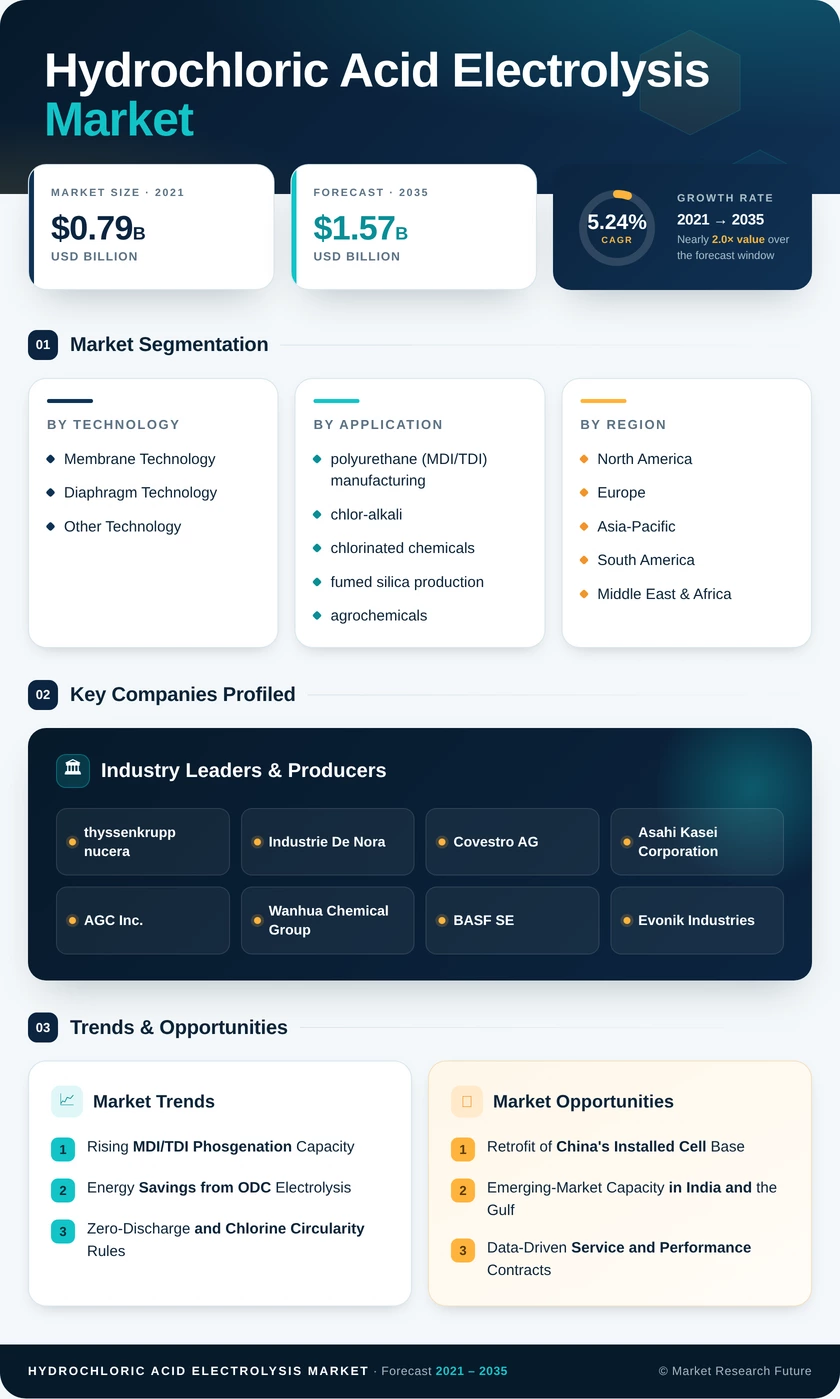
Hydrochloric Acid Electrolysis Market Research Report Information By Technology (Membrane Technology, Diaphragm Technology, and Other Technology), By Application (Polyurethane (MDI/TDI) Manufacturing, Chlor-Alkali and Chlorinated Chemicals, Fumed Silica Production, Agrochemicals, Pharmaceuticals, and Other Applications), And By Region (North America, Europe, Asia-Pacific, and Rest of the World) – Market Forecast Till 2035.
Hydrochloric Acid Electrolysis Market
Market Size
Forecast Period2026-2035
CAGR (2026-2035)5.24%
2025 Market SizeUSD 0.94 Billion
2035 Market SizeUSD 1.57 Billion
Key Players
thyssenkrupp nucera
Industrie De Nora
Covestro AG
Asahi Kasei Corporation
AGC Inc.
Wanhua Chemical Group
Opportunities
  • Retrofit of China's Installed Cell Base
  • Emerging-Market Capacity in India and the Gulf
  • Data-Driven Service and Performance Contracts
  1. 1 Market Summary | |
  2. 2 Key Report Takeaways | |
    1. 2.1 By Technology | |
    2. 2.2 By Application | |
    3. 2.3 By Region | |
  3. 3 Market Size and Forecast (2021–2035) | |
    1. 3.1 Historical Market Size (2021–2025) | |
    2. 3.2 Forecast Market Size (2026–2035) | |
    3. 3.3 Year-over-Year Growth Analysis | |
  4. 4 Driver Impact Analysis | |
    1. 4.1 Rising MDI/TDI Phosgenation Capacity | |
    2. 4.2 Energy Savings from ODC Electrolysis | |
    3. 4.3 Zero-Discharge and Chlorine Circularity Rules | |
    4. 4.4 Industrial Decarbonization Policy | |
    5. 4.5 High-Purity Chlorine Demand in Pharmaceuticals | |
    6. 4.6 Chlorine Transport Risk Favoring On-Site Recovery | |
  5. 5 Restraints Impact Analysis | |
    1. 5.1 High Capital Cost of ODC and Membrane Plants | |
    2. 5.2 Electricity Price Volatility | |
    3. 5.3 Competition from Deacon-Type Oxidation Routes | |
    4. 5.4 PFAS Restriction Risk for Fluoropolymer Membranes | |
    5. 5.5 Merchant Acid Sales and Neutralization Alternatives | |
  6. 6 Opportunities | |
    1. 6.1 Retrofit of China's Installed Cell Base | |
    2. 6.2 Emerging-Market Capacity in India and the Gulf | |
    3. 6.3 Data-Driven Service and Performance Contracts | |
    4. 6.4 Hydrogen Co-Product Valorization | |
    5. 6.5 Modular Units for Specialty and Remote Sites | |
  7. 7 Regional Market Share and Country-Level Analysis | |
    1. 7.1 North America | | |
      1. 7.1.1 US | | |
      2. 7.1.2 Canada | | |
      3. 7.1.3 Mexico | |
    2. 7.2 Europe | | |
      1. 7.2.1 Germany | | |
      2. 7.2.2 UK | | |
      3. 7.2.3 France | | |
      4. 7.2.4 Italy | | |
      5. 7.2.5 Spain | | |
      6. 7.2.6 Nordic Countries | | |
      7. 7.2.7 Russia | | |
      8. 7.2.8 Rest of Europe | |
    3. 7.3 Asia-Pacific | | |
      1. 7.3.1 China | | |
      2. 7.3.2 India | | |
      3. 7.3.3 Japan | | |
      4. 7.3.4 South Korea | | |
      5. 7.3.5 ASEAN | | |
      6. 7.3.6 Rest of Asia-Pacific | |
    4. 7.4 South America | | |
      1. 7.4.1 Brazil | | |
      2. 7.4.2 Argentina | | |
      3. 7.4.3 Rest of South America | |
    5. 7.5 Middle East & Africa | | |
      1. 7.5.1 Saudi Arabia | | |
      2. 7.5.2 UAE | | |
      3. 7.5.3 South Africa | | |
      4. 7.5.4 Egypt | | |
      5. 7.5.5 Rest of MEA | |
  8. 8 Future Outlook (2026–2035) | |
    1. 8.1 Digital Cell-Room Operations | |
    2. 8.2 Consolidation of Technology Ownership | |
    3. 8.3 Low-Carbon Power Supply Expansion | |
    4. 8.4 Sustainability Reporting and Membrane Chemistry | |
  9. 9 Segmentation Analysis | |
    1. 9.1 By Technology | | |
      1. 9.1.1 Membrane Technology | | |
      2. 9.1.2 Diaphragm Technology | | |
      3. 9.1.3 Other Technology | |
    2. 9.2 By Application | | |
      1. 9.2.1 Polyurethane (MDI/TDI) manufacturing | | |
      2. 9.2.2 chlor-alkali and chlorinated chemicals | | |
      3. 9.2.3 fumed silica production | | |
      4. 9.2.4 agrochemicals | | |
      5. 9.2.5 pharmaceuticals | | |
      6. 9.2.6 Other applications | |
  10. 10 Competitive Landscape | |
    1. 10.1 Market Concentration Analysis | |
    2. 10.2 Competitive Benchmarking Matrix | |
    3. 10.3 Company Profiles | | |
      1. 10.3.1 thyssenkrupp nucera | | |
      2. 10.3.2 Industrie De Nora | | |
      3. 10.3.3 Covestro AG | | |
      4. 10.3.4 Asahi Kasei Corporation | | |
      5. 10.3.5 AGC Inc. | | |
      6. 10.3.6 The Chemours Company | | |
      7. 10.3.7 Wanhua Chemical Group | | |
      8. 10.3.8 BASF SE | | |
      9. 10.3.9 Evonik Industries | | |
      10. 10.3.10 Bluestar (Beijing) Chemical Machinery | |
  11. 11 Recent News & Developments | |
  12. 12 Report Scope and Methodology | |
  13. 13 Detailed Sources and Citations | |
  14. 14 Frequently Asked Questions (FAQs) | | LIST OF TABLES | |
  15. TABLE 1 Market Snapshot – Key Metrics, 2025–2035 | |
  16. TABLE 2 Global Market Size & Forecast, by Revenue (USD Billion), 2021–2035 | |
  17. TABLE 3 Driver Impact Analysis, 2026–2035 | |
  18. TABLE 4 Restraints Impact Analysis, 2026–2035 | |
  19. TABLE 5 Regional Summary, by Region, 2025 | |
  20. TABLE 6 North America Market, by Country, 2025 | |
  21. TABLE 7 Europe Market, by Country, 2025 | |
  22. TABLE 8 Asia-Pacific Market, by Country, 2025 | |
  23. TABLE 9 South America Market, by Country, 2025 | |
  24. TABLE 10 Middle East & Africa Market, by Country, 2025 | |
  25. TABLE 11 Global Market, by Technology, 2025 | |
  26. TABLE 12 Global Market, by Application, 2025 | |
  27. TABLE 13 Competitive Benchmarking Matrix, 2025 | |
  28. TABLE 14 Report Scope and Methodology | |
  29. TABLE 15 Detailed Sources and Citations | |
  30. TABLE 16 Segmentation Quick Reference | |
  31. TABLE 17 Segmentation Overview – By Technology | |
  32. TABLE 18 Segmentation Overview – By Application | | LIST OF FIGURES | |
  33. FIGURE 1 Market Dynamics Overview – Drivers, Restraints and Opportunities | |
  34. FIGURE 2 Industry Value Chain Analysis | |
  35. FIGURE 3 Porter's Five Forces Analysis | |
  36. FIGURE 4 Global Market Size Trend (USD Billion), 2021–2035 | |
  37. FIGURE 5 Market Share, by Technology, 2025 | |
  38. FIGURE 6 Market Share, by Application, 2025 | |
  39. FIGURE 7 Market Share, by Region, 2025 | |
  40. FIGURE 8 Asia-Pacific Market Share, by Country, 2025 | |
  41. FIGURE 9 Competitive Landscape – Estimated Revenue Share Ranges, 2025 | |
  42. FIGURE 10 Competitive Positioning Matrix – Key Players

Segmentation Quick Reference

DimensionSub-SegmentsDominant SegmentFastest Growing Segment
By TechnologyMembrane Technology; Diaphragm Technology; Other TechnologyMembrane Technology (82.9% share)Other Technology (6.4% CAGR)
By Applicationpolyurethane (MDI/TDI) manufacturing; chlor-alkali and chlorinated chemicals; fumed silica production; agrochemicals; pharmaceuticals; other applicationspolyurethane (MDI/TDI) manufacturing (34.8% share)pharmaceuticals (6.0% CAGR)
By RegionNorth America; Europe; Asia-Pacific; South America; Middle East & AfricaAsia-Pacific (46.0% share)Asia-Pacific (46.0% share; fastest-growing region)

Market Segmentation Overview

By Technology

Sub-SegmentKey Trend
Membrane TechnologyODC retrofits and advanced membranes replacing aging cell rooms
Diaphragm TechnologyRetained mainly where hydrogen co-product carries value
Other TechnologyModular regeneration units and anhydrous-feed designs gaining pilots

Membrane Technology leads because it delivers the chlorine purity phosgene units demand and pairs naturally with ODC cathodes that cut power use. Other Technology grows fastest, as containerised units and anhydrous-feed designs open sites too small for a full cell room. Diaphragm Technology holds a shrinking niche tied to plants that can sell or use byproduct hydrogen.

By Application

Sub-SegmentKey Trend
polyurethane (MDI/TDI) manufacturingNew isocyanate trains specifying closed-loop chlorine at design stage
chlor-alkali and chlorinated chemicalsRecovered chlorine displacing purchased volumes
fumed silica productionIntegrated chlorine loops in silicon tetrachloride processes
agrochemicalsSteady demand from chlorinated crop-protection intermediates
pharmaceuticalsPurity and traceability driving compact on-site units.
other applicationsWater treatment and specialty synthesis adding balancing volume.

Polyurethane (MDI/TDI) manufacturing leads because phosgenation releases hydrogen chloride in every cycle, making recovery a design necessity at large complexes. Pharmaceuticals grow fastest, since API producers pay a premium for traceable, contaminant-free chlorine. Chlor-alkali and chlorinated chemicals, agrochemicals and fumed silica production provide stable volume that reduces dependence on any single downstream chain.


Download PDF ×

We do not share your information with anyone. However, we may send you emails based on your report interest from time to time. You may contact us at any time to opt-out.