Request Free Sample ×

Kindly complete the form below to receive a free sample of this Report

* Please use a valid business email

Leading companies partner with us for data-driven Insights

clients tt-cursor
Hero Background
English
Chinese
French
Japanese
Korean
German
Spanish

High Density Interconnect PCB Market Trends

ID: MRFR/SEM/5821-CR
100 Pages
Nirmit Biswas
April 2023

High Density Interconnect PCB Market Size, Share and Research Report By Interconnection Layers (1 Layer (1+N+1) HDI, 2 or more layers (2+N+2) HDI, and All Layers HDI), Application (into Consumer Electronics, Automotive, Military and Defense, Healthcare, Industrial/ Manufacturing, and Others), and By Region (North America, Europe, Asia-Pacific, Middle East & Africa, and South America) - Industry Forecast Till 2035

Share:
Download PDF ×

We do not share your information with anyone. However, we may send you emails based on your report interest from time to time. You may contact us at any time to opt-out.

High Density Interconnect PCB Market Infographic
Purchase Options

Market Trends

Key Emerging Trends in the High Density Interconnect PCB Market

As electronic devices become more intricate and compact, the size and aspect ratio of vias, along with component density, are also decreasing. Multilayer PCB boards with traces as small as 3mil (0.075mm) now feature a higher concentration of microvias. These microvias play a crucial role in creating high-density interconnects (HDI) for printed circuit boards (PCBs).

PCB manufacturers are generally capable of drilling via holes as small as 6 mils (0.15mm), but mechanical drilling can be costly due to tooling expenses. The thin drills used in this process are prone to breakage, especially for microvias with a high aspect ratio.

HDI PCBs are commonly found in complex electronic devices that demand exceptional performance while maintaining a compact form factor. Applications include mobile phones, touch-screen devices, laptop computers, digital cameras, 4/5G network communications, and military applications such as avionics and smart munitions.

The automotive and aerospace industries, where lower weight translates into more efficient operation, have increasingly embraced HDI PCBs. HDI PCBs are also prominent in medical devices; advanced electronic medical devices, such as equipment for monitoring, imaging, surgical procedures, and laboratory analysis, incorporate HDI boards. With high-density technology, monitoring and medical testing could become more accurate and more cost-effective.

The growing sophistication of industrial automation has led to the widespread adoption of IoT devices in manufacturing, warehousing, and other industrial settings. HDI technology is integral to many of these advanced pieces of equipment. Businesses today rely on electronic tools to track inventory and monitor equipment performance. Machines are increasingly equipped with smart sensors that collect usage data and communicate with other smart devices, providing valuable insights to optimize operations.

Similar to other advancements, cars are becoming more connected and computerized. Most modern cars have around 50 microprocessors, responsible for engine control, diagnostics, safety features, and various other tasks. Numerous advanced features, including onboard Wi-Fi, GPS, rearview cameras, and backup sensors, depend on HDI PCBs. As automotive technology continues to evolve, HDI technology is likely to play an increasingly significant role.

Beyond medical devices, HDI PCBs are extensively used in equipment for monitoring, imaging, surgical procedures, laboratory analysis, and more. The utilization of high-density technology could enhance the accuracy and cost-effectiveness of monitoring and medical testing.

In summary, HDI PCBs have emerged as a transformative technology, revolutionizing the design and manufacturing of electronic devices. Their ability to pack more circuitry into a smaller space, coupled with their enhanced reliability and signal integrity, makes them the preferred choice for engineers, designers, and manufacturers alike.


Author
Author Profile
Nirmit Biswas
Senior Research Analyst

With 5+ years of expertise in Market Intelligence and Strategic Research, Nirmit Biswas specializes in ICT, Semiconductors, and BFSI. Backed by an MBA in Financial Services and a Computer Science foundation, Nirmit blends technical depth with business acumen. He has successfully led 100+ projects for global enterprises and startups, including Amazon, Cisco, L&T and Huawei, delivering market estimations, competitive benchmarking, and GTM strategies. His focus lies in transforming complex data into clear, actionable insights that drive growth, innovation, and investment decisions. Recognized for bridging engineering innovation with executive strategy, Nirmit helps businesses navigate dynamic markets with confidence.

Leave a Comment

FAQs

What is the projected market valuation for the High Density Interconnect PCB Market in 2035?

<p>The projected market valuation for the High Density Interconnect PCB Market in 2035 is 35205.74 USD Million.</p>

What was the market valuation for the High Density Interconnect PCB Market in 2024?

<p>The overall market valuation for the High Density Interconnect PCB Market was 6096.32 USD Million in 2024.</p>

What is the expected CAGR for the High Density Interconnect PCB Market during the forecast period 2025 - 2035?

<p>The expected CAGR for the High Density Interconnect PCB Market during the forecast period 2025 - 2035 is 17.28%.</p>

Which application segment had the highest valuation in the High Density Interconnect PCB Market in 2024?

<p>The Consumer Electronics application segment had the highest valuation at 1828.0 USD Million in 2024.</p>

What are the key players in the High Density Interconnect PCB Market?

Key players in the High Density Interconnect PCB Market include Avery Dennison, AT&amp;S, Unimicron Technology Corp, and Samsung Electro-Mechanics.

Which end-use segment is projected to have the highest valuation in 2035?

The Healthcare end-use segment is projected to have the highest valuation at 10305.74 USD Million in 2035.

What material type is expected to dominate the High Density Interconnect PCB Market by 2035?

Copper is expected to dominate the High Density Interconnect PCB Market, with a valuation of 10400.0 USD Million in 2035.

How does the valuation of the Multi-Layer segment compare to others in 2024?

The Multi-Layer segment had a valuation of 2435.86 USD Million in 2024, making it one of the higher-valued segments.

What manufacturing technology segment is anticipated to grow significantly by 2035?

The Printed Circuit Board manufacturing technology segment is anticipated to grow significantly, reaching 10400.0 USD Million by 2035.

What was the valuation of the Automotive segment in 2024?

The Automotive segment had a valuation of 1210.0 USD Million in 2024.

Market Summary

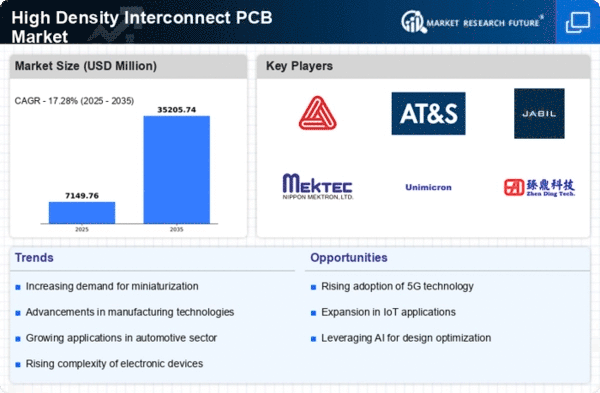
As per MRFR analysis, the High Density Interconnect PCB Market Size was estimated at 6096.32 USD Million in 2024. The High Density Interconnect PCB industry is projected to grow from 7149.88 USD Million in 2025 to 35205.74 USD Million by 2035, exhibiting a compound annual growth rate (CAGR) of 17.28% during the forecast period 2025 - 2035.

Key Market Trends & Highlights

The High Density Interconnect PCB Market is poised for robust growth driven by technological advancements and increasing demand across various sectors.

  • The market is experiencing a notable trend towards the miniaturization of electronics, particularly in North America. Adoption of advanced materials is becoming increasingly prevalent, especially in the Asia-Pacific region. Sustainability initiatives are gaining traction, influencing design and manufacturing processes across multiple segments. The rising demand for consumer electronics and advancements in telecommunications are key drivers propelling market expansion.

Market Size & Forecast

2024 Market Size 6096.32 (USD Million)
2035 Market Size 35205.74 (USD Million)
CAGR (2025 - 2035) 17.28%
Largest Regional Market Share in 2024 North America

Major Players

Avery Dennison (US), AT&amp;S (AT), Jabil (US), Nippon Mektron (JP), Unimicron Technology (TW), Zhen Ding Technology Holding Limited (TW), Shenzhen Fastprint Circuit Tech (CN), Samsung Electro-Mechanics (KR), Flex Ltd. (SG)

Market Trends

The High Density Interconnect PCB Market is currently experiencing a transformative phase, driven by the increasing demand for compact and efficient electronic devices. As technology advances, manufacturers are compelled to innovate, leading to the development of PCBs that can accommodate higher circuit densities. This trend is particularly evident in sectors such as telecommunications, automotive, and consumer electronics, where the need for miniaturization and enhanced performance is paramount. Furthermore, the integration of advanced materials and manufacturing techniques is reshaping the landscape, allowing for greater functionality within smaller footprints. In addition, sustainability considerations are becoming more prominent within the High Density Interconnect PCB Market. Companies are increasingly focusing on eco-friendly materials and processes, responding to both regulatory pressures and consumer preferences for greener products. This shift not only aligns with global sustainability goals but also opens new avenues for innovation. As the market evolves, it appears poised for continued growth, with emerging technologies and changing consumer demands likely to shape its trajectory in the coming years.

Miniaturization of Electronics

The trend towards miniaturization is profoundly influencing the High Density Interconnect PCB Market. As devices become smaller, the need for PCBs that can support higher component densities is critical. This shift is particularly relevant in sectors such as mobile devices and wearables, where space constraints necessitate innovative design solutions.

Adoption of Advanced Materials

The use of advanced materials in PCB manufacturing is gaining traction within the High Density Interconnect PCB Market. Materials that offer improved thermal management and electrical performance are increasingly favored, enabling manufacturers to create more efficient and reliable products. This trend reflects a broader movement towards enhancing the overall performance of electronic devices.

Sustainability Initiatives

Sustainability is emerging as a key focus in the High Density Interconnect PCB Market. Manufacturers are exploring eco-friendly materials and processes to reduce environmental impact. This trend not only meets regulatory requirements but also caters to a growing consumer demand for sustainable electronics, potentially reshaping industry practices.

High Density Interconnect PCB Market Market Drivers

Market Growth Projections

The Global High Density Interconnect PCB Market Industry is poised for remarkable growth, with projections indicating a rise from 6.1 USD Billion in 2024 to an impressive 35.2 USD Billion by 2035. This trajectory reflects the increasing reliance on high-density interconnect technologies across various sectors, including telecommunications, automotive, and consumer electronics. The anticipated compound annual growth rate of 17.28% from 2025 to 2035 underscores the industry's potential for expansion. As businesses and consumers alike seek more efficient and compact electronic solutions, the demand for high-density interconnect PCBs is likely to escalate, driving innovation and investment in this critical sector.

Advancements in Technology

Technological advancements play a crucial role in shaping the Global High Density Interconnect PCB Market Industry. Innovations in materials, such as high-frequency laminates and advanced substrate technologies, enable the production of PCBs that support faster signal transmission and improved thermal management. These advancements are particularly relevant in sectors like automotive and aerospace, where reliability and performance are critical. As the industry evolves, the integration of smart technologies and IoT devices further propels the demand for high-density interconnect solutions. The market is expected to witness a compound annual growth rate of 17.28% from 2025 to 2035, indicating a robust trajectory driven by these technological enhancements.

Surge in Consumer Electronics

The consumer electronics sector is a primary driver of the Global High Density Interconnect PCB Market Industry, as the proliferation of smart devices continues unabated. Products such as tablets, wearables, and smart home devices necessitate PCBs that can deliver high performance in compact designs. This demand is reflected in the market's anticipated growth, with a valuation of 6.1 USD Billion expected in 2024. The trend towards smart technology adoption, coupled with consumer preferences for multifunctional devices, propels manufacturers to innovate and enhance PCB capabilities. As a result, the industry is likely to see sustained growth as it adapts to the evolving landscape of consumer electronics.

Growth in Automotive Electronics

The automotive sector significantly influences the Global High Density Interconnect PCB Market Industry, driven by the increasing complexity of electronic systems in vehicles. Modern automobiles incorporate advanced driver-assistance systems, infotainment, and connectivity features, all of which require sophisticated PCB solutions. As electric vehicles gain traction, the demand for high-density interconnect PCBs is expected to rise, given their ability to support the intricate electronic architectures of these vehicles. The market's expansion is further underscored by projections indicating a growth to 35.2 USD Billion by 2035, highlighting the automotive industry's pivotal role in shaping future PCB requirements.

Rising Demand for Miniaturization

The Global High Density Interconnect PCB Market Industry experiences a notable surge in demand for miniaturization across various sectors, particularly in consumer electronics and telecommunications. As devices become increasingly compact, the need for PCBs that can accommodate higher component densities without compromising performance becomes paramount. This trend is exemplified by the smartphone industry, where manufacturers continuously strive to integrate more features into smaller form factors. The market is projected to reach 6.1 USD Billion in 2024, reflecting the industry's adaptation to these evolving consumer preferences. The push for miniaturization is likely to drive innovation in PCB design and manufacturing processes.

Emerging Markets and Global Expansion

Emerging markets present substantial opportunities for the Global High Density Interconnect PCB Market Industry, as economic development fosters increased demand for electronic products. Countries in Asia-Pacific and Latin America are witnessing rapid urbanization and rising disposable incomes, leading to greater consumption of consumer electronics and automotive technologies. This trend is likely to drive the need for high-density interconnect solutions, as manufacturers seek to establish a foothold in these burgeoning markets. The anticipated growth trajectory, with a CAGR of 17.28% from 2025 to 2035, suggests that the industry will continue to expand its global presence, adapting to the unique demands of diverse markets.

Market Segment Insights

By Application: Consumer Electronics (Largest) vs. Telecommunications (Fastest-Growing)

In the High Density Interconnect PCB Market, the<a href="https://www.marketresearchfuture.com/reports/consumer-electronics-mlcc-market-35506"> Consumer Electronics</a> sector holds the largest market share, largely driven by the ever-increasing demand for electronic devices such as smartphones, tablets, and laptops. This sector continues to dominate due to the constant innovation and reduced size of circuits that High Density Interconnects provide. Conversely, the Telecommunications sector is rapidly gaining traction, reflecting significant investment in infrastructure upgrades and advanced communication technologies, thus positioning itself as the fastest-growing segment. As technology evolves, the growth of both sectors is propelled by the increasing need for enhanced performance, connectivity, and miniaturization. The rise of the Internet of Things (IoT) further boosts the demand for High Density Interconnect PCBs in both Consumer Electronics and Telecommunications, as these applications require high-performance interconnects to support varied functionalities. These sectors are expected to continue expanding as innovations and consumer demands escalate.

Telecommunications: Dominant vs. Automotive: Emerging

The Telecommunications sector stands as a dominant force in the High Density Interconnect PCB Market due to its critical role in facilitating advanced communication and networking technologies. This sector benefits from the increasing demand for high-speed data transmission and connectivity, spurred by the deployment of 5G networks and the rise of smart devices. On the other hand, the Automotive sector is an emerging player in this market, fueled by the growing integration of electronic components in vehicles, including advanced driver-assistance systems (ADAS) and infotainment systems. As the automotive industry shifts towards electric and automated vehicles, the need for sophisticated PCBs is anticipated to surge, creating new opportunities for growth and innovation.

By End Use: Industrial (Largest) vs. Healthcare (Fastest-Growing)

The High Density Interconnect (HDI) PCB Market showcases a diverse array of end uses, with the industrial segment commanding the largest market share. This sector encompasses a wide range of applications, from manufacturing machinery to automation systems, benefitting from the intricate designs and enhanced performance capabilities of HDI technology. Close behind, healthcare applications are rapidly growing, driven by the increasing demand for advanced medical devices and diagnostic equipment that utilize HDI PCBs for their compact and efficient circuitry.

Healthcare: Healthcare (Emerging) vs. Industrial (Dominant)

The healthcare segment is emerging as a significant user of High Density Interconnect PCBs, owing to the rising trend of miniaturization in medical devices and increased deployment of telemedicine technologies. HDI PCBs allow for more functionality in smaller spaces, which is critical in devices such as wearable health monitors and diagnostic equipment. Conversely, the industrial segment remains dominant, leveraging HDI technology for high-performance applications in automation, control systems, and various industrial equipment. Both segments are essential to the market, yet their characteristics and growth trajectories differ markedly, highlighting diverse opportunities in the HDI PCB landscape.

By Material Type: Copper (Largest) vs. Polyimide (Fastest-Growing)

The High Density Interconnect PCB Market exhibits a diverse material type distribution. Copper stands out as the largest segment, owing to its excellent electrical conductivity and thermal properties, which make it a preferred choice for high-performance applications. Following copper, materials like Aluminum and FR-4 hold notable shares, while emerging materials such as Polyimide and Ceramic are gaining traction in specialized segments. The demand for high-density interconnects drives the need for reliable materials that can meet performance requirements without compromising on efficiency. Growth trends in this segment are primarily influenced by technological advancements and the demand for lightweight, flexible, and durable solutions. Polyimide is recognized as the fastest-growing material type, largely due to its resistance to high temperatures and flexibility, which align well with the increasing complexity of electronic devices. As industries push for miniaturized designs, the role of innovative materials becomes more crucial in enhancing device performance, longevity, and reducing overall weight.

Copper (Dominant) vs. Ceramic (Emerging)

Copper holds a dominant position in the High Density Interconnect PCB Market, largely due to its superior conductivity and thermal performance, making it ideal for high-frequency applications. Its electroplated versions are widely used to create intricate circuit designs while ensuring reliability in electronics. In contrast, Ceramic, categorized as an emerging material, is drawing interest due to its unique properties such as low dielectric loss and high thermal stability. While Copper is favored for its cost-effectiveness, Ceramic offers advantages in high-frequency and high-temperature environments. As the market moves towards more advanced applications, including RF and microwave technologies, the shift towards Ceramic is anticipated to grow, appealing to sectors that prioritize performance over costs.

By Layer Count: Multi-Layer (Largest) vs. High Layer Count (Fastest-Growing)

In the High Density Interconnect PCB Market, the market share distribution reveals that Multi-Layer PCBs dominate the segment, with widespread adoption in various electronics due to their advanced capabilities. It is followed by Double Layer PCBs, which offer a balanced performance-to-cost ratio, making them a preferred choice for many applications. Single Layer PCBs, while essential for basic circuitry, occupy a smaller share due to limited functionality, leaving Flexible PCBs and High Layer Count variants to fill specialized niches in the industry.

Multi-Layer (Dominant) vs. High Layer Count (Emerging)

Multi-Layer PCBs, being the cornerstone of the High Density Interconnect PCB Market, are characterized by their ability to incorporate multiple layers of circuitry, which allows for greater functionality and miniaturization in electronic devices. This segment thrives in high-performance applications such as computers and telecommunications, where space is at a premium. In contrast, High Layer Count PCBs are emerging as a strong competitor, catering to niche applications that require extremely complex routing and high connection density. This segment is driven by innovations in technology and the increasing demand for more sophisticated electronic systems, positioning High Layer Count PCBs as critical players in the growing market.

By Manufacturing Technology: Printed Circuit Board (Largest) vs. Additive Manufacturing (Fastest-Growing)

<p>The High Density Interconnect PCB market showcases a diverse array of manufacturing technologies, with Printed Circuit Boards capturing the largest market share due to their widespread adoption across various industries. Embedded Technology, Hybrid Technology, and Subtractive Manufacturing also hold significant places, but the focus on advanced features and performance attributes gives Printed Circuit Boards a competitive edge. As technology evolves, manufacturers increasingly turn to innovative solutions that address efficiency and miniaturization challenges, leading to a dynamic market landscape. In contrast, Additive Manufacturing is emerging as the fastest-growing segment within this domain, reflecting a shift towards more flexible and rapid production processes. The increasing need for customization and shorter production cycles drives the adoption of this technology. Furthermore, the rise of Industry 4.0 and automation trends bolster its relevance, preparing manufacturers for a more agile and responsive production environment.</p>

<p>Embedded Technology (Dominant) vs. Subtractive Manufacturing (Emerging)</p>

<p>Embedded Technology stands out as a dominant force in the High Density Interconnect PCB market due to its ability to integrate advanced functionalities directly into the PCBs, enhancing their performance and enabling the development of smarter electronics. This segment's ability to support miniaturization and complex designs positions it favorably against traditional methodologies. Meanwhile, Subtractive Manufacturing is gaining traction as an emerging technology, offering precise and accurate material removal processes. This technique is particularly valued for producing high-quality boards in niche applications. As demands for precision in electronic devices rise, Subtractive Manufacturing is likely to adapt and incorporate advanced techniques to remain competitive in a market leaning towards higher efficiency and performance.</p>

Get more detailed insights about High Density Interconnect PCB Market Research Report – Forecast 2035

Regional Insights

North America : Market Leader in Innovation

North America is poised to maintain its leadership in the High Density Interconnect PCB market, holding a significant market share of $3040.0M in 2024. The region's growth is driven by robust demand from sectors such as telecommunications, automotive, and consumer electronics. Regulatory support for advanced manufacturing technologies further catalyzes this growth, ensuring compliance with environmental standards and promoting innovation. The competitive landscape is characterized by key players like Avery Dennison and Jabil, who are investing heavily in R&D to enhance product offerings. The U.S. and Canada are the leading countries, with a strong focus on technological advancements and sustainability. This region's commitment to high-quality manufacturing and innovation positions it as a global hub for PCB production.

Europe : Emerging Market with Potential

Europe's High Density Interconnect PCB market is projected to grow, with a market size of $1820.0M. The region benefits from increasing demand in sectors such as automotive and industrial electronics, driven by the push for miniaturization and efficiency. Regulatory frameworks, including the EU's RoHS directive, are shaping the market by promoting environmentally friendly manufacturing practices, which are essential for compliance and market acceptance. Leading countries like Germany and France are at the forefront, hosting major players such as AT&S and Flex Ltd. The competitive landscape is evolving, with a focus on innovation and sustainability. European manufacturers are increasingly collaborating with tech firms to develop advanced PCB solutions, ensuring they remain competitive in a rapidly changing market.

Asia-Pacific : Rapid Growth and Expansion

The Asia-Pacific region is witnessing rapid growth in the High Density Interconnect PCB market, with a market size of $1500.0M. This growth is fueled by the increasing demand for consumer electronics and automotive applications, particularly in countries like China, Japan, and South Korea. The region's favorable manufacturing environment, coupled with government initiatives to support technology advancements, is driving market expansion. China stands out as a manufacturing hub, hosting key players like Nippon Mektron and Zhen Ding Technology Holding Limited. The competitive landscape is marked by aggressive pricing strategies and innovation, as companies strive to meet the growing demand for high-performance PCBs. The region's focus on enhancing production capabilities positions it as a critical player in The High Density Interconnect PCB.

Middle East and Africa : Emerging Market Opportunities

The Middle East and Africa region is gradually emerging in the High Density Interconnect PCB market, with a market size of $736.32M. The growth is driven by increasing investments in technology and infrastructure, particularly in sectors like telecommunications and automotive. Regulatory initiatives aimed at enhancing manufacturing standards are also contributing to market development, fostering a conducive environment for PCB production. Countries like South Africa and the UAE are leading the charge, with a growing number of local manufacturers entering the market. The competitive landscape is characterized by a mix of established players and new entrants, focusing on innovation and quality. As the region continues to develop its technological capabilities, it presents significant opportunities for growth in the PCB sector.

Key Players and Competitive Insights

The High Density Interconnect PCB Market is characterized by a dynamic competitive landscape, driven by technological advancements and increasing demand for miniaturized electronic devices. Key players such as Jabil (US), AT&S (AT), and Samsung Electro-Mechanics (KR) are at the forefront, each adopting distinct strategies to enhance their market positioning. Jabil (US) focuses on innovation and digital transformation, leveraging advanced manufacturing technologies to optimize production efficiency. Meanwhile, AT&S (AT) emphasizes regional expansion, particularly in Asia, to capitalize on the growing electronics market. Samsung Electro-Mechanics (KR) is heavily investing in R&D to develop next-generation PCBs, indicating a strong commitment to maintaining technological leadership. Collectively, these strategies contribute to a competitive environment that is increasingly centered around innovation and operational excellence.
In terms of business tactics, companies are localizing manufacturing and optimizing supply chains to enhance responsiveness to market demands. The market structure appears moderately fragmented, with several players vying for market share, yet the influence of major companies is substantial. This competitive structure fosters an environment where innovation and strategic partnerships are critical for success, as companies seek to differentiate themselves in a crowded marketplace.
In November 2025, Jabil (US) announced a strategic partnership with a leading semiconductor manufacturer to co-develop advanced PCB solutions tailored for high-performance computing applications. This collaboration is likely to enhance Jabil's capabilities in producing high-density interconnects, positioning the company to better serve the burgeoning demand for sophisticated electronic systems. The partnership underscores the importance of alliances in driving technological advancements and meeting customer needs in a rapidly evolving market.
In October 2025, AT&S (AT) unveiled plans to expand its manufacturing facility in Malaysia, aiming to increase production capacity for high-density interconnect PCBs. This expansion is strategically significant as it allows AT&S to better serve its Asian clientele, particularly in the automotive and telecommunications sectors, which are experiencing robust growth. The move reflects a broader trend of companies localizing production to reduce lead times and enhance supply chain resilience.
In September 2025, Samsung Electro-Mechanics (KR) launched a new line of eco-friendly PCBs, incorporating sustainable materials and processes. This initiative aligns with the growing emphasis on sustainability within the electronics industry and positions Samsung as a leader in environmentally responsible manufacturing. The introduction of these products may not only attract environmentally conscious customers but also comply with increasingly stringent regulations regarding electronic waste and sustainability.
As of December 2025, the competitive trends in the High Density Interconnect PCB Market are increasingly defined by digitalization, sustainability, and the integration of AI technologies. Strategic alliances are becoming more prevalent, as companies recognize the need to collaborate to drive innovation and enhance supply chain reliability. Looking ahead, competitive differentiation is likely to evolve from traditional price-based competition to a focus on technological innovation and sustainable practices. This shift suggests that companies that prioritize R&D and sustainable manufacturing will be better positioned to thrive in the future.

Key Companies in the High Density Interconnect PCB Market include

Industry Developments

July 2022: Meiko has acquired NEC Embedded Products, Ltd., Ltd. Meiko Electronics will purchase 403,800 equity shares of NEC Embedded Products, Ltd. as part of the deal. NEC Embedded Products, Ltd. reported sales of $14.03 billion, net assets of $3.61 billion, total assets of $9.98 billion, and an operating loss of 184 million for the year ended March 31, 2022.

September 2021: NCAB Group acquired RedBoard Circuits, LLC, in the USA. RedBoard Circuits will contribute to NCAB Group's objective to take on a leading position in the U.S PCB market.

December 2021: NCAB Group acquired 100 percent of the shares in META Leiterplatten GmbH & CO. KG based in Villingen-Schwenningen in southern Germany. The company provides customers with PCB solutions in the HMLV (High-Mix-Low-Volume) segment, mainly in the industrial, consumer, and medical sectors. Their suppliers are located in China and Taiwan. This enhances the customer base in China and Taiwan.

Future Outlook

High Density Interconnect PCB Market Future Outlook

The High Density Interconnect PCB Market is projected to grow at a 17.28% CAGR from 2025 to 2035, driven by advancements in electronics and increasing demand for miniaturization.

New opportunities lie in:

  • Development of advanced materials for enhanced thermal management
  • Expansion into emerging markets with tailored product offerings
  • Integration of IoT capabilities in PCB designs for smart applications

By 2035, the market is expected to achieve substantial growth, solidifying its position in the electronics industry.

Market Segmentation

High Density Interconnect PCB Market End Use Outlook

  • Industrial
  • Commercial
  • Residential
  • Military
  • Healthcare

High Density Interconnect PCB Market Application Outlook

  • Consumer Electronics
  • Telecommunications
  • Automotive
  • Aerospace
  • Medical Devices

High Density Interconnect PCB Market Layer Count Outlook

  • Single Layer
  • Double Layer
  • Multi-Layer
  • High Layer Count
  • Flexible

High Density Interconnect PCB Market Material Type Outlook

  • Copper
  • Aluminum
  • Polyimide
  • FR-4
  • Ceramic

High Density Interconnect PCB Market Manufacturing Technology Outlook

  • Printed Circuit Board
  • Embedded Technology
  • Hybrid Technology
  • Laser Direct Imaging
  • Additive Manufacturing

Report Scope

MARKET SIZE 2024 6096.32(USD Million)
MARKET SIZE 2025 7149.88(USD Million)
MARKET SIZE 2035 35205.74(USD Million)
COMPOUND ANNUAL GROWTH RATE (CAGR) 17.28% (2025 - 2035)
REPORT COVERAGE Revenue Forecast, Competitive Landscape, Growth Factors, and Trends
BASE YEAR 2024
Market Forecast Period 2025 - 2035
Historical Data 2019 - 2024
Market Forecast Units USD Million
Key Companies Profiled Avery Dennison (US), AT&S (AT), Jabil (US), Nippon Mektron (JP), Unimicron Technology (TW), Zhen Ding Technology Holding Limited (TW), Shenzhen Fastprint Circuit Tech (CN), Samsung Electro-Mechanics (KR), Flex Ltd. (SG)
Segments Covered Application, End Use, Material Type, Layer Count, Manufacturing Technology
Key Market Opportunities Integration of advanced materials and miniaturization drives growth in the High Density Interconnect PCB Market.
Key Market Dynamics Rising demand for miniaturization drives innovation in High Density Interconnect Printed Circuit Board technology and manufacturing processes.
Countries Covered North America, Europe, APAC, South America, MEA

FAQs

What is the projected market valuation for the High Density Interconnect PCB Market in 2035?

<p>The projected market valuation for the High Density Interconnect PCB Market in 2035 is 35205.74 USD Million.</p>

What was the market valuation for the High Density Interconnect PCB Market in 2024?

<p>The overall market valuation for the High Density Interconnect PCB Market was 6096.32 USD Million in 2024.</p>

What is the expected CAGR for the High Density Interconnect PCB Market during the forecast period 2025 - 2035?

<p>The expected CAGR for the High Density Interconnect PCB Market during the forecast period 2025 - 2035 is 17.28%.</p>

Which application segment had the highest valuation in the High Density Interconnect PCB Market in 2024?

<p>The Consumer Electronics application segment had the highest valuation at 1828.0 USD Million in 2024.</p>

What are the key players in the High Density Interconnect PCB Market?

Key players in the High Density Interconnect PCB Market include Avery Dennison, AT&amp;S, Unimicron Technology Corp, and Samsung Electro-Mechanics.

Which end-use segment is projected to have the highest valuation in 2035?

The Healthcare end-use segment is projected to have the highest valuation at 10305.74 USD Million in 2035.

What material type is expected to dominate the High Density Interconnect PCB Market by 2035?

Copper is expected to dominate the High Density Interconnect PCB Market, with a valuation of 10400.0 USD Million in 2035.

How does the valuation of the Multi-Layer segment compare to others in 2024?

The Multi-Layer segment had a valuation of 2435.86 USD Million in 2024, making it one of the higher-valued segments.

What manufacturing technology segment is anticipated to grow significantly by 2035?

The Printed Circuit Board manufacturing technology segment is anticipated to grow significantly, reaching 10400.0 USD Million by 2035.

What was the valuation of the Automotive segment in 2024?

The Automotive segment had a valuation of 1210.0 USD Million in 2024.

  1. SECTION I: EXECUTIVE SUMMARY AND KEY HIGHLIGHTS
    1. | 1.1 EXECUTIVE SUMMARY
    2. | | 1.1.1 Market Overview
    3. | | 1.1.2 Key Findings
    4. | | 1.1.3 Market Segmentation
    5. | | 1.1.4 Competitive Landscape
    6. | | 1.1.5 Challenges and Opportunities
    7. | | 1.1.6 Future Outlook
  2. SECTION II: SCOPING, METHODOLOGY AND MARKET STRUCTURE
    1. | 2.1 MARKET INTRODUCTION
    2. | | 2.1.1 Definition
    3. | | 2.1.2 Scope of the study
    4. | | | 2.1.2.1 Research Objective
    5. | | | 2.1.2.2 Assumption
    6. | | | 2.1.2.3 Limitations
    7. | 2.2 RESEARCH METHODOLOGY
    8. | | 2.2.1 Overview
    9. | | 2.2.2 Data Mining
    10. | | 2.2.3 Secondary Research
    11. | | 2.2.4 Primary Research
    12. | | | 2.2.4.1 Primary Interviews and Information Gathering Process
    13. | | | 2.2.4.2 Breakdown of Primary Respondents
    14. | | 2.2.5 Forecasting Model
    15. | | 2.2.6 Market Size Estimation
    16. | | | 2.2.6.1 Bottom-Up Approach
    17. | | | 2.2.6.2 Top-Down Approach
    18. | | 2.2.7 Data Triangulation
    19. | | 2.2.8 Validation
  3. SECTION III: QUALITATIVE ANALYSIS
    1. | 3.1 MARKET DYNAMICS
    2. | | 3.1.1 Overview
    3. | | 3.1.2 Drivers
    4. | | 3.1.3 Restraints
    5. | | 3.1.4 Opportunities
    6. | 3.2 MARKET FACTOR ANALYSIS
    7. | | 3.2.1 Value chain Analysis
    8. | | 3.2.2 Porter's Five Forces Analysis
    9. | | | 3.2.2.1 Bargaining Power of Suppliers
    10. | | | 3.2.2.2 Bargaining Power of Buyers
    11. | | | 3.2.2.3 Threat of New Entrants
    12. | | | 3.2.2.4 Threat of Substitutes
    13. | | | 3.2.2.5 Intensity of Rivalry
    14. | | 3.2.3 COVID-19 Impact Analysis
    15. | | | 3.2.3.1 Market Impact Analysis
    16. | | | 3.2.3.2 Regional Impact
    17. | | | 3.2.3.3 Opportunity and Threat Analysis
  4. SECTION IV: QUANTITATIVE ANALYSIS
    1. | 4.1 Semiconductor & Electronics, BY Application (USD Million)
    2. | | 4.1.1 Consumer Electronics
    3. | | 4.1.2 Telecommunications
    4. | | 4.1.3 Automotive
    5. | | 4.1.4 Aerospace
    6. | | 4.1.5 Medical Devices
    7. | 4.2 Semiconductor & Electronics, BY End Use (USD Million)
    8. | | 4.2.1 Industrial
    9. | | 4.2.2 Commercial
    10. | | 4.2.3 Residential
    11. | | 4.2.4 Military
    12. | | 4.2.5 Healthcare
    13. | 4.3 Semiconductor & Electronics, BY Material Type (USD Million)
    14. | | 4.3.1 Copper
    15. | | 4.3.2 Aluminum
    16. | | 4.3.3 Polyimide
    17. | | 4.3.4 FR-4
    18. | | 4.3.5 Ceramic
    19. | 4.4 Semiconductor & Electronics, BY Layer Count (USD Million)
    20. | | 4.4.1 Single Layer
    21. | | 4.4.2 Double Layer
    22. | | 4.4.3 Multi-Layer
    23. | | 4.4.4 High Layer Count
    24. | | 4.4.5 Flexible
    25. | 4.5 Semiconductor & Electronics, BY Manufacturing Technology (USD Million)
    26. | | 4.5.1 Printed Circuit Board
    27. | | 4.5.2 Embedded Technology
    28. | | 4.5.3 Hybrid Technology
    29. | | 4.5.4 Additive Manufacturing
    30. | | 4.5.5 Subtractive Manufacturing
    31. | 4.6 Semiconductor & Electronics, BY Region (USD Million)
    32. | | 4.6.1 North America
    33. | | | 4.6.1.1 US
    34. | | | 4.6.1.2 Canada
    35. | | 4.6.2 Europe
    36. | | | 4.6.2.1 Germany
    37. | | | 4.6.2.2 UK
    38. | | | 4.6.2.3 France
    39. | | | 4.6.2.4 Russia
    40. | | | 4.6.2.5 Italy
    41. | | | 4.6.2.6 Spain
    42. | | | 4.6.2.7 Rest of Europe
    43. | | 4.6.3 APAC
    44. | | | 4.6.3.1 China
    45. | | | 4.6.3.2 India
    46. | | | 4.6.3.3 Japan
    47. | | | 4.6.3.4 South Korea
    48. | | | 4.6.3.5 Malaysia
    49. | | | 4.6.3.6 Thailand
    50. | | | 4.6.3.7 Indonesia
    51. | | | 4.6.3.8 Rest of APAC
    52. | | 4.6.4 South America
    53. | | | 4.6.4.1 Brazil
    54. | | | 4.6.4.2 Mexico
    55. | | | 4.6.4.3 Argentina
    56. | | | 4.6.4.4 Rest of South America
    57. | | 4.6.5 MEA
    58. | | | 4.6.5.1 GCC Countries
    59. | | | 4.6.5.2 South Africa
    60. | | | 4.6.5.3 Rest of MEA
  5. SECTION V: COMPETITIVE ANALYSIS
    1. | 5.1 Competitive Landscape
    2. | | 5.1.1 Overview
    3. | | 5.1.2 Competitive Analysis
    4. | | 5.1.3 Market share Analysis
    5. | | 5.1.4 Major Growth Strategy in the Semiconductor & Electronics
    6. | | 5.1.5 Competitive Benchmarking
    7. | | 5.1.6 Leading Players in Terms of Number of Developments in the Semiconductor & Electronics
    8. | | 5.1.7 Key developments and growth strategies
    9. | | | 5.1.7.1 New Product Launch/Service Deployment
    10. | | | 5.1.7.2 Merger & Acquisitions
    11. | | | 5.1.7.3 Joint Ventures
    12. | | 5.1.8 Major Players Financial Matrix
    13. | | | 5.1.8.1 Sales and Operating Income
    14. | | | 5.1.8.2 Major Players R&D Expenditure. 2023
    15. | 5.2 Company Profiles
    16. | | 5.2.1 Avery Dennison (US)
    17. | | | 5.2.1.1 Financial Overview
    18. | | | 5.2.1.2 Products Offered
    19. | | | 5.2.1.3 Key Developments
    20. | | | 5.2.1.4 SWOT Analysis
    21. | | | 5.2.1.5 Key Strategies
    22. | | 5.2.2 AT&S (AT)
    23. | | | 5.2.2.1 Financial Overview
    24. | | | 5.2.2.2 Products Offered
    25. | | | 5.2.2.3 Key Developments
    26. | | | 5.2.2.4 SWOT Analysis
    27. | | | 5.2.2.5 Key Strategies
    28. | | 5.2.3 Unimicron Technology Corp (TW)
    29. | | | 5.2.3.1 Financial Overview
    30. | | | 5.2.3.2 Products Offered
    31. | | | 5.2.3.3 Key Developments
    32. | | | 5.2.3.4 SWOT Analysis
    33. | | | 5.2.3.5 Key Strategies
    34. | | 5.2.4 Nippon Mektron (JP)
    35. | | | 5.2.4.1 Financial Overview
    36. | | | 5.2.4.2 Products Offered
    37. | | | 5.2.4.3 Key Developments
    38. | | | 5.2.4.4 SWOT Analysis
    39. | | | 5.2.4.5 Key Strategies
    40. | | 5.2.5 Zhen Ding Technology Holding Limited (TW)
    41. | | | 5.2.5.1 Financial Overview
    42. | | | 5.2.5.2 Products Offered
    43. | | | 5.2.5.3 Key Developments
    44. | | | 5.2.5.4 SWOT Analysis
    45. | | | 5.2.5.5 Key Strategies
    46. | | 5.2.6 Shenzhen Fastprint Circuit Tech Co., Ltd. (CN)
    47. | | | 5.2.6.1 Financial Overview
    48. | | | 5.2.6.2 Products Offered
    49. | | | 5.2.6.3 Key Developments
    50. | | | 5.2.6.4 SWOT Analysis
    51. | | | 5.2.6.5 Key Strategies
    52. | | 5.2.7 Samsung Electro-Mechanics (KR)
    53. | | | 5.2.7.1 Financial Overview
    54. | | | 5.2.7.2 Products Offered
    55. | | | 5.2.7.3 Key Developments
    56. | | | 5.2.7.4 SWOT Analysis
    57. | | | 5.2.7.5 Key Strategies
    58. | | 5.2.8 Jabil Inc. (US)
    59. | | | 5.2.8.1 Financial Overview
    60. | | | 5.2.8.2 Products Offered
    61. | | | 5.2.8.3 Key Developments
    62. | | | 5.2.8.4 SWOT Analysis
    63. | | | 5.2.8.5 Key Strategies
    64. | | 5.2.9 Flex Ltd. (SG)
    65. | | | 5.2.9.1 Financial Overview
    66. | | | 5.2.9.2 Products Offered
    67. | | | 5.2.9.3 Key Developments
    68. | | | 5.2.9.4 SWOT Analysis
    69. | | | 5.2.9.5 Key Strategies
    70. | 5.3 Appendix
    71. | | 5.3.1 References
    72. | | 5.3.2 Related Reports
  6. LIST OF FIGURES
    1. | 6.1 MARKET SYNOPSIS
    2. | 6.2 NORTH AMERICA MARKET ANALYSIS
    3. | 6.3 US MARKET ANALYSIS BY APPLICATION
    4. | 6.4 US MARKET ANALYSIS BY END USE
    5. | 6.5 US MARKET ANALYSIS BY MATERIAL TYPE
    6. | 6.6 US MARKET ANALYSIS BY LAYER COUNT
    7. | 6.7 US MARKET ANALYSIS BY MANUFACTURING TECHNOLOGY
    8. | 6.8 CANADA MARKET ANALYSIS BY APPLICATION
    9. | 6.9 CANADA MARKET ANALYSIS BY END USE
    10. | 6.10 CANADA MARKET ANALYSIS BY MATERIAL TYPE
    11. | 6.11 CANADA MARKET ANALYSIS BY LAYER COUNT
    12. | 6.12 CANADA MARKET ANALYSIS BY MANUFACTURING TECHNOLOGY
    13. | 6.13 EUROPE MARKET ANALYSIS
    14. | 6.14 GERMANY MARKET ANALYSIS BY APPLICATION
    15. | 6.15 GERMANY MARKET ANALYSIS BY END USE
    16. | 6.16 GERMANY MARKET ANALYSIS BY MATERIAL TYPE
    17. | 6.17 GERMANY MARKET ANALYSIS BY LAYER COUNT
    18. | 6.18 GERMANY MARKET ANALYSIS BY MANUFACTURING TECHNOLOGY
    19. | 6.19 UK MARKET ANALYSIS BY APPLICATION
    20. | 6.20 UK MARKET ANALYSIS BY END USE
    21. | 6.21 UK MARKET ANALYSIS BY MATERIAL TYPE
    22. | 6.22 UK MARKET ANALYSIS BY LAYER COUNT
    23. | 6.23 UK MARKET ANALYSIS BY MANUFACTURING TECHNOLOGY
    24. | 6.24 FRANCE MARKET ANALYSIS BY APPLICATION
    25. | 6.25 FRANCE MARKET ANALYSIS BY END USE
    26. | 6.26 FRANCE MARKET ANALYSIS BY MATERIAL TYPE
    27. | 6.27 FRANCE MARKET ANALYSIS BY LAYER COUNT
    28. | 6.28 FRANCE MARKET ANALYSIS BY MANUFACTURING TECHNOLOGY
    29. | 6.29 RUSSIA MARKET ANALYSIS BY APPLICATION
    30. | 6.30 RUSSIA MARKET ANALYSIS BY END USE
    31. | 6.31 RUSSIA MARKET ANALYSIS BY MATERIAL TYPE
    32. | 6.32 RUSSIA MARKET ANALYSIS BY LAYER COUNT
    33. | 6.33 RUSSIA MARKET ANALYSIS BY MANUFACTURING TECHNOLOGY
    34. | 6.34 ITALY MARKET ANALYSIS BY APPLICATION
    35. | 6.35 ITALY MARKET ANALYSIS BY END USE
    36. | 6.36 ITALY MARKET ANALYSIS BY MATERIAL TYPE
    37. | 6.37 ITALY MARKET ANALYSIS BY LAYER COUNT
    38. | 6.38 ITALY MARKET ANALYSIS BY MANUFACTURING TECHNOLOGY
    39. | 6.39 SPAIN MARKET ANALYSIS BY APPLICATION
    40. | 6.40 SPAIN MARKET ANALYSIS BY END USE
    41. | 6.41 SPAIN MARKET ANALYSIS BY MATERIAL TYPE
    42. | 6.42 SPAIN MARKET ANALYSIS BY LAYER COUNT
    43. | 6.43 SPAIN MARKET ANALYSIS BY MANUFACTURING TECHNOLOGY
    44. | 6.44 REST OF EUROPE MARKET ANALYSIS BY APPLICATION
    45. | 6.45 REST OF EUROPE MARKET ANALYSIS BY END USE
    46. | 6.46 REST OF EUROPE MARKET ANALYSIS BY MATERIAL TYPE
    47. | 6.47 REST OF EUROPE MARKET ANALYSIS BY LAYER COUNT
    48. | 6.48 REST OF EUROPE MARKET ANALYSIS BY MANUFACTURING TECHNOLOGY
    49. | 6.49 APAC MARKET ANALYSIS
    50. | 6.50 CHINA MARKET ANALYSIS BY APPLICATION
    51. | 6.51 CHINA MARKET ANALYSIS BY END USE
    52. | 6.52 CHINA MARKET ANALYSIS BY MATERIAL TYPE
    53. | 6.53 CHINA MARKET ANALYSIS BY LAYER COUNT
    54. | 6.54 CHINA MARKET ANALYSIS BY MANUFACTURING TECHNOLOGY
    55. | 6.55 INDIA MARKET ANALYSIS BY APPLICATION
    56. | 6.56 INDIA MARKET ANALYSIS BY END USE
    57. | 6.57 INDIA MARKET ANALYSIS BY MATERIAL TYPE
    58. | 6.58 INDIA MARKET ANALYSIS BY LAYER COUNT
    59. | 6.59 INDIA MARKET ANALYSIS BY MANUFACTURING TECHNOLOGY
    60. | 6.60 JAPAN MARKET ANALYSIS BY APPLICATION
    61. | 6.61 JAPAN MARKET ANALYSIS BY END USE
    62. | 6.62 JAPAN MARKET ANALYSIS BY MATERIAL TYPE
    63. | 6.63 JAPAN MARKET ANALYSIS BY LAYER COUNT
    64. | 6.64 JAPAN MARKET ANALYSIS BY MANUFACTURING TECHNOLOGY
    65. | 6.65 SOUTH KOREA MARKET ANALYSIS BY APPLICATION
    66. | 6.66 SOUTH KOREA MARKET ANALYSIS BY END USE
    67. | 6.67 SOUTH KOREA MARKET ANALYSIS BY MATERIAL TYPE
    68. | 6.68 SOUTH KOREA MARKET ANALYSIS BY LAYER COUNT
    69. | 6.69 SOUTH KOREA MARKET ANALYSIS BY MANUFACTURING TECHNOLOGY
    70. | 6.70 MALAYSIA MARKET ANALYSIS BY APPLICATION
    71. | 6.71 MALAYSIA MARKET ANALYSIS BY END USE
    72. | 6.72 MALAYSIA MARKET ANALYSIS BY MATERIAL TYPE
    73. | 6.73 MALAYSIA MARKET ANALYSIS BY LAYER COUNT
    74. | 6.74 MALAYSIA MARKET ANALYSIS BY MANUFACTURING TECHNOLOGY
    75. | 6.75 THAILAND MARKET ANALYSIS BY APPLICATION
    76. | 6.76 THAILAND MARKET ANALYSIS BY END USE
    77. | 6.77 THAILAND MARKET ANALYSIS BY MATERIAL TYPE
    78. | 6.78 THAILAND MARKET ANALYSIS BY LAYER COUNT
    79. | 6.79 THAILAND MARKET ANALYSIS BY MANUFACTURING TECHNOLOGY
    80. | 6.80 INDONESIA MARKET ANALYSIS BY APPLICATION
    81. | 6.81 INDONESIA MARKET ANALYSIS BY END USE
    82. | 6.82 INDONESIA MARKET ANALYSIS BY MATERIAL TYPE
    83. | 6.83 INDONESIA MARKET ANALYSIS BY LAYER COUNT
    84. | 6.84 INDONESIA MARKET ANALYSIS BY MANUFACTURING TECHNOLOGY
    85. | 6.85 REST OF APAC MARKET ANALYSIS BY APPLICATION
    86. | 6.86 REST OF APAC MARKET ANALYSIS BY END USE
    87. | 6.87 REST OF APAC MARKET ANALYSIS BY MATERIAL TYPE
    88. | 6.88 REST OF APAC MARKET ANALYSIS BY LAYER COUNT
    89. | 6.89 REST OF APAC MARKET ANALYSIS BY MANUFACTURING TECHNOLOGY
    90. | 6.90 SOUTH AMERICA MARKET ANALYSIS
    91. | 6.91 BRAZIL MARKET ANALYSIS BY APPLICATION
    92. | 6.92 BRAZIL MARKET ANALYSIS BY END USE
    93. | 6.93 BRAZIL MARKET ANALYSIS BY MATERIAL TYPE
    94. | 6.94 BRAZIL MARKET ANALYSIS BY LAYER COUNT
    95. | 6.95 BRAZIL MARKET ANALYSIS BY MANUFACTURING TECHNOLOGY
    96. | 6.96 MEXICO MARKET ANALYSIS BY APPLICATION
    97. | 6.97 MEXICO MARKET ANALYSIS BY END USE
    98. | 6.98 MEXICO MARKET ANALYSIS BY MATERIAL TYPE
    99. | 6.99 MEXICO MARKET ANALYSIS BY LAYER COUNT
    100. | 6.100 MEXICO MARKET ANALYSIS BY MANUFACTURING TECHNOLOGY
    101. | 6.101 ARGENTINA MARKET ANALYSIS BY APPLICATION
    102. | 6.102 ARGENTINA MARKET ANALYSIS BY END USE
    103. | 6.103 ARGENTINA MARKET ANALYSIS BY MATERIAL TYPE
    104. | 6.104 ARGENTINA MARKET ANALYSIS BY LAYER COUNT
    105. | 6.105 ARGENTINA MARKET ANALYSIS BY MANUFACTURING TECHNOLOGY
    106. | 6.106 REST OF SOUTH AMERICA MARKET ANALYSIS BY APPLICATION
    107. | 6.107 REST OF SOUTH AMERICA MARKET ANALYSIS BY END USE
    108. | 6.108 REST OF SOUTH AMERICA MARKET ANALYSIS BY MATERIAL TYPE
    109. | 6.109 REST OF SOUTH AMERICA MARKET ANALYSIS BY LAYER COUNT
    110. | 6.110 REST OF SOUTH AMERICA MARKET ANALYSIS BY MANUFACTURING TECHNOLOGY
    111. | 6.111 MEA MARKET ANALYSIS
    112. | 6.112 GCC COUNTRIES MARKET ANALYSIS BY APPLICATION
    113. | 6.113 GCC COUNTRIES MARKET ANALYSIS BY END USE
    114. | 6.114 GCC COUNTRIES MARKET ANALYSIS BY MATERIAL TYPE
    115. | 6.115 GCC COUNTRIES MARKET ANALYSIS BY LAYER COUNT
    116. | 6.116 GCC COUNTRIES MARKET ANALYSIS BY MANUFACTURING TECHNOLOGY
    117. | 6.117 SOUTH AFRICA MARKET ANALYSIS BY APPLICATION
    118. | 6.118 SOUTH AFRICA MARKET ANALYSIS BY END USE
    119. | 6.119 SOUTH AFRICA MARKET ANALYSIS BY MATERIAL TYPE
    120. | 6.120 SOUTH AFRICA MARKET ANALYSIS BY LAYER COUNT
    121. | 6.121 SOUTH AFRICA MARKET ANALYSIS BY MANUFACTURING TECHNOLOGY
    122. | 6.122 REST OF MEA MARKET ANALYSIS BY APPLICATION
    123. | 6.123 REST OF MEA MARKET ANALYSIS BY END USE
    124. | 6.124 REST OF MEA MARKET ANALYSIS BY MATERIAL TYPE
    125. | 6.125 REST OF MEA MARKET ANALYSIS BY LAYER COUNT
    126. | 6.126 REST OF MEA MARKET ANALYSIS BY MANUFACTURING TECHNOLOGY
    127. | 6.127 KEY BUYING CRITERIA OF SEMICONDUCTOR & ELECTRONICS
    128. | 6.128 RESEARCH PROCESS OF MRFR
    129. | 6.129 DRO ANALYSIS OF SEMICONDUCTOR & ELECTRONICS
    130. | 6.130 DRIVERS IMPACT ANALYSIS: SEMICONDUCTOR & ELECTRONICS
    131. | 6.131 RESTRAINTS IMPACT ANALYSIS: SEMICONDUCTOR & ELECTRONICS
    132. | 6.132 SUPPLY / VALUE CHAIN: SEMICONDUCTOR & ELECTRONICS
    133. | 6.133 SEMICONDUCTOR & ELECTRONICS, BY APPLICATION, 2024 (% SHARE)
    134. | 6.134 SEMICONDUCTOR & ELECTRONICS, BY APPLICATION, 2024 TO 2035 (USD Million)
    135. | 6.135 SEMICONDUCTOR & ELECTRONICS, BY END USE, 2024 (% SHARE)
    136. | 6.136 SEMICONDUCTOR & ELECTRONICS, BY END USE, 2024 TO 2035 (USD Million)
    137. | 6.137 SEMICONDUCTOR & ELECTRONICS, BY MATERIAL TYPE, 2024 (% SHARE)
    138. | 6.138 SEMICONDUCTOR & ELECTRONICS, BY MATERIAL TYPE, 2024 TO 2035 (USD Million)
    139. | 6.139 SEMICONDUCTOR & ELECTRONICS, BY LAYER COUNT, 2024 (% SHARE)
    140. | 6.140 SEMICONDUCTOR & ELECTRONICS, BY LAYER COUNT, 2024 TO 2035 (USD Million)
    141. | 6.141 SEMICONDUCTOR & ELECTRONICS, BY MANUFACTURING TECHNOLOGY, 2024 (% SHARE)
    142. | 6.142 SEMICONDUCTOR & ELECTRONICS, BY MANUFACTURING TECHNOLOGY, 2024 TO 2035 (USD Million)
    143. | 6.143 BENCHMARKING OF MAJOR COMPETITORS
  7. LIST OF TABLES
    1. | 7.1 LIST OF ASSUMPTIONS
    2. | | 7.1.1
    3. | 7.2 North America MARKET SIZE ESTIMATES; FORECAST
    4. | | 7.2.1 BY APPLICATION, 2025-2035 (USD Million)
    5. | | 7.2.2 BY END USE, 2025-2035 (USD Million)
    6. | | 7.2.3 BY MATERIAL TYPE, 2025-2035 (USD Million)
    7. | | 7.2.4 BY LAYER COUNT, 2025-2035 (USD Million)
    8. | | 7.2.5 BY MANUFACTURING TECHNOLOGY, 2025-2035 (USD Million)
    9. | 7.3 US MARKET SIZE ESTIMATES; FORECAST
    10. | | 7.3.1 BY APPLICATION, 2025-2035 (USD Million)
    11. | | 7.3.2 BY END USE, 2025-2035 (USD Million)
    12. | | 7.3.3 BY MATERIAL TYPE, 2025-2035 (USD Million)
    13. | | 7.3.4 BY LAYER COUNT, 2025-2035 (USD Million)
    14. | | 7.3.5 BY MANUFACTURING TECHNOLOGY, 2025-2035 (USD Million)
    15. | 7.4 Canada MARKET SIZE ESTIMATES; FORECAST
    16. | | 7.4.1 BY APPLICATION, 2025-2035 (USD Million)
    17. | | 7.4.2 BY END USE, 2025-2035 (USD Million)
    18. | | 7.4.3 BY MATERIAL TYPE, 2025-2035 (USD Million)
    19. | | 7.4.4 BY LAYER COUNT, 2025-2035 (USD Million)
    20. | | 7.4.5 BY MANUFACTURING TECHNOLOGY, 2025-2035 (USD Million)
    21. | 7.5 Europe MARKET SIZE ESTIMATES; FORECAST
    22. | | 7.5.1 BY APPLICATION, 2025-2035 (USD Million)
    23. | | 7.5.2 BY END USE, 2025-2035 (USD Million)
    24. | | 7.5.3 BY MATERIAL TYPE, 2025-2035 (USD Million)
    25. | | 7.5.4 BY LAYER COUNT, 2025-2035 (USD Million)
    26. | | 7.5.5 BY MANUFACTURING TECHNOLOGY, 2025-2035 (USD Million)
    27. | 7.6 Germany MARKET SIZE ESTIMATES; FORECAST
    28. | | 7.6.1 BY APPLICATION, 2025-2035 (USD Million)
    29. | | 7.6.2 BY END USE, 2025-2035 (USD Million)
    30. | | 7.6.3 BY MATERIAL TYPE, 2025-2035 (USD Million)
    31. | | 7.6.4 BY LAYER COUNT, 2025-2035 (USD Million)
    32. | | 7.6.5 BY MANUFACTURING TECHNOLOGY, 2025-2035 (USD Million)
    33. | 7.7 UK MARKET SIZE ESTIMATES; FORECAST
    34. | | 7.7.1 BY APPLICATION, 2025-2035 (USD Million)
    35. | | 7.7.2 BY END USE, 2025-2035 (USD Million)
    36. | | 7.7.3 BY MATERIAL TYPE, 2025-2035 (USD Million)
    37. | | 7.7.4 BY LAYER COUNT, 2025-2035 (USD Million)
    38. | | 7.7.5 BY MANUFACTURING TECHNOLOGY, 2025-2035 (USD Million)
    39. | 7.8 France MARKET SIZE ESTIMATES; FORECAST
    40. | | 7.8.1 BY APPLICATION, 2025-2035 (USD Million)
    41. | | 7.8.2 BY END USE, 2025-2035 (USD Million)
    42. | | 7.8.3 BY MATERIAL TYPE, 2025-2035 (USD Million)
    43. | | 7.8.4 BY LAYER COUNT, 2025-2035 (USD Million)
    44. | | 7.8.5 BY MANUFACTURING TECHNOLOGY, 2025-2035 (USD Million)
    45. | 7.9 Russia MARKET SIZE ESTIMATES; FORECAST
    46. | | 7.9.1 BY APPLICATION, 2025-2035 (USD Million)
    47. | | 7.9.2 BY END USE, 2025-2035 (USD Million)
    48. | | 7.9.3 BY MATERIAL TYPE, 2025-2035 (USD Million)
    49. | | 7.9.4 BY LAYER COUNT, 2025-2035 (USD Million)
    50. | | 7.9.5 BY MANUFACTURING TECHNOLOGY, 2025-2035 (USD Million)
    51. | 7.10 Italy MARKET SIZE ESTIMATES; FORECAST
    52. | | 7.10.1 BY APPLICATION, 2025-2035 (USD Million)
    53. | | 7.10.2 BY END USE, 2025-2035 (USD Million)
    54. | | 7.10.3 BY MATERIAL TYPE, 2025-2035 (USD Million)
    55. | | 7.10.4 BY LAYER COUNT, 2025-2035 (USD Million)
    56. | | 7.10.5 BY MANUFACTURING TECHNOLOGY, 2025-2035 (USD Million)
    57. | 7.11 Spain MARKET SIZE ESTIMATES; FORECAST
    58. | | 7.11.1 BY APPLICATION, 2025-2035 (USD Million)
    59. | | 7.11.2 BY END USE, 2025-2035 (USD Million)
    60. | | 7.11.3 BY MATERIAL TYPE, 2025-2035 (USD Million)
    61. | | 7.11.4 BY LAYER COUNT, 2025-2035 (USD Million)
    62. | | 7.11.5 BY MANUFACTURING TECHNOLOGY, 2025-2035 (USD Million)
    63. | 7.12 Rest of Europe MARKET SIZE ESTIMATES; FORECAST
    64. | | 7.12.1 BY APPLICATION, 2025-2035 (USD Million)
    65. | | 7.12.2 BY END USE, 2025-2035 (USD Million)
    66. | | 7.12.3 BY MATERIAL TYPE, 2025-2035 (USD Million)
    67. | | 7.12.4 BY LAYER COUNT, 2025-2035 (USD Million)
    68. | | 7.12.5 BY MANUFACTURING TECHNOLOGY, 2025-2035 (USD Million)
    69. | 7.13 APAC MARKET SIZE ESTIMATES; FORECAST
    70. | | 7.13.1 BY APPLICATION, 2025-2035 (USD Million)
    71. | | 7.13.2 BY END USE, 2025-2035 (USD Million)
    72. | | 7.13.3 BY MATERIAL TYPE, 2025-2035 (USD Million)
    73. | | 7.13.4 BY LAYER COUNT, 2025-2035 (USD Million)
    74. | | 7.13.5 BY MANUFACTURING TECHNOLOGY, 2025-2035 (USD Million)
    75. | 7.14 China MARKET SIZE ESTIMATES; FORECAST
    76. | | 7.14.1 BY APPLICATION, 2025-2035 (USD Million)
    77. | | 7.14.2 BY END USE, 2025-2035 (USD Million)
    78. | | 7.14.3 BY MATERIAL TYPE, 2025-2035 (USD Million)
    79. | | 7.14.4 BY LAYER COUNT, 2025-2035 (USD Million)
    80. | | 7.14.5 BY MANUFACTURING TECHNOLOGY, 2025-2035 (USD Million)
    81. | 7.15 India MARKET SIZE ESTIMATES; FORECAST
    82. | | 7.15.1 BY APPLICATION, 2025-2035 (USD Million)
    83. | | 7.15.2 BY END USE, 2025-2035 (USD Million)
    84. | | 7.15.3 BY MATERIAL TYPE, 2025-2035 (USD Million)
    85. | | 7.15.4 BY LAYER COUNT, 2025-2035 (USD Million)
    86. | | 7.15.5 BY MANUFACTURING TECHNOLOGY, 2025-2035 (USD Million)
    87. | 7.16 Japan MARKET SIZE ESTIMATES; FORECAST
    88. | | 7.16.1 BY APPLICATION, 2025-2035 (USD Million)
    89. | | 7.16.2 BY END USE, 2025-2035 (USD Million)
    90. | | 7.16.3 BY MATERIAL TYPE, 2025-2035 (USD Million)
    91. | | 7.16.4 BY LAYER COUNT, 2025-2035 (USD Million)
    92. | | 7.16.5 BY MANUFACTURING TECHNOLOGY, 2025-2035 (USD Million)
    93. | 7.17 South Korea MARKET SIZE ESTIMATES; FORECAST
    94. | | 7.17.1 BY APPLICATION, 2025-2035 (USD Million)
    95. | | 7.17.2 BY END USE, 2025-2035 (USD Million)
    96. | | 7.17.3 BY MATERIAL TYPE, 2025-2035 (USD Million)
    97. | | 7.17.4 BY LAYER COUNT, 2025-2035 (USD Million)
    98. | | 7.17.5 BY MANUFACTURING TECHNOLOGY, 2025-2035 (USD Million)
    99. | 7.18 Malaysia MARKET SIZE ESTIMATES; FORECAST
    100. | | 7.18.1 BY APPLICATION, 2025-2035 (USD Million)
    101. | | 7.18.2 BY END USE, 2025-2035 (USD Million)
    102. | | 7.18.3 BY MATERIAL TYPE, 2025-2035 (USD Million)
    103. | | 7.18.4 BY LAYER COUNT, 2025-2035 (USD Million)
    104. | | 7.18.5 BY MANUFACTURING TECHNOLOGY, 2025-2035 (USD Million)
    105. | 7.19 Thailand MARKET SIZE ESTIMATES; FORECAST
    106. | | 7.19.1 BY APPLICATION, 2025-2035 (USD Million)
    107. | | 7.19.2 BY END USE, 2025-2035 (USD Million)
    108. | | 7.19.3 BY MATERIAL TYPE, 2025-2035 (USD Million)
    109. | | 7.19.4 BY LAYER COUNT, 2025-2035 (USD Million)
    110. | | 7.19.5 BY MANUFACTURING TECHNOLOGY, 2025-2035 (USD Million)
    111. | 7.20 Indonesia MARKET SIZE ESTIMATES; FORECAST
    112. | | 7.20.1 BY APPLICATION, 2025-2035 (USD Million)
    113. | | 7.20.2 BY END USE, 2025-2035 (USD Million)
    114. | | 7.20.3 BY MATERIAL TYPE, 2025-2035 (USD Million)
    115. | | 7.20.4 BY LAYER COUNT, 2025-2035 (USD Million)
    116. | | 7.20.5 BY MANUFACTURING TECHNOLOGY, 2025-2035 (USD Million)
    117. | 7.21 Rest of APAC MARKET SIZE ESTIMATES; FORECAST
    118. | | 7.21.1 BY APPLICATION, 2025-2035 (USD Million)
    119. | | 7.21.2 BY END USE, 2025-2035 (USD Million)
    120. | | 7.21.3 BY MATERIAL TYPE, 2025-2035 (USD Million)
    121. | | 7.21.4 BY LAYER COUNT, 2025-2035 (USD Million)
    122. | | 7.21.5 BY MANUFACTURING TECHNOLOGY, 2025-2035 (USD Million)
    123. | 7.22 South America MARKET SIZE ESTIMATES; FORECAST
    124. | | 7.22.1 BY APPLICATION, 2025-2035 (USD Million)
    125. | | 7.22.2 BY END USE, 2025-2035 (USD Million)
    126. | | 7.22.3 BY MATERIAL TYPE, 2025-2035 (USD Million)
    127. | | 7.22.4 BY LAYER COUNT, 2025-2035 (USD Million)
    128. | | 7.22.5 BY MANUFACTURING TECHNOLOGY, 2025-2035 (USD Million)
    129. | 7.23 Brazil MARKET SIZE ESTIMATES; FORECAST
    130. | | 7.23.1 BY APPLICATION, 2025-2035 (USD Million)
    131. | | 7.23.2 BY END USE, 2025-2035 (USD Million)
    132. | | 7.23.3 BY MATERIAL TYPE, 2025-2035 (USD Million)
    133. | | 7.23.4 BY LAYER COUNT, 2025-2035 (USD Million)
    134. | | 7.23.5 BY MANUFACTURING TECHNOLOGY, 2025-2035 (USD Million)
    135. | 7.24 Mexico MARKET SIZE ESTIMATES; FORECAST
    136. | | 7.24.1 BY APPLICATION, 2025-2035 (USD Million)
    137. | | 7.24.2 BY END USE, 2025-2035 (USD Million)
    138. | | 7.24.3 BY MATERIAL TYPE, 2025-2035 (USD Million)
    139. | | 7.24.4 BY LAYER COUNT, 2025-2035 (USD Million)
    140. | | 7.24.5 BY MANUFACTURING TECHNOLOGY, 2025-2035 (USD Million)
    141. | 7.25 Argentina MARKET SIZE ESTIMATES; FORECAST
    142. | | 7.25.1 BY APPLICATION, 2025-2035 (USD Million)
    143. | | 7.25.2 BY END USE, 2025-2035 (USD Million)
    144. | | 7.25.3 BY MATERIAL TYPE, 2025-2035 (USD Million)
    145. | | 7.25.4 BY LAYER COUNT, 2025-2035 (USD Million)
    146. | | 7.25.5 BY MANUFACTURING TECHNOLOGY, 2025-2035 (USD Million)
    147. | 7.26 Rest of South America MARKET SIZE ESTIMATES; FORECAST
    148. | | 7.26.1 BY APPLICATION, 2025-2035 (USD Million)
    149. | | 7.26.2 BY END USE, 2025-2035 (USD Million)
    150. | | 7.26.3 BY MATERIAL TYPE, 2025-2035 (USD Million)
    151. | | 7.26.4 BY LAYER COUNT, 2025-2035 (USD Million)
    152. | | 7.26.5 BY MANUFACTURING TECHNOLOGY, 2025-2035 (USD Million)
    153. | 7.27 MEA MARKET SIZE ESTIMATES; FORECAST
    154. | | 7.27.1 BY APPLICATION, 2025-2035 (USD Million)
    155. | | 7.27.2 BY END USE, 2025-2035 (USD Million)
    156. | | 7.27.3 BY MATERIAL TYPE, 2025-2035 (USD Million)
    157. | | 7.27.4 BY LAYER COUNT, 2025-2035 (USD Million)
    158. | | 7.27.5 BY MANUFACTURING TECHNOLOGY, 2025-2035 (USD Million)
    159. | 7.28 GCC Countries MARKET SIZE ESTIMATES; FORECAST
    160. | | 7.28.1 BY APPLICATION, 2025-2035 (USD Million)
    161. | | 7.28.2 BY END USE, 2025-2035 (USD Million)
    162. | | 7.28.3 BY MATERIAL TYPE, 2025-2035 (USD Million)
    163. | | 7.28.4 BY LAYER COUNT, 2025-2035 (USD Million)
    164. | | 7.28.5 BY MANUFACTURING TECHNOLOGY, 2025-2035 (USD Million)
    165. | 7.29 South Africa MARKET SIZE ESTIMATES; FORECAST
    166. | | 7.29.1 BY APPLICATION, 2025-2035 (USD Million)
    167. | | 7.29.2 BY END USE, 2025-2035 (USD Million)
    168. | | 7.29.3 BY MATERIAL TYPE, 2025-2035 (USD Million)
    169. | | 7.29.4 BY LAYER COUNT, 2025-2035 (USD Million)
    170. | | 7.29.5 BY MANUFACTURING TECHNOLOGY, 2025-2035 (USD Million)
    171. | 7.30 Rest of MEA MARKET SIZE ESTIMATES; FORECAST
    172. | | 7.30.1 BY APPLICATION, 2025-2035 (USD Million)
    173. | | 7.30.2 BY END USE, 2025-2035 (USD Million)
    174. | | 7.30.3 BY MATERIAL TYPE, 2025-2035 (USD Million)
    175. | | 7.30.4 BY LAYER COUNT, 2025-2035 (USD Million)
    176. | | 7.30.5 BY MANUFACTURING TECHNOLOGY, 2025-2035 (USD Million)
    177. | 7.31 PRODUCT LAUNCH/PRODUCT DEVELOPMENT/APPROVAL
    178. | | 7.31.1
    179. | 7.32 ACQUISITION/PARTNERSHIP
    180. | | 7.32.1

Semiconductor & Electronics Market Segmentation

Semiconductor & Electronics By Application (USD Million, 2025-2035)

  • Consumer Electronics
  • Telecommunications
  • Automotive
  • Aerospace
  • Medical Devices

Semiconductor & Electronics By End Use (USD Million, 2025-2035)

  • Industrial
  • Commercial
  • Residential
  • Military
  • Healthcare

Semiconductor & Electronics By Material Type (USD Million, 2025-2035)

  • Copper
  • Aluminum
  • Polyimide
  • FR-4
  • Ceramic

Semiconductor & Electronics By Layer Count (USD Million, 2025-2035)

  • Single Layer
  • Double Layer
  • Multi-Layer
  • High Layer Count
  • Flexible

Semiconductor & Electronics By Manufacturing Technology (USD Million, 2025-2035)

  • Printed Circuit Board
  • Embedded Technology
  • Hybrid Technology
  • Additive Manufacturing
  • Subtractive Manufacturing
Infographic

Free Sample Request

Kindly complete the form below to receive a free sample of this Report

Get Free Sample

Customer Strories

Compare Licence

×
Features License Type
Single User Multiuser License Enterprise User
Price $4,950 $5,950 $7,250
Maximum User Access Limit 1 User Upto 10 Users Unrestricted Access Throughout the Organization
Free Customization
Direct Access to Analyst
Deliverable Format
Platform Access
Discount on Next Purchase 10% 15% 15%
Printable Versions
%>