×
Request Free Sample ×

Kindly complete the form below to receive a free sample of this Report

* Please use a valid business email

Leading companies partner with us for data-driven Insights

clients tt-cursor
Hero Background
English
Chinese
French
Japanese
Korean
German
Spanish

Gas Concentration Sensor Market Trends

ID: MRFR/SEM/11045-HCR
128 Pages
Aarti Dhapte
October 2025

Gas Concentration Sensor Market Size, Share and Research Report By Product (Oxygen (O2)/Lambda Sensors, Carbon Dioxide (CO2) Sensors, Carbon Monoxide (CO) Sensors, Nitrogen Oxide (NOx) Sensors, Methyl Mercaptan Sensor, and Others), By Type (Wireless, and Wired), By Technology (Electrochemical, Semiconductor, Solid State/MOS, Photo-ionization Detector (PID), Catalytic, Infrared (IR), and Others), By End-use (Building Automation & Domestic Appliances, Petrochemical, Automotive, Agriculture, and Others), And Region– Industry Forecast Till 2035

Share:
Download PDF ×

We do not share your information with anyone. However, we may send you emails based on your report interest from time to time. You may contact us at any time to opt-out.

Gas Concentration Sensor Market Infographic
×
Gas Concentration Sensor Market Infographic Full View
Purchase Options

Market Trends

Key Emerging Trends in the Gas Concentration Sensor Market

Notable trends driving the Gas Concentration Sensor market are industries’ focus on environmental monitoring, compliance with regulatory standards, and workplace safety locking mechanism. Applications of gas concentration sensors that are significant in detecting and correlating the amount of gases present are evolving rapidly according to end-use besides leading factors. One of the major changing features that are seen in this Gas Concentration Sensor market is increased demand for multi-gas sensing type. Beside the threats of air quality and safety in workplace, it is crucial to have flex sensors detecting not only familiar pollutants but also those emerging contaminants. The sensing of gas concentration is increasingly focusing on the detection of gases other than this, VOCs, greenhouse gases as well as industrial pollutants and various techniques to monitor such variety in covered with respect to fully devised technique. At the market, there is also a movement in that aspect toward miniaturization and integration of gas sensors to multiple devices and systems. The use of gas concentration sensors has given rise to including them in wearable devices, smartphones as well as environmental monitoring systems during the era of IoT and other smart technologies. This trend enables real-time data gathering and analyzing before acts of potential gases related hazards, which makes it possible to answer faster while environmental problems management become more efficient. Technological changes are the factors leading to Gas Concentration Sensor market growths; sensors technology is changing because of solid state sensor and laser-based sensor. As solid-state sensors respond to changes more quickly and requirements for durability and robustness increase, they offer a much higher level of improvements in terms of structural reliability compared with fiber-optic ones. Compared to these, laser-based sensors allow the best gas detection accuracy and precision. These technological enhancements form part of the general dependability and performance of portable gas concentration sensors that find their use in various applications. In commercial and residential buildings, there is the increasing in indoor air quality concerns and this is encouraging people to use gas concentration sensors. In today’s world, more and more are spending hours inside while at home or work; monitoring indoor air quality for pollutants and gases is a necessary step towards maintaining the appropriate well-being setting. By this stage, it would aid the implementation of gas concentrations sensors which have air quality indicators to human beings and building managers, send them real-time reads that they need and can take preventive measures if there is need. Think how important environmental sustainability is becoming for the Gas Concentration Sensor market. Manufacturers are encouraging nearly non-destructive testing and green sensors and components, which means less disruption to the environment when developed and used by their products. These range from energy-free technologies to the use of environment-friendly materials. Economic entities and end-users are going to focus on sustainable technologies as we see new trends in the market for environment friendly gas concentration sensors.


Author
Aarti Dhapte
Team Lead - Research

She holds an experience of about 6+ years in Market Research and Business Consulting, working under the spectrum of Information Communication Technology, Telecommunications and Semiconductor domains. Aarti conceptualizes and implements a scalable business strategy and provides strategic leadership to the clients. Her expertise lies in market estimation, competitive intelligence, pipeline analysis, customer assessment, etc.

Leave a Comment

FAQs

How big is the market for Gas Concentration Sensors?

In 2024, A valuation of USD 722.78 Million was put on the market for gas concentration sensors.

How fast is the market for gas concentration sensors growing?

During the forecast period, 2025 to 2035, It is expected that the global market would grow at a CAGR of 11.30%.

Which region accounted for the greatest proportion of the market for Gas Concentration Sensors?

North America maintained the biggest market share globally.

Who are the leading companies in the market for gas concentration sensors?

ABB Ltd., AlphaSense Inc., City Technology Ltd., Dynament, Figaro Engineering Inc., Membrapor, Nemoto & Co. Ltd., and Robert Bosch LLC are the major competitors in the market.

Which product dominated the market for Gas Concentration Sensors?

In 2022, the market was dominated by Carbon Dioxide (CO2) Sensors.

Which type dominated the market for Gas Concentration Sensors?

Which type dominated the market for Gas Concentration Sensors?

Market Summary

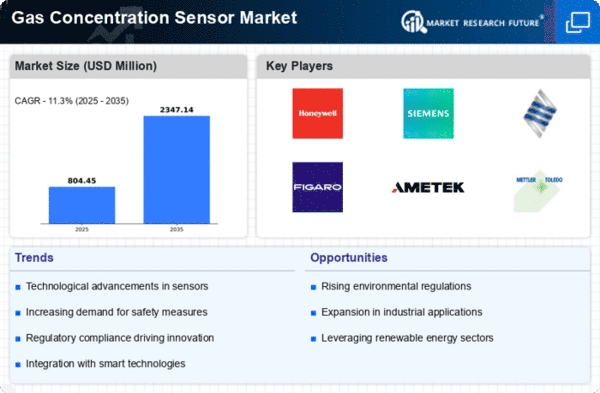
As per MRFR analysis, the Gas Concentration Sensor Market Size was estimated at 722.78 USD Million in 2024. The Gas Concentration Sensor industry is projected to grow from 804.47 in 2025 to 2347.14 by 2035, exhibiting a compound annual growth rate (CAGR) of 11.3 during the forecast period 2025 - 2035.

Key Market Trends & Highlights

The Gas Concentration Sensor Market is poised for substantial growth driven by technological advancements and increasing regulatory compliance.

  • North America remains the largest market for gas concentration sensors, driven by stringent industrial safety regulations. The Asia-Pacific region is emerging as the fastest-growing market, fueled by rapid urbanization and environmental concerns. The environmental monitoring segment holds the largest share, while the industrial safety segment is experiencing the fastest growth due to heightened safety awareness. Key market drivers include the rising demand for air quality monitoring and the growing adoption of smart city initiatives.

Market Size & Forecast

2024 Market Size 722.78 (USD Million)
2035 Market Size 2347.14 (USD Million)
CAGR (2025 - 2035) 11.3%
Largest Regional Market Share in 2024 North America

Major Players

<p>Honeywell (US), Siemens (DE), Emerson (US), Figaro Engineering (JP), Ametek (US), Mettler Toledo (CH), Teledyne Technologies (US), Sensirion (CH), Gas Sensing Solutions (GB)</p>

Market Trends

The Gas Concentration Sensor Market is currently experiencing a notable evolution, driven by advancements in technology and increasing awareness regarding environmental safety. The demand for precise gas detection solutions is rising across various sectors, including industrial, automotive, and residential applications. This trend is largely influenced by regulatory frameworks that emphasize the need for monitoring air quality and ensuring compliance with safety standards. As industries strive to enhance operational efficiency and minimize risks, the integration of sophisticated gas concentration sensors becomes paramount. Furthermore, the growing emphasis on smart technologies and the Internet of Things (IoT) is likely to propel the market forward, as these innovations facilitate real-time monitoring and data analysis. In addition to technological advancements, the Gas Concentration Sensor Market is also shaped by shifting consumer preferences towards sustainable practices. Organizations are increasingly investing in eco-friendly solutions, which may lead to a surge in demand for sensors that can detect harmful gases and pollutants. This shift is indicative of a broader societal trend towards environmental consciousness, prompting manufacturers to innovate and develop products that align with these values. As the market continues to evolve, it appears that collaboration between stakeholders, including manufacturers, regulatory bodies, and end-users, will be essential in driving growth and ensuring the development of effective gas detection solutions.

Technological Advancements

The Gas Concentration Sensor Market is witnessing rapid technological advancements, particularly in sensor design and functionality. Innovations such as miniaturization and enhanced sensitivity are enabling the development of more efficient and accurate sensors. These improvements are likely to enhance the performance of gas detection systems across various applications, from industrial settings to smart homes.

Increased Regulatory Compliance

There is a growing emphasis on regulatory compliance regarding air quality and safety standards, which is influencing the Gas Concentration Sensor Market. Industries are compelled to adopt advanced gas detection solutions to meet stringent regulations. This trend suggests that companies prioritizing compliance will likely drive demand for sophisticated sensors.

Sustainability and Environmental Awareness

The rising awareness of environmental issues is shaping the Gas Concentration Sensor Market. Consumers and organizations are increasingly seeking sustainable solutions that minimize environmental impact. This trend indicates a potential shift towards sensors that not only detect harmful gases but also contribute to broader sustainability goals.

Gas Concentration Sensor Market Market Drivers

Growth in Industrial Applications

The Global Gas Concentration Sensor Market Industry is witnessing substantial growth due to the expanding industrial applications of gas sensors. Industries such as chemical manufacturing, food processing, and pharmaceuticals are increasingly adopting gas concentration sensors to monitor and control processes. For example, in the chemical sector, sensors are utilized to detect hazardous gases during production, ensuring safety and compliance with industry standards. This trend is indicative of a broader shift towards automation and process optimization, which is likely to drive market growth. As industries continue to prioritize efficiency and safety, the demand for gas concentration sensors is expected to rise significantly.

Increasing Environmental Regulations

The Global Gas Concentration Sensor Market Industry is experiencing growth due to stringent environmental regulations aimed at reducing air pollution. Governments worldwide are implementing laws that require continuous monitoring of gas emissions from industrial sources. For instance, the European Union's Industrial Emissions Directive mandates that companies utilize advanced monitoring technologies, including gas concentration sensors, to ensure compliance. This regulatory push is likely to drive the demand for gas sensors, as industries seek to avoid penalties and improve their environmental footprint. As a result, the market is projected to reach 722.8 USD Billion in 2024, reflecting the increasing emphasis on environmental sustainability.

Rising Demand for Safety and Security

The Global Gas Concentration Sensor Market Industry is significantly influenced by the rising demand for safety and security in various sectors. Industries such as oil and gas, manufacturing, and mining require reliable gas detection systems to prevent hazardous situations. For instance, the implementation of gas sensors in confined spaces has become critical in ensuring worker safety and compliance with occupational health standards. The increasing awareness of workplace safety is likely to propel the market forward, as organizations invest in advanced gas monitoring solutions. This trend is expected to contribute to the market's growth, with projections indicating a value of 2347.1 USD Billion by 2035.

Technological Advancements in Sensor Technology

The Global Gas Concentration Sensor Market Industry benefits from rapid technological advancements in sensor technology. Innovations such as miniaturization, enhanced sensitivity, and integration with IoT devices are transforming how gas concentration sensors operate. For example, the development of MEMS (Micro-Electro-Mechanical Systems) sensors has led to more compact and efficient devices that can provide real-time data. These advancements not only improve the accuracy of gas detection but also expand the application range across various sectors, including healthcare and automotive. Consequently, the market is anticipated to grow at a CAGR of 11.3% from 2025 to 2035, driven by these technological improvements.

Market Segment Insights

By Application: Environmental Monitoring (Largest) vs. Industrial Safety (Fastest-Growing)

<p>The Gas Concentration Sensor Market showcases a significant distribution among its various application segments. Notably, Environmental Monitoring emerges as the largest segment, reflecting an increasing need for accurate air quality assessments and compliance with regulatory standards. This segment benefits from growing environmental concerns and the need for clean air initiatives, making it a vital area of focus. On the other hand, Industrial Safety is noted for its rapid growth, driven by stringent safety regulations and a heightened focus on worker safety across various industrial sectors. This makes it a competitive area as businesses prioritize technology that enhances workplace safety. As we look toward future growth trends, technological advancements play a crucial role in both segments. Environmental Monitoring is being propelled by innovations in sensor technology that enhance sensitivity and reliability, aligning with global sustainability goals. Meanwhile, the Industrial Safety segment is witnessing robust growth spurred by increased investment in safety protocols and smart technologies that integrate gas sensors into broader safety systems. The rise of automation and the Internet of Things (IoT) further amplify these trends, indicating a promising future for both segments in the Gas Concentration Sensor Market.</p>

<p>Environmental Monitoring (Dominant) vs. Industrial Safety (Emerging)</p>

<p>Environmental Monitoring claims the title of the dominant application segment in the Gas Concentration Sensor Market, driven by a global commitment to environmental protection and sustainability. This segment encompasses a wide array of applications, including air quality monitoring, pollution control, and compliance testing for environmental regulations. As governmental policies tighten around air quality standards, the demand for robust sensor technologies continues to soar. On the other hand, Industrial Safety is emerging as a critical segment with significant growth potential. Heightened awareness of workplace hazards and increased regulatory scrutiny have resulted in a surge in the adoption of gas concentration sensors in industrial environments. These sensors are essential for detecting hazardous gases, ensuring not only compliance but also the safety and well-being of employees.</p>

By End Use: Manufacturing (Largest) vs. Oil and Gas (Fastest-Growing)

<p>The Gas Concentration Sensor Market exhibits a varied distribution among its end-use segments, with manufacturing holding a significant share, predominantly due to its robust demand in industrial applications. This sector capitalizes on advanced sensor technologies to enhance operational safety and efficiency. In contrast, the oil and gas sector is witnessing rapid growth, driven by stringent regulations and the need for real-time monitoring of gas emissions and concentrations, further accelerating adoption.</p>

<p>Manufacturing: Dominant vs. Oil and Gas: Emerging</p>

<p>In the Gas Concentration Sensor Market, the manufacturing sector remains the dominant player, leveraging its extensive applications in process optimization and safety management. As industries increasingly prioritize safety and regulatory compliance, the demand for reliable gas sensors has soared. Conversely, the oil and gas sector is emerging as a critical growth area, propelled by technological advancements and a heightened focus on environmental sustainability. The industry's adoption of advanced sensor systems is essential for monitoring safety measures and reducing environmental impact, marking it as a sector to watch in the coming years.</p>

By Technology: Electrochemical (Largest) vs. Infrared (Fastest-Growing)

<p>The Gas Concentration Sensor Market showcases a diverse range of technological solutions. Electrochemical sensors hold the largest market share due to their reliability, accuracy, and cost-effectiveness for detecting various gas levels. In contrast, although having a smaller share currently, infrared sensors are rapidly gaining traction, often recognized for their efficiency and non-contact measurement capabilities, positioning them as the fastest-growing segment.</p>

<p>Technology: Electrochemical (Dominant) vs. Infrared (Emerging)</p>

<p>Electrochemical sensors are a major player in the Gas Concentration Sensor Market, revered for their precise readings in a variety of applications, including industrial safety and environmental monitoring. Their dominant position can be attributed to their affordability and ease of use. On the other hand, infrared sensors emerge as a promising technology, predicted to expand significantly due to the increasing demand for non-invasive and long-lasting solutions. These sensors excel in detecting gases like CO2 and CH4, making them highly desirable for both industrial applications and environmental compliance.</p>

By Sensor Type: Portable Sensors (Largest) vs. Wireless Sensors (Fastest-Growing)

<p>In the Gas Concentration Sensor Market, the distribution of market share among sensor types reveals that Portable Sensors hold the largest share, favored for their versatility and ease of use in various applications. Fixed Sensors follow closely, utilized primarily in industrial settings where continuous monitoring is a requirement. Meanwhile, Wireless Sensors are gaining traction due to advancements in connectivity and remote monitoring capabilities, while Multi-Gas Sensors cater to diverse needs by detecting multiple gases simultaneously, ensuring a comprehensive safety solution. Single-Gas Sensors, though essential, take a smaller portion of the market as industries lean towards more adaptable options. Growth trends within this segment are noteworthy, particularly the rapid rise of Wireless Sensors, which are anticipated to see increased adoption driven by the need for real-time data and reduced installation complexity. Innovations in technology are leading to more efficient and accurate sensing, pushing manufacturers to enhance sensor capabilities. Additionally, regulatory factors demanding stringent air quality monitoring are bolstering demand for Multi-Gas Sensors, promoting their growth as industries adapt to new compliance measures. Overall, the evolution of sensor technology and user preferences significantly shape the trajectory of the Gas Concentration Sensor Market.</p>

<p>Portable Sensors (Dominant) vs. Multi-Gas Sensors (Emerging)</p>

<p>Portable Sensors have established themselves as the dominant category in the Gas Concentration Sensor Market, primarily due to their portability and versatility in various applications ranging from environmental monitoring to industrial safety. They offer real-time data collection and can be utilized in diverse settings, enhancing their appeal among end users. On the other hand, Multi-Gas Sensors are emerging as a significant segment, driven by the need to detect various gases simultaneously for comprehensive safety measures. These sensors are particularly valuable in industrial environments where multiple gas exposures pose risks. Their ability to monitor a wider range of gases efficiently aligns with regulatory trends focusing on safety, positioning them as a critical choice for companies seeking to optimize safety and compliance.</p>

By Detection Method: Non-Dispersive Infrared (Largest) vs. Electrochemical Detection (Fastest-Growing)

<p>The Gas Concentration Sensor Market exhibits a diverse range of detection methods that cater to various industrial applications. Among these, Non-Dispersive Infrared (NDIR) technology holds the largest market share, favored for its accuracy and reliability in measuring gas concentrations. In contrast, Electrochemical Detection is recognized as the fastest-growing segment, primarily due to its compact design and cost-effectiveness, making it increasingly popular, especially in portable gas sensors.</p>

<p>Detection Method: NDIR (Dominant) vs. Electrochemical Detection (Emerging)</p>

<p>Non-Dispersive Infrared (NDIR) detection technology is the dominant method in the gas concentration sensor market, owing to its superior sensitivity and ability to measure a wide range of gases, including carbon dioxide and methane. This method’s popularity stems from its durability and low maintenance requirements, leading to its extensive adoption in HVAC systems and environmental monitoring. On the other hand, Electrochemical Detection is viewed as an emerging technology, particularly for applications in safety and portable monitoring. This method offers quick response times and is ideal for measuring toxic gases like carbon monoxide and hydrogen sulfide, making it critical for safety applications in industries such as manufacturing, oil and gas, and confined space monitoring.</p>

Get more detailed insights about Gas Concentration Sensor Market Research Report—Global Forecast till 2035

Regional Insights

North America : Market Leader in Innovation

North America is poised to maintain its leadership in the gas concentration sensor market, holding a significant share of 360.0 million in 2024. The region's growth is driven by stringent environmental regulations and increasing demand for safety in industrial applications. The adoption of advanced technologies and smart sensors is further propelling market expansion, as industries seek to enhance operational efficiency and compliance with safety standards. The United States and Canada are the primary contributors to this market, with key players like Honeywell, Emerson, and Teledyne Technologies leading the charge. The competitive landscape is characterized by continuous innovation and strategic partnerships among these companies, ensuring a robust supply chain and advanced product offerings. The focus on R&D and technological advancements positions North America as a hub for gas sensor development.

Europe : Emerging Regulatory Frameworks

Europe is witnessing a significant transformation in the gas concentration sensor market, with a market size of 200.0 million. The region's growth is largely attributed to stringent environmental regulations and a strong emphasis on workplace safety. The European Union's commitment to reducing emissions and enhancing air quality is driving demand for advanced gas sensors across various sectors, including manufacturing and healthcare. Leading countries such as Germany, France, and the UK are at the forefront of this market, with companies like Siemens and Mettler Toledo playing pivotal roles. The competitive landscape is marked by innovation and collaboration among key players, ensuring compliance with evolving regulations. As the market matures, the focus on sustainable solutions and smart technologies is expected to further enhance growth prospects. "The European market is increasingly prioritizing safety and environmental compliance, driving demand for advanced gas sensors."

Asia-Pacific : Rapid Industrialization and Growth

Asia-Pacific is emerging as a significant player in the gas concentration sensor market, with a market size of 130.0 million. The region's rapid industrialization and urbanization are key drivers of growth, as industries seek to enhance safety and efficiency. Government initiatives aimed at improving air quality and safety standards are further catalyzing demand for gas sensors, particularly in countries like China and India. China is the largest market in the region, with a growing number of manufacturers and suppliers entering the space. The competitive landscape is evolving, with local players gaining traction alongside established global companies like Figaro Engineering and Sensirion. As the region continues to invest in infrastructure and technology, the gas sensor market is expected to expand significantly, driven by innovation and regulatory support.

Middle East and Africa : Emerging Market Opportunities

The Middle East and Africa region is gradually developing its gas concentration sensor market, currently valued at 32.78 million. The growth is primarily driven by increasing industrial activities and a rising focus on safety and environmental regulations. Countries in this region are beginning to adopt advanced technologies to monitor air quality and ensure compliance with international safety standards, which is essential for attracting foreign investment. Leading countries such as South Africa and the UAE are making strides in implementing gas sensor technologies across various sectors, including oil and gas, manufacturing, and healthcare. The competitive landscape is characterized by a mix of local and international players, with companies exploring partnerships to enhance their market presence. As the region continues to develop, the demand for gas concentration sensors is expected to rise, driven by both regulatory and market needs.

Key Players and Competitive Insights

The Gas Concentration Sensor Market is currently characterized by a dynamic competitive landscape, driven by increasing demand for environmental monitoring and industrial safety. Key players such as Honeywell (US), Siemens (DE), and Emerson (US) are strategically positioned to leverage their technological expertise and extensive distribution networks. Honeywell (US) focuses on innovation in sensor technology, emphasizing the development of advanced gas detection systems that enhance safety in industrial applications. Siemens (DE) is concentrating on digital transformation, integrating IoT capabilities into their sensors to provide real-time data analytics. Emerson (US) is pursuing regional expansion, particularly in emerging markets, to capitalize on the growing need for gas monitoring solutions.

The market structure appears moderately fragmented, with a mix of established players and emerging companies. Key tactics employed by these companies include localizing manufacturing to reduce costs and optimize supply chains. This approach not only enhances operational efficiency but also allows for quicker response times to market demands. The collective influence of these major players shapes a competitive environment where innovation and responsiveness are paramount.

In November 2025, Honeywell (US) announced the launch of a new line of smart gas sensors designed for industrial applications, which utilize AI algorithms to predict potential gas leaks. This strategic move is likely to enhance their market share by addressing the growing need for predictive maintenance solutions in hazardous environments. The integration of AI into their product offerings signifies a shift towards more intelligent and responsive gas monitoring systems.

In October 2025, Siemens (DE) unveiled a partnership with a leading software company to develop a cloud-based platform for gas sensor data management. This collaboration is expected to streamline data collection and analysis, providing customers with actionable insights to improve operational safety. By enhancing their digital capabilities, Siemens (DE) positions itself as a frontrunner in the digital transformation of the gas concentration sensor market.

In September 2025, Emerson (US) completed the acquisition of a regional sensor manufacturer, which is anticipated to bolster its product portfolio and expand its market reach. This acquisition aligns with Emerson's strategy to enhance its technological capabilities and offer a broader range of gas monitoring solutions. The integration of new technologies from the acquired company could lead to innovative product developments that meet evolving customer needs.

As of December 2025, current trends in the Gas Concentration Sensor Market indicate a strong emphasis on digitalization, sustainability, and AI integration. Strategic alliances among key players are increasingly shaping the competitive landscape, fostering innovation and enhancing product offerings. The shift from price-based competition to a focus on technological advancement and supply chain reliability is evident. Moving forward, competitive differentiation will likely hinge on the ability to innovate and adapt to changing market demands, positioning companies to thrive in an evolving environment.

Key Companies in the Gas Concentration Sensor Market include

Industry Developments

October 2019: FLIR introduced the FLIR One Pro LT, a smart phone camera attachment, to broaden the use of thermal imaging technology.

April 2022: The MEMBRAPOR ETO/CA-10 sensor is designed for precise ethylene oxide (ETO) detection with greatly reduced cross-sensitivity to carbon monoxide (CO). With the use of this invention, specific ETO measurements can now be performed in areas where very low CO concentrations, such as those affected by traffic, may exist. Ethylene oxide plays a significant role as a sterilizing agent in many applications, hence accurate monitoring is required.

February 2021: ABB and Amazon Web Services (AWS) have established a collaborative partnership to develop an online platform for managing EV fleets. This platform would make it possible for companies to operate their electric car fleets more sustainably and cheaply.

Future Outlook

Gas Concentration Sensor Market Future Outlook

<p>The Gas Concentration Sensor Market is projected to grow at 11.3% CAGR from 2024 to 2035, driven by increasing industrial automation, stringent environmental regulations, and advancements in sensor technology.</p>

New opportunities lie in:

  • <p>Development of smart gas monitoring systems for industrial applications.</p>
  • <p>Expansion into emerging markets with tailored sensor solutions.</p>
  • <p>Integration of IoT capabilities for real-time data analytics and monitoring.</p>

<p>By 2035, the Gas Concentration Sensor Market is expected to be robust, driven by innovation and expanding applications.</p>

Market Segmentation

Gas Concentration Sensor Market End Use Outlook

  • Manufacturing
  • Oil and Gas
  • Chemical Processing
  • Food and Beverage
  • Pharmaceuticals

Gas Concentration Sensor Market Technology Outlook

  • Electrochemical
  • Infrared
  • Semiconductor
  • Photoionization
  • Catalytic

Gas Concentration Sensor Market Application Outlook

  • Environmental Monitoring
  • Industrial Safety
  • Automotive
  • Healthcare
  • Agriculture

Gas Concentration Sensor Market Sensor Type Outlook

  • Portable Sensors
  • Fixed Sensors
  • Wireless Sensors
  • Multi-Gas Sensors
  • Single-Gas Sensors

Gas Concentration Sensor Market Detection Method Outlook

  • Non-Dispersive Infrared
  • Electrochemical Detection
  • Photoionization Detection
  • Catalytic Combustion
  • Semiconductor Detection

Report Scope

MARKET SIZE 2024 722.78(USD Million)
MARKET SIZE 2025 804.47(USD Million)
MARKET SIZE 2035 2347.14(USD Million)
COMPOUND ANNUAL GROWTH RATE (CAGR) 11.3% (2024 - 2035)
REPORT COVERAGE Revenue Forecast, Competitive Landscape, Growth Factors, and Trends
BASE YEAR 2024
Market Forecast Period 2025 - 2035
Historical Data 2019 - 2024
Market Forecast Units USD Million
Key Companies Profiled Honeywell (US), Siemens (DE), Emerson (US), Figaro Engineering (JP), Ametek (US), Mettler Toledo (CH), Teledyne Technologies (US), Sensirion (CH), Gas Sensing Solutions (GB)
Segments Covered Application, End Use, Technology, Sensor Type, Detection Method
Key Market Opportunities Integration of advanced analytics in Gas Concentration Sensor Market enhances real-time monitoring capabilities.
Key Market Dynamics Rising demand for air quality monitoring drives innovation and competition in the gas concentration sensor market.
Countries Covered North America, Europe, APAC, South America, MEA

FAQs

How big is the market for Gas Concentration Sensors?

In 2024, A valuation of USD 722.78 Million was put on the market for gas concentration sensors.

How fast is the market for gas concentration sensors growing?

During the forecast period, 2025 to 2035, It is expected that the global market would grow at a CAGR of 11.30%.

Which region accounted for the greatest proportion of the market for Gas Concentration Sensors?

North America maintained the biggest market share globally.

Who are the leading companies in the market for gas concentration sensors?

ABB Ltd., AlphaSense Inc., City Technology Ltd., Dynament, Figaro Engineering Inc., Membrapor, Nemoto &amp; Co. Ltd., and Robert Bosch LLC are the major competitors in the market.

Which product dominated the market for Gas Concentration Sensors?

In 2022, the market was dominated by Carbon Dioxide (CO2) Sensors.

Which type dominated the market for Gas Concentration Sensors?

Which type dominated the market for Gas Concentration Sensors?

  1. SECTION I: EXECUTIVE SUMMARY AND KEY HIGHLIGHTS |
    1. EXECUTIVE SUMMARY 2
  2. SECTION II: SCOPING, METHODOLOGY AND MARKET STRUCTURE |
    1. MARKET INTRODUCTION |
    2. RESEARCH METHODOLOGY 3
  3. SECTION III: QUALITATIVE ANALYSIS |
    1. MARKET DYNAMICS |
    2. MARKET FACTOR ANALYSIS 4
  4. SECTION IV: QUANTITATIVE ANALYSIS |
    1. Semiconductor & Electronics, BY Application (USD Million) |
    2. Semiconductor & Electronics, BY End Use (USD Million) |
    3. Semiconductor & Electronics, BY Technology (USD Million) |
    4. Semiconductor & Electronics, BY Sensor Type (USD Million) |
    5. Semiconductor & Electronics, BY Detection Method (USD Million) |
    6. Semiconductor & Electronics, BY Region (USD Million) 5
  5. SECTION V: COMPETITIVE ANALYSIS |
    1. Competitive Landscape |
    2. Company Profiles |
    3. Appendix

Gas Concentration Sensor Market Segmentation

Market Segmentation Overview

  • Detailed segmentation data will be available in the full report
  • Comprehensive analysis by multiple parameters
  • Regional and country-level breakdowns
  • Market size forecasts by segment
Infographic

Free Sample Request

Kindly complete the form below to receive a free sample of this Report

Get Free Sample

Customer Strories

Compare Licence

×
Features License Type
Single User Multiuser License Enterprise User
Price $4,950 $5,950 $7,250
Maximum User Access Limit 1 User Upto 10 Users Unrestricted Access Throughout the Organization
Free Customization
Direct Access to Analyst
Deliverable Format
Platform Access
Discount on Next Purchase 10% 15% 15%
Printable Versions