
Request Free Sample ×

Kindly complete the form below to receive a free sample of this Report

* Please use a valid business email

Leading companies partner with us for data-driven Insights

clients tt-cursor
Hero Background
English
Chinese
French
Japanese
Korean
German
Spanish

Flight Inspection Market Share

ID: MRFR/AD/8667-HCR
168 Pages
Abbas Raut
March 2026

Flight Inspection Market Size, Share, Industry Trend & Analysis Research Report Information By Application (Commercial Airports, Defense Airports), By Solution (Services, Systems) And By Region (North America, Europe, Asia-Pacific, And Rest Of The World) – Forecast Till 2035

Share:
Download PDF ×

We do not share your information with anyone. However, we may send you emails based on your report interest from time to time. You may contact us at any time to opt-out.

Flight Inspection Market Infographic
Purchase Options

Market Share

Flight Inspection Market Share Analysis

In the competitive panorama of the Flight Inspection Market, powerful marketplace proportion positioning techniques are critical for groups aiming to establish a strong presence and differentiate themselves inside the enterprise. One key method involves technological leadership and innovation. Companies that spend money on modern-day technologies, along with advanced avionics, the latest sensors, and facts analytics, role themselves as leaders able to impart correct and comprehensive Flight Inspection services. Global marketplace enlargement and geographic diversification are strategic movements to boost marketplace percentage within the Flight Inspection Market. Companies that establish an international footprint and penetrate emerging markets can tap into new opportunities and cater to the evolving needs of diverse regions. Expanding into regions experiencing great aviation increases the position of companies as international leaders, permitting them to seize market proportion in areas where flight inspection services are in high demand because of expanding air visitors and modernization projects. Brand recognition and notion management are vital marketplace percentage positioning strategies inside the Flight Inspection Market. Companies that set up themselves as industry experts, concept leaders, and dependable sources of data advantage the trust of clients and enterprise stakeholders. Building a sturdy emblem image via participation in enterprise events, guides, and contributions to investigate and improvement efforts positions corporations as leaders inside the Flight Inspection region, improving market proportion and influence. Environmental sustainability is becoming a strategic market proportion positioning method inside the Flight Inspection Market. As aviation enterprises place more emphasis on eco-friendly practices, businesses that combine sustainable substances, power-green additives, and environmentally conscious practices in flight inspection technology align themselves with enterprise expectations. Continuous product updates and innovation in Flight Inspection technology are key techniques for retaining market percentage positioning. In a swiftly evolving technological panorama, corporations that often update their Flight Inspection services, introduce new functions, and cope with rising enterprise traits exhibit agility and adaptableness. The marketplace percentage positioning techniques in the Flight Inspection Market revolve around technological management, strategic partnerships, customization and versatility, international marketplace expansion, operational efficiency, customer support excellence, logo popularity, environmental sustainability, non-stop product updates, and innovation. Companies that efficaciously implement those techniques navigate the aggressive panorama, differentiate themselves, and secure an outstanding position in a market wherein innovation, client pride, and strategic collaborations are pivotal elements influencing the alternatives of aviation enterprise stakeholders.


Author
Author Profile
Abbas Raut
Research Analyst

Abbas Raut is a Senior Research Analyst with 5+ years of experience delivering data-driven insights and strategic recommendations across the Automotive and Aerospace & Defense sectors. He specializes in emerging technologies, industry value chains, and global market dynamics shaping the future of mobility and defense. In automotive, Abbas has led studies on EVs, charging stations, BMS, superchargers, and more, guiding stakeholders through electrification and regulatory shifts. In Aerospace & Defense, he has analyzed markets for military electronics, drones, radars, and electronic warfare solutions, supporting procurement and investment strategies. With expertise in market sizing, forecasting, benchmarking, and technology adoption, Abbas is known for transforming complex datasets into actionable insights that drive strategy, innovation, and growth.

Leave a Comment

FAQs

What is the current valuation of the Flight Inspection Market as of 2024?

<p>The Flight Inspection Market was valued at 5.93 USD Billion in 2024.</p>

What is the projected market valuation for the Flight Inspection Market in 2035?

<p>The market is projected to reach 9.035 USD Billion by 2035.</p>

What is the expected CAGR for the Flight Inspection Market during the forecast period 2025 - 2035?

<p>The expected CAGR for the Flight Inspection Market during 2025 - 2035 is 3.9%.</p>

Which segments are included in the Flight Inspection Market analysis?

<p>The market analysis includes segments such as Application and Solution.</p>

What are the projected valuations for the Commercial and Defense Airports segments by 2035?

<p>By 2035, the Commercial Airports segment is projected to reach 3.8 USD Billion, while the Defense Airports segment is expected to reach 5.235 USD Billion.</p>

What are the projected valuations for Systems and Services in the Flight Inspection Market by 2035?

The Systems segment is projected to reach 3.5 USD Billion, and the Services segment is expected to reach 5.535 USD Billion by 2035.

Who are the key players in the Flight Inspection Market?

Key players in the market include Honeywell, Northrop Grumman, Rockwell Collins, Airbus, Boeing, Thales Group, Indra Sistemas, Saab, and L3Harris Technologies.

How does the Flight Inspection Market's growth compare between the Application and Solution segments?

The Application segment is projected to grow from 5.93 USD Billion in 2024 to 9.035 USD Billion by 2035, while the Solution segment shows similar growth potential.

What role do major companies like Boeing and Airbus play in the Flight Inspection Market?

Companies like Boeing and Airbus are pivotal in driving innovation and technological advancements within the Flight Inspection Market.

What factors could influence the growth of the Flight Inspection Market from 2025 to 2035?

Factors such as advancements in technology, increased air traffic, and regulatory changes may influence the growth of the Flight Inspection Market during 2025 - 2035.

Market Summary

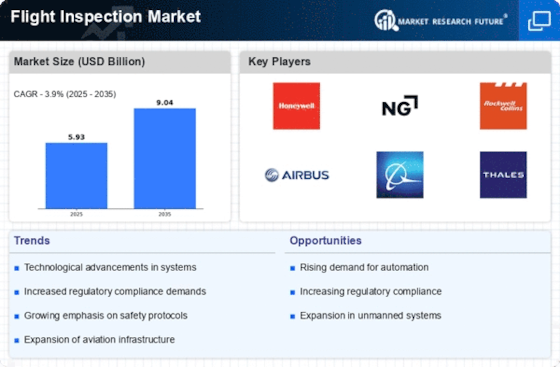
As per Market Research Future analysis, the Flight Inspection Market Size was estimated at 5.93 USD Billion in 2024. The Flight Inspection industry is projected to grow from 6.161 USD Billion in 2025 to 9.035 USD Billion by 2035, exhibiting a compound annual growth rate (CAGR) of 3.9% during the forecast period 2025 - 2035

Key Market Trends & Highlights

The Flight Inspection Market is poised for substantial growth driven by technological advancements and regulatory compliance.

  • Technological advancements are revolutionizing flight inspection processes, enhancing accuracy and efficiency. North America remains the largest market, while the Asia-Pacific region is emerging as the fastest-growing area for flight inspection services. The commercial airports segment dominates the market, whereas the defense airports segment is experiencing rapid growth. Key market drivers include increased air traffic and the need for stringent regulatory compliance in aviation safety.

Market Size & Forecast

2024 Market Size 5.93 (USD Billion)
2035 Market Size 9.035 (USD Billion)
CAGR (2025 - 2035) 3.9%
Largest Regional Market Share in 2024 North America

Major Players

Honeywell (US), Northrop Grumman (US), Rockwell Collins (US), Airbus (FR), Boeing (US), Thales Group (FR), Indra Sistemas (ES), Saab (SE), L3Harris Technologies (US)

Market Trends

The Flight Inspection Market is currently experiencing a transformative phase, driven by advancements in technology and increasing regulatory requirements for aviation safety. The integration of sophisticated systems, such as automated flight inspection tools and enhanced navigation aids, appears to be reshaping the landscape of this sector, as emphasized in recent flight inspection market analysis examining modernization strategies. Stakeholders are increasingly focusing on ensuring compliance with stringent safety standards, which may lead to a rise in demand for flight inspection services. Furthermore, the growing emphasis on operational efficiency and cost-effectiveness is likely to propel innovations in inspection methodologies, thereby enhancing the overall quality of aviation operations.

In addition, the Flight Inspection Market seems to be influenced by the expansion of the global aviation industry. As air travel continues to grow, the need for reliable and accurate flight inspection services becomes more pronounced. This trend suggests that companies operating within this market may need to adapt to evolving customer expectations and technological advancements. The interplay between regulatory frameworks and market dynamics indicates a complex environment where adaptability and foresight will be crucial for success in the coming years.

Technological Advancements

The Flight Inspection Market is witnessing a surge in the adoption of cutting-edge technologies. Innovations such as automated systems and advanced data analytics are enhancing the precision and efficiency of flight inspections. This trend indicates a shift towards more reliable and faster inspection processes, which could significantly improve operational safety, aligning with findings from comprehensive flight inspection market analysis evaluating advanced inspection technologies.

Regulatory Compliance

Increasing regulatory demands are shaping the Flight Inspection Market. Aviation authorities worldwide are implementing stricter safety standards, necessitating more frequent and thorough inspections. This trend suggests that companies must prioritize compliance to maintain operational licenses and ensure passenger safety.

Global Aviation Growth

The expansion of the global aviation sector is driving demand for flight inspection services. As air travel becomes more accessible, the need for reliable inspection processes is likely to increase, a trend frequently highlighted in flight inspection market analysis assessing aviation expansion impacts. This trend indicates that stakeholders in the Flight Inspection Market may need to scale their operations to meet the rising demand.

Flight Inspection Market Market Drivers

Increased Air Traffic and Aviation Growth

The Flight Inspection Market is poised for growth due to the increasing air traffic and overall expansion of the aviation sector. As more airlines enter the market and existing airlines expand their fleets, the demand for reliable navigation systems becomes paramount. According to recent data, air traffic is projected to grow by approximately 4.5% annually, necessitating enhanced flight inspection services to ensure the safety and efficiency of air travel. This growth in air traffic not only drives the need for more frequent inspections but also encourages investment in advanced flight inspection technologies. The rising number of airports and air traffic management systems further indicates a robust demand for flight inspection services, positioning the industry for sustained growth in the coming years.

Regulatory Compliance and Safety Standards

The Flight Inspection Market is heavily influenced by stringent regulatory compliance and safety standards imposed by aviation authorities. These regulations are designed to ensure the safety and reliability of air navigation services. As countries continue to enhance their aviation safety frameworks, the demand for flight inspection services is likely to increase. For example, the International Civil Aviation Organization (ICAO) mandates regular inspections of navigation aids, which drives the need for specialized flight inspection services. This regulatory environment creates a stable demand for flight inspection services, as operators must adhere to these standards to maintain their licenses and operational capabilities. Consequently, the market is expected to expand as more operators invest in compliance-related flight inspection services to meet evolving safety requirements.

Emerging Markets and Infrastructure Development

The Flight Inspection Market is witnessing growth opportunities in emerging markets where aviation infrastructure is rapidly developing. Countries in Asia and Africa are investing heavily in their aviation sectors, leading to the construction of new airports and the modernization of existing facilities. This infrastructure development necessitates the establishment of reliable flight inspection services to ensure that navigation aids and systems are functioning optimally. As these markets expand, the demand for flight inspection services is likely to increase, creating new avenues for service providers. Furthermore, partnerships between local governments and international aviation organizations may facilitate the transfer of technology and expertise, further enhancing the capabilities of flight inspection services in these regions.

Technological Advancements in Flight Inspection

The Flight Inspection Market is experiencing a surge in technological advancements that enhance the efficiency and accuracy of flight inspection processes. Innovations such as automated flight inspection systems and advanced data analytics tools are being integrated into existing frameworks. These technologies not only streamline operations but also reduce the time required for inspections. For instance, the adoption of drones for aerial inspections is gaining traction, allowing for real-time data collection and analysis. As a result, the market is projected to grow at a compound annual growth rate of approximately 5.2% over the next five years, driven by these technological improvements. The integration of artificial intelligence and machine learning into flight inspection systems further indicates a shift towards more sophisticated methodologies, potentially revolutionizing the industry.

Investment in Modernization of Flight Inspection Systems

The Flight Inspection Market is experiencing a trend towards the modernization of flight inspection systems, driven by the need for enhanced operational efficiency and accuracy. Many aviation authorities and service providers are investing in upgrading their existing flight inspection equipment to incorporate the latest technologies. This modernization includes the integration of satellite-based navigation systems and advanced simulation tools, which improve the precision of inspections. As a result, the market is likely to see a shift towards more sophisticated flight inspection methodologies that can adapt to the evolving demands of the aviation industry. The investment in modernization not only enhances the quality of flight inspection services but also positions companies to better compete in a rapidly changing market landscape.

Market Segment Insights

By Application: Commercial Airports (Largest) vs. Defense Airports (Fastest-Growing)

<p>In the Flight Inspection Market, the application segment demonstrates a distinct division between commercial and defense airports. Commercial airports hold the largest share, driven by the increasing demand for regular air travel and the expansion of air traffic. Their robust infrastructure and investment in advanced flight inspection technologies contribute significantly to their prevailing market position. Meanwhile, defense airports, although smaller in market share, are rapidly gaining traction due to rising defense budgets and the growing emphasis on homeland security and military aviation safety standards.</p>

<p>Application: Commercial Airports (Dominant) vs. Defense Airports (Emerging)</p>

<p>Commercial airports have established themselves as the dominant force in the Flight Inspection Market, characterized by high passenger volumes and investment in innovative inspection technologies. These airports prioritize safety and compliance, resulting in frequent flight inspections that sustain operational efficiency and regulatory alignment. In contrast, defense airports represent an emerging segment, propelled by increasing government spending on military aviation and a focus on advanced surveillance and safety measures. This segment is witnessing significant growth as governments enhance their air defense capabilities and upgrade their aging infrastructure, making the defense airport market an integral part of the overall flight inspection landscape.</p>

By Solution: Systems (Largest) vs. Services (Fastest-Growing)

<p>In the Flight Inspection Market, the Systems segment commands the largest share, showcasing its critical role in ensuring aircraft safety and compliance with international standards. This segment encompasses advanced technologies that provide precise navigation and detection capabilities, solidifying its dominance in the market. On the other hand, the Services segment is rapidly gaining traction due to increasing demand for specialized maintenance and operational procedures that enhance efficiency and safety in flight inspections.</p>

<p>Services: Inspection Services (Dominant) vs. Training Services (Emerging)</p>

<p>Within the Services segment of the Flight Inspection Market, Inspection Services are currently dominant, characterized by their comprehensive approach to evaluating aircraft performance, ensuring adherence to regulatory requirements. These services cover everything from routine checks to extensive inspections, catering to a wide range of aircraft types. Conversely, Training Services are emerging as a vital component, driven by the need for skilled personnel who can effectively operate advanced flight inspection technologies. This growth is fueled by the industry's ongoing evolution, necessitating continuous education and training to keep pace with advancements and to comply with changing regulatory frameworks.</p>

Get more detailed insights about Flight Inspection Market Research Report - Global Forecast till 2035

Regional Insights

North America : Innovation and Leadership Hub

North America is the largest market for flight inspection, holding approximately 45% of the global share. The region's growth is driven by advancements in aviation technology, stringent safety regulations, and increasing air traffic. The U.S. Federal Aviation Administration (FAA) plays a crucial role in setting regulatory standards that enhance market demand. The focus on modernization of air traffic management systems further propels the market forward. The focus on modernization of air traffic management systems further propels the market forward, reflecting conclusions drawn from regional flight inspection market analysis evaluating innovation hubs. The United States is the leading country in this sector, with major players like Honeywell, Northrop Grumman, and Boeing headquartered there. The competitive landscape is characterized by continuous innovation and partnerships among key players. Canada also contributes significantly, focusing on enhancing its aviation infrastructure. The presence of these industry giants ensures a robust market environment, fostering growth and technological advancements.

Europe : Regulatory Framework and Growth

Europe is the second-largest market for flight inspection, accounting for approximately 30% of the global share. The region benefits from a strong regulatory framework established by the European Union Aviation Safety Agency (EASA), which mandates rigorous safety inspections and certifications. This regulatory environment drives demand for advanced flight inspection technologies, as countries aim to enhance their aviation safety standards and operational efficiency. Leading countries in Europe include France, Germany, and the United Kingdom, where companies like Airbus and Thales Group are prominent. The competitive landscape is marked by collaborations between manufacturers and regulatory bodies to innovate and improve flight inspection systems. The presence of established players and a focus on sustainable aviation practices further enhance the market's growth potential.

Asia-Pacific : Rapid Growth and Investment

Asia-Pacific is witnessing rapid growth in the flight inspection market, holding approximately 20% of the global share. The increasing air traffic, coupled with government investments in aviation infrastructure, is a significant driver of this growth. Countries like China and India are expanding their airport facilities and modernizing air traffic management systems, which necessitates advanced flight inspection solutions to ensure safety and compliance with international standards. China is the largest market in the region, followed by India and Japan. The competitive landscape is evolving, with local players emerging alongside established global companies like L3Harris Technologies and Rockwell Collins. The region's focus on enhancing aviation safety and efficiency is fostering partnerships and collaborations, leading to innovative solutions tailored to meet the unique demands of the market.

Middle East and Africa : Strategic Growth and Development

The Middle East and Africa region is gradually emerging in the flight inspection market, holding about 5% of the global share. The growth is driven by increasing investments in aviation infrastructure, particularly in the Gulf Cooperation Council (GCC) countries, which are enhancing their airport facilities and air traffic management systems. Regulatory bodies are also focusing on improving safety standards, which is expected to boost demand for flight inspection services in the coming years. Leading countries in this region include the United Arab Emirates and South Africa, where significant investments are being made to modernize aviation infrastructure. The competitive landscape is characterized by a mix of local and international players, with companies like Indra Sistemas and Saab making notable contributions. The region's strategic location as a The Flight Inspection Market potential, attracting investments and partnerships.

Key Players and Competitive Insights

Leading market players are investing heavily in research and development to expand their product lines, which will help the Flight Inspection Market, grow even more. Market participants are also undertaking various strategic activities to expand their  footprint, with important market developments including new product launches, contractual agreements, mergers and acquisitions, higher investments, and collaboration with other organizations. To expand and survive in a more competitive and rising market climate, the Flight Inspection industry must offer cost-effective items.Manufacturing locally to minimize operational costs is one of the key business tactics used by manufacturers in the  Flight Inspection industry to benefit clients and increase the market sector. In recent years, the Flight Inspection industry has offered some of the most significant advantages to medicine.Major players in the Flight Inspection Market attempting to increase market demand by investing in research and development operations are Textron, Inc. (US), Bombardier,    Inc. (Canada), Norwegian Special Mission AS (Norway), AERODATA AG (Germany), Airfield Technology, Inc. (US), Saab AB (Sweden), Safran (France),  Cobham plc (UK), Radiola Limited (New Zealand), ENAV S.p.A. (Italy), MISTRAS Group, Inc. (US) and ST Engineering (Singapore)The right flight inspection and flight calibration operational aircraft for your mission are available from Textron Aviation. Modern en-route and terminal navigational aids have been installed in the flight inspection systems. If someone needs the payload capacity for substantial onboard test equipment, the extended range of border-to-border flight calibration, or a dual flight inspection and executive transportation configuration. Flight inspection organizations are operating the KING AIR turboprop family throughout the world.  The BEECHCRAFT King Air 260 turboprop can take off and land on unimproved runways, allowing you to visit additional airports while retaining its well-known stable handling qualities.When you install any significant Flight Inspection Market equipment (FIS) equipment, your King Air 260 transforms into the exact tool, you require for repeated accuracy. The BEECHCRAFT 360ER aircraft is a preferred flight inspection aircraft ly due to its stability and range.  Long flight calibration trips can be completed comfortably and accurately while still adhering to ICAO, FAA, and regional regulations.  We can adapt the mission suite to your needs because it can support any significant FIS system.  Fly the King Air 360 ER aircraft with assurance.The platforms from Bombardier are the appropriate aircraft to guarantee the precision of approaches and procedures as governments modernize and upgrade their infrastructure for safe and effective air transport. The world's leading flight departments favor our aircraft due to their agility, runway performance, and handling qualities. Additionally, crew tiredness during validation flights can be minimized using Bombardier's renowned smooth ride technology. As a result of their dispatch dependability and extended maintenance intervals, aircraft are regarded as reliable assets.Depending on the kinds of operations that need to be tested and the runway performance needed, the Challenger and  platforms each provide specific advantages. The cockpit of the Challenger 650 aircraft is the best in its class and includes innovations like the Synthetic Vision System (SVS) and MultiScan weather radar.

Key Companies in the Flight Inspection Market include

Industry Developments

December 2019: The aviation authority of India (AAI) announced intentions to build the nation's first three water aerodromes in the Indian Union region of Andaman & Nicobar.

October 2020:  By establishing a new customer service center in Melbourne, Australia, Bombardier Inc. increased its presence in the APAC region.

Future Outlook

Flight Inspection Market Future Outlook

The Flight Inspection Market is projected to grow at a 3.9% CAGR from 2025 to 2035, driven by technological advancements, regulatory changes, and increasing air traffic demands.

New opportunities lie in:

  • <p>Development of advanced automated flight inspection systems Expansion of mobile flight inspection services Integration of AI for predictive maintenance in flight inspection operations</p>

By 2035, the Flight Inspection Market is expected to achieve robust growth, reflecting evolving industry needs.

Market Segmentation

Flight Inspection Market Solution Outlook

  • Systems
  • Services

Flight Inspection Market Application Outlook

  • Commercial Airports
  • Defense Airports

Report Scope

MARKET SIZE 2024 5.93(USD Billion)
MARKET SIZE 2025 6.161(USD Billion)
MARKET SIZE 2035 9.035(USD Billion)
COMPOUND ANNUAL GROWTH RATE (CAGR) 3.9% (2025 - 2035)
REPORT COVERAGE Revenue Forecast, Competitive Landscape, Growth Factors, and Trends
BASE YEAR 2024
Market Forecast Period 2025 - 2035
Historical Data 2019 - 2024
Market Forecast Units USD Billion
Key Companies Profiled Honeywell (US), Northrop Grumman (US), Rockwell Collins (US), Airbus (FR), Boeing (US), Thales Group (FR), Indra Sistemas (ES), Saab (SE), L3Harris Technologies (US)
Segments Covered Application, Solution, Region
Key Market Opportunities Integration of advanced automation technologies enhances efficiency in the Flight Inspection Market.
Key Market Dynamics Technological advancements and regulatory changes drive innovation and competition in the Flight Inspection Market.
Countries Covered North America, Europe, APAC, South America, MEA

FAQs

What is the current valuation of the Flight Inspection Market as of 2024?

<p>The Flight Inspection Market was valued at 5.93 USD Billion in 2024.</p>

What is the projected market valuation for the Flight Inspection Market in 2035?

<p>The market is projected to reach 9.035 USD Billion by 2035.</p>

What is the expected CAGR for the Flight Inspection Market during the forecast period 2025 - 2035?

<p>The expected CAGR for the Flight Inspection Market during 2025 - 2035 is 3.9%.</p>

Which segments are included in the Flight Inspection Market analysis?

<p>The market analysis includes segments such as Application and Solution.</p>

What are the projected valuations for the Commercial and Defense Airports segments by 2035?

<p>By 2035, the Commercial Airports segment is projected to reach 3.8 USD Billion, while the Defense Airports segment is expected to reach 5.235 USD Billion.</p>

What are the projected valuations for Systems and Services in the Flight Inspection Market by 2035?

The Systems segment is projected to reach 3.5 USD Billion, and the Services segment is expected to reach 5.535 USD Billion by 2035.

Who are the key players in the Flight Inspection Market?

Key players in the market include Honeywell, Northrop Grumman, Rockwell Collins, Airbus, Boeing, Thales Group, Indra Sistemas, Saab, and L3Harris Technologies.

How does the Flight Inspection Market's growth compare between the Application and Solution segments?

The Application segment is projected to grow from 5.93 USD Billion in 2024 to 9.035 USD Billion by 2035, while the Solution segment shows similar growth potential.

What role do major companies like Boeing and Airbus play in the Flight Inspection Market?

Companies like Boeing and Airbus are pivotal in driving innovation and technological advancements within the Flight Inspection Market.

What factors could influence the growth of the Flight Inspection Market from 2025 to 2035?

Factors such as advancements in technology, increased air traffic, and regulatory changes may influence the growth of the Flight Inspection Market during 2025 - 2035.

  1. SECTION I: EXECUTIVE SUMMARY AND KEY HIGHLIGHTS
    1. | 1.1 EXECUTIVE SUMMARY
    2. | | 1.1.1 Market Overview
    3. | | 1.1.2 Key Findings
    4. | | 1.1.3 Market Segmentation
    5. | | 1.1.4 Competitive Landscape
    6. | | 1.1.5 Challenges and Opportunities
    7. | | 1.1.6 Future Outlook
  2. SECTION II: SCOPING, METHODOLOGY AND MARKET STRUCTURE
    1. | 2.1 MARKET INTRODUCTION
    2. | | 2.1.1 Definition
    3. | | 2.1.2 Scope of the study
    4. | | | 2.1.2.1 Research Objective
    5. | | | 2.1.2.2 Assumption
    6. | | | 2.1.2.3 Limitations
    7. | 2.2 RESEARCH METHODOLOGY
    8. | | 2.2.1 Overview
    9. | | 2.2.2 Data Mining
    10. | | 2.2.3 Secondary Research
    11. | | 2.2.4 Primary Research
    12. | | | 2.2.4.1 Primary Interviews and Information Gathering Process
    13. | | | 2.2.4.2 Breakdown of Primary Respondents
    14. | | 2.2.5 Forecasting Model
    15. | | 2.2.6 Market Size Estimation
    16. | | | 2.2.6.1 Bottom-Up Approach
    17. | | | 2.2.6.2 Top-Down Approach
    18. | | 2.2.7 Data Triangulation
    19. | | 2.2.8 Validation
  3. SECTION III: QUALITATIVE ANALYSIS
    1. | 3.1 MARKET DYNAMICS
    2. | | 3.1.1 Overview
    3. | | 3.1.2 Drivers
    4. | | 3.1.3 Restraints
    5. | | 3.1.4 Opportunities
    6. | 3.2 MARKET FACTOR ANALYSIS
    7. | | 3.2.1 Value chain Analysis
    8. | | 3.2.2 Porter's Five Forces Analysis
    9. | | | 3.2.2.1 Bargaining Power of Suppliers
    10. | | | 3.2.2.2 Bargaining Power of Buyers
    11. | | | 3.2.2.3 Threat of New Entrants
    12. | | | 3.2.2.4 Threat of Substitutes
    13. | | | 3.2.2.5 Intensity of Rivalry
    14. | | 3.2.3 COVID-19 Impact Analysis
    15. | | | 3.2.3.1 Market Impact Analysis
    16. | | | 3.2.3.2 Regional Impact
    17. | | | 3.2.3.3 Opportunity and Threat Analysis
  4. SECTION IV: QUANTITATIVE ANALYSIS
    1. | 4.1 Aerospace & Defense, BY Application (USD Billion)
    2. | | 4.1.1 Commercial Airports
    3. | | 4.1.2 Defense Airports
    4. | 4.2 Aerospace & Defense, BY Solution (USD Billion)
    5. | | 4.2.1 Systems
    6. | | 4.2.2 Services
    7. | 4.3 Aerospace & Defense, BY Region (USD Billion)
    8. | | 4.3.1 North America
    9. | | | 4.3.1.1 US
    10. | | | 4.3.1.2 Canada
    11. | | 4.3.2 Europe
    12. | | | 4.3.2.1 Germany
    13. | | | 4.3.2.2 UK
    14. | | | 4.3.2.3 France
    15. | | | 4.3.2.4 Russia
    16. | | | 4.3.2.5 Italy
    17. | | | 4.3.2.6 Spain
    18. | | | 4.3.2.7 Rest of Europe
    19. | | 4.3.3 APAC
    20. | | | 4.3.3.1 China
    21. | | | 4.3.3.2 India
    22. | | | 4.3.3.3 Japan
    23. | | | 4.3.3.4 South Korea
    24. | | | 4.3.3.5 Malaysia
    25. | | | 4.3.3.6 Thailand
    26. | | | 4.3.3.7 Indonesia
    27. | | | 4.3.3.8 Rest of APAC
    28. | | 4.3.4 South America
    29. | | | 4.3.4.1 Brazil
    30. | | | 4.3.4.2 Mexico
    31. | | | 4.3.4.3 Argentina
    32. | | | 4.3.4.4 Rest of South America
    33. | | 4.3.5 MEA
    34. | | | 4.3.5.1 GCC Countries
    35. | | | 4.3.5.2 South Africa
    36. | | | 4.3.5.3 Rest of MEA
  5. SECTION V: COMPETITIVE ANALYSIS
    1. | 5.1 Competitive Landscape
    2. | | 5.1.1 Overview
    3. | | 5.1.2 Competitive Analysis
    4. | | 5.1.3 Market share Analysis
    5. | | 5.1.4 Major Growth Strategy in the Aerospace & Defense
    6. | | 5.1.5 Competitive Benchmarking
    7. | | 5.1.6 Leading Players in Terms of Number of Developments in the Aerospace & Defense
    8. | | 5.1.7 Key developments and growth strategies
    9. | | | 5.1.7.1 New Product Launch/Service Deployment
    10. | | | 5.1.7.2 Merger & Acquisitions
    11. | | | 5.1.7.3 Joint Ventures
    12. | | 5.1.8 Major Players Financial Matrix
    13. | | | 5.1.8.1 Sales and Operating Income
    14. | | | 5.1.8.2 Major Players R&D Expenditure. 2023
    15. | 5.2 Company Profiles
    16. | | 5.2.1 Honeywell (US)
    17. | | | 5.2.1.1 Financial Overview
    18. | | | 5.2.1.2 Products Offered
    19. | | | 5.2.1.3 Key Developments
    20. | | | 5.2.1.4 SWOT Analysis
    21. | | | 5.2.1.5 Key Strategies
    22. | | 5.2.2 Northrop Grumman (US)
    23. | | | 5.2.2.1 Financial Overview
    24. | | | 5.2.2.2 Products Offered
    25. | | | 5.2.2.3 Key Developments
    26. | | | 5.2.2.4 SWOT Analysis
    27. | | | 5.2.2.5 Key Strategies
    28. | | 5.2.3 Rockwell Collins (US)
    29. | | | 5.2.3.1 Financial Overview
    30. | | | 5.2.3.2 Products Offered
    31. | | | 5.2.3.3 Key Developments
    32. | | | 5.2.3.4 SWOT Analysis
    33. | | | 5.2.3.5 Key Strategies
    34. | | 5.2.4 Airbus (FR)
    35. | | | 5.2.4.1 Financial Overview
    36. | | | 5.2.4.2 Products Offered
    37. | | | 5.2.4.3 Key Developments
    38. | | | 5.2.4.4 SWOT Analysis
    39. | | | 5.2.4.5 Key Strategies
    40. | | 5.2.5 Boeing (US)
    41. | | | 5.2.5.1 Financial Overview
    42. | | | 5.2.5.2 Products Offered
    43. | | | 5.2.5.3 Key Developments
    44. | | | 5.2.5.4 SWOT Analysis
    45. | | | 5.2.5.5 Key Strategies
    46. | | 5.2.6 Thales Group (FR)
    47. | | | 5.2.6.1 Financial Overview
    48. | | | 5.2.6.2 Products Offered
    49. | | | 5.2.6.3 Key Developments
    50. | | | 5.2.6.4 SWOT Analysis
    51. | | | 5.2.6.5 Key Strategies
    52. | | 5.2.7 Indra Sistemas (ES)
    53. | | | 5.2.7.1 Financial Overview
    54. | | | 5.2.7.2 Products Offered
    55. | | | 5.2.7.3 Key Developments
    56. | | | 5.2.7.4 SWOT Analysis
    57. | | | 5.2.7.5 Key Strategies
    58. | | 5.2.8 Saab (SE)
    59. | | | 5.2.8.1 Financial Overview
    60. | | | 5.2.8.2 Products Offered
    61. | | | 5.2.8.3 Key Developments
    62. | | | 5.2.8.4 SWOT Analysis
    63. | | | 5.2.8.5 Key Strategies
    64. | | 5.2.9 L3Harris Technologies (US)
    65. | | | 5.2.9.1 Financial Overview
    66. | | | 5.2.9.2 Products Offered
    67. | | | 5.2.9.3 Key Developments
    68. | | | 5.2.9.4 SWOT Analysis
    69. | | | 5.2.9.5 Key Strategies
    70. | 5.3 Appendix
    71. | | 5.3.1 References
    72. | | 5.3.2 Related Reports
  6. LIST OF FIGURES
    1. | 6.1 MARKET SYNOPSIS
    2. | 6.2 NORTH AMERICA MARKET ANALYSIS
    3. | 6.3 US MARKET ANALYSIS BY APPLICATION
    4. | 6.4 US MARKET ANALYSIS BY SOLUTION
    5. | 6.5 CANADA MARKET ANALYSIS BY APPLICATION
    6. | 6.6 CANADA MARKET ANALYSIS BY SOLUTION
    7. | 6.7 EUROPE MARKET ANALYSIS
    8. | 6.8 GERMANY MARKET ANALYSIS BY APPLICATION
    9. | 6.9 GERMANY MARKET ANALYSIS BY SOLUTION
    10. | 6.10 UK MARKET ANALYSIS BY APPLICATION
    11. | 6.11 UK MARKET ANALYSIS BY SOLUTION
    12. | 6.12 FRANCE MARKET ANALYSIS BY APPLICATION
    13. | 6.13 FRANCE MARKET ANALYSIS BY SOLUTION
    14. | 6.14 RUSSIA MARKET ANALYSIS BY APPLICATION
    15. | 6.15 RUSSIA MARKET ANALYSIS BY SOLUTION
    16. | 6.16 ITALY MARKET ANALYSIS BY APPLICATION
    17. | 6.17 ITALY MARKET ANALYSIS BY SOLUTION
    18. | 6.18 SPAIN MARKET ANALYSIS BY APPLICATION
    19. | 6.19 SPAIN MARKET ANALYSIS BY SOLUTION
    20. | 6.20 REST OF EUROPE MARKET ANALYSIS BY APPLICATION
    21. | 6.21 REST OF EUROPE MARKET ANALYSIS BY SOLUTION
    22. | 6.22 APAC MARKET ANALYSIS
    23. | 6.23 CHINA MARKET ANALYSIS BY APPLICATION
    24. | 6.24 CHINA MARKET ANALYSIS BY SOLUTION
    25. | 6.25 INDIA MARKET ANALYSIS BY APPLICATION
    26. | 6.26 INDIA MARKET ANALYSIS BY SOLUTION
    27. | 6.27 JAPAN MARKET ANALYSIS BY APPLICATION
    28. | 6.28 JAPAN MARKET ANALYSIS BY SOLUTION
    29. | 6.29 SOUTH KOREA MARKET ANALYSIS BY APPLICATION
    30. | 6.30 SOUTH KOREA MARKET ANALYSIS BY SOLUTION
    31. | 6.31 MALAYSIA MARKET ANALYSIS BY APPLICATION
    32. | 6.32 MALAYSIA MARKET ANALYSIS BY SOLUTION
    33. | 6.33 THAILAND MARKET ANALYSIS BY APPLICATION
    34. | 6.34 THAILAND MARKET ANALYSIS BY SOLUTION
    35. | 6.35 INDONESIA MARKET ANALYSIS BY APPLICATION
    36. | 6.36 INDONESIA MARKET ANALYSIS BY SOLUTION
    37. | 6.37 REST OF APAC MARKET ANALYSIS BY APPLICATION
    38. | 6.38 REST OF APAC MARKET ANALYSIS BY SOLUTION
    39. | 6.39 SOUTH AMERICA MARKET ANALYSIS
    40. | 6.40 BRAZIL MARKET ANALYSIS BY APPLICATION
    41. | 6.41 BRAZIL MARKET ANALYSIS BY SOLUTION
    42. | 6.42 MEXICO MARKET ANALYSIS BY APPLICATION
    43. | 6.43 MEXICO MARKET ANALYSIS BY SOLUTION
    44. | 6.44 ARGENTINA MARKET ANALYSIS BY APPLICATION
    45. | 6.45 ARGENTINA MARKET ANALYSIS BY SOLUTION
    46. | 6.46 REST OF SOUTH AMERICA MARKET ANALYSIS BY APPLICATION
    47. | 6.47 REST OF SOUTH AMERICA MARKET ANALYSIS BY SOLUTION
    48. | 6.48 MEA MARKET ANALYSIS
    49. | 6.49 GCC COUNTRIES MARKET ANALYSIS BY APPLICATION
    50. | 6.50 GCC COUNTRIES MARKET ANALYSIS BY SOLUTION
    51. | 6.51 SOUTH AFRICA MARKET ANALYSIS BY APPLICATION
    52. | 6.52 SOUTH AFRICA MARKET ANALYSIS BY SOLUTION
    53. | 6.53 REST OF MEA MARKET ANALYSIS BY APPLICATION
    54. | 6.54 REST OF MEA MARKET ANALYSIS BY SOLUTION
    55. | 6.55 KEY BUYING CRITERIA OF AEROSPACE & DEFENSE
    56. | 6.56 RESEARCH PROCESS OF MRFR
    57. | 6.57 DRO ANALYSIS OF AEROSPACE & DEFENSE
    58. | 6.58 DRIVERS IMPACT ANALYSIS: AEROSPACE & DEFENSE
    59. | 6.59 RESTRAINTS IMPACT ANALYSIS: AEROSPACE & DEFENSE
    60. | 6.60 SUPPLY / VALUE CHAIN: AEROSPACE & DEFENSE
    61. | 6.61 AEROSPACE & DEFENSE, BY APPLICATION, 2024 (% SHARE)
    62. | 6.62 AEROSPACE & DEFENSE, BY APPLICATION, 2024 TO 2035 (USD Billion)
    63. | 6.63 AEROSPACE & DEFENSE, BY SOLUTION, 2024 (% SHARE)
    64. | 6.64 AEROSPACE & DEFENSE, BY SOLUTION, 2024 TO 2035 (USD Billion)
    65. | 6.65 BENCHMARKING OF MAJOR COMPETITORS
  7. LIST OF TABLES
    1. | 7.1 LIST OF ASSUMPTIONS
    2. | | 7.1.1
    3. | 7.2 North America MARKET SIZE ESTIMATES; FORECAST
    4. | | 7.2.1 BY APPLICATION, 2025-2035 (USD Billion)
    5. | | 7.2.2 BY SOLUTION, 2025-2035 (USD Billion)
    6. | 7.3 US MARKET SIZE ESTIMATES; FORECAST
    7. | | 7.3.1 BY APPLICATION, 2025-2035 (USD Billion)
    8. | | 7.3.2 BY SOLUTION, 2025-2035 (USD Billion)
    9. | 7.4 Canada MARKET SIZE ESTIMATES; FORECAST
    10. | | 7.4.1 BY APPLICATION, 2025-2035 (USD Billion)
    11. | | 7.4.2 BY SOLUTION, 2025-2035 (USD Billion)
    12. | 7.5 Europe MARKET SIZE ESTIMATES; FORECAST
    13. | | 7.5.1 BY APPLICATION, 2025-2035 (USD Billion)
    14. | | 7.5.2 BY SOLUTION, 2025-2035 (USD Billion)
    15. | 7.6 Germany MARKET SIZE ESTIMATES; FORECAST
    16. | | 7.6.1 BY APPLICATION, 2025-2035 (USD Billion)
    17. | | 7.6.2 BY SOLUTION, 2025-2035 (USD Billion)
    18. | 7.7 UK MARKET SIZE ESTIMATES; FORECAST
    19. | | 7.7.1 BY APPLICATION, 2025-2035 (USD Billion)
    20. | | 7.7.2 BY SOLUTION, 2025-2035 (USD Billion)
    21. | 7.8 France MARKET SIZE ESTIMATES; FORECAST
    22. | | 7.8.1 BY APPLICATION, 2025-2035 (USD Billion)
    23. | | 7.8.2 BY SOLUTION, 2025-2035 (USD Billion)
    24. | 7.9 Russia MARKET SIZE ESTIMATES; FORECAST
    25. | | 7.9.1 BY APPLICATION, 2025-2035 (USD Billion)
    26. | | 7.9.2 BY SOLUTION, 2025-2035 (USD Billion)
    27. | 7.10 Italy MARKET SIZE ESTIMATES; FORECAST
    28. | | 7.10.1 BY APPLICATION, 2025-2035 (USD Billion)
    29. | | 7.10.2 BY SOLUTION, 2025-2035 (USD Billion)
    30. | 7.11 Spain MARKET SIZE ESTIMATES; FORECAST
    31. | | 7.11.1 BY APPLICATION, 2025-2035 (USD Billion)
    32. | | 7.11.2 BY SOLUTION, 2025-2035 (USD Billion)
    33. | 7.12 Rest of Europe MARKET SIZE ESTIMATES; FORECAST
    34. | | 7.12.1 BY APPLICATION, 2025-2035 (USD Billion)
    35. | | 7.12.2 BY SOLUTION, 2025-2035 (USD Billion)
    36. | 7.13 APAC MARKET SIZE ESTIMATES; FORECAST
    37. | | 7.13.1 BY APPLICATION, 2025-2035 (USD Billion)
    38. | | 7.13.2 BY SOLUTION, 2025-2035 (USD Billion)
    39. | 7.14 China MARKET SIZE ESTIMATES; FORECAST
    40. | | 7.14.1 BY APPLICATION, 2025-2035 (USD Billion)
    41. | | 7.14.2 BY SOLUTION, 2025-2035 (USD Billion)
    42. | 7.15 India MARKET SIZE ESTIMATES; FORECAST
    43. | | 7.15.1 BY APPLICATION, 2025-2035 (USD Billion)
    44. | | 7.15.2 BY SOLUTION, 2025-2035 (USD Billion)
    45. | 7.16 Japan MARKET SIZE ESTIMATES; FORECAST
    46. | | 7.16.1 BY APPLICATION, 2025-2035 (USD Billion)
    47. | | 7.16.2 BY SOLUTION, 2025-2035 (USD Billion)
    48. | 7.17 South Korea MARKET SIZE ESTIMATES; FORECAST
    49. | | 7.17.1 BY APPLICATION, 2025-2035 (USD Billion)
    50. | | 7.17.2 BY SOLUTION, 2025-2035 (USD Billion)
    51. | 7.18 Malaysia MARKET SIZE ESTIMATES; FORECAST
    52. | | 7.18.1 BY APPLICATION, 2025-2035 (USD Billion)
    53. | | 7.18.2 BY SOLUTION, 2025-2035 (USD Billion)
    54. | 7.19 Thailand MARKET SIZE ESTIMATES; FORECAST
    55. | | 7.19.1 BY APPLICATION, 2025-2035 (USD Billion)
    56. | | 7.19.2 BY SOLUTION, 2025-2035 (USD Billion)
    57. | 7.20 Indonesia MARKET SIZE ESTIMATES; FORECAST
    58. | | 7.20.1 BY APPLICATION, 2025-2035 (USD Billion)
    59. | | 7.20.2 BY SOLUTION, 2025-2035 (USD Billion)
    60. | 7.21 Rest of APAC MARKET SIZE ESTIMATES; FORECAST
    61. | | 7.21.1 BY APPLICATION, 2025-2035 (USD Billion)
    62. | | 7.21.2 BY SOLUTION, 2025-2035 (USD Billion)
    63. | 7.22 South America MARKET SIZE ESTIMATES; FORECAST
    64. | | 7.22.1 BY APPLICATION, 2025-2035 (USD Billion)
    65. | | 7.22.2 BY SOLUTION, 2025-2035 (USD Billion)
    66. | 7.23 Brazil MARKET SIZE ESTIMATES; FORECAST
    67. | | 7.23.1 BY APPLICATION, 2025-2035 (USD Billion)
    68. | | 7.23.2 BY SOLUTION, 2025-2035 (USD Billion)
    69. | 7.24 Mexico MARKET SIZE ESTIMATES; FORECAST
    70. | | 7.24.1 BY APPLICATION, 2025-2035 (USD Billion)
    71. | | 7.24.2 BY SOLUTION, 2025-2035 (USD Billion)
    72. | 7.25 Argentina MARKET SIZE ESTIMATES; FORECAST
    73. | | 7.25.1 BY APPLICATION, 2025-2035 (USD Billion)
    74. | | 7.25.2 BY SOLUTION, 2025-2035 (USD Billion)
    75. | 7.26 Rest of South America MARKET SIZE ESTIMATES; FORECAST
    76. | | 7.26.1 BY APPLICATION, 2025-2035 (USD Billion)
    77. | | 7.26.2 BY SOLUTION, 2025-2035 (USD Billion)
    78. | 7.27 MEA MARKET SIZE ESTIMATES; FORECAST
    79. | | 7.27.1 BY APPLICATION, 2025-2035 (USD Billion)
    80. | | 7.27.2 BY SOLUTION, 2025-2035 (USD Billion)
    81. | 7.28 GCC Countries MARKET SIZE ESTIMATES; FORECAST
    82. | | 7.28.1 BY APPLICATION, 2025-2035 (USD Billion)
    83. | | 7.28.2 BY SOLUTION, 2025-2035 (USD Billion)
    84. | 7.29 South Africa MARKET SIZE ESTIMATES; FORECAST
    85. | | 7.29.1 BY APPLICATION, 2025-2035 (USD Billion)
    86. | | 7.29.2 BY SOLUTION, 2025-2035 (USD Billion)
    87. | 7.30 Rest of MEA MARKET SIZE ESTIMATES; FORECAST
    88. | | 7.30.1 BY APPLICATION, 2025-2035 (USD Billion)
    89. | | 7.30.2 BY SOLUTION, 2025-2035 (USD Billion)
    90. | 7.31 PRODUCT LAUNCH/PRODUCT DEVELOPMENT/APPROVAL
    91. | | 7.31.1
    92. | 7.32 ACQUISITION/PARTNERSHIP
    93. | | 7.32.1

Aerospace & Defense Market Segmentation

Aerospace & Defense By Application (USD Billion, 2025-2035)

  • Commercial Airports
  • Defense Airports

Aerospace & Defense By Solution (USD Billion, 2025-2035)

  • Systems
  • Services
Infographic

Free Sample Request

Kindly complete the form below to receive a free sample of this Report

Get Free Sample

Customer Strories

Compare Licence

×
Features License Type
Single User Multiuser License Enterprise User
Price $4,950 $5,950 $7,250
Maximum User Access Limit 1 User Upto 10 Users Unrestricted Access Throughout the Organization
Free Customization
Direct Access to Analyst
Deliverable Format
Platform Access
Discount on Next Purchase 10% 15% 15%
Printable Versions