
Request Free Sample ×

Kindly complete the form below to receive a free sample of this Report

* Please use a valid business email

Leading companies partner with us for data-driven Insights

clients tt-cursor
Hero Background
English
Chinese
French
Japanese
Korean
German
Spanish

Extended Reality (XR) Market Share

ID: MRFR/ICT/7080-CR
111 Pages
Ankit Gupta
January 2023

Extended Reality (XR) Market Size, Share and Trends Analysis Research Report: By Application (Gaming, Education, Healthcare, Real Estate, Military), By Technology (Virtual Reality, Augmented Reality, Mixed Reality), By End Use (Consumer, Commercial, Industrial), By Device Type (Head-Mounted Displays, Smartphones, Tablets, Wearable Devices) and By Regional (North America, Europe, South America, Asia Pacific, Middle East and Africa) - Industry Forecast to 2035.

Share:
Download PDF ×

We do not share your information with anyone. However, we may send you emails based on your report interest from time to time. You may contact us at any time to opt-out.

Extended Reality Market Infographic
Purchase Options

Market Share

Extended Reality Market Share Analysis

Quickly developing is the market for Expanded Reality (XR) advances like virtual reality (VR), mixed reality (MR), & augmented reality (AR). This presents a hindrance for organizations trying to keep up with seriousness in this always evolving climate. Acquiring piece of the pie is a fundamental part for making progress in this industry. A frequently utilized methodology is to lay out separation by making inventive advancements. Firms endeavour to separate themselves by extending the capability of XR innovation, which might include consolidating progressed equipment, upgraded intelligence, or prevalent designs. This sets their situation as leaders in the area, attracting mechanically slanted clients and organizations looking for state of the art progressions. An extra methodology is market division, in which organizations target explicit client bunches as per their exceptional necessities and inclinations. Certain XR organizations might spend significant time in the advancement of gaming applications, though others might tweak their items for ventures like assembling, medical services, or training. This engages ventures to distribute their assets and apply their endeavours to foster areas of strength for a presence in the sections they have picked. A comprehensive environment is shaped in XR through essential joint efforts and organizations that envelop equipment makers, programming engineers, and content makers. These substances benefit from their individual assets to drive development and increment piece of the pie. The portion of the overall industry situating of organizations is considerably affected by cutthroat estimating techniques, which focus on cost productivity and practical creation processes. Cost delicate customers are drawn to XR arrangements that focus on quality and add esteem. Portion of the overall industry is altogether affected by viable showcasing and brand situating. Conspicuous XR organizations accomplish this by putting resources into powerful stories, laying out a strong brand character, and developing ideal relationship to cultivate client faithfulness. Flexibility and adaptability are basic parts of portion of the overall industry catch methodologies. The XR business is dependent upon fast change because of mechanical progressions and developing client inclinations. Associations that can expeditiously adjust to these changes and alter their tasks to either extend or contract are bound to maintain or develop their market presence. This versatility might require creative business techniques, quick item improvement, and observing of new patterns.


Author
Author Profile
Ankit Gupta
Team Lead - Research

Ankit Gupta is a seasoned market intelligence and strategic research professional with over six plus years of experience in the ICT and Semiconductor industries. With academic roots in Telecom, Marketing, and Electronics, he blends technical insight with business strategy. Ankit has led 200+ projects, including work for Fortune 500 clients like Microsoft and Rio Tinto, covering market sizing, tech forecasting, and go-to-market strategies. Known for bridging engineering and enterprise decision-making, his insights support growth, innovation, and investment planning across diverse technology markets.

Leave a Comment

FAQs

What is the projected market valuation of the Extended Reality Market by 2035?

<p>The Extended Reality Market is projected to reach a valuation of 299.95 USD Billion by 2035.</p>

What was the market valuation of the Extended Reality Market in 2024?

<p>In 2024, the Extended Reality Market was valued at 51.32 USD Billion.</p>

What is the expected CAGR for the Extended Reality Market from 2025 to 2035?

<p>The expected CAGR for the Extended Reality Market during the forecast period 2025 - 2035 is 17.41%.</p>

Which companies are considered key players in the Extended Reality Market?

<p>Key players in the Extended Reality Market include Meta Platforms, Microsoft, Apple, Google, Sony, NVIDIA, HTC, Samsung, and Unity Technologies.</p>

What are the main application segments of the Extended Reality Market?

<p>The main application segments include Gaming, Education, Healthcare, Real Estate, and Military.</p>

How does the valuation of the Healthcare segment compare to others in 2025?

<p>The Healthcare segment is projected to grow from 12.0 USD Billion to 70.0 USD Billion, indicating substantial growth potential.</p>

What is the projected valuation for the Augmented Reality segment by 2035?

<p>The Augmented Reality segment is expected to grow from 20.0 USD Billion to 120.0 USD Billion by 2035.</p>

Which device types are expected to dominate the Extended Reality Market?

<p>Head-Mounted Displays, Smartphones, Tablets, and Wearable Devices are the primary device types in the market.</p>

What is the projected growth for the Consumer end-use segment by 2035?

<p>The Consumer end-use segment is anticipated to grow from 15.0 USD Billion to 85.0 USD Billion by 2035.</p>

How does the Mixed Reality technology segment compare to others in terms of growth?

<p>The Mixed Reality segment is projected to grow from 16.32 USD Billion to 94.95 USD Billion, suggesting a robust growth trajectory.</p>

Market Summary

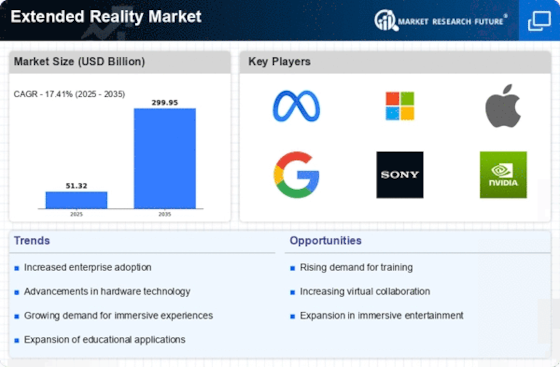
As per Market Research Future analysis, the Extended Reality Market Size was estimated at 51.32 USD Billion in 2024. The Extended Reality industry is projected to grow from 60.25 USD Billion in 2025 to 299.95 USD Billion by 2035, exhibiting a compound annual growth rate (CAGR) of 17.41% during the forecast period 2025 - 2035

Key Market Trends & Highlights

The Extended Reality Market is experiencing robust growth driven by diverse applications across various sectors.

  • The market is witnessing increased adoption in healthcare, enhancing patient care and training methodologies. Remote collaboration tools are expanding, facilitating seamless communication and teamwork across geographical boundaries. Gaming remains the largest segment, while education is emerging as the fastest-growing sector within the Extended Reality Market landscape. Key market drivers include a surge in demand for training and simulation, alongside rising investment in augmented reality technologies.

Market Size & Forecast

2024 Market Size 51.32 (USD Billion)
2035 Market Size 299.95 (USD Billion)
CAGR (2025 - 2035) 17.41%
Largest Regional Market Share in 2024 North America

Major Players

Meta Platforms (US), <a title="Microsoft" href="https://www.microsoft.com/en-us/research/publication/xrmas-extended-reality-multi-agency-spaces-for-a-magical-remote-christmas/" target="_blank" rel="noopener">Microsoft</a> (US), Apple (US), Google (US), Sony (JP), <a title="NVIDIA" href="https://blogs.nvidia.com/blog/what-is-extended-reality/" target="_blank" rel="noopener">NVIDIA</a> (US), HTC (TW), Samsung (KR), Unity Technologies (US)

Market Trends

The Extended Reality Market is currently experiencing a transformative phase, characterized by rapid advancements in technology and increasing adoption across various sectors. This market encompasses virtual reality, augmented reality, and mixed reality, collectively known as XR. Industries such as healthcare, education, and entertainment are integrating these immersive technologies to enhance user experiences and improve operational efficiency. As organizations recognize the potential of XR to revolutionize their processes, investment in this domain is likely to surge, fostering innovation and creating new opportunities. Moreover, the Extended Reality Market appears to be influenced by evolving consumer preferences and the growing demand for interactive content. Users are increasingly seeking engaging and immersive experiences, prompting developers to create more sophisticated applications. This trend suggests that the market will continue to expand, driven by advancements in hardware and software capabilities. As the technology matures, it may also lead to the emergence of new business models and revenue streams, further solidifying the position of XR in the global economy.

The adoption of extended reality in business is accelerating as enterprises deploy immersive technologies for training, design visualization, marketing, and remote collaboration. Extended reality applications in business are transforming workflow efficiency, enabling organizations to enhance decision-making and customer engagement. As a result, extended reality for business is emerging as a critical growth driver, positioning the extended reality business segment as a key contributor to overall market expansion.

Increased Adoption in Healthcare

The Extended Reality Market is witnessing a notable rise in the application of XR technologies within the healthcare sector. Medical professionals are utilizing virtual and augmented reality for training, surgical simulations, and patient rehabilitation. This trend indicates a shift towards more interactive and effective methods of medical education and patient care.

The growing demand for extended reality devices such as head-mounted displays, smartphones, and wearable technologies is driving adoption across consumer and enterprise segments. 

Growth in Remote Collaboration

The Extended Reality Market is facilitating enhanced remote collaboration through immersive technologies. Businesses are increasingly leveraging XR tools to conduct virtual meetings and collaborative projects, which may lead to improved communication and productivity. This trend highlights the potential of XR to bridge geographical gaps and foster teamwork.

Expansion in Gaming and Entertainment

The Extended Reality Market is experiencing significant growth in the gaming and entertainment industries. Developers are creating more immersive gaming experiences that utilize augmented and virtual reality, attracting a broader audience. This trend suggests that XR will continue to play a crucial role in shaping the future of entertainment.

Extended Reality Market Market Drivers

Advancements in Hardware Technology

Advancements in hardware technology are playing a crucial role in shaping the Extended Reality Market. The development of more powerful and affordable devices, such as headsets and smart glasses, is making extended reality experiences more accessible to a broader audience. Innovations in display technology, such as higher resolution screens and improved field of view, enhance the overall user experience, making applications more immersive and engaging. Furthermore, the introduction of standalone devices that do not require external hardware is likely to drive adoption rates among consumers and businesses alike. As hardware continues to evolve, the Extended Reality Market is expected to benefit from increased user engagement and a wider range of applications across different sectors.

Integration of Artificial Intelligence

The integration of artificial intelligence into the Extended Reality Market is poised to revolutionize user experiences and application capabilities. AI technologies enhance the interactivity and personalization of extended reality applications, allowing for more intuitive user interfaces and adaptive learning environments. For example, AI algorithms can analyze user behavior in real-time, adjusting the virtual environment to optimize engagement and learning outcomes. This synergy between AI and extended reality is expected to drive market growth, with projections indicating that the AI-enhanced segment of the Extended Reality Market could account for a substantial share by 2026. As companies invest in AI-driven solutions, the Extended Reality Market will likely witness a transformation in how users interact with digital content.

Rising Investment in Augmented Reality

Investment in augmented reality technologies is on the rise, significantly impacting the Extended Reality Market. Companies across various sectors, including retail, real estate, and education, are increasingly leveraging augmented reality to enhance customer engagement and improve operational efficiency. For instance, retailers are utilizing AR applications to provide virtual try-on experiences, allowing customers to visualize products before making a purchase. Recent statistics indicate that the augmented reality segment is expected to grow at a compound annual growth rate of over 40% in the next few years. This influx of investment is likely to drive innovation and expand the range of applications within the Extended Reality Market, fostering a competitive landscape that encourages the development of new solutions.

Surge in Demand for Training and Simulation

The Extended Reality Market is experiencing a notable surge in demand for training and simulation applications across various sectors. Industries such as aviation, military, and healthcare are increasingly adopting immersive technologies to enhance training effectiveness. For instance, the use of virtual reality simulations allows trainees to engage in realistic scenarios without the associated risks. According to recent data, the training segment within the Extended Reality Market is projected to grow at a compound annual growth rate of over 30% in the coming years. This growth is driven by the need for cost-effective and efficient training solutions that can be tailored to specific industry requirements. As organizations recognize the benefits of immersive training, the Extended Reality Market is likely to see further expansion in this domain.

Growing Interest in Virtual Events and Experiences

The growing interest in virtual events and experiences is significantly influencing the Extended Reality Market. As organizations seek innovative ways to connect with audiences, virtual reality and augmented reality are being utilized to create immersive event experiences that transcend geographical limitations. This trend is particularly evident in sectors such as entertainment, education, and corporate training, where virtual events are becoming more prevalent. Recent data suggests that the market for virtual events is expected to grow substantially, with many companies investing in extended reality solutions to enhance audience engagement. As the demand for virtual experiences continues to rise, the Extended Reality Market is likely to see an influx of new applications and services designed to meet this evolving need.

Market Segment Insights

By Application: Gaming (Largest) vs. Education (Fastest-Growing)

In the Extended Reality Market, the 'Gaming' application leads in market share, capturing a substantial portion of user engagement and investment. This segment has consistently attracted users with immersive experiences, leveraging advanced technologies to create engaging environments. Meanwhile, 'Education' is gaining momentum, rapidly expanding its footprint as more educational institutions and learning platforms integrate extended reality to enhance instructional methods and student engagement.

Gaming (Dominant) vs. Education (Emerging)

The 'Gaming' segment is characterized by extensive investment in immersive technology, creating compelling experiences that captivate users. This dominance is driven by advancements in VR and AR, enabling developers to produce high-quality games that appeal to a wide audience. Conversely, the 'Education' segment, while currently emerging, is experiencing accelerated growth as it adopts extended reality to facilitate interactive learning environments. This segment focuses on utilizing these technologies to improve training, simulations, and student engagement, thus attracting significant attention and investment for its potential to reshape educational methodologies.

By Technology: Virtual Reality (Largest) vs. Augmented Reality (Fastest-Growing)

In the Extended Reality Market, Virtual Reality (VR) currently stands as the largest segment, commanding a significant portion of the market share. This technology is predominantly adopted in gaming, entertainment, and training applications, thus giving it a robust market presence. In contrast, Augmented Reality (AR) is emerging rapidly, gaining traction across various industries, including retail, healthcare, and education, due to its versatile applications and user engagement strategies. The growth trends indicate a dynamic shift toward AR, where user-friendly solutions and continuous technological advancements are driving adoption. Furthermore, advancements in mobile technology and software integration bolster AR's market potential, as it becomes a preferred option for businesses seeking innovative ways to enhance customer experiences. Both segments are expected to witness significant growth, fuelled by increasing investment in technology development and application diversification.

Virtual Reality: Dominant vs. Augmented Reality: Emerging

Virtual Reality (VR) serves as the dominant segment within the Extended Reality Market, characterized by immersive environments that replace the user's real-world surroundings. This technology has made significant strides in various applications, such as gaming, simulations, and training, thereby enhancing user engagement through its interactive nature. VR attracts major investments, indicating its strong market position and potential for further evolution. Conversely, Augmented Reality (AR) is positioned as an emerging segment, characterized by its ability to overlay digital information onto the real world. AR's versatility allows for innovative applications in fields like retail, where it enhances shopping experiences through virtual trials, and healthcare, where it's utilized for surgical simulations. With a focus on user experience and accessibility, AR is witnessing faster adoption rates, indicating its vital role in shaping the future of the Extended Reality Market.

By End Use: Consumer (Largest) vs. Commercial (Fastest-Growing)

In the Extended Reality Market, the distribution of end use segments reveals that the consumer sector holds the largest share, primarily driven by the increasing adoption of VR and AR technologies in gaming and entertainment. The consumer segment benefits from a growing number of devices and applications, enhancing accessibility and appeal to a broader audience. On the other hand, the commercial segment is rapidly expanding, fueled by businesses leveraging Extended Reality Market for training, marketing, and customer engagement, highlighting a shift towards immersive experiences in professional settings.

End Use: Consumer (Dominant) vs. Commercial (Emerging)

The consumer segment in the Extended Reality Market is characterized by a strong dominance, as it encompasses a wide range of VR and AR applications tailored for entertainment, gaming, and social interaction. This segment is heavily influenced by major technological advancements and content creation, leading to a steady influx of innovative products. Conversely, the commercial segment, while emerging, is experiencing exponential growth as organizations adopt Extended Reality Market for competitive advantages. This includes training simulations, virtual meetings, and product showcases, propelling businesses into a new era of customer interaction and operational efficiency. The increasing emphasis on experiential marketing and training in sectors such as retail and real estate is particularly driving this transition.

By Device Type: Head-Mounted Displays (Largest) vs. Wearable Devices (Fastest-Growing)

In the Extended Reality Market, Head-Mounted Displays hold the largest market share due to their extensive usage in gaming and training simulations. These devices have become a standard for immersive experiences, capturing the attention of both consumers and enterprises. On the other hand, <a href="https://www.marketresearchfuture.com/reports/smartphone-market-8165">smartphones</a> and tablets also contribute significantly, thanks to their accessibility and growing AR capabilities. However, they lag behind Head-Mounted Displays in terms of specialized applications and user engagement. The growth trends in the Extended Reality Market indicate a surge in interest towards wearable devices, which are rapidly becoming the fastest-growing segment. Factors driving this growth include advancements in technology, increasing demand for health and fitness applications, and integration with IoT. This trend highlights a shift towards more personal and compact devices, fostering a more immersive experience wherever users go.

Head-Mounted Displays (Dominant) vs. Wearable Devices (Emerging)

Head-Mounted Displays are considered the dominant device in the Extended Reality Market due to their superior immersive capabilities, which are essential for applications in gaming, training, and simulation environments. These devices provide users with unparalleled engagement and interaction, leading to widespread adoption among both consumers and businesses. They have well-established ecosystems and are supported by continuous innovation from leading technology companies. Conversely, wearable devices are emerging as a significant player, driven by advancements in miniaturization and functionality. These devices often incorporate features that promote health tracking, fitness monitoring, and enhanced user experiences through augmented reality. As consumers increasingly seek convenient solutions that integrate seamlessly into their daily lives, the demand for <a href="https://www.marketresearchfuture.com/reports/digital-transformation-market-8685">wearable devices</a> is expected to grow, positioning them as an essential component of the Extended Reality Market landscape.

Get more detailed insights about Extended Reality Market Research Report - Global Forecast till 2035

Regional Insights

The Extended Reality Market (XR) Market is poised for robust growth across various regions, reflecting a strong interest and investment in technologies related to virtual reality, augmented reality, and immersive experiences. In 2024, North America holds a significant share of the market at 20.0 USD Billion, driven by a high adoption rate of XR technologies among enterprises and consumers alike, expected to reach 120.0 USD Billion by 2035, thereby dominating the landscape. Europe follows with a market valuation of 12.0 USD Billion in 2024, growing to 75.0 USD Billion, benefitting from strong Research and Development initiatives and a thriving gaming industry.

The APAC region, valued at 10.0 USD Billion in 2024 and projected to reach 70.0 USD Billion in 2035, exemplifies rapid technological adoption, with nations like China and Japan leading in XR innovations. South America, while smaller, showcases potential with 5.0 USD Billion in 2024, anticipated to increase to 20.0 USD Billion, as local businesses start leveraging XR for improved operational efficiencies. Meanwhile, the Middle East and Africa (MEA) holds a market value of 4.32 USD Billion in 2024, growing to 15.0 USD Billion, indicating the gradual acceptance of XR technologies driven by educational and healthcare sectors.

Each region uniquely contributes to the overall growth trajectory of the Extended Reality Market (XR) Market, while facing distinct challenges and opportunities within their local economies.

Key Players and Competitive Insights

The Extended Reality Market (XR) Market is an evolving and competitive landscape characterized by rapid advancements and the growing adoption of innovative technologies such as virtual reality (VR), augmented reality (AR), and mixed reality (MR). Leading vendors are expanding their portfolios of extended reality platforms and extended reality products to deliver scalable, interoperable, and immersive user experiences across multiple industries. The market is supported by a growing ecosystem of extended reality companies, specialized extended reality development companies, and immersive technology providers. In addition, an increasing number of extended reality agencies are offering customized XR solutions for enterprises, supporting content creation, application deployment, and system integration. The growth of the mixed reality market is contributing significantly to the overall expansion of the Extended Reality Market, supported by rising enterprise adoption and advanced hardware capabilities. 
This market is increasingly being influenced by a range of factors including technological developments, consumer demand, and the integration of XR across various sectors such as gaming, healthcare, education, and enterprise solutions. Companies are continually striving to differentiate their offerings and create immersive experiences that enhance user engagement while addressing the diverse needs of their target audiences.
As the boundaries between the physical and digital worlds blur, competitive insights reveal a race not only for technological prowess but also for creating scalable and user-friendly platforms that can capture market share and foster brand loyalty.HTC has established itself as a significant player in the Extended Reality Market (XR) Market, with strong brand recognition and a rich history in the VR space. The company boasts a robust portfolio of XR products, including headsets and software platforms that cater to both consumers and enterprises.
HTC's strengths lie in its innovative approach to user experience and its commitment to enhancing VR technology with high-quality hardware and content partnerships. The company has also made significant strides in establishing a global distribution network, allowing it to reach a wide audience while focusing on developer support and community engagement to drive adoption. This strategic focus on building a comprehensive ecosystem around its XR offerings has helped HTC maintain a competitive edge and foster strong relationships within the XR community.
Valve is another key player in the Extended Reality Market (XR) Market, recognized for its distinct contributions to the gaming segment through its innovative technologies and platforms. The company is well-known for the development of the SteamVR platform and hardware offerings like the Valve Index headset, which have gained considerable traction among gamers and developers alike. Valve's strengths include its strong presence in the gaming industry, continuous improvements in VR experiences, and support for both first-party and third-party content creation. The company has actively pursued partnerships and collaborations to expand its market reach and enhance its technological capabilities.
In recent years, Valve has also been involved in mergers and acquisitions aimed at bolstering its XR ecosystem, strengthening its competitive stance within the global market. This strategic focus on innovation and collaboration positions Valve as a formidable competitor in the rapidly evolving XR space.

Key Companies in the Extended Reality Market include

Industry Developments

The Extended Reality Market (XR) Market has recently seen significant developments, particularly with advancements in hardware and software. Companies like Meta and Qualcomm are investing heavily in XR technologies, continuing to enhance their platform capabilities. As of October 2023, Apple's release of Vision Pro headset has raised industry expectations, showcasing the company's commitment to high-quality XR experiences. In terms of mergers and acquisitions, NVIDIA announced its acquisition of Arm in September 2022, expanding its technology portfolio for XR applications. Also, in March 2023, Microsoft acquired Activision Blizzard, thereby strengthening its gaming and XR footprint.

Growth in the market valuation of firms such as Epic Games and Sony is being driven by increased demand for immersive experiences across gaming and enterprise sectors, bolstered by a compound annual growth rate projected to exceed 40% in the coming years. Over the last two to three years, the industry has witnessed an increased focus on integrating XR with AI technologies, particularly for enhanced user interactions and simulations. This trend is expected to drive further innovations across various applications in healthcare, education, and entertainment globally.

Future Outlook

Extended Reality Market Future Outlook

The Extended Reality Market is projected to grow at a 17.41% CAGR from 2025 to 2035, driven by advancements in technology, increased adoption in various sectors, and enhanced user experiences.

New opportunities lie in:

  • <p>Development of immersive training programs for corporate sectors Integration of XR solutions in telehealth services Creation of virtual retail environments for enhanced consumer engagement</p>

By 2035, the Extended Reality Market is expected to be a pivotal component of global digital transformation.

Market Segmentation

Extended Reality Market End Use Outlook

  • Consumer
  • Commercial
  • Industrial

Extended Reality Market Technology Outlook

  • Virtual Reality
  • Augmented Reality
  • Mixed Reality

Extended Reality Market Application Outlook

  • Gaming
  • Education
  • Healthcare
  • Real Estate
  • Military

Extended Reality Market Device Type Outlook

  • Head-Mounted Displays
  • Smartphones
  • Tablets
  • Wearable Devices

Report Scope

MARKET SIZE 2024 51.32(USD Billion)
MARKET SIZE 2025 60.25(USD Billion)
MARKET SIZE 2035 299.95(USD Billion)
COMPOUND ANNUAL GROWTH RATE (CAGR) 17.41% (2025 - 2035)
REPORT COVERAGE Revenue Forecast, Competitive Landscape, Growth Factors, and Trends
BASE YEAR 2024
Market Forecast Period 2025 - 2035
Historical Data 2019 - 2024
Market Forecast Units USD Billion
Key Companies Profiled Meta Platforms (US), Microsoft (US), Apple (US), Google (US), Sony (JP), NVIDIA (US), HTC (TW), Samsung (KR), Unity Technologies (US)
Segments Covered Application, Technology, End Use, Device Type, Regional
Key Market Opportunities Integration of artificial intelligence in Extended Reality Market enhances user experience and personalization.
Key Market Dynamics Technological advancements drive competitive forces, reshaping consumer behavior and fostering market consolidation in the Extended Reality sector.
Countries Covered North America, Europe, APAC, South America, MEA

FAQs

What is the projected market valuation of the Extended Reality Market by 2035?

<p>The Extended Reality Market is projected to reach a valuation of 299.95 USD Billion by 2035.</p>

What was the market valuation of the Extended Reality Market in 2024?

<p>In 2024, the Extended Reality Market was valued at 51.32 USD Billion.</p>

What is the expected CAGR for the Extended Reality Market from 2025 to 2035?

<p>The expected CAGR for the Extended Reality Market during the forecast period 2025 - 2035 is 17.41%.</p>

Which companies are considered key players in the Extended Reality Market?

<p>Key players in the Extended Reality Market include Meta Platforms, Microsoft, Apple, Google, Sony, NVIDIA, HTC, Samsung, and Unity Technologies.</p>

What are the main application segments of the Extended Reality Market?

<p>The main application segments include Gaming, Education, Healthcare, Real Estate, and Military.</p>

How does the valuation of the Healthcare segment compare to others in 2025?

<p>The Healthcare segment is projected to grow from 12.0 USD Billion to 70.0 USD Billion, indicating substantial growth potential.</p>

What is the projected valuation for the Augmented Reality segment by 2035?

<p>The Augmented Reality segment is expected to grow from 20.0 USD Billion to 120.0 USD Billion by 2035.</p>

Which device types are expected to dominate the Extended Reality Market?

<p>Head-Mounted Displays, Smartphones, Tablets, and Wearable Devices are the primary device types in the market.</p>

What is the projected growth for the Consumer end-use segment by 2035?

<p>The Consumer end-use segment is anticipated to grow from 15.0 USD Billion to 85.0 USD Billion by 2035.</p>

How does the Mixed Reality technology segment compare to others in terms of growth?

<p>The Mixed Reality segment is projected to grow from 16.32 USD Billion to 94.95 USD Billion, suggesting a robust growth trajectory.</p>

  1. SECTION I: EXECUTIVE SUMMARY AND KEY HIGHLIGHTS
    1. | 1.1 EXECUTIVE SUMMARY
    2. | | 1.1.1 Market Overview
    3. | | 1.1.2 Key Findings
    4. | | 1.1.3 Market Segmentation
    5. | | 1.1.4 Competitive Landscape
    6. | | 1.1.5 Challenges and Opportunities
    7. | | 1.1.6 Future Outlook
  2. SECTION II: SCOPING, METHODOLOGY AND MARKET STRUCTURE
    1. | 2.1 MARKET INTRODUCTION
    2. | | 2.1.1 Definition
    3. | | 2.1.2 Scope of the study
    4. | | | 2.1.2.1 Research Objective
    5. | | | 2.1.2.2 Assumption
    6. | | | 2.1.2.3 Limitations
    7. | 2.2 RESEARCH METHODOLOGY
    8. | | 2.2.1 Overview
    9. | | 2.2.2 Data Mining
    10. | | 2.2.3 Secondary Research
    11. | | 2.2.4 Primary Research
    12. | | | 2.2.4.1 Primary Interviews and Information Gathering Process
    13. | | | 2.2.4.2 Breakdown of Primary Respondents
    14. | | 2.2.5 Forecasting Model
    15. | | 2.2.6 Market Size Estimation
    16. | | | 2.2.6.1 Bottom-Up Approach
    17. | | | 2.2.6.2 Top-Down Approach
    18. | | 2.2.7 Data Triangulation
    19. | | 2.2.8 Validation
  3. SECTION III: QUALITATIVE ANALYSIS
    1. | 3.1 MARKET DYNAMICS
    2. | | 3.1.1 Overview
    3. | | 3.1.2 Drivers
    4. | | 3.1.3 Restraints
    5. | | 3.1.4 Opportunities
    6. | 3.2 MARKET FACTOR ANALYSIS
    7. | | 3.2.1 Value chain Analysis
    8. | | 3.2.2 Porter's Five Forces Analysis
    9. | | | 3.2.2.1 Bargaining Power of Suppliers
    10. | | | 3.2.2.2 Bargaining Power of Buyers
    11. | | | 3.2.2.3 Threat of New Entrants
    12. | | | 3.2.2.4 Threat of Substitutes
    13. | | | 3.2.2.5 Intensity of Rivalry
    14. | | 3.2.3 COVID-19 Impact Analysis
    15. | | | 3.2.3.1 Market Impact Analysis
    16. | | | 3.2.3.2 Regional Impact
    17. | | | 3.2.3.3 Opportunity and Threat Analysis
  4. SECTION IV: QUANTITATIVE ANALYSIS
    1. | 4.1 Information and Communications Technology, BY Application (USD Billion)
    2. | | 4.1.1 Gaming
    3. | | 4.1.2 Education
    4. | | 4.1.3 Healthcare
    5. | | 4.1.4 Real Estate
    6. | | 4.1.5 Military
    7. | 4.2 Information and Communications Technology, BY Technology (USD Billion)
    8. | | 4.2.1 Virtual Reality
    9. | | 4.2.2 Augmented Reality
    10. | | 4.2.3 Mixed Reality
    11. | 4.3 Information and Communications Technology, BY End Use (USD Billion)
    12. | | 4.3.1 Consumer
    13. | | 4.3.2 Commercial
    14. | | 4.3.3 Industrial
    15. | 4.4 Information and Communications Technology, BY Device Type (USD Billion)
    16. | | 4.4.1 Head-Mounted Displays
    17. | | 4.4.2 Smartphones
    18. | | 4.4.3 Tablets
    19. | | 4.4.4 Wearable Devices
    20. | 4.5 Information and Communications Technology, BY Region (USD Billion)
    21. | | 4.5.1 North America
    22. | | | 4.5.1.1 US
    23. | | | 4.5.1.2 Canada
    24. | | 4.5.2 Europe
    25. | | | 4.5.2.1 Germany
    26. | | | 4.5.2.2 UK
    27. | | | 4.5.2.3 France
    28. | | | 4.5.2.4 Russia
    29. | | | 4.5.2.5 Italy
    30. | | | 4.5.2.6 Spain
    31. | | | 4.5.2.7 Rest of Europe
    32. | | 4.5.3 APAC
    33. | | | 4.5.3.1 China
    34. | | | 4.5.3.2 India
    35. | | | 4.5.3.3 Japan
    36. | | | 4.5.3.4 South Korea
    37. | | | 4.5.3.5 Malaysia
    38. | | | 4.5.3.6 Thailand
    39. | | | 4.5.3.7 Indonesia
    40. | | | 4.5.3.8 Rest of APAC
    41. | | 4.5.4 South America
    42. | | | 4.5.4.1 Brazil
    43. | | | 4.5.4.2 Mexico
    44. | | | 4.5.4.3 Argentina
    45. | | | 4.5.4.4 Rest of South America
    46. | | 4.5.5 MEA
    47. | | | 4.5.5.1 GCC Countries
    48. | | | 4.5.5.2 South Africa
    49. | | | 4.5.5.3 Rest of MEA
  5. SECTION V: COMPETITIVE ANALYSIS
    1. | 5.1 Competitive Landscape
    2. | | 5.1.1 Overview
    3. | | 5.1.2 Competitive Analysis
    4. | | 5.1.3 Market share Analysis
    5. | | 5.1.4 Major Growth Strategy in the Information and Communications Technology
    6. | | 5.1.5 Competitive Benchmarking
    7. | | 5.1.6 Leading Players in Terms of Number of Developments in the Information and Communications Technology
    8. | | 5.1.7 Key developments and growth strategies
    9. | | | 5.1.7.1 New Product Launch/Service Deployment
    10. | | | 5.1.7.2 Merger & Acquisitions
    11. | | | 5.1.7.3 Joint Ventures
    12. | | 5.1.8 Major Players Financial Matrix
    13. | | | 5.1.8.1 Sales and Operating Income
    14. | | | 5.1.8.2 Major Players R&D Expenditure. 2023
    15. | 5.2 Company Profiles
    16. | | 5.2.1 Meta Platforms (US)
    17. | | | 5.2.1.1 Financial Overview
    18. | | | 5.2.1.2 Products Offered
    19. | | | 5.2.1.3 Key Developments
    20. | | | 5.2.1.4 SWOT Analysis
    21. | | | 5.2.1.5 Key Strategies
    22. | | 5.2.2 Microsoft (US)
    23. | | | 5.2.2.1 Financial Overview
    24. | | | 5.2.2.2 Products Offered
    25. | | | 5.2.2.3 Key Developments
    26. | | | 5.2.2.4 SWOT Analysis
    27. | | | 5.2.2.5 Key Strategies
    28. | | 5.2.3 Apple (US)
    29. | | | 5.2.3.1 Financial Overview
    30. | | | 5.2.3.2 Products Offered
    31. | | | 5.2.3.3 Key Developments
    32. | | | 5.2.3.4 SWOT Analysis
    33. | | | 5.2.3.5 Key Strategies
    34. | | 5.2.4 Google (US)
    35. | | | 5.2.4.1 Financial Overview
    36. | | | 5.2.4.2 Products Offered
    37. | | | 5.2.4.3 Key Developments
    38. | | | 5.2.4.4 SWOT Analysis
    39. | | | 5.2.4.5 Key Strategies
    40. | | 5.2.5 Sony (JP)
    41. | | | 5.2.5.1 Financial Overview
    42. | | | 5.2.5.2 Products Offered
    43. | | | 5.2.5.3 Key Developments
    44. | | | 5.2.5.4 SWOT Analysis
    45. | | | 5.2.5.5 Key Strategies
    46. | | 5.2.6 NVIDIA (US)
    47. | | | 5.2.6.1 Financial Overview
    48. | | | 5.2.6.2 Products Offered
    49. | | | 5.2.6.3 Key Developments
    50. | | | 5.2.6.4 SWOT Analysis
    51. | | | 5.2.6.5 Key Strategies
    52. | | 5.2.7 HTC (TW)
    53. | | | 5.2.7.1 Financial Overview
    54. | | | 5.2.7.2 Products Offered
    55. | | | 5.2.7.3 Key Developments
    56. | | | 5.2.7.4 SWOT Analysis
    57. | | | 5.2.7.5 Key Strategies
    58. | | 5.2.8 Samsung (KR)
    59. | | | 5.2.8.1 Financial Overview
    60. | | | 5.2.8.2 Products Offered
    61. | | | 5.2.8.3 Key Developments
    62. | | | 5.2.8.4 SWOT Analysis
    63. | | | 5.2.8.5 Key Strategies
    64. | | 5.2.9 Unity Technologies (US)
    65. | | | 5.2.9.1 Financial Overview
    66. | | | 5.2.9.2 Products Offered
    67. | | | 5.2.9.3 Key Developments
    68. | | | 5.2.9.4 SWOT Analysis
    69. | | | 5.2.9.5 Key Strategies
    70. | 5.3 Appendix
    71. | | 5.3.1 References
    72. | | 5.3.2 Related Reports
  6. LIST OF FIGURES
    1. | 6.1 MARKET SYNOPSIS
    2. | 6.2 NORTH AMERICA MARKET ANALYSIS
    3. | 6.3 US MARKET ANALYSIS BY APPLICATION
    4. | 6.4 US MARKET ANALYSIS BY TECHNOLOGY
    5. | 6.5 US MARKET ANALYSIS BY END USE
    6. | 6.6 US MARKET ANALYSIS BY DEVICE TYPE
    7. | 6.7 CANADA MARKET ANALYSIS BY APPLICATION
    8. | 6.8 CANADA MARKET ANALYSIS BY TECHNOLOGY
    9. | 6.9 CANADA MARKET ANALYSIS BY END USE
    10. | 6.10 CANADA MARKET ANALYSIS BY DEVICE TYPE
    11. | 6.11 EUROPE MARKET ANALYSIS
    12. | 6.12 GERMANY MARKET ANALYSIS BY APPLICATION
    13. | 6.13 GERMANY MARKET ANALYSIS BY TECHNOLOGY
    14. | 6.14 GERMANY MARKET ANALYSIS BY END USE
    15. | 6.15 GERMANY MARKET ANALYSIS BY DEVICE TYPE
    16. | 6.16 UK MARKET ANALYSIS BY APPLICATION
    17. | 6.17 UK MARKET ANALYSIS BY TECHNOLOGY
    18. | 6.18 UK MARKET ANALYSIS BY END USE
    19. | 6.19 UK MARKET ANALYSIS BY DEVICE TYPE
    20. | 6.20 FRANCE MARKET ANALYSIS BY APPLICATION
    21. | 6.21 FRANCE MARKET ANALYSIS BY TECHNOLOGY
    22. | 6.22 FRANCE MARKET ANALYSIS BY END USE
    23. | 6.23 FRANCE MARKET ANALYSIS BY DEVICE TYPE
    24. | 6.24 RUSSIA MARKET ANALYSIS BY APPLICATION
    25. | 6.25 RUSSIA MARKET ANALYSIS BY TECHNOLOGY
    26. | 6.26 RUSSIA MARKET ANALYSIS BY END USE
    27. | 6.27 RUSSIA MARKET ANALYSIS BY DEVICE TYPE
    28. | 6.28 ITALY MARKET ANALYSIS BY APPLICATION
    29. | 6.29 ITALY MARKET ANALYSIS BY TECHNOLOGY
    30. | 6.30 ITALY MARKET ANALYSIS BY END USE
    31. | 6.31 ITALY MARKET ANALYSIS BY DEVICE TYPE
    32. | 6.32 SPAIN MARKET ANALYSIS BY APPLICATION
    33. | 6.33 SPAIN MARKET ANALYSIS BY TECHNOLOGY
    34. | 6.34 SPAIN MARKET ANALYSIS BY END USE
    35. | 6.35 SPAIN MARKET ANALYSIS BY DEVICE TYPE
    36. | 6.36 REST OF EUROPE MARKET ANALYSIS BY APPLICATION
    37. | 6.37 REST OF EUROPE MARKET ANALYSIS BY TECHNOLOGY
    38. | 6.38 REST OF EUROPE MARKET ANALYSIS BY END USE
    39. | 6.39 REST OF EUROPE MARKET ANALYSIS BY DEVICE TYPE
    40. | 6.40 APAC MARKET ANALYSIS
    41. | 6.41 CHINA MARKET ANALYSIS BY APPLICATION
    42. | 6.42 CHINA MARKET ANALYSIS BY TECHNOLOGY
    43. | 6.43 CHINA MARKET ANALYSIS BY END USE
    44. | 6.44 CHINA MARKET ANALYSIS BY DEVICE TYPE
    45. | 6.45 INDIA MARKET ANALYSIS BY APPLICATION
    46. | 6.46 INDIA MARKET ANALYSIS BY TECHNOLOGY
    47. | 6.47 INDIA MARKET ANALYSIS BY END USE
    48. | 6.48 INDIA MARKET ANALYSIS BY DEVICE TYPE
    49. | 6.49 JAPAN MARKET ANALYSIS BY APPLICATION
    50. | 6.50 JAPAN MARKET ANALYSIS BY TECHNOLOGY
    51. | 6.51 JAPAN MARKET ANALYSIS BY END USE
    52. | 6.52 JAPAN MARKET ANALYSIS BY DEVICE TYPE
    53. | 6.53 SOUTH KOREA MARKET ANALYSIS BY APPLICATION
    54. | 6.54 SOUTH KOREA MARKET ANALYSIS BY TECHNOLOGY
    55. | 6.55 SOUTH KOREA MARKET ANALYSIS BY END USE
    56. | 6.56 SOUTH KOREA MARKET ANALYSIS BY DEVICE TYPE
    57. | 6.57 MALAYSIA MARKET ANALYSIS BY APPLICATION
    58. | 6.58 MALAYSIA MARKET ANALYSIS BY TECHNOLOGY
    59. | 6.59 MALAYSIA MARKET ANALYSIS BY END USE
    60. | 6.60 MALAYSIA MARKET ANALYSIS BY DEVICE TYPE
    61. | 6.61 THAILAND MARKET ANALYSIS BY APPLICATION
    62. | 6.62 THAILAND MARKET ANALYSIS BY TECHNOLOGY
    63. | 6.63 THAILAND MARKET ANALYSIS BY END USE
    64. | 6.64 THAILAND MARKET ANALYSIS BY DEVICE TYPE
    65. | 6.65 INDONESIA MARKET ANALYSIS BY APPLICATION
    66. | 6.66 INDONESIA MARKET ANALYSIS BY TECHNOLOGY
    67. | 6.67 INDONESIA MARKET ANALYSIS BY END USE
    68. | 6.68 INDONESIA MARKET ANALYSIS BY DEVICE TYPE
    69. | 6.69 REST OF APAC MARKET ANALYSIS BY APPLICATION
    70. | 6.70 REST OF APAC MARKET ANALYSIS BY TECHNOLOGY
    71. | 6.71 REST OF APAC MARKET ANALYSIS BY END USE
    72. | 6.72 REST OF APAC MARKET ANALYSIS BY DEVICE TYPE
    73. | 6.73 SOUTH AMERICA MARKET ANALYSIS
    74. | 6.74 BRAZIL MARKET ANALYSIS BY APPLICATION
    75. | 6.75 BRAZIL MARKET ANALYSIS BY TECHNOLOGY
    76. | 6.76 BRAZIL MARKET ANALYSIS BY END USE
    77. | 6.77 BRAZIL MARKET ANALYSIS BY DEVICE TYPE
    78. | 6.78 MEXICO MARKET ANALYSIS BY APPLICATION
    79. | 6.79 MEXICO MARKET ANALYSIS BY TECHNOLOGY
    80. | 6.80 MEXICO MARKET ANALYSIS BY END USE
    81. | 6.81 MEXICO MARKET ANALYSIS BY DEVICE TYPE
    82. | 6.82 ARGENTINA MARKET ANALYSIS BY APPLICATION
    83. | 6.83 ARGENTINA MARKET ANALYSIS BY TECHNOLOGY
    84. | 6.84 ARGENTINA MARKET ANALYSIS BY END USE
    85. | 6.85 ARGENTINA MARKET ANALYSIS BY DEVICE TYPE
    86. | 6.86 REST OF SOUTH AMERICA MARKET ANALYSIS BY APPLICATION
    87. | 6.87 REST OF SOUTH AMERICA MARKET ANALYSIS BY TECHNOLOGY
    88. | 6.88 REST OF SOUTH AMERICA MARKET ANALYSIS BY END USE
    89. | 6.89 REST OF SOUTH AMERICA MARKET ANALYSIS BY DEVICE TYPE
    90. | 6.90 MEA MARKET ANALYSIS
    91. | 6.91 GCC COUNTRIES MARKET ANALYSIS BY APPLICATION
    92. | 6.92 GCC COUNTRIES MARKET ANALYSIS BY TECHNOLOGY
    93. | 6.93 GCC COUNTRIES MARKET ANALYSIS BY END USE
    94. | 6.94 GCC COUNTRIES MARKET ANALYSIS BY DEVICE TYPE
    95. | 6.95 SOUTH AFRICA MARKET ANALYSIS BY APPLICATION
    96. | 6.96 SOUTH AFRICA MARKET ANALYSIS BY TECHNOLOGY
    97. | 6.97 SOUTH AFRICA MARKET ANALYSIS BY END USE
    98. | 6.98 SOUTH AFRICA MARKET ANALYSIS BY DEVICE TYPE
    99. | 6.99 REST OF MEA MARKET ANALYSIS BY APPLICATION
    100. | 6.100 REST OF MEA MARKET ANALYSIS BY TECHNOLOGY
    101. | 6.101 REST OF MEA MARKET ANALYSIS BY END USE
    102. | 6.102 REST OF MEA MARKET ANALYSIS BY DEVICE TYPE
    103. | 6.103 KEY BUYING CRITERIA OF INFORMATION AND COMMUNICATIONS TECHNOLOGY
    104. | 6.104 RESEARCH PROCESS OF MRFR
    105. | 6.105 DRO ANALYSIS OF INFORMATION AND COMMUNICATIONS TECHNOLOGY
    106. | 6.106 DRIVERS IMPACT ANALYSIS: INFORMATION AND COMMUNICATIONS TECHNOLOGY
    107. | 6.107 RESTRAINTS IMPACT ANALYSIS: INFORMATION AND COMMUNICATIONS TECHNOLOGY
    108. | 6.108 SUPPLY / VALUE CHAIN: INFORMATION AND COMMUNICATIONS TECHNOLOGY
    109. | 6.109 INFORMATION AND COMMUNICATIONS TECHNOLOGY, BY APPLICATION, 2024 (% SHARE)
    110. | 6.110 INFORMATION AND COMMUNICATIONS TECHNOLOGY, BY APPLICATION, 2024 TO 2035 (USD Billion)
    111. | 6.111 INFORMATION AND COMMUNICATIONS TECHNOLOGY, BY TECHNOLOGY, 2024 (% SHARE)
    112. | 6.112 INFORMATION AND COMMUNICATIONS TECHNOLOGY, BY TECHNOLOGY, 2024 TO 2035 (USD Billion)
    113. | 6.113 INFORMATION AND COMMUNICATIONS TECHNOLOGY, BY END USE, 2024 (% SHARE)
    114. | 6.114 INFORMATION AND COMMUNICATIONS TECHNOLOGY, BY END USE, 2024 TO 2035 (USD Billion)
    115. | 6.115 INFORMATION AND COMMUNICATIONS TECHNOLOGY, BY DEVICE TYPE, 2024 (% SHARE)
    116. | 6.116 INFORMATION AND COMMUNICATIONS TECHNOLOGY, BY DEVICE TYPE, 2024 TO 2035 (USD Billion)
    117. | 6.117 BENCHMARKING OF MAJOR COMPETITORS
  7. LIST OF TABLES
    1. | 7.1 LIST OF ASSUMPTIONS
    2. | | 7.1.1
    3. | 7.2 North America MARKET SIZE ESTIMATES; FORECAST
    4. | | 7.2.1 BY APPLICATION, 2025-2035 (USD Billion)
    5. | | 7.2.2 BY TECHNOLOGY, 2025-2035 (USD Billion)
    6. | | 7.2.3 BY END USE, 2025-2035 (USD Billion)
    7. | | 7.2.4 BY DEVICE TYPE, 2025-2035 (USD Billion)
    8. | 7.3 US MARKET SIZE ESTIMATES; FORECAST
    9. | | 7.3.1 BY APPLICATION, 2025-2035 (USD Billion)
    10. | | 7.3.2 BY TECHNOLOGY, 2025-2035 (USD Billion)
    11. | | 7.3.3 BY END USE, 2025-2035 (USD Billion)
    12. | | 7.3.4 BY DEVICE TYPE, 2025-2035 (USD Billion)
    13. | 7.4 Canada MARKET SIZE ESTIMATES; FORECAST
    14. | | 7.4.1 BY APPLICATION, 2025-2035 (USD Billion)
    15. | | 7.4.2 BY TECHNOLOGY, 2025-2035 (USD Billion)
    16. | | 7.4.3 BY END USE, 2025-2035 (USD Billion)
    17. | | 7.4.4 BY DEVICE TYPE, 2025-2035 (USD Billion)
    18. | 7.5 Europe MARKET SIZE ESTIMATES; FORECAST
    19. | | 7.5.1 BY APPLICATION, 2025-2035 (USD Billion)
    20. | | 7.5.2 BY TECHNOLOGY, 2025-2035 (USD Billion)
    21. | | 7.5.3 BY END USE, 2025-2035 (USD Billion)
    22. | | 7.5.4 BY DEVICE TYPE, 2025-2035 (USD Billion)
    23. | 7.6 Germany MARKET SIZE ESTIMATES; FORECAST
    24. | | 7.6.1 BY APPLICATION, 2025-2035 (USD Billion)
    25. | | 7.6.2 BY TECHNOLOGY, 2025-2035 (USD Billion)
    26. | | 7.6.3 BY END USE, 2025-2035 (USD Billion)
    27. | | 7.6.4 BY DEVICE TYPE, 2025-2035 (USD Billion)
    28. | 7.7 UK MARKET SIZE ESTIMATES; FORECAST
    29. | | 7.7.1 BY APPLICATION, 2025-2035 (USD Billion)
    30. | | 7.7.2 BY TECHNOLOGY, 2025-2035 (USD Billion)
    31. | | 7.7.3 BY END USE, 2025-2035 (USD Billion)
    32. | | 7.7.4 BY DEVICE TYPE, 2025-2035 (USD Billion)
    33. | 7.8 France MARKET SIZE ESTIMATES; FORECAST
    34. | | 7.8.1 BY APPLICATION, 2025-2035 (USD Billion)
    35. | | 7.8.2 BY TECHNOLOGY, 2025-2035 (USD Billion)
    36. | | 7.8.3 BY END USE, 2025-2035 (USD Billion)
    37. | | 7.8.4 BY DEVICE TYPE, 2025-2035 (USD Billion)
    38. | 7.9 Russia MARKET SIZE ESTIMATES; FORECAST
    39. | | 7.9.1 BY APPLICATION, 2025-2035 (USD Billion)
    40. | | 7.9.2 BY TECHNOLOGY, 2025-2035 (USD Billion)
    41. | | 7.9.3 BY END USE, 2025-2035 (USD Billion)
    42. | | 7.9.4 BY DEVICE TYPE, 2025-2035 (USD Billion)
    43. | 7.10 Italy MARKET SIZE ESTIMATES; FORECAST
    44. | | 7.10.1 BY APPLICATION, 2025-2035 (USD Billion)
    45. | | 7.10.2 BY TECHNOLOGY, 2025-2035 (USD Billion)
    46. | | 7.10.3 BY END USE, 2025-2035 (USD Billion)
    47. | | 7.10.4 BY DEVICE TYPE, 2025-2035 (USD Billion)
    48. | 7.11 Spain MARKET SIZE ESTIMATES; FORECAST
    49. | | 7.11.1 BY APPLICATION, 2025-2035 (USD Billion)
    50. | | 7.11.2 BY TECHNOLOGY, 2025-2035 (USD Billion)
    51. | | 7.11.3 BY END USE, 2025-2035 (USD Billion)
    52. | | 7.11.4 BY DEVICE TYPE, 2025-2035 (USD Billion)
    53. | 7.12 Rest of Europe MARKET SIZE ESTIMATES; FORECAST
    54. | | 7.12.1 BY APPLICATION, 2025-2035 (USD Billion)
    55. | | 7.12.2 BY TECHNOLOGY, 2025-2035 (USD Billion)
    56. | | 7.12.3 BY END USE, 2025-2035 (USD Billion)
    57. | | 7.12.4 BY DEVICE TYPE, 2025-2035 (USD Billion)
    58. | 7.13 APAC MARKET SIZE ESTIMATES; FORECAST
    59. | | 7.13.1 BY APPLICATION, 2025-2035 (USD Billion)
    60. | | 7.13.2 BY TECHNOLOGY, 2025-2035 (USD Billion)
    61. | | 7.13.3 BY END USE, 2025-2035 (USD Billion)
    62. | | 7.13.4 BY DEVICE TYPE, 2025-2035 (USD Billion)
    63. | 7.14 China MARKET SIZE ESTIMATES; FORECAST
    64. | | 7.14.1 BY APPLICATION, 2025-2035 (USD Billion)
    65. | | 7.14.2 BY TECHNOLOGY, 2025-2035 (USD Billion)
    66. | | 7.14.3 BY END USE, 2025-2035 (USD Billion)
    67. | | 7.14.4 BY DEVICE TYPE, 2025-2035 (USD Billion)
    68. | 7.15 India MARKET SIZE ESTIMATES; FORECAST
    69. | | 7.15.1 BY APPLICATION, 2025-2035 (USD Billion)
    70. | | 7.15.2 BY TECHNOLOGY, 2025-2035 (USD Billion)
    71. | | 7.15.3 BY END USE, 2025-2035 (USD Billion)
    72. | | 7.15.4 BY DEVICE TYPE, 2025-2035 (USD Billion)
    73. | 7.16 Japan MARKET SIZE ESTIMATES; FORECAST
    74. | | 7.16.1 BY APPLICATION, 2025-2035 (USD Billion)
    75. | | 7.16.2 BY TECHNOLOGY, 2025-2035 (USD Billion)
    76. | | 7.16.3 BY END USE, 2025-2035 (USD Billion)
    77. | | 7.16.4 BY DEVICE TYPE, 2025-2035 (USD Billion)
    78. | 7.17 South Korea MARKET SIZE ESTIMATES; FORECAST
    79. | | 7.17.1 BY APPLICATION, 2025-2035 (USD Billion)
    80. | | 7.17.2 BY TECHNOLOGY, 2025-2035 (USD Billion)
    81. | | 7.17.3 BY END USE, 2025-2035 (USD Billion)
    82. | | 7.17.4 BY DEVICE TYPE, 2025-2035 (USD Billion)
    83. | 7.18 Malaysia MARKET SIZE ESTIMATES; FORECAST
    84. | | 7.18.1 BY APPLICATION, 2025-2035 (USD Billion)
    85. | | 7.18.2 BY TECHNOLOGY, 2025-2035 (USD Billion)
    86. | | 7.18.3 BY END USE, 2025-2035 (USD Billion)
    87. | | 7.18.4 BY DEVICE TYPE, 2025-2035 (USD Billion)
    88. | 7.19 Thailand MARKET SIZE ESTIMATES; FORECAST
    89. | | 7.19.1 BY APPLICATION, 2025-2035 (USD Billion)
    90. | | 7.19.2 BY TECHNOLOGY, 2025-2035 (USD Billion)
    91. | | 7.19.3 BY END USE, 2025-2035 (USD Billion)
    92. | | 7.19.4 BY DEVICE TYPE, 2025-2035 (USD Billion)
    93. | 7.20 Indonesia MARKET SIZE ESTIMATES; FORECAST
    94. | | 7.20.1 BY APPLICATION, 2025-2035 (USD Billion)
    95. | | 7.20.2 BY TECHNOLOGY, 2025-2035 (USD Billion)
    96. | | 7.20.3 BY END USE, 2025-2035 (USD Billion)
    97. | | 7.20.4 BY DEVICE TYPE, 2025-2035 (USD Billion)
    98. | 7.21 Rest of APAC MARKET SIZE ESTIMATES; FORECAST
    99. | | 7.21.1 BY APPLICATION, 2025-2035 (USD Billion)
    100. | | 7.21.2 BY TECHNOLOGY, 2025-2035 (USD Billion)
    101. | | 7.21.3 BY END USE, 2025-2035 (USD Billion)
    102. | | 7.21.4 BY DEVICE TYPE, 2025-2035 (USD Billion)
    103. | 7.22 South America MARKET SIZE ESTIMATES; FORECAST
    104. | | 7.22.1 BY APPLICATION, 2025-2035 (USD Billion)
    105. | | 7.22.2 BY TECHNOLOGY, 2025-2035 (USD Billion)
    106. | | 7.22.3 BY END USE, 2025-2035 (USD Billion)
    107. | | 7.22.4 BY DEVICE TYPE, 2025-2035 (USD Billion)
    108. | 7.23 Brazil MARKET SIZE ESTIMATES; FORECAST
    109. | | 7.23.1 BY APPLICATION, 2025-2035 (USD Billion)
    110. | | 7.23.2 BY TECHNOLOGY, 2025-2035 (USD Billion)
    111. | | 7.23.3 BY END USE, 2025-2035 (USD Billion)
    112. | | 7.23.4 BY DEVICE TYPE, 2025-2035 (USD Billion)
    113. | 7.24 Mexico MARKET SIZE ESTIMATES; FORECAST
    114. | | 7.24.1 BY APPLICATION, 2025-2035 (USD Billion)
    115. | | 7.24.2 BY TECHNOLOGY, 2025-2035 (USD Billion)
    116. | | 7.24.3 BY END USE, 2025-2035 (USD Billion)
    117. | | 7.24.4 BY DEVICE TYPE, 2025-2035 (USD Billion)
    118. | 7.25 Argentina MARKET SIZE ESTIMATES; FORECAST
    119. | | 7.25.1 BY APPLICATION, 2025-2035 (USD Billion)
    120. | | 7.25.2 BY TECHNOLOGY, 2025-2035 (USD Billion)
    121. | | 7.25.3 BY END USE, 2025-2035 (USD Billion)
    122. | | 7.25.4 BY DEVICE TYPE, 2025-2035 (USD Billion)
    123. | 7.26 Rest of South America MARKET SIZE ESTIMATES; FORECAST
    124. | | 7.26.1 BY APPLICATION, 2025-2035 (USD Billion)
    125. | | 7.26.2 BY TECHNOLOGY, 2025-2035 (USD Billion)
    126. | | 7.26.3 BY END USE, 2025-2035 (USD Billion)
    127. | | 7.26.4 BY DEVICE TYPE, 2025-2035 (USD Billion)
    128. | 7.27 MEA MARKET SIZE ESTIMATES; FORECAST
    129. | | 7.27.1 BY APPLICATION, 2025-2035 (USD Billion)
    130. | | 7.27.2 BY TECHNOLOGY, 2025-2035 (USD Billion)
    131. | | 7.27.3 BY END USE, 2025-2035 (USD Billion)
    132. | | 7.27.4 BY DEVICE TYPE, 2025-2035 (USD Billion)
    133. | 7.28 GCC Countries MARKET SIZE ESTIMATES; FORECAST
    134. | | 7.28.1 BY APPLICATION, 2025-2035 (USD Billion)
    135. | | 7.28.2 BY TECHNOLOGY, 2025-2035 (USD Billion)
    136. | | 7.28.3 BY END USE, 2025-2035 (USD Billion)
    137. | | 7.28.4 BY DEVICE TYPE, 2025-2035 (USD Billion)
    138. | 7.29 South Africa MARKET SIZE ESTIMATES; FORECAST
    139. | | 7.29.1 BY APPLICATION, 2025-2035 (USD Billion)
    140. | | 7.29.2 BY TECHNOLOGY, 2025-2035 (USD Billion)
    141. | | 7.29.3 BY END USE, 2025-2035 (USD Billion)
    142. | | 7.29.4 BY DEVICE TYPE, 2025-2035 (USD Billion)
    143. | 7.30 Rest of MEA MARKET SIZE ESTIMATES; FORECAST
    144. | | 7.30.1 BY APPLICATION, 2025-2035 (USD Billion)
    145. | | 7.30.2 BY TECHNOLOGY, 2025-2035 (USD Billion)
    146. | | 7.30.3 BY END USE, 2025-2035 (USD Billion)
    147. | | 7.30.4 BY DEVICE TYPE, 2025-2035 (USD Billion)
    148. | 7.31 PRODUCT LAUNCH/PRODUCT DEVELOPMENT/APPROVAL
    149. | | 7.31.1
    150. | 7.32 ACQUISITION/PARTNERSHIP
    151. | | 7.32.1

Information and Communications Technology Market Segmentation

Information and Communications Technology By Application (USD Billion, 2025-2035)

  • Gaming
  • Education
  • Healthcare
  • Real Estate
  • Military

Information and Communications Technology By Technology (USD Billion, 2025-2035)

  • Virtual Reality
  • Augmented Reality
  • Mixed Reality

Information and Communications Technology By End Use (USD Billion, 2025-2035)

  • Consumer
  • Commercial
  • Industrial

Information and Communications Technology By Device Type (USD Billion, 2025-2035)

  • Head-Mounted Displays
  • Smartphones
  • Tablets
  • Wearable Devices
Infographic

Free Sample Request

Kindly complete the form below to receive a free sample of this Report

Get Free Sample

Customer Strories

Compare Licence

×
Features License Type
Single User Multiuser License Enterprise User
Price $4,950 $5,950 $7,250
Maximum User Access Limit 1 User Upto 10 Users Unrestricted Access Throughout the Organization
Free Customization
Direct Access to Analyst
Deliverable Format
Platform Access
Discount on Next Purchase 10% 15% 15%
Printable Versions