×
Request Free Sample ×

Kindly complete the form below to receive a free sample of this Report

* Please use a valid business email

Leading companies partner with us for data-driven Insights

clients tt-cursor
Hero Background
English
Chinese
French
Japanese
Korean
German
Spanish

Europe Warehouse Robotics Market Size

ID: MRFR/SEM/11007-HCR
128 Pages
Shubham Munde
October 2025

Europe Warehouse Robotics Market Size, Share and Research Report By Type (Industrial Robots, Sortation Systems, Conveyors, Palletizers, Automated Storage and Retrieval System (ASRS), and Mobile Robots (AGVs and AMRs)), By Function (Storage, Packaging, Trans-shipments, and Other Functions), By End-user Application (Food and Beverage, Automotive, Retail, Electrical and Electronics, Pharmaceutical, and Other End User Applications), And By Europe – Industry Forecast Till 2035

Share:
Download PDF ×

We do not share your information with anyone. However, we may send you emails based on your report interest from time to time. You may contact us at any time to opt-out.

Europe Warehouse Robotics Market Infographic
×
Europe Warehouse Robotics Market Infographic Full View
Purchase Options

Europe Warehouse Robotics Size

Europe Warehouse Robotics Market Growth Projections and Opportunities

The Europe warehouse robotics market is undergoing significant transformations driven by various market factors that shape its landscape. One of the key factors influencing this market is the increasing demand for automation in logistics and warehousing operations. With the growing e-commerce sector and the need for efficient order fulfillment, companies are turning to warehouse robotics to streamline their processes and enhance operational efficiency.

Moreover, the labor shortage in the region is contributing to the adoption of warehouse robotics. As the traditional manual labor force becomes scarce, businesses are seeking automated solutions to mitigate the impact of workforce challenges. Warehouse robots offer a reliable and consistent alternative, ensuring the continuous flow of operations without being affected by human resource limitations.

In addition, the need for cost reduction and improved productivity is driving the adoption of warehouse robotics in Europe. Automated systems can optimize warehouse space utilization, minimize errors, and accelerate order processing, ultimately leading to cost savings and increased productivity. Businesses are recognizing the long-term benefits of investing in robotics to stay competitive in the dynamic market environment.

The advancement of technology is another significant market factor influencing the growth of warehouse robotics in Europe. Innovations in artificial intelligence, machine learning, and sensor technologies have enabled the development of more sophisticated and capable robotic systems. These advancements allow robots to handle complex tasks, adapt to dynamic environments, and collaborate seamlessly with human workers, making them an attractive solution for modern warehouses.

Furthermore, the emphasis on sustainability and environmental concerns is impacting the warehouse robotics market in Europe. Automated systems are designed to optimize energy consumption, reduce waste, and enhance overall sustainability in warehouse operations. As businesses prioritize environmentally friendly practices, the adoption of robotics aligns with their commitment to sustainable and responsible business practices.

Government initiatives and regulations also play a crucial role in shaping the Europe warehouse robotics market. Governments across the region are increasingly recognizing the importance of automation in driving economic growth and competitiveness. Supportive policies, incentives, and regulations are encouraging businesses to invest in robotics, fostering a conducive environment for the expansion of the warehouse robotics market.

The COVID-19 pandemic has accelerated the adoption of warehouse robotics in Europe. The disruptions caused by the pandemic highlighted the vulnerabilities of traditional supply chain models, prompting businesses to reassess their strategies. Warehouse robotics emerged as a resilient solution, ensuring the continuity of operations during lockdowns and restrictions. The pandemic has underscored the importance of automation in building robust and adaptable supply chains.

Europe Warehouse Robotics Market Size Graph
Author
Shubham Munde
Research Analyst Level II

With a technical background in information technology & semiconductors, Shubham has 4.5+ years of experience in market research and analytics with the tasks of data mining, analysis, and project execution. He is the POC for our clients, for their consulting projects running under the ICT/Semiconductor domain. Shubham holds a Bachelor’s in Information and Technology and a Master of Business Administration (MBA). Shubham has executed over 150 research projects for our clients under the brand name Market Research Future in the last 2 years. His core skill is building the research respondent relation for gathering the primary information from industry and market estimation for niche markets. He is having expertise in conducting secondary & primary research, market estimations, market projections, competitive analysis, analysing current market trends and market dynamics, deep-dive analysis on market scenarios, consumer behaviour, technological impact analysis, consulting, analytics, etc. He has worked on fortune 500 companies' syndicate and consulting projects along with several government projects. He has worked on the projects of top tech brands such as IBM, Google, Microsoft, AWS, Meta, Oracle, Cisco Systems, Samsung, Accenture, VMware, Schneider Electric, Dell, HP, Ericsson, and so many others. He has worked on Metaverse, Web 3.0, Zero-Trust security, cyber-security, blockchain, quantum computing, robotics, 5G technology, High-Performance computing, data centers, AI, automation, IT equipment, sensors, semiconductors, consumer electronics and so many tech domain projects.

Leave a Comment

FAQs

What is the current valuation of the Europe Warehouse Robotics Market?

<p>As of 2024, the Europe Warehouse Robotics Market was valued at 1.52 USD Billion.</p>

What is the projected market size for the Europe Warehouse Robotics Market by 2035?

<p>The market is projected to reach a valuation of 5.22 USD Billion by 2035.</p>

What is the expected CAGR for the Europe Warehouse Robotics Market during the forecast period 2025 - 2035?

<p>The expected CAGR for the market during the forecast period 2025 - 2035 is 11.84%.</p>

Which application segments are driving growth in the Europe Warehouse Robotics Market?

<p>Key application segments include Order Fulfillment, Material Handling, and Packaging, with valuations projected to reach 1.58, 1.32, and 0.88 USD Billion respectively by 2035.</p>

What are the leading end-use sectors for warehouse robotics in Europe?

<p>The leading end-use sectors include E-commerce, Retail, and Logistics, with projected valuations of 1.58, 1.23, and 1.05 USD Billion respectively by 2035.</p>

Which types of robots are most prevalent in the Europe Warehouse Robotics Market?

<p>Autonomous Mobile Robots and Automated Guided Vehicles are among the most prevalent types, with projected valuations of 1.05 and 0.85 USD Billion respectively by 2035.</p>

What technological advancements are influencing the Europe Warehouse Robotics Market?

Technologies such as Artificial Intelligence and Machine Learning are influencing the market, with projected valuations of 1.05 and 0.90 USD Billion respectively by 2035.

What components are essential in the Europe Warehouse Robotics Market?

Essential components include Hardware and Software, with projected valuations of 2.14 and 1.34 USD Billion respectively by 2035.

Who are the key players in the Europe Warehouse Robotics Market?

Key players include Kiva Systems, Dematic, Honeywell Intelligrated, and Siemens, among others.

How does the growth of the Europe Warehouse Robotics Market compare to other regions?

While specific regional comparisons are not provided, the robust projected growth rate of 11.84% suggests a strong competitive position for Europe in the warehouse robotics sector.

Market Summary

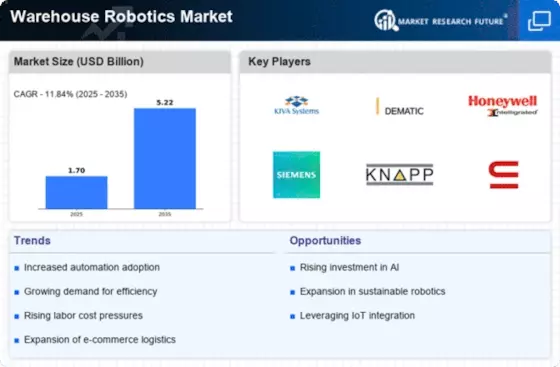
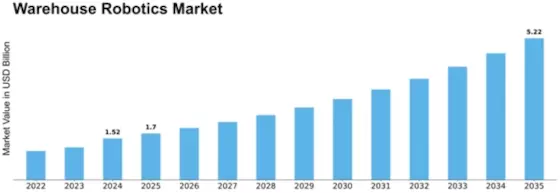
As per analysis, the Europe Warehouse Robotics Market is projected to grow from USD 1.72 Billion in 2025 to USD 5.22 Billion by 2035, exhibiting a compound annual growth rate (CAGR) of 11.84% during the forecast period (2025 - 2035).

Key Market Trends & Highlights

The Europe Warehouse Robotics Market is experiencing robust growth driven by automation and technological advancements.

  • Germany remains the largest market for warehouse robotics, reflecting a strong commitment to automation in logistics.
  • The UK is emerging as the fastest-growing region, showcasing rapid adoption of robotic solutions in warehousing.
  • Order fulfillment stands as the largest segment, while inventory management is witnessing the fastest growth due to evolving supply chain needs.
  • Rising e-commerce demand and labor shortages are key drivers propelling the market forward.

Market Size & Forecast

2024 Market Size 1.52 (USD Billion)
2035 Market Size 5.22 (USD Billion)
CAGR (2025 - 2035) 11.84%

Major Players

<p>Kiva Systems (US), Dematic (DE), Honeywell Intelligrated (US), Siemens (DE), Knapp AG (AT), Swisslog (CH), GreyOrange (IN), Fetch Robotics (US), Locus Robotics (US)</p>

Market Trends

The Europe Warehouse Robotics Market is currently experiencing a transformative phase, driven by advancements in automation technology and the increasing demand for efficiency in logistics operations. As businesses strive to enhance productivity and reduce operational costs, the integration of robotics into warehouse environments appears to be a strategic response to these challenges. The adoption of automated guided vehicles, robotic arms, and autonomous mobile robots is becoming more prevalent, suggesting a shift towards more sophisticated and flexible supply chain solutions. Furthermore, the emphasis on sustainability and reducing carbon footprints is influencing the design and implementation of robotic systems, as companies seek to align with environmental regulations and consumer expectations. In addition, the regulatory landscape in Europe is evolving, with governments promoting innovation in automation while ensuring safety and compliance. This regulatory support may facilitate the growth of the Europe Warehouse Robotics Market, as businesses are encouraged to invest in cutting-edge technologies. Moreover, the collaboration between technology providers and logistics companies is likely to foster the development of tailored solutions that address specific operational needs. Overall, the market appears poised for continued expansion, driven by technological advancements, regulatory support, and a growing focus on sustainability in warehouse operations.

Increased Investment in Automation

The Europe Warehouse Robotics Market is witnessing a surge in investment as companies recognize the potential of automation to enhance operational efficiency. This trend indicates a shift towards integrating advanced robotic systems that can streamline processes and reduce labor costs.

Focus on Sustainability

Sustainability is becoming a central theme in the Europe Warehouse Robotics Market, with businesses increasingly seeking solutions that minimize environmental impact. This focus may lead to the development of energy-efficient robotic systems and practices that align with European environmental regulations.

Collaboration Between Technology Providers and Logistics Firms

There is a growing trend of collaboration between technology providers and logistics companies in Europe. This partnership aims to create customized robotic solutions that address specific challenges within warehouse operations, enhancing overall productivity and efficiency.

Europe Warehouse Robotics Market Market Drivers

Rising E-commerce Demand

The surge in e-commerce activities across Europe is a pivotal driver for the Europe Warehouse Robotics Market. As online shopping continues to gain traction, logistics and warehousing operations are compelled to enhance their efficiency and speed. According to recent data, the European e-commerce market is projected to reach approximately 800 billion euros by 2026. This growth necessitates the adoption of advanced robotics solutions to manage increased order volumes and streamline operations. Warehouse robotics, including automated guided vehicles and robotic picking systems, are becoming essential to meet consumer expectations for rapid delivery. Consequently, the demand for warehouse robotics is likely to escalate, as companies seek to optimize their supply chains and reduce operational costs.

Focus on Supply Chain Resilience

The emphasis on supply chain resilience is increasingly influencing the Europe Warehouse Robotics Market. Recent disruptions in global supply chains have highlighted the need for businesses to enhance their operational flexibility and responsiveness. Companies are now prioritizing investments in warehouse robotics to build more resilient supply chains capable of adapting to unforeseen challenges. The European logistics sector is projected to invest over 10 billion euros in automation technologies by 2026, reflecting this shift in focus. By integrating robotics into their operations, businesses can improve inventory management, reduce lead times, and enhance overall supply chain efficiency, thereby positioning themselves to better withstand future disruptions.

Government Initiatives and Funding

Government initiatives and funding programs are playing a crucial role in the growth of the Europe Warehouse Robotics Market. Various European governments are actively promoting automation and robotics through grants, subsidies, and research funding. For example, the European Union has launched several initiatives aimed at fostering innovation in robotics, which includes financial support for companies adopting advanced technologies. This support not only encourages businesses to invest in warehouse robotics but also helps to create a favorable regulatory environment for their deployment. As a result, the market for warehouse robotics is expected to expand, driven by both public and private sector investments in automation technologies.

Technological Advancements in Robotics

Technological advancements are significantly shaping the Europe Warehouse Robotics Market. Innovations in artificial intelligence, machine learning, and sensor technologies are enhancing the capabilities of warehouse robots, making them more efficient and versatile. For instance, the integration of AI allows robots to learn from their environment and optimize their operations in real-time. The European robotics sector is expected to grow at a compound annual growth rate of around 12% over the next five years, driven by these technological improvements. As companies seek to leverage these advancements, the demand for sophisticated robotic solutions in warehouses is likely to increase, enabling businesses to improve their operational efficiency and reduce costs.

Labor Shortages and Workforce Challenges

Labor shortages in Europe are increasingly influencing the dynamics of the Europe Warehouse Robotics Market. Many sectors, particularly logistics and warehousing, are facing difficulties in attracting and retaining skilled labor. This challenge is prompting companies to invest in automation technologies, including robotics, to mitigate the impact of workforce shortages. The European Commission has reported that labor shortages could reach 2 million by 2025 in various industries. As a result, warehouse robotics are being viewed as a viable solution to enhance productivity and maintain operational continuity. By integrating robotic systems, companies can alleviate the pressure on human resources while ensuring that their operations remain efficient and responsive to market demands.

Market Segment Insights

By Application: Order Fulfillment (Largest) vs. Inventory Management (Fastest-Growing)

<p>In the Europe Warehouse Robotics Market, the application segment is seeing a diverse distribution of market share among various values such as Order Fulfillment, Material Handling, Packaging, Sorting, and Inventory Management. Order Fulfillment continues to hold the largest portion due to the increasing demand for e-commerce and quick shipping solutions, driving automation to ensure efficiency and accuracy in processing orders. Material Handling and Sorting also retain significant shares, as they play crucial roles in optimizing warehouse operations and ensuring smooth logistics workflows. The growth trends within the application segment are heavily driven by advancements in robotics technology and increased investments in automation by warehouses across Europe. Order Fulfillment remains a crucial area as businesses strive to meet consumer demands for faster delivery. Conversely, Inventory Management is emerging as the fastest-growing segment, supported by innovations in AI and machine learning, which enable better stock control and forecast accuracy, thus enhancing overall operational efficiency in warehouses.</p>

<p>Order Fulfillment: Dominant vs. Inventory Management: Emerging</p>

<p>Order Fulfillment is recognized as the dominant application in the Europe Warehouse Robotics Market, characterized by its ability to streamline logistics and improve processing times. This segment is crucial for businesses focusing on e-commerce and rapid delivery services, utilizing robotics to pick and sort products efficiently, thus turning orders around quickly. On the other hand, Inventory Management is emerging as a vital segment within this market. As businesses seek to enhance accuracy in stock control and reduce carrying costs, Robotics is being increasingly employed for real-time inventory tracking and reporting. This segment benefits from technological trends such as the integration of IoT, enabling more proactive management of stock levels and minimizing waste, thus supporting overall profitability.</p>

By End Use: E-commerce (Largest) vs. Retail (Fastest-Growing)

<p>In the Europe Warehouse Robotics Market, the end-use segment is characterized by notable disparities in market share distribution. E-commerce has emerged as the dominant driver of warehouse robotics adoption, accounting for a significant portion of the overall market. Other end-use sectors like Retail, Manufacturing, Logistics, and Pharmaceuticals follow, but with distinct applications and demands driving their growth. Each of these sectors has unique requirements, which influences the adoption rates of warehouse robotics technology, as they strive to optimize operations and enhance efficiency. The growth trends in this segment are largely influenced by the rapid expansion of E-commerce, which necessitates advanced robotics solutions to handle increasing order volumes and improve fulfillment speed. Retail, while currently smaller, is witnessing a surge in demand as companies seek to modernize their supply chains and enhance customer experience. Factors such as labor shortages, advancements in automation technologies, and the growing emphasis on efficiency and cost reduction are propelling the growth of warehouse robotics across these end-use segments.</p>

<p>E-commerce (Dominant) vs. Logistics (Emerging)</p>

<p>E-commerce stands out as the dominant segment in the Europe Warehouse Robotics Market, characterized by its robust integration of advanced robotics technologies to meet soaring consumer demand and streamline distribution processes. This segment emphasizes efficiency and speed, leveraging automated systems for order fulfillment, sorting, and inventory management. In contrast, the Logistics segment is emerging, driven by the rising need for improved supply chain logistics and freight handling solutions. As logistics service providers seek to enhance operational efficiency, robotics adoption is accelerating, particularly for last-mile delivery and warehouse sorting functions. While E-commerce primarily focuses on throughput and customer satisfaction, Logistics is increasingly looking to optimize routes and storage, highlighting the distinct but interrelated dynamics within these segments.</p>

By Type: Autonomous Mobile Robot (Largest) vs. Automated Guided Vehicle (Fastest-Growing)

<p>In the Europe Warehouse Robotics Market, the Autonomous Mobile Robot segment holds the largest share, reflecting its widespread adoption in various logistics and warehousing operations. This growth is driven by the increasing demand for efficiency and flexibility in warehouse management, where mobile solutions help optimize material handling and inventory processes. On the other hand, the Automated Guided Vehicle segment is emerging as the fastest-growing area within this market. The rise in e-commerce and need for automated solutions to handle complex operations have propelled these vehicles into the spotlight, enabling seamless movement of goods and reducing labor costs significantly.</p>

<p>Autonomous Mobile Robot (Dominant) vs. Robotic Arm (Emerging)</p>

<p>The Autonomous Mobile Robot segment stands out as the dominant player in the European Warehouse Robotics Market due to its adaptability and ability to enhance operational efficiency. These robots are designed to autonomously navigate spaces, making them ideal for tasks such as picking and transporting goods. In contrast, the Robotic Arm segment represents an emerging category with increasing relevance. Robotic Arms are increasingly employed for precision tasks like assembly and packaging, complementing mobile robotics by handling specialized operations. Both segments are pivotal; however, the versatility and scalability of Autonomous Mobile Robots secure their position as market leaders, while Robotic Arms are rapidly gaining traction with innovations that improve their functionality and ease of integration.</p>

By Technology: Artificial Intelligence (Largest) vs. Sensor Technology (Fastest-Growing)

<p>In the Europe Warehouse Robotics Market, Artificial Intelligence (AI) holds the largest share among the various technology segments, demonstrating a robust integration of smart systems into warehouse operations. Following AI, Sensor Technology is rapidly gaining traction, driven by the increasing need for enhanced automation and precision in logistics. This growing trend indicates a clear consumer preference for advanced technologies that improve operational efficiency and accuracy in inventory management.</p>

<p>Technology: AI (Dominant) vs. Sensor Technology (Emerging)</p>

<p>Artificial Intelligence has established itself as the dominant force in the Europe Warehouse Robotics Market, serving as the backbone for data-driven decisions and automation. Its ability to optimize tasks such as order picking and inventory management significantly enhances productivity levels. In contrast, Sensor Technology represents an emerging market segment, characterized by its potential to revolutionize navigation and object detection in warehouses. Sensors facilitate real-time data collection and analysis, thus improving warehouse safety and operational effectiveness. The combined adoption of these technologies is heralding a transformative era in warehouse operations, setting the stage for future innovations.</p>

By Component: Hardware (Largest) vs. Software (Fastest-Growing)

<p>In the Europe Warehouse Robotics Market, the Component segment showcases a diverse allocation in its market share. Hardware has established itself as the largest contributor, encompassing various physical elements of warehouse robotics such as robotic arms and moving components. Software, while smaller in share compared to hardware, is recognized as a rapidly growing segment, driven by advancements in artificial intelligence and machine learning that enhance operational efficiency and automation in warehouses.</p>

<p>Software (Dominant) vs. Control Systems (Emerging)</p>

<p>Software is becoming the dominant force in the Europe Warehouse Robotics Market, with capabilities that integrate seamlessly with hardware to streamline logistics operations. This segment is characterized by its ability to offer real-time data analytics, operational monitoring, and sophisticated algorithms that optimize warehouse procedures. On the other hand, Control Systems represent an emerging segment, providing the necessary frameworks to manage and synchronize the various robotic components. While currently less prominent, control systems are gaining traction as more warehouses embrace automation and seek cohesive solutions for operational efficiency.</p>

Get more detailed insights about Europe Warehouse Robotics Market Research Report – Forecast till 2035

Regional Insights

Germany : Strong industrial base drives growth

Germany holds a commanding 55% market share in the European warehouse robotics sector, valued at approximately €1.1 billion. Key growth drivers include a robust manufacturing sector, increasing automation demands, and government initiatives promoting Industry 4.0. The demand for efficient logistics solutions is rising, supported by favorable regulatory policies that encourage technological adoption and investment in infrastructure development.

UK : Innovation fuels competitive advantage

The UK commands a 30% share of the warehouse robotics market, valued at around €600 million. Growth is driven by a surge in e-commerce, necessitating advanced logistics solutions. The government has introduced initiatives to support automation in warehouses, alongside favorable tax incentives for tech investments. The demand for robotics is particularly strong in urban areas, where distribution efficiency is critical.

France : E-commerce boosts robotics adoption

With a 25% market share, France's warehouse robotics market is valued at approximately €500 million. The growth is primarily fueled by the booming e-commerce sector, which demands faster and more efficient logistics solutions. Government policies promoting digital transformation and sustainability are also key drivers. The French market is witnessing a shift towards automated solutions in retail and logistics.

Russia : Growing demand in logistics sector

Russia holds a 15% share of the warehouse robotics market, valued at about €300 million. Key growth drivers include increasing investments in logistics infrastructure and a rising demand for automation in warehousing. Government initiatives aimed at modernizing the logistics sector are also contributing to market growth. The demand for robotics is particularly strong in major cities like Moscow and St. Petersburg.

Italy : Manufacturing sector drives adoption

Italy accounts for 10% of the warehouse robotics market, valued at approximately €200 million. The growth is driven by the country's strong manufacturing base and increasing demand for automation in logistics. Government initiatives supporting technological innovation and infrastructure development are also pivotal. The market is particularly vibrant in regions like Lombardy and Emilia-Romagna, known for their industrial activities.

Spain : E-commerce growth fuels demand

Spain captures a 10% share of the warehouse robotics market, valued at around €200 million. The rapid growth is largely attributed to the expansion of e-commerce, which necessitates advanced logistics solutions. Government policies promoting digital transformation and investment in automation are also significant. Key markets include Madrid and Barcelona, where logistics operations are increasingly automated.

Rest of Europe : Varied markets with unique needs

The Rest of Europe holds a 7% share of the warehouse robotics market, valued at approximately €140 million. Growth is driven by varying demands across different countries, with some focusing on automation in manufacturing while others prioritize logistics. Government initiatives supporting technological advancements are common. The competitive landscape includes local players and international firms adapting to regional needs.

Key Players and Competitive Insights

The Warehouse Robotics Market in Europe is characterized by a dynamic competitive landscape, driven by technological advancements and increasing demand for automation in logistics and supply chain operations. Key players such as Kiva Systems (US), Dematic (DE), and Honeywell Intelligrated (US) are at the forefront, each adopting distinct strategies to enhance their market positioning. Kiva Systems (US) focuses on innovation through continuous product development, while Dematic (DE) emphasizes regional expansion and strategic partnerships to bolster its market presence. Honeywell Intelligrated (US) is leveraging digital transformation initiatives to optimize operational efficiency, collectively shaping a competitive environment that is increasingly reliant on advanced robotics solutions.

The business tactics employed by these companies include localizing manufacturing and optimizing supply chains to enhance responsiveness to market demands. The competitive structure of the market appears moderately fragmented, with several key players exerting influence over various segments. This fragmentation allows for a diverse range of solutions, catering to different customer needs and preferences, while also fostering innovation as companies strive to differentiate themselves.

In December 2025, Kiva Systems (US) announced the launch of its latest autonomous mobile robot, designed to improve warehouse efficiency by integrating AI-driven navigation systems. This strategic move is likely to enhance Kiva's competitive edge by offering customers more advanced automation solutions, thereby addressing the growing demand for efficiency in warehouse operations. The introduction of this technology may also signal a shift towards more intelligent systems that can adapt to changing environments.

In November 2025, Dematic (DE) expanded its partnership with a leading European retailer to implement a comprehensive automation solution across multiple distribution centers. This collaboration underscores Dematic's commitment to regional expansion and highlights the importance of strategic alliances in enhancing operational capabilities. By aligning with major retailers, Dematic is positioned to capture a larger share of the market while providing tailored solutions that meet specific client needs.

In October 2025, Honeywell Intelligrated (US) unveiled a new software platform aimed at integrating robotics with existing warehouse management systems. This initiative reflects a growing trend towards digitalization, as companies seek to streamline operations and improve data analytics capabilities. By enhancing interoperability between robotics and software, Honeywell is likely to strengthen its market position and offer clients a more cohesive operational framework.

As of January 2026, current trends in the Warehouse Robotics Market are heavily influenced by digitalization, sustainability, and AI integration. The emphasis on strategic alliances is reshaping the competitive landscape, enabling companies to leverage complementary strengths and resources. Looking ahead, competitive differentiation is expected to evolve, with a notable shift from price-based competition towards innovation, technology, and supply chain reliability. This transition may redefine how companies approach market entry and customer engagement, ultimately fostering a more resilient and adaptive industry.

Key Companies in the Europe Warehouse Robotics Market include

Industry Developments

Future Outlook

Europe Warehouse Robotics Market Future Outlook

The Europe Warehouse Robotics Market is projected to grow at 11.84% CAGR from 2025 to 2035, driven by automation demand, labor shortages, and technological advancements.

New opportunities lie in:

  • Integration of AI-driven inventory management systems
  • Development of autonomous mobile robots for last-mile delivery
  • Expansion of robotic process automation in supply chain operations

By 2035, the market is expected to be robust, reflecting substantial advancements and widespread adoption.

Market Segmentation

Europe Warehouse Robotics Market Type Outlook

  • Autonomous Mobile Robot
  • Automated Guided Vehicle
  • Robotic Arm
  • Automated Storage and Retrieval System
  • Collaborative Robot

Europe Warehouse Robotics Market End Use Outlook

  • E-commerce
  • Retail
  • Manufacturing
  • Logistics
  • Pharmaceutical

Europe Warehouse Robotics Market Component Outlook

  • Hardware
  • Software
  • Control Systems
  • Sensors
  • Batteries

Europe Warehouse Robotics Market Technology Outlook

  • Artificial Intelligence
  • Machine Learning
  • Computer Vision
  • Sensor Technology
  • Navigation Systems

Europe Warehouse Robotics Market Application Outlook

  • Order Fulfillment
  • Material Handling
  • Packaging
  • Sorting
  • Inventory Management

Report Scope

MARKET SIZE 20241.52(USD Billion)
MARKET SIZE 20251.72(USD Billion)
MARKET SIZE 20355.22(USD Billion)
COMPOUND ANNUAL GROWTH RATE (CAGR)11.84% (2024 - 2035)
REPORT COVERAGERevenue Forecast, Competitive Landscape, Growth Factors, and Trends
BASE YEAR2024
Market Forecast Period2025 - 2035
Historical Data2019 - 2024
Market Forecast UnitsUSD Billion
Key Companies ProfiledKiva Systems (US), Dematic (DE), Honeywell Intelligrated (US), Siemens (DE), Knapp AG (AT), Swisslog (CH), GreyOrange (IN), Fetch Robotics (US), Locus Robotics (US)
Segments CoveredApplication, End Use, Type, Technology, Component
Key Market OpportunitiesIntegration of artificial intelligence in warehouse robotics enhances operational efficiency and adaptability in Europe.
Key Market DynamicsRising automation in logistics drives demand for advanced warehouse robotics across Europe, enhancing operational efficiency.
Countries CoveredGermany, UK, France, Russia, Italy, Spain, Rest of Europe

FAQs

What is the current valuation of the Europe Warehouse Robotics Market?

<p>As of 2024, the Europe Warehouse Robotics Market was valued at 1.52 USD Billion.</p>

What is the projected market size for the Europe Warehouse Robotics Market by 2035?

<p>The market is projected to reach a valuation of 5.22 USD Billion by 2035.</p>

What is the expected CAGR for the Europe Warehouse Robotics Market during the forecast period 2025 - 2035?

<p>The expected CAGR for the market during the forecast period 2025 - 2035 is 11.84%.</p>

Which application segments are driving growth in the Europe Warehouse Robotics Market?

<p>Key application segments include Order Fulfillment, Material Handling, and Packaging, with valuations projected to reach 1.58, 1.32, and 0.88 USD Billion respectively by 2035.</p>

What are the leading end-use sectors for warehouse robotics in Europe?

<p>The leading end-use sectors include E-commerce, Retail, and Logistics, with projected valuations of 1.58, 1.23, and 1.05 USD Billion respectively by 2035.</p>

Which types of robots are most prevalent in the Europe Warehouse Robotics Market?

<p>Autonomous Mobile Robots and Automated Guided Vehicles are among the most prevalent types, with projected valuations of 1.05 and 0.85 USD Billion respectively by 2035.</p>

What technological advancements are influencing the Europe Warehouse Robotics Market?

Technologies such as Artificial Intelligence and Machine Learning are influencing the market, with projected valuations of 1.05 and 0.90 USD Billion respectively by 2035.

What components are essential in the Europe Warehouse Robotics Market?

Essential components include Hardware and Software, with projected valuations of 2.14 and 1.34 USD Billion respectively by 2035.

Who are the key players in the Europe Warehouse Robotics Market?

Key players include Kiva Systems, Dematic, Honeywell Intelligrated, and Siemens, among others.

How does the growth of the Europe Warehouse Robotics Market compare to other regions?

While specific regional comparisons are not provided, the robust projected growth rate of 11.84% suggests a strong competitive position for Europe in the warehouse robotics sector.

  1. SECTION I: EXECUTIVE SUMMARY AND KEY HIGHLIGHTS
    1. | 1.1 EXECUTIVE SUMMARY
  2. SECTION II: SCOPING, METHODOLOGY AND MARKET STRUCTURE
    1. | 2.1 MARKET INTRODUCTION
    2. | 2.2 RESEARCH METHODOLOGY
  3. SECTION III: QUALITATIVE ANALYSIS
    1. | 3.1 MARKET DYNAMICS
    2. | 3.2 MARKET FACTOR ANALYSIS
  4. SECTION IV: QUANTITATIVE ANALYSIS
    1. | 4.1 Semiconductor & Electronics, BY Application (USD Billion)
    2. | 4.2 Semiconductor & Electronics, BY End Use (USD Billion)
    3. | 4.3 Semiconductor & Electronics, BY Type (USD Billion)
    4. | 4.4 Semiconductor & Electronics, BY Technology (USD Billion)
    5. | 4.5 Semiconductor & Electronics, BY Component (USD Billion)
  5. SECTION V: COMPETITIVE ANALYSIS
    1. | 5.1 Competitive Landscape
    2. | 5.2 Company Profiles
    3. | 5.3 Appendix

Europe Warehouse Robotics Market Segmentation

Market Segmentation Overview

  • Detailed segmentation data will be available in the full report
  • Comprehensive analysis by multiple parameters
  • Regional and country-level breakdowns
  • Market size forecasts by segment
Infographic

Free Sample Request

Kindly complete the form below to receive a free sample of this Report

Get Free Sample

Customer Strories

Compare Licence

×
Features License Type
Single User Multiuser License Enterprise User
Price $4,950 $5,950 $7,250
Maximum User Access Limit 1 User Upto 10 Users Unrestricted Access Throughout the Organization
Free Customization
Direct Access to Analyst
Deliverable Format
Platform Access
Discount on Next Purchase 10% 15% 15%
Printable Versions