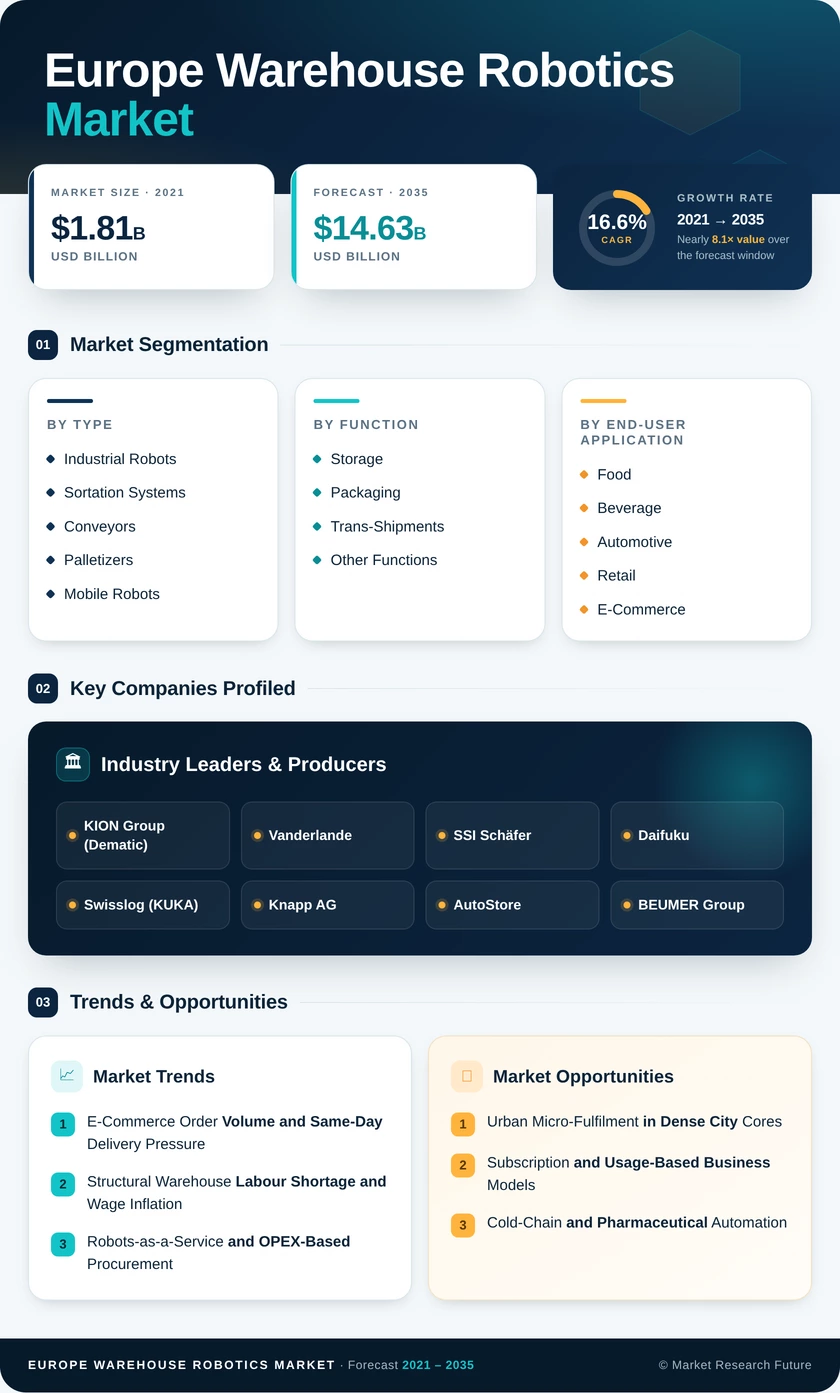
Segmentation Quick Reference
| Dimension | Sub-Segments | Dominant Segment | Fastest Growing Segment |
| By Type | Industrial Robots; Sortation Systems; Conveyors; Palletizers; Mobile Robots; Other Types | Mobile Robots (36.7% share, 2025) | Mobile Robots (17.3% CAGR) |
| By Function | Storage; Packaging; Trans-Shipments; Other Functions | Storage (49.5% share, 2025) | Trans-Shipments (17.6% CAGR) |
| By End-user Application | Food and Beverage; Automotive; Retail and E-Commerce; Electrical and Electronics; Pharmaceuticals; Other End-user Applications | Retail and E-Commerce (41.2% share, 2025) | Pharmaceuticals (18.4% CAGR) |
| By Component | Hardware; Software; Services | Hardware (66.6% share, 2025) | Software (18.1% CAGR) |
| By Country | Germany; United Kingdom; France; Netherlands; Italy; Spain; Nordic Countries; Rest of Europe | Germany (33.8% share, 2025) | Spain (17.7% CAGR) |
Market Segmentation Overview
By Type
| Sub-Segment | Key Trend |
| Industrial Robots | Collaborative models migrating from production halls into mixed-SKU picking zones |
| Sortation Systems | Confined to sites above 50,000 parcels daily by capital cost and lead time |
| Conveyors | Legacy estates under replacement pressure from energy audit obligations |
| Palletizers | End-of-line robotic case erection reaching sub-three-year payback. |
| Mobile Robots | Eight-to-twelve-week installation enabling seasonal capacity matching |
| Other Types | Vertical lift modules serving space-constrained electronics warehouses |
Mobile Robots lead this dimension and also grow fastest, because operators facing volatile order profiles will not commit to fixed assets depreciating over fifteen years when a self-navigating fleet can be resized each season. Sortation Systems hold the opposing position: unmatched throughput, but a EUR 5 million entry point and twelve-month lead times restrict them to a small number of mega-hubs. Conveyors face the sharpest structural decline, as continuously running loops are the first target identified in EU energy audits.
By Function
| Sub-Segment | Key Trend |
| Storage | Density-optimised retrieval remains the largest installed function |
| Packaging | Robotic case erectors displacing manual stations in high-wage markets |
| Trans-Shipments | Cross-dock conversion eliminating static holding areas |
| Other Functions | Returns and kitting still labour-intensive pending vision maturity |
Storage retains the dominant position through a decade of accumulated automated retrieval investment, but Trans-Shipments grow fastest as retailers push inventory through facilities within twenty-four hours to contain carrying costs. Conversions to direct cross-dock flows have cut facility footprints by up to 40%, which changes layout economics fundamentally. Packaging automation advances in step with wage levels, concentrating in Germany and the Netherlands, while returns processing lags because SKU variability defeats current grasp reliability.
By End-user Application
| Sub-Segment | Key Trend |
| Food and Beverage | Multi-temperature complexity favouring modular micro-fulfilment |
| Automotive | Line-side replenishment cutting work-in-process inventory |
| Retail and E-Commerce | Fleet-scale deployments serving same-day commitments |
| Electrical and Electronics | Vertical lift systems maximising constrained floor area |
| Pharmaceuticals | Cold-chain accuracy and batch traceability requirements |
| Other End-user Applications | Apparel and third-party logistics contract-driven adoption |
Retail and E-Commerce dominates on volume alone, since same-day cut-offs cannot be met by manual picking at peak order density. Pharmaceuticals grow fastest despite a smaller base, because Good Distribution Practice obligations for temperature integrity and traceability justify automation depth that general merchandise cannot cost-justify. Automotive buyers pursue a narrower objective — inventory reduction at the line side — while Food and Beverage adoption is slowed by the engineering burden of multi-temperature zones within a single facility.
By Component
| Sub-Segment | Key Trend |
| Hardware | Robot units, sorters, racking and sensing; share eroding annually |
| Software | Orchestration, path planning and predictive maintenance layers |
| Services | Integration and maintenance, compressed by bundled subscriptions |
Hardware still absorbs two-thirds of spending, yet Software grows substantially faster because realised throughput depends on task allocation rather than mechanical capability, and interoperability standards now let one control layer govern equipment from several suppliers. Services expand in absolute terms while their share plateaus, as maintenance is increasingly folded into monthly subscription fees rather than invoiced as a separate line. The practical consequence for buyers is that control-layer selection outlasts any individual hardware generation.
By Country
| Sub-Segment | Key Trend |
| Germany | Highest labour cost base plus interoperability standards leadership |
| United Kingdom | Grocery e-commerce penetration sustaining picking investment. |
| France | National-scale retailer cross-dock conversion programmes |
| Netherlands | Port-linked distribution centres serving multiple national markets |
| Italy | Fashion and third-party logistics modernisation cycle |
| Spain | Greenfield capacity with automation designed in from commissioning |
| Nordic Countries | Energy cost sensitivity accelerating equipment replacement |
| Rest of Europe | Central and Eastern European distribution build-out |
Germany leads on installed value because wage levels above EUR 18 per hour make substitution economics compelling and because German industry authors the fleet communication standards others adopt. Spain grows fastest, since new-build distribution capacity carries none of the retrofit and integration penalties that slow German and French brownfield projects. The Netherlands outperforms its size through port-adjacent facilities serving several national markets from one automated site, while Italian adoption trails on capital access among mid-sized third-party logistics operators.


 Noah Malgeri
Co-Founder

 Peter Groot koerkamp
Account and Business Manager

 Younghwan Choi
Senior Retail Manager

 Mark Irwin
Management Consultant

 Akif Moroglu
Strategy & Business Development Director

 Guilherme Gomes Martins
Product Management Director

 Joseph Aguayo
Sales Operations & Pricing Manager

 La Terria Dodd
Program Support Specialist

 Rob Kooiker
Group Product Manager HVAC & Fire Protection GMA