×
Hero Background
English
Chinese
French
Japanese
Korean
German
Spanish

Emulsion Adhesives Market Analysis

ID: MRFR/CnM/5582-HCR
140 Pages
Chitranshi Jaiswal
October 2025

Emulsion Adhesives Market Research Report Information by Type (Acrylic Polymers, Polyvinyl Acetate (PVA) and Others), Application (Tapes & Labels, Furniture, Woodworking and Others), End-Use Industry (Packaging, Paper Working) and Region - Forecast till 2035

Share:
Download PDF ×

We do not share your information with anyone. However, we may send you emails based on your report interest from time to time. You may contact us at any time to opt-out.

Emulsion Adhesives Market Infographic
Purchase Options

Market Analysis

In-depth Analysis of Emulsion Adhesives Market Industry Landscape

The Emulsion Adhesives Market operates within a dynamic framework influenced by various factors that collectively shape its growth and trends. Emulsion adhesives, also known as water-based adhesives, are versatile bonding solutions widely used in industries such as packaging, woodworking, and automotive. The market dynamics of emulsion adhesives are intricately linked to trends in end-user industries, technological advancements, environmental considerations, and global economic conditions.

A significant driver of the emulsion adhesives market is the increasing demand for sustainable and environmentally friendly adhesive solutions. With growing awareness of environmental concerns and stringent regulations on volatile organic compounds (VOCs), emulsion adhesives offer a water-based alternative that is low in VOC content. The dynamics of the market respond to the shift in consumer preferences and industry demands for adhesives that align with eco-friendly practices, particularly in sectors such as paper and packaging.

Technological advancements play a pivotal role in shaping the emulsion adhesives market dynamics. Ongoing research and development efforts focus on enhancing the performance characteristics of emulsion adhesives, such as bonding strength, tackiness, and drying time. Innovations in polymer chemistry and formulation techniques contribute to the production of high-performance emulsion adhesives that meet the diverse needs of industries. The market dynamics adapt to these technological breakthroughs, with companies striving to provide advanced adhesive solutions that address evolving requirements.

Regulatory standards and environmental considerations are critical factors influencing the emulsion adhesives market dynamics. Stringent regulations on emissions and the use of hazardous chemicals in adhesives drive the adoption of water-based formulations like emulsion adhesives. Compliance with environmental standards becomes integral to the competitive positioning of companies within the market. Companies must stay abreast of evolving regulatory requirements to navigate the complex landscape and ensure market compliance, especially in regions where environmental awareness is high.

Global economic conditions and industrial activities further contribute to the dynamics of the emulsion adhesives market. Economic growth leads to increased manufacturing and construction activities, driving the demand for adhesives in various applications. Conversely, economic downturns may lead to a temporary reduction in industrial activities, impacting the dynamics of the emulsion adhesives market. The cyclical nature of the economy adds an element of unpredictability to market trends.

Market dynamics are also influenced by the competitive landscape and regional variations. Companies operating in specific regions may tailor their emulsion adhesive products to meet local regulatory requirements and industry practices. The geographical distribution of manufacturing facilities, raw material availability, and the concentration of end-user industries impact the competitiveness of emulsion adhesive suppliers in specific regions. Global players often adapt their strategies to address regional variations and maintain a strong market presence. The level of competition, market consolidation, and strategic alliances within the emulsion adhesives market contribute to the overall dynamics of the industry.

The increased focus on sustainability and circular economy principles further shapes the emulsion adhesives market dynamics. The water-based nature of emulsion adhesives aligns with the broader trend towards greener and more sustainable products. Companies are investing in research and development to enhance the recyclability and biodegradability of emulsion adhesives, contributing to the circular economy goals of various industries.
Author
Chitranshi Jaiswal
Research Analyst Level I

In her 3 years of experience in the market research field, she has handled critical cross-domain projects. She has an in-depth knowledge of market estimation & analysis, problem-solving, primary as well as secondary research, and team management.She holds an engineering degree and is an MBA professional from a well-known university, capable of evaluating the market and competitive conditions. An exceptional strategist with excellent communication skills and a passion for delivering cutting-edge & practical insights for the market. Proficient in multi-tasking, and can successfully deal with competing demands, while maintaining complete confidentiality. Generated business through active client and project development, networking, and high-quality responses. Her knowledge and skills have helped in making solid business decisions, securing funding from investors, and avoiding business failures.

Leave a Comment

FAQs

What are the major end-use industries of emulsion adhesives?

Packaging and paper working are some of the major end-use industries of emulsion adhesives.

Which is the largest segment in the global emulsion adhesives market?

The packaging segment holds the largest share in the global emulsion adhesives market.

What are the major tailwinds pushing the growth of the global emulsion adhesives market?

Augmenting demand from the rapidly growing packaging industry, Increasing uses of tapes and labels for packaging purposes, Increasing adoption of pressure sensitive labels in F&B and cosmetics & personal care products industry.

Which region holds the largest share in the global emulsion adhesives market?

Asia Pacific holds the largest share in the global emulsion adhesives market, followed by North America and Europe, respectively.

Who are the top players in the global emulsion adhesives market?

Eastman Chemical Company (US), Cemedine Co., Ltd (Japan), Ashland (US), Emerald Performance Materials (US), H.B. Fuller (US), Henkel AG & Co. KGaA (Germany), 3M (US), Wacker Chemie AG (Germany), DowDuPont (US), Avery Dennison Corporation (US), Paramelt (Netherlands), and Chemsultants International, Inc. (US), are some of the major players operating in the emulsion adhesives market.

Who are the key players in the market?

LG Chem (South Korea), Samsung (South Korea), Panasonic (Japan), Fluence (US), and Tesla (US)are the major companies operating in the market.

Market Summary

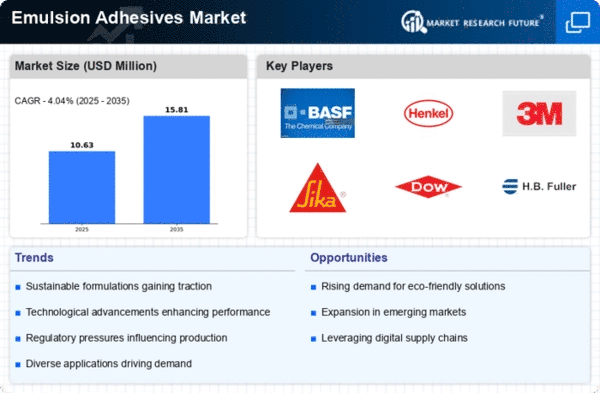
As per MRFR analysis, the Emulsion Adhesives Market Size was estimated at 10.22 USD Million in 2024. The Emulsion Adhesives industry is projected to grow from 10.64 USD Million in 2025 to 15.81 USD Million by 2035, exhibiting a compound annual growth rate (CAGR) of 4.04 during the forecast period 2025 - 2035.

Key Market Trends & Highlights

The Emulsion Adhesives Market is poised for growth driven by sustainability and technological advancements.

  • The market is experiencing a notable shift towards sustainability, with manufacturers increasingly adopting eco-friendly formulations.
  • Technological advancements are enhancing the performance and application versatility of emulsion adhesives, particularly in the construction sector.
  • Customization and specialization are becoming critical as end-user industries demand tailored adhesive solutions, especially in furniture manufacturing.
  • Key market drivers include sustainability initiatives and rising demand from the construction and automotive sectors.

Market Size & Forecast

2024 Market Size 10.22 (USD Million)
2035 Market Size 15.81 (USD Million)
CAGR (2025 - 2035) 4.04%
Largest Regional Market Share in 2024 North America

Major Players

<p>BASF SE (DE), Henkel AG & Co. KGaA (DE), 3M Company (US), Sika AG (CH), Dow Inc. (US), H.B. Fuller Company (US), Wacker Chemie AG (DE), Ashland Global Holdings Inc. (US), Kraton Corporation (US)</p>

Market Trends

The Emulsion Adhesives Market is currently experiencing a dynamic evolution, driven by various factors that influence its growth trajectory. The increasing demand for eco-friendly and sustainable adhesive solutions is reshaping the landscape, as manufacturers strive to meet stringent environmental regulations and consumer preferences. This shift towards greener products appears to be a significant driver, as industries such as construction, automotive, and packaging seek alternatives that minimize environmental impact while maintaining performance. Furthermore, advancements in technology and formulation are enabling the development of high-performance emulsion adhesives that cater to diverse applications, enhancing their appeal across multiple sectors. In addition to sustainability, the Emulsion Adhesives Market is witnessing a surge in innovation, with companies investing in research and development to create specialized products tailored to specific industry needs. This trend suggests a growing recognition of the importance of customization in adhesive solutions, allowing businesses to optimize their processes and improve product quality. Moreover, the rise of e-commerce and online distribution channels is transforming how these products reach end-users, potentially expanding market access and driving competition. As the market continues to evolve, stakeholders must remain vigilant to emerging trends and adapt their strategies accordingly to capitalize on new opportunities.

Sustainability Focus

The Emulsion Adhesives Market is increasingly oriented towards sustainable practices, as manufacturers prioritize eco-friendly formulations. This trend reflects a broader societal shift towards environmental responsibility, influencing product development and consumer choices.

Technological Advancements

Innovations in adhesive technology are reshaping the Emulsion Adhesives Market, with new formulations enhancing performance and versatility. These advancements enable applications across various industries, driving demand for high-quality adhesive solutions.

Customization and Specialization

There is a growing emphasis on tailored adhesive solutions within the Emulsion Adhesives Market. Companies are recognizing the need for specialized products that meet specific industry requirements, fostering a trend towards customization.

Emulsion Adhesives Market Market Drivers

Growth in Automotive Sector

The automotive sector's expansion significantly influences the Global Emulsion Adhesives Market Industry. With the automotive industry increasingly adopting lightweight materials to enhance fuel efficiency, emulsion adhesives are becoming essential for bonding various components. This trend is likely to continue, as manufacturers prioritize performance and sustainability. The integration of advanced adhesive technologies in vehicle assembly processes suggests a growing reliance on these products. As a result, the market is expected to benefit from this sector's growth, contributing to the projected increase in market value to 20.3 USD Billion by 2035.

Sustainable Construction Practices

The increasing emphasis on sustainable construction practices appears to drive the Global Emulsion Adhesives Market Industry. As builders and manufacturers seek eco-friendly materials, emulsion adhesives, which are water-based and contain fewer volatile organic compounds, become more appealing. This shift aligns with global initiatives aimed at reducing carbon footprints and promoting sustainability. For instance, the demand for green building materials is projected to grow significantly, potentially enhancing the market's value. In 2024, the market is estimated to reach 12.5 USD Billion, indicating a robust interest in environmentally responsible products.

Rising Demand in Packaging Industry

The packaging industry's growth is a crucial driver for the Global Emulsion Adhesives Market Industry. As consumer preferences shift towards sustainable and recyclable packaging solutions, emulsion adhesives are increasingly favored for their eco-friendly properties. This trend is particularly evident in the food and beverage sector, where safety and compliance with regulations are paramount. The demand for efficient and reliable adhesive solutions in packaging applications is expected to rise, further boosting market growth. The anticipated increase in market value to 20.3 USD Billion by 2035 underscores the packaging industry's pivotal role in shaping the emulsion adhesives landscape.

Regulatory Support for Eco-Friendly Products

Regulatory support for eco-friendly products is becoming a significant driver for the Global Emulsion Adhesives Market Industry. Governments worldwide are implementing stringent regulations to limit the use of harmful chemicals in adhesives, thereby promoting water-based alternatives like emulsion adhesives. This regulatory landscape encourages manufacturers to innovate and develop compliant products that align with environmental standards. As a result, the market is likely to experience increased demand for these safer alternatives. The projected market value of 12.5 USD Billion in 2024 reflects the positive impact of such regulations on the industry's growth.

Technological Advancements in Adhesive Formulations

Technological advancements in adhesive formulations are likely to propel the Global Emulsion Adhesives Market Industry forward. Innovations in polymer chemistry and formulation techniques enable the development of high-performance emulsion adhesives that offer superior bonding strength and durability. These advancements cater to diverse applications across industries, including construction, automotive, and packaging. The introduction of specialized formulations that meet specific performance criteria may enhance market competitiveness. As manufacturers continue to invest in research and development, the market could witness a steady growth trajectory, potentially achieving a CAGR of 4.51% from 2025 to 2035.

Market Segment Insights

By Application: Construction (Largest) vs. Automotive (Fastest-Growing)

<p>The Emulsion Adhesives Market exhibits a diverse distribution across various applications, with construction holding a significant share. This sector benefits from the rising demand for sustainable building materials and environmentally friendly construction practices. The automotive sector, on the other hand, is experiencing an accelerated growth trajectory as manufacturers increasingly adopt lightweight and efficient adhesive solutions to enhance vehicle performance and fuel economy. In recent years, the packaging, woodworking, and textiles sectors have shown steady innovation and growth, but construction remains dominant due to large-scale projects and ongoing infrastructure developments. The automotive segment is poised for rapid advancements, driven by technological innovations and a shift towards electric vehicles, which are likely to utilize advanced adhesive technologies to meet stringent performance standards.</p>

<p>Construction: Dominant vs. Automotive: Emerging</p>

<p>The construction application of emulsion adhesives is characterized by its robust usage in bonding a wide variety of materials, such as wood, concrete, and plastics. This dominance is fueled by ongoing infrastructure projects and a growing focus on sustainable building practices. The adhesives are favored for their ease of application and performance across diverse temperature and moisture conditions, contributing to their widespread adoption. In contrast, the automotive segment is emerging as a fast-growing area, led by advancements in adhesive technology. Emulsion adhesives in this sector facilitate lightweight bonding, essential for modern automotive designs, particularly in electric vehicles. The dynamic nature of automotive manufacturing, combined with evolving regulations and increasing consumer expectations for performance, is propelling this segment's rapid expansion.</p>

By End Use: Building and Construction (Largest) vs. Furniture Manufacturing (Fastest-Growing)

<p>In the Emulsion Adhesives Market, the Building and Construction sector is the largest segment, accounting for a significant portion of market share. This sector's demand for versatile and durable adhesive solutions stems from the increasing construction activities worldwide, fueled by urbanization and infrastructure development. Other segments like Furniture Manufacturing, Automotive Industry, Consumer Goods, and Footwear, while important, contribute to a lesser extent, reflecting their varying adhesive requirements and application processes. As we look at growth trends, Furniture Manufacturing emerges as the fastest-growing segment within the Emulsion Adhesives Market. This growth is driven by the rising demand for eco-friendly and sustainable adhesives in manufacturing processes. Additionally, the Automotive Industry and Consumer Goods sectors exhibit steady demand, bolstered by innovations such as lightweight materials and increasing consumer preferences for high-quality finishes. The interplay of sustainability and technological advancements creates a dynamic landscape for all segments in this market.</p>

<p>Building and Construction: Dominant vs. Furniture Manufacturing: Emerging</p>

<p>The Building and Construction sector is characterized by its substantial scale and reliance on emulsion adhesives for applications such as flooring, wall coverings, and paneling. The drive for eco-friendly and high-performance adhesive solutions aligns with the increasing emphasis on sustainable construction practices. On the other hand, the Furniture Manufacturing segment is emerging rapidly due to trends toward customization and lightweight designs. Manufacturers are increasingly incorporating advanced adhesive technologies to enhance durability and aesthetic appeal. The emphasis on reducing environmental impact is leading both segments to adopt innovative, water-based adhesives that meet consumer preferences for safety and sustainability.</p>

By Technology: Water-Based Technology (Largest) vs. Hot Melt Technology (Fastest-Growing)

<p>In the Emulsion Adhesives Market, technology segmentation reveals a diverse distribution of market shares. Water-Based Technology dominates the space due to its eco-friendly properties and versatility in various applications, making it a preferred choice for manufacturers. Solvent-Based Technology holds a significant share as well, but it faces competition from more sustainable options. Reactive and Hot Melt Technologies are also present, with the latter showing a growing inclination among end-users for its quick bonding capabilities in fast-paced production environments.</p>

<p>Technology: Water-Based (Dominant) vs. Hot Melt (Emerging)</p>

<p>Water-Based Technology stands out as the dominant force in the Emulsion Adhesives Market, primarily due to its environmentally friendly formulation and comprehensive application range including woodworking and packaging. Manufacturers favor this segment for its low VOC emissions and compliance with stringent regulations. On the other hand, Hot Melt Technology is emerging rapidly, especially in industries requiring quick setting times and high bond strength. Its versatility allows usage in diverse areas such as consumer goods and automotive sectors, making it an attractive option for businesses looking to enhance productivity and ensure swift assembly.</p>

By Formulation Type: Acrylic Emulsion Adhesives (Largest) vs. Polyvinyl Acetate Emulsion Adhesives (Fastest-Growing)

<p>In the emulsion adhesives market, Acrylic Emulsion Adhesives lead the segment with the largest market share, driven by their superior performance in various applications, such as paper and packaging, textiles, and woodworking. Polyvinyl Acetate Emulsion Adhesives follow closely, retaining a significant share of the market, particularly in woodworking and crafts. These products are favored for their ease of use and effectiveness in bonding porous materials, ensuring a devoted user base despite emerging competitors.</p>

<p>Acrylic Emulsion Adhesives (Dominant) vs. Polyurethane Emulsion Adhesives (Emerging)</p>

<p>Acrylic Emulsion Adhesives are the dominant force in the emulsion adhesives market, praised for their versatility, excellent adhesion properties, and environmental benefits due to low VOC emissions. They are extensively used in sectors like construction, automotive, and consumer goods. On the other hand, Polyurethane Emulsion Adhesives are emerging as a competitive segment, offering exceptional durability and flexibility, making them ideal for applications in industries such as automotive and footwear. Their growing acceptance among manufacturers is a testament to their performance, especially in demanding applications, as they allow for more innovative bonding solutions.</p>

Get more detailed insights about Emulsion Adhesives Market Research Report - Global Forecast till 2035

Regional Insights

North America : Market Leader in Adhesives

North America is poised to maintain its leadership in the emulsion adhesives market, holding a significant share of 4.5 in 2024. The region's growth is driven by robust demand from construction, automotive, and packaging sectors, alongside stringent regulations promoting eco-friendly products. The increasing focus on sustainable materials is further catalyzing market expansion, as manufacturers adapt to evolving consumer preferences and regulatory frameworks. The United States and Canada are the primary contributors to this market, with key players like BASF SE, 3M Company, and Dow Inc. leading the charge. The competitive landscape is characterized by innovation and strategic partnerships, as companies invest in R&D to enhance product performance. The presence of established firms ensures a dynamic market environment, fostering continuous growth and adaptation to emerging trends.

Europe : Innovative Adhesive Solutions

Europe's emulsion adhesives market is projected to grow significantly, with a market size of 3.0 in 2024. The region is witnessing a shift towards sustainable and bio-based adhesives, driven by stringent environmental regulations and consumer demand for eco-friendly products. The European Union's Green Deal and various national initiatives are catalyzing this transition, encouraging manufacturers to innovate and adopt greener practices. Germany, France, and the UK are leading the charge in this market, with major players like Henkel AG and Wacker Chemie AG at the forefront. The competitive landscape is marked by a strong emphasis on R&D, as companies strive to develop high-performance adhesives that meet regulatory standards. This focus on innovation, coupled with a growing emphasis on sustainability, positions Europe as a key player in The Emulsion Adhesives.

Asia-Pacific : Emerging Market Potential

The Asia-Pacific region is experiencing rapid growth in the emulsion adhesives market, with a market size of 2.5 in 2024. This growth is fueled by increasing industrialization, urbanization, and a booming construction sector. Countries like China and India are witnessing a surge in demand for adhesives in various applications, including automotive, packaging, and woodworking, driven by rising consumer spending and infrastructural developments. China is the dominant player in this market, supported by local manufacturers and international companies like H.B. Fuller and 3M. The competitive landscape is evolving, with a mix of established firms and emerging players striving to capture market share. As the region continues to develop, the demand for innovative and high-performance adhesives is expected to rise, further enhancing market dynamics.

Middle East and Africa : Untapped Market Opportunities

The Middle East and Africa (MEA) region is gradually emerging in the emulsion adhesives market, with a market size of 0.22 in 2024. The growth is primarily driven by increasing construction activities and a rising demand for packaging solutions. Governments in the region are investing in infrastructure projects, which is expected to boost the demand for adhesives in various applications, including construction and automotive sectors. Countries like the UAE and South Africa are leading the market, with a growing presence of international players such as Ashland Global Holdings and Kraton Corporation. The competitive landscape is characterized by a mix of local and global companies, focusing on expanding their product offerings to meet the diverse needs of the market. As the region continues to develop, the potential for growth in the emulsion adhesives sector remains significant.

Key Players and Competitive Insights

The Emulsion Adhesives Market is currently characterized by a dynamic competitive landscape, driven by increasing demand across various sectors such as construction, automotive, and packaging. Key players are actively engaging in strategies that emphasize innovation, sustainability, and regional expansion. For instance, BASF SE (DE) has been focusing on developing eco-friendly adhesive solutions, which aligns with the growing trend towards sustainability. Similarly, Henkel AG & Co. KGaA (DE) is enhancing its product portfolio through strategic acquisitions and partnerships, thereby strengthening its market position. These strategies collectively contribute to a competitive environment that is increasingly influenced by technological advancements and consumer preferences for sustainable products.

In terms of business tactics, companies are localizing manufacturing to reduce lead times and optimize supply chains. The market structure appears moderately fragmented, with several key players holding substantial market shares. This fragmentation allows for a diverse range of products and innovations, while also intensifying competition among major players. The collective influence of these companies shapes market dynamics, as they strive to differentiate themselves through unique offerings and operational efficiencies.

In November 2025, 3M Company (US) announced the launch of a new line of bio-based emulsion adhesives aimed at reducing environmental impact. This strategic move not only enhances 3M's commitment to sustainability but also positions the company favorably in a market increasingly driven by eco-conscious consumers. The introduction of these products is likely to attract a broader customer base, thereby potentially increasing market share.

In October 2025, Dow Inc. (US) expanded its production capabilities in Europe by investing in a new manufacturing facility dedicated to emulsion adhesives. This expansion is significant as it allows Dow to meet the rising demand in the region while also enhancing its supply chain efficiency. The strategic importance of this investment lies in its potential to bolster Dow's competitive edge in a key market, ensuring timely delivery and responsiveness to customer needs.

In September 2025, Sika AG (CH) entered into a strategic partnership with a leading construction firm to develop innovative adhesive solutions tailored for the construction industry. This collaboration is indicative of Sika's focus on leveraging partnerships to drive product innovation and market penetration. By aligning with industry leaders, Sika is likely to enhance its visibility and credibility, which could translate into increased sales and market presence.

As of December 2025, the Emulsion Adhesives Market is witnessing trends that emphasize digitalization, sustainability, and the integration of AI technologies. Strategic alliances are becoming increasingly pivotal, as companies seek to enhance their competitive positioning through collaborative innovation. The shift from price-based competition to a focus on technological advancements and supply chain reliability is evident. Moving forward, competitive differentiation will likely hinge on the ability to innovate and adapt to evolving market demands, with a strong emphasis on sustainable practices and advanced manufacturing techniques.

Key Companies in the Emulsion Adhesives Market market include

Industry Developments

It was in October 2023 when Asahi Kasei declared its investments in new coating machines for HiporeTM lithium-ion battery separators. Installation of the coating lines will be done at the present locations that the company operates from, hence the U.S, Japan and South Korea. The project will be ready to run by the beginning of the first quarter in fiscal 2026

Avient Corporation and BASF worked together in order to allow Color grades of Ultrason® high-performance polymers get into the market by June 2023. Avient Corporation and BASF jointly brought color grades of Ultrason®, a high-performance polymer worldwide, which will offer particular advantages to their consumers operating in consumer & food service and electrical electronics (EE) healthcare sectors as they are offered all-around technical support from base polymer till last paint produced.

H.B. Fuller announced the acquisition of Beardow Adams, multipurpose industrial adhesives developer who is are British family-owned business, in May 2023. This acquisition is expected to result in profitable growth along with generating business synergies through production optimization, a broader distribution platform, and differentiated innovation

Sika came to an agreement in July 2023 in Peru whereby it purchased renowned tile setting materials manufacturer under the Chema umbrella brand. Sika’s position within the booming mortar sector improves through this acquisition providing significant cross-selling opportunities for further expanding its presence within the distribution network.

In February 2023, 3M introduced a new medical adhesive that can stick on the skin for up to twenty-eight days, doubling the previous standard time range for extended medical adhesives, which was two weeks to fourteen days (14 days). It is intended for various health monitors including sensors and long-term wearable medical products with longer wear time for patient care improvement.

Global Emulsion Adhesives Market, by Chemical Composition

    • Rubber-based
    • Acrylic-based

Global Emulsion Adhesives Market, by Product

    • Permanent
    • Removable

Global Emulsion Adhesives Market, by End-use Industry

    • Paper Working
    • Packaging
    • Woodworking & Furniture
    • Paints & Coatings
    • Construction
    • Others

Global Emulsion Adhesives Market, by Region

    • North America
      • S.
      • Canada
    • Europe
      • Germany
      • K.
      • France
      • Italy
      • Spain
      • Russia & CIS
      • Rest of Europe
    • Asia Pacific
      • China
      • India
      • Japan
      • ASEAN
      • Rest of Asia Pacific
    • Latin America
      • Brazil
      • Mexico
      • Rest of Latin America
    • Middle East & Africa
      • GCC
      • South Africa
      • Rest of Middle East & Africa

Future Outlook

Emulsion Adhesives Market Future Outlook

<p>The Emulsion Adhesives Market is projected to grow at a 4.04% CAGR from 2024 to 2035, driven by increasing demand in construction, automotive, and packaging sectors.</p>

New opportunities lie in:

  • <p>Development of bio-based emulsion adhesives for sustainable applications.</p>
  • <p>Expansion into emerging markets with tailored product offerings.</p>
  • <p>Integration of smart adhesive technologies for enhanced performance.</p>

<p>By 2035, the Emulsion Adhesives Market is expected to achieve robust growth, reflecting evolving industry needs.</p>

Market Segmentation

Emulsion Adhesives Market End Use Outlook

  • Building and Construction
  • Automotive Industry
  • Consumer Goods
  • Furniture Manufacturing
  • Footwear

Emulsion Adhesives Market Technology Outlook

  • Water-Based Technology
  • Solvent-Based Technology
  • Hot Melt Technology
  • Reactive Technology

Emulsion Adhesives Market Application Outlook

  • Construction
  • Automotive
  • Packaging
  • Woodworking
  • Textiles

Emulsion Adhesives Market Formulation Type Outlook

  • Acrylic Emulsion Adhesives
  • Polyvinyl Acetate Emulsion Adhesives
  • Polyurethane Emulsion Adhesives
  • Styrenic Block Copolymer Emulsion Adhesives

Report Scope

MARKET SIZE 202410.22(USD Million)
MARKET SIZE 202510.64(USD Million)
MARKET SIZE 203515.81(USD Million)
COMPOUND ANNUAL GROWTH RATE (CAGR)4.04% (2024 - 2035)
REPORT COVERAGERevenue Forecast, Competitive Landscape, Growth Factors, and Trends
BASE YEAR2024
Market Forecast Period2025 - 2035
Historical Data2019 - 2024
Market Forecast UnitsUSD Million
Key Companies ProfiledBASF SE (DE), Henkel AG & Co. KGaA (DE), 3M Company (US), Sika AG (CH), Dow Inc. (US), H.B. Fuller Company (US), Wacker Chemie AG (DE), Ashland Global Holdings Inc. (US), Kraton Corporation (US)
Segments CoveredApplication, End Use, Technology, Formulation Type
Key Market OpportunitiesGrowing demand for eco-friendly solutions drives innovation in the Emulsion Adhesives Market.
Key Market DynamicsRising demand for eco-friendly formulations drives innovation and competition in the emulsion adhesives market.
Countries CoveredNorth America, Europe, APAC, South America, MEA

FAQs

What are the major end-use industries of emulsion adhesives?

Packaging and paper working are some of the major end-use industries of emulsion adhesives.

Which is the largest segment in the global emulsion adhesives market?

The packaging segment holds the largest share in the global emulsion adhesives market.

What are the major tailwinds pushing the growth of the global emulsion adhesives market?

Augmenting demand from the rapidly growing packaging industry, Increasing uses of tapes and labels for packaging purposes, Increasing adoption of pressure sensitive labels in F&amp;B and cosmetics &amp; personal care products industry.

Which region holds the largest share in the global emulsion adhesives market?

Asia Pacific holds the largest share in the global emulsion adhesives market, followed by North America and Europe, respectively.

Who are the top players in the global emulsion adhesives market?

Eastman Chemical Company (US), Cemedine Co., Ltd (Japan), Ashland (US), Emerald Performance Materials (US), H.B. Fuller (US), Henkel AG &amp; Co. KGaA (Germany), 3M (US), Wacker Chemie AG (Germany), DowDuPont (US), Avery Dennison Corporation (US), Paramelt (Netherlands), and Chemsultants International, Inc. (US), are some of the major players operating in the emulsion adhesives market.

Who are the key players in the market?

LG Chem (South Korea), Samsung (South Korea), Panasonic (Japan), Fluence (US), and Tesla (US)are the major companies operating in the market.

  1. Executive Summary
  2. Market Introduction
    1. Market Definition
    2. Scope of the Study
    3. List of Assumptions
    4. Markets Structure
  3. Market Research Methodology
    1. Research
    2. Process
    3. Primary Research
    4. Secondary Research
    5. Market
    6. Size Estimation
    7. Forecast Model
  4. Market Dynamics of Global Emulsion
    1. Adhesives Market
    2. Introduction
    3. Drivers
    4. Restraints
    5. Opportunities
    6. Challenges
    7. Trends/Technology
  5. Market
    1. Factor Analysis of Global Emulsion Adhesives Market
    2. Supply Chain Analysis
      1. Raw Material Suppliers
      2. Manufacturers/Producers
      3. End User
    3. Distributors/Retailers/Wholesalers/E-Commerce
    4. Porter’s
      1. Threat of New Entrants
      2. Bargaining Power
      3. Bargaining Power of Suppliers
      4. Threat of Substitutes
      5. Intensity of Competitive Rivalry
    5. Five Forces Analysis
    6. of Buyers
  6. Global Emulsion Adhesives Market,
    1. by Type
    2. Introduction
    3. Acrylic Polymers
      1. Market Estimates
      2. Market Estimates & Forecast, by Region,
    4. & Forecast, 2020−2027
    5. Polyvinyl Acetate (PVA)
      1. Market Estimates &
      2. Market Estimates & Forecast, by Region,
    6. Forecast, 2020−2027
    7. Vinyl Acetate Ethylene (VAE)
      1. Market Estimates
      2. Market Estimates & Forecast, by Region,
    8. & Forecast, 2020−2027
    9. Styrene-Butadiene Latex (SB)
      1. Market Estimates
      2. Market Estimates & Forecast, by Region,
    10. & Forecast, 2020−2027
    11. Polyurethane Dispersion (PUD)
      1. Market Estimates
      2. Market Estimates & Forecast, by Region,
    12. & Forecast, 2020−2027
    13. Others
      1. Market Estimates & Forecast, 2020−2027
      2. Market Estimates & Forecast, by Region, 2020−2027
  7. Global
  8. Emulsion Adhesives Market, by Application
    1. Introduction
    2. Tapes &
      1. Market Estimates & Forecast, 2020−2027
      2. Market
    3. Labels
    4. Estimates & Forecast, by Region, 2020−2027
    5. Furniture
      1. Market Estimates &
    6. Market Estimates & Forecast, 2020−2027
    7. Forecast, by Region, 2020−2027
    8. Woodworking
      1. Market Estimates
      2. Market Estimates & Forecast, by Region,
    9. & Forecast, 2020−2027
    10. Decorated Plywood
      1. Market Estimates & Forecast,
      2. Market Estimates & Forecast, by Region, 2020−2027
    11. Composite Materials
      1. Market Estimates & Forecast, 2020−2027
      2. Market Estimates & Forecast, by Region, 2020−2027
    12. Plastics
      1. Market Estimates & Forecast, 2020−2027
      2. Market Estimates
    13. & Forecast, by Region, 2020−2027
    14. Paper
      1. Market Estimates
      2. Market Estimates & Forecast, by Region,
    15. & Forecast, 2020−2027
    16. Panels
      1. Market Estimates & Forecast, 2020−2027
      2. Market Estimates & Forecast, by Region, 2020−2027
    17. Cloths
      1. Market Estimates & Forecast, 2020−2027
      2. Market Estimates
    18. & Forecast, by Region, 2020−2027
    19. Others
      1. Market Estimates
      2. Market Estimates & Forecast, by
    20. & Forecast, 2020−2027
    21. Region, 2020−2027
  9. Global Emulsion Adhesives Market, by End-Use Industry
    1. Introduction
    2. Packaging
      1. Market Estimates & Forecast,
      2. Market Estimates & Forecast, by Region, 2020−2027
    3. Paper Working
      1. Market Estimates & Forecast, 2020−2027
      2. Market Estimates & Forecast, by Region, 2020−2027
    4. Furnishing
      1. Market Estimates & Forecast, 2020−2027
      2. Market Estimates
    5. & Forecast, by Region, 2020−2027
    6. Construction
      1. Market
      2. Market Estimates & Forecast,
    7. Estimates & Forecast, 2020−2027
    8. by Region, 2020−2027
    9. Automotive
      1. Market Estimates &
      2. Market Estimates & Forecast, by Region,
    10. Forecast, 2020−2027
    11. Others
      1. Market Estimates & Forecast, 2020−2027
      2. Market Estimates & Forecast, by Region, 2020−2027
  10. Global
  11. Emulsion Adhesives Market, by Region
    1. Introduction
    2. North America
      1. Market Estimates & Forecast, 2020−2027
      2. Market Estimates
      3. Market Estimates & Forecast,
      4. Market Estimates & Forecast, by Mode
      5. US
      6. Canada
    3. & Forecast, by Type, 2020−2027
    4. by Application, 2020−2027
    5. of Application, 2020−2027
    6. Forecast, 2020−2027
  12. Market Estimates & Forecast, by Application, 2020−2027
    1. Estimates & Forecast, by Mode of Application, 2020−2027
    2. & Forecast, by Type, 2020−2027
    3. by Application, 2020−2027
    4. of Application, 2020−2027
    5. & Forecast, 2020−2027
    6. Type, 2020−2027
  13. Market
    1. Europe
      1. Market Estimates & Forecast, 2020−2027
      2. Market Estimates
      3. Market Estimates & Forecast,
      4. Market Estimates & Forecast, by Mode
      5. Germany
      6. France
  14. Market Estimates & Forecast, by Mode of Application, 2020−2027
    1. Italy
  15. Market Estimates & Forecast, 2020−2027
  16. Market Estimates & Forecast, by Type, 2020−2027
    1. & Forecast, by Application, 2020−2027
    2. Forecast, by Mode of Application, 2020−2027
    3. Market Estimates & Forecast, 2020−2027
    4. Forecast, by Type,2020−2027
    5. by Application,2020−2027
    6. Mode of Application,2020−2027
    7. & Forecast, 2020−2027
    8. Type,2020−2027
  17. Market Estimates
  18. Market Estimates &
  19. Spain
  20. Market Estimates &
  21. Market Estimates & Forecast,
  22. Market Estimates & Forecast, by
  23. UK
  24. Market Estimates
  25. Market Estimates & Forecast, by
  26. Market Estimates & Forecast, by Application,2020−2027
  27. Market Estimates & Forecast, by Mode of Application,2020−2027
  28. Russia
  29. Market Estimates & Forecast, 2020−2027
  30. Market Estimates & Forecast, by Type,2020−2027
  31. Market Estimates & Forecast, by Application,2020−2027
    1. Estimates & Forecast, by Mode of Application,2020−2027
    2. Estimates & Forecast, by Type, 2020−2027
    3. & Forecast, by Application, 2020−2027
    4. Forecast, by Mode of Application, 2020−2027
    5. Estimates & Forecast, by Type, 2020−2027
    6. & Forecast, by Application, 2020−2027
    7. Forecast, by Mode of Application, 2020−2027
    8. Market Estimates & Forecast, 2020−2027
    9. Forecast, by Type, 2020−2027
    10. Application, 2020−2027
    11. of Application, 2020−2027
    12. Forecast, 2020−2027
  32. Market
  33. Poland
  34. Market Estimates & Forecast, 2020−2027
  35. Market
  36. Market Estimates
  37. Market Estimates &
  38. Rest of Europe
  39. Market Estimates & Forecast, 2020−2027
  40. Market
  41. Market Estimates
  42. Market Estimates &
    1. Asia-Pacific
      1. Market Estimates &
      2. Market Estimates & Forecast, by
      3. Market Estimates & Forecast, by Mode
      4. China
      5. India
  43. Market Estimates & Forecast, by Type, 2020−2027
    1. & Forecast, by Application, 2020−2027
    2. Forecast, by Mode of Application, 2020−2027
    3. Market Estimates & Forecast, 2020−2027
    4. Forecast, by Type, 2020−2027
    5. by Application, 2020−2027
    6. Mode of Application, 2020−2027
    7. Market Estimates & Forecast, 2020−2027
    8. Forecast, by Type, 2020−2027
    9. by Application, 2020−2027
    10. Mode of Application, 2020−2027
    11. Market Estimates & Forecast, 2020−2027
    12. Forecast, by Type, 2020−2027
    13. by Application, 2020−2027
    14. Mode of Application, 2020−2027
    15. Market Estimates & Forecast, 2020−2027
    16. Forecast, by Type, 2020−2027
    17. Application, 2020−2027
    18. of Application, 2020−2027
    19. Forecast, 2020−2027
  44. Market Estimates
  45. Market Estimates &
  46. Japan
  47. Market Estimates &
  48. Market Estimates & Forecast,
  49. Market Estimates & Forecast, by
  50. Australia & New Zealand
  51. Market Estimates &
  52. Market Estimates & Forecast,
  53. Market Estimates & Forecast, by
  54. Rest of Asia-Pacific
  55. Market Estimates &
  56. Market Estimates & Forecast,
  57. Market Estimates & Forecast, by
    1. Middle East & Africa
      1. Market Estimates &
      2. Market Estimates & Forecast, by
      3. Market Estimates & Forecast, by Mode
      4. GCC
      5. Israel
  58. Market Estimates & Forecast, by Application, 2020−2027
    1. Estimates & Forecast, by Mode of Application, 2020−2027
    2. Africa
  59. Market
  60. North
  61. Market Estimates & Forecast, 2020−2027
  62. Market Estimates & Forecast, by Type, 2020−2027
    1. & Forecast, by Application, 2020−2027
    2. Forecast, by Mode of Application, 2020−2027
    3. Market Estimates & Forecast, 2020−2027
    4. Forecast, by Type, 2020−2027
    5. by Application, 2020−2027
    6. Mode of Application, 2020−2027
    7. Estimates & Forecast, by Type, 2020−2027
    8. & Forecast, by Application, 2020−2027
    9. Forecast, by Mode of Application, 2020−2027
    10. Market Estimates & Forecast, 2020−2027
    11. Forecast, by Type, 2020−2027
    12. Application, 2020−2027
    13. of Application, 2020−2027
    14. & Forecast, 2020−2027
    15. Type, 2020−2027
  63. Market Estimates
  64. Market Estimates &
  65. Turkey
  66. Market Estimates &
  67. Market Estimates & Forecast,
  68. Market Estimates & Forecast, by
  69. Rest of Middle East & Africa
  70. Market Estimates & Forecast, 2020−2027
  71. Market
  72. Market Estimates
  73. Market Estimates &
    1. Latin America
      1. Market Estimates &
      2. Market Estimates & Forecast, by
      3. Market Estimates & Forecast, by Mode
      4. Brazil
      5. Argentina
  74. Market Estimates & Forecast, by Mode of Application, 2020−2027
    1. Mexico
  75. Market Estimates & Forecast, 2020−2027
  76. Market Estimates & Forecast, by Type, 2020−2027
    1. & Forecast, by Application, 2020−2027
    2. Forecast, by Mode of Application, 2020−2027
    3. Estimates & Forecast, by Type, 2020−2027
    4. & Forecast, by Application, 2020−2027
    5. Forecast, by Mode of Application, 2020−2027
  77. Market Estimates
  78. Market Estimates &
  79. Rest of Latin America
  80. Market Estimates & Forecast, 2020−2027
  81. Market
  82. Market Estimates
  83. Market Estimates &
  84. Company Landscape
    1. Introduction
    2. Market Strategy
    3. Key Development Analysis
    4. (Expansion/Merger & Acquisitions/Joint Venture/New Product Development/Agreement/Investment)
  85. Company Profiles
    1. Cemedine Co., Ltd
      1. Company Overview
      2. Financial Updates
      3. Product/Business Segment Overview
      4. Key Developments
      5. SWOT Analysis
    2. Strategy
    3. Eastman
      1. Company Overview
      2. Financial Updates
      3. Product/Business Segment Overview
      4. Strategy
      5. Key
      6. SWOT Analysis
    4. Chemical Company
    5. Developments
    6. Ashland
      1. Company Overview
      2. Financial Updates
      3. Product/Business Segment Overview
      4. Key Developments
      5. SWOT Analysis
    7. Strategy
    8. H.B.
      1. Company Overview
      2. Financial Updates
      3. Product/Business
      4. Strategy
      5. Key Developments
    9. Fuller
    10. Segment Overview
    11. SWOT Analysis
    12. Emerald Performance Materials
      1. Company Overview
      2. Financial Updates
      3. Product/Business Segment Overview
      4. Key Developments
      5. SWOT Analysis
    13. Strategy
    14. Henkel
      1. Company Overview
      2. Financial Updates
      3. Product/Business Segment Overview
      4. Strategy
      5. Key
      6. SWOT Analysis
    15. AG & Co. KGaA
    16. Developments
    17. Wacker Chemie AG
      1. Company
      2. Financial Updates
      3. Product/Business Segment Overview
      4. Strategy
      5. Key Developments
      6. SWOT Analysis
    18. Overview
    19. 3M
      1. Company Overview
      2. Financial Updates
      3. Strategy
      4. Key Developments
      5. SWOT Analysis
    20. Product/Business Segment Overview
    21. DowDuPont
      1. Company Overview
      2. Product/Business Segment Overview
      3. Strategy
      4. Key Developments
      5. SWOT Analysis
    22. Financial Updates
    23. Paramelt
      1. Financial Updates
      2. Product/Business Segment
      3. Strategy
      4. Key Developments
      5. SWOT
    24. Company Overview
    25. Overview
    26. Analysis
    27. Avery Dennison Corporation
      1. Company Overview
      2. Financial Updates
      3. Product/Business Segment Overview
      4. Strategy
      5. Key Developments
      6. SWOT Analysis
    28. Chemsultants International, Inc.
      1. Company Overview
      2. Product/Business Segment Overview
      3. Key Developments
      4. SWOT Analysis
    29. Financial Updates
    30. Strategy
  86. Conclusion
    1. LIST OF TABLES:
  87. Global Emulsion Adhesives Market: by Region,
  88. North America: Emulsion Adhesives Market, by Country,
  89. Europe: Emulsion Adhesives Market, by Country, 2020−2027
  90. Asia-Pacific: Emulsion Adhesives Market. by Country, 2020−2027
  91. Middle East & Africa: Emulsion Adhesives Market, by Country, 2020−2027
  92. Latin America: Emulsion Adhesives Market, by Country, 2020−2027
  93. Global Emulsion Adhesives Type Market, by Regions, 2020−2027
  94. North America: Emulsion Adhesives Type Market, by Country, 2020−2027
  95. Europe: Emulsion Adhesives Type Market, by Country, 2020−2027
  96. Table10 Asia-Pacific: Emulsion Adhesives Type Market, by Country, 2020−2027
  97. Table11 Middle East & Africa: Emulsion Adhesives Type Market, by Country,
  98. Table12 Latin America: Emulsion Adhesives Type Market, by Country,
  99. Table13 Global Emulsion Adhesives Application Market, by Regions,
    1. Table14 North America: Emulsion Adhesives Application Market,
    2. by Country, 2020−2027
    3. Table15 Europe: Emulsion Adhesives Application
  100. Market, by Country, 2020−2027
    1. Table16 Asia-Pacific: Emulsion Adhesives
  101. Application Market, by Country, 2020−2027
    1. Table17 Middle East & Africa:
  102. Emulsion Adhesives Application Market, by Country, 2020−2027
    1. Table18
  103. Latin America: Emulsion Adhesives Application Market, by Country, 2020−2027
  104. Table19 Global Emulsion Adhesives Mode of Application Market, by Regions, 2020−2027
  105. Table20 North America: Emulsion Adhesives Mode of Application Market, by Country,
    1. Table21 Europe: Emulsion Adhesives Mode of Application Market,
    2. by Country, 2020−2027
    3. Table22 Asia-Pacific: Emulsion Adhesives Mode of
  106. Application Market, by Country, 2020−2027
    1. Table23 Middle East & Africa:
  107. Emulsion Adhesives Mode of Application Market, by Country, 2020−2027
    1. Table24
  108. Latin America: Emulsion Adhesives Mode of Application Market, by Country, 2020−2027
  109. Table25 Global Type Market, by Region, 2020−2027
    1. Table26 Global Application
  110. Market, by Region, 2020−2027
    1. Table27 Global Mode of Application Market,
    2. by Region, 2020−2027
    3. Table28 North America: Emulsion Adhesives Market,
    4. by Country, 2020−2027
    5. Table29 North America: Emulsion Adhesives Market,
    6. by Type, 2020−2027
    7. Table30 North America: Emulsion Adhesives Market,
    8. by Application, 2020−2027
    9. Table31 North America: Emulsion Adhesives Market,
    10. by Mode of Application, 2020−2027
    11. Table32 Europe: Emulsion Adhesives
  111. Market, by Country, 2020−2027
    1. Table33 Europe: Emulsion Adhesives Market,
    2. by Type, 2020−2027
  112. Table34 Europe: Emulsion Adhesives Market, by Application,
  113. Table35 Europe: Emulsion Adhesives Market, by Mode of Application,
  114. Table36 Asia-Pacific: Emulsion Adhesives Market, by Country,
  115. Table37 Asia-Pacific: Emulsion Adhesives Market, by Type,
  116. Table38 Asia-Pacific: Emulsion Adhesives Market, by Application,
  117. Table39 Asia-Pacific: Emulsion Adhesives Market, by Mode of
    1. Application, 2020−2027
    2. Table40 Middle East & Africa: Emulsion Adhesives
  118. Market, by Country, 2020−2027
    1. Table41 Middle East & Africa: Emulsion
  119. Adhesives Market, by Type, 2020−2027
    1. Table42 Middle East & Africa:
  120. Emulsion Adhesives Market, by Application, 2020−2027
    1. Table43 Middle East
  121. & Africa: Emulsion Adhesives Market, by Mode of Application, 2020−2027
  122. Table44 Latin America: Emulsion Adhesives Market, by Country, 2020−2027
  123. Table45 Latin America: Emulsion Adhesives Market, by Type, 2020−2027
  124. Table46 Latin America: Emulsion Adhesives Market, by Application, 2020−2027
  125. Table47 Latin America: Emulsion Adhesives Market, by Mode of Application,
    1. LIST OF FIGURES:
  126. Global Emulsion Adhesives
    1. Market Segmentation
  127. Forecast Research Methodology
  128. Five
    1. Forces Analysis of Global Emulsion Adhesives Market
  129. Value Chain of
    1. Global Emulsion Adhesives Market
  130. Global Emulsion Adhesives Market,
  131. Share of Global Emulsion Adhesives
  132. Market, by Country, 2020−2027
  133. Global Emulsion Adhesives Market
    1. Size, by Type, 2020
  134. Share of Global Emulsion Adhesives Market, by
    1. Type, 2020−2027
  135. Global Emulsion Adhesives Market Size, by Application,
  136. FIGURE10 Share of Global Emulsion Adhesives Market, by Application, 2020−2027
  137. FIGURE11 Global Emulsion Adhesives Market Size, by Mode of Application, 2020
  138. FIGURE12 Share of Global Emulsion Adhesives Market, by Mode of Application, 2020−2027

Emulsion Adhesives Market Segmentation

Market Segmentation Overview

  • Detailed segmentation data will be available in the full report
  • Comprehensive analysis by multiple parameters
  • Regional and country-level breakdowns
  • Market size forecasts by segment
Infographic

Free Sample Request

Kindly complete the form below to receive a free sample of this Report

Get Free Sample

Customer Strories

Compare Licence

×
Features License Type
Single User Multiuser License Enterprise User
Price $4,950 $5,950 $7,250
Maximum User Access Limit 1 User Upto 10 Users Unrestricted Access Throughout the Organization
Free Customization
Direct Access to Analyst
Deliverable Format
Platform Access
Discount on Next Purchase 10% 15% 15%
Printable Versions