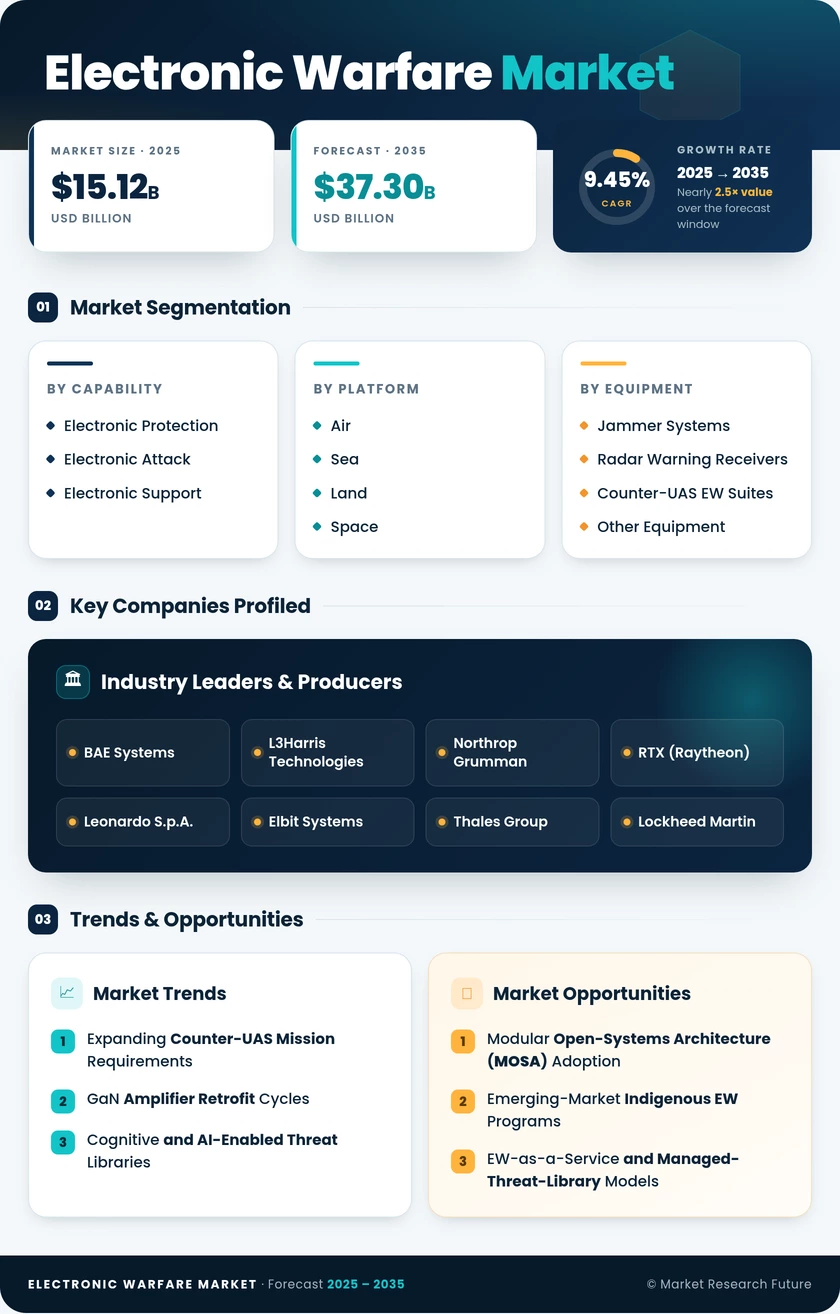
Segmentation Quick Reference
| Dimension | Sub-Segments | Dominant Segment | Fastest Growing Segment |
| Capability | Electronic Attack, Electronic Protection, Electronic Support | Electronic Protection (37.8% share, 2025) | Electronic Attack (9.92% CAGR) |
| Platform | Air, Sea, Land, Space | Air (USD 5.30B, 2025) | Space (10.10% CAGR) |
| Equipment | Jammer Systems, Radar Warning Receivers, Counter-UAS EW Suites, Other Equipment | Jammer Systems (42.3% share, 2025) | Counter-UAS EW Suites (9.72% CAGR) |
| End User | Air Force, Navy, Army | Air Force (41.5% share, 2025) | Navy (9.55% CAGR) |
| Fit | OEM (New-Build), Retrofit / Upgrades | Retrofit / Upgrades (59.0% share, 2025) | Retrofit / Upgrades (9.23% CAGR) |
Market Segmentation Overview
By Capability
| Sub-Segment | Key Trend |
| Electronic Attack | Stand-in jamming via unmanned platforms is gaining operational priority; software-defined waveform agility is increasing mission flexibility. |
| Electronic Protection | Self-protection suite integration across 4th- and 5th-gen fighters; towed-decoy and DIRCM demand rising |
| Electronic Support | SIGINT modernization with wideband digital receivers; real-time emitter geolocation for targeting support |
Electronic Protection remains the broadest capability segment because every combat platform requires baseline threat-warning and countermeasure systems. Electronic Attack is closing the gap as offensive electronic warfare transitions from dedicated assets to distributed, platform-agnostic mission sets integrated into multi-domain operations.
By Platform
| Sub-Segment | Key Trend |
| Air | Fighter-pod refresh cycles (NGJ, Arexis); escort-jammer programs extending into unmanned wingman concepts |
| Sea | Integrated ship EW suites combining soft-kill and hard-kill cueing; fleet-level cooperative electronic warfare |
| Land | Tactical ground-force EW at brigade level; mobile counter-UAS electronic defeat systems proliferating |
| Space | Orbital EW sensing payloads entering operational service; dedicated space electronic attack research accelerating |
Air-based electronic warfare maintains revenue leadership due to the high per-unit cost of airborne pods and the sheer size of global fighter-fleet inventories. Space-based systems, while having a small revenue base today, are attracting disproportionate investment as great-power competition extends into the orbital domain.
By Equipment
| Sub-Segment | Key Trend |
| Jammer Systems | Transition from mechanically steered to AESA-based jammers; multi-band simultaneous operation. |
| Radar Warning Receivers | Digital RWR architectures replacing crystal-video receivers; instantaneous-frequency-measurement upgrades |
| Counter-UAS EW Suites | Rapidly deployable RF-denial systems for base and convoy protection; protocol-specific drone-link disruption |
| Other Equipment | Expendable decoys (BriteCloud-type), chaff/flare dispensers, directed-energy pre-cursor systems |
Jammer systems command the largest equipment share, reflecting the capital-intensive nature of active electronic attack hardware. Counter-UAS EW suites represent the fastest-moving equipment category as the global drone threat outpaces kinetic-intercept capacity and cost-per-engagement economics.
By End User
| Sub-Segment | Key Trend |
| Air Force | Largest EW spender; pod-centric procurement plus integrated-aperture investments on new-build fighters |
| Navy | Ship self-protection modernization; cooperative EW across carrier strike group architectures |
| Army | Ground-based tactical EW resurgence; electronic warfare platoons reactivated at brigade combat team level |
Air forces dominate end-user demand because airborne electronic warfare systems carry the highest unit costs and the broadest mission-set requirements. Armies are the fastest-growing service-branch end user as ground-force electronic warfare—neglected for two decades—receives renewed doctrinal emphasis and dedicated funding lines.
By Fit
| Sub-Segment | Key Trend |
| OEM (New-Build) | EW suites designed-in from aircraft inception; deeply integrated apertures replacing bolt-on pods |
| Retrofit / Upgrades | GaN amplifier insertion, software-defined receiver upgrades, and threat-library modernization |
Retrofit programs dominate because the global installed base of combat platforms far exceeds new-production deliveries in any given year. Operators achieve near-generational capability leaps through targeted hardware swaps and software updates at a fraction of new-build cost, sustaining the retrofit segment's majority share across the forecast period.