Request Free Sample ×

Kindly complete the form below to receive a free sample of this Report

* Please use a valid business email

Leading companies partner with us for data-driven Insights

clients tt-cursor
Hero Background
English
Chinese
French
Japanese
Korean
German
Spanish

E sports Market Size

ID: MRFR/ICT/9757-CR
200 Pages
Aarti Dhapte
July 2025

E sports Market Size, Share and Trends Analysis Research Report: By Game Type (First-Person Shooter, Multiplayer Online Battle Arena, Real-Time Strategy, Sports, Battle Royale), By Revenue Source (Sponsorship, Media Rights, Merchandising, Ticket Sales, In-Game Purchases), By Platform (PC, Console, Mobile), By Participant Type (Professional Players, Amateur Players, Spectators) and By Regional (North America, Europe, South America, Asia Pacific, Middle East and Africa) - Industry Forecast to 2035

Share:
Download PDF ×

We do not share your information with anyone. However, we may send you emails based on your report interest from time to time. You may contact us at any time to opt-out.

E Sports Market Infographic
Purchase Options

E Sports Size

E Sports Market Growth Projections and Opportunities

The market dynamics of the esports industry are experiencing rapid growth and transformation, driven by a combination of technological advancements, changing consumer preferences, and increased investment from various stakeholders. While esports (competitive video gaming) was in its early stages, it was nothing more than a niche subculture attracting just a few fans in the world. However, within the space of few years, this has become a globally recognized brand, now having its dedicated and passionate fans. In the first place, the way technological achievements affect the patterns of the esports industry is really very important. Being permanently on the look for ways of upgrading their devices, graphics and networking equipment has in fact seen the emergence of a new generation of esports, which is more interactive and better presented. The spread of power gaming PCs, gaming consoles, and mobile devices allows gamers to battle virtually within the esport arena or on other platforms, with the world becoming wider and wider for esports. Consumer’s behavior and habits changes become the top causes of why the esports market grows. The younger generations, mainly, have demonstrated a strong willingness in relation to these sporting events to watch them as viewers and to play them. Because esports has exciting and interactive characteristic that allows viewers to talk authors directly through live streaming platform and social web, that viewers can engage or be part of the content. Attitude of consumers about esports, as a primary form of entertainment, has drastically changed, resulting in an increase in number of esports events, which draw more and more viewers across various parts of the globe. Investment and sponsorship provided by these different sectors is the reason why the esports industry continues to experience such a rapid growth. We have realized that the major league brand, technology companies as well as the traditional sports industry is seeing esports as a promising potential in the big industry due to its influence and wealth. From sponsorship bilateral deals to commercial partnerships and provision of resources as a franchiser, from the perspective of financial sustainability of esports teams, leagues and tournaments these are all part of the income generating machine. A substantial amount of money from the investments has defined the rise of the esports industry. It has grown to cover by various reforms including decent work, professional competitiveness, and structured roles of players, trainers, experts, and support staff. The dynamic in the esports market is closely connected to the nature and framework of the esports organizations and the structure of the esports leagues and tournaments. A case in point here is when franchised leagues, which very closely emulate the traditional sport leagues, are set up, the industry gains a level of stability, long-term convenience, and planning. Esports companies now conduct franchising system when teams are like registered entities on the basis of city/region. With this model fans are engaged more, the two regions start fighting each other and a storyline is told in the same way as with league sports. TV broadcasting and media rights dominate, being what contributes most to the sports esports market development. Most of the upcoming esports content is distributed via a number of channels; among them: online streaming platforms, television networks, and dedicated esports platforms. The rise of exclusive broadcasting deals, partnerships with mainstream media outlets, and the creation of esports-focused content contribute to the increasing prominence of esports in the global media landscape. As viewership numbers continue to rise, esports events attract advertisers and sponsors, further enhancing the market dynamics.
E Sports Market Size Graph
Author
Author Profile
Aarti Dhapte
AVP - Research

A consulting professional focused on helping businesses navigate complex markets through structured research and strategic insights. I partner with clients to solve high-impact business problems across market entry strategy, competitive intelligence, and opportunity assessment. Over the course of my experience, I have led and contributed to 100+ market research and consulting engagements, delivering insights across multiple industries and geographies, and supporting strategic decisions linked to $500M+ market opportunities. My core expertise lies in building robust market sizing, forecasting, and commercial models (top-down and bottom-up), alongside deep-dive competitive and industry analysis. I have played a key role in shaping go-to-market strategies, investment cases, and growth roadmaps, enabling clients to make confident, data-backed decisions in dynamic markets.

Leave a Comment

FAQs

What is the current valuation of the E Sports Market as of 2024?

<p>The E Sports Market was valued at 1580.79 USD Billion in 2024.</p>

What is the projected market valuation for the E Sports Market in 2035?

<p>The market is projected to reach a valuation of 12775.06 USD Billion by 2035.</p>

What is the expected CAGR for the E Sports Market during the forecast period 2025 - 2035?

<p>The expected CAGR for the E Sports Market during the forecast period 2025 - 2035 is 20.92%.</p>

Which game genre generates the highest revenue in the E Sports Market?

<p>The Multiplayer Online Battle Arena genre generated 474.24 USD Billion in 2024.</p>

What are the primary platforms for E Sports gaming?

<p>The primary platforms include Mobile, which generated 600.0 USD Billion, and PC, which generated 400.0 USD Billion in 2024.</p>

How does the audience demographic segment impact the E Sports Market?

<p>The audience demographic segment, including age group and income level, contributed 158.08 USD Billion each in 2024.</p>

What types of events are most popular in the E Sports Market?

<p>Online tournaments were the most popular, generating 632.31 USD Billion in 2024.</p>

What monetization models are prevalent in the E Sports Market?

<p>In-game purchases led the monetization models with 793.95 USD Billion in 2024.</p>

Who are the key players in the E Sports Market?

<p>Key players include Tencent, Activision Blizzard, Riot Games, and Epic Games, among others.</p>

What trends are expected to shape the E Sports Market in the coming years?

<p>The market is likely to see growth driven by increased participation in online tournaments and mobile gaming.</p>

Market Summary

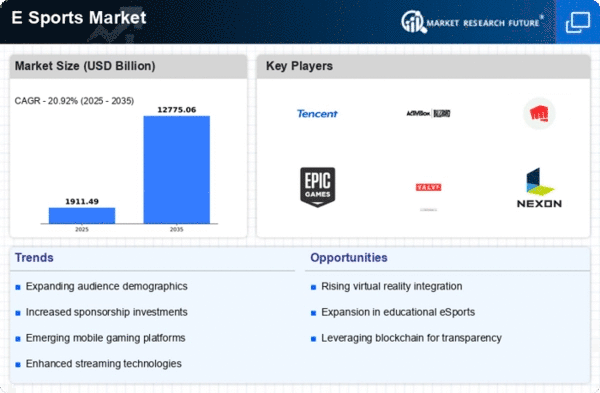
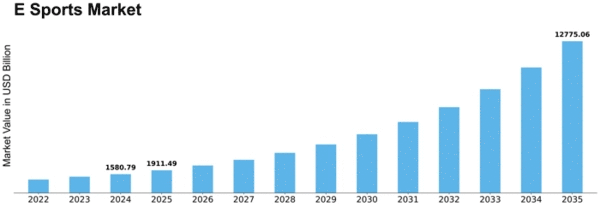
As per MRFR analysis, the E Sports Market Size was estimated at 1580.79 USD Billion in 2024. The E Sports industry is projected to grow from 1911.5 USD Billion in 2025 to 12775.06 USD Billion by 2035, exhibiting a compound annual growth rate (CAGR) of 20.92% during the forecast period 2025 - 2035.

Key Market Trends & Highlights

The E Sports Market is experiencing robust growth driven by technological advancements and diverse revenue streams.

  • The rise of mobile gaming is reshaping the competitive landscape, particularly in the Asia-Pacific region. North America remains the largest market, with First Person Shooter games leading in popularity. Streaming platforms are witnessing increased investment, enhancing viewer engagement and monetization opportunities. The expansion of competitive gaming and integration of E Sports in education are key drivers propelling market growth.

Market Size & Forecast

2024 Market Size 1580.79 (USD Billion)
2035 Market Size 12775.06 (USD Billion)
CAGR (2025 - 2035) 20.92%
Largest Regional Market Share in 2024 North America

Major Players

Tencent (CN), Activision Blizzard (US), Riot Games (US), Epic Games (US), Valve Corporation (US), Nexon (KR), Bandai Namco Entertainment (JP), Electronic Arts (US), Ubisoft (FR)

Market Trends

The E Sports Market is currently experiencing a dynamic evolution, characterized by a surge in viewership and participation across various demographics. This growth is driven by the increasing accessibility of gaming platforms and the proliferation of high-speed internet, which facilitates seamless online experiences. Furthermore, the integration of advanced technologies, such as virtual reality and augmented reality, appears to enhance user engagement, creating immersive environments that captivate audiences. As a result, the market is witnessing a diversification of content, with a broader array of games appealing to different segments of players and viewers alike. The rapid expansion of competitive gaming has transformed esports into a global entertainment industry.

Many audiences now ask, “Is esports a sport?” or “Are video games a sport?” With professional leagues, structured tournaments, and international participation, esports is increasingly recognized as a legitimate sport. The rise of the most popular esports titles and the growing influence of esports organizations continue to shape market growth, supported by strong esports statistics and rising investments worldwide. In addition to technological advancements, the E Sports Market is also influenced by strategic partnerships and sponsorships. Major brands are increasingly recognizing the potential of this sector, leading to collaborations that enhance visibility and credibility. This trend suggests a shift in marketing strategies, where traditional advertising methods are being replaced by innovative approaches that resonate with younger audiences. 

Overall, the E Sports Market seems poised for continued expansion, driven by evolving consumer preferences and the ongoing integration of gaming into mainstream culture. The rise of competitive gaming has led to the formation of structured leagues, professional teams, and global esports organizations. Major video game tournaments and international video game tourneys now attract millions of online viewers and large sponsorship investments. In modern esports ecosystems, professionals play games as full-time careers, supported by teams, coaches, and analysts. The evolution of esports history and genres highlights the shift from early arcade competitions to today’s structured FPS, MOBA, and battle royale tournaments.

Rise of Mobile Gaming

The E Sports Market is witnessing a notable shift towards mobile gaming, as smartphones become the primary devices for many players. This trend indicates a broader audience reach, allowing individuals to engage with competitive gaming from virtually anywhere. Mobile titles are increasingly designed for competitive play, attracting both casual gamers and serious competitors.

Increased Investment in Infrastructure

Investment in infrastructure is becoming a critical trend within the E Sports Market. Organizations are focusing on building state-of-the-art arenas and training facilities, which enhances the overall experience for players and fans. This development suggests a commitment to elevating the professionalism of E Sports, potentially attracting more sponsorships and partnerships.

Growth of Streaming Platforms

The proliferation of streaming platforms dedicated to E Sports is reshaping how audiences consume content. These platforms provide real-time access to tournaments and gameplay, fostering community interaction and engagement. This trend indicates a shift in content consumption habits, as viewers increasingly prefer live, interactive experiences over traditional media.

E Sports Market Market Drivers

Diverse Revenue Streams

The Global Esports Market Industry benefits from a diverse range of revenue streams, including sponsorships, advertising, merchandise sales, and ticket sales for live events. This multifaceted approach to revenue generation enables the industry to remain resilient and adaptable to market fluctuations. Sponsorship deals with major brands, such as Intel and Coca-Cola, provide substantial financial support, while advertising revenue from streaming platforms contributes to overall growth. As the industry evolves, new revenue opportunities, such as in-game purchases and digital collectibles, are likely to emerge. This diversification of income sources positions the Global Esports Market Industry for sustained growth and profitability.

Market Growth Projections

The Global Esports Market Industry is projected to experience remarkable growth, with estimates indicating a market value of 10.5 USD Billion by 2035. This growth trajectory reflects the increasing acceptance of esports as a legitimate form of entertainment and competition. Factors contributing to this expansion include rising viewership, increased participation rates, and the ongoing development of esports infrastructure. The projected CAGR of 13.94% for the period of 2025-2035 underscores the industry's potential for long-term success. As more stakeholders enter the market, the Global Esports Market Industry is likely to evolve, adapting to changing consumer preferences and technological advancements.

Youth Engagement and Demographics

The Global Esports Market Industry is significantly influenced by the engagement of younger demographics, particularly Generation Z and Millennials, who are increasingly drawn to competitive gaming. This demographic shift is evident in the growing number of esports tournaments and events tailored to younger audiences. As these individuals prioritize digital entertainment, the industry is likely to see a sustained increase in participation and viewership. The appeal of esports as a social activity, combined with the rise of online communities, fosters a sense of belonging among players and fans. This trend suggests that the Global Esports Market Industry will continue to thrive as it aligns with the preferences of younger generations.

Technological Advancements in Gaming

Technological advancements play a crucial role in the evolution of the Global Esports Market Industry. Innovations in hardware and software enhance the gaming experience, allowing for more immersive and competitive gameplay. The rise of virtual reality and augmented reality technologies offers new opportunities for game developers and players alike. Furthermore, improvements in internet connectivity and streaming capabilities enable seamless broadcasting of esports events to global audiences. As these technologies continue to develop, they are likely to attract more participants and viewers, contributing to the projected CAGR of 13.94% for the period of 2025-2035. This growth reflects the industry's adaptability and potential for future expansion.

Rising Popularity of Competitive Gaming

The Global Esports Market Industry experiences a surge in popularity as competitive gaming becomes a mainstream entertainment option. With an estimated market value of 2.5 USD Billion in 2024, the industry attracts millions of viewers and participants worldwide. Major tournaments, such as the League of Legends World Championship, draw in large audiences, showcasing the appeal of esports. This growing interest is further fueled by the increasing accessibility of gaming platforms and the rise of streaming services, which allow fans to engage with their favorite games and players. As a result, the Global Esports Market Industry is poised for substantial growth in the coming years.

Investment from Traditional Sports Organizations

The Global Esports Market Industry benefits from significant investments by traditional sports organizations, which recognize the potential of esports as a lucrative venture. Notable franchises, such as the NBA and NFL, have established their own esports leagues, thereby legitimizing the industry and attracting a broader audience. This influx of capital not only enhances the competitive landscape but also facilitates the development of infrastructure and talent. As traditional sports entities continue to invest in esports, the market is expected to expand, potentially reaching a valuation of 10.5 USD Billion by 2035. This trend indicates a convergence of sports and gaming, further solidifying esports' position in the entertainment sector.

Market Segment Insights

By Game Genre: First Person Shooter (Largest) vs. Multiplayer Online Battle Arena (Fastest-Growing)

In the E Sports market, the distribution of game genres showcases a competitive landscape dominated by the First Person Shooter (FPS) category, which captures a significant market share. Games like Call of Duty and Counter-Strike have built a loyal audience, contributing to FPS's leading position. Meanwhile, the Multiplayer Online Battle Arena (MOBA) genre, popularized by titles such as League of Legends and Dota 2, continues to expand rapidly, attracting new players and investments. The growth trends in the E Sports market indicate that while FPS games hold a strong position, MOBAs are emerging as the fastest-growing segment. The increasing accessibility of gaming platforms and the rise of online streaming are key drivers. Additionally, competitive events and tournaments in MOBAs are gaining popularity, enhancing community engagement and driving player retention in the genre.

FPS (Dominant) vs. MOBA (Emerging)

The First Person Shooter (FPS) genre stands as a dominant force in the E Sports market, characterized by its intense and competitive gameplay. Titles like Counter-Strike: Global Offensive and Overwatch have created a robust ecosystem of professional tournaments and sponsorships. The genre's immersive experience and community-driven content keep players engaged and attract a diverse audience. In contrast, the Multiplayer Online Battle Arena (MOBA) genre, represented by games such as League of Legends, is an emerging player that is redefining competitive gaming. With its strategic depth and teamwork focus, it offers a unique appeal. The regular updates, expansions, and active competitive scene contribute to its rapid growth, positioning MOBAs as a key player in the evolving E Sports landscape.

By Platform: PC (Largest) vs. Mobile (Fastest-Growing)

In the E Sports Market, the distribution of platform usage underscores the significance of PC gaming, which dominates a substantial share of the market. With robust hardware capabilities and versatile gaming experiences, PCs have long been favored by serious gamers, leading to a strong competitive environment. Meanwhile, mobile gaming has emerged as a significant player, rapidly gaining traction among casual gamers and offering unprecedented accessibility, contributing to a shift in market dynamics. Growth trends in the E Sports platform segment reveal an exciting trajectory. Mobile gaming is witnessing exponential growth driven by increased smartphone penetration and the development of high-quality mobile titles. As infrastructure improves and 5G technology becomes widespread, the cloud gaming segment is also poised for rapid expansion, providing gamers with the ability to access high-performance games without the need for expensive hardware, further democratizing the E Sports landscape.

PC (Dominant) vs. Cloud Gaming (Emerging)

In the E Sports Market, PC gaming stands out as the dominant platform, favored for its superior graphics, processing power, and extensive game libraries. PC gamers enjoy a diverse ecosystem that supports a wide range of gaming genres, from fast-paced shooters to immersive role-playing games. Conversely, cloud gaming is an emerging platform that leverages cloud technology to offer streaming of high-quality games without the necessity for advanced hardware. This innovation allows players to engage in E Sports across various devices, attracting those unable or unwilling to invest in high-end gaming rigs. While PC maintains its leadership position due to its established infrastructure, cloud gaming is rapidly gaining popularity, appealing to a broader audience and enhancing overall accessibility.

By Audience Demographics: 18-34 Years (Largest) vs. 35-54 Years (Fastest-Growing)

<p>In the E Sports Market, the audience demographics reveal that the largest segment is composed of individuals aged 18-34 years, capturing a significant market share. This age group exhibits a high engagement level, driven by their familiarity with gaming and digital platforms. Meanwhile, the 35-54 years segment is also growing rapidly, reflecting an increasing interest among older gamers who are becoming more active in the competitive gaming space. Understanding these demographics can aid marketers in designing tailored strategies. Growth trends in the audience demographics of the E Sports Market are particularly influenced by the evolving landscape of gaming and its accessibility. The surge in mobile gaming and online streaming platforms has extended the reach to mature audiences, fostering the rapid growth of the 35-54 years demographic. Additionally, targeted marketing campaigns and the inclusion of diverse gaming genres have attracted a broader range of participants, enriching the complexity and vibrancy of the overall user base.</p>

<p>Age: 18-34 Years (Dominant) vs. 35-54 Years (Emerging)</p>

<p>The age group of 18-34 years is recognized as the dominant force in the E Sports Market, largely due to its inherent familiarity with technology and gaming culture. This demographic not only consists of avid gamers but also includes casual players who constantly engage with E Sports through streaming and social media. They contribute significantly to the audience base, participating in both online and offline gaming events. Conversely, the 35-54 years age group is emerging as a vital segment, reflecting a significant shift in the gaming landscape as individuals in this range seek recreational activities and social connection through E Sports. Their growing participation indicates a maturing market that welcomes diverse age groups, progressively breaking stereotypes associated with gaming.</p>

By Event Type: Online Tournaments (Largest) vs. LAN Events (Fastest-Growing)

<p>The E Sports Market is increasingly being segmented by event type, with Online Tournaments leading the pack as the largest segment in terms of participation and audience reach. Dominating the landscape, online events host a multitude of players and spectators, which significantly boosts their market share. In contrast, LAN Events constitute a smaller, yet rapidly expanding segment. Their appeal lies in the in-person experience and atmosphere, drawing in passionate fans and players alike.</p>

<p>Event Format: Online Tournaments (Dominant) vs. LAN Events (Emerging)</p>

<p>Online Tournaments have become the cornerstone of the E Sports Market, characterized by their accessibility and extensive reach. This format enables players to participate from anywhere in the world, creating a diverse global audience. In contrast, LAN Events, while currently smaller in participation numbers, are witnessing explosive growth. These events offer unique live experiences, attracting dedicated fans and fostering a strong sense of community. LAN events not only provide immersive environments but also add significant marketing value for sponsors and partners, making them an exciting area for future investment.</p>

By Monetization Model: Sponsorship (Largest) vs. In-Game Purchases (Fastest-Growing)

<p>In the E Sports market, the monetization model is predominantly driven by sponsorships, which hold the largest market share. Sponsorship has become the cornerstone of revenue generation, with brands eager to align themselves with popular teams and events, providing financial support in exchange for exposure. In-game purchases also contribute significantly to the market, capturing a growing segment of user engagement as gamers opt for digital goods to enhance their experience.</p>

<p>Sponsorship (Dominant) vs. In-Game Purchases (Emerging)</p>

<p>Sponsorship in the E Sports market continues to dominate, offering companies a unique platform to reach target audiences effectively. Major brands leverage their partnerships with gaming teams to create authentic connections with fans, translating to substantial visibility and loyalty. Conversely, in-game purchases are emerging as a significant revenue stream, providing players with customizable options and enhancing game engagement. This model benefits from the rise in mobile gaming and the increasing trend of microtransactions, ultimately driving user satisfaction and continuing market growth.</p>

Get more detailed insights about E-sports Market Research Report - Global Forecast till 2035

Regional Insights

North America : Leading Market for E Sports

North America continues to lead the E Sports market, holding a significant share of 790.39M in 2025. The growth is driven by increasing viewership, sponsorship deals, and a robust gaming culture. Regulatory support and investment in infrastructure further enhance market dynamics, making it a prime location for E Sports events and tournaments. The region's technological advancements and high internet penetration also contribute to its growth trajectory. The competitive landscape is dominated by key players such as Activision Blizzard, Riot Games, and Epic Games, all based in the US. These companies are at the forefront of innovation, creating popular titles that attract millions of players and viewers. The presence of major gaming events and a strong community of gamers solidify North America's position as the epicenter of the E Sports industry. With a growing audience and increasing revenue streams, the region is poised for continued success.

Europe : Emerging E Sports Hub

Europe's E Sports market is rapidly expanding, with a market size of 450.0M in 2025. The region benefits from a diverse gaming community and strong regulatory frameworks that support E Sports development. Countries like Germany, the UK, and France are leading the charge, with increasing investments in E Sports infrastructure and events. The rise of online streaming platforms has also fueled demand, making E Sports more accessible to a wider audience. The competitive landscape features prominent players such as Ubisoft and Bandai Namco Entertainment, which are investing heavily in E Sports initiatives. The region is characterized by a mix of established franchises and emerging titles, creating a vibrant ecosystem. As European countries continue to embrace E Sports, the market is expected to grow significantly, driven by fan engagement and sponsorship opportunities. "The European gaming market is set to grow significantly, driven by innovation and community engagement," European Gaming Commission.

Asia-Pacific : Rapidly Growing E Sports Market

The Asia-Pacific region is witnessing a surge in the E Sports market, with a size of 290.0M in 2025. This growth is fueled by a massive youth population, increasing internet accessibility, and a cultural shift towards gaming as a mainstream entertainment option. Countries like China and South Korea are at the forefront, with significant investments in E Sports leagues and tournaments, supported by favorable government policies that promote digital entertainment. The competitive landscape is vibrant, featuring major players like Tencent and NCSOFT, which dominate the market with popular titles. The region's unique gaming culture, characterized by high engagement and community participation, further enhances its appeal. As E Sports continues to gain traction, the Asia-Pacific market is expected to expand rapidly, driven by technological advancements and a growing fan base.

Middle East and Africa : Emerging E Sports Frontier

The Middle East and Africa (MEA) region is emerging as a new frontier in the E Sports market, with a size of 50.4M in 2025. The growth is driven by increasing interest in gaming, supported by investments in infrastructure and events. Governments in the region are recognizing the potential of E Sports as a tool for youth engagement and economic development, leading to favorable policies that encourage growth in this sector. Countries like South Africa and the UAE are leading the charge, hosting major E Sports tournaments and attracting international attention. The competitive landscape is evolving, with local and international players entering the market. As the region continues to develop its gaming ecosystem, the potential for growth in the E Sports market is significant, driven by a young population eager to engage in competitive gaming. "The MEA region is poised for growth in E Sports, driven by youth engagement and investment in infrastructure," Middle East Gaming Association.

Key Players and Competitive Insights

The E Sports Market is currently characterized by a dynamic competitive landscape, driven by rapid technological advancements and an increasing global audience. Major players such as Tencent (CN), Activision Blizzard (US), and Riot Games (US) are at the forefront, each employing distinct strategies to enhance their market presence. Tencent (CN) continues to leverage its vast ecosystem, focusing on strategic investments and partnerships to expand its influence in the gaming sector. Activision Blizzard (US) emphasizes innovation through the development of new game titles and the enhancement of existing franchises, while Riot Games (US) concentrates on community engagement and competitive integrity, fostering a loyal player base that drives sustained growth.The business tactics employed by these companies reflect a moderately fragmented market structure, where collaboration and competition coexist. Localizing content and optimizing supply chains are critical tactics that enhance operational efficiency and market responsiveness. The collective influence of these key players shapes the competitive environment, as they navigate the complexities of consumer preferences and technological advancements.
In November Tencent (CN) announced a strategic partnership with a leading cloud service provider to enhance its gaming infrastructure. This move is poised to improve the gaming experience for users, potentially increasing player retention and attracting new audiences. The partnership underscores Tencent's commitment to leveraging technology to maintain its competitive edge in the E Sports Market.
In October Activision Blizzard (US) launched a new initiative aimed at promoting diversity and inclusion within its gaming communities. This initiative not only aligns with contemporary social values but also positions the company as a leader in fostering a welcoming environment for all players. Such strategic actions may enhance brand loyalty and attract a broader demographic, thereby expanding its market share.
In September Riot Games (US) introduced a new competitive league format for its flagship title, which aims to increase viewer engagement and enhance the overall spectator experience. This strategic shift is likely to attract more sponsorships and advertising revenue, further solidifying Riot's position in the market. By prioritizing the spectator experience, Riot Games demonstrates an understanding of the evolving dynamics of E Sports viewership.
As of December current trends in the E Sports Market indicate a strong focus on digitalization, sustainability, and the integration of AI technologies. Strategic alliances are increasingly shaping the competitive landscape, as companies collaborate to enhance their technological capabilities and market reach. Looking ahead, competitive differentiation is expected to evolve, with a shift from price-based competition to a focus on innovation, technology, and supply chain reliability. This transition may redefine success in the E Sports Market, as companies strive to meet the demands of an ever-evolving consumer base.

Key Companies in the E Sports Market include

Industry Developments

The Esports Market has been witnessing significant developments recently, with substantial growth attributed to increasing viewership and investment from major companies. Bandai Namco Entertainment and Riot Games continue to expand their game portfolios, while Valve Corporation is enhancing its competitive environment through multiple tournaments. The investment activities by Tencent are noteworthy, with the company acquiring stakes in various gaming entities, thereby influencing market dynamics. In September 2023, Activision Blizzard and Microsoft announced an agreement to enhance their gaming ecosystem, showcasing strategic partnerships as key trends in the industry. 

Electronic Arts, capitalizing on the popularity of its sports franchises, remains focused on elevating esports experiences for fans. The Overwatch League has restructured its league format, aiming to boost viewer engagement. Furthermore, NVIDIA and PGL are working together to leverage advanced technology, aiding in the overall growth of esports events. The substantial influx of venture capital and sponsorships across the market indicates a promising future, with strong upward valuations for companies involved in esports, echoing the increasing significance of this sector on a global scale. These developments have reinforced the position of esports as a prominent entertainment avenue worldwide.


Future Outlook

E Sports Market Future Outlook

The E Sports Market is projected to grow at a 20.92% CAGR from 2025 to 2035, driven by technological advancements, increased sponsorship, and expanding audience engagement.

New opportunities lie in:

  • <p>Development of immersive virtual reality gaming experiences Creation of subscription-based content platforms for exclusive tournaments Expansion of mobile eSports leagues targeting emerging markets</p>

By 2035, the E Sports Market is poised for substantial growth, solidifying its position as a leading entertainment sector.

Market Segmentation

E Sports Market Platform Outlook

  • PC
  • Console
  • Mobile
  • Cloud Gaming

E Sports Market Event Type Outlook

  • Online Tournaments
  • LAN Events
  • Exhibitions
  • Charity Events

E Sports Market Game Genre Outlook

  • First Person Shooter
  • Multiplayer Online Battle Arena
  • Real Time Strategy
  • Sports Simulation
  • Fighting

E Sports Market Monetization Model Outlook

  • Free to Play
  • Pay to Play
  • Subscription
  • In Game Purchases

E Sports Market Audience Demographics Outlook

  • Age Group
  • Gender
  • Income Level
  • Geographic Location

Report Scope

MARKET SIZE 2024 1580.79(USD Billion)
MARKET SIZE 2025 1911.5(USD Billion)
MARKET SIZE 2035 12775.06(USD Billion)
COMPOUND ANNUAL GROWTH RATE (CAGR) 20.92% (2025 - 2035)
REPORT COVERAGE Revenue Forecast, Competitive Landscape, Growth Factors, and Trends
BASE YEAR 2024
Market Forecast Period 2025 - 2035
Historical Data 2019 - 2024
Market Forecast Units USD Billion
Key Companies Profiled Tencent (CN), Activision Blizzard (US), Riot Games (US), Epic Games (US), Valve Corporation (US), Nexon (KR), Bandai Namco Entertainment (JP), Electronic Arts (US), Ubisoft (FR)
Segments Covered Game Genre, Platform, Monetization Model, Audience Demographics, Event Type
Key Market Opportunities Integration of virtual reality technology enhances immersive experiences in the E Sports Market.
Key Market Dynamics Rising consumer engagement and technological advancements are reshaping competitive dynamics within the E Sports Market.
Countries Covered North America, Europe, APAC, South America, MEA

FAQs

What is the current valuation of the E Sports Market as of 2024?

<p>The E Sports Market was valued at 1580.79 USD Billion in 2024.</p>

What is the projected market valuation for the E Sports Market in 2035?

<p>The market is projected to reach a valuation of 12775.06 USD Billion by 2035.</p>

What is the expected CAGR for the E Sports Market during the forecast period 2025 - 2035?

<p>The expected CAGR for the E Sports Market during the forecast period 2025 - 2035 is 20.92%.</p>

Which game genre generates the highest revenue in the E Sports Market?

<p>The Multiplayer Online Battle Arena genre generated 474.24 USD Billion in 2024.</p>

What are the primary platforms for E Sports gaming?

<p>The primary platforms include Mobile, which generated 600.0 USD Billion, and PC, which generated 400.0 USD Billion in 2024.</p>

How does the audience demographic segment impact the E Sports Market?

<p>The audience demographic segment, including age group and income level, contributed 158.08 USD Billion each in 2024.</p>

What types of events are most popular in the E Sports Market?

<p>Online tournaments were the most popular, generating 632.31 USD Billion in 2024.</p>

What monetization models are prevalent in the E Sports Market?

<p>In-game purchases led the monetization models with 793.95 USD Billion in 2024.</p>

Who are the key players in the E Sports Market?

<p>Key players include Tencent, Activision Blizzard, Riot Games, and Epic Games, among others.</p>

What trends are expected to shape the E Sports Market in the coming years?

<p>The market is likely to see growth driven by increased participation in online tournaments and mobile gaming.</p>

  1. SECTION I: EXECUTIVE SUMMARY AND KEY HIGHLIGHTS
    1. | 1.1 EXECUTIVE SUMMARY
    2. | | 1.1.1 Market Overview
    3. | | 1.1.2 Key Findings
    4. | | 1.1.3 Market Segmentation
    5. | | 1.1.4 Competitive Landscape
    6. | | 1.1.5 Challenges and Opportunities
    7. | | 1.1.6 Future Outlook
  2. SECTION II: SCOPING, METHODOLOGY AND MARKET STRUCTURE
    1. | 2.1 MARKET INTRODUCTION
    2. | | 2.1.1 Definition
    3. | | 2.1.2 Scope of the study
    4. | | | 2.1.2.1 Research Objective
    5. | | | 2.1.2.2 Assumption
    6. | | | 2.1.2.3 Limitations
    7. | 2.2 RESEARCH METHODOLOGY
    8. | | 2.2.1 Overview
    9. | | 2.2.2 Data Mining
    10. | | 2.2.3 Secondary Research
    11. | | 2.2.4 Primary Research
    12. | | | 2.2.4.1 Primary Interviews and Information Gathering Process
    13. | | | 2.2.4.2 Breakdown of Primary Respondents
    14. | | 2.2.5 Forecasting Model
    15. | | 2.2.6 Market Size Estimation
    16. | | | 2.2.6.1 Bottom-Up Approach
    17. | | | 2.2.6.2 Top-Down Approach
    18. | | 2.2.7 Data Triangulation
    19. | | 2.2.8 Validation
  3. SECTION III: QUALITATIVE ANALYSIS
    1. | 3.1 MARKET DYNAMICS
    2. | | 3.1.1 Overview
    3. | | 3.1.2 Drivers
    4. | | 3.1.3 Restraints
    5. | | 3.1.4 Opportunities
    6. | 3.2 MARKET FACTOR ANALYSIS
    7. | | 3.2.1 Value chain Analysis
    8. | | 3.2.2 Porter's Five Forces Analysis
    9. | | | 3.2.2.1 Bargaining Power of Suppliers
    10. | | | 3.2.2.2 Bargaining Power of Buyers
    11. | | | 3.2.2.3 Threat of New Entrants
    12. | | | 3.2.2.4 Threat of Substitutes
    13. | | | 3.2.2.5 Intensity of Rivalry
    14. | | 3.2.3 COVID-19 Impact Analysis
    15. | | | 3.2.3.1 Market Impact Analysis
    16. | | | 3.2.3.2 Regional Impact
    17. | | | 3.2.3.3 Opportunity and Threat Analysis
  4. SECTION IV: QUANTITATIVE ANALYSIS
    1. | 4.1 Information and Communications Technology, BY Game Genre (USD Billion)
    2. | | 4.1.1 First Person Shooter
    3. | | 4.1.2 Multiplayer Online Battle Arena
    4. | | 4.1.3 Real Time Strategy
    5. | | 4.1.4 Sports Simulation
    6. | | 4.1.5 Fighting
    7. | 4.2 Information and Communications Technology, BY Platform (USD Billion)
    8. | | 4.2.1 PC
    9. | | 4.2.2 Console
    10. | | 4.2.3 Mobile
    11. | | 4.2.4 Cloud Gaming
    12. | 4.3 Information and Communications Technology, BY Audience Demographics (USD Billion)
    13. | | 4.3.1 Age Group
    14. | | 4.3.2 Gender
    15. | | 4.3.3 Income Level
    16. | | 4.3.4 Geographic Location
    17. | 4.4 Information and Communications Technology, BY Event Type (USD Billion)
    18. | | 4.4.1 Online Tournaments
    19. | | 4.4.2 LAN Events
    20. | | 4.4.3 Exhibitions
    21. | | 4.4.4 Streaming Competitions
    22. | 4.5 Information and Communications Technology, BY Monetization Model (USD Billion)
    23. | | 4.5.1 Sponsorship
    24. | | 4.5.2 Advertising
    25. | | 4.5.3 In-Game Purchases
    26. | | 4.5.4 Subscription
    27. | 4.6 Information and Communications Technology, BY Region (USD Billion)
    28. | | 4.6.1 North America
    29. | | | 4.6.1.1 US
    30. | | | 4.6.1.2 Canada
    31. | | 4.6.2 Europe
    32. | | | 4.6.2.1 Germany
    33. | | | 4.6.2.2 UK
    34. | | | 4.6.2.3 France
    35. | | | 4.6.2.4 Russia
    36. | | | 4.6.2.5 Italy
    37. | | | 4.6.2.6 Spain
    38. | | | 4.6.2.7 Rest of Europe
    39. | | 4.6.3 APAC
    40. | | | 4.6.3.1 China
    41. | | | 4.6.3.2 India
    42. | | | 4.6.3.3 Japan
    43. | | | 4.6.3.4 South Korea
    44. | | | 4.6.3.5 Malaysia
    45. | | | 4.6.3.6 Thailand
    46. | | | 4.6.3.7 Indonesia
    47. | | | 4.6.3.8 Rest of APAC
    48. | | 4.6.4 South America
    49. | | | 4.6.4.1 Brazil
    50. | | | 4.6.4.2 Mexico
    51. | | | 4.6.4.3 Argentina
    52. | | | 4.6.4.4 Rest of South America
    53. | | 4.6.5 MEA
    54. | | | 4.6.5.1 GCC Countries
    55. | | | 4.6.5.2 South Africa
    56. | | | 4.6.5.3 Rest of MEA
  5. SECTION V: COMPETITIVE ANALYSIS
    1. | 5.1 Competitive Landscape
    2. | | 5.1.1 Overview
    3. | | 5.1.2 Competitive Analysis
    4. | | 5.1.3 Market share Analysis
    5. | | 5.1.4 Major Growth Strategy in the Information and Communications Technology
    6. | | 5.1.5 Competitive Benchmarking
    7. | | 5.1.6 Leading Players in Terms of Number of Developments in the Information and Communications Technology
    8. | | 5.1.7 Key developments and growth strategies
    9. | | | 5.1.7.1 New Product Launch/Service Deployment
    10. | | | 5.1.7.2 Merger & Acquisitions
    11. | | | 5.1.7.3 Joint Ventures
    12. | | 5.1.8 Major Players Financial Matrix
    13. | | | 5.1.8.1 Sales and Operating Income
    14. | | | 5.1.8.2 Major Players R&D Expenditure. 2023
    15. | 5.2 Company Profiles
    16. | | 5.2.1 Tencent (CN)
    17. | | | 5.2.1.1 Financial Overview
    18. | | | 5.2.1.2 Products Offered
    19. | | | 5.2.1.3 Key Developments
    20. | | | 5.2.1.4 SWOT Analysis
    21. | | | 5.2.1.5 Key Strategies
    22. | | 5.2.2 Activision Blizzard (US)
    23. | | | 5.2.2.1 Financial Overview
    24. | | | 5.2.2.2 Products Offered
    25. | | | 5.2.2.3 Key Developments
    26. | | | 5.2.2.4 SWOT Analysis
    27. | | | 5.2.2.5 Key Strategies
    28. | | 5.2.3 Riot Games (US)
    29. | | | 5.2.3.1 Financial Overview
    30. | | | 5.2.3.2 Products Offered
    31. | | | 5.2.3.3 Key Developments
    32. | | | 5.2.3.4 SWOT Analysis
    33. | | | 5.2.3.5 Key Strategies
    34. | | 5.2.4 Epic Games (US)
    35. | | | 5.2.4.1 Financial Overview
    36. | | | 5.2.4.2 Products Offered
    37. | | | 5.2.4.3 Key Developments
    38. | | | 5.2.4.4 SWOT Analysis
    39. | | | 5.2.4.5 Key Strategies
    40. | | 5.2.5 Valve Corporation (US)
    41. | | | 5.2.5.1 Financial Overview
    42. | | | 5.2.5.2 Products Offered
    43. | | | 5.2.5.3 Key Developments
    44. | | | 5.2.5.4 SWOT Analysis
    45. | | | 5.2.5.5 Key Strategies
    46. | | 5.2.6 NCSOFT (KR)
    47. | | | 5.2.6.1 Financial Overview
    48. | | | 5.2.6.2 Products Offered
    49. | | | 5.2.6.3 Key Developments
    50. | | | 5.2.6.4 SWOT Analysis
    51. | | | 5.2.6.5 Key Strategies
    52. | | 5.2.7 Electronic Arts (US)
    53. | | | 5.2.7.1 Financial Overview
    54. | | | 5.2.7.2 Products Offered
    55. | | | 5.2.7.3 Key Developments
    56. | | | 5.2.7.4 SWOT Analysis
    57. | | | 5.2.7.5 Key Strategies
    58. | | 5.2.8 Bandai Namco Entertainment (JP)
    59. | | | 5.2.8.1 Financial Overview
    60. | | | 5.2.8.2 Products Offered
    61. | | | 5.2.8.3 Key Developments
    62. | | | 5.2.8.4 SWOT Analysis
    63. | | | 5.2.8.5 Key Strategies
    64. | | 5.2.9 Ubisoft (FR)
    65. | | | 5.2.9.1 Financial Overview
    66. | | | 5.2.9.2 Products Offered
    67. | | | 5.2.9.3 Key Developments
    68. | | | 5.2.9.4 SWOT Analysis
    69. | | | 5.2.9.5 Key Strategies
    70. | 5.3 Appendix
    71. | | 5.3.1 References
    72. | | 5.3.2 Related Reports
  6. LIST OF FIGURES
    1. | 6.1 MARKET SYNOPSIS
    2. | 6.2 NORTH AMERICA MARKET ANALYSIS
    3. | 6.3 US MARKET ANALYSIS BY GAME GENRE
    4. | 6.4 US MARKET ANALYSIS BY PLATFORM
    5. | 6.5 US MARKET ANALYSIS BY AUDIENCE DEMOGRAPHICS
    6. | 6.6 US MARKET ANALYSIS BY EVENT TYPE
    7. | 6.7 US MARKET ANALYSIS BY MONETIZATION MODEL
    8. | 6.8 CANADA MARKET ANALYSIS BY GAME GENRE
    9. | 6.9 CANADA MARKET ANALYSIS BY PLATFORM
    10. | 6.10 CANADA MARKET ANALYSIS BY AUDIENCE DEMOGRAPHICS
    11. | 6.11 CANADA MARKET ANALYSIS BY EVENT TYPE
    12. | 6.12 CANADA MARKET ANALYSIS BY MONETIZATION MODEL
    13. | 6.13 EUROPE MARKET ANALYSIS
    14. | 6.14 GERMANY MARKET ANALYSIS BY GAME GENRE
    15. | 6.15 GERMANY MARKET ANALYSIS BY PLATFORM
    16. | 6.16 GERMANY MARKET ANALYSIS BY AUDIENCE DEMOGRAPHICS
    17. | 6.17 GERMANY MARKET ANALYSIS BY EVENT TYPE
    18. | 6.18 GERMANY MARKET ANALYSIS BY MONETIZATION MODEL
    19. | 6.19 UK MARKET ANALYSIS BY GAME GENRE
    20. | 6.20 UK MARKET ANALYSIS BY PLATFORM
    21. | 6.21 UK MARKET ANALYSIS BY AUDIENCE DEMOGRAPHICS
    22. | 6.22 UK MARKET ANALYSIS BY EVENT TYPE
    23. | 6.23 UK MARKET ANALYSIS BY MONETIZATION MODEL
    24. | 6.24 FRANCE MARKET ANALYSIS BY GAME GENRE
    25. | 6.25 FRANCE MARKET ANALYSIS BY PLATFORM
    26. | 6.26 FRANCE MARKET ANALYSIS BY AUDIENCE DEMOGRAPHICS
    27. | 6.27 FRANCE MARKET ANALYSIS BY EVENT TYPE
    28. | 6.28 FRANCE MARKET ANALYSIS BY MONETIZATION MODEL
    29. | 6.29 RUSSIA MARKET ANALYSIS BY GAME GENRE
    30. | 6.30 RUSSIA MARKET ANALYSIS BY PLATFORM
    31. | 6.31 RUSSIA MARKET ANALYSIS BY AUDIENCE DEMOGRAPHICS
    32. | 6.32 RUSSIA MARKET ANALYSIS BY EVENT TYPE
    33. | 6.33 RUSSIA MARKET ANALYSIS BY MONETIZATION MODEL
    34. | 6.34 ITALY MARKET ANALYSIS BY GAME GENRE
    35. | 6.35 ITALY MARKET ANALYSIS BY PLATFORM
    36. | 6.36 ITALY MARKET ANALYSIS BY AUDIENCE DEMOGRAPHICS
    37. | 6.37 ITALY MARKET ANALYSIS BY EVENT TYPE
    38. | 6.38 ITALY MARKET ANALYSIS BY MONETIZATION MODEL
    39. | 6.39 SPAIN MARKET ANALYSIS BY GAME GENRE
    40. | 6.40 SPAIN MARKET ANALYSIS BY PLATFORM
    41. | 6.41 SPAIN MARKET ANALYSIS BY AUDIENCE DEMOGRAPHICS
    42. | 6.42 SPAIN MARKET ANALYSIS BY EVENT TYPE
    43. | 6.43 SPAIN MARKET ANALYSIS BY MONETIZATION MODEL
    44. | 6.44 REST OF EUROPE MARKET ANALYSIS BY GAME GENRE
    45. | 6.45 REST OF EUROPE MARKET ANALYSIS BY PLATFORM
    46. | 6.46 REST OF EUROPE MARKET ANALYSIS BY AUDIENCE DEMOGRAPHICS
    47. | 6.47 REST OF EUROPE MARKET ANALYSIS BY EVENT TYPE
    48. | 6.48 REST OF EUROPE MARKET ANALYSIS BY MONETIZATION MODEL
    49. | 6.49 APAC MARKET ANALYSIS
    50. | 6.50 CHINA MARKET ANALYSIS BY GAME GENRE
    51. | 6.51 CHINA MARKET ANALYSIS BY PLATFORM
    52. | 6.52 CHINA MARKET ANALYSIS BY AUDIENCE DEMOGRAPHICS
    53. | 6.53 CHINA MARKET ANALYSIS BY EVENT TYPE
    54. | 6.54 CHINA MARKET ANALYSIS BY MONETIZATION MODEL
    55. | 6.55 INDIA MARKET ANALYSIS BY GAME GENRE
    56. | 6.56 INDIA MARKET ANALYSIS BY PLATFORM
    57. | 6.57 INDIA MARKET ANALYSIS BY AUDIENCE DEMOGRAPHICS
    58. | 6.58 INDIA MARKET ANALYSIS BY EVENT TYPE
    59. | 6.59 INDIA MARKET ANALYSIS BY MONETIZATION MODEL
    60. | 6.60 JAPAN MARKET ANALYSIS BY GAME GENRE
    61. | 6.61 JAPAN MARKET ANALYSIS BY PLATFORM
    62. | 6.62 JAPAN MARKET ANALYSIS BY AUDIENCE DEMOGRAPHICS
    63. | 6.63 JAPAN MARKET ANALYSIS BY EVENT TYPE
    64. | 6.64 JAPAN MARKET ANALYSIS BY MONETIZATION MODEL
    65. | 6.65 SOUTH KOREA MARKET ANALYSIS BY GAME GENRE
    66. | 6.66 SOUTH KOREA MARKET ANALYSIS BY PLATFORM
    67. | 6.67 SOUTH KOREA MARKET ANALYSIS BY AUDIENCE DEMOGRAPHICS
    68. | 6.68 SOUTH KOREA MARKET ANALYSIS BY EVENT TYPE
    69. | 6.69 SOUTH KOREA MARKET ANALYSIS BY MONETIZATION MODEL
    70. | 6.70 MALAYSIA MARKET ANALYSIS BY GAME GENRE
    71. | 6.71 MALAYSIA MARKET ANALYSIS BY PLATFORM
    72. | 6.72 MALAYSIA MARKET ANALYSIS BY AUDIENCE DEMOGRAPHICS
    73. | 6.73 MALAYSIA MARKET ANALYSIS BY EVENT TYPE
    74. | 6.74 MALAYSIA MARKET ANALYSIS BY MONETIZATION MODEL
    75. | 6.75 THAILAND MARKET ANALYSIS BY GAME GENRE
    76. | 6.76 THAILAND MARKET ANALYSIS BY PLATFORM
    77. | 6.77 THAILAND MARKET ANALYSIS BY AUDIENCE DEMOGRAPHICS
    78. | 6.78 THAILAND MARKET ANALYSIS BY EVENT TYPE
    79. | 6.79 THAILAND MARKET ANALYSIS BY MONETIZATION MODEL
    80. | 6.80 INDONESIA MARKET ANALYSIS BY GAME GENRE
    81. | 6.81 INDONESIA MARKET ANALYSIS BY PLATFORM
    82. | 6.82 INDONESIA MARKET ANALYSIS BY AUDIENCE DEMOGRAPHICS
    83. | 6.83 INDONESIA MARKET ANALYSIS BY EVENT TYPE
    84. | 6.84 INDONESIA MARKET ANALYSIS BY MONETIZATION MODEL
    85. | 6.85 REST OF APAC MARKET ANALYSIS BY GAME GENRE
    86. | 6.86 REST OF APAC MARKET ANALYSIS BY PLATFORM
    87. | 6.87 REST OF APAC MARKET ANALYSIS BY AUDIENCE DEMOGRAPHICS
    88. | 6.88 REST OF APAC MARKET ANALYSIS BY EVENT TYPE
    89. | 6.89 REST OF APAC MARKET ANALYSIS BY MONETIZATION MODEL
    90. | 6.90 SOUTH AMERICA MARKET ANALYSIS
    91. | 6.91 BRAZIL MARKET ANALYSIS BY GAME GENRE
    92. | 6.92 BRAZIL MARKET ANALYSIS BY PLATFORM
    93. | 6.93 BRAZIL MARKET ANALYSIS BY AUDIENCE DEMOGRAPHICS
    94. | 6.94 BRAZIL MARKET ANALYSIS BY EVENT TYPE
    95. | 6.95 BRAZIL MARKET ANALYSIS BY MONETIZATION MODEL
    96. | 6.96 MEXICO MARKET ANALYSIS BY GAME GENRE
    97. | 6.97 MEXICO MARKET ANALYSIS BY PLATFORM
    98. | 6.98 MEXICO MARKET ANALYSIS BY AUDIENCE DEMOGRAPHICS
    99. | 6.99 MEXICO MARKET ANALYSIS BY EVENT TYPE
    100. | 6.100 MEXICO MARKET ANALYSIS BY MONETIZATION MODEL
    101. | 6.101 ARGENTINA MARKET ANALYSIS BY GAME GENRE
    102. | 6.102 ARGENTINA MARKET ANALYSIS BY PLATFORM
    103. | 6.103 ARGENTINA MARKET ANALYSIS BY AUDIENCE DEMOGRAPHICS
    104. | 6.104 ARGENTINA MARKET ANALYSIS BY EVENT TYPE
    105. | 6.105 ARGENTINA MARKET ANALYSIS BY MONETIZATION MODEL
    106. | 6.106 REST OF SOUTH AMERICA MARKET ANALYSIS BY GAME GENRE
    107. | 6.107 REST OF SOUTH AMERICA MARKET ANALYSIS BY PLATFORM
    108. | 6.108 REST OF SOUTH AMERICA MARKET ANALYSIS BY AUDIENCE DEMOGRAPHICS
    109. | 6.109 REST OF SOUTH AMERICA MARKET ANALYSIS BY EVENT TYPE
    110. | 6.110 REST OF SOUTH AMERICA MARKET ANALYSIS BY MONETIZATION MODEL
    111. | 6.111 MEA MARKET ANALYSIS
    112. | 6.112 GCC COUNTRIES MARKET ANALYSIS BY GAME GENRE
    113. | 6.113 GCC COUNTRIES MARKET ANALYSIS BY PLATFORM
    114. | 6.114 GCC COUNTRIES MARKET ANALYSIS BY AUDIENCE DEMOGRAPHICS
    115. | 6.115 GCC COUNTRIES MARKET ANALYSIS BY EVENT TYPE
    116. | 6.116 GCC COUNTRIES MARKET ANALYSIS BY MONETIZATION MODEL
    117. | 6.117 SOUTH AFRICA MARKET ANALYSIS BY GAME GENRE
    118. | 6.118 SOUTH AFRICA MARKET ANALYSIS BY PLATFORM
    119. | 6.119 SOUTH AFRICA MARKET ANALYSIS BY AUDIENCE DEMOGRAPHICS
    120. | 6.120 SOUTH AFRICA MARKET ANALYSIS BY EVENT TYPE
    121. | 6.121 SOUTH AFRICA MARKET ANALYSIS BY MONETIZATION MODEL
    122. | 6.122 REST OF MEA MARKET ANALYSIS BY GAME GENRE
    123. | 6.123 REST OF MEA MARKET ANALYSIS BY PLATFORM
    124. | 6.124 REST OF MEA MARKET ANALYSIS BY AUDIENCE DEMOGRAPHICS
    125. | 6.125 REST OF MEA MARKET ANALYSIS BY EVENT TYPE
    126. | 6.126 REST OF MEA MARKET ANALYSIS BY MONETIZATION MODEL
    127. | 6.127 KEY BUYING CRITERIA OF INFORMATION AND COMMUNICATIONS TECHNOLOGY
    128. | 6.128 RESEARCH PROCESS OF MRFR
    129. | 6.129 DRO ANALYSIS OF INFORMATION AND COMMUNICATIONS TECHNOLOGY
    130. | 6.130 DRIVERS IMPACT ANALYSIS: INFORMATION AND COMMUNICATIONS TECHNOLOGY
    131. | 6.131 RESTRAINTS IMPACT ANALYSIS: INFORMATION AND COMMUNICATIONS TECHNOLOGY
    132. | 6.132 SUPPLY / VALUE CHAIN: INFORMATION AND COMMUNICATIONS TECHNOLOGY
    133. | 6.133 INFORMATION AND COMMUNICATIONS TECHNOLOGY, BY GAME GENRE, 2024 (% SHARE)
    134. | 6.134 INFORMATION AND COMMUNICATIONS TECHNOLOGY, BY GAME GENRE, 2024 TO 2035 (USD Billion)
    135. | 6.135 INFORMATION AND COMMUNICATIONS TECHNOLOGY, BY PLATFORM, 2024 (% SHARE)
    136. | 6.136 INFORMATION AND COMMUNICATIONS TECHNOLOGY, BY PLATFORM, 2024 TO 2035 (USD Billion)
    137. | 6.137 INFORMATION AND COMMUNICATIONS TECHNOLOGY, BY AUDIENCE DEMOGRAPHICS, 2024 (% SHARE)
    138. | 6.138 INFORMATION AND COMMUNICATIONS TECHNOLOGY, BY AUDIENCE DEMOGRAPHICS, 2024 TO 2035 (USD Billion)
    139. | 6.139 INFORMATION AND COMMUNICATIONS TECHNOLOGY, BY EVENT TYPE, 2024 (% SHARE)
    140. | 6.140 INFORMATION AND COMMUNICATIONS TECHNOLOGY, BY EVENT TYPE, 2024 TO 2035 (USD Billion)
    141. | 6.141 INFORMATION AND COMMUNICATIONS TECHNOLOGY, BY MONETIZATION MODEL, 2024 (% SHARE)
    142. | 6.142 INFORMATION AND COMMUNICATIONS TECHNOLOGY, BY MONETIZATION MODEL, 2024 TO 2035 (USD Billion)
    143. | 6.143 BENCHMARKING OF MAJOR COMPETITORS
  7. LIST OF TABLES
    1. | 7.1 LIST OF ASSUMPTIONS
    2. | | 7.1.1
    3. | 7.2 North America MARKET SIZE ESTIMATES; FORECAST
    4. | | 7.2.1 BY GAME GENRE, 2025-2035 (USD Billion)
    5. | | 7.2.2 BY PLATFORM, 2025-2035 (USD Billion)
    6. | | 7.2.3 BY AUDIENCE DEMOGRAPHICS, 2025-2035 (USD Billion)
    7. | | 7.2.4 BY EVENT TYPE, 2025-2035 (USD Billion)
    8. | | 7.2.5 BY MONETIZATION MODEL, 2025-2035 (USD Billion)
    9. | 7.3 US MARKET SIZE ESTIMATES; FORECAST
    10. | | 7.3.1 BY GAME GENRE, 2025-2035 (USD Billion)
    11. | | 7.3.2 BY PLATFORM, 2025-2035 (USD Billion)
    12. | | 7.3.3 BY AUDIENCE DEMOGRAPHICS, 2025-2035 (USD Billion)
    13. | | 7.3.4 BY EVENT TYPE, 2025-2035 (USD Billion)
    14. | | 7.3.5 BY MONETIZATION MODEL, 2025-2035 (USD Billion)
    15. | 7.4 Canada MARKET SIZE ESTIMATES; FORECAST
    16. | | 7.4.1 BY GAME GENRE, 2025-2035 (USD Billion)
    17. | | 7.4.2 BY PLATFORM, 2025-2035 (USD Billion)
    18. | | 7.4.3 BY AUDIENCE DEMOGRAPHICS, 2025-2035 (USD Billion)
    19. | | 7.4.4 BY EVENT TYPE, 2025-2035 (USD Billion)
    20. | | 7.4.5 BY MONETIZATION MODEL, 2025-2035 (USD Billion)
    21. | 7.5 Europe MARKET SIZE ESTIMATES; FORECAST
    22. | | 7.5.1 BY GAME GENRE, 2025-2035 (USD Billion)
    23. | | 7.5.2 BY PLATFORM, 2025-2035 (USD Billion)
    24. | | 7.5.3 BY AUDIENCE DEMOGRAPHICS, 2025-2035 (USD Billion)
    25. | | 7.5.4 BY EVENT TYPE, 2025-2035 (USD Billion)
    26. | | 7.5.5 BY MONETIZATION MODEL, 2025-2035 (USD Billion)
    27. | 7.6 Germany MARKET SIZE ESTIMATES; FORECAST
    28. | | 7.6.1 BY GAME GENRE, 2025-2035 (USD Billion)
    29. | | 7.6.2 BY PLATFORM, 2025-2035 (USD Billion)
    30. | | 7.6.3 BY AUDIENCE DEMOGRAPHICS, 2025-2035 (USD Billion)
    31. | | 7.6.4 BY EVENT TYPE, 2025-2035 (USD Billion)
    32. | | 7.6.5 BY MONETIZATION MODEL, 2025-2035 (USD Billion)
    33. | 7.7 UK MARKET SIZE ESTIMATES; FORECAST
    34. | | 7.7.1 BY GAME GENRE, 2025-2035 (USD Billion)
    35. | | 7.7.2 BY PLATFORM, 2025-2035 (USD Billion)
    36. | | 7.7.3 BY AUDIENCE DEMOGRAPHICS, 2025-2035 (USD Billion)
    37. | | 7.7.4 BY EVENT TYPE, 2025-2035 (USD Billion)
    38. | | 7.7.5 BY MONETIZATION MODEL, 2025-2035 (USD Billion)
    39. | 7.8 France MARKET SIZE ESTIMATES; FORECAST
    40. | | 7.8.1 BY GAME GENRE, 2025-2035 (USD Billion)
    41. | | 7.8.2 BY PLATFORM, 2025-2035 (USD Billion)
    42. | | 7.8.3 BY AUDIENCE DEMOGRAPHICS, 2025-2035 (USD Billion)
    43. | | 7.8.4 BY EVENT TYPE, 2025-2035 (USD Billion)
    44. | | 7.8.5 BY MONETIZATION MODEL, 2025-2035 (USD Billion)
    45. | 7.9 Russia MARKET SIZE ESTIMATES; FORECAST
    46. | | 7.9.1 BY GAME GENRE, 2025-2035 (USD Billion)
    47. | | 7.9.2 BY PLATFORM, 2025-2035 (USD Billion)
    48. | | 7.9.3 BY AUDIENCE DEMOGRAPHICS, 2025-2035 (USD Billion)
    49. | | 7.9.4 BY EVENT TYPE, 2025-2035 (USD Billion)
    50. | | 7.9.5 BY MONETIZATION MODEL, 2025-2035 (USD Billion)
    51. | 7.10 Italy MARKET SIZE ESTIMATES; FORECAST
    52. | | 7.10.1 BY GAME GENRE, 2025-2035 (USD Billion)
    53. | | 7.10.2 BY PLATFORM, 2025-2035 (USD Billion)
    54. | | 7.10.3 BY AUDIENCE DEMOGRAPHICS, 2025-2035 (USD Billion)
    55. | | 7.10.4 BY EVENT TYPE, 2025-2035 (USD Billion)
    56. | | 7.10.5 BY MONETIZATION MODEL, 2025-2035 (USD Billion)
    57. | 7.11 Spain MARKET SIZE ESTIMATES; FORECAST
    58. | | 7.11.1 BY GAME GENRE, 2025-2035 (USD Billion)
    59. | | 7.11.2 BY PLATFORM, 2025-2035 (USD Billion)
    60. | | 7.11.3 BY AUDIENCE DEMOGRAPHICS, 2025-2035 (USD Billion)
    61. | | 7.11.4 BY EVENT TYPE, 2025-2035 (USD Billion)
    62. | | 7.11.5 BY MONETIZATION MODEL, 2025-2035 (USD Billion)
    63. | 7.12 Rest of Europe MARKET SIZE ESTIMATES; FORECAST
    64. | | 7.12.1 BY GAME GENRE, 2025-2035 (USD Billion)
    65. | | 7.12.2 BY PLATFORM, 2025-2035 (USD Billion)
    66. | | 7.12.3 BY AUDIENCE DEMOGRAPHICS, 2025-2035 (USD Billion)
    67. | | 7.12.4 BY EVENT TYPE, 2025-2035 (USD Billion)
    68. | | 7.12.5 BY MONETIZATION MODEL, 2025-2035 (USD Billion)
    69. | 7.13 APAC MARKET SIZE ESTIMATES; FORECAST
    70. | | 7.13.1 BY GAME GENRE, 2025-2035 (USD Billion)
    71. | | 7.13.2 BY PLATFORM, 2025-2035 (USD Billion)
    72. | | 7.13.3 BY AUDIENCE DEMOGRAPHICS, 2025-2035 (USD Billion)
    73. | | 7.13.4 BY EVENT TYPE, 2025-2035 (USD Billion)
    74. | | 7.13.5 BY MONETIZATION MODEL, 2025-2035 (USD Billion)
    75. | 7.14 China MARKET SIZE ESTIMATES; FORECAST
    76. | | 7.14.1 BY GAME GENRE, 2025-2035 (USD Billion)
    77. | | 7.14.2 BY PLATFORM, 2025-2035 (USD Billion)
    78. | | 7.14.3 BY AUDIENCE DEMOGRAPHICS, 2025-2035 (USD Billion)
    79. | | 7.14.4 BY EVENT TYPE, 2025-2035 (USD Billion)
    80. | | 7.14.5 BY MONETIZATION MODEL, 2025-2035 (USD Billion)
    81. | 7.15 India MARKET SIZE ESTIMATES; FORECAST
    82. | | 7.15.1 BY GAME GENRE, 2025-2035 (USD Billion)
    83. | | 7.15.2 BY PLATFORM, 2025-2035 (USD Billion)
    84. | | 7.15.3 BY AUDIENCE DEMOGRAPHICS, 2025-2035 (USD Billion)
    85. | | 7.15.4 BY EVENT TYPE, 2025-2035 (USD Billion)
    86. | | 7.15.5 BY MONETIZATION MODEL, 2025-2035 (USD Billion)
    87. | 7.16 Japan MARKET SIZE ESTIMATES; FORECAST
    88. | | 7.16.1 BY GAME GENRE, 2025-2035 (USD Billion)
    89. | | 7.16.2 BY PLATFORM, 2025-2035 (USD Billion)
    90. | | 7.16.3 BY AUDIENCE DEMOGRAPHICS, 2025-2035 (USD Billion)
    91. | | 7.16.4 BY EVENT TYPE, 2025-2035 (USD Billion)
    92. | | 7.16.5 BY MONETIZATION MODEL, 2025-2035 (USD Billion)
    93. | 7.17 South Korea MARKET SIZE ESTIMATES; FORECAST
    94. | | 7.17.1 BY GAME GENRE, 2025-2035 (USD Billion)
    95. | | 7.17.2 BY PLATFORM, 2025-2035 (USD Billion)
    96. | | 7.17.3 BY AUDIENCE DEMOGRAPHICS, 2025-2035 (USD Billion)
    97. | | 7.17.4 BY EVENT TYPE, 2025-2035 (USD Billion)
    98. | | 7.17.5 BY MONETIZATION MODEL, 2025-2035 (USD Billion)
    99. | 7.18 Malaysia MARKET SIZE ESTIMATES; FORECAST
    100. | | 7.18.1 BY GAME GENRE, 2025-2035 (USD Billion)
    101. | | 7.18.2 BY PLATFORM, 2025-2035 (USD Billion)
    102. | | 7.18.3 BY AUDIENCE DEMOGRAPHICS, 2025-2035 (USD Billion)
    103. | | 7.18.4 BY EVENT TYPE, 2025-2035 (USD Billion)
    104. | | 7.18.5 BY MONETIZATION MODEL, 2025-2035 (USD Billion)
    105. | 7.19 Thailand MARKET SIZE ESTIMATES; FORECAST
    106. | | 7.19.1 BY GAME GENRE, 2025-2035 (USD Billion)
    107. | | 7.19.2 BY PLATFORM, 2025-2035 (USD Billion)
    108. | | 7.19.3 BY AUDIENCE DEMOGRAPHICS, 2025-2035 (USD Billion)
    109. | | 7.19.4 BY EVENT TYPE, 2025-2035 (USD Billion)
    110. | | 7.19.5 BY MONETIZATION MODEL, 2025-2035 (USD Billion)
    111. | 7.20 Indonesia MARKET SIZE ESTIMATES; FORECAST
    112. | | 7.20.1 BY GAME GENRE, 2025-2035 (USD Billion)
    113. | | 7.20.2 BY PLATFORM, 2025-2035 (USD Billion)
    114. | | 7.20.3 BY AUDIENCE DEMOGRAPHICS, 2025-2035 (USD Billion)
    115. | | 7.20.4 BY EVENT TYPE, 2025-2035 (USD Billion)
    116. | | 7.20.5 BY MONETIZATION MODEL, 2025-2035 (USD Billion)
    117. | 7.21 Rest of APAC MARKET SIZE ESTIMATES; FORECAST
    118. | | 7.21.1 BY GAME GENRE, 2025-2035 (USD Billion)
    119. | | 7.21.2 BY PLATFORM, 2025-2035 (USD Billion)
    120. | | 7.21.3 BY AUDIENCE DEMOGRAPHICS, 2025-2035 (USD Billion)
    121. | | 7.21.4 BY EVENT TYPE, 2025-2035 (USD Billion)
    122. | | 7.21.5 BY MONETIZATION MODEL, 2025-2035 (USD Billion)
    123. | 7.22 South America MARKET SIZE ESTIMATES; FORECAST
    124. | | 7.22.1 BY GAME GENRE, 2025-2035 (USD Billion)
    125. | | 7.22.2 BY PLATFORM, 2025-2035 (USD Billion)
    126. | | 7.22.3 BY AUDIENCE DEMOGRAPHICS, 2025-2035 (USD Billion)
    127. | | 7.22.4 BY EVENT TYPE, 2025-2035 (USD Billion)
    128. | | 7.22.5 BY MONETIZATION MODEL, 2025-2035 (USD Billion)
    129. | 7.23 Brazil MARKET SIZE ESTIMATES; FORECAST
    130. | | 7.23.1 BY GAME GENRE, 2025-2035 (USD Billion)
    131. | | 7.23.2 BY PLATFORM, 2025-2035 (USD Billion)
    132. | | 7.23.3 BY AUDIENCE DEMOGRAPHICS, 2025-2035 (USD Billion)
    133. | | 7.23.4 BY EVENT TYPE, 2025-2035 (USD Billion)
    134. | | 7.23.5 BY MONETIZATION MODEL, 2025-2035 (USD Billion)
    135. | 7.24 Mexico MARKET SIZE ESTIMATES; FORECAST
    136. | | 7.24.1 BY GAME GENRE, 2025-2035 (USD Billion)
    137. | | 7.24.2 BY PLATFORM, 2025-2035 (USD Billion)
    138. | | 7.24.3 BY AUDIENCE DEMOGRAPHICS, 2025-2035 (USD Billion)
    139. | | 7.24.4 BY EVENT TYPE, 2025-2035 (USD Billion)
    140. | | 7.24.5 BY MONETIZATION MODEL, 2025-2035 (USD Billion)
    141. | 7.25 Argentina MARKET SIZE ESTIMATES; FORECAST
    142. | | 7.25.1 BY GAME GENRE, 2025-2035 (USD Billion)
    143. | | 7.25.2 BY PLATFORM, 2025-2035 (USD Billion)
    144. | | 7.25.3 BY AUDIENCE DEMOGRAPHICS, 2025-2035 (USD Billion)
    145. | | 7.25.4 BY EVENT TYPE, 2025-2035 (USD Billion)
    146. | | 7.25.5 BY MONETIZATION MODEL, 2025-2035 (USD Billion)
    147. | 7.26 Rest of South America MARKET SIZE ESTIMATES; FORECAST
    148. | | 7.26.1 BY GAME GENRE, 2025-2035 (USD Billion)
    149. | | 7.26.2 BY PLATFORM, 2025-2035 (USD Billion)
    150. | | 7.26.3 BY AUDIENCE DEMOGRAPHICS, 2025-2035 (USD Billion)
    151. | | 7.26.4 BY EVENT TYPE, 2025-2035 (USD Billion)
    152. | | 7.26.5 BY MONETIZATION MODEL, 2025-2035 (USD Billion)
    153. | 7.27 MEA MARKET SIZE ESTIMATES; FORECAST
    154. | | 7.27.1 BY GAME GENRE, 2025-2035 (USD Billion)
    155. | | 7.27.2 BY PLATFORM, 2025-2035 (USD Billion)
    156. | | 7.27.3 BY AUDIENCE DEMOGRAPHICS, 2025-2035 (USD Billion)
    157. | | 7.27.4 BY EVENT TYPE, 2025-2035 (USD Billion)
    158. | | 7.27.5 BY MONETIZATION MODEL, 2025-2035 (USD Billion)
    159. | 7.28 GCC Countries MARKET SIZE ESTIMATES; FORECAST
    160. | | 7.28.1 BY GAME GENRE, 2025-2035 (USD Billion)
    161. | | 7.28.2 BY PLATFORM, 2025-2035 (USD Billion)
    162. | | 7.28.3 BY AUDIENCE DEMOGRAPHICS, 2025-2035 (USD Billion)
    163. | | 7.28.4 BY EVENT TYPE, 2025-2035 (USD Billion)
    164. | | 7.28.5 BY MONETIZATION MODEL, 2025-2035 (USD Billion)
    165. | 7.29 South Africa MARKET SIZE ESTIMATES; FORECAST
    166. | | 7.29.1 BY GAME GENRE, 2025-2035 (USD Billion)
    167. | | 7.29.2 BY PLATFORM, 2025-2035 (USD Billion)
    168. | | 7.29.3 BY AUDIENCE DEMOGRAPHICS, 2025-2035 (USD Billion)
    169. | | 7.29.4 BY EVENT TYPE, 2025-2035 (USD Billion)
    170. | | 7.29.5 BY MONETIZATION MODEL, 2025-2035 (USD Billion)
    171. | 7.30 Rest of MEA MARKET SIZE ESTIMATES; FORECAST
    172. | | 7.30.1 BY GAME GENRE, 2025-2035 (USD Billion)
    173. | | 7.30.2 BY PLATFORM, 2025-2035 (USD Billion)
    174. | | 7.30.3 BY AUDIENCE DEMOGRAPHICS, 2025-2035 (USD Billion)
    175. | | 7.30.4 BY EVENT TYPE, 2025-2035 (USD Billion)
    176. | | 7.30.5 BY MONETIZATION MODEL, 2025-2035 (USD Billion)
    177. | 7.31 PRODUCT LAUNCH/PRODUCT DEVELOPMENT/APPROVAL
    178. | | 7.31.1
    179. | 7.32 ACQUISITION/PARTNERSHIP
    180. | | 7.32.1

Information and Communications Technology Market Segmentation

Information and Communications Technology By Game Genre (USD Billion, 2025-2035)

  • First Person Shooter
  • Multiplayer Online Battle Arena
  • Real Time Strategy
  • Sports Simulation
  • Fighting

Information and Communications Technology By Platform (USD Billion, 2025-2035)

  • PC
  • Console
  • Mobile
  • Cloud Gaming

Information and Communications Technology By Audience Demographics (USD Billion, 2025-2035)

  • Age Group
  • Gender
  • Income Level
  • Geographic Location

Information and Communications Technology By Event Type (USD Billion, 2025-2035)

  • Online Tournaments
  • LAN Events
  • Exhibitions
  • Streaming Competitions

Information and Communications Technology By Monetization Model (USD Billion, 2025-2035)

  • Sponsorship
  • Advertising
  • In-Game Purchases
  • Subscription
Infographic

Free Sample Request

Kindly complete the form below to receive a free sample of this Report

Get Free Sample

Customer Strories

Compare Licence

×
Features License Type
Single User Multiuser License Enterprise User
Price $4,950 $5,950 $7,250
Maximum User Access Limit 1 User Upto 10 Users Unrestricted Access Throughout the Organization
Free Customization
Direct Access to Analyst
Deliverable Format
Platform Access
Discount on Next Purchase 10% 15% 15%
Printable Versions