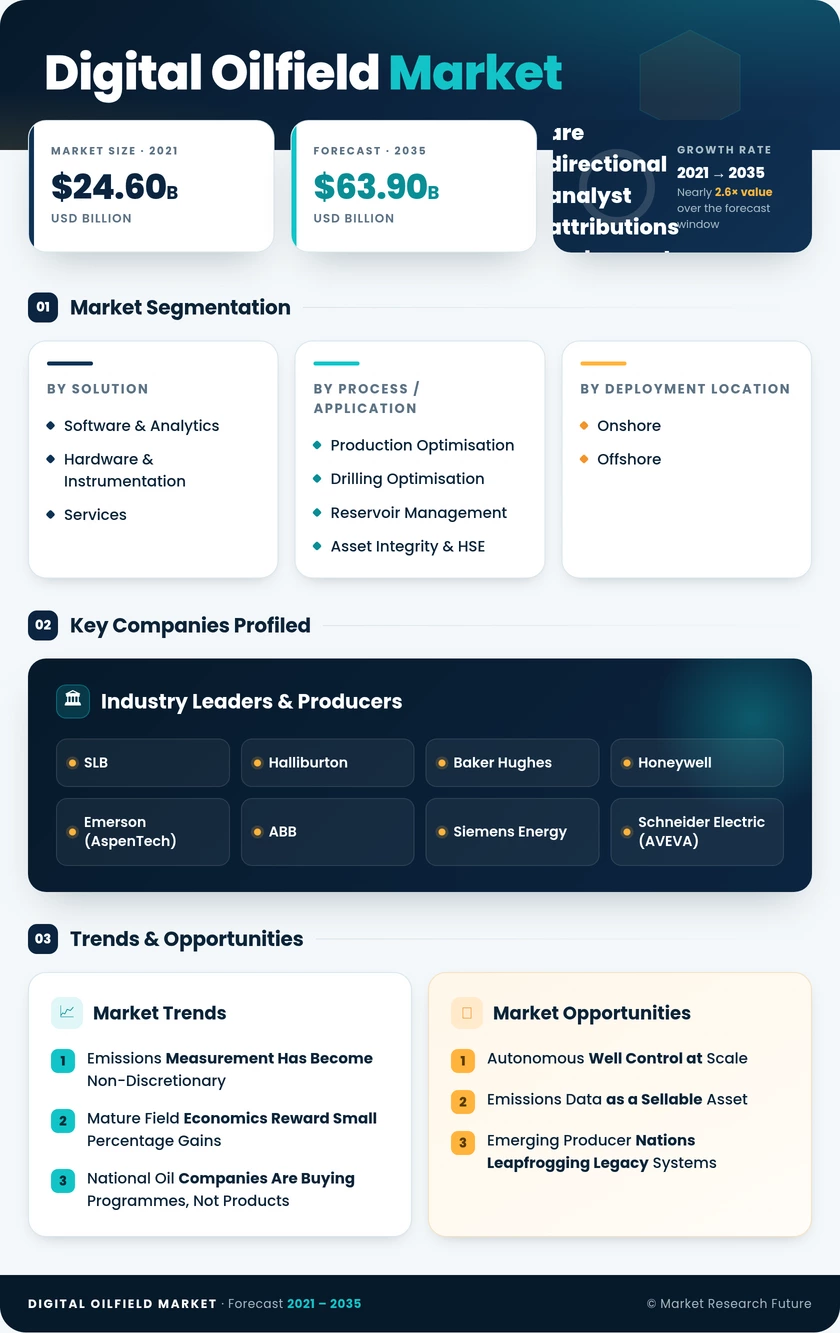
Digital Oilfield Market (2026 - 2035)

ID: MRFR/EnP/5320-HCR 111 Pages Priya Nagrale Last Updated: October 16, 2026
Digital Oilfield Market Research Report By Solution (Software & Analytics, Hardware & Instrumentation, Services), By Process / Application (Production Optimisation, Drilling Optimisation, Reservoir Management, Asset Integrity & HSE), By Deployment Location (Onshore, Offshore), By End User (National Oil Companies, International Oil Companies, Independents, Oilfield Service Providers) and By Regional (North America, Europe, South America, Asia Pacific, Middle East and Africa) - Forecast to 2035
Digital Oilfield Market
Market Size
Forecast Period2026-2035
CAGR (2026-2035)7.4%
2025 Market SizeUSD 31.4 Billion
2035 Market SizeUSD 63.9 Billion
Key Players
SLB
Halliburton
Baker Hughes
Honeywell
Emerson
ABB
Opportunities
  • Autonomous Well Control at Scale
  • Emissions Data as a Sellable Asset
  • Emerging Producer Nations Leapfrogging Legacy Systems
  1. 1 Market Overview |
    1. 1.1 Study Assumptions & Market Definition |
    2. 1.2 Scope of the Study |
    3. 1.3 Research Methodology
  2. 2 Market Summary & Key Report Takeaways |
    1. 2.1 By Technology |
    2. 2.2 By Sector |
    3. 2.3 By Geography
  3. 3 Market Size & Forecast (2021–2035) |
    1. 3.1 Historical Market Size (2021–2025) |
    2. 3.2 Current & Forecast Market Size (2026–2035) |
    3. 3.3 Market Size by Revenue (USD Billion) |
    4. 3.4 Year-over-Year Growth Analysis
  4. 4 Driver Impact Analysis |
    1. 4.1 Emissions Measurement Mandates |
    2. 4.2 Mature Field Production Economics |
    3. 4.3 National Oil Company Programmes |
    4. 4.4 Workforce Demographics & Remote Operations
  5. 5 Restraints Impact Analysis |
    1. 5.1 Brownfield Integration Complexity |
    2. 5.2 Operational Technology Cybersecurity |
    3. 5.3 Capital Discipline & Budget Cycles
  6. 6 Market Opportunity Analysis |
    1. 6.1 Autonomous Well Control at Scale |
    2. 6.2 Emissions Data Monetisation |
    3. 6.3 Emerging Producer Nations |
    4. 6.4 Subscription & Consumption Economics |
    5. 6.5 Offshore Late-Life Asset Management |
    6. 6.6 Industry Value Chain Analysis |
    7. 6.7 Porter's Five Forces Analysis
  7. 7 Regional Analysis |
    1. 7.1 North America | |
      1. 7.1.1 United States | |
      2. 7.1.2 Canada | |
      3. 7.1.3 Mexico |
    2. 7.2 Europe | |
      1. 7.2.1 Norway | |
      2. 7.2.2 United Kingdom | |
      3. 7.2.3 Rest of Europe |
    3. 7.3 Asia-Pacific | |
      1. 7.3.1 China | |
      2. 7.3.2 India | |
      3. 7.3.3 Australia | |
      4. 7.3.4 Rest of Asia-Pacific |
    4. 7.4 Middle East & Africa | |
      1. 7.4.1 Saudi Arabia | |
      2. 7.4.2 United Arab Emirates | |
      3. 7.4.3 Nigeria | |
      4. 7.4.4 Rest of Middle East & Africa |
    5. 7.5 South America | |
      1. 7.5.1 Brazil | |
      2. 7.5.2 Argentina | |
      3. 7.5.3 Rest of South America
  8. 8 Future Outlook (2026–2035) |
    1. 8.1 Autonomous Operations |
    2. 8.2 Platform Consolidation & Data Gravity |
    3. 8.3 Emissions Reporting as Financial Infrastructure |
    4. 8.4 Capital Reallocation & Demand Plateau
  9. 9 Market Segmentation Analysis |
    1. 9.1 By Solution | |
      1. 9.1.1 Software & Analytics | |
      2. 9.1.2 Hardware & Instrumentation | |
      3. 9.1.3 Services |
    2. 9.2 By Process / Application | |
      1. 9.2.1 Production Optimisation | |
      2. 9.2.2 Drilling Optimisation | |
      3. 9.2.3 Reservoir Management | |
      4. 9.2.4 Asset Integrity & HSE |
    3. 9.3 By Deployment Location | |
      1. 9.3.1 Onshore | |
      2. 9.3.2 Offshore |
    4. 9.4 By End User | |
      1. 9.4.1 National Oil Companies | |
      2. 9.4.2 International Oil Companies | |
      3. 9.4.3 Independents | |
      4. 9.4.4 Oilfield Service Providers
  10. 10 Competitive Landscape |
    1. 10.1 Market Share Analysis (2026) |
    2. 10.2 Competitive Benchmarking Matrix |
    3. 10.3 Company Profiles | |
      1. 10.3.1 SLB | |
      2. 10.3.2 Halliburton | |
      3. 10.3.3 Baker Hughes | |
      4. 10.3.4 Honeywell | |
      5. 10.3.5 Emerson (AspenTech) | |
      6. 10.3.6 ABB | |
      7. 10.3.7 Siemens Energy | |
      8. 10.3.8 Schneider Electric (AVEVA) | |
      9. 10.3.9 Weatherford | |
      10. 10.3.10 Rockwell Automation
  11. 11 Recent Developments & News
  12. 12 Report Scope & Methodology |
    1. 12.1 Study Period & Base Year |
    2. 12.2 Data Sources & Citations |
    3. 12.3 Abbreviations
  13. 13 Detailed Sources & Citations
  14. 14 Frequently Asked Questions (FAQs)
  15. 15 LIST OF TABLES |
  16. TABLE 1 Global Digital Oilfield Market Size & Forecast, by Revenue (USD Billion), 2021–2035 |
  17. TABLE 2 Global Digital Oilfield Market – Year-over-Year Growth Analysis, 2021–2035 |
  18. TABLE 3 Driver Impact Analysis – Impact on CAGR, Geographic Relevance & Timeline |
  19. TABLE 4 Restraint Impact Analysis – Drag on CAGR, Geographic Relevance & Timeline |
  20. TABLE 5 Global Digital Oilfield Market Size, by Region, 2021–2035 (USD Billion) |
  21. TABLE 6 North America Digital Oilfield Market Size, by Country, 2021–2035 (USD Billion) |
  22. TABLE 7 Europe Digital Oilfield Market Size, by Country, 2021–2035 (USD Billion) |
  23. TABLE 8 Asia-Pacific Digital Oilfield Market Size, by Country, 2021–2035 (USD Billion) |
  24. TABLE 9 Middle East & Africa Digital Oilfield Market Size, by Country, 2021–2035 (USD Billion) |
  25. TABLE 10 South America Digital Oilfield Market Size, by Country, 2021–2035 (USD Billion) |
  26. TABLE 11 Global Digital Oilfield Market Size, by Solution, 2021–2035 (USD Billion) |
  27. TABLE 12 Global Digital Oilfield Market Size, by Process / Application, 2021–2035 (USD Billion) |
  28. TABLE 13 Global Digital Oilfield Market Size, by Deployment Location, 2021–2035 (USD Billion) |
  29. TABLE 14 Global Digital Oilfield Market Size, by End User, 2021–2035 (USD Billion) |
  30. TABLE 15 North America Digital Oilfield Market Size, by Solution, 2021–2035 (USD Billion) |
  31. TABLE 16 North America Digital Oilfield Market Size, by Process / Application, 2021–2035 (USD Billion) |
  32. TABLE 17 Europe Digital Oilfield Market Size, by Solution, 2021–2035 (USD Billion) |
  33. TABLE 18 Europe Digital Oilfield Market Size, by Deployment Location, 2021–2035 (USD Billion) |
  34. TABLE 19 Asia-Pacific Digital Oilfield Market Size, by Solution, 2021–2035 (USD Billion) |
  35. TABLE 20 Asia-Pacific Digital Oilfield Market Size, by End User, 2021–2035 (USD Billion) |
  36. TABLE 21 Middle East & Africa Digital Oilfield Market Size, by Process / Application, 2021–2035 (USD Billion) |
  37. TABLE 22 South America Digital Oilfield Market Size, by Deployment Location, 2021–2035 (USD Billion) |
  38. TABLE 23 Competitive Benchmarking Matrix – Global Digital Oilfield Market, 2026 |
  39. TABLE 24 Company Profiles – Key Players, Global Digital Oilfield Market |
  40. TABLE 25 Recent Developments & Strategic Announcements, 2023–2025 |
  41. TABLE 26 Report Scope & Methodology Summary |
  42. TABLE 27 Detailed Sources & Citations Index
  43. 16 LIST OF FIGURES |
  44. FIGURE 1 Global Digital Oilfield Market Dynamics – Drivers, Restraints & Opportunities |
  45. FIGURE 2 Industry Value Chain Analysis – Digital Oilfield Market |
  46. FIGURE 3 Porter's Five Forces Analysis – Digital Oilfield Market |
  47. FIGURE 4 Global Market Size Trend, 2021–2035 (USD Billion) |
  48. FIGURE 5 Year-over-Year Growth Rate Trend, 2022–2035 (%) |
  49. FIGURE 6 Market Share by Solution, 2025 vs 2035 (%) |
  50. FIGURE 7 Market Share by Process / Application, 2025 (%) |
  51. FIGURE 8 Market Share by Deployment Location, 2025 vs 2035 (%) |
  52. FIGURE 9 Market Share by End User, 2025 (%) |
  53. FIGURE 10 Regional Revenue Share, 2025 (%) |
  54. FIGURE 11 Regional CAGR Comparison, 2026–2035 (%) |
  55. FIGURE 12 Country-Level Revenue Contribution – Top 10 Markets, 2025 |
  56. FIGURE 13 Competitive Landscape – Estimated Revenue Share Bands, 2026 |
  57. FIGURE 14 Strategic Positioning Matrix – Capability Depth vs Portfolio Breadth |
  58. FIGURE 15 Driver Impact Heatmap by Region and Timeline

Segmentation Quick Reference

DimensionSub-SegmentsDominant SegmentFastest Growing Segment
By SolutionSoftware & Analytics; Hardware & Instrumentation; ServicesSoftware & AnalyticsServices
By Process / ApplicationProduction Optimisation; Drilling Optimisation; Reservoir Management; Asset Integrity & HSEProduction OptimisationAsset Integrity & HSE
By Deployment LocationOnshore; OffshoreOnshoreOffshore
By End UserNational Oil Companies; International Oil Companies; Independents; Oilfield Service ProvidersInternational Oil CompaniesNational Oil Companies
By RegionNorth America; Europe; Asia-Pacific; Middle East & Africa; South AmericaNorth AmericaAsia-Pacific


Market Segmentation Overview

By Solution

Sub-SegmentKey Trend
Software & AnalyticsShift from perpetual licences to consumption-based subscription pricing
Hardware & InstrumentationSensor density rising as emissions rules mandate physical measurement points
ServicesManaged operations and integration work growing faster than product revenue


Solution mix is migrating toward recurring revenue as operators replace one-time purchases with renewable service agreements. Integration labour remains the largest hidden cost line on retrofit projects, which keeps the services segment structurally attractive for vendors.

By Process / Application

Sub-SegmentKey Trend
Production OptimisationArtificial lift and gas-lift allocation tuning delivering sub-14-month paybacks
Drilling OptimisationAutomated directional control reducing non-productive time on pad operations
Reservoir ManagementPhysics-informed models compressing scenario cycles from weeks to hours
Asset Integrity & HSEContinuous barrier verification replacing periodic manual testing regimes


Application spending follows measurable barrels. Integrity and safety workflows are the exception, growing on regulatory obligation rather than return calculations, which makes their demand notably less price-sensitive.

By Deployment Location

Sub-SegmentKey Trend
OnshorePad-scale automation economics driven by high well counts and thin per-well margins
OffshoreNormally-unmanned installation concepts and manning-reduction business cases


Onshore volume and offshore intensity produce two distinct buying patterns. Offshore projects carry longer sales cycles and higher specification thresholds, while onshore adoption spreads through repeatable templates applied across hundreds of similar wells.

By End User

Sub-SegmentKey Trend
National Oil CompaniesMulti-year enterprise programmes with dedicated internal delivery organisations
International Oil CompaniesPortfolio-wide standardisation on two or three data platforms
IndependentsSelective adoption gated on strict payback thresholds
Oilfield Service ProvidersEmbedding analytics into performance-based drilling and production contracts


Buyer behaviour diverges sharply by ownership model. State producers commit to decade-long programmes, while listed independents approve projects one payback case at a time — a difference that shapes vendor go-to-market design more than any technical factor.




Download PDF ×

We do not share your information with anyone. However, we may send you emails based on your report interest from time to time. You may contact us at any time to opt-out.