Request Free Sample ×

Kindly complete the form below to receive a free sample of this Report

* Please use a valid business email

Leading companies partner with us for data-driven Insights

clients tt-cursor
Hero Background
English
Chinese
French
Japanese
Korean
German
Spanish

Device as a Service Market Share

ID: MRFR/ICT/3072-CR
174 Pages
Ankit Gupta
November 2020

Device as a Service Market Size, Share and Trends Analysis Report by Component Hardware, Solution and Services), by Hardware (Desktop, Laptops, Printers, And Others), by Services(Professional and Managed Services) by Organization Size (Large Enterprises, Small and Medium Enterprises), By Industry Vertical (IT & Telecom, BFSI, Healthcare, Retail, Government, Education, Manufacturing and Others) and by Region (North America, Europe, Asia-Pacific, Middle East & Africa and South America) - Forecast Till 2035.

Share:
Download PDF ×

We do not share your information with anyone. However, we may send you emails based on your report interest from time to time. You may contact us at any time to opt-out.

Device as a Service Market Infographic
Purchase Options

Market Share

Device as a Service Market Share Analysis

The global market for something called "Device as a Service" or DaaS is expected to grow a lot, says an analysis by MRFR. This is because businesses want to spend less money on buying and running devices, like computers and printers, and are choosing services that work like contracts instead. Small and medium-sized businesses are also liking this idea. Additionally, more and more companies are using a lot of devices connected to the internet (IoT).

However, there are some things that might slow down the growth of this market. Some companies are letting employees use their own devices (BYOD) or choose devices (CYOD), and this can be a challenge for the DaaS market. Also, some companies might not have enough people who know a lot about the technology, and they might worry about how safe it is.

The DaaS market can be divided into different parts based on what it includes, how big the businesses using it are, and what industry they are in. For example, the hardware part, which includes things like computers and printers, is the biggest, making up more than half of the market. Small and medium-sized businesses use DaaS, and industries like IT & telecom and banking (BFSI) use it the most.

Some big players in this market include HP, Dell, Lenovo, Microsoft, Amazon Web Services, Citrix Systems, CompuCom Systems, Plantronics, Capgemini, and SHI International Corporation. These companies are working on new products and making long-term partnerships to do well in the global DaaS market.

In terms of money, the global DaaS market was worth around USD 9,843.8 million, and it's expected to grow by 55.8% every year from 2020 to 2026. This shows that more and more businesses are finding the idea of getting devices as a service rather than buying them outright really appealing.

Author
Author Profile
Ankit Gupta
Team Lead - Research

Ankit Gupta is a seasoned market intelligence and strategic research professional with over six plus years of experience in the ICT and Semiconductor industries. With academic roots in Telecom, Marketing, and Electronics, he blends technical insight with business strategy. Ankit has led 200+ projects, including work for Fortune 500 clients like Microsoft and Rio Tinto, covering market sizing, tech forecasting, and go-to-market strategies. Known for bridging engineering and enterprise decision-making, his insights support growth, innovation, and investment planning across diverse technology markets.

Leave a Comment

FAQs

What is the current valuation of the Device as a Service Market?

<p>The Device as a Service Market was valued at 146.5 USD Billion in 2024.</p>

What is the projected market size for the Device as a Service Market by 2035?

<p>The market is projected to reach 1804.35 USD Billion by 2035.</p>

What is the expected CAGR for the Device as a Service Market from 2025 to 2035?

<p>The expected CAGR for the Device as a Service Market during the forecast period 2025 - 2035 is 25.64%.</p>

Which companies are considered key players in the Device as a Service Market?

<p>Key players include Microsoft, Dell Technologies, HP Inc., Lenovo, Cisco Systems, Apple, IBM, Fujitsu, and Atos.</p>

How does the Device as a Service Market segment by component?

The market segments by component include Hardware valued at 500.0 USD Billion, Solutions at 600.0 USD Billion, and Services at 704.35 USD Billion.

What is the market segmentation based on organization size?

The market segments by organization size with SMEs at 351.5 USD Billion and Large Enterprises at 1452.85 USD Billion.

Which industry verticals are driving the Device as a Service Market?

Key industry verticals include IT &amp; Telecom at 400.0 USD Billion, BFSI at 300.0 USD Billion, and Healthcare at 250.0 USD Billion.

What is the projected growth for the Hardware segment in the Device as a Service Market?

The Hardware segment is projected to grow significantly, with a valuation of 500.0 USD Billion.

How does the Device as a Service Market perform in the education sector?

In the education sector, the market is valued at 100.0 USD Billion.

What potential does the Device as a Service Market hold for future growth?

The Device as a Service Market appears poised for substantial growth, potentially reaching 1804.35 USD Billion by 2035.

Market Summary

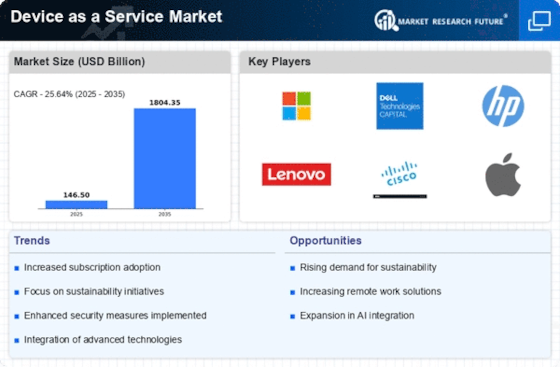
As per Market Research Future analysis, the Device as a Service Market Size was estimated at 146.5 USD Billion in 2024. The Device as a Service industry is projected to grow from 184.07 USD Billion in 2025 to 1804.35 USD Billion by 2035, exhibiting a compound annual growth rate (CAGR) of 25.64% during the forecast period 2025 - 2035

Key Market Trends & Highlights

The Device as a Service Market is experiencing robust growth driven by evolving consumer preferences and technological advancements.

  • The market witnesses increased adoption of subscription models, particularly in North America, which remains the largest market. A strong focus on sustainability and the circular economy is shaping service offerings, especially in the Asia-Pacific region, the fastest-growing market. Integration of advanced technologies is becoming a key differentiator in both hardware and services segments, enhancing overall value propositions. Cost efficiency and enhanced flexibility are major drivers, particularly for large enterprises seeking to optimize their operations.

Market Size & Forecast

2024 Market Size 146.5 (USD Billion)
2035 Market Size 1804.35 (USD Billion)
CAGR (2025 - 2035) 25.64%
Largest Regional Market Share in 2024 North America

Major Players

Microsoft (US), Dell Technologies (US), HP Inc. (US), Lenovo (CN), Cisco Systems (US), Apple (US), IBM (US), Fujitsu (JP), Atos (FR)

Market Trends

The Device as a Service Market is currently experiencing a transformative phase, characterized by a shift in how organizations approach technology procurement and management. This model, which allows businesses to access devices and services on a subscription basis, appears to be gaining traction due to its flexibility and cost-effectiveness. Companies are increasingly recognizing the benefits of outsourcing device management, which can lead to enhanced operational efficiency and reduced capital expenditure.

As organizations seek to adapt to rapidly changing technological landscapes, the Device as a Service Market seems poised for continued growth, driven by the demand for innovative solutions that align with evolving business needs. The DaaS market is witnessing rapid expansion as enterprises increasingly adopt subscription-based device procurement models to improve cost efficiency and operational flexibility. The global device-as-a-service market is expected to grow at a strong CAGR during the forecast period, driven by rising demand for scalable and managed IT infrastructure. 

Moreover, the integration of advanced technologies such as artificial intelligence and machine learning into the Device as a Service Market is likely to enhance service offerings. This integration may facilitate better data analytics, predictive maintenance, and improved user experiences. As businesses strive to remain competitive, the emphasis on seamless technology integration and user-centric solutions is becoming more pronounced. Consequently, the Device as a Service Market is not only reshaping how devices are utilized but also influencing broader trends in digital transformation across various sectors. The growth of the Device as a Service Market aligns closely with trends observed in the hardware as a service market, as organizations shift toward subscription-based IT consumption models.

Increased Adoption of Subscription Models

Organizations are increasingly gravitating towards subscription-based models for device procurement. This trend reflects a broader shift in business strategies, where flexibility and scalability are prioritized. By adopting subscription services, companies can better manage their budgets and resources, allowing for more agile responses to market demands. The device as a service model enables organizations to access hardware, software, and lifecycle services through a single subscription, reducing upfront capital expenditure. Key benefits of device as a service include predictable IT costs, simplified device management, enhanced scalability, and improved support for remote and hybrid work environments.  

Focus on Sustainability and Circular Economy

The Device as a Service Market is witnessing a growing emphasis on sustainability. Companies are recognizing the importance of environmentally friendly practices, leading to initiatives that promote recycling and responsible disposal of devices. This focus on sustainability aligns with the principles of the circular economy, where resources are reused and waste is minimized.

Integration of Advanced Technologies

The incorporation of advanced technologies, such as artificial intelligence and machine learning, is becoming increasingly prevalent within the Device as a Service Market. These technologies enhance service delivery, enabling predictive maintenance and improved analytics. As a result, organizations can optimize device performance and user satisfaction.

Device as a Service Market Market Drivers

Enhanced Flexibility and Scalability

Flexibility and scalability are pivotal drivers in the Device as a Service Market. Organizations are increasingly seeking solutions that can adapt to their changing needs, particularly in dynamic business environments. The Device as a Service Market model allows companies to scale their device usage up or down based on current requirements without the burden of long-term commitments. This adaptability is particularly advantageous for businesses experiencing rapid growth or seasonal fluctuations. Furthermore, the ability to upgrade devices regularly ensures that organizations remain competitive by utilizing the latest technology. As a result, the Device as a Service Market is witnessing a surge in demand from businesses that prioritize agility and responsiveness in their operations.

Integration of Advanced Technologies

The integration of advanced technologies is a key driver in the Device as a Service Market. As businesses seek to enhance their operational efficiency, the incorporation of technologies such as artificial intelligence, machine learning, and the Internet of Things is becoming essential. Device as a Service Market providers are increasingly offering solutions that integrate these technologies, enabling organizations to leverage data analytics and automation. This integration not only streamlines processes but also enhances decision-making capabilities. According to industry reports, companies that utilize advanced technologies in their operations can achieve up to a 25% increase in efficiency. Thus, the Device as a Service Market is poised for growth as organizations recognize the value of integrating cutting-edge technologies into their device management strategies.

Cost Efficiency and Budget Management

The Device as a Service Market is increasingly appealing to organizations seeking cost efficiency and improved budget management. By adopting a subscription-based model, companies can avoid the substantial upfront costs associated with purchasing devices outright. This model allows for predictable monthly expenses, which can be particularly beneficial for budgeting purposes. According to recent data, organizations that have transitioned to Device as a Service Market have reported a reduction in total cost of ownership by up to 30%. This financial flexibility enables businesses to allocate resources more effectively, potentially investing in other critical areas such as innovation and employee training. As a result, the Device as a Service Market is likely to continue growing as more companies recognize the financial advantages of this approach.

Focus on Employee Experience and Productivity

The Device as a Service Market is significantly influenced by the growing emphasis on employee experience and productivity. Organizations are increasingly recognizing that providing employees with the right tools can enhance job satisfaction and overall performance. By leveraging Device as a Service Market, companies can ensure that their workforce has access to the latest devices and technologies, which can lead to improved efficiency. Studies indicate that organizations that invest in modern technology solutions see a 20% increase in employee productivity. This focus on enhancing the employee experience is driving the adoption of Device as a Service Market, as businesses strive to create a more engaging and productive work environment.

Sustainability and Environmental Considerations

Sustainability is becoming a crucial consideration in the Device as a Service Market. As organizations strive to reduce their environmental footprint, the Device as a Service Market model offers a viable solution. This approach promotes the circular economy by facilitating the recycling and refurbishment of devices, thereby minimizing electronic waste. Companies that adopt this model can demonstrate their commitment to sustainability, which is increasingly important to consumers and stakeholders alike. Recent surveys indicate that over 70% of consumers prefer to engage with brands that prioritize environmental responsibility. Consequently, the Device as a Service Market is likely to see continued growth as businesses align their operations with sustainable practices.


Market Segment Insights

By Component: Hardware (Largest) vs. Services (Fastest-Growing)

In the Device as a Service Market, the Component segment showcases a diverse distribution among its values, namely Hardware, Solutions, and Services. Hardware holds the largest market share, driven by the increasing demand for physical devices in corporate environments. Meanwhile, Services, which encompass various management and support offerings, are gaining traction as businesses increasingly adopt subscription-based models to streamline operations and reduce capital expenditures.

Services: Support (Dominant) vs. Managed Services (Emerging)

In the services category, Support Services emerge as the dominant force, providing essential maintenance and troubleshooting for hardware deployed under Device as a Service Market arrangements. Conversely, Managed Services are regarded as an emerging segment within this market. They offer comprehensive management of IT infrastructures, allowing enterprises to focus on core business functions. The shift toward Managed Services is fueled by the need for businesses to enhance productivity while optimizing costs. As organizations seek improved flexibility and efficiency, the demand for these services is expected to accelerate, positioning them as a key growth driver in the Device as a Service Market landscape.

By Organization Size: Large Enterprises (Largest) vs. SMEs (Fastest-Growing)

In the Device as a Service Market, large enterprises command a significant portion of the market share, driven by their need for comprehensive, flexible solutions across multiple departments. As they continue to invest in managed services, large enterprises benefit from economies of scale, allowing them to leverage advanced devices and services efficiently. On the other hand, small and medium-sized enterprises (SMEs) are emerging as a rapidly growing segment, although they hold a smaller share. Their increasing adoption of technology in operations and remote working demands positions them as significant players in the market.

Organization Size: Large Enterprises (Dominant) vs. SMEs (Emerging)

Large enterprises are characterized by their vast resources, enabling them to deploy advanced Device as a Service Market solutions seamlessly. These organizations often require extensive IT service management, integration, and support, provided by leading vendors in the market. Conversely, SMEs are recognized as an emerging market segment, showcasing rapid growth in their demand for DaaS as they strive for competitive advantage through technology. With limited budgets but high adaptability, SMEs tend to opt for flexible service contracts that allow them to scale device usage based on fluctuating needs. This adaptive response to market demands positions SMEs uniquely as agile entities within the Device as a Service Market space.

By Industry Vertical: IT & Telecom (Largest) vs. Healthcare (Fastest-Growing)

The Device as a Service Market is significantly shaped by industry verticals, with IT &amp; Telecom holding the largest market share. This segment is characterized by high demand for managed devices, offering businesses flexibility and cost efficiency. Other notable segments such as BFSI, Government, and Retail also contribute to the market landscape, but the dominance of IT &amp; Telecom underscores its critical role in digital transformation initiatives.

IT &amp; Telecom: IT Services (Dominant) vs. Healthcare: Patient Management (Emerging)

In the Device as a Service Market, the IT &amp; Telecom sector leads with its comprehensive managed services that cater to business needs ensuring seamless operational efficiency. This segment thrives on the increasing demand for cloud solutions and mobile device management. In contrast, the Healthcare segment, predominantly emerging, is leveraging DaaS to enhance patient management systems and telehealth services, which is critical for improving care delivery. With ongoing digitalization in healthcare, this segment showcases substantial growth potential, driven by a focus on data accessibility and remote consultations.

Get more detailed insights about Device as a Service (DaaS) Market Research Report - Global Forecast till 2035

Regional Insights

North America : Technology Adoption Leader

North America is the largest market for Device as a Service Market (DaaS), holding approximately 45% of the global market share. The region's growth is driven by rapid technological advancements, increasing demand for flexible IT solutions, and a strong focus on cost efficiency. Regulatory support for digital transformation initiatives further catalyzes market expansion, making it a hub for innovation and service delivery. The United States leads the DaaS market, with significant contributions from Canada. Major players like Microsoft, Dell Technologies, and HP Inc. dominate the landscape, offering comprehensive solutions tailored to various sectors. The competitive environment is characterized by continuous innovation and strategic partnerships, ensuring that North America remains at the forefront of DaaS offerings.

Europe : Emerging Market Dynamics

Europe is witnessing a significant rise in the Device as a Service Market, accounting for approximately 30% of the global share. The region's growth is fueled by increasing digitalization, a shift towards remote work, and stringent regulations promoting sustainable IT practices. Countries like Germany and the UK are at the forefront, driving demand for DaaS solutions that enhance operational efficiency and reduce costs. Leading countries in Europe include Germany, the UK, and France, where key players like Atos and Fujitsu are making substantial inroads. The competitive landscape is evolving, with a focus on innovation and customer-centric solutions. Regulatory frameworks are increasingly supportive, encouraging businesses to adopt DaaS models as part of their digital transformation strategies.

Asia-Pacific : Rapid Growth Potential

Asia-Pacific is emerging as a significant player in the Device as a Service Market, holding around 20% of the global market share. The region's growth is driven by rapid urbanization, increasing adoption of cloud services, and a burgeoning startup ecosystem. Countries like China and India are leading this transformation, supported by favorable government policies aimed at enhancing digital infrastructure and innovation. China is the largest market in the region, with India following closely. Key players such as Lenovo and Cisco Systems are actively expanding their DaaS offerings to cater to the growing demand. The competitive landscape is marked by a mix of established companies and innovative startups, all vying to capture market share in this dynamic environment.

Middle East and Africa : Emerging Market Opportunities

The Middle East and Africa region is gradually embracing the Device as a Service Market model, currently holding about 5% of the global market share. The growth is driven by increasing investments in digital infrastructure, a rising number of tech startups, and government initiatives aimed at fostering innovation. Countries like the UAE and South Africa are leading the charge, focusing on enhancing their IT capabilities and service offerings. In the Middle East, the UAE is at the forefront, while South Africa leads in the African market. The competitive landscape is characterized by a mix of local and international players, with companies exploring partnerships to enhance their service portfolios. As the region continues to develop its digital economy, the DaaS market is expected to expand significantly.

Key Players and Competitive Insights

The Device as a Service Market (DaaS) market is currently characterized by a dynamic competitive landscape, driven by the increasing demand for flexible IT solutions and the growing emphasis on digital transformation across various sectors. Leading device as a service providers are focusing on integrated offerings that combine hardware, software, analytics, and managed services to enhance customer value. Prominent device as a service companies, including Microsoft, Dell Technologies, and HP Inc., are expanding their portfolios to address evolving enterprise IT requirements. Major players such as Microsoft (US), Dell Technologies (US), and HP Inc. (US) are strategically positioning themselves to capitalize on these trends. Microsoft (US) focuses on integrating its cloud services with DaaS offerings, enhancing customer experience through seamless connectivity and data management. Dell Technologies (US) emphasizes its commitment to sustainability, promoting circular economy principles in its DaaS solutions, while HP Inc. (US) leverages its strong brand presence to offer tailored solutions that meet diverse customer needs. Collectively, these strategies not only enhance their competitive edge but also shape the overall market dynamics by fostering innovation and customer-centric approaches. Apple device as a service offering support enterprise mobility strategies by providing integrated hardware, software, and lifecycle management solutions for business users.
In terms of business tactics, companies are increasingly localizing manufacturing and optimizing supply chains to enhance responsiveness and reduce costs. The DaaS market appears moderately fragmented, with a mix of established players and emerging startups. The collective influence of key players is significant, as they drive industry standards and customer expectations, thereby shaping the competitive structure of the market.
In August 2025, Microsoft (US) announced a strategic partnership with a leading cloud provider to enhance its DaaS offerings, integrating advanced analytics and AI capabilities. This move is likely to bolster Microsoft's position in the market by providing customers with more robust data-driven insights, thereby enhancing operational efficiency and decision-making processes. The partnership underscores the importance of technological integration in DaaS solutions, aligning with the broader trend of digital transformation.
In September 2025, Dell Technologies (US) launched a new DaaS initiative aimed at small and medium-sized enterprises (SMEs), offering flexible payment options and tailored support services. This initiative is strategically significant as it opens new revenue streams and addresses the unique challenges faced by SMEs in adopting technology solutions. By focusing on this segment, Dell is likely to strengthen its market presence and foster long-term customer relationships.
In October 2025, HP Inc. (US) unveiled a sustainability-focused DaaS program that emphasizes the recycling and refurbishment of devices. This initiative not only aligns with global sustainability goals but also appeals to environmentally conscious consumers. By prioritizing sustainability, HP is positioning itself as a leader in responsible technology solutions, which may enhance its competitive differentiation in the market.
As of October 2025, current trends in the DaaS market include a strong focus on digitalization, sustainability, and the integration of AI technologies. Strategic alliances are increasingly shaping the competitive landscape, enabling companies to leverage complementary strengths and enhance their service offerings. Looking ahead, competitive differentiation is likely to evolve from traditional price-based competition to a focus on innovation, technological advancements, and supply chain reliability. Companies that can effectively navigate these trends will likely emerge as leaders in the Device as a Service Market.

Key Companies in the Device as a Service Market include

Industry Developments

In October 2023 - HP Inc. hosted its first-ever HP Imagine event, where it unveiled more than 20 new devices and services designed to revolutionize how we live, work, and dream. The event showcased HP's latest breakthrough innovations across Personal Systems, Printing Systems, and Workforce Solutions.

In September 2023 - Advantech, a leading provider of intelligent systems, has recently launched a new cloud-based version of its DeviceOn-iService Suite SaaS for remote device management. This new version promises a more user-friendly and convenient remote device management experience, in addition to the comprehensive equipment and peripheral monitoring and management capabilities offered by its predecessor.

In September 2023 - Nokia launched a range of industrial 5G devices designed to keep workers safe, connected, and informed in hazardous and industrial environments such as ports, mines, chemical plants, and offshore oil platforms. The launch of these industrial 5G devices and services demonstrates Nokia's commitment to providing innovative solutions that address the unique challenges of industrial environments while keeping workers safe and connected.

In August 2023 - RingCentral, a leading voice-over-internet protocol (VoIP) service provider, has launched a subscription service for handsets, allowing customers to purchase hardware phones as part of a monthly subscription.

In October 2022- HP launched an expanded version of its device-as-a-service (DaaS) offering called HP DaaS+ Hybrid, which is a managed service optimized for customers with remote workforces. The new service is designed to provide customers with a more flexible and cost-effective solution for their business communication needs.

Future Outlook

Device as a Service Market Future Outlook

The Device as a Service Market is projected to grow at a 25.64% CAGR from 2025 to 2035, driven by increasing demand for flexible IT solutions and cost-effective technology management.

New opportunities lie in:

  • <p>Integration of AI-driven analytics for device performance optimization. Expansion into emerging markets with tailored service packages. Development of subscription models for specialized industry sectors.</p>

By 2035, the Device as a Service Market is expected to be a dominant force in technology provisioning.

Market Segmentation

Device as a Service Market Component Outlook

  • Hardware
  • Solution
  • Services

Device as a Service Market Industry Vertical Outlook

  • IT & Telecom
  • BFSI
  • Healthcare
  • Retail
  • Government
  • Education
  • Manufacturing
  • Others

Device as a Service Market Organization Size Outlook

  • SMEs
  • Large Enterprises

Report Scope

MARKET SIZE 2024 146.5(USD Billion)
MARKET SIZE 2025 184.07(USD Billion)
MARKET SIZE 2035 1804.35(USD Billion)
COMPOUND ANNUAL GROWTH RATE (CAGR) 25.64% (2025 - 2035)
REPORT COVERAGE Revenue Forecast, Competitive Landscape, Growth Factors, and Trends
BASE YEAR 2024
Market Forecast Period 2025 - 2035
Historical Data 2019 - 2024
Market Forecast Units USD Billion
Key Companies Profiled Microsoft (US), Dell Technologies (US), HP Inc. (US), Lenovo (CN), Cisco Systems (US), Apple (US), IBM (US), Fujitsu (JP), Atos (FR)
Segments Covered Component Hardware, Solution and Services, Hardware, Services, Organization Size, Industry Vertical, Region
Key Market Opportunities Growing demand for flexible IT solutions drives innovation in the Device as a Service Market.
Key Market Dynamics Rising demand for flexible IT solutions drives growth in the Device as a Service market, reshaping consumer engagement.
Countries Covered North America, Europe, APAC, South America, MEA

FAQs

What is the current valuation of the Device as a Service Market?

<p>The Device as a Service Market was valued at 146.5 USD Billion in 2024.</p>

What is the projected market size for the Device as a Service Market by 2035?

<p>The market is projected to reach 1804.35 USD Billion by 2035.</p>

What is the expected CAGR for the Device as a Service Market from 2025 to 2035?

<p>The expected CAGR for the Device as a Service Market during the forecast period 2025 - 2035 is 25.64%.</p>

Which companies are considered key players in the Device as a Service Market?

<p>Key players include Microsoft, Dell Technologies, HP Inc., Lenovo, Cisco Systems, Apple, IBM, Fujitsu, and Atos.</p>

How does the Device as a Service Market segment by component?

The market segments by component include Hardware valued at 500.0 USD Billion, Solutions at 600.0 USD Billion, and Services at 704.35 USD Billion.

What is the market segmentation based on organization size?

The market segments by organization size with SMEs at 351.5 USD Billion and Large Enterprises at 1452.85 USD Billion.

Which industry verticals are driving the Device as a Service Market?

Key industry verticals include IT &amp; Telecom at 400.0 USD Billion, BFSI at 300.0 USD Billion, and Healthcare at 250.0 USD Billion.

What is the projected growth for the Hardware segment in the Device as a Service Market?

The Hardware segment is projected to grow significantly, with a valuation of 500.0 USD Billion.

How does the Device as a Service Market perform in the education sector?

In the education sector, the market is valued at 100.0 USD Billion.

What potential does the Device as a Service Market hold for future growth?

The Device as a Service Market appears poised for substantial growth, potentially reaching 1804.35 USD Billion by 2035.

  1. SECTION I: EXECUTIVE SUMMARY AND KEY HIGHLIGHTS
    1. | 1.1 EXECUTIVE SUMMARY
    2. | | 1.1.1 Market Overview
    3. | | 1.1.2 Key Findings
    4. | | 1.1.3 Market Segmentation
    5. | | 1.1.4 Competitive Landscape
    6. | | 1.1.5 Challenges and Opportunities
    7. | | 1.1.6 Future Outlook
  2. SECTION II: SCOPING, METHODOLOGY AND MARKET STRUCTURE
    1. | 2.1 MARKET INTRODUCTION
    2. | | 2.1.1 Definition
    3. | | 2.1.2 Scope of the study
    4. | | | 2.1.2.1 Research Objective
    5. | | | 2.1.2.2 Assumption
    6. | | | 2.1.2.3 Limitations
    7. | 2.2 RESEARCH METHODOLOGY
    8. | | 2.2.1 Overview
    9. | | 2.2.2 Data Mining
    10. | | 2.2.3 Secondary Research
    11. | | 2.2.4 Primary Research
    12. | | | 2.2.4.1 Primary Interviews and Information Gathering Process
    13. | | | 2.2.4.2 Breakdown of Primary Respondents
    14. | | 2.2.5 Forecasting Model
    15. | | 2.2.6 Market Size Estimation
    16. | | | 2.2.6.1 Bottom-Up Approach
    17. | | | 2.2.6.2 Top-Down Approach
    18. | | 2.2.7 Data Triangulation
    19. | | 2.2.8 Validation
  3. SECTION III: QUALITATIVE ANALYSIS
    1. | 3.1 MARKET DYNAMICS
    2. | | 3.1.1 Overview
    3. | | 3.1.2 Drivers
    4. | | 3.1.3 Restraints
    5. | | 3.1.4 Opportunities
    6. | 3.2 MARKET FACTOR ANALYSIS
    7. | | 3.2.1 Value chain Analysis
    8. | | 3.2.2 Porter's Five Forces Analysis
    9. | | | 3.2.2.1 Bargaining Power of Suppliers
    10. | | | 3.2.2.2 Bargaining Power of Buyers
    11. | | | 3.2.2.3 Threat of New Entrants
    12. | | | 3.2.2.4 Threat of Substitutes
    13. | | | 3.2.2.5 Intensity of Rivalry
    14. | | 3.2.3 COVID-19 Impact Analysis
    15. | | | 3.2.3.1 Market Impact Analysis
    16. | | | 3.2.3.2 Regional Impact
    17. | | | 3.2.3.3 Opportunity and Threat Analysis
  4. SECTION IV: QUANTITATIVE ANALYSIS
    1. | 4.1 Information and Communications Technology, BY Component (USD Billion)
    2. | | 4.1.1 Hardware
    3. | | 4.1.2 Solution
    4. | | 4.1.3 Services
    5. | 4.2 Information and Communications Technology, BY Organization Size (USD Billion)
    6. | | 4.2.1 SMEs
    7. | | 4.2.2 Large Enterprises
    8. | 4.3 Information and Communications Technology, BY Industry Vertical (USD Billion)
    9. | | 4.3.1 IT & Telecom
    10. | | 4.3.2 BFSI
    11. | | 4.3.3 Healthcare
    12. | | 4.3.4 Retail
    13. | | 4.3.5 Government
    14. | | 4.3.6 Education
    15. | | 4.3.7 Manufacturing
    16. | | 4.3.8 Others
    17. | 4.4 Information and Communications Technology, BY Region (USD Billion)
    18. | | 4.4.1 North America
    19. | | | 4.4.1.1 US
    20. | | | 4.4.1.2 Canada
    21. | | 4.4.2 Europe
    22. | | | 4.4.2.1 Germany
    23. | | | 4.4.2.2 UK
    24. | | | 4.4.2.3 France
    25. | | | 4.4.2.4 Russia
    26. | | | 4.4.2.5 Italy
    27. | | | 4.4.2.6 Spain
    28. | | | 4.4.2.7 Rest of Europe
    29. | | 4.4.3 APAC
    30. | | | 4.4.3.1 China
    31. | | | 4.4.3.2 India
    32. | | | 4.4.3.3 Japan
    33. | | | 4.4.3.4 South Korea
    34. | | | 4.4.3.5 Malaysia
    35. | | | 4.4.3.6 Thailand
    36. | | | 4.4.3.7 Indonesia
    37. | | | 4.4.3.8 Rest of APAC
    38. | | 4.4.4 South America
    39. | | | 4.4.4.1 Brazil
    40. | | | 4.4.4.2 Mexico
    41. | | | 4.4.4.3 Argentina
    42. | | | 4.4.4.4 Rest of South America
    43. | | 4.4.5 MEA
    44. | | | 4.4.5.1 GCC Countries
    45. | | | 4.4.5.2 South Africa
    46. | | | 4.4.5.3 Rest of MEA
  5. SECTION V: COMPETITIVE ANALYSIS
    1. | 5.1 Competitive Landscape
    2. | | 5.1.1 Overview
    3. | | 5.1.2 Competitive Analysis
    4. | | 5.1.3 Market share Analysis
    5. | | 5.1.4 Major Growth Strategy in the Information and Communications Technology
    6. | | 5.1.5 Competitive Benchmarking
    7. | | 5.1.6 Leading Players in Terms of Number of Developments in the Information and Communications Technology
    8. | | 5.1.7 Key developments and growth strategies
    9. | | | 5.1.7.1 New Product Launch/Service Deployment
    10. | | | 5.1.7.2 Merger & Acquisitions
    11. | | | 5.1.7.3 Joint Ventures
    12. | | 5.1.8 Major Players Financial Matrix
    13. | | | 5.1.8.1 Sales and Operating Income
    14. | | | 5.1.8.2 Major Players R&D Expenditure. 2023
    15. | 5.2 Company Profiles
    16. | | 5.2.1 Microsoft (US)
    17. | | | 5.2.1.1 Financial Overview
    18. | | | 5.2.1.2 Products Offered
    19. | | | 5.2.1.3 Key Developments
    20. | | | 5.2.1.4 SWOT Analysis
    21. | | | 5.2.1.5 Key Strategies
    22. | | 5.2.2 Dell Technologies (US)
    23. | | | 5.2.2.1 Financial Overview
    24. | | | 5.2.2.2 Products Offered
    25. | | | 5.2.2.3 Key Developments
    26. | | | 5.2.2.4 SWOT Analysis
    27. | | | 5.2.2.5 Key Strategies
    28. | | 5.2.3 HP Inc. (US)
    29. | | | 5.2.3.1 Financial Overview
    30. | | | 5.2.3.2 Products Offered
    31. | | | 5.2.3.3 Key Developments
    32. | | | 5.2.3.4 SWOT Analysis
    33. | | | 5.2.3.5 Key Strategies
    34. | | 5.2.4 Lenovo (CN)
    35. | | | 5.2.4.1 Financial Overview
    36. | | | 5.2.4.2 Products Offered
    37. | | | 5.2.4.3 Key Developments
    38. | | | 5.2.4.4 SWOT Analysis
    39. | | | 5.2.4.5 Key Strategies
    40. | | 5.2.5 Cisco Systems (US)
    41. | | | 5.2.5.1 Financial Overview
    42. | | | 5.2.5.2 Products Offered
    43. | | | 5.2.5.3 Key Developments
    44. | | | 5.2.5.4 SWOT Analysis
    45. | | | 5.2.5.5 Key Strategies
    46. | | 5.2.6 Apple (US)
    47. | | | 5.2.6.1 Financial Overview
    48. | | | 5.2.6.2 Products Offered
    49. | | | 5.2.6.3 Key Developments
    50. | | | 5.2.6.4 SWOT Analysis
    51. | | | 5.2.6.5 Key Strategies
    52. | | 5.2.7 IBM (US)
    53. | | | 5.2.7.1 Financial Overview
    54. | | | 5.2.7.2 Products Offered
    55. | | | 5.2.7.3 Key Developments
    56. | | | 5.2.7.4 SWOT Analysis
    57. | | | 5.2.7.5 Key Strategies
    58. | | 5.2.8 Fujitsu (JP)
    59. | | | 5.2.8.1 Financial Overview
    60. | | | 5.2.8.2 Products Offered
    61. | | | 5.2.8.3 Key Developments
    62. | | | 5.2.8.4 SWOT Analysis
    63. | | | 5.2.8.5 Key Strategies
    64. | | 5.2.9 Atos (FR)
    65. | | | 5.2.9.1 Financial Overview
    66. | | | 5.2.9.2 Products Offered
    67. | | | 5.2.9.3 Key Developments
    68. | | | 5.2.9.4 SWOT Analysis
    69. | | | 5.2.9.5 Key Strategies
    70. | 5.3 Appendix
    71. | | 5.3.1 References
    72. | | 5.3.2 Related Reports
  6. LIST OF FIGURES
    1. | 6.1 MARKET SYNOPSIS
    2. | 6.2 NORTH AMERICA MARKET ANALYSIS
    3. | 6.3 US MARKET ANALYSIS BY COMPONENT
    4. | 6.4 US MARKET ANALYSIS BY ORGANIZATION SIZE
    5. | 6.5 US MARKET ANALYSIS BY INDUSTRY VERTICAL
    6. | 6.6 CANADA MARKET ANALYSIS BY COMPONENT
    7. | 6.7 CANADA MARKET ANALYSIS BY ORGANIZATION SIZE
    8. | 6.8 CANADA MARKET ANALYSIS BY INDUSTRY VERTICAL
    9. | 6.9 EUROPE MARKET ANALYSIS
    10. | 6.10 GERMANY MARKET ANALYSIS BY COMPONENT
    11. | 6.11 GERMANY MARKET ANALYSIS BY ORGANIZATION SIZE
    12. | 6.12 GERMANY MARKET ANALYSIS BY INDUSTRY VERTICAL
    13. | 6.13 UK MARKET ANALYSIS BY COMPONENT
    14. | 6.14 UK MARKET ANALYSIS BY ORGANIZATION SIZE
    15. | 6.15 UK MARKET ANALYSIS BY INDUSTRY VERTICAL
    16. | 6.16 FRANCE MARKET ANALYSIS BY COMPONENT
    17. | 6.17 FRANCE MARKET ANALYSIS BY ORGANIZATION SIZE
    18. | 6.18 FRANCE MARKET ANALYSIS BY INDUSTRY VERTICAL
    19. | 6.19 RUSSIA MARKET ANALYSIS BY COMPONENT
    20. | 6.20 RUSSIA MARKET ANALYSIS BY ORGANIZATION SIZE
    21. | 6.21 RUSSIA MARKET ANALYSIS BY INDUSTRY VERTICAL
    22. | 6.22 ITALY MARKET ANALYSIS BY COMPONENT
    23. | 6.23 ITALY MARKET ANALYSIS BY ORGANIZATION SIZE
    24. | 6.24 ITALY MARKET ANALYSIS BY INDUSTRY VERTICAL
    25. | 6.25 SPAIN MARKET ANALYSIS BY COMPONENT
    26. | 6.26 SPAIN MARKET ANALYSIS BY ORGANIZATION SIZE
    27. | 6.27 SPAIN MARKET ANALYSIS BY INDUSTRY VERTICAL
    28. | 6.28 REST OF EUROPE MARKET ANALYSIS BY COMPONENT
    29. | 6.29 REST OF EUROPE MARKET ANALYSIS BY ORGANIZATION SIZE
    30. | 6.30 REST OF EUROPE MARKET ANALYSIS BY INDUSTRY VERTICAL
    31. | 6.31 APAC MARKET ANALYSIS
    32. | 6.32 CHINA MARKET ANALYSIS BY COMPONENT
    33. | 6.33 CHINA MARKET ANALYSIS BY ORGANIZATION SIZE
    34. | 6.34 CHINA MARKET ANALYSIS BY INDUSTRY VERTICAL
    35. | 6.35 INDIA MARKET ANALYSIS BY COMPONENT
    36. | 6.36 INDIA MARKET ANALYSIS BY ORGANIZATION SIZE
    37. | 6.37 INDIA MARKET ANALYSIS BY INDUSTRY VERTICAL
    38. | 6.38 JAPAN MARKET ANALYSIS BY COMPONENT
    39. | 6.39 JAPAN MARKET ANALYSIS BY ORGANIZATION SIZE
    40. | 6.40 JAPAN MARKET ANALYSIS BY INDUSTRY VERTICAL
    41. | 6.41 SOUTH KOREA MARKET ANALYSIS BY COMPONENT
    42. | 6.42 SOUTH KOREA MARKET ANALYSIS BY ORGANIZATION SIZE
    43. | 6.43 SOUTH KOREA MARKET ANALYSIS BY INDUSTRY VERTICAL
    44. | 6.44 MALAYSIA MARKET ANALYSIS BY COMPONENT
    45. | 6.45 MALAYSIA MARKET ANALYSIS BY ORGANIZATION SIZE
    46. | 6.46 MALAYSIA MARKET ANALYSIS BY INDUSTRY VERTICAL
    47. | 6.47 THAILAND MARKET ANALYSIS BY COMPONENT
    48. | 6.48 THAILAND MARKET ANALYSIS BY ORGANIZATION SIZE
    49. | 6.49 THAILAND MARKET ANALYSIS BY INDUSTRY VERTICAL
    50. | 6.50 INDONESIA MARKET ANALYSIS BY COMPONENT
    51. | 6.51 INDONESIA MARKET ANALYSIS BY ORGANIZATION SIZE
    52. | 6.52 INDONESIA MARKET ANALYSIS BY INDUSTRY VERTICAL
    53. | 6.53 REST OF APAC MARKET ANALYSIS BY COMPONENT
    54. | 6.54 REST OF APAC MARKET ANALYSIS BY ORGANIZATION SIZE
    55. | 6.55 REST OF APAC MARKET ANALYSIS BY INDUSTRY VERTICAL
    56. | 6.56 SOUTH AMERICA MARKET ANALYSIS
    57. | 6.57 BRAZIL MARKET ANALYSIS BY COMPONENT
    58. | 6.58 BRAZIL MARKET ANALYSIS BY ORGANIZATION SIZE
    59. | 6.59 BRAZIL MARKET ANALYSIS BY INDUSTRY VERTICAL
    60. | 6.60 MEXICO MARKET ANALYSIS BY COMPONENT
    61. | 6.61 MEXICO MARKET ANALYSIS BY ORGANIZATION SIZE
    62. | 6.62 MEXICO MARKET ANALYSIS BY INDUSTRY VERTICAL
    63. | 6.63 ARGENTINA MARKET ANALYSIS BY COMPONENT
    64. | 6.64 ARGENTINA MARKET ANALYSIS BY ORGANIZATION SIZE
    65. | 6.65 ARGENTINA MARKET ANALYSIS BY INDUSTRY VERTICAL
    66. | 6.66 REST OF SOUTH AMERICA MARKET ANALYSIS BY COMPONENT
    67. | 6.67 REST OF SOUTH AMERICA MARKET ANALYSIS BY ORGANIZATION SIZE
    68. | 6.68 REST OF SOUTH AMERICA MARKET ANALYSIS BY INDUSTRY VERTICAL
    69. | 6.69 MEA MARKET ANALYSIS
    70. | 6.70 GCC COUNTRIES MARKET ANALYSIS BY COMPONENT
    71. | 6.71 GCC COUNTRIES MARKET ANALYSIS BY ORGANIZATION SIZE
    72. | 6.72 GCC COUNTRIES MARKET ANALYSIS BY INDUSTRY VERTICAL
    73. | 6.73 SOUTH AFRICA MARKET ANALYSIS BY COMPONENT
    74. | 6.74 SOUTH AFRICA MARKET ANALYSIS BY ORGANIZATION SIZE
    75. | 6.75 SOUTH AFRICA MARKET ANALYSIS BY INDUSTRY VERTICAL
    76. | 6.76 REST OF MEA MARKET ANALYSIS BY COMPONENT
    77. | 6.77 REST OF MEA MARKET ANALYSIS BY ORGANIZATION SIZE
    78. | 6.78 REST OF MEA MARKET ANALYSIS BY INDUSTRY VERTICAL
    79. | 6.79 KEY BUYING CRITERIA OF INFORMATION AND COMMUNICATIONS TECHNOLOGY
    80. | 6.80 RESEARCH PROCESS OF MRFR
    81. | 6.81 DRO ANALYSIS OF INFORMATION AND COMMUNICATIONS TECHNOLOGY
    82. | 6.82 DRIVERS IMPACT ANALYSIS: INFORMATION AND COMMUNICATIONS TECHNOLOGY
    83. | 6.83 RESTRAINTS IMPACT ANALYSIS: INFORMATION AND COMMUNICATIONS TECHNOLOGY
    84. | 6.84 SUPPLY / VALUE CHAIN: INFORMATION AND COMMUNICATIONS TECHNOLOGY
    85. | 6.85 INFORMATION AND COMMUNICATIONS TECHNOLOGY, BY COMPONENT, 2024 (% SHARE)
    86. | 6.86 INFORMATION AND COMMUNICATIONS TECHNOLOGY, BY COMPONENT, 2024 TO 2035 (USD Billion)
    87. | 6.87 INFORMATION AND COMMUNICATIONS TECHNOLOGY, BY ORGANIZATION SIZE, 2024 (% SHARE)
    88. | 6.88 INFORMATION AND COMMUNICATIONS TECHNOLOGY, BY ORGANIZATION SIZE, 2024 TO 2035 (USD Billion)
    89. | 6.89 INFORMATION AND COMMUNICATIONS TECHNOLOGY, BY INDUSTRY VERTICAL, 2024 (% SHARE)
    90. | 6.90 INFORMATION AND COMMUNICATIONS TECHNOLOGY, BY INDUSTRY VERTICAL, 2024 TO 2035 (USD Billion)
    91. | 6.91 BENCHMARKING OF MAJOR COMPETITORS
  7. LIST OF TABLES
    1. | 7.1 LIST OF ASSUMPTIONS
    2. | | 7.1.1
    3. | 7.2 North America MARKET SIZE ESTIMATES; FORECAST
    4. | | 7.2.1 BY COMPONENT, 2025-2035 (USD Billion)
    5. | | 7.2.2 BY ORGANIZATION SIZE, 2025-2035 (USD Billion)
    6. | | 7.2.3 BY INDUSTRY VERTICAL, 2025-2035 (USD Billion)
    7. | 7.3 US MARKET SIZE ESTIMATES; FORECAST
    8. | | 7.3.1 BY COMPONENT, 2025-2035 (USD Billion)
    9. | | 7.3.2 BY ORGANIZATION SIZE, 2025-2035 (USD Billion)
    10. | | 7.3.3 BY INDUSTRY VERTICAL, 2025-2035 (USD Billion)
    11. | 7.4 Canada MARKET SIZE ESTIMATES; FORECAST
    12. | | 7.4.1 BY COMPONENT, 2025-2035 (USD Billion)
    13. | | 7.4.2 BY ORGANIZATION SIZE, 2025-2035 (USD Billion)
    14. | | 7.4.3 BY INDUSTRY VERTICAL, 2025-2035 (USD Billion)
    15. | 7.5 Europe MARKET SIZE ESTIMATES; FORECAST
    16. | | 7.5.1 BY COMPONENT, 2025-2035 (USD Billion)
    17. | | 7.5.2 BY ORGANIZATION SIZE, 2025-2035 (USD Billion)
    18. | | 7.5.3 BY INDUSTRY VERTICAL, 2025-2035 (USD Billion)
    19. | 7.6 Germany MARKET SIZE ESTIMATES; FORECAST
    20. | | 7.6.1 BY COMPONENT, 2025-2035 (USD Billion)
    21. | | 7.6.2 BY ORGANIZATION SIZE, 2025-2035 (USD Billion)
    22. | | 7.6.3 BY INDUSTRY VERTICAL, 2025-2035 (USD Billion)
    23. | 7.7 UK MARKET SIZE ESTIMATES; FORECAST
    24. | | 7.7.1 BY COMPONENT, 2025-2035 (USD Billion)
    25. | | 7.7.2 BY ORGANIZATION SIZE, 2025-2035 (USD Billion)
    26. | | 7.7.3 BY INDUSTRY VERTICAL, 2025-2035 (USD Billion)
    27. | 7.8 France MARKET SIZE ESTIMATES; FORECAST
    28. | | 7.8.1 BY COMPONENT, 2025-2035 (USD Billion)
    29. | | 7.8.2 BY ORGANIZATION SIZE, 2025-2035 (USD Billion)
    30. | | 7.8.3 BY INDUSTRY VERTICAL, 2025-2035 (USD Billion)
    31. | 7.9 Russia MARKET SIZE ESTIMATES; FORECAST
    32. | | 7.9.1 BY COMPONENT, 2025-2035 (USD Billion)
    33. | | 7.9.2 BY ORGANIZATION SIZE, 2025-2035 (USD Billion)
    34. | | 7.9.3 BY INDUSTRY VERTICAL, 2025-2035 (USD Billion)
    35. | 7.10 Italy MARKET SIZE ESTIMATES; FORECAST
    36. | | 7.10.1 BY COMPONENT, 2025-2035 (USD Billion)
    37. | | 7.10.2 BY ORGANIZATION SIZE, 2025-2035 (USD Billion)
    38. | | 7.10.3 BY INDUSTRY VERTICAL, 2025-2035 (USD Billion)
    39. | 7.11 Spain MARKET SIZE ESTIMATES; FORECAST
    40. | | 7.11.1 BY COMPONENT, 2025-2035 (USD Billion)
    41. | | 7.11.2 BY ORGANIZATION SIZE, 2025-2035 (USD Billion)
    42. | | 7.11.3 BY INDUSTRY VERTICAL, 2025-2035 (USD Billion)
    43. | 7.12 Rest of Europe MARKET SIZE ESTIMATES; FORECAST
    44. | | 7.12.1 BY COMPONENT, 2025-2035 (USD Billion)
    45. | | 7.12.2 BY ORGANIZATION SIZE, 2025-2035 (USD Billion)
    46. | | 7.12.3 BY INDUSTRY VERTICAL, 2025-2035 (USD Billion)
    47. | 7.13 APAC MARKET SIZE ESTIMATES; FORECAST
    48. | | 7.13.1 BY COMPONENT, 2025-2035 (USD Billion)
    49. | | 7.13.2 BY ORGANIZATION SIZE, 2025-2035 (USD Billion)
    50. | | 7.13.3 BY INDUSTRY VERTICAL, 2025-2035 (USD Billion)
    51. | 7.14 China MARKET SIZE ESTIMATES; FORECAST
    52. | | 7.14.1 BY COMPONENT, 2025-2035 (USD Billion)
    53. | | 7.14.2 BY ORGANIZATION SIZE, 2025-2035 (USD Billion)
    54. | | 7.14.3 BY INDUSTRY VERTICAL, 2025-2035 (USD Billion)
    55. | 7.15 India MARKET SIZE ESTIMATES; FORECAST
    56. | | 7.15.1 BY COMPONENT, 2025-2035 (USD Billion)
    57. | | 7.15.2 BY ORGANIZATION SIZE, 2025-2035 (USD Billion)
    58. | | 7.15.3 BY INDUSTRY VERTICAL, 2025-2035 (USD Billion)
    59. | 7.16 Japan MARKET SIZE ESTIMATES; FORECAST
    60. | | 7.16.1 BY COMPONENT, 2025-2035 (USD Billion)
    61. | | 7.16.2 BY ORGANIZATION SIZE, 2025-2035 (USD Billion)
    62. | | 7.16.3 BY INDUSTRY VERTICAL, 2025-2035 (USD Billion)
    63. | 7.17 South Korea MARKET SIZE ESTIMATES; FORECAST
    64. | | 7.17.1 BY COMPONENT, 2025-2035 (USD Billion)
    65. | | 7.17.2 BY ORGANIZATION SIZE, 2025-2035 (USD Billion)
    66. | | 7.17.3 BY INDUSTRY VERTICAL, 2025-2035 (USD Billion)
    67. | 7.18 Malaysia MARKET SIZE ESTIMATES; FORECAST
    68. | | 7.18.1 BY COMPONENT, 2025-2035 (USD Billion)
    69. | | 7.18.2 BY ORGANIZATION SIZE, 2025-2035 (USD Billion)
    70. | | 7.18.3 BY INDUSTRY VERTICAL, 2025-2035 (USD Billion)
    71. | 7.19 Thailand MARKET SIZE ESTIMATES; FORECAST
    72. | | 7.19.1 BY COMPONENT, 2025-2035 (USD Billion)
    73. | | 7.19.2 BY ORGANIZATION SIZE, 2025-2035 (USD Billion)
    74. | | 7.19.3 BY INDUSTRY VERTICAL, 2025-2035 (USD Billion)
    75. | 7.20 Indonesia MARKET SIZE ESTIMATES; FORECAST
    76. | | 7.20.1 BY COMPONENT, 2025-2035 (USD Billion)
    77. | | 7.20.2 BY ORGANIZATION SIZE, 2025-2035 (USD Billion)
    78. | | 7.20.3 BY INDUSTRY VERTICAL, 2025-2035 (USD Billion)
    79. | 7.21 Rest of APAC MARKET SIZE ESTIMATES; FORECAST
    80. | | 7.21.1 BY COMPONENT, 2025-2035 (USD Billion)
    81. | | 7.21.2 BY ORGANIZATION SIZE, 2025-2035 (USD Billion)
    82. | | 7.21.3 BY INDUSTRY VERTICAL, 2025-2035 (USD Billion)
    83. | 7.22 South America MARKET SIZE ESTIMATES; FORECAST
    84. | | 7.22.1 BY COMPONENT, 2025-2035 (USD Billion)
    85. | | 7.22.2 BY ORGANIZATION SIZE, 2025-2035 (USD Billion)
    86. | | 7.22.3 BY INDUSTRY VERTICAL, 2025-2035 (USD Billion)
    87. | 7.23 Brazil MARKET SIZE ESTIMATES; FORECAST
    88. | | 7.23.1 BY COMPONENT, 2025-2035 (USD Billion)
    89. | | 7.23.2 BY ORGANIZATION SIZE, 2025-2035 (USD Billion)
    90. | | 7.23.3 BY INDUSTRY VERTICAL, 2025-2035 (USD Billion)
    91. | 7.24 Mexico MARKET SIZE ESTIMATES; FORECAST
    92. | | 7.24.1 BY COMPONENT, 2025-2035 (USD Billion)
    93. | | 7.24.2 BY ORGANIZATION SIZE, 2025-2035 (USD Billion)
    94. | | 7.24.3 BY INDUSTRY VERTICAL, 2025-2035 (USD Billion)
    95. | 7.25 Argentina MARKET SIZE ESTIMATES; FORECAST
    96. | | 7.25.1 BY COMPONENT, 2025-2035 (USD Billion)
    97. | | 7.25.2 BY ORGANIZATION SIZE, 2025-2035 (USD Billion)
    98. | | 7.25.3 BY INDUSTRY VERTICAL, 2025-2035 (USD Billion)
    99. | 7.26 Rest of South America MARKET SIZE ESTIMATES; FORECAST
    100. | | 7.26.1 BY COMPONENT, 2025-2035 (USD Billion)
    101. | | 7.26.2 BY ORGANIZATION SIZE, 2025-2035 (USD Billion)
    102. | | 7.26.3 BY INDUSTRY VERTICAL, 2025-2035 (USD Billion)
    103. | 7.27 MEA MARKET SIZE ESTIMATES; FORECAST
    104. | | 7.27.1 BY COMPONENT, 2025-2035 (USD Billion)
    105. | | 7.27.2 BY ORGANIZATION SIZE, 2025-2035 (USD Billion)
    106. | | 7.27.3 BY INDUSTRY VERTICAL, 2025-2035 (USD Billion)
    107. | 7.28 GCC Countries MARKET SIZE ESTIMATES; FORECAST
    108. | | 7.28.1 BY COMPONENT, 2025-2035 (USD Billion)
    109. | | 7.28.2 BY ORGANIZATION SIZE, 2025-2035 (USD Billion)
    110. | | 7.28.3 BY INDUSTRY VERTICAL, 2025-2035 (USD Billion)
    111. | 7.29 South Africa MARKET SIZE ESTIMATES; FORECAST
    112. | | 7.29.1 BY COMPONENT, 2025-2035 (USD Billion)
    113. | | 7.29.2 BY ORGANIZATION SIZE, 2025-2035 (USD Billion)
    114. | | 7.29.3 BY INDUSTRY VERTICAL, 2025-2035 (USD Billion)
    115. | 7.30 Rest of MEA MARKET SIZE ESTIMATES; FORECAST
    116. | | 7.30.1 BY COMPONENT, 2025-2035 (USD Billion)
    117. | | 7.30.2 BY ORGANIZATION SIZE, 2025-2035 (USD Billion)
    118. | | 7.30.3 BY INDUSTRY VERTICAL, 2025-2035 (USD Billion)
    119. | 7.31 PRODUCT LAUNCH/PRODUCT DEVELOPMENT/APPROVAL
    120. | | 7.31.1
    121. | 7.32 ACQUISITION/PARTNERSHIP
    122. | | 7.32.1

Information and Communications Technology Market Segmentation

Information and Communications Technology By Component (USD Billion, 2025-2035)

  • Hardware
  • Solution
  • Services

Information and Communications Technology By Organization Size (USD Billion, 2025-2035)

  • SMEs
  • Large Enterprises

Information and Communications Technology By Industry Vertical (USD Billion, 2025-2035)

  • IT & Telecom
  • BFSI
  • Healthcare
  • Retail
  • Government
  • Education
  • Manufacturing
  • Others
Infographic

Free Sample Request

Kindly complete the form below to receive a free sample of this Report

Get Free Sample

Customer Strories

Compare Licence

×
Features License Type
Single User Multiuser License Enterprise User
Price $4,950 $5,950 $7,250
Maximum User Access Limit 1 User Upto 10 Users Unrestricted Access Throughout the Organization
Free Customization
Direct Access to Analyst
Deliverable Format
Platform Access
Discount on Next Purchase 10% 15% 15%
Printable Versions