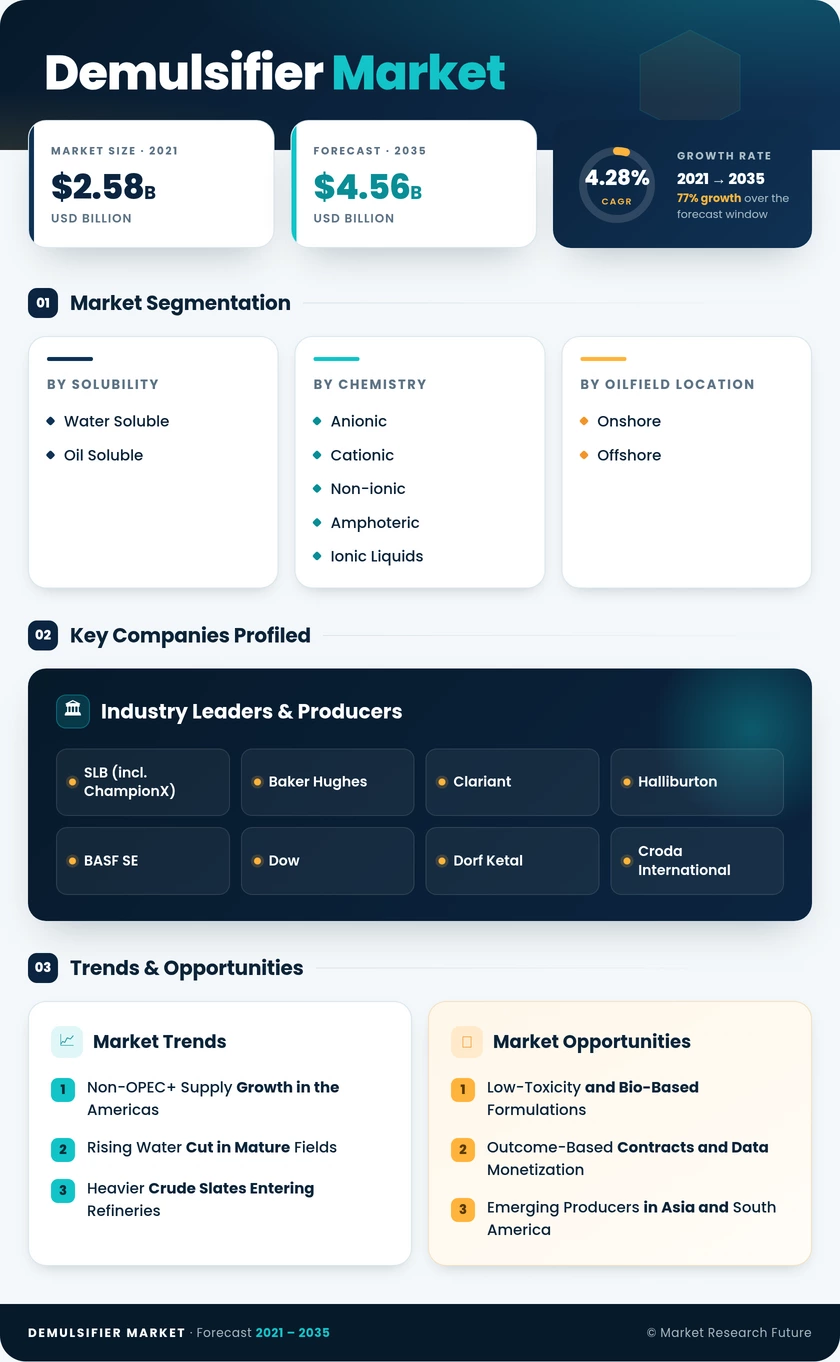
Segmentation Quick Reference
| Dimension | Sub-Segments | Dominant Segment | Fastest Growing Segment |
|---|
| By Solubility | Water Soluble; Oil Soluble | Oil Soluble (68.1% share) | Water Soluble (6.2% CAGR) |
| By Chemistry | Anionic; Cationic; Non-ionic; Amphoteric; Ionic Liquids | Non-ionic (37.2% share) | Ionic Liquids (6.9% CAGR) |
| By Oilfield Location | Onshore; Offshore | Onshore (63.7% share) | Offshore (5.3% CAGR) |
| By Application | Crude Oil Processing; Petro Refineries; Sludge Oil Treatment; Oil-based Power Plants; Lubricant Manufacturing; Other Applications (Enhanced Oil Recovery, etc.) | Crude Oil Processing (44.5% share) | Other Applications (Enhanced Oil Recovery, etc.) (7.1% CAGR) |
| By Region | North America; Europe; Asia-Pacific; South America; Middle East and Africa | North America (35.8% share) | Asia-Pacific (5.1% CAGR) |
Market Segmentation Overview
| Sub-Segment | Key Trend |
|---|
| Water Soluble | Rising use in oil-in-water polishing and water reuse systems |
| Oil Soluble | Entrenched in wellhead and separator injection for primary dehydration |
Oil Soluble products lead because they act directly in the crude phase, speeding free-water drop-out during primary separation where most treating spend occurs. Water Soluble grades grow fastest as stricter discharge limits and reuse projects demand lower residual oil in water. The gap narrows slowly, since Water Soluble demand depends on water infrastructure investment rather than crude volumes.
| Sub-Segment | Key Trend |
|---|
| Anionic | Steady demand in refinery desalter circuits |
| Cationic | Preferred for acidic crudes needing charge-based separation |
| Non-ionic | Broad compatibility with multi-chemical treating packages |
| Amphoteric | Niche use where pH varies across the process |
| Ionic Liquids | Pilot-to-commercial transition in harsh reservoirs |
Non-ionic blends lead because they work across crude grades and coexist with corrosion and scale inhibitors on shared injection lines. Ionic Liquids grow fastest, driven by stability at high temperature and salinity, though cost keeps them in premium offshore and pilot programs. Anionic and Cationic products hold defined niches in desalters and acidic crudes, which limits their exposure to switching.
| Sub-Segment | Key Trend |
|---|
| Onshore | Cost-per-barrel optimization on shale pads and giant fields |
| Offshore | High-performance chemistry for compact FPSO separation trains |
Onshore fields dominate on sheer volume from North American shale and Middle East conventional production, with procurement focused on price and logistics. Offshore grows faster because deepwater platforms have little separator residence time, so operators pay for chemistry that works under high pressure. Long offshore qualification cycles also make those contracts stickier once won.
| Sub-Segment | Key Trend |
|---|
| Crude Oil Processing | Low basic sediment and water targets for export and pipeline crude |
| Petro Refineries | Desalter optimization for heavier, saltier crude slates |
| Sludge Oil Treatment | Recovery of oil from tank bottoms and waste streams |
| Oil-based Power Plants | Fuel-oil conditioning in regions reliant on oil-fired power |
| Lubricant Manufacturing | Water removal during base oil and additive processing |
| Other Applications (Enhanced Oil Recovery, etc.) | Treating emulsions from back-produced flooding chemicals |
Crude Oil Processing leads because every produced barrel passes through separation and dehydration before sale. Other Applications (Enhanced Oil Recovery, etc.) grow fastest as chemical floods in aging reservoirs return surfactant- and polymer-laden fluids that conventional breakers struggle with. Petro Refineries add a stable second pillar as heavier crude slates raise desalter chemical needs.


 Noah Malgeri
Co-Founder

 Peter Groot koerkamp
Account and Business Manager

 Younghwan Choi
Senior Retail Manager

 Mark Irwin
Management Consultant

 Akif Moroglu
Strategy & Business Development Director

 Guilherme Gomes Martins
Product Management Director

 Joseph Aguayo
Sales Operations & Pricing Manager

 La Terria Dodd
Program Support Specialist

 Rob Kooiker
Group Product Manager HVAC & Fire Protection GMA