
Request Free Sample ×

Kindly complete the form below to receive a free sample of this Report

* Please use a valid business email

Leading companies partner with us for data-driven Insights

clients tt-cursor
Hero Background
English
Chinese
French
Japanese
Korean
German
Spanish

Cyber Insurance Market Size

ID: MRFR/BS/7163-CR
200 Pages
Aarti Dhapte
June 2025

Cyber Insurance Market Size, Share & Research Report By Coverage Type (Network Security Liability, Data Breach Response, Business Interruption, Privacy Liability), By Deployment Mode (Cloud-Based, On-Premises), By Application (Financial Services, Healthcare, Retail, Manufacturing), By Organization Size (Small Enterprises, Medium Enterprises, Large Enterprises) and By Regional (North America, Europe, South America, Asia Pacific, Middle East and Africa) - Industry Forecast Till 2035

Share:
Download PDF ×

We do not share your information with anyone. However, we may send you emails based on your report interest from time to time. You may contact us at any time to opt-out.

Cyber Insurance Market Infographic
Purchase Options

Cyber Insurance Size

Market Size Snapshot

Year Value
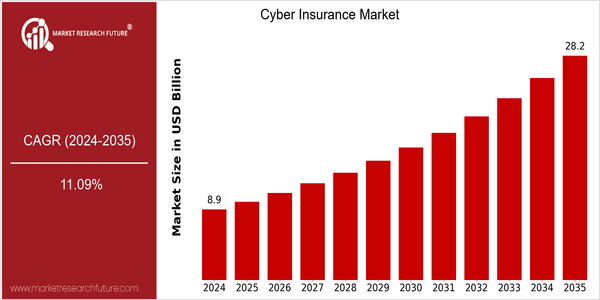
2024 USD 8.88 Billion
2035 USD 28.24 Billion
CAGR (2025-2035) 11.09 %

Note – Market size depicts the revenue generated over the financial year

CYBER INSURANCE IS GROWING: The global cyber insurance market is expected to grow to $ 28.24 billion by 2035. A robust CAGR of 11.09% is projected from 2025 to 2035. The growing frequency and sophistication of cyber attacks and the growing awareness of the business community of the risks of cyber risks are driving this market. Companies are increasingly seeing cyber insurance as an essential part of their risk management strategy, resulting in the demand for comprehensive coverage. The spread of cloud computing, the Internet of Things and artificial intelligence is also driving the need for cyber insurance. These new technologies are exposing companies to new cyber risks, which in turn increases their reliance on insurance solutions to protect themselves from potential losses. The leading players in the market, such as AIG, Chubb and Allianz, are involved in strategic initiatives, such as strategic alliances, investments in the development of new risk assessment tools and the development of tailored insurance products, to meet the changing needs of their customers. These efforts not only strengthen their market position but also help to increase the overall growth of the cyber insurance industry.
home-ubuntu-www-mrf_ne_design-batch-6-cp-cyber-insurance-market size

Regional Market Size

Regional Deep Dive

The cyber insurance market is growing rapidly across all regions, driven by increasing cyber threats and growing awareness of the need for risk management solutions. North America has a mature insurance market, with high penetration of cyber insurance products, while Europe is experiencing a surge in demand as a result of strict data protection regulations such as the General Data Protection Regulation (GDPR). In the Asia-Pacific region, companies are increasingly aware of the importance of risk management. The Middle East and Africa are gradually adopting cyber insurance, as digital transformation initiatives grow. Latin America is also a potential market, but the growth rate is slower. Despite this, Latin American companies are starting to understand the value of cyber insurance in protecting their operations against cyber incidents.

Europe

  • The implementation of the General Data Protection Regulation (GDPR) has led to a heightened focus on data security, prompting organizations to seek cyber insurance as a means of compliance and risk management.
  • Companies such as Allianz and AXA are developing tailored cyber insurance products that address specific regional risks, reflecting the diverse regulatory environments across European countries.

Asia Pacific

  • The rise of digital transformation initiatives in countries like India and Australia is driving demand for cyber insurance, as businesses seek to protect themselves against increasing cyber threats.
  • Government programs, such as the Cyber Security Strategy in Australia, are promoting awareness and encouraging organizations to adopt cyber insurance as part of their risk management strategies.

Latin America

  • The increasing frequency of cyberattacks in Brazil and Mexico is prompting businesses to consider cyber insurance as a critical component of their risk management strategies.
  • Organizations like Grupo Nacional Provincial (GNP) are starting to offer cyber insurance products, reflecting a growing recognition of the need for protection against cyber risks in the region.

North America

  • The introduction of the Cyber Insurance Framework by the National Association of Insurance Commissioners (NAIC) is shaping the market by providing guidelines for insurers and policyholders, enhancing transparency and trust.
  • Major players like AIG and Chubb are innovating their offerings by incorporating advanced risk assessment tools and incident response services, which are expected to improve customer engagement and retention.

Middle East And Africa

  • The UAE's National Cybersecurity Strategy is fostering a supportive environment for the growth of cyber insurance, as it emphasizes the importance of risk management in the face of rising cyber threats.
  • Local insurers are beginning to collaborate with global firms to develop customized cyber insurance products that cater to the unique challenges faced by businesses in the region.

Did You Know?

“As of 2023, nearly 60% of small to medium-sized enterprises (SMEs) in the U.S. have reported that they do not have cyber insurance, despite the increasing frequency of cyberattacks targeting this segment.” — Cybersecurity & Infrastructure Security Agency (CISA)

Segmental Market Size

The cyber insurance market is growing strongly as organizations increasingly understand the importance of protecting themselves against cyber risks. It is driven by the increasing frequency of cyber-attacks, the growing regulatory requirements such as the General Data Protection Regulation (GDPR) and the Californian Data Protection Act (CCPA), and the increasing dependence of companies on digital platforms. These factors are driving a need to secure operations and data, which is driving the demand for comprehensive cyber insurance solutions. At present, the market is in a stage of scale deployment, with AIG, Chubb and Allianz being the main players in the field of bespoke cyber insurance solutions. These products cover the main use cases such as data breaches, ransomware attacks and business interruptions caused by cyber incidents, especially in the finance, health and retail industries. The growing complexity of cyber-threats and the increasing regulatory pressure are driving the market forward. The evolution of this market is being driven by the emergence of new technologies, such as artificial intelligence (AI)-based risk assessment tools and incident response platforms, which allow insurers to offer more precise and comprehensive coverage and support to their customers.

Future Outlook

The cyber insurance market is expected to grow significantly from 2024 to 2035, with a CAGR of 11.09% from $8.88 billion to $28.24 billion. The main driving force for this growth is the increasing frequency and complexity of cyber-attacks, which has raised the awareness of enterprises to implement comprehensive risk management strategies. The penetration of cyber insurance is expected to rise rapidly, from 30.0% in 2024 to more than 60.0% in 2035. Artificial intelligence and machine learning in the underwriting and risk assessment process will further increase the attractiveness of cyber insurance products. Moreover, stricter data protection laws and the resulting compliance requirements will force companies to adopt cyber insurance as an important component of their risk management strategy. Also, the trend of remote work and the increasing use of cloud services will also contribute to the constantly changing cyber threat landscape, which will also lead to the demand for a variety of tailored insurance products to meet these new risks. In summary, the cyber insurance market is expected to grow significantly, driven by a combination of rising awareness of cyber risks, technological innovations, and regulatory requirements.
Cyber Insurance Market Size Graph
Author
Aarti Dhapte
AVP - Research

A consulting professional focused on helping businesses navigate complex markets through structured research and strategic insights. I partner with clients to solve high-impact business problems across market entry strategy, competitive intelligence, and opportunity assessment. Over the course of my experience, I have led and contributed to 100+ market research and consulting engagements, delivering insights across multiple industries and geographies, and supporting strategic decisions linked to $500M+ market opportunities. My core expertise lies in building robust market sizing, forecasting, and commercial models (top-down and bottom-up), alongside deep-dive competitive and industry analysis. I have played a key role in shaping go-to-market strategies, investment cases, and growth roadmaps, enabling clients to make confident, data-backed decisions in dynamic markets.

Leave a Comment

FAQs

What is the current valuation of the Cyber Insurance Market as of 2024?

<p>The Cyber Insurance Market was valued at 13.13 USD Billion in 2024.</p>

What is the projected market valuation for the Cyber Insurance Market in 2035?

<p>The market is projected to reach a valuation of 126.89 USD Billion by 2035.</p>

What is the expected CAGR for the Cyber Insurance Market during the forecast period 2025 - 2035?

<p>The expected CAGR for the Cyber Insurance Market during 2025 - 2035 is 22.9%.</p>

Which coverage type holds the highest valuation in the Cyber Insurance Market?

<p>Network Security Liability holds the highest valuation at 39.73 USD Billion.</p>

How does the deployment mode of Cloud-Based compare to On-Premises in terms of market valuation?

<p>Cloud-Based deployment is valued at 78.45 USD Billion, significantly higher than On-Premises at 48.44 USD Billion.</p>

What are the leading application sectors in the Cyber Insurance Market?

<p>The leading application sectors include Financial Services at 39.0 USD Billion and Healthcare at 25.0 USD Billion.</p>

Which organization size segment is projected to have the highest market valuation?

<p>Large Enterprises are projected to have the highest market valuation at 51.77 USD Billion.</p>

Who are the key players in the Cyber Insurance Market?

<p>Key players include AIG, Chubb, AXA, Beazley, CNA, Liberty Mutual, Zurich, Travelers, and Hiscox.</p>

What is the market valuation for Business Interruption coverage type?

<p>The market valuation for Business Interruption coverage type is 30.07 USD Billion.</p>

How does the market valuation for Medium Enterprises compare to Small Enterprises?

<p>Medium Enterprises are valued at 49.56 USD Billion, which is significantly higher than Small Enterprises at 25.56 USD Billion.</p>

Market Summary

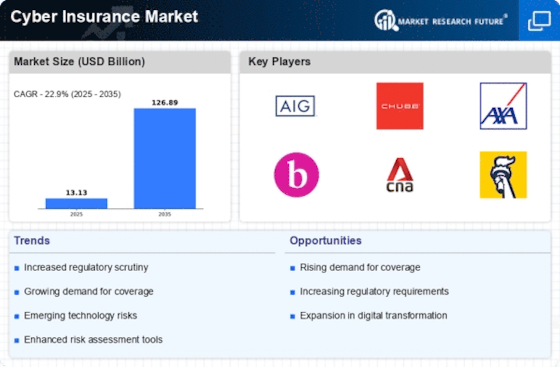
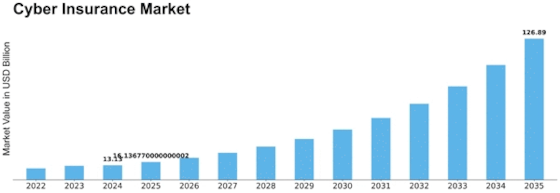
As per Market Research Future analysis, the Cyber Insurance Market Size was estimated at 13.13 USD Billion in 2024. The Cyber Insurance Industry is projected to grow from 16.14 USD Billion in 2025 to 126.89 USD Billion by 2035, exhibiting a compound annual growth rate (CAGR) of 22.9% during the forecast period 2025 - 2035

Key Market Trends & Highlights

The Cyber Insurance Market is experiencing robust growth driven by increasing demand for customized coverage and evolving regulatory requirements.

  • The demand for tailored policies is surging as organizations seek coverage that aligns with their specific risk profiles. North America remains the largest market, while Asia-Pacific is emerging as the fastest-growing region in cyber insurance. Network Security Liability continues to dominate the market, whereas Data Breach Response is witnessing the fastest growth. Rising cyber threats and regulatory compliance requirements are key drivers propelling the expansion of the cyber insurance Industry.

Market Size & Forecast

2024 Market Size 13.13 (USD Billion)
2035 Market Size 126.89 (USD Billion)
CAGR (2025 - 2035) 22.9%
Largest Regional Market Share in 2024 North America

Major Players

AIG (US), Chubb (US), AXA (FR), Beazley (GB), CNA (US), Liberty Mutual (US), Zurich (CH), Travelers (US), Hiscox (GB)

Market Trends

The Cyber Insurance Market is currently experiencing a notable evolution, driven by the increasing frequency and sophistication of cyber threats. Organizations across various sectors are recognizing the necessity of safeguarding their digital assets, leading to a heightened demand for comprehensive insurance solutions. This market appears to be expanding as businesses seek to mitigate potential financial losses stemming from data breaches, ransomware attacks, and other cyber incidents. Insurers are responding by developing tailored policies that address the unique risks associated with different industries, thereby enhancing the overall resilience of organizations against cyber threats. Moreover, regulatory frameworks are evolving, compelling companies to adopt more robust cybersecurity measures. This shift suggests that the Cyber Insurance Industry may continue to grow as compliance requirements become more stringent. Insurers are likely to incorporate risk assessment tools and cybersecurity best practices into their offerings, fostering a proactive approach to risk management. As awareness of cyber risks increases, the market is poised for further innovation, with emerging technologies potentially reshaping the landscape of insurance products available to businesses.

Increased Demand for Tailored Policies

Organizations are increasingly seeking customized insurance solutions that address their specific cyber risk profiles. This trend indicates a shift from generic coverage to more specialized offerings, allowing businesses to better protect themselves against unique threats.

Integration of Cybersecurity Measures

Insurers are beginning to incorporate cybersecurity best practices into their policies, encouraging clients to adopt proactive measures. This integration suggests a growing recognition that effective risk management is essential for minimizing potential losses.

Evolving Regulatory Landscape

As governments implement stricter regulations regarding data protection and cybersecurity, businesses are compelled to enhance their security protocols. This trend may drive further growth in the Cyber Insurance Industry as compliance becomes a critical factor in risk management.

Cyber Insurance Market Market Drivers

Rising Cyber Threats

The Cyber Insurance Market is experiencing a surge in demand due to the increasing frequency and sophistication of cyber threats. Organizations across various sectors are facing heightened risks from ransomware attacks, data breaches, and other cyber incidents. According to recent data, the number of reported cyber incidents has escalated significantly, prompting businesses to seek insurance solutions that can mitigate potential financial losses. This trend indicates a growing awareness of the need for robust cyber risk management strategies. As companies recognize the potential impact of cyber threats on their operations and reputations, the Cyber Insurance Industry is likely to expand, with insurers developing more comprehensive policies to address these evolving risks.

Growing Awareness of Cyber Risks

The Cyber Insurance Industry is benefiting from a growing awareness of cyber risks among businesses and consumers alike. As high-profile data breaches and cyberattacks make headlines, organizations are becoming increasingly cognizant of the potential financial and reputational damage associated with such incidents. This heightened awareness is prompting companies to proactively seek cyber insurance solutions to mitigate risks. Surveys indicate that a significant percentage of businesses now view cyber insurance as an essential part of their risk management strategy. As awareness continues to rise, the Cyber Insurance Market is likely to expand, with insurers developing tailored products to meet the diverse needs of organizations.

Increased Digital Transformation

The ongoing digital transformation across industries is a key driver for the Cyber Insurance Market. As organizations increasingly adopt cloud computing, IoT devices, and digital platforms, they expose themselves to new vulnerabilities and cyber risks. This shift towards digitalization necessitates a reevaluation of risk management strategies, leading many companies to consider cyber insurance as a critical component of their overall security framework. Data suggests that businesses investing in digital technologies are also prioritizing cyber insurance to safeguard their assets and operations. The Cyber Insurance Industry is thus poised for growth as more organizations recognize the importance of protecting their digital infrastructure against potential cyber threats.

Regulatory Compliance Requirements

The Cyber Insurance Market is influenced by the evolving regulatory landscape that mandates organizations to adopt stringent cybersecurity measures. Governments and regulatory bodies are increasingly implementing laws and guidelines that require businesses to protect sensitive data and report breaches. For instance, regulations such as the General Data Protection Regulation (GDPR) and the California Consumer Privacy Act (CCPA) have heightened the need for organizations to ensure compliance. This regulatory pressure is driving companies to invest in cyber insurance as a means of demonstrating due diligence and protecting against potential fines and legal liabilities. Consequently, the Cyber Insurance Market is likely to see growth as businesses seek coverage that aligns with these compliance requirements.

Technological Advancements in Cybersecurity

Technological advancements in cybersecurity are playing a pivotal role in shaping the Cyber Insurance Market. As new technologies emerge, they not only enhance the ability of organizations to protect themselves against cyber threats but also influence the types of coverage available in the insurance market. Innovations such as artificial intelligence, machine learning, and advanced threat detection systems are becoming integral to cybersecurity strategies. Insurers are increasingly incorporating these technologies into their underwriting processes, allowing for more accurate risk assessments and tailored policies. This trend suggests that the Cyber Insurance Industry will continue to evolve, with insurers adapting their offerings to align with the latest technological developments in cybersecurity.

Market Segment Insights

By Coverage Type: Network Security Liability (Largest) vs. Data Breach Response (Fastest-Growing)

In the Cyber Insurance Market, coverage types reveal a diverse allocation of market share. Network Security Liability currently stands as the largest segment, encapsulating primary protection against various cyber threats. Meanwhile, Data Breach Response, once a niche aspect, has grown substantially, now demanding a considerable share as businesses face an increasing number of data breach incidents, prompting them to seek responsive coverage in real time. This segment represents a critical need for immediate support in the event of a data exposure. As organizations continue to recognize the paramount importance of cyber resilience, growth trends indicate robust expansion in the Cyber Insurance Industry. Factors driving this growth include escalating cyber threat levels, stricter regulatory landscapes, and heightened awareness among businesses regarding the financial repercussions of cyber incidents. Furthermore, as incidents of data breaches increase, the demand for comprehensive Data Breach Response policies is escalating rapidly, positioning it as a key growth driver within this segment, thus transforming the market landscape significantly.

Network Security Liability (Dominant) vs. Business Interruption (Emerging)

In the coverage type of Cyber Insurance Market, Network Security Liability serves as the dominant player, providing crucial protection against diverse network vulnerabilities and threats. Its relevance is highlighted by an increase in data threats, with businesses viewing it as a cornerstone of their cybersecurity strategy. As firms invest heavily to safeguard their networks, it is clear that Network Security Liability continues to be a necessary coverage. Conversely, Business Interruption has emerged as a significant focus area, gaining momentum due to its critical role in protecting revenue against downtime caused by cyber incidents. Organizations are realizing that cyberattacks may not only threaten data but also hinder operational continuity, leading to a rising demand for policies that address this emerging concern. This juxtaposition defines the coverage type landscape in the Cyber Insurance Industry today.

By Deployment Mode: Cloud-Based (Largest) vs. On-Premises (Fastest-Growing)

The Cyber Insurance Market is witnessing a significant division in deployment modes, with cloud-based solutions taking the lead in market share. Cloud-based solutions are preferred due to their scalability and flexibility, allowing businesses to adapt their insurance policies as needed. On-premises solutions, while traditionally favored for their control and security, are now gaining traction among companies that prioritize rapid deployment and integration with existing IT infrastructure.

Deployment Mode: Cloud-Based (Dominant) vs. On-Premises (Emerging)

Cloud-based deployment mode in the Cyber Insurance Market is the dominant segment due to its advantages in cost-effectiveness and ease of access. It enables organizations to leverage advanced analytics and real-time data processing to assess risks effectively. In contrast, on-premises solutions are emerging as a preferred choice for businesses with stringent regulatory requirements or those seeking heightened data security. These solutions, although slower to implement, provide comprehensive control over data management and security protocols, appealing to organizations prioritizing compliance and risk mitigation.

By Application: Financial Services (Largest) vs. Healthcare (Fastest-Growing)

In the Cyber Insurance Market, the application segment shows a diverse distribution among key sectors. Financial services represent the largest share, leading the market due to strict regulatory requirements and the high value of financial data at stake. Other applications such as healthcare, retail, and manufacturing follow, each contributing to a dynamic market landscape. As organizations increasingly rely on technology for operations, the demand for cyber insurance penetrates these sectors at varying levels, with industries adjusting their risk strategies accordingly.

Healthcare: Financial Services (Dominant) vs. Retail (Emerging)

The financial services segment holds a dominant position in the cyber insurance Industry, characterized by robust demand for comprehensive coverage against increasing cyber threats such as data breaches and fraud. This segment's stability is largely driven by high regulatory scrutiny and the critical nature of protecting sensitive financial information. Conversely, the retail segment is emerging rapidly, primarily influenced by the rise of e-commerce and digital transactions, prompting retailers to invest in cyber insurance to safeguard consumer data and strengthen their security posture. This dichotomy illustrates a market where established sectors maintain leadership, while newer segments adapt to evolving challenges.

By Organization Size: Small Enterprises (Largest) vs. Large Enterprises (Fastest-Growing)

In the Cyber Insurance Industry, the distribution of market share among organization sizes reveals that small enterprises hold the largest share, driven by their increasing need for affordable protection against cyber risks. Their agility and rapid digital adoption make them notable players in this segment. Conversely, large enterprises, while comparatively smaller in share, are recognized as the fastest-growing category, demonstrating significant demand as they enhance their cybersecurity frameworks to comply with regulations and protect their extensive data assets.

Small Enterprises: (Dominant) vs. Large Enterprises: (Emerging)

Small enterprises are characterized by their adaptive strategies and cost-efficient measures to address cyber threats, making them dominant in the Cyber Insurance Market. This segment is increasingly embracing digital tools and insurance products that cater to limited budgets while providing essential coverage. In contrast, large enterprises are emerging in this space, characterized by their high-value assets and complex infrastructures. As they face escalating cyber threats, these firms are progressively investing in tailored cyber insurance policies that reflect their unique risk profiles and compliance needs, marking them as a rapidly evolving segment.

Get more detailed insights about Cyber Insurance Market Research Report - Global Forecast till 2035

Regional Insights

North America : Cybersecurity Leadership and Growth

North America is the largest market for cyber insurance, accounting for approximately 45% of the global share. The region's growth is driven by increasing cyber threats, regulatory requirements, and a heightened awareness of data protection among businesses. The demand for comprehensive cyber insurance policies is further fueled by the rise in ransomware attacks and data breaches, prompting organizations to seek robust coverage. The United States leads the market, with significant contributions from Canada. Major players like AIG, Chubb, and CNA dominate the landscape, offering a range of tailored products. The competitive environment is characterized by innovation and partnerships, as insurers collaborate with cybersecurity firms to enhance their offerings. The presence of advanced technology and a strong regulatory framework further solidify North America's position in the cyber insurance market.

Europe : Emerging Cyber Insurance Market Landscape

Europe is witnessing rapid growth in the cyber insurance Industry, holding approximately 30% of the global share. The region's expansion is driven by stringent regulations such as the General Data Protection Regulation (GDPR), which mandates businesses to protect personal data. This regulatory environment encourages organizations to invest in cyber insurance as a risk management strategy, leading to increased demand for coverage. Leading countries include the United Kingdom, Germany, and France, where key players like AXA and Hiscox are actively expanding their portfolios. The competitive landscape is evolving, with insurers focusing on innovative products that address specific industry needs. The presence of regulatory bodies ensures that the market remains robust and responsive to emerging threats, fostering a culture of risk awareness among businesses.

Asia-Pacific : Rapidly Growing Cyber Insurance Market Sector

Asia-Pacific is an emerging powerhouse in the cyber insurance market, accounting for about 20% of the global share. The region's growth is propelled by the increasing digitization of businesses, rising cyber threats, and a growing awareness of the importance of cybersecurity. Countries like India and Australia are witnessing a surge in demand for cyber insurance as organizations recognize the need for comprehensive coverage against cyber risks. The competitive landscape is characterized by a mix of local and international players, with companies like Zurich and Beazley expanding their presence. The region's diverse market dynamics require insurers to tailor their products to meet specific local needs. As governments implement supportive regulations, the cyber insurance market in Asia-Pacific is expected to continue its upward trajectory, attracting more investments and innovations.

Middle East and Africa : Evolving Cyber Insurance Market

The Middle East and Africa region is gradually developing its cyber insurance market, currently holding about 5% of the global share. The growth is driven by increasing cyber threats, digital transformation, and a rising awareness of the importance of cybersecurity among businesses. Countries like South Africa and the UAE are leading the way, with organizations beginning to recognize the value of cyber insurance as part of their risk management strategies. The competitive landscape is still in its infancy, with a few key players starting to establish their presence. Local insurers are beginning to collaborate with international firms to enhance their offerings. As regulatory frameworks evolve and awareness increases, the cyber insurance Industry in the Middle East and Africa is poised for significant growth in the coming years, attracting more players and investments.

Key Players and Competitive Insights

The Cyber Insurance Market is currently characterized by a dynamic competitive landscape, driven by increasing cyber threats and the growing recognition of the need for robust risk management solutions. Major players such as AIG (US), Chubb (US), and AXA (FR) are actively shaping the market through strategic initiatives that emphasize innovation and regional expansion. AIG (US) has positioned itself as a leader in providing comprehensive cyber risk solutions, focusing on enhancing its underwriting capabilities and leveraging data analytics to better assess risks. Meanwhile, Chubb (US) has been expanding its product offerings to include tailored solutions for small and medium-sized enterprises, thereby broadening its market reach. AXA (FR) is also investing in digital transformation, aiming to streamline its operations and improve customer engagement through advanced technology. Collectively, these strategies contribute to a competitive environment that is increasingly focused on innovation and customer-centric solutions.In terms of business tactics, companies are increasingly localizing their offerings to better meet regional demands and optimize their supply chains. The Cyber Insurance Industry appears to be moderately fragmented, with a mix of established players and emerging startups vying for market share. The collective influence of key players is significant, as they not only set industry standards but also drive the adoption of best practices across the sector. This competitive structure encourages continuous improvement and innovation, as companies strive to differentiate themselves in a crowded marketplace.

In August Beazley (GB) announced the launch of a new cyber insurance product specifically designed for the healthcare sector. This strategic move is particularly noteworthy given the increasing frequency of cyberattacks targeting healthcare organizations. By tailoring its offerings to meet the unique needs of this sector, Beazley (GB) not only enhances its market position but also addresses a critical gap in the current insurance landscape. This initiative underscores the importance of sector-specific solutions in the evolving Cyber Insurance Market.

In September CNA (US) expanded its partnership with a leading cybersecurity firm to enhance its risk assessment capabilities. This collaboration aims to integrate advanced threat intelligence into CNA's underwriting process, thereby improving the accuracy of risk evaluations. Such strategic partnerships are indicative of a broader trend within the industry, where companies are increasingly recognizing the value of combining insurance expertise with cutting-edge technology to deliver superior products and services.

In October Liberty Mutual (US) launched a new initiative focused on educating businesses about cyber risk management. This program aims to provide resources and training to help organizations better understand and mitigate their cyber risks. By positioning itself as a thought leader in the space, Liberty Mutual (US) not only strengthens its brand but also fosters customer loyalty through value-added services. This approach reflects a growing trend among insurers to move beyond traditional coverage and engage clients in proactive risk management.

As of October the Cyber Insurance Market is witnessing several defining trends, including the integration of artificial intelligence and a heightened focus on sustainability. Strategic alliances are becoming increasingly prevalent, as companies recognize the need to collaborate in order to enhance their offerings and address complex cyber threats. Looking ahead, competitive differentiation is likely to evolve, with a shift from price-based competition towards innovation, technology integration, and supply chain reliability. This transition suggests that companies that prioritize these aspects will be better positioned to thrive in an increasingly competitive landscape.

Key Companies in the Cyber Insurance Market include

Industry Developments

  • Q2 2024: Cyber insurance premiums drop for first time, report finds Cybersecurity insurance premiums declined 2.3% year over year to roughly $7.1 billion in 2024, marking the first annual decline since 2015, according to a report by AM Best. The drop was attributed to pricing changes rather than reduced demand, with some large businesses opting for self-insurance arrangements.
  • Q2 2025: Cyber Risk Insurance Market Remains Buyer-Friendly - Aon Cyber insurance pricing continued to decrease, ending with a 7% decline in Q1 2025, as broader coverage and increased limits became available for risks with responsive cyber security controls. Despite increased claims frequency, insurer loss ratios remained stable, supporting a competitive and resilient market.
  • Q3 2025: AM Best maintains stable outlook for global cyber insurance in 2025 amid growth, AI and rising threats AM Best reported that global cyber insurance premiums rose by 7% in 2024 to approximately USD 15.3 billion, with the US leading the market. The report highlighted the growing use of AI by threat actors and identified SMEs as a key growth opportunity for insurers.

Future Outlook

Cyber Insurance Market Future Outlook

The Cyber Insurance Market is projected to grow at a 22.9% CAGR from 2025 to 2035, driven by increasing cyber threats, regulatory requirements, and digital transformation.

New opportunities lie in:

  • Development of tailored insurance products for SMEs</p><p>Integration of AI-driven risk assessment tools</p><p>Expansion into emerging markets with localized solutions

By 2035, the Cyber Insurance Market is expected to be robust, reflecting substantial growth and innovation.

Market Segmentation

Cyber Insurance Market Application Outlook

  • Financial Services
  • Healthcare
  • Retail
  • Manufacturing

Cyber Insurance Market Coverage Type Outlook

  • Network Security Liability
  • Data Breach Response
  • Business Interruption
  • Privacy Liability

Cyber Insurance Market Deployment Mode Outlook

  • Cloud-Based
  • On-Premises

Cyber Insurance Market Organization Size Outlook

  • Small Enterprises
  • Medium Enterprises
  • Large Enterprises

Report Scope

MARKET SIZE 2024 13.13(USD Billion)
MARKET SIZE 2025 16.14(USD Billion)
MARKET SIZE 2035 126.89(USD Billion)
COMPOUND ANNUAL GROWTH RATE (CAGR) 22.9% (2025 - 2035)
REPORT COVERAGE Revenue Forecast, Competitive Landscape, Growth Factors, and Trends
BASE YEAR 2024
Market Forecast Period 2025 - 2035
Historical Data 2019 - 2024
Market Forecast Units USD Billion
Key Companies Profiled AIG (US), Chubb (US), AXA (FR), Beazley (GB), CNA (US), Liberty Mutual (US), Zurich (CH), Travelers (US), Hiscox (GB)
Segments Covered Coverage Type, Deployment Mode, Application, Organization Size, Regional
Key Market Opportunities Integration of advanced technologies enhances risk assessment in the Cyber Insurance Market.
Key Market Dynamics Rising cyber threats drive demand for comprehensive insurance solutions, influencing competitive dynamics and regulatory frameworks.
Countries Covered North America, Europe, APAC, South America, MEA

FAQs

What is the current valuation of the Cyber Insurance Market as of 2024?

<p>The Cyber Insurance Market was valued at 13.13 USD Billion in 2024.</p>

What is the projected market valuation for the Cyber Insurance Market in 2035?

<p>The market is projected to reach a valuation of 126.89 USD Billion by 2035.</p>

What is the expected CAGR for the Cyber Insurance Market during the forecast period 2025 - 2035?

<p>The expected CAGR for the Cyber Insurance Market during 2025 - 2035 is 22.9%.</p>

Which coverage type holds the highest valuation in the Cyber Insurance Market?

<p>Network Security Liability holds the highest valuation at 39.73 USD Billion.</p>

How does the deployment mode of Cloud-Based compare to On-Premises in terms of market valuation?

<p>Cloud-Based deployment is valued at 78.45 USD Billion, significantly higher than On-Premises at 48.44 USD Billion.</p>

What are the leading application sectors in the Cyber Insurance Market?

<p>The leading application sectors include Financial Services at 39.0 USD Billion and Healthcare at 25.0 USD Billion.</p>

Which organization size segment is projected to have the highest market valuation?

<p>Large Enterprises are projected to have the highest market valuation at 51.77 USD Billion.</p>

Who are the key players in the Cyber Insurance Market?

<p>Key players include AIG, Chubb, AXA, Beazley, CNA, Liberty Mutual, Zurich, Travelers, and Hiscox.</p>

What is the market valuation for Business Interruption coverage type?

<p>The market valuation for Business Interruption coverage type is 30.07 USD Billion.</p>

How does the market valuation for Medium Enterprises compare to Small Enterprises?

<p>Medium Enterprises are valued at 49.56 USD Billion, which is significantly higher than Small Enterprises at 25.56 USD Billion.</p>

  1. SECTION I: EXECUTIVE SUMMARY AND KEY HIGHLIGHTS
    1. | 1.1 EXECUTIVE SUMMARY
    2. | | 1.1.1 Market Overview
    3. | | 1.1.2 Key Findings
    4. | | 1.1.3 Market Segmentation
    5. | | 1.1.4 Competitive Landscape
    6. | | 1.1.5 Challenges and Opportunities
    7. | | 1.1.6 Future Outlook
  2. SECTION II: SCOPING, METHODOLOGY AND MARKET STRUCTURE
    1. | 2.1 MARKET INTRODUCTION
    2. | | 2.1.1 Definition
    3. | | 2.1.2 Scope of the study
    4. | | | 2.1.2.1 Research Objective
    5. | | | 2.1.2.2 Assumption
    6. | | | 2.1.2.3 Limitations
    7. | 2.2 RESEARCH METHODOLOGY
    8. | | 2.2.1 Overview
    9. | | 2.2.2 Data Mining
    10. | | 2.2.3 Secondary Research
    11. | | 2.2.4 Primary Research
    12. | | | 2.2.4.1 Primary Interviews and Information Gathering Process
    13. | | | 2.2.4.2 Breakdown of Primary Respondents
    14. | | 2.2.5 Forecasting Model
    15. | | 2.2.6 Market Size Estimation
    16. | | | 2.2.6.1 Bottom-Up Approach
    17. | | | 2.2.6.2 Top-Down Approach
    18. | | 2.2.7 Data Triangulation
    19. | | 2.2.8 Validation
  3. SECTION III: QUALITATIVE ANALYSIS
    1. | 3.1 MARKET DYNAMICS
    2. | | 3.1.1 Overview
    3. | | 3.1.2 Drivers
    4. | | 3.1.3 Restraints
    5. | | 3.1.4 Opportunities
    6. | 3.2 MARKET FACTOR ANALYSIS
    7. | | 3.2.1 Value chain Analysis
    8. | | 3.2.2 Porter's Five Forces Analysis
    9. | | | 3.2.2.1 Bargaining Power of Suppliers
    10. | | | 3.2.2.2 Bargaining Power of Buyers
    11. | | | 3.2.2.3 Threat of New Entrants
    12. | | | 3.2.2.4 Threat of Substitutes
    13. | | | 3.2.2.5 Intensity of Rivalry
    14. | | 3.2.3 COVID-19 Impact Analysis
    15. | | | 3.2.3.1 Market Impact Analysis
    16. | | | 3.2.3.2 Regional Impact
    17. | | | 3.2.3.3 Opportunity and Threat Analysis
  4. SECTION IV: QUANTITATIVE ANALYSIS
    1. | 4.1 BFSI, BY Coverage Type (USD Billion)
    2. | | 4.1.1 Network Security Liability
    3. | | 4.1.2 Data Breach Response
    4. | | 4.1.3 Business Interruption
    5. | | 4.1.4 Privacy Liability
    6. | 4.2 BFSI, BY Deployment Mode (USD Billion)
    7. | | 4.2.1 Cloud-Based
    8. | | 4.2.2 On-Premises
    9. | 4.3 BFSI, BY Application (USD Billion)
    10. | | 4.3.1 Financial Services
    11. | | 4.3.2 Healthcare
    12. | | 4.3.3 Retail
    13. | | 4.3.4 Manufacturing
    14. | 4.4 BFSI, BY Organization Size (USD Billion)
    15. | | 4.4.1 Small Enterprises
    16. | | 4.4.2 Medium Enterprises
    17. | | 4.4.3 Large Enterprises
    18. | 4.5 BFSI, BY Region (USD Billion)
    19. | | 4.5.1 North America
    20. | | | 4.5.1.1 US
    21. | | | 4.5.1.2 Canada
    22. | | 4.5.2 Europe
    23. | | | 4.5.2.1 Germany
    24. | | | 4.5.2.2 UK
    25. | | | 4.5.2.3 France
    26. | | | 4.5.2.4 Russia
    27. | | | 4.5.2.5 Italy
    28. | | | 4.5.2.6 Spain
    29. | | | 4.5.2.7 Rest of Europe
    30. | | 4.5.3 APAC
    31. | | | 4.5.3.1 China
    32. | | | 4.5.3.2 India
    33. | | | 4.5.3.3 Japan
    34. | | | 4.5.3.4 South Korea
    35. | | | 4.5.3.5 Malaysia
    36. | | | 4.5.3.6 Thailand
    37. | | | 4.5.3.7 Indonesia
    38. | | | 4.5.3.8 Rest of APAC
    39. | | 4.5.4 South America
    40. | | | 4.5.4.1 Brazil
    41. | | | 4.5.4.2 Mexico
    42. | | | 4.5.4.3 Argentina
    43. | | | 4.5.4.4 Rest of South America
    44. | | 4.5.5 MEA
    45. | | | 4.5.5.1 GCC Countries
    46. | | | 4.5.5.2 South Africa
    47. | | | 4.5.5.3 Rest of MEA
  5. SECTION V: COMPETITIVE ANALYSIS
    1. | 5.1 Competitive Landscape
    2. | | 5.1.1 Overview
    3. | | 5.1.2 Competitive Analysis
    4. | | 5.1.3 Market share Analysis
    5. | | 5.1.4 Major Growth Strategy in the BFSI
    6. | | 5.1.5 Competitive Benchmarking
    7. | | 5.1.6 Leading Players in Terms of Number of Developments in the BFSI
    8. | | 5.1.7 Key developments and growth strategies
    9. | | | 5.1.7.1 New Product Launch/Service Deployment
    10. | | | 5.1.7.2 Merger & Acquisitions
    11. | | | 5.1.7.3 Joint Ventures
    12. | | 5.1.8 Major Players Financial Matrix
    13. | | | 5.1.8.1 Sales and Operating Income
    14. | | | 5.1.8.2 Major Players R&D Expenditure. 2023
    15. | 5.2 Company Profiles
    16. | | 5.2.1 AIG (US)
    17. | | | 5.2.1.1 Financial Overview
    18. | | | 5.2.1.2 Products Offered
    19. | | | 5.2.1.3 Key Developments
    20. | | | 5.2.1.4 SWOT Analysis
    21. | | | 5.2.1.5 Key Strategies
    22. | | 5.2.2 Chubb (US)
    23. | | | 5.2.2.1 Financial Overview
    24. | | | 5.2.2.2 Products Offered
    25. | | | 5.2.2.3 Key Developments
    26. | | | 5.2.2.4 SWOT Analysis
    27. | | | 5.2.2.5 Key Strategies
    28. | | 5.2.3 AXA (FR)
    29. | | | 5.2.3.1 Financial Overview
    30. | | | 5.2.3.2 Products Offered
    31. | | | 5.2.3.3 Key Developments
    32. | | | 5.2.3.4 SWOT Analysis
    33. | | | 5.2.3.5 Key Strategies
    34. | | 5.2.4 Beazley (GB)
    35. | | | 5.2.4.1 Financial Overview
    36. | | | 5.2.4.2 Products Offered
    37. | | | 5.2.4.3 Key Developments
    38. | | | 5.2.4.4 SWOT Analysis
    39. | | | 5.2.4.5 Key Strategies
    40. | | 5.2.5 CNA (US)
    41. | | | 5.2.5.1 Financial Overview
    42. | | | 5.2.5.2 Products Offered
    43. | | | 5.2.5.3 Key Developments
    44. | | | 5.2.5.4 SWOT Analysis
    45. | | | 5.2.5.5 Key Strategies
    46. | | 5.2.6 Liberty Mutual (US)
    47. | | | 5.2.6.1 Financial Overview
    48. | | | 5.2.6.2 Products Offered
    49. | | | 5.2.6.3 Key Developments
    50. | | | 5.2.6.4 SWOT Analysis
    51. | | | 5.2.6.5 Key Strategies
    52. | | 5.2.7 Zurich (CH)
    53. | | | 5.2.7.1 Financial Overview
    54. | | | 5.2.7.2 Products Offered
    55. | | | 5.2.7.3 Key Developments
    56. | | | 5.2.7.4 SWOT Analysis
    57. | | | 5.2.7.5 Key Strategies
    58. | | 5.2.8 Travelers (US)
    59. | | | 5.2.8.1 Financial Overview
    60. | | | 5.2.8.2 Products Offered
    61. | | | 5.2.8.3 Key Developments
    62. | | | 5.2.8.4 SWOT Analysis
    63. | | | 5.2.8.5 Key Strategies
    64. | | 5.2.9 Hiscox (GB)
    65. | | | 5.2.9.1 Financial Overview
    66. | | | 5.2.9.2 Products Offered
    67. | | | 5.2.9.3 Key Developments
    68. | | | 5.2.9.4 SWOT Analysis
    69. | | | 5.2.9.5 Key Strategies
    70. | 5.3 Appendix
    71. | | 5.3.1 References
    72. | | 5.3.2 Related Reports
  6. LIST OF FIGURES
    1. | 6.1 MARKET SYNOPSIS
    2. | 6.2 NORTH AMERICA MARKET ANALYSIS
    3. | 6.3 US MARKET ANALYSIS BY COVERAGE TYPE
    4. | 6.4 US MARKET ANALYSIS BY DEPLOYMENT MODE
    5. | 6.5 US MARKET ANALYSIS BY APPLICATION
    6. | 6.6 US MARKET ANALYSIS BY ORGANIZATION SIZE
    7. | 6.7 CANADA MARKET ANALYSIS BY COVERAGE TYPE
    8. | 6.8 CANADA MARKET ANALYSIS BY DEPLOYMENT MODE
    9. | 6.9 CANADA MARKET ANALYSIS BY APPLICATION
    10. | 6.10 CANADA MARKET ANALYSIS BY ORGANIZATION SIZE
    11. | 6.11 EUROPE MARKET ANALYSIS
    12. | 6.12 GERMANY MARKET ANALYSIS BY COVERAGE TYPE
    13. | 6.13 GERMANY MARKET ANALYSIS BY DEPLOYMENT MODE
    14. | 6.14 GERMANY MARKET ANALYSIS BY APPLICATION
    15. | 6.15 GERMANY MARKET ANALYSIS BY ORGANIZATION SIZE
    16. | 6.16 UK MARKET ANALYSIS BY COVERAGE TYPE
    17. | 6.17 UK MARKET ANALYSIS BY DEPLOYMENT MODE
    18. | 6.18 UK MARKET ANALYSIS BY APPLICATION
    19. | 6.19 UK MARKET ANALYSIS BY ORGANIZATION SIZE
    20. | 6.20 FRANCE MARKET ANALYSIS BY COVERAGE TYPE
    21. | 6.21 FRANCE MARKET ANALYSIS BY DEPLOYMENT MODE
    22. | 6.22 FRANCE MARKET ANALYSIS BY APPLICATION
    23. | 6.23 FRANCE MARKET ANALYSIS BY ORGANIZATION SIZE
    24. | 6.24 RUSSIA MARKET ANALYSIS BY COVERAGE TYPE
    25. | 6.25 RUSSIA MARKET ANALYSIS BY DEPLOYMENT MODE
    26. | 6.26 RUSSIA MARKET ANALYSIS BY APPLICATION
    27. | 6.27 RUSSIA MARKET ANALYSIS BY ORGANIZATION SIZE
    28. | 6.28 ITALY MARKET ANALYSIS BY COVERAGE TYPE
    29. | 6.29 ITALY MARKET ANALYSIS BY DEPLOYMENT MODE
    30. | 6.30 ITALY MARKET ANALYSIS BY APPLICATION
    31. | 6.31 ITALY MARKET ANALYSIS BY ORGANIZATION SIZE
    32. | 6.32 SPAIN MARKET ANALYSIS BY COVERAGE TYPE
    33. | 6.33 SPAIN MARKET ANALYSIS BY DEPLOYMENT MODE
    34. | 6.34 SPAIN MARKET ANALYSIS BY APPLICATION
    35. | 6.35 SPAIN MARKET ANALYSIS BY ORGANIZATION SIZE
    36. | 6.36 REST OF EUROPE MARKET ANALYSIS BY COVERAGE TYPE
    37. | 6.37 REST OF EUROPE MARKET ANALYSIS BY DEPLOYMENT MODE
    38. | 6.38 REST OF EUROPE MARKET ANALYSIS BY APPLICATION
    39. | 6.39 REST OF EUROPE MARKET ANALYSIS BY ORGANIZATION SIZE
    40. | 6.40 APAC MARKET ANALYSIS
    41. | 6.41 CHINA MARKET ANALYSIS BY COVERAGE TYPE
    42. | 6.42 CHINA MARKET ANALYSIS BY DEPLOYMENT MODE
    43. | 6.43 CHINA MARKET ANALYSIS BY APPLICATION
    44. | 6.44 CHINA MARKET ANALYSIS BY ORGANIZATION SIZE
    45. | 6.45 INDIA MARKET ANALYSIS BY COVERAGE TYPE
    46. | 6.46 INDIA MARKET ANALYSIS BY DEPLOYMENT MODE
    47. | 6.47 INDIA MARKET ANALYSIS BY APPLICATION
    48. | 6.48 INDIA MARKET ANALYSIS BY ORGANIZATION SIZE
    49. | 6.49 JAPAN MARKET ANALYSIS BY COVERAGE TYPE
    50. | 6.50 JAPAN MARKET ANALYSIS BY DEPLOYMENT MODE
    51. | 6.51 JAPAN MARKET ANALYSIS BY APPLICATION
    52. | 6.52 JAPAN MARKET ANALYSIS BY ORGANIZATION SIZE
    53. | 6.53 SOUTH KOREA MARKET ANALYSIS BY COVERAGE TYPE
    54. | 6.54 SOUTH KOREA MARKET ANALYSIS BY DEPLOYMENT MODE
    55. | 6.55 SOUTH KOREA MARKET ANALYSIS BY APPLICATION
    56. | 6.56 SOUTH KOREA MARKET ANALYSIS BY ORGANIZATION SIZE
    57. | 6.57 MALAYSIA MARKET ANALYSIS BY COVERAGE TYPE
    58. | 6.58 MALAYSIA MARKET ANALYSIS BY DEPLOYMENT MODE
    59. | 6.59 MALAYSIA MARKET ANALYSIS BY APPLICATION
    60. | 6.60 MALAYSIA MARKET ANALYSIS BY ORGANIZATION SIZE
    61. | 6.61 THAILAND MARKET ANALYSIS BY COVERAGE TYPE
    62. | 6.62 THAILAND MARKET ANALYSIS BY DEPLOYMENT MODE
    63. | 6.63 THAILAND MARKET ANALYSIS BY APPLICATION
    64. | 6.64 THAILAND MARKET ANALYSIS BY ORGANIZATION SIZE
    65. | 6.65 INDONESIA MARKET ANALYSIS BY COVERAGE TYPE
    66. | 6.66 INDONESIA MARKET ANALYSIS BY DEPLOYMENT MODE
    67. | 6.67 INDONESIA MARKET ANALYSIS BY APPLICATION
    68. | 6.68 INDONESIA MARKET ANALYSIS BY ORGANIZATION SIZE
    69. | 6.69 REST OF APAC MARKET ANALYSIS BY COVERAGE TYPE
    70. | 6.70 REST OF APAC MARKET ANALYSIS BY DEPLOYMENT MODE
    71. | 6.71 REST OF APAC MARKET ANALYSIS BY APPLICATION
    72. | 6.72 REST OF APAC MARKET ANALYSIS BY ORGANIZATION SIZE
    73. | 6.73 SOUTH AMERICA MARKET ANALYSIS
    74. | 6.74 BRAZIL MARKET ANALYSIS BY COVERAGE TYPE
    75. | 6.75 BRAZIL MARKET ANALYSIS BY DEPLOYMENT MODE
    76. | 6.76 BRAZIL MARKET ANALYSIS BY APPLICATION
    77. | 6.77 BRAZIL MARKET ANALYSIS BY ORGANIZATION SIZE
    78. | 6.78 MEXICO MARKET ANALYSIS BY COVERAGE TYPE
    79. | 6.79 MEXICO MARKET ANALYSIS BY DEPLOYMENT MODE
    80. | 6.80 MEXICO MARKET ANALYSIS BY APPLICATION
    81. | 6.81 MEXICO MARKET ANALYSIS BY ORGANIZATION SIZE
    82. | 6.82 ARGENTINA MARKET ANALYSIS BY COVERAGE TYPE
    83. | 6.83 ARGENTINA MARKET ANALYSIS BY DEPLOYMENT MODE
    84. | 6.84 ARGENTINA MARKET ANALYSIS BY APPLICATION
    85. | 6.85 ARGENTINA MARKET ANALYSIS BY ORGANIZATION SIZE
    86. | 6.86 REST OF SOUTH AMERICA MARKET ANALYSIS BY COVERAGE TYPE
    87. | 6.87 REST OF SOUTH AMERICA MARKET ANALYSIS BY DEPLOYMENT MODE
    88. | 6.88 REST OF SOUTH AMERICA MARKET ANALYSIS BY APPLICATION
    89. | 6.89 REST OF SOUTH AMERICA MARKET ANALYSIS BY ORGANIZATION SIZE
    90. | 6.90 MEA MARKET ANALYSIS
    91. | 6.91 GCC COUNTRIES MARKET ANALYSIS BY COVERAGE TYPE
    92. | 6.92 GCC COUNTRIES MARKET ANALYSIS BY DEPLOYMENT MODE
    93. | 6.93 GCC COUNTRIES MARKET ANALYSIS BY APPLICATION
    94. | 6.94 GCC COUNTRIES MARKET ANALYSIS BY ORGANIZATION SIZE
    95. | 6.95 SOUTH AFRICA MARKET ANALYSIS BY COVERAGE TYPE
    96. | 6.96 SOUTH AFRICA MARKET ANALYSIS BY DEPLOYMENT MODE
    97. | 6.97 SOUTH AFRICA MARKET ANALYSIS BY APPLICATION
    98. | 6.98 SOUTH AFRICA MARKET ANALYSIS BY ORGANIZATION SIZE
    99. | 6.99 REST OF MEA MARKET ANALYSIS BY COVERAGE TYPE
    100. | 6.100 REST OF MEA MARKET ANALYSIS BY DEPLOYMENT MODE
    101. | 6.101 REST OF MEA MARKET ANALYSIS BY APPLICATION
    102. | 6.102 REST OF MEA MARKET ANALYSIS BY ORGANIZATION SIZE
    103. | 6.103 KEY BUYING CRITERIA OF BFSI
    104. | 6.104 RESEARCH PROCESS OF MRFR
    105. | 6.105 DRO ANALYSIS OF BFSI
    106. | 6.106 DRIVERS IMPACT ANALYSIS: BFSI
    107. | 6.107 RESTRAINTS IMPACT ANALYSIS: BFSI
    108. | 6.108 SUPPLY / VALUE CHAIN: BFSI
    109. | 6.109 BFSI, BY COVERAGE TYPE, 2024 (% SHARE)
    110. | 6.110 BFSI, BY COVERAGE TYPE, 2024 TO 2035 (USD Billion)
    111. | 6.111 BFSI, BY DEPLOYMENT MODE, 2024 (% SHARE)
    112. | 6.112 BFSI, BY DEPLOYMENT MODE, 2024 TO 2035 (USD Billion)
    113. | 6.113 BFSI, BY APPLICATION, 2024 (% SHARE)
    114. | 6.114 BFSI, BY APPLICATION, 2024 TO 2035 (USD Billion)
    115. | 6.115 BFSI, BY ORGANIZATION SIZE, 2024 (% SHARE)
    116. | 6.116 BFSI, BY ORGANIZATION SIZE, 2024 TO 2035 (USD Billion)
    117. | 6.117 BENCHMARKING OF MAJOR COMPETITORS
  7. LIST OF TABLES
    1. | 7.1 LIST OF ASSUMPTIONS
    2. | | 7.1.1
    3. | 7.2 North America MARKET SIZE ESTIMATES; FORECAST
    4. | | 7.2.1 BY COVERAGE TYPE, 2025-2035 (USD Billion)
    5. | | 7.2.2 BY DEPLOYMENT MODE, 2025-2035 (USD Billion)
    6. | | 7.2.3 BY APPLICATION, 2025-2035 (USD Billion)
    7. | | 7.2.4 BY ORGANIZATION SIZE, 2025-2035 (USD Billion)
    8. | 7.3 US MARKET SIZE ESTIMATES; FORECAST
    9. | | 7.3.1 BY COVERAGE TYPE, 2025-2035 (USD Billion)
    10. | | 7.3.2 BY DEPLOYMENT MODE, 2025-2035 (USD Billion)
    11. | | 7.3.3 BY APPLICATION, 2025-2035 (USD Billion)
    12. | | 7.3.4 BY ORGANIZATION SIZE, 2025-2035 (USD Billion)
    13. | 7.4 Canada MARKET SIZE ESTIMATES; FORECAST
    14. | | 7.4.1 BY COVERAGE TYPE, 2025-2035 (USD Billion)
    15. | | 7.4.2 BY DEPLOYMENT MODE, 2025-2035 (USD Billion)
    16. | | 7.4.3 BY APPLICATION, 2025-2035 (USD Billion)
    17. | | 7.4.4 BY ORGANIZATION SIZE, 2025-2035 (USD Billion)
    18. | 7.5 Europe MARKET SIZE ESTIMATES; FORECAST
    19. | | 7.5.1 BY COVERAGE TYPE, 2025-2035 (USD Billion)
    20. | | 7.5.2 BY DEPLOYMENT MODE, 2025-2035 (USD Billion)
    21. | | 7.5.3 BY APPLICATION, 2025-2035 (USD Billion)
    22. | | 7.5.4 BY ORGANIZATION SIZE, 2025-2035 (USD Billion)
    23. | 7.6 Germany MARKET SIZE ESTIMATES; FORECAST
    24. | | 7.6.1 BY COVERAGE TYPE, 2025-2035 (USD Billion)
    25. | | 7.6.2 BY DEPLOYMENT MODE, 2025-2035 (USD Billion)
    26. | | 7.6.3 BY APPLICATION, 2025-2035 (USD Billion)
    27. | | 7.6.4 BY ORGANIZATION SIZE, 2025-2035 (USD Billion)
    28. | 7.7 UK MARKET SIZE ESTIMATES; FORECAST
    29. | | 7.7.1 BY COVERAGE TYPE, 2025-2035 (USD Billion)
    30. | | 7.7.2 BY DEPLOYMENT MODE, 2025-2035 (USD Billion)
    31. | | 7.7.3 BY APPLICATION, 2025-2035 (USD Billion)
    32. | | 7.7.4 BY ORGANIZATION SIZE, 2025-2035 (USD Billion)
    33. | 7.8 France MARKET SIZE ESTIMATES; FORECAST
    34. | | 7.8.1 BY COVERAGE TYPE, 2025-2035 (USD Billion)
    35. | | 7.8.2 BY DEPLOYMENT MODE, 2025-2035 (USD Billion)
    36. | | 7.8.3 BY APPLICATION, 2025-2035 (USD Billion)
    37. | | 7.8.4 BY ORGANIZATION SIZE, 2025-2035 (USD Billion)
    38. | 7.9 Russia MARKET SIZE ESTIMATES; FORECAST
    39. | | 7.9.1 BY COVERAGE TYPE, 2025-2035 (USD Billion)
    40. | | 7.9.2 BY DEPLOYMENT MODE, 2025-2035 (USD Billion)
    41. | | 7.9.3 BY APPLICATION, 2025-2035 (USD Billion)
    42. | | 7.9.4 BY ORGANIZATION SIZE, 2025-2035 (USD Billion)
    43. | 7.10 Italy MARKET SIZE ESTIMATES; FORECAST
    44. | | 7.10.1 BY COVERAGE TYPE, 2025-2035 (USD Billion)
    45. | | 7.10.2 BY DEPLOYMENT MODE, 2025-2035 (USD Billion)
    46. | | 7.10.3 BY APPLICATION, 2025-2035 (USD Billion)
    47. | | 7.10.4 BY ORGANIZATION SIZE, 2025-2035 (USD Billion)
    48. | 7.11 Spain MARKET SIZE ESTIMATES; FORECAST
    49. | | 7.11.1 BY COVERAGE TYPE, 2025-2035 (USD Billion)
    50. | | 7.11.2 BY DEPLOYMENT MODE, 2025-2035 (USD Billion)
    51. | | 7.11.3 BY APPLICATION, 2025-2035 (USD Billion)
    52. | | 7.11.4 BY ORGANIZATION SIZE, 2025-2035 (USD Billion)
    53. | 7.12 Rest of Europe MARKET SIZE ESTIMATES; FORECAST
    54. | | 7.12.1 BY COVERAGE TYPE, 2025-2035 (USD Billion)
    55. | | 7.12.2 BY DEPLOYMENT MODE, 2025-2035 (USD Billion)
    56. | | 7.12.3 BY APPLICATION, 2025-2035 (USD Billion)
    57. | | 7.12.4 BY ORGANIZATION SIZE, 2025-2035 (USD Billion)
    58. | 7.13 APAC MARKET SIZE ESTIMATES; FORECAST
    59. | | 7.13.1 BY COVERAGE TYPE, 2025-2035 (USD Billion)
    60. | | 7.13.2 BY DEPLOYMENT MODE, 2025-2035 (USD Billion)
    61. | | 7.13.3 BY APPLICATION, 2025-2035 (USD Billion)
    62. | | 7.13.4 BY ORGANIZATION SIZE, 2025-2035 (USD Billion)
    63. | 7.14 China MARKET SIZE ESTIMATES; FORECAST
    64. | | 7.14.1 BY COVERAGE TYPE, 2025-2035 (USD Billion)
    65. | | 7.14.2 BY DEPLOYMENT MODE, 2025-2035 (USD Billion)
    66. | | 7.14.3 BY APPLICATION, 2025-2035 (USD Billion)
    67. | | 7.14.4 BY ORGANIZATION SIZE, 2025-2035 (USD Billion)
    68. | 7.15 India MARKET SIZE ESTIMATES; FORECAST
    69. | | 7.15.1 BY COVERAGE TYPE, 2025-2035 (USD Billion)
    70. | | 7.15.2 BY DEPLOYMENT MODE, 2025-2035 (USD Billion)
    71. | | 7.15.3 BY APPLICATION, 2025-2035 (USD Billion)
    72. | | 7.15.4 BY ORGANIZATION SIZE, 2025-2035 (USD Billion)
    73. | 7.16 Japan MARKET SIZE ESTIMATES; FORECAST
    74. | | 7.16.1 BY COVERAGE TYPE, 2025-2035 (USD Billion)
    75. | | 7.16.2 BY DEPLOYMENT MODE, 2025-2035 (USD Billion)
    76. | | 7.16.3 BY APPLICATION, 2025-2035 (USD Billion)
    77. | | 7.16.4 BY ORGANIZATION SIZE, 2025-2035 (USD Billion)
    78. | 7.17 South Korea MARKET SIZE ESTIMATES; FORECAST
    79. | | 7.17.1 BY COVERAGE TYPE, 2025-2035 (USD Billion)
    80. | | 7.17.2 BY DEPLOYMENT MODE, 2025-2035 (USD Billion)
    81. | | 7.17.3 BY APPLICATION, 2025-2035 (USD Billion)
    82. | | 7.17.4 BY ORGANIZATION SIZE, 2025-2035 (USD Billion)
    83. | 7.18 Malaysia MARKET SIZE ESTIMATES; FORECAST
    84. | | 7.18.1 BY COVERAGE TYPE, 2025-2035 (USD Billion)
    85. | | 7.18.2 BY DEPLOYMENT MODE, 2025-2035 (USD Billion)
    86. | | 7.18.3 BY APPLICATION, 2025-2035 (USD Billion)
    87. | | 7.18.4 BY ORGANIZATION SIZE, 2025-2035 (USD Billion)
    88. | 7.19 Thailand MARKET SIZE ESTIMATES; FORECAST
    89. | | 7.19.1 BY COVERAGE TYPE, 2025-2035 (USD Billion)
    90. | | 7.19.2 BY DEPLOYMENT MODE, 2025-2035 (USD Billion)
    91. | | 7.19.3 BY APPLICATION, 2025-2035 (USD Billion)
    92. | | 7.19.4 BY ORGANIZATION SIZE, 2025-2035 (USD Billion)
    93. | 7.20 Indonesia MARKET SIZE ESTIMATES; FORECAST
    94. | | 7.20.1 BY COVERAGE TYPE, 2025-2035 (USD Billion)
    95. | | 7.20.2 BY DEPLOYMENT MODE, 2025-2035 (USD Billion)
    96. | | 7.20.3 BY APPLICATION, 2025-2035 (USD Billion)
    97. | | 7.20.4 BY ORGANIZATION SIZE, 2025-2035 (USD Billion)
    98. | 7.21 Rest of APAC MARKET SIZE ESTIMATES; FORECAST
    99. | | 7.21.1 BY COVERAGE TYPE, 2025-2035 (USD Billion)
    100. | | 7.21.2 BY DEPLOYMENT MODE, 2025-2035 (USD Billion)
    101. | | 7.21.3 BY APPLICATION, 2025-2035 (USD Billion)
    102. | | 7.21.4 BY ORGANIZATION SIZE, 2025-2035 (USD Billion)
    103. | 7.22 South America MARKET SIZE ESTIMATES; FORECAST
    104. | | 7.22.1 BY COVERAGE TYPE, 2025-2035 (USD Billion)
    105. | | 7.22.2 BY DEPLOYMENT MODE, 2025-2035 (USD Billion)
    106. | | 7.22.3 BY APPLICATION, 2025-2035 (USD Billion)
    107. | | 7.22.4 BY ORGANIZATION SIZE, 2025-2035 (USD Billion)
    108. | 7.23 Brazil MARKET SIZE ESTIMATES; FORECAST
    109. | | 7.23.1 BY COVERAGE TYPE, 2025-2035 (USD Billion)
    110. | | 7.23.2 BY DEPLOYMENT MODE, 2025-2035 (USD Billion)
    111. | | 7.23.3 BY APPLICATION, 2025-2035 (USD Billion)
    112. | | 7.23.4 BY ORGANIZATION SIZE, 2025-2035 (USD Billion)
    113. | 7.24 Mexico MARKET SIZE ESTIMATES; FORECAST
    114. | | 7.24.1 BY COVERAGE TYPE, 2025-2035 (USD Billion)
    115. | | 7.24.2 BY DEPLOYMENT MODE, 2025-2035 (USD Billion)
    116. | | 7.24.3 BY APPLICATION, 2025-2035 (USD Billion)
    117. | | 7.24.4 BY ORGANIZATION SIZE, 2025-2035 (USD Billion)
    118. | 7.25 Argentina MARKET SIZE ESTIMATES; FORECAST
    119. | | 7.25.1 BY COVERAGE TYPE, 2025-2035 (USD Billion)
    120. | | 7.25.2 BY DEPLOYMENT MODE, 2025-2035 (USD Billion)
    121. | | 7.25.3 BY APPLICATION, 2025-2035 (USD Billion)
    122. | | 7.25.4 BY ORGANIZATION SIZE, 2025-2035 (USD Billion)
    123. | 7.26 Rest of South America MARKET SIZE ESTIMATES; FORECAST
    124. | | 7.26.1 BY COVERAGE TYPE, 2025-2035 (USD Billion)
    125. | | 7.26.2 BY DEPLOYMENT MODE, 2025-2035 (USD Billion)
    126. | | 7.26.3 BY APPLICATION, 2025-2035 (USD Billion)
    127. | | 7.26.4 BY ORGANIZATION SIZE, 2025-2035 (USD Billion)
    128. | 7.27 MEA MARKET SIZE ESTIMATES; FORECAST
    129. | | 7.27.1 BY COVERAGE TYPE, 2025-2035 (USD Billion)
    130. | | 7.27.2 BY DEPLOYMENT MODE, 2025-2035 (USD Billion)
    131. | | 7.27.3 BY APPLICATION, 2025-2035 (USD Billion)
    132. | | 7.27.4 BY ORGANIZATION SIZE, 2025-2035 (USD Billion)
    133. | 7.28 GCC Countries MARKET SIZE ESTIMATES; FORECAST
    134. | | 7.28.1 BY COVERAGE TYPE, 2025-2035 (USD Billion)
    135. | | 7.28.2 BY DEPLOYMENT MODE, 2025-2035 (USD Billion)
    136. | | 7.28.3 BY APPLICATION, 2025-2035 (USD Billion)
    137. | | 7.28.4 BY ORGANIZATION SIZE, 2025-2035 (USD Billion)
    138. | 7.29 South Africa MARKET SIZE ESTIMATES; FORECAST
    139. | | 7.29.1 BY COVERAGE TYPE, 2025-2035 (USD Billion)
    140. | | 7.29.2 BY DEPLOYMENT MODE, 2025-2035 (USD Billion)
    141. | | 7.29.3 BY APPLICATION, 2025-2035 (USD Billion)
    142. | | 7.29.4 BY ORGANIZATION SIZE, 2025-2035 (USD Billion)
    143. | 7.30 Rest of MEA MARKET SIZE ESTIMATES; FORECAST
    144. | | 7.30.1 BY COVERAGE TYPE, 2025-2035 (USD Billion)
    145. | | 7.30.2 BY DEPLOYMENT MODE, 2025-2035 (USD Billion)
    146. | | 7.30.3 BY APPLICATION, 2025-2035 (USD Billion)
    147. | | 7.30.4 BY ORGANIZATION SIZE, 2025-2035 (USD Billion)
    148. | 7.31 PRODUCT LAUNCH/PRODUCT DEVELOPMENT/APPROVAL
    149. | | 7.31.1
    150. | 7.32 ACQUISITION/PARTNERSHIP
    151. | | 7.32.1

BFSI Market Segmentation

BFSI By Coverage Type (USD Billion, 2025-2035)

  • Network Security Liability
  • Data Breach Response
  • Business Interruption
  • Privacy Liability

BFSI By Deployment Mode (USD Billion, 2025-2035)

  • Cloud-Based
  • On-Premises

BFSI By Application (USD Billion, 2025-2035)

  • Financial Services
  • Healthcare
  • Retail
  • Manufacturing

BFSI By Organization Size (USD Billion, 2025-2035)

  • Small Enterprises
  • Medium Enterprises
  • Large Enterprises
Infographic

Free Sample Request

Kindly complete the form below to receive a free sample of this Report

Get Free Sample

Customer Strories

Compare Licence

×
Features License Type
Single User Multiuser License Enterprise User
Price $4,950 $5,950 $7,250
Maximum User Access Limit 1 User Upto 10 Users Unrestricted Access Throughout the Organization
Free Customization
Direct Access to Analyst
Deliverable Format
Platform Access
Discount on Next Purchase 10% 15% 15%
Printable Versions