
×
Request Free Sample ×

Kindly complete the form below to receive a free sample of this Report

* Please use a valid business email

Leading companies partner with us for data-driven Insights

clients tt-cursor
Hero Background
English
Chinese
French
Japanese
Korean
German
Spanish

Controlled Release Fertilizers Trends

ID: MRFR/Agri/4540-HCR
128 Pages
Tejas Chaudhary
February 2026

Controlled-release Fertilizers Market Size, Share, Industry Trend & Analysis Research Report Information by Technology (Coating and Encapsulation), Form (Liquid, Granular and Powder), Mode of Application (Dibbling, Foliar and other) and Region (North America, Europe, Asia-Pacific and Rest of the World) - Forecast till 2032

Share:
Download PDF ×

We do not share your information with anyone. However, we may send you emails based on your report interest from time to time. You may contact us at any time to opt-out.

Controlled Release Fertilizers Infographic
Purchase Options

Market Trends

Key Emerging Trends in the Controlled Release Fertilizers

Controlled-release fertilizers (CRFs) have grown more popular in agriculture recently due to their capability to release nutrients, thereby enhancing efficiency and slowly mitigating environmental impact. One major approach here is product differentiation, whereby companies focus on developing unique and innovative CRF formulations. Geographical expansion is also a critical strategy used to position the market share. Hence, by reaching out to different geographical locations where diverse agricultural markets exist, manufacturers of CRF try to expand their market share. This often calls for adaptation based on specific soil types and climate conditions present in different regions. By establishing a strong distribution network and understanding local agricultural practices, companies can effectively cater to the unique needs of farmers in various geographic locations, thereby increasing their market share. On top of that, some companies operating within the Controlled-Release Fertilizers Market utilize a leading strategy to enhance their performance levels more than their rivals do. These strategies help them realize cost advantages. Thus, they are able to determine prices that are competitive enough for CRF products. Strategic partnerships and collaborations play a crucial role in CRF manufacturers' market share positioning. They enable companies to access cutting-edge research, maintain technological advancements, and align themselves with research institutions, agricultural extension services, or even other industry players. Moreover, Companies use marketing and brand positioning to gain market share. This is through the creation of strong brand identities, which focus on the benefits that accrue from using their CRF products, as well as awareness creation among farmers. In addition, they establish confidence among farmers through effective marketing campaigns, educational programs, and demonstration trials, hence influencing their buying decisions and leading to a rise in companies' market shares. Additionally, continuous innovation is pivotal in keeping the Controlled-Release Fertilizers Market competitive. Hence, investing in research and development helps improve the already available types of formulation while at the same time addressing emerging issues experienced within the agriculture sector and complying with new regulations. To conclude thus, it can be stated that controlled-release fertilizer markets are characterized by intense competition where different strategies are applied by various firms so as to position themselves well, thereby capturing bigger market shares. These strategies include product differentiation, geographical expansion, cost leadership, strategic partnerships with other players within the industry, marketing, and continuous innovation, among others. Consequently, those firms able to adjust their positioning strategies for market share in line with emerging trends can survive well amidst uncertainties in this type of business, given its dynamism.


Author
Tejas Chaudhary
Research Analyst Level II

I have a degree in Engineering (Civil), with masters in Business Administration (Marketing). With more than 4 years of experience in market research and consulting, I am involved in end-to-end process of market research, proposals, project kickoffs and delivery. I have research knowledge and expertise in consumer goods/packaging domain. Also I have worked for various other domains like construction & equipment. Effectively managed and delivered more than 60 report studies for regional as well as global clientele.

Leave a Comment

FAQs

What is the current market valuation of Controlled Release Fertilizers?

<p>The market valuation of Controlled Release Fertilizers was 2722.3 USD Million in 2024.</p>

What is the projected market size for Controlled Release Fertilizers by 2035?

<p>The projected market size for Controlled Release Fertilizers is 5426.51 USD Million by 2035.</p>

What is the expected CAGR for Controlled Release Fertilizers from 2025 to 2035?

<p>The expected CAGR for Controlled Release Fertilizers during the forecast period 2025 - 2035 is 6.43%.</p>

Which companies are the key players in the Controlled Release Fertilizers market?

<p>Key players in the market include Nutrien, Yara International, The Mosaic Company, ICL Group, K+S AG, Haifa Group, Fertiberia, Agrium, and OCP Group.</p>

What are the main application segments for Controlled Release Fertilizers?

<p>The main application segments include Agriculture, Horticulture, Turf Management, and Forestry.</p>

How do the sales channels for Controlled Release Fertilizers break down?

<p>Sales channels for Controlled Release Fertilizers include Online Sales, Retail Stores, Agricultural Cooperatives, and Direct Sales.</p>

What are the different formulation types of Controlled Release Fertilizers?

Formulation types include Coated Fertilizers, Encapsulated Fertilizers, Slow Release Fertilizers, and Controlled Release Granules.

Which nutrient types are most commonly used in Controlled Release Fertilizers?

The most commonly used nutrient types are Nitrogen, Phosphorus, Potassium, and Micronutrients.

Who are the primary end users of Controlled Release Fertilizers?

Primary end users include Farmers, Commercial Growers, Landscapers, and Government Agencies.

What was the market valuation for the Agriculture segment in 2024?

The market valuation for the Agriculture segment was 1090.92 USD Million in 2024.

Market Summary

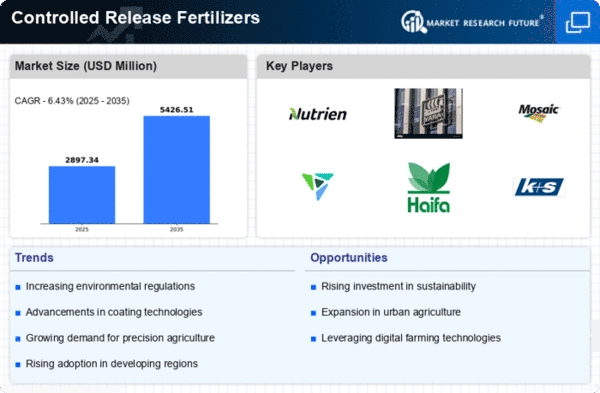
As per Market Research Future analysis, the Controlled-Release Fertilizers Market Size was estimated at 2722.3 USD Million in 2024. The Controlled-Release Fertilizers industry is projected to grow from 2928.54 USD Million in 2025 to 5426.51 USD Million by 2035, exhibiting a compound annual growth rate (CAGR) of 6.43% during the forecast period 2025 - 2035

Key Market Trends & Highlights

The Controlled Release Fertilizers is experiencing a robust shift towards sustainability and technological innovation.

  • The market is increasingly driven by a focus on sustainable agricultural practices, particularly in North America. Technological advancements in fertilizer production are enhancing the efficiency of controlled release fertilizers, especially in the Asia-Pacific region. Soil health awareness is rising, influencing both the agriculture and horticulture segments, with agriculture being the largest segment. Key market drivers include the increasing demand for sustainable agriculture and government initiatives supporting innovative fertilizer solutions.

Market Size & Forecast

2024 Market Size 2722.3 (USD Million)
2035 Market Size 5426.51 (USD Million)
CAGR (2025 - 2035) 6.43%
Largest Regional Market Share in 2024 North America

Major Players

<a href="https://www.nutrien.com/">Nutrien Ltd (CA)</a>, Yara International ASA (NO), The Mosaic Company (US), CF Industries Holdings, Inc. (US), Haifa Group (IL), K+S AG (DE), ICL Group Ltd (IL), BASF SE (DE), Fertiberia (ES)

Market Trends

The market for Controlled-Release Fertilizers is currently experiencing notable evolution, driven by increasing agricultural demands and a growing emphasis on sustainable practices. These fertilizers, designed to release nutrients gradually over time, offer a solution to the challenges of nutrient leaching and inefficient application. As farmers seek to optimize crop yields while minimizing environmental impact, Controlled-Release Fertilizers appear to provide a viable alternative to traditional fertilizers. The integration of advanced technologies in their formulation is likely to enhance their effectiveness, making them more appealing to a broader range of agricultural stakeholders.

Moreover, the rising awareness of soil health and the importance of nutrient management is influencing the adoption of Controlled-Release Fertilizers. This trend is further supported by regulatory frameworks that encourage sustainable farming practices. As the agricultural sector continues to evolve, the demand for innovative solutions that align with environmental stewardship is expected to grow. Consequently, Controlled-Release Fertilizers may play a pivotal role in shaping the future of agriculture, offering a pathway to improved productivity and sustainability in food production.

Sustainability Focus

The increasing emphasis on sustainable agriculture is driving the demand for Controlled-Release Fertilizers. These products help reduce nutrient runoff and enhance soil health, aligning with environmental goals.

Technological Advancements

Innovations in formulation and application technologies are enhancing the efficiency of Controlled-Release Fertilizers. These advancements may lead to improved nutrient delivery and reduced waste.

Regulatory Support

Government policies promoting sustainable farming practices are likely to bolster the market for Controlled-Release Fertilizers. Regulatory frameworks may encourage farmers to adopt these products for better compliance.

Controlled Release Fertilizers Market Drivers

Increasing Demand for Sustainable Agriculture

The Global Controlled-Release Fertilizers Industry is experiencing a notable shift towards sustainable agricultural practices. Farmers are increasingly adopting controlled-release fertilizers to enhance nutrient efficiency and minimize environmental impact. This trend aligns with global initiatives aimed at reducing chemical runoff and promoting soil health. As a result, the market is projected to reach 2.08 USD Billion in 2024, reflecting the growing preference for eco-friendly solutions. The emphasis on sustainability is likely to drive innovation in fertilizer formulations, further expanding the market's reach and appeal.

Market Segment Insights

By Application: Agriculture (Largest) vs. Horticulture (Fastest-Growing)

The Controlled-Release Fertilizers Market is primarily driven by the agriculture segment, which holds the largest share due to its extensive use in large-scale farming operations. This segment includes the use of fertilizers in crops like cereals and grains, where efficient nutrient delivery is critical. Meanwhile, the horticulture segment, which focuses on the growth of flowers, vegetables, and fruits, is experiencing rapid expansion as the demand for high-quality produce increases among consumers that prefer locally sourced and organic options.

Agriculture (Dominant) vs. Horticulture (Emerging)

The agriculture segment remains the dominant player in the Controlled-Release Fertilizers Market, primarily due to its integral role in enhancing crop yields and ensuring sustainable farming practices. The consistent increase in food demand globally forces farmers to seek reliable and effective methods to optimize crop production. Conversely, the horticulture segment is emerging as a significant player driven by the growing trend of urban gardening and the rise of recreational gardening activities. Horticulturists are increasingly adopting Controlled-Release fertilizers to meet precise nutrient requirements and improve plant health, further fueling growth in this segment.

By Formulation Type: Coated Fertilizers (Largest) vs. Encapsulated Fertilizers (Fastest-Growing)

In the Controlled-Release Fertilizers Market , Coated Fertilizers hold the largest market share due to their widespread adoption among farmers seeking cost-effective and efficient nutrient delivery. These fertilizers have gained significant traction in various agricultural sectors, especially in high-demand crops, owing to their proven effectiveness in enhancing yield. Encapsulated Fertilizers, while currently smaller in market share, are the fastest-growing category as they offer a more precise nutrient release profile that is highly appealing to precision agriculture practitioners.

Coated Fertilizers (Dominant) vs. Controlled-Release Granules (Emerging)

Coated Fertilizers dominate the Controlled-Release Fertilizers segment due to their ability to enhance nutrient efficiency while minimizing environmental impact. They are designed to gradually release nutrients, reducing the frequency of applications. On the other hand, Controlled-Release Granules are emerging as a noteworthy alternative; they provide a controlled nutrient supply that matches plant demand, making them increasingly popular in specialized farming applications. Both segments cater to different market needs, with Coated Fertilizers favored for their reliability and Controlled-Release Granules appealing for their innovative nutrient management capabilities.

By Nutrient Type: Nitrogen (Largest) vs. Micronutrients (Fastest-Growing)

In the Controlled-Release Fertilizers Market , nitrogen stands out as the largest nutrient type segment due to its vital role in plant growth and crop yield enhancement. It captures a significant portion of the market share, reflecting the strong demand from agricultural producers looking to optimize their fertilization strategies. Phosphorus and potassium are also important but command a smaller share compared to nitrogen, while micronutrients are gaining traction among farmers seeking to improve soil health and crop resilience. The growth trajectory of the nutrient type segment is driven by several factors, including the rising awareness of sustainable agricultural practices, increasing crop productivity needs, and the necessity to preserve soil quality. Among these, micronutrients are emerging as the fastest-growing segment, as more farmers recognize their importance in enhancing nutrient uptake and overall plant health. This is steering innovation and development towards more balanced fertilizer formulations that include essential micronutrients alongside traditional macronutrients like nitrogen, phosphorus, and potassium.

Nitrogen (Dominant) vs. Micronutrients (Emerging)

Nitrogen is the dominant nutrient type in the Controlled-Release Fertilizers Market , prized for its ability to promote vigorous plant growth and enhance photosynthesis. This nutrient type is critical for agricultural practices, particularly in crops that require a high amount of nitrogen for optimal yields. Additionally, the Controlled-Release formulation helps in reducing nitrogen leaching into the environment, addressing both crop needs and environmental concerns. Conversely, micronutrients, although smaller in share, are rapidly emerging due to their essential role in physiological functions within plants. They are crucial for enzymatic processes and overall crop health, leading to improved yield and quality. As farmers increasingly adopt integrated nutrient management practices, the demand for micronutrient-focused fertilizers is expected to surge.

By Distribution Channel: Retail Stores (Largest) vs. Online Sales (Fastest-Growing)

The distribution channels for Controlled-Release fertilizers exhibit noteworthy diversity, with retail stores holding the largest market share, primarily due to their established presence and accessibility for consumers. Online sales, while currently smaller in share, are rapidly gaining traction, thanks to the increasing preference for digital shopping options among consumers. Agricultural cooperatives and direct sales serve niche markets, with cooperatives offering products tailored to local farmers' needs, though they lag behind major retail channels in overall market share.

Retail Stores (Dominant) vs. Online Sales (Emerging)

Retail stores dominate the distribution landscape for Controlled-Release fertilizers, leveraging physical presence and customer trust to facilitate purchases. Their established networks allow consumers to access a wide range of products, complemented by expert advice from store personnel. On the other hand, online sales are emerging as a critical channel, fueled by the growing trend of e-commerce. This segment benefits from convenience, competitive pricing, and the ability to cater to a broader audience beyond geographical limitations. As more growers opt for online purchases, retailers must adapt their strategies to compete effectively, ensuring that digital platforms become integral to their sales channels.

By End User: Farmers (Largest) vs. Commercial Growers (Fastest-Growing)

In the Controlled-Release Fertilizers Market , the largest share is held by Farmers, who utilize these fertilizers to improve yield efficiency and crop quality. This segment represents a substantial portion of overall demand, largely due to the increasing emphasis on sustainable agriculture practices among smallholder and commercial agricultural operations alike. Meanwhile, Commercial Growers are emerging rapidly, leveraging Controlled-Release technologies to maximize their crop production capabilities and minimize nutrient loss, which is pushing this segment's growth to new heights. Growth trends within the End User segment are significantly influenced by an increasing awareness of sustainable agricultural practices and the need for efficient nutrient management solutions. Farmers, particularly in developing regions, are adopting Controlled-Release fertilizers to enhance soil health and crop output. Additionally, Commercial Growers are increasingly recognizing the benefits of these fertilizers in maintaining a competitive edge in the market, driving their rapid adoption and making them a noteworthy force in the segment's growth trajectory.

Farmers (Dominant) vs. Landscapers (Emerging)

In the Controlled-Release Fertilizers Market, Farmers stand as the dominant segment, utilizing these products primarily for row crops, which require sustained nutrient availability for optimum growth. This segment benefits from ongoing innovations in fertilizer technologies that enhance soil nutrient retention and reduce environmental impacts. Conversely, Landscapers represent an emerging segment, increasingly turning to Controlled-Release solutions to support ornamental plants and garden landscaping efforts. As urban greening initiatives and landscaping projects grow, Landscapers are adopting these fertilizers for their long-lasting effects and environmental benefits. This shift is indicative of a broader trend towards eco-friendly practices, positioning Landscapers as a key emerging player within the industry.

Get more detailed insights about Controlled-Release Fertilizers Market Research Report - Forecast till 2035

Regional Insights

North America : Market Leader in Fertilizers

North America is poised to maintain its leadership in the Controlled-Release Fertilizers Market, holding a significant share of 1360.0 million. The region's growth is driven by increasing agricultural productivity demands, technological advancements in fertilizer formulations, and supportive regulatory frameworks. The rising focus on sustainable farming practices further propels the adoption of Controlled-Release fertilizers, enhancing nutrient efficiency and reducing environmental impact. The United States and Canada are the primary contributors to this market, with key players like Nutrien, The Mosaic Company, and Agrium leading the charge. The competitive landscape is characterized by innovation and strategic partnerships aimed at enhancing product offerings. As farmers increasingly seek solutions that optimize yield while minimizing waste, the presence of established companies ensures a robust supply chain and market stability.

Europe : Sustainable Agriculture Focus

Europe's Controlled-Release Fertilizers Market is valued at 800.0 million, driven by stringent environmental regulations and a strong emphasis on sustainable agricultural practices. The European Union's Green Deal and Farm to Fork strategy are pivotal in promoting the use of innovative fertilizers that minimize environmental impact while maximizing crop yield. This regulatory support is crucial for the growth of Controlled-Release fertilizers, aligning with the region's commitment to sustainability. Leading countries such as Germany, France, and the Netherlands are at the forefront of this market, with key players like Yara International and K+S AG actively investing in research and development. The competitive landscape is marked by a shift towards organic and eco-friendly products, catering to the increasing consumer demand for sustainable food sources. This trend is expected to further enhance market growth in the coming years.

Asia-Pacific : Emerging Market Potential

The Asia-Pacific region, with a market size of 480.0 million, is witnessing rapid growth in the adoption of Controlled-Release fertilizers. This surge is primarily driven by the increasing need for food security due to rising populations and changing dietary preferences. Governments in countries like India and China are implementing policies to enhance agricultural productivity, which is catalyzing the demand for advanced fertilizer solutions that improve nutrient efficiency and reduce leaching. China and India are the leading countries in this market, with significant investments in agricultural technology and fertilizer innovations. Key players such as Haifa Group and ICL Group are expanding their presence in the region, focusing on tailored solutions that meet local agricultural needs. The competitive landscape is evolving, with a growing emphasis on research and development to create fertilizers that align with sustainable farming practices, ensuring long-term market viability.

Middle East and Africa : Resource-Rich Opportunities

The Middle East and Africa region, with a market size of 82.3 million, presents significant untapped potential for Controlled-Release fertilizers. The agricultural sector is increasingly recognized as a vital component for economic diversification, particularly in countries like South Africa and Morocco. The demand for efficient fertilizers is growing as farmers seek to enhance crop yields in arid and semi-arid climates, where water conservation is critical. Leading countries in this region are focusing on improving agricultural practices and investing in modern fertilizer technologies. The presence of key players like OCP Group and Fertiberia is crucial in driving market growth. The competitive landscape is characterized by a mix of local and international companies, all vying to provide innovative solutions that cater to the unique challenges faced by farmers in this region. As awareness of sustainable practices increases, the market for Controlled-Release fertilizers is expected to expand significantly.

Key Players and Competitive Insights

The market for Controlled Release Fertilizers is characterized by a dynamic competitive landscape, driven by increasing agricultural productivity demands and a growing emphasis on sustainable farming practices. Key players such as Nutrien Ltd (CA), Yara International ASA (NO), and The Mosaic Company (US) are strategically positioned to leverage innovation and technological advancements. Nutrien Ltd (CA) focuses on enhancing its product offerings through research and development, while Yara International ASA (NO) emphasizes digital solutions to optimize fertilizer application. The Mosaic Company (US) is actively pursuing partnerships to expand its market reach, collectively shaping a competitive environment that prioritizes efficiency and sustainability.In terms of business tactics, companies are increasingly localizing manufacturing to reduce transportation costs and enhance supply chain resilience. The market appears moderately fragmented, with several key players exerting influence over pricing and product availability. This structure allows for a diverse range of offerings, catering to various agricultural needs while fostering competition among established and emerging firms.
In November Yara International ASA (NO) announced a strategic partnership with a leading agtech firm to develop precision agriculture solutions that integrate controlled release fertilizers with real-time data analytics. This collaboration is poised to enhance crop yield and resource efficiency, reflecting a broader trend towards data-driven farming practices. The strategic importance of this move lies in its potential to position Yara as a frontrunner in the digital agriculture space, aligning with the industry's shift towards sustainability and efficiency.
In October 2025, The Mosaic Company (US) launched a new line of Controlled-Release fertilizers designed specifically for high-value crops. This initiative reflects a targeted approach to meet the needs of specialized agricultural sectors, potentially increasing Mosaic's market share in premium segments. By focusing on high-value crops, the company may not only enhance its revenue streams but also solidify its reputation as an innovator in the fertilizer industry.
In September 2025, Nutrien (CA) expanded its production capacity in North America, aiming to meet the rising global demand for Controlled-Release fertilizers. This expansion is indicative of Nutrien's commitment to scaling operations in response to market needs, which may enhance its competitive position. By increasing production capacity, Nutrien is likely to improve its supply chain reliability and responsiveness to customer demands, further solidifying its market leadership.
As of December 2025, the competitive trends in the Controlled-Release Fertilizers Market are increasingly defined by digitalization, sustainability, and the integration of AI technologies. Strategic alliances are becoming more prevalent, as companies recognize the value of collaboration in enhancing product offerings and market reach. The shift from price-based competition to a focus on innovation and technology is evident, suggesting that future competitive differentiation will hinge on the ability to deliver reliable, efficient, and sustainable solutions to the agricultural sector.

Key Companies in the Controlled Release Fertilizers include

Industry Developments

The Controlled-Release Fertilizers Market Trends is one of the advancements of the technique which has the highest reach and benefits. After the lockdown, the people are interested in getting the controlled–release fertilizer as this provides less harm to the human as well as to nature when compared to other fertilizers. Due to this heavy demand, the manufacturing companies are increasing their productivity to compensate for the need of the customer. In addition to this, they are planning to expand their business once they get the proper financial source.

Regional analysis

The dominating region in the Asia Pacific region in which there is the demand for food and the raw materials for the food. As there was rapid growth in the population so the demand for food was high. So the agricultural activities were also high. So this region is dominating region when compared to the other regions. The dominating countries are China, India, Japan etc.

The second place for holding the largest share in North America, as there were good agricultural technologies and good agricultural farming machines. So the second leading country in North America.

Controlled-release Fertilizers Market Segment Overview

Crop Type

  • Cereals & grains
  • Oilseeds & pulses
  • Fruits & vegetables
    • Plantation crops

Application Type

  • Foliar application
  • Fustigation
  • Other

Product Type

  • Coated & encapsulated
  • Nitrogen stabilizers (N-Stabilizers)

By Region

  • North America
  •  Europe
  • Asia-Pacific

Future Outlook

Controlled Release Fertilizers Future Outlook

The Controlled Release Fertilizers market is projected to grow at a 6.43% CAGR from 2025 to 2035, driven by increasing agricultural efficiency and sustainability demands. The future of the Controlled-Release Fertilizers Market is defined by precision nutrient delivery and the rapid adoption of biodegradable polymer coatings. Driven by stricter environmental regulations and the shift toward "smart" agriculture, the market is evolving through AI-integrated application and micro-encapsulated formulations to maximize yield while minimizing nitrogen leaching.

New opportunities lie in:

  • <p>Development of precision agriculture technologies for targeted nutrient delivery. Expansion into emerging markets with tailored product formulations. Partnerships with agri-tech firms for integrated nutrient management solutions.</p>

By 2035, the Controlled-Release Fertilizers Market  is expected to solidify its position as a leader in sustainable agricultural practices.

Market Segmentation

Controlled Release Fertilizers End User Outlook

  • Farmers
  • Commercial Growers
  • Landscapers
  • Government Agencies

Controlled Release Fertilizers Application Outlook

  • Agriculture
  • Horticulture
  • Turf Management
  • Forestry

Controlled Release Fertilizers Nutrient Type Outlook

  • Nitrogen
  • Phosphorus
  • Potassium
  • Micronutrients

Controlled Release Fertilizers Formulation Type Outlook

  • Coated Fertilizers
  • Encapsulated Fertilizers
  • Slow Release Fertilizers
  • Controlled Release Granules

Controlled Release Fertilizers Distribution Channel Outlook

  • Online Sales
  • Retail Stores
  • Agricultural Cooperatives
  • Direct Sales

Report Scope

MARKET SIZE 2024 2722.3(USD Million)
MARKET SIZE 2025 2928.54(USD Million)
MARKET SIZE 2035 5426.51(USD Million)
COMPOUND ANNUAL GROWTH RATE (CAGR) 6.43% (2025 - 2035)
REPORT COVERAGE Revenue Forecast, Competitive Landscape, Growth Factors, and Trends
BASE YEAR 2024
Market Forecast Period 2025 - 2035
Historical Data 2019 - 2024
Market Forecast Units USD Million
Key Companies Profiled Nutrien Ltd (CA), Yara International ASA (NO), The Mosaic Company (US), CF Industries Holdings, Inc. (US), Haifa Group (IL), K+S AG (DE), ICL Group Ltd (IL), BASF SE (DE), Fertiberia (ES)
Segments Covered Application, Formulation Type, Nutrient Type, Distribution Channel, End User
Key Market Opportunities Advancements in biodegradable materials enhance the sustainability of Controlled-Release Fertilizers.
Key Market Dynamics Rising demand for sustainable agriculture drives innovation in Controlled-Release Fertilizers and enhances competitive market dynamics.
Countries Covered North America, Europe, APAC, South America, MEA

FAQs

What is the current market valuation of Controlled Release Fertilizers?

<p>The market valuation of Controlled Release Fertilizers was 2722.3 USD Million in 2024.</p>

What is the projected market size for Controlled Release Fertilizers by 2035?

<p>The projected market size for Controlled Release Fertilizers is 5426.51 USD Million by 2035.</p>

What is the expected CAGR for Controlled Release Fertilizers from 2025 to 2035?

<p>The expected CAGR for Controlled Release Fertilizers during the forecast period 2025 - 2035 is 6.43%.</p>

Which companies are the key players in the Controlled Release Fertilizers market?

<p>Key players in the market include Nutrien, Yara International, The Mosaic Company, ICL Group, K+S AG, Haifa Group, Fertiberia, Agrium, and OCP Group.</p>

What are the main application segments for Controlled Release Fertilizers?

<p>The main application segments include Agriculture, Horticulture, Turf Management, and Forestry.</p>

How do the sales channels for Controlled Release Fertilizers break down?

<p>Sales channels for Controlled Release Fertilizers include Online Sales, Retail Stores, Agricultural Cooperatives, and Direct Sales.</p>

What are the different formulation types of Controlled Release Fertilizers?

Formulation types include Coated Fertilizers, Encapsulated Fertilizers, Slow Release Fertilizers, and Controlled Release Granules.

Which nutrient types are most commonly used in Controlled Release Fertilizers?

The most commonly used nutrient types are Nitrogen, Phosphorus, Potassium, and Micronutrients.

Who are the primary end users of Controlled Release Fertilizers?

Primary end users include Farmers, Commercial Growers, Landscapers, and Government Agencies.

What was the market valuation for the Agriculture segment in 2024?

The market valuation for the Agriculture segment was 1090.92 USD Million in 2024.

  1. SECTION I: EXECUTIVE SUMMARY AND KEY HIGHLIGHTS
    1. | 1.1 EXECUTIVE SUMMARY
    2. | | 1.1.1 Market Overview
    3. | | 1.1.2 Key Findings
    4. | | 1.1.3 Market Segmentation
    5. | | 1.1.4 Competitive Landscape
    6. | | 1.1.5 Challenges and Opportunities
    7. | | 1.1.6 Future Outlook
  2. SECTION II: SCOPING, METHODOLOGY AND MARKET STRUCTURE
    1. | 2.1 MARKET INTRODUCTION
    2. | | 2.1.1 Definition
    3. | | 2.1.2 Scope of the study
    4. | | | 2.1.2.1 Research Objective
    5. | | | 2.1.2.2 Assumption
    6. | | | 2.1.2.3 Limitations
    7. | 2.2 RESEARCH METHODOLOGY
    8. | | 2.2.1 Overview
    9. | | 2.2.2 Data Mining
    10. | | 2.2.3 Secondary Research
    11. | | 2.2.4 Primary Research
    12. | | | 2.2.4.1 Primary Interviews and Information Gathering Process
    13. | | | 2.2.4.2 Breakdown of Primary Respondents
    14. | | 2.2.5 Forecasting Model
    15. | | 2.2.6 Market Size Estimation
    16. | | | 2.2.6.1 Bottom-Up Approach
    17. | | | 2.2.6.2 Top-Down Approach
    18. | | 2.2.7 Data Triangulation
    19. | | 2.2.8 Validation
  3. SECTION III: QUALITATIVE ANALYSIS
    1. | 3.1 MARKET DYNAMICS
    2. | | 3.1.1 Overview
    3. | | 3.1.2 Drivers
    4. | | 3.1.3 Restraints
    5. | | 3.1.4 Opportunities
    6. | 3.2 MARKET FACTOR ANALYSIS
    7. | | 3.2.1 Value chain Analysis
    8. | | 3.2.2 Porter's Five Forces Analysis
    9. | | | 3.2.2.1 Bargaining Power of Suppliers
    10. | | | 3.2.2.2 Bargaining Power of Buyers
    11. | | | 3.2.2.3 Threat of New Entrants
    12. | | | 3.2.2.4 Threat of Substitutes
    13. | | | 3.2.2.5 Intensity of Rivalry
    14. | | 3.2.3 COVID-19 Impact Analysis
    15. | | | 3.2.3.1 Market Impact Analysis
    16. | | | 3.2.3.2 Regional Impact
    17. | | | 3.2.3.3 Opportunity and Threat Analysis
  4. SECTION IV: QUANTITATIVE ANALYSIS
    1. | 4.1 Life Sciences, BY Application (USD Million)
    2. | | 4.1.1 Agriculture
    3. | | 4.1.2 Horticulture
    4. | | 4.1.3 Turf Management
    5. | | 4.1.4 Forestry
    6. | 4.2 Life Sciences, BY Formulation Type (USD Million)
    7. | | 4.2.1 Coated Fertilizers
    8. | | 4.2.2 Encapsulated Fertilizers
    9. | | 4.2.3 Slow Release Fertilizers
    10. | | 4.2.4 Controlled Release Granules
    11. | 4.3 Life Sciences, BY Nutrient Type (USD Million)
    12. | | 4.3.1 Nitrogen
    13. | | 4.3.2 Phosphorus
    14. | | 4.3.3 Potassium
    15. | | 4.3.4 Micronutrients
    16. | 4.4 Life Sciences, BY Distribution Channel (USD Million)
    17. | | 4.4.1 Online Sales
    18. | | 4.4.2 Retail Stores
    19. | | 4.4.3 Agricultural Cooperatives
    20. | | 4.4.4 Direct Sales
    21. | 4.5 Life Sciences, BY End User (USD Million)
    22. | | 4.5.1 Farmers
    23. | | 4.5.2 Commercial Growers
    24. | | 4.5.3 Landscapers
    25. | | 4.5.4 Government Agencies
    26. | 4.6 Life Sciences, BY Region (USD Million)
    27. | | 4.6.1 North America
    28. | | | 4.6.1.1 US
    29. | | | 4.6.1.2 Canada
    30. | | 4.6.2 Europe
    31. | | | 4.6.2.1 Germany
    32. | | | 4.6.2.2 UK
    33. | | | 4.6.2.3 France
    34. | | | 4.6.2.4 Russia
    35. | | | 4.6.2.5 Italy
    36. | | | 4.6.2.6 Spain
    37. | | | 4.6.2.7 Rest of Europe
    38. | | 4.6.3 APAC
    39. | | | 4.6.3.1 China
    40. | | | 4.6.3.2 India
    41. | | | 4.6.3.3 Japan
    42. | | | 4.6.3.4 South Korea
    43. | | | 4.6.3.5 Malaysia
    44. | | | 4.6.3.6 Thailand
    45. | | | 4.6.3.7 Indonesia
    46. | | | 4.6.3.8 Rest of APAC
    47. | | 4.6.4 South America
    48. | | | 4.6.4.1 Brazil
    49. | | | 4.6.4.2 Mexico
    50. | | | 4.6.4.3 Argentina
    51. | | | 4.6.4.4 Rest of South America
    52. | | 4.6.5 MEA
    53. | | | 4.6.5.1 GCC Countries
    54. | | | 4.6.5.2 South Africa
    55. | | | 4.6.5.3 Rest of MEA
  5. SECTION V: COMPETITIVE ANALYSIS
    1. | 5.1 Competitive Landscape
    2. | | 5.1.1 Overview
    3. | | 5.1.2 Competitive Analysis
    4. | | 5.1.3 Market share Analysis
    5. | | 5.1.4 Major Growth Strategy in the Life Sciences
    6. | | 5.1.5 Competitive Benchmarking
    7. | | 5.1.6 Leading Players in Terms of Number of Developments in the Life Sciences
    8. | | 5.1.7 Key developments and growth strategies
    9. | | | 5.1.7.1 New Product Launch/Service Deployment
    10. | | | 5.1.7.2 Merger & Acquisitions
    11. | | | 5.1.7.3 Joint Ventures
    12. | | 5.1.8 Major Players Financial Matrix
    13. | | | 5.1.8.1 Sales and Operating Income
    14. | | | 5.1.8.2 Major Players R&D Expenditure. 2023
    15. | 5.2 Company Profiles
    16. | | 5.2.1 Nutrien (CA)
    17. | | | 5.2.1.1 Financial Overview
    18. | | | 5.2.1.2 Products Offered
    19. | | | 5.2.1.3 Key Developments
    20. | | | 5.2.1.4 SWOT Analysis
    21. | | | 5.2.1.5 Key Strategies
    22. | | 5.2.2 Yara International (NO)
    23. | | | 5.2.2.1 Financial Overview
    24. | | | 5.2.2.2 Products Offered
    25. | | | 5.2.2.3 Key Developments
    26. | | | 5.2.2.4 SWOT Analysis
    27. | | | 5.2.2.5 Key Strategies
    28. | | 5.2.3 The Mosaic Company (US)
    29. | | | 5.2.3.1 Financial Overview
    30. | | | 5.2.3.2 Products Offered
    31. | | | 5.2.3.3 Key Developments
    32. | | | 5.2.3.4 SWOT Analysis
    33. | | | 5.2.3.5 Key Strategies
    34. | | 5.2.4 ICL Group (IL)
    35. | | | 5.2.4.1 Financial Overview
    36. | | | 5.2.4.2 Products Offered
    37. | | | 5.2.4.3 Key Developments
    38. | | | 5.2.4.4 SWOT Analysis
    39. | | | 5.2.4.5 Key Strategies
    40. | | 5.2.5 K+S AG (DE)
    41. | | | 5.2.5.1 Financial Overview
    42. | | | 5.2.5.2 Products Offered
    43. | | | 5.2.5.3 Key Developments
    44. | | | 5.2.5.4 SWOT Analysis
    45. | | | 5.2.5.5 Key Strategies
    46. | | 5.2.6 Haifa Group (IL)
    47. | | | 5.2.6.1 Financial Overview
    48. | | | 5.2.6.2 Products Offered
    49. | | | 5.2.6.3 Key Developments
    50. | | | 5.2.6.4 SWOT Analysis
    51. | | | 5.2.6.5 Key Strategies
    52. | | 5.2.7 Fertiberia (ES)
    53. | | | 5.2.7.1 Financial Overview
    54. | | | 5.2.7.2 Products Offered
    55. | | | 5.2.7.3 Key Developments
    56. | | | 5.2.7.4 SWOT Analysis
    57. | | | 5.2.7.5 Key Strategies
    58. | | 5.2.8 Agrium (CA)
    59. | | | 5.2.8.1 Financial Overview
    60. | | | 5.2.8.2 Products Offered
    61. | | | 5.2.8.3 Key Developments
    62. | | | 5.2.8.4 SWOT Analysis
    63. | | | 5.2.8.5 Key Strategies
    64. | | 5.2.9 OCP Group (MA)
    65. | | | 5.2.9.1 Financial Overview
    66. | | | 5.2.9.2 Products Offered
    67. | | | 5.2.9.3 Key Developments
    68. | | | 5.2.9.4 SWOT Analysis
    69. | | | 5.2.9.5 Key Strategies
    70. | 5.3 Appendix
    71. | | 5.3.1 References
    72. | | 5.3.2 Related Reports
  6. LIST OF FIGURES
    1. | 6.1 MARKET SYNOPSIS
    2. | 6.2 NORTH AMERICA MARKET ANALYSIS
    3. | 6.3 US MARKET ANALYSIS BY APPLICATION
    4. | 6.4 US MARKET ANALYSIS BY FORMULATION TYPE
    5. | 6.5 US MARKET ANALYSIS BY NUTRIENT TYPE
    6. | 6.6 US MARKET ANALYSIS BY DISTRIBUTION CHANNEL
    7. | 6.7 US MARKET ANALYSIS BY END USER
    8. | 6.8 CANADA MARKET ANALYSIS BY APPLICATION
    9. | 6.9 CANADA MARKET ANALYSIS BY FORMULATION TYPE
    10. | 6.10 CANADA MARKET ANALYSIS BY NUTRIENT TYPE
    11. | 6.11 CANADA MARKET ANALYSIS BY DISTRIBUTION CHANNEL
    12. | 6.12 CANADA MARKET ANALYSIS BY END USER
    13. | 6.13 EUROPE MARKET ANALYSIS
    14. | 6.14 GERMANY MARKET ANALYSIS BY APPLICATION
    15. | 6.15 GERMANY MARKET ANALYSIS BY FORMULATION TYPE
    16. | 6.16 GERMANY MARKET ANALYSIS BY NUTRIENT TYPE
    17. | 6.17 GERMANY MARKET ANALYSIS BY DISTRIBUTION CHANNEL
    18. | 6.18 GERMANY MARKET ANALYSIS BY END USER
    19. | 6.19 UK MARKET ANALYSIS BY APPLICATION
    20. | 6.20 UK MARKET ANALYSIS BY FORMULATION TYPE
    21. | 6.21 UK MARKET ANALYSIS BY NUTRIENT TYPE
    22. | 6.22 UK MARKET ANALYSIS BY DISTRIBUTION CHANNEL
    23. | 6.23 UK MARKET ANALYSIS BY END USER
    24. | 6.24 FRANCE MARKET ANALYSIS BY APPLICATION
    25. | 6.25 FRANCE MARKET ANALYSIS BY FORMULATION TYPE
    26. | 6.26 FRANCE MARKET ANALYSIS BY NUTRIENT TYPE
    27. | 6.27 FRANCE MARKET ANALYSIS BY DISTRIBUTION CHANNEL
    28. | 6.28 FRANCE MARKET ANALYSIS BY END USER
    29. | 6.29 RUSSIA MARKET ANALYSIS BY APPLICATION
    30. | 6.30 RUSSIA MARKET ANALYSIS BY FORMULATION TYPE
    31. | 6.31 RUSSIA MARKET ANALYSIS BY NUTRIENT TYPE
    32. | 6.32 RUSSIA MARKET ANALYSIS BY DISTRIBUTION CHANNEL
    33. | 6.33 RUSSIA MARKET ANALYSIS BY END USER
    34. | 6.34 ITALY MARKET ANALYSIS BY APPLICATION
    35. | 6.35 ITALY MARKET ANALYSIS BY FORMULATION TYPE
    36. | 6.36 ITALY MARKET ANALYSIS BY NUTRIENT TYPE
    37. | 6.37 ITALY MARKET ANALYSIS BY DISTRIBUTION CHANNEL
    38. | 6.38 ITALY MARKET ANALYSIS BY END USER
    39. | 6.39 SPAIN MARKET ANALYSIS BY APPLICATION
    40. | 6.40 SPAIN MARKET ANALYSIS BY FORMULATION TYPE
    41. | 6.41 SPAIN MARKET ANALYSIS BY NUTRIENT TYPE
    42. | 6.42 SPAIN MARKET ANALYSIS BY DISTRIBUTION CHANNEL
    43. | 6.43 SPAIN MARKET ANALYSIS BY END USER
    44. | 6.44 REST OF EUROPE MARKET ANALYSIS BY APPLICATION
    45. | 6.45 REST OF EUROPE MARKET ANALYSIS BY FORMULATION TYPE
    46. | 6.46 REST OF EUROPE MARKET ANALYSIS BY NUTRIENT TYPE
    47. | 6.47 REST OF EUROPE MARKET ANALYSIS BY DISTRIBUTION CHANNEL
    48. | 6.48 REST OF EUROPE MARKET ANALYSIS BY END USER
    49. | 6.49 APAC MARKET ANALYSIS
    50. | 6.50 CHINA MARKET ANALYSIS BY APPLICATION
    51. | 6.51 CHINA MARKET ANALYSIS BY FORMULATION TYPE
    52. | 6.52 CHINA MARKET ANALYSIS BY NUTRIENT TYPE
    53. | 6.53 CHINA MARKET ANALYSIS BY DISTRIBUTION CHANNEL
    54. | 6.54 CHINA MARKET ANALYSIS BY END USER
    55. | 6.55 INDIA MARKET ANALYSIS BY APPLICATION
    56. | 6.56 INDIA MARKET ANALYSIS BY FORMULATION TYPE
    57. | 6.57 INDIA MARKET ANALYSIS BY NUTRIENT TYPE
    58. | 6.58 INDIA MARKET ANALYSIS BY DISTRIBUTION CHANNEL
    59. | 6.59 INDIA MARKET ANALYSIS BY END USER
    60. | 6.60 JAPAN MARKET ANALYSIS BY APPLICATION
    61. | 6.61 JAPAN MARKET ANALYSIS BY FORMULATION TYPE
    62. | 6.62 JAPAN MARKET ANALYSIS BY NUTRIENT TYPE
    63. | 6.63 JAPAN MARKET ANALYSIS BY DISTRIBUTION CHANNEL
    64. | 6.64 JAPAN MARKET ANALYSIS BY END USER
    65. | 6.65 SOUTH KOREA MARKET ANALYSIS BY APPLICATION
    66. | 6.66 SOUTH KOREA MARKET ANALYSIS BY FORMULATION TYPE
    67. | 6.67 SOUTH KOREA MARKET ANALYSIS BY NUTRIENT TYPE
    68. | 6.68 SOUTH KOREA MARKET ANALYSIS BY DISTRIBUTION CHANNEL
    69. | 6.69 SOUTH KOREA MARKET ANALYSIS BY END USER
    70. | 6.70 MALAYSIA MARKET ANALYSIS BY APPLICATION
    71. | 6.71 MALAYSIA MARKET ANALYSIS BY FORMULATION TYPE
    72. | 6.72 MALAYSIA MARKET ANALYSIS BY NUTRIENT TYPE
    73. | 6.73 MALAYSIA MARKET ANALYSIS BY DISTRIBUTION CHANNEL
    74. | 6.74 MALAYSIA MARKET ANALYSIS BY END USER
    75. | 6.75 THAILAND MARKET ANALYSIS BY APPLICATION
    76. | 6.76 THAILAND MARKET ANALYSIS BY FORMULATION TYPE
    77. | 6.77 THAILAND MARKET ANALYSIS BY NUTRIENT TYPE
    78. | 6.78 THAILAND MARKET ANALYSIS BY DISTRIBUTION CHANNEL
    79. | 6.79 THAILAND MARKET ANALYSIS BY END USER
    80. | 6.80 INDONESIA MARKET ANALYSIS BY APPLICATION
    81. | 6.81 INDONESIA MARKET ANALYSIS BY FORMULATION TYPE
    82. | 6.82 INDONESIA MARKET ANALYSIS BY NUTRIENT TYPE
    83. | 6.83 INDONESIA MARKET ANALYSIS BY DISTRIBUTION CHANNEL
    84. | 6.84 INDONESIA MARKET ANALYSIS BY END USER
    85. | 6.85 REST OF APAC MARKET ANALYSIS BY APPLICATION
    86. | 6.86 REST OF APAC MARKET ANALYSIS BY FORMULATION TYPE
    87. | 6.87 REST OF APAC MARKET ANALYSIS BY NUTRIENT TYPE
    88. | 6.88 REST OF APAC MARKET ANALYSIS BY DISTRIBUTION CHANNEL
    89. | 6.89 REST OF APAC MARKET ANALYSIS BY END USER
    90. | 6.90 SOUTH AMERICA MARKET ANALYSIS
    91. | 6.91 BRAZIL MARKET ANALYSIS BY APPLICATION
    92. | 6.92 BRAZIL MARKET ANALYSIS BY FORMULATION TYPE
    93. | 6.93 BRAZIL MARKET ANALYSIS BY NUTRIENT TYPE
    94. | 6.94 BRAZIL MARKET ANALYSIS BY DISTRIBUTION CHANNEL
    95. | 6.95 BRAZIL MARKET ANALYSIS BY END USER
    96. | 6.96 MEXICO MARKET ANALYSIS BY APPLICATION
    97. | 6.97 MEXICO MARKET ANALYSIS BY FORMULATION TYPE
    98. | 6.98 MEXICO MARKET ANALYSIS BY NUTRIENT TYPE
    99. | 6.99 MEXICO MARKET ANALYSIS BY DISTRIBUTION CHANNEL
    100. | 6.100 MEXICO MARKET ANALYSIS BY END USER
    101. | 6.101 ARGENTINA MARKET ANALYSIS BY APPLICATION
    102. | 6.102 ARGENTINA MARKET ANALYSIS BY FORMULATION TYPE
    103. | 6.103 ARGENTINA MARKET ANALYSIS BY NUTRIENT TYPE
    104. | 6.104 ARGENTINA MARKET ANALYSIS BY DISTRIBUTION CHANNEL
    105. | 6.105 ARGENTINA MARKET ANALYSIS BY END USER
    106. | 6.106 REST OF SOUTH AMERICA MARKET ANALYSIS BY APPLICATION
    107. | 6.107 REST OF SOUTH AMERICA MARKET ANALYSIS BY FORMULATION TYPE
    108. | 6.108 REST OF SOUTH AMERICA MARKET ANALYSIS BY NUTRIENT TYPE
    109. | 6.109 REST OF SOUTH AMERICA MARKET ANALYSIS BY DISTRIBUTION CHANNEL
    110. | 6.110 REST OF SOUTH AMERICA MARKET ANALYSIS BY END USER
    111. | 6.111 MEA MARKET ANALYSIS
    112. | 6.112 GCC COUNTRIES MARKET ANALYSIS BY APPLICATION
    113. | 6.113 GCC COUNTRIES MARKET ANALYSIS BY FORMULATION TYPE
    114. | 6.114 GCC COUNTRIES MARKET ANALYSIS BY NUTRIENT TYPE
    115. | 6.115 GCC COUNTRIES MARKET ANALYSIS BY DISTRIBUTION CHANNEL
    116. | 6.116 GCC COUNTRIES MARKET ANALYSIS BY END USER
    117. | 6.117 SOUTH AFRICA MARKET ANALYSIS BY APPLICATION
    118. | 6.118 SOUTH AFRICA MARKET ANALYSIS BY FORMULATION TYPE
    119. | 6.119 SOUTH AFRICA MARKET ANALYSIS BY NUTRIENT TYPE
    120. | 6.120 SOUTH AFRICA MARKET ANALYSIS BY DISTRIBUTION CHANNEL
    121. | 6.121 SOUTH AFRICA MARKET ANALYSIS BY END USER
    122. | 6.122 REST OF MEA MARKET ANALYSIS BY APPLICATION
    123. | 6.123 REST OF MEA MARKET ANALYSIS BY FORMULATION TYPE
    124. | 6.124 REST OF MEA MARKET ANALYSIS BY NUTRIENT TYPE
    125. | 6.125 REST OF MEA MARKET ANALYSIS BY DISTRIBUTION CHANNEL
    126. | 6.126 REST OF MEA MARKET ANALYSIS BY END USER
    127. | 6.127 KEY BUYING CRITERIA OF LIFE SCIENCES
    128. | 6.128 RESEARCH PROCESS OF MRFR
    129. | 6.129 DRO ANALYSIS OF LIFE SCIENCES
    130. | 6.130 DRIVERS IMPACT ANALYSIS: LIFE SCIENCES
    131. | 6.131 RESTRAINTS IMPACT ANALYSIS: LIFE SCIENCES
    132. | 6.132 SUPPLY / VALUE CHAIN: LIFE SCIENCES
    133. | 6.133 LIFE SCIENCES, BY APPLICATION, 2024 (% SHARE)
    134. | 6.134 LIFE SCIENCES, BY APPLICATION, 2024 TO 2035 (USD Million)
    135. | 6.135 LIFE SCIENCES, BY FORMULATION TYPE, 2024 (% SHARE)
    136. | 6.136 LIFE SCIENCES, BY FORMULATION TYPE, 2024 TO 2035 (USD Million)
    137. | 6.137 LIFE SCIENCES, BY NUTRIENT TYPE, 2024 (% SHARE)
    138. | 6.138 LIFE SCIENCES, BY NUTRIENT TYPE, 2024 TO 2035 (USD Million)
    139. | 6.139 LIFE SCIENCES, BY DISTRIBUTION CHANNEL, 2024 (% SHARE)
    140. | 6.140 LIFE SCIENCES, BY DISTRIBUTION CHANNEL, 2024 TO 2035 (USD Million)
    141. | 6.141 LIFE SCIENCES, BY END USER, 2024 (% SHARE)
    142. | 6.142 LIFE SCIENCES, BY END USER, 2024 TO 2035 (USD Million)
    143. | 6.143 BENCHMARKING OF MAJOR COMPETITORS
  7. LIST OF TABLES
    1. | 7.1 LIST OF ASSUMPTIONS
    2. | | 7.1.1
    3. | 7.2 North America MARKET SIZE ESTIMATES; FORECAST
    4. | | 7.2.1 BY APPLICATION, 2025-2035 (USD Million)
    5. | | 7.2.2 BY FORMULATION TYPE, 2025-2035 (USD Million)
    6. | | 7.2.3 BY NUTRIENT TYPE, 2025-2035 (USD Million)
    7. | | 7.2.4 BY DISTRIBUTION CHANNEL, 2025-2035 (USD Million)
    8. | | 7.2.5 BY END USER, 2025-2035 (USD Million)
    9. | 7.3 US MARKET SIZE ESTIMATES; FORECAST
    10. | | 7.3.1 BY APPLICATION, 2025-2035 (USD Million)
    11. | | 7.3.2 BY FORMULATION TYPE, 2025-2035 (USD Million)
    12. | | 7.3.3 BY NUTRIENT TYPE, 2025-2035 (USD Million)
    13. | | 7.3.4 BY DISTRIBUTION CHANNEL, 2025-2035 (USD Million)
    14. | | 7.3.5 BY END USER, 2025-2035 (USD Million)
    15. | 7.4 Canada MARKET SIZE ESTIMATES; FORECAST
    16. | | 7.4.1 BY APPLICATION, 2025-2035 (USD Million)
    17. | | 7.4.2 BY FORMULATION TYPE, 2025-2035 (USD Million)
    18. | | 7.4.3 BY NUTRIENT TYPE, 2025-2035 (USD Million)
    19. | | 7.4.4 BY DISTRIBUTION CHANNEL, 2025-2035 (USD Million)
    20. | | 7.4.5 BY END USER, 2025-2035 (USD Million)
    21. | 7.5 Europe MARKET SIZE ESTIMATES; FORECAST
    22. | | 7.5.1 BY APPLICATION, 2025-2035 (USD Million)
    23. | | 7.5.2 BY FORMULATION TYPE, 2025-2035 (USD Million)
    24. | | 7.5.3 BY NUTRIENT TYPE, 2025-2035 (USD Million)
    25. | | 7.5.4 BY DISTRIBUTION CHANNEL, 2025-2035 (USD Million)
    26. | | 7.5.5 BY END USER, 2025-2035 (USD Million)
    27. | 7.6 Germany MARKET SIZE ESTIMATES; FORECAST
    28. | | 7.6.1 BY APPLICATION, 2025-2035 (USD Million)
    29. | | 7.6.2 BY FORMULATION TYPE, 2025-2035 (USD Million)
    30. | | 7.6.3 BY NUTRIENT TYPE, 2025-2035 (USD Million)
    31. | | 7.6.4 BY DISTRIBUTION CHANNEL, 2025-2035 (USD Million)
    32. | | 7.6.5 BY END USER, 2025-2035 (USD Million)
    33. | 7.7 UK MARKET SIZE ESTIMATES; FORECAST
    34. | | 7.7.1 BY APPLICATION, 2025-2035 (USD Million)
    35. | | 7.7.2 BY FORMULATION TYPE, 2025-2035 (USD Million)
    36. | | 7.7.3 BY NUTRIENT TYPE, 2025-2035 (USD Million)
    37. | | 7.7.4 BY DISTRIBUTION CHANNEL, 2025-2035 (USD Million)
    38. | | 7.7.5 BY END USER, 2025-2035 (USD Million)
    39. | 7.8 France MARKET SIZE ESTIMATES; FORECAST
    40. | | 7.8.1 BY APPLICATION, 2025-2035 (USD Million)
    41. | | 7.8.2 BY FORMULATION TYPE, 2025-2035 (USD Million)
    42. | | 7.8.3 BY NUTRIENT TYPE, 2025-2035 (USD Million)
    43. | | 7.8.4 BY DISTRIBUTION CHANNEL, 2025-2035 (USD Million)
    44. | | 7.8.5 BY END USER, 2025-2035 (USD Million)
    45. | 7.9 Russia MARKET SIZE ESTIMATES; FORECAST
    46. | | 7.9.1 BY APPLICATION, 2025-2035 (USD Million)
    47. | | 7.9.2 BY FORMULATION TYPE, 2025-2035 (USD Million)
    48. | | 7.9.3 BY NUTRIENT TYPE, 2025-2035 (USD Million)
    49. | | 7.9.4 BY DISTRIBUTION CHANNEL, 2025-2035 (USD Million)
    50. | | 7.9.5 BY END USER, 2025-2035 (USD Million)
    51. | 7.10 Italy MARKET SIZE ESTIMATES; FORECAST
    52. | | 7.10.1 BY APPLICATION, 2025-2035 (USD Million)
    53. | | 7.10.2 BY FORMULATION TYPE, 2025-2035 (USD Million)
    54. | | 7.10.3 BY NUTRIENT TYPE, 2025-2035 (USD Million)
    55. | | 7.10.4 BY DISTRIBUTION CHANNEL, 2025-2035 (USD Million)
    56. | | 7.10.5 BY END USER, 2025-2035 (USD Million)
    57. | 7.11 Spain MARKET SIZE ESTIMATES; FORECAST
    58. | | 7.11.1 BY APPLICATION, 2025-2035 (USD Million)
    59. | | 7.11.2 BY FORMULATION TYPE, 2025-2035 (USD Million)
    60. | | 7.11.3 BY NUTRIENT TYPE, 2025-2035 (USD Million)
    61. | | 7.11.4 BY DISTRIBUTION CHANNEL, 2025-2035 (USD Million)
    62. | | 7.11.5 BY END USER, 2025-2035 (USD Million)
    63. | 7.12 Rest of Europe MARKET SIZE ESTIMATES; FORECAST
    64. | | 7.12.1 BY APPLICATION, 2025-2035 (USD Million)
    65. | | 7.12.2 BY FORMULATION TYPE, 2025-2035 (USD Million)
    66. | | 7.12.3 BY NUTRIENT TYPE, 2025-2035 (USD Million)
    67. | | 7.12.4 BY DISTRIBUTION CHANNEL, 2025-2035 (USD Million)
    68. | | 7.12.5 BY END USER, 2025-2035 (USD Million)
    69. | 7.13 APAC MARKET SIZE ESTIMATES; FORECAST
    70. | | 7.13.1 BY APPLICATION, 2025-2035 (USD Million)
    71. | | 7.13.2 BY FORMULATION TYPE, 2025-2035 (USD Million)
    72. | | 7.13.3 BY NUTRIENT TYPE, 2025-2035 (USD Million)
    73. | | 7.13.4 BY DISTRIBUTION CHANNEL, 2025-2035 (USD Million)
    74. | | 7.13.5 BY END USER, 2025-2035 (USD Million)
    75. | 7.14 China MARKET SIZE ESTIMATES; FORECAST
    76. | | 7.14.1 BY APPLICATION, 2025-2035 (USD Million)
    77. | | 7.14.2 BY FORMULATION TYPE, 2025-2035 (USD Million)
    78. | | 7.14.3 BY NUTRIENT TYPE, 2025-2035 (USD Million)
    79. | | 7.14.4 BY DISTRIBUTION CHANNEL, 2025-2035 (USD Million)
    80. | | 7.14.5 BY END USER, 2025-2035 (USD Million)
    81. | 7.15 India MARKET SIZE ESTIMATES; FORECAST
    82. | | 7.15.1 BY APPLICATION, 2025-2035 (USD Million)
    83. | | 7.15.2 BY FORMULATION TYPE, 2025-2035 (USD Million)
    84. | | 7.15.3 BY NUTRIENT TYPE, 2025-2035 (USD Million)
    85. | | 7.15.4 BY DISTRIBUTION CHANNEL, 2025-2035 (USD Million)
    86. | | 7.15.5 BY END USER, 2025-2035 (USD Million)
    87. | 7.16 Japan MARKET SIZE ESTIMATES; FORECAST
    88. | | 7.16.1 BY APPLICATION, 2025-2035 (USD Million)
    89. | | 7.16.2 BY FORMULATION TYPE, 2025-2035 (USD Million)
    90. | | 7.16.3 BY NUTRIENT TYPE, 2025-2035 (USD Million)
    91. | | 7.16.4 BY DISTRIBUTION CHANNEL, 2025-2035 (USD Million)
    92. | | 7.16.5 BY END USER, 2025-2035 (USD Million)
    93. | 7.17 South Korea MARKET SIZE ESTIMATES; FORECAST
    94. | | 7.17.1 BY APPLICATION, 2025-2035 (USD Million)
    95. | | 7.17.2 BY FORMULATION TYPE, 2025-2035 (USD Million)
    96. | | 7.17.3 BY NUTRIENT TYPE, 2025-2035 (USD Million)
    97. | | 7.17.4 BY DISTRIBUTION CHANNEL, 2025-2035 (USD Million)
    98. | | 7.17.5 BY END USER, 2025-2035 (USD Million)
    99. | 7.18 Malaysia MARKET SIZE ESTIMATES; FORECAST
    100. | | 7.18.1 BY APPLICATION, 2025-2035 (USD Million)
    101. | | 7.18.2 BY FORMULATION TYPE, 2025-2035 (USD Million)
    102. | | 7.18.3 BY NUTRIENT TYPE, 2025-2035 (USD Million)
    103. | | 7.18.4 BY DISTRIBUTION CHANNEL, 2025-2035 (USD Million)
    104. | | 7.18.5 BY END USER, 2025-2035 (USD Million)
    105. | 7.19 Thailand MARKET SIZE ESTIMATES; FORECAST
    106. | | 7.19.1 BY APPLICATION, 2025-2035 (USD Million)
    107. | | 7.19.2 BY FORMULATION TYPE, 2025-2035 (USD Million)
    108. | | 7.19.3 BY NUTRIENT TYPE, 2025-2035 (USD Million)
    109. | | 7.19.4 BY DISTRIBUTION CHANNEL, 2025-2035 (USD Million)
    110. | | 7.19.5 BY END USER, 2025-2035 (USD Million)
    111. | 7.20 Indonesia MARKET SIZE ESTIMATES; FORECAST
    112. | | 7.20.1 BY APPLICATION, 2025-2035 (USD Million)
    113. | | 7.20.2 BY FORMULATION TYPE, 2025-2035 (USD Million)
    114. | | 7.20.3 BY NUTRIENT TYPE, 2025-2035 (USD Million)
    115. | | 7.20.4 BY DISTRIBUTION CHANNEL, 2025-2035 (USD Million)
    116. | | 7.20.5 BY END USER, 2025-2035 (USD Million)
    117. | 7.21 Rest of APAC MARKET SIZE ESTIMATES; FORECAST
    118. | | 7.21.1 BY APPLICATION, 2025-2035 (USD Million)
    119. | | 7.21.2 BY FORMULATION TYPE, 2025-2035 (USD Million)
    120. | | 7.21.3 BY NUTRIENT TYPE, 2025-2035 (USD Million)
    121. | | 7.21.4 BY DISTRIBUTION CHANNEL, 2025-2035 (USD Million)
    122. | | 7.21.5 BY END USER, 2025-2035 (USD Million)
    123. | 7.22 South America MARKET SIZE ESTIMATES; FORECAST
    124. | | 7.22.1 BY APPLICATION, 2025-2035 (USD Million)
    125. | | 7.22.2 BY FORMULATION TYPE, 2025-2035 (USD Million)
    126. | | 7.22.3 BY NUTRIENT TYPE, 2025-2035 (USD Million)
    127. | | 7.22.4 BY DISTRIBUTION CHANNEL, 2025-2035 (USD Million)
    128. | | 7.22.5 BY END USER, 2025-2035 (USD Million)
    129. | 7.23 Brazil MARKET SIZE ESTIMATES; FORECAST
    130. | | 7.23.1 BY APPLICATION, 2025-2035 (USD Million)
    131. | | 7.23.2 BY FORMULATION TYPE, 2025-2035 (USD Million)
    132. | | 7.23.3 BY NUTRIENT TYPE, 2025-2035 (USD Million)
    133. | | 7.23.4 BY DISTRIBUTION CHANNEL, 2025-2035 (USD Million)
    134. | | 7.23.5 BY END USER, 2025-2035 (USD Million)
    135. | 7.24 Mexico MARKET SIZE ESTIMATES; FORECAST
    136. | | 7.24.1 BY APPLICATION, 2025-2035 (USD Million)
    137. | | 7.24.2 BY FORMULATION TYPE, 2025-2035 (USD Million)
    138. | | 7.24.3 BY NUTRIENT TYPE, 2025-2035 (USD Million)
    139. | | 7.24.4 BY DISTRIBUTION CHANNEL, 2025-2035 (USD Million)
    140. | | 7.24.5 BY END USER, 2025-2035 (USD Million)
    141. | 7.25 Argentina MARKET SIZE ESTIMATES; FORECAST
    142. | | 7.25.1 BY APPLICATION, 2025-2035 (USD Million)
    143. | | 7.25.2 BY FORMULATION TYPE, 2025-2035 (USD Million)
    144. | | 7.25.3 BY NUTRIENT TYPE, 2025-2035 (USD Million)
    145. | | 7.25.4 BY DISTRIBUTION CHANNEL, 2025-2035 (USD Million)
    146. | | 7.25.5 BY END USER, 2025-2035 (USD Million)
    147. | 7.26 Rest of South America MARKET SIZE ESTIMATES; FORECAST
    148. | | 7.26.1 BY APPLICATION, 2025-2035 (USD Million)
    149. | | 7.26.2 BY FORMULATION TYPE, 2025-2035 (USD Million)
    150. | | 7.26.3 BY NUTRIENT TYPE, 2025-2035 (USD Million)
    151. | | 7.26.4 BY DISTRIBUTION CHANNEL, 2025-2035 (USD Million)
    152. | | 7.26.5 BY END USER, 2025-2035 (USD Million)
    153. | 7.27 MEA MARKET SIZE ESTIMATES; FORECAST
    154. | | 7.27.1 BY APPLICATION, 2025-2035 (USD Million)
    155. | | 7.27.2 BY FORMULATION TYPE, 2025-2035 (USD Million)
    156. | | 7.27.3 BY NUTRIENT TYPE, 2025-2035 (USD Million)
    157. | | 7.27.4 BY DISTRIBUTION CHANNEL, 2025-2035 (USD Million)
    158. | | 7.27.5 BY END USER, 2025-2035 (USD Million)
    159. | 7.28 GCC Countries MARKET SIZE ESTIMATES; FORECAST
    160. | | 7.28.1 BY APPLICATION, 2025-2035 (USD Million)
    161. | | 7.28.2 BY FORMULATION TYPE, 2025-2035 (USD Million)
    162. | | 7.28.3 BY NUTRIENT TYPE, 2025-2035 (USD Million)
    163. | | 7.28.4 BY DISTRIBUTION CHANNEL, 2025-2035 (USD Million)
    164. | | 7.28.5 BY END USER, 2025-2035 (USD Million)
    165. | 7.29 South Africa MARKET SIZE ESTIMATES; FORECAST
    166. | | 7.29.1 BY APPLICATION, 2025-2035 (USD Million)
    167. | | 7.29.2 BY FORMULATION TYPE, 2025-2035 (USD Million)
    168. | | 7.29.3 BY NUTRIENT TYPE, 2025-2035 (USD Million)
    169. | | 7.29.4 BY DISTRIBUTION CHANNEL, 2025-2035 (USD Million)
    170. | | 7.29.5 BY END USER, 2025-2035 (USD Million)
    171. | 7.30 Rest of MEA MARKET SIZE ESTIMATES; FORECAST
    172. | | 7.30.1 BY APPLICATION, 2025-2035 (USD Million)
    173. | | 7.30.2 BY FORMULATION TYPE, 2025-2035 (USD Million)
    174. | | 7.30.3 BY NUTRIENT TYPE, 2025-2035 (USD Million)
    175. | | 7.30.4 BY DISTRIBUTION CHANNEL, 2025-2035 (USD Million)
    176. | | 7.30.5 BY END USER, 2025-2035 (USD Million)
    177. | 7.31 PRODUCT LAUNCH/PRODUCT DEVELOPMENT/APPROVAL
    178. | | 7.31.1
    179. | 7.32 ACQUISITION/PARTNERSHIP
    180. | | 7.32.1

Life Sciences Market Segmentation

Life Sciences By Application (USD Million, 2025-2035)

  • Agriculture
  • Horticulture
  • Turf Management
  • Forestry

Life Sciences By Formulation Type (USD Million, 2025-2035)

  • Coated Fertilizers
  • Encapsulated Fertilizers
  • Slow Release Fertilizers
  • Controlled Release Granules

Life Sciences By Nutrient Type (USD Million, 2025-2035)

  • Nitrogen
  • Phosphorus
  • Potassium
  • Micronutrients

Life Sciences By Distribution Channel (USD Million, 2025-2035)

  • Online Sales
  • Retail Stores
  • Agricultural Cooperatives
  • Direct Sales

Life Sciences By End User (USD Million, 2025-2035)

  • Farmers
  • Commercial Growers
  • Landscapers
  • Government Agencies
Infographic

Free Sample Request

Kindly complete the form below to receive a free sample of this Report

Get Free Sample

Customer Strories

Compare Licence

×
Features License Type
Single User Multiuser License Enterprise User
Price $4,950 $5,950 $7,250
Maximum User Access Limit 1 User Upto 10 Users Unrestricted Access Throughout the Organization
Free Customization
Direct Access to Analyst
Deliverable Format
Platform Access
Discount on Next Purchase 10% 15% 15%
Printable Versions