×
Request Free Sample ×

Kindly complete the form below to receive a free sample of this Report

* Please use a valid business email

Leading companies partner with us for data-driven Insights

clients tt-cursor
Hero Background
English
Chinese
French
Japanese
Korean
German
Spanish

Controlled Release Fertilizers Analysis

ID: MRFR/Agri/4540-HCR
128 Pages
Tejas Chaudhary
October 2025

Controlled-release Fertilizers Market Size, Share, Industry Trend & Analysis Research Report Information by Technology (Coating and Encapsulation), Form (Liquid, Granular and Powder), Mode of Application (Dibbling, Foliar and other) and Region (North America, Europe, Asia-Pacific and Rest of the World) - Forecast till 2032

Share:
Download PDF ×

We do not share your information with anyone. However, we may send you emails based on your report interest from time to time. You may contact us at any time to opt-out.

Controlled Release Fertilizers Infographic
×
Controlled Release Fertilizers Infographic Full View
Purchase Options

Market Analysis

In-depth Analysis of Controlled Release Fertilizers Industry Landscape

Controlled-release fertilizers market size and dynamics are significantly influenced by various factors that collectively determine them. One primary factor driving this market's growth is the growing population globally. The world population continues to grow at an alarming rate, hence increasing food consumption and raising the need for improved agricultural productivity. Environmental concerns, together with the need for sustainable agriculture practices, also form crucial factors in determining the shape of controlled-release fertilizers markets. As more knowledge about the negative impacts conventional fertilizers cause to water and soil increases, the use of eco-friendly and sustainable agricultural inputs continues to take root. Controlled-release fertilizers present a solution that lowers the risk of nutrient runoff and leaching, thus reducing their environmental impact. The market size of controlled-release fertilizers is also determined by the economic landscape and farmer preferences. Despite the fact that initially, controlled-release fertilizers may have a higher price than traditional ones, they sometimes lead to cost savings over the entire growing season because they are more efficient and have lasting effects. Technological developments also influence the dynamics of the controlled-release fertilizers market in the agriculture sector in general and the fertilizer industry in particular: vast numbers of patents have been registered within the last decade. Current research and developments concentrate on increasing the efficiency of these fertilizers so that they are more effective in delivering nutrients to plants. Polymer coatings encapsulation technology, among others, is being used to enhance Controlled-release mechanisms, thereby ensuring that there's a continuous flow of plant nutrients. Global eating trends and taste trends also influence the market for controlled-release fertilizers. The farmers are left with no other option but to adopt advanced agricultural practices aimed at meeting the expectations of consumers who demand different crops as well as high-quality foods. Therefore, consumers' evolving preferences can be met if farmers use controlled-release fertilizers, which improve the nutrient content and crop quality. In particular, this has been driven by various factors like population growth, environmental concerns, economic considerations, technological advancements, and changing consumer preferences, among others. It is expected that these will boost the market size of controlled-release fertilizers; thus, it is anticipated to hit USD 3.09 billion in 2027, registering a CAGR of 6.53% during the forecast period ranging from 2020 up to 2027.


Author
Tejas Chaudhary
Research Analyst Level II

I have a degree in Engineering (Civil), with masters in Business Administration (Marketing). With more than 4 years of experience in market research and consulting, I am involved in end-to-end process of market research, proposals, project kickoffs and delivery. I have research knowledge and expertise in consumer goods/packaging domain. Also I have worked for various other domains like construction & equipment. Effectively managed and delivered more than 60 report studies for regional as well as global clientele.

Leave a Comment

FAQs

What is the previous valuation of the global controlled-release fertilizers industry?

controlled-release fertilizers market value was USD 3.58 billion by 2032.

What is the growth rate of the global controlled-release fertilizers industry?

controlled-release fertilizers market is expected to thrive at a CAGR of 7.02% from 2024 to 2032.

What is the major driver of the global controlled-release fertilizers?

Development of high-efficiency fertilizers which can minimize the loss of nutrients is the major driver of the global controlled-release fertilizers market.

What factors restrain the global controlled-release fertilizers industry?

Lack of skilled laborers and presence of counterfeit products can hamper the global controlled-release fertilizers market growth.

Which region can dominate in the global controlled-release fertilizers industry?

The APAC region can dominate the global controlled-release fertilizers market due to adoption of modern agricultural practices.

Name the notable players of the global controlled-release fertilizers industry?

Agrium, Scottsmiracle-Gro, Helena Chemical, Yara International, Jcam Agri., Haifa Chemicals Ltd, Compo Expert GmbH, SQM, Kingenta, Koch Industries, ICL, and BASF SE are major players of the global controlled-release fertilizers market.

Market Summary

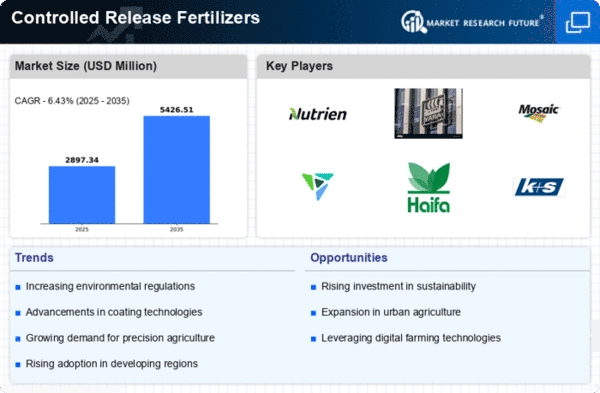
As per MRFR analysis, the Controlled Release Fertilizers Size was estimated at 2722.3 USD Million in 2024. The Controlled Release Fertilizers industry is projected to grow from 2928.54 USD Million in 2025 to 5426.51 USD Million by 2035, exhibiting a compound annual growth rate (CAGR) of 6.43 during the forecast period 2025 - 2035.

Key Market Trends & Highlights

The Controlled Release Fertilizers is experiencing a robust shift towards sustainability and technological innovation.

  • The market is increasingly driven by a focus on sustainable agricultural practices, particularly in North America. Technological advancements in fertilizer production are enhancing the efficiency of controlled release fertilizers, especially in the Asia-Pacific region. Soil health awareness is rising, influencing both the agriculture and horticulture segments, with agriculture being the largest segment. Key market drivers include the increasing demand for sustainable agriculture and government initiatives supporting innovative fertilizer solutions.

Market Size & Forecast

2024 Market Size 2722.3 (USD Million)
2035 Market Size 5426.51 (USD Million)
CAGR (2025 - 2035) 6.43%
Largest Regional Market Share in 2024 North America

Major Players

<p><a href="https://www.nutrien.com/">Nutrien Ltd (CA)</a>, Yara International ASA (NO), The Mosaic Company (US), CF Industries Holdings, Inc. (US), Haifa Group (IL), K+S AG (DE), ICL Group Ltd (IL), BASF SE (DE), Fertiberia (ES)</p>

Market Trends

The market for Controlled Release Fertilizers is evolving, driven by the increasing demand for sustainable agricultural practices and the need for efficient nutrient management. These fertilizers offer a gradual release of nutrients, which aligns with the growing emphasis on reducing environmental impact while enhancing crop yields. As farmers and agricultural stakeholders seek solutions that optimize resource use, Controlled Release Fertilizers appear to provide a viable option. The integration of technology in fertilizer production and application is also gaining traction, suggesting a shift towards more innovative and precise farming methods. Moreover, the rising awareness of soil health and fertility management is influencing the adoption of Controlled Release Fertilizers. Stakeholders are recognizing the importance of maintaining soil quality, which in turn supports long-term agricultural productivity. This trend indicates a potential for increased investment in research and development, as companies strive to create formulations that cater to diverse crop needs and environmental conditions. As the market continues to mature, it is likely that Controlled Release Fertilizers will play a pivotal role in shaping the future of sustainable agriculture.

Sustainability Focus

Controlled release fertilizers are gaining significant traction in modern agriculture as they provide a steady and efficient nutrient supply to crops. Unlike conventional options, slow release fertilizer solutions minimize nutrient loss and improve soil productivity over time. CRF fertilizers are a key segment within enhanced efficiency fertilizers, designed to optimize nutrient uptake while reducing environmental impact. Among these innovations, polymer coated fertilizer products stand out for their ability to regulate nutrient release based on crop demand, making them a preferred choice for sustainable and precision farming practices.

The emphasis on sustainable farming practices is driving the demand for Controlled Release Fertilizers. These products help minimize nutrient runoff and enhance soil health, aligning with environmental goals.

Technological Advancements

Innovations in fertilizer technology are transforming the Controlled Release Fertilizers market. Enhanced formulations and application methods are improving nutrient efficiency and crop performance.

Soil Health Awareness

Growing recognition of the importance of soil health is influencing the adoption of Controlled Release Fertilizers. Farmers are increasingly prioritizing soil fertility management to ensure long-term agricultural success.

Controlled Release Fertilizers Market Drivers

Increasing Demand for Sustainable Agriculture

The Global Controlled-Release Fertilizers Industry is experiencing a notable shift towards sustainable agricultural practices. Farmers are increasingly adopting controlled-release fertilizers to enhance nutrient efficiency and minimize environmental impact. This trend aligns with global initiatives aimed at reducing chemical runoff and promoting soil health. As a result, the market is projected to reach 2.08 USD Billion in 2024, reflecting the growing preference for eco-friendly solutions. The emphasis on sustainability is likely to drive innovation in fertilizer formulations, further expanding the market's reach and appeal.

Market Segment Insights

By Application: Agriculture (Largest) vs. Horticulture (Fastest-Growing)

<p>The Controlled Release Fertilizers market showcases distinct applications, with Agriculture leading significantly due to its extensive practices in crop yield enhancement. This sector benefits from the constant demand for effective fertilizers that support varied soil types and weather conditions. Horticulture, while holding a smaller market share compared to Agriculture, is experiencing rapid growth, driven by an increasing preference for organic and environmentally friendly practices among growers. This segment is becoming increasingly important as gardening and landscaping gain popularity, leading to diverse opportunities for fertilizer application innovations.</p>

<p>Agriculture (Dominant) vs. Horticulture (Emerging)</p>

<p>The Agriculture segment is characterized by its dominance in the Controlled Release Fertilizers market, reflecting the agricultural industry's continuous need for enhanced productivity and sustainability. Farmers rely on these fertilizers for improved nutrient efficiency over time, reducing environmental impact while maximizing crop output. On the other hand, Horticulture is emerging as a crucial segment due to the rising trend of urban gardening and landscaping. This segment focuses on specialty fertilizers tailored to specific plant needs, promoting growth in residential and commercial spaces. The shift towards eco-friendly gardening practices further supports the rising demand for horticultural fertilizers, creating a dynamic landscape for both segments.</p>

By Formulation Type: Coated Fertilizers (Largest) vs. Encapsulated Fertilizers (Fastest-Growing)

<p>In the controlled release fertilizers market, coated fertilizers dominate the formulation type segment, representing the largest share due to their widespread adoption by farmers seeking consistency in nutrient delivery. Encapsulated fertilizers, while currently smaller in market share, are rapidly gaining traction as innovative solutions that provide extended nutrient release patterns. Slow release fertilizers and controlled release granules also hold their ground, contributing to a diverse marketplace catering to different agricultural needs.</p>

<p>Coated Fertilizers (Dominant) vs. Encapsulated Fertilizers (Emerging)</p>

<p>Coated fertilizers represent the dominant formulation type in controlled release fertilizers, characterized by a protective coating that regulates nutrient release according to environmental conditions. This mechanism not only minimizes nutrient loss but also ensures that crops receive fertilizers in a steady manner over time. Conversely, encapsulated fertilizers, known for their fast growth potential, utilize advanced materials to create a barrier around nutrients, allowing for a more controlled release. These emerging products are increasingly preferred for their efficiency and tailored application in precision agriculture, making them attractive to both conventional and organic growers.</p>

By Nutrient Type: Nitrogen (Largest) vs. Micronutrients (Fastest-Growing)

<p>In the Controlled Release Fertilizers market, the Nutrient Type segment reveals a diverse distribution of market share among its key constituents: Nitrogen, Phosphorus, Potassium, and Micronutrients. Nitrogen holds the largest share, driven by its essential role in plant growth and yield enhancement. On the other hand, Phosphorus and Potassium follow as important nutrients that contribute to root development and fruit quality, respectively. However, Micronutrients are emerging as a significant player, gaining traction among farmers and agronomists due to their vital contributions to plant health and productivity, which are often overlooked compared to macronutrients.</p>

<p>Nitrogen (Dominant) vs. Micronutrients (Emerging)</p>

<p>Nitrogen is a dominant force within the Controlled Release Fertilizers market, recognized for its crucial impact on enhancing vegetative growth and overall crop yields. It helps to improve plant vigor and facilitates protein synthesis, making it indispensable for farmers. In contrast, Micronutrients represent an emerging segment, gaining importance as awareness of their benefits proliferates. These elements are vital for chlorophyll production, enzymatic functions, and stimulating plant metabolism. As agricultural practices evolve towards more sustainable methods, the use of controlled release Micronutrients is expected to increase, offering farmers a way to optimize yield while minimizing environmental impact.</p>

By Distribution Channel: Retail Stores (Largest) vs. Online Sales (Fastest-Growing)

<p>In the Controlled Release Fertilizers market, the distribution channels showcase varied dynamics. Retail Stores hold the largest share, serving as traditional touchpoints for consumers, while Online Sales are rapidly gaining traction. Agricultural Cooperatives and Direct Sales also play significant roles but with comparatively smaller market positions. Retail outlets provide farmers and gardeners with convenient access, thus maintaining their dominance in the market.</p>

<p>Retail Stores (Dominant) vs. Online Sales (Emerging)</p>

<p>Retail Stores have established themselves as the dominant distribution channel for Controlled Release Fertilizers by offering a wide range of products and immediate availability. On the other hand, Online Sales are emerging swiftly as consumer preferences shift towards the convenience of e-commerce. This channel caters to a tech-savvy generation of farmers and gardeners who prefer comparing products online and scheduling home deliveries. While Retail Stores focus on in-person sales and customer service, Online Sales capitalize on technology and digital marketing, making them a growing force in the market.</p>

By End User: Farmers (Largest) vs. Commercial Growers (Fastest-Growing)

<p>The Controlled Release Fertilizers market exhibits a diverse distribution across various end users, with farmers holding the largest share in the segment. Their substantial reliance on efficient fertilizer application underscores the critical role these products play in enhancing crop yield. Commercial growers, on the other hand, are rapidly expanding their usage of controlled release fertilizers, capitalizing on the need for consistent and controlled nutrient delivery in large-scale operations.</p>

<p>Farmers (Dominant) vs. Landscapers (Emerging)</p>

<p>Farmers represent the dominant end-user segment in the controlled release fertilizers market, leveraging advanced formulations to optimize nutrient availability and promote sustainable agricultural practices. Their integration of technology in cultivating crops enhances the efficiency of fertilizer use, reducing waste and environmental impact. In contrast, landscapers are an emerging segment, increasingly recognizing the benefits of controlled release fertilizers for maintaining aesthetic landscapes with minimal nutrient runoff. This segment's growth is propelled by a rising demand for sustainable landscaping solutions and environmentally friendly practices.</p>

Get more detailed insights about Controlled-Release Fertilizers Market Research Report - Forecast till 2035

Regional Insights

North America : Market Leader in Fertilizers

North America is poised to maintain its leadership in the controlled release fertilizers market, holding a significant share of 1360.0 million. The region's growth is driven by increasing agricultural productivity demands, advancements in fertilizer technology, and supportive regulatory frameworks. The emphasis on sustainable farming practices and environmental regulations further catalyze the adoption of controlled release fertilizers, enhancing their market appeal. The United States and Canada are the primary contributors to this market, with major players like Nutrien Ltd, CF Industries, and The Mosaic Company leading the charge. The competitive landscape is characterized by innovation and strategic partnerships aimed at improving product efficiency and sustainability. As the market evolves, these companies are expected to leverage their expertise to meet the growing demand for efficient fertilizers.

Europe : Sustainable Agriculture Focus

Europe's controlled release fertilizers market is valued at 800.0 million, driven by a strong emphasis on sustainable agriculture and environmental protection. Regulatory initiatives, such as the EU's Green Deal, promote the use of innovative fertilizers that minimize environmental impact. This regulatory support, combined with increasing consumer awareness about food quality and safety, is propelling the demand for controlled release fertilizers across the region. Leading countries in this market include Germany, France, and the Netherlands, where companies like BASF SE and K+S AG are prominent. The competitive landscape is marked by a focus on research and development, with firms investing in new technologies to enhance product performance. The presence of key players and a robust regulatory framework position Europe as a significant market for controlled release fertilizers.

Asia-Pacific : Emerging Market Potential

The Asia-Pacific region, with a market size of 500.0 million, is witnessing rapid growth in the adoption of controlled release fertilizers. This surge is driven by increasing agricultural output demands, population growth, and the need for sustainable farming practices. Governments are also implementing policies to promote efficient fertilizer use, which is expected to further boost market growth in the coming years. Countries like China and India are at the forefront of this market, with significant investments in agricultural technology and fertilizer production. Key players such as Yara International and Haifa Group are expanding their presence in this region, focusing on innovative solutions tailored to local agricultural needs. The competitive landscape is evolving, with a growing emphasis on sustainability and efficiency in fertilizer application.

Middle East and Africa : Resource-Rich Opportunities

The Middle East and Africa region, with a market size of 62.3 million, presents unique opportunities for the controlled release fertilizers market. The growth is driven by increasing agricultural activities and the need for efficient resource management in arid climates. Governments are recognizing the importance of sustainable agriculture, leading to supportive policies that encourage the use of advanced fertilizers. Countries like South Africa and Egypt are key players in this market, with local and international companies vying for market share. The competitive landscape includes firms like ICL Group and Fertiberia, which are focusing on innovative products to meet the specific needs of the region. As agricultural practices evolve, the demand for controlled release fertilizers is expected to rise, supported by a growing awareness of sustainable farming methods.

Key Players and Competitive Insights

The market for Controlled Release Fertilizers is characterized by a dynamic competitive landscape, driven by increasing agricultural productivity demands and a growing emphasis on sustainable farming practices. Key players such as Nutrien Ltd (CA), Yara International ASA (NO), and The Mosaic Company (US) are strategically positioned to leverage innovation and technological advancements. Nutrien Ltd (CA) focuses on enhancing its product offerings through research and development, while Yara International ASA (NO) emphasizes digital solutions to optimize fertilizer application. The Mosaic Company (US) is actively pursuing partnerships to expand its market reach, collectively shaping a competitive environment that prioritizes efficiency and sustainability.In terms of business tactics, companies are increasingly localizing manufacturing to reduce transportation costs and enhance supply chain resilience. The market appears moderately fragmented, with several key players exerting influence over pricing and product availability. This structure allows for a diverse range of offerings, catering to various agricultural needs while fostering competition among established and emerging firms.


In November Yara International ASA (NO) announced a strategic partnership with a leading agtech firm to develop precision agriculture solutions that integrate controlled release fertilizers with real-time data analytics. This collaboration is poised to enhance crop yield and resource efficiency, reflecting a broader trend towards data-driven farming practices. The strategic importance of this move lies in its potential to position Yara as a frontrunner in the digital agriculture space, aligning with the industry's shift towards sustainability and efficiency.


In October The Mosaic Company (US) launched a new line of controlled release fertilizers designed specifically for high-value crops. This product introduction is significant as it addresses the growing demand for specialized fertilizers that cater to specific crop needs, thereby enhancing productivity and profitability for farmers. The move underscores Mosaic's commitment to innovation and its ability to respond to market demands effectively.


In December Nutrien Ltd (CA) unveiled a new initiative aimed at reducing the carbon footprint of its fertilizer production processes. This initiative includes investments in renewable energy sources and carbon capture technologies. The strategic importance of this action is multifaceted; it not only aligns with global sustainability goals but also positions Nutrien as a leader in environmentally responsible practices within the fertilizer industry.


As of December current competitive trends indicate a pronounced shift towards digitalization, sustainability, and the integration of artificial intelligence in agricultural practices. Strategic alliances are increasingly shaping the landscape, enabling companies to pool resources and expertise to drive innovation. Looking ahead, competitive differentiation is likely to evolve from traditional price-based competition to a focus on technological advancements, sustainable practices, and supply chain reliability, reflecting the industry's response to both consumer demands and regulatory pressures.

Key Companies in the Controlled Release Fertilizers include

Industry Developments

The Controlled-Release Fertilizers Market Trends is one of the advancements of the technique which has the highest reach and benefits. After the lockdown, the people are interested in getting the controlled–release fertilizer as this provides less harm to the human as well as to nature when compared to other fertilizers. Due to this heavy demand, the manufacturing companies are increasing their productivity to compensate for the need of the customer. In addition to this, they are planning to expand their business once they get the proper financial source.

Regional analysis

The dominating region in the Asia Pacific region in which there is the demand for food and the raw materials for the food. As there was rapid growth in the population so the demand for food was high. So the agricultural activities were also high. So this region is dominating region when compared to the other regions. The dominating countries are China, India, Japan etc.

The second place for holding the largest share in North America, as there were good agricultural technologies and good agricultural farming machines. So the second leading country in North America.

Controlled-release Fertilizers Market Segment Overview

Crop Type

  • Cereals & grains
  • Oilseeds & pulses
  • Fruits & vegetables
    • Plantation crops

Application Type

  • Foliar application
  • Fustigation
  • Other

Product Type

  • Coated & encapsulated
  • Nitrogen stabilizers (N-Stabilizers)

By Region

  • North America
  •  Europe
  • Asia-Pacific

Future Outlook

Controlled Release Fertilizers Future Outlook

<p>The Controlled Release Fertilizers market is projected to grow at a 6.43% CAGR from 2025 to 2035, driven by increasing agricultural efficiency and sustainability demands.</p>

New opportunities lie in:

  • <p>Development of precision agriculture technologies for targeted nutrient delivery. Expansion into emerging markets with tailored product formulations. Partnerships with agri-tech firms for integrated nutrient management solutions.</p>

<p>By 2035, the market is expected to solidify its position as a leader in sustainable agricultural practices.</p>

Market Segmentation

Controlled Release Fertilizers End User Outlook

  • Farmers
  • Commercial Growers
  • Landscapers
  • Government Agencies

Controlled Release Fertilizers Application Outlook

  • Agriculture
  • Horticulture
  • Turf Management
  • Forestry

Controlled Release Fertilizers Nutrient Type Outlook

  • Nitrogen
  • Phosphorus
  • Potassium
  • Micronutrients

Controlled Release Fertilizers Formulation Type Outlook

  • Coated Fertilizers
  • Encapsulated Fertilizers
  • Slow Release Fertilizers
  • Controlled Release Granules

Controlled Release Fertilizers Distribution Channel Outlook

  • Online Sales
  • Retail Stores
  • Agricultural Cooperatives
  • Direct Sales

Report Scope

MARKET SIZE 2024 2722.3(USD Million)
MARKET SIZE 2025 2928.54(USD Million)
MARKET SIZE 2035 5426.51(USD Million)
COMPOUND ANNUAL GROWTH RATE (CAGR) 6.43% (2025 - 2035)
REPORT COVERAGE Revenue Forecast, Competitive Landscape, Growth Factors, and Trends
BASE YEAR 2024
Market Forecast Period 2025 - 2035
Historical Data 2019 - 2024
Market Forecast Units USD Million
Key Companies Profiled Nutrien Ltd (CA), Yara International ASA (NO), The Mosaic Company (US), CF Industries Holdings, Inc. (US), Haifa Group (IL), K+S AG (DE), ICL Group Ltd (IL), BASF SE (DE), Fertiberia (ES)
Segments Covered Application, Formulation Type, Nutrient Type, Distribution Channel, End User
Key Market Opportunities Integration of precision agriculture technologies enhances efficiency and demand for Controlled Release Fertilizers.
Key Market Dynamics Rising demand for sustainable agriculture drives innovation in Controlled Release Fertilizers and enhances competitive market dynamics.
Countries Covered North America, Europe, APAC, South America, MEA

FAQs

What is the previous valuation of the global controlled-release fertilizers industry?

controlled-release fertilizers market value was USD 3.58 billion by 2032.

What is the growth rate of the global controlled-release fertilizers industry?

controlled-release fertilizers market is expected to thrive at a CAGR of 7.02% from 2024 to 2032.

What is the major driver of the global controlled-release fertilizers?

Development of high-efficiency fertilizers which can minimize the loss of nutrients is the major driver of the global controlled-release fertilizers market.

What factors restrain the global controlled-release fertilizers industry?

Lack of skilled laborers and presence of counterfeit products can hamper the global controlled-release fertilizers market growth.

Which region can dominate in the global controlled-release fertilizers industry?

The APAC region can dominate the global controlled-release fertilizers market due to adoption of modern agricultural practices.

Name the notable players of the global controlled-release fertilizers industry?

Agrium, Scottsmiracle-Gro, Helena Chemical, Yara International, Jcam Agri., Haifa Chemicals Ltd, Compo Expert GmbH, SQM, Kingenta, Koch Industries, ICL, and BASF SE are major players of the global controlled-release fertilizers market.

  1. SECTION I: EXECUTIVE SUMMARY AND KEY HIGHLIGHTS
    1. | 1.1 EXECUTIVE SUMMARY
    2. | 1.1.1 Market Overview
    3. | 1.1.2 Key Findings
    4. | 1.1.3 Market Segmentation
    5. | 1.1.4 Competitive Landscape
    6. | 1.1.5 Challenges and Opportunities
    7. | 1.1.6 Future Outlook
  2. SECTION II: SCOPING, METHODOLOGY AND MARKET STRUCTURE
    1. | 2.1 MARKET INTRODUCTION
    2. | 2.1.1 Definition
    3. | 2.1.2 Scope of the study
    4. |-- 2.1.2.1 Research Objective
    5. |-- 2.1.2.2 Assumption
    6. |-- 2.1.2.3 Limitations
    7. | 2.2 RESEARCH METHODOLOGY
    8. | 2.2.1 Overview
    9. | 2.2.2 Data Mining
    10. | 2.2.3 Secondary Research
    11. | 2.2.4 Primary Research
    12. |-- 2.2.4.1 Primary Interviews and Information Gathering Process
    13. |-- 2.2.4.2 Breakdown of Primary Respondents
    14. | 2.2.5 Forecasting Model
    15. | 2.2.6 Market Size Estimation
    16. |-- 2.2.6.1 Bottom-Up Approach
    17. |-- 2.2.6.2 Top-Down Approach
    18. | 2.2.7 Data Triangulation
    19. | 2.2.8 Validation
  3. SECTION III: QUALITATIVE ANALYSIS
    1. | 3.1 MARKET DYNAMICS
    2. | 3.1.1 Overview
    3. | 3.1.2 Drivers
    4. | 3.1.3 Restraints
    5. | 3.1.4 Opportunities
    6. | 3.2 MARKET FACTOR ANALYSIS
    7. | 3.2.1 Value chain Analysis
    8. | 3.2.2 Porter's Five Forces Analysis
    9. |-- 3.2.2.1 Bargaining Power of Suppliers
    10. |-- 3.2.2.2 Bargaining Power of Buyers
    11. |-- 3.2.2.3 Threat of New Entrants
    12. |-- 3.2.2.4 Threat of Substitutes
    13. |-- 3.2.2.5 Intensity of Rivalry
    14. | 3.2.3 COVID-19 Impact Analysis
    15. |-- 3.2.3.1 Market Impact Analysis
    16. |-- 3.2.3.2 Regional Impact
    17. |-- 3.2.3.3 Opportunity and Threat Analysis
  4. SECTION IV: QUANTITATIVE ANALYSIS
    1. | 4.1 Security, Access Control and Robotics, BY Application (USD Million)
    2. | 4.1.1 Agriculture
    3. | 4.1.2 Horticulture
    4. | 4.1.3 Turf Management
    5. | 4.1.4 Forestry
    6. | 4.2 Security, Access Control and Robotics, BY Formulation Type (USD Million)
    7. | 4.2.1 Coated Fertilizers
    8. | 4.2.2 Encapsulated Fertilizers
    9. | 4.2.3 Slow Release Fertilizers
    10. | 4.2.4 Controlled Release Granules
    11. | 4.3 Security, Access Control and Robotics, BY Nutrient Type (USD Million)
    12. | 4.3.1 Nitrogen
    13. | 4.3.2 Phosphorus
    14. | 4.3.3 Potassium
    15. | 4.3.4 Micronutrients
    16. | 4.4 Security, Access Control and Robotics, BY Distribution Channel (USD Million)
    17. | 4.4.1 Online Sales
    18. | 4.4.2 Retail Stores
    19. | 4.4.3 Agricultural Cooperatives
    20. | 4.4.4 Direct Sales
    21. | 4.5 Security, Access Control and Robotics, BY End User (USD Million)
    22. | 4.5.1 Farmers
    23. | 4.5.2 Commercial Growers
    24. | 4.5.3 Landscapers
    25. | 4.5.4 Government Agencies
    26. | 4.6 Security, Access Control and Robotics, BY Region (USD Million)
    27. | 4.6.1 North America
    28. |-- 4.6.1.1 US
    29. |-- 4.6.1.2 Canada
    30. | 4.6.2 Europe
    31. |-- 4.6.2.1 Germany
    32. |-- 4.6.2.2 UK
    33. |-- 4.6.2.3 France
    34. |-- 4.6.2.4 Russia
    35. |-- 4.6.2.5 Italy
    36. |-- 4.6.2.6 Spain
    37. |-- 4.6.2.7 Rest of Europe
    38. | 4.6.3 APAC
    39. |-- 4.6.3.1 China
    40. |-- 4.6.3.2 India
    41. |-- 4.6.3.3 Japan
    42. |-- 4.6.3.4 South Korea
    43. |-- 4.6.3.5 Malaysia
    44. |-- 4.6.3.6 Thailand
    45. |-- 4.6.3.7 Indonesia
    46. |-- 4.6.3.8 Rest of APAC
    47. | 4.6.4 South America
    48. |-- 4.6.4.1 Brazil
    49. |-- 4.6.4.2 Mexico
    50. |-- 4.6.4.3 Argentina
    51. |-- 4.6.4.4 Rest of South America
    52. | 4.6.5 MEA
    53. |-- 4.6.5.1 GCC Countries
    54. |-- 4.6.5.2 South Africa
    55. |-- 4.6.5.3 Rest of MEA
  5. SECTION V: COMPETITIVE ANALYSIS
    1. | 5.1 Competitive Landscape
    2. | 5.1.1 Overview
    3. | 5.1.2 Competitive Analysis
    4. | 5.1.3 Market share Analysis
    5. | 5.1.4 Major Growth Strategy in the Security, Access Control and Robotics
    6. | 5.1.5 Competitive Benchmarking
    7. | 5.1.6 Leading Players in Terms of Number of Developments in the Security, Access Control and Robotics
    8. | 5.1.7 Key developments and growth strategies
    9. |-- 5.1.7.1 New Product Launch/Service Deployment
    10. |-- 5.1.7.2 Merger & Acquisitions
    11. |-- 5.1.7.3 Joint Ventures
    12. | 5.1.8 Major Players Financial Matrix
    13. |-- 5.1.8.1 Sales and Operating Income
    14. |-- 5.1.8.2 Major Players R&D Expenditure. 2023
    15. | 5.2 Company Profiles
    16. | 5.2.1 Nutrien Ltd (CA)
    17. |-- 5.2.1.1 Financial Overview
    18. |-- 5.2.1.2 Products Offered
    19. |-- 5.2.1.3 Key Developments
    20. |-- 5.2.1.4 SWOT Analysis
    21. |-- 5.2.1.5 Key Strategies
    22. | 5.2.2 Yara International ASA (NO)
    23. |-- 5.2.2.1 Financial Overview
    24. |-- 5.2.2.2 Products Offered
    25. |-- 5.2.2.3 Key Developments
    26. |-- 5.2.2.4 SWOT Analysis
    27. |-- 5.2.2.5 Key Strategies
    28. | 5.2.3 The Mosaic Company (US)
    29. |-- 5.2.3.1 Financial Overview
    30. |-- 5.2.3.2 Products Offered
    31. |-- 5.2.3.3 Key Developments
    32. |-- 5.2.3.4 SWOT Analysis
    33. |-- 5.2.3.5 Key Strategies
    34. | 5.2.4 CF Industries Holdings, Inc. (US)
    35. |-- 5.2.4.1 Financial Overview
    36. |-- 5.2.4.2 Products Offered
    37. |-- 5.2.4.3 Key Developments
    38. |-- 5.2.4.4 SWOT Analysis
    39. |-- 5.2.4.5 Key Strategies
    40. | 5.2.5 Haifa Group (IL)
    41. |-- 5.2.5.1 Financial Overview
    42. |-- 5.2.5.2 Products Offered
    43. |-- 5.2.5.3 Key Developments
    44. |-- 5.2.5.4 SWOT Analysis
    45. |-- 5.2.5.5 Key Strategies
    46. | 5.2.6 K+S AG (DE)
    47. |-- 5.2.6.1 Financial Overview
    48. |-- 5.2.6.2 Products Offered
    49. |-- 5.2.6.3 Key Developments
    50. |-- 5.2.6.4 SWOT Analysis
    51. |-- 5.2.6.5 Key Strategies
    52. | 5.2.7 ICL Group Ltd (IL)
    53. |-- 5.2.7.1 Financial Overview
    54. |-- 5.2.7.2 Products Offered
    55. |-- 5.2.7.3 Key Developments
    56. |-- 5.2.7.4 SWOT Analysis
    57. |-- 5.2.7.5 Key Strategies
    58. | 5.2.8 BASF SE (DE)
    59. |-- 5.2.8.1 Financial Overview
    60. |-- 5.2.8.2 Products Offered
    61. |-- 5.2.8.3 Key Developments
    62. |-- 5.2.8.4 SWOT Analysis
    63. |-- 5.2.8.5 Key Strategies
    64. | 5.2.9 Fertiberia (ES)
    65. |-- 5.2.9.1 Financial Overview
    66. |-- 5.2.9.2 Products Offered
    67. |-- 5.2.9.3 Key Developments
    68. |-- 5.2.9.4 SWOT Analysis
    69. |-- 5.2.9.5 Key Strategies
    70. | 5.3 Appendix
    71. | 5.3.1 References
    72. | 5.3.2 Related Reports

Security, Access Control and Robotics Market Segmentation

Security, Access Control and Robotics By Application (USD Million, 2025-2035)

  • Agriculture
  • Horticulture
  • Turf Management
  • Forestry

Security, Access Control and Robotics By Formulation Type (USD Million, 2025-2035)

  • Coated Fertilizers
  • Encapsulated Fertilizers
  • Slow Release Fertilizers
  • Controlled Release Granules

Security, Access Control and Robotics By Nutrient Type (USD Million, 2025-2035)

  • Nitrogen
  • Phosphorus
  • Potassium
  • Micronutrients

Security, Access Control and Robotics By Distribution Channel (USD Million, 2025-2035)

  • Online Sales
  • Retail Stores
  • Agricultural Cooperatives
  • Direct Sales

Security, Access Control and Robotics By End User (USD Million, 2025-2035)

  • Farmers
  • Commercial Growers
  • Landscapers
  • Government Agencies
Infographic

Free Sample Request

Kindly complete the form below to receive a free sample of this Report

Get Free Sample

Customer Strories

Compare Licence

×
Features License Type
Single User Multiuser License Enterprise User
Price $4,950 $5,950 $7,250
Maximum User Access Limit 1 User Upto 10 Users Unrestricted Access Throughout the Organization
Free Customization
Direct Access to Analyst
Deliverable Format
Platform Access
Discount on Next Purchase 10% 15% 15%
Printable Versions