×
Request Free Sample ×

Kindly complete the form below to receive a free sample of this Report

* Please use a valid business email

Leading companies partner with us for data-driven Insights

clients tt-cursor
Hero Background
English
Chinese
French
Japanese
Korean
German
Spanish

Chip On Flex Market Size

ID: MRFR/SEM/1483-CR
100 Pages
Ankit Gupta
January 2017

Chip on Flex Market Size, Share and Research Report By Type (Single Sided Chip On Flex, Others), By Application (Static, Dynamic), By Verticals (Military, Medical, Aerospace, Electronics) - Industry Forecast Till 2035

Share:
Download PDF ×

We do not share your information with anyone. However, we may send you emails based on your report interest from time to time. You may contact us at any time to opt-out.

Chip On Flex Market Infographic
Purchase Options

Chip On Flex Size

Chip On Flex Market Growth Projections and Opportunities

The Chip On Flex (COF) market is a dynamic sector influenced by various market factors that play a crucial role in shaping its growth and trajectory. One of the primary drivers of the COF market is the increasing demand for compact and lightweight electronic devices. As consumers continue to seek smaller and more portable gadgets, the need for flexible and space-saving solutions becomes paramount. COF technology, with its ability to integrate chips onto flexible substrates, addresses this demand effectively.

Furthermore, the rapid advancements in semiconductor technology contribute significantly to the growth of the COF market. As chip manufacturers develop smaller and more powerful chips, the compatibility and efficiency of COF technology become increasingly appealing. This aligns with the ongoing trend of miniaturization in the electronics industry, where smaller and thinner devices are preferred. The adaptability of COF to accommodate these smaller and advanced chips positions it as a key player in the market.

Globalization and the rise of emerging economies also play a pivotal role in the COF market dynamics. With the increasing penetration of smartphones, wearables, and other electronic devices in developing regions, the demand for COF solutions rises. Manufacturers are keen on adopting COF technology to produce cost-effective and innovative electronic components. This surge in demand from emerging markets contributes significantly to the overall expansion of the COF market.

The automotive industry is another influential factor shaping the COF market. As automotive manufacturers incorporate more electronic components into vehicles, the need for flexible and reliable solutions like COF becomes evident. COF technology offers the flexibility and durability required for the challenging environments within automotive applications. The growing trend of electric vehicles and smart automotive systems further fuels the demand for COF in this sector.

Moreover, the increasing focus on Internet of Things (IoT) devices contributes substantially to the growth of the COF market. The interconnectivity of devices in IoT applications demands flexible and space-efficient solutions, making COF an ideal choice. From smart home devices to industrial IoT applications, COF technology provides the necessary integration capabilities without compromising on performance.

Supply chain dynamics also influence the COF market, particularly in terms of raw materials and manufacturing processes. The availability and cost of materials used in COF production, such as flexible substrates and conductive materials, impact the overall pricing and competitiveness of COF solutions in the market. Additionally, advancements in manufacturing techniques and processes contribute to improved efficiency and reduced production costs, further driving the market forward.
The regulatory landscape and standards in the electronics industry also impact the COF market. Compliance with international standards and regulations is essential for manufacturers to ensure the reliability and safety of their COF products. Adherence to these standards not only enhances product quality but also instills confidence in consumers and industry partners.

Chip On Flex Market Size Graph
Author
Ankit Gupta
Senior Research Analyst

Ankit Gupta is an analyst in market research industry in ICT and SEMI industry. With post-graduation in "Telecom and Marketing Management" and graduation in "Electronics and Telecommunication" vertical he is well versed with recent development in ICT industry as a whole. Having worked on more than 150+ reports including consultation for fortune 500 companies such as Microsoft and Rio Tinto in identifying solutions with respect to business problems his opinions are inclined towards mixture of technical and managerial aspects.

Leave a Comment

FAQs

At what CAGR the global market for Global Chip on flex is expected to rise in the future?

A CAGR of 3.7% has been calculated for the Global Chip on flex’s growth in the future.

Which region has been regarded as the most significant recording highest Global Chip on flex market share?

Europe has been regarded as the most significant region for market share and is growing with a market share of USD 1,868.63 Million by 2030.

How has the global Chip on flex market maintained its growth graph currently?

The activities such as joint ventures, mergers and acquisitions, new product developments, and research and developments has helped global Chip on flex market maintained its growth graph.

Which top names of key players have been included in the analysis of Global Chip on flex market?

Stemko group(Korea), Flexceed(Japan), LGIT corporation (U.S.), Chipbond technology corporation(Taiwan), CWE(Taiwan) are the top names of key players.

What are the segments mentioned in the market for Global Chip on flex market?

The segments such as types, applications and verticals are mentioned in the market study for Global Chip on flex.

Market Summary

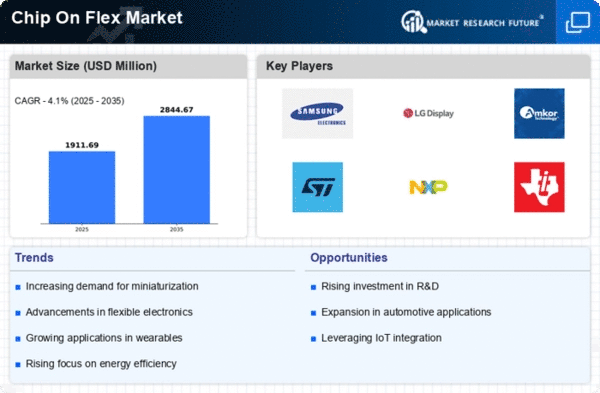
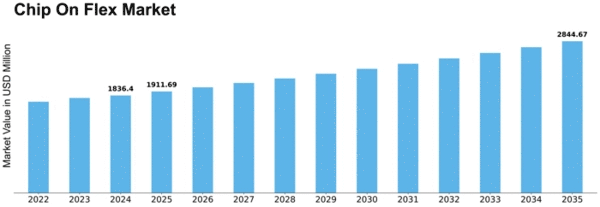
As per MRFR analysis, the Chip On Flex Market Size was estimated at 1836.4 USD Million in 2024. The Chip On Flex industry is projected to grow from 1903.35 USD Million in 2025 to 2844.67 USD Million by 2035, exhibiting a compound annual growth rate (CAGR) of 4.1 during the forecast period 2025 - 2035.

Key Market Trends & Highlights

The Chip On Flex Market is experiencing robust growth driven by technological advancements and increasing demand across various sectors.

  • The market is witnessing a rising demand for wearable technology, particularly in the Asia-Pacific region. Advancements in manufacturing techniques are enhancing the capabilities of flexible displays, which remain the largest segment. Sustainable solutions are becoming a focal point, as consumers and manufacturers alike prioritize eco-friendly practices. Key market drivers include the increasing adoption of flexible displays and the expansion of Internet of Things (IoT) applications, particularly in North America.

Market Size & Forecast

2024 Market Size 1836.4 (USD Million)
2035 Market Size 2844.67 (USD Million)
CAGR (2025 - 2035) 4.1%
Largest Regional Market Share in 2024 Asia-Pacific

Major Players

<p>Samsung Electronics (KR), LG Display (KR), Amkor Technology (US), STMicroelectronics (FR), NXP Semiconductors (NL), Texas Instruments (US), Infineon Technologies (DE), ASE Technology Holding Co. (TW), Jabil Inc. (US)</p>

Market Trends

The Chip On Flex Market is currently experiencing a notable transformation, driven by advancements in flexible electronics and increasing demand for miniaturized devices. This market segment appears to be gaining traction due to its ability to provide lightweight and compact solutions, which are essential in various applications such as consumer electronics, automotive, and medical devices. The integration of chip-on-flex technology into these sectors suggests a shift towards more efficient and versatile designs, potentially enhancing product performance and user experience. Furthermore, the growing emphasis on sustainability and energy efficiency may also influence the adoption of chip-on-flex solutions, as manufacturers seek to reduce their environmental footprint while maintaining high functionality. In addition, the Chip On Flex Market seems poised for further growth as innovations in materials and manufacturing processes emerge. The development of advanced substrates and encapsulation techniques could lead to improved reliability and durability of flexible circuits. Moreover, collaborations between technology firms and research institutions may foster the creation of novel applications, expanding the market's reach. As the industry evolves, it is likely that new opportunities will arise, enabling stakeholders to capitalize on the benefits of chip-on-flex technology in an increasingly competitive landscape.

Rising Demand for Wearable Technology

The Chip On Flex Market is witnessing an increase in demand for wearable devices, which require flexible and lightweight components. This trend indicates a shift towards integrating advanced technology into everyday items, enhancing user convenience and functionality.

Advancements in Manufacturing Techniques

Innovations in manufacturing processes are likely to enhance the production efficiency of chip-on-flex solutions. These advancements may lead to reduced costs and improved quality, making the technology more accessible to various industries.

Focus on Sustainable Solutions

There is a growing emphasis on sustainability within the Chip On Flex Market. Manufacturers are increasingly seeking eco-friendly materials and processes, which could drive the development of greener alternatives in flexible electronics.

Chip On Flex Market Market Drivers

Market Segment Insights

By Application: Consumer Electronics (Largest) vs. Medical Devices (Fastest-Growing)

<p>In the Chip On Flex Market, the application segment is predominantly driven by consumer electronics, which holds the largest market share. This category encompasses a wide range of devices including smartphones, tablets, and wearables, which demand flexible and compact chip solutions. The robustness and adaptability of chip on flex technologies are pivotal in meeting the performance needs of these devices. Other applications like automotive, industrial equipment, and telecommunications also contribute to the overall landscape but are comparatively smaller in share.</p>

<p>Consumer Electronics: Dominant vs. Medical Devices: Emerging</p>

<p>Consumer Electronics remains the dominant application in the Chip On Flex Market due to its extensive adoption in everyday gadgets and continuous innovation. This segment leverages the flexibility and lightweight characteristics of chip on flex technology, making it ideal for sleek and portable devices. In contrast, the Medical Devices segment is emerging as a fast-growing segment, driven by the rising demand for advanced healthcare solutions. Medical devices utilize chip on flex technology for its compact size and reliability in critical healthcare applications, paving the way for innovations in diagnostics and wearable health monitors. As the sector expands with advancements in telemedicine and real-time health monitoring, the demand for flexible chip solutions is set to rise.</p>

By End Use: Flexible Displays (Largest) vs. Wearable Devices (Fastest-Growing)

<p>The Chip On Flex Market exhibits a diverse range of applications, with flexible displays leading in market share, driven by their integration in smartphones and televisions. Following flexible displays, wearable devices are gaining traction due to the increasing adoption of health monitoring technologies and fitness trackers, contributing significantly to the overall market dynamics.</p>

<p>Flexible Displays (Dominant) vs. Wearable Devices (Emerging)</p>

<p>Flexible displays are instrumental in revolutionizing visual technology, offering flexibility and durability that are conducive to various industrial applications. They serve as the backbone for high-end smartphones, televisions, and tablets. On the other hand, wearable devices represent the emerging segment within the Chip On Flex Market, fueled by innovations in health monitoring and fitness technology. These devices are not only lightweight and portable but also increasingly sophisticated, integrating advanced sensors that track health metrics, thus appealing to a growing consumer base invested in personal health.</p>

By Material Type: Polyimide (Largest) vs. Polyester (Fastest-Growing)

<p>In the Chip On Flex Market, the material type distribution is somewhat diverse, with polyimide leading as the largest share contributor due to its high thermal resistance and robustness, making it a preferred choice for various applications. Polyester follows as a notable contender, particularly in cost-sensitive projects, garnering attention due to its lightweight and flexibility, making it an attractive option for emerging technologies.</p>

<p>Polyimide (Dominant) vs. Polyester (Emerging)</p>

<p>Polyimide serves as the dominant material in the Chip On Flex Market, known for its exceptional thermal stability, chemical resistance, and electrical insulation properties. These characteristics are crucial for high-performance applications in the electronics industry, particularly in flexible circuits and high-frequency devices. On the other hand, polyester is emerging as a viable alternative, offering a balance of performance and affordability. While it is not as thermally stable as polyimide, its lightweight nature and flexibility cater to less demanding applications, which are gaining traction in cost-sensitive markets, allowing for broader use in flexible electronic devices.</p>

By Technology: Printed Electronics (Largest) vs. Thin Film Technology (Fastest-Growing)

<p>In the Chip On Flex Market, the technology segment showcases a diverse distribution among its key sub-segments. Printed Electronics leads the market, driven by its robust application in flexible displays and wearables. Its established presence and wide adaptability in various electronic devices bolster its position. In contrast, Thin Film Technology is appearing as a rapidly growing segment, primarily due to advancements in miniaturization and the demand for lightweight solutions in consumer electronics. This dynamic growth trajectory is supported by increasing adoption across various industries, including healthcare and automotive.</p>

<p>Technology: Printed Electronics (Dominant) vs. Thin Film Technology (Emerging)</p>

<p>Printed Electronics is characterized by its ability to print electronic circuits and components on flexible substrates, enabling innovations in responsive and lightweight designs. This technology has gained significant traction in the Chip On Flex Market due to its environmentally friendly processing and potential for cost reduction in manufacturing. Conversely, Thin Film Technology is emerging strongly in the market, known for its thin, lightweight, and flexible characteristics that offer advantages in power-efficient and compact electronic devices. Its adoption is propelled by the increasing demand for advanced materials that can meet the performance requirements of next-generation electronics.</p>

By Form Factor: Single Layer (Largest) vs. Multi Layer (Fastest-Growing)

<p>In the Chip On Flex Market, the segment of Single Layer is currently the largest, benefiting from its simplicity and cost-effectiveness. This segment not only holds significant market share but is also widely used in applications requiring less complex configurations. Multi Layer, on the other hand, is emerging as the fastest-growing segment, driven by advancements in technology that allow for more intricate designs and higher density of components, appealing to the growing demand for lightweight and high-performance applications.</p>

<p>Single Layer (Dominant) vs. Multi Layer (Emerging)</p>

<p>The Single Layer segment is characterized by its straightforward architecture, making it a preferred choice for many standard applications in the Chip On Flex Market. It offers advantages in terms of low manufacturing costs and ease of integration into existing systems. Conversely, the Multi Layer segment is gaining traction with its capability to support more complex electronic interconnections, attractive to applications in sectors like medical devices and consumer electronics where miniaturization and efficiency are paramount. This emerging segment highlights the market's shift towards advanced, multi-functional solutions.</p>

Get more detailed insights about Chip On Flex Market Research Report - Global Forecast to 2035

Regional Insights

North America : Innovation and Growth Hub

The North American Chip On Flex market is projected to reach $550.0 million by December 2025, driven by increasing demand for flexible electronics in consumer devices and automotive applications. Regulatory support for innovation in semiconductor technologies is also a key growth driver, as companies seek to enhance product performance and reduce costs. The region's focus on R&D and technological advancements further fuels market expansion. Leading countries in this region include the US and Canada, where major players like Amkor Technology and Texas Instruments are headquartered. The competitive landscape is characterized by a mix of established firms and emerging startups, all vying for market share. The presence of key players ensures a robust supply chain and innovation pipeline, positioning North America as a leader in the Chip On Flex market.

Europe : Emerging Market with Potential

Europe's Chip On Flex market is expected to reach $400.0 million by December 2025, driven by increasing adoption in automotive and industrial applications. The region is witnessing a shift towards flexible electronics, supported by EU regulations promoting sustainable technology. This regulatory environment encourages investment in innovative solutions, enhancing market growth and competitiveness. Germany, France, and the Netherlands are leading countries in this sector, with key players like STMicroelectronics and NXP Semiconductors driving innovation. The competitive landscape is marked by collaboration between established firms and startups, fostering a dynamic ecosystem. As Europe focuses on digital transformation, the Chip On Flex market is poised for significant growth, attracting investments and talent.

Asia-Pacific : Dominant Market Leader

Asia-Pacific holds the largest share of the Chip On Flex market, projected to reach $750.0 million by December 2025. The region's growth is fueled by rapid advancements in consumer electronics, automotive, and IoT applications. Strong government initiatives and investments in semiconductor manufacturing are key drivers, creating a favorable environment for market expansion and innovation. Countries like South Korea, Japan, and China are at the forefront, with major players such as Samsung Electronics and LG Display leading the charge. The competitive landscape is robust, characterized by significant R&D investments and collaborations among industry leaders. As the demand for flexible electronics continues to rise, Asia-Pacific is set to maintain its dominance in The Chip On Flex.

Middle East and Africa : Emerging Frontier for Technology

The Middle East and Africa (MEA) Chip On Flex market is projected to reach $136.4 million by December 2025, driven by increasing investments in technology and infrastructure. The region is witnessing a gradual shift towards flexible electronics, particularly in telecommunications and consumer goods. Government initiatives aimed at diversifying economies are also contributing to market growth, creating new opportunities for innovation. Leading countries in this region include South Africa and the UAE, where local firms are beginning to explore flexible electronics applications. The competitive landscape is still developing, with a mix of local and international players entering the market. As MEA continues to invest in technology, the Chip On Flex market is expected to grow, attracting interest from global companies seeking to expand their footprint.

Key Players and Competitive Insights

The Chip On Flex Market is currently characterized by a dynamic competitive landscape, driven by technological advancements and increasing demand for flexible electronics. Key players such as Samsung Electronics (KR), LG Display (KR), and Amkor Technology (US) are at the forefront, each adopting distinct strategies to enhance their market positioning. Samsung Electronics (KR) focuses on innovation, particularly in developing advanced materials that improve the performance and durability of flexible circuits. Meanwhile, LG Display (KR) emphasizes regional expansion, particularly in Asia, to capitalize on the growing demand for flexible displays in consumer electronics. Amkor Technology (US) is strategically investing in partnerships with semiconductor firms to optimize its manufacturing capabilities, thereby enhancing its competitive edge in the market.

The business tactics employed by these companies include localizing manufacturing and optimizing supply chains to reduce costs and improve efficiency. The market structure appears moderately fragmented, with several key players exerting influence over various segments. This fragmentation allows for a diverse range of products and innovations, fostering a competitive environment where companies must continuously adapt to maintain their market share.

In November 2025, LG Display (KR) announced a significant investment in a new manufacturing facility in Vietnam, aimed at increasing production capacity for flexible OLED displays. This strategic move is likely to enhance LG's ability to meet the rising demand in Southeast Asia, positioning the company favorably against competitors. The investment underscores LG's commitment to regional expansion and its focus on maintaining leadership in the flexible display segment.

In October 2025, Amkor Technology (US) entered into a strategic partnership with a leading semiconductor firm to develop next-generation packaging solutions for flexible electronics. This collaboration is expected to leverage both companies' strengths, potentially leading to innovative products that could redefine performance standards in the Chip On Flex Market. Such partnerships are indicative of a broader trend where companies seek to combine expertise to drive technological advancements.

In September 2025, Samsung Electronics (KR) unveiled a new line of flexible chips designed for IoT applications, showcasing its commitment to innovation in the Chip On Flex Market. This launch not only highlights Samsung's technological prowess but also reflects a strategic shift towards catering to the burgeoning IoT sector, which is anticipated to drive significant growth in the coming years. The introduction of these chips may enhance Samsung's competitive positioning by addressing specific market needs.

As of December 2025, the Chip On Flex Market is witnessing trends such as digitalization, sustainability, and AI integration, which are reshaping competitive dynamics. Strategic alliances are becoming increasingly vital, as companies recognize the need to collaborate to enhance innovation and efficiency. The competitive landscape is likely to evolve from a focus on price-based competition to one centered on technological differentiation, supply chain reliability, and sustainable practices. This shift suggests that companies that prioritize innovation and adaptability will be better positioned to thrive in the future.

Key Companies in the Chip On Flex Market include

Industry Developments

Future Outlook

Chip On Flex Market Future Outlook

<p>The Chip On Flex Market is projected to grow at a 4.1% CAGR from 2024 to 2035, driven by advancements in flexible electronics and increasing demand for miniaturization.</p>

New opportunities lie in:

  • <p>Development of advanced flexible display technologies for consumer electronics.</p>
  • <p>Integration of IoT solutions in automotive applications to enhance connectivity.</p>
  • <p>Expansion into emerging markets with tailored product offerings for local industries.</p>

<p>By 2035, the Chip On Flex Market is expected to achieve robust growth, reflecting evolving technological demands.</p>

Market Segmentation

Chip On Flex Market End Use Outlook

  • Flexible Displays
  • Wearable Devices
  • Smart Cards
  • Sensors
  • RFID Tags

Chip On Flex Market Technology Outlook

  • Printed Electronics
  • Thin Film Technology
  • Laser Direct Structuring
  • Surface Mount Technology
  • Chip On Board

Chip On Flex Market Application Outlook

  • Consumer Electronics
  • Automotive
  • Medical Devices
  • Industrial Equipment
  • Telecommunications

Chip On Flex Market Form Factor Outlook

  • Single Layer
  • Multi Layer
  • Flexible Circuit
  • Rigid Flex
  • Hybrid

Chip On Flex Market Material Type Outlook

  • Polyimide
  • Polyester
  • Paper
  • Metal
  • Glass

Report Scope

MARKET SIZE 2024 1836.4(USD Million)
MARKET SIZE 2025 1903.35(USD Million)
MARKET SIZE 2035 2844.67(USD Million)
COMPOUND ANNUAL GROWTH RATE (CAGR) 4.1% (2024 - 2035)
REPORT COVERAGE Revenue Forecast, Competitive Landscape, Growth Factors, and Trends
BASE YEAR 2024
Market Forecast Period 2025 - 2035
Historical Data 2019 - 2024
Market Forecast Units USD Million
Key Companies Profiled Samsung Electronics (KR), LG Display (KR), Amkor Technology (US), STMicroelectronics (FR), NXP Semiconductors (NL), Texas Instruments (US), Infineon Technologies (DE), ASE Technology Holding Co. (TW), Jabil Inc. (US)
Segments Covered Application, End Use, Material Type, Technology, Form Factor
Key Market Opportunities Integration of advanced flexible electronics in wearable technology drives growth in the Chip On Flex Market.
Key Market Dynamics Rising demand for flexible electronics drives innovation and competition in the Chip On Flex Market.
Countries Covered North America, Europe, APAC, South America, MEA

FAQs

At what CAGR the global market for Global Chip on flex is expected to rise in the future?

A CAGR of 3.7% has been calculated for the Global Chip on flex’s growth in the future.

Which region has been regarded as the most significant recording highest Global Chip on flex market share?

Europe has been regarded as the most significant region for market share and is growing with a market share of USD 1,868.63 Million by 2030.

How has the global Chip on flex market maintained its growth graph currently?

The activities such as joint ventures, mergers and acquisitions, new product developments, and research and developments has helped global Chip on flex market maintained its growth graph.

Which top names of key players have been included in the analysis of Global Chip on flex market?

Stemko group(Korea), Flexceed(Japan), LGIT corporation (U.S.), Chipbond technology corporation(Taiwan), CWE(Taiwan) are the top names of key players.

What are the segments mentioned in the market for Global Chip on flex market?

The segments such as types, applications and verticals are mentioned in the market study for Global Chip on flex.

  1. MARKET INTRODUCTION
    1. INTRODUCTION
    2. SCOPE OF STUDY
      1. RESEARCH OBJECTIVE
      2. ASSUMPTIONS
      3. LIMITATIONS
    3. MARKET STRUCTURE
  2. RESEARCH METHODOLOGY
    1. RESEARCH NETWORK SOLUTION
    2. PRIMARY RESEARCH
    3. SECONDARY RESEARCH
    4. FORECAST MODEL
      1. MARKET DATA COLLECTION, ANALYSIS & FORECAST
      2. MARKET SIZE ESTIMATION
  3. MARKET DYNAMICS
    1. INTRODUCTION
    2. MARKET DRIVERS
    3. MARKET CHALLENGES
    4. MARKET OPPORTUNITIES
    5. MARKET RESTRAINTS
  4. EXECUTIVE SUMMARY
  5. MARKET FACTOR ANALYSIS
    1. PORTER’S FIVE FORCES ANALYSIS
    2. SUPPLY CHAIN ANALYSIS
  6. GLOBAL CHIP ON FLEX MARKET, BY SEGMENTS
    1. INTRODUCTION
    2. MARKET STATISTICS
      1. BY TYPE
      2. BY APPLICATIONS
      3. BY VERTICALS
      4. BY GEOGRAPHY
  7. COMPETITIVE ANALYSIS
    1. MARKET SHARE ANALYSIS
    2. COMPANY PROFILES
      1. LGIT CORPORATION (U.S.)
      2. STEMKO GROUP (KOREA)
      3. FLEXCEED (JAPAN)
      4. CHIPBOND TECHNOLOGY CORPORATION (TAIWAN)
      5. CWE (TAIWAN)
      6. DANBOND TECHNOLOGY CO. LTD. (CHINA)
      7. AKM INDUSTRIAL COMPANY LTD. (CHINA)
      8. COMPASS TECHNOLOGY COMPANY LIMITED (HONG KONG)
      9. COMPUNETICS (U.S.)
      10. STARS MICROELECTRONICS PUBLIC COMPANY LTD (THAILAND)
  8. List of Tables
  9. GLOBAL CHIP ON FLEX MARKET, BY TYPE
  10. GLOBAL CHIP ON FLEX MARKET, BY APPLICATIONS
  11. GLOBAL CHIP ON FLEX MARKET, BY VERTICALS
  12. GLOBAL CHIP ON FLEX MARKET, BY REGIONS
  13. NORTH AMERICA CHIP ON FLEXMARKET, BY TYPE
  14. NORTH AMERICA CHIP ON FLEX MARKET, BY APPLICATIONS
  15. NORTH AMERICA CHIP ON FLEX MARKET, BY VERTICALS
  16. U.S. CHIP ON FLEX MARKET, BY TYPE
  17. U.S. CHIP ON FLEX MARKET, BY APPLICATIONS
  18. U.S. CHIP ON FLEX MARKET, BY VERTICALS
  19. CANADA CHIP ON FLEX MARKET, BY TYPE
  20. CANADA CHIP ON FLEX MARKET, BY APPLICATIONS
  21. CANADA CHIP ON FLEX MARKET, BY VERTICALS
  22. EUROPE CHIP ON FLEX MARKET, BY TYPE
  23. EUROPE CHIP ON FLEX MARKET, BY APPLICATIONS
  24. EUROPE CHIP ON FLEX MARKET, BY VERTICALS
  25. GERMANY CHIP ON FLEX MARKET, BY TYPE
  26. GERMANY CHIP ON FLEX MARKET, BY APPLICATIONS
  27. GERMANY CHIP ON FLEX MARKET, BY VERTICALS
  28. FRANCE CHIP ON FLEX MARKET, BY TYPE
  29. FRANCE CHIP ON FLEX MARKET, BY APPLICATIONS
  30. FRANCE CHIP ON FLEX MARKET, BY VERTICALS
  31. U.K. CHIP ON FLEX MARKET, BY TYPE
  32. U.K. CHIP ON FLEX MARKET, BY APPLICATIONS
  33. U.K. CHIP ON FLEX MARKET, BY VERTICALS
  34. REST OF EUROPE CHIP ON FLEX MARKET, BY TYPE
  35. REST OF EUROPE CHIP ON FLEX MARKET, BY APPLICATIONS
  36. REST OF EUROPE CHIP ON FLEX MARKET, BY VERTICALS
  37. ASIA-PACIFIC CHIP ON FLEX MARKET, BY TYPE
  38. ASIA-PACIFIC CHIP ON FLEX MARKET, BY APPLICATIONS
  39. ASIA-PACIFIC CHIP ON FLEX MARKET, BY VERTICALS
  40. MIDDLE EAST & AFRICA CHIP ON FLEX MARKET, BY TYPE
  41. MIDDLE EAST & AFRICA CHIP ON FLEX MARKET, BY APPLICATIONS
  42. MIDDLE EAST & AFRICA CHIP ON FLEX MARKET, BY VERTICALS
  43. List of Figures
  44. RESEARCH NETWORK SOLUTION
  45. GLOBAL CHIP ON FLEX MARKET: BY TYPE (%)
  46. GLOBAL CHIP ON FLEX MARKET: BY APPLICATIONS (%)
  47. GLOBAL CHIP ON FLEX MARKET: BY VERTICALS (%)
  48. GLOBAL CHIP ON FLEX MARKET: BY REGION
  49. NORTH AMERICA CHIP ON FLEX MARKET, BY TYPE (%)
  50. NORTH AMERICA CHIP ON FLEX MARKET, BY APPLICATIONS (%)
  51. NORTH AMERICA CHIP ON FLEX MARKET, BY VERTICALS (%)
  52. EUROPE CHIP ON FLEX MARKET, BY TYPE (%)
  53. EUROPE CHIP ON FLEX MARKET, BY APPLICATIONS (%)
  54. EUROPE CHIP ON FLEX MARKET, BY VERTICALS (%)
  55. ASIA-PACIFIC CHIP ON FLEX MARKET, BY TYPE (%)
  56. ASIA-PACIFIC CHIP ON FLEX MARKET, BY APPLICATIONS (%)
  57. ASIA-PACIFIC CHIP ON FLEX MARKET, BY VERTICALS (%)
  58. ROW CHIP ON FLEX MARKET, BY TYPE (%)
  59. ROW CHIP ON FLEX MARKET, BY APPLICATIONS (%)
  60. ROW CHIP ON FLEX MARKET, BY VERTICALS (%)

Chip On Flex Market Segmentation

Market Segmentation Overview

  • Detailed segmentation data will be available in the full report
  • Comprehensive analysis by multiple parameters
  • Regional and country-level breakdowns
  • Market size forecasts by segment
Infographic

Free Sample Request

Kindly complete the form below to receive a free sample of this Report

Get Free Sample

Customer Strories

Compare Licence

×
Features License Type
Single User Multiuser License Enterprise User
Price $4,950 $5,950 $7,250
Maximum User Access Limit 1 User Upto 10 Users Unrestricted Access Throughout the Organization
Free Customization
Direct Access to Analyst
Deliverable Format
Platform Access
Discount on Next Purchase 10% 15% 15%
Printable Versions