×
Hero Background
English
Chinese
French
Japanese
Korean
German
Spanish

Chip On Flex Market Share

ID: MRFR/SEM/1483-CR
100 Pages
Ankit Gupta
January 2017

Chip on Flex Market Research Repor By Type (Single Sided Chip On Flex, Others), By Application (Static, Dynamic), By Verticals (Military, Medical, Aerospace, Electronics) - Industry Size, Share and Trends 2030

Share:
Download PDF ×

We do not share your information with anyone. However, we may send you emails based on your report interest from time to time. You may contact us at any time to opt-out.

Chip On Flex Market Infographic
Purchase Options

Market Share

Chip On Flex Market Share Analysis

The Chip On Flex (COF) market has become increasingly competitive, prompting companies to adopt strategic market share positioning strategies to gain a competitive edge. One prevalent approach involves differentiation, where companies strive to distinguish their COF products from competitors through unique features, superior performance, or innovative technologies. This strategy aims to create a perception among customers that the offered COF solutions are distinct and superior, thereby capturing a larger market share.

Another key strategy in the Chip On Flex market is cost leadership. Companies employing this approach focus on achieving economies of scale, optimizing production processes, and minimizing costs without compromising on quality. By offering cost-effective COF solutions, these companies aim to attract price-sensitive customers, secure large-volume contracts, and ultimately increase their market share. This strategy is particularly effective in markets where price plays a pivotal role in the purchasing decision.

Furthermore, companies may opt for a niche market positioning strategy. In this approach, businesses target specific market segments with unique COF requirements or preferences. By tailoring their products to meet the specific needs of a niche market, companies can establish themselves as experts in that segment, potentially achieving higher profit margins and garnering customer loyalty. Niche market positioning enables companies to compete effectively in specialized areas, even if they might not command the largest overall market share.

Collaborative strategies also play a crucial role in market share positioning within the Chip On Flex industry. Partnerships, alliances, and collaborations with other companies, research institutions, or technology providers can help leverage complementary strengths and resources. By forming strategic collaborations, companies can enhance their product offerings, access new markets, and strengthen their overall market position. Such partnerships can lead to the development of innovative solutions that resonate well with customers, contributing to an increase in market share.

In addition to these strategies, companies in the Chip On Flex market often focus on customer-centric approaches. Understanding customer needs and preferences allows companies to tailor their COF solutions accordingly. This customer-centric strategy involves not only providing high-quality products but also offering excellent customer support, warranty services, and post-sales assistance. By building strong relationships with customers, companies can create a loyal customer base, leading to repeat business and positive word-of-mouth, ultimately driving an increase in market share.


Continuous innovation is another pivotal aspect of market share positioning in the Chip On Flex industry. Companies that invest in research and development to bring cutting-edge technologies and features to their COF products are better positioned to capture the attention of customers seeking advanced solutions. Staying ahead of technological trends and being quick to adapt to market changes can set a company apart from competitors, fostering growth in market share.

Author
Ankit Gupta
Senior Research Analyst

Ankit Gupta is an analyst in market research industry in ICT and SEMI industry. With post-graduation in "Telecom and Marketing Management" and graduation in "Electronics and Telecommunication" vertical he is well versed with recent development in ICT industry as a whole. Having worked on more than 150+ reports including consultation for fortune 500 companies such as Microsoft and Rio Tinto in identifying solutions with respect to business problems his opinions are inclined towards mixture of technical and managerial aspects.

Leave a Comment

FAQs

At what CAGR the global market for Global Chip on flex is expected to rise in the future?

A CAGR of 3.7% has been calculated for the Global Chip on flex’s growth in the future.

Which region has been regarded as the most significant recording highest Global Chip on flex market share?

Europe has been regarded as the most significant region for market share and is growing with a market share of USD 1,868.63 Million by 2030.

How has the global Chip on flex market maintained its growth graph currently?

The activities such as joint ventures, mergers and acquisitions, new product developments, and research and developments has helped global Chip on flex market maintained its growth graph.

Which top names of key players have been included in the analysis of Global Chip on flex market?

Stemko group(Korea), Flexceed(Japan), LGIT corporation (U.S.), Chipbond technology corporation(Taiwan), CWE(Taiwan) are the top names of key players.

What are the segments mentioned in the market for Global Chip on flex market?

The segments such as types, applications and verticals are mentioned in the market study for Global Chip on flex.

Market Summary

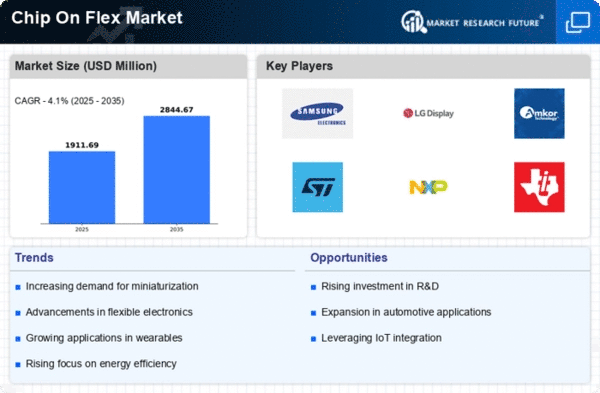
As per MRFR analysis, the Chip On Flex Market Size was estimated at 1836.4 USD Million in 2024. The Chip On Flex industry is projected to grow from 1903.35 USD Million in 2025 to 2844.67 USD Million by 2035, exhibiting a compound annual growth rate (CAGR) of 4.1 during the forecast period 2025 - 2035.

Key Market Trends & Highlights

The Chip On Flex Market is poised for substantial growth driven by technological advancements and increasing applications across various sectors.

  • The integration of Chip On Flex technology with IoT devices is becoming increasingly prevalent, enhancing connectivity and functionality.
  • Advancements in manufacturing techniques are streamlining production processes, thereby reducing costs and improving efficiency.
  • North America remains the largest market for Chip On Flex, while Asia-Pacific is emerging as the fastest-growing region, driven by rising demand.
  • The growth in automotive electronics and the increased focus on wearable technology are key drivers propelling the market forward.

Market Size & Forecast

2024 Market Size 1836.4 (USD Million)
2035 Market Size 2844.67 (USD Million)
CAGR (2025 - 2035) 4.1%
Largest Regional Market Share in 2024 Asia-Pacific

Major Players

<p>Samsung Electronics (KR), LG Display (KR), Amkor Technology (US), STMicroelectronics (FR), NXP Semiconductors (NL), Texas Instruments (US), Infineon Technologies (DE), ASE Technology Holding (TW), Jabil Inc. (US)</p>

Market Trends

The Chip On Flex Market is currently experiencing a notable transformation, driven by advancements in flexible electronics and increasing demand for miniaturized devices. This market segment appears to be gaining traction due to its ability to integrate complex circuitry into compact formats, which is particularly appealing in sectors such as consumer electronics, automotive, and healthcare. The flexibility and lightweight nature of chip on flex technology enable manufacturers to create innovative products that meet the evolving needs of consumers. Furthermore, the trend towards sustainable manufacturing practices is likely to influence the market, as companies seek to reduce waste and enhance energy efficiency in production processes. In addition, the Chip On Flex Market seems poised for growth as emerging technologies, such as Internet of Things (IoT) and wearable devices, continue to proliferate. These applications require flexible and durable solutions that can withstand various environmental conditions while maintaining performance. As a result, research and development efforts are increasingly focused on enhancing the reliability and functionality of chip on flex products. Overall, the market landscape appears dynamic, with numerous opportunities for stakeholders to capitalize on the ongoing innovations and shifting consumer preferences.

Integration with IoT Devices

The Chip On Flex Market is witnessing a surge in demand due to the integration of flexible electronics with Internet of Things (IoT) devices. This trend indicates a growing need for adaptable and lightweight components that can seamlessly connect and communicate within smart environments.

Advancements in Manufacturing Techniques

Recent advancements in manufacturing techniques are reshaping the Chip On Flex Market. Innovations such as improved printing technologies and material science developments suggest a potential for enhanced production efficiency and product quality, which may attract more manufacturers.

Focus on Wearable Technology

The increasing popularity of wearable technology is significantly influencing the Chip On Flex Market. As consumers seek more sophisticated and comfortable devices, the demand for flexible circuits that can be integrated into clothing and accessories appears to be on the rise.

Chip On Flex Market Market Drivers

Market Segment Insights

By Application: Consumer Electronics (Largest) vs. Medical Devices (Fastest-Growing)

<p>In the Chip On Flex Market, the application segment is predominantly driven by consumer electronics, which holds the largest market share. This category encompasses a wide range of devices including smartphones, tablets, and wearables, which demand flexible and compact chip solutions. The robustness and adaptability of chip on flex technologies are pivotal in meeting the performance needs of these devices. Other applications like automotive, industrial equipment, and telecommunications also contribute to the overall landscape but are comparatively smaller in share.</p>

<p>Consumer Electronics: Dominant vs. Medical Devices: Emerging</p>

<p>Consumer Electronics remains the dominant application in the Chip On Flex Market due to its extensive adoption in everyday gadgets and continuous innovation. This segment leverages the flexibility and lightweight characteristics of chip on flex technology, making it ideal for sleek and portable devices. In contrast, the Medical Devices segment is emerging as a fast-growing segment, driven by the rising demand for advanced healthcare solutions. Medical devices utilize chip on flex technology for its compact size and reliability in critical healthcare applications, paving the way for innovations in diagnostics and wearable health monitors. As the sector expands with advancements in telemedicine and real-time health monitoring, the demand for flexible chip solutions is set to rise.</p>

By End Use: Flexible Displays (Largest) vs. Wearable Devices (Fastest-Growing)

<p>The Chip On Flex Market exhibits a diverse range of applications, with flexible displays leading in market share, driven by their integration in smartphones and televisions. Following flexible displays, wearable devices are gaining traction due to the increasing adoption of health monitoring technologies and fitness trackers, contributing significantly to the overall market dynamics.</p>

<p>Flexible Displays (Dominant) vs. Wearable Devices (Emerging)</p>

<p>Flexible displays are instrumental in revolutionizing visual technology, offering flexibility and durability that are conducive to various industrial applications. They serve as the backbone for high-end smartphones, televisions, and tablets. On the other hand, wearable devices represent the emerging segment within the Chip On Flex Market, fueled by innovations in health monitoring and fitness technology. These devices are not only lightweight and portable but also increasingly sophisticated, integrating advanced sensors that track health metrics, thus appealing to a growing consumer base invested in personal health.</p>

By Material Type: Polyimide (Largest) vs. Polyester (Fastest-Growing)

<p>In the Chip On Flex Market, the material type distribution is somewhat diverse, with polyimide leading as the largest share contributor due to its high thermal resistance and robustness, making it a preferred choice for various applications. Polyester follows as a notable contender, particularly in cost-sensitive projects, garnering attention due to its lightweight and flexibility, making it an attractive option for emerging technologies.</p>

<p>Polyimide (Dominant) vs. Polyester (Emerging)</p>

<p>Polyimide serves as the dominant material in the Chip On Flex Market, known for its exceptional thermal stability, chemical resistance, and electrical insulation properties. These characteristics are crucial for high-performance applications in the electronics industry, particularly in flexible circuits and high-frequency devices. On the other hand, polyester is emerging as a viable alternative, offering a balance of performance and affordability. While it is not as thermally stable as polyimide, its lightweight nature and flexibility cater to less demanding applications, which are gaining traction in cost-sensitive markets, allowing for broader use in flexible electronic devices.</p>

By Technology: Printed Electronics (Largest) vs. Thin Film Technology (Fastest-Growing)

<p>In the Chip On Flex Market, the technology segment showcases a diverse distribution among its key sub-segments. Printed Electronics leads the market, driven by its robust application in flexible displays and wearables. Its established presence and wide adaptability in various electronic devices bolster its position. In contrast, Thin Film Technology is appearing as a rapidly growing segment, primarily due to advancements in miniaturization and the demand for lightweight solutions in consumer electronics. This dynamic growth trajectory is supported by increasing adoption across various industries, including healthcare and automotive.</p>

<p>Technology: Printed Electronics (Dominant) vs. Thin Film Technology (Emerging)</p>

<p>Printed Electronics is characterized by its ability to print electronic circuits and components on flexible substrates, enabling innovations in responsive and lightweight designs. This technology has gained significant traction in the Chip On Flex Market due to its environmentally friendly processing and potential for cost reduction in manufacturing. Conversely, Thin Film Technology is emerging strongly in the market, known for its thin, lightweight, and flexible characteristics that offer advantages in power-efficient and compact electronic devices. Its adoption is propelled by the increasing demand for advanced materials that can meet the performance requirements of next-generation electronics.</p>

By Form Factor: Single Layer (Largest) vs. Multi Layer (Fastest-Growing)

<p>In the Chip On Flex Market, the segment of Single Layer is currently the largest, benefiting from its simplicity and cost-effectiveness. This segment not only holds significant market share but is also widely used in applications requiring less complex configurations. Multi Layer, on the other hand, is emerging as the fastest-growing segment, driven by advancements in technology that allow for more intricate designs and higher density of components, appealing to the growing demand for lightweight and high-performance applications.</p>

<p>Single Layer (Dominant) vs. Multi Layer (Emerging)</p>

<p>The Single Layer segment is characterized by its straightforward architecture, making it a preferred choice for many standard applications in the Chip On Flex Market. It offers advantages in terms of low manufacturing costs and ease of integration into existing systems. Conversely, the Multi Layer segment is gaining traction with its capability to support more complex electronic interconnections, attractive to applications in sectors like medical devices and consumer electronics where miniaturization and efficiency are paramount. This emerging segment highlights the market's shift towards advanced, multi-functional solutions.</p>

Get more detailed insights about Chip On Flex Market Research Report - Global Forecast to 2035

Regional Insights

North America : Innovation and Growth Hub

North America is witnessing robust growth in the Chip On Flex market, driven by increasing demand for advanced electronics and IoT devices. The market size is projected at $550.0 million, reflecting a significant share in the global landscape. Regulatory support for technology innovation and investment in R&D are key catalysts for this growth, enhancing the region's competitive edge in semiconductor technologies. The United States leads the North American market, with major players like Amkor Technology and Texas Instruments driving innovation. The competitive landscape is characterized by a focus on high-performance applications, with companies investing heavily in flexible electronics. This region's strong infrastructure and skilled workforce further bolster its position, making it a critical player in The Chip On Flex.

Europe : Emerging Technology Landscape

Europe's Chip On Flex market is evolving, with a market size of $400.0 million, driven by increasing demand for flexible displays and automotive applications. The region is focusing on sustainability and innovation, supported by regulatory frameworks that encourage green technologies. This shift is expected to enhance market growth and attract investments in advanced manufacturing processes. Leading countries like Germany and France are at the forefront, with key players such as STMicroelectronics and Infineon Technologies contributing to the competitive landscape. The presence of established semiconductor firms and a strong emphasis on research and development are pivotal in positioning Europe as a significant player in the global market. The region's commitment to innovation is evident in its strategic initiatives aimed at fostering technological advancements.

Asia-Pacific : Dominant Market Leader

Asia-Pacific is the largest market for Chip On Flex, with a remarkable size of $800.0 million, reflecting its dominance in the global landscape. The region's growth is fueled by rapid advancements in consumer electronics, automotive, and telecommunications sectors. Government initiatives promoting technology adoption and manufacturing capabilities are significant drivers of this market expansion. Countries like South Korea and China are leading the charge, with major players such as Samsung Electronics and LG Display at the forefront. The competitive landscape is intense, characterized by continuous innovation and strategic partnerships among key players. The region's strong manufacturing base and technological expertise position it as a powerhouse in the Chip On Flex market, catering to both domestic and international demands.

Middle East and Africa : Emerging Market Potential

The Middle East and Africa (MEA) region is emerging in the Chip On Flex market, with a market size of $86.4 million. Growth is driven by increasing investments in technology and infrastructure, alongside a rising demand for flexible electronics in various sectors. Regulatory support for technology initiatives is fostering a conducive environment for market expansion, making it an attractive region for investment. Countries like South Africa and the UAE are leading the way, with a growing number of local and international players entering the market. The competitive landscape is evolving, with companies focusing on innovative solutions to meet the unique demands of the region. As the MEA market matures, it presents significant opportunities for growth and collaboration among key stakeholders in the Chip On Flex industry.

Key Players and Competitive Insights

The Chip On Flex Market is currently characterized by a dynamic competitive landscape, driven by technological advancements and increasing demand for flexible electronics. Key players such as Samsung Electronics (KR), LG Display (KR), and Amkor Technology (US) are at the forefront, each employing distinct strategies to enhance their market positioning. Samsung Electronics (KR) focuses on innovation in flexible display technologies, while LG Display (KR) emphasizes partnerships with automotive manufacturers to integrate flexible solutions into next-generation vehicles. Amkor Technology (US) is enhancing its operational capabilities through strategic mergers and acquisitions, thereby expanding its service offerings and geographical reach. Collectively, these strategies contribute to a competitive environment that is increasingly focused on innovation and collaboration.

In terms of business tactics, companies are localizing manufacturing to reduce lead times and optimize supply chains. The market structure appears moderately fragmented, with several key players exerting influence over various segments. This fragmentation allows for niche players to thrive, while larger companies leverage their scale to drive efficiencies and innovation. The collective influence of these key players shapes the market dynamics, fostering a competitive atmosphere that encourages continuous improvement and adaptation.

In November 2025, LG Display (KR) announced a strategic partnership with a leading automotive manufacturer to develop advanced flexible display solutions tailored for electric vehicles. This collaboration is poised to enhance LG Display's position in the automotive sector, aligning with the growing trend of integrating flexible technologies into transportation. The strategic importance of this partnership lies in its potential to capture a significant share of the burgeoning market for flexible displays in vehicles, which is expected to grow substantially in the coming years.

In October 2025, Amkor Technology (US) completed the acquisition of a smaller semiconductor packaging firm, which is anticipated to bolster its capabilities in Chip On Flex technology. This acquisition is strategically significant as it allows Amkor to enhance its product offerings and improve its competitive edge in the market. By integrating advanced packaging solutions, Amkor is likely to attract a broader customer base, particularly in sectors demanding high-performance flexible electronics.

In December 2025, Samsung Electronics (KR) unveiled a new line of flexible chips designed for IoT applications, showcasing its commitment to innovation in the Chip On Flex Market. This launch is indicative of Samsung's strategy to diversify its product portfolio and cater to the increasing demand for smart devices. The introduction of these chips is expected to strengthen Samsung's market position, as it aligns with the growing trend of digitalization and the Internet of Things (IoT).

As of December 2025, the Chip On Flex Market is witnessing trends that emphasize digitalization, sustainability, and AI integration. Strategic alliances among key players are shaping the competitive landscape, fostering innovation and collaboration. The shift from price-based competition to a focus on technological advancement and supply chain reliability is becoming increasingly evident. Moving forward, competitive differentiation will likely hinge on the ability to innovate and adapt to evolving market demands, positioning companies to thrive in a rapidly changing environment.

Key Companies in the Chip On Flex Market market include

Industry Developments

Future Outlook

Chip On Flex Market Future Outlook

<p>The Chip On Flex Market is projected to grow at a 4.1% CAGR from 2024 to 2035, driven by advancements in flexible electronics and increasing demand for miniaturization.</p>

New opportunities lie in:

  • <p>Development of advanced flexible display technologies for consumer electronics.</p>
  • <p>Integration of Chip On Flex in wearable health monitoring devices.</p>
  • <p>Expansion into automotive applications for enhanced electronic systems.</p>

<p>By 2035, the Chip On Flex Market is expected to achieve substantial growth, reflecting evolving technological demands.</p>

Market Segmentation

Chip On Flex Market End Use Outlook

  • Flexible Displays
  • Wearable Devices
  • Smart Cards
  • Sensors
  • RFID Tags

Chip On Flex Market Technology Outlook

  • Printed Electronics
  • Thin Film Technology
  • Surface Mount Technology
  • Laser Direct Structuring
  • Roll-to-Roll Processing

Chip On Flex Market Application Outlook

  • Consumer Electronics
  • Automotive
  • Medical Devices
  • Industrial Equipment
  • Telecommunications

Chip On Flex Market Form Factor Outlook

  • Single Layer
  • Multi Layer
  • Flexible Circuit
  • Rigid-Flex
  • Hybrid

Chip On Flex Market Material Type Outlook

  • Polyimide
  • Polyester
  • Paper
  • Metal
  • Glass

Report Scope

MARKET SIZE 20241836.4(USD Million)
MARKET SIZE 20251903.35(USD Million)
MARKET SIZE 20352844.67(USD Million)
COMPOUND ANNUAL GROWTH RATE (CAGR)4.1% (2024 - 2035)
REPORT COVERAGERevenue Forecast, Competitive Landscape, Growth Factors, and Trends
BASE YEAR2024
Market Forecast Period2025 - 2035
Historical Data2019 - 2024
Market Forecast UnitsUSD Million
Key Companies ProfiledSamsung Electronics (KR), LG Display (KR), Amkor Technology (US), STMicroelectronics (FR), NXP Semiconductors (NL), Texas Instruments (US), Infineon Technologies (DE), ASE Technology Holding (TW), Jabil Inc. (US)
Segments CoveredApplication, End Use, Material Type, Technology, Form Factor
Key Market OpportunitiesIntegration of advanced flexible electronics in wearable technology drives growth in the Chip On Flex Market.
Key Market DynamicsRising demand for flexible electronics drives innovation and competition in the Chip On Flex Market.
Countries CoveredNorth America, Europe, APAC, South America, MEA

FAQs

At what CAGR the global market for Global Chip on flex is expected to rise in the future?

A CAGR of 3.7% has been calculated for the Global Chip on flex’s growth in the future.

Which region has been regarded as the most significant recording highest Global Chip on flex market share?

Europe has been regarded as the most significant region for market share and is growing with a market share of USD 1,868.63 Million by 2030.

How has the global Chip on flex market maintained its growth graph currently?

The activities such as joint ventures, mergers and acquisitions, new product developments, and research and developments has helped global Chip on flex market maintained its growth graph.

Which top names of key players have been included in the analysis of Global Chip on flex market?

Stemko group(Korea), Flexceed(Japan), LGIT corporation (U.S.), Chipbond technology corporation(Taiwan), CWE(Taiwan) are the top names of key players.

What are the segments mentioned in the market for Global Chip on flex market?

The segments such as types, applications and verticals are mentioned in the market study for Global Chip on flex.

  1. MARKET INTRODUCTION
    1. INTRODUCTION
    2. SCOPE OF STUDY
      1. ASSUMPTIONS
      2. LIMITATIONS
    3. RESEARCH OBJECTIVE
    4. MARKET
    5. STRUCTURE
  2. RESEARCH METHODOLOGY
    1. RESEARCH NETWORK SOLUTION
    2. PRIMARY RESEARCH
    3. SECONDARY RESEARCH
    4. FORECAST MODEL
      1. MARKET SIZE ESTIMATION
    5. MARKET DATA COLLECTION, ANALYSIS & FORECAST
  3. MARKET DYNAMICS
    1. INTRODUCTION
    2. MARKET DRIVERS
    3. MARKET CHALLENGES
    4. MARKET OPPORTUNITIES
    5. MARKET RESTRAINTS
  4. EXECUTIVE SUMMARY
  5. MARKET FACTOR ANALYSIS
    1. PORTER’S
  6. FIVE FORCES ANALYSIS
    1. SUPPLY CHAIN ANALYSIS
  7. GLOBAL CHIP ON
  8. FLEX MARKET, BY SEGMENTS
    1. INTRODUCTION
    2. MARKET STATISTICS
    3. BY TYPE
    4. MILITARY
    5. EUROPE
  9. ONE SIDED CHIP ON FLEX
  10. OTHERS
  11. BY APPLICATIONS
  12. STATIC
  13. DYNAMIC FLEXING
  14. BY VERTICALS
  15. MEDICAL
  16. AEROSPACE
  17. ELECTRONICS
  18. OTHERS
  19. BY GEOGRAPHY
  20. NORTH AMERICA
  21. ASIA-PACIFIC
  22. REST OF THE WORLD
  23. COMPETITIVE
    1. ANALYSIS
    2. MARKET SHARE ANALYSIS
    3. COMPANY PROFILES
      1. LGIT
      2. STEMKO GROUP (KOREA)
      3. FLEXCEED (JAPAN)
      4. CHIPBOND TECHNOLOGY CORPORATION (TAIWAN)
      5. CWE (TAIWAN)
      6. AKM INDUSTRIAL COMPANY LTD. (CHINA)
      7. COMPASS TECHNOLOGY COMPANY LIMITED (HONG KONG)
      8. COMPUNETICS (U.S.)
      9. STARS MICROELECTRONICS PUBLIC COMPANY LTD (THAILAND)
    4. CORPORATION (U.S.)
    5. DANBOND TECHNOLOGY CO. LTD. (CHINA)
  24. List of Tables
  25. GLOBAL CHIP ON FLEX MARKET, BY TYPE
    1. TABLE 2
  26. GLOBAL CHIP ON FLEX MARKET, BY APPLICATIONS
  27. GLOBAL CHIP ON FLEX MARKET,
    1. BY VERTICALS
  28. GLOBAL CHIP ON FLEX MARKET, BY REGIONS
  29. NORTH
    1. AMERICA CHIP ON FLEXMARKET, BY TYPE
  30. NORTH AMERICA CHIP ON FLEX MARKET,
    1. BY APPLICATIONS
  31. NORTH AMERICA CHIP ON FLEX MARKET, BY VERTICALS
  32. U.S. CHIP ON FLEX MARKET, BY TYPE
  33. U.S. CHIP ON FLEX MARKET,
    1. BY APPLICATIONS
  34. U.S. CHIP ON FLEX MARKET, BY VERTICALS
    1. TABLE
  35. CANADA CHIP ON FLEX MARKET, BY TYPE
  36. CANADA CHIP ON FLEX MARKET,
    1. BY APPLICATIONS
  37. CANADA CHIP ON FLEX MARKET, BY VERTICALS
    1. TABLE
  38. EUROPE CHIP ON FLEX MARKET, BY TYPE
  39. EUROPE CHIP ON FLEX MARKET,
    1. BY APPLICATIONS
  40. EUROPE CHIP ON FLEX MARKET, BY VERTICALS
    1. TABLE
  41. GERMANY CHIP ON FLEX MARKET, BY TYPE
  42. GERMANY CHIP ON FLEX MARKET,
    1. BY APPLICATIONS
  43. GERMANY CHIP ON FLEX MARKET, BY VERTICALS
    1. TABLE
  44. FRANCE CHIP ON FLEX MARKET, BY TYPE
  45. FRANCE CHIP ON FLEX MARKET,
    1. BY APPLICATIONS
  46. FRANCE CHIP ON FLEX MARKET, BY VERTICALS
    1. TABLE
  47. U.K. CHIP ON FLEX MARKET, BY TYPE
  48. U.K. CHIP ON FLEX MARKET, BY
    1. APPLICATIONS
  49. U.K. CHIP ON FLEX MARKET, BY VERTICALS
    1. TABLE 26
  50. REST OF EUROPE CHIP ON FLEX MARKET, BY TYPE
  51. REST OF EUROPE CHIP ON
  52. FLEX MARKET, BY APPLICATIONS
  53. REST OF EUROPE CHIP ON FLEX MARKET, BY
    1. VERTICALS
  54. ASIA-PACIFIC CHIP ON FLEX MARKET, BY TYPE
    1. TABLE 30
  55. ASIA-PACIFIC CHIP ON FLEX MARKET, BY APPLICATIONS
  56. ASIA-PACIFIC CHIP
  57. ON FLEX MARKET, BY VERTICALS
  58. MIDDLE EAST & AFRICA CHIP ON FLEX
  59. MARKET, BY TYPE
  60. MIDDLE EAST & AFRICA CHIP ON FLEX MARKET, BY APPLICATIONS
  61. MIDDLE EAST & AFRICA CHIP ON FLEX MARKET, BY VERTICALS
  62. List of Figures
  63. RESEARCH NETWORK SOLUTION
    1. FIGURE 2
    2. GLOBAL CHIP ON FLEX MARKET: BY TYPE (%)
  64. GLOBAL CHIP ON FLEX MARKET:
    1. BY APPLICATIONS (%)
  65. GLOBAL CHIP ON FLEX MARKET: BY VERTICALS (%)
  66. GLOBAL CHIP ON FLEX MARKET: BY REGION
  67. NORTH AMERICA CHIP
  68. ON FLEX MARKET, BY TYPE (%)
  69. NORTH AMERICA CHIP ON FLEX MARKET, BY
    1. APPLICATIONS (%)
  70. NORTH AMERICA CHIP ON FLEX MARKET, BY VERTICALS (%)
  71. EUROPE CHIP ON FLEX MARKET, BY TYPE (%)
  72. EUROPE CHIP ON
  73. FLEX MARKET, BY APPLICATIONS (%)
  74. EUROPE CHIP ON FLEX MARKET, BY VERTICALS
    1. (%)
  75. ASIA-PACIFIC CHIP ON FLEX MARKET, BY TYPE (%)
    1. FIGURE 13
  76. ASIA-PACIFIC CHIP ON FLEX MARKET, BY APPLICATIONS (%)
  77. ASIA-PACIFIC
  78. CHIP ON FLEX MARKET, BY VERTICALS (%)
  79. ROW CHIP ON FLEX MARKET, BY
    1. TYPE (%)
  80. ROW CHIP ON FLEX MARKET, BY APPLICATIONS (%)
    1. FIGURE
  81. ROW CHIP ON FLEX MARKET, BY VERTICALS (%)

Chip On Flex Market Segmentation

Market Segmentation Overview

  • Detailed segmentation data will be available in the full report
  • Comprehensive analysis by multiple parameters
  • Regional and country-level breakdowns
  • Market size forecasts by segment
Infographic

Free Sample Request

Kindly complete the form below to receive a free sample of this Report

Get Free Sample

Customer Strories

Compare Licence

×
Features License Type
Single User Multiuser License Enterprise User
Price $4,950 $5,950 $7,250
Maximum User Access Limit 1 User Upto 10 Users Unrestricted Access Throughout the Organization
Free Customization
Direct Access to Analyst
Deliverable Format
Platform Access
Discount on Next Purchase 10% 15% 15%
Printable Versions