Request Free Sample ×

Kindly complete the form below to receive a free sample of this Report

* Please use a valid business email

Leading companies partner with us for data-driven Insights

clients tt-cursor
Hero Background
English
Chinese
French
Japanese
Korean
German
Spanish

Automotive Seat Market Share

ID: MRFR/AT/4049-HCR
100 Pages
Triveni Bhoyar
April 2026

Automotive Seat Market Size, Share & Growth Analysis Report by Type (Bench, Bucket, Folding, and Others), Technology (Powered, Heated, Powered & Heated, Standard), Material (Genuine Leather, Synthetic Leather, and Fabric), Vehicle Type (Passenger Car and Commercial Vehicle), And By Region (North America, Europe, Asia-Pacific, And Rest Of The World) - Industry Outlook & Forecast to 2035

Share:
Download PDF ×

We do not share your information with anyone. However, we may send you emails based on your report interest from time to time. You may contact us at any time to opt-out.

Automotive Seat Market Infographic
Purchase Options

Market Share

Automotive Seat Market Share Analysis

The automotive seat market is a dynamic region where businesses strategically function to benefit an aggressive area and seize an enormous market proportion. In this relatively competitive landscape, groups appoint various techniques to establish themselves as leaders within the industry. One regularly occurring method is differentiation, where agencies recognize developing unique and innovative functions in their automotive seats. This could encompass superior ergonomic designs, customizable options, and the mixing of current technology, including heating and cooling systems. By presenting something extraordinary, companies aim to attract clients who value those introduced features, thereby carving out a spot for themselves inside the marketplace. Cost leadership is another key positioning strategy in the Automotive seat Market. Companies adopting this method pay attention to minimizing manufacturing fees while preserving notable standards. By accomplishing economies of scale and operational efficiencies, these organizations can offer aggressive pricing for their automotive seats. This strategy appeals to cost-conscious consumers who prioritize affordability without compromising on first-rate. Collaboration and partnerships also play an essential function in marketplace percentage positioning. Companies frequently shape alliances with car manufacturers to grow to be their preferred seat provider. By setting up strong partnerships, groups can stabilize long-term contracts and gain a competitive advantage over rivals. This approach not only facilitates securing a stable market percentage but also complements logo visibility and credibility through associations with well-known automakers. In addition to product-centric strategies, consumer-centric techniques are equally crucial. Building a strong brand popularity and fostering customer loyalty can extensively impact market share. Companies spend money on studies and improvements to recognize patron preferences, making sure that their products align with market needs. Providing excellent customer support and after-income assistance, in addition, enhances purchaser pleasure, contributing to copy business and effective word-of-mouth referrals. In conclusion, the Automotive seat Market is characterized by severe competition, prompting businesses to adopt various marketplace percentage positioning techniques. Whether through differentiation, cost leadership, consciousness, collaboration, purchaser-centric approaches, international growth, or sustainability initiatives, agencies try to carve out their area of interest and set up a robust presence in this dynamic industry.


Author
Author Profile
Triveni Bhoyar
Senior Research Analyst

Triveni Bhoyar has over 5 years of experience in the market research industry, specializing in the Automotive and Aerospace & Defense sectors. She has contributed to 200+ reports, including numerous custom projects for leading global companies, delivering solutions to complex business challenges. Renowned for her ability to generate valuable insights, Triveni excels in addressing unique market dynamics with precision and depth. Her expertise spans market sizing, competitive intelligence, and trend analysis, enabling clients to craft data-driven growth strategies. With strong analytical rigor and a client-centric approach, she plays a pivotal role in driving impactful, strategic decision-making.

Leave a Comment

FAQs

What is the projected market valuation of the Automotive Seat Market by 2035?

<p>The Automotive Seat Market is projected to reach a valuation of 121.35 USD Billion by 2035.</p>

What was the market valuation of the Automotive Seat Market in 2024?

<p>In 2024, the Automotive Seat Market was valued at 63.27 USD Billion.</p>

What is the expected CAGR for the Automotive Seat Market during the forecast period 2025 - 2035?

<p>The expected CAGR for the Automotive Seat Market during the forecast period 2025 - 2035 is 6.1%.</p>

Which companies are considered key players in the Automotive Seat Market?

<p>Key players in the Automotive Seat Market include Adient, Lear Corporation, Faurecia, and Toyota Boshoku, among others.</p>

What are the projected valuations for different types of automotive seats by 2035?

<p>By 2035, the projected valuations for automotive seat types include Bucket seats at 50.0 USD Billion and Bench seats at 30.0 USD Billion.</p>

How does the market for powered and heated automotive seats compare to standard seats?

<p>The market for powered and heated automotive seats is projected to reach 30.0 USD Billion, while standard seats may reach 56.35 USD Billion by 2035.</p>

What materials are expected to dominate the Automotive Seat Market by 2035?

<p>By 2035, synthetic leather and fabric are expected to dominate the Automotive Seat Market, with valuations of 40.0 USD Billion and 51.35 USD Billion, respectively.</p>

What is the projected market size for passenger cars in the Automotive Seat Market by 2035?

<p>The projected market size for passenger cars in the Automotive Seat Market is expected to reach 73.0 USD Billion by 2035.</p>

What segment of the Automotive Seat Market is anticipated to grow the fastest?

<p>The segment for powered and heated seats is anticipated to grow rapidly, potentially reaching 30.0 USD Billion by 2035.</p>

How do the valuations of commercial vehicles compare to passenger cars in the Automotive Seat Market?

<p>The valuation for commercial vehicles in the Automotive Seat Market is projected to be 48.35 USD Billion, significantly lower than the 73.0 USD Billion for passenger cars by 2035.</p>

Market Summary

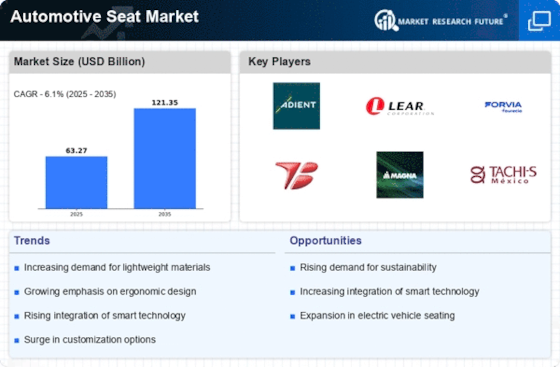
As per Market Research Future analysis, the Automotive Seat Market was estimated at 63.27 USD Billion in 2024. The Automotive Seat industry is projected to grow from 67.12 USD Billion in 2025 to 121.35 USD Billion by 2035, exhibiting a compound annual growth rate (CAGR) of 6.1% during the forecast period 2025 - 2035

Key Market Trends & Highlights

The Automotive Seat Market is experiencing a transformative shift towards advanced technologies and sustainable practices.

  • The integration of smart technologies is reshaping consumer expectations in the automotive seat market. Sustainability in materials is becoming a focal point, particularly in North America, where eco-friendly options are gaining traction. Customization and personalization are increasingly sought after, especially in the largest bench segment. Rising demand for electric vehicles and technological advancements in seat design are driving growth in both the powered and heated segments.

Market Size & Forecast

2024 Market Size 63.27 (USD Billion)
2035 Market Size 121.35 (USD Billion)
CAGR (2025 - 2035) 6.1%
Largest Regional Market Share in 2024 Asia Pacific

Major Players

Adient (US), Lear Corporation (US), Faurecia (FR), Toyota Boshoku (JP), Magna International (CA), Tachi-S (JP), Recaro (DE), Seating Solutions (US), Groupe PSA (FR), Hyundai Dymos (KR)

Market Trends

The Automotive Seat Market is currently experiencing a transformative phase, driven by evolving consumer preferences and technological advancements. As vehicles become more sophisticated, the demand for seats that offer enhanced comfort, safety, and functionality is on the rise. Manufacturers are increasingly focusing on integrating smart technologies into seating solutions, which not only improve user experience but also align with the growing trend of vehicle electrification. This shift towards innovation suggests a potential for significant growth in the sector, as companies strive to meet the expectations of modern consumers who prioritize both aesthetics and practicality in automotive design. Moreover, sustainability is emerging as a crucial factor influencing the Automotive Seat Market. With heightened awareness regarding environmental issues, manufacturers are exploring eco-friendly materials and production processes. This trend indicates a broader commitment to reducing the carbon footprint associated with automotive production. As a result, the Automotive Seat Market is likely to witness a surge in demand for seats made from recycled or sustainable materials, reflecting a shift towards more responsible consumption patterns. The interplay between technology and sustainability appears to be shaping the future landscape of the Automotive Seat Market, presenting opportunities for innovation and growth.

Integration of Smart Technologies

The Automotive Seat Market is witnessing a notable trend towards the incorporation of smart technologies. Features such as heating, cooling, and adjustable lumbar support are becoming standard, enhancing passenger comfort. Additionally, connectivity options that allow seats to interact with other vehicle systems are gaining traction, indicating a shift towards more integrated automotive experiences.

Sustainability in Materials

A growing emphasis on sustainability is influencing the Automotive Seat Market. Manufacturers are increasingly adopting eco-friendly materials, such as recycled plastics and organic fabrics, in seat production. This trend reflects a broader commitment to environmental responsibility and aligns with consumer preferences for greener products.

Customization and Personalization

The demand for customized seating solutions is rising within the Automotive Seat Market. Consumers are seeking options that cater to their individual preferences, from color and material choices to ergonomic designs. This trend suggests that manufacturers may need to adopt more flexible production processes to meet diverse consumer needs.

Automotive Seat Market Market Drivers

Growing Focus on Safety Regulations

The Automotive Seat Market is significantly influenced by the stringent safety regulations imposed by various governments. These regulations mandate the incorporation of advanced safety features in vehicle seating, such as side airbags and enhanced crash protection systems. As a result, manufacturers are compelled to innovate and improve their seat designs to comply with these regulations. The market data suggests that the demand for seats equipped with advanced safety features is expected to increase, driven by consumer awareness and regulatory pressures. This focus on safety not only enhances the appeal of vehicles but also positions manufacturers favorably within the competitive landscape of the Automotive Seat Market.

Rising Demand for Electric Vehicles

The increasing adoption of electric vehicles (EVs) is a pivotal driver for the Automotive Seat Market. As consumers become more environmentally conscious, the demand for EVs is projected to rise significantly. According to recent data, the EV market is expected to grow at a compound annual growth rate (CAGR) of over 20% in the coming years. This surge in EV production necessitates the development of specialized seating solutions that cater to the unique requirements of electric vehicles, such as lightweight materials and innovative designs. Consequently, manufacturers in the Automotive Seat Market are likely to invest in research and development to create seats that enhance comfort and safety while aligning with the sustainability goals of EV manufacturers.

Shift Towards Lightweight Materials

The Automotive Seat Market is witnessing a notable shift towards the use of lightweight materials in seat manufacturing. This trend is primarily driven by the need for improved fuel efficiency and reduced emissions in vehicles. Manufacturers are increasingly adopting materials such as advanced composites and high-strength steel to create lighter seats without compromising safety or comfort. Data suggests that the use of lightweight materials in automotive seating could lead to a reduction in vehicle weight by up to 10%, which is significant for fuel economy. As a result, this shift is likely to influence design strategies and material selection in the Automotive Seat Market, fostering innovation and sustainability.

Increase in Vehicle Production and Sales

The Automotive Seat Market is experiencing growth due to the rising production and sales of vehicles across various segments. As economies recover and consumer confidence improves, vehicle sales are projected to rise steadily. Recent statistics indicate that global vehicle production is expected to reach over 100 million units annually by 2026. This increase in production directly correlates with a heightened demand for automotive seats, as each vehicle requires multiple seating solutions. Consequently, manufacturers in the Automotive Seat Market are likely to ramp up production capabilities to meet this growing demand, thereby driving innovation and competition within the sector.

Technological Advancements in Seat Design

Technological innovations are transforming the Automotive Seat Market, leading to the development of advanced seating solutions. Features such as integrated heating and cooling systems, adjustable lumbar support, and memory foam technology are becoming increasingly prevalent. The market for smart seats, which can monitor driver posture and provide feedback, is also gaining traction. Data indicates that the market for smart automotive seats is expected to grow at a CAGR of approximately 15% over the next five years. These advancements not only enhance passenger comfort but also contribute to overall vehicle safety, making them a crucial focus for manufacturers in the Automotive Seat Market.

Market Segment Insights

By Type: Bench (Largest) vs. Bucket (Fastest-Growing)

In the Automotive Seat Market, the dominant segment is the bench seat, which holds the largest share due to its widespread use in various vehicle types, particularly in family cars and <a href="https://www.marketresearchfuture.com/reports/commercial-vehicle-market-34525">commercial vehicles</a>. Its simplicity and cost-effectiveness make it a preferred choice for many manufacturers. Following closely is the bucket seat segment, which, while smaller in overall Automotive Seat Market share, is rapidly gaining traction, especially in sports and luxury vehicles that prioritize both aesthetics and comfort. The growth of the bucket seat segment is driven by increased consumer demand for customization and enhanced ergonomic features. This trend is further fueled by the rising popularity of SUVs and performance cars, where bucket seats are favored for their supportive design. Innovations in materials and manufacturing technologies also play a crucial role in the segment's expansion, allowing for lighter yet durable options that cater to the performance-oriented Automotive Seat Market.

Bench (Dominant) vs. Bucket (Emerging)

The bench seat segment remains a dominant player in the Automotive Seat Market, primarily due to its versatility and cost efficiency. Bench seats are designed to accommodate multiple passengers, making them ideal for family vehicles, vans, and trucks where space optimization is crucial. In contrast, bucket seats are emerging as a preferred choice in modern automotive design, especially in sports cars, where they enhance driver engagement and comfort. These seats offer improved support, customization options, and stylish aesthetics that appeal to a younger, more performance-focused demographic. Bucket seats are increasingly being integrated with advanced features such as heating, cooling, and even electric adjustments, setting them apart from traditional bench designs.

By Technology: Powered (Largest) vs. Heated (Fastest-Growing)

In the Automotive Seat Market, the 'Powered' segment accounts for the largest share, appealing to consumers who prioritize convenience and comfort in their driving experience. This segment enhances user functionality with features such as adjustable seating positions, lumbar support, and memory settings, making it a common choice for many vehicles. Conversely, the 'Heated' segment is witnessing rapid growth, driven by increasing consumer demand for enhanced comfort, particularly in colder regions. Manufacturers are continuously innovating to integrate efficient heating technologies, leading to a surge in adoption of heated seats.

Technology: Powered (Dominant) vs. Heated (Emerging)

The 'Powered' seats have established themselves as a dominant force in the Automotive Seat Market, offering a blend of comfort and adjustability that appeals widely to consumers. Often equipped with features like electronic adjustments and memory foam technologies, these seats cater to a wide array of preferences and body types. On the other hand, the 'Heated' seats segment is emerging rapidly, particularly appealing to consumers in colder climates where enhanced warmth significantly elevates the driving experience. The rise in <a title="electric vehicles" href="https://www.marketresearchfuture.com/reports/electric-vehicles-market-1793" target="_blank" rel="noopener">electric vehicles</a> has further fueled this trend, as manufacturers seek to provide more luxurious features even in compact models. As such, both segments play crucial roles, with powered seats leading in Automotive Seat Market presence, while heated seats are quickly capitalizing on growing consumer expectations.

By Material: Genuine Leather (Largest) vs. Synthetic Leather (Fastest-Growing)

In the Automotive Seat Market, the material segment showcases a diverse range of options including Genuine Leather, Synthetic Leather, and Fabric. Genuine Leather holds the largest Automotive Seat Market share, appealing to consumers who favor luxurious and premium seating experiences. Synthetic Leather, while not as dominant, is gaining traction due to its cost-effectiveness and growing influence among environmentally conscious consumers. Fabric has a stable presence but tends to be overshadowed by the advancements and acceptance of the other two materials.

Genuine Leather (Dominant) vs. Synthetic Leather (Emerging)

Genuine Leather is renowned for its durability, luxury, and aesthetic appeal, making it the dominant choice among high-end automobile manufacturers and discerning consumers. It offers a premium feel that is difficult to replicate, providing an upscale ambiance that many drivers desire. Conversely, Synthetic Leather is emerging rapidly, driven by innovations in manufacturing techniques, which enhance its appearance and feel. It appeals especially to budget-conscious consumers and those seeking eco-friendly options, as it is often more sustainable than conventional leather. This shift towards synthetic alternatives is reshaping Automotive Seat Market dynamics in the automotive seating sector.

By Vehicle Type: Passenger Car (Largest) vs. Commercial Vehicle (Fastest-Growing)

The Automotive Seat Market showcases a significant preference for passenger cars, capturing a large portion of the overall Automotive Seat Market share. This segment has long been the cornerstone of seat production due to the high volume of vehicle sales and the consumer preference for personal mobility solutions. Innovations in design and technology to enhance comfort and safety are key contributors to this segment's dominance. On the other hand, the commercial vehicle segment exhibits rapid growth, driven by the expansion of logistics and transportation sectors. The rise in e-commerce activities has escalated the demand for efficient delivery solutions, leading to an uptick in commercial vehicle production. Additionally, advancements in seating technology aimed at improving driver comfort and safety are propelling this segment forward, marking it as the fastest-growing area in the automotive seat market.

Passenger Car (Dominant) vs. Commercial Vehicle (Emerging)

Passenger cars represent the dominant segment in the Automotive Seat Market, characterized by a strong consumer demand for comfort, safety, and customization. Manufacturers focus on integrating advanced features such as memory foam, climate control, and ergonomic designs to cater to the diverse preferences of consumers. The passenger car market is also influenced by trends like lightweight materials and sustainability practices, which manufacturers are increasingly adopting to appeal to eco-conscious consumers. In contrast, the commercial vehicle segment is emerging rapidly, largely driven by the increasing focus on efficiency and productivity within logistics. This segment prioritizes durability and functionality in seat design, aimed at enhancing driver performance during long hours of operation. Features such as adjustable seating, reinforced structures, and easy-to-clean materials are becoming essential. With the expansion of urbanization and infrastructure initiatives worldwide, <a href="https://www.marketresearchfuture.com/reports/commercial-vehicle-market-34525">commercial vehicles</a> are expected to continue gaining traction, thus shaping the future landscape of the automotive seat market.

Get more detailed insights about Automotive Seat Market Research Report - Global Forecast to 2035

Regional Insights

By region, the study provides Automotive Seat Market insights into North America, Europe, Asia-Pacific, and the Rest of the World. Asia Pacific holds the largest Automotive Seat Market share. The rising adoption of innovative technology and an increasing number of vehicle production would be factors driving the growth of the market. China is the largest automotive manufacturer followed by Japan, South Korea, and India.

Figure 3: Automotive Seat Market Share By Region 2021 (%)

North America and Europe are expected to grow significantly over the forecast period owing to rising consumer demand for luxurious and comfortable travel. The technological development in the automotive seats by the key players in this region is likely to boost the market in this region.

Key Players and Competitive Insights

Major market players are spending a lot of money on R&D to increase their product lines, which will help the Automotive Seat Market grow even more. Market participants are also taking a range of strategic initiatives to grow their worldwide footprint, with key market developments such as new product launches, contractual agreements, mergers and acquisitions, increased investments, and collaboration with other organizations. Competitors in the Automotive Seat industry must offer cost-effective items to expand and survive in an increasingly competitive and rising market environment. The major market players are investing a lot of money in R&D to expand their product lines, which will spur further market growth for Automotive seats. With significant market development like new product releases, contractual agreements, mergers and acquisitions, increased investments, and collaboration with other organizations, market participants are also undertaking various strategic activities to expand their presence. To grow and thrive in a market climate that is becoming more competitive and growing, competitors in the Automotive Seat industry must offer affordable products. Manufacturing locally to cut operating costs is one of the main business tactics manufacturers use in the Automotive Seat industry to benefit customers and expand the market sector. The Automotive Seat Market has recently given medicine some of the most important advantages. Major hair care product market players, including Johnson Controls (U.S.), Lear Corporation (U.S.), Faurecia (France), Toyota Boshoku Corporation (Japan), TS Tech Co. Ltd (Japan), and others, are attempting to increase market demand by funding R&D initiatives. Johnson Controls Automotive Seating ranked highest in three out of seven vehicle segments in the annual J.D. Power 2016 Seat Quality and Satisfaction Study SM. The company ranks highest in more categories than any other seating supplier. Manufacturing automotive seats with a high level of craftsmanship that exceed comfort and safety requirements is a top priority for Johnson Controls said Byron Foster, executive vice president for Johnson Controls Automotive Seating. "they are pleased to be recognized by J.D. Power, as it acknowledges the efforts of our entire team to build quality seat products for our automaker customers. Also, Magna International prides itself on a highly entrepreneurial culture and a corporate constitution that outlines the distribution of profits to various stakeholders. This automotive supplier's product groups include exteriors, interiors, seating, roof systems, body and chassis, powertrain, vision, and electronic systems, closure systems, electric vehicle systems, tooling and engineering, and contracted vehicle assembly. Roughly 46% of Magna's revenue comes from North America while Europe accounts for approximately 43%.

Key Companies in the Automotive Seat Market include

Industry Developments

June 2022: Sustainable seat foam from bio-sourced raw material,US foam producer Woodbridge has developed a process to integrate biogenic carbon (biocarbon) in its purest form into the company’s polyurethane seating foam chemistry. The new product, TrimVisible Bio, is stated to enable a cradle-to-gate reduction in carbon dioxide (CO2 ) footprint for automotive seating foam without compromising material properties, performance and comfort.

January 2022: Volkswagen-Brose joint venture for seat production goes live,A joint venture between automotive supplier Brose and Volkswagen, called Brose Sitech, began operations as an independent supplier of seat systems on January 1, 2022. Brose and Volkswagen each hold a 50% stake in the joint venture, headquartered in Polkowice, Poland.The companies hope that the JV will cater to current megatrends of e-mobility and autonomous driving, where the vehicle is becoming a mobile living space, and the importance of interior and seats as a differentiating feature is increasing.

September 2021: Adient, a global supplier of seating systems for the automotive industry, and Covestro, a polymer specialist, have joined forces in an effort to improve the sustainability of the former’s seat products.From November, Adient will be integrating Cardyon, a polyol made using Covestro’s CO₂ technology, as a sustainable feedstock for the production of hot cure molded polyurethane foam. Adient uses these foams as cushioning in its automotive seating systems.This supply chain-related sustainability move helps to further reduce Adient’s Scope 3 emissions as calculated by the Greenhouse Gas Protocol.

Based on the principle of the circular economy, the Covestro’s CO₂ technology reuses carbon dioxide as a material source by integrating up to 20% of CO₂ into polyol production. The smart contribution helps to preserve fossil resources and close the carbon loop.

March 2020, a popular enterpriser, Adient took an agreement with Sage Automotive Interiors, an Asahi Kasei Company, to sell their automotive fabrics manufacturing business, and their lamination business for USD 175 Billion. This selling process is predicted to complete at the end of FY 2020.

February 2020, in Japan, one of the top leading companies, Toyota Boshoku Corporation introduced the innovation in a seat with a comfortable and convenient function Drivers easy return seta function for Toyota Yaris.

Future Outlook

Automotive Seat Market Future Outlook

The Automotive Seat Market is projected to grow at a 6.1% CAGR from 2025 to 2035, driven by technological advancements, increasing vehicle production, and rising consumer demand for comfort and safety.

New opportunities lie in:

  • <p>Integration of smart seating technologies for enhanced user experience. Development of lightweight materials to improve fuel efficiency. Expansion into electric vehicle seat manufacturing for sustainable growth.</p>

By 2035, the Automotive Seat Market is expected to achieve robust growth, driven by innovation and evolving consumer preferences.

Market Segmentation

Automotive Seat Market Type Outlook

  • Bench
  • Bucket
  • Folding
  • Others

Automotive Seat Market Material Outlook

  • Genuine Leather
  • Synthetic Leather
  • Fabric

Automotive Seat Market Technology Outlook

  • Powered
  • Heated
  • Powered & Heated
  • Standard

Automotive Seat Market Vehicle Type Outlook

  • Passenger Car
  • Commercial Vehicle

Report Scope

MARKET SIZE 2024 63.27(USD Billion)
MARKET SIZE 2025 67.12(USD Billion)
MARKET SIZE 2035 121.35(USD Billion)
COMPOUND ANNUAL GROWTH RATE (CAGR) 6.1% (2025 - 2035)
REPORT COVERAGE Revenue Forecast, Competitive Landscape, Growth Factors, and Trends
BASE YEAR 2024
Market Forecast Period 2025 - 2035
Historical Data 2019 - 2024
Market Forecast Units USD Billion
Key Companies Profiled Adient (US), Lear Corporation (US), Faurecia (FR), Toyota Boshoku (JP), Magna International (CA), Tachi-S (JP), Recaro (DE), Seating Solutions (US), Groupe PSA (FR), Hyundai Dymos (KR)
Segments Covered Type, Region
Key Market Opportunities Integration of smart technology and sustainable materials in the Automotive Seat Market presents significant growth opportunities.
Key Market Dynamics Rising demand for lightweight materials in automotive seats drives innovation and enhances fuel efficiency across vehicle segments.
Countries Covered North America, Europe, APAC, South America, MEA

FAQs

What is the projected market valuation of the Automotive Seat Market by 2035?

<p>The Automotive Seat Market is projected to reach a valuation of 121.35 USD Billion by 2035.</p>

What was the market valuation of the Automotive Seat Market in 2024?

<p>In 2024, the Automotive Seat Market was valued at 63.27 USD Billion.</p>

What is the expected CAGR for the Automotive Seat Market during the forecast period 2025 - 2035?

<p>The expected CAGR for the Automotive Seat Market during the forecast period 2025 - 2035 is 6.1%.</p>

Which companies are considered key players in the Automotive Seat Market?

<p>Key players in the Automotive Seat Market include Adient, Lear Corporation, Faurecia, and Toyota Boshoku, among others.</p>

What are the projected valuations for different types of automotive seats by 2035?

<p>By 2035, the projected valuations for automotive seat types include Bucket seats at 50.0 USD Billion and Bench seats at 30.0 USD Billion.</p>

How does the market for powered and heated automotive seats compare to standard seats?

<p>The market for powered and heated automotive seats is projected to reach 30.0 USD Billion, while standard seats may reach 56.35 USD Billion by 2035.</p>

What materials are expected to dominate the Automotive Seat Market by 2035?

<p>By 2035, synthetic leather and fabric are expected to dominate the Automotive Seat Market, with valuations of 40.0 USD Billion and 51.35 USD Billion, respectively.</p>

What is the projected market size for passenger cars in the Automotive Seat Market by 2035?

<p>The projected market size for passenger cars in the Automotive Seat Market is expected to reach 73.0 USD Billion by 2035.</p>

What segment of the Automotive Seat Market is anticipated to grow the fastest?

<p>The segment for powered and heated seats is anticipated to grow rapidly, potentially reaching 30.0 USD Billion by 2035.</p>

How do the valuations of commercial vehicles compare to passenger cars in the Automotive Seat Market?

<p>The valuation for commercial vehicles in the Automotive Seat Market is projected to be 48.35 USD Billion, significantly lower than the 73.0 USD Billion for passenger cars by 2035.</p>

  1. SECTION I: EXECUTIVE SUMMARY AND KEY HIGHLIGHTS
    1. | 1.1 EXECUTIVE SUMMARY
    2. | | 1.1.1 Market Overview
    3. | | 1.1.2 Key Findings
    4. | | 1.1.3 Market Segmentation
    5. | | 1.1.4 Competitive Landscape
    6. | | 1.1.5 Challenges and Opportunities
    7. | | 1.1.6 Future Outlook
  2. SECTION II: SCOPING, METHODOLOGY AND MARKET STRUCTURE
    1. | 2.1 MARKET INTRODUCTION
    2. | | 2.1.1 Definition
    3. | | 2.1.2 Scope of the study
    4. | | | 2.1.2.1 Research Objective
    5. | | | 2.1.2.2 Assumption
    6. | | | 2.1.2.3 Limitations
    7. | 2.2 RESEARCH METHODOLOGY
    8. | | 2.2.1 Overview
    9. | | 2.2.2 Data Mining
    10. | | 2.2.3 Secondary Research
    11. | | 2.2.4 Primary Research
    12. | | | 2.2.4.1 Primary Interviews and Information Gathering Process
    13. | | | 2.2.4.2 Breakdown of Primary Respondents
    14. | | 2.2.5 Forecasting Model
    15. | | 2.2.6 Market Size Estimation
    16. | | | 2.2.6.1 Bottom-Up Approach
    17. | | | 2.2.6.2 Top-Down Approach
    18. | | 2.2.7 Data Triangulation
    19. | | 2.2.8 Validation
  3. SECTION III: QUALITATIVE ANALYSIS
    1. | 3.1 MARKET DYNAMICS
    2. | | 3.1.1 Overview
    3. | | 3.1.2 Drivers
    4. | | 3.1.3 Restraints
    5. | | 3.1.4 Opportunities
    6. | 3.2 MARKET FACTOR ANALYSIS
    7. | | 3.2.1 Value chain Analysis
    8. | | 3.2.2 Porter's Five Forces Analysis
    9. | | | 3.2.2.1 Bargaining Power of Suppliers
    10. | | | 3.2.2.2 Bargaining Power of Buyers
    11. | | | 3.2.2.3 Threat of New Entrants
    12. | | | 3.2.2.4 Threat of Substitutes
    13. | | | 3.2.2.5 Intensity of Rivalry
    14. | | 3.2.3 COVID-19 Impact Analysis
    15. | | | 3.2.3.1 Market Impact Analysis
    16. | | | 3.2.3.2 Regional Impact
    17. | | | 3.2.3.3 Opportunity and Threat Analysis
  4. SECTION IV: QUANTITATIVE ANALYSIS
    1. | 4.1 Automobile, BY Type (USD Billion)
    2. | | 4.1.1 Bench
    3. | | 4.1.2 Bucket
    4. | | 4.1.3 Folding
    5. | | 4.1.4 Others
    6. | 4.2 Automobile, BY Technology (USD Billion)
    7. | | 4.2.1 Powered
    8. | | 4.2.2 Heated
    9. | | 4.2.3 Powered & Heated
    10. | | 4.2.4 Standard
    11. | 4.3 Automobile, BY Material (USD Billion)
    12. | | 4.3.1 Genuine Leather
    13. | | 4.3.2 Synthetic Leather
    14. | | 4.3.3 Fabric
    15. | 4.4 Automobile, BY Vehicle Type (USD Billion)
    16. | | 4.4.1 Passenger Car
    17. | | 4.4.2 Commercial Vehicle
    18. | 4.5 Automobile, BY Region (USD Billion)
    19. | | 4.5.1 North America
    20. | | | 4.5.1.1 US
    21. | | | 4.5.1.2 Canada
    22. | | 4.5.2 Europe
    23. | | | 4.5.2.1 Germany
    24. | | | 4.5.2.2 UK
    25. | | | 4.5.2.3 France
    26. | | | 4.5.2.4 Russia
    27. | | | 4.5.2.5 Italy
    28. | | | 4.5.2.6 Spain
    29. | | | 4.5.2.7 Rest of Europe
    30. | | 4.5.3 APAC
    31. | | | 4.5.3.1 China
    32. | | | 4.5.3.2 India
    33. | | | 4.5.3.3 Japan
    34. | | | 4.5.3.4 South Korea
    35. | | | 4.5.3.5 Malaysia
    36. | | | 4.5.3.6 Thailand
    37. | | | 4.5.3.7 Indonesia
    38. | | | 4.5.3.8 Rest of APAC
    39. | | 4.5.4 South America
    40. | | | 4.5.4.1 Brazil
    41. | | | 4.5.4.2 Mexico
    42. | | | 4.5.4.3 Argentina
    43. | | | 4.5.4.4 Rest of South America
    44. | | 4.5.5 MEA
    45. | | | 4.5.5.1 GCC Countries
    46. | | | 4.5.5.2 South Africa
    47. | | | 4.5.5.3 Rest of MEA
  5. SECTION V: COMPETITIVE ANALYSIS
    1. | 5.1 Competitive Landscape
    2. | | 5.1.1 Overview
    3. | | 5.1.2 Competitive Analysis
    4. | | 5.1.3 Market share Analysis
    5. | | 5.1.4 Major Growth Strategy in the Automobile
    6. | | 5.1.5 Competitive Benchmarking
    7. | | 5.1.6 Leading Players in Terms of Number of Developments in the Automobile
    8. | | 5.1.7 Key developments and growth strategies
    9. | | | 5.1.7.1 New Product Launch/Service Deployment
    10. | | | 5.1.7.2 Merger & Acquisitions
    11. | | | 5.1.7.3 Joint Ventures
    12. | | 5.1.8 Major Players Financial Matrix
    13. | | | 5.1.8.1 Sales and Operating Income
    14. | | | 5.1.8.2 Major Players R&D Expenditure. 2023
    15. | 5.2 Company Profiles
    16. | | 5.2.1 Adient (US)
    17. | | | 5.2.1.1 Financial Overview
    18. | | | 5.2.1.2 Products Offered
    19. | | | 5.2.1.3 Key Developments
    20. | | | 5.2.1.4 SWOT Analysis
    21. | | | 5.2.1.5 Key Strategies
    22. | | 5.2.2 Lear Corporation (US)
    23. | | | 5.2.2.1 Financial Overview
    24. | | | 5.2.2.2 Products Offered
    25. | | | 5.2.2.3 Key Developments
    26. | | | 5.2.2.4 SWOT Analysis
    27. | | | 5.2.2.5 Key Strategies
    28. | | 5.2.3 Faurecia (FR)
    29. | | | 5.2.3.1 Financial Overview
    30. | | | 5.2.3.2 Products Offered
    31. | | | 5.2.3.3 Key Developments
    32. | | | 5.2.3.4 SWOT Analysis
    33. | | | 5.2.3.5 Key Strategies
    34. | | 5.2.4 Toyota Boshoku (JP)
    35. | | | 5.2.4.1 Financial Overview
    36. | | | 5.2.4.2 Products Offered
    37. | | | 5.2.4.3 Key Developments
    38. | | | 5.2.4.4 SWOT Analysis
    39. | | | 5.2.4.5 Key Strategies
    40. | | 5.2.5 Magna International (CA)
    41. | | | 5.2.5.1 Financial Overview
    42. | | | 5.2.5.2 Products Offered
    43. | | | 5.2.5.3 Key Developments
    44. | | | 5.2.5.4 SWOT Analysis
    45. | | | 5.2.5.5 Key Strategies
    46. | | 5.2.6 Tachi-S (JP)
    47. | | | 5.2.6.1 Financial Overview
    48. | | | 5.2.6.2 Products Offered
    49. | | | 5.2.6.3 Key Developments
    50. | | | 5.2.6.4 SWOT Analysis
    51. | | | 5.2.6.5 Key Strategies
    52. | | 5.2.7 Recaro (DE)
    53. | | | 5.2.7.1 Financial Overview
    54. | | | 5.2.7.2 Products Offered
    55. | | | 5.2.7.3 Key Developments
    56. | | | 5.2.7.4 SWOT Analysis
    57. | | | 5.2.7.5 Key Strategies
    58. | | 5.2.8 Seating Solutions (US)
    59. | | | 5.2.8.1 Financial Overview
    60. | | | 5.2.8.2 Products Offered
    61. | | | 5.2.8.3 Key Developments
    62. | | | 5.2.8.4 SWOT Analysis
    63. | | | 5.2.8.5 Key Strategies
    64. | | 5.2.9 Groupe PSA (FR)
    65. | | | 5.2.9.1 Financial Overview
    66. | | | 5.2.9.2 Products Offered
    67. | | | 5.2.9.3 Key Developments
    68. | | | 5.2.9.4 SWOT Analysis
    69. | | | 5.2.9.5 Key Strategies
    70. | | 5.2.10 Hyundai Dymos (KR)
    71. | | | 5.2.10.1 Financial Overview
    72. | | | 5.2.10.2 Products Offered
    73. | | | 5.2.10.3 Key Developments
    74. | | | 5.2.10.4 SWOT Analysis
    75. | | | 5.2.10.5 Key Strategies
    76. | 5.3 Appendix
    77. | | 5.3.1 References
    78. | | 5.3.2 Related Reports
  6. LIST OF FIGURES
    1. | 6.1 MARKET SYNOPSIS
    2. | 6.2 NORTH AMERICA MARKET ANALYSIS
    3. | 6.3 US MARKET ANALYSIS BY TYPE
    4. | 6.4 US MARKET ANALYSIS BY TECHNOLOGY
    5. | 6.5 US MARKET ANALYSIS BY MATERIAL
    6. | 6.6 US MARKET ANALYSIS BY VEHICLE TYPE
    7. | 6.7 CANADA MARKET ANALYSIS BY TYPE
    8. | 6.8 CANADA MARKET ANALYSIS BY TECHNOLOGY
    9. | 6.9 CANADA MARKET ANALYSIS BY MATERIAL
    10. | 6.10 CANADA MARKET ANALYSIS BY VEHICLE TYPE
    11. | 6.11 EUROPE MARKET ANALYSIS
    12. | 6.12 GERMANY MARKET ANALYSIS BY TYPE
    13. | 6.13 GERMANY MARKET ANALYSIS BY TECHNOLOGY
    14. | 6.14 GERMANY MARKET ANALYSIS BY MATERIAL
    15. | 6.15 GERMANY MARKET ANALYSIS BY VEHICLE TYPE
    16. | 6.16 UK MARKET ANALYSIS BY TYPE
    17. | 6.17 UK MARKET ANALYSIS BY TECHNOLOGY
    18. | 6.18 UK MARKET ANALYSIS BY MATERIAL
    19. | 6.19 UK MARKET ANALYSIS BY VEHICLE TYPE
    20. | 6.20 FRANCE MARKET ANALYSIS BY TYPE
    21. | 6.21 FRANCE MARKET ANALYSIS BY TECHNOLOGY
    22. | 6.22 FRANCE MARKET ANALYSIS BY MATERIAL
    23. | 6.23 FRANCE MARKET ANALYSIS BY VEHICLE TYPE
    24. | 6.24 RUSSIA MARKET ANALYSIS BY TYPE
    25. | 6.25 RUSSIA MARKET ANALYSIS BY TECHNOLOGY
    26. | 6.26 RUSSIA MARKET ANALYSIS BY MATERIAL
    27. | 6.27 RUSSIA MARKET ANALYSIS BY VEHICLE TYPE
    28. | 6.28 ITALY MARKET ANALYSIS BY TYPE
    29. | 6.29 ITALY MARKET ANALYSIS BY TECHNOLOGY
    30. | 6.30 ITALY MARKET ANALYSIS BY MATERIAL
    31. | 6.31 ITALY MARKET ANALYSIS BY VEHICLE TYPE
    32. | 6.32 SPAIN MARKET ANALYSIS BY TYPE
    33. | 6.33 SPAIN MARKET ANALYSIS BY TECHNOLOGY
    34. | 6.34 SPAIN MARKET ANALYSIS BY MATERIAL
    35. | 6.35 SPAIN MARKET ANALYSIS BY VEHICLE TYPE
    36. | 6.36 REST OF EUROPE MARKET ANALYSIS BY TYPE
    37. | 6.37 REST OF EUROPE MARKET ANALYSIS BY TECHNOLOGY
    38. | 6.38 REST OF EUROPE MARKET ANALYSIS BY MATERIAL
    39. | 6.39 REST OF EUROPE MARKET ANALYSIS BY VEHICLE TYPE
    40. | 6.40 APAC MARKET ANALYSIS
    41. | 6.41 CHINA MARKET ANALYSIS BY TYPE
    42. | 6.42 CHINA MARKET ANALYSIS BY TECHNOLOGY
    43. | 6.43 CHINA MARKET ANALYSIS BY MATERIAL
    44. | 6.44 CHINA MARKET ANALYSIS BY VEHICLE TYPE
    45. | 6.45 INDIA MARKET ANALYSIS BY TYPE
    46. | 6.46 INDIA MARKET ANALYSIS BY TECHNOLOGY
    47. | 6.47 INDIA MARKET ANALYSIS BY MATERIAL
    48. | 6.48 INDIA MARKET ANALYSIS BY VEHICLE TYPE
    49. | 6.49 JAPAN MARKET ANALYSIS BY TYPE
    50. | 6.50 JAPAN MARKET ANALYSIS BY TECHNOLOGY
    51. | 6.51 JAPAN MARKET ANALYSIS BY MATERIAL
    52. | 6.52 JAPAN MARKET ANALYSIS BY VEHICLE TYPE
    53. | 6.53 SOUTH KOREA MARKET ANALYSIS BY TYPE
    54. | 6.54 SOUTH KOREA MARKET ANALYSIS BY TECHNOLOGY
    55. | 6.55 SOUTH KOREA MARKET ANALYSIS BY MATERIAL
    56. | 6.56 SOUTH KOREA MARKET ANALYSIS BY VEHICLE TYPE
    57. | 6.57 MALAYSIA MARKET ANALYSIS BY TYPE
    58. | 6.58 MALAYSIA MARKET ANALYSIS BY TECHNOLOGY
    59. | 6.59 MALAYSIA MARKET ANALYSIS BY MATERIAL
    60. | 6.60 MALAYSIA MARKET ANALYSIS BY VEHICLE TYPE
    61. | 6.61 THAILAND MARKET ANALYSIS BY TYPE
    62. | 6.62 THAILAND MARKET ANALYSIS BY TECHNOLOGY
    63. | 6.63 THAILAND MARKET ANALYSIS BY MATERIAL
    64. | 6.64 THAILAND MARKET ANALYSIS BY VEHICLE TYPE
    65. | 6.65 INDONESIA MARKET ANALYSIS BY TYPE
    66. | 6.66 INDONESIA MARKET ANALYSIS BY TECHNOLOGY
    67. | 6.67 INDONESIA MARKET ANALYSIS BY MATERIAL
    68. | 6.68 INDONESIA MARKET ANALYSIS BY VEHICLE TYPE
    69. | 6.69 REST OF APAC MARKET ANALYSIS BY TYPE
    70. | 6.70 REST OF APAC MARKET ANALYSIS BY TECHNOLOGY
    71. | 6.71 REST OF APAC MARKET ANALYSIS BY MATERIAL
    72. | 6.72 REST OF APAC MARKET ANALYSIS BY VEHICLE TYPE
    73. | 6.73 SOUTH AMERICA MARKET ANALYSIS
    74. | 6.74 BRAZIL MARKET ANALYSIS BY TYPE
    75. | 6.75 BRAZIL MARKET ANALYSIS BY TECHNOLOGY
    76. | 6.76 BRAZIL MARKET ANALYSIS BY MATERIAL
    77. | 6.77 BRAZIL MARKET ANALYSIS BY VEHICLE TYPE
    78. | 6.78 MEXICO MARKET ANALYSIS BY TYPE
    79. | 6.79 MEXICO MARKET ANALYSIS BY TECHNOLOGY
    80. | 6.80 MEXICO MARKET ANALYSIS BY MATERIAL
    81. | 6.81 MEXICO MARKET ANALYSIS BY VEHICLE TYPE
    82. | 6.82 ARGENTINA MARKET ANALYSIS BY TYPE
    83. | 6.83 ARGENTINA MARKET ANALYSIS BY TECHNOLOGY
    84. | 6.84 ARGENTINA MARKET ANALYSIS BY MATERIAL
    85. | 6.85 ARGENTINA MARKET ANALYSIS BY VEHICLE TYPE
    86. | 6.86 REST OF SOUTH AMERICA MARKET ANALYSIS BY TYPE
    87. | 6.87 REST OF SOUTH AMERICA MARKET ANALYSIS BY TECHNOLOGY
    88. | 6.88 REST OF SOUTH AMERICA MARKET ANALYSIS BY MATERIAL
    89. | 6.89 REST OF SOUTH AMERICA MARKET ANALYSIS BY VEHICLE TYPE
    90. | 6.90 MEA MARKET ANALYSIS
    91. | 6.91 GCC COUNTRIES MARKET ANALYSIS BY TYPE
    92. | 6.92 GCC COUNTRIES MARKET ANALYSIS BY TECHNOLOGY
    93. | 6.93 GCC COUNTRIES MARKET ANALYSIS BY MATERIAL
    94. | 6.94 GCC COUNTRIES MARKET ANALYSIS BY VEHICLE TYPE
    95. | 6.95 SOUTH AFRICA MARKET ANALYSIS BY TYPE
    96. | 6.96 SOUTH AFRICA MARKET ANALYSIS BY TECHNOLOGY
    97. | 6.97 SOUTH AFRICA MARKET ANALYSIS BY MATERIAL
    98. | 6.98 SOUTH AFRICA MARKET ANALYSIS BY VEHICLE TYPE
    99. | 6.99 REST OF MEA MARKET ANALYSIS BY TYPE
    100. | 6.100 REST OF MEA MARKET ANALYSIS BY TECHNOLOGY
    101. | 6.101 REST OF MEA MARKET ANALYSIS BY MATERIAL
    102. | 6.102 REST OF MEA MARKET ANALYSIS BY VEHICLE TYPE
    103. | 6.103 KEY BUYING CRITERIA OF AUTOMOBILE
    104. | 6.104 RESEARCH PROCESS OF MRFR
    105. | 6.105 DRO ANALYSIS OF AUTOMOBILE
    106. | 6.106 DRIVERS IMPACT ANALYSIS: AUTOMOBILE
    107. | 6.107 RESTRAINTS IMPACT ANALYSIS: AUTOMOBILE
    108. | 6.108 SUPPLY / VALUE CHAIN: AUTOMOBILE
    109. | 6.109 AUTOMOBILE, BY TYPE, 2024 (% SHARE)
    110. | 6.110 AUTOMOBILE, BY TYPE, 2024 TO 2035 (USD Billion)
    111. | 6.111 AUTOMOBILE, BY TECHNOLOGY, 2024 (% SHARE)
    112. | 6.112 AUTOMOBILE, BY TECHNOLOGY, 2024 TO 2035 (USD Billion)
    113. | 6.113 AUTOMOBILE, BY MATERIAL, 2024 (% SHARE)
    114. | 6.114 AUTOMOBILE, BY MATERIAL, 2024 TO 2035 (USD Billion)
    115. | 6.115 AUTOMOBILE, BY VEHICLE TYPE, 2024 (% SHARE)
    116. | 6.116 AUTOMOBILE, BY VEHICLE TYPE, 2024 TO 2035 (USD Billion)
    117. | 6.117 BENCHMARKING OF MAJOR COMPETITORS
  7. LIST OF TABLES
    1. | 7.1 LIST OF ASSUMPTIONS
    2. | | 7.1.1
    3. | 7.2 North America MARKET SIZE ESTIMATES; FORECAST
    4. | | 7.2.1 BY TYPE, 2025-2035 (USD Billion)
    5. | | 7.2.2 BY TECHNOLOGY, 2025-2035 (USD Billion)
    6. | | 7.2.3 BY MATERIAL, 2025-2035 (USD Billion)
    7. | | 7.2.4 BY VEHICLE TYPE, 2025-2035 (USD Billion)
    8. | 7.3 US MARKET SIZE ESTIMATES; FORECAST
    9. | | 7.3.1 BY TYPE, 2025-2035 (USD Billion)
    10. | | 7.3.2 BY TECHNOLOGY, 2025-2035 (USD Billion)
    11. | | 7.3.3 BY MATERIAL, 2025-2035 (USD Billion)
    12. | | 7.3.4 BY VEHICLE TYPE, 2025-2035 (USD Billion)
    13. | 7.4 Canada MARKET SIZE ESTIMATES; FORECAST
    14. | | 7.4.1 BY TYPE, 2025-2035 (USD Billion)
    15. | | 7.4.2 BY TECHNOLOGY, 2025-2035 (USD Billion)
    16. | | 7.4.3 BY MATERIAL, 2025-2035 (USD Billion)
    17. | | 7.4.4 BY VEHICLE TYPE, 2025-2035 (USD Billion)
    18. | 7.5 Europe MARKET SIZE ESTIMATES; FORECAST
    19. | | 7.5.1 BY TYPE, 2025-2035 (USD Billion)
    20. | | 7.5.2 BY TECHNOLOGY, 2025-2035 (USD Billion)
    21. | | 7.5.3 BY MATERIAL, 2025-2035 (USD Billion)
    22. | | 7.5.4 BY VEHICLE TYPE, 2025-2035 (USD Billion)
    23. | 7.6 Germany MARKET SIZE ESTIMATES; FORECAST
    24. | | 7.6.1 BY TYPE, 2025-2035 (USD Billion)
    25. | | 7.6.2 BY TECHNOLOGY, 2025-2035 (USD Billion)
    26. | | 7.6.3 BY MATERIAL, 2025-2035 (USD Billion)
    27. | | 7.6.4 BY VEHICLE TYPE, 2025-2035 (USD Billion)
    28. | 7.7 UK MARKET SIZE ESTIMATES; FORECAST
    29. | | 7.7.1 BY TYPE, 2025-2035 (USD Billion)
    30. | | 7.7.2 BY TECHNOLOGY, 2025-2035 (USD Billion)
    31. | | 7.7.3 BY MATERIAL, 2025-2035 (USD Billion)
    32. | | 7.7.4 BY VEHICLE TYPE, 2025-2035 (USD Billion)
    33. | 7.8 France MARKET SIZE ESTIMATES; FORECAST
    34. | | 7.8.1 BY TYPE, 2025-2035 (USD Billion)
    35. | | 7.8.2 BY TECHNOLOGY, 2025-2035 (USD Billion)
    36. | | 7.8.3 BY MATERIAL, 2025-2035 (USD Billion)
    37. | | 7.8.4 BY VEHICLE TYPE, 2025-2035 (USD Billion)
    38. | 7.9 Russia MARKET SIZE ESTIMATES; FORECAST
    39. | | 7.9.1 BY TYPE, 2025-2035 (USD Billion)
    40. | | 7.9.2 BY TECHNOLOGY, 2025-2035 (USD Billion)
    41. | | 7.9.3 BY MATERIAL, 2025-2035 (USD Billion)
    42. | | 7.9.4 BY VEHICLE TYPE, 2025-2035 (USD Billion)
    43. | 7.10 Italy MARKET SIZE ESTIMATES; FORECAST
    44. | | 7.10.1 BY TYPE, 2025-2035 (USD Billion)
    45. | | 7.10.2 BY TECHNOLOGY, 2025-2035 (USD Billion)
    46. | | 7.10.3 BY MATERIAL, 2025-2035 (USD Billion)
    47. | | 7.10.4 BY VEHICLE TYPE, 2025-2035 (USD Billion)
    48. | 7.11 Spain MARKET SIZE ESTIMATES; FORECAST
    49. | | 7.11.1 BY TYPE, 2025-2035 (USD Billion)
    50. | | 7.11.2 BY TECHNOLOGY, 2025-2035 (USD Billion)
    51. | | 7.11.3 BY MATERIAL, 2025-2035 (USD Billion)
    52. | | 7.11.4 BY VEHICLE TYPE, 2025-2035 (USD Billion)
    53. | 7.12 Rest of Europe MARKET SIZE ESTIMATES; FORECAST
    54. | | 7.12.1 BY TYPE, 2025-2035 (USD Billion)
    55. | | 7.12.2 BY TECHNOLOGY, 2025-2035 (USD Billion)
    56. | | 7.12.3 BY MATERIAL, 2025-2035 (USD Billion)
    57. | | 7.12.4 BY VEHICLE TYPE, 2025-2035 (USD Billion)
    58. | 7.13 APAC MARKET SIZE ESTIMATES; FORECAST
    59. | | 7.13.1 BY TYPE, 2025-2035 (USD Billion)
    60. | | 7.13.2 BY TECHNOLOGY, 2025-2035 (USD Billion)
    61. | | 7.13.3 BY MATERIAL, 2025-2035 (USD Billion)
    62. | | 7.13.4 BY VEHICLE TYPE, 2025-2035 (USD Billion)
    63. | 7.14 China MARKET SIZE ESTIMATES; FORECAST
    64. | | 7.14.1 BY TYPE, 2025-2035 (USD Billion)
    65. | | 7.14.2 BY TECHNOLOGY, 2025-2035 (USD Billion)
    66. | | 7.14.3 BY MATERIAL, 2025-2035 (USD Billion)
    67. | | 7.14.4 BY VEHICLE TYPE, 2025-2035 (USD Billion)
    68. | 7.15 India MARKET SIZE ESTIMATES; FORECAST
    69. | | 7.15.1 BY TYPE, 2025-2035 (USD Billion)
    70. | | 7.15.2 BY TECHNOLOGY, 2025-2035 (USD Billion)
    71. | | 7.15.3 BY MATERIAL, 2025-2035 (USD Billion)
    72. | | 7.15.4 BY VEHICLE TYPE, 2025-2035 (USD Billion)
    73. | 7.16 Japan MARKET SIZE ESTIMATES; FORECAST
    74. | | 7.16.1 BY TYPE, 2025-2035 (USD Billion)
    75. | | 7.16.2 BY TECHNOLOGY, 2025-2035 (USD Billion)
    76. | | 7.16.3 BY MATERIAL, 2025-2035 (USD Billion)
    77. | | 7.16.4 BY VEHICLE TYPE, 2025-2035 (USD Billion)
    78. | 7.17 South Korea MARKET SIZE ESTIMATES; FORECAST
    79. | | 7.17.1 BY TYPE, 2025-2035 (USD Billion)
    80. | | 7.17.2 BY TECHNOLOGY, 2025-2035 (USD Billion)
    81. | | 7.17.3 BY MATERIAL, 2025-2035 (USD Billion)
    82. | | 7.17.4 BY VEHICLE TYPE, 2025-2035 (USD Billion)
    83. | 7.18 Malaysia MARKET SIZE ESTIMATES; FORECAST
    84. | | 7.18.1 BY TYPE, 2025-2035 (USD Billion)
    85. | | 7.18.2 BY TECHNOLOGY, 2025-2035 (USD Billion)
    86. | | 7.18.3 BY MATERIAL, 2025-2035 (USD Billion)
    87. | | 7.18.4 BY VEHICLE TYPE, 2025-2035 (USD Billion)
    88. | 7.19 Thailand MARKET SIZE ESTIMATES; FORECAST
    89. | | 7.19.1 BY TYPE, 2025-2035 (USD Billion)
    90. | | 7.19.2 BY TECHNOLOGY, 2025-2035 (USD Billion)
    91. | | 7.19.3 BY MATERIAL, 2025-2035 (USD Billion)
    92. | | 7.19.4 BY VEHICLE TYPE, 2025-2035 (USD Billion)
    93. | 7.20 Indonesia MARKET SIZE ESTIMATES; FORECAST
    94. | | 7.20.1 BY TYPE, 2025-2035 (USD Billion)
    95. | | 7.20.2 BY TECHNOLOGY, 2025-2035 (USD Billion)
    96. | | 7.20.3 BY MATERIAL, 2025-2035 (USD Billion)
    97. | | 7.20.4 BY VEHICLE TYPE, 2025-2035 (USD Billion)
    98. | 7.21 Rest of APAC MARKET SIZE ESTIMATES; FORECAST
    99. | | 7.21.1 BY TYPE, 2025-2035 (USD Billion)
    100. | | 7.21.2 BY TECHNOLOGY, 2025-2035 (USD Billion)
    101. | | 7.21.3 BY MATERIAL, 2025-2035 (USD Billion)
    102. | | 7.21.4 BY VEHICLE TYPE, 2025-2035 (USD Billion)
    103. | 7.22 South America MARKET SIZE ESTIMATES; FORECAST
    104. | | 7.22.1 BY TYPE, 2025-2035 (USD Billion)
    105. | | 7.22.2 BY TECHNOLOGY, 2025-2035 (USD Billion)
    106. | | 7.22.3 BY MATERIAL, 2025-2035 (USD Billion)
    107. | | 7.22.4 BY VEHICLE TYPE, 2025-2035 (USD Billion)
    108. | 7.23 Brazil MARKET SIZE ESTIMATES; FORECAST
    109. | | 7.23.1 BY TYPE, 2025-2035 (USD Billion)
    110. | | 7.23.2 BY TECHNOLOGY, 2025-2035 (USD Billion)
    111. | | 7.23.3 BY MATERIAL, 2025-2035 (USD Billion)
    112. | | 7.23.4 BY VEHICLE TYPE, 2025-2035 (USD Billion)
    113. | 7.24 Mexico MARKET SIZE ESTIMATES; FORECAST
    114. | | 7.24.1 BY TYPE, 2025-2035 (USD Billion)
    115. | | 7.24.2 BY TECHNOLOGY, 2025-2035 (USD Billion)
    116. | | 7.24.3 BY MATERIAL, 2025-2035 (USD Billion)
    117. | | 7.24.4 BY VEHICLE TYPE, 2025-2035 (USD Billion)
    118. | 7.25 Argentina MARKET SIZE ESTIMATES; FORECAST
    119. | | 7.25.1 BY TYPE, 2025-2035 (USD Billion)
    120. | | 7.25.2 BY TECHNOLOGY, 2025-2035 (USD Billion)
    121. | | 7.25.3 BY MATERIAL, 2025-2035 (USD Billion)
    122. | | 7.25.4 BY VEHICLE TYPE, 2025-2035 (USD Billion)
    123. | 7.26 Rest of South America MARKET SIZE ESTIMATES; FORECAST
    124. | | 7.26.1 BY TYPE, 2025-2035 (USD Billion)
    125. | | 7.26.2 BY TECHNOLOGY, 2025-2035 (USD Billion)
    126. | | 7.26.3 BY MATERIAL, 2025-2035 (USD Billion)
    127. | | 7.26.4 BY VEHICLE TYPE, 2025-2035 (USD Billion)
    128. | 7.27 MEA MARKET SIZE ESTIMATES; FORECAST
    129. | | 7.27.1 BY TYPE, 2025-2035 (USD Billion)
    130. | | 7.27.2 BY TECHNOLOGY, 2025-2035 (USD Billion)
    131. | | 7.27.3 BY MATERIAL, 2025-2035 (USD Billion)
    132. | | 7.27.4 BY VEHICLE TYPE, 2025-2035 (USD Billion)
    133. | 7.28 GCC Countries MARKET SIZE ESTIMATES; FORECAST
    134. | | 7.28.1 BY TYPE, 2025-2035 (USD Billion)
    135. | | 7.28.2 BY TECHNOLOGY, 2025-2035 (USD Billion)
    136. | | 7.28.3 BY MATERIAL, 2025-2035 (USD Billion)
    137. | | 7.28.4 BY VEHICLE TYPE, 2025-2035 (USD Billion)
    138. | 7.29 South Africa MARKET SIZE ESTIMATES; FORECAST
    139. | | 7.29.1 BY TYPE, 2025-2035 (USD Billion)
    140. | | 7.29.2 BY TECHNOLOGY, 2025-2035 (USD Billion)
    141. | | 7.29.3 BY MATERIAL, 2025-2035 (USD Billion)
    142. | | 7.29.4 BY VEHICLE TYPE, 2025-2035 (USD Billion)
    143. | 7.30 Rest of MEA MARKET SIZE ESTIMATES; FORECAST
    144. | | 7.30.1 BY TYPE, 2025-2035 (USD Billion)
    145. | | 7.30.2 BY TECHNOLOGY, 2025-2035 (USD Billion)
    146. | | 7.30.3 BY MATERIAL, 2025-2035 (USD Billion)
    147. | | 7.30.4 BY VEHICLE TYPE, 2025-2035 (USD Billion)
    148. | 7.31 PRODUCT LAUNCH/PRODUCT DEVELOPMENT/APPROVAL
    149. | | 7.31.1
    150. | 7.32 ACQUISITION/PARTNERSHIP
    151. | | 7.32.1

Automobile Market Segmentation

Automobile By Type (USD Billion, 2025-2035)

  • Bench
  • Bucket
  • Folding
  • Others

Automobile By Technology (USD Billion, 2025-2035)

  • Powered
  • Heated
  • Powered & Heated
  • Standard

Automobile By Material (USD Billion, 2025-2035)

  • Genuine Leather
  • Synthetic Leather
  • Fabric

Automobile By Vehicle Type (USD Billion, 2025-2035)

  • Passenger Car
  • Commercial Vehicle
Infographic

Free Sample Request

Kindly complete the form below to receive a free sample of this Report

Get Free Sample

Customer Strories

Compare Licence

×
Features License Type
Single User Multiuser License Enterprise User
Price $4,950 $5,950 $7,250
Maximum User Access Limit 1 User Upto 10 Users Unrestricted Access Throughout the Organization
Free Customization
Direct Access to Analyst
Deliverable Format
Platform Access
Discount on Next Purchase 10% 15% 15%
Printable Versions
%>